
Lashkar-e-Taiba Is Only An Unofficial Militant Wing Of The Government Of Pakistan
Lashkar-e-Taiba
Is An Organization That Serves The Purpose Of The Pakistani Government And
Military
Main
Points:
1. The survey
reveals that LeT draws inspiration from Ahl-e-Hadith
2. The survey
reveals that no Pakistani denounced LeT.
3. Pakistanis
support LeT because of its anti-India rhetoric.
4. Anyone
speaking against India in Pakistan is considered patriotic.
-----
New
Age Islam Staff Writer
25
January 2022
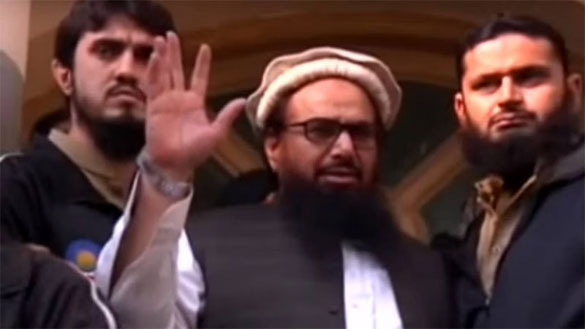
File photo of Lashkar-e-Taiba founder
Hafiz Muhammad Saeed | Youtube
-----
Christine
Fair and her colleague Karl Kaltenthaler conducted a survey on about seven
thousand Pakistanis and asked them why they support LeT. The survey conducted
among a few thousand Pakistanis reveals an important aspect of the terrorist
organization called LeT. It reveals perhaps for the first time that it draws
inspiration not only from Deobandi takfirism but from the more puritanical sect
called Ahl-e-Hadith. But one aspect that the researchers ignored that LeT is
not an organization working for establishing a government in Pakistan on the
basis of its ideological interpretation or a government based on Ahl-e-Hadith
ideology. It has not openly stated its ideological leanings.
Actually,
LeT and Jamat-ud-Dawah, its mother organization, is only a militant wing of the
government of Pakistan as the government of Pakistan would publish tenders for
construction and modification work in its headquarters in Muridke. It is also a
fact that LeT’s hand in the Mumbai terror attacks has been established.
Pakistan’s Urdu newspaper does not hide its affiliation with LeT. So in Pakistan the LeT is known as an
organization that serves the purpose of the Pakistani government and military
as and when required. That’s why it does not perpetrate any violence within
Pakistan on sectarian and ideological lines.
In fact, in
Pakistan, religion is the most powerful tool for acquiring political power.
Therefore, owning a religious and extremist organization does not pose any risk
to its owner unlike in any other country. Hafiz Sayeed’s occasional rants
against India wins him a general sympathy among the Pakistani people and the
government. Since the government of Pakistan does not want to antagonize China
by raking up Uighur issue, Sayeed also does
not say a word against China on the issue of persecution of Uighurs.
An
organization in Pakistan is affiliated to Deobandi ideology or ISIS ideology or
for that matter Ahl-e-Hadith or even Barelvi sect does not make much difference
because in the end all of them profess violence either within the country or
outside the country. Some may be less violent and some more violent but no
organization in Pakistan says that violence is not the solution of problems.
Minorities or sects within Islam are continually under the threat of oppression
and persecution by the majority community.
The survey
also reveals the Pakistani mentality that harbours ill will against the
minorities and members of other sects within Pakistan. It also reveals that
almost all the Pakistanis support LeT for one or the other reason. No Pakistani
said that it does not support the LeT or he denounces the terrorist ideology or
sectarian ideology of LeT. The situation has come to such a passé in Pakistan that
the media, the Islamic scholars and the common people in Pakistan do not have
the courage to speak up against terrorist and militant organizations of their
country.
-----
We
Asked Why Pakistanis Support Lashkar-E-Taiba, Results Will Surprise You

By
Christine Fair
24 January,
2022
Lashkar-e-Taiba
along with Jaish-e-Mohammed, remains Pakistan’s most virulent export. It
remains the most effective and brutal terrorist group operating in India,
Afghanistan, Bangladesh and possibly elsewhere. Understanding who supports this
nefarious organisation remains an important scholarly and policy analytic
question. To cast light on which Pakistanis support this group, my colleague,
Karl Kaltenthaler and I, fielded a novel, nationally-representative survey of
7,656 Pakistanis in the country’s four provinces of Punjab, Sindh, Balochistan,
and Khyber Pakhtunkhwa. Our results may surprise you.
Ideology
Matters
The
Lashkar-e-Taiba (and other various noms de guerre it has used and uses) differs
from many of the Islamist terrorist groups operating in the region that hail
from the Deobandi religious interpretive tradition, in that the LeT draws from
the Ahl-e-Hadees tradition. In fact, the organisation has considerable conflict
with these Deobandi groups in large measure because most of the Deobandis
engage in a practice of takfir, or declaring Pakistanis to be non-Muslim, which
then render them subject to lethal violence. Moreover, the Islamic State in
Pakistan draws from Deobandi militant organisations because the madrassas and
the terrorist organisations the Deobandis support are deeply sectarian with a
rich history of targeting non-Muslims, Shia, Ahmadi and increasingly Barelvis
over the last decade.
More than
anything, Pakistan’s deep state values the Lashkar-e-Taiba precisely because it
preaches non-violence within the country. As I discuss elsewhere, the
organisation does not even publicly advocate death for Ahmadis, which puts it
in stark contrast with Pakistan’s Deobandis and even Barelvis, who view Ahmadis
as the worst perpetrators of shirk(apostasy). Moreover, Lashkar believes that
it provides the only ideological competitor to the Islamic State in Pakistan.
Despite the
organisation’s claims to be Ahl-e-Hadees, most of Pakistan’s Ahl-e-Hadees ulema
and institutions reject Lashkar’s primary claims that waging military jihad is
an inescapable obligation of all Muslims and that it can be waged only by
non-state actors. Instead, most Ahl-e-Hadees ulema believe that only an Islami
Riyasit (Islamic State) can wage jihad. While the LeT preaches nonviolence
towards anyone who recognises the supremacy of Allah, it has real ideological
differences with virtually all other Muslim sects in Pakistan. It accuses
Barelvis (likely the largest market share in Pakistan) of committing idolatry
for their cult-like adoration for the Prophet, who in Islam is merely a human
being. Barelvis not only ascribe attributes to the Prophet that are reserved
for Allah alone, but they also engage in practices – wearing amulets, worship
of pirs, erection of elaborate graves, etc. – that the Lashkar believes to be
apostasy.
Lashkar,
like Deobandi militant groups, also take issue with Shias because they reject
the succession of the Prophet. Unlike Deobandis, who believe that Shia are
wajib-ul-qatil, worthy of being killed, Lashkar believes that they should be
educated and converted.
Despite
significant ideological differences with mainstream Ahl-e-Hadees institutions
in Pakistan, according to our study, Lashkar-e-Taiba still draws support from
Ahle-e-Hadees adherents. Notably, we find that Barelvi, Shia, and Deobandi
oppose the organisation, which is consistent with the LeT’s proselytisation
efforts (dawa and tabligh) to convert such persons to the Lashkar’s
understanding of the Ahl-e-Hadees interpretative tradition.
But Ethnicity
Matters More
Lashkar has
long claimed to be a Kashmiri Tanzeem, comprising Kashmiris fighting for
Kashmiris and dying in Kashmir. But it has long been suspected and recent data
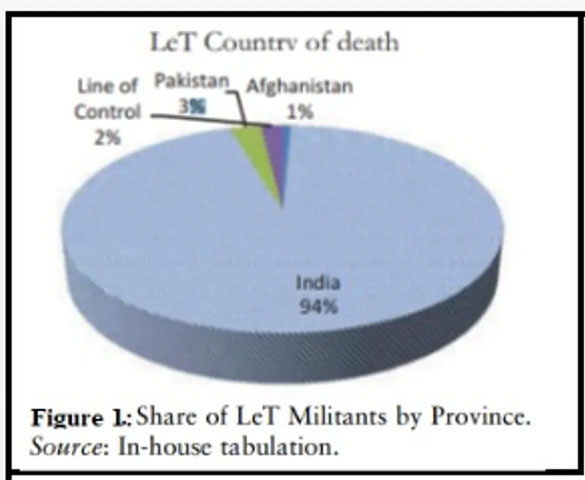
somewhat demonstrates that only the latter claim is true (See Figure 1).
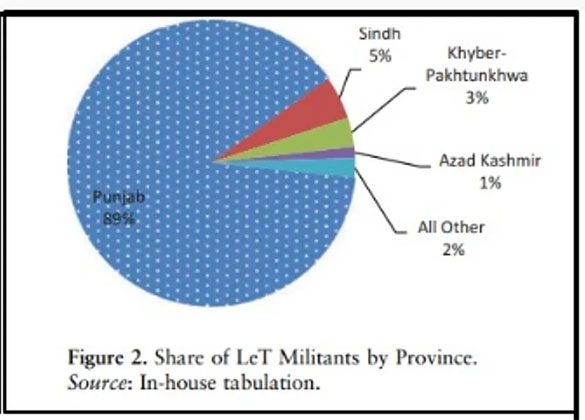
Whereas some 90 per cent die in India, and over 90 per cent of its cadres come
from a mere ten districts in Pakistan’s Punjab. A meagre 1 per cent come from
Pakistan-occupied Kashmir. Irrespective of the LeT’s claim to be a “Kashmiri”
organisation, it is by all measure a Punjabi organisation.
This raises
an interesting question: Do Pakistanis support the organisation because of its
religious or ethnic bona fides? It turns out that while ideology matters,
ethnicity is the strongest predictor of support. It is far more important than
ideology. At the same time, the Baloch are significantly more likely than
others to oppose the Lashkar-e-Taiba whereas Sindhis are weak in their
response. This also tracks with reality: Pakistan’s deep state has used the
Lashkar in Balochistan for various reasons.
First, it
is expected that Lashkar can persuade Baloch to abandon their ethnonationalist
aspirations and embrace the State-sponsored notions of Islam propounded by
Lashkar. To advance this agenda, when natural disasters hit Balochistan, as
they often do, Pakistan only lets “humanitarian” organisations in to do relief,
which are tied to Lashkar. Equally important, the Lashkar is explicitly
pro-China and endorses the China-Pakistan Economic Corridor (CPEC). Given that
Pakistan will fight to the last Baloch to make the resource-rich province safe
for Chinese exploitation, the Baloch rightly view the Lashkar to be another
guise of Punjabi domination working in concert with the Punjabi-dominated army,
which many Baloch believe has immiserated Baloch in their own province.
Support Of
The Army-Led Status Quo In Pakistan
While the
Lashkar is an important and violent disruptor abroad, at home in Pakistan, it
is an explicitly status quo power. While LeT advocates killing kuffars
(nonbelievers) in India, within Pakistan, it insists upon converting them
through social services, humanitarian relief, and lived examples of pious
Muslims. LeT’s staunch opposition to sectarian violence pits it against the
Islamic State and many of the Deobandi militant groups, such as the anti‐Shia
Lashkar‐e‐Jhangvi (LeJ, which also operates under the names
Sipah‐e‐Sahaba‐e‐Pakistan and Ahle Sunnat Wal Jamaat) or the Tehreek‐e‐Taliban
(TTP or the Pakistani Taliban), which draws many of its commanders and cadres
from the LeJ.
Moreover,
the Lashkar argues against any kind of protest of the State—irrespective of its
leadership—and is a staunch supporter of the current domestic, political and
economic system in Pakistan, including Pakistan’s unaffordable friendship with
China. Perhaps unsurprisingly, the third-strongest predictor of support for the
Lashkar was satisfaction with the status quo. Our results should put to rest
any thinking that Lashkar is a revolutionary organisation.
Mothers Of
Brutes
While very
little work has been done to explicate whether and why women support Islamist
terrorism, women in Pakistan are much more likely to support the Lashkar than
are men. As I describe elsewhere, the organisation dedicates significant
resources to recruit women to the organisation’s goals to ensure that they
support the LeT by encouraging their sons and other male family members to join
it either as militants or in supporting roles.
The LeT
empower women to promote the organisation’s creed, which empowers them and
frees them to move about without hindrance. To ensure that mothers are not
disenchanted with the organisation, the Lashkar-e-Taiba requires the mother’s
explicit blessings for every mission in which her son may meet so-called
martyrdom. The organisation dispatches senior personnel to notify the parents
of their sons’ death and it oversees the important Ghaib-E-Janaza, or
funerary prayers in absence of a body.
None Of
This Is Good News
So, what
does one do with this information? These results continue to show that it is
very likely that there is a viable non-kinetic strategy to deal with the
Lashkar-e-Taiba. Given the extensive State support for the organisation and the
stronghold that Pakistan’s military and intelligence agencies have in the
country, there is little scope to conduct information offensives that would
undermine any of the sources of support we find.
The only
options to deter the LeT—absent capabilities to impose India’s will over
Pakistan decisively through overt military operations—are covert and kinetic.
As I have shown elsewhere, the pyramidal and open leadership structure in
Pakistan make it vulnerable to leadership decapitation. While this option is
challenging and difficult to execute, other options seem elusive.
-----
C. Christine Fair is a professor within
Georgetown University’s Security Studies Program within the Edmund A. Walsh
school of foreign service. She is the author of In their own Words:
Understanding the Lashkar-e-Tayyaba and Fighting to the End: The Pakistan
Army’s Way of War. She tweets at @cchristinefair. Views are personal.
Source: We
Asked Why Pakistanis Support Lashkar-E-Taiba, Results Will Surprise You
URL: https://www.newageislam.com/radical-islamism-jihad/lashkar-e-taiba-militant-wing-pakistan/d/126236
New Age Islam, Islam Online, Islamic Website, African Muslim News, Arab World News, South Asia News, Indian Muslim News, World Muslim News, Women in Islam, Islamic Feminism, Arab Women, Women In Arab, Islamophobia in America, Muslim Women in West, Islam Women and Feminism