
Imran Khan Government’s Agreement with the Tehreek-e-Labbaik Pakistan Will Usher Pakistan into Another Era of Religious Extremism
Tehreek-e-Labbaik
Pakistan Demands That They Be Allowed To Function As a Political Party
Main
Points:
1. They demand the ouster of
French ambassador to Pakistan.
2. They demand the closure of
French embassy in Pakistan.
3. Barelvi group TLP is
inspired by the success of Deobandi groups in Pakistan.
4. By compromising with
Deobandi groups, Pakistani governments showed the Barelvi groups the way to
capture power.
----
New Age Islam Staff Writer
5 November 2021
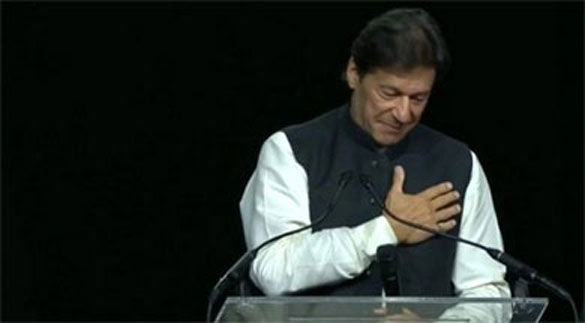
Imran
Khan, Prime Minister of Pakistan (File Photo)
------
Imran Khan’s surrender to the Barelvi
radical group Tehreek-e-Labbaik Pakistan’s diktat is a new chapter in the
politicization of religion in the country that has long seen the emergence of
Deobandi and Wahhabi extremist groups and their growing power. Till now, it was
the Deobandi and Wahhabi religious groups that wielded social and political
power. Groups like TTP, Sipah-e-Sahaba, and LeT had the support of the
government and the army. They made inroads into the Pak Army and the
bureaucracy and on many occasions made the government kowtow their demands.
The TTP even helped Nawaz Sharif win the
elections and so enjoyed the support of his brother Shahbaz Sharif when he was
the chief minister of Punjab. The clerics associated with the madrasas run by
the Deobandi group’s wielded enormous support in Pakistan.
The Barelvi groups, though not supportive
of violence and terrorism, had their own extremist beliefs on Khatm-e-Nabbuwat
(Finality of the Prophet) and Blasphemy and pressurized the government to go
back on minor changes in the law to accommodate the Ahmadiyyas. They also opposed
any changes in the Blasphemy Law demanded by the former Punjab governor Salman
Taseer. The groups violent extremism was demonstrated first when a Barelvi
fanatic Mumtaz Qadri gunned down Salman Taseer for his demand to repeal the
Blasphemy Laws.
Since then, The Barelvi extremism has been
on the rise and Bareilwi clerics have been flexing their sectarian muscle to
make their presence felt in the political arena of the country. They staged
violent protests in the country last year when the French President Macron said
that Islam was in crisis and launched a series of steps to curb Wahhabi
extremism in France. The Bareilwi group TLP also demanded the closure of French
Embassy in Pakistan.
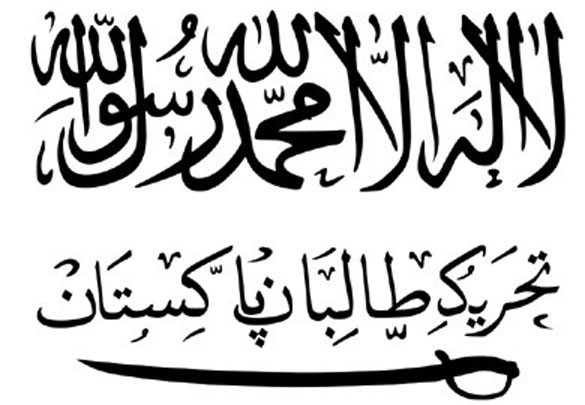
(File
Photo)
-----
The Tehreek-e-Labbaik Pakistan again staged
a violent protest for two weeks now during which violent clashes with the
police witnessed the destruction of public property and the death of a number
of policemen. They have been demanding the closure of French Embassy and the
recall of the French Ambassador. They have also been demanding that they should
be allowed to function as a political party. This means that they want to
capture power and establish a Barelvi government at the Centre. This may be
fallout of the government of the Wahhabi group Taliban in Afghanistan. The Barelvis might have realized that despite
being in the majority in Pakistan, they did not have powerful political
presence like the TTP or other Wahhabi groups active in the country. Therefore.
The Barelvi group Tehreek-e-Labbaik Pakistan has decided to claim their
political pound of flesh. Hence the violent protests.
Imran Khan had to surrender to the group
because of the intensity and enormity of the protests. This also holds a lesson
for the Imran Khan government that by surrendering to the Wahhabi groups in the
country it has showed the way to the Barelvi groups to assert power. Until now
the Barelvi groups only confined their movements to Blasphemy and Finality of
the Prophethood. But now they seem to have made the decision to capture power
to establish a Barelvi government in Pakistan. If it becomes a possibility,
then Pakistan will see a greater demonstration of extremism violence and
victimization of minorities. Ayesha Siddiqua’s article, therefore, sees in the
agreement between the Imran Khan government and the TLP a grim and bleak future
of secularism and religious harmony in Pakistan.
-----
Imran
Khan’s Secret Agreement with TLP Has Brought the Barelvi Jinni out Of the
Bottle

By
Ayesha Siddiqa
3 November, 2021
Imran Khan govt had said it won't tolerate
TLP goons breaking the law. Then Army Chief Bajwa got top businessmen and
religious leaders to help draw an agreement with the group.
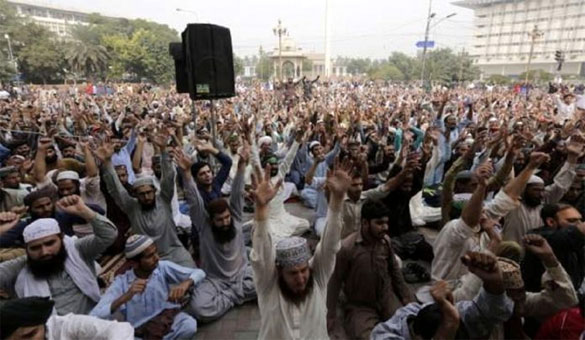
Representation image | A demonstration of protest by
Tehreek-e-Labbaik (TLP) supporters against the top court's verdict on Asia Bibi
| @nailainayat/Twitter
-----
The Imran Khan government, like its
predecessors, has arrived at an agreement with the Barelvi religious-political
group, Tehreek-e-Labbaik Pakistan, which was marching towards
Islamabad for release of their leader and ouster of France’s ambassador from
Pakistan. Besides talks with the government, it was the timely intervention
by Army Chief Qamar Javed Bajwa that saved the day.
Proving the members of Imran Khan Cabinet
including National Security Advisor Moeed Yusuf wrong, who had claimed
that the government would not tolerate breaking of law by the TLP miscreants,
the general got top businessmen and religious leaders to help draw yet another
secret agreement. The government has refused to disclose the details of the
arrangement, but it is clear that a politically expensive agreement has been
inked as a result of which the TLP will get more than a pound of flesh for
calling off its march.
The first agreement that the TLP signed
with the previous government of Nawaz Sharif in late 2017 was to call off a
protect against minor changes in electoral laws that would have accommodated
the Ahmadiyya community, which majority Muslims in Pakistan and around the
world do not consider as Muslims. Pakistan even passed a constitutional
amendment in 1974 declaring them as non-Muslims.
Since then, individuals from Ahmadiyya community
are systematically victimised. The 2017 agreement was reportedly facilitated by the
outgoing Inter-Services Intelligence (ISI) chief Lt. General Faiz Hameed in
which another general, head of Rangers Punjab, was caught on camera
distributing money to TLP protesters. After that arrangement, there was no
looking back for the Barelvi group, which also became popular because of its
leader Khadim Hussain Rizvi who is known for letting out invectives.
Who
is TLP?
On the surface, the TLP is like any other
religious group in Pakistan, which was either made or assisted by the Army. One
is reminded of other groups like the Deobandi Jaish-e-Mohammed (JeM),
Sipah-e-Sahaba Pakistan (SSP), Harkat-ul-Mujahideen (HuM) or the Ahl-e-Hadith
Lashkar-e-Taiba (LeT) – all had support of the military in surviving in return
for furthering their ideological support base in the society.
But the TLP is different from these groups
as it was never engaged in violence outside Pakistan. Barring a small unit from
South Punjab, Barelvi religious groups have largely stayed away from the
State’s wars abroad.
The TLP’s agenda is very political and
reactive and its creation very much a result of the politics within Pakistan.
The TLP formally became a party in 2016 consolidating around the
death-by-hanging in the same year of Mumtaz Qadri, the security guard who shot
dead Punjab governor Salman Taseer in 2011 for supporting a Christian woman,
Asiya bibi, who was accused of blasphemy.
The TLP began to find its feet after the
2017 sit-in and run-in with the police in which the ISI not just helped, but
also assisted TLP goons in beating up police officers in Islamabad. I
personally met officers from the Bara Kahu (suburban Islamabad) police station
who spoke of being attacked with wooden sticks laden with nails. The police
officers knew their attackers. It was a sad case of State institutions harming
other State institutions to maximise power. Since the first sit-in and
encounter, the TLP has threatened mass protest at least thrice and each time
around the two issues of the finality of Prophet (khatme Nabuwat) and blasphemy
that are also the party’s main selling points.
A Dangerous
Agreement
The establishment has brought the dangerous
jinni out of the bottle. The agreement will have an impact at four levels.
First, ideologically, the agenda laid out
by the TLP is what will guide all other stakeholders. No other party is likely
to cross the threshold on blasphemy or Khatm e Nabbuwat. Since the party
entered the socio-political arena, even its ideological rivals like Deobandi
and Ahl-e-Hadith had to support the rhetoric on these issues wholeheartedly. In
this respect, it will now paint the colour of Pakistan’s religious-nationalism
deeper than before.
Second, the Barelvi party has overtaken
powers of pirs to set the ideological and political agenda. The politics of
Punjab and Sindh is dominated by pirs or a combination of interests between
agriculturists or landowning pirs. The shrines dominated politics for a long
time, which also means control of the social discourse that created some space
for minority groups. Though this began to change much earlier, the entry of the
TLP in politics has raised the bar for the pirs. The rising number of small
towns throughout these two provinces, the growing urbanisation combined with
the advent of technology, social media, and some literacy (not to be confused
with education) has changed the political taste of the constituent. The pirs
contesting elections or having some role in politics will now be judged much
more on the position they take on blasphemy and Khatme Nabuwat. The pirs have a
challenge but the TLP brings them power as well. The State’s support to
Deobandi and Ahl-e-Hadith militancy had muddied the waters for even the pirs.
The Barelvi political-militancy put them back in center stage not just
religiously but also more central to politics of the state. It were more than a
dozen pirs of important shrines around the country that met the prime minister
to help avoid a conflict between the TLP and the government.
Third, the TLP’s relevance for the
establishment is adjusting the domestic political balance, especially in
pushing back the conservative Pakistan Muslim League – Nawaz (PMLN).
Notwithstanding Imran Khan’s growing unpopularity, the generals remain
sceptical of allowing Nawaz Sharif back into corridors of power or entry of his
daughter Maryam. While there are many theories floating around regarding the
real reason for the latest TLP protest and it certainly denotes tension within
the establishment, one cannot ignore that the prime reason for the march to
Islamabad was to erode Sharif’s support base or divert the neutral voter.
Though the TLP did not manage a single seat from Punjab in the 2018 elections,
the fact that it now has a solid ideological vote bank in every constituency,
which like the Deobandi vote bank will be used to negotiate at the local and
national level with major parties, cannot be ignored.
Finally, the Barelvi jinni is far more
dangerous than its Deobandi or Ahl-e-Hadith counterparts because of the
ideological following across the spectrum, which includes the armed forces.
Even though the military remains professionally controlled and strictly
hierarchical, the Jawan’s ideological sensibility is equally affected by the
TLP rhetoric. An Army chief can continue to function but will feel seriously
restrained in case of a battle within the institution in which ideology is used
against him. General Bajwa had to reach out to Barelvi ulema, which, besides
being a signal to his own men of his ability to solve political problems, was
also a proclamation that religious nationalism of the State won’t be abandoned.
Bajwa, in any case, has organised more private religious gatherings throughout
his career as the service chief to command support of his men. Although the TLP
didn’t win a seat in Punjab during the last elections, it is also a battle for
controlling Punjab where the bulk of the military comes from. One is reminded
of the early 2000s when the then army chief General Ashfaq Kiyani would not
dare conduct a military operation against militants in tyhe tribal areas due to
its impact on peace and stability in Punjab.
There is no doubt that the TLP will
ultimately be managed. It will get challenged from within the religious
opposition. The unhappiness
of Maulana Tahir Ashrafi, the Deobandi head of the Ulema Council, with the
agreement indicates an ideological competition and discomfort. In case of a
major threat, the establishment could use the divide-and-rule formula. Also,
once the Army and ISI reach their tolerance threshold or the party runs out of
efficacy for the establishment the latter will use the method it uses typically
to bring down power of a group: create and insert a rival group and encourage
internal conflict to bring down overall power. it will be pushed through
possible insertion of some rival group. But strategically, this means that the
new TLP rival will be even more vicious and drastic in their agenda. In today’s
Pakistan, the mullah is a serious stakeholder ready to cut a deal with the
establishment for short-term gains but long-term socio-political impact.
-----
Ayesha
Siddiqa is Senior Fellow at the Department of War Studies at King’s College,
London. She is the author of Military Inc. Views are personal.
(Edited by Prashant)
Source: The
Print