
Film Called ‘Inside Out’ Reveals Muslim Women's Experiences In Prison
New Age Islam News Bureau
30 May 2024
·
Film Called ‘Inside Out’ Reveals Muslim Women's
Experiences In Prison
·
Sarah Nava Rani Appointed As Malaysia’s
Permanent Representative To ASEAN
·
Hattan Alsaif, Saudi Arabia’s Mixed Martial
Arts Star: ‘When I Fight, I Can Feel My Soul Alive’
·
Don’t Compromise Islamic Value While Seeking To
Become Professionals – Muslim Women Urged
·
Menstrual Hygiene Day: Tackling Period Poverty
Among Nigerian Girls, Women
Compiled by
New Age Islam News Bureau
URL:
-------
Film
Called ‘Inside Out’ Reveals Muslim Women's Experiences In Prison
30 May
2024
A new
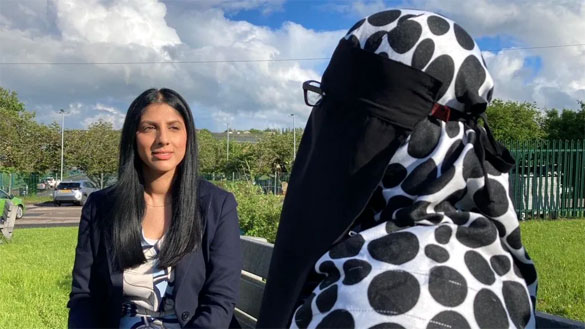
film aims to give an insight into the experiences of Muslim women behind bars.
The
documentary, called Inside Out, has been made by a team including Dr Sofia
Buncy, founder of the Bradford-based Muslim Women In Prison project (MWIP).
It is
hoped the 20-minute feature will be used to assist workers across the criminal
justice system (CJS), including those responsible for rehabilitating offenders.
"We
hope providers will listen and be proactive in developing more culturally
appropriate and equitable models of support," Dr Buncy said.
The
film, made in collaboration with researchers Dr Alexandria Bradley of Leeds
Beckett University and Dr Sarah Goodwin of Sheffield Hallam University, was
created alongside a research project on the topic.
Dr
Buncy, who founded MWIP in 2013 as part of Bradford's Khidmat Centres, said:
“It was important for us to encourage women with lived experiences of the CJS
to speak directly about their journeys.
"For
many it took a tremendous amount of courage to face a camera."
She
added: "They spoke about their experiences with passion, delving into
their emotions and frustration with unreserved candidness."
Neena,
not her real name, from West Yorkshire, spent more than two years in jail and
is featured in the film.
"I
learnt a lot quicker through inmates than I did through staff," she said.
The
mother, who now has a part-time job after serving her sentence, said she
struggled to adapt and felt some staff avoided her due to her religious
beliefs.
"I
think that's why it's important to educate the staff about our background, our
race, culture, my religion," she said.
"It's
very important to make them understand and educate them rather than hearing it
from your cellmate or the girl in the next room."
Dania,
also not her real name, said: “There is no real culture of understanding Muslim
women’s background and needs when they enter the CJS.
"Part
of the problem is not knowing how the system works and then nobody telling you
how it works either - it's a very lonely journey.”
'Prevent
future reoffending'
Statistics
from the Prison Reform Trust for 2019 showed there were 226 Muslim women in UK
prisons, representing 6% of the overall female prison population.
Dr
Goodwin, a senior lecturer in law and criminology, said: “It’s really rare to
hear from Muslim women in the CJS about their experiences.
"Conducting
this research has allowed us to understand more of their stories and see how
they are different from, and similar to, others on that journey."
She
added: "The more we understand, the better we can support their
reintegration into the community and prevent future offending.”
Inside
Out is set to be premiered on Thursday at a private screening in Leeds.
Source: bbc.com
https://www.bbc.com/news/articles/cq550j2z14zo
--------
Sarah Nava Rani Appointed As Malaysia’s Permanent Representative To ASEAN
Datin Sarah Nava Rani Al Bakri Devadason
------
30-05-
2024
KUALA
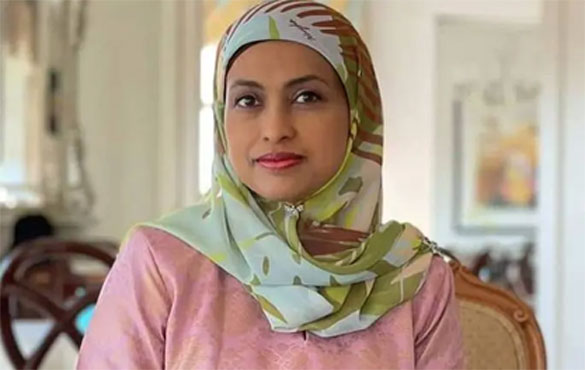
LUMPUR: Datin Sarah Nava Rani Al Bakri Devadason has been appointed as
Permanent Representative of Malaysia to the Association of Southeast Asian
Nations (ASEAN) in Jakarta, Indonesia, effective Thursday (May 30), the Foreign
Ministry announced.
Sarah
hails from Negri Sembilan and holds a Bachelor of Laws from Universiti Malaya.
She was
appointed as an Administrative and Diplomatic Officer in 1994 and was initially
assigned to the Defence Ministry before joining the Foreign Ministry in 1996.
Sarah
served as the ambassador of Malaysia to Germany from 2017 to 2020. Her other
diplomatic assignments include roles at the Permanent Mission of Malaysia to
the United Nations in New York, United States of America, and at the Permanent
Mission of Malaysia to ASEAN in Jakarta, Indonesia, as Minister Counsellor.
At the
Foreign Ministry, she served as the undersecretary of the Human Rights and
Humanities Division and as the deputy director-general at the Department of
Policy Planning and Strategy.
She also
served as principal assistant secretary at the Territorial Affairs and Maritime
Division.
Source: thesun.my
https://thesun.my/home-news/sarah-nava-rani-appointed-as-malaysia-s-permanent-representative-to-asean-DH12511992
-----
Hattan
Alsaif, Saudi Arabia’s Mixed Martial ArtsStar: ‘When I Fight, I Can Feel My
Soul Alive’
Hattan Alsaif is about to make her MMA debut. Courtesy Professional
Fighters League
------
MAY 29,
2024 PFL
Hattan Alsaif
has grown accustomed to sparring with men. Rarely shy about confronting
heavier, stronger opponents, she knows what it’s like to absorb blow after blow
until tears begin to shine in her eyes, her face red and hot from crying.
As one
of the few women at her gym in Riyadh, Saudi Arabia – and the only woman
hopeful of fighting at an elite level – Alsaif had little choice but to train
with and against her male counterparts when she first took up martial arts. She
credits her sometimes brutal introduction to the sport as one of the reasons
for her success.
“I was
the only girl doing it day and night, day and night, day and night,” Alsaif told
CNN Sport. “I always spar with guys, I train with guys, I’m always with the
guys in the gym.
“It’s
not an easy thing, so when it comes to the cage, when I get a hit from a girl,
I feel like, ‘Whoa, is this all you’ve got?’”
The
22-year-old had already made history in MMA, even before her atom weight bout
against Egypt’s Nada Faheem on Friday, which she won by knock out in the second
round.
In
January, Alsaif signed a contract with the Professional Fighters League (PFL),
making her the first woman from Saudi Arabia to join a global MMA promotion.
It was a
notable moment in a country known for its socially conservative attitudes,
where sporting opportunities have historically been limited for women. The
Saudi women’s soccer team only played its first match two years ago, while a
domestic soccer league wasn’t established until 2020.
Alsaif
is acutely aware of her status as a trailblazer for female MMA fighters in
Saudi Arabia and takes such a responsibility seriously.
“It’s
big, to be honest, because I’m going to be carrying this thing my entire life,”
she said, speaking to CNN before her MMA debut fight on Friday. “It’s a bit
heavy to carry it, but I’m excited and proud to be the person to do it.”
Alsaif
endured a difficult upbringing, orphaned at the age of 10 after both of her
parents died in a short space of time. She says she battled depression during
her teenage years before finding solace in martial arts, helping her to
discover a sense of purpose and peace.
“I
didn’t have a normal childhood or an easy childhood because of the loss of my
parents,” said Alsaif. “But after God, martial arts helped me a lot – so, so,
so much. It changed my life 100% for the better.
“That’s
why I’m so addicted to martial arts. I don’t want to stop doing [it] because
it’s just the thing that makes me feel alive. I feel I’m alive when I train,
when I fight, in the gym – I can feel my soul alive.
Source: pflmma.com
https://pflmma.com/news/when-i-fight-i-can-feel-my-soul-alive-says-hattan-alsaif-saudi-arabias-groundbreaking-mma-star
--------
Don’t
compromise Islamic value while seeking to become professionals – Muslim women
urged
Accra,
May 29, GNA – The Ghana Academy of Muslim Professional (GAMP) has held its 13th
annual sister’s forum with the call on Muslim women not to compromise their
Islamic values in the quest to becoming professionals.
Hajia
Samira Seidu Esq, Legal Practitioner, said, “in striving to attain personal
career objectives we must be mindful of the principles of Islam, the values
that we Muslims hold very important to us which identifies us as Muslims.”
She said
Islam is a way of life and culture, and so there were rules and regulations
that governed the way a Muslim must conduct him or herself.
“Even
though sometimes these values may conflict with that of society, because Islam
does not give you the right to do certain things if it is not defined in Islam,
Islam does not disrespect the laws of any country, it rather teaches us to
respect our leaders, laws and regulation.”
Madam
Seidu said in most cases Islamic laws would align with the laws of the state.
“Where you have a thin line, you have to obey the laws of the state, but as a
Muslim you are a Muslim first so that should take a better part of you, while
respecting the laws of your state, because not doing so may have implications.”
“The
fact that some Muslims engage in bad behaviour, does not mean Islam encourages
them to do that. “Islam teaches us to respect authority. Most Muslims find
themselves
at the wrong side of the law because of the moral decadence in society.”
Her
ladyship Justice Mariam Sammo, a High Court Judge, said the moral decadence in
society today started from the home, and it was important for Muslim parents to
discipline their children when they go wrong.
“If you
are discipline at the end of the day you will have economic independence,
strategies for self-wealth, and Islamic values. But when you are not disciplined
you lose everything at the end of the day.”
She
urged Muslim women to manage their time properly, follow instructions, and
preach discipline wherever they find themselves.
HajiaHamdiyaIsmaila,
Chief Executive Officer, Savannah Impacts, speaking on promoting economic
independence among Muslim women, said there were various ways to become
economically independent, include savings and investment.
She
said, “to be economically independent you must build wealth, be independent,
make your own decisions about your expenditure, savings, and your own selfcare.
And this means that it is either you earn income or make income.”
“Decide
how much you want to save at the end of the month before you spend it. And when
you save, invest the money into something that would earn you extra income to
supplement your monthly income.”
She
noted that financial literacy was important, and parents must train their
children at a very young age, to be disciplined about their spendings.
HajiaIsmaila
noted that Islam was not against a woman working, saying Muslim men must not
see economic empowerment of their wives as a threat, and women should not think
that being economically independent meant they did not need men in their lives
“You
should realize that the way the world is going you need to have some kind of
support, so it is to support each other for a common good
Mr
MuniruShaibuAlidu, President, GAMP, said the Forum was organised in
collaboration with CISA-Ghana, on the theme: “Empowering Muslim Women by
Identifying Cultural and Religious Values, self-worth, educational
opportunities and fostering financial independence”
GAMP is
a Non-Profit and faith-based organisation aimed at mobilizing and bringing
together Muslim intellectuals and professionals to harness their energies and
capabilities to effectively champion the course of Islam in Ghana.
GAMP
also aims to promote education in all its forms in the Ghanaian society
especially in deprived communities. It also seeks to foster and promote unity
among Muslims and other religious groups in Ghana and the world at large by
organizing programmes aimed at empowering the youth intellectually, socially
and morally.
Source: gna.org.gh
https://gna.org.gh/2024/05/dont-compromise-islamic-value-while-seeking-to-become-professionals-muslim-women-urged/
--------
Menstrual
Hygiene Day: Tackling Period Poverty Among Nigerian Girls, Women
30 May
2024
As the
world marks Menstrual Hygiene Day, many girls and women in Nigeria still cannot
afford menstrual hygiene products.
Some
female residents of Rivers State like 27-year-old single mother, Ann, who lives
in the Rumuosi area of the State, say they resort to alternatives like fabric
pieces whenever they can’t afford a pack of sanitary pads. "I can use a
wrapper. I can use a pad. If you use a wrapper if you do not keep it and the
thing stays long, it will not do you anything, it's better than tissue sef,
because people that use tissue, the tissue used to enter inside their private
parts. If I see the thing is soaked, I will just remove it and change,” Ann
said. Another resident of Port Harcourt, 29-year-old Blessing, who says she's
currently unemployed, also uses pieces of wrapped cloth during her period.
"As I no get money to buy pad, I use wrapper take do pad, when I use am
finish, I wash am, when e dry I put am back," she said in Pidgin.
On their
part, some secondary school girls in Port Harcourt say they have now become
used to pieces of fabric because their parents cannot afford to buy them sanitary
pads. “As there's no money, my mummy usually gives me materials, like fabrics,
I am not used to the pads,” said 16-year-old Favour, an SS3 student. She also
described the discomfort they face in school due to the lack of good and
adequate toilets. "I don’t use the toilet, I am not comfortable with it, I
cannot use it. It's not clean." Thirteen-year-old Boma says a junior
Secondary School student also does not use the toilet in her school. “I don’t
use the toilet o, I just go to one side outside. There was a particular time
when my seatmate was stained, I took her outside and used my water to wash her
off. She uses a pad but doesn't change it while in school because there’s no
place to stay and change it,” she said. “The toilet in our school is clean, but
they (school authority) do not normally allow us to enter because there’s no
water to use," Boma added.
The
school girls also say their little knowledge of the menstrual cycle was taught
to them in their first year of secondary school, adding that they only get
sanitary pads at the school principal's office on emergency requests.
"Our
Home Economics teacher taught us in JSS1 but some people normally come and care
for girls, I don’t know who they are but they come to share pads for
girls," Boma said.
"Our
Home Economics teacher taught us in JS1, but when I entered SS1, I did not hear
anything about it, until some people came during International Girl Child
Day," added Favour.
An
elderly woman known as Mummy K says the age-long practice of using pieces of
cloth in place of sanitary pads is unhygienic. She was lucky her parents were
enlightened and provided her with pads in the 70’s. “During my own time, my
parents were a little bit educated. I started seeing my period at the age of 13
years in the 70s. My mother bought me a sanitary pad which is not of the kind
nowadays. The name is Comfit, it was blue colored. My mother said she used
pieces of wrapper during her own time. Using that piece of cloth is not
hygienic. She now said she will not use it on her own children."
In 2023,
the then minister of women affairs Pauline Tallen said more than 37 million
girls and women in Nigeria could not afford menstrual hygiene products,
limiting their ability to study, work, and live their lives. A medical
practitioner, Ann Imoru of the Clinical Pharmacists Association of Nigeria,
agrees with her. Dr. Imoru, however, cautioned against using tissue paper as an
alternative due to its potential hygiene and health risks. “It’s never safe to
use other materials for menstruation, we have sanitary pads and tampons. It is
not very common to use a silicone cup but that is also available. Some people
use tissues which is not advisable at all. Don’t use it. Sanitary pad is mostly
used because it is convenient and safe.”
Dr.
Imoru is concerned about the poor hygiene habits of some females during their
periods, which she says exposes them to some health issues. “Some people keep
their pads for like eight hours, some even more. The blood is not something
that you just expose your skin to, because now you’re exposing the old blood
directly to your skin, to your vulva, that is the vagina opening at the same
time. You have situations where some women go and sit in the toilets for a long
time because they know that the flow is very heavy. They sit in the toilet to
get them out of their system. That's very unhealthy,” she said. Dr. Imoru
advised those who experience severe menstrual pain to seek proper medical care.
She also advocated for free pads for underprivileged girls and women.
A lawyer
and gender policy advocate, Debbie Effiong, wants the government, NGOs, and
well-meaning individuals to make sanitary pads freely available for school
girls. She says the lack of access to sanitary menstrual hygiene products
forces girls to miss school, creating an unfair disadvantage. “When you go to
the schools in the communities, you find the difficulty these girls face in
being able to manage during menstruation, and most times they will tell you
during menstruation they don’t go to school, not just because of the cramps,
but because they have nothing to manage with.” She wonders why sanitary pads
cannot be as free as condoms. “Sex is a choice, but menstruation is not a
choice. So why should the girls be off school because of menstruation?” Mrs.
Effiong is advocating investment in handmade reusable sanitary pads which
school girls can also learn to make by themselves, to reduce period poverty.
“It’s a simple sewing process with your needle and thread, there is a special
type of absorbent and then with very clean clothing, they are glued and sewn
together to form the shape of a pad. Now the beauty of these products is that
they can be used for two years before you start thinking of changing,” she
said.
Another
medical practitioner, EzinneOkpani, wants young girls to learn how to calculate
their menstrual cycle. “The menstrual cycle begins the first day the
menstruator sees her blood till the first day of the period the following
month. A normal cycle is between 21 to 35 days, but the average menstrual cycle
we have is 28 days. For some that have a 28-day cycle you are supposed to be
ovulating on the 14th of your menstrual cycle, and you should be very careful
at that time because ovulation means you are ready to get pregnant if you meet
a man.”
A
Nigeria Info survey shows that a pack of eight sanitary pads costs between N500
and N1,000, and a pack of 30 sells for N1,800 to N2,300. A reusable silicone
menstrual cup, which is not readily available in Port Harcourt, can be bought
online for N3,000 to N5,000, while, tampons cost between N5,000 and N8,000. A
pack of panty liners costs between N1,000 and N3,000, and a piece of simple
panties is sold for at least N400. Menstrual Hygiene Day is marked on 28 May
yearly in line with the normal female 28-day menstrual cycle. The theme for
this year is "Together for a Period-Friendly World."
Source: nigeriainfo.fm
https://www.nigeriainfo.fm/news/homepagelagos/menstrual-hygiene-day-tackling-period-poverty-among-nigerian-girls-women/
--------
URL: https://www.newageislam.com/islam-women-feminism/sarah-nava-rani-malaysia-asean/d/132416