
Friday Namaz in Gurgaon: Why Muslims Need to be Pragmatic
By
Arshad Alam, New Age Islam
25 October
2021
There Seems
To Be Political Interest In The Continuation Of Religious Tension
Main
Points:
1. Protests
against Friday Namaz is now regularly held in some sectors of Gurgaon.
2. Hindu groups
allege that Muslims are praying at illegal places; such claims that are not
backed up by the police version.
3. The CM sees
nothing wrong if prayers are being held at designated places but has so far
refused to act on vigilante groups.
4. Muslims need
to strategize and think if Friday congregation is necessary at all.
-------
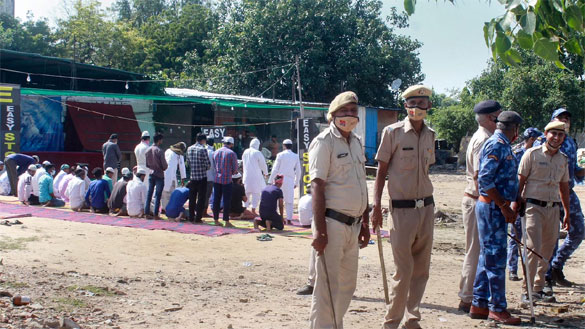
'Jai Shri Ram' Slogans Allegedly Raised (Photo: The Quint)
----
Gurgaon is
on the edge. Every Friday, when Muslims gather to pray at the congregation,
groups of right-wing Hindus assemble at the spot shouting objectionable slogans
with the express intention to stop Muslims from performing their ritual. These
Hindu groups claim that Muslims do not have the requisite permission to perform
their prayers at a public place which makes their ritual illegal. They further
claim that after the prayers, Muslims indulge in anti-social activities. They
accuse the police of being partisan because they do not stop these Muslims from
praying in public.
The police
have so far maintained that this is not a new issue. Similar strife was
reported during the year 2018, when the district administration and ‘both
parties’ (Hindus and Muslims) had come with a solution of designated spots
where Muslims could offer their Fridays prayers. The police claim that Muslims
were allotted 37 such places and that so far there have been no violation from
the Muslim side. Despite the weekly protest by some Hindu groups, the police
have been offering protection to Muslims and upholding the administrative
decision that was made three years ago. Most of the protests have happened in
sectors 47 and 12, but the police have consistently maintained that in both these
sectors, Muslims are praying at the designated spots and hence there is no
illegality involved.
Gurgaon was
built adjacent to Delhi as a posh metropolitan area where the expectation was
that glitzy markets would flatten differences of religion and caste. In the
arrogance of planning this new city, the developers not only saw no need to
build pedestrian paths (as everyone would have cars!) but they also failed to
plan for adequate religious spaces for their new residents. And residents are
not only those who live in the high rises oblivious to what is happening on the
ground below but also those who migrated to this new city in search of jobs and
ended up serving those living in the high rises. There are nearly 4 Lakh
Muslims living in Gurgaon, most eking out their living as service providers.
But there are only 22 mosques to serve a population this big and that’s the
reason why Muslims search for alternative spaces. And this becomes a crisis
because the noon payer on Friday is supposed to be held in congregation. There
are simply not enough big mosques to accommodate the numbers.
It is not
that all Hindus have a problem with the Muslim prayer. Indeed, only a handful
of Hindus gather at odd sites to protest against the Namaz. But like always,
the majority of Hindus have no problem that such disruption is taking place in
their name; they simply do not care. Otherwise, we would have seen a counter
mobilization of other Hindus who believe that all religions should have the
space to freely express their faith in the country. At any such protest, there
are no more than 300 odd Hindus, and most of them come from one of the many
right-wing organizations like the Bajrang Dal, etc.
The
argument that these Hindu groups are making do much have much basis. They have
argued that the area in which Muslims are praying have not been designated by
the administration which is not true because the police are corroborating the
Muslim version. They also wonder why Muslims cannot pray inside their mosques
and why they should do so in a public place? The simple answer is that there
are not enough big mosques to accommodate a congregation. But this is also
rather rich coming from a community where the distinction between public and
private in most festivals is nearly absent. In fact, most religious communities
in India, insist on public display of their religiosity and Muslims are no
exception to this rule. The claim that Muslims indulge in anti-social
activities after their prayers also does not have any empirical basis as there
is no such data which might prove it. This is like another patently false
allegation that Muslims raise the slogan of ‘Pakistan zindabad’ after their
prayers!
The issue
is patently political. Most of these Hindus are related to blatantly communal
organizations. Some are even members of the ruling party. But the chief
minister of Haryana, Manohar Lal Khattar, has said in no uncertain terms that
Muslims should not be disturbed in their prayers if they are praying at spaces
earmarked by the district administration. Why is it then that his ideological
brotherhood is not listening to him? And why is that the CM is not taking to
task those who are indulging in such activities? The only reason perhaps is
that the political class in interested in the perpetuation of this religious
tension. This tension has all the potential to give them some talking point in
the upcoming elections in the neighboring state of Uttar Pradesh.
Muslims
need to understand this political game. Their insistence that Friday Namaz must
be said collectively needs to be revised in the light of present-day realities.
There was a time when Friday prayers served political purposes. It was at times
an occasion to show collective strength. At times, it was utilized by Islamic
governments to gain legitimacy and authority. Even now, the Friday sermon in
Arab countries is tightly controlled by the state, with the speaker only
allowed to say what the ruler wants him to say. These conditions are absent in
India and hence insisting on congregation doesn’t make much sense. It is only
being continued as a relic of the past.
Moreover,
in earlier times the Friday congregation was also the space where, and through
which, important decisions were conveyed to the people. Today’s Friday’s
sermons are nothing like that: there is no political discussion that happens;
only tales of the Prophet and his companions are recounted. Today, if anything
important needs to be conveyed to Muslims, it can be done instantly through
modern media. In short, there is no need to insist on a collective prayer every
Friday. Such an insistence would only mean that Muslims are still wedded to the
political idea of demonstrating their faith in public.
For a long
time, Muslims have been blocking highways to offer their prayers without any
regard to the concerns of the larger public, Hindus or Muslims. It is good that
better sense has prevailed, and such scenes of public religiosity are not so
common anymore.
Better
sense should prevail, and Muslims should strategically withdraw from such
spaces and concentrate on those aspects that leads to the empowerment of the
community, like accessing modern education and getting into desired jobs.
-----
Arshad
Alam is a columnist with NewAgeIslam.com
URL: https://www.newageislam.com/islam-politics/friday-namaz-gurgaon-muslim/d/125640
New Age Islam, Islam
Online, Islamic
Website, African
Muslim News, Arab
World News, South
Asia News, Indian
Muslim News, World
Muslim News, Women
in Islam, Islamic
Feminism, Arab
Women, Women
In Arab, Islamophobia
in America, Muslim
Women in West, Islam
Women and Feminism