
Rumi’s Message Of Love And Pluralism Is Relevant Even Today
Rumi Was
Close To The Vedantists In His Belief In Wahdat Ul Wajood
Main
Points:
1. Rumi’s
Mathnavi is the greatest treatise on Sufism.
2. Rumi held
the view that all the beings have emerged from the same Divine Principle.
3. Love was
central to his poetic and philosophical message.
----
By
New Age Islam Staff Writer
16 October
2021
Rumi is one
of the greatest poet philosophers of all times. His thoughts and philosophy had
great impact on the poetic and political thinking of the modern times. He was a
great Sufi, an Islamic jurist and a great poet of Persian and had good command
over Turkish and Arabic. His masterpiece called Mathnavi is in six volumes and
is regarded as one of the greatest poetic masterpieces of Persian language.
Rumi is
better known as a Sufi and one of the great proponents of the philosophy of
Wahdat ul Wajood (Monism). He believed that man did not have an independent
existence but was the part of the existence of the Supreme Being. He sang about
the humanity and saw the presence of God in each human being and so he held the
view that every human being felt the urge to return to Him. In fact, like the
Vedantists, Rumi also believers that all the beings have emerged from the same
Divine Principle and so even the matter is divine to him. Rumi also believed in
the truth of all the religions and believed that all the religions lead man to
the same goal, the realization of God. All the religions were only the means to
reach Him. The essence of Rumi’s poetic and philosophical thinking is love.
Without love, man cannot achieve God’s realization. It is Love that drives the
universe and it is love that has been holding the universe together. Therefore,
Rumi’s ideas and philosophy is very much relevant in the present multicultural
society in which followers of different religions live and follow their own
religious beliefs.
--
Rumi: Universal Religion and
Composite Culture
By Dr. Sarim Abbas
15 October 2021
A
World-View That Brings Out A Spiritual Perspective On Universe
"It teaches that multiple spiritual paths lead to
the same purpose. Higher values depend on the growth of human personality and
the growth of human society. “Special
arrangement
------
“My
religion is, to live through Love.” Rumi
INTRODUCTION
The article
envisages carrying out a study of Rumi's views on Universal Religion and their
impact on the development of composite culture. The thirteenth century
poet-philosopher Maulana Jalal-ud-Din Rumi is one of the foremost spiritual
geniuses of human history. With the passage of time his perennial wisdom is
yielding profound spiritual insights. His exceptional creativity is globally
being acknowledged in our times and climes. Universal religion has emphasised
the basic unity of all the world's great religions. This teaches reverence for
all. It teaches that multiple spiritual paths lead to the same purpose. Higher
values depend on the growth of human personality and the growth of human
society. Universal religion claims that by virtue of the creative spark inside
him, every man will create direct contact with the eternal. After all, the
everlasting is the true ground of his life. The bottom line message is that
even while one finds his own path to be real and others to be false, he can
still have peaceful coexistence with the travellers of other routes.
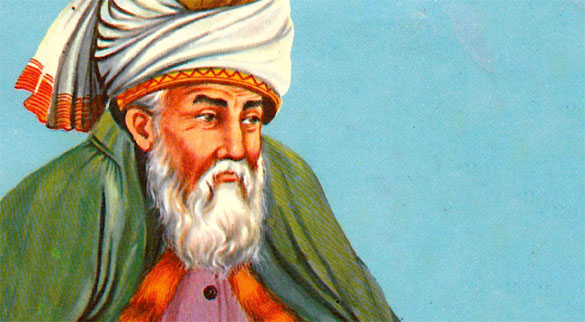
Jalaluddin
Rumi (1207-1273)
Rumi's
World-View brings out Rumi's spiritual perspective on universe. For Rumi, the
ground of Being is akin to what we feel in ourselves-a spirit or an ego. The
entire cosmic existence is comprised of an infinite number of egos emerging out
of the Cosmic Ego. The cosmological vision of Rumi is thoroughly teleological
like that of classical Aristotle. Like modem Bergson he is also a creative
evolutionist. He also seems to be subscribing to the emanationistic cosmology
of Plotinus. Metaphysically speaking, every being has emerged from a kind
overflow of ‘the Divine Spirit'. However, every being is impelled by an
irresistible urge to return to its origin. This urge is nothing but love,
according to Rumi. Love is the primal evolutionary principle of all existence.
Every ego or monad is essentially spiritual and each ego or monad has emerged
from the same Divine Principle. For Rumi, God is the origin and destiny for the
entire process of evolution. He is not only the ground but also the goal of all
existence. Rumi is in full agreement with mechanistic evolutionists that life
has evolved out of Matter. However, Matter itself is essentially spiritual for
Rumi.
In Rumi's
worldview there is an unqualified emphasis on uncreatedness of the
transcendental Self of man. The essence of Rumi's religious consciousness is
his advocacy of identity between Divine and human Orders of existence, although
man is painfully and wistfully conscious of by the pangs of separation. Human
soul is essentially or originally from God.
However,
the soul is painfully conscious of the fact of separation. Our entire moral and
spiritual struggle is aimed at self-realization- a realization of our essential
identity which God, signifying a return to car Origin. All of us are evolving
back to God. According to Rumi, in this evolutionary process, the minerals
develop into plants, plants develop into animals and animals develop into men.
The men are destined to develop into superhuman being. We are ultimately
reaching back to the starting point i.e. God who according to the Quran is the
beginning and the end and to whom everything has to return.
With
respect to Love Rumi says that it is a cosmic feeling, a spirit of oneness with
universe. Love, says Rumi, is the remedy of our pride and self-conceit. Any
form in which love expresses itself is good not because it is a particular
expression, but because it is an expression of love. Forms of love are
irrelevant to the nature of religious experience. Love is different from
feelings of pleasure and pain. It is not regulated by any consideration of
reward and punishment. Not only is faith generated by love, but, what is more,
faith generated by any other motive is worthless. Faith developed out of
imitation, custom or scholasticism is not acceptable to Rumi. Love is the
essence of all religion.
The
religion is not the creed of any one particular religious community but being
the religion of the universe is a universal religion. Rumi describes his search
for God after having realized the nature of his own ego. He moves from creed to
creed and dogma to dogma. Not finding Him in temples, institutions, and
symbols, he returns unto himself and discovers Him there in the sanctuary of
his own heart. He is not satisfied with any creed until God is directly
experienced by him. Here is one of the finest mystical lyrics of Rumi:
I existed at a time when there were neither the
names nor the
objects of which they were the names; the names
and the
objects named came into existence in relation
to us at a time
when egos were not yet individualized and there
was not yet
any question of `I' and `We.' I searched for
God among the
Christians and on the Cross but there in found
Him not. I went
into the ancient temples of idolatry; no trace
of Him was there.
I entered the mountain cave of Hira (where the
Archangel
Gabriel appeared to the Prophet) and then went
as far as
Qandhar but God found I, not neither in low nor
in high
places. With set purpose I fared to the summit
of Mount
Caucasus and found there only 'anga's
habitation. Then I
directed my search to the Ka'bah, the resort of
old and young;
God was not there even. Turning to philosophy I
inquired
about Him from ibn Sina but found Him not
within his range. I
fared then to the scene of the Prophet's
experience of a great
divine manifestation only a `two bow-lengths'
distance from
him' but God was not there even in that I
exalted court.
Finally, I looked into my own heart and there I
saw Him\He is
nowhere else. (Hakim.p.838)
This is the
experience and language of the great mystics of all spiritual religions who
were not satisfied with institutional religion, and who based their spiritual
life on personal experiences and convictions not derived from theologies and
philosophies. These experiences are the common heritage of all great souls and
the common ground on which great religions meet, disregarding intellectual
formulation of dogmas and diversities of modes of worship which have made
religion a dividing instead of a unitive and harmonizing force. Rumi is one of
those rare saints and mystics whose intellectual fibre and creative moral and
social effort is not weakened by subjective emotional experiences unrelated to
the realities of everyday life. In him spirituality, rationality, and universal
morality have found a healthy synthesis. God, universe, and humanity are
embraced in a single all-encompassing vision, the vision of creative love.
(Sharif, p. 838).
The
religion of a mystic philosopher like Rumi is Universal Religion, which could
not be enclosed within any orthodox or dogmatic boundaries. In one of his
lyrical compositions Rumi claims' that he is not a Muslim, a Jew or a
Christian. He is neither from East nor from West; neither from Land nor from
Sea; neither from Iraq nor from Khurasan. He is neither of India nor of China
nor of Bulgaria. He is placeless and traceless. He is neither body nor soul,
for be belongs to the Beloved. He has put duality away and has seen two worlds
as one. One he sees and one he knows, One he sees and One he calls. Rumi's
ethical philosophy is a culmination of Sufi beliefs and values. As an
anti-establishmentarian, he has advanced liberal, horizontal and pluralistic
values. He is sincere enough to stipulate that one moment of companionship with
men of God is superior to hundred years of prayers offered to God. He is
iconoclastic enough to suggest that being considerate to a fellow human being
is better than going on pilgrimage to Kabah, for one human heart is superior to
thousands of houses of God. He belongs to the religion of lovers is nothing but
God. He is neither formalistic nor sanctimonious for religious symbols do not
necessarily signify spiritual authenticity. Ethical values stem from self-
realization leading to God-realisation. It is realization of God by recourse to
love of God that can inculcate in us love and compassion for fellow human
beings.
-----
Dr.
Sarim Abbas, Assistant Professor, Mirza Ghalib College, Gaya Bihar (India)
Disclaimer:
The views and opinions expressed in this article are the personal opinions of
the author.
Source: The Greater Kashmir
URL: https://www.newageislam.com/interfaith-dialogue/rumi-message-love-pluralism/d/125586
New Age Islam, Islam Online, Islamic
Website, African Muslim News, Arab World News, South Asia News, Indian Muslim News, World Muslim News, Women in Islam, Islamic Feminism, Arab Women, Women In Arab, Islamophobia in America, Muslim Women in West, Islam Women and Feminism