
Pakistan’s Relations with India, China and US Remained Largely Unchanged in Recent History
By T
C A Raghavan
Dec 31,
2020
The
cocktail that was mixed in Pakistan in 2020 has ingredients that have remained
largely unchanged in recent history. Internally, the issues that predominated
were, firstly civil military frictions which were reflected in increased
inter-party feuding; second, extremism and terrorism; and finally, a gloomy
economic forecast. Externally the areas of most significance included relations
with Afghanistan, India, China, the United States (US), and the Gulf states.
Interestingly, the pandemic, which has impacted Pakistan as it has other
countries, was not a factor in this cocktail.
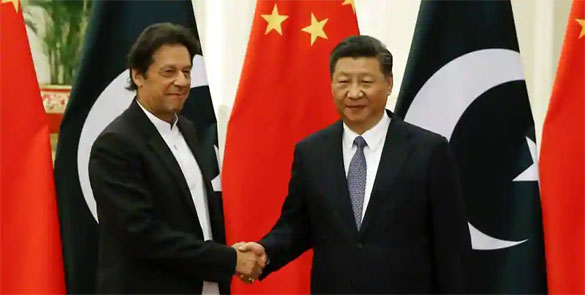
Chinese President Xi Jinping meets Pakistani Prime Minister Imran Khan
at the Great Hall of the People, Beijing, 2018(Getty Images)
-----
Standing
out among the numerous events that jostled for precedence domestically is
former Prime Minister Nawaz Sharif’s defiant roar against the military from his
exile in London to a combined opposition conference in September. Referring to
a “State above the State”, the Sharif crossed the invisible red line of
Pakistan: That mainstream political leaders not criticise the military publicly.
Nevertheless, Sharif’s charged rhetoric has given their new front, the Pakistan
Democratic Movement (PDM), its cutting edge.
It may well
turn out that the PDM will pose a more formidable challenge for the military,
the ruling party, Pakistan Tehreek-e-Insaf and the others. The ruling party
appears stable enough with the military firmly behind it, but clearly the
opposition strategy is to continue to mount pressure. In many ways, it is
ironic that the opposition is using much the same tactics that Prime Minister
(PM) Imran Khan used against Sharif’s government from 2014 onwards. The
difference is, of course, the role of the military — it was then supportive of
Khan in opposition; it now finds itself supporting his government against an
opposition.
Pakistan’s
ongoing review in the Financial Action Task Force (FATF) process meant its
efforts to remove itself from the grey list or at least not get blacklisted saw
greater urgency during the year. A number of United Nations-listed terrorists
were thus convicted, including some high-profile names wanted for carrying out
attacks in India. The list includes Hafiz Sayeed and Abdul Rahman Makki. The
convictions were on account of terrorist financing rather than for actual
involvement in acts of terrorism. In any case, the action taken possibly
appeared too little and too late to have much impact — at least on opinion in
India.
Relations
with India remained at their familiar same low plateau over the year
interspersed by fire fights on the Line of Control (LoC) in violation of the
ceasefire, acrimonious exchanges bilaterally and in international platforms,
and a frequently-charged rhetoric on Jammu and Kashmir from Pakistan’s military
and political leadership. Missing, however, were the dramas of the
super-charged military tensions of 2019. Missing also was any unusual step
forward towards de-securitisation such as the opening of the Kartarpur Saheb
corridor in November 2019.
If
relations with India then remained largely stationary, there was considerable
change in other relationships. With China there appeared to be an even greater
cementing and consolidation. A cluster of explanations arise here — the
India-China tensions on account of the Line of Actual Control (LAC) stand-off
in Ladakh and an emerging gulf in Pakistan’s relations with Saudi Arabia and
the United Arab Emirates makes Pakistan’s fragile economy even more dependent
on Chinese loans and aid. Possibly this change in equations with Saudi Arabia
and the Gulf states is the cause of greater worry for Pakistan. While there
have been ups and downs in this relationship in the past, nevertheless during
Nawaz Sharif’s tenure there was never much doubt about the basic texture and
strength of the relationship.
On the
other hand, what has significantly changed for the better is the Pakistan-US
relationship. The US Taliban Agreement of April 2020, the direct dialogue
between the Taliban and the Afghan government all were the platforms on which
the repair of US-Pakistan relations took place. In brief, the US rediscovered
Pakistan’s utility in Afghanistan. That this happened within the tenure of the
Trump presidency gave to many in Pakistan the hope that things will begin with
the new Biden administration on a more stable note and move quickly in a
positive direction.
----
TCA
Raghavan is a former High Commissioner to Pakistan. He is currently Director
General of the Indian Council of World Affairs
Original
Headline: Pakistan’s relations with India remain stationary; with China it has
consolidated; there is an uptick with the US
Source: The Hindustan Times
New Age Islam, Islam Online, Islamic Website, African Muslim News, Arab World News, South Asia News, Indian Muslim News, World Muslim News, Women in Islam, Islamic Feminism, Arab Women, Women In Arab, Islamophobia in America, Muslim Women in West, Islam Women and Feminism