
Three Reasons Why Political Pundits Got It Wrong in Uttar Pradesh
By
Arshad Alam, New Age Islam
14 March
2022
The
Communal Rhetoric Was the Base upon Which Issues of ‘Safety and Security’ Were
Hoisted Successfully By the Ruling Dispensation
Main
Points:
1. During the
COVID-19, the entire opposition was missing from action; the only presence in
the political space was that of the government.
2. Calling the
government welfare programme as ‘freebies’ harmed the opposition immensely.
3. Lower caste
leaders who defected to the opposition failed to carry their social base with
them.
-----
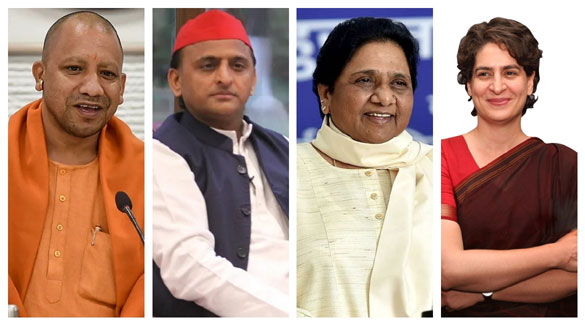
Though the main contest is believed to be between the BJP and the
SP-RLD, the BSP too has its influence on some seats in the first phase.
-----
Despite the
rather formidable challenges faced by the ruling BJP in Uttar Pradesh; its
victory at the polls is nothing sort of spectacular. The election was fought in
the backdrop of COVID-19 pandemic which devastated lives and livelihoods across
sections but most severely affected the poor. On top of it were issues of price
rise and unemployment, which directly affected the everyday lives of ordinary
citizens. Moreover, towards the very end, there was a realignment of caste
equations in favour of the challenger Samajwadi Party. Some prominent political
leaders from the marginalized castes joined the opposition and it seemed that
the damage to the ruling BJP will be irreparable. Many political pundits
therefore were expecting that people’s ‘anger’ will get reflected in the polls
and ‘they will teach BJP a lesson’. The result seems to have been the exact
opposite: the people, especially those who suffered the most, have once again
reposed their trust in the BJP and its popular chief minister Yogi Adityanath.
Here are some of the reasons why the political pundits got it so wrong:
First, it
is true that the pandemic wreaked havoc in the lives of poor people. Images of
people walking hundreds of kilometers to their homes; corpses floating on river
banks are still fresh in the minds of the people. But people rationalized the
pandemic as a natural disaster, the scale of which was beyond the capacity of
any human to control. The opposition could have exploited the situation by
pointing out the inadequate and at places non-existent health facilities. But
if one remembers correctly, the entire opposition was missing from action.
Forget about making this into an issue, opposition leaders refused to come out
of the safe confines of their homes. The only presence, no matter how feeble,
was that of the government. As a result of this wholesale abandonment of the
opposition of its own space, people could see the presence of the government
alone.
A result of
the pandemic was the expansion of the government’s welfare programme aimed at
the poorer sections of the population. They were given free rice and other
items of subsistence, which any sensible government should do. However, the
opposition again completely misread the situation and scored a self-goal. They
called it ‘freebies’ and saw it as the government’s desire to make a
welfare-dependent population. Some even likened the programme to a deliberate
effort to turn the poor into beggars. Such discourses ended up harming the
opposition immensely. Calling poor people beggars was an affront to their
dignity and the poor did not take it kindly. For these people, the government
seemed to be a caring one, helping them tide over a natural calamity. The
opposition’s critique was seen by them as extremely insensitive and callous. To
be fair to the ruling dispensation, this was not the first time such an
exercise was being carried out. Governments in Tamil Nadu, undivided Andhra and
Orissa have been doing it for decades. Similar measures were undertaken by the
West Bengal government before the local elections but then the same political
commentators had called her a visionary leader.
Second, it appears that contrary to expectations, the exit of some prominent caste leaders was not enough to realign a majority of lower caste votes in favour of the opposition. One forgets that Hindu organizations have invested years of hard work in these communities with a view to bring them within the larger Hindutva fold. The fact that despite some of their leaders exiting the saffron fold, the masses still opted to remain within the fold tells us that the hard work has paid off. Simply because Swami Prasad Maurya or Om Prakash Rajbhar decide to quit the BJP, doesn’t automatically mean that all Mauryas and Rajbhars will start voting for the opposition.
Moreover,
as Dr. Ambedkar reminds us, Indian society is not just about upper castes and
lower castes; rather caste is a system of graded inequality. This means that
caste contradictions operate locally and regionally. It doesn’t really make
sense that Dalits and marginal non-dominant backwards will start aligning with
Yadavs, Jats and Muslims simply because some of their leaders have done so. At
many places, these marginal communities have historically been oppressed by the
dominant OBCs like the Yadavs and Jats and it is difficult to erase such
historical memories. It is no wonder that the lower OBCs and Dalits have
largely stayed with the BJP for the security it provides them from the dominant
OBCs. It also needs to be said that in terms of political representation, the
BJP has been far better in accommodating the interests of these groups as
compared to the so-called social justice parties. It is intriguing how this
escaped the attention of our political pundits.
Last but
not the least, the communal rhetoric has paid its dividends to the ruling
party. The political pundits were in fact loath to say it aloud this time. They
underlined the immense sagacity of Akhilesh Yadav to remain focused on issues
which could not lead to any polarization. They congratulate the opposition (but
not the Muslims) for not ‘falling in the trap’ of communal rhetoric. However,
the fact remains that almost every slogan of the ruling dispensation was laced
with communal rhetoric. The slogan of safety and security was another way
of reminding the electorate that ‘Muslim Romeos’ had been eradicated; the names
of Azam Khan and Atiq Ahmad were regularly invoked because the electorate had
to be reminded that Muslims have been ‘put in their place’. The average Hindu
mind had been so saturated with anti-Muslim imagery that even small signals
were enough to reach their intended audience. This mobilization of Hindu
identity would have happened even in the absence of Muslims throwing their
entire weight behind one so called secular party.
----
A
regular contributor to NAI, Arshad Alam is a writer and researcher on Islam and
Muslims in South Asia.
URL:
New Age Islam, Islam
Online, Islamic
Website, African Muslim News, Arab World News, South Asia News, Indian Muslim News, World Muslim News, Women in Islam, Islamic Feminism, Arab Women, Women In Arab, Islamophobia in America, Muslim Women in West, Islam Women and Feminism