
While We Look Back to The Period of Emergency 1975, We Need to Introspect the Undeclared Emergency

By Ram Puniyani for
New Age Islam
8 July 2024
The First Major Change
Occurred Around That Time Was That Jaya Prakash Narayan, Who Was One of the
Tall Leaders of the Freedom Movement, Accepted RSS to Be the Part of the
Agitation Launched by Him. RSS’s Nanaji Deshmukh, Who Has Recently Been Awarded
Bharat Ratna by The BJP Regime, Became The Central Organizer of the Movement.
It Gave Respectability to The RSS as It Was Under Eclipse Due to Its Trained
Ex-Pracharak Godse Having Killed the Father of the Nation.
-------
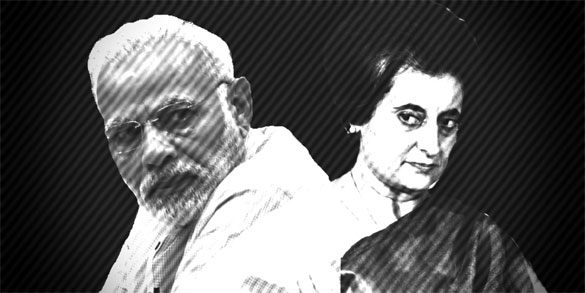
Narendra
Modi and Indira Gandhi. Photo: File.
------
Om Birla,
the speaker of Lok Sabha is mired in many controversies. When he started his
2nd term as Lok Sabha (Parliament) Speaker he read out a resolution against
Emergency which was imposed in 1975 by Indira Gandhi.
The
background of that emergency was the rising Sampoorna
Kranti (Total Revolution) Movement, led by Jaya Prakash Narayan (JP). The
movement of students of Gujarat which began to protest against the rise in mess
bill, was soon joined by the students of Bihar. This spiralled into students
requesting JP to lead the movement at national level. JP gave the call of
gheraoing (encircling) the assemblies and parliament. On 15th June 1975 in a
huge rally in Ramlila Maidan, Delhi, he gave the call to military and police to
defy the orders of the Government. Mrs. Gandhi’s election was challenged and on
flimsy grounds she was disqualified by the High Court. The Supreme Court gave a
stay on this on 24 June.
Seeing the
growing turmoil in the country, Mrs. Gandhi imposed the emergency using the
article 352 of the Constitution on 25th June 1975. This lasted for 21 months,
and she herself lifted it.
Mrs. Gandhi
had regretted the excesses during this period in a speech in Yavatmal on 24th
January in 1978. Even Rahul Gandhi
offered apologies for the excesses during Emergency. While the opposition
leaders were arrested Lalu Prasad Yadav who was in jail all through emergency,
in a recent article along with a journalist (The Sangh Silence on Emergency,
(I.E. June 29, 2024) wrote that though the opposition was arrested it was
treated with dignity by Indira Gandhi. For many years BJP has been observing
the 25 June as the dark period of Indian democracy.
The first
major change occurred around that time was that Jaya Prakash Narayan, who was
one of the tall leaders of the freedom movement, accepted RSS to be the part of
the agitation launched by him. RSS’s Nanaji Deshmukh, who has recently been
awarded Bharat Ratna by the BJP regime, became the central organizer of the
movement. It gave respectability to the RSS as it was under eclipse due to its
trained ex-Pracharak Godse having killed the Father of the Nation. As some
people pointed out to JP that RSS is a fascist organization, JP in his naivety
or whatever went on to say, if RSS is fascist I too am a fascist!
JP’s call to
the army and police not to obey the orders was very unnerving and this
precipitated the intensification of agitations, Gherao of Parliament and Assemblies. RSS had played an important
role in the Sampoorna Kranti movement, which gave it credibility in people’s
eyes. After the imposition of Emergency, when many of its members were
arrested, it started bowing to the ruling regime. Many of its members signed
Mafinamas (Mercy petitions) and got released.
BJP’s
effort is to project itself as the Hero of resistance of Emergency. Prabhash
Joshi, the eminent journalist brought out the real truth in his article in
Tehelka Magazine, “"Balasaheb Deoras, then RSS chief, wrote a letter to
Indira Gandhi pledging to help implement the notorious 20-point programme of
Sanjay Gandhi. This is the real character of the RSS...You can decipher a line
of action, a pattern.
Even during
the Emergency, many among the RSS and Jana Sangh who came out of the jails gave
Mafinamas. They were the first to
apologize. Only their leaders remained in jail: Atal Behari Vajpayee [most of
time in hospital], LK Advani, even Arun Jaitley. But the RSS did not fight the
Emergency. So why is the BJP trying to appropriate that memory?" Deoras’s
letters were also published in a book, ‘Hindu
Sangthan aur Sattavadi Rajniti’, authored by him and published by Jagruti
Prakashan Noida. Same was confirmed by T V Rajeshewar who was Deputy Chief of
IB.
Press
censorship and excesses on the issue of vasectomy and demolition of slums were
painful parts of this period. On the contrary, since last ten years we have
been witnessing the arrest of public intellectuals, participants in peaceful
struggles, arrest of journalists, the mainstream media bowing to the regime,
the opponents of Government policies being called anti-Nationals, the
suspension of 146 members of parliament among others.
The
violations which took place during this period are aided by the foot soldiers
of the patriarch of the ruling party, the RSS. The situation for the last one
decade has been worse than the declared emergency. This is what prompted the
critic of 1975 Emergency, Nayantara Sahgal to call the last one decade as
undeclared emergency, “Well, we have an undeclared Emergency; there is no doubt
about that. We have seen a huge, massive attack on the freedom of expression.
We have seen innocent, helpless Indians killed because they did not fit into
the RSS’s view of India. … So we have a horrendous situation, a nightmare which
is worse than the Emergency… It is an absolutely nightmarish situation which
has no equal.”
And to cap
it all the leader of BJP, Mr. Lal Krishna Advani also called last one decade as
undeclared Emergency, “Today there is an undeclared emergency in the country.
Even senior BJP (Bharatiya Janata Party) leader Lal Krishna Advani hinted the
same after the government formed but after pressure from RSS (Rashtriya
Swayamsevak Sangh), he became silent…” While we look back to the period of
Emergency 1975, we need to introspect and ward off the periods like undeclared
Emergency which the country has been witnessing from the last decade.
Filing
mercy petitions to the rulers is the norm with the Hindu right wing. Savarakar
wrote five mercy petitions when he was in Andamans, Atal Bihari Vajpayee wrote
on similar lines to get released during his arrest in 1942 uprising stating
that he had nothing to do with the ‘Quit India’ movement and during emergency
Balasaheb Deoras wrote to Indira Gandhi twice to patch up, and then requested
Vinoba Bhave to ask Indira Gandhi to lift the ban on RSS. Also many BJP leaders
like the late Arun Jaitley compared the Emergency period to Hitler’s regime.
The crucial difference between the two is the encouragement of foot soldiers by
the fascist regime. It was brown shirts in Germany, in India there are many vigilante
groups which flourished during last one decade.
Source: Emergency: Declared versus Undeclared
-----
Ram Puniyani is president of the Centre for
Study of Society and Secularism.
URL: https://www.newageislam.com/current-affairs/emergency-1975-introspect-indira-jp/d/132655