
"Tafheem-e-Jihad"—Understanding, Explaining and Building a Nuanced Narrative on the Islamic Philosophy of War!

By Ghulam Rasool Dehlvi, New Age Islam
27 July 2024
Main Point:
After
countering Takfirist extremism in his remarkable book Masla-e-Takfīr wa
Mutakallimīn (A historical and theoretical counter-narrative against
Takfirism), Dr Zishan Misbahi's new treatise "Tafheem-e-Jihad” refutes
Violent Jihadism. It offers intellectual tools required to question the
Jihadist theology propounded by the Violent Jihadist ideologues.
-------
After countering Takfirist extremism in his
remarkable book Masla-e-Takfīr wa
Mutakallimīn (A historical and theoretical counter-narrative against
Takfirism), Dr Zishan Misbahi's new treatise "Tafheem-e-Jihad” refutes
Violent Jihadism. It offers intellectual tools required to question the
Jihadist theology propounded by the Jihadist ideologues.
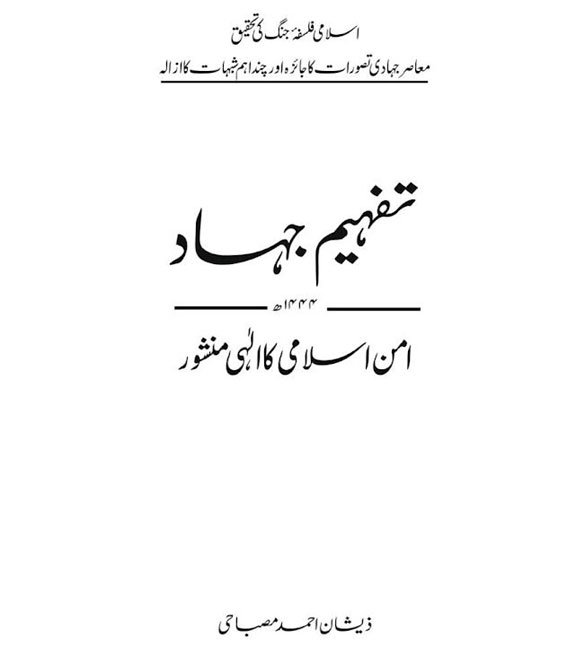
This book under my review is titled in Urdu: "Tafheem-e-Jihad: Amn-e-Islami Ka Ilahi Manshoor” (Understanding & Explaining Jihad: A Divine Charter of Islamic Peace Narrative). A clear, critical and candid exposition on the subject, this treatise is a detailed study and descriptive explanation of the Islamic concept of Jihad which seeks to dispel the key doubts created by the contemporary Jihadist movements.
Authored by an acclaimed classical Islamic
scholar and a prolific writer Dr Zishan Ahmad Misbahi, this work cannot be seen
and undermined just as another Muslim ‘apologia’. There is no denying the fact
that the most controversial Islamic postulate—Jihad—still requires a solid and
satisfactory elucidation. But at a time when scores of ‘run-of-the-mill’
written defences and oral statements have been issued to debunk the ‘misconstrued
notions’ and misinterpretations of Jihad, Tafheem-e-Jihad brings out a nuanced
understanding of this Islamic concept. It aims to dispel not only prevailing
doubts and mistrust but also the seeds of religious hatred, brainless violence,
extremism and acts of terrorism in the name of Jihad.
Besides its classical significance and
substantial theological and legal (Fiqhi)
underpinnings based on the Qur’anic hermeneutics (Tafseer and Taweel) and
hadith-oriented contextualisation, the book stands as a treasure-trove for the
connoisseurs of Islamic philosophy of peace and war. It also demystifies the
basic tenets of Islam such as Imaan (belief), Kufr (disbelief), Shirk
(polytheism or association of partnership with God) and other related precepts
in the Qur’an such as Fitnah (tumult or religious persecution), Hakimiyyah
(God’s sovereignty) and Ghalba-e-Islam
(Islam’s dominion over the globe) which are often juxtaposed with jihad. In
this work, Maulana Misbahi has carried out a painstaking quality research while
carefully treading a moderate path. A long-awaited result of hard-earned
research and a critical study of primary and secondary sources, the book is the
essence of moderate thought on the theme of ‘true Islamic Jihad’. In two
hundred pages, the author exerts a concerted effort to maintain a reasonably
sound academic, intellectual and critical research method (Manhaj-e-Tahqiqi).
At the very outset, a dispassionate reading
of the book has been presented in a "preface" written by Dr. Hafeezur
Rehman, Convener of the "Khusro Foundation", which has sponsored this
publication. It makes it patently clear that a successful attempt has been made
in this book to understand and expound the contextual concept of Jihad in
Islam. The Foreword of the book states:
“With the downfall
of the Ottoman Empire and the rise of the British Empire, the colonial certain
pan-Islamist organisations and movements [which were created in the name of
Islam] started to exploit the victimhood of Muslims in various territories
around the world. One of their strategies to exploit these oppressed Muslims
was to lure them into Jihad by exposing them to some cherry-picked verses from
the Qur’an with a self-styled and de-contextualised interpretation of them”.
In this historical backdrop, I assume, the
author of “Tafheem-e-Jihad” has
tried not only to contextualise but also to ‘de-colonise’ the interpretations
of Jihad in the Qur’an.
Tellingly, in this recent Urdu book, a
critical study of previously written exegesis on the verses of Jihad both in
Arabic and Urdu has been undertaken. Most significantly, Maulana Misbahi has
exposed the intellectual inaccuracies of the existing literature on Jihad such
as the world-famed work in Urdu “Al-Jihad fil Islam” by Maulana Maududi and
Syed Qutub’s Arabic books “Ma’alim fi al-Tariq” (Milestones) and “Fi Zilal
al-Qur’an” (In shade of the Qur’an). While the earlier formed the bedrock of
Jama’at-e-Islami in India, the latter provided the basis for Ikhwan-ul-Muslimin
(Muslim Brotherhood) in Egypt. Few scholars in the Indian subcontinent
sufficiently rebutted their extremist Jihadist rhetoric. Even the modernist
Islamic scholars and thinkers including Late Maulana Wahiduddin Khan of India
and Javed Ahmed Ghamdi of Pakistan who tried to critique them also failed to
properly contextualise the Qur’anic concept of ‘jihad’ in their writings.
Therefore, their discrepancies have also been exposed in “Tafheem-e-Jihad”.
Thus, this work re-institutes an established tradition of classical Islamic
thinking on the theory of jihad and peace and the Qur'anic philosophy of war.
Only in 200 pages, the author endeavours to accomplish this task in such a
succinct and precise manner that readers remain glued to it till the end, until
their curiosity is gratified.
The
correct context of the war-time verses and the related teachings of the Qur'an
in the light of the actual Sirah (the lifetime of the Prophet PBUH) have been
highlighted, so that we may discredit the violent Jihadist organizations which
misuse the Qru’anic philosophy of a ‘just Jihad’ to fulfil their ulterior
ambitions. With this view in mind, author of the book begins with what he calls
“Shazraat’ (seeds of thought) in which he quotes Sheikh Mahmoud Shaltut, an
Egyptian Islamic reformer and former Sheikh al-Azhar, best known for his
attempts in Islamic reform. A disciple of another Islamic reformist Mohammad
Abduh's school of thought, Sheikh Shaltut wrote a significant book “Al-Qur’an
Wal-Qitaal” (Qur’an and Warfare) in which he debunks the terror organisations
justifying their use of the term ‘jihad’. It was a fatal mistake when terrorism
was equated with the doctrine of jihad in Islam. Terrorism in Arabic is termed
as ‘al-Irhab’ which is not taught in
the Qur’an. As for warfare, it is called ‘al-Qital’
in the Qur’an which too is not synonymous with the term of Jihad in Islam, says
the Sheikh. Dr Misbahi refers his “Shazraat” to Sheikh Shaltut’s book from
which he brings some crucial points, as follows:
The Islamic philosophy of religion is
evidently clear and easy to understand. Therefore, there is absolutely no
justification for coercion or compulsion in calling people towards Islam, and
there is essentially no need for war or using force for it.
In matters of faith and disbelief (iman
and kufr), Islam has left the choice to one’s own discretion and for this, it
urges people to use their own brains and intellect.
There are clear and categorical texts in
the Qur’an which disapprove of all sorts of coercion and violence in matters of
the religion.
An Islamic preacher (da’ee) will only be
held accountable for his/her individual responsibility of calling people
towards Allah. Therefore, he/she does not need to resort to forceful conversion
in any circumstance, at all!
As a matter of fact, Islam does not
sanction someone’s acceptance of Islam under compulsion (i.e. forced
conversion). Given this, any conception of using force or coercion in Islamic
preaching and proselytising is pointless, and it stands totally dismissed.
By studying the classical and contemporary
books on Jihad, the author of ‘Tafheem-e-Jihad’ tries to explore some of the
deeply-entrenched misunderstandings about jihad, while at the same time putting
up the correct positions and perspectives from the authentic scholars and
original opinion-makers of the Muslim world. He opines that the errors in
understanding the concept of Jihad should be corrected by referring and
resorting to the original opinion of the established Muslim scholars. However,
the book also extensively quotes Ibn Taimiyya and Ibn al-Qayyim al-Jawzia and
the opinions of other medieval Islamist scholars who are themselves questioned
on this issue. However, the book "Tafheem-e-Jihad" discusses the
major issues that have been vitally important but curiously ignored in a detailed
analysis of the Jihad literature. The thrust of this study has been reproduced
by the author in his carefully crafted words. For example, he writes:
“Although Jihad
(in the sense of ‘a noble effort’) is enjoined upon everyone at all times, the
Islamic notion of Jihad (in the sense of Qitaal or war-time Jihad), is not a
complicated philosophy which goes against reason and morality, or something
that is difficult to understand in the context of the current global order…..In
Islam too, we have the same basis for the justification of war which any
peace-loving and logical person today would offer as the reason for war. The
war principles and foundations of Islam are actually based on universal truths,
which no serious person can deny…...In Islam, the justification of war is only
to end sedition, corruption, oppression and persecution and to establish peace
and order and protect freedom of thought and conscience, and this is such a
reasonable and thoughtful principle that no one with sound intellect can
reject……In any case, Islam strongly advocates public safety, peace, internal
and external security and freedom from all sorts of fear, terror, cruelty and
coercion. The Qur'an requires us to create a society that is free from fear and
hunger, and provide people with food against hunger, and with security against
fear of danger (106: 4).
In a critical appraisal of the key texts on
Jihad, the main contents of the book basically provide a detailed analysis of
eleven possible questions arising from internal and external dimensions. These
questions are extremely crucial. Take a look:
First: Does Islam wage a war against
Kufr (disbelief)?
Second: Does Islam want a war against
the dominion of disbelief (Shaukat-e-Kufr)?
Third: What is the reality of Fitnah and
how to get rid of it?
Fourth: Were the Qur’anic verses of
peace and pluralism (Aayat-e-Amn)
abrogated by sword verses (Aayaat-e-Saif)?
Fifth: What is the meaning of “al-Deen Kulluh lillah” (Religion totally
belongs to Allah)?
Sixth: Was Jihad a divine punishment
against the Arab polytheists?
Seventh: Were there only two choices for
the polytheist Arabs, Islam or sword?
Eighth: Is war against all polytheists
inevitable and essential?
Ninth: Is waging a war permissible to
convert people into Islam?
Tenth: Why did the Prophet’s Companions
fight against other nations?
Eleventh: Is reconciliation allowed only
under compulsion?
At the end of the book, a summary of the
well-known Arabic book on the refutation of Jihadist theology "Al-Haq Al-Mubeen" by Allama Dr.
Osama Al-Azhari, former faculty at Al-Azhar University and the religious
adviser of the current President of the Republic of Egypt, Abdel Fattah
Al-Sisi, is also included. The summary was written by Maulana Zia-ur-Rahman
Alimi. Significantly, Al-Azhari’s work is one of the most substantial documents
written in Arabic against the jihadist narrative of terrorists. In this book,
the false Fiqhi (legal) and
theological justifications of terrorist organizations like Al-Qaeda and ISIS
have been countered with clear evidences from the Quran and Hadith.
Well argued, well-reasoned and backed by
the principles of Qur'an and Sunnah, Ijma’a
(consensus), Qiyas (analogy) and
the chief objectives of Fiqh and Sharia (Maqasid),
the book is replete with valuable exegesis and a rich jurisprudential
collection from legal Islamic theorists, and medieval and modern books written
on Jihad. This shows the author has thoroughly studied the subject. The results
of this study show that the misunderstanding of the Qur’anic concept of Jihad
has basically lied on the meaning and concept of jihad. Therefore, the author
has focused on reproducing and reinforcing the true essence of Jihad in a
simple and lucid manner which appeals to the common sense, and should be
received reasonably well.
-------
Excerpts
from Zishan Misbahi's book on Takfeer Dealing with Issues of Excommunicating
Muslims
A Regular
Columnist with Newageislam.com, Ghulam Rasool Dehlvi is an Indo-Islamic
scholar, Sufi poet and English-Arabic-Urdu-Hindi writer with a background in a
leading Sufi Islamic seminary in India. He is currently serving as Head of
International Affairs at Voice for Peace & Justice, Jammu & Kashmir.
URL: https://www.newageislam.com/books-documents/tafheem-jihad-narrative-islamic-philosophy-war/d/132802
New Age Islam, Islam Online, Islamic Website, African Muslim News, Arab World News, South Asia News, Indian Muslim News, World Muslim News, Women in Islam, Islamic Feminism, Arab Women, Women In Arab, Islamophobia in America, Muslim Women in West, Islam Women and Feminism