
World Press On Legal Definition Of Rape, Muslims’ Rage At Macron And Bangladesh: New Age Islam's Selection, 3 November 2020
By New Age Islam Edit
Desk
3 November
2020
• The Problematic Legal Definition Of Rape
By Taslima Yasmin
• Muslims’ Rage At Macron Threatens To Escalate
Tensions Across Europe
By Simon Tisdall
• It's Not Just Trump – To Much Of The World,
The US Is A Bully Whoever Is In Charge
By Mohammed Hanif
• Jail Killing Day, November 3, 1975: The
Indelible Shame
By Muhammad Nurul Huda
• Bangladesh: How Free Are We?
By Faruq Faisel
-----
The Problematic Legal Definition Of Rape
By Taslima Yasmin
November
03, 2020
The
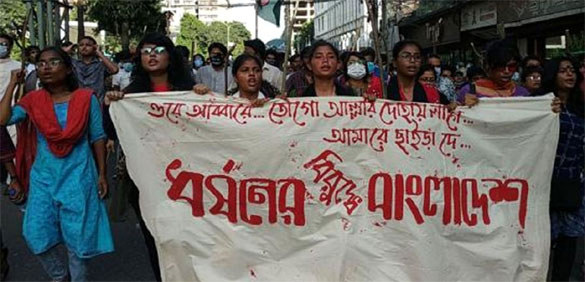
brutal gang rape in Noakhali led to nationwide protests and started a debate on
rape and violence against women. Photo: Star
-----
The video
of a gruesome act of sexual violence on a woman in Begumganj, Noakhali that
went viral in early October, and the subsequent reporting on the incident in
various media outlets had led many to questions—was it rape or could it be
called an attempt to rape, or was it a sexual assault? This confusion is
natural since the idea of rape, or of other sexual offences with similar
degree, are concepts that remain unexplained even in the key Bangladeshi laws
that criminalise such violence.
In the
Begumganj case, the details of the video showed that the offenders were
sexually torturing the woman using a wooden rod. The violence was no doubt
equally brutal as rape; however, traditionally, in seeking justice for such
violence, the attack perhaps would not be considered as rape. Reportedly, the
first FIR in the incident was filed under section 9(4) and section 10 of the Women
and Children Repression Prevention Act 2000 (WCRPA) for attempt to rape and
sexual assault; and not for the offence of committing rape. The reason simply
is that the way the definition of "rape" stands now, it is difficult
for law enforcement agencies to contemplate that such sexual violence can be
considered as rape.
Previously,
rape was punishable only under the Penal Code of 1860. With the hope of
speedier and effective prosecution in cases of violence against women, the
WCRPA was enacted in the year 2000. The WCRPA provided increased punishment for
rape in varied contexts (punishment for gang rape, custodial rape, etc.).
Nevertheless, when it came to defining the offence of rape, WCRPA clearly
stated that the definition of rape would be same as the one given in section
375 of the 1860 Penal Code. Which means that although the WCRPA, which is a
relatively modern law, had brought several changes in the degree and nature of
punishment for rape; for defining the offence itself, the British colonial law
is what we have to follow.
The
definition of rape in the Penal Code says there has to be sexual intercourse
initiated by a man with a woman, and to consider an act as sexual intercourse,
"penetration" would be sufficient. The definition stops here without
explaining what the term "penetration" means. Adding to this, section
9 of the WCRPA uses the Bengali term Jouno shnagam to refer to sexual
intercourse, again without explaining what specific sexual acts such a term may
entail. As such, the various arms of the legal system commonly consider
penetration in its traditional understanding, leaving out several other ways of
sexual penetration which could sometimes be even more violent. Forceful
penetration by a sharp object, for instance, may fall outside the realm of
"rape" and may be punished as a sexual assault under section 10,
which of course is a lesser degree offence.
Rape under
section 9 is punishable with mandatory sentences of life imprisonment or death
as per the new amendment ordinance. However, for sexual assault, the punishment
is maximum 10 years and minimum three years imprisonment. Additionally, unlike
section 9, section 10 nowhere mentions the punishment for causing death
resulting from sexual assault. As such, what appears is that, in addition to being
a lesser degree of offence, if sexual assault causes death of the victim, the
WCRPA won't be applicable for her and the case would have to be filed in the
ordinary criminal courts for murder under section 302 of the Penal Code.
Because the
term "penetration" does not include any further details, the question
of proving rape may also depend on the degree of a particular penetration.
Especially in cases of child victims of rape, the offender often cannot fully
penetrate the victim and then proving that penetration did happen becomes
cumbersome for the prosecution. This is precisely the reason that subsequent to
the Delhi gang rape case, section 375 of the Indian Penal Code was amended,
adding several clauses explaining what forms and extent of sexual intercourse
or penetration would amount to rape.
The
definition of rape has several other areas of ambiguities and legal
inconsistencies that need to be comprehensively reviewed in light of the
progressive developments in other domestic laws. The definition does not
contemplate a boy child to be a victim of rape, it provides no indication as to
what the term "consent" would entail and most importantly, it
decriminalises rape by the husband against his child bride, who may be as young
as 13 years of age.
Formulating
a timely and appropriate definition of rape can be an effective first step in
bringing a meaningful change in the rape justice system. Unless the inherent
loopholes in the existing laws are seriously addressed, concentrating on the
harshness of punishment alone will not yield any meaningful change in rape
prosecution.
----
Taslima Yasmin is a legal researcher and
teaches in the Department of Law, University of Dhaka.
https://www.thedailystar.net/opinion/news/the-problematic-legal-definition-rape-1988293
----
Muslims’
rage at Macron threatens to escalate tensions across Europe
By Simon
Tisdall
1 Nov 2020
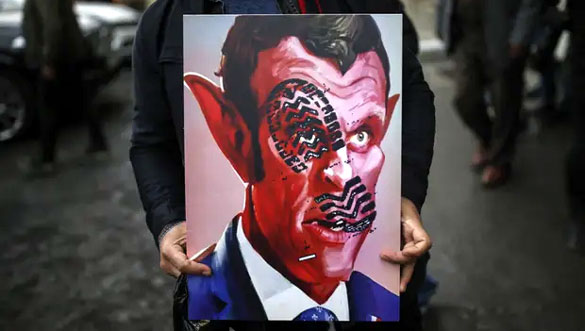
Protesters
in Istanbul portray Emmanuel Macron as a devil on 30 October. Turkey’s
president has questioned his mental health. Photograph: Emrah Gürel/AP
-----
Maybe he
knew what he was doing. Maybe he didn’t. Either way, Emmanuel Macron set France
and Europe on a new collision course with the Islamic world last month – all in
the name of freedom. Last week’s spate of lethal terror attacks suggests the French
president may have started something he cannot finish.
Macron’s
impassioned speech on 2 October, vowing to fight “radical Islamism”, eradicate
“separatism” and uphold secular values at all costs, foreshadowed this latest
crisis. It was seen at the time as a mainly domestic political exercise,
intended to spike the guns of France’s far right before his 2022 election
campaign.
But Muslim
leaders were enraged by Macron’s description of Islam as a faith “in crisis all
over the world” that had, in effect, been hijacked by extremists. Then, two
weeks later, after the murder of a Paris schoolteacher, Samuel Paty, by a
foreign-born Islamist, an undaunted Macron doubled down. His defence of the
notorious, recently republished Charlie Hebdo caricatures of the Prophet
Muhammad, which Paty had shown to pupils, and a national crackdown on mosques,
imams and Islamic groups added fuel to the fire. France itself was “under
attack”, Macron dramatically declared, a phrase he repeated on Thursday.
Political
and religious leaders from Bangladesh to Jordan and anti-French demonstrators
publicly vented their fury, accusing him of doing “Satan’s work”. Much of what
he said was misunderstood or purposefully distorted. Truth was a casualty, too.
Yet the
fact remained: by loudly and uncompromisingly championing French values, Macron
had managed simultaneously to outrage mainstream Muslim opinion and,
apparently, to energise extremists.
The
immediate, grim result, which fairly or unfairly will be laid at his door, was
a string of attacks in Nice, Avignon and Saudi Arabia. France, struggling to
contain a worsening Covid pandemic, is now on its highest terrorism alert, with
schools and churches under armed guard.
Macron
cannot be faulted for sticking up for the French post-Enlightenment ideal of an
equal, integrated, secular and republican society. But he and other European
leaders now face a possibly powerful Islamophobic, anti-Muslim backlash that
could spawn yet more bloodshed.
This sudden
explosion of violence and recrimination potentially affects everyone. All of
Europe’s governments risk being drawn into a deepening polarisation, with
evident implications for peace, security and social cohesion.
Like
France’s National Rally (formerly the National Front), German, Italian and
other far-right Islamophobic and anti-migrant populist parties whose public
support has been falling of late must be licking their lips. Muslim leaders
such as Pakistan’s Imran Khan have seized on the affair to deflect anger over
their own failings.
Macron’s
critics will say this is what comes of having an imperious
president-in-a-hurry, pushing to seize the reins of European leadership. Macron
wants to turn the EU into a more powerful, independent bloc that stands up for
itself against the US, China – and Islam. But the price tag for his
neo-Gaullist European vision keeps rising.
Europe’s
most determined opponents have meanwhile spotted an opportunity. Chief among
them is Recep Tayyip Erdoğan, Turkey’s president. He suggested Macron was
mentally unbalanced. “Our history is one of a battle against tyranny and
fanaticism,” Macron responded via Twitter. No prizes for which tyrant and
fanatic he was talking about.
Erdoğan is
a deeply unpleasant, authoritarian Islamic nationalist. But in one respect, he
and Macron are alike. Erdoğan also casts himself as a pan-regional leader, as a
tutor and defender of the Sunni Muslim world. This ambition was symbolised by
his provocative re-designation of Istanbul’s former cathedral, Hagia Sophia, as
a mosque.
Forget
Trump v Biden – Erdoğan v Macron is the heavyweight bout of the year. The two
have already gone several punishing rounds over disputed gas reserves in the
eastern Mediterranean, Libya, Syria and Nagorno-Karabakh. At Macron’s urging,
December’s EU summit will discuss sanctions on Turkey.
Yet two
men’s clashing ideas and geopolitical rivalries do not explain the depth and
breadth of Muslim-world fury. That stems from dismay felt by the overwhelmingly
nonviolent Muslim majority about entrenched European Islamophobia, racial
discrimination, cultural insensitivity, and heartless migrant policies.
Further
afield, perceived French neocolonialism in the Sahel and apparent western indifference
to the endless horrors in Syria, Yemen, Afghanistan, Myanmar and Xinjiang feed
tensions. For many Muslims, the projection of the Prophet Muhammad caricatures
on to the walls of several French cities after Paty’s death was intolerable.
Yet so, too, was the attack on a Nice church. On both sides, lack of respect is
a big part of the problem.
The
destructive impact of Covid-19 has frayed tempers further, putting governments
and citizens everywhere under pressure. Into this giant mantrap Macron has jumped
feet-first, increasing, not reducing, misunderstanding at a time of extreme
stress.
A Pew
Research survey last year found that solid majorities of people in the UK,
France, the Netherlands, Germany and Sweden hold positive opinions of Muslims
in their country. In Italy and southern and eastern Europe, there is greater
negativity. Although far-right populist parties continue to exploit fears about
identity and immigration, especially among less-educated and older people, and
although recorded incidents of Islamophobia are up, overall tensions have
fallen compared with five years ago.
On the
other hand, the French policy mandating assimilation into a prescriptively
“lay” society – unlike British-style laissez-faire multiculturalism – appears
too rigid. Macron should think again about how it is applied.
It’s plain
the relationship between Muslims and non-Muslims in Europe remains fragile. The
danger is obvious. Will the bitter furore over Macron’s justified but clumsy
defence of French values, the perception Islam is under assault, and the
ensuing terror, tip Europe into a new, confrontational downward spiral? Let’s
hope not.
https://www.theguardian.com/commentisfree/2020/nov/01/macron-europe-new-clash-islamic-world
-----
It's Not Just Trump – To Much Of The World, The
US Is A Bully Whoever Is In Charge
By Mohammed Hanif
3 Nov 2020
Our
American friends are worried about their president. They are telling us – even
in what may be his final months in office – that Donald Trump is sick, that he
is a fascist, that he is a grotesque parody of a proper US president.
As a
long-suffering citizen of a world run by US presidents, may I remind them that
he is not very different from the other presidents that I and the rest of the
non-American world have suffered for the past half century. Americans say they
are better people than Trump. In solidarity, one might be tempted to say that,
yes, sure, we are also better people than Trump. But one is compelled to add
that although those former presidents might have had better syntax than Trump,
worn better-fitted suits, had finer dance moves, weren’t proud “pussy
grabbers”, or cunning tax dodgers, being a world-class bully has always been a
part of the job.
The US has
always elected a bully, nurtured him and asked him to go out in the world and
do the presidential thing: fight the evil that is the rest of us. At the same
time they have expected their president to be nice at home, have mercy on their
Thanksgiving turkey and keep talking about the American dream and affordable
healthcare.
Abroad, US
presidents have wrought havoc, invaded and destroyed places whose names they
could never pronounce, hosted murderous dictators from around the world at Camp
David and found even more bloodthirsty ones to replace them.
Trump has
just brought all that bullying home.
The first
US president that I heard of as a child was Nixon, who was kicked out after
Watergate. But during his presidency, he watched over the massacre of
Bangladeshi people, kept promising to intervene but in the end couldn’t be bothered.
Jimmy Carter seemed like a nice man, a reluctant bully, perhaps. One might have
first heard that blasted term “human rights” during his time, but in Pakistan,
where I live, a military dictator hanged an elected prime minister, Zulfikar
Ali Bhutto, during his presidency. In return, Carter offered General Zia ul-Haq
millions of dollars in aid to win him over, which the dictator rejected,
calling it peanuts – the joke being that Carter was a peanut farmer.
Then came
that sage Ronald Reagan, who started dishing out serious money to play out his
cowboy fantasies across the globe. “Leader of the free world” he called
himself. And to make the world freer, he bankrolled dictators like Augusto
Pinochet in Chile and Zia in Pakistan.
When Reagan
started funding the mujahideen in Afghanistan, I was 11; now my son has
graduated from university, and a third generation of poor US kids is still
fighting and negotiating in the same country. And a fourth generation of
Afghans is growing up in refugee camps and women are wondering if, when the US
finally succeed in their peace talks, they will have a country to live in.
George Bush
Sr lit up the Baghdad skyline with his fireworks. He took money from one despot
to liberate another and in between tried to fund Iraqi rebels before leaving
them at the mercy of a third despot, Saddam Hussein. Didn’t we love Bill
Clinton? Wasn’t he the antithesis of Trump, suave, a charmer, the kind of
person you could have a beer with? When Clinton faced impeachment for his
relations with Monica Lewinsky, he launched some cruise missiles over
Afghanistan and Sudan as a distraction.
Americans
must have loved George W Bush because they elected him twice. He believed that
instigating a war with Afghanistan was something a US president was required to
do. But then he realised that his predecessors hadn’t left much to destroy. In
search of target-rich areas he lighted on Iraq, manufactured a pretext for war,
set up prisons in Guantánamo and Abu Ghraib, then declared victory and went
home leaving behind millions to die. Even mild-mannered US presidents have been
mass murderers on the world stage. Because that’s what the job entails.
Barack
Obama was one of the most loved president of recent times, the kind of man who
you could actually imagine have a beer with. He left the killings to algorithms
and drones, while his foreign policy left Libya annihilated. By the end of his
tenure, the US was dropping the equivalent of nearly three bombs an hour every
single day. (In 2009, he won the Nobel peace prize for his good intentions.)
Americans
are the world’s biggest entertainers, but seem to get bored easily and in their
fabled innocence go around the world destroying places in order to save them.
At home they keep telling themselves that it’s time to make a choice but, in
reality, what choices do they have?
Trump makes
the US look bad, makes the US look too white, makes the US speak bad English,
makes the US look ill-mannered, greedy, overweight. But as far as many of us
around the world are concerned, even if he loses, it’s not a sign that the US
is about to change; it really just heralds a bit of a makeover.
The US
needs a lean mascot, someone who wears better suits, who is not as overtly
racist. US presidents are like the boss who goes to work terrorising his
employees but comes home to spread sunshine and love. Deal with Trump by all
means, lock the door and throw away the key. Elect the person you believe will
save the US soul – but don’t send him out into the world to save us.
-----
Mohammed
Hanif is a novelist based in Karachi, Pakistan
https://www.theguardian.com/commentisfree/2020/nov/03/donald-trump-us-presidents-joe-biden
-----
Jail Killing Day, November 3, 1975: The
Indelible Shame
By Muhammad Nurul Huda
November
03, 2020
The brutal
killings of four national leaders by misguided soldiers inside Dhaka Central
Jail in the early hours of November 3, 1975, remain an indelible shame on the
national psyche. The compounding tragedy in the whole transaction is that the
brutality and shame did not stir the national conscience until a favourable
political scenario emerged in 1996.
The four
slain leaders—Syed Nazrul Islam, Tajuddin Ahmad, AHM Qamaruzzaman and Captain
Mansur Ali—were no ordinary men because for them, public service was more
important than life itself. They had immense concern for public welfare and
demonstrated their will to fight valiantly for justice.
When it was
a question of displaying unflinching devotion to Bangabandhu and his ideals,
Syed Nazrul Islam, Tajuddin Ahmad, AHM Qamaruzzaman and Captain Mansur Ali were
second to none. They did not compromise with the murderous cabal to earn
freedom or a cozy position in the establishment, while others capitulated in
the most shameful manner. Records show that they could have bargained with the
assassins and their patrons but they did not wilt. This was a rare instance of
displaying inner strength; a necessity for establishing truth under adversity.
The tragedy
in Bangladesh is that we, as a nation, have not been able to come out of our
self-absorption and it was, thus, no surprise that it took 21 years to
officially recognise the culpability of a heinous offence committed in the most
blatant manner. Cynics say that we have in our midst far too many
"boneless wonders." With such men, expediency is all. The four slain
leaders, however, were men who had the courage not to submit or yield and were
like rocks in the wilderness of shifting sands.
The
historical significance of the sacrifice of the four national leaders cannot be
lost sight of. We have to admit that by lingering for a painfully long time in
taking legal action, we have made ourselves small. Must we not admit that
vigorous societies have to harbour a certain extravagance of objectives, so
that men wander beyond the safe provision of personal gratifications?
As
mentioned, the state sprang into action to investigate the ghastly misdeeds
only when a favourable scenario emerged. However, the task was not easy by any
account. The First Information Report (FIR) had mentioned the name of only one
person as accused and four accomplices were mentioned as unknown.
Significantly,
the original FIR could not be located despite the best efforts given in tracing
them from the concerned court, police station and CID office. Finally, a
hand-written copy of the original FIR was located at Police Headquarters.
The
investigator of the gruesome crime thus had to commence his work with a
handicap. Curiously, although the FIR was lodged on November 4, 1975 at Lalbagh
police station, the investigation officer, the then Deputy Superintendent of
Police (DSP) Saifuddin, was not allowed to visit the place of the incident
despite repeated efforts, thus failing to take initial steps towards the
investigation.
Between
1975 and 1996, the investigation could not get started due to the indifference
of the establishment, and consequently many relevant supporting papers and
direct evidence disappeared, much to the consternation of the prosecution. Some
of the jail employees of the relevant period had been located from different
places around the country after prolonged efforts and the complainant of the
incident, the very old former DIG Prison, was traced from Sandwip Island to
prove the FIR. Some old files had been retrieved from the prison records but copies
of the inquest and post mortem reports of the slain leaders could not be
traced.
The then
establishment instituted a Judicial Commission after the incident, but the said
Commission could not complete their inquiry. The relevant files regarding this
Commission could not be traced at the ministry as some interested quarters were
suspected to have caused its disappearance.
Admittedly,
the investigator's job was made very difficult.
The
misguided soldiers who committed the atrocities were rewarded with diplomatic
postings. The job of tracing them and bringing them under the law was a
challenging task. These accused persons were staying in Bangabhaban, the seat
of power, and from there they proceeded to Dhaka Central Jail to commit the
massacre.
After a
lapse of so many years, it was extremely difficult to trace the relevant files
in these sensitive places. Equally difficult was locating important exhibits
from Radio Bangladesh.
Despite all
the odds, encumbrances and limiting factors, the case ended in charge sheets
against 21 accused persons, including 14 absconders. The trial court awarded
death sentence to three accused persons and sentenced 12 to life imprisonment,
thanks to the exacting and gritty investigation of Abdul Kahhar Akand, the then
Senior Assistant Superintendent of Police. The trial was held in the ordinary
court of law, where the defence enjoyed all statutory privileges.
Of
significant consequence is the fact that our socio-political situation turned
for the worse with the tragic murder of the Father of the Nation and the four
national leaders in 1975.
----
Muhammad Nurul Huda is a former IGP.
https://www.thedailystar.net/opinion/straight-line/news/jail-killing-day-the-indelible-shame-1988305
----
Bangladesh: How Free Are We?
By Faruq Faisel
November 03, 2020
In the last
decade, freedom of expression has been in the decline globally, from
authoritarian to traditionally liberal states. There are trends of oppression,
repression of dissent, and delegitimising peaceful protests and opinions. More
than half of the world's population is now living in a country in which freedom
of expression is categorised as "in crisis."
This was
highlighted in the Global Expression Report (GxR) 2019/2020 released by ARTICLE
19, a British human rights organisation mandated in the defence and promotion
of freedom of expression and information. The protection of the right to
freedom of expression and information is now at its lowest point than it was
ever before. The right to speak and be heard are tools for effective public
engagement and participation, which provide checks and balances for those who
govern our societies. This has become more apparent with Covid-19, where the
free-flow of information becomes crucial to address public health needs and
access to life-saving information. Tackling these issues and addressing public
needs become difficult due to the worsening environment of global expression.
Free speech and information are fundamental components to the functioning of
democracy, which provides credibility to any government. Thus, democracy and
freedom of expression are inextricably linked and are important for ensuring
equality, development and non-discrimination.
In
Bangladesh, civic spaces have been under threat for some time. In the GxR
report, Bangladesh ranked 132 out of 162 countries around the world, coming at
the bottom five in the Asia Pacific region. In the past decade, Bangladesh has
made significant strides in human development indicators and is on its way to
graduate from its status as a Least Developed Country (LDC) to a Developing
Country. While income per capita, life expectancy, education and access to
healthcare progressed, human rights regressed. According to the report,
Bangladesh scored 15 out of a total of 100 in Freedom of Expression, putting it
in the "crisis" group along with China, Turkey, Russia and Iran. This
means 163 million Bangladeshis are living in a state where human rights
standards, both in legislation and practice, are violated. With rising attacks
on media, journalists and peaceful protests, and rampant enforced
disappearances, it paints a worrisome picture of Bangladesh's future.
One of the
main reasons for this regression in freedom of expression is The Digital
Security Act (DSA), passed in October 2018, replacing the Information and
Communication Technology Act (ICT). Instead of reforming the problematic
aspects of the ICT Act, DSA criminalises a wide range of speech and gives the
authorities power to interpret and use the law according to how they see fit.
In 2019 alone, at least 1,325 people were arrested in 732 cases filed under the
draconian DSA—more than three detentions per day. In 2020, the number of
detained people under DSA crossed the 500 mark in the first half of the year.
Additionally, according to the Paris-based International Federation for Human
Rights (FIDH), between 2009 and 2018, at least 507 people were subjected to
enforced disappearances. Of them, 62 people were found dead, 286 returned
alive, and the fate and whereabouts of 159 are still unknown. Police brutality
and use of force are the other issues the country has seen in the past year,
where peaceful protests turned violent or activists and young students
participating in the protests were harassed and beaten by authorities or by
members of the student wing of political parties.
This begs
the question of why this is happening in Bangladesh. Article 11 of the
Constitution states that Bangladesh is a democracy that guarantees fundamental
human rights and freedom to its people, while Article 37 allows freedom of
assembly for its people. Free speech, thought and conscience are enshrined
under Article 39. Yet civil liberties are highly restricted, with an alarming
trend of shrinking civic spaces. Loopholes and vague interpretations of the law
along with the culture of impunity leave room for exploitation, leading to an
opaque judicial system. Most of these laws bear the legacy left behind by the
British colonial rulers, and for Bangladesh to move forward towards a brighter
future, there is a strong need for legal reforms in the country to reinforce
fundamental rights and reflect the democratic values of the 21st century.
For the
country to grow and progress sustainably, it needs to reflect the current times
and the wants of its people. Systemic failures such as corruption, lack of
accountability and weak human rights principles are holding Bangladesh back
from achieving its full potential.
Media, as
the fourth estate, is an integral part of society, as it directs the press to
uphold democracy and creates checks and balances in governance by facilitating
the free flow of information and ensuring accountability. Yet, with an increase
in clampdown on dissent and free speech, journalists feel pressured to practice
self-censorship, affecting the free flow of information.
Bangladesh
has long been focused on economic growth. The protection and promotion of human
rights, especially freedom of expression and the free flow of information,
which are central to a democracy, is not only the right thing to do but the
smart thing to do in economic terms. Research has found that freedom and
participation rights have a positive long-term effect on economic growth. The
rights to freedom of assembly, association and electoral self-determination are
especially essential for a democratic society. This was affirmed in the World
Summit for Social Development in 1995, where states made a declaration stating
sustainable and equitable development must incorporate democracy, social
justice, economic development, environmental protection, transparent and
accountable governance, and universal respect for, and observance of, all human
rights. Thus, human rights and development are intertwined and the fundamentals
of these are safe civic spaces and strong civil liberties.
Without
having freedom of expression and information, we are left in the darkness and
are prevented from holding those in power accountable, which puts our basic
rights in danger. States and authorities are obligated to its people to ensure
the protection of their rights and uphold the commitments it made, nationally
and internationally. Progress cannot be made by leaving people behind.
Bangladesh needs to reaffirm its commitment to ensuring better protection of
freedom of expression and civic spaces. Having its people's voices heard and
engaging in public spaces will help to better understand the needs of the
people and result in better governance. It is in the state's interest to use a
holistic approach, with human rights principles at the core of social and
economic development. The people of Bangladesh deserve better. It is high time
that these systemic failures are addressed for an effective democratic system,
which includes the right of the citizens to raise questions.
----
Faruq Faisel is the Regional Director of
ARTICLE 19 Bangladesh and South Asia. GxR report is available at:
https://www.article19.org/gxr2020/
https://www.thedailystar.net/opinion/news/how-free-are-we-1988297
----
URL: https://newageislam.com/world-press/world-press-legal-definition-rape,/d/123350
New
Age Islam, Islam Online, Islamic Website, African Muslim News, Arab World News, South Asia News, Indian Muslim News, World Muslim News, Women in Islam, Islamic Feminism, Arab Women, Women In Arab, Islamophobia in America, Muslim Women in West, Islam Women and Feminism