
Understanding Terrorism Beyond the Headlines: Lessons from Two Landmark Studies – Part 1
By New Age Islam Staff Writer
28 June 2026
Following the Money: How Terrorist Financing Sustains Global Extremism
The phenomenon of religiously inspired extremism and terrorism has attracted enormous scholarly attention over the past four decades. Since the Iranian Revolution of 1979 and the subsequent rise of militant ideological movements across different regions, researchers from diverse disciplines have sought to understand why individuals and organisations embrace violence in the name of religion or political ideology. Religious studies, political science, sociology, psychology, economics, and security studies have all contributed valuable perspectives to this ongoing inquiry.
Yet despite the abundance of literature on terrorism, many important works remain relatively unknown outside specialist academic and security circles. Some focus not on spectacular acts of violence themselves but on the hidden structures that make those acts possible. Others shift attention from ideology to the social and psychological conditions that enable radicalisation.
This article is the first in a three-part series reviewing two important recent books that offer fresh insights into the mechanics of terrorism and the challenge of combating it. Rather than concentrating solely on extremist doctrines, these works examine two often-overlooked dimensions of the problem: the financial networks that sustain terrorist organisations and the psychological processes that draw individuals into extremism.
The first book under review is Abécédaire du financement du terrorisme (An Alphabet of Terrorist Financing), published in France in 2022 by Nathalie Goulet. A member of the French Senate and its Foreign Affairs and Defence Committee, Goulet has long been involved in international efforts to combat terrorist financing. Her expertise was shaped through participation in parliamentary investigations into religious extremism and through her work within NATO's economic structures, where she examined methods of disrupting financial support for terrorist organisations.
Unlike conventional academic books, Goulet's work is designed as a practical reference guide for policymakers, intelligence officials, financial investigators, and security professionals. It systematically catalogues the many ways terrorist organisations acquire and move money while also explaining the legal and institutional mechanisms available to governments seeking to disrupt those financial flows.
Terrorism Cannot Exist Without Money
One of the book's central arguments is both simple and profound: terrorism is ultimately sustained by money. Ideological narratives may inspire recruits, but without financial resources terrorist organisations cannot train fighters, purchase weapons, arrange logistics, produce propaganda, recruit supporters, or maintain operational networks.
The spectacular violence witnessed around the world represents only the visible tip of a much larger financial infrastructure operating quietly beneath the surface. Every terrorist attack is preceded by an extensive chain of economic transactions involving recruitment, travel, communication, accommodation, procurement, training, and planning.
For this reason, combating terrorist financing has become as important as confronting terrorists themselves.
The Convergence of Terrorism and Organised Crime
The book demonstrates that modern terrorism has become deeply intertwined with organised criminal activity. Terrorist groups increasingly rely upon illicit markets rather than conventional donations alone.
Among the most significant sources of funding identified are human trafficking, narcotics smuggling, illegal arms trading, gold trafficking, counterfeit goods, money laundering, ransom payments, kidnapping, and various forms of organised financial crime.
These criminal enterprises have blurred the traditional distinction between ideological extremism and organised crime. In practice, terrorist organisations often behave like multinational criminal syndicates, exploiting every profitable opportunity regardless of ideological consistency.
As the author observes, virtually any illegal activity becomes acceptable once it serves the objective of financing violence.
Small Budgets, Catastrophic Consequences
One of the most striking observations in Goulet's study concerns the surprisingly modest financial cost of many devastating terrorist attacks.
The attacks on the French satirical magazine Charlie Hebdo reportedly required only around €25,000 to execute. Likewise, the coordinated attacks across Paris on 13 November 2015, including the massacre at the Bataclan Theatre and attacks on nearby cafes that killed more than 130 people and injured hundreds—cost an estimated €80,000.
These figures expose one of the greatest challenges facing intelligence agencies.
Detecting large financial transfers is comparatively straightforward. Identifying a few thousand euros hidden among millions of ordinary banking transactions is infinitely more difficult. Searching for such small amounts resembles searching for a needle in a haystack.
This explains why modern counter-terrorism increasingly emphasises sophisticated financial intelligence capable of identifying seemingly insignificant transactions before they culminate in mass violence.
Infrastructure Costs Far More Than Individual Attacks
The book also challenges a common misconception regarding the economics of terrorism.
While the components required to manufacture an improvised explosive device or acquire a firearm may be inexpensive, sustaining an active terrorist organisation demands substantial and continuous financial investment.
Long before an attack occurs, resources are needed for ideological indoctrination, recruitment, safe houses, forged documents, transportation, encrypted communications, military training, salaries, propaganda production, and logistical support.
Consequently, the visible cost of a single attack represents only a fraction of the broader financial ecosystem sustaining extremist movements.
The author therefore distinguishes between two separate categories of terrorist financing: long-term funding required to maintain organisational infrastructure and operational funding directly associated with specific attacks.
Understanding this distinction enables governments to intervene much earlier in the terrorist planning cycle.
Why Financial Sanctions Matter
Goulet argues that restricting access to financial resources remains one of the most effective methods of weakening terrorist organisations.
International sanctions imposed by the United Nations, the European Union, and individual governments discourage donors and financial intermediaries from supporting designated terrorist entities.
Financial surveillance also performs a preventive function. By tracing money transfers and monitoring suspicious financial activities, intelligence agencies can uncover hidden relationships among extremist organisations, individual operatives, and support networks long before attacks occur.
Perhaps most importantly, terrorist organisations themselves acknowledge the destructive consequences of financial shortages. Without adequate funding, recruitment slows, operational capabilities deteriorate, and long-term organisational survival becomes increasingly difficult.
In many cases, financial disruption has proved as strategically effective as military action.
New Technologies, New Threats
One of the book's greatest strengths lies in its recognition that terrorist financing constantly evolves alongside technological innovation.
Cryptocurrencies and digital assets now offer extremists new opportunities to move funds across borders while avoiding traditional banking oversight. Informal financial facilitators, property transactions, vehicle rental businesses, shell companies, and prepaid payment cards all present opportunities for concealing financial activity.
The author also highlights less obvious sectors vulnerable to exploitation, including real estate, precious metals, works of art, antiques, and legitimate commercial enterprises.
Even professions associated with law, accounting, and financial services may unintentionally become channels for laundering illicit funds if regulatory safeguards remain inadequate.
Such observations remind readers that terrorist financing is not confined to criminal underground networks alone. It frequently penetrates perfectly legal sectors of national economies.
Unexpected Sources of Terrorist Funding
Perhaps the most surprising aspect of the book is its documentation of highly unconventional funding methods.
A Canadian government study published shortly after the attacks of September 11, 2001, reportedly identified instances in which honey producers had been used in schemes connected with terrorist financing or money laundering.
Similarly, online gambling platforms and internet gaming have occasionally been exploited to move funds across jurisdictions.
These examples illustrate an important lesson: terrorist financiers continually adapt to regulatory pressure by seeking new commercial sectors where scrutiny remains comparatively weak.
Counter-terrorism strategies must therefore remain equally adaptive.
Corporate Responsibility and Ethical Accountability
The book also explores controversial allegations involving multinational corporations accused of indirectly facilitating terrorist financing.
Among the most widely discussed examples is the French cement giant Lafarge, which faced allegations of making financial arrangements with the so-called Islamic State (ISIS) to protect its operations in Syria. Similar allegations have surfaced against other multinational firms operating in conflict zones where armed groups exercise territorial control.
Such cases illustrate the ethical dilemmas confronting global businesses operating amid war and instability. Corporate decisions motivated by commercial survival may inadvertently strengthen violent extremist organisations.
They also demonstrate that counter-terrorism is not solely the responsibility of governments and security agencies. Private corporations increasingly occupy the front lines of financial accountability.
International Cooperation Remains Essential
Goulet concludes that no country can combat terrorist financing in isolation.
Modern financial systems operate across borders with remarkable speed. Consequently, successful counter-terrorism requires unprecedented cooperation among intelligence services, financial regulators, law enforcement agencies, banks, and international organisations.
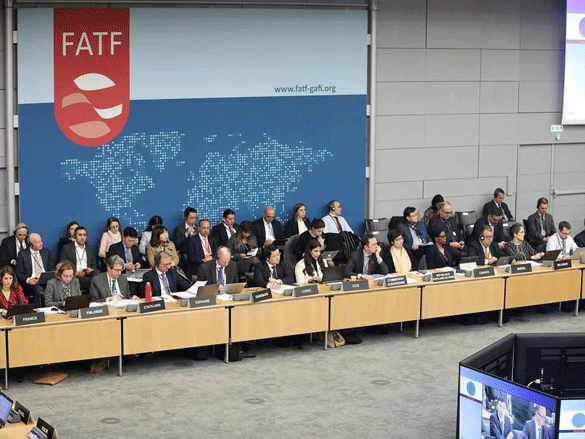
Institutions such as the Financial Action Task Force (FATF), Europol, the European Counter Terrorism Centre, TRACFIN, the Egmont Group of Financial Intelligence Units, and the Wolfsberg Group have become indispensable pillars of the global effort to identify and disrupt terrorist financing.
The effectiveness of these institutions depends not merely upon stronger legislation but upon timely information-sharing, coordinated investigations, and common international standards.
Looking Beyond the Money
Abécédaire du financement du terrorisme succeeds because it broadens our understanding of terrorism beyond ideological rhetoric and battlefield violence. It reminds us that extremist organisations survive through intricate financial ecosystems that are often invisible to the public yet indispensable to their operations.
If governments wish to prevent future attacks rather than merely respond to them, tracing the movement of money must become as important as tracking the movement of militants.
Yet financial networks explain only one side of the equation.
An equally important question remains unanswered: Why do individuals become extremists in the first place? What psychological needs, emotional vulnerabilities, and social dynamics transform ordinary people into committed radicals willing to kill—or die—for a cause?
Those questions are explored in the second book under review, The Psychology of Extremism: A Motivational Perspective, which will be discussed in the next instalment of this series.
(To be continued in Part II)
…
URL: https://newageislam.com/war-terror/understanding-terrorism-two-landmark-studies-part-1/d/140580
New Age Islam, Islam Online, Islamic Website, African Muslim News, Arab World News, South Asia News, Indian Muslim News, World Muslim News, Women in Islam, Islamic Feminism, Arab Women, Women In Arab, Islamophobia in America, Muslim Women in West, Islam Women and Feminism