
Ghazi on Screen
By Farooq Sulehria
Oct. 21, 2011
While Ilam Din is embracing death, Jinnah is addressing a rally in Lahore, telling people, “As long as Muslims do not create a separate country, Raj Pals will be born over and over again”. In 2002, Gujar Art Production produced a remake of Haider’s film, Ilam Din Shaheed (1978). In 1991, PTV aired ‘Ghazi Ilam Din Shaheed’, directed by Iqbal Ansari, scripted by Asghar Nadeem Syed
--------
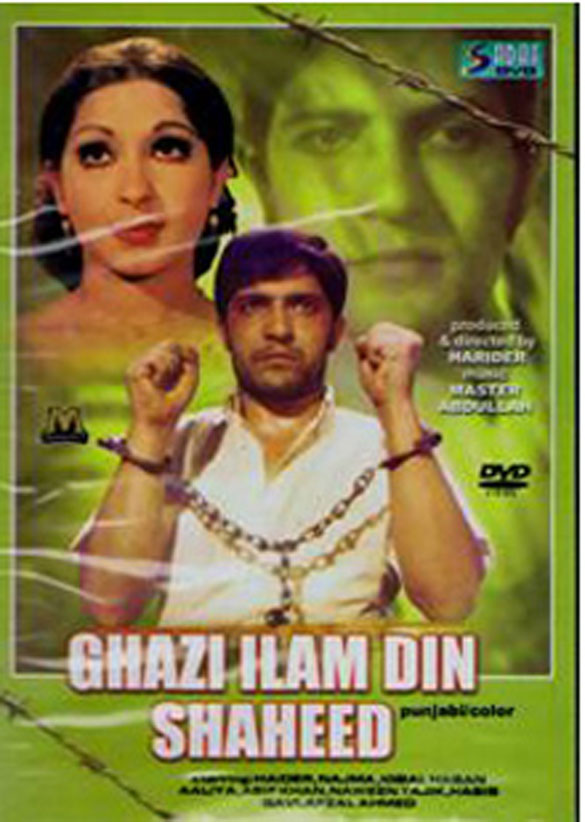
In 1978, Lollywood first began to take up Ilam Din and blasphemy as a theme with Ghazi Ilam Din, a G&S Co. production. The Punjabi-language film was produced and directed by Haider and released on 5 September, a day ahead of ‘Yum-e-Dafah’ (Pakistan Defence Day). The cast included Najma, Alia, Haider, Iqbal Hassan, Qavi, Afzal Ahmed, Badar Munir, and Ali Ejaz; the music was composed by Abdullah.
According to Yasin Goreeja’s ‘Pakistan Millennium Film Directory’, the film was neither a box-office hit nor a total flop. I spent some time at Lahore’s Hall Road searching for a DVD copy of the film last summer. But in vain. However, it is available on YouTube.
The film is notable for its portrayal of Hinduism and of the British. Hindus are presented as miserable, corrupt, and sexually debauched while the British are scheming. Muslims, meanwhile, are poor and hard working. Ilam Din (Haider) is depicted as a blessed Muslim from the moment of his birth. When a mullah recites Azan (call for prayers) in his ear, the new-born Ilam Din stops crying and listens to Azan attentively. The mullah interprets this as a blessed sign. In contrast, Raj Pal (Afzal Ahmed) is greedy, scheming and sexually wayward. He is fond of a Red Light Area girl who is also a Hindu.
Raj Pal wants to publish an inflammatory book to provoke the Muslims. The white ruler (Angraiz Sarkar) has assured him that no harm will come his way. But his wife and daughter - who was once about to be raped by a local Hindu tough (Munawwar Saeed), only to be rescued by Ilam Din - dissuade him. When the book hits the stall, Muslims begin to protest. Raj Pal is sent to jail by the district court and the book is banned.
A Christian High Court judge, however, not only overturns the ban but also orders Raj Pal’s release. This annoys Muslims. A Pashtun, Abdul Aziz Kohati (Badar Munir), goes to Raj Pal’s office intending to murder him, but in a case of mistaken identity, kills his relative instead. Another attempt is made on Raj Pal’s life by a shadowy character played by Iqbal Hassan. Eventually, when Ilam Din, who has been working at Kohat, gets to know of Raj Pal, he returns to Lahore and stabs the author to death.
Like Abdul Aziz’s mother, Ilam Din’s mother (Najma Mehboob) is proud of her son’s actions. Both mothers keep praying that their sons will embrace martyrdom (Shahadat). Aziz is sentenced to life imprisonment, but Ilam Din is sentenced to death. Agitated Muslims decide to appeal against the verdict in the High Court and engage India’s foremost Muslim lawyer, Muhammad Ali Jinnah. A fundraising campaign is mounted to pay Jinnah’s fee. Jinnah (Qavi Khan), however, scorns the Lahorites for offering him a fee: ‘Don’t you know my name is Muhammad Ali. I won’t take any fee.’
But his defence is ineffective because Ilam Din, despite attempts to persuade him otherwise by Lahore’s Muslim leaders, refuses to deny his act. As a result, Jinnah’s defence seeks to justify the murder as a response to blasphemy; he also pleads for the introduction of blasphemy laws in the country.
The authorities are concerned that the execution of llam Din could lead to a breakdown of law and order so they send him to Mianwali Jail where he is hanged. While Ilam Din is embracing death, Jinnah is addressing a rally in Lahore, telling people, “As long as Muslims do not create a separate country, Raj Pals will be born over and over again (paida hotay rahain gay)”. The film ends with the arrival of Ilam Din’s dead body in Lahore, and as his dead body is taken to Miani Saab, the film ends.
In 2002, Gujar Art Production produced a remake of Haider’s film, Ilam Din Shaheed. Directed by Riaz Gujjar, it was an Urdu-Punjabi production, with music composed by Ali Afzal and a cast that included Moammer Rana ---playing Ilam Din--- Saima, Saood, Nirma, Tabinda and Shafqat Javed Cheema.
In 1991, the Pakistan Television (PTV) broadcast a serial entitled Wafa kay Pekar (Fidelity Personified), which portrayed great Muslims from Islam’s history. The serial included a play, Ghazi Ilam Din Shaheed, directed by Iqbal Ansari. Although scripted by Asghar Nadeem Sayeed, it was based on a book by Zafar Iqbal Nagina, who for a few years had worked as a journalist with a couple of mainstream Lahore-based vernacular dailies. Before it was published, the book had been serialised by the Daily Pakistan in its weekly magazine.
The TV version not only lacks the typical Lollywood dance and song sequences, it is also a grim narrative , in contrast to Bollywood’s 1978 production in which Ali Ejaz’s brisk humour at least offered some comic relief. On the mini-screen, Ilam Din was played by TV actor Toqeer Nasir. The Jang (15 January 1991) carried an in-depth report about the filming of Ghazi Ilam Din Shaheed under the headline, ‘Ghazi Ilam Din Shaheed ki shooting asal phanis ghat per’ [Ghazi Ilam Din Shaheed filmed on actual site of gallows]. The report describes the scene when Toqeer Nasir, along with the crew, walks towards the gallows for the filming of the execution scene: ‘The jail inmates began reciting Kalma-e-Shahadat. They were waving at Toqeer Nasir as he was taken to the gallows (Takhta-e-dar). The prisoners were waving at Nasir and bidding him adieu (haath hila hila kar alwida keh rahay thay).’
The report goes on: ‘Meantime, a prisoner shouted at his jail mates, “Those who want to show their faces to their mothers, better come and join the spectacle”. The prisoners were chanting “Toqeer Nasir Zinda Bad” (Long live Toqeer Nasir)’. The report says that the shooting had to be postponed for an hour because ‘Toqeer Nasir was overcome by emotions.’ The Nawa-i-Waqt also ran a report on Ghazi Ilam Din Shaheed. Entitled ‘Islami Tareekhi dramo’N ki ibtada (Launching of Islamic historical plays)’, it says that Toqeer Nasir filmed all the scenes after having performed his ablutions (bawazo ho kar).
Farooq Sulehria is working with Stockholm-based Weekly Internationalen (www.internationalen.se). Before joining Internationalen, he worked for one year,2006-07 at daily The News, Rawalpindi. Also, in Pakistan, he has worked with Lahore-based dailies, The Nation, The Frontier Post and Pakistan. He has MA in Mass Communication from Punjab University, Lahore. He also contributes for Znet and various left publications in Europe and Australia.
Source: Viewpoint
URL: https://newageislam.com/war-terror/ghazi-screen/d/5778