
Drama at Deoband-Spurious claims of Indian Muslim leadership
Yoginder
Sikand, TwoCircles.net
9
November 2009
Last
week, tens of thousands of men—this was a strictly all-male gathering—descended
on the town of Deoband in Uttar Pradesh’s Saharanpur district to attend the
30th annual convention of the Jamiat Ulema-I-Hind, a leading body of Muslim
clerics of the ultra-conservative Deobandi sect. Sources claimed that the
gathering numbered over five hundred thousand, brought in from across India.
Impassable crowds clogged the narrow, dusty pathways leading to the venue of
the rally, and so, although I had travelled all the way from Bangalore to
report on the event, I had to content myself by listening to the speeches
relayed by loudspeakers while sitting a mile away, in the portals of the Darul
Uloom, possibly the world’s largest madrasa and the nerve-centre of the
Deobandi movement.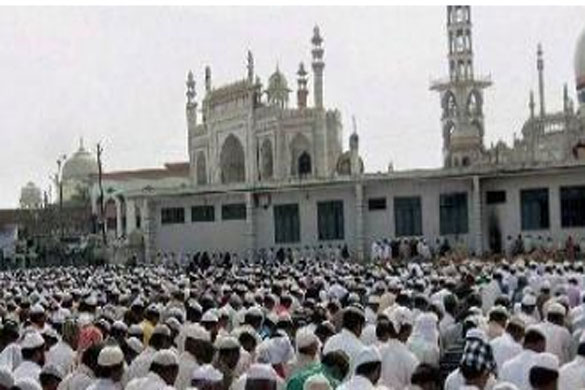
The
event commenced with a maulvi reciting an Urdu poem extolling the sacrifices of
the ulema of the Jamiat in India’s freedom struggle. ‘Were it not for us’, he
burst forth, ‘you’—by which he probably meant the Hindus of India—‘would still
be labouring under the yoke of the British.’ ‘We stiffly opposed the creation
of Pakistan. We have sacrificed our lives for the country. We condemn all forms
of terror. We love our India, whether or not you believe this’, he went on. The
men sitting around me—dressed, like the rest of the crowd, in white
kurta-pyjama, and sporting unkempt beards and white skull-caps—enthusiastically
shook their heads in agreement. Like the maulvi-poet, they laboured under the
burden of being forced to prove their patriotism, their anti-Pakistani
credentials, and their opposition to terrorism—an unenviable predicament they
were compelled to share with the rest of their co-religionists at a time of
heightened Islamophobia the world over.
More
than the speeches delivered at the rally it was the response of some of those
who attended the event, including a number of students and graduates of the
Darul Uloom, that interested me. And, among these, it were the cynics who
impressed me the most. ‘This is just a political stunt orchestrated by the
self-styled head of the Jamiat, Maulana Mahmud Madani’, said Akram, a peasant
from a village near Saharanpur. ‘The rally is simply a show of strength, to
impress upon the Congress his claim to be the leader of the Muslims, and to
curry favour with Congress bosses’.
Akram
spoke of murky goings-on within the Jamiat. ‘These selfish mullahs can never
agree, though they keep harping on Muslim unity. They love nothing more than
fighting among themselves.’ The Jamiat had split into several rival groups, he
explained. One was led by the recently deceased Maulana Fuzail. The other two
were headed by Maulana Arshad Madani and his nephew, Maulana Mahmud Madani,
respectively. Maulana Arshad had recently organized an anti-terrorism
conference, which had invited much media attention. Not to be outdone, Akram
explained, Mahmud, who had emerged as his principal rival, had now arranged for
this mammoth rally. ‘A petty game of one-upmanship’, Akram remarked. Mahmud’s
branch of the Jamiat, he claimed, had splurged vast sums of money for this
purpose, subsidizing train fares to the men who had been brought in, lured by
the prospect of a free holiday in Deoband and free chicken biryani - ‘neither
of which’, Akram joked, ‘a true Deobandi could ever refuse’. ‘How can these
mullahs unite the Muslims and speak for us, when they cannot even unite among
themselves?’, he angrily spluttered.
‘You
won’t spot a single modern-educated Muslim in this huge carnival’, said Faisal,
the owner of a bookshop located adjacent to the Darul Uloom. ‘The maulvis shun
them, not just because they don’t find them religious enough but also because
they fear that they will challenge their hegemony’. He indicated the crowd
surging past his shop. Their features, dress and mannerisms all revealed, he
said, that they were all poor peasants, madrasa teachers or maulvis. ‘The
maulvis have little or no understanding of the modern world, so how can they
provide us Muslims with proper leadership?’, he continued. ‘But because the
Muslim middle class remains indifferent to community issues, engrossed in their
pursuit of material acquisition or simply too scared to speak out against the
mullahs’ obscurantist views, the mullahs’ hold on the community continues unchallenged’.
‘That’s why lakhs of Muslims have so easily been mobilized by the Jamiat for
this mela’.
Bilal,
a student of the Darul Uloom, decried the opposition of the Jamiat leaders to
madrasa reforms, which was reflected in the resolution they passed at the
conclusion of the conference decrying the suggestion that the Government set up
a national madrasa board. ‘These politically influential maulvis send their
sons to modern schools and even abroad, but they won’t let us madrasa students,
most of who come from very poor families, learn anything about the modern
world. They want us to remain ignorant so that they can continue to play
politics in our name.’ He pointed to an open drain that ran along the wall
outside the madrasa, clogged with grey water, plastic bags and blobs of fresh
human refuse, out of which emerged an overpowering, nauseous sulphurous stench.
Ahead, built into the outside wall of a mosque, a door-less toilet was littered
with excrement that spilled out onto the street. ‘According to a saying
attributed to the Prophet, cleanliness is half of faith. And so, as you can
see, here half our faith is in the gutters!’
Bilal
took me around the hostels of the madrasa, into dark, dingy airless rooms, each
shared by more than half a dozen students. Cobwebs hung like thick curtains in
corners, and the floors were strewn with filth. The scenario was even more
pathetic at the nearby Darul Uloom Waqf, a madrasa set up by a rival group of
Deobandi maulvis in the wake of a coup engineered by the Madani family that
forcibly ousted the then rector of the Deoband madrasa, Maulana Qari Tayyeb, in
1980. Vegetable peels and waste daal and rice law thrown around in large
puddles outside the students’ rooms, under vast armies of flies. ‘The maulvis
here, who never tire of claiming to be heirs of the Prophet, simply don’t care
about all this. All they hanker after is power and fame’, Bilal rued.
The
next morning’s newspapers gave wide coverage to the Deoband rally, focusing
particularly on one of the many resolutions that the Jamiat had passed—its
opposition to the compulsory singing of the Vande Mataram song. Rizwan, a
graduate of the Dar ul-Ulum, now teaching in a Deobandi madrasa in Agra, summed
up what seemed to be a widely-shared feeling among the participants at the
rally. ‘We love India, but it is ridiculous to demand that our loyalty be
tested on the basis of our attitude to this song.’ The song, originally
contained in a book that openly spewed hatred against Muslims, had generated a
major stir even in pre-independence days, he explained. It was also, he pointed
out, unacceptable not just to Muslims but to other monotheists, for it spoke of
the worship of the motherland as a deity. At the same time, he added, there was
simply no need for the Jamiat to have raked up the issue that had been lying
dormant for years. ‘It’s probably a deliberate tactic of Maulana Mahmud and his
cronies to leap into the limelight by igniting a controversy and then
presenting themselves as leaders of the Muslims’, he mused.
Rizwan
was equally critical of the media coverage of the rally. ‘The media has pounced
on the Vande Mataram issue, conveniently ignoring the other resolutions passed
at the rally—the Jamiat’s condemnation of terrorism, its demand for the
implementation of the recommendations of the Sachar Committee report, its call
for combating communalism and providing security to Muslims and so on’. ‘Like
our self-styled leaders behind this Jamiat-sponsored drama’, he added ‘the
media, too, is simply not interested in the welfare of the Muslim masses. They
both revel in stirring wholly avoidable controversies, while it is the hapless
Muslim masses who continue to suffer, and whose voices continue to go unheard.’
URL of this Page: https://newageislam.com/the-war-within-islam/drama-deoband-spurious-claims-indian/d/2079