
Taliban's Retrograde Steps Removing Women From Public Life
Now
Taliban Bars Women From Working In NGOs.
Main
Points:
1. 3 NGOs stop
working in Afghanistan.
2. The
international NGOs cannot reach children, men and women in distress without the
help of women staff.
3. The US
condemned Taliban's step.
4. The UN said
Taliban's step will jeopardise the life of 2.8 crore Afghan children and adults
who depend on humanitarian relief from the UN and national and international
NGOs.
------
By
New Age Islam Staff Writer
26 December
2022
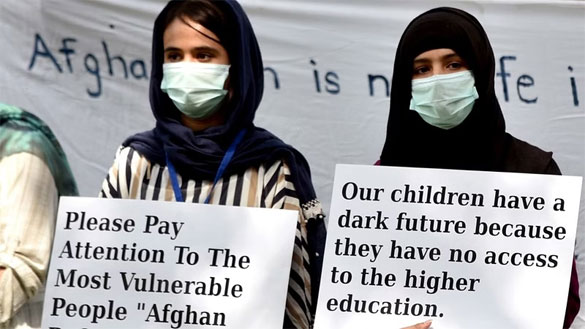
Representational image. | Afghan Refugee
Women Association members hold placards during a protest at Jantar Mantar, in
New Delhi on 16 August 2021. | Photo: ANI
-----
For over a
year, a tug of war was being played within the inner circles of Taliban. The
political leadership based in Kabul was trying to its liberal face to the world
by saying that it was not against female education and that it wants to
guarantee the rights to women enshrined in the Shariah. It also opened schools
for girls and allowed girls to study in universities with some conditions.
Previous
Minister for Higher Education, Abdul Baqi Haqqani was comparatively liberal.
But the ideological headquarters of Taliban based in Kandahar was rigid over
women's rights including right to education. They wanted complete isolation of
women from public. And in December, the Kandahar Elders prevailed over the
political leadership of Taliban. First, they banned university education for
girls. Then they banned primary education for girls. Now the girls are left
with madrasa education.
The
educated women have suffered the most because they had been working as
teachers, doctors, clerks, fashion designers, TV anchors, reporters,
journalists and activists. Suddenly, all the avenues of work and livelihood
have been closed for them.
The world
thinks that the Taliban are following the Shariah because they belong to a
religious organisation having ideological affiliations to the Deoband school of
Islamic thought. But it would be wrong to look at them from the religious point
of view.
The Taliban
are not different from the illiterate tribal leaders of the early 20th century.
They opposed social and educational reforms that were brought by the kings and
their educated wives.
King Abdur
Rahman Khan of Afghanistan who had ruled Afghanistan from 1880 to 1901 had
tried to bring reform by raising the age of marriage to 18 for girls and had
permitted divorce. His wife Bobo Jan would wear a veil in public and rode
horses. King Abdur Rahman's son King Habibullah had opened colleges and an
English medium schools for girls. But faced the wrath of tribal leaders and was
subsequently assassinated.
After his
assassination King Amanullah ruled Afghanistan. His wife Soraya Tarzi was an
educated lady and wanted to bring an educational reform among Afghan women.
Amanullah tried to end the custom of veil and proscribed polygamy. Soraya
promoted girls' education. This antagonised tribal leaders and they had to
leave Afghanistan due to the fear of a backlash at the hands of fearful tribal leaders
like Bacha Saqqa.
During the
40s, universities and colleges were set up in Kabul, Kandahar and other cities and,
Afghanistan made small strides towards education and development.
The Taliban
have inherited the tribal culture and values of Afghanistan. They have only put
up the garb of Islamic ideology to be acceptable to the mainstream Islamic
world. Their affiliation to Deoband school has helped them garner the support
of Deobandi Ulema like Maulana Arshad Madani.
In the
tribal culture of Afghanistan, girls attaining the age of 12 are barred from
public life as they reach puberty in that age. Therefore, in tribal areas,
girls are not allowed to study after the sixth grade. During the secular and
democratic governments between 2001 to 2021, girls were allowed to study from
primary to university level. Women worked in every field from hospitals, to TV
studios. They worked as fashion designers, journalists, sportswomen, activists,
teachers and professors. But all this stopped after August 2021.
Today Afghan
women have been relegated to the corner. They have been fully removed from
public life. They cant even go to primary schools. They may at the most be
allowed to go to the local madrasa and memorise some religious lessons and then
may be married to an elderly Afghan Jirga leader or Taliban fighter against her
will.
They cannot
pursue any professional career. They can't dream of becoming a doctor, an
engineer, a pilot or even a teacher.
The senior
Afghan leaders of Taliban have sent their daughters to prestigious colleges for
higher education. This speaks of their hypocrisy. In India too, the sons and
daughters of separatist leaders of Kashmir study in universities of Pakistan.
In
Afghanistan, women can't even go to parks, mosques and seminaries. They will be
confined within the four walls of their parents' house or of their in - laws.
They cannot contribute to the development of the nation or of their own species.
Their fate will be decided by some Taliban leaders of tribal mentality. Though
Saudi Arabia and Pakistan have raised their voice but the Islamic world in
general is silent on this issue. As Mr Praveen Swami says in his article, the
world is unanimously silent on the violation of women's rights in Afghanistan.
In the 7th
century, the advent of Islam had brought about a revolution in the thought
process of the tribals of Arab and they helped in the emancipation of women and
freed women from the clutches of slavery. They made great strides in the fields
of science and technology. In the 21st century, a narrow and obscurantist
interpretation of Islam has pushed the tribal community of Afghanistan back to
the pre-Islamic mentality which considers women only sex slaves.
-----
For
Afghan Women, World Is Uniting Again—This Time To Leave Them To Their Fate
By
Praveen Swami
25
December, 2022
From the
high walls of Afghanistan’s Ministry of Information and Broadcasting, the
portraits of the country’s kings looked down on the journalists who trooped
into Kabul after 9/11, in the weeks after the fall of the Taliban. There was
just one painting—taken from a photograph of king Amanullah Khan—which included
the queen consort. The artist, anthropologist Julie Billaud observed, had chosen to paint a traditional wedding veil
over queen Soraya Tarzi’s face, flowing down to the floor.
Late in
August 1928, Tarzi had torn off her veil at a Loya Jirga, or grand assembly of
tribal elders, after a speech where the king had declared “Islam did not require women to cover their bodies or wear any special
kind of covering.” Tarzi set up the country’s first schools and hospitals for
women. The portrait represented the erasure of Tarzi’s dramatic rebellion
against tradition—a radicalism too deep even for the new republic.
Earlier
this week, the reborn Islamic Emirate of Afghanistan banned women from
universities—the latest in a series of measures which mark the descent of an
iron veil over Afghanistan. Girls have been banned from high schools, the United Nations says, and gender-segregation rules are denying women
access to work and even healthcare. Forced marriages—often to ageing Taliban commanders—have become common.
The Taliban had
promised,
before taking power, to allow the education of women to continue, and vowed to
“guarantee the legal and human rights of every child, woman and man.” Their
failure to keep their promises has led to loud condemnation in world
capitals—but the international community is offering Afghanistan’s women little
more than pieties. Even scholarships
for women have been restricted in India, and many other countries.
“Women are
half of society and they’re disregarded,” one woman told the researchers
Roxanna Shapour and Rama Mirzada. “How can a bird fly on only one wing?”
The Politics
Of Gender Apartheid
Ever since
the cleric Nida Muhammad Nadim took charge as the Islamic Emirate’s higher
education minister in October, he began working to dismantle the last traces of
Tarzi’s legacy. Last month, the minister
assailed Amanullah for “bringing debauchery and obscenity from foreign lands.” Educating women, he argued, “clashed with
Islam and Afghan values.” Following the decision to close college gates to
women, Nadim
complained that students “wore dresses like they are going to a wedding ceremony.”
The higher
education minister also argued against
examination tests for Taliban candidates who were seeking jobs. A Taliban’s true
qualification, he insisted, was the “number of bombs” he had detonated.
Like many
of the most powerful figures in the Islamic Emirate, Nadim is a member of a
small circle of clerics from the southern Kandahar region grouped around its
emir, Hibatullah Akhundzada. The key
figures in the group include Mohammad Khalid Haqqani, the head of the Ministry
for the Promotion of Virtue and Prevention of Vice—responsible for enforcing
theocratic norms—as well as chief justice Abdul Hakim Haqqani and minister of
religious affairs Nur Muhammad Saqeb.
Few details
have emerged on Nadim’s background, but the 1977-born cleric is thought to have
run a seminary in Kandahar, before joining the Taliban insurgency after 9/11.
Earlier, he served as regional governor for Nangarhar and Kabul.
The hard
line on educating women, some argue, is enmeshed with a power-struggle within
the Taliban, with rival factions using religion as an instrument to assert
their legitimacy. Earlier this year, Akhundzada ordered judges to rigorously enforce Shari’a-law punishments,
including flogging and amputations—restituting the savagely-coercive legal
system used to subjugate women before 9/11.
Even
earlier, though, the Islamic Emirate had taken an ambiguous posture on
educating girls—notably, by resiling on a promise to reopen high schools after a meeting of top leaders failed to reach
a consensus. The previous minister for higher education, Abdul Baqi
Haqqani—linked to the eastern Afghan networks of Taliban leader Sirajuddin Haqqani—had said
women could continue to study at university, but in gender-segregated
classrooms. Abdul Baqi, however, insisted formal education was “less
valuable”
than clerical instruction.
Top Taliban
leaders—among them health minister Qalandar Ebad, deputy foreign minister Sher
Mohammad Abbas Stanikzai, and spokesperson Suhail Shaheen—sent their own daughters for higher education, casting it as
an Islamic duty.
Facing
resentment against Taliban commanders enriched by power in Kabul—in an
increasingly poor country—the southern Afghan clerics responded by pushing the
anti-modern values of their peasant constituencies.
Even after
a democratic government was instituted following 9/11, resistance against
education for girls remained widespread in swathes of rural Afghanistan. The United
Nations noted last year that the number of girls in higher education increased from
only 5,000 in 2001 to just around 90,000 in 2018. Teachers and students
remained concentrated in urban areas.
Education,
Gender And Class
Entwined
with class and tradition, the education of women has been a fraught political
issue for over a century. King Abdur Rahman Khan—the founding patriarch of the
Afghan State, who ruled from 1880 to 1901—believed women ought to remain
subordinate to men, but sought to eradicate some elements of institutionalised
discrimination. The king abolished the custom of forcing widowed women to marry
their husband’s next of kin, raised the age of marriage, and permitted divorce.
Fahima
Rahimi and Nancy Dupree Hatch have
recorded that king Abdur Rahman’s wife, Bobo Jan, appeared in public without a
veil, wearing European dress. The queen, they wrote, engaged actively in
politics, “rode horses and trained her maidservants in military exercises.”
King
Habibullah, Abdur Rahman’s son, continued efforts at reform, opening
Afghanistan’s first colleges, as well as an English-medium school for girls.
Tarzi’s father—the liberal journalist and diplomat Mehmud Beg Tarzi—played a
key role in pushing for reforms in education and marriage. The modernisation
effort, though, challenged the power of tribal leaders—leading to the king’s
assassination in 1919.
Following
the murder, Tarzi and king Amanullah rose to rule the country. Their ambitious
efforts at reform provoked a furious backlash. Encouraged by imperial
Britain—which saw Amanullah as a threat—tribal rebellion was soon brewing
against his efforts to end the veil, give women the right to choose their
partners, and proscribe polygamy. Images of the unveiled queen were circulated
in Afghanistan’s south, inciting anger among clerics.
European
experiences led the royal couple to transform Afghanistan into a constitutional
monarchy with an elected assembly and a secular judiciary. The most significant
of their decisions was to make education compulsory for both genders and set up
co-educational schools.
Though the
reforms did little to change the lives of women outside Kabul, Huma Ahmed-Ghosh writes, they constituted a powerful threat to the
established order. The Loya Jirga rebelled in 1928, incensed by Amanullah’s
decision to raise the marriage to 18 for women and 21 for men. Amanullah rolled
back his plans, but it was too late: The king and queen would be forced into
exile ten years after they took power.
The Mullahs
Against The State
Empowering
women continued to be a central motif of Afghan modernisation, however. Though
King Zahir Shah moved cautiously through his long reign from 1933-1973, he saw
empowering women as part of a wider political effort to break the hold of
reactionary clerics over rural society. Women teachers, nurses and doctors
began emerging from Afghan educational institutions in the 1940s. Kabul
University founded faculties of medicine, sciences and humanities for women, in
addition to separate institutions for men.
Following a
coup in 1973, Zahir Shah was deposed by his cousin Daud Khan, who set up a
one-party republic. The new republic dramatically
expanded education for girls. Leaders supported by Pakistan, like Gulbuddin
Hekmatyar, Ahmad Shah Masood, and Burhanuddin Rabbani, made the issue a
centre-piece of their resistance to the regime.
Kabul and
other cities, Billaud writes, “were perceived to be the centres of ‘sin’ and
‘vice’ precisely because of the high visibility of educated, emancipated urban
women. To many peasant women, whose lives had gained little from the process of
westernisation, the idea that a licentious urban élite was threatening the
family and the rural order was an attractive one.
Fanaticism
flourished inside refugee camps in Pakistan, which grew dramatically after the
Soviet invasion in 1979. A decree issued by clerics in 1989, Valentine Moghadam recorded, ordered women “not to walk in the middle of
the street or swing their hips, they were not to talk, laugh, or joke with
strangers or foreigners.” A year later, girls were barred from school. Women
who protested, like the feminist Meena Keshwar Kamal, were assassinated.
The Taliban
institutionalised these values when they captured power in 1996. A sliver of
ankle showing, a gust of wind slightly revealing the face, a movement judged as
provocative: Almost anything could be punished with a public beating.
Following
its Cold War triumph, the United States and its allies ceased to care. Today,
the world is uniting in showing its willing to leave Afghan women to their
fate.
----
Praveen
Swami is National Security Editor, ThePrint. He tweets @praveenswami. Views are
personal.
(Edited by Anurag
Chaubey)
Source: For
Afghan Women, World Is Uniting Again—This Time To Leave Them To Their Fate
URL: https://newageislam.com/the-war-within-islam/taliban-retrograde-women-public-life/d/128718
New
Age Islam, Islam Online, Islamic Website, African Muslim News, Arab World News, South Asia News, Indian Muslim News, World Muslim News, Women in Islam, Islamic Feminism, Arab Women, Women In Arab, Islamophobia in America, Muslim Women in West, Islam Women and Feminism