
When Debate Becomes Spectacle: Sectarian Polemics and the Crisis of Religious Ethics in Kashmir

By Mushtaq Ul Haq Ahmad Sikander, New Age Islam
01 July 2026
Religious debates in Kashmir have shifted from scholarly exchange to performative sectarian spectacle, weakening ethics, truth-seeking, and communal balance.
Main Points:
• It argues that recent religious debates in Kashmir have become staged performances driven by ego, applause, and online attention rather than genuine scholarship.
• It says Islam permits dialogue, but only in a wise and ethical manner, not through humiliation or triumphalist combat.
• It criticizes the misuse of the mubahala episode, noting that it was a prophetic moment and not a general model for public polemical contests.
• It highlights how Barelvi-Deobandi differences have been turned into sectarian branding, often ignoring their shared Hanafi background and historical complexity.
• It warns that social media debates distract the community from real concerns such as education, morality, and social justice, while damaging young people’s understanding of Islam.
…
There is something profoundly unsettling about the current culture of religious debate unfolding in Kashmir. What was once confined to dense theological texts and scholarly circles has now descended into a public spectacle—live-streamed, monetized, and cheered on like a competitive sport. The recent debate between Nasir Firdous, self-styled as “Sunni Tiger,” and Irfan Deobandi is not an isolated incident but a symptom of a deeper malaise. It reflects a dangerous shift: from the pursuit of truth to the performance of triumph, from ethical disagreement to sectarian combat.
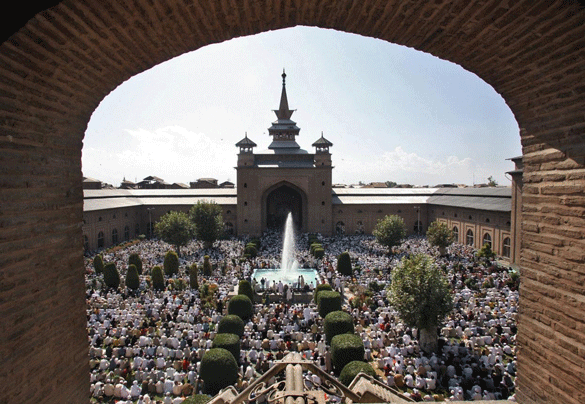
Let us state this clearly at the outset: debating, in the adversarial and triumphalist form now being popularized, has never been an Islamic injunction. Islam does not command believers to enter arenas of polemical combat in order to “defeat” one another. The Qur’an permits dialogue, but it regulates both its purpose and its tone. “Invite to the way of your Lord with wisdom and good instruction, and argue with them in a way that is best” (16:125). The operative phrase here is “in a way that is best”—not loudest, not most humiliating, not most viral.
What we are witnessing today is not “argument in the best manner” but it’s very opposite: argument as spectacle, as ego, as performance. Victory is declared not on the basis of rigorous scholarship but on applause, social media engagement, and the echo chambers of one’s own followers. In such an environment, truth becomes secondary; what matters is who appears dominant.
The frequent invocation of the Prophet’s (peace be upon him) engagement with the Christians of Najran is particularly telling—and often deeply misunderstood. The Qur’an recounts: “Then whoever argues with you about it after knowledge has come to you, say: Come, let us call our sons and your sons, our women and your women, ourselves and yourselves; then let us pray earnestly and invoke the curse of Allah upon the liars” (3:61). This is the famous episode of mubahala. Crucially, when confronted with this invitation, the Christian delegation withdrew. They did not proceed. They stepped back from invoking divine curse.
But what is often ignored in contemporary appropriations of this episode is its singularity. This was not a general method prescribed for all Muslims across time. This was a moment tied to prophetic authority. The Prophet (peace be upon him) could call upon divine judgment because he was the recipient of revelation. His certainty was not speculative; it was divinely grounded. We, in contrast, inhabit a world of interpretation, legitimate differences, and partial knowledge.
To imitate the outward form of such an event—framing debates as decisive contests of truth and falsehood—is to strip it of its theological foundation. It is to turn a sacred moment into a theatrical template. Worse still, it creates the illusion that truth can be settled through rhetorical dominance rather than through revelation, scholarship, and character. Also none among us is Prophet who can be a yardstick between truth and falsehood.
This illusion is precisely what fuels the current sectarian tensions between Barelvis and Deobandis in Kashmir. Both groups, it must be emphasized, belong to the Hanafi school of jurisprudence. Their disagreements—whether on issues such as ‘ilm al-ghayb (the Prophet’s knowledge of the unseen), devotional practices, or theological interpretations—are not new. They have existed for over a century within the broader tapestry of South Asian Islam. Yet today, these differences are being weaponized as markers of faith and disbelief.
In the recent debate, Barelvi representatives claimed victory on the grounds that their beliefs are “1400 years old,” while those of the Deobandis are “only 100 years old.” This argument is not merely weak; it is historically incoherent. The very labels “Barelvi” and “Deobandi” are products of the late nineteenth century. They emerged within specific colonial and intellectual contexts. To claim an unbroken, exclusive lineage of 1400 years under these modern labels is to collapse history into rhetoric.
More troubling, however, is the moral posture that accompanies such claims. Deobandis are not simply being disagreed with; they are being rebranded as “Baad Mazhab”—a term loaded with condemnation. This is not theological discourse; it is sectarian branding. It reduces complex intellectual traditions to caricatures and transforms disagreement into deviance.
The figure of Nasir Firdous, or “Sunni Tiger,” embodies this shift. His prominence is not derived from scholarly contribution but from performative confrontation. The debate at his home, broadcast online, was less an exchange of ideas and more a staged contest. The declaration of victory was swift, celebratory, and—crucially—unquestioned within his support base. Financial contributions began to flow, with supporters eager to fund future debates against these so-called “Baad Mazhabs.”
This raises a disturbing question: what exactly is being funded? Is it the pursuit of knowledge, or the perpetuation of division? Time, money, and communal energy are being invested in exercises that yield no constructive outcome. There is no resolution, no synthesis, no intellectual advancement. Each side emerges claiming victory, reinforcing its own certainties, and deepening the divide.
This is not a new phenomenon. Polemical debates have a long history in the Muslim world. Scholars have written extensive refutations and counter-refutations. Yet even at their most intense, these exchanges operated within a framework of scholarship. They were addressed to trained audiences, grounded in textual evidence, and—importantly—did not claim to settle matters in a way that would render entire groups out of the fold of Islam.
What has changed today is the medium and the motive. Social media has transformed debate into performance. Complex issues are reduced to slogans, nuances are flattened. The goal is not understanding but virality. In this environment, anger travels faster than insight, and condemnation garners more attention than careful reasoning.
The consequences are severe, particularly for the younger generation. A young Muslim in Kashmir today does not encounter Islam first through its ethical teachings, its spiritual depth, or its intellectual richness. Instead, he or she is confronted with clips of mullahs shouting over one another, declaring each other misguided, innovated, or worse. Islam is presented not as a path of guidance but as a battlefield of egos.
It is no surprise, then, that many young people feel disillusioned. They see what can only be described as “angry birds fighting”—a chaotic, noisy, and ultimately meaningless exchange of hostility. The sacred is trivialized. The profound is reduced to the performative. And in the process, faith itself becomes collateral damage.
One must ask: what is the endgame of such a culture? If every disagreement is escalated into a public showdown, if every scholar is a potential opponent, if every difference is a threat to be neutralized—what remains of the Qur’anic vision of a community? The Qur’an describes Muslims as a “middle nation” (2:143), a community of balance, justice, and character. That vision is increasingly difficult to discern amidst the noise of sectarian polemics.
There is also a deeper theological problem at play. The assumption underlying these debates is that truth can be established through victory—through defeating an opponent. But in Islam, truth is not contingent upon human triumph. It is grounded in revelation and approached through humility. The Qur’an warns against those who “dispute about Allah without knowledge or guidance or an enlightening Book” (31:20). The emphasis here is on knowledge and guidance—not on rhetorical skill or public approval.
Without a Prophet among us, the stakes of such debates become even more precarious. We do not possess the certainty that would justify invoking divine judgment in our favour. We operate within the limits of human understanding. To behave as though one’s position is so unquestionably true that it warrants the public humiliation of others is not a sign of strength; it is a sign of intellectual and spiritual insecurity.
The tragedy is that these debates distract from the real challenges facing the Muslim community. Issues of education, economic hardship, moral development, and social justice receive far less attention than sectarian disputes. Energy that could be directed towards reform is instead consumed by argumentation. It is time to call this out for what it is: a lackadaisical approach towards priorities. A misplacement of religious energy. A confusion between defending Islam and defending one’s sect.
None of this is to suggest that disagreement should be suppressed. Difference of opinions is an integral part of the Islamic intellectual tradition. But there is a difference between disagreement and hostility, between critique and condemnation, between dialogue and spectacle. The former enriches the tradition; the latter corrodes it.
What is needed is not more debates, but a return to adab—intellectual and spiritual etiquette. A recognition that truth is not served by shouting matches. A humility that acknowledges the limits of one’s own understanding. And above all, a refusal to turn the Islam into a stage upon which egos perform. Until such a shift occurs, the cycle will continue: more debates, more declarations of victory, more fundraising, more division. And with each iteration, the distance between the community and the ethical vision of Islam will grow wider.
The question, then, is not who won the latest debate. The question is what has been lost in the process—and whether we are willing to acknowledge it. The stalwart Ulema of both sects have maintained silence, meaning that they are endorsing these futile debates and then they decry while the youth are getting wary of Islam and adopting other ideologies and lifestyles.
…
M. H. A. Sikander is Writer-Activist based in Srinagar, Kashmir.
New Age Islam, Islam Online, Islamic Website, African Muslim News, Arab World News, South Asia News, Indian Muslim News, World Muslim News, Women in Islam, Islamic Feminism, Arab Women, Women In Arab, Islamophobia in America, Muslim Women in West, Islam Women and Feminism