
Nahdlatul Ulema's Campaign Against the Concept of A Universal Caliphate Challenges Autocratic Governments in Arab World
The
Concept Of Caliphate Is Used By Terrorist Organisations To Justify Their
Violent Ideology
Main
Points:
1. Nahdlatul
Ulema organised a conference against the concept of caliphate in Java,
Indonesia.
2. Ten
thousand people attended the conference.
3. The Indonesian
President Joko Widodo participated in the conference.
4. The
conference discussed the ways to replace autocracy with a modern form.of
government.
-----
By
New Age Islam Staff Writer
5 April
2023
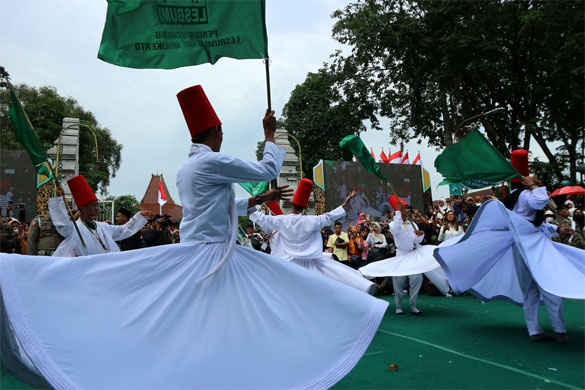
The
Nahdlatul Ulema, the organisation of moderate religious scholars of Indonesia,
organised a conference to discuss the ways to recontextualise Islamic law and
replace the 'outdated' concept of a universal caliphate for the entire world
with a modern state that respects the rights of non- Muslims and endorses the
United Nation' s Charter of Human Rights.
The
Nahdlatul Ulema opposes the concept of caliphate as an ideological tool to
legitimise the autocratic governments of the Arab kings and despots like that
of Saudi Arabia and UAE. The Nahdlatul Ulema also sees the Organisation of
Islamic Conference (OIC) as a platform that legitimises autocracy of the Arab
states.
The
concept of caliphate has long caught the fancy of Muslim religious scholars and
traditional intellectuals on the grounds of the initial caliphate of the four
rightly guided caliphs of Islam. Since under the caliphate of the rightly
guided caliphs, the Islamic empire flourished and expanded till Spain and Iran,
the general Muslims and Ulema of later periods got a deep rooted impression
that the caliphate was the blessed form of government for any Islamic
government if it wanted to flourish, prosper and be victorious against its
enemies. They ignored the fact that it was the administrative capability
coupled with characterial integrity of the ruler and not a form of government
that guaranteed its success. It was this misplaced belief that led Muslims to
support and pay allegiance to weak and incapable rulers in the name of
caliphate.
The
obsession of the Muslims with the form of caliphate was exploited by the
autocratic and despotic Muslim rulers in the Middle Ages to prolong their rule
and by the extremist and terrorist organisations of the 20th and 21st centuries
to implement their ideology of violence and bloodshed in the name of
establishing Shariah. The Al Qaida, the ISIS and the Taliban have been the
major terrorist organisations that used the concept of caliphate based on
Shariah to further their political agenda. This concept is based on the idea of
enmity with all non- Muslims.
The
Nahdlatul Ulema has been making an assault on the concept of caliphate with the
argument that Islam does not prescribe any particular form of government, leave
aside caliphate. Islam stresses on the establishment of a state based on human
rights, justice, equality, pluralism and peaceful co- existence with non-
Muslims. It says that a universal caliphate for the entire world is not
possible and will lead to confrontation between nation states of the Muslim
world.
Instead
what is needed is to remove the ideology that is based on Takfir (
declaring groups or individuals infidels). It achieved some success in 2019
when 20,000 of its scholars released a religious finding that eliminated the
category of Kafir in Islamic law. It was the same Indonesia where 126
Islamic scholars including the former grand Mufti of Egypt Shawqi Allam and
scholars of Al Azhar University had written an open letter addressed to Abu
Bakr Al Baghdadi, the so- called self proclaimed caliph of Mosul in 2014
accepting him as the caliph of the Muslim Ummah.
Perhaps,
India 's renowned Islamic scholar Maulana Salman Nadvi also was influenced by
this letter and he had written an open letter to al Baghdadi addressing him as Amir
ul Mumineen. Most of the 126 Islamic scholars participated in Nahdlatul
Ulema's conference in February hinting at a change in their point of view.
However, still some Islamic scholars of Egypt and Saudi Arabia opposed
Nahdlatul Ulema's position on caliphate. Nevertheless, the conference organised
by Nahdlatul Ulema is an important step towards bringing a positive change in
Muslim society.
-------
Reforming Islamic Jurisprudence
Shapes The Battle To Define Moderate Islam

By
James M. Dorsey
Mar 31,
2023
The
world’s largest, most moderate Muslim civil society movement has called for
abolishing the concept of a caliphate in Islamic law.
In a
radical break with Islamic orthodoxy, Indonesia’s Nahdlatul Ulama, or Revival
of Islamic Scholars, wants to replace the concept with notions of the
nation-state and the United Nations that are non-existent in Islamic legal
tradition.
The
reform is one pillar of the Indonesian movement’s campaign to update or, in its
words, re-contextualise Islamic law, free it from obsolete or outdated
concepts, and deprive militants and jihadists of the ability to employ
references to the Sharia to justify their theology, extremism, and violence.
Islamic
scholars from across the globe discussed the call in February at a day-long
gathering in the Javan city of Surabaya.
The call
was made public at a commemoration of Nahdlatul Ulema’s centennial, according
to the Hijra calendar, attended by more than a million people and Indonesian
President Joko Widodo.
“Nahdlatul
Ulama believes it is essential to the well-being of Muslims to develop a new
vision capable of replacing the long-established aspiration, rooted in Islamic
jurisprudence (fiqh), of uniting Muslims throughout the world into a single
universal state, or caliphate,” the group said in a declaration read out at the
rally.
“It is
neither feasible nor desirable to re-establish a universal caliphate that would
unite Muslims throughout the world in opposition to non-Muslims. As recently
demonstrated by the Islamic State in Iraq and Syria, or ISIS, attempts to do so
will inevitably be disastrous and contrary to the purposes of Sharia (Islamic
law): i.e., the protection of religion, human life, sound reasoning, family,
and property,” the declaration went on to say.
The
declaration asserted that Islam faces a choice: maintaining the obligation to
create a caliphate or reforming Islamic jurisprudence so that it would “embrace
a new vision and develop a new discourse regarding Islamic jurisprudence, which
will prevent the political weaponisation of identity; curtail the spread of
communal hatred; promote solidarity and respect among the diverse peoples,
cultures, and nations of the world; and foster the emergence of a truly just
and harmonious world order.”
In a
discussion paper distributed shortly after the conference and rally, Nahdlatul
Ulama argued that “Muslims should acknowledge that a socio-political construct
(or imperium) capable of operationalizing these normative views across the
Muslim world no longer exists" and that "as a consequence of choosing
to retain the established fiqh view and norms associated therewith it would
automatically be a religious duty incumbent upon Muslims to revive the
imperium. This, in turn, would necessarily entail dissolving any and all existing
nation-states, under whose governance Muslims currently live."
With its
assault on the concept of a caliphate, Nahdlatul Ulama laid down a gauntlet for
autocratic and authoritarian Muslim leaders by insisting that change needs to
involve reform of religious jurisprudence, not just social change as enacted,
for example, by Saudi Crown Prince Mohammed bin Salman and United Arab Emirates
President Mohammed bin Zayed.
These
reforms have enhanced women's social rights and professional opportunities,
eased restrictions on gender interaction and embraced Western-style
entertainment. However, the two men anchored these changes in civil law and
ignored the need to synchronise religious jurisprudence.
Anchoring
the United Nations and its charter in Islamic religious law would increase the
pressure on regimes in Muslim-majority countries to respect human rights.
The UN
charter obliges member states to honour “fundamental human rights…the dignity
and worth of the human person, (and)…the equal rights of men and women” and
makes it legally binding for its Muslim signatories.
Muslim-majority
states accepted that obligation when they joined the United Nations but couched
their religious legitimacy in the language of Islamic jurisprudence employed by
the Organisation for Islamic Cooperation (OIC) rather than the law itself. The
OIC groups the world’s 57 Muslim-majority countries.
By
reforming the jurisprudence, Nahdlatul Ulama would introduce guardrails for the
incorporation by OIC members of Islamic law into domestic legal systems.
Muslim-majority
states have used the OIC framework to monopolise the right to interpret Islamic
law and bend it to their will, for example, in the justification of abuse of
human rights or, in the case of countries like Saudi Arabia and the UAE, to
demand on religious grounds absolute obedience of the ruler.
The OIC
and some of its members have also used the organisation’s religious framing and
the 1990 Cairo Declaration on Human Rights in Islam to curtail rights enshrined
in the UN charter and lobby the United Nations to classify blasphemy a
violation of human rights and a form of hate speech.
In its
discussion paper, Nahdlatul Ulama asserted that the view that Muslims
"should have a default attitude of enmity towards non-Muslims, and that
infidels…should be subject to discrimination is well established within Turats
Al-Fiqh (the tradition of Islamic jurisprudence).”
An
earlier Nahdlatul Ulama concept note argued that “views that legitimize and
encourage suspicion, segregation, discrimination, and even hostility and
conflict towards those who bear the legal status of infidels…are scattered
throughout classical texts on Islamic jurisprudence (Fiqh). These
views…are still considered…credible…and should…be practiced to the present day.
Muslim groups involved in conflict – including the use of violence and terror –
defend their position by citing references from these classical fiqh texts.”
In 2019,
the Indonesian movement put its money where its mouth is when 20,000 of its
scholars issued a religious finding that eliminated the category of the Kafir
in Islamic law.
Nevertheless,
notions of the Kafir and the caliphate remain at the core of the Muslim
world’s response to religious extremism and jihadism.
An open
letter to Abu Bakr al-Baghdadi, the late leader of the Islamic State, written
after he declared in 2014 a caliphate with himself as caliph, insists that
“there is agreement (Ittifaq) among scholars that a caliphate is an
obligation upon the Ummah (Muslim community).” The letter was signed by 126
prominent Islamic scholars, including participants in the Surabaya gathering.
Among
the letter's signatories were state-aligned proponents of autocratic forms of
moderate Islam.
They
included Egyptian Grand Mufti Shawqi Allam; Egypt's former grand mufti, Ali
Goma, who religiously endorsed the killing on a Cairo square in 2013 of some
800 Muslim Brotherhood protesters by security forces; several members of Egypt’s
state-controlled Fatwa Council; and scholars At Al Azhar, Cairo’s citadel of
Islamic learning.
Also
among the signatories were Abdullah Bin Bayyah, the head of the Fatwa Council
of the United Arab Emirates, and one of its other members, popular American
Muslim preacher Hamza Yusuf, men who do the Gulf state’s religious bidding.
For over
two decades since the 9/11 Al Qaeda attacks on New York and Washington, Muslim
leaders and their Western counterparts have insisted that Islam and Islamic
jurisprudence need no reform. Instead, they asserted that jihadist ideology was
not rooted in religious jurisprudence and misrepresented and misconstrued the
faith.
Muslim
autocrats and authoritarians have used that argument to squash criticism of
their often brutal, repressive rule that brooks no dissent and potentially
breeds violence.
Moreover,
casting jihadists as deviants rather than products of problematic tenants of
religious jurisprudence allowed them to project autocracy as a necessary means
to combat extremism and promote a moderate Islam.
At the
core of the debate about Islamic jurisprudence is a battle for the soul of
Islam, involving competition for religious soft power and leadership of the
Muslim world and who will define what constitutes moderate Islam.
The
battle pits Nahdlatul Ulema’s concept of Humanitarian Islam, which calls for
religious reform and unambiguously endorses pluralism, the United Nations
Charter, and the Universal Declaration of Human Rights against an autocratic
definition of moderate Islam that rejects religious and political reform but
supports a formalistic, ceremonial form of inter-faith dialogue and the
loosening of social restrictions long advocated by orthodox Islam.
Autocrats
and their clerical surrogates ignore Nahdlatul Ulama at their peril.
The
Indonesian movement is a player with an estimated 90 million followers, 18,000
religious seminaries, 44 universities, tens of thousands of Muslim scholars
that constitute a religious authority independent of traditional centres in the
Middle East, a five million-strong paramilitary militia, and a political party
that was part of Indonesian President Widodo's coalition government and is an
influential member of Centrist Democrat International (CDI), the world’s
largest alliance of political parties.
The
degree to which Nahdlatul Ulama threatens proponents of an autocratic
definition of moderate Islam was reflected in how prominent state-aligned
Islamic scholars responded to invitations to attend the Surabaya conference.
Messrs.
Bin Bayyah and Goma initially said they would attend but then backed out.
Others opted for making statements on a video link but not participating in
person or any of the conference's deliberations.
Mr.
Allam used his video remarks to express opposition to Nahdlatul Ulema’s
proposition.
Muhammad
Al-Issa, the head of the Muslim World League, Mr. Bin Salman's vehicle for
propagating his autocratic version of moderate Islam, chose to ignore Nahdlatul
Ulema’s proposition in his video statement. Like Mr. Allam, Mr. Al-Issa had
initially indicated that he would attend.
Theirs
is a tactic that, at best, buys time for state-aligned Muslim scholars.
“The
majority of the Arab and Islamic delegations at the First International
Convention on Islamic Jurisprudence for a Global Civilization expressed a
traditional mindset that has become outdated. For they dealt with the centenary
of Nahdlatul Ulama as if it were a carnival,” said Muhammad Abu Al-Fadl, deputy
editor of Egypt’s Al Ahram newspaper, in his coverage of the Surabaya conference.
“If the
leadership of religious institutions in the Arab world continues to insist on
burying their heads in the sand, then Arab states may require another 100 years
to absorb the Nahdlatul Ulama project in Indonesia,” Mr Abu Al-Fadl went on to
say.
In the
ultimate analysis, state-aligned Islamic scholars are either able to coopt the
Indonesian reformers or will be forced to join the bandwagon.
So far,
efforts to coopt Nahdlatul Ulama have failed.
These
efforts included the Muslim World League joining Nahdlatul Ulama in hosting the
November 2022 Religion Forum 20 or R20, a summit of religious leaders in Bali
on the eve of the meeting of leaders of the Group of 20 (G20) that groups the
world’s largest economies.
Indonesia,
last year’s G20 chair, designated the R20 as an official G20 engagement party.
To be
sure, Nahdlatul Ulema’s jurisprudential reform is not binding in a Muslim world
where religious legal authority is decentralised.
Nevertheless,
influential commentators in Saudi Arabia and Egypt echoed Nahdlatul Ulema’s
call for religious reform without referencing the Indonesian group.
“All
religious institutions must work to create contemporary jurisprudence… The
Islamic world is waiting for (Saudi Arabia) to lead it towards contemporary
jurisprudence,” said Okaz newspaper columnist and Jeddah-based lawyer Osama
Al-Yamani.
Earlier,
journalist Mamdouh AlMuhaini proposed top-down Martin Luther-like religious
reforms that would be led by Mr. Bin Salman, even though the writer stopped
short of identifying the crown prince by name.
“There
are dozens, or perhaps thousands, of Luthers of Islam… As such, the question of
'where is the Luther of Islam' is wrong. It should instead be: Where is Islam's
Frederick the Great? The King of Prussia, who earned the title of Enlightened
Despot, embraced major philosophers in Europe like Kant and Voltaire and gave
them the freedom to think and carry out scientific research,” Mr AlMuhaini
said.
The
journalists' comments suggest that, at the very least, Nahdlatul Ulama has laid
down a marker that other Muslim religious authorities will ultimately be unable
to ignore if they want recognition as proponents of a genuinely moderate Islam.
Commenting
on Nahdlatul Ulema’s campaign, Mr. Abu Al-Fadl, the Al Ahram editor, asserted
that Middle Eastern Islamic scholars risk missing the boat.
“The
majority of Muslims look to the Arab world for guidance, and the failure of
this region’s Ulama (Muslim religious scholars) to keep up with the
transformations taking place will lead to the rug being pulled out from under
them. For the openness adopted by Nahdlatul Ulama and its new Chairman, Yahya
Cholil Staquf, will not stop at one specific country or region.”
-------
Dr.
James M. Dorsey is an award-winning journalist and scholar, an Adjunct Senior
Fellow at Nanyang Technological University’s S. Rajaratnam School of
International Studies, and the author of the syndicated column and podcast, The
Turbulent World with James M. Dorsey.
Source: Reforming Islamic Jurisprudence
Shapes The Battle To Define Moderate Islam
URL: https://newageislam.com/the-war-within-islam/nahdlatul-ulema-caliphate-autocratic-arab/d/129495
New Age Islam, Islam Online, Islamic Website, African Muslim News, Arab World News, South Asia News, Indian Muslim News, World Muslim News, Women in Islam, Islamic Feminism, Arab Women, Women In Arab, Islamophobia in America, Muslim Women in West, Islam Women and Feminism