
The World of Words

By Sumit Paul, New Age Islam
04 May 2026
"A word grows to a thought, a thought to an idea, an idea to an act." — Beryl Markham
According to a recent linguistic survey, two most exasperating words are, 'Wow' and 'Awesome.' Surprisingly, 'bro' and 'bestie' (a common term for a close friend) are not on the list of irritating words and terms. Both could and should have been!
How was the movie? 'It was awesome'. 'Wow, she looks awesome' (!) and so on. Is the vocabulary of English so poor as to have no other better words to express wonder and admiration than 'Wow' and 'Awesome'? You get to hear these two words umpteen times in a day. 'Every decade has its set words,' observed the British linguist David Crystal. If you remember, the decade of the 90s was bombarded with words like 'so sweet', ' so cute' and the 80s had words like 'excellent' and 'wonderful.' It's very interesting to note that people, despite having a fairly good vocabulary, have a pretty fixed way of using adjectives and superlatives and they generally don't go beyond those threadbare words in spite of being capable of reeling off a spate of superlatives. This linguistic trend is not just limited to English. Every language has certain words that are used ad nauseum. The Professor, scholar and critic of Urdu, the late Dr Gopichand Narang found that the most commonly used words in Urdu are 'Khoobsoorat' (in the sense of beautiful and excellent), 'Marhaba' (the word comes from Arabic and literally means 'hello' or 'welcome') and Allah/Khuda. In these sectarian times, Allah is reserved for the Sunnis and Khuda is for the Shias because Sunni Muslims have begun to say, Allah Hafiz and the Shia Muslims will always say the traditional and most euphonic, Khuda Hafiz. Alas, even languages haven't been spared by religions and sects. Of course, this is a recent phenomenon.
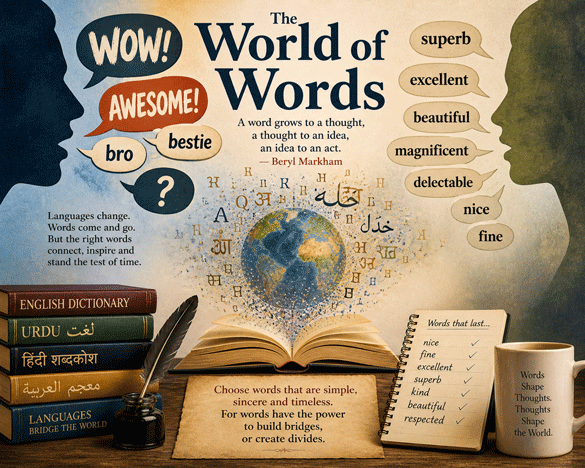
A few particular words have an uncanny quality to relate to others. When we say, 'Awesome', we relate to others unconsciously and spontaneously, knowing jolly well that he / she is pretty familiar with this word. Its linguistic ethos is relatable and that's the objective of Semantics (science of words and their meanings) and also the primary aim of communication. 'Superb', 'delectable' or 'magnificent' are very fine words and aptly describe the mood but these words don't strike the linguistic chords, conscience and consciousness. Right from the advent of human civilization, the human mind has been striving to find expressions that are not just relatable but are also disarmingly simple. Psycholinguists have found that above average and relatively intelligent human beings use only 2000-2500 words in their daily communication and correspondence: Working males average 2000-3000, females from 10,000-20000. However, both average about 500-700 words of actual value (i.e. words which have intent to communicate to another person). This means the ladies add a great deal of "filler" to their conversation (and they wonder why men tune them out!). Ordinary mortals use even fewer words. In all the languages, most of the words have ornamental value and they sound very distant and standoffish like 'connoisseur,' said to be linguistically the most aloof word. So is 'erudite', often used by those who pretend to know more than what they actually know! When 'south-paw' is used for a 'left-hander' it shows the user's above average vocabulary, but it fails to connect to another person's linguistic comfort level. That's the reason, William Somerset Maugham, who refrained from using varied adjectives in his novels and short stories, opined, 'Lush wordiness is for those who want to cover up their flaws and limitations as a writer. I know very limited words and am happy to use them to drive home my message.' Point to be noted.
Bombastic, highfalutin, and pompous words have a deeper import and they often reveal a person's personality and psychological make up. When we use hackneyed words and terms, which are in vogue, we often subconsciously drop a hint of our lack of linguistic imagination, called 'impoverished lingual prowess' (ILP) or in plain words, 'linguistic deficiency.' Words have a life span. We must be aware that expressions that are commonly used, may fade into the firmament of language/s as soon as they come into being. It's, therefore, essential to stick to words that are more or less deathless like 'nice', ' fine,' 'superb', 'excellent', among others. They may also sound moth-eaten and tattered, but they have survived the test of time to sound okay and acceptable even now. Outlandish words are out before you can say Jack Robinson. After all, it's an art to be judicious with words. Lastly, 'Awesome' had 'awe' and 'fright' in its earliest and most correct connotation.
…
A regular columnist for New Age Islam, Sumit Paul is a researcher in comparative religions, with special reference to Islam. He has contributed articles to the world's premier publications in several languages including Persian.
URL: https://newageislam.com/spiritual-meditations/the-world-of-words-/d/139884
New Age Islam, Islam Online, Islamic Website, African Muslim News, Arab World News, South Asia News, Indian Muslim News, World Muslim News, Women in Islam, Islamic Feminism, Arab Women, Women In Arab, Islamophobia in America, Muslim Women in West, Islam Women and Feminism