
Rabindranath Tagore: Remembering A Polymath on His 165th Birth Anniversary
By Sumit Paul, New Age Islam
07 May 2026
Today, May 7, is Rabindranath Tagore's 165th birth anniversary. Tagore hailed from a prominent Bengali Brahmo family renowned for their cultural and intellectual pursuits. He was the youngest of thirteen children and grew up in a stimulating environment surrounded by individuals who were deeply interested in literature, art, and music. His father, Debendranath Tagore, was a renowned philosopher and social reformer, while his mother, Sarada Devi, was deeply involved in various philanthropic activities. Despite not pursuing higher education at a traditional institution, Tagore became a voracious reader and avid learner, exploring a diverse range of subjects that included literature, philosophy, history, and the arts. His intellectual pursuits and exposure to different cultures greatly influenced his writing style, which seamlessly blended elements of both Indian and Western traditions.
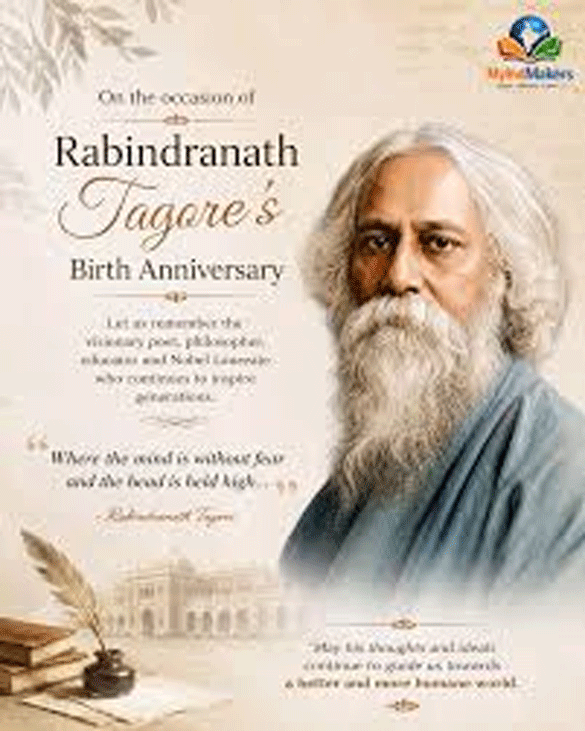
Tagore is known for his insightful observations. Nirad C Chaudhuri once wrote that if only his quotable observations are collected in a systematic order, minimum four big novels would emerge from them. So very true. Who can forget the following one?
Nobody really knows anybody else. Do we even know our own minds?
Chokher Bali , Chapter 34, pages 285-292
This quote touches on the complexity of human relationships and self-understanding. It suggests that despite our attempts to understand others and ourselves, there remains an inherent mystery in our thoughts and feelings. The intricacy of emotions often leads to misunderstandings, showcasing the importance of empathy and patience in interactions. Pakistani poet and journalist Ahmed Nadeem Qasmi once said, " Ik muamma hai insaan khud ke liye bhi " (Humans are enigmas even to themselves). To know a person, one has to swallow the whole world but to know oneself, even the Universe is not enough. Once we understand the impenetrable individuality and uniqueness of others and also the vagueness of our own minds, we become mellowed down, our vision expands and our empathy deepens. In short, we become more considerate and broad-minded.
And this one,
One can understand nothing from books," I went on. "We read in the scriptures that our desires are bonds, fettering us as well as others. But such words, by themselves, are so empty. It is only when we get to the point of letting the bird out of its cage that we can realize how free the bird has set us.
The Home and the World (Ghare-Baire) , Chapter 8, pages 137-153
In this quote, the character Nikhil emphasizes the importance of experiencing freedom firsthand rather than merely reading about it. He suggests that true understanding comes from the act of freeing oneself from the constraints of desires. Until we let go of our aspirations and attachments, we remain confined, and thus only through personal experience can we comprehend the essence of liberation. This reminds the readers of Dr Muhammad Iqbal's famous couplet, " Tujhe kitaab se mumkin nahin faragh ke tu/ Kitaab-khwaan hai magar sahib-e-kitaab nahin " (You're engrossed in a book; yet you don't possess it-You don't understand the import of it and have not been able to imbibe its spirit). We've been reading books and scriptures but we've not understood their
essence. Books are insinuations and nudges. They're not directions and destinations. Makhdoom Mohiuddin aptly said, " Zindagi kitni alag lagi / Jab kitaab se nazar hati " (Life looked so different once I looked beyond books). Read but also experience the world outside the books. " Tu kitabon ki khushk duniya se baahar aa / Hai jahan aur bhi, le uss ka bhi zaiqa " (You come out of the arid world of books / Experience and taste a world beyond). Remember, reading is great but it's always a bloodless substitute for life. Books, like your beloved's picture or portrait, can look at you but they cannot directly talk to you. They talk through words, dead and still long ago.
…
A regular columnist for New Age Islam, Sumit Paul is a researcher in comparative religions, with special reference to Islam. He has contributed articles to the world's premier publications in several languages including Persian.
New Age Islam, Islam Online, Islamic Website, African Muslim News, Arab World News, South Asia News, Indian Muslim News, World Muslim News, Women in Islam, Islamic Feminism, Arab Women, Women In Arab, Islamophobia in America, Muslim Women in West, Islam Women and Feminism