
The Social System of Hinduism - Part One

Dr. Zafar Darik Qasmi , New Age Islam
3 February 2026
Abstract;
The social system of Hinduism is one of the oldest social traditions of the Indian subcontinent. It developed over thousands of years through religious, cultural and philosophical ideas. This system does not deal only with religion but also guides family life, social relations, moral values, customs and responsibilities. Its foundation is based on concepts such as Dharma, Karma, Samsara and Moksha, which shape both individual behaviour and social order.
A key feature of this system is the Varna or caste system, which divided society into Brahmins, Kshatriyas, Vaishyas and Shudras. Although originally meant to organise social duties, it later became rigid and caused inequality. Hindu scriptures give Brahmins the highest status and special privileges, while Kshatriyas are assigned the duty of protection and governance. Over time, this dominance led to social imbalance. In the modern period, education and constitutional reforms have challenged caste discrimination, yet caste divisions still exist in Indian society today.
Main Points:
1- Hindu social system is based on religion, morality, customs, family structure and social responsibilities.
2- Varna or caste system divided society into four classes, later causing inequality and discrimination.
3- Brahmins were given highest status and privileges according to Hindu religious scriptures.
4- Kshatriyas were responsible for protection, governance and supporting religious authority in society.
5- Modern reforms oppose caste discrimination, yet caste influence still exists in Indian social life.
—-
The social system of Hinduism is one of the oldest social and religious traditions of the Indian subcontinent. It is the result of thousands of years of intellectual, religious and cultural development. This system is not limited to religious beliefs alone; rather, it organises all aspects of human life, including family structure, social relations, moral values, customs, traditions and social responsibilities.
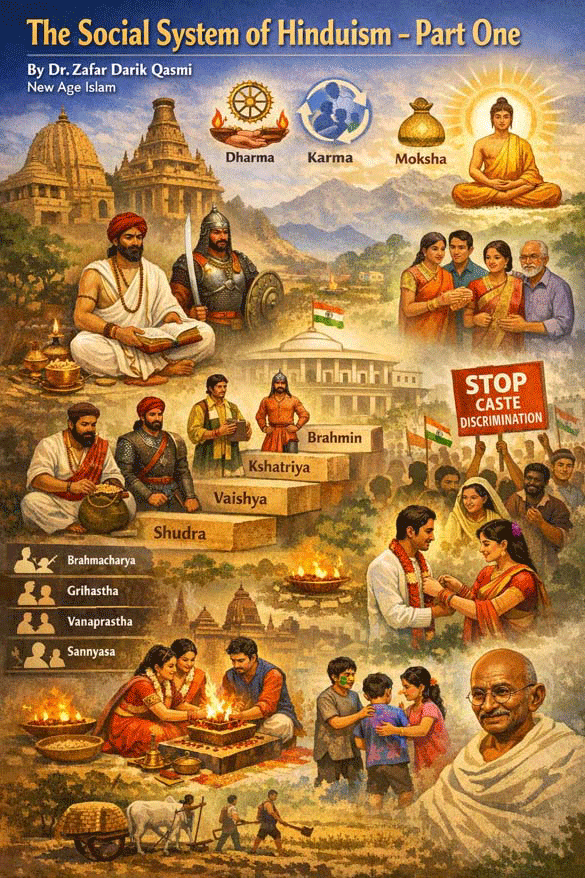
The foundation of Hindu social life rests on concepts such as Dharma (duty and moral law), Karma (result of actions), Samsara (cycle of birth and death), and Moksha (liberation). These ideas provide guidance for both the individual and society as a whole.
One of the most prominent features of the Hindu social system is the Varna or caste system, which historically divided society into four major classes: Brahmin, Kshatriya, Vaishya and Shudra. The original purpose of this division was to organise social duties and maintain order in society. However, over time, this system became rigid and led to social inequalities.
Along with the caste system, the Ashrama system—Brahmacharya (student life), Grihastha (householder), Vanaprastha (retirement) and Sannyasa (renunciation)—organises the different stages of human life and reminds individuals of their moral and social responsibilities.
In the family structure, the joint family system has traditionally held a central place. Respect for elders, obedience to parents and loyalty to family values are considered essential principles. Marriage is regarded as a religious duty and a means of social stability. Festivals and rituals such as Diwali, Holi and Raksha Bandhan strengthen social harmony and mutual relationships. The status of women has changed across different periods; while ancient texts often describe women with respect, social restrictions were also imposed in practice at various times.
From a moral perspective, Hindu society values Ahimsa (non-violence), truthfulness, patience, service to humanity and self-control. In the modern era, the Hindu social system has accepted many changes due to education, urban life and constitutional reforms. These include laws against caste-based discrimination and efforts to promote social equality.
Thus, it can be said that the social system of Hinduism is a comprehensive, historical and diverse structure formed through the interaction of religion, philosophy and society. Its positive aspects include social order, moral training and family stability, while its major challenges lie in social division and inequality. These complexities make it an important subject in the study of religions and social sciences.
According to the Manu Dharma Shastra (Chapter One, Verse 88), the duties assigned to Brahmins include studying and teaching the Vedas, performing sacrifices for their own benefit and for others, and giving and receiving charity. Manu also writes that Brahmins are born from the mouth of Brahma and possess the knowledge of the Vedas. Therefore, they are considered the masters of all creation. After severe penance, Brahma created them from his own mouth so that offerings might reach the gods and the universe could continue to exist.
It is stated that among all living beings, those with intelligence are superior; among intelligent beings, humans are superior; among humans, Brahmins are superior; and among Brahmins, those who have studied the Vedas are superior. Among them, those who understand and perform prescribed duties are higher, and the highest are those who realise Brahma. The birth of a Brahmin itself is considered the eternal embodiment of sacred law, as he is created for the preservation of Dharma and is united with Brahma.
The texts claim that nothing in the world is higher than the Brahmin, who is described as the master of all creation and the guardian of sacred law on earth. Everything in the world is said to belong to him, and other people benefit from worldly things only through him. Manu is described as having laid down fixed duties for Brahmins and other castes according to their ranks. A learned Brahmin is instructed to study these laws carefully and teach them to his students, while non-Brahmins are forbidden from doing so.
It is further claimed that a Brahmin who sincerely follows these laws is freed from sins of thought, speech and action. Such a Brahmin purifies the place he visits and redeems seven generations before and after him. He alone is described as the rightful owner of the entire world (Manu Dharma Shastra, Chapter One, Verses 93–105).
These texts describe the duties and special responsibilities of Brahmins, but the status and privileges granted to them appear highly unethical. A study of Hindu religious scriptures shows that Brahmins are not only given superiority but are regarded as the highest form of creation. Some texts even state that a Brahmin should not be given the death penalty for any crime. Such privileges clearly reflect inequality within the social structure.
Kshatriya
In Hindu society, Kshatriyas are placed second in rank. Just as Hindu texts describe the qualities, honours and privileges of Brahmins, they also discuss the responsibilities of Kshatriyas in detail. Their primary duty and Dharma is to fight wars, protect the country, manage financial support for the promotion of knowledge and arts, and most importantly, to serve and protect Brahmins.
It is stated that a Kshatriya cannot prosper without a Brahmin, and a Brahmin cannot prosper without a Kshatriya. Because of this close relationship, both flourish together in this world and the next (Manu Dharma Shastra, Chapter Nine, Verse 322).
Brahmins and Kshatriyas have historically held dominance over Hindu religion and society. Brahmins are regarded as protectors of Dharma, while Kshatriyas are seen as protectors of society and subjects. Therefore, Hindu religion and society largely reflect the thoughts and actions of these two classes. The role of other classes in the development and spread of Hindu religion and society was considered very limited.
Even today, the caste system continues to exist in India in its traditional form, and its presence can be observed frequently in many parts of the country, particularly within political circles, where caste-based divisions are still clearly visible.
—
Dr. Zafar Darik Qasmi is an author and a New Age Islam Regular Columnist.
-----
URL: https://newageislam.com/spiritual-meditations/social-system-hinduism-part-one/d/138706
New Age Islam, Islam Online, Islamic Website, African Muslim News, Arab World News, South Asia News, Indian Muslim News, World Muslim News, Women in Islam, Islamic Feminism, Arab Women, Women In Arab, Islamophobia in America, Muslim Women in West, Islam Women and Feminism