
The Profanation of The Sacred in Modern Life

By Moin Qazi, New Age Islam
12 May 2026
The gods made us human beings of soft and easily wounded flesh, for they dreamed us good and not evil. Had they been able to see what men would do to each other, they would have given us shells such as turtles have, into which we could have drawn our heads and our soft parts. But we were not made so, and the gods made us and we cannot change ourselves. We can only bear what is to come and live on if we can, and die if we must
-Pearl S Buck's,The Good Earth
The Moral Crisis Within Religion
In every age, the deepest measure of a human being has not been outward appearance, status, or words, but the quiet integrity of the inner life. True goodness does not announce itself; it is reflected gently in honesty, humility, and the consistency between thought, speech, and action. A life rooted in authenticity carries a natural dignity that does not depend on recognition or display. When inner character and outer conduct are in harmony, life becomes steady, meaningful, and free from contradiction. Such a state of being brings clarity to the mind and calmness to the heart, allowing one to relate to others with sincerity rather than pretence. In a world often driven by image and performance, the call to live truthfully becomes a quiet but powerful reminder that real strength lies in being genuine, transparent, and inwardly whole.
Human beings—“created in God’s image”—are born with an inherent capacity for immortality and growth, differing from figures such as Socrates and Shakespeare not in essence but only in degree. Humanity, in this sense, stretches along a single moral and intellectual continuum: from its most diminished expressions to its most elevated, regal possibilities.
Yet life, when observed with quiet clarity, also reveals a more unsettling dimension. Not all that sounds gentle is benign; not all that appears warm is trustworthy. Speech can be carefully polished, softened, and arranged to simulate care, while concealing motives that are far more calculating beneath the surface. Honeyed words may, at times, mask hidden intent—comforting in form, but cutting in effect.
As the Qur’an soberly warns: “And among the people is he whose speech pleases you in worldly life, yet he is the fiercest of opponents.” (Qur’an 2:204)
In every age, the deepest measure of a human being has not been outward appearance, status, or words, but the quiet integrity of the inner life. True goodness does not announce itself; it is reflected gently in honesty, humility, and the consistency between thought, speech, and action. A life rooted in authenticity carries a natural dignity that does not depend on recognition or display. When inner character and outer conduct are in harmony, life becomes steady, meaningful, and free from contradiction. Such a state of being brings clarity to the mind and calmness to the heart, allowing one to relate to others with sincerity rather than pretence. In a world often driven by image and performance, the call to live truthfully becomes a quiet but powerful reminder that real strength lies in being genuine, transparent, and inwardly whole.
The greatest threat to a sacred tradition rarely comes from open disbelief. External criticism is visible and therefore easier to confront. Far more dangerous is the corruption that arises from within—when religion is preserved in form but emptied of moral substance, when rituals survive. Still, conscience weakens, and when piety becomes performance rather than transformation.
Every faith is wounded more deeply by hypocrisy than by criticism.
History repeatedly shows that the gravest betrayals are not committed by those who openly reject morality, but by those who invoke virtue while abandoning compassion. The most dangerous corruption of conscience occurs when righteousness becomes incapable of self-doubt.
Across societies, self-proclaimed spiritual guardians often project themselves as uniquely chosen by God—as if they alone possess a permanent passport to heaven and exclusive access to divine truth. Many ordinary believers, overwhelmed by reverence or fear, begin to treat such figures not merely as teachers, but as earthly manifestations of the divine itself. Around them grew an aura of invincibility, moral infallibility, and near-absolute authority.
Yet beneath this sanctified image often lies something far more troubling: spiritual charlatanism.
Such individuals cultivate obedience not through wisdom, humility, or moral example, but through psychological domination clothed in religious language. They encourage dependence rather than reflection, submission rather than understanding. Criticism becomes equated with sin, questioning with rebellion, and disagreement with disloyalty to God Himself. In this way, faith is gradually transformed from a path of moral awakening into an instrument of control.
A scripture does not lose its power because someone questions it. It loses moral credibility when those who claim to defend it repeatedly betray the values it seeks to uphold. The tragedy is not that sacred words are rejected, but that they are endlessly recited while their ethical demands are quietly ignored.
Throughout history, religious societies have struggled with this contradiction. Public expressions of devotion become louder and more visible, while cruelty, arrogance, exploitation, dishonesty, and injustice continue beneath the surface—sometimes flourishing behind the shield of sanctity itself. Religion then ceases to function as a force of moral renewal and becomes a source of prestige, authority, and social power instead.
Nothing is more dangerous than sanctified hypocrisy.
The openly irreligious person may still possess honesty, compassion, humility, and integrity. But the person who invokes divine authority while practising manipulation or oppression corrupts both morality and faith simultaneously. Such a figure does not merely fail religion; he discredits it in the eyes of others. When power cloaks itself in holiness, accountability weakens, and injustice acquires a false aura of legitimacy.
This is why the gravest distortions of religion often arise not from its enemies, but from its self-appointed defenders.
Sacred texts become selective instruments in their hands. Verses that reinforce authority are emphasised, while those demanding humility, justice, self-restraint, and accountability are softened or ignored. Religion is applied rigorously to regulate others, but gently when confronting personal conduct. Public morality becomes obsessive, while private ethics remain neglected.
The Prophet Muhammad as the Embodiment of Revelation
The life of Prophet Muhammad has inspired generations across centuries, shaping not only religious consciousness but also humanity's ethical imagination. He occupies a unique place in the hearts of believers because his message was not confined to doctrine alone; it was translated into compassion, justice, humility, and spiritual integrity. Through him, faith became visible in action, and revelation took on human form. His life continues to illuminate the dilemmas of the modern world because it speaks not merely to worship, but to character, responsibility, and human coexistence.
Character and conduct must remain inseparable from the moral truths one professes to believe. Principles lose their force when they remain confined to speech and fail to shape behaviour. Human beings are deeply imitative creatures; they learn more from living examples than from declarations. Conduct, therefore, becomes a silent form of teaching, often more persuasive than words themselves. Speech becomes hollow when wisdom is absent from conduct.
This understanding finds its highest expression in the life of the Prophet himself. After the passing of the Prophet Muhammad, his beloved wife, Hazrat Aisha, was once asked about his character. Her reply carried remarkable depth: "Have you not seen the Prophet's public life? He was a living and talking Quran." In another narration, she declared, "His nature was as the Quran." Within these words lies the essence of embodied morality. The Quran was not merely recited through him; it was manifested through his conduct, mercy, justice, patience, and humility. Revelation became visible in the rhythm of his daily life.
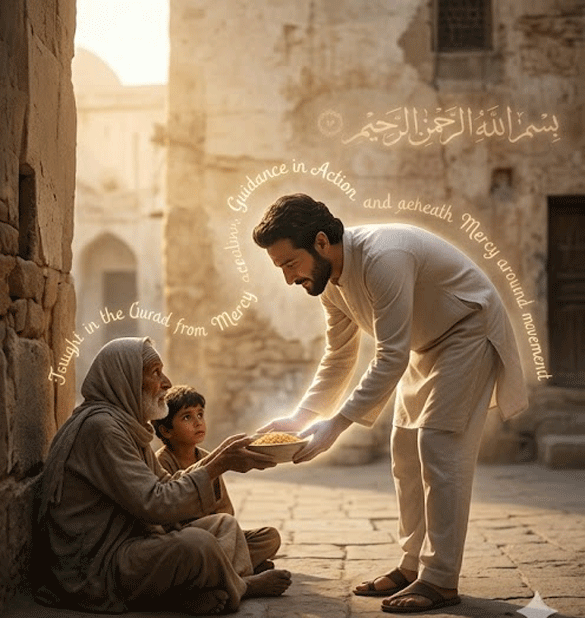
The Holy Quran is the eternal word of God, revealed as guidance for humankind and containing principles meant for humanity's moral and spiritual elevation. Yet revelation was never intended to remain confined to scripture alone. It required a living embodiment capable of translating divine principles into human experience. If the Quran is the word of guidance, the Prophet's life is that guidance in action.
As the Messenger of God, he was the first to submit himself completely to every commandment revealed to him. Every injunction descended first upon his own heart before it was conveyed to the world. His conduct, therefore, became the practical interpretation of revelation itself. After the Quran, the Prophet's life and deeds constitute the principal frame of reference for Muslims, not only in spiritual matters but also in the ethical and practical dimensions of everyday life.
This indeed constitutes the central current of the Quranic message. A unique feature of the Quran is that, while it lays down an ethical code, a moral path, a political system, a social order, an economic vision, and a legal philosophy, it simultaneously presents their practical exposition and living application in the life of the Prophet Muhammad. The Quran is therefore not merely a theoretical scripture addressed to abstract reflection; it is a guide meant to be embodied within the realities of human existence.
There is hardly any dimension of life untouched by the Quran. In a striking parallelism, the life of the Prophet penetrates with extraordinary versatility every sphere of human experience, both public and private. Whether in matters of worship, governance, justice, family relations, commerce, compassion, or social responsibility, his conduct demonstrated the principles revealed in the sacred text. This profound harmony between the Quranic message and the life of Prophet Muhammad clearly indicates that the pattern of life enunciated in the Quran is not beyond human capacity but is practicable within the ordinary conditions of existence.
Faith as Ethical Civilisation and Moral Responsibility
What distinguishes the Prophet's mission is that it transformed belief from abstraction into civilisation. Through him, faith became a living force shaping culture, compassion, social justice, family relations, and community life. He demonstrated how divine principles could harmonise with commerce, governance, mercy, and ordinary human interaction. In him, spirituality did not withdraw from the world but illuminated it from within.
This is why his message retains enduring relevance today. Modern humanity suffers not from a lack of information but from the fragmentation of moral vision. Technological progress has expanded material power while often impoverishing spiritual depth. Societies possess unprecedented means of communication yet remain wounded by alienation, aggression, and ethical confusion. In such a climate, the Prophetic model offers moral orientation. It reminds humanity that dignity cannot survive without compassion, justice without mercy, or power without restraint.
The Prophet's greatness also lay in his integration of inward spirituality with outward responsibility. He was neither a detached ascetic nor a worldly ruler intoxicated by power. His life established a balance between devotion and action, contemplation and service, principle and practicality. He taught that faith must manifest through honesty, kindness, fairness, and humility. Religion, therefore, was not a retreat from life but a discipline for living it nobly.
The enduring power of his example lies in the harmony between his words and deeds. Many preach virtue; few embody it. The Prophet's authority emerged not merely from revelation but from the credibility of character. His truthfulness, compassion toward the weak, forgiveness toward enemies, and concern for human dignity transformed ethical ideals into lived reality.
Thus, the highest form of faith is not verbal profession alone but the transformation of ethical teaching into conduct. The Prophet's life demonstrated that revelation attains its fullest meaning only when translated into action. His example endures because it speaks to the universal longing for a life rooted in integrity, balance, mercy, and truth.
Yet the essence of faith was never mere ceremonial display.
The deepest purpose of religion is moral transformation: to discipline the ego, restrain greed, cultivate justice, deepen compassion, and awaken responsibility. A truly spiritual person is not merely one who performs rituals consistently, but one whose conduct reflects integrity even when integrity is difficult and costly. Sacredness is measured not by appearance alone, but by the alignment between belief and behaviour.
This is why hypocrisy occupies such a central place in every religious tradition's moral critique.
A society can survive doubt more easily than it can survive moral fraud disguised as holiness. Honest questioning still preserves sincerity; performative righteousness destroys trust itself. Once religion becomes detached from ethical credibility, people begin associating faith not with justice or mercy, but with fear, contradiction, and control. The damage extends far beyond individuals—it corrodes the moral legitimacy of the tradition itself.
Personal Experience of Sanctified Control
The deepest wounds in life are often not inflicted by declared enemies, but by those who stand closest while hiding behind the mask of virtue. I have seen how outward spirituality can become a carefully crafted disguise concealing ambition, manipulation, and emotional cruelty. Sacred words were spoken with ease, rituals were performed with precision, and moral sermons flowed endlessly, yet beneath this polished exterior lay jealousy, selfishness, and the hunger for control. The betrayal became more painful because it emerged from within my own circle of kinship and trust. What appeared outwardly as piety slowly revealed itself as performance — a spirituality concerned more with image than with compassion, more with authority than with truth.
That contradiction shattered not merely personal trust but also faith in the moral credibility of those who claimed spiritual superiority. I could endure human weakness, but hypocrisy clothed in holiness carried a different kind of violence. The people who spoke most passionately about humility often practised arrogance; those who preached love inflicted silent wounds through indifference and judgment. Their outward postures of devotion concealed instincts they themselves refused to confront. In witnessing this, I realised that genuine spirituality is not measured by rituals, appearances, or public declarations, but by the capacity for honesty, kindness, and moral courage in ordinary human relationships. Where these are absent, spirituality becomes only a mask — and betrayal committed behind such a mask leaves scars deeper than open hostility ever could.
In my own family, my uncle, aunt, and sisters gradually assumed the role of self-appointed spiritual guides and moral advisers—figures who believed they had a special capacity to comment on others' ethical and emotional lives. They often expressed their views with strong conviction, sometimes framing personal opinions in moral or religious language. What I found difficult was not disagreement itself, but the sense that their interpretations left little room for alternative perspectives or individual autonomy.
Every emotional struggle, disagreement, moment of vulnerability, or independent thought risked being interpreted as evidence of spiritual corruption, defiance, or the influence of unseen evil. Faith, instead of becoming a source of compassion and inner healing, increasingly resembled an instrument of scrutiny, correction, and exorcism—where human frailty was approached not with understanding, but with suspicion.
They projected not the compassion of a merciful God, but the severity of a punitive one, where judgment overshadowed empathy and moral authority became inseparable from emotional domination. Their standards of evaluation were exacting and unforgiving, and no matter how sincerely I tried, I constantly felt as though I had failed some invisible spiritual examination—forever unable to secure a satisfactory verdict in their eyes.
The True Spiritual Struggle: Sincerity Against Pretence
The deepest spiritual struggle, therefore, is not simply between belief and disbelief. It is between sincerity and pretence.
To confront hypocrisy honestly requires immense courage, as it demands self-examination before judging others. It requires acknowledging that religious identity alone guarantees nothing. One may speak constantly of God while remaining distant from the very qualities that faith seeks to cultivate. Indeed, excessive outward piety can sometimes become a refuge from inward accountability.
A sacred text cannot elevate a society whose people refuse to embody its ethical vision.
The true honour of scripture lies not in decoration, slogans, or public recitation alone, but in lived character—in fairness, restraint, humility, honesty, mercy, and courage. Without these, religion risks becoming theatre: emotionally charged and visually impressive, yet spiritually hollow.
The real enemies of faith, then, are not always those who stand outside it. More often, they are those who stand closest to its symbols while drifting furthest from its spirit.
For nothing wounds religion more deeply than betrayal committed in its own name.
: The gods made us human beings of soft and easily wounded flesh, for they dreamed us good and not evil. Had they been able to see what men would do to each other, they would have given us shells such as turtles have, into which we could have drawn our heads and our soft parts. But we were not made so, and the gods made us and we cannot change ourselves. We can only bear what is to come and live on if we can, and die if we must.
Pearl Buck, Dragon Seed
…
URL: https://newageislam.com/spiritual-meditations/profanation-sacred-modern-life/d/139995
New Age Islam, Islam Online, Islamic Website, African Muslim News, Arab World News, South Asia News, Indian Muslim News, World Muslim News, Women in Islam, Islamic Feminism, Arab Women, Women In Arab, Islamophobia in America, Muslim Women in West, Islam Women and Feminism