
The Price of Moral Courage

By Moin Qazi, New Age Islam
13 may 2026
The Burden of Truth: Conscience Against Conformity
Curse all these men who come into the world to upset it with wars!” he shouted. “And curse them for spoiling our homes and fouling our women and making our life a thing of fear and emptiness! Curse such childish men that cannot have done with fights and quarrels in childhood but must still be children when they are grown and by their fights and quarrels ruin the lives of decent people such as we are!

— Pearl S. Buck, Dragon Seed
History’s most enduring voices converge on a single, unyielding truth: human greatness is not measured by applause, but by fidelity to truth under pressure. Across time and tradition, the pattern is unmistakable. Blind obedience corrodes judgment; silence in the face of wrongdoing becomes complicity; and moral courage often demands standing alone when conformity feels safer. Leadership, in its most exacting form, is not the art of popularity but the discipline of choosing what is right when no external reward compels it.
The record of human experience repeatedly confirms this. Institutions may fail, reputations may be distorted, and power may temporarily shield injustice, but ethical truth does not depend on approval. It survives precisely because it is tested. What history ultimately preserves is not compliance with prevailing norms, but resistance to their failures—those rare individuals who refuse to normalize injustice even when it is widely accepted. Character, in this sense, is not formed in comfort but forged in crisis.
At the core of this reflection lies a simple but exacting insight: human beings are inherently limited in knowledge and foresight, yet capable of moral awareness that exceeds calculation. This awareness imposes a demand—periodic, rigorous self-examination. Life, in its brevity and urgency, requires a deliberate stepping back from impulse and habit to examine intention, conduct, and consequence. Without such scrutiny, action becomes mechanical, and conviction devolves into performance rather than principle.
Across civilizations, certain values recur with striking consistency: honesty, courage, fairness, humility, gratitude, loyalty, dignity, and intellectual integrity. These are not cultural ornaments or situational preferences, but structural foundations of any coherent ethical life. To violate one’s inner moral light—however it is named—is the gravest transgression, for it corrodes the very faculty through which truth is discerned and acted upon.
Within this moral horizon lies the insight that the value of good action is not diminished by the absence of recognition, and that its highest expression often emerges when the ego is set aside. As Ronald Reagan observed, “There is no limit to the amount of good you can do if you don't care who gets the credit.”
The Erosion: Moral Failure and the Collapse of Responsibility
Moral failure, however, rarely presents itself as obvious wrongdoing. More often, it arrives quietly—disguised as convenience, rationalization, conformity, or the gradual acceptance of what should have been resisted. The most dangerous corruption is not sudden collapse but incremental adjustment, where conscience adapts itself to diminishing expectations. In such conditions, wrongdoing ceases to feel like a violation and begins to appear necessary.
History further reveals that societies do not decline only through political breakdown. Their erosion begins earlier, at the level of individual responsibility. When inner discipline weakens, external systems lose coherence. Law becomes procedural rather than moral, and institutions continue to function while losing their ethical center. What remains is structure without integrity.
This insight was articulated with clarity by Shah Waliullah Dehlavi, who argued that the decay of societies begins not with institutional failure but with the erosion of individual moral responsibility. Religion, in his understanding, was not ritual repetition but an ethical system that harmonized inner intention with outward conduct. When conscience weakens, law becomes hollow, and piety degenerates into habit.
In such a landscape, identity itself becomes unstable. When individuals lose their internal moral compass, they become dependent on external validation. Mimicry replaces understanding, performance replaces conviction, and borrowed certainty replaces lived principle. People detached from their ethical core become vulnerable to imitation, despair, and dependency. Education becomes mimicry; progress, displacement. Identity, when unmoored from conscience, becomes either brittle defensiveness or quiet self-erasure.
It is here that the question of inheritance acquires meaning beyond form. My parents gave me religion, culture, and spiritual grounding, but what I absorbed ultimately transcended instruction. Languages, philosophies, and literatures are vehicles; only occasionally do they deliver a message that reaches the heart with clarity. Despite deep engagement with Western thought, I never lost touch with my Eastern and Islamic inheritance. Through success and failure alike, I learned to rely increasingly on an inner compass—conscience speaking in a register beyond calculation.
This balance between rootedness and openness finds resonance in the work of Malik Bennabi, who diagnosed the crisis of societies not merely in external domination but in “colonisability”—a condition born of inner disintegration, loss of purpose, and moral exhaustion. When this internal collapse occurs, societies become susceptible not only to domination but to imitation, losing the capacity for independent moral and intellectual life.
The Inner Reckoning: Meaning, Suffering, and Moral Coherence
The examined life, therefore, is not a philosophical luxury but a structural necessity. Plato’s declaration that “the unexamined life is not worth living” is not a rhetorical flourish but a moral demand. Socrates sharpened it further: before judging others, examine yourself—not only your rights, but your responsibilities; not only your achievements, but your failures.
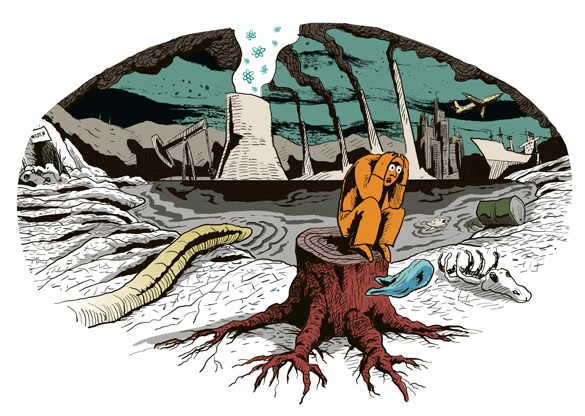
The struggle between good and evil is not episodic; it is continuous, enacted in daily choices between truth and falsehood, humility and arrogance, generosity and greed. Moral failure rarely announces itself as evil; it arrives disguised as justification. The account of the sons of Adam illustrates this with unsettling precision: failure rooted not in outward form, but in corrupted intention. Outer compliance without inner sincerity is hollow.
This moral architecture was given a contemporary articulation by Fazlur Rahman, who insisted that ethical principles—justice, responsibility, sincerity—are prior to legal form. When law is detached from moral purpose, it ceases to guide and begins to dominate. Responsibility, therefore, cannot be reduced to obedience. It requires discernment—the capacity to distinguish between what is demanded and what is right. No individual can evade moral accountability by delegating judgment entirely to institutions. Ethical agency is inescapable.
Yet moral life cannot be sustained by discipline alone. It requires meaning. Human beings cannot survive on material sustenance alone; meaning sustains the inner life. Deprived of purpose, individuals drift into alienation, cynicism, or despair. Often, what appears to be a rejection of life is, in reality, a collapse of meaning.
Suffering, in this context, is not merely an interruption but a crucible. It strips illusion, compels honesty, and refines judgment. It exposes the limits of control and the necessity of inner stability. Pain can either awaken clarity or deepen nihilism; the difference lies in orientation.
This is where detachment acquires ethical significance. Detachment is not withdrawal from the world, but freedom from compulsive attachment to outcomes. It allows action without despair and effort without entitlement. In such a state, responsibility is preserved without emotional collapse when results diverge from expectation. True freedom lies not in controlling outcomes, but in aligning intention with duty.
Humility completes this moral architecture. It is not self-denial, but accurate self-perception. It prevents conviction from hardening into arrogance and allows continuous correction of one’s own understanding. Where humility weakens, thought becomes rigid; where it is present, clarity deepens without losing direction.
Ultimately, life reduces everything to character. Achievements fade, status dissolves, and external validation loses its hold. What remains is the quality of choices made under pressure—especially when no audience is present, and no reward is guaranteed. The decisive question is not how one appeared in moments of success, but how one acted in moments of ethical ambiguity.
The deepest lesson life offers is not complexity but clarity: integrity is not a single act but a sustained orientation. It is maintained through vigilance, repetition, and the refusal to normalize what one knows to be wrong. It demands endurance without bitterness, engagement without illusion, and conviction without arrogance.
In the end, life does not ask for perfection. It asks for coherence—between what one understands and how one chooses to live. That coherence, fragile yet exacting, is continuously tested. And it is this—more than achievement, recognition, or power—that constitutes the enduring measure of a life lived in truth.
…
Moin Qazi is an Indian author and development leader who advanced dignity-centred, community-led change. A pioneer of microfinance and grassroots institutions, he fused ethics with social innovation. With deep interdisciplinary scholarship, he bridged policy, justice, and lived realities. His legacy affirms ethical leadership and people’s agency as drivers of India’s progress…
URL: https://newageislam.com/spiritual-meditations/price-of-moral-courage/d/140002
New Age Islam, Islam Online, Islamic Website, African Muslim News, Arab World News, South Asia News, Indian Muslim News, World Muslim News, Women in Islam, Islamic Feminism, Arab Women, Women In Arab, Islamophobia in America, Muslim Women in West, Islam Women and Feminism