
The Changing Face of Lashkar-e-Jhangvi in Pakistan
By
New Age Islam Staff Writer
10 October
2023
Lashkar-e-Jhangvi
Fighters Have Allied with Other Terrorist Organisations Like The Al Qaida,
Taliban and ISIS In Pakistan in Order to Hurt Army and Civilians
Main
Points:
1. Lashkar-e-Jhangvi may be behind
Balochistan attacks on Eid Milad-un-Nabi.
2. Lashkar-e-Jhangvi is an armed wing
of Anjuman Sipah-e-Sahaba.
1. 3.Anjuman Sipah-e-Sahaba was founded
by Maulana Haq Nawaz.
3. In 2006, Lashkar attacked a police
training college in Quetta.
2. 5.in 2018, it attacked an election
rally.
3. 6. It also attempted assassination
of Nawaz Sharif.
------
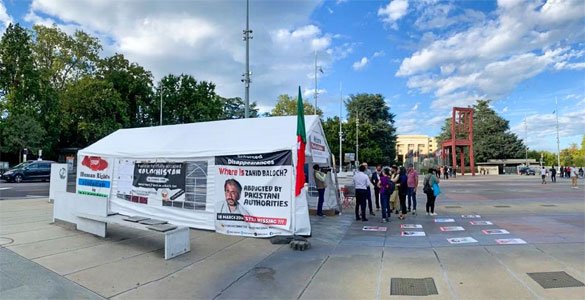
The Baloch National Movement organises a three-day long exhibition showcasing
about the history and violations of human rights in Balochistan during the 54th
Session of the UN Human Rights Council in Geneva. | Representational image |
ANI
------
On the
morning of 13th Rabiul Awwal, Muslims of Mastung in Balochistan had assembled
outside a mosque to participate in a procession to be taken out as a part of
Eid Milad-un-Nabi celebrations. A suicide bomber exploded his device near the
procession killing more than 55 people including children. Though no
organisation claimed responsibility for the attack, the police said they have
records of the presence of the ISIS in the province.
It is
important to be noted that during 2014, when the ISIS established its so-called
caliphate in Mosul in Iraq and it was being glorified by a section of Urdu
media and some Islamic organisations, the media and Islamic circles in Pakistan
gave cold shoulder to it because here a number of militant and extremist
organisations like Lashkar-e-Jhangvi, Lashkar-e-Taiba, Al Qaida and Taliban
were active and they did not want to concede space to a new organisation
subscribing to the same Salafi Wahhabi ideology.
However, as
the ISIS was decimated in Iraq and Syria, it tried to spread its base in other
parts of the Muslim world. The ISIS made inroads in Afghanistan and Pakistan
thanks to changing situation. The operations of the Pakistan army against
Lashkar-e-Jhangvi and TTP compelled their members to join the ISIS and Al Qaida
to hide their identity. Balochistan and Khaybar Pakhtunkhwa provided them safe sanctuary
because of the weak government control in these areas.
Before the
emergence of the ISIS and its spread in Pakistan, Lashkar-e-Jhangvi had a
considerable presence in the tribal belt of Balochistan and KPK and some areas
of Punjab. It was an armed wing of Anjuman Sipah-e-Sahaba. It was found by
Maulana Haq Nawaz in the beginning of this century. It was involved in some big
terrorist attacks in Pakistan apart from sectarian killings. It attacked a
police training college in Quetta in 2006 and attacked an election rally in
2018. In 2019, it attempted the assassination of Nawaz Sharif.
When the
Pakistan army launched an operation against Lashkar and other militant
organisations, they crossed over to Afghanistan and joined the Taliban. They
also allied with Al Qaida. Of late they have also joined ranks with the ISIS
and have been killing Shias, on the army and on those advocating girls right to
education.
The suicide
attack on Eid Milad-un-Nabi procession, therefore, seems to be a work of the
hybrid terrorists who regularly switch their allegiance to likeminded radical
organisations as they follow the same Salafi ideology.
Praveen
Swami's article seeks to study the evolution of the anti-Sunni extremism from
the anti-Shia extremism.
----
Islamic State Rising in Balochistan.
Pakistan Doesn’t Have the Resources to Win This Fight

By
Praveen Swami
04 October,
2023
Entering
the ancient city of Kharan in 1886, as he traversed the great desert trade
route through Balochistan to the borders of Afghanistan and Persia, the
colonial civil servant George Tate observed two pillars guarding the path:
Inside, were two men who had been tied to stakes and entombed alive. “These men
had been the owners of a couple of exceedingly fine asses which were coveted by
the chieftain of their tribe,” Tate wrote. The men tried to flee with their
prize asses—but were caught.
“The chief
had been rather lenient with them,” local residents told Tate, “since just
before the pillars were completed over their heads each of these misguided men,
who had dared to assert their right to their own property, had been stunned by
a blow from an axe handle.”
Last week,
alleged Islamic State jihadists savagely struck Balochistan’s Mastung district,
killing at least 55 people at a procession to mark the birthday of the Prophet
Muhammad. Although there have been several massacres of the Shi’a minority in
Pakistan by jihadists, the Islamic State has become increasingly aggressive in
its opposition to folk religious traditions, like the Barelvis participating in
the procession.
Even though
the growing power of the Islamic State in Balochistan is drawing global
attention, the process enabling that sunrise isn’t. The crude state structures
built in the colonial period, and reinforced by the Pakistan Army, are
disintegrating—enabling jihadists, narcotics traffickers and organised crime
cartels to step into the vacuum. Enfeebled by economic implosion and political
crisis, the Pakistani state no longer has the resources to push back.
The bombing
in Mastung does, of course, have something to do with theology: Taliban chief
Mullah Haibatullah Akhundzada is a member of the Saifis, a Sufi order with a
significant following in Afghanistan. The killing, however, is also part of a
broader effort to intimidate ethnic Pashtun communities and leadership across
Balochistan.
Earlier
this summer, though, the ethnic-Pashtun politician Mohsin Dawar voiced concern
about the growing power of jihadist death squads which were targeting the
fundamental institutions of society. Local leaders, Dawar said, were being
targeted for assassination, while businesses and industries were being
extorted: “People are abducted, tortured, and a video of theirs is recorded and
posted online.”
The Rise
of The Islamic State
Everyone
watched the birth of the Islamic State in Pakistan, some cheering, some silent.
Fifty men with weapons dragged three women out of their homes and paraded them
naked through the streets of a village near Lahore in 2009. Human rights
investigators reported that the women’s faces were blackened with ink and
“children were instructed to degrade them by poking them with sticks.” Once the
police arrived, the women were arrested and booked for prostitution.
Led by the
local Islamist leader Intezar-ul-Haq, Punjab’s Lashkar-e-Jhangvi had begun to
demonstrate that it—not the Pakistani state—ruled the heartland. Local
politicians lined up behind the phalanxes of the fundamentalists.
In 1984, a
then-obscure cleric, Maulana Haq Nawaz Jhangvi, founded the
Anjuman-e-Sipah-e-Sahaba Pakistan in the Punjab town of Jhang. Fired by General
Zia-ul-Haq’s Islamising project, the Anjuman was one of several organisations
seeking to rebuild Pakistan on theocratic lines. The organisation’s armed wing,
the Lashkar-e-Jhangvi, targeted Shi’a mosques and communities, as well as
police.
Following
an attempt to assassinate Prime Minister Nawaz Sharif in 1999, authorities
clamped down on the Lashkar-e-Jhangvi. Its leadership took refuge in
Taliban-ruled Afghanistan—only to return home after 9/11, when General Pervez
Musharraf’s regime provided a homecoming for Pakistani jihadists.
Elements of
the Lashkar-e-Jhangvi, as well as other ethnic Punjabi jihadist groups, later
embedded themselves in Taliban-linked movements across Pakistan’s northwest.
The scholar Qandeel Siddiqui has recorded that, by 2009, the Pakistani Taliban
had taken control of police stations in areas like Matta, Maidan and Kalam, and
even ran parallel police forces. Women were jailed for working alongside men,
and girls’ schools were blown up.
Finally
pushed to confront the Taliban by rising levels of violence against the army,
Pakistan went to war in Khyber Pakhtunkhwa province. The Taliban slipped back
across the border into Afghanistan, helped by their old Taliban allies. For a
time, the Generals in Rawalpindi congratulated themselves, imagining their
Taliban clients would keep things quiet.
The
Economics of The Islamic State
For
generations, we know from the account of colonial officials like Tate, bandit
raids across the Afghan-Baloch border were a feature of colonial life. Tate’s
stories include the tale of two bandits shot dead by border guards in 1899, who
were given a rough-and-ready burial in the sand. The sand, though, served to
plug the wound on the shoulder of the second bandit. Later recovering, the man
climbed out of his grave and was rescued by travellers.
“Every
Baloch in camp probably gave him a feed,” Tate recorded, “and for a time he was
quite the lion of the place.” “The profession of a freebooter was one in which
a man of long and honourable pedigree might engage,” he observed. “Petty theft
was regarded as utterly vile.”
This
particular bandit, though, decided he’d tested his luck enough, and gave up
raiding for a life as a peasant.
Economic
historian Tirthankar Roy’s path-breaking work on Afghanistan has shown that
this kind of violence was fated by circumstance. As economic power shifted to
the great port cities of Asia, the trade routes that ran through the
Afghan-Persian borderlands became irrelevant. The new colonial powers saw
little reason to invest in regions like the borderlands, which were too
resource-poor to justify constructing roads or railway lines linking them to
the ports.
Like in the
European peripheries documented by the great historian Eric Hobsbawm, banditry
flourished, as a means not just of harvesting economic resources, but also
resisting central authority and unjust local power-brokers.
The
generation of young jihadists who had returned from Afghanistan after 9/11 came
from poor backgrounds, scholar Farhat Taj has noted, distinct from the tribal
élites who had controlled political life in the Pashtun heartlands of Khyber
Pakhtunkhwa and Balochistan. Armed with some education, and empowered by the
Kalashnikov, they sought to remake the region in their own image.
The ISKP
Rise
Long before
the triumph of the Taliban in Kabul, experts like Paul Lushenko had remarked on
the ability of the Islamic State to regenerate itself from apparently crushing
defeats. The reasons are not opaque. Elements denied what they considered a
fair share of power by regional Taliban commanders, or cut out of lucrative
narcotics and illegal mining syndicates, sometimes rebranded themselves as the
Islamic State. Even though the links between these groups and the central
Islamic State were tenuous.
For its
part, journalist Zia ur Rahman notes, the Lashkar-e-Jhangvi survived by fluidly
allying itself with other jihadist organisations—among them al-Qaeda, the
Islamic State’s key rival in the Middle East.
Lashkar-e-Jhangvi
cadre attacked the Police Training College in Quetta in 2006, killing 61 police
cadets. Later, a suicide bomber targeted the shrine of Sufi saint Shah Noorani
in Khuzdar district, leaving 52 dead. Later, branding itself as the Islamic
State, Lashkar-e-Jhangvi operatives also carried out a bombing at an election
rally in 2018, killing at least 128 people, including the prominent politician
Siraj Raisani.
The
Pakistan Army’s long and bloody operation to evict jihadists from the
ethnic-Pashtun belt had, for all practical purposes, ended in nothing. Last
month, a video emerged showing Tehreek-e-Taliban chief Noor Wali Mehsud
commanding operations against Pakistani forces in Chitral. Large-scale attacks
have taken place in Balochistan, too—and almost everywhere, the Pakistan army
has proved unable to meaningfully hit back.
Fears are
mounting that the rising tide of jihadism could spread to Central Asia—a
prospect that is likely provoking some wry smiles in Washington, as regional
powers China and Iran both fuelled the Taliban campaign to evict the United
States from Afghanistan.
As
commentator Farhan Siddiqui has argued, a solution needs not just a military
response, but a whole-of-government solution which addresses long-standing
fault lines of class, ethnicity and religion which have powered the jihadist
movement. The problem is the Pakistani state has neither the resources nor the
political will to implement it.
----
Praveen Swami is National Security Editor,
ThePrint. He tweets @praveenswami. Views are personal.
(Edited by Theres
Sudeep)
Source: Islamic State Rising in Balochistan.
Pakistan Doesn’t Have the Resources to Win This Fight
URL: https://newageislam.com/radical-islamism-jihad/lashkar-jhangvi-pakistan-army-civilians/d/130866
New Age Islam, Islam Online, Islamic Website, African Muslim News, Arab World News, South Asia News, Indian Muslim News, World Muslim News, Women in Islam, Islamic Feminism, Arab Women, Women In Arab, Islamophobia in America, Muslim Women in West, Islam Women and Feminism