
Maulvi Mujib Rahman Ansari - a Radical Cleric - Enforcing Harsh Shariah Law Reminiscent Of the Taliban in Herat, Afghanistan

Najim Rahim
By David Zucchino and
Najim Rahim
Oct. 22,
2020
In one of
the oldest districts of the ancient city of Herat, religious vigilantes loyal
to a local cleric patrol the streets, routinely detaining and interrogating
couples they suspect are unmarried.

Friday prayer at cleric Maulvi Mujib Rahman Ansari’s
mosque in Herat, Afghanistan, last month.
-----
Then the
vigilantes take the suspects to the cleric’s tribunals that enforce his
interpretation of Shariah law, which forbids public contact between a single
woman and an unrelated male. The penalty for violators: the man is whipped or
clubbed, and the woman is returned to male relatives for likely punishment.
The cleric,
Maulvi Mujib Rahman Ansari, has also posted billboards declaring that any man
whose wife does not completely cover herself in public is a coward. And he has
banned music and concerts, while also declaring that Covid-19 was sent by God
to punish non-Muslims.
Maulvi
Ansari, 36, a burly, bearded cleric, has carved out his own fief in a
conservative district of Herat, a western Afghanistan city renowned for art and
culture. Residents say his enforcers have seized control of the district from
the police, who rarely interfere with their vigorous enforcement of strict
Shariah law.
Though he
says he is not affiliated with the Taliban, Maulvi Ansari’s edicts are an echo
of that movement’s harsh Islamic codes — and perhaps a portent of what could
come as the insurgency negotiates a power-sharing deal with the government.
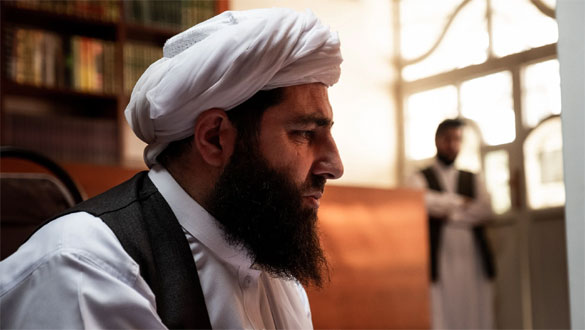
Maulvi Ansari at his religious school.
-----
Maulvi
Ansari’s tactics have alarmed women’s rights advocates and put the provincial
government on the defensive. And Islamic scholars say he is just the vanguard
of a rising tide of extremist clerics who have galvanized public resistance to
the often corrupt and ineffective American-backed Afghan government — yet
another way the government is coming under dire pressure outside the Taliban’s
insurgency.
In his
slice of Herat, Maulvi Ansari has resurrected perhaps the most despised relic
of Taliban rule during the late 1990s: the Ministry for the Promotion of Virtue
and Prevention of Vice, which brutally enforced Shariah law.
In the
mullah’s neighborhood of Gozargah, his enforcers wear white tunics adorned with
the crossed-swords logo of his religious movement. They intercept couples in
cars, on motorcycles and on the street, questioning them separately and
sometimes demanding a marriage certificate. Married couples have been
threatened because they didn’t have a certificate on hand.
In a sermon
last year, Maulvi Ansari suggested chopping off the hands of thieves and
stoning accused adulterers. He bars women from his news conferences. He has
cowed the local government with his music ban, though officials did take down
his billboards.
“He is
creating a lot of fear in the community,” said Suraya Pakzad, a prominent
women’s rights activist in Herat. She said the tactics evoked painful memories
of Taliban rule, when she ran an underground school for girls.
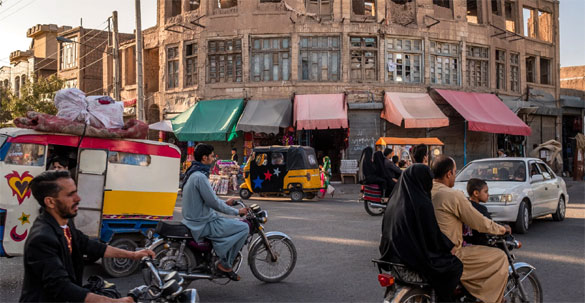
Maulvi Ansari’s followers have taken to stopping
couples on the street to demand proof that they are married.
------
“They are
there to keep anyone from enjoying life,” she said.
Another
activist, Fatima Farahi, said she was afraid to let her daughter leave the
house. “The government should prevent this sort of extremism,” she said.
Herat’s
provincial governor, Abdul Wahid Qatali, acknowledged that Maulvi Ansari had
tapped into public resentment of the government. But he said most followers
were uneducated villagers drawn by the mullah’s conservative religious and
cultural populism.
Maulvi
Ansari — Maulvi is a title meaning Islamic scholar — is venerated by many
followers as a descendant of a revered 11th-century Muslim Sufi saint, Abdullah
Ansari of Herat, whose tomb is near the cleric’s mosque.
“Whatever
he says at Friday Prayer, we can deal with,” Governor Qatali said inside his
heavily guarded compound. “He’s not taking weapons against the government. But
our red line is that we won’t let him panic our people and our women.”
He added:
“We’re fighting the Taliban now and we don’t want to expend energy fighting
this mullah. And we don’t want to lose the mullahs who support the government.”
Asked about
Maulvi Ansari’s ban on music and concerts, the governor said such gatherings
posed security risks anyway.
On a recent
Friday, buses crammed with men and boys lumbered up to a city mosque, where
thousands of people queued under a punishing sun to submit to body searches.
The mullah’s voice boomed over loudspeakers, echoing off the mosque walls and
reaching worshipers praying in walkways and gardens well beyond the mosque.
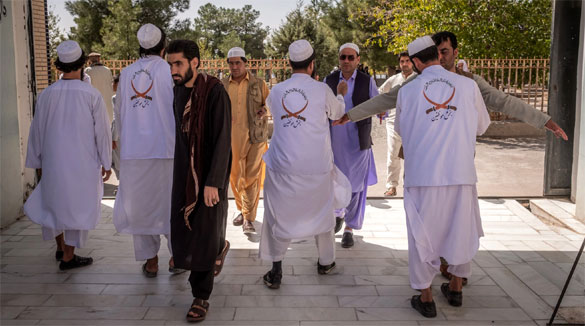
Mullah Ansari's enforcers wear the crossed-swords
symbol that his religious movement has adopted.
-----
The next
day, Maulvi Ansari gave an interview to The New York Times, sitting
cross-legged on the library floor of the school at his mosque and condemning
the Afghanistan government as un-Islamic and unworthy of allegiance. His radio
station and Facebook and Instagram accounts help spread that message even
though he has condemned certain secular TV programs and social media platforms
as “shameful” and un-Islamic.
Maulvi
Ansari boasted that his mosque tribunals had punished more than 100 people
accused of violating Shariah law since the patrols began in December. He said
detained men had been held briefly in a makeshift jail while a religious
committee determined punishment.
“If the government
did its job properly, we would be its servants,” he said. “But it doesn’t, so
we have the responsibility to stand on our own feet.”
Told that
many women in Herat feared his harsh tactics, he said that only “impure and
immoral” women felt threatened. Women of virtue and chastity obey his
strictures to cover their bodies and hair, he said.
“There is
no justice in the Afghanistan system, so we must provide justice,” Maulvi
Ansari said. Even with the old Taliban government long gone and after 19 years
of occupation by foreign troops, “the people still want Islamic government with
Shariah law,” he said.
The local
government does not dare confront him, he said, because many officials and
police officers agree with his teachings; some officers were seen praying at
this mosque.
Asked about
the peace talks going on with the Taliban, Maulvi Ansari said he would support
any government based on Shariah law, whether or not it included the Taliban.
But he said
he condemned Taliban suicide attacks and maintained no militia himself — only
bodyguards who carry assault rifles and have government-issued weapon permits.
He approves of girls attending schools and universities, he said, but separately
from male students.
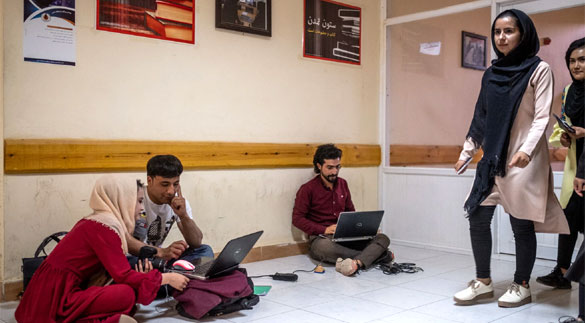
Journalism
students at their campus in Herat University.
-----
At Friday
Prayer, Najibullah Sari, 24, a university student, said he supported the cleric
because “bad people must be stopped when society is headed toward corruption.”
Ahmad
Huzaif Noorzaie, 22, who directs one of Maulvi Ansari’s checkpoints, said he
and his colleagues separate men and women seen traveling together in the
Gozargah neighborhood.
“We
question them to see if their answers are the same,” he said. “If not, they
face punishment.”
Tariq Nabi,
a prominent Islamic scholar, said Maulvi Ansari had created a worrisome
parallel government based on the ultraconservative Wahhabi interpretation of
Islam learned during his studies in Saudi Arabia. He said other extremist
clerics have imposed similar versions of Shariah law in other Afghan provinces.
“I’m very
concerned, because individual freedoms are endangered,” said Mr. Nabi, who
described Maulvi Ansari’s Wahhabi teachings as unsuited for Afghanistan.
On his TV
broadcasts, Mr. Nabi has challenged Maulvi Ansari’s call for Muslims to attend
mosques despite Covid-19 risks, telling listeners to avoid crowds, including at
mosques.
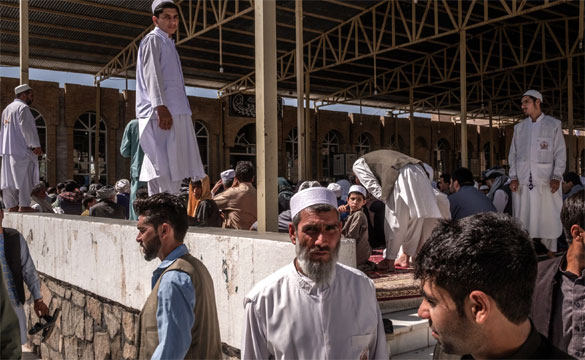
Maulvi
Ansari’s enforcers during a recent Friday prayer at his mosque.
------
Another
Islamic scholar, Abdul Majid Samim, said many Afghans embraced Maulvi Ansari
and other extremist clerics because they condemned the government and its
American backers. Some espoused violence, he said.
“You can’t
implement Islam by force,” he said.
Recently,
the government-run Ministry of Haj and Religious Affairs in Herat revived its
dormant Office for the Promotion of Virtue and Prevention of Vice — though
officials insisted that it was not to support Maulvi Ansari’s vice checkpoints,
and that it did not punish anyone.
Still, the
move has been seen as a victory for Maulvi Ansari, who said plans were underway
to establish such offices in other provinces. Recently, the governor of
Nangarhar Province said he would form a vice office, but later backtracked
after an angry backlash on social media.
Maulvi
Ansari is not taking no for an answer.
Sitting
inside the mosque library, he insisted that a visiting American journalist
convert to Islam. When the journalist declined, the cleric gave him a stern
look and said, “Then you will burn in hell.”
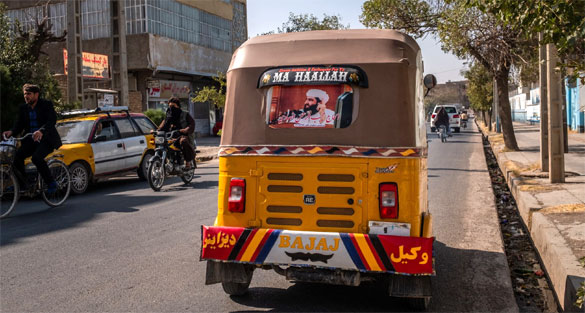
Maulvi Ansari’s image can be found on billboards and
rickshaws in Herat.
-----
Photographs by Jim Huylebroek
Original Headline: A Radical Cleric Ignites an
Islamist Resistance in Afghanistan
Source: The New York Times
URL: https://newageislam.com/radical-islamism-jihad/maulvi-mujib-rahman-ansari-radical/d/123243
New Age Islam, Islam Online, Islamic Website, African
Muslim News, Arab
World News, South
Asia News, Indian
Muslim News, World
Muslim News, Women
in Islam, Islamic
Feminism, Arab
Women, Women
In Arab, Islamophobia
in America, Muslim
Women in West, Islam
Women and Feminism