
Al Qaeda May Return If More Structural Concerns In Counter-Terror Thinking Are Not Addressed Over Time

By Kabir Taneja
Nov 18,
2020
Over the
past few weeks, amid the global chaos of the Covid-19 pandemic and the United
States (US) elections, a series of events reportedly eliminated a major section
of al Qaeda’s top leadership. The terror group was founded by the once
most-wanted man on earth, Osama bin Laden, who was killed at Abbottabad,
Pakistan, in a US raid in 2011.
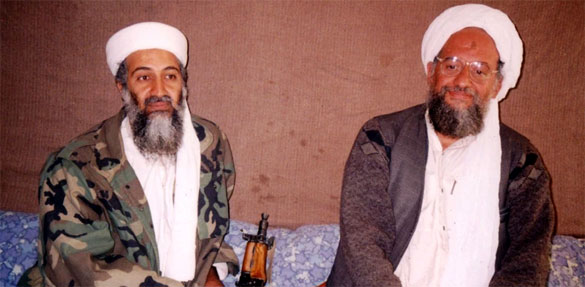
Ayman al-Zawahiri and Osama
bin Laden (Getty Images)
------
According
to a yet-uncorroborated claim, al Qaeda’s chief, Egypt-born Aymen al-Zawahiri,
who took over after bin Laden, passed away two months ago from natural causes.
Reports also surfaced that one of his closest aides, Abu Mohammed al-Masri, was
killed in Tehran, Iran, where he was living under a false identity, purportedly
by an Israeli hit squad in August.
Prior to
al-Masri and Zawahiri, bin Laden’s son, Hamza bin Laden, who was being groomed
to take over the group, was killed in a US operation in 2019. Late last month,
another senior al-Qaeda leader, Hussam Abdur Rauf, head of the group’s media
operations, was killed by Afghan forces in Taliban-controlled territories. Only
one senior al-Qaeda leader’s name is being discussed as a replacement for
Zawahiri after al-Masri’s killing, and that is of Saif al-Adel, also from
Egypt.
After 19
years of the US war against terror, the past few years have been comparatively
successful in decimating figures in the al Qaeda leadership, starting with
Osama bin Laden himself, arguably fragmenting structures and hierarchies. Like
any other organisation, jihadist groups are equally, if not more, prone to
internal strife around power, ideology and control.
The killing
of al Qaeda leaders has now sparked a debate on what the future holds for the
once-feared terror group, a reputation overtaken by the threat posed by the
so-called Islamic State (IS) today. While some argue that an imminent
disintegration of al Qaeda after Zawahiri may be on the cards, there are other
more radical ideas like that of a potential merger between IS and al Qaeda.
Under
Zawahiri, al Qaeda was often seen as a bureaucratic, old-school and somewhat
stoic jihadist movement, especially in comparison to IS, which took over much
of the narrative, threat and global attention since 2014 with its pace. It
became synonymous with deadly levels of violence, control of territory and
robust online propaganda which attracted hundreds of foreigners, including a
few from India. In comparison, Zawahiri, known for his dense monologues, was
seen as too bookish to attract a new breed of jihadists. Arguably, the last al
Qaeda leader, along with bin Laden, who was charismatic was Anwar al-Awlaki,
killed in 2011 in Yemen. His lectures on Islam that were narrated with great
script and panache still find many takers today.

The idea
behind a merger of IS and al Qaeda comes from the fact that the secession of al
Qaeda in Iraq from al-Qaeda Central created ISIS. Ideologue Abu Musab
al-Zarqawi had then fallen out with bin Laden and gone his own way, along with
Abu Bakr al-Baghdadi, who as IS chief, was killed last year.
However,
today, al Qaeda is arguably playing second fiddle to IS as it hangs on to its
legacy. IS is able to make continuous claims of attacks across geographies,
from Afghanistan to the African Sahel and Europe to Sri Lanka. Meanwhile, al
Qaeda appears destined to hide behind the protection of the Taliban in
Afghanistan, which itself is negotiating with the US, and theoretically could
throw al-Qaeda under the bus or puppeteer it significantly to achieve its
larger political aims that start and end with Afghan territory.
However, it
would be a mistake to write off al Qaeda just yet. The group has proved its
penchant for survival over the years. The fact that it has seemingly managed to
cut a deal for safe haven in Iran, the seat of Shia Islam, as a Sunni
insurgency, speaks volumes for the prevalence of broader geopolitical interests
over sectarian fissures.
Also, it
must not be forgotten that the argument of depleted hierarchy today also
applies to IS, whose new leadership remains largely nameless and faceless.
Nonetheless,
a significantly depleted al Qaeda in a post-Zawahiri era may be a welcome
enough development. This, however, does not change the fact that as a group it
remains much more grounded for a long-haul return if more structural concerns
in global counter-terror thinking and policies are not addressed over time.
Where IS
came from is a good enough reason to not underestimate the fact that even in
jihadist groups, it is often that the tortoise that eventually wins the race
while the hare gets most of the attention before its eventual downfall.
---
Kabir Taneja is Fellow, Strategic Studies
Programme, Observer Research Foundation. He is the author of The ISIS Peril:
The World’s Most Feared Terror Group and its Shadow on South Asia
Original Headline: Al Qaeda is battered, but
don’t rejoice yet
Source: The Hindustan Times
URL: https://www.newageislam.com/radical-islamism-jihad/al-qaeda-return-if-more/d/123506