
Beyond the Narrative of “Genocide”: Understanding Boko Haram, Religion, and Reality in Nigeria

By Ghulam Ghaus Siddiqi, New Age Islam
24 April 2026
Understanding the True Drivers of Violence in Nigeria
Main points:
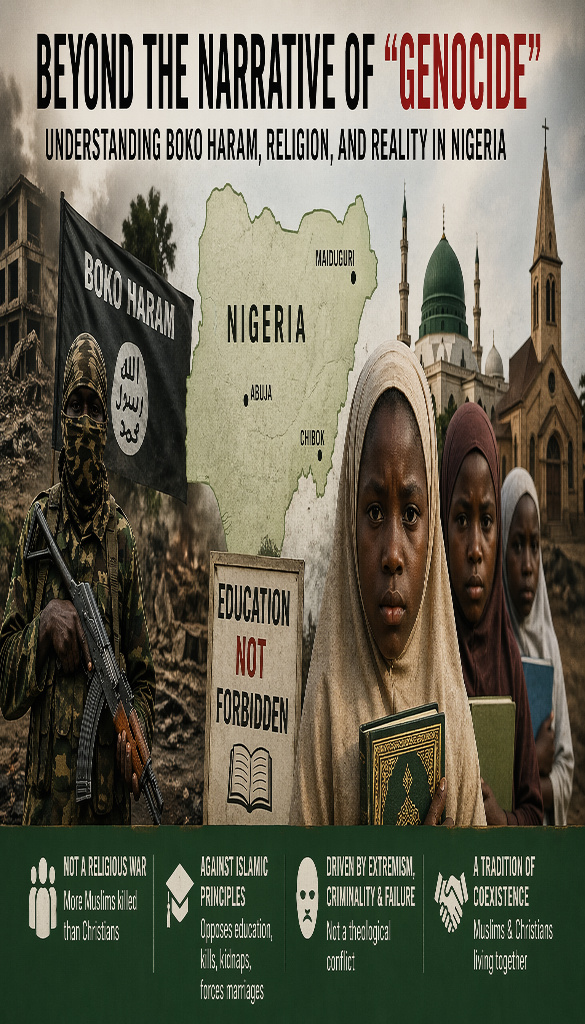
1. Lai Mohammed rejects the claim of a Christian genocide in Nigeria, noting that Boko Haram has killed more Muslims than Christians.
2. The violence in Nigeria stems from a mix of extremism, criminality, governance failures, and socio-economic issues, not simply Muslim–Christian tensions.
3. The group began by attacking Muslims who opposed its extremist ideology, showing its takfiri nature.
4. Its actions such as killings, kidnappings, and opposition to education go against core Islamic principles, making it an adversary rather than a representative of Islam.
5. The “genocide” narrative oversimplifies reality and can mislead international responses, highlighting the need for a more accurate and nuanced understanding.
….
In an era shaped by rapid information flows and polarised narratives, conflicts are often reduced to simplistic binaries; frequently framed along religious lines. Recent remarks by Lai Mohammed, former Minister of Information and Culture of Nigeria, offer a timely intervention in correcting one such narrative: the claim of a targeted “Christian genocide” in Nigeria. Speaking at Abbey College Cambridge, Lai Mohammed argued that insurgent violence, particularly by Boko Haram, has claimed more Muslim lives than Christian ones, challenging widespread assumptions about the nature of the conflict.
This assertion does not seek to minimise the suffering of any community. Rather, it compels a more comprehensive understanding of Nigeria’s security crisis: one rooted not in religious extermination, but in a complex web of extremism, criminality, governance challenges, and socio-economic distress.
The Misleading Simplicity of Religious Framing
The tendency to interpret violence in Nigeria as a straightforward Muslim-versus-Christian conflict has gained traction in global discourse, particularly in parts of the Western media and advocacy circles. Yet, as Lai Mohammed pointed out, such a framing risks distorting reality. Boko Haram, whose name loosely translates to “Western education is forbidden,” did not begin as an anti-Christian movement. Its early targets were, in fact, Muslims, particularly those who embraced modern education and rejected extremist interpretations of Islam.
……
Read Also:
Islam versus Boko Haram and Forced Marriages
…….
This internal targeting reveals a critical truth: Boko Haram’s ideology is fundamentally takfiri, meaning it declares other Muslims as apostates and legitimate targets. In its formative years, the group’s violence was directed overwhelmingly inward, against Muslim communities that did not conform to its rigid worldview.
Over time, the group widened its scope of attacks to include Christians, driven less by theological motives and more by strategic intent. As Lai Mohammed frankly noted, assaults on Christians tend to draw greater international attention. In a media-driven age, the spectacle of interfaith violence heightens visibility, attracts funding, and enhances the notoriety of extremist organisations.
Terrorism Without Theology
To understand Boko Haram solely through a religious lens is to misunderstand its nature. As highlighted in earlier scholarly critiques, the group’s actions—from mass killings to the abduction of schoolgirls in Chibok—stand in stark contradiction to Islamic teachings. Renowned Islamic scholars and institutions worldwide have unequivocally condemned such acts as un-Islamic.
……
Read Also:
…….
Islam’s foundational principles emphasise the sanctity of life, the pursuit of knowledge, and the dignity of women. These are the values that Boko Haram systematically violates. Its campaign against education, especially for girls, directly opposes the very first Qur’anic revelation: “Read.” Similarly, practices such as forced marriages and abductions have no legitimacy within Islamic jurisprudence.
Thus, Boko Haram is not merely a violent group operating under religious pretexts; it is, in many ways, an adversary of the very religion it claims to represent. It exploits religious language while undermining its ethical core.
Banditry and the Politics of Crime
Lai Mohammed’s remarks also addressed another critical misconception: the religious interpretation of banditry in northern Nigeria. He argued that these acts are primarily criminal, not ideological. The perpetrators and victims often share the same ethnic and religious backgrounds, predominantly Hausa-Fulani Muslims.
This observation underscores a broader point: much of Nigeria’s violence is driven by economic desperation, weak state capacity, and organised crime rather than doctrinal conflict. Cattle rustling, kidnapping for ransom, and territorial disputes are manifestations of governance gaps, not religious wars.
Reducing these issues to religious persecution not only obscures their root causes but also risks inflaming tensions that are otherwise manageable within Nigeria’s historically pluralistic society.
A Tradition of Coexistence
Despite its challenges, Nigeria has long been a model of interfaith coexistence. Lai Mohammed pointed to the example of President Bola Ahmed Tinubu and his wife, representing a Muslim-Christian household, as emblematic of the country’s social fabric. Across Nigeria, interfaith marriages, shared communities, and everyday interactions reflect a lived reality far removed from the narrative of existential religious conflict.
As Lai Mohammed aptly noted, ordinary Nigerians are more likely to disagree over economic issues than theological ones. This insight is crucial. It suggests that the primary concerns of citizens, jobs, security, and stability, transcend religious identity.
The Danger of “Fake News” in Conflict Zones
Labelling the “Christian genocide” narrative as “fake news,” Lai Mohammed raises an uncomfortable but necessary question: how do misinformation and selective reporting shape international perceptions?
In conflict zones, narratives can be weaponised. Advocacy groups, political actors, and even well-meaning observers may inadvertently amplify incomplete or skewed accounts. While highlighting human rights abuses is essential, doing so without context can lead to policy missteps and deepen divisions on the ground.
A more responsible approach requires distinguishing between targeted persecution and indiscriminate violence. In Nigeria’s case, the latter is far more representative of reality.
None of this is to deny the severity of Nigeria’s security crisis. Boko Haram remains a brutal insurgency responsible for thousands of deaths and widespread displacement. Its atrocities against Muslims and Christians alike demand urgent and sustained action.
However, effective responses must be grounded in accurate diagnosis. Mischaracterising the conflict as a religious genocide risks diverting attention from the structural issues that sustain violence: poverty, corruption, weak institutions, and lack of education.
The international community, therefore, has a responsibility to engage with Nigeria based on evidence rather than assumption. This includes supporting counter-terrorism efforts, strengthening governance, and investing in education and economic development, especially in the country’s most vulnerable regions.
The tragedy of Boko Haram is not that it represents Islam, but that it distorts it. The greater tragedy would be if the world, in its haste to categorise, fails to see this distinction. Lai Mohammed’s remarks serve as a reminder that truth in complex conflicts is rarely convenient. Nigeria’s crisis is not a story of one religion targeting another; it is a story of extremism preying on vulnerability, of criminals exploiting chaos, and of a nation striving, despite immense challenges, to preserve its pluralistic identity. Recognising this complexity is not an exercise in denial. It is the first step toward meaningful solutions.
…
A regular Columnist with NewAgeIslam.com, Ghulam Ghaus Siddiqi Dehlvi is a Classical Islamic scholar with a Sufi background and English-Arabic-Urdu Translator.
New Age Islam, Islam Online, Islamic Website, African Muslim News, Arab World News, South Asia News, Indian Muslim News, World Muslim News, Women in Islam, Islamic Feminism, Arab Women, Women In Arab, Islamophobia in America, Muslim Women in West, Islam Women and Feminism