
Middle East Press On: US, Iran, Turkey, Pakistan Role in Iran War, Iraqi Militias, West of Hormuz, Gaza, Abu Obeida, Saree, Zolfaghari Made Battlefield, New Age Islam's Selection, 02 April 2026

By New Age Islam Edit Desk
02 April 2026
Why neither US nor Iran can claim victory and what comes next
State consciousness: Türkiye’s intelligence doctrine in age of AI
From the margins to the middle: Pakistan’s role in the Iran war
Iraqi militias: An intractable security dilemma
A New Resistance Front: How Does Syria Factor into the Regional War?
Iran: East of Suez, West of Hormuz? The Question That Will Define the Next Era
Not the Economy, Stupid – How Gaza Reshaped America’s View of the Iran War
The Rise of the Spokesman: How Abu Obeida, Saree, and Zolfaghari Made Words a Battlefield
-------
Why neither US nor Iran can claim victory and what comes next
By Nebi Miş
Apr 02, 2026
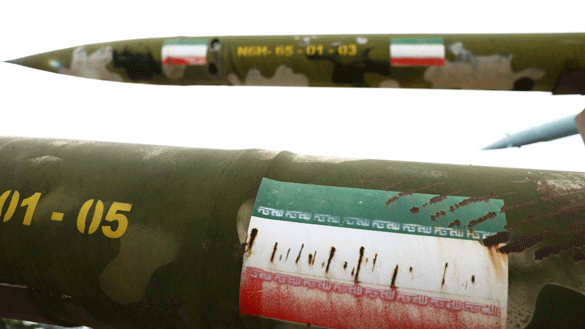
There is no clear winner in this war, and the timeline for how and when it will end remains uncertain. At present, neither side is in a position to declare victory, and the conflict may never produce an outcome where any party can claim an unqualified triumph.
From the American perspective, striking tens of thousands of targets in Iran, eliminating senior officials and destroying infrastructure may constitute technical achievements. But results that can be presented as successes do not amount to victory when they fall short of the stated strategic objective. Even if framed as a victory, they will not be received as such by the relevant audiences.
The threshold for what constitutes winning differs sharply between the belligerents. For a great power like the United States, that threshold is very high. If it does not win decisively, it is seen as having lost. For a smaller power, victory can be defined far more modestly: not being defeated by a great power, or simply enduring, is itself a form of winning. In this context, Iran's victory threshold is survival.
There is also a considerable gap between the strategic objectives the U.S. held at the outset of the war and those it holds four weeks in. The initial goals were ambitious: regime change first, then the elimination of Iran's nuclear and missile capabilities, followed by the establishment of a postwar Iranian government aligned with Washington. Now, securing or controlling the Strait of Hormuz may be what gets presented as a "victory." The larger the original objective, the broader the definition of failure becomes.
What has also become clear is that Iran is not simply a narrow regime. It is a deep and extensive state ecosystem. The Iranian system is not held together by ideology or religion alone. It consists of more than a million bureaucrats who identify with the state, who understand that their own survival is bound to its survival, and who would have no viable existence if the state ceased to exist.
The continuation of this structure will itself be seen as a victory by the regime's forces. If a cease-fire were reached today, Iran could readily claim it had won the war.
Even if Iran suffers severe losses across every dimension, the survival of the regime and the structural and institutional continuity of the state could accelerate the postwar recovery process. The regime may, in fact, emerge more confident, both in intensifying domestic repression and in projecting regional pressure and hegemony.
In the postwar period, the Iranian regime may abandon its longstanding nuclear threshold policy, the posture of possessing the capacity to build a nuclear weapon without actually doing so, and redefine weaponization as a legitimate and necessary security guarantee, justified by the price already paid. Until now, Tehran had maintained the strategy of remaining a threshold state precisely because crossing that line was understood to risk triggering direct military intervention and far harsher sanctions. But Iran has now been subjected to a comprehensive military assault without having built the weapon. This will likely spread the conviction within Iran that remaining without nuclear deterrence was a strategic error. That shift in thinking could reframe the nuclear weapon not as a risk to be managed but as an indispensable security guarantee.
Iran will also construct a victory narrative from having globalized the cost of the war and transferred a disproportionate share of it onto the Gulf. The economic and security model that Gulf states have built over decades has sustained serious damage. Going forward, Gulf countries will begin questioning the "security purchasing" model they have sustained for decades. Despite enormous military expenditures, the inadequacy of external protection mechanisms in a moment of genuine crisis has been made plainly visible. Over the long term, Gulf states may look toward new strategic orientations and multi-directional alliances.
Ultimately, this war will be shaped less by what the parties achieved on the battlefield than by what they failed to achieve. The U.S. can demonstrate military superiority, but as long as it cannot translate that superiority into a strategic outcome, the claim to victory will remain weak. Iran, despite paying a severe price, will define itself as the winner to the extent that it remained standing, kept its system functioning, and frustrated the objectives of the other side.
https://www.dailysabah.com/opinion/columns/why-neither-us-nor-iran-can-claim-victory-and-what-comes-next
------
State consciousness: Türkiye’s intelligence doctrine in age of AI
By Alp Cenk Arslan
Apr 02, 2026
Intelligence affairs are often discussed today in the language of systems, data and machines. Artificial intelligence (AI), predictive analytics, surveillance architectures and algorithmic decision-support tools now dominate conversations about the future of security. In this increasingly technocratic climate, intelligence risks being understood as little more than the efficient processing of vast quantities of information. Yet intelligence has never been only about information. At its deepest level, it is about political purpose, about how a state perceives danger, interprets uncertainty and acts to preserve its continuity.
Intelligence beyond technocracy
The U.S. Office of the Director of National Intelligence’s (ODNI) 2026 Annual Threat Assessment presents AI as a defining technology of the 21st century with implications across defense, intelligence and economic competition. Stanford’s 2025 AI Index Report documents a more than ninefold increase in global legislative mentions of AI since 2016. Separate industry reporting also points to rapid diffusion across the private sector, with some estimates suggesting that 65% of enterprises are now using generative AI, while market analyses project agentic AI spending could reach $51.5 billion by 2028. At the same time, global data volumes are estimated to have reached roughly 181 zettabytes in 2025, prompting intelligence communities worldwide to invest heavily in algorithms, surveillance clouds and predictive analytics. Yet this technocratic vision, centered on data lakes, machine learning and top-secret AI platforms, risks reducing intelligence to a sterile exercise in pattern recognition.At this critical moment, Türkiye’s intelligence tradition offers a compelling philosophical alternative. Intelligence is understood through its teleology, the purposeful striving of the state toward continuity, sovereignty and renewal. It is rooted in historical purpose, existential awareness, and civilizational continuity. As Aristotle first systematically developed in his doctrine of final causes, teleology concerns the inherent purpose or end toward which something naturally tends.
This perspective flows directly from Türkiye’s unique trajectory, where intelligence has never been a detached bureaucratic function but an organic extension of the state’s telos, its purposeful striving toward survival, sovereignty and renewal. From Ottoman frontier governance to the proactive operations of the National Intelligence Organization (MIT) today, Turkish intelligence embodies a deeper role. It is safeguarding the state’s continuity amid perpetual threats. As MIT President İbrahim Kalın outlined in the organization’s 2025 activity report, Türkiye has embraced a “preventive intelligence paradigm” that integrates human insight, technical capabilities and strategic foresight to neutralize risks before they materialize. This is the living expression of a centuries-old doctrine that views intelligence as the state’s vigilant self-awareness.
Roots of Türkiye’s intelligence
The historical roots of the teleological approach trace back to the Ottoman Empire’s sophisticated frontier intelligence practices. During great-power rivalries and declining territorial integrity, Ottoman intelligence was not technocratic data collection but a deliberate instrument of civilizational preservation. It embodied teleology in action, gathering insights to sustain the empire’s strategic purpose as a bridge between East and West, a guardian of Islamic and Turkic heritage amid encirclement.
This legacy persisted with the founder of the Republic of Türkiye, Mustafa Kemal Atatürk’s establishment of the National Security Service (commonly known as MAH) in 1926, which centralized intelligence to fortify the nascent state against partition.
By 1965, this had evolved into MIT, tasked with integrating intelligence into national security policy. These institutions were never neutral observers. On the contrary, they were conscious actors in the state’s self-realization, shaped by the existential imperative of survival following the collapse of the Ottoman order.
This historical telos has found renewed expression in contemporary Turkish practice. Over the past decade, organizational and legislative reforms have expanded MIT’s mandate, enabling Turkish intelligence to move beyond a primarily defensive posture toward a more proactive and externally oriented role. Syria offers a clear example of this evolution.
Following the fall of the Assad regime in December 2024, MIT appears to have assumed an active role in intelligence diplomacy aimed at preventing new threats along Türkiye’s border and shaping the conditions for a more stable post-conflict environment. As noted in MIT’s 2025 report, proactive measures helped prevent developments in Syria from generating new security risks for Türkiye, reflecting an approach that links operational activity with broader strategic foresight. This is also evident in the way MIT has assumed a leading role in intelligence diplomacy, drawing on sociological dynamics such as trust formed through repeated interactions and shared organizational practices to navigate complex multilateral initiatives.
Similarly, in Libya, Africa and beyond, MIT has expanded its external reach through intelligence diplomacy, counterterrorism cooperation and engagement with local and regional actors. The organization’s 2025 reporting highlights activity stretching from Libya and Somalia to Sudan, Chad, Niger and Kenya, presenting these theaters as part of a broader preventive approach aimed at safeguarding Türkiye’s security interests beyond its borders.
Intelligence as consciousness
What distinguishes this from the global technocratic model is its philosophical grounding in civilizational continuity. Unlike Western intelligence cultures increasingly beholden to algorithms and surveillance capitalism, where the ODNI’s data strategy and secret cloud initiatives prioritize volume, velocity and AI-augmented analysis, Turkish doctrine insists on the primacy of human judgment informed by historical purpose.
The U.S. Defense Intelligence Agency’s 2025 Threat Assessment warns of adversaries exploiting AI for decision support, targeting and influence, yet acknowledges the persistent challenges of unstructured data and the need for contextual expertise. Similar foreign reports repeatedly highlight risks such as bias in models, over-reliance on black-box predictions and the erosion of analyst intuition amid data deluges.
Türkiye sidesteps these pitfalls by viewing intelligence as “state consciousness,” a collective awareness that filters raw inputs through the lens of existential threats and long-term telos. Separatist terrorism, religion-abusing networks such as the Gülenist Terror Group (FETÖ), hybrid cyber campaigns and great-power maneuvering are manifestations of deeper assaults on Türkiye’s sovereign continuity. MIT operations thus become acts of strategic self-preservation, blending emerging technologies such as unmanned aerial vehicles (UAVs), signals intelligence (SIGINT) and big-data analytics with centuries-old statecraft.
This original understanding resonates with international debates on the philosophy of intelligence. Several scholars in the field have long noted that intelligence is inherently teleological. It serves to advance a polity’s ends. Amid the proliferation of AI, however, questions arise about whether machines can replicate, or supplant, the intentionality and moral purpose that define human strategic thought. Claims about replicating biological intelligence often rest on unexamined philosophical assumptions.
Türkiye’s experience suggests that true intelligence transcends replication and requires embedding technology within a living tradition. In this sense, MIT’s 2025 emphasis on hundreds of years of state tradition and a vast civilizational memory underscores the view that AI may enhance, but cannot replace, the conscious pursuit of national purpose.
Critics in the West may dismiss this as romanticism, preferring the apparent objectivity of data-driven systems. Yet the evidence points elsewhere. Several global reports have long warned of fragmented world orders, hybrid threats and the limits of purely technological superiority. In Ukraine, Gaza, and the Indo-Pacific, AI-enhanced surveillance has proliferated, yet strategic surprises persist, precisely because technocracy often severs intelligence from the political and historical telos it must serve.
Türkiye, in contrast, demonstrates that intelligence cultures evolve most effectively when anchored in purpose. Its self-reliant doctrine, forged through reforms that enhanced operational autonomy while preserving democratic oversight, has yielded tangible results such as thwarted espionage rings, disrupted terrorist cells and diplomatic leverage that bolsters regional stability.
At a moment when AI-driven systems promise to transform global security practices, revisiting these philosophical foundations is essential. The Turkish case illustrates that intelligence is about the state’s strategic consciousness, perpetually attuned to threats against its continuity and animated by a civilizational telos. By integrating cutting-edge technology with this deeper awareness, Türkiye offers the world a model for the future, one where intelligence remains a profoundly human and humane endeavor, safeguarding not just data but the very purpose of the state itself.
This approach is more than a national asset. It is a lesson for an international community grappling with uncertainty. As great-power competition intensifies and technological disruption accelerates, states that neglect the teleology of intelligence risk becoming reactive algorithms rather than purposeful actors. Türkiye’s tradition reminds us that true strategic advantage lies in consciousness, in knowing why the state exists and what it must become. Only by embracing this philosophical depth can intelligence affairs fulfill their highest calling, which is ensuring the continuity of sovereign purpose amid the storms of history.
https://www.dailysabah.com/opinion/op-ed/state-consciousness-turkiyes-intelligence-doctrine-in-age-of-ai
-----
From the margins to the middle: Pakistan’s role in the Iran war
By Dr Zarqa Parvez
April 1, 2026
When the foreign ministers of Saudi Arabia, Türkiye and Egypt landed in Islamabad on March 29, 2026, much of the international media reached for the same word: unexpected. The AP wire described Pakistan as an “unexpected mediator.” Foreign Policy’s Michael Kugelman, an otherwise careful South Asia analyst, opened his piece with the caveat that “Pakistan might seem an unlikely mediator.” Pakistani analyst Zahid Hussain went further, demoting Islamabad to a “messenger rather than a mediator.” The framing is consistent across the commentary, and it is wrong in a way that tells us more about the analytical blind spots of those applying it than about Pakistan itself.
Pakistan has never not been relevant to Gulf and regional politics. What has changed is not Pakistan’s position in this order. It is the world’s willingness, or rather, its sudden inability to avoid, reading it correctly.
The Structure of Pakistani Power
To understand why Pakistan is not a new player but the most structurally logical mediator in this war, you have to understand what Pakistan actually is, not through the lens of its chronic political crises, but through its relational geometry in the Islamic world.
Pakistan is the world’s only Muslim-majority nuclear power. That single fact carries weight that no amount of domestic instability can fully neutralise. As Barry Buzan and Ole Wæver’s framework of regional security complexes makes clear, states derive their international relevance not merely from internal strength but from the relational architecture of threats, alliances, and interdependencies that position them within and across security orders. Pakistan sits at the intersection of two of the most volatile security complexes on the planet: South Asia and the Middle East. It is not peripheral to either. It is load-bearing.
But nuclear capability alone does not explain Pakistani leverage right now. What makes Pakistan irreplaceable in this specific moment is a combination that no other state can replicate: it hosts the world’s second-largest Shia Muslim population after Iran, is the heartland of Sunni political ideology, was born in the name of Islam without constitutionally becoming a theocracy, and has simultaneously maintained strategic partnerships with the United States, China, Saudi Arabia, and Iran — often all at once. Its military apparatus is, as Ayesha Jalal argued in The State of Martial Rule, so constitutively fused with the state itself that Pakistani foreign policy is, in many respects, army policy. That is not a dysfunction in this moment. It is a precision instrument. When Prime Minister Shehbaz Sharif holds a 90-minute call with Iranian President Masoud Pezeshkian and Field Marshal Asim Munir, whom Trump has publicly called his “favourite Field Marshal”, maintains direct access to the White House, those are not separate diplomatic tracks. They are the same state speaking in two registers simultaneously.
History Does Not Begin in 2026
Pakistan and Iran established diplomatic relations on August 14, 1947, the very day of Pakistan’s independence. Iran was the first country in the world to recognise Pakistan as a sovereign state. Shah Mohammad Reza Pahlavi was the first head of any state to visit Pakistan officially, in March 1950, and the Treaty of Friendship signed on that visit anchored a relationship built on geographic contiguity, linguistic affinity, and shared civilisational depth. Pakistan is, in its very etymology and cultural DNA, heir to Persian literary and philosophical tradition. Urdu is saturated with Farsi. The border with Iran is 900 kilometres of shared history that no war can simply erase.
Saudi Arabia, meanwhile, is not a later addition to Pakistan’s strategic portfolio. King Faisal’s relationship with Pakistan was one of the most consequential bilateral partnerships of the postcolonial Muslim world. Saudi Arabia invested heavily in Pakistan’s education, infrastructure, and security architecture through the 1970s and 1980s. The depth of military cooperation is equally unambiguous: during the siege of Mecca in 1979, when Juhayman al-Otaybi’s militants seized the Grand Mosque, Pakistani special forces worked alongside Saudi units to retake the holiest site in Islam. The strategic defence pact formalised in September 2025, by which an attack on Saudi Arabia constitutes an attack on Pakistan, codified what had long been an operational reality.
Pakistan, in other words, has never been a bystander in Gulf and regional politics. It has been a structural participant whose contributions were systematically underdiscussed in Western and analytical frameworks that historically cordoned off “Middle Eastern” politics within the Arab world and treated South Asia as a separate file. That compartmentalisation was always artificial. This war has made it untenable.
The Islamabad Moment
What happened on March 29, 2026, was not Pakistan inserting itself into a crisis it had no business being in. It was a crisis finally organising itself around the one geography capable of holding its contradictions together.
The four-nation consultative meeting, Pakistan, Saudi Arabia, Türkiye and Egypt, was originally planned for Ankara. It was moved to Islamabad. That relocation is the entire story. As Al Jazeera’s reporting from the Pakistani capital noted, the shift reflected Pakistan’s active role as the relay between Washington and Tehran, passing messages between two parties who do not speak directly and do not trust each other. Pakistan had already, on March 3, told its parliament it was ready to facilitate dialogue and had pushed back on Washington’s demand for zero uranium enrichment, proposing instead a monitored surveillance framework that Iran found workable. That is not diplomatic performance. That is substantive mediation with a documented paper trail.
Foreign Minister Ishaq Dar was unambiguous at the conclusion of the talks: “Pakistan is very happy that both Iran and the US have expressed their confidence in Pakistan to facilitate their talks. Pakistan will be honoured to host and facilitate meaningful talks between the two sides in coming days, for a comprehensive and lasting settlement of the ongoing conflict.” Within hours, Iran agreed to allow 20 Pakistani-flagged vessels to pass through the Strait of Hormuz, two per day, a confidence-building measure that was simultaneously practical and symbolic. Pakistan’s flag transiting Hormuz while both sides remain at war is a form of diplomatic grammar that communiqués cannot produce. On March 31, Dar travelled to Beijing at the invitation of Foreign Minister Wang Yi to present Pakistan’s five-point peace framework. China’s backing, alongside UN Secretary-General Guterres’s expressed support, signals that Islamabad’s track has acquired multilateral legitimacy that no single-state mediation effort could claim.
The Gulf Steps Back
A crucial structural dynamic that most commentary has failed to engage with is the fact that the Gulf Cooperation Council does not have a united stance towards negotiations with Iran. According to reporting from Gulf sources, Qatar, Oman and Kuwait are pushing for a swift ceasefire, while the UAE and Bahrain are prepared to tolerate, or even invite, further US military escalation against Iran. The Gulf states, having been targeted by Iranian missile and drone strikes throughout this war, have a legitimate grievance. But that grievance has also made them epistemically disqualified as neutral mediators. As one Gulf International Forum analyst noted, for some Gulf states “stopping hostilities against their respective country would be a prerequisite for taking on any meaningful mediating role.” The GCC cannot broker a deal it is too injured, and too internally divided, to own.
This is precisely the structural opening Pakistan occupies. Unlike the Gulf states, Pakistan is not in the war. Unlike the Western powers, it is not perceived by Tehran as a party to the aggression. Unlike Oman, which previously held talks that Tehran later said were undermined when strikes continued mid-negotiation, Pakistan has the ability to condemn Israeli attacks while maintaining its channel to Washington, an act of precision diplomacy it has sustained throughout the crisis. Islamabad condemned Israeli strikes on Iran and named Israel explicitly. It expressed solidarity with Gulf states under Iranian attack. It declined to name the United States. That calibration is not ambiguity. It is architecture.
The Stakes Are Pakistan’s Own
To read Pakistan’s mediation as purely altruistic statecraft is to miss the self-preservation logic that makes it credible. Pakistan mediates because it must. Five million Pakistanis work in the Arab Gulf, sending home remittances roughly equal to the country’s total export earnings. Pakistan imports the majority of its energy from the Middle East. Hormuz disruption has already forced fuel prices up by approximately 20 percent and the government has imposed a four-day working week as energy stocks run dangerously low. The economic chokehold of this war on Pakistan is not abstract. It is existential.
Add to this the security pact with Saudi Arabia, and Pakistan’s strategic calculus becomes even starker. If Iran attacks Saudi Arabia and Pakistan is formally obligated to respond, Islamabad enters the war directly, a scenario that broadens and prolongs the conflict while simultaneously destroying Pakistan’s carefully maintained position of relative neutrality. Mediation, in this light, is not an opportunity Pakistan is seizing. It is a necessity Pakistan is managing. Former Pakistani diplomat Salman Bashir put it plainly: “Pakistan’s relations with the Trump administration have been very good, and we have been talking to Iran as well. It would very much be in our interest, because we could be affected by this conflict.” States that mediate for self-interested reasons are not thereby less credible, they are more credible, because their continued engagement can be predicted.
The China Triangle
What has received almost no analytical attention is the great-power geometry that Pakistan’s mediation introduces into this conflict. On March 31, Pakistan’s Foreign Minister Dar met with Chinese Foreign Minister Wang Yi in Beijing. China, which brokered the Iranian-Saudi reconciliation in 2023, has conveyed full support for Pakistan’s mediation initiative and encouraged Tehran to engage with the diplomatic process. This is not simply bilateral solidarity. It means that any deal Pakistan brokers will carry Beijing’s fingerprints, which transforms the Islamabad track from a regional Muslim-world initiative into a framework that both the US and China have an interest in seeing succeed. For an administration as transactionally minded as Trump’s, the knowledge that a Pakistani-brokered deal provides a geopolitical win that simultaneously manages China’s regional influence is not a complication. It may be a selling point.
The Regional Order Being Born
This war is not simply destroying Iran’s military infrastructure. It is changing the regional order that preceded it one that operated within a US security umbrella. Iran contested that order from outside, and Pakistan watched from the periphery. As Turkish President Erdoğan has warned, “the region is being drawn step by step into a game scripted by Israel.” Mahmoud Alloush, a Türkiye-based analyst, has described the Islamabad gathering as the foundational step for an “Islamic alliance” designed to address the geopolitical vacuums being created by this war. Whether or not that characterisation is premature, the structural shift it gestures toward is real.
Iran weakened as a non-Arab regional power, the US security umbrella revealed as both destructive and unreliable, the GCC fractured between escalation and restraint, this is the landscape in which Pakistan has stepped forward. It has not done so from nowhere. It has done so from a position it has occupied, quietly and consequentially, for nearly eighty years.
Pakistan is the only Muslim-majority nuclear power. It has simultaneous access to Washington, Tehran, Riyadh, and Beijing. It carries no Israeli diplomatic relationship that would render it suspect to Iran. It has a border, a history, and a civilisational register that Iran reads as proximate rather than foreign. The question was never whether Pakistan was capable of this role. The question was when the crisis would become legible enough to make its position impossible to ignore.
That moment arrived on March 29, 2026, in Islamabad. The sleeping giant was never asleep. The world simply needed a war large enough to finally look up.
https://www.middleeastmonitor.com/20260401-from-the-margins-to-the-middle-pakistans-role-in-the-iran-war/
-------
Iraqi militias: An intractable security dilemma
Hassan Al-Mustafa
April 01, 2026
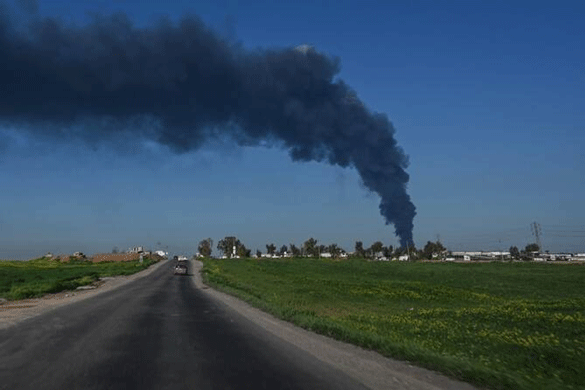
A diplomatic crisis unfolded this week when Kuwait issued its second formal protest to Iraq’s envoy, followed hours later by Baghdad’s suspension of a number of senior security commanders. This sequence of events exposes a troubling reality: Iraq’s government publicly disavows attacks on neighboring states, yet lacks the enforcement mechanisms to prevent Iran-backed militias from targeting Gulf energy infrastructure. The fallout is damaging Baghdad’s ties with Gulf capitals.
Kuwait’s move was no diplomatic formality. It came with a pointed accusation: armed Iraqi factions had struck Kuwaiti soil. The demand was blunt: “concrete, actionable steps” to make the attacks stop.
Kuwaiti officials are under no illusion about the power dynamics inside Iraq. They know that Iran-backed militias routinely defy Prime Minister Mohammed Shia Al-Sudani. But that understanding only goes so far. By escalating diplomatically, Kuwait is highlighting a simple equation: if Baghdad holds sovereignty over its territory, then Baghdad is responsible for everything that comes out of it.
The Iraqi government’s own actions tell the same story. Relieving security officials in the Al-Mada’in sector and placing them in custody over a breach near Baghdad International Airport is, in effect, a confession — an admission that the state’s security apparatus failed in one of the most sensitive areas in the country. This did not happen in some remote borderland. It happened in the capital’s backyard. The implications cut to the bone.
Foreign Minister Fuad Hussein has been unambiguous: Iraq rejects “any attack” against Gulf Arab states and Jordan, insisting that “the security of our Arab brothers is inseparable from Iraqi national security.” This clarity matters. It reframes the militia attacks not merely as a foreign relations headache but as a genuine internal security threat — one that breeds chaos, damages Iraq’s standing and undermines its interests.
But words have limits. Attacks keep happening. Armed factions keep claiming credit for them, proudly announcing they are fighting on Iran’s behalf. For anyone watching events on the ground, reassurances from Baghdad are starting to feel like background noise.
Gulf states and Jordan last week issued a joint statement that dispensed with diplomatic pleasantries. They condemned “attacks carried out by armed factions loyal to Iran from the Republic of Iraq against a number of countries in the region, as well as their facilities and infrastructure,” and called on Baghdad to act “immediately.”
That language marks a turning point. Saudi Arabia, in particular, went out of its way to support Al-Sudani. He took office backed by the Coordination Framework — a coalition stacked with Tehran’s allies — yet Riyadh chose pragmatism, investing in relations with his government in the hope that a stronger Iraqi state could gradually push back against militia dominance.
That bet is now being tested. With armed factions launching strikes on Gulf infrastructure, neighboring capitals are recalibrating. Iraq is no longer just a fragile postwar state deserving patience. It is a launchpad for threats that must be halted by a decisive Iraqi sovereign decision.
The militias, meanwhile, are not subtle about their intentions. The Islamic Resistance in Iraq claimed it downed an American refueling aircraft in western Iraq. Abu Alaa Al-Walai, a senior commander of Kata’ib Sayyid Al-Shuhada, went further, openly threatening Gulf states and Jordan and promising more attacks to come.
This is the knot at the center of the crisis. The Iraqi state says one thing; the armed factions do another. And Iraq’s neighbors have grown tired of parsing the difference between a government that cannot control its militias and one that will not. For Al-Sudani, that collapsing distinction is the real danger.
Washington is not waiting around either. Joint Chiefs of Staff Chairman Dan Caine declared that the US is conducting strikes against Iran-aligned militias inside Iraq to neutralize threats to American forces and interests. For Baghdad, this is a double blow. It partially strips the government of its sovereign prerogative to handle threats on its own territory and it sends an unmistakable signal that the era of American patience with Iraqi excuses is over.
Fundamentally, this transcends security mechanics. It reflects the broader collapse of Iraqi state capacity, the hollowing out of institutions through sectarian patronage networks, and the ascendance of armed factions over elected authority. When uncontrolled militias can spark regional crises, state credibility vanishes. When the government cannot enforce its monopoly on the use of force, neighboring nations withdraw their confidence.
https://www.arabnews.com/node/2638437
------
A New Resistance Front: How Does Syria Factor into the Regional War?
April 2, 2026
By Robert Inlakesh
A new Syrian resistance group has emerged and is the only organization in the country currently carrying out offensive actions against both Israeli and US targets. This development comes as Israel uses the newly occupied territories in its ground assault on Lebanon, a move that could easily rope Tel Aviv into a new quagmire.
While a US allied leader now technically controls Damascus, the reality on the ground in Syria is that there is no functional State. This being the case, the outbreak of chaos is simply one miscalculation away.
In stark contrast to the regimented and tightly controlled Syria that existed under the rule of Bashar Al-Assad and his father Hafez al-Assad, the country today is divided between countless powers throughout the country, with the President functioning as less of a strongman and more of a symbolic figure that covers the explosive charges ready to detonate. Nowhere was this on clearer display than in the July 2025 clashes in southern Syria’s Sweida Province.
President Ahmed al-Shara’a, also known as Abu Mohammed al-Jolani, has allied himself with his Western backers and even gone as far as signing onto a normalization mechanism with Israel. Short of full normalization of ties with Tel Aviv, the “joint fusion mechanism” that was agreed upon by Syrian and Israeli officials seeks to “facilitate immediate and ongoing coordination on their intelligence sharing, military de-escalation, diplomatic engagement, and commercial opportunities under the supervision of the United States.”
Knowing this, it would therefore appear strange that the Israelis still persist with not only bombing Syrian civilian infrastructure across the country, but also Syria’s new military forces. Understanding why will help in unlocking what appears on the surface to be a difficult puzzle to solve.
The Syrian leadership is Hayat Tahrir al-Sham (HTS), infamous for being a rebrand of al-Nusra Front (Al-Qaeda in Syria). Although it is presented as if it were a real government, the group never had any experience in governance. Instead, they knew only how to rule over smaller militia factions and worked as the de facto leadership in Idlib, despite there having been a “Syrian Salvation Government” (SSG) who were technically in control of the territory.
Prior to the fall of Bashar al-Assad’s leadership in December of 2024, HTS had consented to the SSG’s existence in order to give the veneer of a professionally organized opposition. In reality, HTS held all the power cards, even running its own secret prisons, while leaving the administrative details to be hashed out by the professionals.
All of this is of great importance because Bashar al-Assad’s entire system was not overthrown in some kind of war of liberation; instead, it collapsed without any real fight. Therefore, when Ahmed al-Shara’a entered Damascus and declared himself leader, he was in a very difficult position.
Under the supervision of his foreign backers, chiefly the United States, the new Syrian leadership focused on symbolism rather than fundamentally changing the way the country functioned. Therefore, Damascus opened itself up to Washington and became a playground for Western and Israeli intelligence agents, as the new President attempted to impress Washington.
Meanwhile, many of the most corrupt elements belonging to the former regime, were permitted to continue on as if it was business as usual, all as the Syrian Arab Army (SAA) and former intelligence and police services were disbanded. What replaced the former security apparatus were simply militants belonging to the alphabet soup of Al-Qaeda affiliates that had been operating previously out of Idlib.
This being the case, the words of Ahmed al-Shara’a often have little to no bearing on what actually transpires on the ground. Meaning that corruption is rampant, every corner of the nation is filled with different armed forces who have their own territory when push comes to shove. In essence, all of Syria became a big Idlib.
Syria is no longer subjected to sanctions, has gained access to its most fertile agricultural lands, is no longer internationally isolated, while ruling over its own oil and gas fields. Despite all of this, the country’s economy is still in the toilet, and the long-promised prosperity has been reduced to vague future visions. This isn’t to say it’s impossible for things to change, but as it stands, this is Syria today.
Because of the state of Syria’s affairs, cross-border smuggling has exploded and this has evidently benefited Lebanese Hezbollah next door. Two sources familiar with the matter informed Palestine Chronicle that the quantity of weapons flowing through the Syrian-Lebanese border had even increased since the fall of Bashar al-Assad.
According to reports, the US has been applying pressure on Damascus to attack Lebanon in order to help Israel weaken Hezbollah in the Bekaa Valley region. In response, President al-Shara’a broke his silence this Tuesday and declared that Syria will not attack Lebanon, an announcement that came following a threat earlier that day from an Iraqi Popular Mobilization Units (PMU) spokesperson, threatening to attack if Damascus orders such a move.
This affirmed previous suspicions that such an equation could arise, whereby a Syrian invasion of Lebanon would trigger an Iraqi invasion. The PMU, when fully mobilized, can muster a force of around 250,000 fighters, a much more formidable force than what currently constitutes the Syrian Army.
Another possible equation that could be set is a Syria-Israel clash. Not only could armed resistance groups, aligned with the Iranian-led Axis of Resistance, end up creating such a reality, but others could also be roped in.
Israel’s recent bombing of Syrian military positions, coupled with Israeli Security Minister Itamar Ben Gvir’s calls to assassinate the Syrian President, both occurred following an alleged military buildup near the Sweida Province.
It is likely that Damascus was eyeing the opportunity presenting itself to finally deal with the Druze Separatist movement in the southern province. Led by one of the Druze minority group’s spiritual leaders, Hikmat al-Hijri, a unified command calling itself the “National Guard” formed in order to operate a semi-autonomous zone in Sweida.
The National Guard began receiving direct military, financial and logistical support from Israel, who have long sought to establish a Druze rump State in southern Syria, a goal that enables an even greater land grab, as well as opening up “David’s Corridor” spanning over to the Iraqi-Syrian border.
In the eyes of Syria’s leadership, the Druze issue is of great importance to solve for a range of reasons. One of which is that there is an enormous amount of sectarian tension, which various groups who form the new Syrian security apparatus, along with the Bedouin tribal forces, seek to punish following the bloodshed that began last July. It will also mean that technically, Syria will be one step closer to having one central government rule the entire country, which is a symbolic victory for Ahmed al-Shara’a.
However, the Israelis appear to have pre-empted such an offensive and committed a number of airstrikes as a warning to the Syrian leadership. There is clear anxiety over such a battle unfolding, because if it occurs, the Israeli military will be forced to intervene in order to save its Druze separatist allies.
As mentioned above, if things spiral out of control, the President himself cannot necessarily do much about it. That means that Syrian forces will likely begin to directly come into contact with the Israelis on the ground, something that could easily spiral.
Most of the fighters who have, for now, aligned themselves with the Syrian government are no fans of Israel, to say the least. This was on full display last December during the military parades conducted by Syria’s new armed forces, who openly chanted for Gaza, threatened Tel Aviv, and some even burned Israeli flags.
The alternative scenario for the Israelis in Syria may end up being worse, meaning that if they were to assassinate al-Shara’a, a power struggle would likely end up playing out on the streets of the Capital and throughout the country. So many different actors will seek to claim power.
Syria’s predicament has turned out to be less favourable to Tel Aviv, not because it poses an immediate strategic threat, but because almost anything is possible there. During the regional war between the Israeli-US alliance and the Iranian-led Axis of Resistance, one wrong misstep could prove fatal and open up yet another front, which will not only drain their resources but also weaken their ability to fight Hezbollah.
https://www.palestinechronicle.com/a-new-resistance-front-how-does-syria-factor-into-the-regional-war/
------
Iran: East of Suez, West of Hormuz? The Question That Will Define the Next Era
April 2, 2026
By Jeremy Salt
In February 1960, the British Prime Minister, Harold MacMillan, made an historic speech in the South African parliament. “The wind of change is blowing through the continent,” he said. “Whether we like it or not, the growth of national conscience is a fact.” He did not say it outright, but apartheid was unacceptable to the British government, which had in fact accepted it since it was officially declared in 1948. In the future, the UK would not stand in the way of independence movements.
Of course, it did, and he was only talking about the African continent anyway and not the Middle East, where, in 1956, the US had humiliated the UK by forcing it to end the ‘tripartite aggression’ launched against Egypt in collaboration with France and Israel only ten days earlier.
In 1946, the UK had declared its intention to withdraw from Palestine, not out of the goodness of its heart but because it could no longer afford to stay there. It was pulling out of India and other colonial possessions for the same reason.
World War Two had left it virtually bankrupt and dependent on US financial aid. Empire was a luxury it could no longer afford.
In 1960, the devaluation of the pound was the trigger for the declaration by then Prime Minister Harold Wilson and defence minister Denis Healey that British troops would be withdrawn from bases ‘east of Aden,’ which had been in British hands since 1839. Basically, they were referring to the bases in Malaya (Malaysia) and Singapore, but those in the Persian Gulf were also included.
In time ‘east of Aden’ was taken to mean the closure of all military bases ‘east of Suez.’
However, while the British lion had lost its teeth, it had not lost its appetite and was never going to accept the loss of status as a great power.
As Anthony Eden, the prime minister at the time of the Suez war, had remarked, he would rather go to war than allow Britain to be reduced to the level of second-rate countries like Portugal or the Netherlands. He did go to war, and was humiliated.
In fact, the British never withdrew ‘east of Suez’ and never intended to. It dominated the Persian Gulf in the 19th century, occupying Aden in 1839 and maintaining its grip through subsidized tribal shaikhs who headed the ‘Trucial States’. In 1971 Britain relinquished its control of foreign policy and these states became independent, if only in name, as the UAE (United Arab Emirates).
Oman, Kuwait, and Bahrain remained outside this arrangement but remain tied militarily either to the US or the UK. The UK had a naval base in Bahrain from 1935. In 1971, it was taken over by the US, but in 2014, the UK established a permanent naval base ‘east of Suez’ at Mina (port) Salman in Bahrain. In 2024, it opened an air base at Al Minhad, close to Dubai in the UAE.
The US and the UK share a military base on the island of Diego Garcia in the Indian Ocean Chagos Islands. From 1968-1973, the inhabitants of the entire Chagos archipelago were forcefully removed so these two governments could use their homes as a launching pad for war.
In the Mediterranean, ‘east of Suez’ never applied to Cyprus, snitched from the Ottoman government in 1878 in return for a pledge to defend the Ottomans in the event of an attack by Russia and maintained as a military base ever since. In 1914, the Ottoman Empire was attacked by Russia, but by then Britain was its ally. It ruled Cyprus until its independence in 1960.
In the past two years, the RAF base at Akrotiri in Greek Cyprus has been used for regular surveillance flights over Gaza to help Israel. Israeli troops were training in Cyprus several years ago because its mountainous terrain is similar to that of southern Lebanon.
Where all of this dovetails into the war on Iran is that the Iranian government has demanded a full US withdrawal from the Persian Gulf as one of its conditions for ending the war. This would have to imply a UK withdrawal as well. What Iran wants is an end to the entire western military presence, and a withdrawal ‘west of Hormuz’ that would be the parallel to the withdrawal ‘east of Suez.’
In fact, the UK never fully withdrew ‘east of Suez’ and it is even less likely that the US would agree to Iran’s demand that it withdraw ‘west of Hormuz.’ Empires don’t go down without a fight. Withdrawal ‘west of Hormuz’ would not be existential for the US as a country, but it would be for the collective ‘west.’
For half a millennium, every ‘western’ empire has had its turn in raping the east through war, intimidation and economic exploitation. Britain, France, Spain, Italy, Portugal and the Netherlands all jumped in for their chop over the past five hundred years before being forced to retreat and settle for comfortable late empire retirement.
Now the US seems close to the end of its run, which is why, of all the demands made by Iran, withdrawal ‘west of Hormuz’ is non-negotiable for the US. Retreat would be the acceptance of defeat.
It would push an already tottering American empire off its plinth. Furthermore, the last gasp on the deathbed of ‘western’ global domination would almost be audible. No one would be left with the will or the power to pick up the fallen American banner.
Yet this demand is non-negotiable for Iran as well. Nearly 50 years have passed and it cannot live any longer at the point of the ‘western’ sword.
This epochal moment in history compares with Suez and no doubt many other occasions in history as the long run of the powerful approaches its end.
In the past several weeks, Trump has offered terms that are not subject to negotiations because they are an ultimatum. ‘Accept these terms or we will obliterate you.’ This is a scarcely veiled variation of the Mafia ‘offer you can’t refuse’ and what puzzles Trump is that Iran is not accepting.
Having started this war, Trump, behind the bluster, seems to want to get out of it, but does not know how. A large part of his problem is that Israel wants the war to continue, with the full support of the US, because without it, Israel cannot continue the fight. Its strong advantage is the Zionist billionaires who fund Trump and a Congress bribed and bought out long ago by the Israel lobby.
There seems no negotiated way out but sooner or later, under the accumulating pressure, something has to give way.
The wild card in the pack, of course, is Israel. It does not want the war to end, not just until the Islamic government is destroyed but until Iran is either broken up into ethno-national statelets or returned to the slave status that lasted until 1979.
This goes beyond what the US thinks is feasible, at least what sound military and strategic minds think is feasible. The truth seems to be dawning on Trump, but he is impaled on Israel’s hook and Israel is not going to let him wriggle off it. This is his own fault. He made his own pact with the devil long ago and now the billionaire Zionists who funded him all the way into the White House are calling in the debt.
The Islamic Republic of Iran was never an existential threat to Israel. Its opposition was based on principled legal and moral support for the Palestinians. Had the Palestinians ever been offered a judicious settlement, and had they accepted it, Iran would have accepted it, too, but such an offer was never made.
Israel was never going to share what it had stolen. It always wanted more. Its road to ‘peace’ was genocidal force against the Palestinians and anyone who would dare stand against it.
That policy has now completely unravelled. Its own military-strategic decline began long ago. Over-extended militarily at several levels, it has now finally started a war that has bounced back in its own large-scale destruction.
Both Yemen and Hezbollah have joined the war. The destruction of scores of Merkava tanks in southern Lebanon is unprecedented. Israel’s own chief of staff says the military is exhausted and suffering a manpower shortage so acute it is at risk of “collapsing in on itself.”
This is a scare attack designed to bring into the army those avoiding military service. At the same time, there is no doubt that the military is overstretched. The ‘existential threat’ Israel has always used as a pretext for its wars is now real, but brought on by Israel itself.
Trump’s public standing in the US is fast heading to rock bottom. Narcissistic, blaming everyone else for his own folly, turning on European allies who are rapidly turning against him, can Trump somehow resist being pulled deeper into the vortex by Israel, and if he can, what will Israel do then?
Or is he still fully onside with Israel, with his talk of negotiations and maybe ‘walking away’ from the Strait of Hormuz a ruse giving him time to marshal US forces ahead of a land attack on Iran intended to seize strategic territory?
Will ‘west of Hormuz’ share historical space with ‘east of Suez’ as a defining act that changed the balance of global power? The answers to these and other questions should not be long in coming.
https://www.palestinechronicle.com/iran-east-of-suez-west-of-hormuz-the-question-that-will-define-the-next-era/
-------
Not the Economy, Stupid – How Gaza Reshaped America’s View of the Iran War
April 2, 2026
A Familiar Explanation
In the wake of new polling showing that most Americans oppose the war on Iran and reject the deployment of ground troops, much of the media coverage has followed a predictable script.
The public’s anti-war stance, we are told, is driven by economic anxiety, partisan polarization, or dissatisfaction with President Donald Trump’s leadership style. Concerns about rising fuel prices, the financial burden of war, and the risks to American soldiers are repeatedly cited as the primary reasons behind growing opposition.
These explanations are not wrong. But they are incomplete.
By reducing public sentiment to material concerns or partisan divides, such framing overlooks a deeper transformation already underway in American public opinion—one that predates the current war and cannot be fully explained by immediate circumstances.
The February Shift
On February 27, 2026—just one day before the launch of the US-Israeli war on Iran—a Gallup poll recorded a historic shift.
For the first time in decades of tracking, more Americans said they sympathize with Palestinians than with Israelis.
The significance of this shift extends far beyond the Israel-Palestine context. It signals a broader reorientation in how Americans perceive war, occupation, and the use of military force.
Crucially, this change occurred before the current escalation with Iran, meaning it cannot be attributed to war fatigue, economic pressures, or immediate political developments related to the conflict.
It reflects something more fundamental.
A Consistent Pattern
The latest polling on the Iran war shows that most Americans want the conflict to end quickly; a clear majority opposes sending ground troops; and public concern centers on the human and economic cost of war.
These findings are often interpreted as reactive or situational.
But when placed alongside the February Gallup data, a different picture emerges.
The opposition to the war on Iran is not an isolated response—it is part of a consistent and evolving pattern in American public opinion, one that increasingly rejects military intervention, regime change, and the framing of foreign adversaries as existential threats.
In this sense, the shift on Palestine and the opposition to the Iran war are not separate developments. They are expressions of the same underlying transformation.
Beyond Cost and Politics
Economic concerns undoubtedly play a role. So do partisan divisions. But these factors alone cannot explain why public sentiment is changing so rapidly and so fundamentally.
If opposition were driven solely by cost, one would expect support for war to remain stable when framed in strategic or security terms. Instead, we are seeing growing skepticism toward the very premises of such conflicts.
Similarly, if the shift were purely partisan, it would not be accompanied by measurable changes in attitudes toward Palestine—an issue that has historically transcended short-term political cycles.
What is emerging instead is a broader questioning of long-standing narratives about US foreign policy, including the justification of wars in the Middle East and the role of allies, namely Israel, in shaping American military decisions.
The Moral Dimension
The reluctance to support war is not only pragmatic—it is also moral.
The February polling suggests that Americans are increasingly willing to reconsider entrenched assumptions, including the portrayal of Israel and the framing of Palestinian resistance. This reassessment inevitably shapes how new conflicts are understood.
When Americans question the legitimacy of one prolonged conflict, they are more likely to question others.
Seen in this light, opposition to the war on Iran reflects not only fear of its consequences, but also a growing discomfort with the logic that underpins it.
The convergence of these trends points to a potential turning point in US public opinion.
For decades, American support for military intervention in the Middle East was often sustained by a combination of political consensus, media framing, and strategic narratives. That consensus now appears to be weakening.
The February Gallup poll did not simply capture a moment—it revealed a shift already in motion.
The latest surveys on the Iran war confirm that the shift is continuing.
A Narrative Still Catching Up
If there is a disconnect, it is not between public opinion and policy alone—it is also between public sentiment and how that sentiment is internalized and described.
By attributing anti-war attitudes primarily to economic or partisan factors, much of the current coverage risks missing the broader transformation taking place.
The American public is not only reacting to the costs of war. It is also rethinking the assumptions that have long justified it.
And that may prove to be the most consequential shift of all.
https://www.palestinechronicle.com/not-the-economy-stupid-how-gaza-reshaped-americas-view-of-the-iran-war/
-------
The Rise of the Spokesman: How Abu Obeida, Saree, and Zolfaghari Made Words a Battlefield
April 1, 2026
The current phase of war in the Middle East has not only redrawn military maps—it has redefined how war itself is articulated, perceived, and embodied.
What was once described as the “unity of squares – has evolved into something far more concrete: a ‘unity of battlefields’.
Overlapping conflicts have driven this transformation—the ongoing genocide in Gaza, the widening regional confrontations, and most decisively, the US-Israeli aggression on Iran beginning February 28.
The result is not merely coordination. It is simultaneity: Missiles launched from Yemen align with operations in Lebanon. Statements issued in Tehran echo those emerging from Gaza. Military timelines intersect, narratives converge, and the war begins to function as a single, interconnected space.
This shift—from conceptual alignment to tangible, synchronized warfare—has also produced a parallel transformation: the emergence of new kinds of figures who represent this war.
People’s Voices
One layer of this transformation is rooted in the visibility of ordinary people.
Across Gaza, Yemen, Lebanon, and Iran, men, women, and children have produced some of the most powerful and widely circulated narratives of the war. Their testimonies—often recorded in real time—have reshaped how events are understood, bypassing traditional media structures.
These voices have become iconic in their own right. They reassert a fundamental principle: that history is not only written by institutions or states, but also articulated by people themselves.
Through social media, these individuals have turned lived experience into political discourse, often reaching audiences far beyond their immediate surroundings.
But while these voices are central, they exist alongside another, more structured phenomenon.
The Spokesman
At the forefront of this second layer stand military spokesmen.
Figures such as Abu Obeida in Gaza, Ibrahim Zolfaghari in Iran, and Yahya Saree of Ansarallah in Yemen have moved far beyond their formal roles as conveyors of information.
They do not simply announce operations. They embody them.
Each appearance is not just a briefing—it is an event. Each statement is not merely descriptive—it is performative, strategic, and deeply embedded in the broader logic of the war.
Their tone, language, timing, and even physical presence form part of the battlefield itself.
When Abu Obeida declared that “the shortest way to liberate the prisoners is through resistance,” he was not simply making a tactical argument, but reaffirming a long-standing doctrine that places armed struggle at the center of political outcomes.
When Yahya Saree repeatedly emphasized that operations “will continue”, he was not merely describing military continuity, but situating Yemen within an expanding, unified confrontation that stretches beyond its borders.
And when Ibrahim Zolfaghari addressed US forces directly, warning that they could become “food for the sharks of the Persian Gulf,” he was projecting a language of deterrence that bypasses mediation and speaks directly to adversaries in their own political and psychological space.
Each of these statements operates beyond information. It is a signal.
Iconic Presence
What distinguishes these figures is not only what they say, but how they are received.
Abu Obeida, the military spokesman of Al-Qassam Brigades, has become one of the most recognizable figures associated with the Palestinian resistance. His carefully structured statements, delivered with consistency and clarity, resonate far beyond Gaza.
Yahya Saree, speaking on behalf of Yemen’s Ansarallah, has similarly established a steady presence, announcing operations that are explicitly framed within a broader regional alignment.
In Iran, Ibrahim Zolfaghari has introduced a different dimension—multilingual communication that directly addresses multiple audiences, including Israeli society itself, collapsing linguistic distance and reinforcing psychological impact.
Their words travel instantly. Their tone is studied. Their pauses, repetitions, and formulations become recognizable patterns.
They are quoted, clipped, translated, and redistributed across platforms.
Their presence generates expectation.
Their absence raises questions.
Beyond Individual
Perhaps the most striking aspect of this phenomenon is that it does not depend on the individual alone.
Following the assassination of Abu Obeida, a new figure emerged under the same name—continuing the role with remarkable continuity in tone, cadence, and presence. The transition was seamless.
Nothing essential changed. This continuity suggests that Abu Obeida is no longer merely a person. He is a constructed presence, sustained by a broader institutional and cultural framework.
A voice that can be reproduced. A figure that can be reinhabited. The same applies, in different ways, to Saree and Zolfaghari. They function not only as individuals, but as expressions of a collective identity.
Language as Power
Central to this transformation is the role of language. These spokesmen do not simply communicate facts. They structure meaning.
Abu Obeida consistently frames resistance as the decisive factor in shaping outcomes, linking battlefield action to political consequence.
Saree situates Yemeni operations within a wider geography of solidarity, where each strike is part of a broader moral and strategic framework.
Zolfaghari, in turn, employs direct, often multilingual messaging that collapses the distance between speaker and audience, reinforcing the immediacy of the confrontation.
Language, in this context, becomes a form of action. It shapes perception, influences morale, and contributes to the overall conduct of the war.
The New Role
The evolution of these figures reflects a broader shift in the role of the military spokesman.
Traditionally, the spokesman was a mediator—someone who translated battlefield developments into public information. Today, that role has expanded significantly.
The spokesman is now a strategic actor.
His presence carries weight beyond the content of his statements. His credibility, tone, and consistency contribute to shaping how the war is understood, both regionally and globally.
A Collective Symbol
Ultimately, the significance of figures like Abu Obeida, Zolfaghari, and Saree lies in what they represent. They are not isolated personalities. They are part of a wider phenomenon that reflects the convergence of battlefields, narratives, and public perception.
In a moment defined by fragmentation, they provide continuity. In a landscape shaped by competing narratives, they offer a consistent voice.
And in a war that spans multiple fronts, they embody the idea that those fronts are no longer separate.
They are one.
https://www.palestinechronicle.com/the-rise-of-the-spokesman-how-abu-obeida-saree-and-zolfaghari-made-words-a-battlefield/
-------
New Age Islam, Islam Online, Islamic Website, African Muslim News, Arab World News, South Asia News, Indian Muslim News, World Muslim News, Women in Islam, Islamic Feminism, Arab Women, Women In Arab, Islamophobia in America, Muslim Women in West, Islam Women and Feminism