
Middle East Press On: New Turkish Air Force, Trump, Iran War, Lebanon, America, Genocide, Gaza’s Destruction, Geneva As Palestine, ILO Victory, UK, New Age Islam's Selection, 04 June 2026

By New Age Islam Edit Desk
04 June 2026
New Turkish Air Force: Airpower without dependence
Trump’s desperate attempt to end the Iran War: Abraham Accords
Why Iran’s real war begins when the bombing ends
Lebanon: America’s bargaining chip in its standoff with Iran
Fighting the opportunists who profit from genocide
What Comes After Gaza’s Destruction? A Response to Gideon Levy
Tense Scenes in Geneva as Palestine Secures ILO Victory, Israeli Delegate Interrupted
The UK Government Will Persecute Those Vocal about Israel, But Not War Criminals
------
New Turkish Air Force: Airpower without dependence
BY AHMET ALEMDAR
JUN 04, 2026

The projects Türkiye has been developing for many years in the fields of defense and security continue to yield tangible results in the aviation sector, just as they have in the maritime sector. Thanks to the national vision established for the aviation and space industry, high-tech platforms that will be central to future battlefields are preparing to enter the inventory of the Turkish Air Force.
Significant progress is being made, particularly in the long-awaited Airborne Electronic Warfare Aircraft (HAVASOJ) project, which possesses the capability to neutralize enemy radars. However, HAVASOJ is not the sole factor shaping the future of the Turkish Air Force.
A major transformation is underway that positions Türkiye as a global player in both manned and unmanned aviation as well as air defense systems. The Ministry of National Defense’s video marking the 115th anniversary of the Turkish Air Force (1911-2026) also conveys messages about the future.
Overcoming psychological barrier
The reliance on procuring military aviation platforms from abroad has been a deep-rooted dependency spanning many years in Türkiye. The necessity of purchasing aircraft from abroad created a psychological barrier within society and the defense bureaucracy. However, this barrier is being gradually overcome through helicopter, fighter jet and unmanned system projects, each brought to life one by one under the coordination of the Defense Industries Presidency.
In the near future, this psychological barrier will be eliminated as our domestically produced platforms begin operational service in fleets. In particular, the successful performance of the Hürjet, Türkiye’s first domestically produced manned jet-powered aircraft, is the clearest indication of this progress. The Hürjet, produced by Turkish Aerospace Industries (TAI) and scheduled to enter service in the near future, will enable us to say, “We have produced and put our own fighter jet into service.”
The Hürkuş II training aircraft, scheduled to enter service this year, will completely end our reliance on foreign sources for pilot training. The National Combat Aircraft Kaan, meanwhile, represents the pinnacle of Türkiye’s capability, proving that we are among the few countries capable of producing fifth-generation fighter jets. When Kaan enters service with a domestically produced turbofan engine, it will mark a turning point, signifying that all psychological barriers in military aviation have been overcome.
Unmanned strike force
It is widely acknowledged that Türkiye is not only a producer but also a rule-setting power in unmanned aerial vehicle (UAV) technologies, which are reshaping global war strategies. In regions such as Syria, Libya, Karabakh, Ukraine, Ethiopia, Somalia and Sudan, it has altered the course of wars in favor of Türkiye’s allies. The Bayraktar TB3 UAV, which possesses the unique capability to take off and land from short-runway ships like the TCG Anadolu (L400), serves as a significant force multiplier. Its ability to carry and fire Roketsan-produced UAV-122/230 smart munitions capable of reaching supersonic speeds, striking targets with high precision, demonstrates the firepower of unmanned systems.
Furthermore, unmanned jet fighter aircraft, in which Türkiye is again taking the lead, will play a leading role in future air battles. In this context, the performance demonstrated by unmanned combat aircraft such as the Bayraktar Kızılelma, produced by Baykar and the Anka-III, produced by TAI, marks a turning point in the history of military aviation. The first deliveries are scheduled to take place soon, and these high-tech jet-powered unmanned aircraft are planned to be deployed in fleets. These systems will be able to enter enemy airspace without putting pilots’ lives at risk and successfully carry out the most challenging missions. The Bayraktar Kızılelma is equipped with advanced radar and visual detection systems, giving it the capability to engage in air-to-air combat. It is fully equipped as a combat aircraft.
Unmanned systems command
The effective use of systems produced by the defense industry on the battlefield is just as important as producing them. New UAV systems are continuously being delivered to various units of the Turkish Armed Forces (TSK) and Turkish Air Force. The Turkish Air Force, meanwhile, operates dozens of UAVs. This fact demonstrates the establishment of a very large operational system. The Turkish Air Force is currently successfully operating UAV systems with different features and capabilities, such as the Bayraktar Akıncı, Anka Aksungur, and Anka-S in its fleet.
This extensive field experience should also guide future military organizations. Given that this unmanned aerial force has accumulated hundreds of thousands of hours of flight and operational experience, it must be consolidated within the Turkish Armed Forces under the name “Command of Unmanned Systems.” For UAV systems of different classes, it has become an absolute necessity to manage training, logistics, operational planning, and strategy development processes jointly from a single center. This step that Türkiye will take will also serve as an important example for modern world armies.
Independence in defense, warfare
The video released by the Ministry of National Defense featured not only the Turkish Air Force’s aerial platforms but also ground-based systems. Both domestically produced air defense systems and electronic warfare solutions drew particular attention. The evolving battlefield environment demonstrates that air forces must be structured not only to attack effectively but also to defend airspace effectively. To achieve this, they must possess the capability to neutralize the enemy’s electronic systems.
It was observed that older-generation missiles like the MIM-23 Hawk, which previously formed the backbone of the Turkish Air Force’s ground-based air defense, are being replaced by the domestically developed and national Siper air and missile defense systems. The Siper family is produced in layered configurations: Block 1, Block 2, Block 3 and Block 4. It is being developed to destroy a wide range of targets, from air-breathing targets to ballistic missiles.
In addition to the long-range air and missile defense system Siper, the Turkish Air Force is also incorporating the medium/low-altitude air defense system Hisar (A/O) into its inventory. These defense systems are supported by products from Aselsan, Türkiye’s most experienced company in electronic warfare. The implemented airborne electronic warfare-capable HAVASOJ and IHASOJ (UAV-based SOJ) projects are supported by ground-based electronic warfare systems such as Koral (I-II generations).
Thanks to this integration, the Turkish Air Force is transforming into a far more deterrent and effective force against all types of threats in the project to protect Türkiye’s airspace, known as the Iron Dome. The interest shown by friendly and allied nations in Turkish defense industry products is a clear indication of this. Exports also contribute to enhancing the security and deterrence capabilities of the recipient countries. Türkiye is now a nation that meets its own military needs while fully protecting its airspace with domestically produced systems.
https://www.dailysabah.com/opinion/op-ed/new-turkish-air-force-airpower-without-dependence
-------
Trump’s desperate attempt to end the Iran War: Abraham Accords
BY HAYDAR ORUÇ
JUN 04, 2026
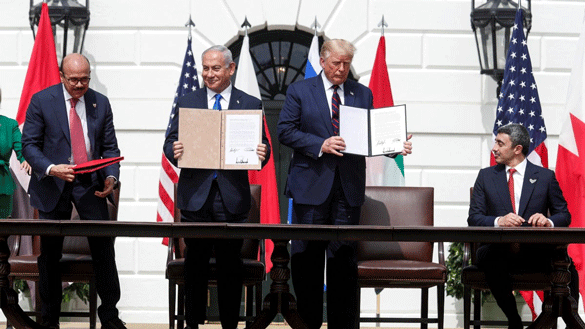
While the whole world eagerly awaits an agreement between the U.S. and Iran, U.S. President Donald Trump posted on his TruthSocial account on May 25, demanding that Saudi Arabia, Qatar, Pakistan, Egypt, Jordan and Türkiye, as well as Iran, join the Abraham Accords. He stated that this was not a request but rather a necessity, and that if these countries did not join the agreement, negotiations with Iran would not proceed to the next phase.
While these remarks, which dropped like a bombshell, caused widespread outrage and astonishment in regional countries, they were met with satisfaction in Israel. This is because it had been deeply disappointed that, since the Abraham Accords were implemented in 2020, no other regional country besides the United Arab Emirates and Bahrain had joined the process. Following Trump’s latest statement, Israel has begun to anticipate the possibility of new participants joining the Abraham Accords process.
However, despite Trump’s threatening remarks, none of the countries mentioned has expressed a willingness to join the Abraham Accords, which require normalization with Israel under the current conditions. On the contrary, it has become clear that Trump is desperately trying to use the Abraham Accords as a tool to end the war with Iran, and this demand has been flatly rejected.
Therefore, there has been curiosity about the reasoning behind his strategy, which has no connection to the war with Iran.
Onset of the Abraham Accords
During his first term, Trump promised to implement a major agreement that would end the long-standing conflict between Israel and Palestine, and in this context, he announced the so-called “Deal of the Century” on Jan. 27, 2020. However, because the agreement’s terms were entirely tailored to Israel’s demands and disregarded the rights of Palestinians, the plan was rejected by the Palestinians and has since become obsolete.
Then, Trump announced the Abraham Accords on Aug. 13, 2020, in an effort to both appease Israel and gain an advantage by securing the support of the Jewish lobby in the upcoming elections. Subsequently, on Sept.15, 2020, during a grand ceremony at the White House, the Abraham Accords, which provide recognition of Israel and establishment of trade relations, were signed by Israeli Prime Minister Netanyahu and the foreign ministers of the UAE and Bahrain. Shortly thereafter, Morocco was included in the Abraham Accords after being promised recognition of its sovereignty over Western Sahara, and Sudan was subsequently included after being promised removal from the U.S. list of state sponsors of terrorism.
Trump’s loss in the November 2020 election and the new administration’s statement that, while they do not oppose the Abraham Accords, they will not be as eager as the Trump administration to expand the number of countries participating in the process have effectively, if not officially, put the Abraham Accords on hold.
During this period, Israel’s escalation of attacks on Gaza, its intensification of violations and land seizures in the occupied West Bank, its approval of new settlement areas in violation of international law, and, perhaps most importantly, its increasing actions aimed at altering the status of the Al-Aqsa Mosque have made it impossible for Muslim countries to even establish communication with Israel, let alone normalize relations. Then, the “Al-Aqsa Flood” attack carried out on Oct.7 and the genocidal policies Israel has implemented against Palestinians in its attacks on Gaza have left no room for normalization with Israel, neither for Saudi Arabia nor for any other regional country.
Initiatives to revive accords
One of Trump's major promises during his campaign to be reelected as president was to revive the Abraham Accords and ensure that more regional countries joined the process. Indeed, after he was reelected, this issue became the top priority during Netanyahu’s visits to the White House and during Trump’s May 2025 trip to the Middle East, following agreements on arms sales.
Trump has encouraged regional countries to normalize relations with Israel at every opportunity, while at the same time pressuring them by wielding the stick under the cloak. However, as if Israel’s attacks on Gaza were not enough, its increased occupation following the regime change in Syria, its renewed attacks on Lebanon under the pretext of Hezbollah, and finally the 12-Day War in June 2025 have all led regional countries to drift further away from the Abraham Accords.
Under intense pressure from the Jewish lobby and the Evangelicals in his inner circle, and having been misled by the false intelligence reports presented to him by Netanyahu, Trump joined the war that began on Feb. 28 in the hope of an easy victory and attacked Iran alongside Israel. However, despite the heavy casualties inflicted on Iran by U.S. and Israeli forces, the Iranian regime did not collapse, dashing Trump’s hopes. Despite all his efforts, Trump has been unable to bring Iran to its knees. He has neither managed to open the Strait of Hormuz nor remove Iran’s enriched uranium.
When you add to this the possibility of Iran attacking Gulf countries, escalating the conflict, and damaging the global economy by closing the Strait of Hormuz, continuing the war has become very costly for the United States.
Hopeless endeavour
It was against this backdrop that Trump made his remarks regarding the Abraham Accords, projecting the image of someone who, rather than acting like the leader of a superpower, was left with no other option but to cling to any available means in an attempt to extricate himself from the predicament he had fallen into. After all, not only do the Abraham Accords have no direct connection to the war with Iran, but they cannot be sustained due to both Israel’s genocidal policies in Gaza and its attacks on Lebanon and Syria. Consequently, all the countries Trump mentioned have objected to normalizing relations with Israel in exchange for ending the war against Iran.
Other than the UAE and Bahrain, no regional country views the Abraham Accords as a mechanism for resolving issues by normalizing relations with Israel despite the Palestinians. Nor do they believe in the sincerity of this process or wish to participate in it.
If Trump wants to use this opportunity to normalize relations between regional countries and Israel, he must first ensure that Israel withdraws from Gaza, accepts the two-state solution and stops attacking its neighboring countries. Restraining Israel would eliminate the need for the Abraham Accords, render the ongoing war with Iran unnecessary, and lead to comprehensive regional normalization. Therefore, it is Israel, not the regional countries, that Trump should be pressuring.
https://www.dailysabah.com/opinion/op-ed/trumps-desperate-attempt-to-end-the-iran-war-abraham-accords
-------
Why Iran’s real war begins when the bombing ends
BY ORAL TOĞA
JUN 03, 2026
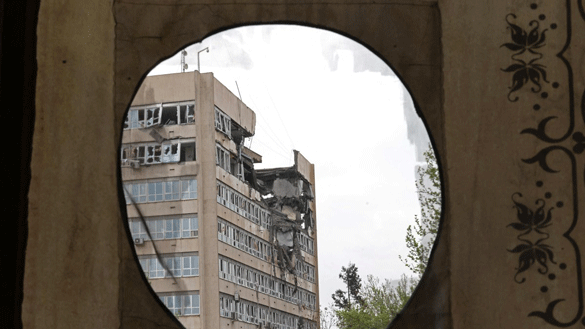
Iran is fighting two wars at once, and they are not separate conflicts but two faces of the same one. The first is the military war now playing out in the air and across the country’s industrial heartland. The second is already being set in motion by these same strikes, yet it will become fully visible and will truly be lived, only after the guns fall silent. It is the war of the aftermath, the economic collapse, the social strain and the political reckoning that the destruction leaves behind. Iran may well survive the first. The second will be longer and harder, and it is the one that may decide the fate of the system.
First war: The siege
Iran is currently fighting a defensive war. Judging by the statements of the United States and Israel and what has surfaced in open sources, the campaign was waged from the very first day with the aim of regime change. As far as can be discerned, the working assumption was that if the entire leadership tier, Khamenei included, were decapitated, the system would unravel on its own.
This was not an improvised idea, and its traces can be followed back well before the current conflict. Eyal Zamir, before becoming Israel’s chief of the general staff, set out much of the underlying logic in “Countering Iran’s Regional Strategy,” the paper he wrote for the Washington Institute in 2022. There, he defined the Islamic Revolutionary Guard Corps (IRGC) as Iran’s center of gravity, argued that the regime would disintegrate from within if that center were struck, and called for an escalation that included targeted operations against the IRGC’s command structure. Both during the 12-day war and in its aftermath, the strikes appear to have followed this template closely, hitting the IRGC directly, severing its chain of command and thinning its senior ranks.
The calculation, however, appears to have rested on a fundamental flaw. The problem was not simply a failure to understand Shia political culture, but a failure to understand how the Islamic Republic has institutionalized that culture as a mechanism of regime resilience. The role played by Karbala and martyrdom as a bond holding the system together seems to have gone unaccounted for. In Shia political culture, death in confrontation with a stronger adversary is read not as defeat but as a source of legitimacy, and over four decades the Islamic Republic has woven this register into its institutions, its commemorations and its schooling.
The mass mobilization that followed the killing of Qassem Soleimani in 2020 should have served as a warning. On the ground, the strikes appear to have done something similar, turning the fallen commanders and the targeted leadership into new heroes. The symbolism woven around Khamenei and the narrative of martyrdom reinforced the very system that was expected to collapse, rather than hastening its fall.
The failure to place cultural intelligence at the center of planning thus became one of the main reasons that military superiority did not translate into a political outcome. The concept being applied here is one of systemic paralysis, a logic that reaches beyond the classical doctrine associated with John Warden and folds in hybrid elements such as the attempt to use public anger as a force multiplier. Yet the fact that the U.S. entered the war without a clearly defined strategic objective made the picture heavier still. The doctrine was applied on the ground, but at no stage did it become clear what the ultimate objective actually was, or what political settlement was meant to follow the bombing.
Read in its simplest terms, the U.S. and Israel have laid siege to a fortress. If the fortress does not fall, the defending side may be considered to have won the war. Since it has become clear that regime change will not be achieved through airstrikes, the moment the U.S. withdraws its vessels from the region, Iran will, in all likelihood, declare victory. Beyond that, even the smallest concession Iran might secure on matters such as the status of the Strait of Hormuz, frozen assets or the easing of sanctions would amount to a gain, for it would be obtaining something it did not possess before the war. In an equation where the strategic objective is regime change but the outcome is a negotiating table, what emerges is the trap of tactical victory. Superiority on the battlefield does not convert into strategic success at the table. In short, Iran stands a strong chance of winning the first war.
Second war: The rubble
The truly difficult war, the second one, begins at precisely this point, and it is the one Iran is far less prepared to win. The severe economic and social crisis expected to follow the destruction of infrastructure carries with it the prospect of a serious political crisis and renewed street mobilization. It is worth recalling that the sense of unity generated by the 12-day war did not prevent the war’s bill from turning into the protests of late December, which began when merchants in Tehran’s bazaar shut their shops over the collapse of the rial and spread quickly across the country. As today’s destruction is far greater in scale, the attendant risk grows in equal measure.
Iran’s leadership appears to be aware of this. It seems to be trying to convert every concession it can extract, the Strait of Hormuz foremost among them, into the resources needed to rebuild the country. Tehran has already signaled that it expects compensation for the damage and has floated the idea of financing reconstruction through a levy on traffic passing through the strait. Needing substantial funds, it is unlikely to relinquish control of Hormuz easily. Even if the money is found, however, repairing the destruction in the shadow of sanctions will be exceedingly difficult. Critical components, industrial inputs and spare parts cannot be procured quickly, and many of them cannot be sourced at all without access to Western suppliers.
As far as open sources reflect, the damage is extensive. Iran’s petrochemical plants, iron and steel mills, aluminum production, oil and gas processing facilities, fuel storage depots and even its railways, bridges and ports have sustained heavy damage. Official estimates put the cost of the war in the hundreds of billions of dollars, and the Central Bank of Iran is reported to have warned that rebuilding could take more than a decade, with inflation liable to climb well beyond current levels if shortages of industrial inputs persist. Replacing this capacity will be neither quick nor cheap.
Should U.S. President Donald Trump carry out his repeatedly postponed threat and strike Iran’s electricity infrastructure as well, the picture would grow far worse. Targeting the power plants and grid that sustain civilian life would carry grave practical consequences and would sit uneasily with international humanitarian law, which prohibits attacks on objects indispensable to the survival of the civilian population.
The practical chain is easy to trace. Hospitals would be left without power and unable to find fuel for their generators. Agricultural production would seize up as there would be no diesel for tractors and no fertilizer for the fields. Even if crops were harvested, there would be no fuel for the trucks to carry them and no sound roads to travel. Even if the products reached the cities, the cold chain would break due to a lack of electricity, and they would spoil. The smallest tradesman would be unable to work; a barber without power or a restaurant without gas cannot operate. The problem would engulf not only heavy industry but every link of daily life. Bringing the entire grid down, it should be noted, is not a matter of a handful of strikes. Iran’s electricity system is spread across a large number of thermal plants and thousands of substations, so plunging the whole country into darkness would require a sustained campaign of hundreds of sorties rather than a single decisive blow.
Iranian President Masoud Pezeshkian’s recent appeals to tradesmen and merchants can be read as a reflection of this concern. Speaking at the Tehran Chamber of Commerce on May 27, he stated that the main front was now the economy and urged the private sector not to lay off the people working for it. The picture reflected in open sources, however, is already grim. Many businesses, from technology firms to steel mills, are reported to have shed workers, and by some accounts, millions of employees in the industrial sector are at risk.
What is more, all of this is being layered on top of problems that predate the war. Last winter, Iran was forced to close its schools because of shortfalls in natural gas supply. Throughout the summer, public institutions could not operate at full capacity owing to electricity rationing, and some factories halted production and dismissed workers for lack of power. The war arrived on top of this chronic weakness and deepened it. Although Iran is trying to take precautions, its room for maneuver appears to be narrowing by the day.
The Israeli security establishment, too, appears to accept that there will be no regime change in the short term, even as it reads the structural difficulties facing Iran as a window of opportunity. This suggests that even if the war formally comes to an end, attempts at assassination and sabotage aimed at manipulating the country’s political balance may well continue. For all these reasons, the real test for Iran will begin not with the failure of the fortress to fall, but after the siege is lifted. The second war will be longer and far more decisive than the first.
https://www.dailysabah.com/opinion/op-ed/why-irans-real-war-begins-when-the-bombing-ends
------
Lebanon: America’s bargaining chip in its standoff with Iran
OSAMA AL-SHARIF
June 03, 2026
Lebanon, home to millennia of human history, is being flattened as it is being used as a bargaining chip in the US-Iran standoff. President Donald Trump this week halted an Israeli onslaught on the capital, Beirut, claiming that he had managed to reinstate a ceasefire agreement between the pro-Iran Hezbollah and Tel Aviv, under which the militant group would suspend its drone attacks on Israel’s north in exchange for an Israeli commitment not to bomb the Lebanese capital.
This agreement does not include the Israeli bombardment of southern Lebanon and its military takeover of large swaths of territory in the south, which has so far displaced more than 1.2 million Lebanese, many of whom have seen their towns and villages erased from the map.
From an Israeli perspective, ceasefires are a cover for selective, one-sided military operations — the barely holding Gaza ceasefire being a case in point. In reality, the Israeli advance into Lebanese territory, in retaliation for Hezbollah’s attacks on Israel, goes beyond the current diplomatic stalemate between Washington and Tehran — a confrontation that has elevated Lebanon from battlefield to bargaining chip. While the Trump administration believes taking Lebanon hostage and using it as a pawn in its showdown with Iran will eventually force the Iranians to make concessions, the Israelis have other plans.
It was Hezbollah’s grave miscalculation following the Oct. 7, 2023, Hamas attacks on southern Israel that created a domino effect that sucked Lebanon into a deadly vortex. The Israeli response was devastating. It killed the group’s top leadership, destroyed most of its Beirut base, eroded its capacity to fire missiles into northern Israel and carried out a major incursion into Lebanese territory, the likes of which had not been seen since 1982.
And even when a fragile ceasefire deal was reached following last year’s 12-day Israeli-American strikes on Iran, the group — politically and militarily rattled — was already preparing for another round of fighting. So, when the US and Israel waged a surprise war on Iran in February, killing its supreme leader and top brass, Hezbollah retaliated and reopened the Lebanese front. This gave Israel the pretext to push further into Lebanon’s south, creating a so-called defensive buffer from which it could launch lethal incursions, even crossing the Litani River. In the process, Israel applied its Gaza playbook — destroying entire villages and forcing tens of thousands to evacuate.
Only recently has Washington seen an opportunity to weaponize Lebanon in its confrontation with Iran. Tehran shocked the Trump administration by closing the Strait of Hormuz, creating a global economic backlash. Negotiations between the two sides appeared to favor the Iranians, much to Trump’s frustration and dismay.
Using Lebanon as a bargaining chip through Washington’s Israeli proxy is Trump’s way of leveling the playing field: the Strait of Hormuz in exchange for Lebanon. The Iranians are well aware that Hezbollah is a valuable asset in their confrontations with both Israel and the US. And, regrettably, Hezbollah has brazenly subordinated Lebanon’s survival to Iran’s strategic calculus, even though it is recognized as a political party and is represented in the Lebanese government.
So, while Trump has convinced the Israelis not to attack Beirut for now, the ceasefire he announced does not include Israeli military operations in southern Lebanon. Israel’s bombardment of Lebanese cities and towns, including the historic city of Tyre, continues without pause, as do the evacuation orders. Hezbollah is retaliating but is unable to stop the Israeli advance. Lebanon is paying the ultimate price in this latest round of war amid regional and international silence.
Like in Gaza, Israel has not spared mosques, churches, hospitals, schools or residential buildings. The mass destruction of southern Lebanon is deliberate and carries long-term consequences. Israeli officials have openly declared that they intend to stay, that residents will not be allowed to return and that, even if the war ends, the south will be held hostage until Hezbollah is fully disarmed.
The scale is staggering: Israel launched more than 1,840 attacks on Lebanon between March 2 and April 7, forcing about a fifth of the country’s entire population — including 350,000 children — to flee their homes, creating what experts describe as one of the world’s fastest-growing displacement crises.
Meanwhile, the US has forced the Lebanese government into direct negotiations with Israel in Washington, with the final goal of signing a peace treaty. The talks proceed while Israel destroys Lebanese cities and towns and expands its occupation. The Lebanese government is being asked to deliver the impossible: disarming Hezbollah. The Washington talks are not a parallel track toward peace, they are a performance of a process designed to buy time for facts on the ground. Israel will not withdraw from the Lebanese territory it occupies, rendering the negotiations a theater of the absurd.
Israel is in a strong position. It has the full backing of Washington, even as it openly declares objectives that differ sharply from those of America. Under the far-right government of Benjamin Netanyahu, it seeks territorial expansion into both Lebanon and Syria — annexing buffer zones, entrenching military positions and redrawing the map of the Levant. The Americans may believe that a peace deal, if reached, would persuade Israel to withdraw. That is fantasy.
On the other hand, Hezbollah is losing sympathy even among Lebanon’s Shiite population, who have suffered the most. The group has attacked the government for engaging in peace talks with Israel, yet has offered no path toward national reconciliation, disengagement from Iran or the integration of its forces into the Lebanese army. Unless Hezbollah commits to this path, Israel will continue destroying Lebanon, entrenching its occupation and pursuing what many now fear is its ultimate objective: the demographic and territorial partition of Lebanon.
This is not merely a war between Israel and Hezbollah. It is the convergence of three tragedies: American cynicism that turns a country into collateral, Israeli territorial ambition disguised as security doctrine, and Hezbollah’s catastrophic miscalculation that has dragged Lebanon into an existential battle it cannot win — and did not choose.
The international community’s silence is not neutrality. It is complicity.
https://www.arabnews.com/node/2645893
------
Fighting the opportunists who profit from genocide
DR. RAMZY BAROUD
June 03, 2026
It all started with a call to my family in a displacement camp in northern Gaza. Since internet lines rarely stay connected, I managed to send a message to the widow of my cousin, who was killed along with all of his sons during the Gaza genocide. I asked her a simple question: What do the people of Gaza want?
My purpose was to gather raw testimonies from her neighbors to weave into a letter to a European official whose country is active in pursuing justice for Palestinians. I chose this approach to bypass cliched political discourse and avoid the pitfall of speaking on behalf of those enduring genocide and famine. Palestinians in Gaza are entirely capable of speaking for themselves.
The responses, however, reframed my entire approach. While I am deeply tied to my community in Gaza, I had anticipated a direct focus on macro-political language — on statehood, rights and global justice. Instead, I was met with the visceral reality of immediate physical survival.
“We want a life … we want a dignified life,” she said. “A dignified life with food, water and even the ability to breathe. One feels so suffocated. We need so many things … so, so many things. We need psychological support, financial support and moral support.”
Another neighbor said: “They (Israel) fight us with everything, absolutely everything; even when we are sleeping in our beds … the mosquitoes drain us. Insects and rats are all around us, fleas, and the heat is killing us. There are no fans and there is no electricity.”
Yes, many spoke about “karameh” (dignity), “hurriye” (freedom) and “Haq Al-Awda” (the right of return), but these broad political and social rights were almost always tied directly to the everyday struggle for education, water and basic medical care — and against rats.
The rats. This is the recurring nightmare in the minds of Gaza’s parents, who find themselves unable to protect their children even from rodents. Nearly 2 million Palestinians remain displaced in horrific conditions, trapped in barely 40 percent of an already tiny, besieged enclave.
I spent the day trying to process the pain, grief and humble expectations of these proud people.
Yet, later that evening, a seemingly separate matter came to my attention. I learned of two characters — Aziz Abu Sarah, a Palestinian from the 1948 areas, and Maoz Inon, an Israeli — who have been touring for months, promoting what they call their “The Future is Peace” tour. These two individuals have achieved global celebrity status, sitting down with the likes of US comedian Jon Stewart on “The Daily Show” and meeting Pope Francis.
To the untrained eye, they are peddling a message of peace and forgiveness, routinely staging a display where they forgive each other at the end of their talks. All of this serves as the promotional springboard for a week-long “peace tour” inside Israel they are running in October. Tickets are being sold for $4,200 per person, air tickets excluded.
The sad truth is that this corporate approach to “peacebuilding” is not unique; it is a symptom of a broader trend exploiting Palestine. Even more tragically, many individual Palestinians have capitalized on the well-intentioned, but often misunderstood, concept of “centering Palestinian voices” to accumulate personal wealth, status and prestige, while their own brethren cannot find drinkable water and teeter on the brink of starvation.
The Arab maxim, famous in Palestine for generations, has long contended that “the revolution is a tree watered by the blood of the martyrs, and its fruits are plucked by the opportunists and the cowards.”
Should mass extermination not be a moral threshold that stops opportunists from feeding their pathological greed?
Desperate for solidarity, Palestinians in Gaza continue to hope that global efforts will eventually aid their raw struggle for freedom, dignity, clean water and relief from the rats. And millions worldwide are indeed well-meaning; they care about Gaza in ways that no social media post can ever capture.
The crisis is that the balance between genuine solidarity and outright exploitation at times risks tipping in favor of the exploiters. We are witnessing the rise of a lucrative cult of personality, built on high speaker fees and business-class airline tickets, circumnavigating the globe under the guise of advocacy. There are those who have experienced a literal rags to riches transformation since Oct. 7, becoming overnight celebrities and acting like heroic figures surrounded by adoring fans, simply for doing their basic jobs or taking a moral public position.
There are organizations with massive budgets, hosting events costing up to $200,000 over a single weekend, simply to regurgitate the same old stances without strategy, slogans without action plans and claims of stupendous “victories” while Gaza’s people die of thirst and hunger.
On the other hand, Palestinian officials and those who tout the official line continue to turn their back on the reality of Gaza while reaping the immense benefits of global solidarity: the prestige of diplomatic recognition, the red carpets rolled out for bureaucrats and the standing ovations at international conferences.
The circle of exploitation grows wider, while the actual messages filtering out from the displacement camps grow more tragic by the day. “I want my family back — the family Israel took from me.” “I want to bury my children who are still under the rubble.” “I want my father released from prison. We have no one else but him.” “The rats, the rats, brother. They are eating the flesh of our children.”
As I reflected on the horror of those parents who are helpless to protect their children, the word “rats” took on a heavier meaning.
The struggle for Palestinian freedom must remain anchored in the soil of Gaza. The global solidarity movement must not be permitted to mutate into a careerist industry for self-serving individuals masquerading as saviors. This creeping opportunism must be fought with the same urgency as the literal rats of Gaza.
https://www.arabnews.com/node/2645891
------
What Comes After Gaza’s Destruction? A Response to Gideon Levy
June 4, 2026
By Jamil Khader
In his recent Haaretz op-ed, “Israel’s Solution to the Gaza Problem,” Gideon Levy argues that Israel’s actions in Gaza reveal the existence of a coherent postwar strategy rather than the absence of one. According to Levy, the destruction of Gaza is not simply a military campaign aimed at defeating Hamas. Instead, it is part of a broader project to dismantle Palestinian society itself.
Having devastated Gaza’s infrastructure and social institutions, Israel is now moving toward what Levy describes as the next phase of its plan: reducing Palestinians to a fragmented population of the disabled, injured, hungry, homeless, unemployed, and socially disorganized. Once Gaza’s society has been sufficiently destroyed, Levy argues, the conditions will be created for the final objective—mass expulsion.
Levy’s intervention is important because it rejects the familiar claim that Israel lacks a political vision for Gaza. On the contrary, he argues that Israel’s refusal to permit governance by Hamas, the Palestinian Authority, or any alternative Palestinian institution reveals its actual objective. Israel does not seek a different government in Gaza; it seeks the destruction of governance itself.
The systematic targeting of teachers, doctors, engineers, civil servants, journalists, and social workers is therefore not accidental. It is part of a deliberate effort to eliminate the institutional foundations necessary for collective life. No society can function without the people who reproduce its social, educational, medical, and administrative infrastructure. Their elimination transforms Gaza into a space of chaos and dependency, making displacement easier to achieve.
While Levy’s analysis is compelling, it remains limited by its humanitarian and sociological framing. He accurately describes the destruction of Palestinian society but does not fully theorize the political and economic logic driving that destruction. Most significantly, he continues to reproduce the assumption embedded in the title itself: that Gaza constitutes a “problem” requiring a “solution.” The question that remains unasked is why Gaza appears as a problem in the first place.
From a settler-colonial perspective, Gaza is not a problem because of Hamas, terrorism, or failed governance. Gaza is a problem because Palestinians continue to exist. The continued presence of Palestinians on the land interrupts the demographic, territorial, and ideological aspirations of Ziofascist sovereignty. What appears as a security problem is, at a deeper level, a colonial contradiction. The obstacle confronting Ziofascist settler-colonialism is not merely armed resistance but the persistence of an indigenous population that refuses elimination.
Levy also treats the destruction of society primarily as a preparatory stage for future expulsion. Yet a necro-imperial analysis suggests that social destruction is not merely instrumental. It is itself a political objective. Hospitals, universities, schools, ministries, archives, cultural centers, and municipal institutions are not simply collateral targets in a military campaign. They are the infrastructures through which a people reproduces itself as a collective political subject. Their destruction aims not only at territorial control but at the dissolution of Palestinian social existence itself.
This distinction is crucial because it shifts attention from expulsion to the production of surplus humanity. Levy observes that Israel has systematically targeted the professionals and institutions that sustain social life. However, he does not fully recognize that this process creates a population rendered economically, politically, and socially superfluous. The elimination of doctors, teachers, engineers, and administrators is not merely the destruction of services; it is the destruction of the mechanisms through which society reproduces itself across generations. What emerges is a population increasingly confined to biological survival while stripped of the institutional capacities necessary for collective autonomy and political self-determination.
Such a population occupies what may be called a necro-imperial death-world. Here the objective is no longer simply the administration of life but the management of populations whose lives have been rendered disposable. Rather than integrating these populations into a political order, necro-imperial governance seeks to contain, fragment, monitor, and administer them at the threshold of social death. Gaza’s devastation, therefore, exceeds the framework of military occupation or even ethnic cleansing. What is being produced is a population that survives biologically while being systematically deprived of the conditions necessary for collective social and political reproduction.
This broader framework also reveals a dimension largely absent from Levy’s account: political economy. The devastation of Gaza is not simply a national project pursued by Israel alone. Gaza increasingly functions as a laboratory for surveillance technologies, military experimentation, humanitarian management, and population control. The methods refined there circulate through global networks of security capitalism, military contracting, border enforcement, and humanitarian governance. Gaza is therefore not merely a site of destruction. It is also a site of accumulation.
The devastation of Gaza generates markets alongside death. Technologies tested on Palestinians become exportable security products. Systems of surveillance, targeting, biometric monitoring, and population management are transformed into commodities marketed to states and corporations around the world. The same processes that render Palestinians disposable simultaneously create new opportunities for profit. Gaza thus emerges not only as a space of elimination but as a frontier of necro-imperial accumulation, where the production of surplus humanity and the production of value become mutually reinforcing processes.
Yet recognizing the barbaric violence of this project should not lead us to overestimate its success. Here, Levy’s analysis risks reproducing a familiar colonial assumption: that the destruction of institutions necessarily produces the destruction of society itself. While he correctly identifies Israel’s systematic assault on the infrastructures of collective life, Gaza continues to reveal the limits of colonial power.
In a recent reflection, Gazan physician Dr. Ezzideen (@ezzingaza) describes walking through a society suspended between celebration and mourning. Weddings continue. Children still play. Families still gather. Yet beneath every moment of joy lies an absence—a son, daughter, brother, or parent killed in the genocide. Gaza, he writes, exists in two realities simultaneously: a visible world of everyday life and an invisible city of grief. Every celebration contains an absent guest; every smile carries a name. What emerges from his account is not a narrative of resilience in the conventional sense, but a portrait of a society that continues to reproduce memory, care, and collective life amid catastrophic loss.
Dr. Ezzideen’s reflections expose a contradiction at the heart of necro-imperial Ziofascist settler colonialism. The destruction of infrastructure, institutions, and leadership may produce what necro-imperial power intends—a population rendered precarious, impoverished, and disposable. Yet it cannot fully eliminate the social relations through which Palestinians continue to constitute themselves as a people. Gaza is therefore not only a site where surplus humanity is produced; it is also a site where that reduction is continually resisted.
This persistence should not be romanticized. Palestinians continue to live, mourn, love, and imagine a future under conditions that no people should endure. Yet their continued reproduction of social life reveals something fundamental about colonial power itself: its incompleteness. Necro-imperial Ziofascist settler colonialism may destroy institutions, manufacture surplus populations, and transform entire territories into death-worlds.
What it cannot fully eradicate is the capacity of human beings to create forms of meaning, solidarity, and world-making amid devastation. Gaza thus reveals not only the violence of colonial power but also the limits of its ability to achieve the finality it seeks.
https://www.palestinechronicle.com/what-comes-after-gazas-destruction-a-response-to-gideon-levy/
------
Tense Scenes in Geneva as Palestine Secures ILO Victory, Israeli Delegate Interrupted
June 3, 2026
Major Diplomatic Victory
Palestine scored a significant diplomatic victory on Wednesday after the International Labour Conference overwhelmingly rejected an Israeli-backed effort to reverse its status within the International Labour Organization (ILO).
The vote reaffirms the growing international recognition of Palestinian statehood and participation in multilateral institutions.
Meeting in Geneva during its 114th session, the conference voted by a margin of 394 votes in favor, 17 against and 42 abstentions to uphold Palestine’s standing and participation rights within the organization.
The vote represented a decisive defeat for an Israeli initiative, supported by the United States and Argentina, seeking to rescind the resolution that had granted Palestine observer-state status and expanded privileges within the ILO.
According to WAFA, the legal quorum stood at 296 votes, while only 206 votes were required for a majority, underscoring the scale of support Palestine received. Following the announcement of the results, delegates in the conference hall applauded, reflecting broad backing for the Palestinian position.
Tense Session in Geneva
The vote took place amid visible tensions inside the conference hall.
According to Al Mayadeen’s correspondent in Geneva, the Israeli delegation unsuccessfully sought a repeat of the vote after the result became clear.
The session also witnessed repeated interruptions during the Israeli delegate’s speech. Delegates reportedly protested by banging on tables and creating sustained noise inside the hall, expressing opposition to Israeli policies and solidarity with the Palestinian cause.
The scenes highlighted the increasingly difficult diplomatic environment Israel has faced in international forums since the start of the Israeli genocide in Gaza.
Building on Last Year’s Upgrade
The latest vote follows a landmark decision adopted by the ILO in June 2025.
At that time, the organization upgraded Palestine’s status from a designation dating back to the 1970s as a “national liberation movement” to that of a “non-member observer state.”
The move aligned the ILO with broader United Nations recognition frameworks already adopted by organizations such as UNESCO and the World Health Organization.
The upgrade granted Palestine expanded participation rights, including the ability to address agenda items, submit proposals, participate fully in meetings and nominate delegates to certain conference bodies beginning in 2026.
Palestinian officials described the measure as part of a broader effort to secure recognition and representation across international institutions despite the continued absence of full UN membership.
Diplomatic Campaign
Palestinian officials credited the result to months of diplomatic engagement.
Palestine’s Permanent Representative to the United Nations in Geneva, Ambassador Ibrahim Khraishi, played a central role in mobilizing support through consultations with member states and diplomatic groups.
The 2025 resolution had received backing from the Arab Group, the Organization of Islamic Cooperation and a broad coalition of countries including France, Spain, China and Switzerland.
At the time, Khraishi described the ILO decision as a direct response to efforts aimed at denying Palestinian statehood and self-determination.
Palestinian Reactions
The Secretary-General of the General Federation of Palestinian Trade Unions, Shaher Saad, welcomed Wednesday’s result as further evidence of Palestine’s growing standing within international institutions.
Saad said the vote demonstrated increasing international support for Palestinian rights and praised the joint efforts of Palestinian representatives from government, labor and employer organizations.
He also thanked Arab and international delegations that supported Palestine throughout the discussions and voting process.
According to Saad, the outcome shows that Palestine continues to achieve diplomatic and political gains despite the extraordinary circumstances facing the Palestinian people and workers.
https://www.palestinechronicle.com/tense-scenes-in-geneva-as-palestine-secures-ilo-victory-israeli-delegate-interrupted/
-----
The UK Government Will Persecute Those Vocal about Israel, But Not War Criminals
June 3, 2026
By Robert Inlakesh
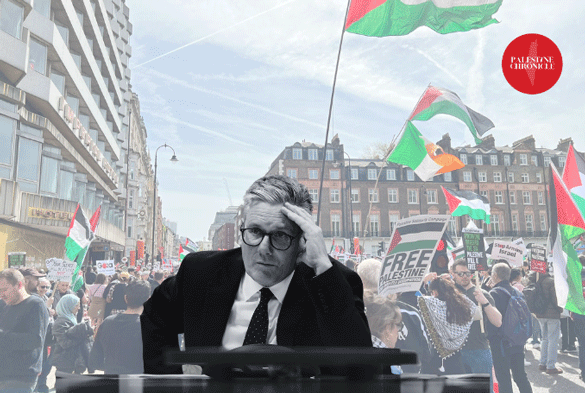
After Declassified-UK revealed that around 2,000 Britons have served in the Israeli military since the beginning of the Gaza Genocide on October 7, 2023, a campaign has now been launched to demand that London pursue justice. Instead of pursuing potential war criminals, the British authorities appear too busy cracking down on critics of Israel.
A major campaign has been launched by Declassified and the International Center of Justice for Palestinians (ICJP), demanding “in the interests of transparency, public safety, and justice”, the British government adhere to the following demands:
“Track the movements of Brits who have served in the IDF (Israeli army – PC)”.
“Subject them to secondary screening where necessary at ports of entry”.
“Support robust war crimes investigations in line with domestic and international law”.
Producing a letter addressed to the British leadership, the campaign quickly attracted the signatures of 60 prominent individuals– including lawyers, military veterans, politicians and Genocide Scholars. The campaign was also grounded in the fact of the recent meeting of the Hague Group, where 40 States convened to demand the implementation of international law in order for Israel to be held accountable.
This is but one of various initiatives launched to achieve justice for the victims of the Gaza genocide, aligning alongside activist work, legal projects, political lobbying efforts, and even efforts through the world’s top legal bodies.
Notably, the International Criminal Court (ICC) arrest warrants issued for Israeli Prime Minister Benjamin Netanyahu and his former Defense Minister Yoav Gallant have so far failed to achieve their desired results. Similarly, South Africa’s case against Israel at the International Court of Justice (ICJ) is still pending. Having worked to discourage the usefulness of international law, these cases also highlight a clear reality: individual nations’ leaders must be forced to take action, not simply a court.
The Declassified-ICJP campaign seeks to push the UK government to implement the law, which is why so many are getting behind it, hoping that the pressure will finally make London do the right thing.
For its part, the British government has been doing precisely the opposite of what this new campaign demands. In fact, in a recent move, it decided to reject the entry of prominent Leftist commentators Cenk Uygur and Hasan Piker. Instead of admitting in a public statement why they had done this, they instead fed the information to The Times newspaper, informing them that comments critical of Israel were the reason for refusing them entry.
A range of personalities, from journalists to activists and former politicians, have also notably been detained at British ports of entry, under the Terrorism Act, all because of their outspoken stances on the issue of Palestine and criticism of the Israeli government. Palestine Action was even designated a terrorist organization for launching a campaign to directly confront weapons manufacturers in the UK that are affiliated with Israel’s biggest weapons manufacturer, Elbit Systems, or supply the Israeli military directly.
Journalists like Asa Winstanley of the Electronic Intifada and activists such as Sarah Wilkinson were even subjected to police raids on their personal homes. These are not isolated cases and there have been numerous others since the beginning of the genocide.
All of this begs the question: If the free speech rights of Britons and foreign visitors to the UK are nullified when it comes to criticizing and voicing discontent at Israeli war crimes, does the British government care for domestic legislation, let alone international law? Or, is there simply an exception to Israel that puts its officials and citizens outside of the law altogether?
Take, for example, the infamous case of Shemema Begum, a British national who was brainwashed by Daesh (IS) propaganda and headed to Syria in order to become part of the group as a bride to a fighter. Begum had made this decision at 15 years of age, and as a result, the British State revoked her citizenship, refusing her entry back into the country.
Keep in mind that Begum never committed any provable war crime, much less engaged in committing genocide; she was also a young teenager when she made this decision. The UK government, however, made the determination that she was unfit for her British passport and could no longer return to the nation of her birth.
A few years after this was all decided in court and the British Home Office fought its case – after presenting its arguments as both legally binding and moral principles – there are now some 2,000 Britons who were adults who made the decision to actively fight in a military, committing what the ICJ has ruled a plausible genocide.
Thousands of UK citizens who served in a military commanded by men who now have war crimes arrest warrants issued for them, yet not a single one has been stripped of their citizenship, there is no evidence that a single one of them has even been questioned at a port of entry, let alone investigated. All of this again points back to the question of double standards and whether the UK considers Israelis as above both domestic and international law.
If the answer is that Israel is simply above the law, then this sets a dangerous precedent and poses a major security threat inside the UK and outside its borders also. If London believes that the law doesn’t apply to Israel, then its legal system loses all legitimacy in the eyes of the public and downgrades the status of the nation in the international order.
https://www.palestinechronicle.com/the-uk-government-will-persecute-those-vocal-about-israel-but-not-war-criminals/
------
New Age Islam, Islam Online, Islamic Website, African Muslim News, Arab World News, South Asia News, Indian Muslim News, World Muslim News, Women in Islam, Islamic Feminism, Arab Women, Women In Arab, Islamophobia in America, Muslim Women in West, Islam Women and Feminism