
Middle East Press On: Turkey’s Post-European Security Moment, Hejaz Railway, Gaza, UAE–Indonesia, Israel, Hezbollah, Arab, Strait of Hormuz Crisis, New Age Islam's Selection, 05 May 2026

By New Age Islam Edit Desk
05 May 2026
Türkiye’s Post-European security moment
Reviving Hejaz Railway: Türkiye wires connectivity of Middle East
Are Gaza anti-blockade flotillas futile?
A post-OPEC moment calls for a UAE–Indonesia green sukuk
Why peace talks with Israel pose a threat to Hezbollah
Arab interests must define resolution of Strait of Hormuz crisis
------
Türkiye’s Post-European security moment
BY MURAT YEŞILTAŞ
MAY 05, 2026
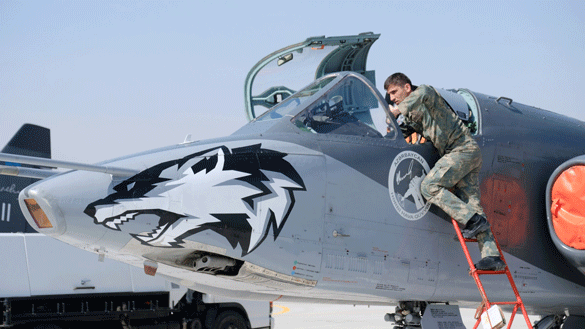
Türkiye is not leaving European security. But Europe is no longer the only frame through which Türkiye’s strategic horizon can be understood. Across the Black Sea, Syria, the Middle East and Africa, Ankara is shaping security outcomes that European institutions are not designed to reach.
For most of the past two decades, Türkiye’s relationship with European security was defined by expectation: the expectation of accession, convergence and a strategic future eventually settled in Brussels. That framework has not collapsed. It has simply become insufficient. The EU has frozen the accession process, constructed a defense architecture that institutionally marginalizes Ankara and allowed bilateral grievances to harden into structural vetoes. But Türkiye’s post-European security moment is not primarily a story of exclusion. It is a story of outgrowth. Türkiye has developed the geography, military capacity, diplomatic access and defense-industrial instruments to shape security outcomes across multiple theatres simultaneously. The question is no longer whether Europe will accommodate Türkiye within its emerging defense architecture. The question is whether European institutions have the conceptual range to understand the kind of strategic actor Türkiye has become.
Europe still matters. It remains Türkiye’s largest trading partner, a source of institutional frameworks for interoperability and procurement and a shared security space in the Black Sea and the Eastern Mediterranean where interests continue to intersect. Türkiye participates in the German-led European Sky Shield Initiative, maintains deepening defense industrial ties with Italy and Spain and supplies eastern flank states with equipment their deterrence postures require. These are not symbolic gestures. They reflect a recognition that selective engagement with European security structures remains strategically rational. What has changed is the frame of reference. Europe is no longer the agenda-setting actor in the security theatres that matter most to Türkiye’s strategic depth. That role is now being exercised elsewhere, and Türkiye is exercising it.
In Black Sea, Middle East
In the Black Sea, Türkiye’s post-European security posture rests on geographic indispensability that no institutional arrangement can replicate. The Montreux Convention gives Ankara regulatory authority over the Turkish Straits, placing it at the center of every serious calculation about Black Sea access, naval reinforcement and commercial shipping during the Russia-Ukraine war. Türkiye resisted pressure to fully align with Western escalation while maintaining a working channel with Moscow, a posture that preserved its value as a mediator without compromising its deterrence credentials. Through different institutional mechanisms, Ankara positioned itself as a critical energy transit hub at precisely the moment European states were scrambling to diversify away from Russian gas. This is not a strategy of equidistance. It is a strategy of indispensability, pursued with discipline and without requiring European institutional validation.
Syria is the theatre where Türkiye’s strategic depth is most visibly expressed. For over a decade, the Syrian civil war was the most consequential security crisis in Türkiye’s immediate neighborhood. European engagement with Syria remained largely confined to humanitarian assistance and the management of refugee flows, orientations driven more by domestic political pressures in European capitals than by any coherent security strategy toward the Levant. Türkiye engaged Syria as a security imperative and, after December 2024, as a defining strategic opportunity.
The fall of Assad transformed the calculus. Türkiye emerged as the most consequential external power in the post-Assad order. In August 2025, Damascus and Ankara signed a comprehensive military cooperation agreement covering counterterrorism, cybersecurity, demining, and armed forces coordination. Turkish exports to Syria reached three billion dollars in 2025. When Ahmed al-Sharaa’s government moved in January 2026 to assert control over SDF-held northeastern territory, Türkiye was among the architects of the political and military framework that made it possible. The PKK’s March 2025 announcement to dissolve and disarm removed the single greatest constraint on Türkiye’s ability to shape Syria’s northern security architecture. Türkiye holds a military agreement with Damascus, a multi-billion-dollar trade relationship, and a direct strategic interest in Syrian stabilization that no European government can match.
The war against Iran extended this logic across the wider region. The weakening role of Iran’s regional order, the exposure of the United States security umbrella’s limits after the Gulf Cooperation Council (GCC) states sustained direct Iranian strikes, and the collapse of the Gulf-Iran rapprochement created a structural vacancy in regional security thinking that Türkiye was uniquely positioned to occupy. Adopting what Turkish officials describe as active neutrality, Ankara declined to participate in the strikes, served as a communication channel between Tehran and Washington, and became a co-architect of the April 2026 ceasefire framework.
The quartet that has since coalesced around Türkiye, Saudi Arabia, Egypt and Pakistan now constitutes the most operationally significant diplomatic formation in the post-Iran war order. Each actor brings distinct assets: Pakistan provides nuclear deterrence and a direct channel to Tehran; Saudi Arabia commands financial and military power; Egypt controls the Suez Canal and maintains the Arab world’s largest standing army; Türkiye contributes NATO membership, an advanced indigenous defense industrial base, and the diplomatic agility to hold contradictory relationships simultaneously.
Saudi Arabia’s reported discussions to join the Kaan fighter programme would make Riyadh the first Gulf state with a stake in an advanced combat aircraft project outside direct American control. The post-war regional order is being co-authored by regional powers asserting the principle of regional ownership. Europe’s voice in this conversation is present but not formative. More importantly, Türkiye has positioned itself as the most vocal state-level challenger to Israeli conduct in Gaza, a stance that carries real diplomatic costs in some Western capitals but has generated substantial political capital across the Muslim world and the Global South.
In Africa
In Africa, the contrast between Türkiye’s trajectory and Europe’s is sharpest. France’s security architecture across the Sahel has unraveled. Mali, Burkina Faso and Niger terminated their defense agreements with Paris by January 2025. Operation Barkhane is over. The EU Training Mission in Mali, once described as a lighthouse project for European security policy, was wound down after consuming over a billion euros without producing measurable improvement in security conditions. The African states that expelled European forces did not do so because they no longer needed security partners. They did so because the European model of security partnership, shaped by post-colonial frameworks and domestic political constraints, had exhausted its legitimacy.
Türkiye offers a different model: military capability without colonial memory, security partnerships calibrated to the partner’s own security logic rather than the donor’s political agenda. Niger signed a military cooperation agreement with Ankara in July 2025. Baykar drones are now deployed across twelve African countries.
In Somalia, Türkiye operates its largest overseas military base, has trained over 15,000 Somali security forces and through the December 2025 SOMTURK agreement holds regulatory authority over Somalia’s Exclusive Economic Zone, with a state-owned Turkish vessel exploring a hydrocarbon basin estimated at 30 billion barrels. Europe invested a decade and over a billion euros in Sahel security and produced diminishing returns. Türkiye invested 15 years of patient engagement in Somalia and produced an enduring strategic presence. Africa has registered the difference.
What post-Europe means
Post-European security does not mean anti-European security. Türkiye will continue to engage European partners on a functional and selective basis, deepening industrial cooperation with certain countries. But these are transactions, not relationships of strategic dependence. Türkiye engages European security frameworks where they serve Turkish interests and builds alternative architectures where they do not. The deeper significance of Türkiye’s post-European turn is what it reveals about the changing structure of regional power. The era in which middle powers organized their security identities around the gravitational pull of Western institutional frameworks is ending. Türkiye is not the only state making this adjustment, but it is making it with more strategic deliberateness, more material capacity, and more geographic reach than almost any other.
Brussels continues to debate whether Türkiye belongs in its emerging defense architecture. Ankara has moved on to a different question: what kind of security order does Türkiye want to build and where does it want to build it? The answer, increasingly, is visible from Mogadishu to Niamey, from Damascus to the Black Sea. Europe remains in the picture. But it is no longer the frame.
https://www.dailysabah.com/opinion/columns/turkiyes-post-european-security-moment
------
Reviving Hejaz Railway: Türkiye wires connectivity of Middle East
BY BURAK ELMALI
MAY 05, 2026
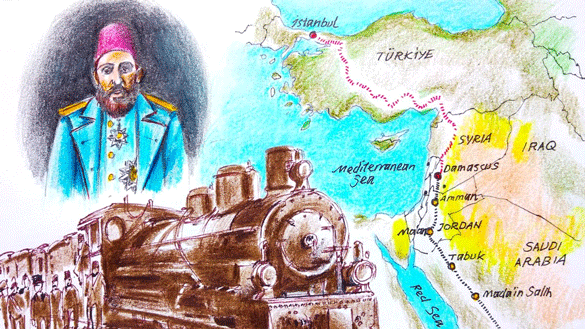
More than a century after its construction between 1900 and 1908 during the reign of Sultan Abdulhamid II, the 1,322-kilometer (822-mile) Hejaz Railway is now poised for revival as a manifestation of a profound historical legacy. Far from being merely symbolic, this initiative carries strategic weight within Türkiye’s broader vision of inclusive and integrative regional connectivity.
During his visit to Jordan last month, Minister of Transport and Infrastructure Abdulkadir Uraloğlu, following meetings with his Jordanian and Syrian counterparts, underscored the transformative potential of the project. Speaking at the restored Hejaz Railway Amman Station and museum, currently being restored by the Turkish Cooperation and Coordination Agency (TIKA), Uraloğlu emphasized that the railway would facilitate both human mobility across the region and more efficient commercial flows. With the completion of the Türkiye-Syria-Jordan corridor, and growing political will and optimism from partners such as Saudi Arabia and Oman, the project is set to emerge as both a historically significant and economically viable connectivity initiative across the Gulf.
Originally commissioned by Abdulhamid II, the Hejaz Railway stood as one of the Ottoman Empire’s flagship infrastructure projects of the early 20th century. At the time, it faced staunch discontent, particularly from the British Empire, as such a large-scale connectivity initiative in the Hejaz region ran counter to its imperial deeds. France similarly opposed the project for comparable reasons. British propaganda sought to undermine public perception of the railway in the region, spreading disinformation about the infeasibility of its financing and a smear campaign by alleging the misuse of collected funds.
Within the framework of the proposed revival, Türkiye has already prepared an action plan under a memorandum of understanding agreed in September last year. This roadmap envisages consultations and preparatory work among the technical teams of the participating countries. Syria, with Türkiye’s support, is expected to complete the remaining 30-kilometre segment of missing infrastructure, while Jordan will oversee the maintenance, repair and operational management of locomotives. Recent statements also indicate that, given their expressed interest, Saudi Arabia and Oman may be incorporated into the project’s further extension.
The modernization of the Hejaz Railway has the potential to become a cornerstone of Türkiye’s regional connectivity vision. When viewed in the broader context of Syria’s stabilization following the removal of the Assad regime in late 2024 and the mitigation of terrorist threats in the region, the project transcends mere railway integration. It represents a strategic corridor extending toward the Gulf and assisting Syria’s new regional and global integration agenda with the aid of logistics and facilitated trade flows.
This vision is further reinforced by the largely completed Türkiye-Iraq Development Road Project, which has already positioned Türkiye as a central actor in regional connectivity by linking the Persian Gulf through Iraq into its own territory via an integrated port, road and rail network. In this context, the Hejaz Railway serves as a complementary axis, reviving a historical link between Türkiye and Syria, extending into Jordan. Coupled with the recent expansion of Türkiye’s high-speed rail network, the project effectively outlines a complementary corridor connecting Türkiye directly to the Gulf.
Beyond infrastructure, this renewed connectivity vision underscores Türkiye’s proactive approach to generating alternative regional trade corridors. In the post-Assad landscape, where Syria is re-establishing ties with both the region and the wider international system, and in coordination with Jordan, the Hejaz Railway Project can be manifested as a strategic Türkiye-Levant axis. The convergence of intergovernmental agreements, technical negotiations, and shared development goals is generating a tangible synergy. Simultaneously, Türkiye is advancing the prospect of a corridor through this project, opening to the Red Sea via the Port of Aqaba. Together with the Development Road Project, which anchors connectivity toward the Gulf, this initiative effectively establishes a dual-corridor architecture linking Türkiye to key maritime and trade nodes.
Drawing inspiration from its historical roots and endowed with renewed strategic purpose, the Hejaz Railway Project aims to assert a significant presence on the regional connectivity map. Through this initiative, Türkiye positions itself as the architect of a route that not only reaches the Port of Aqaba via the Syria-Jordan axis but also, if extended toward Saudi Arabia and Oman, connects directly with the Gulf. Provided that the demonstrated political will is matched by sustained commitment and coordinated effort, this project holds the potential to facilitate regional mobility while injecting new dynamism into trade flows, redefining connectivity across a historically interconnected geography.
https://www.dailysabah.com/opinion/op-ed/reviving-hejaz-railway-turkiye-wires-connectivity-of-middle-east
-------
Are Gaza anti-blockade flotillas futile?
May 4, 2026
by Adnan Hmidan
Each time a new flotilla sets sail towards Gaza with the aim of challenging the blockade, the same question is repeated: what is the point if these ships are intercepted before they arrive?
From a purely logistical perspective, the pattern appears predictable. The vessels are stopped. The participants are detained. The mission does not reach its physical destination. On that narrow reading, some conclude that these efforts are indeed futile.
But this way of framing the issue reduces a complex political and moral action to a single outcome: arrival of the vessels and delivery of the aid on board. It ignores the wider purpose these initiatives serve, and misunderstands how resistance movements operate under conditions of asymmetrical power.
As a Palestinian activist, coordinator of the Red Ribbons Campaign for Palestinian hostages in Israeli prisons, and involved in Palestine solidarity work across multiple international platforms, I approach this question with a clear reservation. Evaluating acts of resistance solely through immediate material success or failure is not a neutral analytical position. It is a framing that, intentionally or not, reflects the logic of the powerful rather than the perspectives of the oppressed.
If this logic were applied historically, very few anti-colonial or civil rights struggles would ever have begun.
This is how the flotillas to Gaza should be viewed.
Their significance is not limited to whether they physically break the naval blockade. Their impact also lies in what they reveal and what they challenge.
First, these flotillas disrupt normalisation. The blockade of Gaza is often treated in international discourse as a long-standing political reality rather than an ongoing collective punishment affecting over two million people. Maritime civilian initiatives force the issue back into visibility and prevent it from fading into the background of international attention.
Second, they expose the contradiction between Israel’s international image and its actions. For decades, Israel has presented itself in Western political discourse as a democratic state operating under the rule of law. When unarmed civilian vessels carrying humanitarian intent and cargo are intercepted by military force, and participants are detained or attacked, this narrative is directly challenged. The question becomes unavoidable: how does a state that claims democratic legitimacy justify preventing humanitarian access to a besieged civilian population?
This is also why the response to these flotillas is consistently forceful. If they were genuinely irrelevant, they would be ignored. Instead, they are met with interception, surveillance, diplomatic pressure, and in many cases, detention of participants. In the case of the recent Sumoud 2 flotilla, 175 participants were detained, and two key figures, Saif and Thiago, remain in custody. I know both personally, and their continued detention reflects how seriously such initiatives are taken by the authorities involved.
Third, these flotillas operate within a wider political and ethical dimension. Their importance is not limited to material aid. They also serve as acts of international solidarity that challenge the isolation imposed on Gaza. In conditions of siege, isolation is not only physical but psychological and political. The message sent by these initiatives is that Gaza is not forgotten and that the blockade is not accepted as normal or legitimate.
From an ethical perspective, this matters significantly.
This raises an important question about whether such initiatives should continue despite repeated interceptions?
The answer depends on what one considers the alternative. If these efforts were to stop entirely, it would not simply mean the end of maritime attempts to reach Gaza. It would also signal something broader: that sustained obstruction and the use of force have succeeded in discouraging even symbolic or civilian challenges to the blockade. In other words, that the siege has not only been enforced physically, but also normalised psychologically.
It is also important to be clear about what flotillas are and are not. They are not a standalone solution to the blockade. They do not replace political action, legal accountability, diplomatic pressure, or broader forms of mobilisation. Rather, they form one component within a wider ecosystem of resistance and solidarity efforts.
Their value lies in accumulation.
In that sense, their effectiveness cannot be measured solely by arrival. It must also be measured by impact on discourse, perception, and international engagement.
The more difficult question, therefore, is not whether these flotillas reach Gaza. It is what it would mean if such efforts ceased altogether.
Because the absence of action would not represent neutrality. It would represent acceptance.
https://www.middleeastmonitor.com/20260504-are-gaza-blockade-breaking-flotillas-futile/
-----
A post-OPEC moment calls for a UAE–Indonesia green sukuk
May 4, 2026
by Bhima Yudhistira
The United Arab Emirates’ decision to leave OPEC is not just a rupture in oil diplomacy. It is a signal that the old architecture of energy coordination—built on production quotas and cartel discipline—is giving way to something looser, more competitive, and potentially more volatile.
For Indonesia, the implications are immediate. But so is the opportunity.
Effective 1st May 2026, the UAE exited OPEC after nearly six decades, citing national interest and a reassessment of its production strategy. The move frees Abu Dhabi from output quotas that had constrained its ability to monetize expanded production capacity. It also reflects deeper tensions within the group—particularly with Saudi Arabia—and the disruptive effects of regional conflict, including the war involving Iran and instability in the Strait of Hormuz.
This matters for Indonesia. Like many emerging economies, it remains exposed to swings in global energy prices and supply disruptions. Indonesian officials have already acknowledged that the UAE’s departure reflects “the evolving dynamics of global energy governance” and could affect national energy security.
Yet the same disruption that creates risk also opens a door.
For decades, OPEC embodied a model of cooperation centered on oil—coordinating scarcity to influence prices. As that model frays, new forms of cooperation are likely to emerge, increasingly centered not on fossil fuels, but on the financing of their alternatives.
Indonesia is well positioned to lead in this space. It has established itself as a global pioneer in sovereign sukuk, including green sukuk instruments that fund climate and environmental projects. These issuances have demonstrated that Islamic finance can attract broad international participation while adhering to transparency and sustainability standards.
What Indonesia lacks is scale.
That is where the UAE could come in—not as a fellow oil producer coordinating supply, but as a capital partner helping finance the transition beyond it.
The UAE’s exit from OPEC is, at its core, about autonomy: the ability to pursue its own energy and economic strategy without external constraints. That strategy includes maximizing the value of its hydrocarbon resources in the near term while positioning itself as a global financial and investment hub.
A bilateral sovereign green sukuk between Indonesia and the UAE would fit squarely within this new logic.
Such an instrument could be structured around Indonesia’s renewable energy portfolio—wind, solar, and hydropower projects that require long-term, patient capital. The UAE, through its sovereign investment ecosystem, could act as a cornerstone investor, anchoring demand and signaling credibility to other Gulf and Asian investors.
The benefits would be mutual.
For Indonesia, it would unlock large-scale, Sharia-compliant financing aligned with its development and climate goals. It would also reduce vulnerability to external energy shocks by accelerating domestic renewable capacity.
For the UAE, it would provide access to high-growth infrastructure assets in one of Asia’s largest economies, while reinforcing its role as a global hub for Islamic finance and cross-border investment.
More broadly, it would represent a shift in how energy cooperation is defined.
There are, of course, obstacles. Indonesia’s renewable sector still faces regulatory and pricing challenges. Currency risks and project bankability remain concerns for foreign investors. And the global sukuk market, while growing, is still relatively small compared with conventional debt markets.
But these are technical problems, not structural ones. They can be addressed through careful design, regulatory reform, and risk-sharing mechanisms.
What matters more is strategic timing.
The UAE’s departure from OPEC underscores a broader reality: the institutions that governed 20th-century energy markets are losing their coherence. In their place, a more fragmented—but also more flexible—system is emerging.
Countries that adapt early will help define it.
Indonesia should see this moment not only as a disruption to manage, but as an opening to lead. A UAE–Indonesia green sukuk partnership would not replace the old energy order overnight. But it would point toward a new one—where cooperation is measured not in barrels withheld, but in capital deployed.
The UAE has stepped outside the old system. The question is whether Indonesia can meet it there—and build something new.
https://www.middleeastmonitor.com/20260504-a-post-opec-moment-calls-for-a-uae-indonesia-green-sukuk/
-------
Why peace talks with Israel pose a threat to Hezbollah
NADIM SHEHADI
May 04, 2026
Let us be clear, the greatest fallacy is that Hezbollah objects to talks with Israel. What it really opposes is the Lebanese government conducting the talks. Hezbollah needs to be the interlocutor in order to maintain its control over the country. The militant group’s declared aim is the liberation of Jerusalem but its real one is the continued occupation of Lebanon. The formula is that Iran negotiates with the US over the region, while its Islamic Revolutionary Guard Corps proxies each remain in charge of the territory they control.
In fact, Hezbollah itself engaged in talks with Israel to coordinate the Israeli withdrawal from south Lebanon in 2000. This was facilitated by two Swedish mediators. In his recently published memoirs, Magnus Ranstorp described how he was contacted by former Israeli Prime Minister Ehud Barak and his advisers and asked to mediate with Hezbollah. Ranstorp had written articles describing how Hezbollah could transform itself into a political party after an Israeli withdrawal and had given presentations at a conference in the UK where he predicted that Hezbollah would not continue the war if Israel withdrew.
The fact that Israel withdrew on May 25, 2000 — “without even a slap on anyone’s face,” as it was then described — was thanks to the efforts of Ranstorp and another Swedish researcher, Magnus Norell. The withdrawal was coordinated through indirect talks between Hezbollah and Israel. Talks are talks, whether direct or indirect; what matters is who talks about what.
Maybe one day historians will judge it a mistake for Israel to have empowered Hezbollah and not to have dealt with the Lebanese state. In any case, Israel is making the same mistake now by negotiating with Hamas instead of the Palestine Liberation Organization.
The current bold move by the Lebanese state to initiate direct talks with Israel under US auspices breaks many taboos and challenges Hezbollah’s authority.
To understand the significance of this, one has to go back to the last time such direct talks happened, also with US backing, in 1983, which led to what became known as the May 17 Agreement for Israel to withdraw from south Lebanon after its invasion the previous year — an incursion that resulted in the PLO being driven out of the country. This led to violent opposition by Syria and the Shiite Amal movement under the leadership of Nabih Berri, now the Lebanese parliamentary speaker, and other elements that were later to emerge as Hezbollah.
The violence included attacks on both the French and US embassies in Beirut in April and a truck bomb blast at a US barracks in October that killed 241 troops. In September 1982, President Bachir Gemayel was assassinated. All this was followed by the occupation of Beirut by Shiite and Druze militias on Feb. 6, 1984. A few months later, the US withdrew.
Now, 42 years after what amounted to a takeover, Hezbollah is being challenged openly, with the Lebanese government initiating direct talks with Israel. The last time the group was challenged was when its status as a resistance movement was questioned following the Israeli withdrawal in 2000. This eventually led to a series of assassinations from 2004, a war with Israel in 2006 that helped restore its resistance credentials, an occupation of the capital, government paralysis, a 2011 coup — and so on until Hezbollah achieved almost total control of the country.
Intense debate surrounds the subject of peace talks with Israel and why they should or should not happen. Many hint at previous violence or the threat of civil war if full internal consensus is not achieved for the talks. This is an indirect way of giving Hezbollah the power of veto, though it did not require such a consensus to drag the country into war after war.
Another myth is that the Lebanese delegation to the talks should include a comprehensive representation of all the political parties. This is another attempt to give Hezbollah the power to paralyze the Lebanese team. In 1983, the Lebanese negotiating team was composed of professionals who consulted with various parties between sessions of talks. This empowered the negotiators in relation to their Israeli counterparts because they asked for the best concessions, so as to be able to sell it internally to the various parties.
There is the argument that any talk of peace with Israel is impossible given the current government and its wars in Gaza, Lebanon and Iran. In fact, it could be argued that relations between Israel and the Arab world have never been better. There are treaties with Egypt and Jordan and the Abraham Accords with the UAE and four other states.
There is a convoluted story that normalization will be imposed on Lebanon and that this will create a rift with regional countries, since it abandons the Palestinian cause and will result in Israeli hegemony and economic control. These are exaggerations, however, and ignore the Lebanese government’s objectives in these talks, which are to achieve Israel’s withdrawal to the 1949 armistice line and to resolve border issues, allowing people to go back to their villages in the south and begin rebuilding their lives. Such an achievement would be a threat to Hezbollah’s power over the community, which is where the real internal political battle will take place.
Finally, there are the claims that the Lebanese state is too weak, that it is going to the talks empty-handed, with no leverage, and will be forced to make concessions. This is all the more reason why these talks should happen now, while there is US and Arab support. The main threat remains from Hezbollah, but it will be at its weakest militarily and politically if the talks can deliver a return for the people of south Lebanon and allow them to live in peace for the first time in more than half a century.
https://www.arabnews.com/node/2642289
--------
Arab interests must define resolution of Strait of Hormuz crisis
HANI HAZAIMEH
May 04, 2026
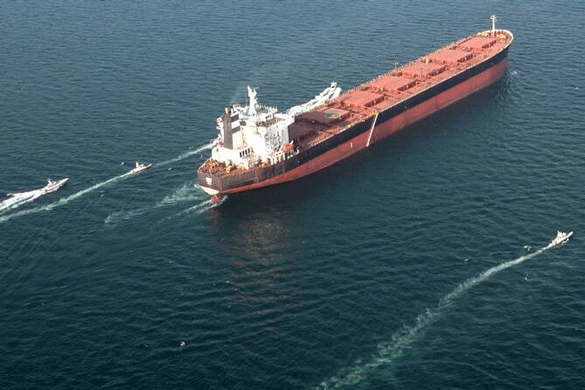
The Strait of Hormuz has once again become one of the most sensitive geopolitical flashpoints in the world. Yet the current escalation should not be read as an unavoidable consequence of regional tensions. It is, in fact, the result of a long-standing pattern, in which Iran has repeatedly leveraged its geographic position along this vital waterway to advance strategic and political objectives.
Tehran’s approach to the strait has gone beyond the conventional logic of territorial security. Over time, it has increasingly treated the narrow waterway as an instrument of pressure — linking maritime stability and freedom of navigation to broader regional and international disputes. Through periodic threats to shipping routes and energy flows, Iran has sought to turn geography into leverage, positioning itself as an unavoidable actor in any equation concerning Gulf security.
This strategy is inherently destabilizing. The Strait of Hormuz is not a national asset to be instrumentalized, it is an international maritime corridor upon which global energy security and trade depend. More importantly, the Arab Gulf states — Saudi Arabia, the UAE, Kuwait, Qatar, Bahrain and Oman — are not external observers to this crisis. They are the principal stakeholders whose economic stability and national security are directly affected by any disruption in these waters.
Any serious diplomatic effort to address tensions in the strait must therefore include Arab interests at its core. Excluding the Gulf Cooperation Council states from meaningful participation would produce an incomplete and ultimately fragile outcome. These states are the most exposed to escalation and the most invested in stability. Their role cannot be reduced to that of secondary consultees in negotiations shaped elsewhere.
A recurring feature of Iran’s regional behavior is the use of escalation as a bargaining mechanism. The pattern is familiar: heightened tension, increased uncertainty and then an attempt to translate de-escalation into political or strategic concessions. This is not traditional diplomacy grounded in mutual restraint — it is statecraft that relies on manufactured instability to create negotiating leverage.
Such an approach raises a fundamental problem. No state can simultaneously threaten international commerce and endanger global energy security, then seek political reward for restoring the stability it undermined. The security of the Strait of Hormuz cannot be contingent on concessions extracted under pressure.
At a broader level, the critical question is not only how to manage immediate tensions but who is entitled to shape the long-term security architecture of the Gulf. Iran’s apparent assumption that it can negotiate directly with global powers while imposing strategic realities on its Arab neighbors reflects a misreading of the regional balance of interests.
Gulf states are central actors in this equation. Their security concerns and strategic priorities define the stability of the entire system. Any agreement between the US and Iran that seeks to address the current crisis without full Arab participation would lack both legitimacy and durability.
Arab Gulf countries have consistently pursued stability, secure trade routes and predictable regional relations. Their involvement in shaping any framework for the Strait of Hormuz is essential not only to protect their own interests but also to ensure that broader principles — such as sovereignty, noninterference and freedom of navigation — are upheld in a balanced and enforceable manner.
At the same time, the assumption that the strait can remain a permanent pressure point is increasingly questionable. Gulf states have, over time, invested heavily in reducing strategic vulnerability through diversification of export routes, expanded pipeline infrastructure and strengthened access through alternative maritime corridors. While the Strait of Hormuz remains critical, it is no longer an exclusive chokepoint upon which the entire region depends without options.
Iran itself is not insulated from the consequences of escalation. Its economy remains deeply reliant on maritime access and energy exports. Any prolonged disruption in the Strait of Hormuz not only destabilizes regional trade but also intensifies Iran’s own economic pressures, compounding existing sanctions and reducing its fiscal flexibility. In strategic terms, the use of the strait as leverage carries significant internal costs that cannot be ignored.
This exposes a key contradiction in Tehran’s approach. A tactic intended to increase bargaining power risks accelerating long-term strategic isolation. As regional actors diversify infrastructure and international stakeholders reassess risk exposure, reliance on coercive control over maritime chokepoints becomes less effective over time.
The path toward sustainable security in the Gulf cannot be built on threats or episodic escalation. It must rest on a framework grounded in international maritime law, mutual restraint and inclusive regional engagement that reflects the realities of all principal stakeholders. Above all, it must recognize that Gulf security is inseparable from Arab sovereignty and economic stability.
Arab states are not seeking confrontation. Their overriding interest lies in maintaining open trade routes, regional stability and a security environment free from coercive disruption. Their inclusion in any meaningful diplomatic process is therefore not optional — it is essential to the credibility and success of any agreement.
Iran, like any sovereign state, has legitimate national interests. However, pursuing those interests through the destabilization of a global economic artery carries consequences that extend far beyond the region. Normalizing such behavior would establish a precedent that incentivizes recurrence rather than restraint.
Ultimately, this crisis is not only about maritime access. It is a test of whether regional security can be governed through balance and law or whether it will continue to be shaped by coercion. Iran may have contributed to the escalation but it cannot be allowed to unilaterally define its resolution.
A durable outcome will require a framework that places Arab interests at its center, acknowledges the interdependence of regional security and rejects the logic of strategic hostage-taking. Only through such an approach can the region move beyond recurring instability toward a more sustainable and balanced order.
https://www.arabnews.com/node/2642287
------
New Age Islam, Islam Online, Islamic Website, African Muslim News, Arab World News, South Asia News, Indian Muslim News, World Muslim News, Women in Islam, Islamic Feminism, Arab Women, Women In Arab, Islamophobia in America, Muslim Women in West, Islam Women and Feminism