
Middle East Press On: Turkey-Uzbekistan Partnership, Israel, Lebanon, US-Iran Agreement, Iran’s War Doctrine, Ex-Mossad Chief, New Age Islam's Selection, 22 June 2026

By New Age Islam Edit Desk
22 June 2026
Is Türkiye-Uzbekistan partnership reaching anew threshold?
The next Iran? Why Israel’s Turkey anxiety is becoming doctrine
Lebanon paid the price for a ceasefire that never existed
The US-Iran agreement is a first step
The Architecture of Endurance – Understanding Iran’s War Doctrine Beyond Western Narratives
‘October 7 Was Only Prelude’: Ex-Mossad Chief Says Israel is Heading Toward Disaster
Shakespeare in the Displacement Camps: The Story War Could Not Cancel
Ports of Resistance: Blocking the War Machine and the Genocide Economy
-------
Is Türkiye-Uzbekistan partnership reaching anew threshold?
BY ZEYNEP GIZEM ÖZPINAR
JUN 22, 2026
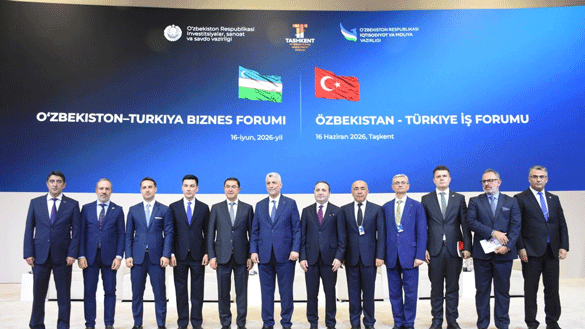
Relations between Türkiye and Uzbekistan have undergone a remarkable transformation in recent years. Bilateral relations, which were once driven by rhetoric centered on cultural affinity and political solidarity, are now increasingly grounded in concrete economic foundations.
The Türkiye-Uzbekistan Business Forum, held in Tashkent on June 16 as part of the 5th International Tashkent Investment Forum, marked the latest stage in this transformation. Chaired by Trade Minister Ömer Bolat and Uzbekistan’s Deputy Prime Minister and Minister of Economy and Finance, Jamshid Kuchkarov, the forum signalled a new phase aimed at deepening the economic dimension of the strategic partnership built between Ankara and Tashkent in recent years.
The economic liberalization policies launched by Uzbekistan’s President Shavkat Mirziyoyev following his accession to office have significantly enhanced the country’s capacity to attract foreign investment. In particular, the new legal framework established for foreign investors, industrial modernization projects and regional connectivity initiatives has transformed Uzbekistan into one of Central Asia’s most dynamic economies.
During this process, Türkiye has emerged as one of the key partners in Uzbekistan’s integration into the global economy. Indeed, the fact that Türkiye has ranked among the top countries investing in Uzbekistan over the past two years is a concrete indication of this trend.
The significance of the business forum held in Tashkent also becomes apparent at this point. The forum aims to achieve far more than simply maintaining existing economic relations. The primary objective is to extend economic cooperation between Türkiye and Uzbekistan into new sectors, integrate supply chains, and transform the two countries into actors that act in unison within Eurasia’s changing economic landscape.
Search for production partnership
For many years, the complementary nature of Türkiye’s industrial exports and Uzbekistan’s growing domestic market has formed the fundamental dynamic of the relationship. However, trends that have emerged in recent years indicate that this relationship is beginning to move beyond the traditional framework of exports and imports. The messages conveyed in Tashkent also confirm this transformation. It was notable that topics such as production, investment, industrial cooperation, technology transfer and joint ventures came to the fore throughout the forum.
Underlying this transformation are structural changes in the global economy. Supply chain disruptions during the pandemic, logistical disruptions arising from the Russia-Ukraine War, ongoing regional tensions in the Middle East and neighbouring regions, and the increasing economic repercussions of great power rivalry have driven companies to seek new production centers and more reliable partnerships. Within this framework, factors such as political stability, legal certainty, transport infrastructure, regional connections and market access have become key determinants of investment strategies.
Uzbekistan is one of the countries attracting attention in this new era. Thanks to the reform process, improvements to the investment climate, increased incentives for foreign capital and the development of industrial zones have enhanced the country’s appeal. From Türkiye’s perspective, Uzbekistan is a strategic partner that could serve as a production hub for Turkish companies expanding into Central Asia.
For this reason, the investment targets outlined at the forum should not be viewed merely as technical targets relating to economic scale. The key issue here is the greater integration of Turkish capital into Uzbekistan’s industrialization process. The more than 2,200 Turkish-owned companies currently operating in the country demonstrate the level to which economic relations have progressed. These companies operate across a wide range of sectors, including textiles, food, construction, energy, logistics, machinery manufacturing and services. Consequently, economic relations are taking on a direct dimension in terms of production and employment.
The activities of the Turkish construction sector in Uzbekistan are also one of the key indicators of this transformation. The fact that the total value of the 325 projects undertaken to date has reached $9.5 billion demonstrates just how effective a role Turkish firms have played in the country’s infrastructure and development processes. This cooperation, which is developing through transport networks, housing projects, industrial facilities, energy investments and public infrastructure projects, is helping to establish economic relations on a long-term and sustainable footing.
Furthermore, the regional experience possessed by the Turkish business community also creates a significant advantage. Turkish companies have a better understanding of the economic structure, business culture and bureaucratic processes of the post-Soviet region than many of their Western competitors. This enables Turkish investors to operate more swiftly in the Uzbek market and forge stronger partnerships. The forum held in Tashkent also served as an important platform for utilising this advantage in a more systematic manner.
Another notable aspect of the forum was the discussion of new opportunities for cooperation in the fields of energy, renewable energy technologies, digital transformation, agricultural technologies, transport, logistics and high-value-added industries. Particularly at a time when the energy transition is gathering pace, investments in solar and wind energy could represent a new dimension of economic cooperation between the two countries. Furthermore, joint projects developed in the field of the digital economy could help economic relations take on a more innovative character in the future.
Middle Corridor binds Turkic world
Another notable aspect of the forum is that it is directly linked to the geopolitical dimension of economic cooperation. For this reason, regional geopolitics must also be taken into account when assessing the economic rapprochement between Türkiye and Uzbekistan.
Uzbekistan’s location at the heart of Central Asia affords the country a significant strategic advantage. Situated at one of the junctions of trade routes stretching from China to Europe, Uzbekistan plays a critical role in the development of regional transport networks. Türkiye, meanwhile, stands out as a key logistics hub providing access to markets in Europe, the Mediterranean, the Black Sea and the Middle East. When these two positions are combined, a broader field of geo-economic cooperation emerges.
The economic rapprochement between Türkiye and Uzbekistan has the potential to contribute directly to the effectiveness of the Middle Corridor. The aim to increase the volume of trade from its current level of $3.1 billion to $5 billion, and subsequently to $10 billion, necessitates the development of transport infrastructure and the streamlining of logistics processes. To achieve these targets, the simplification of customs procedures, the reduction of border crossing times and the lowering of transport costs are of paramount importance.
Another noteworthy aspect here is the push for economic integration within the Organization of Turkic States, which has gained momentum in recent years. The “Turkic world” approach, which for a long time centered on cultural and political cooperation, has now begun to take on an economic dimension. Transport corridors, joint investment projects, trade facilitation and industrial partnerships are among the key elements of this process. The strong economic ties established between Türkiye and Uzbekistan also constitute one of the most concrete examples of this large-scale drive towards integration.
For economic integration to be sustainable, progress must be made in other areas alongside transport projects. The development of digital trade infrastructure, the widespread adoption of electronic customs systems, the establishment of joint investment funds and the strengthening of financial cooperation mechanisms are of critical importance to this process. The fact that the forum held in Tashkent paved the way for new contacts in these areas can be regarded as a significant development in terms of the meeting’s long-term impact.
Ultimately, the business forum demonstrated that Ankara and Tashkent are seeking to place their economic relations within a new strategic framework. If this process is managed successfully, the partnership between Türkiye and Uzbekistan will evolve into a model of cooperation that plays a decisive role in the reshaping of Eurasia’s economic architecture. Indeed, current developments indicate that the parties are closer than ever to achieving this goal.
https://www.dailysabah.com/opinion/op-ed/is-turkiye-uzbekistan-partnership-reaching-anew-threshold
------
The next Iran? Why Israel’s Turkey anxiety is becoming doctrine
June 21, 2026
by Jasim Al-Azzawi
On 17th February, addressing the Conference of Presidents of Major American Jewish Organizations in Jerusalem, former prime minister Naftali Bennett delivered a line that has since become shorthand for a shift in Israeli strategic thinking: “Turkey is the new Iran.” He accused Recep Tayyip Erdoğan of seeking to “encircle Israel.” He charged Ankara and Doha with nourishing a Muslim Brotherhood axis modeled on Iran’s proxy network, this time anchored by a “hostile Sunni axis with nuclear Pakistan.” Coming from a man positioning himself for an electoral comeback this fall, the remarks could be dismissed as campaign theatre. They are not isolated.
Bennett’s framing echoes a document few outside Israel’s defense establishment have read closely. In January 2025, the Nagel Committee — a government-commissioned panel on long-term defense strategy — concluded that a Turkish-aligned Syria could pose a threat that “could evolve into something even more dangerous than the Iranian threat.” That assessment has since filtered out of classified planning and into open political discourse, lending institutional weight to what might otherwise read as a politician’s bluster. Former defence minister Yoav Gallant added his own escalation on 27th February, urging Western states to reconsider arms sales to Ankara despite Turkey’s standing as NATO’s second-largest army.
Prime Minister Benjamin Netanyahu has not stayed above the fray. Facing slipping approval at home after the U.S.-brokered ceasefire with Iran, he announced a “hexagon” of regional partnerships — including Greece and Cyprus — explicitly framed to counter what he called an “emerging radical Sunni axis.” Both Greece and Cyprus carry long-running grievances against Ankara over maritime boundaries and Cyprus’s division — an alignment of convenience that lends the new doctrine institutional scaffolding without settling whether Turkey poses a threat genuinely comparable to Iran’s.
Turkey’s own posture has, so far, been a study in calculated restraint. Foreign Minister Hakan Fidan, asked about Ankara’s role in toppling Bashar al-Assad, called it “a grave mistake” to frame Syria’s transition as a Turkish takeover, insisting cooperation rather than domination should define the relationship. That restraint reflects an awareness — voiced by U.S. envoy Tom Barrack — that perceptions of encirclement run in both directions: Israelis read Ankara closing in from Syria and Gaza. In contrast, Turkish officials read Israeli expansion in the Golan and the Eastern Mediterranean as an encircling move.
Not everyone in Israel’s own security establishment is convinced the threat is being honestly assessed. Former ambassador Alon Pinkas offered a blunter diagnosis: Israeli politicians, he argued, “rely on the perpetual threat of war … it doesn’t matter who. There just always needs to be a threat.” His deeper point cuts against the comparison itself — unlike Iran, Turkey has never called for Israel’s destruction, and the relationship, however degraded, remains formally diplomatic rather than openly belligerent.
Washington’s think tank ecosystem is nonetheless amplifying the narrative. Michael Rubin of the American Enterprise Institute has openly speculated that, in a decade, Ankara will resemble Tehran today. At the same time, Bradley Martin of the Pentagon-linked Near East South Asia Center argued in The Wall Street Journal that NATO should reconsider Turkey’s membership altogether. Critics such as Sumantra Maitra counter that this amounts to “narrative manufacturing” — a coordinated effort to cast Erdoğan as the gravest regional threat since the Ottoman sultans, regardless of whether the underlying facts support such a claim.
But neither side wants a NATO member and a nuclear-armed Israel in direct conflict, and Erdoğan’s deliberate silence on Syria suggests Ankara understands the cost of overplaying its hand.
What is clear is that the “Turkey is the next Iran” framework — born partly of electoral convenience, partly of genuine strategic anxiety — is no longer fringe commentary. It is fast becoming the working assumption of Israel’s post-Iran regional doctrine, whether or not Ankara has actually earned the comparison.
https://www.middleeastmonitor.com/20260621-the-next-iran-why-israels-turkey-anxiety-is-becoming-doctrine/
------
Lebanon paid the price for a ceasefire that never existed
June 21, 2026
by Kurniawan Arif Maspul
There are moments in international affairs when language itself becomes part of the violence. Lebanon’s latest tragedy may be one of them.
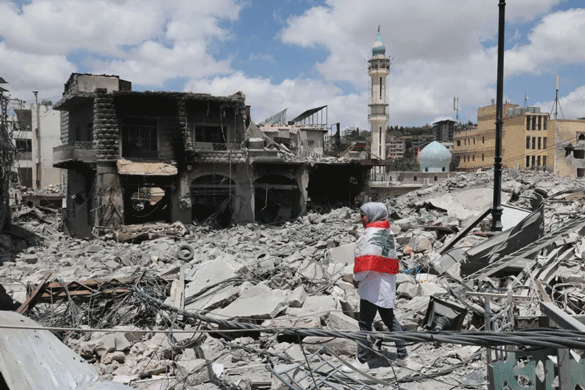
More than 150 Israeli strikes reportedly hit southern Lebanon overnight, leaving dozens dead and hundreds injured. Entire neighbourhoods were shattered before sunrise. Families fled once again along roads already crowded by months of displacement. Yet this devastation unfolded beneath the vocabulary of a ‘ceasefire’ — a word that, in theory, should signify restraint, protection and a chance for diplomacy to breathe.
The scale of the suffering tells its own story. Since March 2, 3,980 people have been killed and more than 12,000 wounded, among them 247 children, 363 women and 133 healthcare workers. More than one million civilians — over one-fifth of Lebanon’s population — have been driven from their homes. Behind each number lies a family uprooted, a community shattered, and a country pushed deeper into exhaustion.
Instead,
For decades, ceasefires have represented a political pause rather than a permanent peace. But when military operations continue on such a scale while diplomatic actors continue speaking of de-escalation, the distinction between war and peace becomes dangerously blurred. The language remains intact while its substance evaporates. This semantic collapse matters because international order ultimately rests upon shared meanings. If ceasefire no longer means the suspension of hostilities, what exactly remains of the rules meant to govern conflict?
The contradiction became especially stark after reports that understandings reached between Washington and Tehran included commitments to reduce hostilities across multiple fronts, including Lebanon. Such arrangements were always fragile. Israel maintained freedom of action in accordance with its own security calculations. Yet the speed with which violence resumed exposed a deeper reality: agreements involving regional powers mean little when the actors most capable of shaping events do not regard themselves as constrained by them.
The MOU was clear. Iran demanded—and received—assurances that hostilities in Lebanon would cease. The US gave those assurances. And then, within days, Israel launched the largest bombing campaign of the entire conflict.
The consequences extend beyond Lebanon. Iran’s withdrawal from negotiations, viewed in some Western capitals as an escalation, can equally be interpreted as evidence of collapsing confidence. Diplomatic processes depend upon credibility. When understandings are overtaken by military realities within days, incentives for compromise disappear. Why invest political capital in negotiations when bombs speak louder than signatures?
Furthermore, the result is not merely a failed agreement. It is the erosion of faith in diplomacy itself. Lebanon’s suffering illustrates the asymmetry at the heart of today’s regional order. According to Lebanese authorities and international humanitarian agencies, thousands have been killed since the current escalation began, with women, children and medical workers among the dead. More than one million people have reportedly been displaced — over one-fifth of the country’s population. The scale rivals, and in some respects surpasses, the destruction witnessed during the 2006 war.
Amnesty International, Human Rights Watch and United Nations agencies have repeatedly warned about the humanitarian consequences of mass displacement and the destruction of civilian infrastructure. UNICEF has reported alarming rates of children killed or injured. The World Bank estimates Lebanon’s economy, already crippled by financial collapse, faces billions of dollars in additional losses.
Yet the strategic conversation remains imprisoned by the language of deterrence. Israel sees Hezbollah through the prism of an Iranian-backed enemy; Hezbollah casts itself as part of the Axis of Resistance and as a defender of Lebanese land and sovereignty. Between these rival narratives lies a devastated country whose civilians bear the consequences of a conflict larger than themselves.
Once an overwhelming force becomes a permanent doctrine rather than a temporary necessity, violence ceases to serve political ends and instead becomes an end in itself. Entire generations are left suspended between memories of loss and the fading hope that diplomacy might one day prevail over destruction.
Words matter because they reveal philosophies. Statements from prominent Israeli ministers invoking imagery of destruction and promising to ‘open the gates of hell’ have attracted international alarm. Such rhetoric may play well domestically during wartime, but it carries strategic consequences. Language that casts entire societies as enemies undermines the very conditions necessary for future coexistence. Security doctrines built upon perpetual punishment rarely produce lasting security. They produce cycles of grievance.
History offers uncomfortable parallels. From Iraq to Afghanistan, overwhelming military superiority repeatedly failed to generate sustainable political settlements. The ruins of countless wars carry the same haunting message: peace cannot be built from rubble alone. Lasting stability emerges from institutions people trust, incentives that reward coexistence, and a sense of legitimacy that gives diplomacy meaning.
Firepower may destroy enemies, but it cannot manufacture reconciliation, nor can devastation become a substitute for justice. Military campaigns may suppress threats temporarily, but they seldom resolve the political conditions that created them.
Lebanon today sits at the intersection of several collapsing systems. Its state remains weakened by economic catastrophe. Hezbollah operates simultaneously as an armed actor and political force. Regional rivalries between Iran and Israel continue to spill across borders. Meanwhile, external powers pursue competing agendas while claiming to support stability. Into this fractured landscape enters another uncomfortable question: what happens when the guarantors themselves appear unable or unwilling to enforce restraint?
Washington’s position remains central.
It chips away at the moral authority of the international system itself, fostering the perception that justice is not universal but conditional, reserved for some and suspended for others.
When some violations are treated as existential and others as manageable, perceptions of double standards inevitably emerge. This perception may matter as much as reality itself.
The rules-based international order, frequently invoked by Western leaders, derives power from universality. If exceptions become routine, adversaries and partners alike begin seeing norms not as principles but as instruments applied selectively. Confidence erodes. Cynicism grows. Lebanon’s agony therefore transcends Lebanon.
It raises uncomfortable questions for a world already struggling with wars in Gaza, Ukraine and Sudan. Can international law survive if enforcement depends primarily upon geopolitical convenience? Can diplomacy function when military realities consistently override political commitments? Can a rules-based order endure when exemptions appear more visible than the rules themselves?
These are not abstract questions. They strike at the foundations of contemporary international politics. The tragedy unfolding across Lebanon is not simply another chapter in the Middle East’s endless cycles of violence. It is a warning about what happens when power outruns accountability and when words lose their meaning.
Peace cannot exist as a public relations exercise. Ceasefires cannot survive as diplomatic theatre. International law cannot remain credible if restraint becomes optional for the powerful and obligatory only for the weak.
https://www.middleeastmonitor.com/20260621-lebanon-paid-the-price-for-a-ceasefire-that-never-existed/
------
The US-Iran agreement is a first step
MOHAMED A. EL-ERIAN
June 21, 2026
The memorandum of understanding signed by the US and Iran last week is an important step forward. After months of open hostilities that have exacted a heavy toll — in both lives and livelihoods — and inflicted significant economic damage worldwide, the memorandum provides a much-needed foundation for diplomacy that could reverse the stagflationary spillovers of the war.
Since the war has complicated an already tricky outlook for most countries and companies, the announcement is understandably being celebrated. But as critical as it is, it is only a first step. A true return to global economic stability still depends on whether all the parties involved can move from a framework deal to a lasting agreement.
Of course, this uncertainty has not stopped global financial markets from reacting as though normal economic activity had already been restored. Expectations for a reopening of the Strait of Hormuz and a resumption of full-scale energy exports to international markets have triggered a sharp drop in global oil prices; and that, in turn, has boosted equity markets globally, as well as lowering borrowing costs.
Moreover, in the initial hours after the agreement’s announcement, portions of the bond market revised down their assumptions about how aggressively central banks would need to hike interest rates, having inferred that the memorandum could lead to an easing of supply-side constraints fueling inflation.
But lasting relief for the global economy will depend on how the US and Iran navigate the profound operational complexities that their agreement entails. For economists and a substantial segment of financial markets, it is too early to declare “all clear.” The next few weeks will be dominated by a step-by-step evaluation of whether renewed diplomacy can survive contact with structural realities.
Specifically, further clarity is needed on four issues. First, can technical teams from both the US and Iran sort through what US Vice President J.D. Vance has described as “a lot” of yet-to-be-negotiated details? They must not only resolve current outstanding issues but also navigate the inevitable transition from the memorandum of understanding to constructive talks on the fundamental issues that caused the war — not least Iran’s nuclear program and the broader issue of regional security.
Second, international and regional actors’ reaction could either solidify or sabotage the fragile peace. On one side are America’s European and Middle East allies, who are eager to end the energy supply shock. They are hoping for a broader multilateral effort to ensure an enduring peace. But then there is Israel, which has continued to strike targets in Lebanon and has already signaled its refusal to withdraw from the territory it has held since the start of the war.
Third, the speed of normalization will be critical for restoring global economic health. Reopening a chokepoint like the Strait of Hormuz is not as simple as flipping a switch. Adjusting shipping insurance rates, carrying out de-mining operations and ramping up energy production all takes time.
Lastly, policymakers must carefully gauge the extent to which the war has left “economic scarring,” on the one hand, and built additional resilience on the other. The ceasefire does not automatically reverse adverse effects such as the hit to global costs, some of which have yet to materialize (particularly in the food sector). But these shocks must be weighed against the resilience-building measures that countries and companies were forced to pursue — from establishing alternative energy supply chains that bypass current chokepoints to placing a heavier logistical emphasis on precautionary inventories.
Most economists will refrain from declaring “all clear” as each of these issues could derail or prolong the process. A sense of caution will initially dominate policymakers’ approach, as will become clear in the commentary surrounding major central banks’ upcoming policy meetings.
That includes the US Federal Reserve. It will welcome the ceasefire but it is unlikely simply to assume that a preliminary framework agreement constitutes a complete, immediate reversion of the war’s adverse impact on inflation. The Fed and other central banks will wait for tangible proof that the details are sorted out, that the Strait of Hormuz will remain open, and that production and shipping will in fact be restored.
While the memorandum of understanding is certainly good news, it is not definitive. The path from a statement of diplomatic intent to a fully restored, noninflationary energy supply chain is subject to political, technical and physical risks. Indeed, the coming weeks will be about how quickly the US and Iran can overcome challenges to implementation. Until then, the global economy remains in a state of suspended hope and not yet on a path toward definitive recovery.
https://www.arabnews.com/node/2648049
------
The Architecture of Endurance – Understanding Iran’s War Doctrine Beyond Western Narratives
June 22, 2026
By Iqbal Jassat
Led by Israel and Zionist allied “think tanks”, Western political leaders, military planners, and media institutions have portrayed Iran as an “irrational actor” driven by ideological extremism and regional aggression.
This deceptive narrative has served a strategic purpose by obscuring a more uncomfortable reality: Iran’s military doctrine is not built around conquest, expansion, or conventional battlefield dominance. It is built around survival.
Absent from much of the public discourse is the fact that Iran’s entire military structure evolved in response to isolation, sanctions, encirclement and repeated threats of regime change.
Following Iran’s historic 1979 Islamic Revolution, which overthrew a Western puppet and the devastating Western-imposed war by Saddam Hussein’s Baathist regime on Iran, Tehran concluded that it could not compete directly with the overwhelming technological superiority of the United States and its allies. The result was the development of a doctrine focused on deterrence, endurance and resilience rather than conventional superiority.
What is routinely presented as aggression is often the visible component of a much broader strategy designed to impose costs on any adversary contemplating war. Iranian planners understand that they cannot defeat the United States or Israel in a traditional military confrontation. Their objective is therefore different. They seek to make military intervention so costly, prolonged and disruptive that political leaders in Washington or Tel Aviv reconsider the value of war itself.
While Western militaries often seek rapid, decisive victories through technological superiority and overwhelming firepower, Iran seeks to stretch conflict over time. The longer a conflict continues, the greater the financial, political and social burden imposed on its adversaries. Iranian strategists calculate that democratic societies possess lower tolerance for prolonged military and economic pain than Iran itself.
This explains Tehran’s enormous investment in missiles and drones.
The logic is simple. A relatively inexpensive drone can force an adversary to expend interceptor missiles costing many times more. The objective is not merely military damage. It is economic exhaustion. Every interception becomes a financial drain. Every wave of drones becomes a test of sustainability. The battlefield extends beyond military installations into budgets, supply chains and political patience.
This approach exposes a vulnerability rarely discussed in mainstream coverage. Advanced military technology often comes with extraordinary costs. Iran’s strategy seeks to weaponize that imbalance.
Another element routinely omitted from public discussion is the extent to which Iran has redefined the battlefield itself.
Through support for Hezbollah, Iraqi Resistance, the Houthis, and Palestinian liberation movements Hamas and Islamic Jihad, Iran has developed what it describes as an Axis of Resistance. Western governments portray these relationships exclusively through the language of proxy warfare. Yet from Tehran’s perspective, they represent strategic depth.
A conflict with Iran can thus no longer be confined to a single battlefield. It immediately becomes regional.
The beneficiaries of narratives that reduce these dynamics to simple “terrorism frameworks” are clear. Such framing eliminates historical context and removes discussion of broader regional security calculations. It simplifies a sophisticated deterrence architecture into a morality play that is easier to sell to domestic audiences.
Perhaps the most significant and least understood component of Iran’s doctrine is its decentralized command structure.
For decades, Western and Israeli military planning has relied heavily on leadership decapitation strategies. The assumption is straightforward. Remove key commanders and military organizations become ineffective.
Iran spent years studying the failures of Saddam Hussein’s military during the 2003 US invasion of Iraq and concluded that centralized command structures were fatal vulnerabilities. The result was the development of the Mosaic Defense doctrine.
Under this model, Iran is divided into multiple semi-autonomous regional commands capable of functioning independently if central leadership is destroyed. Each command possesses local intelligence capabilities, logistics infrastructure, and operational authority. If communications collapse or senior leaders are eliminated, regional commanders are expected to continue fighting under preplanned directives.
If one commander is killed, another immediately assumes responsibility. The objective is simple: ensure that the military never stops functioning.
Iran’s military doctrine also treats geography as an active component of warfare.
Its mountainous terrain provides natural defensive barriers. Vast distances complicate any ground invasion. Underground missile complexes carved deep into mountains preserve critical assets from aerial bombardment.
Most importantly, Iran’s position alongside the Strait of Hormuz gives it leverage over one of the world’s most important energy chokepoints.
Western reporting frequently focuses on missile inventories and military hardware while giving far less attention to the strategic reality that geography itself remains one of Iran’s most powerful deterrents.
The ability to threaten disruptions to global energy markets transforms regional conflict into an international economic crisis. This expands the political costs of war far beyond the immediate participants.
And of course, modern warfare is fought through information as much as missiles.
Iran understands this reality and invests heavily in influence operations designed to shape domestic and international perceptions. State media networks, cyber capabilities and strategic messaging are deployed alongside conventional military assets. The goal is to ensure that Iranian actions are correctly framed as defensive responses while portraying adversaries as aggressors.
The United States, NATO members, Israel, Russia, and China all engage in similar information operations. Yet mainstream discussion often presents Western strategic communication as public diplomacy while framing Iranian messaging as propaganda. The distinction reflects power and narrative control more than objective analysis.
The most important lesson from Iran’s military doctrine is that it was never designed to produce a traditional military victory. Its purpose is deterrence and evidently has proven to be successful as we observe in how both the US and Israel have been pushed into a corner.
Iran’s planners have built a system designed to survive bombardment, absorb leadership losses, stretch conflicts over time and impose escalating economic and political costs on attackers.
This reality is frequently absent from public debate because it complicates prevailing narratives of “irrationality and aggression”.
It reveals a military doctrine shaped less by ambitions of conquest than by calculations of survival.
The evidence demonstrates that Iran’s strategic focus is not battlefield dominance but endurance. Its military architecture is designed to ensure that even if its leaders are killed, its cities attacked and its infrastructure damaged, the state remains capable of fighting.
https://www.palestinechronicle.com/the-architecture-of-endurance-understanding-irans-war-doctrine-beyond-western-narratives/
------
‘October 7 Was Only Prelude’: Ex-Mossad Chief Says Israel is Heading Toward Disaster
June 21, 2026

Former Mossad chief Tamir Pardo has issued one of the starkest warnings yet from a senior figure within Israel’s security establishment, arguing that the greatest threat facing Israel is no longer Iran, Hezbollah or Hamas, but the country’s deepening internal crisis and its unresolved occupation of Palestinian land.
In a wide-ranging interview with Israel’s Channel 12, Pardo said the October 7 events may prove to be only a “prelude” to a far more dangerous scenario in the occupied West Bank, while also criticizing Israel’s recent war against Iran and warning of a possible internal confrontation within Israeli society itself.
‘We Achieved Nothing’
Pardo, who spent decades involved in Israel’s covert campaign against Iran and later headed the Mossad, argued that Israel emerged from the recent confrontation with Tehran having failed to achieve its objectives.
“We came out of this campaign very badly because we achieved nothing,” he said.
According to Pardo, the military operations carried out against Iran earlier this year may ultimately strengthen rather than weaken Tehran’s nuclear ambitions.
“My feeling is that we made such a wrong move that its result could be an aggressive nuclear arms race in the Middle East,” he said. “I would not be surprised if Iran now tries to run as fast as possible to obtain nuclear weapons.”
He warned that Iranian leaders are likely asking themselves a dangerous question after the attacks.
“If we had nuclear weapons, would anyone have dared do to us what the Israelis and Americans did?” Pardo said. “The answer is that they would not have dared.”
He argued that this conclusion could create a far greater threat than the one Israel claimed it was trying to prevent.
Criticism of Israel’s Strategy
Pardo also criticized what he described as the public exposure of intelligence operations and covert capabilities.
“Any discussion of these operations is a mistake and a serious failure,” he said. “It allows the other side to complete the puzzle and block future operations.”
“The use of exposing capabilities in order to excite the public in real time, as has happened in recent years, is, in my view, a disaster.”
The former intelligence chief further questioned the Israeli-American campaign’s targeting doctrine, arguing that attempts to eliminate political leadership represented a dangerous departure from previous military practice.
“When you decide to take such a dramatic step, you have to think about what happens if you fail,” he said. “If you fail, you enter an event far more serious than the place you were in before.”
Netanyahu and the Surveillance Request
One of the most striking revelations in the interview concerned Prime Minister Benjamin Netanyahu.
Pardo disclosed that during his tenure as Mossad chief he learned that Netanyahu had asked then-Shin Bet chief Yoram Cohen to monitor the phones of both the Mossad director and then-Chief of Staff Benny Gantz.
“I discovered it a few days after the request was submitted,” Pardo said.
“It was a sad event and completely lacking in logic.”
He said the request undermined the relationship between Israel’s political and security institutions.
“The role of the Mossad chief is to serve the state, not anyone else.”
‘You Are Clerks, We Are the Elected Officials’
Pardo described what he sees as a long-term deterioration in relations between Israel’s political leadership and its security establishment.
According to him, discussions between professional and political officials were once conducted “at eye level,” but that changed over the past decade.
“A spirit began blowing that said: ‘You are the clerks, we are the elected officials,'” he recalled.
Today, he argued, the attitude has become institutionalized.
“They tell the attorney general, the Mossad chief and the chief of staff: ‘You are a clerk. Go do what you are told.'”
“It has entered our political DNA.”
Warning of Internal Conflict
A section in Pardo’s interview focused on Israel’s internal divisions.
He said his primary concern is no longer external enemies but growing fractures within Israeli society.
“I told them then that my fear is not Iran, not Hezbollah and not Hamas,” he said.
“The real threat is the internal rift that has been created within the people of Israel.”
Pardo warned that the possibility of internal violence can no longer be dismissed.
“Can the State of Israel reach a civil war today?” he asked. “The answer is yes.”
“Something I never imagined.”
He specifically pointed to the possibility that a future Israeli government could attempt to dismantle settlement outposts in the occupied West Bank.
“If the legitimate government of Israel decides to evacuate the outposts and farms in Judea and Samaria, I am not sure how it will end.”
Asked whether he was referring to armed confrontations, he replied: “Real use of force.”
“The country has changed. Not for the better.”
“And responsibility for that change always lies with leadership.”
‘October 7 Was Only the Prelude’
Pardo’s strongest warning concerned the occupied West Bank.
In his view, the absence of internationally recognized borders and the continued expansion of settlements are creating conditions for a future crisis that could surpass October 7.
“The State of Israel is the only country in the world without a border to its territory,” he said.
“On the day there is no border to territory, there is no border to anything else.”
“We are deteriorating, and this government is leading us toward a disaster of which October 7 was only the prelude.”
“What awaits us in Judea and Samaria is much worse.”
Pardo argued that a major escalation in the West Bank would be fundamentally different from the events of October 7 because it would occur along a vast geographical area stretching next to Israel’s largest population centers.
“October 7 was against the Gaza envelope, a thin belt of communities,” he said.
“The West Bank envelope runs from Afula through the center of the country, from Netanya and Hadera to Tel Aviv and Kfar Saba.”
“An event of this kind would look completely different.”
“This is a different population, a different rear front, a different line of contact.”
“It is heading there.”
Call for Defining Borders
Pardo concluded by arguing that Israel’s unresolved territorial ambitions lie at the heart of the crisis.
“Israel needs to define its borders through a referendum,” he said.
“Whoever lives inside the territory receives full rights.”
“Whoever is outside the border—the army will hold the key until someone emerges on the other side who is prepared to live in peace.”
He also called on Israeli leaders to adopt what he termed a “Vision 2048” and confront the Palestinian issue directly rather than continuing to manage it through military force.
“The Middle East wants cooperation with us,” Pardo said.
“But we insist on not solving our number one problem … It is time for us to begin defining borders, and from there grow forward.”
https://www.palestinechronicle.com/october-7-was-only-the-prelude-ex-mossad-chief-warns-israel-is-heading-toward-disaster/
------
Shakespeare in the Displacement Camps: The Story War Could Not Cancel
June 21, 2026
By Hani al-Salmy
A few months ago, amid the rubble of indistinguishable days and their relentless bitterness, I received a call from my friend, theater director Naim Nasr. His voice carried the tone of someone searching for a lifeline in a flood of sorrow. He was eagerly looking for a play that could be performed for children in one of the crowded displacement camps, where exhausted faces filled every corner.
He surprised me with a question my reality-weary mind did not expect:
“Did Shakespeare ever write a play suitable for children?”
I smiled at the question for a long moment—a smile tinged with both wonder and sadness. For an instant, I imagined an impossible encounter between children wrapped in fear beneath worn canvas tents and an English playwright who had lived and died more than four centuries ago.
I thought briefly, running through Shakespeare’s tragedies in my mind—from Hamlet to Macbeth—until a warmer thought emerged.
“A Midsummer Night’s Dream,” I replied.
It was the closest thing to the spirit of childhood: enchanted forests, mischievous fairies, intertwined dreams, and surprises that invite laughter and delight.
Naim loved the idea immediately. Even through the phone, I could sense his enthusiasm returning. He wasted no time and began the work at once.
In the days that followed, Naim became a magnet for deferred joy. He gathered children from the camp’s narrow alleys, from water lines and bread queues. He distributed roles carefully, discovering talents buried beneath the dust of displacement, and daily rehearsals began.
Out of necessity and imagination, a gray piece of fabric became a stage curtain. Worn cardboard boxes that once carried aid supplies were transformed into colorful masks bursting with life. Dry sticks collected for firewood became towering trees in Shakespeare’s enchanted forest.
There was no polished theater stage, no sophisticated lighting equipment, no comfortable seats waiting for an audience. Yet theater, as we have always known, does not require concrete walls to exist. It only needs a story worth telling and children brave enough to dream amid destruction.
I watched this extraordinary scene from a distance and found myself thinking about Shakespeare.
Did he ever imagine, while writing in old London, that his words would cross oceans and centuries to arrive in a Palestinian displacement camp?
Did he imagine that the fairies he released into England’s green forests would one day find their way into the hearts of children who fall asleep and wake to the sound of drones and bombardment?
Probably not.
But true literature often accomplishes what its creators never foresee. It crosses borders, languages, centuries, and barbed-wire fences to reach those who need it most.
Gradually, the play ceased to be a simple activity. It became a sacred ritual, woven into the fabric of the children’s daily lives. They memorized their lines as faithfully as they memorized their mothers’ names. They practiced songs and movements with infectious excitement, laughing wholeheartedly whenever someone forgot a line or missed a cue.
For the first time in what felt like ages, the camp seemed to possess a genuine appointment with happiness.
The play was not merely a way to pass the time. It was an act of reclamation—a determined attempt to recover a fragment of the childhood that war had stolen. Every rehearsal became a quiet declaration that life still possessed the power to grow amid rubble and ash.
One week passed, then another. A month passed, then a second. Masks were completed and painted. Scenes were perfected. The long-awaited performance drew near.
But wars have little affection for happy endings.
Just days before the curtain was due to rise, disaster arrived. A sudden military evacuation order was issued for the camp. The area had become a threatened zone, and residents were instructed to leave immediately.
On that sorrowful morning, the children were not wearing fairy masks or rehearsing scenes from A Midsummer Night’s Dream.
Instead, they were rehearsing another displacement.
They packed what remained of their lives.
The tents were folded before the curtain could rise. Bags were lifted onto weary shoulders before an audience could gather. The small stage the children had built with their effort, imagination, and hope disappeared amid the chaos of departure, the cries of fear, and the uncertainty of the road ahead.
Naim was heartbroken—not because his directorial work would never be seen, nor because the performance had been canceled, but because the children who had spent two months creating joy from almost nothing were once again forced to master the art of survival.
The children grieved as well.
They had longed for just one evening—one evening in which the heroes would be kind fairies and green forests and beautiful dreams, rather than warplanes, evacuation orders, and the machinery of fear.
Yet whenever I remember that story, I am struck by a strange certainty: the play was never truly canceled.
It is true that no performance took place on a stage. No applause echoed through the camp. No curtain rose before an audience.
But Shakespeare arrived there nonetheless.
He arrived when those children gathered around a shared story.
He arrived when they believed that a piece of cardboard could transform them into kings and fairies, that a scrap of cloth could become a magical forest, and that imagination remained the one force capable of opening a window of light in the darkest walls of war.
The play left the camp with the children. It traveled in their hearts and minds as they moved from tent to tent, from road to road, carrying with them a stubborn dream that refused to die.
War may destroy a theater. It may flatten a stage and scatter an audience. It may postpone a performance indefinitely. But it cannot destroy a story.
And stories, much like children, always find a way to survive.
https://www.palestinechronicle.com/shakespeare-in-the-displacement-camps-the-story-the-war-could-not-cancel/
------
Ports of Resistance: Blocking the War Machine and the Genocide Economy
June 21, 2026
By Michael Leonardi
As Israel’s genocidal campaign grinds on — with over 70,000 Palestinians slaughtered in Gaza and its aggression now spreading into Lebanon — a powerful new front of resistance is emerging at the world’s ports. Dockworkers, truckers, and solidarity activists are refusing to be complicit in the machinery of death, physically blocking weapons shipments and exposing the global supply chains that fuel endless war and profit from mass slaughter.
These actions are not symbolic gestures. They are developing a strategy to choke the war machine and dismantle the genocide economy at its weakest links. But to succeed, they must evolve into a sustained, coordinated international effort. Isolated blockades can raise awareness; only synchronized, cross-border action can truly starve the beast.
Italy’s Ports of Resistance
Italian dockworkers have been at the forefront. Unions like the Unione Sindacale di Base (USB) and the Autonomous Collective of Port Workers of Genoa (CALP) have repeatedly shut down operations to prevent arms and military components from reaching Israel.
In September 2025, dockworkers in Genoa and Livorno blocked ports during a nationwide general strike that brought millions into the streets. In Ravenna, workers refused entry to trucks carrying explosives bound for Haifa. Similar actions have targeted vessels linked to ZIM and other carriers.
The resistance has spread south as well. In Calabria, at the strategic port of Gioia Tauro, activists and port workers have mobilized against suspected dual-use shipments and military cargo destined for Israel.
Greece Joins the Fight
The momentum is spreading across the Mediterranean. In Greece, dockworkers at the major port of Piraeus have taken bold action, blocking shipments of military-grade steel and ammunition bound for Israel. Hundreds of workers and activists have mobilized to halt loading and unloading of deadly cargo, declaring they will not be complicit in the ongoing genocide.
New Jersey and the American Front
Across the Atlantic, the Port of Elizabeth in New Jersey has become a critical battleground. As the third-largest port in the United States and the single most important commercial exporter of weaponry to Israel outside of military bases, it ships approximately 1,000 tons of weapons and military components per week.
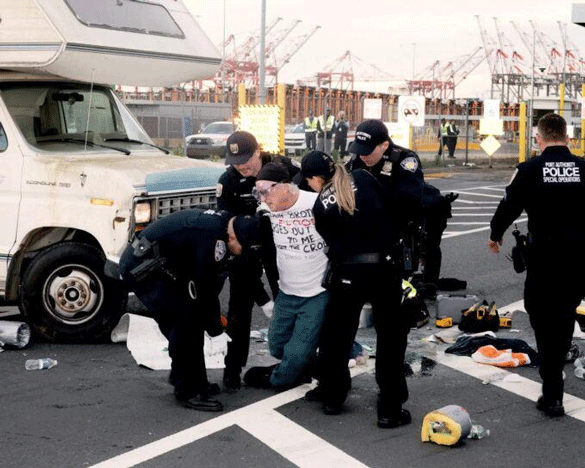
On May 22, 2026, over 30 activists blockaded the Maher Terminals at 4:30 a.m., targeting the ZIM Virginia and Maersk vessels carrying ammunition bound for Israel. Demonstrators chained themselves to an RV and a truck with a boat, obstructing the terminal entrance with banners reading “ZIM and Maersk Ship Genocide and Ecocide,” “Block the Bombs,” and “Stop Genocide, Ecocide & Deportation.” Ten activists were arrested and now face felony charges.
Danny Creamer, one of those arrested, stated: “Weapons companies like Zim and Maersk cannot be allowed to perpetuate and profit from the violence and genocide committed by the United States and its allies. I believe every single person has the responsibility to resist the actions of our government and these corporations, regardless of consequence.”
Mark Colville added: “We blockaded the terminal to stop the US government from violating its own laws by sending weapons to Israel to commit war crimes and genocide.”
Port Workers for Palestine has conducted persistent outreach at Elizabeth, highlighting the port’s role as a key artery in the U.S.-Israel war machine. While the International Longshoremen’s Association (ILA) has been largely unresponsive, non-unionized truckers have shown far greater sympathy. Because official union channels have failed to act, grassroots activists have stepped in.
Toward a Coordinated International Effort
These blockades are part of a growing global awakening. A recent international meeting of port workers in Turkey brought together representatives from at least 34 unions across 34 ports. The gathering laid the groundwork for coordinated actions planned for this fall — late September into October — aimed at escalating pressure on the war economy through synchronized strikes and blockades.
From Gioia Tauro to Piraeus, from Genoa to Elizabeth, the message is clear: ports must become barriers to war, not corridors for weapons deliveries. International solidarity is not optional — it is essential. Isolated actions raise consciousness, but only a coordinated, cross-border campaign can deliver decisive blows against the genocide economy.
The vision runs deeper than Palestine alone. Ports represent communal ownership and collective leverage. The military-industrial complex extracts enormous resources from working communities before they ever see the benefits of their labor. On average, every American contributes over $5,000 per year to U.S. militarism — a figure that has only grown under Trump. As working people, we have a profound moral obligation to stand up not only for ourselves but for the international community: to refuse the flow of weaponry that brings such misery to Palestine, Lebanon, and beyond.
Governments and corporations denounce these efforts as “disruptive.” But the real disruption is the daily shipment of bombs that level hospitals, schools, and entire families. Workers and citizens refusing complicity are exercising the highest form of solidarity: using their labor power and collective presence to stop the killing.
The path forward is urgent. Port workers, unions, truckers, and solidarity movements must expand these actions — coordinating across borders, targeting key chokepoints like Elizabeth, Gioia Tauro, and Piraeus, and building sustained pressure until arms flows cease. The fall coordinated actions emerging from the Turkey meeting represent a critical step in this direction.
History will remember those who blocked the ships, not those who loaded them. From Genoa to Newark-Elizabeth to Calabria, Piraeus, and beyond, the message is resounding: Not one more weapon, not one more shipment.
The ports are rising. The resistance is international. The war machine and the genocide economy can — and must — be brought to a halt.
https://www.palestinechronicle.com/ports-of-resistance-blocking-the-war-machine-and-the-genocide-economy/
-------
New Age Islam, Islam Online, Islamic Website, African Muslim News, Arab World News, South Asia News, Indian Muslim News, World Muslim News, Women in Islam, Islamic Feminism, Arab Women, Women In Arab, Islamophobia in America, Muslim Women in West, Islam Women and Feminism