
Middle East Press On: Lebanon, Korea-Turkey Strategic Partnership, Saudi Arabia, Gaza, pro-Israel, US, Palestine, Netanyahu, Iranian Victory, New Age Islam's Selection, 09 June 2026

By New Age Islam Edit Desk
09 June 2026
How Lebanon became a managed stalemate
Why Korea and Türkiye need a comprehensive strategic partnership
Why Saudi Arabia wants the Iran war to end
Gaza aid must be delinked from politics
The pro-Israel lobby and US military ‘cooperation’
Why Gaza Matters: From ‘Never Again’ to Ecocide, A Liberated Palestine Benefits Us All
One Bullet, Three Victims: How Israel Killed Seven-Month-Old Wissam Abu Heikal
The Dahiyeh Gamble: How Netanyahu’s Escalation Backfired into an Iranian Victory
------
How Lebanon became a managed stalemate
June 8, 2026
by Ali Salman
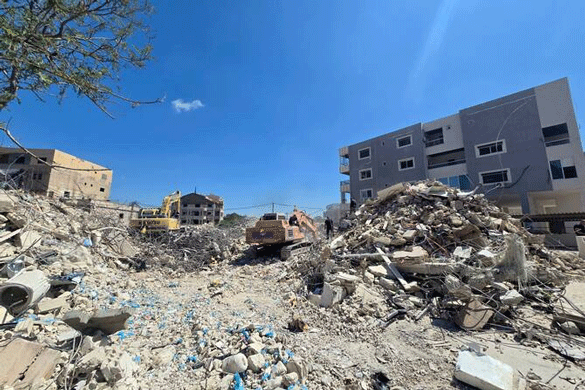
The pattern is now visible. On 1 June, Israel and Hezbollah agreed to a ceasefire. Within days, both sides violated it. On 5 June, Israeli airstrikes killed three Lebanese army officers and six others on a road south of Nabatiyeh. On 6 June, Israeli helicopters struck Beirut’s southern suburbs in retaliation for Hezbollah drone attacks. On 3 June, Hezbollah leader Naim Kassem called the ceasefire agreement “absurd, humiliating, and insulting” and rejected it entirely. The ceasefire lasted less than a week before it became what all the previous ones became: a framework in name, warfare in practice.
But here is what is not being said plainly: this is no longer a ceasefire breaking down. This is a ceasefire that was never real, now settling into its permanent form.
The ceasefire that was never a ceasefire
The 16 April ceasefire was supposed to be temporary. A ten-day pause. A negotiating window. It was extended on 23 April to three weeks. Extended again on 15 May to forty-five days. On 1 June, a new agreement was reached with explicit terms: Israel would not target Beirut’s southern suburbs. Hezbollah would not attack Israel. The Lebanese state would extend authority southward. All of this would be verified and enforced.
None of it was real. Not because the negotiators were dishonest. Because the framework assumed conditions that do not exist.
The Israeli military occupies approximately one-fifth of Lebanese territory. It has pushed further into the country than at any time since its 1982-2000 occupation. It is not occupying on the basis of a military offensive that ended, it is occupying while a ceasefire nominally holds. Every “violation” is not a breach of the ceasefire. It is the ceasefire’s actual operation.
Hezbollah has not disarmed. It has not withdrawn from southern Lebanon. It has not accepted the subordination to state authority that the ceasefire framework demands. Instead, it has continued limited military operations, attacking Israeli forces and launching drone strikes when Israeli aircraft strike Hezbollah positions. This is not defiance of the ceasefire. This is the ceasefire’s actual structure.
The Lebanese state has announced phases of disarmament and state consolidation. The military made declarations of progress on “establishing a state monopoly on arms.” None of this corresponds to reality. The state has not disarmed Hezbollah because it does not have the capacity. It has not extended authority south of Litani because Israel occupies that territory. The state’s announcements are not lies. They are the performance that makes managed stalemate possible.
What exists now is not a ceasefire that will hold or break. It is an arrangement where all parties continue operating while maintaining the fiction that a ceasefire exists.
Why all parties prefer this to everything else
Consider what each actor would face if the ceasefire actually ended:
Israel would need to decide: invade further northward toward Beirut and risk a full conflict with a Lebanese state it has no desire to fight, or stop and accept that Hezbollah remains in the south. Invasion carries costs that exceed benefits. Accepting Hezbollah’s presence seems unacceptable publicly. But accepting it under the cover of a ceasefire framework that is nominally holding? That is manageable.
Hezbollah would face: full escalation against Israel while weakened from eighteen months of bombardment, facing Iranian inability to resupply at scale, and watching Israeli forces consolidate in Lebanon. Or disarmament, which means surrendering the military capacity that gives it political legitimacy. Or this: continue limited military operations, enough to maintain credibility with its base that resistance continues, while avoiding escalation that would trigger Israeli response beyond what the population is already enduring.
The Lebanese state would face: attempting to disarm Hezbollah and triggering sectarian conflict that collapses the government, or accepting that disarmament is impossible and watching the state’s legitimacy erode. Or this: announce disarmament phases, make symbolic gestures, maintain the appearance of state consolidation while actually exercising no authority in the occupied south. This preserves the government’s international standing while avoiding internal collapse.
The United States would face: escalation involving Iran and broader regional conflict, or withdrawing from mediation and accepting that Middle East strategy has failed. Or this: maintain a framework that is nominally active, declare ceasefire extensions and new agreements when violations spike, give each actor the diplomatic cover they need while the actual situation on the ground remains frozen.
Every actor prefers managed stalemate to the alternatives.
The mechanics of permanent occupation
What makes managed stalemate permanent is that it does not require consensus on what is actually happening. Each side can narrate the situation differently.
Israel occupies territory and conducts military operations. These are violations of a ceasefire by Israel’s official position: targeted strikes against Hezbollah infrastructure and “imminent threats” to Israeli forces. By Hezbollah’s position: evidence that the ceasefire was never meant to be honored. By the US position: unfortunate incidents that do not constitute ceasefire collapse, provided both sides commit to negotiations.
Hezbollah conducts drone attacks on Israeli forces. These are violations of the ceasefire by Israel’s position: evidence Hezbollah is not committed to peace. By Hezbollah’s position: legitimate resistance to occupation. By the Lebanese state’s position: regrettable but not the state’s responsibility, as Hezbollah is a separate actor.
The Lebanese state announces progress on disarmament while exercising zero authority in the occupied south. By its position: the state is consolidating control gradually, in phases. By Israel’s position: insufficient progress, justifying continued military presence. By Hezbollah’s position: an illusion designed to serve Israel’s interests.
Each narrative is internally consistent. Each can be maintained indefinitely because none requires proof. The proof is in the territory that remains under Israeli control, the population still under Hezbollah’s de facto protection, the Lebanese state is still unable to exercise authority south of Litani.
The question that will not be asked
The real question is not whether the ceasefire will hold. It will hold because it is not a ceasefire, it is an occupation arrangement with diplomatic cover.
The question is not whether the Lebanese state will extend authority southward. It cannot, because it does not control the territory and has no military capacity to contest Israeli occupation.
The real question is: how long before the fiction becomes accepted reality?
The answer: it already is. The ceasefire framework has been “extended” four times in eight weeks. Each extension is a renewal of the fiction. Each violation is reported as aberration rather than pattern. Each new agreement comes with new terms that will be honored in form and violated in practice. Eventually, the extensions stop being announced. The violations stop being reported. Israeli military presence in Lebanese territory becomes accepted as the new status quo. Hezbollah maintains control of the south through Israeli sufferance. The Lebanese state exercises nominal authority from afar. The international community declares the situation “stabilized.”
This is not peace. It is not war. It is the permanent condition that all parties have learned to prefer.
The ceasefire will not collapse because there is no ceasefire to collapse. What exists is a managed stalemate that serves every actor better than escalation or actual resolution. It will persist because breaking it costs more than maintaining it. And the cost of maintaining it, permanent Israeli occupation of Lebanese territory, Hezbollah’s effective control of the south, the Lebanese state’s irrelevance in half its own country, has become the price of avoiding worse outcomes.
https://www.middleeastmonitor.com/20260608-how-lebanon-became-a-managed-stalemate/
------
Why Korea and Türkiye need a comprehensive strategic partnership
BY CHONG-JIN OH
JUN 09, 2026

Foreign Minister Hakan Fidan's recent visit to Seoul was brief, lasting little more than a day. Yet, its significance extends far beyond the schedule itself. His meetings with Korean officials and his keynote address at Korea University should not be viewed as routine diplomatic engagements. Rather, they represent an important step in preparing the next phase of South Korea-Türkiye relations at a time when both countries face rapidly changing regional and global environments.
The visit comes at a particularly important moment. Since the summit meeting between President Lee Jae-myung and President Recep Tayyip Erdoğan last November, both governments have explored a wide range of new cooperative initiatives. Discussions have expanded beyond traditional trade relations to include defense industries, energy security, supply chains, advanced manufacturing, electric vehicles, batteries, renewable energy and emerging technologies such as artificial intelligence.
Among these issues, cooperation in the energy sector deserves particular attention. Türkiye's planned Sinop Nuclear Power Plant project has generated sustained consultations between Turkish authorities and Korean institutions. Numerous technical feasibility discussions and working-level consultations have already taken place. Similar momentum is evident in defense cooperation, where both countries possess complementary industrial capabilities and strategic interests.
Against this backdrop, Fidan's visit serves as an important strategic review of ongoing bilateral initiatives and as a preparatory step toward a future presidential summit. As many projects move from conceptual discussions toward implementation, political guidance from the highest level will become increasingly necessary.
Indeed, South Korea and Türkiye remain among the few countries whose strategic interests are highly complementary rather than competitive. There are remarkably few areas where the two countries face direct geopolitical friction, while numerous sectors offer opportunities for cooperation that can generate mutual benefits. Such conditions are rare in contemporary international politics.
Vision for global governance
During his lecture at Korea University, titled “The Future of Global Governance: A Turkish Perspective,” Fidan argued that the world is facing not merely a security crisis but a deeper crisis of governance. Despite the proliferation of international institutions, treaties and diplomatic mechanisms, the international community increasingly struggles to respond effectively to contemporary challenges.
His diagnosis resonated strongly in South Korea. Both South Korea and Türkiye have long advocated reform of the existing international order. Both support multilateralism, diplomacy and rules-based cooperation. Both understand that global stability can no longer depend solely on the actions of major powers.
Recent developments have only reinforced this reality. The Russia-Ukraine War, ongoing instability in the Middle East, and the recent military confrontation involving the United States and Iran have exposed the limitations of a global order heavily dependent on great-power management. International institutions have often proven unable to prevent crises, while major powers increasingly prioritize strategic competition over collective problem-solving. In this environment, middle powers are no longer peripheral actors. They are becoming indispensable stakeholders in maintaining international stability.
As Fidan noted, countries capable of building coalitions, facilitating dialogue, and producing practical solutions are increasingly expected to contribute to global governance. South Korea and Türkiye fit this description remarkably well. Neither country is a traditional great power. Yet both possess advanced economies, sophisticated technological capabilities, extensive diplomatic networks, and growing international influence. More importantly, both serve as bridges between regions. Türkiye connects Europe, the Middle East, and Central Eurasia, while South Korea serves as a critical actor linking Northeast Asia with the broader Indo-Pacific. This shared strategic identity creates opportunities for cooperation not only at the bilateral level but also within broader multilateral frameworks across Eurasia and the Asia-Pacific.
Fidan's lecture also highlighted an important question regarding the future direction of South Korea-Türkiye relations. Officially, the two countries have maintained a strategic partnership. For decades, both peoples have referred to one another as “Brother Nations," a phrase rooted in shared memories of the Korean War and reinforced by enduring cultural affinity and mutual goodwill. However, while this symbolism remains valuable, symbolism alone is insufficient in an era defined by strategic competition and economic transformation.
The time has come to institutionalize this unique relationship through a higher-level diplomatic framework. A comprehensive strategic partnership would provide a stronger foundation for future collaboration.
Towards presidential bonds
Achieving this objective ultimately requires political leadership. Both South Korea and Türkiye operate under presidential systems in which national leaders play decisive roles in setting strategic priorities and mobilizing government resources. Working-level consultations and ministerial meetings are essential, but transformative initiatives often require presidential direction.
This is why the momentum generated by Fidan's visit should now be elevated to the summit level. A future meeting between President Lee and President Erdoğan would provide an opportunity to review ongoing projects, remove bureaucratic obstacles, and identify new areas for cooperation. It would also send a powerful signal that both governments are committed to transforming political goodwill into tangible outcomes. Given the substantial progress already achieved through sectoral consultations and working-group meetings, the timing for such a summit is increasingly favorable.
For decades, Korea and Türkiye have proudly called each other brother nations. The challenge now is to transform that historic friendship into one of the most consequential middle-power partnerships of the 21st century.
https://www.dailysabah.com/opinion/op-ed/why-korea-and-turkiye-need-a-comprehensive-strategic-partnership
------
Why Saudi Arabia wants the Iran war to end
DR. ABDEL AZIZ ALUWAISHEG
June 08, 2026
Considering the long list of complaints Saudi Arabia has had against Iran over the years, many wonder why the Kingdom is supporting diplomatic efforts to end a war that could possibly eliminate a major irritant. The question is a good one, but the answer is complicated.
In 1979, soon after the revolution, Tehran put Saudi Arabia in its crosshairs. In a futile attempt to destabilize the Kingdom, it set up terrorist groups that fomented sectarian strife, sabotaged oil installations, attacked security forces and even called for parts of Saudi Arabia to be put under Iran’s control. All that mischief failed.
During the last 47 years, Saudi Arabia has thrived. Its social and economic indicators have skyrocketed and its economy has grown more than tenfold, from $112 billion in 1979 to $1.24 trillion now. Iran, by contrast, has stumbled. Choosing to live by its own rules and disregarding international norms for state conduct, it has become a pariah among nations, a rogue state, spending its wealth on terrorist and separatist groups and stoking hatred and discord throughout the region and beyond.
Despite this history, Saudi Arabia opposed the war before it started and is now pushing to end it as soon as possible.
Monday marks 100 days since the war started on Feb. 28, but there does not appear to be an end in sight. The objectives announced by US President Donald Trump are no closer to being achieved today than they were at the start — and they may even be more distant.
More than 60 days after a ceasefire was announced on April 8, the war goes on, albeit at a slower pace. The Strait of Hormuz has remained effectively closed for 100 days now, with a few exceptions. Thousands of ships are stuck at sea around the world and on both sides of the waterway. The fate of the global economy hinges on getting it reopened, as do the livelihoods and well-being of billions of people around the world.
This in part explains why Saudi Arabia wants the war to end. Over the past few years, it has sought diplomatic solutions to complicated issues, such as the Israel-Palestine conflict, the Yemen war and its perennial dispute with Iran. But in addition to this principled position, the war and the closure of the Hormuz waterway have wreaked havoc with the economies of both the Gulf and the rest of the world, including many poor and fragile states, which may not survive if the war and the closure continue.
The Gulf conflict demonstrates how the regional and the global are intertwined, because the Gulf is integrated with the world economy and finance. It is a clear example of the intersection between geopolitics and geoeconomics.
The Gulf Cooperation Council economies have been directly affected, to varying degrees, by the crisis. Last October, the International Monetary Fund projected healthy 2026 growth rates for some GCC states, exceeding 6 percent. Now, it expects some of them to shrink by more than 8 percent, depending on how long the closure lasts and how dependent each state is on the waterway for its exports.
In addition to the decline or halt of exports, there is the physical damage resulting from Iranian attacks and the invisible damage from lost opportunities, as investment decisions are delayed or rescaled.
While government revenues are also significantly affected in GCC states, they are fortunate enough to have accumulated wealth from better times, which can be used to maintain their style of living for a while. However, there are scores of less-fortunate countries that have been worse affected by this war.
Before its closure, about 13 million barrels of oil crossed the Strait of Hormuz daily, as did about 140 billion cubic meters of natural gas. About 20 percent of the world’s supply of fertilizers also crossed the waterway, including 46 percent of urea. The fuel and fertilizer shortages are having an impact on food production, which could get worse.
Industrial production has been affected by the diminished exports from the Gulf of critical materials such as aluminum, steel, sulfur and methanol. For example, Qatar used to supply about a third of the world’s needs of helium.
For these reasons, the IMF has recalculated expected global growth rates. In January, it predicted that the world economy was going to grow at about 3.4 percent during 2026, as there was some optimism that the international economy was starting to recover from the US-China trade war and unprecedented tariffs.
However, after the Iran war broke out and the Strait of Hormuz was closed, it put the growth rate for 2026 at only 2 percent if things stay the same until the end of the year. Inflation may rise to a devastating 6 percent. We have not seen these levels since the global financial crisis in 2008-09.
Saudi Arabia is not the country worst affected by the closure of the strait because it has other export channels through the Red Sea and extensive land routes. However, the Kingdom thrives when the world economy is growing because the volume and value of its exports depend on healthy global demand.
Equally importantly, ending the war and reopening the strait will allow Saudi Arabia to resume its quest for regional stability and prosperity.
https://www.arabnews.com/node/2646410
------
Gaza aid must be delinked from politics
DR. RAMZY BAROUD
June 08, 2026
Gaza requires urgent international attention. What is happening in the besieged and devastated Strip far exceeds an unfolding humanitarian disaster; it is a calculated geopolitical reshaping. Israel is executing a plan to permanently occupy the vast majority of Gaza, with consequences that require little elaboration considering what we already know about the ongoing genocide.
Currently, much of the international debate centers on a single official: Bulgarian diplomat Nickolay Mladenov. The former UN special envoy to the Middle East has been designated by the US as executive director of the Trump administration’s “Board of Peace” — an international council founded to oversee the implementation of Washington’s 20-point Gaza roadmap.
The issue, however, is much bigger than a single Washington-backed bureaucrat. A growing number of Palestinians and political analysts accuse Mladenov of manufacturing the conditions that continue to obstruct progress on the agreement’s transition to its second phase.
Under this framework, the official transition to the second phase — which Trump and the Board of Peace declared to have begun in January — demands sweeping, one-sided Palestinian concessions, most notably the total disarmament of armed factions.
This demand is a recipe for the failure of the entire project, especially given that Israel has not implemented the most basic requirements of the agreement’s first phase. It has refused to halt its routine military incursions, failed to withdraw its forces to the originally mandated “Yellow Line,” and it continues to deny entry permits to the technocratic committee slated to assume civil governance of the Strip.
Mladenov’s insistence on Palestinian disarmament before the agreement can advance — without a single guarantee of Israeli compliance — conveniently flips the narrative. It cynically reframes systematic starvation and the denial of medical and construction supplies as being due to a Palestinian failure to honor commitments.
In reality, Mladenov holds no real cards; he is merely a cog in a larger machine controlled by Benjamin Netanyahu. The Israeli prime minister has made it clear that he has no intention of following any peace roadmap, planning instead for the permanent, incremental takeover of Gaza.
Speaking at a conference in a West Bank settlement on May 28, Netanyahu explained his strategy with total clarity, abandoning all diplomatic doublespeak: “We are currently squeezing Hamas; we now control 60 percent of the territory of the Strip — you know this. We were at 50, we moved to 60. My directive is to move to…” he said, pausing as an audience member shouted “100.” Netanyahu smiled and responded: “Let’s go step by step. First of all, 70. Let’s start with that. We are pressing them from all sides, we’ll deal with the remnants.”
This is the blueprint of the Israeli government, declared openly to domestic audiences. The admission was so brazen that even US Secretary of State Marco Rubio expressed frustration at Netanyahu’s candor. Testifying before Congress last week, Rubio remarked: “We have a plan — it doesn’t call for that,” referring to further Israeli territorial expansion.
But Rubio quickly reverted to Washington’s standard line: “And at the end of the day, we understand that what we want, and I think what the Israelis would ultimately want, is a Gaza that is governed by a non-Hamas entity.”
While the immediate priority for Palestinians is not governance but food, clean water, medicine and basic survival, Netanyahu and Rubio view the entire crisis through a political lens. The US-Israeli plan is predicated on achieving, through diplomatic strangulation and engineered famine, what they failed to fully achieve through military might.
A rare, decisive answer came from UN spokesperson Stephane Dujarric, who summed up the organization’s position plainly: “One hundred percent of Gaza should be for the Palestinian people.” The problem, however, is that the UN’s rhetoric does not have the backing of any genuine enforcement mechanisms.
The international community has walked into a trap, outsourcing the future of the Gaza Strip to the Trump administration and its Board of Peace. Even the designated technocratic committee has been rendered entirely irrelevant, excluded from a decision-making process left solely to diplomats beholden to the White House.
The situation on the ground remains catastrophic. Since the fragile, heavily compromised ceasefire took effect on Oct. 10 last year, regular Israeli violations and airstrikes have killed nearly 1,000 Palestinians and wounded thousands more — the vast majority women and children. When added to the horrific toll of the initial two years of war, the official number of Palestinians killed has surpassed 73,000, with more than 173,000 injured. Furthermore, credible epidemiological studies and medical journals have concluded that the true death toll is likely vastly higher.
With nearly the entire population of Gaza living in substandard tents and surviving on the meager rations permitted through Israeli checkpoints, it is the highest form of immorality to demand political concessions in exchange for basic sustenance.
Netanyahu’s “step-by-step” annexation does not hinge on what Palestinian factions decide to do — his expansionist timeline is shaped independently of Palestinian compliance.
Arab, Muslim and allied nations must fundamentally shift their diplomatic strategy. They must firmly insist that humanitarian aid is completely delinked from the future governance and demilitarization of the Gaza Strip.
Starvation cannot be tolerated as political leverage for war criminals. Netanyahu is emboldened by a history of international impunity, speaking openly of expanding Israel’s military footprint regardless of the consequences of such actions.
The international community must remind Israel’s government that the survival of millions of Palestinians cannot be held hostage to the political ambitions of an extremist coalition.
https://www.arabnews.com/node/2646394
------
The pro-Israel lobby and US military ‘cooperation’
DR. DANIA KOLEILAT KHATIB
June 08, 2026
Americans are slowly starting to wake up and ask themselves why their tax dollars should finance a genocide when so many of them cannot afford healthcare or higher education and suffer from homelessness, among other problems. Israel has seen that pressing on the issue of military aid is a losing battle. However, it has used its influence in Congress to add an amendment to the National Defense Authorization Act that would effectively mean the Israeli and US militaries are fused under the guise of “cooperation.” Basically, this is an attempt at a hostile takeover of the US military by Israel.
Israel wants to calm public anger and, as usual, it is using loopholes in the system to benefit from American tax dollars. This time, the pro-Israel lobby helped add a provision to the spending bill that would effectively allow the two militaries to fuse. If it passes, Israel will have access to the US military. More bluntly, Israel will take over the US military. Representatives from both sides of the aisle have tried to strip the bill of this amendment but have so far been unsuccessful.
The provision, dubbed section 224, is supposed to boost ties between the two militaries. This amendment “would require the secretary of defense to designate an executive agent responsible for synchronizing cooperative efforts between the United States and Israel.” The “cooperation” referred to in the text is very shady. Why would the US share its military technology with Israel?
Reps. Ro Khanna, a Democrat, and Republican Thomas Massie tried to repeal this section of the defense bill. Khanna tried to use his seat on the House Armed Services Committee to put forward an amendment to remove section 224 from the bill. Khanna told his colleagues: “The American people are tired of the arrogance and insolence of (Israeli) Prime Minister (Benjamin) Netanyahu telling America what we should do.”
Khanna added that Americans “want less cooperation and blank checks to Israel, not more. Only the United States Congress would dream up at this moment, ‘Let’s actually do more for Israel.’” It is rumored that Netanyahu pressured members of Congress to write this section into the bill. Khanna said in his speech: “Last I checked, Netanyahu doesn’t have a seat on this committee.”
The fact the amendment was maintained shows that, while Netanyahu may not have a seat on the committee, he controls it. The pro-Israel lobby is still strong and, despite the awareness of the grassroots, it still has influence over the so-called grasstops. It knows that its influence is dwindling, so it wants to secure as much as possible before the lobby becomes obsolete.
In the background of this proposed hostile takeover of the US military, the Pentagon raised the threat of Israeli spying on America to its highest level. The Defense Intelligence Agency has become increasingly concerned in recent weeks as Israeli spying has become more aggressive than usual. However, Israel has always spied on the US.
Last year, Tucker Calson confronted Sen. Ted Cruz, a strong advocate of Israel, and asked him how Israel could be an ally when it spies on the US. The most famous Israeli spy is the American-born intelligence officer Jonathan Pollard, who leaked state secrets to Israel and was jailed for doing so in 1987. Nevertheless, Israel’s spying activities have always been brushed under the carpet by compliant American politicians. So, for it to become a major story in mainstream media outlets like The New York Times and NBC means that Israel has crossed a red line. Israel reportedly listened in on conversations held by American officials, including the pro-Israel Middle East negotiator Steve Witkoff. But still there has been no outcry.
The pro-Israel lobby is able to operate because of the absence of a massive grassroots movement that aims to bring about policy change. But new organizations, such as Track AIPAC and the Anti-Zionist America Political Action Committee, are aiming to put the lobby’s actions under the spotlight. There has been a change in public opinion and awareness. Surveys show that Americans are holding increasingly unfavorable views of Israel. They are starting to see Israel for what it truly is: an apartheid, genocidal state feeding on their hard-earned American tax dollars.
However, the American public is not doing anything about it. There are no mass protests. Massie, the popular Republican congressman from Kentucky, last month lost his midterm primary election to an obscure candidate backed by the pro-Israel lobby. As long as there is no pushback against its dealings, the lobby will keep on interfering in US policies in favor of Tel Aviv.
There are some activist groups, such as Code Pink, which have targeted pro-Israel lawmakers and confronted them. But there have been no massive local campaigns that see protests in front of representatives’ district offices, with people threatening to vote them out of Congress if they back sending money to Israel. Do we see mass letter campaigns sent to each representative and each senator? Awareness is not being translated into action. It will probably take a while. In the meantime, the pro-Israel lobby is benefiting from this lag effect to extract the maximum it can from Americans and to lock in its gains through resolutions voted on in Congress that will be difficult to reverse.
https://www.arabnews.com/node/2646402
-------
Why Gaza Matters: From ‘Never Again’ to Ecocide, A Liberated Palestine Benefits Us All
June 9, 2026
By Benay Blend
A recent poll by the Pew Research Center shows that many countries around the world are recognizing that Israel’s genocide in Gaza is unacceptable in a world that values human life. According to the survey, a median of 67 percent across 36 countries disapprove of Israel’s actions, a shift that has become particularly pronounced since the bombing of Iran.
These findings reinforce Gallup reports that 41 percent of Americans recently said that they sympathize more with Palestinians than Israelis, marking a shift from the numbers found in earlier polls. Gallup found favorability towards Palestinians highest among younger Americans, Democrats, and political independents.
Despite these encouraging numbers, there are still pockets of the US population who say that they never watch the news because they believe it is too depressing. Many also believe that current problems in this country are so overwhelming that there is little room left to feel empathy for other people.
Nevertheless, it has long been impossible to separate foreign policy from domestic concerns as both are inextricably linked by several factors. In order to promote violence abroad—as in Vietnam, Iraq, Afghanistan, Latin America, and the Middle East—there must be an effort on the part of corporate media and public officials to promote xenophobia at home.
Complicity on the part of recent administrations in both funding and promoting Israel’s genocide is obvious. From disparaging remarks about individuals from those regions to providing weapons used across Gaza, Iran, and Lebanon, politicians within both the Biden and Trump regimes have enabled mass murder in those countries.
To the unskilled eye, media collusion is less apparent, perhaps because of long-held myths that surround the founding of the “Israeli” state as a bastion of democracy and rightful homeland for the Jewish people in the Middle East.
Yet, as Iqbal Jassat notes, “the pattern of framing [by corporate media] is evident in the choice of soft language as well as the omission of critical context.” After October 7, such reports described Israel’s siege on Gaza as a “just war,” calling it a response to “terrorism” by Hamas, thus omitting years of the entity’s illegal occupation followed by a 17-year blockade, all of which have contributed to the plight of Palestinians in Gaza today.
As far as “soft language,” Jassat writes, journalists have been instructed to avoid terms like genocide, ethnic cleansing, and occupied territories. When referring to Palestinian actions, the term “resistance” is never used, but instead words like massacre and slaughter are substituted to describe what is in reality Palestinians’ legal right to resist the occupiers of their country.
According to the Press on Palestine Series, an initiative by Palestine Square, the blog of the Institute for Palestine Studies-USA, these practices, long common in US reporting, have escalated since October 7th.
For example, when the Washington Post covered the assassination of poet/teacher Refaat Alareer, Farah Hamouda explains that the reporter “perpetuates harmful stereotypes by associating Palestinians with violence,” thus holding the victims responsible for their own deaths. By “escalat[ing] his criticism of Israel,” the Post alludes, Alareer deserved the “Israeli” airstrike that murdered him along with his brother, sister, and her four children.
Indeed, the dissemination of such images by the press has consequences far beyond the page. For instance, on May 18, 2026, a shooting at the Islamic Center in San Diego, California, left three worshipers dead along with a traumatized Muslim community.
Reporting on the incident, Anisah Bagasra writes that “negative portrayals of Muslims shape public opinion towards them,” a trend that she says has escalated since the US bombing of Iran. Thus, foreign policy impacts what happens on the domestic scene, in this case leading to increased discrimination and hate crimes such as the recent shooting in San Diego.
Closer to my home, a proposed mosque and Islamic community center in Albuquerque, New Mexico’s North Valley, has drawn considerable controversy during a recent Planning Commission meeting about the site.
Though the outward objection seems to be increased traffic, comments on social media, along with those in public meetings, tell a different story. As one person wrote, “Islam is not compatible with American and Western ideals,” thus repeating stereotypes perpetuated by Western media
Also complicit are Republican politicians who recently held a hearing titled “Sharia-free America,” an anti-Muslim trope that Bagasra contends “portrays Muslims as invaders who want to impose Sharia–Islamic religious law–on all Americans.”
Albuquerque activist Selinda Guerrero, who also attended the meeting, had a different take. “It’s the same people who support genocide and support othering and dehumanizing,” she said, thus linking Israel’s genocide in Gaza with such instances of hate at home.
Given the location of Sandia and Los Alamos labs, along with Kirtland Air Force Base, there are other reasons that New Mexicans are living within the belly of the beast. All of these examples point to why Gaza matters far beyond its borders, thereby linking what is happening in Palestine to concerns closer to our homes.
Climate change has also made its way around the world, thereby causing massive floods in some areas while serious droughts plague others, particularly in the desert Southwest, where we have had far below the average rainfall/snow pack for at least the past year. In my area, there is a choice between letting our trees die or paying massive water bills, neither of which is a viable option.
On the one hand, Israel describes itself as a champion of green technologies, leading many in drought-stricken areas to collaborate with the entity for help. In 2021, “Israeli” company Watergen installed apparatus in the Hard Rock Community in Arizona that brought clean drinking water to 10,000 families across the Navajo Nation who had previously lacked access to running water.
On the other, Israel has used destruction of Gaza’s infrastructure as “another weapon of war,” according to Doctors Without Borders. By destroying desalination plants and cutting off electricity, the entity has blocked the population’s access to water, thus adding more misery to those who have endured bombing, displacement, and loss of family and close friends.
In “Israel’s Obliteration Ecocide from Gaza to Lebanon and Beyond,” Dan Steinbock traces how the entity has carried out what he calls The Obliteration Doctrine in both Gaza and Lebanon, then describes how these “these environmental consequences of such conflict patterns are not geographically contained.”
Defined as the consequence of “scorched earth policy, collective punishment, and civilian victimization, coupled with massive indiscriminate bombardment and systemic use of artificial intelligence [AI],” this doctrine should be of interest to all those interested in climate change.
Accordingly, Steinbock discusses “spillover trajectories” that cross borders, thereby causing environmental degradation that contributes to the current global crisis.
“What happens in Gaza won’t stay in Gaza,” he concludes. “What happens in Lebanon won’t stay in Lebanon. The stage is being set for obliteration ecocides wherever they are seen as effective necessities.”
In this way, Steinbock’s analysis underscores the thesis of this article: What happens in Gaza, Iran and Lebanon should concern us all.
Finally, as segments of the US population confront rising healthcare costs combined with steep cuts to healthcare programs included in the recently released White House budget, it should be remembered that massive amounts of tax money has gone to Israel to support its wars.
As of October 7, 2025, the United States has enabled the “Israeli” genocide by sending approximately 21 billion dollars to the Zionist war chest. According to the Costs of War Project at Brown University, without these funds Israel would not have been able to sustain its genocide on Gaza, start a war with Iran, or repeatedly bomb Yemen.
All of this should matter. After World War II, the mantra “Never Again” arose in reference to the Holocaust of Jewish people and others deemed undesirable by the German government. There, too, genocide was allowed to happen by onlookers who felt it in their best interest to look away.
As history continues to repeat itself, it is important to understand that what happens in Gaza matters beyond its borders, not only for material and environmental reasons but also for humanitarian ones.
https://www.palestinechronicle.com/why-gaza-matters-from-never-again-to-ecocide-a-liberated-palestine-benefits-us-all/
------
One Bullet, Three Victims: How Israel Killed Seven-Month-Old Wissam Abu Heikal
June 8, 2026
The Abu Heikal family was returning home from a family visit in Hebron (Al-Khalil) when a single bullet tore through their vehicle, striking three members of the family and killing seven-month-old Wissam Abu Heikal.
The infant was traveling with his parents and his older sibling on Friday when their car came under Israeli gunfire in the Wadi al-Hariya area, south of Hebron. What began as an ordinary family outing ended in a tragedy that left a child dead, his mother seriously wounded, and his family searching for answers.
Speaking to Quds News Network, the child’s uncle, Alaa Abu Heikal, recounted the events that unfolded in the moments before the shooting, describing a journey that was supposed to end at home but instead ended in a hospital and a funeral.
According to Alaa, his brother was returning from a family visit accompanied by his wife, seven-month-old Wissam, and their eleven-year-old child. The family had spent time with relatives before beginning the drive back through southern Hebron.
Nothing about the journey appeared unusual. Then they encountered Israeli soldiers.
One Bullet, Three Victims
According to the family’s account, the vehicle was traveling through the Wadi al-Hariya area when it approached an Israeli occupation force stationed nearby.
Relatives insist the family posed no threat and that the soldiers were close enough to clearly identify the occupants of the vehicle before opening fire.
Then came the shot that would change their lives.
According to Alaa Abu Heikal, the bullet first struck his brother in the hand. It then continued into the head of seven-month-old Wissam before lodging in his mother’s face.
Within seconds, one bullet had wounded the father, fatally injured the infant, and left the mother seriously hurt.
The sequence remains one of the most haunting aspects of the family’s account. For relatives, the trajectory of the bullet illustrates both the proximity of the soldiers and the devastating consequences of the shooting.
Wissam later succumbed to his injuries. His mother survived, but her ordeal continues.
A Mother’s Fight for Recovery
While the family mourns the loss of Wissam, concern remains focused on his mother, who continues to receive treatment for the injuries she sustained.
According to relatives, doctors remain concerned about a fragment lodged near her heart. Family members say physicians have so far refrained from removing it because of the serious risks associated with the procedure.
Her condition remains complex, and uncertainty surrounding her recovery has added another layer of anguish for the family.
In the days since the shooting, relatives have found themselves moving between mourning the infant they lost and following medical updates regarding his mother.
For the family, grief and anxiety have become inseparable.
‘There Was No Danger’
The family firmly rejects any suggestion that the shooting was justified.
Israeli Army Radio reported that a soldier fired two rounds at the vehicle, claiming he believed his life was in danger.
Relatives say that explanation bears no resemblance to what happened.
According to the family, the vehicle was only a short distance from the soldiers, who had ample opportunity to identify those inside before opening fire.
Alaa Abu Heikal said there was nothing about the family’s movements that could reasonably have been interpreted as threatening.
For relatives, the fact that the victims included a seven-month-old infant only deepens their conviction that the shooting was entirely unjustified.
Seeking Accountability
The Abu Heikal family says it intends to pursue accountability for those responsible for the shooting.
For them, the issue extends beyond the loss of a single family member.
Alaa Abu Heikal stressed that accountability is necessary not only for Wissam but for Palestinian civilians who continue to navigate roads and communities where encounters with Israeli forces can quickly turn deadly.
“This is not only about a personal right,” he said.
“It is about protecting civilians and ensuring accountability for those who commit violations.”
He argued that families should not have to fear for their lives while carrying out ordinary daily activities such as visiting relatives or returning home.
“What is needed is not for us to fear while traveling to our homes, but for there to be a deterrent that makes whoever pulls the trigger understand the consequences of what they are doing.”
A Wider Reality
Wissam’s death comes amid continuing Israeli military raids and settler attacks throughout the occupied West Bank.
According to Palestinian sources, approximately 68 Palestinians have been killed in the occupied West Bank and Jerusalem since the beginning of 2026, as military incursions and settler violence continue across the territory.
For many Palestinians, roads, checkpoints and military zones have become places where routine daily activities carry extraordinary risks.
The killing of Wissam has therefore resonated far beyond Hebron, becoming another symbol of the vulnerability faced by Palestinian civilians, including children.
Yet for the Abu Heikal family, statistics and political debates remain secondary to the absence left behind by a child who had not yet reached his first birthday.
https://www.palestinechronicle.com/one-bullet-three-victims-how-israel-killed-seven-month-old-wissam-abu-heikal/
-------
The Dahiyeh Gamble: How Netanyahu’s Escalation Backfired into an Iranian Victory
June 8, 2026
By Ramzy Baroud
According to Israeli Channel 12, citing a senior Israeli official, Israel has agreed to halt further attacks on Iran following a direct request from US President Donald Trump.
The declaration itself may appear unremarkable. It could easily be interpreted as another instance of coordination between Washington and Tel Aviv, whereby Israel agrees to American requests in exchange for political and diplomatic capital.
Yet, understood within its proper context, the announcement is extraordinary. To appreciate its significance, one must examine the timeline that led to it.
The current crisis did not begin with Iran’s latest missile strikes, nor with Israel’s bombing of Beirut’s southern suburb, Dahiya, on June 7. Rather, it began months earlier, when the United States sought to prevent the various fronts of the regional conflict from merging into a single geopolitical confrontation.
The turning point came on April 17, when Washington brokered what was presented as a ceasefire arrangement between Lebanon and Israel. The agreement followed the first round of direct Lebanese-Israeli negotiations in Washington on April 14 and was marketed as a pathway toward de-escalation and regional stability.
The sudden American interest in Lebanon was not a reflection of concern for Lebanese civilians, tens of thousands of whom had been killed or wounded. Rather, it reflected a growing realization in Washington that Iran was attempting to transform the concept of the “unity of fronts” from a military doctrine into a diplomatic strategy.
By mid-April, Tehran had begun signaling that Lebanon, Palestine, Yemen, Iraq, the Persian Gulf and Iran itself could no longer be treated as separate files. On April 17, Iranian officials linked broader regional de-escalation, including discussions surrounding the Strait of Hormuz, to Israel ending its war on Lebanon.
The declaration alarmed not only Israel and the United States but also Beirut itself.
For the Lebanese ruling class, allowing Lebanon to become formally integrated into Iran’s regional deterrence architecture would represent a major geopolitical victory for Tehran. Closely aligned with Washington, Western governments and traditional Arab allies, President Joseph Aoun and Prime Minister Nawaf Salam instead sought to establish a separate negotiating track with Israel.
The objective was straightforward: delink Lebanon from Iran.
This logic gave rise to the unprecedented direct negotiations between Beirut and Tel Aviv. The talks were presented as confidence-building measures aimed at stabilizing southern Lebanon and resolving security disputes. In reality, they were part of a broader effort to isolate Hezbollah politically and prevent Tehran from claiming diplomatic influence over the Lebanese file.
Everything that followed—from the April 17 ceasefire to its extension by Trump on April 23—was ultimately designed to shut the door in Iran’s face. The biggest obstacle to that strategy, however, was Benjamin Netanyahu himself.
Caught between competing priorities, Netanyahu attempted to strike a balance. On one hand, he wanted to keep Lebanon isolated and vulnerable. On the other, he faced relentless pressure from his far-right coalition partners and a domestic political environment increasingly addicted to perpetual confrontation.
His solution was a controlled war.
The strategy relied on the systematic destruction of southern Lebanese villages, the constant targeting of Hezbollah members, and the gradual expansion of Israeli military control, while avoiding major escalatory steps that might trigger a regional response.
The model was not new. Following previous ceasefire arrangements, Israel maintained what was officially described as a ceasefire while continuing military operations almost unilaterally.
The war did not end. It simply became one-sided.
The scale of that reality becomes apparent when examining the facts. Between the April 17 ceasefire and Israel’s attack on Dahiya on June 7, Israel carried out nearly 3,500 strikes and more than 400 demolitions inside Lebanon.
For months, Hezbollah largely refrained from major retaliation. Israeli officials, joined by many Arab media outlets, promoted the narrative that Hezbollah had been strategically crippled and that Secretary-General Naim Qassem was unable to restore the movement’s military capabilities.
The theory proved premature, and instead of collapsing, Hezbollah adapted.
Its military capabilities evolved significantly, particularly in the field of drones and reconnaissance technologies. Systems such as the Ababil platform, advanced surveillance drones, and increasingly sophisticated reconnaissance capabilities complicated Israeli operations and challenged assumptions about Hezbollah’s post-war weakness.
Israeli military officials themselves acknowledged the growing challenge posed by Hezbollah’s drone capabilities.
As Hezbollah’s military confidence returned, so too did its political confidence. At the same time, the alliance between Hezbollah and Iran tightened.
Meanwhile, Iran itself had largely rebuilt the military capabilities damaged during the US-Israeli aggression that began on February 28. The result was a dramatic reshuffling of regional calculations.
The Lebanese government, which had placed considerable faith in Washington’s promises and the direct negotiation process, suddenly found itself confronting a different reality.
Once again, it was Netanyahu who disrupted the equation.
With Israeli elections approaching and pressure mounting from his political base, Netanyahu returned to escalation. On June 7, Israeli aircraft struck Dahiya.
Given Netanyahu’s record and his repeated efforts to draw Washington into confrontation with Tehran, the objectives behind the strike appear relatively clear.
First, he sought to reassure his far-right allies that he remained committed to confronting Hezbollah.
Second, he aimed to test Iranian deterrence as Tehran had repeatedly warned that attacks on Dahiya would trigger an immediate Iranian response.
Third, if Iran did retaliate, Netanyahu likely hoped that the United States would once again become trapped in a military confrontation with Tehran.
The calculation failed: Iran responded. Within hours of the June 7 attack, multiple waves of missiles struck military and intelligence targets across northern and central Israel.
The response was immediate, direct and unmistakably non-symbolic.
Israel retaliated. Iran responded again. Simultaneously, Hezbollah intensified attacks on Israeli military positions in northern occupied Palestine.
For a brief moment, the region appeared to be moving rapidly toward a wider war. It was at this point, on June 7 and into June 8, that Trump intervened.
The American president had little interest in returning to a confrontation that neither the US military establishment, the American public nor much of his own administration appeared willing to fight.
The result was the reported phone call. Soon afterward came the statement to Channel 12.
On June 8, a senior Israeli official indicated that Israel would not respond further. If that position holds, the implications may be historic.
For the first time, Israel may have been compelled to accept a new regional equation.
That equation is simple: An attack on Lebanon is an attack on Iran.
Lebanon, whether Washington, Tel Aviv or Beirut likes it or not, has become part of Iran’s effective deterrence architecture. Ironically, this is precisely the outcome that months of diplomacy were intended to prevent.
And the man most responsible for producing it may be Benjamin Netanyahu himself.
Had he maintained his policy of controlled escalation after April 17, the process of separating Lebanon from Iran might have continued. Instead, his decision to bomb Dahiya on June 7 may have accomplished the opposite.
Recent statements by Iranian officials and Hamas leader Khalil al-Hayya have hinted that the framework could eventually expand beyond Lebanon.
Should Palestine become formally incorporated into the same deterrence equation, the strategic consequences would be even more profound.
Whether that happens remains uncertain. But one conclusion is already difficult to avoid:
If the current equation survives its first major test, Netanyahu’s decision to strike Dahiya on June 7 may be remembered not as an act of strength, but as one of the most consequential strategic miscalculations in Israel’s modern history.
https://www.palestinechronicle.com/the-dahiyeh-gamble-how-netanyahus-escalation-backfired-into-an-iranian-victory/
------
New Age Islam, Islam Online, Islamic Website, African Muslim News, Arab World News, South Asia News, Indian Muslim News, World Muslim News, Women in Islam, Islamic Feminism, Arab Women, Women In Arab, Islamophobia in America, Muslim Women in West, Islam Women and Feminism