
Middle East Press On: Israel Decide Lebanon’s Future, Israel’s Propaganda, War on Iran, Chris Hedges Hosts Dr. Ramzy Baroud, Palestinian Christians, Nakba 2026, New Age Islam's Selection, 15 May 2026

By New Age Islam Edit Desk
15 May 2026
Will Israel decide Lebanon’s future?
Israel’s propaganda machine: Western media still plays along
The Nakba between hypocritical remembrance and oblivion
War on Iran no longer a short-term operation
‘Long History of Resistance’ – Chris Hedges Hosts Dr. Ramzy Baroud to Discuss New Book
The Assault on a French Nun and the Forgotten Story of Palestinian Christians
Nakba 2026: How the Past Defines the Present While Paving the Way for Liberation and Return
------
Will Israel decide Lebanon’s future?
BY AHMET ARDA ŞENSOY
MAY 15, 2026
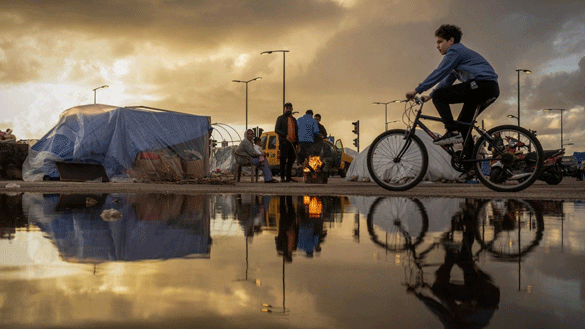
Lebanon’s political paralysis in the face of the ongoing Israeli air and ground attacks has become one of the most striking aspects of the current crisis. While Israeli operations continue to expand, the Lebanese leadership has mostly limited itself to diplomatic condemnations. Even more remarkable is that many Lebanese political figures direct their harshest criticism not at Israel but at Hezbollah itself. Since the foundation of the Lebanese state, structural weaknesses, the paralysis of the political system and especially the deepening sectarian and ethnic fragmentation have gradually eroded state authority. In such a fragmented balance of power, any unified resistance against Israel has remained weak and inconsistent. Still, understanding why Lebanese leaders remain relatively silent toward Israeli attacks while taking a sharp anti-Hezbollah position can help clarify the extremely complicated political reality inside Lebanon.
Dream of disarmament
Over the last year, much of Lebanon’s political class has tied its entire political future to the project of disarming Hezbollah. Rather than producing a coherent policy against Israeli attacks, this approach reflects submission to American pressure and the hope that Washington might somehow restrain Israel in return.
There is a serious paradox in this calculation. Hezbollah is seen as the main problem and many Lebanese politicians believe that removing Hezbollah’s weapons could provide Lebanon with diplomatic leverage against Israel. However, Hezbollah’s existence is also deeply integrated into Lebanese society and even parts of the state structure itself. It is not simply an armed militia but also a social and political movement with a large support base.
At the same time, because of the weakness of the Lebanese army, eliminating Hezbollah would leave Lebanon even more vulnerable militarily. Meanwhile, both the U.S. and Saudi Arabia continue to pressure Lebanon into taking a harder anti-Hezbollah stance. Lebanese leaders are therefore trying to survive inside an impossible contradiction.
This is why there are many political statements but almost no concrete action. The Lebanese leadership neither has the strength to confront Israel directly nor the real capacity to forcibly disarm Hezbollah. More importantly, there is also little political will for either option. Many Gulf-oriented political elites are mainly focused on preserving themselves and maintaining American support. In this atmosphere, direct negotiations between Lebanese and Israeli representatives took place for the first time in nearly 30 years.
Lebanon today is in an even weaker position than many expected. It has almost no reliable external supporter. If a cease-fire eventually emerges, it would not be surprising to see Lebanese leaders presenting negotiations with Israeli Prime Minister Benjamin Netanyahu as a political concession necessary for survival. The Lebanese state also lacks the institutional capacity to manage the growing humanitarian crisis. As the state weakens further, alternative centers of power naturally become more influential, and Hezbollah is one of them. Ironically, the attempt to weaken Hezbollah through external pressure may ultimately strengthen it domestically. The new political and social order emerging under Israeli military pressure could make Hezbollah even stronger relative to the Lebanese state itself.
Dilemma within dilemma
At the same time, Israel’s strategy appears to have expanded far beyond the old “Dahiya Doctrine.” Its current plan reportedly includes occupying nearly 10% of Lebanese territory and displacing hundreds of thousands of civilians. What exists now is no longer simply the targeting of Hezbollah-controlled areas but effectively a broader “Lebanon Doctrine,” where entire regions and multiple actors become legitimate targets. Because of this, the argument that Israel attacks Lebanon only because of Hezbollah’s existence or its ties with Iran has largely collapsed. The Lebanese government’s assumption that Israeli attacks would stop if Hezbollah were weakened is therefore becoming increasingly unsustainable.
At its core, the problem lies in the structural weakness of the Lebanese state itself. These problems cannot realistically be solved in the short or medium term. Not only society but also the political system remains deeply divided along sectarian and ethnic lines. Ironically, both the government that wants to disarm Hezbollah and Hezbollah itself can claim some form of legal or constitutional legitimacy for their positions.
Taking concrete action against Hezbollah could also trigger a sectarian civil war. Taking concrete action against Israel, on the other hand, risks losing American support while also inviting much harsher Israeli attacks. In both scenarios, Lebanon knows that no regional actor is likely to come to its rescue. This is why confronting Hezbollah directly remains almost impossible.
At the same time, cooperating with Hezbollah against Israel is also politically impossible for much of the Lebanese establishment. Even figures who previously adopted a more moderate tone toward Hezbollah have increasingly moved into openly anti-Hezbollah positions, arguing that Hezbollah acts primarily according to Iranian strategic interests rather than Lebanese national interests. These political camps, already unable to unite domestically, are even less likely to support Hezbollah when regional and international balances are taken into account.
Fundamentally, Hezbollah’s armed existence challenges the Lebanese state’s monopoly over force and authority. In a normal state structure, the existence of a powerful non-state armed actor outside the regular army is difficult to accept. This is why anti-Hezbollah sentiment inside Lebanon has a genuine political basis. However, prioritizing hostility toward Hezbollah while Israel expands its occupation in southern Lebanon creates growing public discomfort and contradiction.
In short, the U.S. pressures the Lebanese government to disarm Hezbollah, while the Trump administration simultaneously treats Lebanon as a secondary issue and largely tolerates ongoing Israeli operations. Lebanon submits to American pressure not only because it is weak but because, structurally, it has no real alternative. Hezbollah, meanwhile, refuses disarmament regardless of the broader regional conflict with Iran, and Lebanon lacks the capability to force such an outcome anyway.
Under Israeli mercy
Inside this chaos, Israel increasingly acts according to realities it creates on the ground rather than waiting for negotiations or diplomatic agreements. At a certain point, what Hezbollah wants, what the Lebanese government does or even what Washington officially plans begins to matter less. Israel is imposing its own political and military equation on Lebanon directly through force.
As a result, the Lebanese government cannot realistically disarm Hezbollah in a way that simultaneously satisfies American pressure and stops Israeli attacks. Yet it also lacks both the will and the strength to adopt an alternative strategy. Measures such as restricting Hezbollah’s military activities or declaring the Iranian ambassador persona non grata have failed to produce the Israeli restraint that some Lebanese politicians hoped for, mainly because such policies are almost impossible to implement fully. The more Washington imposes unrealistic plans on Lebanon, the more these plans collapse. Eventually, Lebanese leaders find themselves accepting Israeli realities on the ground and indirectly adapting to Israeli strategic goals. This is precisely the point Israel relies on, much like in Gaza or during confrontations with Iran.
In the end, any meaningful outcome in Lebanon will depend less on what Hezbollah or the Lebanese government wants and more on how far the U.S. is willing to restrain Israel. At present, no local or regional actor possesses the diplomatic or military capability to stop what Israel is doing in Lebanon.
https://www.dailysabah.com/opinion/op-ed/will-israel-decide-lebanons-future
-----
Israel’s propaganda machine: Western media still plays along
BY ÖMER KAYACI
MAY 15, 2026
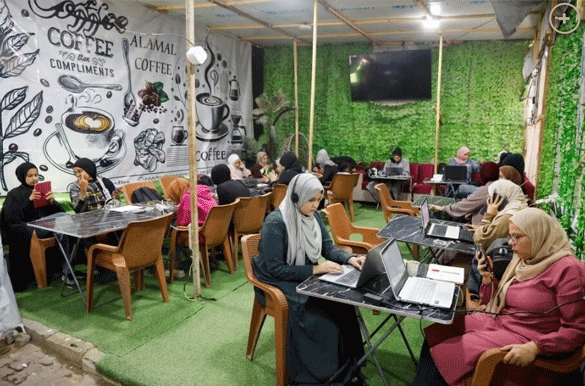
Last week, the editorial board of Rupert Murdoch’s New York Post published a shockingly perverse article describing supposedly “luxurious Gaza cafes” that, in their estimation, “poke quite the hole in the ‘genocide’ narrative.” Accompanying the piece was a picture of “Palestinian students studying inside a cafe in Khan Younis on April 6, 2026.”
This particular “luxurious cafe” was little more than a poorly constructed tent, held up by a couple of thin wooden poles and decorated with cheap astroturf wallpaper. Even the cracked pavement beneath it remained visible at the edge of the frame.
Yet this was presented as evidence of "luxury," as though the mere sight of Palestinian youth sitting, studying or momentarily inhabiting a semblance of ordinary life, which would itself be considered substandard anywhere else in the world, were enough to discredit reports of extreme suffering.
Of course, this portrayal would make no sense if Palestinians were not presumed undeserving of even minimal human dignity. Perhaps the editorial board of the New York Post simply meant to express their disappointment at the failure to eradicate all social and intellectual life in Gaza, something Israel has pursued since Oct. 7, 2023.
Whatever the exact motivation, the implication was clear: that genocide would have rendered Palestinians incapable of any meaningful social or intellectual existence. The standard was set remarkably low – so low, in fact, that it could only be justified if Palestinians were indeed perceived as “human animals,” as former Israeli Defense Minister Yoav Gallant described them in 2023 to justify their extermination.
Another Rupert Murdoch organ, ostensibly a “paper of record” in Britain, the Times has accommodated similar “perspectives” on this subject in its coverage over the years. A genocide enthusiast is given a column to speak of the evils of “Dangerous Palestinianism” that apparently has “gripped politics” in Britain, for example.
The casual racism and, frankly, contempt displayed toward Palestinians has been a given in much of the mainstream press in the Anglosphere. It is partly this contempt that normalizes a U.S. President using the term “Palestinian” as an insult, as U.S. President Donald Trump did on multiple occasions to attack U.S. Senator Chuck Schumer.
It appears as though, as much as people like to say nowadays that mainstream press is dead, it is pretty much alive and well, especially when it is in the service of “the masters of mankind.” Its agenda-setting function has been widely discussed, and it is most evident in cases concerning matters of life and death. Crucially, this function has a “legitimizing” effect.
If a story is printed in, say, The New York Times, it is considered legitimate from that point onwards to agree with its claims. This is surely why many felt relieved at last to be able to agree with the simple facts about “the rape of Palestinians” by Israel, as the New York Times columnist Nicholas Kristof laid them out in a “controversial” (meaning: accurate) piece earlier this week.
That with this legitimizing effect, extreme centrists are finally allowed to condemn Israel in some form may be beside the point. Long before Kristof’s expose, this information was amply available elsewhere. In fact, just a couple of weeks before the publication of Kristof’s article, British journalist Owen Jones was smeared for writing pretty much the same things. However, it had to be a “respectable” platform like The New York Times for the story to carry any weight. After all, it was the same New York Times that amplified the completely unfounded allegation of “40 beheaded babies” and introduced another one about “mass rape” taking place on Oct. 7, 2023. Subsequently, the political class referred to those stories in their justification for “death and destruction from the sky all day long.”
Today, however, the likes of fanatical Zionist billionaire Bill Ackman demand that The New York Times “shut down.” The cardinal sin of publishing facts unfavorable to Israel could not be forgiven. In fact, the sin is considered so grave that even the Israeli government itself had to chip in, protesting the article in very strong terms and accusing its author of invoking ancient “blood libels.”
What the general public thinks seems to have never been nearly as important as what appears on the pages of The New York Times, for it was The New York Times to which someone like the prominent early Zionist leader Elie Wiesel would turn for its coverage on Israel whenever he wanted to “feel better.” When it comes to assessing the influence of a news source, it matters not whether it is a serious one; it matters only who takes it seriously.
https://www.dailysabah.com/opinion/op-ed/israels-propaganda-machine-western-media-still-plays-along
------
The Nakba between hypocritical remembrance and oblivion
May 14, 2026
by Ramona Wadi
On the eve of the 78th anniversary of the Palestinian Nakba, the silence around the world speaks volumes about oblivion. At the UN, a brief program, so far tentative, lasting 2 and half hours, is what the international institution will dedicate to an ongoing rupture that escalated to genocide. The entire world has witnessed Israel’s genocide in Gaza, and the Nakba is treated as less than a relic of the past.
At a time when Israel’s hasbara requires a $730 million boost, the international community should be reflecting on its own complicity. Even when Israel can barely sustain its narrative anymore, world leaders are preferring to render the Nakba insignificant. The UN, on the other hand, adorns its complicity with a perfunctory program that speaks for itself to itself.
Palestinians have repeatedly spoken of the Nakba as ongoing. The UN treats the Nakba as a single event. World leaders only emit silence. There is no discussion of the illegality woven into the 1947 Partition Plan, the annihilation of Palestinians’ self-determination, the ideology of Greater Israel which provided Zionism with the foundations for the Nakba, or the racism which served as the basic argument in favour of colonialism. The Palestinian people, far removed at the beginning of the catastrophe, are now even more far removed as perpetual refugees faced with genocide.
In 1947, the Partition Plan garnered a majority of votes. In 1948, the world did not object to the massacres Zionism committed to establish Israel on colonised Palestinian territory. Seventy-eight years later, Israel faces no objection to either its violent origins or its genocide in Gaza. The occupied West Bank remains ensconced between illusory state-building and forced displacement, while Palestinians living in Israel are barely spoken about.
The latter is, of course, by design, in as much the same way as the 1947 Partition Plan was mean to pave the way for a violent colonial enterprise.
As Palestinians remember the Nakba, it is the world’s duty to at least observe the Palestinian people’s remembrance. Between Palestinian collective memory and the current reality, decades of Palestinian history buried under the humanitarian paradigm and Israel’s security narrative must be allowed the space to resurface in global consciousness. In the same way people around the world refuted Israel’s genocidal justifications, the international community’s justifications about the Nakba must also be refuted. It is no use looking to the UN for commemoration when its complicity in colonisation has been documented. It is also no use to refer to international law, when international law is a tool in the hands of former colonial powers providing impunity for Israel.
https://www.middleeastmonitor.com/20260514-the-nakba-between-hypocritical-remembrance-and-oblivion/
------
War on Iran no longer a short-term operation
KHALED ABOU ZAHR
May 14, 2026
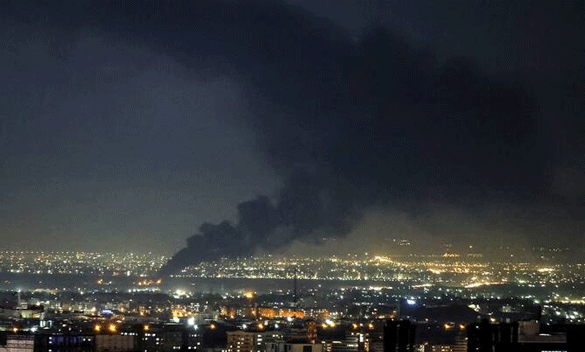
The war between the US and Iran has entered an ambiguous phase. While strikes still take place during the ceasefire, both sides are exchanging demands for the negotiations. Among the points raised by Iran is the recognition of its sovereignty over the Strait of Hormuz. And, while it denies that the US has any impact on the strait, it demands an end to the American naval restrictions on Iranian ports, plus guarantees for safe passage under Iranian control.
As we discuss Iran, I feel compelled to paraphrase something Saddam Hussein stated during the Iran-Iraq war, which was also the last time the Strait of Hormuz faced real navigational obstructions. Saddam stated that, if you take out your gun, it is not to threaten but to shoot and kill. Iran today, after decades of threatening to block the strait, has finally done so. Yet, despite the hurt inflicted on the global economy, it missed its shot. This weapon, whose use has been threatened for years and years, is finally out — but it has clearly been overpowered by the US.
Despite this, we are now in a difficult position. It is undeniable that the Iranian regime’s actions are a threat to the stability and future of both the Middle East and the world. Even if it is not a gun, it is a splinter adding pressure.
To start, no country — not even China — will accept the regime in Iran continuing to threaten or control this strait, through which about a quarter of global seaborne oil trade and a fifth of the world’s liquefied natural gas usually passes. China gets about half of its crude oil imports from the Middle East, so any disruption is a direct threat to its economy.
The main diplomatic effort is a UN Security Council draft resolution under Chapter VII of the UN Charter that demands Iran immediately cease attacks on shipping, remove mines, stop imposing illegal restrictions and guarantee freedom of navigation. Experts have compared the long-term goal to a solution similar to the 2022-23 Black Sea grain deal, which, despite the war in Ukraine and tensions in the neighborhood, guaranteed the safe transit of food, fertilizer and essential goods.
As for the multinational military proposition, there has been a series of ideas put forward with the goal of restoring safe passage through the strait. The latest is a strictly defensive multinational mission co-led by the UK and France. The goal is to ensure merchant vessel protection, escorts and mine clearance, with participation from more than 40 nations.
For its part, the US launched “Project Freedom,” a unilateral but expandable escort operation that was briefly activated before being paused for diplomacy. Additionally, Washington proposed the broader “Maritime Freedom Construct,” inviting international partners for coordinated diplomatic and military support.
While the back and forth between military action — even if it is defensive — and diplomacy continues, there is always a possibility we could witness a swift and dangerous escalation. If this happens, will the US and other countries be forced to put boots on the ground?
The Iranian regime knows the US can inflict more pain, but it also knows that America does not want to send soldiers to complete the mission. The US and Israel know that, while the Iranian regime can project an image of resistance through targeted actions, its military infrastructure has been devastated. So, what comes next? How long will this status quo hold? And who will yield first?
The US and Iran have probably already started a long-term posture of confrontation, flirting with the red line of an all-out war and boots on the ground.
The Iranian regime’s goals were exemplified by the Islamic Revolutionary Guard Corps’ failed attempt at an infiltration attack on Kuwait’s Bubiyan Island this month. A relatively small group of six armed IRGC members tried to land by boat but Kuwaiti forces repelled them, detaining four. One Kuwaiti officer was wounded. While Tehran claimed it was a navigation error during a routine patrol, few believe this. It is worth noting that the island hosts the China-backed Mubarak Al-Kabeer Port project. Such consistent and persistent destabilization actions, while officially denied, look to increase the hostage-taking and blackmail operations, while not being serious enough to merit a military escalation from the US.
The US and Israel themselves will probably work to weaken the regime even more or push for its downfall through infiltration by covertly supporting internal opposition networks and ethnic minorities, such as the Kurds, Balochis and Azeris. The work of intelligence agencies, coupled with further airstrikes and cyber operations, could be the way forward to avoid boots on the ground. The ability to assassinate regime figures, coupled with the sabotage of key infrastructure by limited special forces or proxy actions, can certainly disrupt the regime’s control.
This is hence no longer a quick operation but a long-term one that will continue to focus on information warfare, targeted assassinations and economic disruption. There is no doubt that the main goal will be to erode loyalty within the military and security forces. Looking at past covert programs, the US is capable of executing its goals with great precision and with the same deniability the Iranian regime uses. Ultimately, this could lead to the regime’s downfall. But patience and time will be of the essence.
https://www.arabnews.com/node/2643581
------
‘Long History of Resistance’ – Chris Hedges Hosts Dr. Ramzy Baroud to Discuss New Book
May 14, 2026
Palestinian author and journalist, Dr. Ramzy Baroud, discusses his latest book, Before the Flood: A Gaza Family Memoir, in a newly released interview with American journalist and author Chris Hedges, examining Palestinian resistance, historical memory, and the ongoing struggle for national liberation.
Situated in the genre of people’s history, the book traces the experiences of ordinary Palestinians across generations, arguing that resistance is rooted in lived experience, collective memory, and historical continuity.
The discussion explores key themes at the center of Baroud’s work, including reclaiming Palestinian narratives and understanding the current liberation movement within a broader historical framework.
Watch the full interview below:
https://www.palestinechronicle.com/long-history-of-resistance-chris-hedges-hosts-dr-ramzy-baroud-to-discuss-new-book/
-----
The Assault on a French Nun and the Forgotten Story of Palestinian Christians
May 14, 2026
By Ramzy Baroud
The video is horrifying, though it is the kind of horror now synonymous with the behavior of Israel, its military, its armed settlers, and society that has been conditioned to see the ‘other’ as subhuman.
Yet, this was not the typical viral video that emerges almost daily from occupied Palestine. The victim, this time, was not a Palestinian. She was an elderly French nun.
On May 1, footage surfaced from Jerusalem showing a 36-year-old Israeli man running behind a French nun—a researcher at the French School of Biblical and Archaeological Research—and shoving her violently to the ground.
In a chilling display of cruelty, the assailant did not simply hit and run. He walked away a few paces, then returned to the fallen woman to kick her repeatedly and mercilessly as she lay helpless.
What was most astonishing was the sense of normalcy that followed. The assailant remained on the scene, conversing with another man who appeared entirely unperturbed by what should have been a devastating event in any other context.
The video briefly imposed itself on the mainstream media scene, garnering perfunctory condemnations. Many explained the event as part of the larger landscape of Israeli violence, highlighting the ongoing genocide in Gaza as the most obvious example of this unchecked aggression.
But even the context of general violence does not fully explain why a French nun was targeted. She is not dark-skinned, she is European, she is Christian, and she holds no historical or territorial claims that would typically trigger the ‘security’ paranoia of the Zionist state.
Still, the incident was anything but ‘isolated,’ despite the rush by Israeli officials to label it a ‘shameful’ exception. To the contrary, the nun was attacked specifically because she is Christian.
This raises the question: why?
To answer this, we must acknowledge how Palestinian Christians have been systematically written out of the history of their own land.
Palestinian Christians are not merely present in the land; they are among the most historically rooted communities in Palestine. They are anything but ‘foreigners’ or ‘bystanders’ caught in a supposed religious conflict between Jews and Muslims.
In fact, the Christian Arab presence in Palestine predates the Islamic era by centuries. They are the descendants of historic tribes who shaped the region’s identity long before the advent of modern political labels.
The marginalization of Palestinian Christians is a relatively new phenomenon, deeply linked to Western colonialism. For centuries, European powers used the pretense of ‘protecting’ Christian communities to justify their own imperial interventions.
Consequently, this framed the native Christian not as a sovereign Arab with agency, but as a ward of the West—a narrative that effectively stripped them of their indigenous status and alienated them from their own national fabric in the eyes of the world.
Zionism added a lethal layer to this erasure. It has often projected itself as a ‘protector’ of Christians to avoid raising the ire of its Western backers.
In reality, Palestinian Christians have been subjected to the same policies of ethnic cleansing, racism, and military occupation as their Muslim brothers and sisters. How else can we explain the catastrophic dwindling of the Christian population?
Before the 1948 Nakba, Palestinian Christians made up roughly 12% of the population. Today, that number has plummeted to a mere 1%. During the Nakba alone, tens of thousands were expelled from their homes in West Jerusalem, Haifa, and Jaffa, their properties looted and their communities dismantled.
A quick look at the map of Jerusalem and Bethlehem today tells the story of an ongoing erasure. Jerusalem is being systematically emptied of its native population, both Christian and Muslim. Christian properties and houses of worship are restricted, and the ‘Little Town’ of Bethlehem has been swallowed by a ring of illegal settlements and an 8-meter-high Apartheid Wall that has transformed the birthplace of Christ into an open-air prison.
Yet, despite this, we rarely hear about the struggle for survival of Palestinian Christians. Instead, the world occasionally glimpses ‘incidents’—like the common habit of Jewish extremists spitting on foreign pilgrims and clergy in Jerusalem. This behavior has become so normalized that Israeli ministers, such as Itamar Ben-Gvir, have previously defended the act as an “ancient custom” that should not be criminalized.
The reason the Palestinian Christian story is rarely told is that it fails to factor neatly into the convenient narratives used by Western governments. They are keen on presenting the ‘conflict’ as a Jewish state fighting for its identity against a monolithic ‘Islamic’ threat. Israel is heavily invested in this same ‘Clash of Civilizations’ trope, positioning itself as the vanguard of “Western civilization” against Arab extremism.
But some Palestinians—Muslim and Christian alike—are, to a lesser degree, also guilty of falling into this trap. The former often frame the Palestinian resistance as an exclusively Muslim struggle; meanwhile, some Christians participate in the very discourse that led to their marginalization in the first place.
The Gaza genocide, however, has proven this logic not only erroneous but unsustainable. Throughout the slaughter, Israel has destroyed over 800 mosques, but it has not spared the Christian sanctuaries.
On October 19, 2023, an Israeli airstrike targeted a building within the compound of the Church of Saint Porphyrius—one of the oldest churches in the world.
In that massacre, 18 Palestinian Christians were killed, their blood mixing with the dust of a sanctuary that had stood for 1,600 years. It was a devastating reminder that the Israeli missile does not distinguish between a mosque and a church, nor between the blood of a Muslim and a Christian.
The story of the French nun is worth every bit of the attention it received, as is the targeting of pilgrims. But as the headlines move on, we must remember that Palestinian Christians endure a suffering that is collective and rooted in the very soil of Palestine. They are now an endangered community, and Israel is the culprit. Without them, Palestine is not the same.
The Palestinian homeland is only whole when it is the cradle of religious coexistence, and Palestinian Christians sit at the very heart of that history, dating back two millennia. Their survival is not a ‘minority issue’—it is the survival of Palestine itself.
https://www.palestinechronicle.com/the-assault-on-a-french-nun-and-the-forgotten-story-of-palestinian-christians/
-----
Nakba 2026: How the Past Defines the Present While Paving the Way for Liberation and Return
May 14, 2026
By Benay Blend
“Making memories public affirms identity, tames trauma, and asserts Palestinian political and moral claims to justice, redress, and the right of return,” explain Ahmad H. Sa’di and Lila Abu-Lughod in Nakba: Palestine, 1948, and the Claims of Memory (2007, p. 3).
In Before the Flood: A Gaza Family Memoir (2026), Ramzy Baroud reiterates this theory. As Israeli historian Ilan Pappé notes in the foreword, the mere recitation of Palestinians killed, displaced and otherwise abused during the Nakba and since, while horrific, does not convey the story (p. xvi).
Nevertheless, it is important to understand the magnitude of the Nakba, partly because certain Zionists today who acknowledge the term “genocide” to describe the current situation in Gaza too often qualify that it is due to a “liberatory strand of Zionism” that has gone wrong.
For instance, genocide scholar Omer Bartov’s Israel: What Went Wrong?, recently reviewed in a Guardian article by Aaron Gell, is seen as an attempt to explain how a country founded on “complete equality of social and political rights to all its citizens irrespective of religion, race or sex” could have evolved into one intent on “settler colonialism and ethno-nationalism.”
While Gell admits that there has been some criticism of the book, namely that the author omits Israel’s colonial role since ’48, he does so only briefly. The focus of his review omits the Nakba, though he seems to accept that the horrors of the Holocaust somehow justified the granting of a Jewish state on what had been land belonging to Palestinians.
As Sa’di and Abu-Lughod note, the 1948 war that resulted in the creation of the State of Israel, the catastrophe that Bartov ignores, led to the “devastation of Palestinian society” (p. 3). While Bartov defends the Zionist movement by stating that it led to the “liberation and emancipation and rescue of a persecuted minority,” Sa’di and Abu-Lughod explain that Palestinians were “excluded from the unfolding of this history” (p. 4).
In his study, then, Bartov ignores that 80 percent of Palestinians who had lived on what became the State of Israel were forced to flee their land, becoming permanent residents of refugee camps or inhabitants of a diaspora. Those who stayed behind became second-class citizens under a separate system of military administration by a government who also stole the majority of their land (Sa’di and Abu-Lughod, p. 3).
On the one hand, Bartov contends that there were two strands of Zionism, one was liberatory (though ostensibly only for Jewish people), the other was ethno-nationalist.
On the other, if the Zionist movement is comparable to other imperialist doctrines, as Eric Cheyfitz notes, then there was only one ideology, a settler-colonial drive that justified displacing Palestinians, just as Indigenous tribes in the Americas lost their land.
Along with the Zionist’s “deliberate erasure” of the Palestinian story, this “lack of resolution” and unremitting ethnic cleansing has resulted in the “stubborn dissidence of their memory work” to this day (Sa’di and Abu-Lughod, p. 5).
“Memory is one of the few weapons available to those against whom the tide of history has turned,” Sa’di and Abu-Lughod write. “Palestinian memory is, by dent of its preservation and social production under the conditions of its silencing by the story of Zionism, dissident memory, counter memory,” and as such “contributes to counter-history” (p. 6).
Nevertheless, some memories have been more visible than others, particularly as in the case of Palestinian women’s words that often found no place in the accounts of armed resistance.
In the private sphere, however, women are more often responsible for the transfer of memories between generations. Reversing this logic, it is the current age group who are “creating the art and writing the books, trying to grasp the meaning of the Nakba, while fighting forgetfulness and making public claims on behalf of their parents’ and grandparents’ suffering” (Sa’di and Abu-Lughod, p. 21).
In I’ll Tell You When I’m Home (2025), Syrian/Palestinian writer Hala Alyan chronicles the lives of her ancestors, all of whom fled from one country to the next, journeys that characterized the lives of Arabic people.
Having fictionalized the tale of her Palestinian lineage in Salt Houses (2018) and her Syrian family in The Arsonist’s City (2021), Alyan turned to memoir to chronicle her foremothers’ impact on her life.
Significantly, Alyan begins her story in May 1948 when her grandmother’s village was stormed by Israeli soldiers, forcing her to flee to Gaza. After that she left for Kuwait, where Alyan’s father was born, but who would later leave for various destinations with his family.
Her grandmothers’ stories formed part of a larger tale, “thousands of stories” that shape a narrative of resilience in the face of displacement and families torn apart (p.11). At some point, Alyan hopes that the stories will be passed on “to an audience that isn’t even here yet, but also you hope against hope is coming” (p. 11).
“There is no such thing as an assault on people and land that doesn’t first” assault the truth (p. 201), Alyan asserts. Thus, it is her responsibility to witness, to not look away when Israel drops white phosphorous on small children, when a bulldozer destroys a house.
Even though the land is in fragments, as are the stories that get passed down, it is this stubborn refusal to forget that provides an imaginative return until the physical return is possible.
Like Hala Alyan’s memoir, Cherien Dabis’s most recent film tells the story of three generations of a Palestinian family. Also beginning with the Nakba, All That’s Left of You (2025) narrates the various ways that Palestinians have resisted, including armed resistance as well as the act of choosing to survive amidst political unrest and violence.
In an interview with Amy Goodman, Dabis relates her interpretation of the film:
“At its heart, it’s really about the extraordinary will that it takes to survive political turmoil and personal loss. And, you know, if you want to probe even deeper, I think it’s really about choosing our humanity, you know, looking for meaning in grief and choosing humanity even in the most difficult of circumstances, which Palestinians have done and do every single day, but, you know, for some reason, the world just never gets to see that.”
One of the most challenging things, Dabis explained, was “making a movie about what was happening as it was happening,” i.e., the Nakba that never ends.
By making 1948 the origin story in both film and books, Dabis, Alyan, and Baroud, too, make clear that Israel’s ethnic cleansing did not begin in response to October 7, nor did Palestinian resistance begin on that later date.
Growing up immersed in Western media that dehumanized Palestinians into “nameless, faceless numbers,” Dabis wanted to film a Nakba story, a movie that tells what happened to Palestinians after ’48.
In a review of Dabis’ film, Jamal Kanj writes that “to remain human, to insist on grief, memory, and dignity, is itself an act of resistance against a system that survives on our dehumanization.”
Having been born and raised in a refugee camp himself, Kanj experienced a layering of memories as he watched the film, his own brought about as the scenes of other lives unfolded on the screen.
By cutting through the numbness caused by numbers, Dabis joins Alyan and Baroud, whose work tells the full story of suffering caused by displacement, harassment, and assassination by Israeli forces. In so doing, she creates a counter-history, a story calculated to draw others into the movement to free Palestine.
Indeed, Nakba Day (May 15th) is marked by commemoration of the displacement of Palestinian people, but it is also a Global Day of Protest in solidarity with the struggle for liberation and freedom in a not far-off future.
In “Restoring the Day of Liberation Struggle,” Khaled Barakat explains how commemorating the day as an “open wound” does injustice to the reality of the people fighting a “battle for liberation and return.”
“The Palestinian national movement, particularly after the launch of the contemporary Palestinian revolution,” Baraket contends, “sought to move beyond the condition of the ‘Nakba’ as a title of defeat, toward redefining the Palestinian as the bearer of a project of resistance and liberation, not merely the victim of a historical catastrophe.”
At the closing session of the Gaza Tribunal in Istanbul last year, Dr. Ramzy Baroud concluded with the following: “Feel bad for the victims, for the innocent children pulverized with their families, but don’t think for a minute that resistance in Palestine will stop, under any circumstance,” he continued. “Gaza is on the frontline of this struggle—not only for the sake of Gaza, but for the sake of humanity.”
https://www.palestinechronicle.com/nakba-2026-how-the-past-defines-the-present-while-paving-the-way-for-liberation-and-return/
------
New Age Islam, Islam Online, Islamic Website, African Muslim News, Arab World News, South Asia News, Indian Muslim News, World Muslim News, Women in Islam, Islamic Feminism, Arab Women, Women In Arab, Islamophobia in America, Muslim Women in West, Islam Women and Feminism