
Middle East Press On: Genocide, Turkey-EU Relations, IDF Raids Gaza, Americans, Israel-First Wars, Israelis Fear Hezbollah Uavs, West Bank, New Age Islam's Selection, 07 May 2026

By New Age Islam Edit Desk
07 May 2026
When a birthday cake becomes a celebration of genocide
Does Yerevan summit mark new chapter in Türkiye-EU relations?
Football is not ‘the beautiful game’ when it collaborates with genocide
IDF raids Gaza-bound flotilla in international waters — Where is the line between enforcement and unlawful seizure?
The Surcharge Tax Americans Pay to Finance Israel-first Wars
Drones on the Balconies: Israelis Fear Hezbollah UAVs Could Reach West Bank, Gaza
Cairo Negotiations over Gaza: Humanitarian Blackmail and the Struggle over Disarmament
-----
When a birthday cake becomes a celebration of genocide
BY AHMED ASMAR
MAY 07, 2026 - 12:05 AM GMT+3
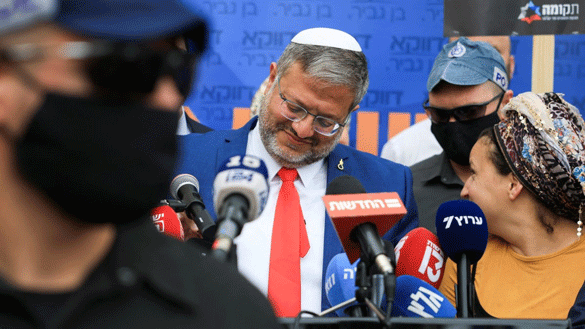
What kind of person celebrates his birthday with a cake decorated with a hanging noose? What kind of human being proudly displays the symbol of execution as a festive decoration? The answer is Itamar Ben-Gvir, Israel's national security minister, who marked his 50th birthday on May 3, 2026, with a disgusting and grotesque spectacle.
Ben-Gvir’s wife, Ayala, presented him with a large three-tier cake topped with a golden noose, with a Hebrew text: “Sometimes dreams come true.” Another cake featured two guns pointing at a map of the occupied Palestinian territories. These were not innocent decorations; they were celebrations of death and dehumanization.
For those who don’t know, the noose represented the recently passed Israeli racist law mandating the death penalty for Palestinian prisoners, while the guns represented his criminal policies that have flooded illegal settlers with weapons to freely kill Palestinians and vandalize their properties.
This man's "dream," openly displayed on his birthday cake, is to execute Palestinians, based solely on their identity and nothing more than their existence as a people resisting an illegal occupation. Ben-Gvir’s brazen acts, as well as those of many other Israeli officials, have exceeded all limits that sane people associate with the monstrous fascist leaders of the past century and beyond, amid a deafening silence from the world community, including the very institutions that hold the mandate of protecting humanity from ill-minded people, like Ben-Gvir.
Black record of bloodlust
To understand the full horror of this moment, one must understand who Itamar Ben-Gvir truly is, as this is not an isolated incident. It is the latest chapter in a career defined by racism, incitement, hate and an unquenchable thirst for Palestinian blood, as he is a lawyer who gained his notorious reputation from defending Jewish terrorists accused of crimes against Palestinians.
Ben-Gvir is so extreme that he was exempted from the mandatory military service due to his extremist and racist political background. Imagine this paradox: the Israeli military that has always been aggressive against Palestinians and most recently has committed a full-fledged genocide in Gaza, denied him conscription.
Throughout his life, 53 criminal charges have been filed against him for “hatred, inciting discourse, and racism.” He was convicted in 2007 for “racism and supporting a terrorist organization.” He was once a member of the Kahanist movement, a racist organization banned by Israel itself and designated as a terrorist group by the United States.
However, Ben-Gvir, along with fellow Kahanist figures such as Finance Minister Bezalel Smotrich, who compete with him over who can introduce the worst policies and acts against Palestinians, has found his way through the Israeli genocidal system to direct it towards more violence and fascism.
His behavior as a government official has matched his extremist credentials. In February 2026, just days before the month of Ramadan – the Muslims’ holy month of fasting – Ben-Gvir raided the Ofer Prison in the occupied West Bank. Video footage showed him overseeing his prison repression forces assaulting and humiliating defenseless detainees and brutally dragging them from their cells with their hands tied behind their backs. As he was watching, he declared, “I want one more thing: to execute them, the death penalty for terrorists.”
A government ensuring impunity
Ben-Gvir’s birthday party was not a private family affair as he openly intended to showcase his hate-cake. The guest list speaks for itself; it included many top and senior officials within the Israeli government: Defense Minister Israel Katz, Knesset Speaker Amir Ohana, Education Minister Yoav Kisch, Energy Minister Eli Cohen, along with senior police commanders, prison service officials and far-right figures who all share Ben-Gvir’s views and extremism.
The decorations of his birthday cakes are greenlighted by the government; they are symbols of a broader reality applied over the past years. Under Ben-Gvir’s tenure, which began when Prime Minister Benjamin Netanyahu brought him into government in December 2022, settler violence in the West Bank has expanded and entered a dangerous level that genuinely threatens the existence of the Palestinians on their land. His policies have flooded illegal settlements across the occupied West Bank with weapons. His rhetoric has encouraged extremist groups to act with impunity. And his death penalty law, which passed in March 2026, institutionalizes the very racism that his birthday cake celebrated.
That law, as a United Nations watchdog noted, is unprecedented in its design: a system of capital punishment that applies exclusively to one population under occupation. It does not apply to Israelis who kill Palestinians. It applies only to Palestinians deemed guilty of “terrorism” in military courts that lack basic fair trial standards.
His birthday party was, in fact, a government manifesto that sends an unmistakable message to the world community: the globally agreed-upon red lines of humanity do not apply to Israel. It is a direct defiance of the world, openly saying: We are above the law and beyond accountability.
Disgrace to humanity
What kind of political leader celebrates the death of people he is responsible for? What kind of human being looks at a noose, the instrument of execution, and smiles? What kind of society tolerates a government official who turns state-sponsored killing into a birthday theme?
The answer is a regime that has lost its moral compass and abandoned the basic parameters of the globally agreed human values. While the Israeli regime bears direct responsibility for bringing such ill-minded and fascist figures to power, the international community shares a significant level of the blame, as it has looked away for too long at Israel’s racist practices against the Palestinian people, emboldening the regime to commit further ruthless acts and insults to humanity.
Until June 2025, a handful of countries, including the United Kingdom, Canada, Australia, New Zealand, Norway, the Netherlands and Spain, imposed sanctions and a travel ban on Ben-Gvir. But this is still far from being effective in changing the course of the racist policies adopted by the Israeli regime. This is not about Ben-Gvir or Smotrich; it is about an entire system that insults humanity and mocks international law under the watch of the world.
Before we see the international courts reacting and fulfilling their duties, how many more nooses must be displayed? How many more cakes must be decorated with symbols of death? How many more Palestinians must be executed before the world stops treating this man as a legitimate political figure and starts treating him as what he is: a racist, a bloodlust, and a disgrace to the human race?
Ben-Gvir’s birthday cake was not meant for eating or celebrating. It was brazenly meant to be a coronation of his moral decadence and an embodiment of how humanity is plagued by such sick mentalities. The worst of all is that he wanted the world to witness his birthday with all its messages, loud and clear.
https://www.dailysabah.com/opinion/op-ed/when-a-birthday-cake-becomes-a-celebration-of-genocide
-----
Does Yerevan summit mark new chapter in Türkiye-EU relations?
BY ZEYNEP GIZEM ÖZPINAR
MAY 06, 2026

On May 4-5, 2026, Yerevan, the capital of Armenia, provided a geopolitical snapshot of the new European order. Around 50 leaders gathered at the Karen Demirchyan Complex for the 8th European Political Community (EPC) Summit, held under the motto “Building the Future: Unity and Stability in Europe.”
NATO allies, EU candidate countries, key figures from the former Soviet sphere, and, for the first time in the forum’s history, a non-European leader, Canadian Prime Minister Mark Carney, were all in the same room. Ankara was represented by Vice President Cevdet Yılmaz. The fact that this seat was occupied is of great significance. This presence in Yerevan is a concrete sign of a transformation in Türkiye’s approach to the regional agenda that is becoming increasingly evident.
The defining feature of this structure, which provides a platform for political and strategic dialogue across the continent, is that it has been detached from the EU accession process from the outset. For countries whose prospects of membership have become unclear, this situation represents a striking new opening.
EPC as gateway to balance
The fundamental tension at the heart of Turkish foreign policy lies in the conflict between the goal of integration with Western institutions and the determination to remain an autonomous power in the region. The EU framework further sharpened this tension as the accession process required extensive domestic reforms and imposed a degree of alignment in foreign policy.
However, given that negotiations have effectively been on hold since 2016, this framework no longer provides a functional basis. Relations between Brussels and Ankara remain mired in the structural uncertainty created by a legal framework; both sides have grown accustomed to managing this situation, yet it is becoming increasingly clear that it is not sustainable.
The EPC fills this void precisely. Without any chapters, progress reports or conditionality mechanisms, it grants Ankara a say on the continent’s most critical issues such as energy supply, cyber security, migration management and transit routes. Türkiye sits at this table with a unique weight of influence. To put it more plainly: The EPC does not expect Ankara to reconcile its regional role with European aspirations; perhaps for the first time, the two can coexist in the same room without excluding one another.
This architectural difference is decisive in practice. The traditional logic of EU enlargement links progress to criteria set by member states and monitored by the commission. There is no such hierarchy in the structure of the EPC. Participants shape the agenda together; the positions taken in working groups derive their legitimacy from concrete contributions. Türkiye is well aware of this distinction: For over a decade of accession negotiations, the party setting the criteria has always sat on the opposite side of the table. The EPC structurally reverses this asymmetry.
Yılmaz's attendance matters
Yılmaz’s level of representation in Yerevan is significant in this context. In the past, Türkiye had occasionally turned its participation in European forums into a tactical messaging tool. Consistent representation at successive summits can no longer be interpreted otherwise. This continuity allows Ankara to intervene as soon as agendas take shape.
The picture becomes clearer when examining the bilateral contacts in Yerevan: While the meetings with Georgian Prime Minister Kobakhidze laid the groundwork for the practical coordination of the Middle Corridor, the contacts established with Western European counterparts created space for the partial easing of accumulated tensions regarding defence industry and migration issues. For this reason, the summit was functionally effective from a diplomatic perspective.
The atmosphere in which the summit took place adds weight to this interpretation. The Armenia-Azerbaijan peace agreement signed in Washington in August 2025 has redrawn the South Caucasus in ways that directly concern Ankara. Baku has lifted transit restrictions; the “Trump Route,” extending through Armenian territory to Nakhchivan, is on track to become a critical link in the Middle Corridor. With Aliyev addressing the summit via video link and Georgian Prime Minister Kobakhidze present in the hall in person, the South Caucasus is now being addressed from the very heart of the European agenda. Türkiye, however, offers more than just a neighbor.
Ankara’s real trump card
The transit route and infrastructure agenda highlighted in Yerevan aligns directly with a thesis Ankara has been articulating for years: Türkiye’s geographical position is a natural source of momentum for engagement with Europe. The Middle Corridor is the most concrete testing ground for this thesis.
The route, which aims to link China and Europe via the Caspian Sea, the Caucasus and Türkiye, has gained significant geopolitical value due to the logistical disruptions caused by the Russia-Ukraine war. However, the route’s operationalization depends on a coordinated political will. The discussions in Yerevan have clearly demonstrated that this will has not yet fully materialized but that it cannot be formed without Türkiye.
Turkish ports, railway capacity and energy transmission infrastructure form the final gateway to Europe along this route. When the container volumes of Mersin and Iskenderun are combined with the increased capacity on the Turkish section of the Baku-Tbilisi-Kars line, Ankara’s role in this corridor shifts from a technical detail to a strategic determinant.
Consequently, Ankara’s exclusion from negotiations would mean that decisions directly affecting its own interests would be taken by others. The discussions on infrastructure and standardization at the summit proceeded on a basis that could not be finalized without the Turkish side’s technical input. This situation transforms Ankara’s presence at the table from a diplomatic preference into a practical necessity.
When energy supply is added to this picture, the picture becomes even clearer. Following Russia’s attack on Ukraine, the Southern Gas Corridor and Trans-Anatolian Natural Gas Pipeline (TANAP) have once again become strategic priorities. The transit of Azerbaijani gas through Türkiye to Europe has moved beyond being a purely commercial equation and has become a direct matter of energy security. As the commission addresses these two issues alongside its green transition objectives, Ankara’s technical and physical role creates a foundation that cannot be sidelined in the negotiations.
The fact that the energy discussions in Yerevan extend beyond gas supplies to include the integration of renewable energy points to a structural shift that will consolidate Türkiye’s influence in this area in the medium term. Integration into the Southeast European electricity grid and undersea cable projects are still on the periphery of the agenda; however, once these issues mature, Ankara’s position at the negotiating table will make a decisive difference.
What can Türkiye expect?
So what does Türkiye gain concretely from this process? This must be assessed under three separate headings. First, intervening at the early stages when agendas have not yet taken shape and being at the table before positions harden. Secondly, opportunities for high-level bilateral contacts outside the official calendar; discussions held in the corridors of summits sometimes yield diplomatic outcomes that go beyond the main agenda. Thirdly, a reservoir of credibility that operates independently of the accession process; this reservoir creates a quiet but enduring weight at bilateral tables.
Some experts believe the platform will not produce binding outcomes and question its true value. However, institutions should be assessed not by their current structure but by their transformative potential. The same question could have been asked during the G7’s formative years. That platform now shapes the course of global economic policy. Moreover, the binding nature is rooted not only in legal texts but also in the political expectations fostered by sustained participation over time. Türkiye’s stance in Yerevan indicates that Ankara has begun to make this calculation.
Ultimately, this summit is one of the visible steps in an increasingly clear direction. In a period where the framework of membership has lost its function, seeking the most efficient form of existing tools rather than resetting the relationship is a mature choice. The real test will lie beyond the summit photographs, in the working groups and the details of technical negotiations. How Ankara navigates this process will remain one of the most decisive foreign policy questions in the coming years.
https://www.dailysabah.com/opinion/op-ed/does-yerevan-summit-mark-new-chapter-in-turkiye-eu-relations
------
Football is not ‘the beautiful game’ when it collaborates with genocide
May 6, 2026
by Ramona Wadi
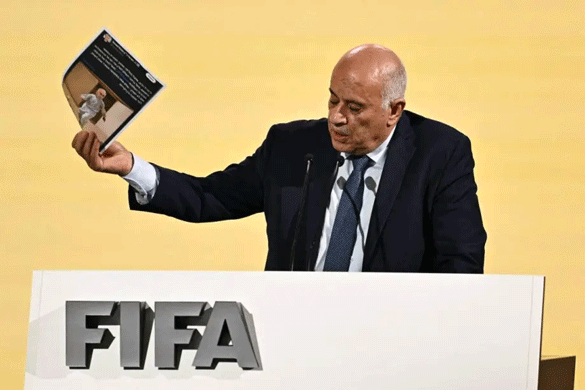
FIFA President Gianni Infantino played an infantile game at the 76th FIFA congress when he encouraged the Palestinian Football Association President Jibril Rajoub and Israel’s FA Vice President Basim Sheikh Suliman to shake hands. Faed with Rajoub’s refusal, In Fantino then said, “We will work together, President Rajoub, Vice President Suliman. Let’s work together to give hope to the children. These are complex matters.”
Throughout the decades FIFA turned a blind eye to international law violations several times. One would recall the destruction of favelas in Brazil to build stadiums for the 2014 World Cup. In earlier history, FIFA’s tacit silence during Latin America’s right-wing dictatorships enabled both impunity and coverup of disappearances of thousands of detainees. One horrifying details regarding football and dictatorships was the 1978 World Cup in Argentina, where stadiums hosting the games were situated close to the dictatorship’s torture and extermination centres.
In Palestine’s regard, FIFA hasn’t fared any better. It maintains alleged neutrality in its refusal to suspend Israel even after its genocide in Gaza. Genocide is as complex as it is straightforward – a web of international complicity across diplomatic and economic sectors collaborating to aid Israel ethnically cleanse Palestinians from Gaza. The complexity lies in untangling the complicity, in which FIFA plays a considerable propaganda part. The killing part of genocide, on the other hand, is very straightforward, as Israeli officials and soldiers have attested to.
Since the killing part of genocide is straightforward, even if Infantino decided to lump colonialism into mere ‘complex matters’, why did Rajoub dilute his gesture later in remarks to the press by stating that Infantino had good intentions? The rest of Rajoub’s comments depicted the hypocrisy of the attempted handshake – he would not shake hands with an official “defending Netanyahu and his government”. If the rest of the statement stands on its own merit of truth, why apply an apologetic introduction?
Several outlets are stating that Infantino attempted to capitalise on his announcement that he would be contesting the FIFA presidency. The manipulation went awry. Complex matters? Of egotism perhaps? To bring Israel’s genocide of Palestinians in Gaza to the stage, attempt to dilute it into a symbolic handshake and claim hope on behalf of innocent children in Gaza is another low to be recorded in the history of offering the ambiguity of hope to the colonised population.
In February this year, Infantino, along with UEFA President Aleksander Ceferin were accused at the International Criminal Court of aiding and abetting war crimes by allowing the inclusion of Israeli football clubs pertaining to illegal settlements in the occupied West Bank. According to the parties filing the complaint, the FIFA and UEFA presidents collaborated with Israeli and US authorities to maintain the clubs’ inclusion.
With this level of complicity, Rajoub should not have destroyed his message with benevolence towards Infantino. The colonised are not tasked with maintaining Infantino’s career. Palestinians have seen their resistance shattered to shards of survival. It is with immense resilience that they can build resistance through survival over and over again.
Football is not ‘the beautiful game’. It reeks of corruption, of collaboration with dictatorships, and now of collaboration with genocide. Complex matters? Diplomacy can provide a veneer that sustains Infantino’s puerile rhetoric, but Rajoub has Gaza’s testimony at his disposal.
Football is an accomplice to murder, and Rajoub was asked to shake hands on that hidden clause.
https://www.middleeastmonitor.com/20260506-football-is-not-the-beautiful-game-when-it-collaborates-with-genocide/
-----
IDF raids Gaza-bound flotilla in international waters — Where is the line between enforcement and unlawful seizure?
May 6, 2026 at
by Tatiana Svorou
Israel’s interception of the Freedom Flotilla has intensified debate over the limits of state power at sea, raising questions about jurisdiction in international waters and the legality of the Gaza blockade.
Between 29th and 30th April 2026, Israeli naval forces intercepted 22 boats belonging to the Global Sumud Flotilla in international waters to the west of Crete. The boats were carrying activists and humanitarian supplies in an attempt to challenge the blockade of Gaza and deliver aid. On 1 May, 173 of the 175 participants were transferred to Crete while two of them, Thiago Ávila from Brazil and Saif Abukeshek, a Palestinian with Spanish and Swedish citizenship, were deported and detained in Israel on charges of “membership of a terrorist organization”.
The location of the incident was roughly 500-600 nautical miles from Gaza, and about 45 nautical miles west of the Greek island of Kythira, fully open sea, governed by the high seas regime of the UN Convention on the Law of the Sea, UNCLOS. Under this Convention, vessels on the high seas fall under the jurisdiction of their State. Therefore, Israel had no automatic legal right to board or seize these ships simply because of their proximity to Greece or their intended destination. Based on participant testimonies and evidence, boarding was not a neutral or minimally forceful procedure, as Israeli forces approached in military vessels, pointed firearms and lasers at civilians and ordered passengers to kneel on deck. Communications and navigation systems were reportedly jammed. Additionally, detainees and their legal representatives have alleged mistreatment, which includes physical restraint, blindfolding, and isolation during transfer and detention. Organizers immediately described the operation as “piracy,” invoking UNCLOS definitions concerning unlawful seizure at sea for coercive or political purposes.
READ: Trump’s new Iran negotiator is Israel lobbyist who denounced talks with Tehran
Meanwhile, the interception occurred well outside Greek territorial waters, which limited Greece’s formal jurisdiction. Greek authorities emphasised that their role was limited to search and rescue operations and providing humanitarian assistance, rather than enforcing the law against foreign naval forces. Nevertheless, Greece facilitated the disembarkation of detained activists, coordinated medical care and arranged their repatriation, all the while calling for respect for international law, creating a dual dynamic where legal principles are upheld rhetorically, and the consequences of unchallenged actions are managed. At the European level, the response has been notably restrained.
Israel claims that it is essential to keep Gaza under blockade to stop weapons getting in and out, and to stop militants entering and leaving the area, especially after 7 October 2023. From that perspective, any Gaza-bound convoy could be framed as a potential threat, and its interdiction presented as legitimate enforcement. Under international humanitarian law, the legality of a naval blockade is assessed against specific criteria, including effectiveness, prior notification, impartial application, and proportionality. These criteria derive primarily from customary international humanitarian law and are reflected in the San Remo Manual on International Law Applicable to Armed Conflicts at Sea.
Moreover, some might argue that the precedent of the 2010 Mavi Marmara raid is relevant. There, Israeli authorities similarly claimed that the activists posed a threat. However, subsequent investigations found that the use of force in that event was disproportionate and the underlying justification was widely criticized. Reapplying that logic to the 2026 flotilla without specific, evidence-based suspicion collapses the distinction between a credible threat assessment and generalized suspicion. The Global Sumud Flotilla is publicly portrayed as a non-violent humanitarian mission with transparent declarations of cargo and intent. Beyond that, major human rights organizations, including Amnesty International, described the capture as involving the “arbitrary detention” of the activists and called the operation “brazen and unlawful.” Its Senior Director, Erika Guevara Rosas, linked the broader context to what she described as “atrocity crimes… including genocide in the Gaza Strip”, underscoring the severity of the humanitarian catastrophe, reinforcing the urgency of aid delivery.
Gaza’s reality makes the flotilla’s significance impossible to separate from the conditions on the ground. More than two million people live under severe restrictions on movement and a long-standing siege. Humanitarian agencies have repeatedly warned of acute shortages of food and medicine, pointing to tens of thousands of deaths, alongside the extensive destruction of hospitals, water systems and energy networks. These conditions form the backdrop against which civilian-led aid missions emerge. Living conditions are described in repeated UN situation reports as “dire” and “catastrophic,” with civilians unable to access basic goods and exposed to ongoing violence and environmental risks. In parallel, a UN-EU World Bank Rapid Damage and Needs Assessment indicates that more than 371,000 housing units have been damaged or destroyed, alongside widespread destruction of essential infrastructure. The same assessment estimates that human development in Gaza has been pushed back by approximately 77 years.
Even when a blockade is lawful, international humanitarian law requires that essential support be allowed through and halting a humanitarian convoy far from any fighting raises concerns about whether the force used was excessive and whether it worsens the humanitarian devastation that international law seeks to prevent. Confronted with these circumstances, the interception takes on deeper significance, transcending the immediate maritime encounters. The seizure of the flotilla pits two competing security frameworks against each other, namely a state-centred model that justifies pre-emptive enforcement and a humanitarian model based on protecting civilians and ensuring the free passage of essential aid. Using coercive force against unarmed activists and obstructing a mission in response to a humanitarian disaster puts significant strain on the latter. Without an independent investigation into the legality of the event, the use of force, the treatment of detainees, and the broader application of maritime and humanitarian law, there is a risk that states will set a precedent that allows them to extend their oppressive power under the banner of security.
https://www.middleeastmonitor.com/20260506-idf-raids-gaza-bound-flotilla-in-international-waters-where-is-the-line-between-enforcement-and-unlawful-seizure/
------
The Surcharge Tax Americans Pay to Finance Israel-first Wars
May 7, 2026
By Jamal Kanj
The next time you pull into a gas station, watch the number on the pump as you squeeze the handle. That rapidly spinning dollar amount is not just the price of gasoline. Included in it is an Israeli-added tax you did not consent to pay.
Since early March 2026, the average American household has been spending 50 percent more to fill their tank than just one month earlier. The Trump administration and its Israel-first ideologues blamed market forces for the spike, framing it as short-term pain for long-term gain. What they will not say, what they are never permitted to say in Washington, is that Americans have been living the “pain” of the Israeli oil surcharge tax for more than half a century. The bill keeps growing, but no longer only financially. The US is also paying with something harder to rebuild than a budget, its moral standing in the world.
The history of this “pain” remained a closely suppressed secret and one of the most forbidden subjects in American political discourse. Roughly fifty years ago, September 1973 to be exact, crude oil traded at roughly three dollars a barrel, or less than 40 cents a gallon at the pump. Then came the October War.
Israel-first Zionists in the Nixon administration, led by Henry Kissinger, committed the full weight of American resources through what was, at the time, the largest emergency military airlift in American history. Arab oil-producing nations responded by pulling the one lever they controlled: reduction of oil production.
By January 1974, crude had climbed to twelve dollars a barrel — a 400 percent increase in less than four months. American drivers sat in lines stretching around city blocks, waiting for rationed gasoline, paying prices they had never imagined, for a war fought thousands of miles away on behalf of a state that contributes not a single penny to the American economy.
Instead of honest and frank debate, Americans were offered a carefully curated media narrative, one that avoided the most inconvenient question of all: why were they paying 400 percent more?
Corporate American media, where Israel-first loyalists run editorial boards and Middle East commentary is filtered through a reflexively Zionist prism, rarely allows non–Israel-centric perspectives into mainstream conversation. That is why a viewpoint like this is unlikely to appear in outlets such as the San Diego Union-Tribune, the Los Angeles Times, or The New York Times.
Rather than examining the root causes of the oil embargo, the Zionist-managed media reached for a familiar deflection: exploiting public prejudice to redirect frustration and foment anti-Arab racism. The politically targeted embargo was stripped of its context and detached from the reality of Israeli occupation and the Nexon administration’s unconditional financial and diplomatic support for Israel.
That was fifty years ago. The Israeli surcharge tax did not end when the embargo was lifted. It became embedded in the architecture of the American budget and the profit structure of US oil corporations. The Israeli-added tax reemerges with every made-for-Israel war Washington chooses to fight and finance.
The Iraq invasion — sold on fabricated Israeli intelligence and planned by Israel-first loyalists in the dens of the US State Department and the Pentagon — added more than eight trillion dollars to the US national debt. A “legal” theft, extracted from American workers, American schools, infrastructure, and future generations and poured into the sands of a war that made the Middle East less stable, not more. The one government that cheered for that war, that lobbied hardest in Washington’s corridors, coercing and or fooling American leaders with its Weapons-of-Mass-Deception, was Israel’s. The one government that bore none of its costs—in money or in blood—was Israel’s.
Now we are here again. The US-Israel war against Iran has barely begun, and the Pentagon is already before Congress requesting two hundred billion dollars. Two hundred billion dollars financed by cuts to Americans’ healthcare, money to repair bridges, financial aid for higher education, or address the tentacles of the mental health crises throughout the American heartland. Two hundred billion dollars for another made-for-Israel war, undermining US sovereign strategic interests and moral standing in the world.
Setting aside the financial cost, the US is being drained of its moral position, year by year, war by war, veto by veto — in defense of a government whose prime minister stands indicted by the International Criminal Court (ICC) for war crimes and crimes against humanity. Benjamin Netanyahu, the indicted war criminal, is defended by American diplomats in international forums, exercises a dangerous power over Donald Trump, and for whom American soldiers are now dying in a war against Iran.
These Israel-first policies have eroded the idea of America that generations around the world once admired. From the Marshall Plan and the Universal Declaration of Human Rights to “give me your tired, your poor.”
That America has been replaced, in the eyes of billions, by one that arms and enables genocide, vetoes ceasefire resolutions while children starve, and sends its young men and women to fight wars so that Israel does not have to. An ICC-indicted war criminal welcomed as equal alongside the US president into the Situation Room to connive his next war venture. The results: Netanyahu got his new war, and Americans paid for it.
It’s no secret in Washington: “Bibi gets what Bibi wants.” In Congress, elected officials from both aisles welcome Bibi with record-breaking standing ovations, and unite when writing blank checks for Israel. Yet, they descend into partisanship over funding school lunches for American children and taxpayer healthcare coverage. All this while they borrow money to bankroll Israel’s universal healthcare and free universities. In contrast, they deny those same benefits for American taxpayers.
The Israel surcharge is real. It has a history, and a price tag. Consequently, what Americans feel at the grocery store and gas pump is not just inflation, it’s a new Israeli surcharge tax financing another Israel-first war in the Middle East.
https://www.palestinechronicle.com/the-surcharge-tax-americans-pay-to-finance-israel-first-wars/
-----
Drones on the Balconies: Israelis Fear Hezbollah UAVs Could Reach West Bank, Gaza
May 6, 2026
Israel Alarmed

Israeli newspaper Maariv reported Wednesday that Hezbollah’s increasing use of advanced drones in southern Lebanon has become a major source of concern for Israeli military planners.
The report stated that Israeli officials fear the threat is no longer confined to the Lebanese border and could eventually expand into the occupied West Bank and Gaza Strip, creating what the newspaper described as a new strategic challenge for settlements along the Green Line, the Sharon region, and central Israel.
Israeli reserve Brigadier General Ran Kochav warned that explosive drones equipped with fiber-optic guidance systems may soon emerge in the West Bank and Gaza.
“This is a serious problem,” Kochav said, noting that the phenomenon first emerged prominently during the Russia-Ukraine war.
He explained that the primary challenge comes from drones operating through fiber-optic systems, which significantly reduce the effectiveness of Israeli jamming and electronic warfare capabilities.
According to Kochav:
“We are left dealing with fiber-optic drones. I assume — and perhaps this will soon make headlines — that explosive drones could also appear in the West Bank and Gaza.”
Deep inside Israel
Maariv emphasized that Israeli concerns go beyond battlefield implications in southern Lebanon.
The newspaper warned that because of the geographical proximity of the occupied West Bank to densely populated Israeli urban centers, drones launched from relatively short distances could directly threaten civilian areas in central Israel.
The report specifically referenced concerns in Kfar Saba and nearby regions, where officials fear drones could bypass traditional security barriers and strike inside urban neighborhoods.
Rafi Saar issued one of the starkest warnings quoted in the report.
“An explosive drone equipped with fiber optics can reach every street, every balcony, every home,” Saar said.
He added:
“In the next war, it will not knock on doors — it will land on balconies.”
Saar described the issue not merely as a municipal problem but as a national security challenge requiring immediate prioritization by the Israeli state.
Countering Drones
The report acknowledged that Israel has not yet found a comprehensive solution to the growing drone threat.
According to Maariv, Hezbollah adapted commercially available drones by attaching explosive payloads and linking them to fiber-optic systems, effectively creating closed guidance systems immune to conventional electronic disruption measures.
The newspaper also admitted that the drones’ extremely low-altitude flight paths complicate radar detection and make interception more difficult for Israeli air defense systems.
Israeli Defense Ministry officials have reportedly requested proposals from domestic military industries aimed at developing solutions for the fiber-optic drone threat.
However, Maariv noted that none of the proposed systems have successfully passed preliminary testing so far.
Drone Operations
The Israeli warnings coincided with a new wave of operations announced by Hezbollah in Lebanon against Israeli occupation forces in southern Lebanon.
According to Hezbollah statements, Resistance fighters targeted Israeli troop gatherings, military vehicles, command sites, and technical equipment using attack drones, artillery shells, and explosive UAVs.
Operations reportedly targeted occupation forces in Naqoura, Taybeh, Houla, al-Bayyada, Qantara, Deir Seryan, and al-Qawzah.
Hezbollah said several of the attacks achieved confirmed direct hits, including strikes against newly established Israeli command and surveillance positions.
The Resistance stated that the operations were carried out in response to ongoing Israeli ceasefire violations, air raids, and attacks targeting southern Lebanese villages and civilians.
https://www.palestinechronicle.com/drones-on-the-balconies-israelis-fear-hezbollah-uavs-could-reach-west-bank-gaza/
-----
Cairo Negotiations over Gaza: Humanitarian Blackmail and the Struggle over Disarmament
May 6, 2026
By Wissam Abu Shamala
The Gaza file has once again moved to the forefront following the announcement of a fragile ceasefire on the Iranian and Lebanese fronts. A series of meetings in Cairo brought together the High Representative of the so-called Board of Peace in Gaza, Nikolay Mladenov, and Palestinian representatives. During those meetings, proposals and counterproposals were exchanged between the Palestinian side and the mediators, while Israel largely confined itself to relaying its conditions through Mladenov.
Mladenov’s initial proposal reflected what Palestinian negotiators viewed as an almost complete adoption of the Israeli position, as Israel continued to pursue what it still imagines could be an “absolute victory” on at least one front. Yet the broader state of military and political deadlock, coupled with Israel’s inability to achieve its stated objectives, pushed the government to reopen the Gaza file and revive threats of renewed war under the pretext that the Palestinian side refused to disarm.
From the outset, Mladenov centered the negotiations on the issue of weapons and disarmament, treating all other matters as secondary and conditional upon that file. The approach caused the talks to collapse in their first phase after the Palestinian delegation rejected what it described as a reversed negotiating framework, one that prioritized disarmament while ignoring Israel’s failure to fulfill most of the commitments stipulated in the first phase of the Trump plan.
During one of the meetings, US adviser Aryeh Lightstone joined the discussions with the Palestinian delegation. Echoing the rhetoric of US President Donald Trump, Lightstone reportedly warned that “hell” would return to Gaza if the delegation rejected the proposal within 48 hours.
The Palestinian delegation responded days later with its own paper, reflecting what it described as a Palestinian national consensus based on reciprocal commitments and the principle that negotiations could not move to the second phase of the agreement before the first phase was fully implemented. That response prompted Mladenov to submit revised proposals concerning ceasefire arrangements.
The first paper presented by Mladenov in recent weeks proposed implementing the first phase of the agreement over an eight-month period while linking it directly to the disarmament issue. After Palestinian objections, Mladenov and Lightstone submitted a second proposal combining the first and second phases of the agreement, alongside a timetable for disarmament ranging from six months to one year.
The Palestinian response was swift. The delegation submitted a paper demanding clarifications regarding the new proposal while reiterating its rejection of any framework involving disarmament unless it was tied to a broader national and political process leading to an end to the occupation.
Since the ceasefire was announced more than six months ago, Israeli violations have affected virtually every aspect of the agreement. After Israeli forces seized control of roughly 53 percent of the Gaza Strip east of the so-called “yellow line,” they continued expanding westward, bringing nearly 60 percent of the territory under their control.
At the same time, assassinations and military attacks continued. Nearly 800 Palestinians have reportedly been killed since the ceasefire began, while the entry of humanitarian aid and commercial goods has been severely restricted. Instead of the more than 600 aid trucks expected to enter Gaza daily, fewer than 200 have been allowed in. Caravans intended to shelter displaced families were blocked, only limited numbers of individuals were permitted to cross through Rafah, and the occupation prevented members of the National Committee for the Administration of Gaza from entering the Strip, effectively paralyzing its work.
Humanitarian needs have increasingly been used as instruments of political pressure. Electricity, water, waste management, medical travel, and the entry of essential supplies have all been subjected to restrictions, contributing to the spread of insects, rodents, and disease as Gaza’s environmental and public health crisis deepens. According to estimates by the Union of Gaza Municipalities, between 700,000 and 800,000 tons of waste have accumulated across the Strip.
For Gaza’s residents, the central question remains painfully simple: how long can people continue living beneath deteriorating tents that provide neither protection from the summer heat nor shelter from the winter cold? The broader humanitarian crisis has left even the most basic necessities of life increasingly inaccessible.
According to Palestinian negotiators, the worsening humanitarian situation has effectively been transformed into a bargaining tool aimed at weakening the Palestinian position and forcing acceptance of Israeli conditions. Yet the Palestinian delegation’s refusal to concede pushed Mladenov and the mediators to draft a new proposal consisting of 15 points that, at least in relative terms, took into account some Palestinian objections to earlier drafts.
Israel, however, reportedly did not respond positively to the revised paper and instead returned to threatening renewed war, again citing the Palestinian refusal to disarm.
Several days ago, the Palestinian delegation arrived in Cairo to continue discussions regarding the implementation of the mediators’ 15-point proposal. The framework was based on fulfilling the requirements of the first phase before entering negotiations over the second. In a response dated April 23, 2026, the Palestinian side reiterated its rejection of linking humanitarian relief to the surrender of weapons, insisting instead that the weapons issue be addressed only within a broader national vision that would not involve handing them over to the occupation under any circumstances.
Prior to the latest Cairo meetings, understandings had reportedly been reached requiring Israel to begin implementing the obligations of the first phase as a prelude to second-phase negotiations. These included allowing no fewer than 600 aid trucks into Gaza daily, halting military operations and assassinations, and withdrawing to the “yellow line.”
None of those understandings, however, were implemented. Assassinations continued, aid flows showed little meaningful improvement, and Israel refused to withdraw to the “yellow line,” postponing the issue to the second phase of negotiations instead.
Despite being fully aware that Israel had failed to uphold its commitments, the mediators did not publicly hold the occupation responsible for obstructing progress toward the second phase. Instead, they intensified pressure on the Palestinian delegation to respond to Israeli demands and proceed to second-phase negotiations regardless of the unresolved obligations of the first phase.
The Palestinian side, however, maintained its position, prompting renewed Israeli threats of war.
Against this backdrop, Israel continues escalating both its military threats and the humanitarian pressure imposed on Gaza in an effort to force concessions from the Palestinian negotiating side. Mediators are likewise expected to increase pressure under the argument that such concessions are necessary to spare Gaza a return to large-scale war.
Israel may ultimately opt for a calibrated military escalation that stops short of a full-scale offensive but expands the scope of assassinations and military aggression. Meanwhile, the Palestinian side is expected to reassess its options amid the worsening humanitarian catastrophe, the escalation of Israeli attacks, and the continued deadlock in negotiations.
https://www.palestinechronicle.com/cairo-negotiations-over-gaza-humanitarian-blackmail-and-the-struggle-over-disarmament/
-----
New Age Islam, Islam Online, Islamic Website, African Muslim News, Arab World News, South Asia News, Indian Muslim News, World Muslim News, Women in Islam, Islamic Feminism, Arab Women, Women In Arab, Islamophobia in America, Muslim Women in West, Islam Women and Feminism