
Middle East Press On: European Security with Turkey, UN Maintains Gaza, Palestinian, Netanyahu, Israel, Lebanon, American Hegemony, Post-Gaza War, New Age Islam's Selection, 29 April 2026

By New Age Islam Edit Desk
29 April 2026
In crisis zones, education is already building peace
European security: With Türkiye or against logic
How the UN maintains Gaza as an exception to the detriment of the Palestinian people
Removing Netanyahu must not be rivals’ sole aim
Israel marks independence under shadows of war, division
Lebanon: Faced with the Israeli project and its regional cost
The Global Left Confronts American Hegemony: Post-Gaza War Transformations
------
In crisis zones, education is already building peace
BY DOAA MOHAISEN - MARAM SHAHIN
APR 29, 2026
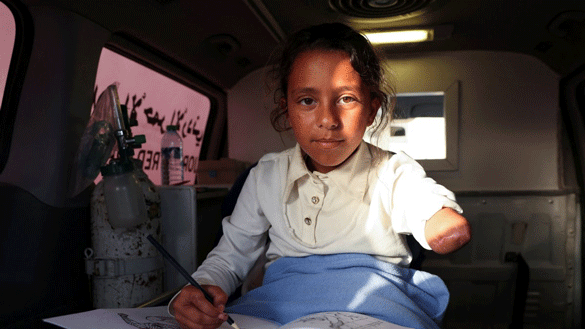
In crisis settings, we continue to act as if education can wait until schools reopen, systems stabilize and life resumes. But for children living through war and displacement, waiting is not an option. Education is already happening. The question is whether we recognize it and whether we invest in it.
What we often overlook is that education in these contexts is doing something far more urgent than delivering academic content: It is shaping how children understand themselves, relate to others and respond to a fractured world. In other words, it is doing the work of peacebuilding.
This does not happen through formal curricula or policy frameworks, but through everyday moments: when a child learns to pause instead of react, to name an emotion instead of suppress it or to see someone different from them as a peer rather than a threat. These are not peripheral outcomes. They are the foundations of more peaceful societies, and they begin long before any formal “peace education” lesson is introduced.
Peace in everyday interactions
In the occupied Palestinian territory, Palestinians continue to face a complex and deeply challenging environment shaped by ongoing tensions, where movement restrictions, economic hardship and periodic violence have placed significant strain on civilian life, giving rise to the critical support provided by the International Rescue Committee, with support from “Education Above All” under the “Hope for Tomorrow” initiative.
Some of the most meaningful moments emerged not from structured lessons but from simple everyday interactions between caregivers and their children. During the “Daily Routine,” caregivers in the West Bank help children name feelings, choose calming strategies and talk about their day, small practices woven into play and conversation that strengthen confidence, emotional expression and curiosity. As the program adapted across the region, one powerful addition in the occupied territory was short wellbeing messages for caregivers at the end of each session. These acknowledgements of their stress and effort help caregivers feel seen, supported and more emotionally connected to their children.
In Gaza, and in partnership with the Teacher Creativity Center (TCC), the mobile play and learning spaces offer children and caregivers something they rarely experience: a moment to breathe. In these small, bright spaces, children learn through playing, singing, performing in groups, tasks that help them understand each other’s thoughts and feelings, and express feelings they often hold inside, slowly rebuilding confidence and a sense of normalcy and safety. Through gentle routines and storytelling, they begin to heal in ways words alone cannot capture. Caregivers sit beside them, sharing in the calm and receiving brief wellbeing messages that remind them they matter too. For many, these moments restore hope, dignity, and connection amid profound uncertainty.
Storytelling at the core
Too often, social and emotional learning, storytelling and caregiver engagement are treated as secondary to “real learning.” In crisis contexts, they are in fact what sustains learning, wellbeing and social cohesion.
When schools close, education does not stop; it shifts into homes, relationships and stories.
Caregivers are children’s most constant educators, especially in crisis settings where learning shifts into the home. With simple routines and emotional support, they help children name and express feelings, stay regulated and make sense of their experiences, which are essential skills for learning and social cohesion. Under the "Hope for Tomorrow" initiative, caregivers in the occupied Palestinian territory turn everyday moments into growth through stories, songs and conversation. When supported, children stay anchored and ready to learn.
Storytelling further amplifies this process. Through stories, children can see characters navigating challenges similar to their own, name and process emotions, and imagine alternative ways of responding to conflict. Stories create a shared language for understanding difference, empathy and cooperation, particularly in contexts where children’s real-world experiences are marked by division.
Media is the new classroom
In contexts where infrastructure is destroyed and access is limited, media becomes a primary learning space. Radio, audio and digital content are not just delivery channels; they are spaces where children learn, cope and connect.
In Gaza and the West Bank, Youm Jadeed (“A New Day”), an educational audio drama produced by Lapis with the support of Education Above All Foundation, uses media both to significantly increase reach to kids out of school but also as a powerful tool to allow kids to process experiences and reconnect with others.
Delivered through radio, simple audio files and group listening, the program reached over 160,000 children, many in low-resource and disrupted environments, where classrooms may be inaccessible, but stories can still travel. As the popularity of the program grew, we worked with partners to bring content to more in-person educational settings as well, like temporary learning spaces and community centers.
In one case, a community facilitator played an episode featuring one of the main characters, Eyad, who was struggling to focus. The lesson became an animated conversation, with the children expressing their feelings and experiences with a common problem in crises that now had a name for them. Disruption, displacement, explosions – all these things were making it hard for the kids to focus. By acknowledging that, letting the kids know others felt it too, and providing some simple tools to learn focus, Youm Jadeed made an impact on the students and educators.
With well-drawn and relatable characters, Youm Jadeed has created a sense of consistency and companionship for kids during upheaval. This program was created fresh by and for Palestinians and has a deeply local feel with music, stories and community icons that draw in the children, while building a vision of a “new day.”
For some, the characters feel like companions, offering reassurance and sparking imagination. As one girl explained, “Sometimes I feel like the characters are protecting me ... they remind me that I am not alone.”
Rethinking what counts as essential
Across these approaches, a common thread emerges: education systems and financing models often undervalue what matters most in crisis contexts. Social and emotional learning (SEL), caregiver engagement and educational media are still treated as complementary, nice to have, but not essential. Yet in many crisis settings, they are the very elements that make learning possible.
If we continue to define education narrowly, as content delivery within formal systems, we risk overlooking where learning is actually happening and what children need most to navigate their realities.
Recognizing these approaches as core infrastructure requires a shift not only in programming, but in how we design, fund and evaluate education in emergencies.
Peacebuilding begins in the smallest, most human moments, when a child feels safe enough to express themselves, to trust others, and to imagine a future that is not defined by violence. Whether through a caregiver’s voice, a story that reshapes how difference is understood or a radio broadcast that reaches children where no school can, these moments are already happening.
The question is no longer whether education can contribute to peacebuilding. It is whether we are willing to recognise where that work is already taking place and invest in it accordingly.
*Education specialist at the Education Above All Foundation
**Emergency Education and Early Childhood Development Coordinator with the International Rescue Committee (IRC)
https://www.dailysabah.com/opinion/op-ed/in-crisis-zones-education-is-already-building-peace
------
European security: With Türkiye or against logic
BY MURAT YEŞILTAŞ
APR 28, 2026
Brussels is constructing a defense architecture that marginalizes its most capable non-EU military partner. This is not merely an injustice to Türkiye. It is a strategic miscalculation by Europe. Ankara’s task is not to seek admission but to make the cost of that miscalculation visible.
When Ursula von der Leyen declared that Europe must not fall under the influence of “Russia, Türkiye or China,” the remark was swiftly walked back by Brussels as a misunderstanding. It was not. It exposed a structural ambiguity at the heart of how Europe conceptualizes Türkiye: not an enemy, but not quite a partner either. Türkiye occupies a liminal strategic space, indispensable in military terms, inconvenient in political ones. It is a NATO ally, an EU candidate country, a major trade partner, and a central actor across the Black Sea and Europe’s most urgent security files. Placing it in the same sentence as a military adversary waging war on Ukrainian soil and a systemic rival with global reach is not merely poor phrasing. It is a category error. And category errors, when institutionalized, produce strategic failures.
That failure is now being built, brick by brick, into Europe’s new defense architecture. Understanding its depth requires examining three compounding gaps between Türkiye and the EU, because it is precisely these gaps that reveal why Europe’s security project, without Ankara, is structurally incomplete.
3 gaps, 1 broken architecture
The first is a perception gap. Brussels has built its emerging defense union on the logic of political belonging: the ReArm Europe plan, the 150-billion-euro Security Action for Europe (SAFE) instrument, and the mutual defense clause all rest on treaty obligations and institutional solidarity among member states. Within this framework, partnership is a function of membership, not military capability. The consequence of this logic is a defense architecture that measures contribution by political identity rather than strategic weight. Türkiye commands NATO’s second-largest standing army, a battle-tested force backed by a defense industrial base producing drones, naval platforms and missile systems at scale most European states cannot match. Excluding this capacity from a collective defense project does not make Europe safer. It makes Europe weaker while allowing Brussels to maintain the institutional fiction of coherence.
The second is an institutional gap. Non-membership has become a decisive exclusion mechanism. The Permanent Structured Cooperation (PESCO) framework and the European Defense Fund operate on unanimity, giving Greece and Greek Cypriots an effective veto over Turkish participation. Ankara’s application to join the Military Mobility project has stalled on Athens’ and the Greek Cypriots’ objections. The institutional architecture has transformed bilateral political grievances into a structural blockade. The accession process is frozen, the defense architecture is being built without Ankara, and the membership lever that once governed the entire relationship is no longer functional. The result is a paradox Europe has chosen not to acknowledge: the EU is arming itself at historic speed while formally excluding the most capable non-member military on the continent.
The third is a policy gap. Brussels has organized its security posture around the Russia threat and a deterrence architecture oriented northward and eastward. Türkiye’s threat perception is structurally different: Syria’s post-civil war fragility, Iran issue, Israel’s aggressive security policies, and an increasingly charged southern flank. Türkiye has maintained working relations with Moscow, a posture European capital read as strategic unreliability while Ankara frames it as indispensable diplomatic utility. On Gaza, Türkiye has moved to categorical opposition, while several EU states maintain strong support for Tel Aviv. These are not misunderstandings. They are divergent strategic interests reflecting different geographies, different threat environments and different historical relationships. Any architecture that pretends otherwise is not a security framework. It is a political document dressed as one.
3 Europe, 1 Türkiye
Europe’s exclusionary impulse is not, however, uniform. Across the 27 member states, three distinct security orientation clusters define the space available to Ankara, and it is this fragmentation that reveals both the weakness of the European position and the strategic opportunity it creates for Türkiye.
The first cluster is the pragmatic integrationists: Italy, Spain, Portugal, Hungary and Germany. For these states, Turkish military-industrial capacity is a direct operational interest. Baykar’s acquisition of Italy’s Piaggio Aerospace has embedded Türkiye’s premier drone manufacturer into European aerospace infrastructure. Türkiye’s Hürjet jet trainer is slated for use at a NATO pilot training center in Badajoz, Spain. Germany argued that SAFE “should be opened to Türkiye and the United Kingdom as important NATO partners.” These states do not include Türkiye out of political generosity. They do so because their own defense programmes require it.
The second cluster is the eastern flank pragmatists: Poland, the Baltic states, Romania, Bulgaria and Finland. Their calculus is defined entirely by proximity to Russian military power. Countries on NATO’s eastern flank increasingly recognize Türkiye’s value as a deterrence asset. Poland and the Baltic states are actively seeking Turkish defense equipment for its affordability and battlefield effectiveness. Lithuania’s foreign minister asked plainly: “Türkiye is an ally. How can we separate it from cooperation?” For this cluster, Türkiye’s exclusion from the EU defense architecture is not a political achievement. It is a liability that weakens the very deterrence posture they are trying to build.
The third cluster is the strategic blockers: Greece, Greek Cypriots and in a softer form, France. Greece and Cyprus view Türkiye’s integration into the EU defense not as a contribution to European security but as the dismantling of their strategy for constraining Ankara within EU institutional structures. For them, EU defense cooperation already serves a secondary function: providing deterrence against Türkiye in the Eastern Mediterranean. France’s position is structurally similar in effect if different in motivation. Its vision of European strategic autonomy is inherently Franco-centric, and it has little interest in a framework that elevates Ankara as a co-architect of European security. This cluster controls the unanimity veto. But its dominance rests on institutional rules, not on strategic logic.
Capitalizing on necessity
The three gaps and the three clusters together point to a conclusion that Ankara should state clearly, rather than obscure through diplomatic courtesy: Europe’s security architecture without Türkiye is not merely incomplete. It is a project that will eventually collide with its own operational requirements. The question for Türkiye is not how to secure admission to a framework designed partly to contain it. The question is how to accelerate that collision and position itself to determine the terms on which Europe eventually has to engage.
The answer lies in two complementary tracks. The first is functional integration pursued not as a concession to exclusion but as a deliberate strategy of indispensability. Türkiye already collaborates with Italy and Spain on aerospace systems, participates in the German-led European Sky Shield Initiative, and engages with Poland, Romania and Portugal on joint defense ventures.
Within SAFE’s architecture, Turkish firms can supply components under the 35% non-EU content rule in ammunition, unmanned aerial vehicle (UAV) systems and naval platforms. As Türkiye’s industrial presence inside European supply chains deepens, the cost of its formal exclusion rises, not for Ankara, but for the European programmes that depend on Turkish output. The U.K.-Türkiye Strategic Partnership Framework illustrates the direction of travel: London has decided that operational reality takes precedence over institutional politics. The more European states reach the same conclusion independently, the less durable the blocking coalition becomes.
The second track is selective Europeanization: aligning Türkiye’s defense standards, procurement frameworks, and interoperability architecture with European norms, not for the sake of membership, but to embed Türkiye so deeply in Europe’s defense ecosystem that exclusion carries a prohibitive cost. The EU’s new defense architecture is becoming a norm-setting enterprise. A Türkiye that builds to European standards, supplies European programmes, and trains alongside European forces is not a candidate waiting at the door. It is a structural participant that the institutional framework has simply failed to acknowledge.
Europe’s strategic autonomy project will not fail because of Russian pressure or American withdrawal. It will fail if the continent’s political architecture continues to prioritize institutional coherence over operational reality. Türkiye’s task is not to help Europe avoid that failure. It is to ensure that when the failure becomes undeniable, Ankara is positioned as the indispensable partner Europe chose, too late, to take seriously.
https://www.dailysabah.com/opinion/columns/european-security-with-turkiye-or-against-logic
------
How the UN maintains Gaza as an exception to the detriment of the Palestinian people
April 28, 2026
By Ramona Wadi
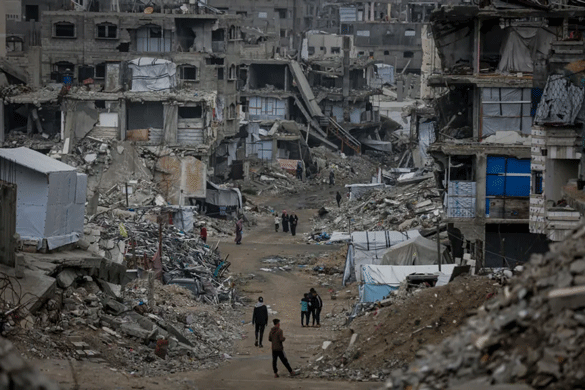
“Lebanon cannot be another Gaza,” the UN Secretary General’s Spokesperson Stephane Dujarric said last week in response to a question during a press briefing regarding Israel’s war in Lebanon. Earlier this month, Israeli Finance Minister Bezalel Smotrich openly spoke about Israel’s plans to extend its non-declared borders into Syria and Lebanon, besides the encroachment already in place and extending in Gaza. Israeli ministers also spoke of applying the same tactics used in Gaza to South Lebanon.
Dujarric’s statement carries as much weight as contradiction in UN rhetoric. Lebanon cannot be another Gaza, and yet, the UN is doing nothing to stop Israel from expanding its borders and increasing its kill toll. On that level, Lebanon is on a par with Gaza – the UN’s silent complicity makes them comparable.
However, not once since October 2023 have we heard any UN official sound a warning about Gaza in terms of comparison. What would UN Secretary General Antonio Guterres, or Dujarric, have said? Gaza cannot become another Gaza? There is no comparison to what Gaza has suffered in increasing increments.
For Dujarric to be able to make such a statement, the UN must assume accountability. Had the international community truly worked to stop Israel’s genocide in Gaza, Dujarric would not be able to elicit a comparison. The UN would not be able to turn Gaza into a mere reference for other realities, while completely ignoring the realities created there for Palestinians by Israel’s colonial violence and genocide.
At any given moment, and with the UN’s tacit blessings, Gaza can become another destroyed Gaza. From Operation Protective Edge in 2014 to the genocide that started in October 2023, Israel went from partial to the near absolute destruction of Gaza. Dujarric’s rhetorical concern for Lebanon and its comparison to Gaza normalises the genocide in Gaza even further. It is not a question of taking an absolute stance against genocide, but ensuring the genocidal tactics are not replicated in Lebanon, which makes Gaza a contemporary reference point. The difference is that while Lebanon cannot be another Gaza, Gaza was forced into becoming the reference for a genocide that carries not only impunity but complete normalisation. And the normalisation of genocide is specific to Gaza.
In UN rhetoric, Gaza maintains relevance but not importance.
For UN officials to make such statements, it should be clarified that the UN allowed Israel’s genocide to happen in Gaza. This selectivity – in rhetoric not in practice – illustrates how the UN was fine with all the tactics Israel used to ethnically cleanse Gaza, to normalise genocide only in Gaza’s context. Israel couldn’t have asked for better rhetorical contradictions at an international level. The underlying UN message is that genocide is a war crime – anywhere except in Gaza.
https://www.middleeastmonitor.com/20260428-how-the-un-maintains-gaza-as-an-exception-to-the-detriment-of-the-palestinian-people/
------
Removing Netanyahu must not be rivals’ sole aim
HANI HAZAIMEH
April 28, 2026
Israel’s political landscape is once again entering a period of profound uncertainty, as the emerging rapprochement between Naftali Bennett and Yair Lapid signals one of the most serious challenges yet to Prime Minister Benjamin Netanyahu’s long-standing dominance. This alliance, bridging the nationalist right and the political center, reflects not ideological harmony but political necessity — a calculated response to growing public exhaustion with Netanyahu’s leadership after years of war, internal division and strategic stagnation.
For decades, Netanyahu successfully cultivated an image of himself as Israel’s ultimate security guardian, the indispensable leader capable of defending the state against mounting regional threats. His political survival depended heavily on this narrative. He portrayed military escalation, aggressive deterrence and hard-line nationalism as essential tools for preserving Israeli security. Today, however, that carefully constructed image is collapsing under the weight of reality.
Despite overseeing devastating military operations in Gaza, repeated confrontations with Lebanon and broader regional tensions involving Iran and its allies, Netanyahu has failed to deliver the decisive victories he has consistently promised Israeli voters. Instead, Israel finds itself trapped in multiple prolonged conflicts, facing growing military exhaustion, rising economic pressure and increasing diplomatic isolation.
Rather than building lasting security, Netanyahu’s policies have entrenched a dangerous cycle of perpetual confrontation. Gaza remains devastated but unresolved. The Lebanese front continues to simmer. Regional hostility persists. Far from eliminating threats, Netanyahu’s strategy has often appeared to manage crises for political survival rather than resolve them through sustainable long-term planning.
This reality has left many Israelis questioning whether Netanyahu’s leadership model — built on fear, division and military force — has reached its limits. They will soon get to have their say, as elections are due to be held by Oct. 27.
The Bennett-Lapid alliance emerges directly from this political fatigue. Although Bennett represents a more nationalist and right-wing constituency, while Lapid appeals to centrist and secular voters, both figures recognize that Netanyahu’s prolonged rule has become increasingly synonymous with national paralysis. Their cooperation is less about shared political philosophy and more about dismantling Netanyahu’s monopoly over Israeli governance.
This alone is politically significant. Netanyahu’s strength has long been built on fragmenting his opponents and positioning himself as the only viable leader amid chaos. A unified opposition, even among unlikely partners, threatens this formula.
However, while this alliance may pose a credible electoral threat, it suffers from a fundamental weakness: it appears primarily designed to remove Netanyahu rather than redefine Israel’s future.
There is little evidence that Bennett and Lapid possess a transformative political vision capable of addressing Israel’s deep structural crises. Their coalition may be tactically effective, but strategy requires more than replacing one leader with another.
Israel’s core challenges remain immense: the unresolved Palestinian issue, the rise of religious nationalism, increasing societal polarization, judicial and constitutional instability, and the normalization of military-first policies. On these existential matters, the Bennett-Lapid partnership has yet to present a coherent alternative.
There is no substantial peace initiative. No serious plan to confront the growing power of extremist political factions. No clear blueprint for repairing Israel’s damaged international standing or redefining its regional relationships beyond military calculations.
This is why Netanyahu’s potential downfall, while symbolically significant, may not necessarily produce meaningful transformation.
The deeper problem facing Israel is not merely Netanyahu as an individual, but the broader political system that enabled and sustained his model of governance. Over the years, Israeli politics has increasingly shifted toward populism, ethnonationalism and the prioritization of force over diplomacy. Netanyahu may have perfected this model, but he did not create it alone.
Removing him without confronting these entrenched systemic dynamics risks little more than a cosmetic transition.
Indeed, Israel could simply exchange one set of political actors for another, while preserving the same underlying dysfunction: perpetual security crises, expanding settlements, unresolved occupation and escalating social fragmentation.
For international observers, this moment should not be mistaken for automatic democratic renewal. Leadership change is not synonymous with structural reform.
The real question is whether Israel’s opposition can evolve beyond anti-Netanyahu sentiment and articulate a new national direction — one that addresses both domestic democratic erosion and the broader regional instability that decades of military dominance have failed to resolve.
Without such a vision, Israel may simply enter a post-Netanyahu era that reproduces many of the same failures under different leadership.
This possibility carries serious consequences not only for Israelis but for the wider Middle East. Israel’s internal political trajectory profoundly shapes regional security, Palestinian realities and broader geopolitical stability. A fragile alliance focused solely on ousting Netanyahu without redefining policy risks perpetuating instability rather than alleviating it.
Ultimately, Netanyahu’s weakening political position may mark the closing of one chapter in Israeli politics, but it does not guarantee the beginning of a better one.
If Bennett and Lapid fail to move beyond tactical maneuvering and confront the foundational crises consuming Israeli society, then Netanyahu’s fall may represent less of a political revolution and more of a reshuffling of power within the same troubled system.
Israelis may witness new faces at the top but, without fundamental changes in governance, ideology and conflict management, the country could remain trapped in the very cycle that brought it to this moment.
In that case, Netanyahu’s departure would not signal true national renewal — it would merely confirm that Israel has changed its leadership while preserving its crisis.
And perhaps that is the greatest danger of all: not that Netanyahu stays but that Israel removes him without truly changing course.
https://www.arabnews.com/node/2641573
------
Israel marks independence under shadows of war, division
YOSSI MEKELBERG
April 28, 2026
National days are meant to highlight what unites a country: a shared vision, collective values shaped across generations and achievements worth celebrating. They are occasions for unity and camaraderie. This was not the case last week, when Israel marked its 78th independence day.
Instead, the day served as a somber reminder that, under the current government, the country is doomed to face the prospect of years of multifront wars with no clear end in sight. At the same time, divisions among different segments of society have deepened at an unprecedented pace, deliberately instigated from the top of the political system by Prime Minister Benjamin Netanyahu.
There is a striking contrast between what Israel could and should be and what it has become. The longer Netanyahu and his ultranationalist, messianic and ultra-Orthodox political allies remain in power, the further the country appears to be steadily drifting away from the vision of its founding fathers. According to Israel’s Declaration of Independence, it should be a Jewish and democratic state coexisting peacefully with its neighbors, where minorities cannot only feel at home but actually be at home — a home where they enjoy full and equal rights.
These goals were never easy to achieve but, under Netanyahu’s leadership, Israel is being steered in the opposite direction, largely in ways that serve his political survival and personal interests.
In more normal times, Israel’s independence day is marked by large public celebrations, including concerts attended by hundreds of thousands, if not millions, of people. This year, however, the mood was markedly subdued. Many municipalities canceled such concerts and other public events.
Perhaps most symbolic was the controversy surrounding the traditional torch-lighting ceremony, which honors individuals recognized for their contributions to the country. This year, many of those chosen were Netanyahu family loyalists, while others were excluded. This provoked significant public outcry and led to the organization of an alternative “liberal, democratic” torch-lighting ceremony.
As for the official event, instead of focusing on the country and its people, it focused excessively on the prime minister and his wife, with some even drawing comparisons to North Korean-style personality cults, in a style unprecedented in Israel’s history.
This year’s independence day also fell just months before a general election that could prove one of the most consequential in Israel’s history. It may shape not only the country’s political leadership but also its broader trajectory. It could be argued that it is almost impossible to separate Israel’s identity from the conflicts with its neighbors — and even more so with the Palestinians. After all, what for Israel is a celebration of achieving self-determination is, for Palestinians, the time of marking the Nakba, their catastrophe of dispossession, which Israelis refuse to acknowledge.
Yet, beyond the conflict, Israel represents a remarkable historical achievement: the establishment of a homeland for Jewish people, the vast majority of them refugees, and the creation of a state with a highly developed, innovative economy, a vibrant society and one of the most powerful militaries in the world.
Despite these accomplishments, the state has struggled in two critical areas, placing it at significant risk.
First, it has failed to secure lasting peace with several of its neighbors, especially the Palestinians, and instead has perpetuated the conflict by entrenching the occupation with the intention of annexing at least the West Bank, if not Gaza too.
Second, it has not succeeded in building a cohesive and unified society grounded in a shared sense of values, one that sees democracy as important as being Jewish and hence ensures equality for all its citizens. What we are now witnessing is a country developing a siege mentality in its relations with the international community and relying heavily on military strength, which also harms its domestic politics.
The main threat to Israel comes from the internal fractures that have been enhanced and exploited by Netanyahu over the past three decades. Instead of using his position to bridge divides, he has cultivated them to maintain a loyal base of support, even in the face of policy failures and allegations of corruption.
As Israel enters its 79th year, it finds itself increasingly entangled in ongoing conflicts. Despite repeated claims by Netanyahu of achieving “total victory,” the reality appears far more complex. The country is engaged in prolonged military confrontations that show little sign of resolution, with no clear diplomatic pathway toward peace.
The trauma of the Oct. 7 attacks continues to weigh heavily on Israeli society. While the scale and brutality of that event have understandably shaped public sentiment, the ongoing cycle of conflict has left little space for reflection or nuanced debate.
Under the current government, dispossessing the Palestinians has become central to Israel’s ideology, in which the grabbing of their lands and talk about forced displacement is common among senior members of the government. This has rightly intensified international criticism and further complicated prospects for peace based on a fair and just solution.
At the same time, concerns about Israel’s democratic institutions have grown. The very foundations of the country’s democracy have been under sustained attack, with tensions between the government and the judiciary ringing alarm bells. Actions such as excluding the president of the Supreme Court from official events or deliberately and publicly undermining the judiciary’s legitimacy have weakened the checks and balances that are fundamental to any liberal democracy.
For Netanyahu, these attacks on democracy represent a cynical attempt to derail his ongoing corruption trial. For others in his coalition government, they represent an ideological stance, ranging from allowing them to introduce more religious legislation to releasing whatever brakes remain on annexing the West Bank and compromising any semblance of good governance.
If Israel’s 79th independence day is to be more hopeful and celebratory than this year’s, significant political change is vital. The upcoming election, which must be held no later than October, offers voters an opportunity to shape the country’s future direction. For this to happen, the opposition will also need to up its game and present a credible alternative to the character of the country and how it engages with the world — an alternative that is diametrically opposite to that of the current government.
https://www.arabnews.com/node/2641572
-----
Lebanon: Faced with the Israeli project and its regional cost
EYAD ABU SHAKRA
April 28, 2026
Before the momentum generated by Lebanon’s breaking of the taboo by engaging in direct negotiations with Israel began to subside, there began to emerge European reverberations that complemented the projects of Benjamin Netanyahu for the future of the Middle East.
Having last week hosted the negotiation process in the presence of President Donald Trump, Washington’s position is understandable. Trump’s apparent unawareness that engaging with Israel is prohibited by law in Lebanon shows that the negotiations’ “program” had been set by another party, with Washington adopting it in full.
In reality, this program is the product of joint efforts between Israel and Lebanese-American groups aligned with it — groups that played a similar role during the 1982 invasion and the May 17 Agreement of 1983. Today, Netanyahu seeks to achieve one of two desired outcomes, or both: a civil war leading to partition and fragmentation or full occupation backed and endorsed by the West.
The general atmosphere in Lebanon is unsettling. The country’s current divisions are perhaps the worst since the civil war that erupted in 1975. At the sectarian level, this division is reflected in statements, media appearances and social media discourse.
Within Christian politics, there are signs, particularly the broad support for direct negotiations with Israel, that some Lebanese Christian leaders are highly optimistic about regaining what they have lost over recent decades, especially since the decline of political Maronitism beginning in 1975, which was later reinforced by the Taif Agreement that ended the war and ultimately by the dominance of Hezbollah.
This is underscored by the repeated media appearances of Lebanese-American activists who have not yet shed the exclusionary resentments of the past, as well as the maps some are circulating and promoting in the US — naturally under the Likud’s patronage — alongside the “Greater Israel” maps that Netanyahu seeks to turn into reality.
On the other hand, within the Muslim space, many Shiites feel they would be the biggest losers if Israel were to strip them of the political, economic and security influence they gained during the era of Hezbollah’s arms and Iran’s regional expansion. They also fear that their heavy reliance on Iran may have already cost them what should have been automatic support from their Sunni partners in any confrontation with their “common enemy,” Israel.
After losing their successive bets on Nasserist Arabism, then Palestinian fedayeen Arabism and later Saddam Hussein-era Arabism, the Sunnis, who had been politically divided for decades, found stability under the prosperity brought by Hariri-style politics.
But the assassination of Rafik Hariri in Iran-dominated Lebanon and the sectarian dimensions of the Syrian war have reconfigured the Sunni scene. Multiple factions emerged and direct negotiations with Israel are likely to add a dilemma, potentially deepening Sunni fragmentation between Islamist, Arab nationalist and leftist factions on one side and right-wing liberal currents and figures from the business world on the other.
The role of the Druze remains. Though they are among the smaller sectarian components in Lebanon, Syria and the Occupied Territories, they possess highly significant advantages that have allowed them to go on despite their religious isolation for more than 1,000 years, with many of their figures rising to political prominence.
The post-independence Lebanese and Syrian constitutions considered the Druze, like the Alawites and Ismailis, as part of the Muslim community. Following a divide and conquer strategy, however, the Zionist movement exploited the secrecy of the doctrine, the esoteric nature of its practices and the particularity of its traditions and concepts to claim that the Druze are not Muslims or even Arabs.
Unfortunately, the ignorance of certain extremist groups has placed Druze communities and regions in the Levant under a kind of demographic, cultural and economic siege. The current Israeli leadership claims concern for the well-being of the Druze and it seeks to exploit their fears of regional sectarian strife by committing to their protection.
This claim, of course, finds some resonance among fearful members of the community and those who believe in such “protection.” Some have been swayed through social media campaigns designed to infiltrate the Druze youth who may lack deep knowledge of their history and heritage. The more prudent among them, on the other hand, tend toward caution. They do not believe that Muslims are facing a collapse that would tempt some weak souls to abandon their identity, origins and culture.
Going back to the start of this article and the “European echoes” of Netanyahu’s projects, which go beyond Iran to include targeting Turkiye and perhaps others as well. Unfortunately, some Western European leaders close to Israel have aligned themselves with these ideas in their statements.
However, in my view, a “global Christian war against Muslims,” as Netanyahu envisions it, would not serve anyone’s interests, including Israel’s. And while Israel’s leader may still feel confident in his lobbies’ ability to pressure and steer Western governments as he wishes, there are indications that his ambitions could be thwarted.
There is currently a split — even within the American Christian-Jewish base — and it may widen further after Trump.
Moreover, the positions of Pope Leo reflect a complete rejection of the logic of war and hatred. Alongside European reservations, there are also the positions of Russia and China — these are forces that cannot be dismissed.
Finally, in the Arab and Islamic worlds, there remain rational actors who understand the dangers of the current scheme and the scope of its targets. They know that there can be no leniency in the face of plots to aggravate strife, division and fragmentation.
https://www.arabnews.com/node/2641569
-----
The Global Left Confronts American Hegemony: Post-Gaza War Transformations
April 28, 2026
By Mr. Shibi
Contrary to right-wing claims, the global influence of the left has not disappeared. Experience demonstrates that leftist forces remain present and influential across different contexts, albeit to varying degrees. Their impact depends both on the level of their political radicalism and on the broader conditions within the societies in which they operate.
Following Donald Trump’s return to power in 2025, alongside the decline of center-left parties in Europe and setbacks for leftist governments across parts of the Global South, right-wing narratives quickly proclaimed the “end of the left.” According to this view, right-wing forces had achieved lasting dominance.
Yet reality suggests otherwise. While the left may have weakened electorally in some Western countries, it has grown more visible and assertive in protest movements and international issues. In many parts of the Global South, it remains both influential and ideologically radical.
There is little doubt that the war on Gaza, which began on October 7, 2023, and the subsequent US-Israeli campaign against Iran starting on February 28, 2026, have created conditions for the resurgence of leftist movements—particularly through the revitalization of anti-imperialist and anti-colonial discourse.
The Nature of the Left Today: North–South Divides
Significant differences persist between leftist movements in the Global South—across Latin America, Africa, the Arab world, and parts of Asia—and those in Western Europe.
The Western left is generally more reformist, rooted in traditions of social democracy and shaped by industrial-era class politics. Its focus tends to center on reforming capitalism from within through welfare systems, progressive taxation, and the protection of social rights.
Over time, especially following the collapse of the Soviet Union in the early 1990s, this left has increasingly gravitated toward political moderation. Its emphasis on traditional class-based issues has diminished, while attention has shifted toward environmental concerns, migration, and LGBTQ+ rights.
Although the Western left broadly opposes the policies of Donald Trump and Israeli actions, it often frames its critique within the language of human rights and international law. At the same time, it tends to avoid endorsing resistance movements or fundamentally challenging the US-led global order.
In contrast, leftist movements in the Global South are shaped by a different historical experience—one deeply marked by colonialism and its enduring legacies. Here, capitalism is widely understood as an unequal global system dominated by the North.
As a result, the “Southern left” is more closely associated with national sovereignty, resistance to foreign intervention, and solidarity with oppressed peoples. It often blends elements of socialism and nationalism, placing Palestine at the center of its symbolic and political framework. Alongside this, it prioritizes issues such as poverty reduction, economic independence, debt relief, and opposition to multinational corporate dominance.
This divergence helps explain why reactions to Gaza and Iran have been more forceful across the Global South, where leftist movements play a central role in shaping public opposition to Washington and Tel Aviv.
Gaza and Iran: Catalysts for a Leftist Resurgence
The wars on Gaza and Iran have brought the global left back to prominence, though in different forms across regions.
In the Global South, this resurgence has gone beyond protest and translated into state policy. Leaders such as Gustavo Petro, Luiz Inácio Lula da Silva, Claudia Sheinbaum, and Nicolás Maduro have adopted strong positions, including downgrading or severing ties with Israel and explicitly describing the war on Gaza as genocide.
Countries such as Cuba, Venezuela, and Nicaragua have characterized US and Israeli actions against Iran as “imperialist aggression.” Demonstrations have taken place condemning US strikes on Iranian civilian infrastructure, while Brazil, Mexico, and Colombia have called for diplomatic solutions.
In South Africa, the legacy of anti-apartheid struggle continues to inform leftist politics. The African National Congress and its allies have played a leading role in international legal efforts against Israel.
In the Arab world, despite the institutional weakness of traditional leftist parties, their presence has been evident in mass demonstrations and solidarity campaigns. In cooperation with Arab nationalist currents, they have helped mobilize public opposition to Israeli actions in Gaza and US aggression against Iran—particularly amid the declining influence of political Islam movements following the aftermath of the Arab Spring.
In Europe, the response has largely taken the form of mass protests, boycott campaigns, and political pressure. Spain has emerged as a notable case. The government of Pedro Sánchez, supported by the left-wing Sumar coalition, has taken significant steps, including recognizing the State of Palestine, downgrading relations with Israel, and advocating for an arms embargo.
Madrid has also called on the European Union to review its partnership agreement with Israel. Following the US campaign against Iran, Spain condemned the attacks and reportedly refused US access to its military bases, prompting threats of sanctions from Washington.
In the United States, members of Congress have sought to limit presidential war powers through legislative measures, while public opposition to a broader war with Iran has grown—driven by concerns over economic costs and regional escalation.
In France, mass demonstrations have also taken place. Figures such as Jean-Luc Mélenchon have gained prominence for their outspoken support for Palestinian statehood and opposition to US foreign policy.
State-Based Left Models and the Challenge to Western Hegemony
Discussions of the global left often overlook the role of state-led models. China, governed by the Communist Party, presents itself as pursuing “socialism with Chinese characteristics” and plays a major role in supporting Global South economies, particularly as an alternative to Western dominance.
Similarly, the Communist Party of Russia, led by Gennady Zyuganov, has historically opposed neoliberal reforms and continues to advocate for stronger resistance to Western influence.
North Korea, governed by the Workers’ Party of Korea, has long positioned itself in opposition to US foreign policy and maintains a consistent stance against Israel, while supporting countries such as Iran and Venezuela.
The Left as an Open Horizon
Ultimately, the left cannot be reduced to electoral outcomes or its presence within formal political institutions. It represents a deeper expression of structural contradictions within the global capitalist system.
Its decline in parts of the West may reflect a crisis in its traditional forms, particularly its shift toward reformism and detachment from its historical social base. However, this does not negate its renewed vitality in protest movements or its growing influence on major international issues—most notably Palestine and opposition to imperial wars.
In contrast, the left in the Global South continues to play a more radical and dynamic role, rooted in long histories of anti-colonial struggle and the pursuit of sovereignty.
The world appears to be entering a new phase of polarization, in which ideology is once again moving to the forefront—not as an abstract framework, but as a political necessity shaped by the intensifying contradictions of the international system.
https://www.palestinechronicle.com/the-global-left-confronts-american-hegemony-post-gaza-war-transformations/
------
New Age Islam, Islam Online, Islamic Website, African Muslim News, Arab World News, South Asia News, Indian Muslim News, World Muslim News, Women in Islam, Islamic Feminism, Arab Women, Women In Arab, Islamophobia in America, Muslim Women in West, Islam Women and Feminism