
Middle East Press On: Call for Unity in Turkic World, Ceasefire, Israel Drives the Iran War, Lebanon, Iranian-American Talks, Netanyahu, New Age Islam's Selection, 24 April 2026

By New Age Islam Edit Desk
24 April 2026
Call for unity in Turkic world: Yusuf Akçura’s vision
A ceasefire without meaning and a strait without horizon: How the war betrayed Iranian hopes
Confusion, delusion, and how Israel drives the Iran War
Lebanon needs humanitarian not philosophical support
Confusion, Delusion, and How Israel Continues to Drive the Iran War
A Fragile Truce and Tense Negotiations: The Future of Iranian-American Talks
Beyond One Man: Why Israel’s Wars Will Not End with Netanyahu
------
Call for unity in Turkic world: Yusuf Akçura’s vision
By Cemil Doğaç İpek
Apr 23, 2026
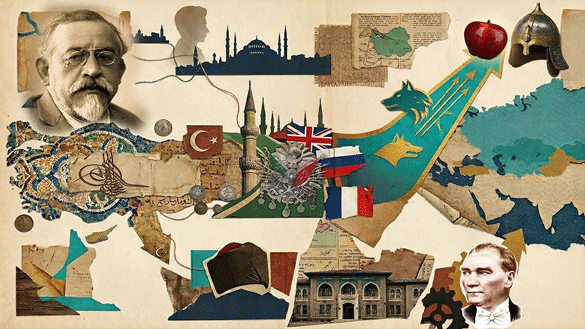
During one of the most turbulent periods in Turkish history, Yusuf Akçura stood at the forefront as one of the great figures who shaped the nation’s destiny not only with the sword but also with the pen and profound strategic insight. He dedicated his life, spanning from the banks of the Volga to the heart of Ankara, to the ideal of Turkic unity. He laid the intellectual foundations for the Turkish state that would rise from the ashes of a crumbling empire.
Yusuf Akçura was born on Dec. 2, 1876, in the Russian city of Simbir, as the son of a distinguished Turkish family. During his childhood, he moved back and forth between Kazan and Istanbul, the two great poles of the Turkic world. After losing his father at the age of 2, he relocated to Istanbul with his mother when he was 7, marking the beginning of his connections with the Ottoman sphere.
A pivotal moment in Akçura's career came with his essay “Three Styles of Politics,” written in Kazan in 1904. This event truly established him as the brightest star in the history of Turkish political thought. The text served as the first political manifesto of Turkish nationalism and a road map to the Red Apple" (”Kızıl Elma”). In this essay, Akçura examined the three paths on the table for saving the Ottoman Empire from collapse: Ottomanism, Islamism and Turkism, using a rational approach.
He viewed the idea of Ottomanism – the effort to create a common “Ottoman nation” from all elements within the empire – as impossible given the political climate of the time. While he saw the politics of Islamism as theoretically strong in its aim to unite the world’s Muslims, he argued that European powers, such as England, France and Russia, possessing Muslim colonies would never permit this in practice.
The true path in Akçura’s heart and mind was the unification of the Turkic world. He viewed the Turkic world as a single entity and argued that the Ottoman Turks must assume a leading role in this unification. The ideal of Turkic unity is not merely a fantasy but the sole political program that will enable Turks to secure their rightful place in the world. Akçura’s realistic approach has also become one of the cornerstones of the Republic of Türkiye's founding philosophy.
Akçura’s nationalism is rooted in a holistic understanding that transcends borders. Building on his ideas, he served as an ambassador and a bridge of ideas, introducing the Northern Turks to the Ottoman Turks. For example, during the 1905 Russian Revolution, he founded the “Alliance of Muslims in Russia” party to defend the rights of Turks in Russia and championed the common cause of Turks in the “Kazan Muhbiri” newspaper. Akçura was one of the figures who best understood and put into practice Crimean Tatar intellectual Ismail Gasprinsky’s motto: “Unity in language, thought and action.”
Akçura helped found the Turkish Homeland journal and Turkish Associations, creating spaces for nationalist intellectuals. For him, the Turkic world was a vast family from the Balkans to the Great Wall of China, sharing sorrow and joy. He opposed an age in which Turks were isolated, their languages and histories fading. Through works like The Year of the Turks (1928), he aimed to revive national memory.
Further demonstrating his impact beyond intellectual circles, Akçura was not merely an intellectual who generated ideas; he was also a hero who passed through the fiery trials of the National Struggle and a statesman who played a role in the founding of the republic. Arriving in Ankara in 1921, he joined the inner circle of Mustafa Kemal Pasha, who would become the founder of the Republic of Türkiye. From 1923 until his death, he served in the Grand National Assembly, representing both Istanbul and Kars.
In Parliament, Akçura emphasized the "populist" and "statist" sides of his nationalism. He advocated loans for poor farmers through the Agricultural Bank. After seeing miners’ tough conditions in Zonguldak, he denounced them in Parliament. His 1925 draft of a 99-article Labor Code, though not enacted, was the first bold step toward regulating workers’ rights, the minimum wage and hours of work. He stressed that the national economy was essential for real political independence.
Akçura, who served as president of the Turkish Historical Society in the final years of his life, made significant contributions to the development of the Turkish Historical Thesis. He sought to prove, through scientific evidence, that the Turks are the most ancient and noble nation in the history of civilization. His vision of Genghis Khan as one of the central figures of Turkish history is proof of his broad, inclusive understanding of history.
Yusuf Akçura’s understanding of Turkish nationalism was not narrow. He believed in the common historical, linguistic and cultural unity of Turks living across a vast geography stretching from the Balkans to the Great Wall of China. He argued that this unity should be transformed into political, economic and cultural cooperation.
Looking at the present, the relationships established with the Turkic republics that gained independence following the dissolution of the Soviet Union represent the realization of the vision Akçura outlined a century ago. The existence of the Organization of Turkic States, the Türkiye-Azerbaijan brotherhood in the liberation of Karabakh from occupation and the resolute stance demonstrated in the Cyprus issue are concrete examples of the seeds of Akçura’s ideals taking root.
When Akçura passed away on March 11, 1935, he left more than just writings; he bequeathed a unifying cause that inspired the republic and continues to guide generations striving for Turkic unity. A leading Tatar politician and writer, Sadri Maksudi Arsal, said: “Everything is fleeting. Only honorable names endure. How fortunate is Yusuf Bey, for he has truly left behind an honorable name.”
https://www.dailysabah.com/opinion/op-ed/call-for-unity-in-turkic-world-yusuf-akcuras-vision
-------
A ceasefire without meaning and a strait without horizon: How the war betrayed Iranian hopes
April 23, 2026
By Karam Nama
The recent statement by U.S. President Donald Trump about Iran’s financial losses from the closure of the Strait of Hormuz is less a policy position and more a late attempt to justify a political, military, and moral failure.
Instead of addressing what the world was actually waiting for — the fate of the theocratic and repressive system in Tehran — Trump retreats into the language of numbers: Iran is losing $500 million a day, soldiers are unpaid, liquidity is drying up. This accounting vocabulary usually appears when decision‑makers are unable to present a real political achievement. It is not the language of a leader waging a war to topple a regime, but the language of a businessman trying to reassure shareholders that the losses are “under control.”
From the first week of the war, large segments of Iranians — inside the country and across the diaspora — were hoping for the moment the regime that has weighed on their lives for more than four decades would finally fall. But it quickly became clear that the war was not designed to bring down Ali Khamenei’s system. It was designed to reshape regional power balances, even if that meant sacrificing Iran as a state and a society.
This is where the sense of betrayal began: the people who dreamed of liberation discovered that the war was being waged above their heads, not for their sake.
As Trump extends the ceasefire indefinitely, he offers a textbook example of the rhetoric of failure. He waves the threat of Iran’s financial collapse, speaks of the pressure on the Strait of Hormuz, hints that Tehran is “begging” to reopen the waterway — yet avoids acknowledging the heavier truth: the regime whose bases were bombed, whose military and economic infrastructure was hit, and whose senior commanders were killed, still stands. No one can claim Iran emerged victorious from this devastating campaign, but no one can grant Trump a certificate of victory either. The regime’s survival is the clearest expression of a shared defeat — the defeat of the project to topple it, and the defeat of the hopes of the people who believed that moment had finally come.
More troubling is that this outcome pushed many Iranians to step back. When they realized the war was not aimed at removing the regime but at destroying Iran itself, part of the public mood recoiled from the idea of “external salvation.” The instinct to preserve the state — even under a repressive authority — began to outweigh the desire to overthrow it. Here lies the harsh paradox: a war marketed as a historic opportunity to end the regime ended up reinforcing its narrative of a “plot against Iran,” giving it a new pretext to suppress dissent in the name of an “existential threat.”
No one can predict what Trump might do next; he is capable of combining contradictions in a single statement. Iran is “collapsing financially,” yet it is simultaneously able to dictate terms in the Strait of Hormuz. It wants the strait opened and closed at the same time “to save face.” This is not a slip of the tongue but part of a strategy of managing conflict by keeping every door half‑open and every scenario plausible — paving the way for one likely outcome: an agreement with the regime in Tehran, not with the Iranian people.
Such an outcome, if it takes the form of a settlement that recycles the regime and grants it renewed legitimacy, will not be welcomed by the Iranian population that has lived under this system for forty years. It would be a stark admission that the thousands who died in this war — and before it in waves of popular uprisings — were not enough to convince the world that the problem in Tehran lies not only in its behavior or its regional ambitions, but in its very existence as a closed, coercive structure.
From a strictly political perspective, what Trump is doing now is an attempt to redefine defeat as “successful pressure.” He speaks of financial collapse, daily losses, and salary crises to obscure the deeper reality: the core objective — toppling the regime or even dismantling its foundations — has not been achieved. Meanwhile, the Iranian regime emerges wounded but standing, able to tell its people it survived the assault of “the world’s greatest power,” and that what happened was merely another chapter in the saga of “Western conspiracy.”
Thus, the regime’s survival after all this bombing and all these losses becomes the harshest expression of defeat — the defeat of the belief that war could be a tool for change, and the defeat of the people who discovered that their fate is decided in negotiation rooms where they have no seat.
As for the world, and for the regional states harmed by Iran’s hegemonic policies, this is not what they were waiting for: not an open‑ended ceasefire, not a strait opened and closed according to the rhythm of bargaining, but a fundamental solution that redefines regional security beyond the logic of sectarian militias and proxy wars.
In the end, Trump may continue speaking about financial losses, the Strait of Hormuz, and imminent collapse. But what he cannot conceal is that the Iranian people — who hoped for the fall of the regime — now find themselves once again alone, facing a power that has mastered the art of survival, and a world that has mastered the art of excuses.
https://www.middleeastmonitor.com/20260423-a-ceasefire-without-meaning-and-a-strait-without-horizon-how-the-war-betrayed-iranian-hopes/
-------
Confusion, delusion, and how Israel drives the Iran War
April 23, 2026
By Jamal Kanj
The closure of the Strait of Hormuz following the temporary ceasefire is the culmination of an American policy defined by strategic incoherence. At the center stands Donald Trump, whose shifting positions, confused war objectives, and conflicting actions have not only failed to ease regional tensions but have actively deepened them.
Nowhere is this clearer than in Trump’s threats to blow up the whole country, including its bridges and power plants. At the same time, he touted a military “big day,” presenting potential war crimes as diplomatic tool, aggression as diplomacy, and destruction as leverage.
Trump inflated, almost delusional, promises ahead of potential talks come across less as statesmanship and more as a calculated sales pitch to the American public. His vows “to end up with a great deal,” coupled with an almost obsessive focus on Barack Obama by insisting his agreement will be “far better” than the one negotiated over a decade ago. An approach that reflects a tendency toward messaging driven less by policy depth and more by projection, comparison, and to frame outcomes in terms of self-aggrandizement and personal glory.
By manufacturing optimism and exaggerating progress while promising an imminent “great deal,” Trump appears to be negotiating with himself—or detached from reality—seeking to construct a narrative of success regardless of the facts on the ground. The performative optimism stands in sharp contrast to his simultaneous threats and pompous rhetoric, suggesting not confidence but a measure of desperation.
Trump’s rationale for extending the ceasefire because of “internal divisions” within Iran is unconvincing. If internal debate within Iran is seen as warranting a pause, what should be said of a policy where direction shifts from one moment to the next? Differing political views are the essence of a normally functioning political system, whereas impulsive, erratic, personalized decision-making is not.
The consequences of these Israel-driven U.S. policies are felt by ordinary Americans at the gas pump and in grocery stores. The Strait of Hormuz has become a battleground, destabilizing global energy supply chains and economies worldwide. Yet despite these cascading effects, the core strategy remains unchanged. Trump continues to operate within an echo chamber of Israel-first sycophants that assume military might alone can deliver results, even as the policy falters and the war spills across the region, threatening roughly one-fifth of the world’s energy infrastructure.
This is not merely a political flaw or a matter of mismanagement. It is rather a strategic vulnerability shaped by Israel-first loyalists pulling U.S. strategy in directions that ultimately undermine U.S. national interests. In the absence of clearly defined national objectives, as in the first Israel’s war in Iraq, each step risks drawing the U.S. deeper into the polluted water of the Gulf, while simultaneously advancing an environment of chaos that serves only Israel’s calculated aims.
In this framework, was Israeli Prijamame Minister Benjamin Netanyahu’s recent statement that the war with Iran is “not over” an embedded message to Trump ahead of the proposed peace talks in Pakistan?
Leaders are not merely bargaining over financial assets or credit ratings, they are navigating domestic demands, legitimacy, and the perception of strength or weakness on the global stage.
In this regard, threats or the constant withdrawal and reintroduction of proposals are not leverage, they are weakness. Unlike commercial transactions where the “Art of the Deal” is largely concluded at the moment of signing, international agreements mark the beginning of an ongoing, often long-term relationship. What may pass as hard-nosed bargaining in business can, in international diplomacy, be interpreted as bad faith, an approach that tends to invite resentment and resistance instead of compromise. This is why since last Tuesday, Trump was left waiting for Iran to come to the negotiation table.
Effective diplomacy requires serious leadership, consistency, and an understanding of the symbolic as much as the substantive. Agreements endure not because one side is pressured into submission, but because all parties can present the outcome as preserving their dignity and advancing mutual interests.
The lack of strategic maturity is indicative in a proclamation in the morning signaling openness to de-escalation; by midday, the message splinters, issuing threats and ultimatums while simultaneously hinting at imminent breakthrough deals; by the middle of the night, amid his insomnia, it escalates to threats of total destruction. This constant shifting of positions is not a minor stylistic quirk. It is possible that, at least some of this, is associated with his nocturnal communications with Netanyahu, who is apparently wagging him left and right.
This yo-yoing of positions does more than create confusion; it erodes the credibility. Diplomacy depends on a baseline of predictability and mental stability. When signals shift faster than the wind, uncertainty breeds mistrust, and negotiations drift from closed rooms into fiery statements played out for public consumption, creating an opening for Israel to drive the war and breed destruction and more chaos.
https://www.middleeastmonitor.com/20260423-confusion-delusion-and-how-israel-drives-the-iran-war/
-----
Lebanon needs humanitarian not philosophical support
Khaled Abou Zahr
April 23, 2026
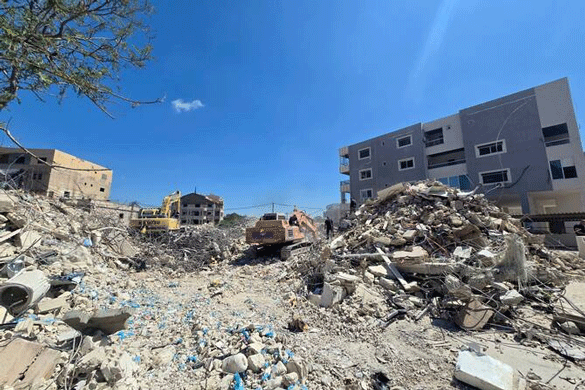
Can you name the one country in the world in which a news magazine would put a philosopher on its cover? The answer is France. This helps us understand how the media and political thought leaders might address complicated issues. Lebanon is a complicated problem that has a simple solution. Yet, as Emmanuel Macron received Nawaf Salam at the Elysee Palace this week to show support, the message is too fragmented and has too many layers, while trying to advocate a balanced approach.
The statement of supporting, in principle, the disarmament of Hezbollah but favoring a gradual and negotiated approach, while pushing the narrative of separation between the group’s military — I would say terrorist — and political wings is in fact bringing more confusion. Paris is looking to act primarily as an indirect supporter of Lebanon rather than a central player, positioning itself as a discreet architect seeking to stabilize the country without provoking internal divisions or directly opposing Israel. This will go nowhere for Lebanon.
To start, I have trouble accepting the way France is looking to push Hezbollah into the political life of Lebanon, especially when making a quick comparison with French political life. In French elections, for example, Renaissance and the center-left and far-left parties tend to treat the conservative parties as outcasts. They will push for television and other media outlets to boycott the right-wing parties and will also label them as fascists. Yet, when it comes to Lebanon, despite Hezbollah being a terrorist organization embedded within the Iranian Islamic Revolutionary Guard Corps, French pundits — and other Western ones too — will claim with all confidence that Hezbollah is part of the Lebanese DNA, as well as part of its political life, and hence should not be excluded.
They will add that Hezbollah is the true representative of the Shiite community and, with this statement, consider that they are capable of understanding the nuances of Lebanese society, unlike those who hold the superficial view that Hezbollah is a terrorist organization. More importantly, not once will they stop to think that, just as this organization is totalitarian toward the Lebanese state, its basis is dictatorship over the Shiite population.
Obviously, just like every communist dictatorship, they can wrap it up in social and medical support and financial aid to help the pill go down. Still, ultimately, the Shiite population is robbed of its free will. These French analysts are correct that Hezbollah uses a narrative of oppression within its own community and that, as a result, they are now respected. But is this true? What respect is there when you are forced off your land?
There are also, just like in communist regimes, perks and help given to the locals. Hezbollah’s financial networks are a cornerstone of this system, just like its weapons. These are the two sides of the same coin.
Moreover, this is not an implicit recognition — it has been declared by the French presidency, even though Hezbollah last week killed a French soldier participating in the UN Interim Force in Lebanon. Hence, this recognition of Hezbollah, which opposes negotiations with Israel, is a direct hit on the efforts by the Lebanese presidency and government to show unity. It offers the perfect argument that the strongest recognized party opposes negotiations, so how will you respect any agreement?
We are in a mirror situation of the Palestinian Authority and Hamas. The PA can negotiate as much as it wants, but as long as Hamas refuses the principle of negotiations and rejects peace, it is a waste of time.
It is also dangerous for Lebanon to believe that the increasingly aggressive approach of the Europeans toward Israel will help it. I wrote at the beginning of the war in Ukraine on the lessons Kyiv should learn from the Lebanese. I think today the Lebanese should look to see if the Europeans have been able to help the Ukrainians really achieve something. This is not about the conferences, loans and other financial and military support, but in terms of the negotiations. The answer is no. Simply because the European agenda is different from the Ukrainian one and this is normal and fair. The same is true for Lebanon.
Sometimes, things are as they look and France needs to stop philosophizing and shift its narrative. It needs to stop pushing the military and political wing theory. We all know that this is done within the balance France seeks with Iran and not for the future of Lebanon. Moreover, suggesting that Hezbollah is the true representative of the Shiite community is a grave mistake that accepts a totalitarian state within the state.
Ultimately, these two main concepts render everything else that Macron can do for Lebanon useless, as he is legitimizing the two main justifications for Hezbollah’s raison d’etre and indirectly accepting it as a true resistance movement. There can be no real peace if we let an organization that is part of the Iranian regime attain moral supremacy.
The current Lebanese crisis was caused by Hezbollah supporting Iran in its war with Israel and the US. While we remember that Israel unilaterally withdrew from Lebanon in 2000, it is now back in the south at the invitation of Hezbollah, which has proven its inability to defend the Shiite community or Lebanon. The support Lebanon needs today is not philosophical but humanitarian and the implementation of Hezbollah’s disarmament: a full disarmament of its military arsenal, financial architecture and social organizations. Nothing less.
https://www.arabnews.com/node/2640986
-------
Confusion, Delusion, and How Israel Continues to Drive the Iran War
April 24, 2026
By Jamal Kanj
The closure of the Strait of Hormuz following the temporary ceasefire is the culmination of an American policy defined by strategic incoherence. At the center stands Donald Trump, whose shifting positions, confused war objectives, and conflicting actions have not only failed to ease regional tensions but have actively deepened them.
Nowhere is this clearer than in Trump’s threats to blow up the whole country, including its bridges and power plants. At the same time, he touted a military “big day,” presenting potential war crimes as a diplomatic tool, aggression as diplomacy, and destruction as leverage.
Trump’s inflated, almost delusional, promises ahead of potential talks come across less as statesmanship and more as a calculated sales pitch to the American public. His vows “to end up with a great deal,” coupled with an almost obsessive focus on Barack Obama by insisting his agreement will be “far better” than the one negotiated over a decade ago.
An approach that reflects a tendency toward messaging driven less by policy depth and more by projection, comparison, and to frame outcomes in terms of self-aggrandizement and personal glory. Instead of articulating clear strategic objectives, his policy relies on distinguishing himself and image cultivation to project authority and superiority, leaving the underlying substance vague and open to question.
By manufacturing optimism and exaggerating progress while promising an imminent “great deal,” Trump appears to be negotiating with himself—or detached from reality—seeking to construct a narrative of success regardless of the facts on the ground. The performative optimism stands in sharp contrast to his simultaneous threats and pompous rhetoric, suggesting not confidence but a measure of desperation.
Trump’s rationale for extending the ceasefire because of “internal divisions” within Iran is unconvincing. If internal debate within Iran is seen as warranting a pause, what should be said of a policy where direction shifts from one moment to the next? Differing political views are the essence of a normally functioning political system, whereas impulsive, erratic, personalized decision-making is not.
All of this unfolds as Trump continues issuing maximalist demands for conditions he helped create. For instance, he demands the surrender of enriched uranium that would not exist had he not abandoned the Joint Comprehensive Plan of Action (JCPOA). Likewise, the Strait of Hormuz was closed as a consequence of his and Netanyahu’s war, not as its cause.
The consequences of these Israel-driven US policies are felt by ordinary Americans at the gas pump and in grocery stores. The Strait of Hormuz has become a battleground, destabilizing global energy supply chains and economies worldwide. Yet despite these cascading effects, the core strategy remains unchanged. Trump continues to operate within an echo chamber of Israel-first sycophants that assume military might alone can deliver results, even as the policy falters and the war spills across the region, threatening roughly one-fifth of the world’s energy infrastructure.
This is not merely a political flaw or a matter of mismanagement. It is rather a strategic vulnerability shaped by Israel-first loyalists pulling the US strategy in directions that ultimately undermine US national interests. In the absence of clearly defined national objectives, as in Israel’s first war in Iraq, each step risks drawing the US deeper into the polluted water of the Gulf, while simultaneously advancing an environment of chaos that serves only Israel’s calculated aims.
In this framework, was Israeli Prime Minister Benjamin Netanyahu’s recent statement that the war with Iran is “not over” an embedded message to Trump ahead of the proposed peace talks in Pakistan?
Negotiation between countries, especially in the context of war is not selling real estate deals, where haggling and the threat of retracting an offer are routine tactics. The craft of negotiation in this case operates on an entirely different level. Culture, national dignity, historical memory, and political positioning shape both the process and the outcome. Leaders are not merely bargaining over financial assets or credit ratings; they are navigating domestic demands, legitimacy, and the perception of strength or weakness on the global stage.
In this regard, threats or the constant withdrawal and reintroduction of proposals are not leverage; they are a weakness. Unlike commercial transactions, where the “Art of the Deal” is largely concluded at the moment of signing, international agreements mark the beginning of an ongoing, often long-term relationship.
What may pass as hard-nosed bargaining in business can, in international diplomacy, be interpreted as bad faith, an approach that tends to invite resentment and resistance instead of compromise. This is why, since last Tuesday, Trump has been left waiting for Iran to come to the negotiation table.
Effective diplomacy requires serious leadership, consistency, and an understanding of the symbolic as much as the substantive. Agreements endure not because one side is pressured into submission, but because all parties can present the outcome as preserving their dignity and advancing mutual interests.
The lack of strategic maturity is indicative in a proclamation in the morning signaling openness to de-escalation; by midday, the message splinters, issuing threats and ultimatums while simultaneously hinting at imminent breakthrough deals; by the middle of the night, amid his insomnia, it escalates to threats of total destruction. This constant shifting of positions is not a minor stylistic quirk. It is possible that, at least some of this, is associated with his nocturnal communications with Netanyahu, who is apparently wagging him left and right.
This yo-yoing of positions does more than create confusion; it erodes credibility. Diplomacy depends on a baseline of predictability and mental stability. When signals shift faster than the wind, uncertainty breeds mistrust, and negotiations drift from closed rooms into fiery statements played out for public consumption, creating an opening for Israel to drive the war and breed destruction and more chaos.
https://www.palestinechronicle.com/confusion-delusion-and-how-israel-continues-to-drive-the-iran-war/
-------
A Fragile Truce and Tense Negotiations: The Future of Iranian-American Talks
April 24, 2026
By Hassan Lafi
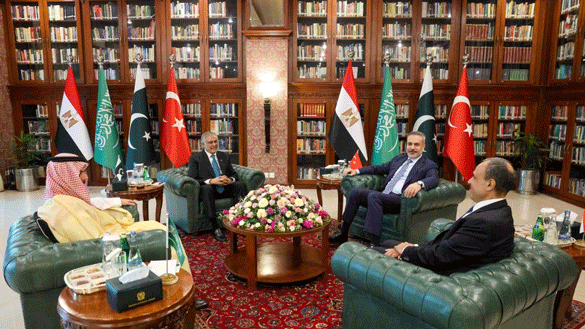
The announcement of a temporary, two-week truce between Iran on one side and the United States and Israel on the other—reportedly mediated by Pakistan—initially suggested that the latest escalation might be contained, potentially opening a pathway toward renewed negotiations.
Yet subsequent developments quickly made clear that this was not a genuine settlement, but rather a fragile ceasefire designed to manage the conflict while allowing all parties to reposition themselves politically and militarily.
The first round of post-truce negotiations failed to produce any tangible breakthrough. Tensions persisted across both military and political fronts. On the military level, Washington escalated pressure by imposing a naval blockade on Iranian ports, tightening economic constraints and increasing the cost of diplomatic delay.
Tehran responded by briefly closing the Strait of Hormuz after announcing its reopening to navigation—an unmistakable signal that it retains strategic leverage and is willing to threaten global trade routes in response to economic coercion.
At the political and media level, the US president reverted to a familiar negotiating style: rhetorical escalation through public statements and social media. Within a single month, threats to target Iranian infrastructure and energy facilities alternated with calls for dialogue, illustrating a deliberate strategy of pressure through ambiguity.
In contrast, Iran refused to participate in a new round of talks in Islamabad, arguing that negotiations conducted under military threat and economic blockade lack both credibility and parity. Nevertheless, Washington announced an extension of the ceasefire and urged Tehran to present a “clear and comprehensive vision” for a solution—without specifying a timeline, thereby preserving strategic flexibility.
Tehran’s response was cautious but firm. Iranian officials rejected the notion that a unilateral ceasefire extension carries political or legal weight, while maintaining military control over key maritime routes. This reflects a consistent principle: reciprocity, and a refusal to accept unilateral management of the crisis.
This dynamic raises several fundamental questions. How should these negotiations be interpreted through the lens of international relations theory? What tools of power are being deployed by each side? And are these developments leading toward de-escalation—or merely postponing a larger confrontation?
The Nature of Negotiations: Pressure as Process
These negotiations diverge from traditional diplomatic frameworks, where a ceasefire precedes structured dialogue. Instead, what is unfolding is negotiation under sustained pressure.
Military, economic, and informational tools have not been suspended—they have been integrated into the negotiation process itself.
The United States employs sanctions, naval restrictions, military threats, and media messaging to extract concessions. Iran, in turn, leverages geography, energy chokepoints, and strategic patience to resist pressure and signal its capacity for escalation.
This is not diplomacy replacing force. It is diplomacy conducted through force.
Interpreting US Strategy
Political Realism: Reasserting Balance of Power
From a realist perspective, US actions reflect a clear objective: preventing Iran from converting its military resilience into long-term geopolitical influence.
Washington’s priorities include limiting Iran’s ability to weaponize maritime routes, curbing its regional reach, and imposing a stricter post-conflict framework—all while reassuring allies and reinforcing its own global standing.
This explains the dual approach of rhetorical de-escalation combined with operational escalation.
Coercive Diplomacy
US behavior also aligns with coercive diplomacy—using credible threats to force negotiations on favorable terms. Repeated warnings about targeting Iran’s energy infrastructure serve less as immediate war signals and more as instruments to raise the cost of defiance.
Dual-Level Negotiation
American messaging is not directed solely at Tehran. It also targets domestic audiences, Congress, allies, and the security establishment. This produces apparent contradictions between threats and flexibility, as each message serves a different political function.
Interpreting Iranian Strategy
Defensive Realism and Survival Logic
Iran operates under the assumption that external pressure is not limited to specific policies, but threatens the system itself. As a result, it rejects negotiations conducted under duress, refuses imposed timelines, and avoids unilateral concessions.
From Tehran’s perspective, yielding under pressure invites further demands.
Asymmetric Deterrence
Faced with conventional military imbalance, Iran relies on asymmetric tools: control over the Strait of Hormuz, missile and drone capabilities, regional alliances, and endurance under sustained pressure.
Its continued use of maritime leverage—even during a truce—reflects this strategy.
Political Identity
Iran’s posture is also shaped by political identity. Presenting itself as an independent actor resisting external domination, it views negotiations under coercion as a threat not only to policy, but to legitimacy.
The Role of Mediation
Pakistan’s involvement highlights the growing influence of middle powers in crisis management. Its ability to engage both Washington and Tehran positions it as a useful intermediary, capable of facilitating temporary de-escalation.
However, mediation alone cannot produce lasting outcomes without genuine political will from the primary actors.
Strategic Objectives
The United States seeks to neutralize Iran’s leverage over global energy routes, secure a new security framework that protects its regional allies, and demonstrate that sustained pressure yields results.
Iran, by contrast, aims to lift sanctions, secure recognition of its regional role, obtain guarantees against future attacks, and ensure that negotiations occur on equal footing.
Israel’s position remains more uncompromising, favoring the degradation of Iran’s capabilities and opposing any agreement that could consolidate Tehran’s strategic gains.
Possible Scenarios
The most likely outcome is a limited interim arrangement—partial easing of pressure, controlled reopening of maritime routes, and continued negotiations without resolving core disputes.
A prolonged truce without agreement is also plausible, reflecting ongoing crisis management rather than resolution.
A breakdown leading to renewed escalation remains a constant risk, particularly in the event of miscalculation or a triggering incident in the Gulf.
A comprehensive agreement, while possible, appears unlikely in the current climate of deep mistrust.
Conclusion
The current trajectory suggests that neither side seeks full-scale war, yet neither is willing to make decisive concessions. What emerges instead is a pattern of managed confrontation—temporary ceasefires interspersed with calibrated escalation.
In this context, negotiation is no longer separate from power; it is an extension of it.
The future of Iranian-American engagement will not be determined solely at the negotiating table, but across strategic waterways, energy markets, deterrence calculations, and domestic political arenas.
This is not merely a dispute over policy. It is a struggle over the shape of the regional order to come.
https://www.palestinechronicle.com/a-fragile-truce-and-tense-negotiations-the-future-of-iranian-american-talks/
-------
Beyond One Man: Why Israel’s Wars Will Not End with Netanyahu
April 23, 2026
By Ramzy Baroud
It is tempting to argue that Israel’s new military doctrine is predicated on perpetual war—but the reality is more complex.
Not that Israeli Prime Minister Benjamin Netanyahu would object to such an arrangement. On the contrary, his relentless drive for military escalation suggests precisely that. After all, his openly declared quest for a “greater Israel” would require exactly this kind of permanent militarism—endless expansion and sustained regional destruction.
However, Israel cannot sustain an open-ended fight on multiple fronts indefinitely.
Israeli officials boast about fighting on “seven fronts,” but many of these are, in military terms, largely imaginary rather than sustained battlefields.
The real wars, however, are entirely of Israel’s making: from the genocide in Gaza to its unprovoked regional wars.
Still, that fact should not blind us to another reality: in the lead-up to the war on Iran, and in the escalation against Lebanon, there was near-total consensus among Jewish Israelis. An Israel Democracy Institute survey conducted on March 2–3 found that 93% of Jewish Israelis supported the joint US-Israeli attack on Iran. Support cut across all political camps.
The same enthusiasm for war accompanied the Gaza genocide and the various wars and escalations in Lebanon.
Even Yair Lapid—so often and so falsely marketed abroad as a “dove”—fully backed these wars, admitting after the Iran ceasefire that Israel had entered them with “rare consensus” and that he supported them “from the very first moment.”
His repeated criticisms, like those of other Israeli politicians, are not of the war but of Netanyahu’s failure to deliver a strategic outcome.
And this is the crucial distinction. Israelis mostly support the wars, but many no longer trust Netanyahu to translate destruction into strategic victory. By mid-April, 92% of Jewish Israelis gave the army high marks for its management of the Iran war, but only 38% gave high ratings to the government.
In other words, the public still believes in war but increasingly doubts the leadership waging it.
That distinction may not matter much to us, since the outcome remains mass death, devastation, and colonial violence. But in Israel’s own military and strategic calculations, it matters enormously. Its wars have historically followed a familiar model: crush resistance, impose military and political domination, and translate battlefield violence into colonial expansion.
Netanyahu delivered none of that.
This is why the uproar in Israel over the April 16 Lebanon ceasefire has been so fierce, and why the fears surrounding a possible stalemate with Iran run even deeper.
The Lebanon ceasefire clearly did not secure one of Israel’s central declared aims: the disarmament of Hezbollah. Israel kept troops in southern Lebanon, but the agreement halted offensive operations and fell far short of the promised “total victory.”
For many in Israel, any outcome that falls short of total victory is immediately read as defeat. One northern Israeli regional leader, Eyal Shtern, captured that mood with brutal clarity when he reacted to the Lebanon ceasefire by asking how Israel had gone “from absolute victory to total surrender,” in remarks reported by CNN.
That is the real crisis now confronting Israel: not that it has discovered the limits of permanent war, but that it has once again discovered that exterminatory violence does not automatically produce political victory.
While Iran possesses political leverage that could allow for a long-term, or even permanent, truce, Lebanon and Syria remain in a far more vulnerable position. However, no one is in a more precarious condition than the Palestinians, particularly those in Gaza.
Unlike others who retain some political margin and space to maneuver, Palestinians live under Israeli occupation, apartheid, and siege. Gaza, in particular, has been reduced to a sealed enclave of devastation.
Its hermetic siege has produced one of the most horrific humanitarian catastrophes in modern history: an entire population surviving on polluted water, with infrastructure destroyed, food critically scarce, and thousands still buried beneath the rubble.
Aside from their legendary steadfastness—sumud—Palestinians operate under severe constraints in their ability to impose conditions on Israel, particularly as it continues to receive unconditional support from the United States and its Western allies. Yet their resilience, collective action, and enduring presence remain powerful forms of leverage that cannot be easily contained.
Netanyahu—and those who will come after him—will always find in Palestine a space in which war can be waged continuously and at relatively low cost to Israel itself. Unlike other battlefields, where war becomes politically, militarily, and economically unsustainable, Israel has turned its occupation of Palestine into a permanent battlefield.
Even if Netanyahu, now politically diminished and aging, exits the political scene, the underlying paradigm will remain intact. Future Israeli leaders will continue to wage war on Palestine, not despite its costs, but because of its perceived benefits: it is financially subsidized, colonially advantageous, and politically sustainable within Israel’s current structure.
To break this paradigm, Palestinians must generate leverage—real leverage. This cannot come from futile negotiations or appeals to long-ignored international law. It can only emerge from sustained collective resistance to colonialism, reinforced by meaningful support from Arab and Muslim states and genuine international allies, and amplified by global solidarity capable of exerting real pressure on Israel and, crucially, on its principal benefactors.
For now, Netanyahu continues his wars because he has no answer to his own strategic failures. Here, escalation is not a strength; it is the last refuge of a leadership that cannot deliver victory.
This, however, also reveals something else: Israel is entering a moment of unprecedented vulnerability.
That vulnerability must be exposed—clearly, consistently, and urgently—by all those who seek an end to these senseless wars, an end to the Israeli occupation of Palestine, and a path toward justice that has been denied for far too long.
https://www.palestinechronicle.com/beyond-one-man-why-israels-wars-will-not-end-with-netanyahu/
------
New Age Islam, Islam Online, Islamic Website, African Muslim News, Arab World News, South Asia News, Indian Muslim News, World Muslim News, Women in Islam, Islamic Feminism, Arab Women, Women In Arab, Islamophobia in America, Muslim Women in West, Islam Women and Feminism