
The Life and Death of Salman Rushdie, Gentleman Author By Hamid Dabashi: New Age Islam's Selection, 18 October 2017
New Age Islam Edit Bureau
18 October 2017
• The Life and Death of Salman Rushdie, Gentleman Author
By Hamid Dabashi
• Concessions Key to Revival of Two-State Solution
By Daoud Kuttab
• UNESCO Exit A Self-Inflicted Wound For US
By Osama Al-Sharif
• Iraq's Reconquest of Kirkuk Checks Kurdish Secession
By Tallha Abdulrazaq
• Hezbollah and Arab Shiites in Gulf Countries
By Kamel Al-Khatti
• Iran’s Nuclear Deal Has Not Yet Suffered a Knockout Blow
By Maria Dubovikova
• Another End to Kurdish Independence Dreams
By Murat Yetkin
• Religious Conservatism and Turkish Academia
By Ahu Özyurt
• The New Bloc against Tehran
By Abdulrahman Al-Rashed
• ‘It Is Not PSG; It Is UNESCO’
By Christian Chesnot
Compiled By New Age Islam Edit Bureau
-----
The Life and Death of Salman Rushdie, Gentleman Author
By Hamid Dabashi
17 October 2017
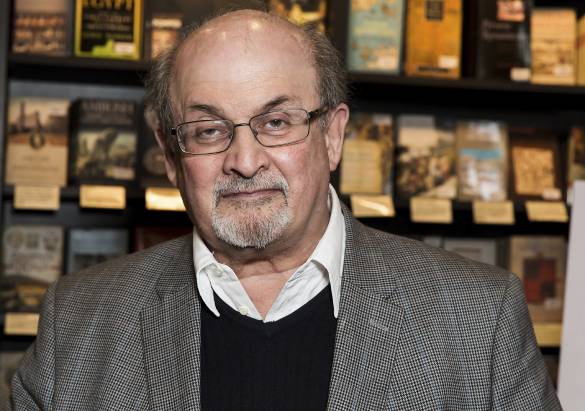
In a recent flight, I was sitting a couple of rows behind Salman Rushdie on the British Airways flight 178 from New York to London. It was an eerie experience. On my way to the bathroom, I could see he was playing a video card game on his mobile phone. I was not even tempted to go forward and introduce myself. I can scarcely stand the man. Plus: can you imagine a bearded Iranian man approaching Salman Rushdie on a plane flying at 37,000 feet towards London. The man may freak out and relive the opening gambit of his Satanic Verses. Which one of us would be Gibreel Farishta and which Saladin Chamcha? Nerve-wracking!
I have met Salman Rushdie though, years ago when, in the heydays of the notorious edict (fatwa) against him, the late Edward Said had invited him to visit Columbia. I remember the small gathering Edward had arranged for him was literally behind closed doors and by invitation only. Perhaps a dozen or so Columbia faculty and students had gathered to chat with the author of The Satanic Verses while he was still in hiding.
This haphazard encounter early in October 2017, however, coincided with the publication of Salman Rushdie's most recent book, The Golden House, of which I was entirely unaware until I ran into a celebratory review in the Guardian - in which it was compared to F Scott Fitzgerald's The Great Gatsby and Evelyn Waugh's Brideshead Revisited.
I dutifully went and purchased a copy of the book and began reading it and, yet again, I could not help feeling I was reading an impostor.
Why an imposter? Allow me to explain.
The Birth of an Author
I was still a graduate student when Salman Rushdie's Midnight's Children (1981) appeared. Words fail to describe my joyous fascination in having discovered him. His voice was witty, brilliant, rambunctious, joyous - his prose revelatory, his politics familiar, his imagination trustworthy. I immediately placed him next to and up against VS Naipaul, whom the more I read the more I detested, especially after his horridly racist Among the Believers: An Islamic Journey (1981) that had come soon after the Iranian revolution of 1977-1979. Its sheer nasty arrogance could scarce conceal its ignorance of a revolution that had shaken my homeland to its foundations. My love at first read for Rushdie's Midnight's Children was no doubt in part animated by my revulsion against VS Naipaul. But long after my animus for Naipaul disappeared into indifference, my love and admiration for Midnight's Children only increased.
I soon began reading the rest of Rushdie's work - his first novel, Grimus (1975), his other magnificent fiction, Shame (1983), and his travelogue to Nicaragua, The Jaguar Smile (1987), which appeared as I was deep into writing my first book on Iranian revolution, Theology of Discontent (1993). Rushdie's playful politics and his magic realism were palpable to me, happily familiar, a kind of Gabriel Garcia Marquez from my neighbourhood, I always thought. I basked in his nasty, naughty, joyous, playful, giggling, irksome prose.
This happy discovery of a new author continued well into the publication of his Satanic Verses (1988), of which I first read a review, I believe in Times Literary Supplement, upon its British release, which was before its US publication. I was so excited to read this new novel, I asked a friend in London to buy and send it to me to New York and I read it before it was published in the US. I found his Satanic Verses utterly magnificent, and I recall referring to it in a conference on Shia passion play at Hartford Seminary in Hartford, Connecticut, citing it as a perfect example of how old stories and even sanctities can be put into urgent contemporary (exilic) fiction.
Long after I could no longer stand Rushdie's politics, I continued to include Satanic Verses in my various syllabi on postcolonial literature - marvelling at while teaching the ecstasy of his prose - its virtuoso performativity, its bravura theatricals, its happy communion with English language, its bringing the Muslim sacrosanct forward for a rendezvous with a homely life away from home. Never ever (long after that horrid fatwa) did I think the novel an insult to Muslims. Quite to the contrary: it brought their sacrosanct to a renewed rendezvous with their history.
In retrospect, I am happy to have had that first undiluted encounter with Rushdie's last novel before the whole hell broke loose on him and the rest of us who loved and admired his work. To this day, I read Satanic Verses with a fully conscious awareness of reading a great novel before it was sabotaged, verbally abused, narratively assassinated, and forever destroyed by one nasty ayatollah who had no freaking clue what the book was about.
The Death of An Author
The Guardian's Emma Brockes recently said of Rushdie: "At 70, Rushdie has had more public incarnations than most writers of literary fiction - brilliant novelist, man on the run, subject of tabloid scorn and government dismay, social butterfly, and, in that singularly British designation, man lambasted for being altogether too Up Himself - but it is often overlooked what good company he is."
I wish I could think of Rushdie that way: died and reincarnated multiple times. But alas for me, Rushdie died and never came back. As an author, he was born with that magnificent milestone novel Midnight's Children and died after a blindfolded revolutionary zealot put a price on his head, killed his person, confused his persona, corrupted his politics, and turned what was left into a pestiferous Islamophobe on par and paired with Ayaan Hirsi Ali, Sam Harris, Bill Maher and the rest of their detestable gang.
If you have "been" with Salman Rushdie as long as I have since his birth as a magnificent writer, and through his ordeal with Khomeini's fatwa and subsequent moral degeneration into a bitter old Islamophobe, it is hard to resist the irrefutable feeling that the old ascetic Iranian Savonarola did, after all, manage to have the great inveterate novelist "assassinated" and what today we know as "Salman Rushdie" is a Picassoesque impostor - all his pieces might be there but the composition is contorted and grotesque.
Ever since one of his earliest "posthumous" novels, The Moor's Last Sigh (1995), I have no longer been able to read Rushdie without a bizarre sensation I am reading an impostor. For that reason, I believe the writer who today goes by the name of "Salman Rushdie" offers literary theorists a unique case of "the death of the author", as we say.
In 1967, Roland Barthes, the eminent French literary theorist, published his highly influential essay on the "Death of the author/La mort de l'auteur" in which he sought to decouple the autonomy of a text from the biography of its author. Though I find much interpretative energy lurking under the skin of Barthes' proposition, I still believe something of the authorial voice remains in the text by way of our imagining an omniscient narrator behind any other narrator who is speaking the story to us when we read or watch or listen to a text. I cannot listen to Wagner or read Heidegger without thinking they were despicable anti-Semites.
My problem with Salman Rushdie's fiction is I can no longer imagine that omniscient ventriloquist crafting a world for me to enter and believe, to possess and behold. I can no longer tell one from the other.
It is not that I don't like Salman Rushdie as a person or that I loathe his politics as much as I do the politics of those who put a price on his head. It is that the words "Salman Rushdie" no longer simply refer to a person, an author, a novelist, for those two words have become an overload of thick and conflicting memories preventing any direct and unmitigated encounter with the novels, memoirs, and essays he writes, as Barthes tells us to do.
The Fate of a Nation
Salman Rushdie himself (or I should rather say "itself") and that grand ayatollah who put a price on his head, both at each other's throat forever, have become a thick text, standing formidably before the books he writes. Hard as I try, I cannot pass that repellent gate to get to the book he keeps writing.
That fatwa Khomeini issued against Rushdie has a far different tone to it in the ear of an Iranian who cares for the fate of his homeland. As the world attention was distracted by the smokescreen of a death sentence against a well-protected Indo-British author, Khomeini ordered the redrafting of an "Islamic constitution" (a contradiction in terms) into which now almost 80 million human beings are trapped. As European and North American liberals were falling head over shoulder to defend Rushdie's freedom of thought, Iranian en masse were being subjected to a pestiferous theocracy to this day. For millions of Iranians, the downfall of Ayatollah Montazeri as a far more humane successor to Khomeini and the substitution of the vindictive Ayatollah Khamenei is the legacy of that so-called "Rushdie Affair".
The moment I reach that historic cul-de-sac is precisely the instance I suddenly remember the Salman Rushdie I used to read when I first encountered his fiction. A sudden sadness, a moment of mourning nostalgia, then dawns on me remembering an author I once so joyously discovered, so dearly loved reading, and now having so sadly forever lost. Who is this strange man impersonating Salman Rushdie? He is "Salman Rushdie", I then realise - forever condemned into two scare quotes, the signal citation of the fatwa a malignant man once issued against him.
As Salman Rushdie and I and the rest of the passengers on that flight between New York and London deplaned and entered Terminal Five at Heathrow Airport I was walking right behind him. He had put a light blue baseball cap on while walking on a moving sidewalk. At one point, he turned right towards the yellow sign for "Arrival" and I turned left towards the purple sign for "Transit". He had reached his destination in London. I still had a long way to go somewhere else.
Hamid Dabashi is the Hagop Kevorkian Professor of Iranian Studies and Comparative Literature at Columbia University.
Source: aljazeera.com/indepth/opinion/life-death-salman-rushdie-gentleman-author-171016094009750.html
-----
Concessions Key to Revival of Two-State Solution
By Daoud Kuttab
17 October 2017
When representatives of the two major Palestinian factions, Fatah and Hamas, signed a new reconciliation agreement in Cairo last week, the focus was not on those actually doing the signing, Fatah Central Committee member Azzam Al-Ahmad and Deputy Head of the Hamas Politburo Saleh Al-Arouri. Instead, all eyes were on the man standing behind them: Khaled Fawzy, the head of Egypt’s General Intelligence Directorate.
The ceremony, held at the intelligence agency’s headquarters, was orchestrated entirely by the Egyptians, who view the reconciliation as a stepping stone to a much larger goal. As the agreement stated in its opening, it stemmed from Egyptian President Abdel Fattah El-Sisi’s “insistence” on ending the divisions among Palestinians “with the aim of creating an independent state” along pre-1967 borders.
Egypt’s leadership in this process will raise the country’s standing in the Arab world, reinforcing its position as a regional heavyweight. Already the reconciliation agreement between Hamas and Fatah has gone some way toward achieving that, while providing a badly needed morale boost for El-Sisi’s government. The good news for Egypt is that the Palestinians have shown a renewed willingness not only to pursue reconciliation, but also to pursue a difficult negotiating process with Israel and its main strategic ally, the United States. This revival of Palestinian national politics largely reflects the recent shift in Hamas’s stance, which follows years of trials for the Islamist organization.
The troubles for Hamas began when it chose to back the wrong side in both Syria and Egypt. Syrian dictator Bashar Assad’s regime prevailed over the Hamas-supported Islamic rebels in Damascus, while the Hamas-backed Muslim Brotherhood government in Egypt, led by Mohammed Mursi, fell after a year. Then, Saudi Arabia, Egypt, the United Arab Emirates and Bahrain severed diplomatic relations with Qatar, causing Hamas to lose its Qatari and Iranian financial and political support.
With few friends and even fewer sponsors in the region, Hamas had little choice but to return to its fellow Palestinians. The group quickly and unconditionally accepted President Mahmoud Abbas’s three demands: To dissolve the Hamas-led administrative committee, to allow the Ramallah-based Palestinian government to resume its role in Gaza, and to allow presidential and parliamentary elections to take place in both Gaza and the West Bank.
Reconciliation among the Palestinians will certainly open the way for peace, not least because the new elections will deliver the needed legitimacy to those tasked with handling negotiations with Israel. But the real work — for Egypt and the Palestinians — lies ahead.
In order to achieve an independent Palestinian state along pre-1967 borders, both actors will need to work with the US, under President Donald Trump, and Israel, under Prime Minister Benjamin Netanyahu. And, on this front, expectations are low.
Trump claims he will deliver the “ultimate deal” to resolve the Israel-Palestine conflict. But Trump and Netanyahu, feeding each other’s hawkishness, both remain unwilling to accept what the rest of the world views as the basic premise of any good deal: A two-state solution. And the ageing Abbas is unlikely to accept whatever bad deal the decidedly pro-Israel Trump administration offers.
Even that futile scenario might be optimistic, as it assumes that talks get off the ground — an impossible feat if Israel continues its illegal construction of settlements in the occupied Palestinian territories. Such activities are not just unjust; they are a violation of United Nations Security Council Resolution 2334, adopted nearly unanimously last year (the US, then led by Barack Obama, abstained). That resolution demanded “that Israel immediately and completely cease all settlement activities in the occupied Palestinian territory, including East Jerusalem” — activities that amount to a “flagrant violation under international law.”
Any agreement between Israelis and Palestinians will require deep concessions by both sides — concessions that leaders on both sides will need to convince their respective public to accept. Trump’s son-in-law and adviser, Jared Kushner, who has been tasked with settling the conflict, and the Trump administration’s chief negotiator on the issue, Jason Greenblatt, seem to understand this. Egypt certainly does, having made it clear that a divided Palestinian leadership without a public mandate, like the one to be delivered by new elections, will be unable to carry out serious negotiations or win popular support for any eventual agreement.
The question is whether the Israelis will be willing to make such concessions, allowing either a two-state solution or a system of genuine and credible power-sharing within a single state. If they aren’t, the recent Palestinian reconciliation, however positive, will not mark the beginning of the end of the Israeli-Palestinian conflict. It will merely be the start of a new chapter in the struggle for the freedom of Palestinians.
Source: arabnews.com/node/1179211
-----
UNESCO Exit a Self-Inflicted Wound for US
By Osama Al-Sharif
17 October 2017
It would be naive to believe that the US decision to withdraw from the United Nations Educational, Scientific and Cultural Organization (UNESCO) will not hurt the Paris-based UN body. Washington is a major financial contributor to UNESCO’s budget — about 22 percent — and it pulling out will affect the financing of the organization’s important projects around the world. Already the US owes about $550 million in arrears and the decision to withdraw raises questions about the ability of UNESCO to overcome chronic financial challenges.
While owing money to the organization is thought to be one reason for the US move, the pretext that the US State Department and ambassador to the UN Nikki Haley cited was the group’s alleged anti-Israel bias. Ironically, two days after the US announcement was made, members of UNESCO elected the first Jewish president in the history of the organization.
The US decision, which will take effect at the end of 2018, marks the third time it has left UNESCO or suspended its membership. The first was at the height of the Cold War in the 1980s, when the US complained of Moscow’s influence over the group and its criticism of Israel. The second was in 2011, when the US withdrew in protest of the acceptance of the state of Palestine as a member.
This time the US has played the Israel card again. Haley had condemned UNESCO for adopting a resolution last July that recognized the old city of Hebron as a Palestinian world heritage site and one that was “in danger”; a move that enraged the far-right Israeli government. More recently, the organization’s executive council reiterated its commitment to a 2015 resolution that condemns “Israeli aggressions and illegal measures against the freedom of worship and Muslims’ access to their holy site, Al Aqsa Mosque” and “firmly deplores the continuous storming” of the mosque compound by “Israeli right-wing extremists and uniformed forces.” The resolutions were proposed jointly by Jordan and Palestine.
The US decision surprised even the Israelis, who were not told of Washington’s intentions. Accordingly, Prime Minister Benjamin Netanyahu praised the move and ordered his foreign ministry to make preparations for a similar exit.
The contrast between American and Israeli departures from UNESCO is overwhelming. Aside from its financial contributions, the US is a major backer of the organization’s education, gender equality, development, and literacy programs; especially in conflict-ridden areas such as Afghanistan and the African Sahara, where religious extremism has become dominant. Other areas include the promotion of human rights and undercutting the smuggling of cultural treasures. The isolationist stand of the current administration notwithstanding, the US has always been supportive of programs that enshrined equality, coexistence and cultural exchange. The US stands to lose leverage in these areas as it walks away.
On the other hand, Israel’s presence in the organization presented moral and political challenges as well as embarrassments. As an occupation force, Israeli policies defied the basic tenets of UNESCO. The UN organization could not ignore the fact that Israel was on a mission to hijack and then erase Palestinian cultural heritage and turn its illegal occupation of Palestinian territories into a dispute over land and places of worship holy to Muslims and Christians.
The UN and other international organizations became the only possible fora for disenfranchised Palestinians to plead their case. The fact of the matter is that US bias in favor of Israel, more so now than at any time before, has blinded American officials from recognizing the legitimate cause of the Palestinian people. The fact that UNESCO members have overwhelmingly embraced the Palestinians and defended their rights put the US and Israel on the wrong side of history.
It is sad that America’s decision to withdraw from UNESCO is grounded in an ideological and unapologetic bias toward a state that is guilty of practicing discrimination, adopting racist laws and committing human rights violations against people under occupation.
Unconditional pro-Israel stands will trigger other confrontations between the US and international bodies. In the absence of a genuine and meaningful peace process that would put an end to decades of unlawful occupation, the Palestinians have nowhere to go but to international bodies. How far is Washington willing to go in punishing such bodies for siding with international law and UN resolutions?
Israel remains the only country that finds itself in brazen defiance of UN Security Council resolutions relating to its occupation of Palestinian territories. It has avoided sanctions because the US has provided it with protection; an approach that has emboldened Israeli leaders and encouraged them to expropriate what remains of Palestinian lands and encroach on their religious sites.
It is disheartening that a great country such as the United States, with its Declaration of Independence and Bill of Rights, now finds itself outside the community of nations alongside Israel. But its exit from UNESCO can only be seen as a self-inflicted wound.
Source: arabnews.com/node/1179206
------
Iraq's Reconquest of Kirkuk Checks Kurdish Secession
By Tallha Abdulrazaq
17 October 2017
In the early hours of Monday, two regular Iraqi divisions, supported by thousands of combatants from the Federal Police and Counter Terrorism Service, began a two-pronged offensive against Kurdish-held Kirkuk, seeking to reclaim the disputed city more than three years after Iraqi Security Forces (ISF) fled it in the face of an assault by the Islamic State of the Iraq and the Levant (ISIL), also known as ISIS. A little more than 12 hours later, the ISF managed to restore their control over the oil-rich city where they have been absent for years, severely upsetting Kurdish plans for independence.
Very early in the operation, the Iraqi military announced that it had taken over the K1 military base and the nearby Kirkuk Air Base west of the city. This was denied by the Kurdistan Region Security Council, which said in a statement that the Peshmerga destroyed at least five US-made Humvee armoured vehicles being used by the state-sanctioned, but Iran-sponsored, militias from the Popular Mobilisation Forces, or Hashd al-Sha'abi in Arabic. However, by late afternoon, Iraqi soldiers were taking photographs of themselves in the former governor's office in downtown Kirkuk, and the national flag had replaced the Kurdish Regional Government's (KRG) over the city skyline.
Kurdish Factionalism Undermines Independence Bid
The Iraqi military's advance was apparently facilitated by factionalism within the ranks of the Peshmerga, a force whose flaws have now been laid bare. The Taza Khormatu district southeast of Kirkuk was surrendered after Peshmerga units loyal to KRG President Masoud Barzani's rivals in the Patriotic Union of Kurdistan (PUK) - the late Jalal Talabani's party - withdrew from their areas of responsibility. These units with partisan loyalties also withdrew from their headquarters in Qasbat al-Bashir, 20 kilometres south of Kirkuk, three days before the offensive began, and without a single shot being fired.
PUK officials said that they handed back military bases as there was a deal to surrender them to Baghdad before ISIL overran the region in 2014. Barzani's Kurdistan Democratic Party, however, will see the decision by the PUK to withdraw its fighters from major approaches to the city as handing the enemy the keys to the city gate. Hemin Hawrami, senior assistant to Barzani, tweeted that the PUK had "betrayed Kurdistan and [the Peshmerga] … by abandoning key fronts", accusing them of being part of an offensive that he said was being led by Iran's Islamic Revolutionary Guard Corps.
Making matters potentially worse for Barzani was the appearance of flags belonging to the Kurdistan Workers' Party, or PKK, who are blacklisted as a terrorist organisation by the United States, the EU, and - most importantly in this conflict - neighbouring Turkey. Turkey, who has fought the PKK domestically for decades, was incensed at their former ally Barzani and the alleged presence of PKK fighters in Kirkuk was denounced by the Iraqi government as a "declaration of war". Although the allegation was swiftly denied by the KRG on Sunday, the Turkish Foreign Ministry pledged on Monday that it would work with Baghdad to help destroy PKK elements in Kirkuk.
However, one cannot help but suspect that Baghdad's focus on a PKK presence is for Turkish consumption. After all, it was only very recently that the Iraqi government was at loggerheads with Turkey over its military base in Bashiqa in northern Iraq, and Baghdad has tolerated PKK affiliates - such as the Yazidi YBS - on its border with Syria. Baghdad and its allied militias have had long enough to contain or even defeat these PKK affiliates, yet have done nothing until now. Their sudden action is designed to appeal to sentiments in Ankara, its latest unlikely ally in the wake of the Kurdish independence referendum last month, who will also be seeking to use an alleged PKK presence to garner public support for moving against their one-time ally Barzani.
US May Reset Iraq to Pre-ISIL Stage
The KRG has also attempted to characterise this offensive as an Iranian-led operation due to US President Donald Trump's refusal to certify the Iranian nuclear deal and call for tougher sanctions against its elite military wing, the Islamic Revolutionary Guards Corps (IRGC) on Saturday. This demonstrates a lack of Kurdish confidence in the United States' willingness to intervene on the KRG's behalf, and a desire to get Washington back on board with the Kurds, especially considering the Peshmerga's assistance to the US-led anti-ISIL coalition.
So far, however, the Pentagon has only stated that it encourages "dialogue" between the belligerents, and desired the parties not to undertake any "destabilising actions that distract from the fight against ISIS". This statement was certainly not what Erbil was hoping for, especially as the US went on to state that it continued to "support a unified Iraq", and characterised the independence referendum as an "unfortunate" and "unilateral" move.
With Washington's lack of desire to intervene, it is possible that American strategists were willing for the Iraqi military to advance to recapture Kirkuk before moving onto other disputed territories under the KRG's de facto - but not de jure - control. That said, it is extremely unlikely that the US will allow Baghdad to reassert its control over the autonomous Kurdish region as a whole, but will likely exert pressure on both sides to stop fighting once Baghdad's and Erbil's positions have been reset to a pre-2014 state of affairs before ISIL burst onto the scene.
After all, the Peshmerga are largely equipped with US-made weapons, while the Iraqi military is also currently using American-made M1 Abrams tanks and heavy artillery against the Kurds. Without US support, the Peshmerga was easily overwhelmed and may soon also be forced to the negotiating table to concede defeat and nullify their independence vote. Equally, without American supplies, and with the threat of other measures against Baghdad especially considering Iranian involvement, the Iraqi military is unlikely to advance far beyond Kirkuk.
With such regional and international forces being brought to bear against Barzani's ambition for an independent Kurdistan, and with the crushing loss of oil-rich Kirkuk as well, it seems that the Kurdish leader will have to sue for peace. Unfortunately for those who voted "Yes" in last month's independence poll, this will mean that, for now at least, their dream may have to remain just that.
Source: aljazeera.com/indepth/opinion/iraq-reconquest-kirkuk-checks-kurdish-secession-171017063044004.html
-----
Hezbollah and Arab Shiites in Gulf Countries
By Kamel Al-Khatti
17 October 2017
When it comes to the impact of Hezbollah’s role on politics and security in the Middle East, it is necessary to first talk about Iran’s role in detail. For all intents and purposes, Hezbollah is the political and military arm of the theocratic regime in Iran and is considered the vanguard among ‘the followers on the path of Al-Imam’.
In fact, Hezbollah cadres are the most well trained and best prepared among members of this broader movement — the followers on the path of Al-Imam’ — and has started organizing ‘sleeper cells’. Although other followers of this movement are not on par with the level of organization and intelligence as Hezbollah, the broader movement provides the social depth required to facilitate the work of Hezbollah cadres. For this reason, there is a need to study both of these constituents of the movement and to what extent the roles of the two overlap with each other in the public arena among the Arab Shiite minorities of Gulf countries, especially among Saudi Shiites.
Iran And Arab Shiites: Divergent Interests
It is important here to recount an incident that occurred in 1979, which covers aspects that remain valid even today. In that year, one of Al-Husseini’s preachers in Al-Qatif warned his listeners against responding to Khomeini’s call to spread his Islamic Revolution. He told his listeners that Khomeini and his cohorts were leading their country with interests that contradicted the interests of countries with which the Arab Shiites identify themselves with. The Iranian discourse addressed members of the Shiite sect, just as an Iranian political ploy to threaten the security and stability of its neighbors by inciting their Shiite citizens to rise up against the ruling dispensation in their countries, on the pretext that this protest sought equality and justice. This preacher was a distinguished luminary of Al-Qatif and was among the prominent Arab intellectuals. However, he was ostracized for expressing his adverse opinion about Khomeini. Rumour-mogering was used as a weapon for the moral assassination of this preacher. Thus, rumours were circulated about his alleged statement that Ben-Gurion's shoes were purer than Khomeini's beard.
There have been several similar instances when Iranian media has sought to manipulate the perceptions of the Arab Shiite. Most efforts of Iranian propaganda proved effective as the response to mitigate its message came from a limited number of traditional religious scholars. These scholars used conventional means to advise the new generation against politicizing religion and sacred religious events, as this would desecrate the sanctity of such solemnities and upset the authorities entrusted with maintaining order. However, these attempts largely failed to disrupt Iranian efforts. It is difficult for individual efforts to succeed while facing institutional efforts supervised by a state.
Revolutionary Iran did not hesitate to use the Arab Shiite minorities as one of its main weapons and for this it relied on its elite cadres to be at the vanguard for directing public opinion to defend its positions in the Arab Shiite communities. These elite forces were organized under the broad framework, which were referred to at the beginning as ‘The followers of the path of Al-Imam’. Under this broad heading, there are sub-headings of more elite groups in terms of recruitment and training.
Hezbollah’s GCC Outreach
Of these groups, the most well-trained and well-organized factions operate under the aegis of Hezbollah in its various geographical extensions, such as ‘Al-Hijaz Hezbollah’, ‘Kuwaiti Hezbollah’, and ‘Iraqi Hezbollah’. In terms of the broad umbrella of the ‘The path of Al-Imam’, the name of the Kuwaiti ‘Abbas bin Nakhi’ comes to mind while surveying the early stages of the movement. Ben Nakhi was a colonel in one of the formations of the Kuwaiti armed forces, but he left his military service to serve with The Khomeinist movement. However, he later retracted from his commitment to Iran and adopted the traditionalist doctrine, particularly after the death of Khomeini and the ascension of Ali Khamenei as the leader of the Revolution.
During the period of the Iran-Iraq war, security authorities in the Eastern region arrested a group of Saudi Shiites from Al-Ahsa. They were Aramco employees who were charged with leaking schemes and coordinates of the company's network stations. The group was headed by Aramco's Director of Communications, the highest rung in the mid-level management hierarchy. Following investigations, those apprehended confessed to their crime and admitted that their motivation was to assist Iran in its war against Iraq and against Gulf countries allied with Iraq.
Out of the 16 arrested, only one belonged to Hezbollah. He was not the head of the group, but played the role of the instigator. The head of the group and other members risked their lives and the security of their country in support of Iran. After investigations, the Emirate of the Eastern Province summoned a number of prominent Shiites and showed them video and audio confessions made by members of the group. All those apprehended were eventually released following a special royal amnesty. None of them was imprisoned for more than two years!
Members of Hezbollah’s regional branch had its own set of militants. These members were assigned with the task of initiating actions that benefited Iran. The kind of actions carried out by sections of the Khomeini movement, whether those of the ‘The followers of the path of Al-Imam’ or ‘Hezbollah’ movement, varied in their scope and seriousness. These actions included hindering local religious men from choosing their jurisprudential references by influencing them into choosing doctrinal references in support of the ‘Vilayat Al-Faqih’ doctrine in order to tighten control of Arab Shiite communities, directing the sentiments and behaviour of the Shiite Arab communities in accordance with Iranian interests, conducting moral assassination of Shiites Sheikhs and dignitaries who did not subscribe to the doctrine of the Vilayat-e-Faqih doctrine. The actions also included conducting violent attacks — such as assassinations and bombings like the one at Sadaf company in Jubail Industrial City east of Saudi Arabia, the mayhem caused in 1989 during the pilgrimage season in Mecca, the bombing of al-Ju'aima laboratory, the failed attempt to blow up the escalator tower at the RasTanura oil-gas plant and the bombing of Al-Khobar Towers in 1996.These crimes were carried out by citizens of Gulf countries, recruited by Iran for more than one reason. Their most important reason was to cause a trust deficit between the Shiite minorities in Gulf countries and their governments, as well as with the majority Sunni Arab population. The crisis of trust has already taken place and along with other factors has contributed toward isolating the Shiite minorities from their Sunni Arab community, Thus, Arab Shiite minorities grew closer toward Iran because of a rising sense of alienation of these minorities from their national community, which instilled in them a sense of insecurity.
Inoculating Domestic Politics from Outside Interference
Iran has invested in fostering discrimination that has harmed the cause of Arab Shiite minorities. Leftists participating in this investment also failed, which turned it into opponents of present regimes, but they never had a clearly defined renaissance project.
I would like to conclude with two recommendations. The first one is to study the social issues faced by members of the Arab Shiite minorities in Gulf countries, who sympathize with Iranian policies, especially those in Saudi Arabia. The security aspect of this issue is handled by the concerned authorities with clear responsibilities, but the social aspect remains unclear. It is not possible to express an opinion about it without conducting thorough research and study. A specialized research would reveal to us the best possible options for closing the gaps through which Iran influences Shiite minorities in Gulf Arab states. The second recommendation relates to inoculating the local socio-political dynamics from regional influences, though I admit I do not know how one could implement such a plan of inoculation.
Source: english.alarabiya.net/en/views/news/middle-east/2017/10/17/Hezbollah-and-Arab-Shiites-in-Gulf-countries.html
-----
Iran’s Nuclear Deal Has Not Yet Suffered A Knockout Blow
By Maria Dubovikova
17 October 2017
US President Donald Trump’s decision not to certify the Iran nuclear agreement could bring the ghost of war close to Europe. Trump has called on the US Congress to determine within two months whether to re-impose sanctions on Iran that were lifted in 2016 as part of the deal, warning that he would consider terminating the pact entirely. However, re-imposing sanctions goes against the interests of European tycoons and major businesses interested in trade and cooperation with Tehran.
When Trump announced on Oct. 13 that Iran had committed multiple violations of the agreement by “exceeding the limit of 130 metric tons of heavy water” and “failing to meet our expectations in its operation of advanced centrifuges,” the US president meant to say that Iran had already intimidated international inspectors into not using fully the inspection authorities.
However, Iran and the other countries who signed the nuclear deal said they will respect it, mainly after the Iranian reaction to American threats, which stipulated that the US should leave the region as Iran has 2,000km range missiles that can target any of the American bases in the Middle East.
Russian officials have repeatedly said that any bashing of the agreement would lead to instability in the region and that the countries of the Middle East would be dragged into a nuclear arms race that would endanger not only the region, but would extend to Europe and Asia as well. The Russians and the Europeans believe Iran has complied with the details of the pact, while Americans believe Tehran has not. The indication is clear from Trump’s statement against Iran at the United Nations General Assembly last month, when he described it as “the worst deal ever.”
Russia’s Foreign Ministry said in a statement after Trump’s speech that there was no place in international diplomacy for “threatening and aggressive rhetoric,” because such techniques are doomed to fail. The statement read: “It is a hangover from the past, which does not correspond to modern norms of civilized dealings between countries. We viewed with regret the decision of the US President not to confirm to Congress that Iran is fulfilling in good faith” the nuclear deal. Russia considers Trump’s decision to de-certify the deal as not having a direct effect on the progress of implementation of the agreement, although, clearly, it does not correspond to its spirit.
Trump’s decision to decertify the deal means Congress now has 60 days to decide whether to re-impose sanctions. In the meantime, the US will address the agreement’s grave flaws as described by Trump. If the Americans terminate the deal, this would give Iran the chance to resume its drive for nuclear enrichment, as Iranian hard-liners would benefit from this chance by weakening the influence of reformists.
The Russian reaction toward the American move is in line with the European one. Federica Mogherini, the EU foreign policy chief, confirmed that the deal between the international community and Iran is not a bilateral agreement and “it is not up to one single country to terminate it.” She also said, “The president of the United States has many powers, (but] not this one.”
However, most important is the Iranian reaction toward American statements regarding the deal. President Hassan Rouhani blamed Trump for maneuvering to get out of his domestic issues by finding a problem outside American borders. Rouhani said that, despite the US president’s aggressive rhetoric, Tehran will be committed to the nuclear deal for the time being. He reiterated that Trump’s threats were “nothing but the repetition of baseless accusations and swear words that they have repeated for years. The Iranian nation does not expect anything else from you.”
It is important to note, that the US political establishment is not united regarding the deal, as there are those who oppose not the deal, but Trump’s approach toward it. Defense Secretary Jim Mattis told a Senate committee last week that he believed it was in America’s national security interests to stay a part of the international accord.
At the United Nations atomic watchdog level, director general Yukiya Amano said Iran was under the world’s “most robust nuclear verification regime,” adding that “the nuclear-related commitments undertaken by Iran under the JCPOA are being implemented.”
Though the agreement between Iran and the G5+1 is currently in limbo, there is still optimism that the US congress will investigate the deal without killing it off completely. This is because, if the deal is out of control, then the global nuclear race will be out of control as well, derailing the international community from driving toward sustainable peace and instead moving toward chaos and wars. This would also bring a high risk of war between Iran and the US if both countries insist on their positions.
Source: arabnews.com/node/1179226
-----
Another End to Kurdish Independence Dreams
By Murat Yetkin
October 18 2017
How many times will Kurds revolt for independence, thinking that either Britain, France, or especially the United States will support them? How many more times will they fail to draw the lesson that they will eventually inevitably be abandoned?
The retaking of Kirkuk by the Iraqi army on Oct. 16 is a direct result of Iraqi Kurdistan Regional Government (KRG) President Masoud Barzani’s bid to secure independence from Iraq through a unilateral referendum on Sept. 25.
After U.S. President Donald Trump said on the same day that Washington was “not going to take sides” between the central Iraqi government lead by Prime Minister Haidar al-Abadi and the Iraqi Kurdish forces, that was it. His statement implied that Barzani had gone too far, and keeping Iraq in one piece was strategically more important for the U.S. than diving into another “nation building” adventure after Afghanistan. Any attempt to do the latter would have meant confronting not only Turkey and Iran but also all Arab states, which would have speculated that the move was simply another U.S. conspiracy to divide them on behalf of Israel.
Kirkuk is not considered part of the KRG according to the 2005 Iraqi Constitution. With its ethnic and religious diversity, the province of Kirkuk has long been a kind of “miniature” of Iraq – and even of the wider Middle East - despite Barzani’s motto that “Kirkuk is the Jerusalem of Kurdistan.”
In 2009 when then Turkish President Abdullah Gül visited Baghdad and met the late Iraqi President Jalal Talabani, the latter proposed a “32-32-32” solution for a special status for Kirkuk. Accordingly, each of the city’s three main ethnic components - Arabs, Kurds and Turkmens - would have a 32 percent share in the city council, while the rest would be reserved for non-Muslim religious minorities.
Talabani always knew that a “secured autonomy” was the most that the Iraqi Kurds could get from the U.S. in return for their collaboration. Gül sympathized with the “32-32-32” formula, but after the Arab Spring and then the Syrian civil war broke out Talabani’s plan was forgotten.
Then, KRG President Barzani moved to seize Kirkuk on June 12, 2014, the day after the Islamic State of Iraq and the Levant (ISIL) seized Mosul, as the Iraqi army fled the city and the region. Barzani thought the U.S. would continue to stand by him because he and his Kurdistan Democratic Party (KDP) militia (Peshmerga) – as well as the Peshmerga of the Patriotic Union of Kurdistan (PUK) of Jalal Talabani (who passed away on Oct. 3, 2017) - collaborated with the U.S. occupation forces in 2003 to bring down Saddam Hussein. Barzani also thought his campaign against ISIL in Iraq from 2013 would make him indispensable against the Baghdad government in the eyes of Washington. Meanwhile, a number of U.S. politicians and think tankers were encouraging Kurdish nationalism by saying that the U.S. “would not let them down this time,” in a hidden apology to former failures.
What’s more, “this time” the U.S. was also using another Kurdish nationalist group in the fight against ISIL in Syria. The Democratic Union Party (PYD) and its militia force, the People’s Protection Units (YPG), are the Syrian extensions of the outlawed Kurdistan Workers’ Party (PKK) and they are effectively fighting as the U.S.’s ground forces against ISIL because the White House no longer wants U.S. soldiers to engage in the Middle East.
The PKK, which has headquarters in the Kandil Mountains neighbouring Turkey and Iran, supposedly under Barzani’s control, has been fighting for over three decades against Turkey and Iran and is aksi designated as a terrorist group by the U.S. and the EU. The PKK is a political rival of Barzani’s KDP, but he calculated that when it comes to the question of an independent Kurdistan, the PKK would be with him. He was right, and the PKK was ready to mobilize its forces for Kirkuk and for an independent Kurdish state.
But after disapproving signals from the U.S., the Peshmerga forces started to disintegrate, leaving Kirkuk to PKK militants. Baghdad was then quick to denounce the PKK presence in Kirkuk as an act of war by KRG forces and intervened to retake the city in one day.
Will this be a lesson for the PKK, which has a strategy to secure autonomy in Syria with the backing of the U.S. as a reward for its fight against ISIL?
Yes and no.
No, because it is deeply invested in this belief. It has acquired a lot of modern weapons from the U.S., despite an outcry from the Turkish government with legitimate concerns that those weapons could end up used against its own citizens. If it is the same PKK that we have known for the last three decades, it will certainly not volunteer to simply hand back those weapons. And the Americans are not likely to bother once they have achieved the goal of crushing ISIL.
But on the other hand, the PKK has its own strategy and it is more dedicated to this strategy than the Americans are to their own. The PKK is smart enough to know that without Russian and Iranian involvement it is not possible to do anything on Syrian soil. After all, the PKK had its headquarters in Syria right up until 1998, when its leader Abdullah Öcalan was expelled by Damascus under Turkish pressure, with the help of Iran and Egypt. He was then arrested while leaving the Greek Embassy in Kenya the following year. History shows that the PKK can easily change sides from Washington to Moscow to Damascus in its bid to secure autonomy.
But for now all these are just assumptions. The reality is that following Trump’s statement yet another dream for Kurdish independence in Iraq is likely to have come to an end.
Source: hurriyetdailynews.com/opinion/murat-yetkin/another-end-to-kurdish-independence-dreams-121024
-----
Religious Conservatism and Turkish Academia
By Ahu Özyurt
October 18 2017
Turkey is trying to cope with several international crises and domestic problems all at the same time. What the nation does not need at this point is some religious vitriol and utter disrespect to whatever is left of the secular values. But lo and behold, ask any ruling Justice and Development Party (AK Party)-appointed university rectors and they will come with a handful of those.
Uludag University, once the centre of medical research and scientific progress as a small city university, is inviting leaders of religious orders to give conferences as if that was the only thing missing in the curricula. The university’s Mete Cengiz Conference Hall could not be booked for the annual symphony concert, but Mustafa Özsimsekler, one of the high-ranking leaders of the Nakshibendi order, will be able to give a conference on “Being young and resurrection” on Oct. 20.
Adiyaman University Rector Prof. Mustafa Talha Gönüllü expressed his views about women in a blatant statement. “Shaking hands with a woman is worse than putting your hand in fire,” Gönüllü said. After angry reactions from women’s groups and social media users, Gönüllü did not even take a step back but claimed those in opposition were “all against Islam.”
This is the kind of mentality that we have to keep our youngsters and kids away from. This is the academia that turned Afghanistan into a Taliban land. This is the mindset that turns a country from being a bright shining candidate of the European Union into a failing nation. Turkey’s academia has been flawed in the past as well but since the failed coup attempt on July 15, 2016, some of Turkey’s universities are a little more than madrasas in Pakistan.
Two weeks ago, Dicle University’s Hüseyin Seyhanlioglu said something very striking on our show on the private broadcaster CNN Türk. “Syria has turned into Afghanistan,” he said. A viewer tweeted back and asked, “Then who is Pakistan?” Indeed, Turkey may become the Pakistan of the region.
Our nation has deep sympathy and ties to Pakistan and its leaders. But both Turkish and Pakistani elites have been notorious in their delusional approach toward radical and political Islam. Sending their kids to the best universities in the U.K. or the U.S., living partly in London and partly in the richest neighbourhoods of Karachi, Lahore, Ankara or Istanbul will not make the elites part of the nation. Soon, their money will not be able to buy science, technology or the renaissance that took centuries to create. Turkey is fast approaching the point of falling into the darkness of the Middle Ages of Islam. With politicians and academia so far from truth, science and the future, a nation cannot make any progress. On the contrary, it will take a step backward.
Amazon’s Jeff Bezos, Tesla’s Elon Musk and Virgin’s Richard Branson are all aiming to create a colony in space. They are aware of the fact that the resources of the Earth are running out, and dogma and conservatism will eventually destroy millions of people.
Knowledge and science can make you go mad. But this madness is much better than ignorance and delusion. With madness comes creativity. Hiding behind the name of Islam with a coat of conservatism is an open insult to Ibn Khaldun and Avicenna. Turkey’s academia is nearing that ultimate challenge. Their choice will be the future of this region.
Source: hurriyetdailynews.com/opinion/ahu-ozyurt/religious-conservatism-and-turkish-academia-120991
-----
The New Bloc against Tehran
By Abdulrahman al-Rashed
17 October 2017
Truth be told, the pace of developments has taken us by surprise. Ever since Washington announced its decision against Iran’s government, Britain and Germany shifted their stance from insisting to remain loyal to the commitments of the nuclear deal to announcing that they support Trump’s plan to confront Tehran’s regime in the Middle East.
It seems quite clear as the problem is not related to an agreement over nuclear activity as much as it’s about the wars, which Iran is regionally managing. It is unreasonable to let the regime loose in the region and to allow it to spread chaos, threaten other regimes and dominate Iraq, Syria, Lebanon and Yemen. All this would basically be its reward for decreasing uranium enrichment!
Britain and Germany criticized Iranian practices and announced they will join the US in confronting Tehran’s policy. This position foils Iran’s attempts to put the entire agreement in one package to impose on everyone without distinguishing between ending nuclear activity, that qualifies it for military supremacy and the dangerous practices, which benefit from the nuclear agreement itself.
We must acknowledge that the White House wittingly managed the battle with its European allies who completely rejected backing down from the agreement and refused to take any action that may lead to tense relations with Tehran.
Correcting Mistakes
However, President Trump put before them two options: correct the mistakes related to the agreement or cancel it altogether. He insisted on refusing the previous situation. This stance harmonizes with the Republican Party’s view and his government of course supported the decision.
The wheel will begin to turn again to pressure Tehran’s regime, which will be responsible for the next economic and political crisis it will suffer from – that is if it refuses to change its behaviour and to suspend its military and militant activities in the region.
The US and governments in solidarity with it do not oppose Iran’s right to establish a civil nuclear program but it expects Tehran to curb the Revolutionary Guards and its intelligence apparatuses that are deployed in the region.
Iran must withdraw the militias, which the Revolutionary Guards established and trained and which consist of powerless refugees from Afghanistan, Pakistan, Iraq and other countries. It also increased Hezbollah’s tasks and turned the party members into mercenaries who launch wars on its behalf in the region.
It is preparing the Houthi Ansar Allah in Yemen for this same purpose. Iran also used a naval network to smuggle weapons to fighting areas in Yemen, Syria and Lebanon and used ships to smuggle supplies to fund the Yemeni war. It tried to do the same in Syria via the Mediterranean Sea.
Iran also has activities in Afghanistan as it has supported the war there ever since the American invasion of the country following the September 11, 2001 attacks.
Sanctions Removal
Iran could not have expanded in this manner in the region if those who signed the agreement hadn’t submitted to its conditions and hadn’t lifted sanctions randomly. Tehran could not have expanded in Syria if the former American administration, under Barack Obama, hadn’t been lenient with it out of fear that it may not sign the deal.
The challenge will be in proposing a new project to Tehran. This can include lifting sanctions in exchange of keeping the deal and getting Iran to commit to withdrawing all its foreign militias from fighting zones and pledge to stop supporting local militias allied with it, like the Houthis, the League of Righteous People, Hezbollah in Iraq and others.
To pressure Iran, Washington said it will revive its support of the Iranian opposition that’s working to topple the regime. Obama’s administration had stopped doing that and had suspended supporting academic, political and media activities directed against Tehran in order to please Rouhani’s government.
Now that the political confrontation is back on, Tehran is before a new formula: stop wars or be sanctioned again. All this will be accompanied with the formation of a new bloc whose aims are to pressure Iran and guarantee the implementation of sanctions.
Source: english.alarabiya.net/en/views/news/middle-east/2017/10/17/The-new-bloc-against-Tehran.html
-----
‘It Is Not PSG; It Is UNESCO’
By Christian Chesnot
17 October 2017
On paper, it was a captivating battle. In the name of geographical rotation, an Arab should have taken the lead of UNESCO’s leadership.
In the end, that is not what happened. Yet in the first round of voting, the four Arab candidates (Moushira Khattab for Egypt, Hamad Al-Kuwari for Qatar, Vera El Khoury Lacoeuilhe for Lebanon and Saleh Al-Hasnawi for Iraq) had obtained a total of 34 votes, i.e. 4 majority votes.
However, Audrey Azoulay is the new Director-General of UNESCO. On the starting line, the French woman was far from being the front runner. She had announced her candidacy at the very last minute.
In Paris, the then former minister of culture was considered as a parachuted of President Hollande who was finishing his mandate. And above all, her competitors recalled that as a member state, France could not claim to direct UNESCO.
For the final ballot, Audrey Azoulay faced Qatar’s candidate Hamad Al-Kuwari, former minister of culture of the Emirate. Admittedly, he lost by two votes only (30 against 28), but behind the scenes of the election, there was an anti-Qatar feeling.
The awkward tweet of Hamad Al-Kuwari saying that he was not “empty-handed” at UNESCO sparked great gossip, as well as his invitation for all members of the Executive Council of the Organization to Doha, the body that elects the Director General.
Check book Diplomacy
Rightly or wrongly, this diplomacy of the checkbook has displeased many. So much so that a French diplomat confided to me frankly: “here, it is not the PSG, it is UNESCO!”
After the shocking departure of the United States and Israel on the eve of the election, it was also whispered behind the scenes that if the candidate of Qatar were elected, Saudi Arabia and the UAE could have decided to slam the door and leave UNESCO.
Already very weak, especially in financial terms, the organization would have struggled to recover from further defections that would have precipitated its decline. The 58 members of the Executive Board did not want to take this risk.
In the end, what are the lessons we can take from this battle of UNESCO? What does it tell us about the diplomatic relations of power of 2017?
This failure of the Arab world - after that of the Egyptian candidate Farouk Hosni in 2009 - is another proof of the Arab countries’ erasure on the international scene. The June crisis between Qatar and its Gulf neighbors added another layer of traditional dissent and rivalry. The voice of the Arabs is inaudible and not heard.
The ‘Great Powers’
As for the great powers, it wasn’t better in anyways. China won only 5 votes in the first round of the UNESCO election. For a super power, it is a bitter failure. As for the United States of Donald Trump, the time has come for withdrawal on all fronts (UNESCO, climate, Iran, Cuba, etc.).
Under these circumstances, France, the average power, was able to pin its name in UNESCO, taking advantage of the weaknesses of others.
It seems like a long time ago when we talked about a “bipolar” world during the Cold War and a “multipolar” world with the rise of emerging countries (China, India, Brazil, Indonesia, South Africa, etc.) in the early years 2000.
Today, we have entered an “apolar” world: the relations of diplomatic force are made and disentangled according to crises, the stakes and the particular situations.
An undoubtedly more democratic world – at UNESCO, the voice of St Christopher and Nevis, a small Caribbean island, weighs as much as that of the United States or China – but certainly more unstable and dangerous too.
Source: english.alarabiya.net/en/views/news/middle-east/2017/10/17/-It-is-not-PSG-it-is-UNESCO-.html
-----
URL: https://newageislam.com/middle-east-press/the-life-death-salman-rushdie,/d/112920