
Middle East Press On Hopeless Plight of Rohingya and Armenian Genocide: New Age Islam's Selection, 16 October 2020
By New Age Islam Edit
Bureau
16 October
2020
• Hopeless Plight of Myanmar’s Remaining
Rohingya Exposed
By Dr. Azeem Ibrahim
• Why Is Turkey Absent From The Table Despite
Being In The Field?
By Fehim Tastekin
• Senate Democrats Urge Library of Congress to
Recognize Armenian Genocide
By Adam Lucente
• Time for Europe to Listen To the Iranian
People
By Dr. Majid Rafizadeh
• Crucial Sunday for Cyprus
By Yusuf Kanli
------
Hopeless Plight of Myanmar’s Remaining Rohingya
Exposed
By Dr. Azeem Ibrahim
October 15,
2020
A
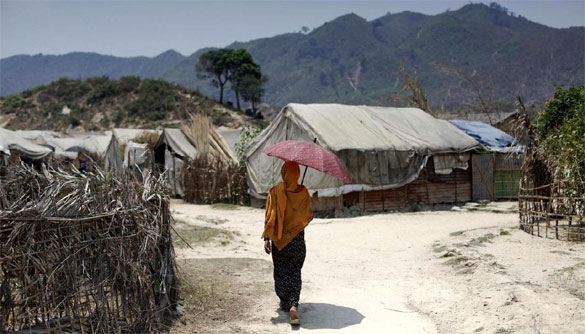
Rohingya woman walks at the Kyein Ni Pyin camp for internally displaced people
in Pauk Taw, Rakhine state, Myanmar, April 23, 2014. (Reuters)
-----
The
Rohingya genocide in the western state of Rakhine in Myanmar saw more than 1
million people flee from their homes across the border to neighboring
Bangladesh. However, an estimated 200,000 to 300,000 Rohingya still remain in
Myanmar and we do not often hear anything of them.
The reasons
for that are as bad as you might imagine: The overwhelming majority of those
hundreds of thousands of people are held in internally displaced persons camps.
In fact, the reason why they did not flee the country during the military’s
“clearing operations” in 2017-2018 was that they were already held in these
camps.
Most of them
have been there since 2012-13, when there was a huge flare-up of communal
violence between them and some of their Buddhist nationalist neighbors in
Rakhine. On that occasion, the assault against them was not directed by the
federal army — even though some police and army personnel appear to have
involved themselves in some of the actions on the aggressors’ side — and so
most did not flee Myanmar entirely. Nevertheless, their villages were
destroyed, so they had no option but to relocate to camps built by the
government.
We have
long since suspected, however, that the conditions in these camps are akin to
imprisonment. A Human Rights Watch report released last week was finally able
to shed some light on the conditions in the camps and they are as bad as feared:
Less refugee camps as per international humanitarian norms, more concentration
camps. The camps are completely economically sealed, there is barely enough
food for everyone, and virtually no education, health services or sanitation to
speak of. It is as if the authorities have put them in a holding pen and are
simply waiting for them to wither and die.
Some manage
to escape the camps and flee abroad. Indeed, whenever you hear news stories
about boat refugees in the area, landing in Bangladesh, India, Malaysia,
Indonesia and so on, it is almost always groups of Rohingya who have fled from
these camps in Myanmar. The boats are usually provided by people smugglers in a
trade that is reminiscent of the one faced by refugees trying to make their way
through Libya to Europe: Exorbitant amounts of money are extracted from the
refugees and, in return, they are given vessels that are barely seaworthy.
Often, the boats do not last the journey and everyone on board drowns — or, if
they are extremely lucky, they might get rescued by the coast patrol of another
country. If migrants are unable to pay the amounts required by the traffickers,
they will either be held for ransom from their families or sold into slavery,
typically to Thai fishing vessels, where they are once again treated as
disposable resources and death is almost a guarantee.
In other
words, those who managed to escape to Bangladesh three years ago were the lucky
ones. And they know it. Nominally, the government of Myanmar is offering to
allow them back. But their villages have long been destroyed and reapportioned
to Buddhists. If they are to return, they will return to these prison camps, in
conditions that are not just far worse than anything they are seeing in the
difficult camps in Bangladesh, but in conditions expressly designed to rob them
of any hope of a meaningful life, trapped between a state that is waiting for
them to die and people traffickers who will try to make money off them
regardless of whether they live or die.
This is why
the Rohingya who made it to Bangladesh remain in Bangladesh, and why they
should continue to remain in Bangladesh. Myanmar is very much the same country
that drove them out three years ago and it remains committed to excluding them
by any means necessary. It will drive them out again where it can, it will lock
them away and wait for them to wither and die if they won’t go, and it will
outright murder them if it has to.
-----
Dr. Azeem Ibrahim is a Director at Centre for
Global Policy in Washington, D.C.
https://www.arabnews.com/node/1749436
-----
Why Is Turkey Absent From The Table Despite
Being In The Field?
By Fehim Tastekin
Oct 15,
2020
NATO
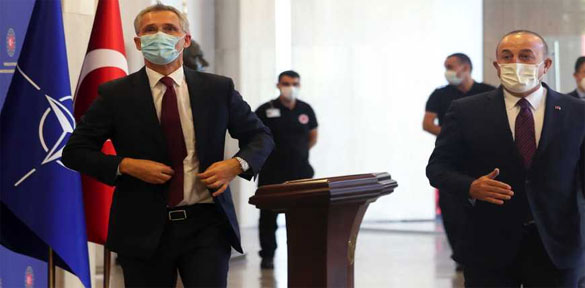
Secretary-General Jens Stoltenberg (C) and Turkey's Foreign Minister Mevlut
Cavusoglu (R) arrive for a press conference after their meeting at the Foreign
Ministry building in Ankara, on Oct. 05, 2020. Photo by ADEM ALTAN/AFP via
Getty Image
------
“We should
be in the field in order to be at the table.” So goes the motto that has
underlain Turkey’s foreign interventions in recent years. The policy, which
upholds Turkey’s involvement in conflicts beyond its borders to boost its
diplomatic say in the region, has achieved partial success in Syria but is
failing to bear fruit in Libya and the Caucasus.
The roots
of this thinking can be traced back to the 1990s, when then-President Turgut
Ozal hoped to “put one and take three” by opening a northern front on Iraq in
support of the United States in the Gulf War — an ambition he failed to realize
due to stiff opposition from military and government seniors, some of whom
resigned in defiance.
In March
2003, only five months after it came to power, the Justice and Development
Party government sought parliamentary approval to team up with the United
States in the invasion of Iraq, but it was rejected. Thirteen years later,
however, the parliament greenlit Operation Euphrates Shield to curb Kurdish
advances in Syria in what became the prelude to other Turkish military
campaigns in Syria and beyond. “Being in the field” in Syria put Turkey “at the
table” in the Astana process with Russia and Iran, though its military presence
has not always meant diplomatic achievement.
In more
recent crises, however, Turkey’s arm-twisting policy has made it a party to the
conflicts, resulting in its exclusion from settlement platforms. The dialogue
process that followed the fighting in Libya earlier this year and the efforts
to end the war between Azerbaijan and Armenia since late September are cases in
point.
On Oct. 10,
Russian President Vladimir Putin sponsored an 11-hour meeting between the Azeri
and Armenian foreign ministers, which resulted in a four-point cease-fire
declaration that precludes any role for Turkey in the solution process in the
Nagorno-Karabakh conflict, a goal that Ankara has eyed through its resolute
support for Azerbaijan. The declaration upheld the mediation of Russia, France
and the United States, the co-chairs of the Minsk Group, which has led
settlement efforts since the conflict first erupted in the early 1990s, and
asserted “the immutability of the negotiation format.”
Azerbaijan
has argued for Turkey’s inclusion into the settlement process, either as a
co-chair of the Minsk Group — a body created by the Organization for
Cooperation and Security in Europe — or through some other formula, but it has
failed to convince its interlocutors thus far. After approving the terms of the
cease-fire declaration, Azeri President Ilham Aliyev insisted that Turkey
should be involved, only to be spurned by Russia and Armenia. UN Security
Council resolutions have similarly upheld the Minsk Group as the settlement
platform in the Nagorno-Karabakh conflict.
Despite its
adamant posturing for an end to the Armenian occupation of Azeri territories
and vocal questioning of the efficiency of the Minsk Group, Ankara is well
aware of its limits in the Caucasus, a Russian sphere of influence for two
centuries. It has no choice but to limit its ambitions to gaining some
meaningful role on the Minsk platform. It would be ready to join a cease-fire
monitoring mission proposed by the Minsk Group about a decade ago if such an
initiative finally takes off. Confining the mission to some form of
Turkish-Russian collaboration, similar to the Turkish-Russian joint patrols in
Syria, would be an even better outcome for Ankara. This, however, would mean
Russian acquiescence to role-sharing with Turkey, a highly unlikely prospect.
The latest
developments in Libya have similarly shown how Turkey’s presence “in the field”
is not working as expected, even though its military assistance for the
Tripoli-based Government of National Accord (GNA) had tipped the scales in the
war earlier this year. Egypt, which had threatened to intervene to stop the
advance of the Turkish-backed forces, has managed to stay in the game as a
mediator. Given Ankara’s bitter rivalry with Cairo that goes beyond Libya,
Egypt’s hosting of talks between the Libyan parties is a clear indication of
Turkey being side-lined from the process.
Most
recently, the Tobruk-based Libyan House of Representatives and Tripoli’s High
Council of State met in Cairo Oct. 11-13 to discuss constitutional issues, with
Egypt’s intelligence chief steering the dialogue. The negotiations followed
UN-mediated military and security talks in the Egyptian city of Hurghada and
other meetings in Cairo in September. Further talks on constitutional matters
are expected to take place in Egypt.
The Turkish
government, for its part, is seeking to influence the process via GNA
representatives, who are frequent guests in Ankara. Of note, Germany’s efforts
have also been instrumental in bringing the warring parties to the negotiating
table.
Turkey’s
involvement in Libya is closely related to its energy ambitions in the eastern
Mediterranean, which have fueled tensions with Greece and Cyprus in particular
over territorial and exploration rights. Turkey has resorted to muscle-flexing
in the seas as well, although it has had other means to force negotiations on
the matter.
In short,
Ankara has proven its ability to “spoil games” in conflict zones, as government
proponents would brag, yet it is struggling to be a playmaker, falling short of
the strategic approaches that playmaking requires. Several reasons can be cited
for that failure.
Above all,
Ankara’s field-table equation goes wrong because of the disparity between its
goals and means. Despite being NATO’s second-largest standing force, Turkey
tends to exaggerate its military deterrence in distant regions. The efficiency
of Turkish armed drones in the conflicts in Syria, Libya and the Caucasus has
led to an overblown sense of “strategic power,” though such power projection
takes more than drones. The Libyan experience in particular has shown that
Turkey’s military capabilities fall short in ventures far beyond its borders.
Moreover, the government’s bragging about “fully indigenous” drones took a blow
earlier this month as Canada suspended the export of crucial drone parts to
Turkey.
How others
perceive Turkey’s might is equally important. Ankara would frequently hurl
threats that it cannot follow through. As a result, its warnings and threats have
come to be often seen as blackmail or bluffing, designed for bargaining
purposes, or as domestic grandstanding by a government that has grown reliant
on the support of nationalist quarters.
Another
downside stems from Ankara’s tendency to ignore or underestimate the
close-neighbor factor in the regions where it intervenes militarily or becomes
otherwise involved. Egypt’s clout in the Libyan crisis and Russia’s decisive
role in the Nagorno-Karabakh conflict come as reminders in this context.
Turkey’s miscalculations
owe also to its tendency to believe that the actors it backs will always adhere
to its course of action. Yet neither its Libyan nor Azeri allies would like
Turkey’s support to be as imposing as to leave them without room to maneuver.
Additionally,
Turkey’s foreign policy has become overly quarrelsome, alienating allies and
contributing to Turkey’s growing isolation in the international arena. And
Turkey’s use of Syrian militants as an intervention tool in other conflicts is
backfiring.
In sum, the
growing militarization of Ankara’s foreign policy is eroding its diplomatic
abilities. While failing to match the show of force, Turkish diplomacy has
turned to a bellicose, quarrelsome and provocative language that makes it even
harder to get results. Examples of how Turkey is losing credibility and
leverage are increasing. To cite a few, Egypt has not only seized the
initiative in Libya, but has nourished close ties with Russia to the point of
holding joint military drills in the Black Sea. France has forayed into the
Mediterranean showdown with an aircraft carrier, and the United States, too,
appears inclined to back Greece and Cyprus as Turkey is increasingly seen as a
“problem country” by its NATO allies and the European Union, despite its key geographic
location and economic potential.
https://www.al-monitor.com/pulse/originals/2020/10/turkey-russia-nagorno-karabakh-ankara-military-support-fails.html
-----
Senate Democrats Urge Library of Congress to
Recognize Armenian Genocide
By Adam Lucente
Oct 15,
2020
Senate
Democrats wrote a letter to the Library of Congress on Wednesday demanding the
national institution refer to the 20th century killings of Armenians in Turkey
as a “genocide.” The move comes at a time of friction between some members of
Congress and the Trump administration on Turkey, and as Turkey has backed
Azerbaijani forces against Armenian ones in the breakaway region of
Nagorno-Karabakh.
Robert
Menendez of New Jersey, who is the highest-ranking Democrat on the Senate
Foreign Relations Committee, signed the letter along with fellow Democratic
Sens. Chuck Schumer of New York, Sheldon Whitehouse of Rhode Island and
Elizabeth Warren of Massachusetts.
The term
Armenian genocide is often used to refer to the killings and forced
displacement of Armenians from 1915-23 by Turks; Greeks and Assyrians were also
killed. The Turkish government admits there were deaths, but adamantly disputes
the events constituted a genocide.
The Library
of Congress currently refers to the period as the “Armenian massacre” in its
database. The senators wrote the letter in support of recent efforts by the
University of California, Los Angeles and the Armenian National Committee of
America to change this phrasing.
The Library
of Congress’ position is consistent with that of the executive branch, which
does not recognize the events as a genocide. The senators said the library
should do so, however, because Congress does recognize the Armenian genocide.
“There is
no statutory or constitutional basis for the Library of Congress to choose the
State Department as the U.S. foreign policy authority on this topic over the
U.S. Congress,” wrote the senators.
“The
scholarly consensus is clear that ‘Armenian Genocide,’ not ‘Armenian
massacres,’ is the most accurate description of this tragedy,” they added.
In
December, the Senate voted to recognize the Armenian genocide, following the
House of Representatives vote to do the same in October 2019. The administration of US President
Donald Trump did not follow suit.
The United
States has avoided recognizing the genocide for years so as not to harm
relations with Turkey, which is an important NATO ally.
A
Democratic Senate aide told Al-Monitor that the letter was also sent because of
the Trump administration’s refusal to recognize the genocide.
US-Turkey
relations improved in October 2019 when Trump repositioned US troops in
northeast Syria, which allowed Turkey to attack Kurdish forces there. Many
Democrats criticized the move.
Some
members of Congress continue to criticize Turkish policy. In August, Menendez
and Democratic Sen. Chris Van Hollen of Maryland wrote to US Secretary of State
Mike Pompeo to demand he place sanctions on Turkey over its drilling and naval
activity in the eastern Mediterranean. Greece, Cyprus and the European Union
believe the areas in question are Greek and Cypriot territory.
There are
Republicans in Congress critical of Turkey as well. In a September Senate
hearing with State Department officials, Republican Sen. Todd Young of Indiana
took a shot at Turkish President Recep Tayyip Erdogan.
“Clearly,
Turkey has rapidly radicalized under Erdogan’s regime,” said Young.
Turkey has
not responded to the Senate letter to the Library of Congress. When the Senate voted
to recognize the Armenian genocide last year, Turkish Foreign Minister Mevlut
Cavusoglu dismissed it as a “political show.”
Democratic
presidential nominee Joe Biden has also criticized Turkey on the campaign trail
recently. This week, the former vice president called Turkish support for
Azerbaijan in the war with Armenia over the Nagorno-Karabakh region
“irresponsible.”
The Senate
letter does not mention the Nagorno-Karabakh conflict.
https://www.al-monitor.com/pulse/originals/2020/10/senate-democrats-letter-library-congress-armenian-genocide.html
-----
Time for Europe to Listen To the Iranian People
By Dr. Majid Rafizadeh
October 15,
2020
Over the
last four decades, European governments have implemented various policies
toward Iran, but one thing has been made clear in this period: Appeasement of
the ruling clergy only helps advance their hard-line agenda.
In 1992,
the European powers experimented with a precarious policy toward Iran. They
wagered that negotiating with the fundamentalist rulers of Tehran may end up
changing their egregious behavior, especially at home. The regime’s human
rights record was so appalling that Europe tried to rationalize its dicey
rapprochement by pretending to have a “critical dialogue.” At the end of the
fatal experiment, however, not only had the regime not modified its behavior,
but it had ramped up its human rights violations and conducted bold terrorist
attacks on European soil.
The
critical dialogue policy was suspended in 1997 after the German judiciary
indicted senior Iranian regime officials over terrorist killings in that
country. Even the most basic realpolitik lesson learned should have been that
appeasement emboldens the regime and makes the situation worse.
Following
that logical line of thought, dialogue should have been replaced by holding the
regime accountable for its past actions in order to prevent future
provocations. Shockingly, however, the European capitals doubled down on a more
conciliatory approach, engaging Tehran in even broader negotiations beginning
in the early 2000s, ostensibly tackling Iran’s clandestine nuclear program.
A few short
years after the conclusion of that attempt in 2015, the Belgian judiciary is on
track to repeat what German courts found 23 years ago, but on a much larger scale.
Next month, regime diplomat Assadollah Assadi will be put on trial in a
breathtaking case that sees him accused of direct involvement in a terrorist
plot in France.
Prosecutors
say that, in June 2018, Assadi delivered 500 grams of the powerful explosive
triacetone triperoxide to his accomplices with the aim of bombing an Iranian
opposition rally in Paris. Had the plot not been discovered at the very last
minute, the terrorist act could have left hundreds dead, including
international dignitaries and many European parliamentarians.
Those
parliamentarians and many of their colleagues are now furious that the EU is
continuing with its failed policies on Iran, even as the regime’s terrorist
plots become more daring and the human rights situation worsens by the day.
More than 40 European Parliament members, as well as national MPs in Poland and
Germany, last week addressed the issue in Brussels and Berlin, respectively.
They
vociferously condemned the regime’s terrorism and ongoing crimes against
humanity. Insisting on action rather than words, they also urged their
governments to live up to Europe’s political and moral obligations by adopting
a firm policy toward the regime, including shutting down its embassies.
The keynote
speaker and one of the main targets of the regime’s terrorism over the past two
years, including a plot in Albania and the one in France, was Maryam Rajavi,
the president-elect of the National Council of Resistance of Iran (NCRI). She
echoed the parliamentarians’ sentiments and insisted there should be no doubt
that the regime is inherently incapable of moderating its behaviour, and the
Iranian people should overthrow that it. This further highlighted the
legitimacy and international recognition of the opposition as a viable
democratic alternative. The NCRI’s message has had a meaningful impact both
inside and outside Iran, forcing regime officials to warn about the growth of
its reach and the drawing of the younger generation to its democratic 10-point
plan.
Iran’s
ongoing crimes against humanity have been swept under carpet by the EU for far
too long. They are simply ignoring the massacre of 30,000 political prisoners
in the summer of 1988, the executioners of which continue to hold senior
positions in the Iranian government. And, when Tehran last year killed 1,500
protesters and arrested and tortured 12,000 others, Europe simply watched from
afar, contenting itself with occasional statements of condemnation.
More
importantly, after several failed and costly rounds of dangerous experimentation
with policies of appeasement and negotiations, the Europeans continue to make
the same mistakes. As the famous quote reminds us, “Insanity is doing the same
thing over and over again and expecting different results.” Individual European
governments and the EU as a whole would do well to listen to the voices of the
Iranian people.
To stop
Tehran’s provocations, especially its terrorism, Europe must hold the regime
accountable for its foreign adventurism and its reprehensible repression of
dissent and peaceful protests at home.
What should
a firm policy include as its core measures? The EU should adopt legislation to
expel Iranian “diplomats” and intelligence agents like Assadi, who may be
plotting further terrorist attacks. They should consider closing down Iranian
embassies. And, most importantly, they should designate the Islamic
Revolutionary Guard Corps and its proxies as terrorist organizations.
When it
comes to human rights, the EU should seek to send an independent international
mission to investigate Iran’s ongoing crimes against humanity and visit the
country’s prisons. It must tell Tehran that it should stop its executions
before any further diplomatic engagement.
For once,
Europe should adopt a sane policy on Iran: A policy that better detects Tehran’s
threat while hearing the legitimate calls for democracy of the Iranian people.
Otherwise, European insanity will continue to breed Iranian terrorism.
----
Dr. Majid Rafizadeh is a Harvard-educated
Iranian-American political scientist.
https://www.arabnews.com/node/1749446
----
Crucial Sunday for Cyprus
By Yusuf Kanli
October 15
2020
After the
Oct. 11 inconclusive first vote, two frontrunners of the first round will
contest this Sunday for the seat of the president of the Northern Cyprus. One
of them is incumbent socialist Mustafa Akıncı, a pro-federalist and the other
is conservative National unity Party (UBP) leader and prime minister, Ersin
Tatar, a supporter of a two-state settlement on the island.
Northern
Cyprus is recognized only by Turkey and its economic survival largely depends
on strong financial assistance from Ankara. Particularly over the past few
years since the collapse of the Cyprus talks at Crans Montana in July 2017,
there has been a rift between Akıncı and the Turkish leadership and at several
occasions. Turkish Foreign Minister Mevlüt Çavuşoğlu publicly accused the Turkish
Cypriot leader of not telling the truth and betraying the fundamentals of the
Cyprus talks position on which Turkey and the Turkish Cypriot government has
established full understanding.
Interestingly,
while Ankara has been actively supporting Tatar, mathematics on the ground
indicate most likely that Akıncı might win a second term in office. What would
be the impact of such an awkward situation, particularly, if Akıncı has been
supportive of the Greek Cypriot’s demand to resume the Cyprus talks from where
they collapsed in the summer of 2017, while Ankara and Turkish Cypriot
conservatives say that before any new round of talks, the two sides on the
island, the U.N. secretary-general and the three guarantor powers should come
together at an informal summit to decide a new target and modality for the
process as 60 years of talks in the previous format were proven doomed to fail.
Nasraddin
Hodja, the great medieval folk hero of this region, is often said to have added
some yeast to Akşehir Lake with the aim of turning it into a huge bowl of
yoghurt. That, however, might have a greater chance of becoming reality than
Greek Cypriots agreeing to share the island, its administration and sovereignty
with Turkish Cypriots on the basis of political equality, bi-zonality and
bi-communality.
Another
Nasreddin Hodja joke stresses that rather than who deserves or who should have
something, “whoever pays for it blows the whistle.” Turkish Cypriots apparently
disagree. Or do they really disagree? We shall see that in Sunday’s second
round of voting. Would the electorate support an Akıncı who has been constantly
in a rebellious mood against Turkey or a Tatar who has been in a full
allegiance mode with the Turkish leadership?
Interestingly
in the first round of voting in Nicosia, Kyrenia, Morphou (Güzelyurt), mostly
populated by Turkish Cypriots, Akıncı came first, while he came third in the
Iskele electoral district and second in Famagusta, whereas Tatar came first in
both of those districts. What was the peculiarity of those two districts? Most
mainland Turks who have acquired citizenship of the Turkish Cypriot state were
living in those two districts. This is to say that the move to open the Varosha
beach to the public, which is still under military control, as well as a
ceremony to mark the resumption of water flow from the mainland through a
repaired pipeline -- both actions that opponents have declared as Turkish
manipulation in favor of Tatar -- have played well in those two regions.
Could Tatar
manage to maintain his lead and win the presidency on Sunday? Indeed very
difficult as the Republican Turks’ Party, whose candidate Tufan Erhürman came
third with almost 22 percent of the vote in the first vote – decided to support
Akıncı in Sunday’s election. Tatar’s victory hinges on his success to convince
the almost 47 percent electorate, mostly disgruntled conservatives, who
boycotted the first vote to go to the ballot box this Sunday and vote for him.
Most of those people, however, were Turkish Cypriot nationalists who considered
as manipulation and angered with Turkey’s strong support for Tatar. Could they
be convinced to go to the polls and vote for Tatar? Very unlikely.
Thus, most
likely, as was the case in the 2015 election, Akıncı will come back from the
second position with the support of other socialists, social democrats and
Turkish Cypriot nationalists and win a second term in office with over 65
percent of the vote.
In that
case, how will a consolidated Akıncı presidency, continued budgetary dependency
on Turkey and confronting political objectives between Akıncı, the majority in
Turkish Cypriot Parliament, and the Ankara government cohabitate and contribute
to any effort aimed at resolving the Cyprus problem?
https://www.hurriyetdailynews.com/opinion/yusuf-kanli/crucial-sunday-for-cyprus-159150
-----
URL:
New Age Islam, Islam Online, Islamic Website, African
Muslim News, Arab
World News, South
Asia News, Indian
Muslim News, World
Muslim News, Women
in Islam, Islamic
Feminism, Arab
Women, Women
In Arab, Islamophobia
in America, Muslim
Women in West, Islam
Women and Feminism