
Middle East Press On Gal Gadot to Play Cleopatra, Iranian Women and Azerbaijan: New Age Islam's Selection, 14 October 2020
By New Age Islam Edit
Bureau
14 October
2020
• Moviegoers Split As Gal Gadot to Play
Cleopatra
By Rina Bassist
• Cleric Reopens Scars of Acid Attacks after
Threatening Iranian Women
A Correspondent In Tehran
• Israel’s President Warns of Growing Social
Schism, Loss of Moral Compass
By Ben Caspit
• Taliban No Easy Pushovers On The Negotiation
Table
By Sajjad Ashraf
• For Azerbaijan, Diplomatic Solution with
Pashinian Seems Impossible
By Talha Kose
------
Moviegoers Split As Gal Gadot To Play Cleopatra
By Rina Bassist
Oct 13,
2020

Gal
Gadot attends the 2018 Vanity Fair Oscar Party hosted by Radhika Jones at
Wallis Annenberg Center for the Performing Arts on March 4, 2018, in Beverly
Hills, California. Photo by Dia
Dipasupil/Getty Images.
------
Israeli
actress Gal Gadot made an exiting announcement Oct. 11. "As you might have
heard I teamed up with Patty Jenks and Laeta Kalogridis to bring the story of
Cleopatra, Queen of Egypt, to the big screen in a way she’s never been seen
before. To tell her story for the first time through women’s eyes, both behind
and in front of the camera," she tweeted. In another tweet, the
"Wonder Woman" actress wrote, "Cleopatra is a story I wanted to
tell for a very long time."
Media
outlets worldwide were quick to pick up the story, hailing another Jenks-Gadot
project after "Wonder Woman" and the upcoming "Wonder Woman
1984." Paramount Pictures is reportedly set to distribute the film, with
Laeta Kalogridis writing the screenplay. Of course, all the coverage mentions
the most famous Cleopatra — Elizabeth Taylor, whose 1936 film
"Cleopatra" won four Oscars, including Best Picture.
But not
everyone has congratulated Gadot. Several commenters slammed Paramount for
casting Gadot for the role. Criticism came from all over. Some people were
angry about a white actress being cast in the role of the Egyptian queen;
others lambasted Paramount for casting an Israeli instead of an Arab actress.
"Which
Hollywood dumbass thought it would be a good idea to cast an Israeli actress as
Cleopatra (a very bland looking one) instead of a stunning Arab actress like
Nadine Njeim? And shame on you, Gal Gadot. Your country steals Arab land &
you’re stealing their movie roles," tweeted Sameera Khan. User Abdul
El-Sayed tweeted, "So … there were no Egyptian women to play, um, an
*Egyptian* queen?"
Other
tweets suggested that the role should have gone to an African woman, like
Yahoo! Entertainment's headline, "Gal Gadot starring in new 'Cleopatra'
draws backlash: 'Can't they find an African actress?'" Twitter user Tony
Laface wrote, "Another attempt to white wash a historical figure!"
The Twitter
argument went on for many hours, with hundreds of statements and reactions over
the choice of Gadot, her nationality and the true history of Cleopatra. One
user wrote, "Get Educated !!! your hate of Israel make you look
ridiculous. FYI Cleopatra wasn't Egyptian or Arab, she was Greek! Stop being
ignorant. Gal Gadot is the perfect choice."
The team
behind the film weighed in with tact. “Incredibly excited to get the chance to
tell the story of Cleopatra, my favourite Ptolemaic Pharoah and arguably the
most famous Macedonian Greek woman in history," tweeted screenplay author
Kalogridis, pointedly referring to Cleopatra’s origins. Several news sites
noted that the idea for the film apparently came from Gadot herself, who had
long dreamed of telling the story of the powerful queen.
The virtual
bashing was not the first time Gadot has received insults over her Israeli
heritage. In 2017, Lebanon banned "Wonder Woman" from the country’s
movie theatres because of Gadot’s Israeli nationality. One might wonder what
will happen when Gadot’s new film reaches Egyptian theatres. One thing is sure;
Gadot’s many fans across the world are already eagerly awaiting its release.
https://www.al-monitor.com/pulse/originals/2020/10/israel-egypt-lebanon-gal-gadot-elizabeth-taylor-cleopatra.html
----
Cleric Reopens Scars Of Acid Attacks After
Threatening Iranian Women
A Correspondent In
Tehran
Oct 13,
2020
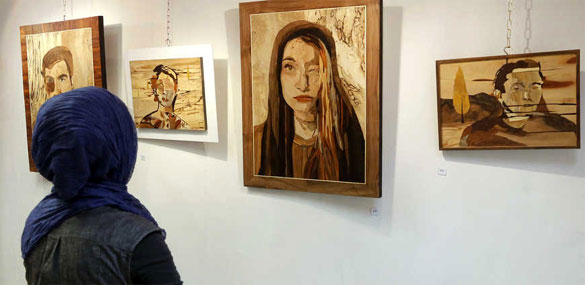
A
woman looks at art work made by Iranian victims of acid attacks at the Ashianeh
Gallery in Tehran on Feb. 28, 2018.
Photo by ATTA KENARE/AFP via Getty Images.
----
“We must
make the social environment unsafe for these people. … We can’t let them simply
break the norms in streets and parks,” said Ayatollah Yousef Tabatabai-Nejad in
reference to Iranian women who violate the Islamic Republic’s mandatory dress
code known as hijab. Tabatabai-Nejad is the Friday prayer imam of the central
city of Esfahan and a de facto local governor, as is the case with all Friday
prayer leaders across Iran. He and his colleagues hold their mandates from
Supreme Leader Ayatollah Ali Khamenei.
“We should
have no fear in facing those norm breakers,” the cleric added, prompting
widespread fears about a fresh wave of public violent attacks against women
with loose headscarves. Back in 2014, the city of Esfahan was rocked with
coordinated chain assaults by religious fundamentalists on motorbikes. The
attackers splashed acid on the faces of their female victims, who were mostly
caught off guard behind wheels. Of the 12 cases reported, only four ended up in
formal lawsuits. And despite pressing demands from a shaken public for speedy
trials, the Iranian judiciary declared the file closed four years later,
bringing none of the perpetrators to justice.
The 2014
acid attacks came only after the same Friday prayer imam openly called for
force against hijab violators. In a provocative speech, Tabatabai-Nejad said
verbal advice would no longer work and time had come to “raise the sticks.”
Six years
on, the cleric’s new threats appeared to have reinjected fresh fears among
Iranian women. More strikingly, it reopened wounds that remain unhealed on the
faces of the acid attack victims who shared traumatic accounts of their ordeals
and their frustration over the justice that was never served.
“Back then,
the city was shattered with horror. … The same story is happening again. I
don’t feel well these days,” wrote Marzieh Ebrahimi, one of the acid attack
survivors, still reeling from the tragic encounter and coping with the
permanent scars. “It’s our right to be able to go out with no anxiety. … We are
not detainees, we are citizens,” she added.
Renowned
women's rights activist Azar Mansouri also strongly questioned the Friday
prayer imam’s comments, saying such a stance “only further widens the gap
between the public and the state.” She advised the ultraconservative ayatollah
to “abandon this discourse before it’s too late.” In another reaction, Minister
of Communication and Information Technology Amir Nazemi urged the cleric to
clear the air and specify what he meant by creating an “unsafe environment” for
those women.
While it’s
not typical of Iran’s powerful figures to bow to pressure and publicly retract
their remarks, the building backlash ultimately forced the hard-line cleric to
come out with some sugar-coated correction, if not an apology, saying his words
had been misinterpreted and that he did not endorse physical attacks.
The
cleric’s original inflammatory remarks, however, are no novelty in the Islamic
Republic’s propaganda about controversial social issues. The ruling
establishment has been developing over the past four decades its own version of
“Promotion of Virtue and the Prevention of Vice,” which has served as a free
pass for religious fanatics to justify their violence under the guise of a
sacred fight, which more often than not has been found by advocates as a breach
of civil rights. Videos make rounds every now and then across Iranian social
media showing frustrated women in arguments or even brawls with religious
extremists who have an institutionalized “duty” in the theocratic system to
warn random female strangers about their hijabs.
An even
stronger green light came from Khamenei in 2017 when he introduced the notion
of “atash-beh-ekhtiar,” the Persian equivalent for “fire at will.” Under the
umbrella concept, Khamenei advised “revolutionary youth” not to wait for orders
but rather to act independently on cultural and social problems. The
instruction has been interpreted as another boost to the bike-riding,
plain-cloth regime loyalists in their campaign to “guide” Iranian women in the
streets while enjoying the privilege of immunity from prosecution as witnessed
in the case of the Esfahan acid assaults.
https://www.al-monitor.com/pulse/originals/2020/10/iran-cleric-scars-acid-attacks-threat-iran-women-tabatabaee.html
----
Israel’s President Warns of Growing Social
Schism, Loss Of Moral Compass
By Ben Caspit
Oct 13,
2020
President
Reuven Rivlin could no longer contain himself. Rivlin, perhaps the last of a
generation of dignified elder statesmen, took the podium on Oct. 12 to deliver
the opening address of the Knesset’s winter session. The speech was meant to
douse the flames licking at the edges of Israeli society. “It is unthinkable
that every night, demonstrators are beating demonstrators. Police are beating
demonstrators. Demonstrators are throwing stones at the police,” Rivlin
thundered. “Israel’s tribalism is breaking out through the cracks, and
accusatory fingers are pointed from one part of society to the other, one tribe
to the other. Stop! Please stop! This is not the way. Pain must have its place.
… It seems to me as if we have lost the moral compass that was with us from the
state’s independence until today. The compass of fundamental principles and
values that we are committed to uphold.”
The
unprecedented speech, alternately warning and beseeching, did not resonate as
expected. The public climate in Israel these days is the most explosive ever.
Israel has experienced the assassination of a prime minister (Yitzhak Rabin in
1995), but it has never been this close to civil war.
This is not
the president’s first reference to the tribal fault lines in Israeli society.
In a defining 2015 address to the annual Herzliya Conference, Rivlin described
the four tribes emerging from the country’s socio-economic shifts — secular,
national/religious, ultra-orthodox and Arab — and warned of the lack of unity
and cohesion among them. In the years since, the chasms among them have
deepened. The police investigations of corruption by Prime Minister Benjamin
Netanyahu and the subsequent decision by Attorney General Avichai Mandelblit to
indict him on three criminal charges appeared to pour a huge barrel of fuel on
the simmering tribal fires.
“The
situation on the streets is highly flammable,” a senior police source told
Al-Monitor on condition of anonymity. The official, who is involved in attempts
to control the disruptions to public order resulting from a nationwide wave of
protests against Netanyahu, added that he had not encountered such a situation
throughout his career. “Such hatred of Israelis against each other, such
alienation between the camps. Sometimes it really scares me,” he confessed.
Israel has
known harsh political discord in its 72 years. The struggle between left and
right was always heated and painful. Deep disagreements over peace agreements
with Israel’s Arab neighbors and the future of the West Bank and the Jewish settlements
there have divided Israeli society for decades. This is different. There are no
peace agreements entailing concessions of homeland territories on the agenda.
There are no disagreements over security issues. There are no particularly
disruptive social-economic struggles. What we have here is a giant pool of bad
blood and a bitter war between the two halves of Israeli society over one man,
Benjamin Netanyahu — a war pitting the “only Netanyahu” tribe against the
“anyone but Netanyahu tribe.”
These two
camps have been facing off for months, teeth bared, vowing to fight to the
bitter end — or victory. Those who believe that Netanyahu is the root of all
evil, a clear and imminent danger to the well-being and security of the State
of Israel, versus those who believe with all their hearts that Netanyahu is a
modern-day Messiah, a world-class leader touched by the “hand of God.” Neither
side intends to compromise, the fault line appears unprecedented and the chasms
seem unbridgeable.
Given the
dangerous abyss on which the Jewish State is verging, Netanyahu might have been
expected to ease up, take time off to defend himself in court, and resign the
way his predecessor Ehud Olmert did at the height of the police corruption
inquiries against him (which ultimately sent him to jail). Netanyahu is not
living up to these expectations. On the contrary, he is living up to the
prophecy sounded by Rivlin several years ago when the police investigations
began, to the effect that Netanyahu would never cave, and if he goes down, he
would take everyone with him.
Netanyahu
has had a number of opportunities to negotiate a dignified plea deal with the
attorney general, which would have ended his trial even before it has properly
begun and protected Israeli society from being torn apart during the court
hearings scheduled to begin in January 2021. He has refused. Instead, on the
first official day of the trial in May, Netanyahu arrived at Jerusalem District
Court “armed” with a phalanx of Likud party lawmakers and ministers who
provided a security cordon around him as he delivered a bitter diatribe against
the country’s law enforcement authorities. In his efforts to avoid the arm of
the law, Netanyahu has no qualms about crushing public trust in what remains of
the police, state prosecution, attorney general’s office and the judiciary. He
believes public support will help him overcome the system that has already sent
a prime minister, president, finance minister and many other senior officials
to jail over the past decade or more.
The
coronavirus pandemic has exacerbated the latest developments to a crisis of
biblical proportions. If Netanyahu could count on high and stable popularity in
the past, he now finds himself on the defensive, perhaps in despair. From a
rate of very low unemployment, the jobless rate has soared within months to
double digits with some 1 million Israelis out of work. The public, by and
large, blames Netanyahu’s failed management for the crisis. His Likud has
plunged in the polls from a record of 41 Knesset seats a few months ago to 26
in the latest poll on Oct. 6. Netanyahu is losing his political-public
immunity.
Pro-settler
Yamina leader Naftali Bennett and his party colleague Matan Kahana voted with
the rest of the opposition parties in favor of a no-confidence motion in
Netanyahu’s government earlier this week. Netanyahu, who was for years the
unchallenged leader of their right-wing camp, was quick to accuse Bennett of
treason and switching to the political left.
The writing
is already on the wall. Netanyahu’s government partner Blue and White leader
Benny Gantz presented him with an ultimatum last week, warning that unless the
prime minister approves the state budget by the end of the year, Israel would
find itself facing elections. Netanyahu is being pushed backed inexorably
toward a wall as he faces a deep abyss. Anyone who knows the man knows that he
never gives up. Anyone familiar with current developments in Israeli society
knows that this characteristic of Netanyahu’s could drag the country into a crisis
rivaled only by the destruction of the two Jewish temples in Jerusalem in
ancient times.
https://www.al-monitor.com/pulse/originals/2020/10/israel-reuven-rivlin-ehud-olmert-benjamin-netanyahu-bennett.html
-----
Taliban No Easy Pushovers on The Negotiation
Table
By Sajjad Ashraf
October 12,
2020
The talks
in Doha between the Taliban and the Kabul regime that began seven months late
on September 12 are in hiatus over disagreements on how to frame a code of
conduct that will guide the broader talks. Their differences over the
procedurals are wide. It is only after a framework is agreed that the two sides
will come to tackle substantive issues like ceasefire, type of governance,
power sharing, and a host of difficult issues that will need to be resolved.
Seeking to
build support for ceasefire while the negotiations continue between the two
sides, Afghan President Ashraf Ghani was in Doha seeking Qatar’s offices in
persuading Taliban for flexibility over ceasefire, power sharing or other
knotty issues.
Earlier,
Dr. Abdullah Abdullah, Chairman of Afghanistan’s High Council for National
Reconciliation — the body created to lead negotiations with the Taliban —
visited Pakistan for similar purpose. Underscoring Pakistan’s central role in
the peace process, Abdullah asked Pakistan’s powerful military to use its
influence to press the Taliban to reduce violence.
Dr.
Abdullah, a member of erstwhile Northern Alliance which led the 2002 putsch
against the Taliban, a former foreign minister and three-time presidential candidate,
retains a significant following especially among the non-Pashtuns in
Afghanistan. As Northern Alliance drew its support from powers antithetical to
Pakistan, Dr. Abdullah’s public pronouncements reflected those interests.
Recognising Pakistan’s centrality in the peacemaking process he is now
‘encouraged’ by the tone of his conversations in Pakistan.
Intra-Afghan Dialogue
The
Taliban, who have fought their way from a rag tag group of resistance fighters
to a formidable force have crafted clear positions and did not concede much
ground on their fundamental objective of getting the US out of Afghanistan.
They only reluctantly acquiesced to an intra-Afghan dialogue, representing
‘Afghan Groups.’
Now, when
they have entered into negotiations, their focus remains on the nature of the
state they want established, on power sharing, on how the government is to be
sustained. Issues, which the western groups or the Kabul regime consider
important like status of women, fundamental rights come secondary for them.
Ceasefire, which is important for Kabul is the least important for them because
they do not want to give away their battlefield advantage.
For
Taliban, faith guides the state ideology and Sharia will be the ‘operative
framework’ to run the affairs of the state. For Kabul, the country already has
a constitution that holds Sharia above others thus making the character of the
state sufficiently Islamic allowing for protecting women’s rights, freedom of
expression and electoral democracy.
The Taliban
understand that puritan application of Islamic injunctions during their
previous regime during the late 1990s alienated them from virtually all
countries. Influenced perhaps, by the public opinion their actions have
indicated that they may be ready for compromises in certain areas. In break
from their previous government policies they allow girls schools in areas under
their control. This time the Taliban seem more inclined to let the systems
evolve rather than impose it through a state diktat. Based on their objectives,
Taliban seeks to draw their support from the communities they represent.
Ideologically Hard-line
Whether the
interlocutors agree to an interim arrangement before a new dispensation, power
sharing is the most intractable issue. And here lies the dilemma for the
Taliban political leadership. Having engaged the most powerful military for two
decades, and compelling them to seek exit, Taliban interlocutors are looking at
a lion’s share of power. The rank and file who gave away their lives and limbs
for the principle of getting the ‘occupation forces’ out will be loath to
leaving authority in the hands of others. Hoping for a ceasefire is therefore,
a pipe dream. They are captives of their battle hardened psychological make up
that anything less than total victory is surrender, which endangers the
movement’s unity.
The
alignment of political positions that either side holds is likely to be slow.
There will be stalemates or even walk outs in frustration. Pushing the
interlocutors to hasten the process will produce results that either side may
not be fully committed to hold. The outside powers should let Afghan
interlocutors to move at the pace they are comfortable with, to arrive at a
durable peace. After all Vietnam’s formal peace negotiations dragged through
1968 to January 1973 when the peace agreement was signed.
The western
concept of democracy is America’s deadliest export. There are several failed
and costly experiments like Vietnam, Iraq, Libya and Afghanistan and many more
— countries where people belong to a different culture. It is time Western
powers realise that ‘their democracy’ is not the best governance system for
people with totally different history and ethos. Peaceful transition in Afghanistan
will only hold if it is supported by the conservative elements who hold a sway
over the Afghan society.
----
Sajjad Ashraf served as an adjunct professor at
the Lee Kuan Yew School of Public Policy, National University of Singapore from
2009 to 2017. He was a member of Pakistan Foreign Service from 1973 to 2008 and
served as Pakistan’s consul general in Dubai during mid 1990s.
https://gulfnews.com/opinion/op-eds/taliban-no-easy-pushovers-on-the-negotiation-table-1.74512759
----
For Azerbaijan, Diplomatic Solution with
Pashinian Seems Impossible
By Talha Kose
October 14,
2020
The ongoing
military confrontation between Armenia and Azerbaijan continues to escalate
despite the recent calls for a cease-fire.
From the
first day of a recently declared truce, the Armenian side violated the uneasy
peace by shelling civilian areas in Azerbaijan's cities.
Even
Russian mediation was insufficient to deter the Yerevan side from attacking
civilian areas. Moscow does not have a well-planned policy to reach a permanent
cease-fire among the fighting parties.
The Russian
authorities are less than sympathetic to Armenian Prime Minister Nikol
Pashinian, but they do not want the Armenian military to be depleted quickly.
Russian efforts serve the purpose of freezing the conflict for another couple
of decades, rather than finding a permanent solution.
Pashinian's
call for international support for his country's aggression did not find a
significant response from Moscow. Meanwhile, Brussels and other European
capitals were reluctant to back Armenian violations – with the exception of
France.
Across the
U.S. and Europe, the Armenian diaspora tried to mobilize their politicians, but
Yerevan's inhumane war crimes could not find strong backing.
Pashinian's
plans to mobilize the international community have backfired for the moment, as
he tries to harness the region with "Christian solidarity," but this
narrative has attracted very few.
One of the
key reasons behind the current escalation in Nagorno-Karabakh is the aggressive
motives and incompetent efforts of the prime minister, given the balance of
power has changed in favour of Azerbaijan over the last two decades.
Azerbaijan
was preparing to liberate her territories from Armenian occupation via a
military build-up, diplomatic efforts and economic development, with
Azerbaijani leadership making remarkable progress in developing the country.
Strengthening
ties with Turkey and Israel and improving Azerbaijan-European Union ties in the
realm of energy have been cornerstones of Azerbaijan's recent diplomatic
achievements. Baku, in the meantime, took care not to antagonize Moscow.
Despite Moscow's bias in favor of Yerevan, Azerbaijan has tried to improve its
relations with Russia.
Pashinian
came to power after street protests in 2018, when the Armenian people grew fed
up with the former corrupt regime and the rule of oligarchs. Armenians sought
to get rid of a rotten political system that was led by Mafiosi networks.
Despite the
Armenian diaspora's support, the country's economic system has been in decline
for an extended period. Young Armenians have sought opportunities outside of
their country, while those who have relatives outside of the country struggled
to emigrate.
The
Armenian diaspora in the U.S. and Europe did not wish to invest further in a
system where the corrupt oligarchs controlled the entire economy. It was almost
impossible to criticize the security establishment, which legitimized itself
within the illegal occupation of Nagorno-Karabakh and the surrounding regions. Russian
security support was crucial for the Armenian security apparatus against
Azerbaijan's rising military power.
Pashinian,
a former journalist, mobilized the Armenian people and led street protests to
topple the government, to Moscow's displeasure as Russia considers such moves
contagious. This is why Moscow wants to keep Belarusian President Alexander
Lukashenko in power despite the widespread popular protests all over Belarus.
Pashinian
formed a government of anti-establishment figures with no experience in
politics. This was promising in the early periods as an opportunity for a
constructive change. However, when the country started to face harsh realities,
Pashinian abandoned progressive aims and switched to dangerous populist
discourses.
Even Pashinian's
wife, Anna Hakobyan, tried to stimulate Armenian militarization by wearing
military uniforms and encouraging the forming of militias. Pashinian's
increasingly ultranationalist discourse and aggressive military moves targeting
Azerbaijani territories – first at Tovuz and around the line of contact – was a
sign of desperation rather than part of a broader plan.
Pashinian
bet on Moscow and other international actors saving Armenia in the most recent
escalation, by which he planned to generate solidarity among the Armenian
people against Azerbaijan. However, he has lost credibility as a result,
needing to declare a state of emergency and restrict media coverage of the
ongoing war.
After such
aggressive moves and incompetent foreign policy, Pashinian has made himself an
obstacle to a peaceful resolution of the Nagorno-Karabakh conflict. His attacks
against Azerbaijan have shaken up the status quo in the long-frozen conflict,
but not in favor of Armenia.
Moscow and
other international actors also do not trust Pashinian because of his war
crimes targeting Azerbaijani civilians.
With the
harsh realities of military defeat, he will eventually lose popular support
among the Armenian population. He is now a significant obstacle to diplomatic
efforts to reach peace. Sooner or later, the Armenian people will punish him,
if not the international courts.
Making a
diplomatic deal with Pashinian and his representatives will not help Baku. It
will only legitimize Armenian aggression. While there is an urgent need for the
current conflict's diplomatic solution, unfortunately, the conditions are not
ripe for reaching a permanent solution.
https://www.dailysabah.com/opinion/columns/for-azerbaijan-diplomatic-solution-with-pashinian-seems-impossible
-----
URL: https://newageislam.com/middle-east-press/middle-east-press-gal-gadot/d/123133
New Age Islam, Islam Online, Islamic Website, African Muslim News, Arab World News, South Asia News, Indian Muslim News, World Muslim News, Women in Islam, Islamic Feminism, Arab Women, Women In Arab, Islamophobia in America, Muslim Women in West, Islam Women and Feminism