
How Do You Solve A Problem Like Aung San Suu Kyi?: New Age Islam's Selection, 28 March 2016
New Age Islam Edit Bureau
28 March 2016
• How Do You Solve A Problem Like Aung San Suu Kyi?
Dr. Azeem Ibrahim
• We Saudis Don’t Need Vigilantes
By Sabria S. Jawhar
• The Arab, the Iranian, the Revolutionary
By Hamid Dabashi
• Using Media for Image Building
By Abdulateef Al-Mulhim
• Iran’s Cyber Crimes
By Abdulrahman Al-Rashed
• A Symbol of Muslim Unity
By Talal Alharbi
• Impacts of Corporal Punishment on Children
Saad Al-Dosari
Compiled By New Age Islam Edit Bureau
------
How Do You Solve A Problem Like Aung San Suu Kyi?
Dr. Azeem Ibrahim
28 March 2016
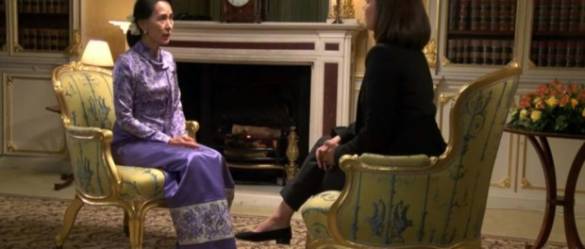
Aung San Suu Kyi
--------
Just as Aung San Suu Kyi gets ready to take over the reins of power in Myanmar after a long and dramatic three decades of fighting for democracy in her country, a new biography reveals she has made rather off-colour remarks about an interview in 2013. It would seem that Ms Suu Kyi does not like being interviewed by Muslims. Even if they work for the BBC who have consistently covered her political career in a positive light.
The interview with Mishal Husain did get rather more pointed than the treatment Ms Suu Kyi expects from Western media, but it was by no means hostile. It was a simple question about the ethnic violence targeted at the Muslim Rohingya community in the country which peaked in 2012 and 2013 and which led to hundreds of thousands being displaced into internal refugee camps in Myanmar or in refugee camps in Bangladesh, Thailand, Indonesia or Malaysia.
And since then the problems have only gotten worse. The same systematic attacks on the Rohingya minority are behind the South East Asian migration crisis last year, a humanitarian disaster that we expect will be repeated this year when the spring brings calmer waters to the Bay of Bengal to enable refugees to take to the seas again.
The problem with Aung San Suu Kyi, as one of the more famous recipients of the Nobel Prize for Peace, is that she is the country’s best hope for democracy and for bringing Myanmar back into global society. But if anyone hopes that she will also heal this deep rift in her society, an inter-religious and inter-ethnic conflict that is on the edge of tipping over into full blown genocide (according to United to End Genocide), there is little reason to get your hopes up.
Anti-Muslim?
In the current media coverage of this incident, reporters have gone to great lengths to show that Ms Suu Kyi is not as anti-Muslim as she sounds. They cite the fact that her first boyfriend in at Oxford in England was from Pakistan and that one of her political mentors from Myanmar was Muslim. And perhaps she is not anti-Muslim. With someone in her position it is rather difficult to say, because she has had to play her cards close to her chest for so long while under the repressive regime of the military junta.
There is plenty of evidence to show that “the Lady” is not quite the Nobel Laureate we want her to be
But it is the case that in her youth she was very much against Muslims being in Burma according to the research I undertook during my forthcoming book on the Rohingya. It is also the case that she has systematically denied that Muslims have been deliberately targeted and kept making apologetics for the “climate of fear” Buddhists in Myanmar feel from “Islam”, even though the Buddhists make up 80 percent of the country, while Muslims make up a mere 4 percent.
In the volatile politics of inter-community violence in Myanmar, every voice for peace counts. In Myanmar, no voice counts as much as that of Suu Kyi, “the Lady” of the nation. Yet her voice is not heard in defense of this, one of the most vulnerable groups in the world at the moment. If this has been some kind of political play she felt she had to make to get into power, this week she will run out of excuses.
As she takes over direct or indirect control of the civilian government, she will have the power to address this crisis in her country. We will have to wait and see. But there is plenty of evidence to show that “the Lady” is not quite the Nobel Laureate we want her to be. So I don’t recommend any of you hold your breath.
Source: english.alarabiya.net/en/views/2016/03/28/How-do-you-solve-a-problem-like-Aung-San-Suu-Kyi-.html
---
We Saudis Don’t Need Vigilantes
By Sabria S. Jawhar
28 March 2016
In our quieter moments we Saudis may sit back comfortably and contemplate how far we have come as a nation. Women have greater rights in the courts than they did a decade ago. Our government is providing every citizen with a free university education. We are becoming a world power and leading a region by example.
We have achieved many milestones, no doubt, but there are many shortcomings that persist. We wake up from our daydreams and discover that we can’t help but stick our noses in other people’s business. And it seems the best place to demonstrate just how easy it is to corrupt our values is on the sidelines of the recently concluded Riyadh Book Fair.
Organizing literary events such as book fairs is a shining achievement in contemporary Saudi Arabia as hundreds of writers, poets and publishers come from all corners of the world to engage in compelling conversations about the literary arts and present new ideas. It’s the best venue to showcase one’s art.
But the Riyadh Book Fair also had attracted some notoriety thanks to a group of narrow-minded individuals who deemed it necessary to force their distorted and nonsensical values on the fair’s unsuspecting participants.
The most recent incident involved a small group of men who were not members of the Haia. They reportedly intimidated fairgoers to enforce “religious values”.
That group of men approached a Kuwaiti author invited to the fair to sign his book. He was told not to smile when talking to people or when he signs his book. The reason: His dimples would be too distracting.
In another incident women were told to keep a respectful distance from men and to make sure their hijab was worn properly — as in what is proper according to their standards. On another occasion a male bookseller was told never to speak to a woman while making a transaction. “Keep silent and don’t acknowledge them when taking their money.”
Finally, an Arabic newspaper reporter who had seen enough confronted these individuals and asked what authority they had to make demands on fair participants.
“We have the right because we are citizens,” came the reply. “Then what is the Haia for?”
“They enforce the rules, we only use our words,” was the answer.
Oh, so wrong, and so arrogant. If there is a religious authority charged with guiding individuals to the right path, then there is no need for private citizens to exercise their special brand of moral instruction. It’s one thing to take someone aside to provide a little quiet advice, but it’s quite another to tell someone not to smile or speak while implying that you have the authority to do so.
All Saudi citizens have an obligation to ensure that our fellow Muslims, whether Saudi or expat, follow the correct path. But what makes a good Muslim is how we approach the issue and the kindness we impart. For most of us, though, we recognize that we have a religious authority in place and backed by the government with full authorization to do the job. The average citizen should simply allow the professionals to do their job and we should mind our own business. After all, we will be judged when our time comes, not by our neighbours or the self-appointed guardians of morality.
We live in a society that is becoming more urban by the day and is certainly more educated than the previous generation. That also means we must be more tolerant and less judgmental of our neighbours. There is no need for vigilantism. It reflects badly on Saudi Arabia and only serves to force us to take a step backward in our efforts to be taken seriously as a regional leader.
Source: .arabnews.com/columns/news/901936
---
The Arab, the Iranian, the Revolutionary
By Hamid Dabashi
27 Mar 2016
Whoever heard of Hashem Beni Torofi? Have you ever heard of Hashem Beni Torofi? Of course not - how could you? Don't try to Google him. You will find nothing in English, and very little in Persian or Arabic.
On March 23, a noble man died peacefully in his home in Tehran. There was no official announcement of his death. Scarce anyone except his immediate family, friends, and comrades took notice of his death.
The ignorance of people in both Iran and the Arab world, and by extension, around the world about who Hashem Beni Torofi was and the significance of his passing is no comment on his precious life, cherished legacy, and revolutionary ideals, and far more, a gloss on the calamity that has befallen both Arabs and Iranians who no longer recognise their mutual and common heroes.
A Life Dedicated To Justice
Born in 1926 and raised in my hometown Ahvaz in southern Iran to a poor Arab family, Beni Torofi grew up to become a widely loved and respected physician and principled revolutionary activist committed to the cause of social and economic justice in his homeland.
After his early education, Beni Torofi entered Tehran University to study medicine in 1947. Soon after, he joined the newly founded Iranian Tudeh (Socialist) Party.
After the CIA-sponsored coup of 1953, he was arrested and jailed for three years. Released from jail, he returned to his medical studies at Tehran University, and with the Tudeh Party now banned, he continued with his principled commitments to the cause of the poor working-class throughout his life.
He was again arrested in 1959 and spent another 15 years in jail and in exile in the poor and disenfranchised parts of the country. He used this period to read and translate books that kept the critical edge of his mind sharp and alert. He returned to university again, and this time was allowed to finish and become a physician specialising in and practising general medicine.
Soon after the Iranian revolution of 1977-1979 and the regrouping of the Tudeh Party, he rejoined his comrades and became a member of the Central Committee of the Party.
During the devastating Iran-Iraq War (1980-1988), he was in his native city practising medicine until he was arrested yet again - this time by the ruling Islamist regime - and sent to jail for yet a third time.
Upon his release from prison in 1986, he returned to practising medicine and treating the poor in Ahvaz. He continued this until 2008, when he suffered a stroke. Having lost his ability to speak, he was forced to go to Tehran, where his wife provided the peace and comfort of his final years.
The happy few, the mournful many
I had, of course, heard of the significance of Dr Hashem Beni Torofi. But I was not aware of his death before mutual friends, both his Arab and Iranian comrades, informed me. A few scattered but heartfelt eulogies have started to appear celebrating his life in both Persian and Arabic by his friends and comrades.
Was Beni Torofi an Iranian or an Arab, a Sunni or Shia? Neither this nor that; both this nor that.
But why is that the case? Why is there not a wider celebration of the life and legacy of Beni Torofi in Iran and the Arab world? The answer must be placed in the diabolic calamity of both Arab and Iranian ethnic nationalism and sectarian politics that have now befallen them both.
Was Beni Torofi an Iranian or an Arab, a Sunni or Shia? Neither this nor that; both this nor that. The absurdity of even asking this question marks the cataclysmic catastrophe that has befallen the political cultures of both Arabs and Iranians, having forgotten what binds them together and what pulls them apart.
Beni Torofi was both and Arab and an Iranian by virtue of the exemplary life he led and in which he transcended the pathetic politics of both such compromising identities and rising to the revolutionary responsibilities of his people - both Arabs and Iranians.
The life and legacy of Beni Torofi are an enduring testimony to a world that is now thickly covered up by a ghastly ethnic nationalism and religious sectarianism manufactured by the ruling class to divide people to rule them more effectively.
Like any other massive political organisation, the Tudeh Party is correctly criticised for many historic mistakes its leadership has made. But the legacy of a massive political movement is not judged only by such mistakes. It must also be remembered by the noble souls like Beni Torofi, who peopled and gave it meaning and purpose.
The Arab and Iranian world in which beautiful people like Hashem Beni Torofi were born and raised will be forever lost to a false and nasty set of binaries engineered between Arabs and Persians, or Sunnis and Shias, if the rich and fulfilling life of forgotten heroes this world has seen are not actively remembered and justly celebrated.
Source: aljazeera.com/indepth/opinion/2016/03/arab-iranian-revolutionary-160327052929002.html
---
Using Media for Image Building
By Abdulateef Al-Mulhim
28 March 2016
On March 17, 2012 Arab News published an article about young Saudi students in the West and their role as the Kingdom’s young unofficial ambassadors.
Undoubtedly, through their hard work and eagerness to learn more about other peoples and cultures, they create a very positive image of their country. Many of them become active and productive members not only in their schools but also in their host communities.
A few years ago, Nazeeh Alothmany from Jeddah headed to the American city of Pittsburgh, Pennsylvania. He was on a scholarship. He attended the University of Pittsburgh and majored in electrical and computer engineering. His majors were far from media or journalism. But, as time passed he started dealing with the local media outlets.
Being an important country of the world, Saudi Arabia is mentioned in various reports about the region and other global issues. Local people want to hear from Saudis so as to better understand their viewpoints and to know more about Saudi Arabia. Sometimes, the role of these scholarship students also become very important in quashing rumours about Saudi Arabia and Saudis.
Keeping in view the importance of media, Alothmany and many other students studying abroad take to the media to present their version to the world, as this is the only way to promote coexistence and harmony and to dispel the wrong notions about Saudi Arabia. Dialogue is the best way to resolve conflicts and perhaps the best way to deal with criticism, particularly if it is not based on facts.
Nowadays, many Saudi youngsters in the Kingdom and abroad are playing an important role in talking about Saudi Arabia. But, we need more.
Saudis are known to be media shy and until recently we were lagging behind and maybe we are still way behind when it comes to talking to others. We let the others talk about us, but when something negative is discussed about the Kingdom then we start blaming them. Saudis should be more open with the outside media. We have a lot to show about the Kingdom. Saudi Arabia is a huge country with such strategic importance. We need to counter stereotypes about the Kingdom. The main reason for this type of negative media coverage is that they don’t know about us.
Saudi television and newspapers must keep pace with the fast- moving world. It is true that there will always be negative news or documentary coverage about any country including Saudi Arabia but it is important to take measures to counter such negative reporting.
During the past few decades, Saudi Arabia witnessed many events that threatened its security and stability. Local and foreign media outlets covered many of those events but many of the foreign media outlets failed to show the real picture and some of them even distorted it.
Now, many young Saudis are forming a line of media defence to fight lies and propaganda. They are using new technologies to show the achievements of their country. Social media is a playing a huge role in this regard and young Saudis are becoming more open, well informed and transparent. Many young Saudis have learned the importance of communication and many of them have mastered this art.
We need to encourage them and should utilize their talents to the fullest.
Source: www.arabnews.com/columns/news/901971
----
Iran’s Cyber Crimes
By Abdulrahman Al-Rashed
28 March 2016
If engineers at a dam in New York hadn’t disconnected water gates from its electronic control centre for maintenance work, a major disaster would have happened. On that day, hackers said to be belonging to the Iranian Revolutionary Guard managed to hack the dam’s electronic control center in order to unlock its gates and drown the area.
A court — which heard this case and other cyber attacks targeting financial institutions — revealed dangerous plots to attack vital installations in the country.
Unfortunately, only the direct perpetrators were made accused in these cases and no charges were framed against the Iranian regime, which should have been held responsible for those attacks. Threatening action against regimes involved in cyber attacks, whether Iranian or any other, builds deterrence against similar attacks in the future.
However, this wasn’t the only case of its kind. Other parts of the world have also come under similar attacks. The most dangerous was a similar group hacking the system of Saudi Aramco, which produces and exports the biggest quantity of oil in the world. Hackers tried to gain control of around 35,000 computers, which run the system. However the company quickly suspended most of its operations and regained control over the systems.
Cyber attacks are regarded as aggression by one country against another although it has not been categorized as such by international organizations such as the United Nations — though many agree that it is tantamount to dangerous crimes.
American authorities have considered major cyber attacks as terrorist operations and the US federal grand jury accused the seven Iranian hackers of terrorism, the maximum charge which can be made against them.
However, only the perpetrators stand charged and not those standing behind them. The hackers’ cells usually work within a system linked to the Iranian security institution and it has several activities aimed at targeting vital institutions, like those related to oil, power, water and aviation, and even nuclear facilities, in countries, such as the US, which Iran considers hostile.
Targeting civil facilities to sabotage them and harm civilians are acts of terrorism, prohibited internationally even in times of war. One of the cell members, Hamid Firoozi, attained information about water levels and managed to open the gates. If they were not manually deactivated the area overlooking the dam could have been drowned. If the US prosecution had considered those inside Iran responsible for these cyber attacks, and not just the seven individuals, a mechanism would have evolved to fight cyber terrorism.
No information has been revealed about the Aramco incident, which took place in 2012. The damage was limited because the hackers targeted the company’s administrative system and not the computers tied to oil production. Their aim was to hit Saudi Arabia’s oil production and sabotage the company’s facilities. The bigger aim was to hamper the Saudi economy.
Two years ago, a report was released on organized cyber attacks being carried out by groups linked to the Iranian Revolutionary Guard. These attacks targeted facilities in 16 countries, including American military zones. All these are terrorist activities planned by countries and not by independent terror cells or gangs. They should be categorized as per international law and their activities should be declared prohibited.
Source: arabnews.com/columns/news/901951
----
A Symbol of Muslim Unity
By Talal Alharbi
28 March 2016
In keeping with the royal tradition, Custodian of the Two Holy Mosques King Salman will host several thousand pilgrims from 70 different countries to perform Haj and Umrah.
Haj, pilgrimage to Makkah, is an important pillar of Islam. Over two million Muslims from all over the world perform Haj every year and a quota system is applied to allow Muslims from different parts of the world to come to the Kingdom for the annual pilgrimage.
Millions others fail to do so due to different reasons, mainly because older people are given preference over the younger Muslims and they are given the chance to perform Haj. Due to this and various other reasons, millions of Muslims die without performing this ritual.
Haj is a must for every physically, mentally and economically capable Muslim. Naturally, Saudi Arabia can’t accommodate more than two or three million pilgrims because this involves lots of preparations and logistics. As such, performing Haj remains an unfulfilled wish of millions.
Nevertheless, the Saudi leadership came out with this novel idea to invite several thousand over three years to help them realize their dream of performing Haj or Umrah. This arrangement is not only a symbol of Islamic international relations, but also a well-studied approach to unify the Muslim nation, a strategy initiated by King Salman since his coming to power over a year ago.
However, those eligible for the invitation should meet certain requirements. The invitees include those who have never performed Haj before and some who have embraced Islam. Others should be well-known figures like member of parliaments, deans of universities, trade union presidents and newsmen. The idea behind this is that these figures are influential players and decision makers in their own countries, and are in a position to shape public opinion and help give true picture of Islam to others.
This program to invite unofficial popular figures is in line with another approach by the Saudi leadership to unify Muslim ranks in the face of the many regional and international challenges.
The Ministry for Islamic Affairs has trained a big team to receive these visitors and look after their welfare.
The ministry has also organized a media campaign, involving leaflets and publications, in addition to an awareness program.
Although, these activities are recommendable, but we hope that the ministry would make maximum use of the technological advancement to convey to the whole world the true image of Islam and the message that King Salman wants to tell: Islam is the religion of morals, peaceful coexistence, tolerance and fraternity and not a religion of terrorism and bloodshed.
Source: arabnews.com/columns/news/901956
-----
Impacts of Corporal Punishment on Children
Saad Al-Dosari
28 March 2016
It is very normal for children to be spontaneous and with an unlimited desire to play and explore. Similarly, it is also a normal thing for parents and family members to try to educate children when their ideas of fun have negative consequences. The problem arises when this elderly intervention comes in the form of violence — physical, verbal, psychological or all simultaneously.
The situation turns disastrous when this violence becomes a social norm and when members of a society start treating corporal or psychological punishment as a normal thing or something that is required to correct children’s behaviour.
Recently a video went viral on the social media showing a family member hitting children with a stick.
Instead of condemning the incident, people become divided over the issue. Of course, one group favoured corporal punishment and the other called for an end to such practices.
It was a shocking incident that points to a deep-rooted social problem. In order to raise and educate our children in a better way, we need to seriously discuss this issue and the consequences of corporal punishment on an individual and the society at large.
According to the UNICEF, violence against children is becoming widespread. The introductory chapters of a study carried out by the UN confirm that “violence against children cuts across boundaries of culture, class, education, income and ethnic origin, and occurs in many different settings. Some of it is allowed by national laws and may be rooted in cultural, economic and social practices.”
This violence takes many forms that include sexual, physical, psychological and deliberate neglect. It could take the form of an intended attack or in many cases to discipline and educate a child. Insults, hitting, name-calling, isolation, rejection, threats, emotional indifference and belittling are all forms of violence that damage a child, causing life-long psychological scars.
The number of recorded cases of violence against children in the Kingdom is scary. According to a report published in Al-Eqtasidyah in 2013, the percentage of physical violence against kids as young as 5 is 32, for kids between 5-10 years it comes at 27 percent, for kids between 10-15 it is 27 percent, and 15 percent for teenagers up to 18 years. In other words, about one-third Saudis are subjected to some sort of physical violence. Given that we are talking about reported cases here, think how horrifying it would be if we included the undetected ones.
In another study that was referred to by a report published by Zmzm, a non-profit organization in the Kingdom, psychological violence leads the way in the types of violence committed against kids in Saudi Arabia.
The different forms of violence take place at home, supposedly the safest place for any child in the world. This is in addition to other types of violence that take place in the streets or at schools, etc.
Perhaps, that is why we witness many people ready to manhandle others over petty issues. It is all about upbringing. As long as violence is considered normal at homes, we would continue to see people with an uncontrollable violent streak.
It is a deep-rooted problem that needs to be resolved at all levels. Having laws and regulations to protect children is a good step, but we need to make sure those regulations are implemented in letter and spirit to protect our next generation.
Source; arabnews.com/columns/news/901961
----
URL: https://newageislam.com/middle-east-press/how-solve-problem-aung-san/d/106778