
Middle East Press On: Iran Destroyed Trump’s Illusion, Iran’s Chess Game, Israel, Turkey, Syria, Israel, Arresting Bilal Abdul Kareem, New Age Islam's Selection, 01 June 2026

By New Age Islam Edit Desk
01 June 2026
Chronicles of a Weak President: How Iran Destroyed Trump’s Illusion of Strength
Iran’s Chess Game: The Grandmaster is Not far from Checkmate
Home Front Cracks: Israel Confronts Deepening Crises with No End in Sight
'Ummah Homeland': Türkiye's civilizational responsibility
Elections in Syria and the future of Kurdish participation
Now, it is Israel’s turn to be remade
Syria has sacrificed the soul of the revolution by arresting Bilal Abdul Kareem
-----
Chronicles of a Weak President: How Iran Destroyed Trump’s Illusion of Strength
May 31, 2026
By Ramzy Baroud
In his second term in office, beginning in January 2013, President Barack Obama was frequently dubbed as cowardly by critics who saw him as paralyzed, failing to take any serious action in any direction.
The Israelis and US Arab allies viewed him with utter contempt, seeing him as weak for failing to militarily confront Iran and for ultimately signing the 2015 nuclear deal—a move they interpreted as total capitulation to Tehran.
Conversely, the opposing camp reprimanded him for a different kind of cowardice, watching in frustration as he refused to use his immense popularity and historic mandate to crack down on Israel’s absolute stranglehold over US foreign policy in the Middle East.
On the global stage, he was sharply criticized for failing to confront the rising power of China; despite his highly publicized “Pivot to Asia,” his administration stood by as Beijing militarized the South China Sea, proving Washington’s grand strategies were nothing more than empty rhetoric.
Even domestically, Obama was criticized for refusing to use his legitimacy as the country’s first Black president to challenge the embedded structural racism and deep socioeconomic inequalities that routinely result in violence against Black and brown communities.
This pervasive sense of paralysis was famously captured by intellectual Cornel West in a blistering May 2011 interview with Chris Hedges on Truthdig. Reflecting on the administration’s early surrender to systemic corporate power, West bluntly described Obama as “a black mascot of Wall Street oligarchs and a black puppet of corporate plutocrats,” arguing that the president completely lacked the backbone to challenge the economic and military elites running amok.
The brilliant deception of Donald Trump was that he was perceived by his supporters—and even many beyond his core base—as the strong leader who would single-handedly reverse Obama’s supposed failures and inaction. Trump projected this false narrative constantly, using aggressive, unvarnished language before and during his first year in office to market himself as a fearless disruptor.
Critically analyzed, however, this machismo was entirely performative—the classic language of a bully designed to project absolute authority while carefully avoiding any risk that might require actual courage.
In actuality, all of Trump’s actions during his first term, and now deep into his second, hardly reflect courage, bravery, or strength. A dark, consistent pattern emerges: every single aggressive action taken by Trump, whether locally or internationally, has been systematically directed at poor nations, vulnerable groups, and situations where the target has no viable means of fighting back.
Nowhere is this cowardly selectivity clearer than in Trump’s policy toward the Palestinians (and other Arab nations) during his first term, executing a calculated, chronological assault to crush a stateless, besieged people:
December 2017 / May 2018: He officially recognized Jerusalem as Israel’s capital and relocated the U.S. Embassy, attempting to erase Palestinian history and claims to the Holy City.
March 2019: He signed away the occupied Syrian Golan Heights, trying to legitimize colonial conquest under international law.
November 2019: His administration declared that illegal Israeli settlements in the West Bank were no longer inconsistent with international law, greenlighting the systematic theft of Palestinian land.
2020: He engineered the cynical “Abraham Accords,” bypassing the Palestinian people entirely to foster normalization between Arab regimes and an apartheid state.
In his second term, Trump has doubled down with the exact same brutal cowardliness. He has permitted Israel to slaughter tens of thousands of trapped, innocent civilians in the Gaza genocide, doing nothing but issuing hollow deadlines and ultimatums. He postures as an omnipotent ruler, but by acting as a rubber stamp for Netanyahu’s extremist cabinet, he projects the absolute opposite of independent strength.
On other international fronts, Trump’s foreign policy has consistently targeted what he perceives to be the weakest and most defenseless of nations. He has routinely tried to bully America’s neighbors and historical targets—threatening the sovereignty of the Panama Canal, bizarrely trying to buy Greenland from Denmark, and using aggressive tariff extortions against many countries around the world.
Yet, at the slightest hint of genuine resistance, Trump has consistently buckled, stumbled, and retreated. His bombastic trade wars ground to a halt when faced with real retaliatory measures, and his territorial ambitions faded the moment Europe presented a unified stance against his designs on Greenland.
In the case of Ukraine, Trump attempted to use raw financial and military leverage to pressure both Kyiv and Moscow into conceding to his arbitrary “peace plan.” Ultimately, when faced with the unyielding realities of a brutal, industrialized war of attrition, he realized the conflict was entirely beyond his ability to alter. Defeated by a real crisis, he promptly retreated to what he does best: returning to bully a fragmented, weak Europe over defense spending.
The administration’s National Defense Strategy, issued on January 23, was meant to give the grand impression that Washington was operating based on a flawless, imperial master plan. The high-profile military operation three weeks earlier—which resulted in the literal kidnapping of a sitting president, Nicolás Maduro, from Caracas—was supposed to be the “proof in the pudding” that this new hemispheric dominance was in motion.
Yet, this critical act carried zero long-term strategic value. Instead, it merely emboldened Trump to return to the Middle East, dragging the US into a major regional war that has destabilized the area far more than any American intervention since World War II. Now, with his regional war against Iran clearly failing to yield a victory, Trump has cycled back to South America, desperate for a symbolic win. He has launched an aggressive campaign to bully Cuba via a strict naval blockade, attempting to manufacture a domestic distraction away from his catastrophic failures in the Persian Gulf.
The war against Iran stands as a definitive monument to political cowardice. It has deliberately targeted civilian infrastructure, schools, and vulnerable communities—striking at a time when the Iranian leadership was actively engaged in earnest diplomatic dialogue to prevent hostilities. Trump quickly became an international case study in mistrust, lies, fabrications, and constant double-speak—qualities fundamentally antithetical to strong leadership. When he realized that a definitive victory in Iran was impossible, he did the exact opposite of what a leader with an iota of courage would do: he stalled, lied, and took to social media to pretend he had achieved stupendous victories.
This dynamic reached a frantic climax on May 29, 2026, when Trump posted a dramatic statement on Truth Social, attempting to project the illusion that a comprehensive peace deal was imminent. Announcing that he was entering the Situation Room to make a “final determination” on a proposed 60-day truce extension, Trump triumphantly declared that the US naval blockade would “now be lifted” and that ships trapped in the Strait of Hormuz could finally “start the process of ‘heading home!'”
Trump used the fully fabricated moment to dictate public ultimatums, demanding that the waterway remain entirely open and toll-free, and that Iran’s deeply buried enriched uranium be unearthed and destroyed.
Yet, the performative strongman narrative immediately fell apart. While Trump claimed a monumental victory was finalized, the broader ceasefire framework required a comprehensive cessation of hostilities across the region—a plan instantly derailed by America’s own dependency. Israeli Prime Minister Benjamin Netanyahu completely ignored Washington’s diplomatic timeline, flatly refusing to stop his military aggression and instead vowing to deepen operations in Lebanon.
By the following morning, White House officials were forced to admit that no final decision had actually been made, exposing a supposedly strong president completely paralyzed by his inability to dictate terms to his allies or bring his own chaotic war to a close.
While there is no question that Barack Obama lacked the qualities of a genuinely courageous leader, Trump remains the ultimate case study in political illusion. His rise to power was mistakenly viewed by some as a clean demarcation line in American history—the transition from weak, compromised politicians groveling for donor money to a strong, self-funded billionaire using his own wealth to “drain the swamp” and restore American greatness.
The exact opposite has manifested. America’s supposedly strong president is actually its greatest structural weakness. He possesses no intrinsic courage, is entirely obsessed with his own ego, and only finds his boldness when punching down at the weak, the blockaded, and the vulnerable.
Ultimately, it can be argued that Trump is not an aberration, but a direct symptom of the American project itself: the perfect avatar of a fading empire that lacks the strength to stop global shifts from occurring, and lacks the wisdom to peacefully be a part of that changing world.
Either way, the fallacy of Trump’s strength must be permanently abandoned for a far more accurate representation of the man: the literal embodiment of weakness and cowardice.
https://www.palestinechronicle.com/chronicles-of-a-weak-president-how-iran-destroyed-trumps-illusion-of-strength/
------
Iran’s Chess Game: The Grandmaster is Not far from Checkmate
May 31, 2026
By Jeremy Salt
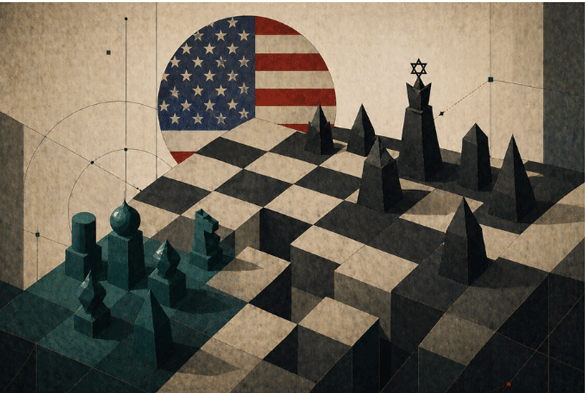
Chess is derived from an Indian board game (chaturanga) but is Persian in its development since ancient times. Concentration, patience, calm under stress, abstract reasoning, and strategic thinking are some of the steps on the way from the novice to the grandmaster.
The game is won with the cry of ‘checkmate’ or ‘the king is dead’ (shahmat in Farsi). In the chess game now playing across West Asia, the shah in the White House is not quite dead, but he is certainly not looking very well.
The Americans entered the game as novices and the Iranians as grandmasters, so no surprise at the outcome so far. Iran has checked every move made by the US and Israel.
These partners in crime have killed thousands of people with their air power but have failed to achieve any of their stated objectives. Hamas has not been destroyed; Hezbollah has blocked Israel from occupying southern Lebanon; Iran still has its ballistic missiles and nuclear reactors, with its control over the Strait of Hormuz bringing it closer to checkmate; and the Israeli settlements along the 1949 armistice line remain emptied of most of their inhabitants.
In the first weeks of the war, Iran wrecked the United States ‘security architecture’ in the Persian Gulf by poking the eyes out of radar installations and bombing US bases, rendering most of them useless for offensive operations and even uninhabitable.
Retaliatory strikes were launched against civilian infrastructure in the Gulf dynasties supporting the US/Israeli onslaught, such as the Ras Tanura oilfield in Saudi Arabia and the Jebel Ali port in Dubai.
Overall, the Iranian defense showed long-term strategic planning, weapons development, and use that left the US looking outdated. It was fighting a war with battleships and destroyers that had to stay well away from the Iranian coast because of the danger of hypersonic missiles.
The US boasted of ‘air superiority’ over Iran when many attacks were launched from beyond Iran’s borders. Damage was done to above-ground missile launchers, but most were deep underground, as were Iran’s nuclear installations. The US bombed civilian ships in Iranian ports and then claimed it had destroyed Iran’s navy, which in fact it had scarcely touched.
The sole US ‘victory’ was the killing of 87 sailors with 61 missing in the torpedo destruction of an Iranian frigate off the coast of Sri Lanka as it returned from naval war games off the coast of India in the name of international friendship and cooperation.
Iran retaliated with fleets of drones and missile attacks that drove US aircraft carriers and destroyers from the Iranian coast and wreaked destruction on US bases in the Gulf. The swarms of drones simultaneously sent into occupied Palestine overwhelmed all Israeli missile defense systems, as they had done in June 2025.
Cheap to manufacture, they were intended to exhaust Israel’s stock of interceptors, which they did. Older missiles launched amidst the swarms of drones were used up before newly developed and far more destructive hypersonic weapons were called into play. Israel could not stop them, and used blanket censorship in an attempt to hide the damage to military bases, airfields, regime intelligence sites and research institutions, port facilities, and residential locations.
In southern Lebanon, occupation forces struggled to capture towns a few kilometers from the 1949 armistice line (the ‘border’).
The losses in men and material included scores of Merkava tanks destroyed in and around the town of Bint Jbeil, along with troop carriers and armored bulldozers.
Frustrated on the ground, they took revenge from the air, destroying or devastating dozens of Lebanese villages and ordering a civilian ‘evacuation’ – the media’s word – of the south. In fact, this was not an evacuation but an expulsion at the point of a gun.
Trump launched this war as a joint US-Israeli venture. Only later, when the grand plan for a quick victory failed, did he call on NATO countries to come and help them. Their reasonable response was that ‘this is your war and we want no part of it.’
Clearly, the war was not covered by the NATO charter. No member state was being attacked, requiring other members to come to its aid. Rather, a member state was attacking another country in violation of international law.
Trump made matters worse by abusing European leaders and then, much worse, by threatening to destroy Iran not just as a state but as a civilization. Given his participation in the Gaza genocide, the threat had to be taken seriously. What was he thinking of? Nuclear weapons?
The Europeans actively backed away. Spain closed its airspace to US military aircraft and banned the US from using the jointly-operated Rota and Moron air bases for war purposes.
France banned Israel from using its airspace for the transport of US military supplies, and Italy closed down landing rights for US military aircraft at the Sigonella base in Italy. Neutral Switzerland refused a US request for the use of its airspace. The UK, on the other hand, kept its airspace open to US military aircraft.
The chessboard stretched from Iran to all resistance fronts, including Iraq, where the Popular Mobilization Forces (PMF) have been attacking US and Kurdish forces and targeting positions in the UAE and other Gulf Cooperation Council (GCC) members.
Iraq’s prime minister, Muhammad Shia’ al Sudani, describes the PMF as a “fundamental component of [Iraq’s] national security system.” The Iraqi government has repeatedly demanded the withdrawal of US forces from Iraq, but the US has refused to pull them out.
At the same time, it closed down the Al Tanf base in Syria, close to the Iraqi and Jordanian borders, more of a terrorist training center than a military base, and handed over bases in the Kurdish northeast to the collaborationist government of former senior Al Qaida figure Ahmad al Shara’a/Muhammad Abu al Jawlani.
Negotiations were a package for Iran. The US accepted the Iranian conditions that all resistance fronts would have to be covered before Trump tried to argue that Lebanon had not been included.
Within hours of a 14-day ceasefire being declared, Israel attempted to sabotage it by launching savage air raids on civilian targets in Lebanon, killing more than 300 people in the space of ten minutes and then boasting about such a great achievement.
It was at the same time obliterating entire Lebanese villages close to the ‘border’ and later declared the same invisible ‘yellow line’ as Gaza’s, with the same threat to kill anyone who crossed it.
Iran declared the strait closed following the Israeli air attacks, but after a 10-day ceasefire negotiated between Lebanese Prime Minister Nawaf al Salam and President Joseph Aoun, it declared that the strait was open again to all commercial shipping.
The only item on the Salam/Aoun/Netanyahu agenda was the disarmament of Hezbollah, a task beyond the capacity and will of the Lebanese armed forces.
The ceasefire was not authorized by the Lebanese government as such and was widely regarded as base treachery, against Israel’s invasion of Lebanon, its massacres, its destruction of villages, and its proclaimed intention to occupy the south of the country up to the Litani river.
Fearing the breakdown of the Lebanese ceasefire would collapse the US-Iran ceasefire, Trump asked Israel to “scale down” attacks on Lebanon. Netanyahu said he would “low key” them just before the Israeli occupation forces bombed two more villages.
With Iran having announced the opening of the Strait of Hormuz, Trump declared he was closing it and Iranian ports through a naval blockade that would be maintained until a peace ‘deal’ was reached. He threatened to destroy the “little that was left of Iran” if the deal wasn’t reached.
Iran’s parliamentary speaker, Mohammed Bagher Qalibaf, warned that the strait “would not remain open” if the blockade continued. As it continued, Iran closed the strait again. Two US destroyers and a minesweeper attempting to enter the strait turned back after being warned that cruise missiles were ready to be fired in their direction.
A US warship subsequently landed marines on the deck of an Iranian container ship sailing from China through the Sea of Oman towards the Strait and disabled its navigation system.
Would the negotiations continue in Islamabad after this act of state piracy? It seemed not. Trump canceled a planned trip to Pakistan by Witkoff and Kushner amidst a flurry of lies that are not worth repeating. The point of all of them is that the US and Trump personally are winning the war, which clearly they are not.
If Trump continues the blockade and, even worse, resumes the military campaign with even greater force, he will bring the developing global supply crisis to the point of a full-blown catastrophe for which he will be held responsible.
The Gulf dynasties are divided. Saudi Arabia and the UAE have been talking tough about how the war on Iran must continue. Others are pleading for dialogue but all have already suffered severe infrastructural damage in Iranian missile attacks.
From Kuwait and Bahrain down to the UAE, these dynastic kingdoms no longer have the protection of US bases. Of the 13 bases in the Gulf, all are badly damaged and many are now even “uninhabitable,” as the US has admitted, with soldiers relocated to luxury hotels. They were tracked by Iran, which then bombed the hotels.
If the Strait of Hormuz remains closed, Saudi Arabia still has the 1200-km east-West Petroline running from Abqaiq to terminal facilities at the Red Sea port of Yanbu’a.
On March 26, an Iranian drone attack damaged a refinery at Yanbu’a, with two ballistic missiles reported (by the Saudis) to have been intercepted. A second attack followed on April 8, the day Israel launched its murderous missile strikes against Lebanon.
Petroline has been built underground, “beyond the reach of any conventional military strike short of a ground invasion,” the Saudis claim. The pipeline moves seven million barrels a day.
Two million are fed to refineries along the way for domestic use, leaving a surplus of five million barrels. Current exports run at about three million bpd because pipeline and port loading capacities don’t match.
The Yanbu’a installations are defended by the same THAAD and Patriot anti-missile defense systems shown to have failed to stop incoming missile attacks on Israel.
Yemen closed Bab al Mandab to Israeli-linked shipping in 2024/5 and has warned that it will shut it again if the war is resumed, again posing a direct threat to Saudi oil exports from the Red Sea. If Saudi Arabia continues to support the war on Iran, Yemen proved its capacity in the failed Saudi-led attack of 2015 to strike damaging blows from the West.
The costs to the Gulf states already are enormous. They have affected the region as a tourist, business, banking, and civilian transport hub. If the US cannot soon be shown decisively to be ‘winning, ’ it won’t be long before all of them will be seeking a settlement with Iran. The UAE’s abandonment of OPEC because other Gulf states did not give enough support to the US/Israeli war has seriously split the ranks.
China’s reliance on Iranian oil has been emphasized, but China has capacious reserves, amongst the largest in the world, and is thus cushioned against the short-term consequences of the crisis in the Gulf.
In their wars of aggression on Iran (the first in June 2025 and the second launched on February 28, 2006), and in the negotiations that followed, the Americans showed no understanding or respect for the people, the culture, and the depth of the civilization they were dealing with.
They expected submission and a quick victory, but instead, people stood firm behind their government and military. They massed in the streets, challenging the US and Israel to do their worst and accepting martyrdom if that was their fate.
W. Morgan Shuster, the upright American called in by the majlis (parliament) as Iran’s Treasurer-General in 1911, before Russian and British intrigue secured his dismissal after eight months, referred to how “two powerful and presumably enlightened Christian countries played fast and loose with truth, honor, decency and law (The Strangling of Persia, 1913, p.8).
These words describe exactly the behavior of the US and Israel in the long campaign to destroy Iran from the moment the Shah was overthrown in 1979. Failing despite 46 years of sanctions, sabotage and assassination, both finally decided on military force.
This is the most significant war in the modern history of West Asia. Its outcome will determine the future of the region for decades to come, if not for the next century, as Sykes-Picot did after 1916.
So far, Iran has not put a foot wrong and Israel and the US have not a foot right. Iranian sophistication has been met with US crudity and bluster. Sending two real estate developers to Islamabad instead of experienced diplomats with actual background knowledge of Iran indicated that the negotiations were not being taken seriously but were a cover for something else.
Rational does not apply to Donald Trump as the meaning of the word is generally understood. What he says one day, he contradicts the next. He wants an ‘off ramp’ with dignity, but there isn’t one. Every time he tries to raise his head above water, Netanyahu pushes it down.
For the moment, there is a stalemate. Each move so far has taken Iran closer to declaring shahmat.
In his frustration, Trump might try to avert defeat by destroying Iran “as a civilization.” Mass destruction through the saturation bombing of civilian infrastructure, centered on the energy sector, would be the equivalent of the bad loser kicking the table over rather than admitting defeat. Chess is a game of rules, but the US does not play by the rules.
https://www.palestinechronicle.com/irans-chess-game-the-grandmaster-is-not-far-from-checkmate-2/
------
Home Front Cracks: Israel Confronts Deepening Crises with No End in Sight
June 1, 2026
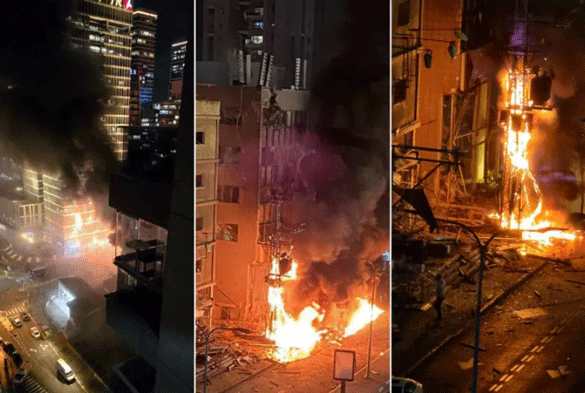
More than two years after October 7, 2023, and the wars that followed, new Israeli data and assessments suggest that the conflict’s impact is extending far beyond the battlefield.
From rising levels of anxiety and depression to growing concerns about military strategy, civilian preparedness and the future of northern settlements, a series of reports published in recent days paint a picture of a society grappling with the cumulative effects of prolonged conflict.
The findings, drawn from Israeli government data, military assessments and commentary by Israeli analysts, point to mounting pressure on institutions that have been forced to adapt to an extended period of war, displacement and uncertainty.
Psychological Toll
Perhaps the clearest indication of the war’s domestic impact comes from Israel’s mental health system.
According to figures released by Israel’s Health Ministry, approximately 435,000 people received treatment through mental health clinics during 2025, representing an increase of nearly 30 percent compared with 2022.
The figures include people seeking treatment for anxiety, depression, war-related trauma, bereavement, displacement, reserve military service and economic stress.
The scale of demand has placed significant pressure on the mental health system.
During 2025 alone, approximately 3.5 million therapy sessions and treatment meetings were conducted, nearly 40 percent more than in 2022.
Consumption of psychiatric medications also increased sharply, with anti-anxiety prescriptions rising by 16.7 percent, sleeping medications by 13.2 percent and antidepressants by 14.3 percent.
More than 36,000 people received assistance through resilience and psychological support centers, while over 150,000 participated in community support programs.
Emergency psychological hotlines handled more than 10,000 cases since October 2023, and support centers recorded nearly 550,000 contacts during 2025 alone.
Despite efforts to expand services through the recruitment of more than 1,180 therapists and the opening or expansion of over 120 mental health clinics, long waiting periods and staff shortages remain major challenges.
Israeli health officials continue to report shortages of psychiatrists, psychologists, social workers and specialized therapists.
The data also showed 293 recorded suicides during 2025, although some specialists estimate the actual number may exceed 400 annually. Approximately 7,000 suicide attempts are believed to occur each year.
Questions about Strategy
At the same time, criticism of Israel’s military strategy is becoming increasingly visible.
Michael Milshtein, head of the Palestinian Studies Forum at Tel Aviv University’s Moshe Dayan Center, warned that Israel is becoming trapped in what he described as a cycle of attrition rather than achieving decisive victories.
Writing in Yedioth Ahronoth, Milshtein argued that recent Israeli policy has relied on two assumptions: territorial control and the continued targeting of senior leaders in Hamas and Hezbollah.
Yet he contended that neither approach has fundamentally altered realities on the ground.
According to Milshtein, Hamas continues to function as the de facto authority in Gaza, while Hezbollah has demonstrated an ability to recover from military setbacks and continue fighting.
The result, he argued, is a prolonged war of attrition that repeatedly reproduces tactical gains without producing a clear political outcome.
He also pointed to the costs of continued military operations, including Israeli military casualties, diplomatic pressure and growing international criticism.
Regarding Lebanon, Milshtein warned that what initially appeared to be rapid military gains has evolved into a prolonged and costly conflict.
He argued that battlefield achievements increasingly depend not on military capabilities alone but on political constraints, particularly Washington’s position.
Fragile Home Front
Concerns are also growing about Israel’s civilian preparedness for future conflicts.
According to assessments by Israel’s Home Front Command cited by Yedioth Ahronoth, military planners increasingly view the home front as a direct battlefield rather than a protected rear area.
The report examined lessons from recent confrontations with Iran and concluded that future wars could involve simultaneous attacks from multiple fronts, longer conflicts and direct strikes on civilian infrastructure.
Israeli officials estimate that more than 500 missiles were launched during the most recent 40-day confrontation with Iran.
According to the report, 72 percent of the missiles fired by Iran carried cluster munitions, while roughly 2,500 rockets were launched from Lebanon during the conflict.
The figures revealed additional vulnerabilities.
Approximately 6,500 settlers were displaced during the war, while only 67 percent of Israelis have access to nearby protected spaces.
Officials also noted that Iran’s response time to military operations has shortened significantly, reducing the time available for warnings and civilian preparation.
North Still Waiting
The effects of the conflict remain especially visible in northern settlements near the Lebanese border.
In a sharply critical article, Israeli writer Merav Batito accused the government of abandoning northern settlers and failing to provide lasting solutions despite repeated promises.
According to figures cited in the report, approximately 26,000 settlers have yet to return to their homes, while thousands continue to live in hotels or temporary housing.
The economic consequences have been equally severe. Roughly 70 percent of businesses in the north have not fully resumed operations, while one-third of students in Kiryat Shmona were not registered for the new academic year.
Batito argued that years after the launch of plans intended to strengthen northern settlements, many projects remain incomplete.
She also questioned claims that military solutions alone can restore security, noting that repeated threats against Lebanon have failed to stop attacks on northern areas.
https://www.palestinechronicle.com/home-front-cracks-israel-confronts-deepening-crises-with-no-end-in-sight/
------
'Ummah Homeland': Türkiye's civilizational responsibility
BY ABDIRASHID DIRIYE KALMOY
JUN 01, 2026
On May 20, International Students Day was commemorated at Ibn Haldun University, where international students from approximately 88 countries gathered to showcase their cultures, values, languages, foods and ideas. Following that, on May 21-24, the 8th Ethnosport Culture Festival was held in Istanbul, where again, people from different geographies showcased their sports and cultures.
In these two gatherings, people from different countries, faiths, races and languages gathered around their shared humanity and on the principle of coexistence based on ontological dignity for all human beings, justice, equality and resistance to structures and ideologies of oppression.
The fact that these activities took place in Istanbul is not a coincidence. Istanbul’s civilizational history makes it a nexus where different civilizations can engage in dialogue.
Moreover, Istanbul, and by extension Türkiye, has become the homeland for many international students, diaspora communities, expatriates and travelers who have been mesmerized by the Anatolian culture and spirit of hospitality. Hence, in this age of global mobility, we need to expand the notions of belonging, identity and homeland.
Homeland transcends borders
The concept of "homeland" has never been merely a cartographic fact for the Turkish state and its people, given its Ottoman and Seljuk past. Rather, homeland has become a living and dynamic doctrine that extends outward through history, civilization, responsibility and ambition.
Many versions of the concept of "homeland" exist in media, political and public discourses in Türkiye today. From the "Blue Homeland," which asserts maritime sovereignty across the Marmara, the Aegean, and Eastern Mediterranean, to the "Sky Homeland" that commands sovereign airspace through air power, Türkiye has systematically extended the philosophical and operational meaning of homeland.
Furthermore, new ideas and concepts like the "Cyber Homeland" and the "Space Homeland" hint at securing the digital and orbital dimensions of national existence. Each iteration of the homeland idea adds a new domain, and each domain, in turn, brings with it a corresponding responsibility. All these ideas share one underlying logic for Türkiye: the nation must be whole, sovereign and capable of defending every sphere.
To these ideas about homeland, we can add a new one regarding Türkiye’s foreign policy, diplomacy and responsibility in the Muslim world and beyond.
"The Homeland of the Ummah" is the proposition that Türkiye’s strategic identity is incomplete without acknowledging its moral, ethical and civilizational responsibilities toward the broader Muslim world and in geographies where there is oppression and suffering.
Civilizational solidarity for Muslims
Türkiye occupies a unique position in the contemporary Muslim world. It is simultaneously a modern republic, a NATO member, and the heir to the Ottoman Empire, which for six centuries served as the administrative center of the Muslim world as the holder of the caliphate. This historical inheritance is not just nostalgia, but it is geopolitical capital.
When President Recep Tayyip Erdoğan speaks at the United Nations General Assembly, holding a map of Palestine, or when Türkiye opens embassies across sub-Saharan Africa, Ankara is drawing on a civilizational memory, concept and responsibility.
This civilizational solidarity and unity Türkiye is positioned to lead is not based on religious imposition, but on a shared historical consciousness. The Muslim world is fractured by sectarian division, by colonial borders, by authoritarian governance, by the cynicism of great-power patronage and neo-colonialism. Into this fractured state, Türkiye offers a model: a Muslim democracy with an indigenous defense industry, a voice that speaks in international forums without apology, and a tradition of statecraft that predates the Westphalian order imposed in the Middle East, Africa and beyond.
But this dialogue demands honesty as much as solidarity and unity. Türkiye and other countries like Saudi Arabia, Malaysia, Indonesia, Egypt, Pakistan, Iran, Algeria and Nigeria can mitigate zero-sum geopolitical and geostrategic competition and usher in a new geopolitical order in this age of crisis and collapse of the international order.
Role against oppression
A shift from passive sympathy to active engagement is what distinguishes the "Ummah Homeland" from rhetoric.
Türkiye has, over the past two decades, built the institutional infrastructure for a genuinely proactive role. The Presidency of Religious Affairs (Diyanet) extends religious and educational outreach across more than 40 countries. The Turkish Cooperation and Coordination Agency (TIKA) has delivered development assistance from Myanmar to Bosnia-Herzegovina. Turkish Maarif Foundation schools have network institutions in dozens of Muslim-majority nations, projecting a Turkish educational philosophy abroad. The Yunus Emre Institute is opening across many African capitals, introducing Turkish culture and language to build deeper connections.
On the military and humanitarian front, Türkiye was among the first to respond to the Rohingya crisis, the Somali famine, the Sudan war and the repeated cycles of violence and brutalities in Gaza and the West Bank. Turkish Bayraktar drones were not only sold to Azerbaijan and Ukraine, but they were also offered as tools of asymmetric self-defense to nations that had long been on the losing end of military imbalance. This is not charity; it is geostrategic solidarity, and it reorders relationships of dependence that have too long defined the Muslim world’s position in this unjust international system.
Ummah homeland for unity
The final and most ambitious dimension of an ummah homeland is its potential as a framework for geostrategic solidarity and unity. It is not a caliphate, not a pan-Islamic state, but a coherent bloc of nations that share interests, coordinate positions and refuse to be played against one another in this unjust global order.
The 57 member states of the Organisation of Islamic Cooperation (OIC) represent 1.9 billion people and control vast energy reserves, critical maritime chokepoints and emerging economies. Fragmented, they are clients. United around shared principles of sovereignty, justice and development, they constitute a pole in a genuinely multipolar world.
Moreover, Türkiye is not the only candidate for leadership within this ummah homeland vision. Indonesia, Pakistan, Malaysia, Egypt, and the Gulf states each bring irreplaceable weight and capital. But Türkiye brings something particular: a functioning state with strategic autonomy, a defense industry that has broken the monopoly of Western arms suppliers, and a diplomatic tradition of navigating between blocs without capitulating to either. In the age of BRICS expansion, shifting alignments, and the slow erosion of the post-1945 liberal order, the ummah homeland concept is not an Islamic project against the West, China or Russia; it is a civilizational project for dignity and justice in the world.
Finally, just as Blue Homeland declared that Türkiye would not accept a diminished maritime presence or violations, and Sky Homeland declared that its skies would be defended by unmanned aerial vehicles (UAVs), Ummah Homeland can declare that the oppression of Muslims and others anywhere in the homeland will be unacceptable.
Ummah Homeland can be a doctrine of moral, ethical and civilizational geography, one that insists the borders of concern are wider than the borders of states.
https://www.dailysabah.com/opinion/op-ed/ummah-homeland-turkiyes-civilizational-responsibility
-------
Elections in Syria and the future of Kurdish participation
BY HAMZA HAŞIL
MAY 31, 2026
The fall of the Assad regime marked not only the end of a dictatorship in Syria; it opened a historic opportunity to rebuild the country's political order after more than a decade of devastating conflict. As the transitional government sought to restore state institutions and foster national reconciliation, parliamentary elections emerged as the first major test of the country’s post-war trajectory. Far from being a routine political exercise, the vote became a measure of whether Syria’s diverse communities were prepared to pursue their interests through democratic institutions rather than armed confrontation.
Originally scheduled for Oct. 5, 2025, voting had to be postponed in several regions due to complex, lingering security risks. The most prominent area left out was northeast Syria. Under the control of the YPG, the Syrian offshoot of the PKK terrorist organization, the region initially distanced itself from the national ballot at a time when integration with the new Damascus government was being heavily contested.
However, following the deployment of central government security forces to key urban centers such as al-Hassakeh and Qamishli in early 2026, state institutions were progressively restored. This stabilization cleared the path for the delayed balloting. On May 24, 2026, voters and local electoral colleges in al-Hassakeh, Qamishli and Ayn al-Arab successfully selected their new representatives for the parliament in Damascus.
YPG’s boycott
By refusing to participate in the elections held in Hassakeh and Raqqa and calling for their cancellation, the YPG once again demonstrated its preference for political obstruction over institutional engagement. The boycott is consistent with the group's longstanding pursuit of extensive autonomy, a vision that stands in direct contrast to Damascus’ efforts to restore centralized authority and territorial sovereignty after years of civil war.
Crucially, the YPG’s boycott failed to find consensus among other Kurdish factions. Most notably, the Kurdish National Council (KNC) chose a pragmatic path of institutional engagement. By fielding candidates through the established electoral college system, the KNC secured vital seats in the new parliament.
This election has highlighted a clear strategic divide: On one side is the YPG’s military-backed, separatist agenda, and on the other is the KNC’s civilian, grassroots politics. By relying on armed militancy rather than the evolving democratic will of the local population, the YPG has demonstrated that it no longer holds a monopoly over the representation of Syrian Kurds. Instead, its rigid policy of isolation is triggering a visible backlash from a population eager for normalization. The presence of KNC and independent Kurdish deputies in Damascus proves that the YPG’s self-exclusion does not leave a political void in the country's future.
Rise of civilian politics
The rising influence of the KNC within national politics deserves rigorous attention. Throughout the civil war, the YPG frequently raided and burned KNC offices, aiming to systematically suppress any civilian Kurdish movement capable of challenging its rule. The overarching goal of that monopoly was to present the YPG to international actors as the sole interlocutor for the Kurds, thereby securing foreign aid and accelerating a separatist project.
Following the political transition in Damascus and the subsequent recalibration of territory, the heavy security pressure on the KNC has finally eased. This opening allowed the council to join mainstream politics effectively. Today, the majority of the lawmakers heading to Damascus from Kurdish-majority districts come from the KNC and aligned independent slates. This high-turnout participation demonstrates that Syrian Kurds can maintain a powerful, peaceful voice in the country’s constitutional future, completely independent of armed agendas.
What lies ahead for Syria?
The current electoral system, which relies on local councils rather than direct voting, is a clear reminder that Syria’s democratic transition is only beginning. However, for a country recovering from total collapse, these elections provide a much-needed structural framework. President Ahmed al-Sharaa’s transitional administration is pushing for political participation under incredibly volatile conditions. The integration of various ethnic and religious groups into the Cabinet, the bureaucracy and parliament is a pragmatic move to replace years of division with a unified state authority.
Syria has made remarkable strides toward territorial and political unity over the past year. Regions in the northeast, where voting was deemed impossible just late last year, have now successfully integrated into the national legislative fold. While the steady policies of the Damascus government facilitated this process, the ultimate credit belongs to the Syrian people, who are demonstrating a collective desire to move past the war. This shift underscores a broader political reality: groups with separatist agendas struggle to maintain domestic legitimacy without heavy foreign backing.
In conclusion, despite many imperfections inherent to a post-conflict transition, these elections mark a historic milestone in Syria's recovery. The country's future will not be dictated by the demands of non-state armed groups, but by the ability of diverse communities to meet on common political and constitutional ground. The YPG’s boycott may serve as a short-term tactical statement, but in the long run, active participation in democratic politics is what will shape the destiny of Syria and secure the rightful place of the Syrian Kurds within it.
https://www.dailysabah.com/opinion/op-ed/elections-in-syria-and-the-future-of-kurdish-participation
------
Now, it is Israel’s turn to be remade
BY HAKKI ÖCAL
JUN 01, 2026
Israel is going down, and it is dragging the U.S. along with it. They don't even need the whole brigade of Zionism that created Israel instead of the two-community, bi-zonal federation of democracy; Itamar Ben-Gvir, Israeli minister of national security, seems capable of single-handedly condemning both Israel and the U.S. into the dustbin of history.
Imagine a nation in which the president calls its people animals, beasts and monsters. The actual term is a Biblical mythological beast, “Behemoth,” a huge primordial beast described in the Hebrew Bible often compared by more modern readers to the hippopotamus.
Isaac Herzog is a strange person to be a president, as he starts political storms entirely willingly. Last month, he agreed to become the head of the “Jewish Agency for Israel,” which is the principal organization that turned the simple “Jewish homeland” next to its centuries-old neighbors in Palestine into a monster Zionist “Behemoth” in the first place. And this month, Herzog warned the Israeli people of a growing process of “brutalization,” and some groups within Israeli society are becoming “Behemoths." This, of course, prompted a sharp condemnation from Ben-Gvir, who accused the president of insulting citizens of Israel and all Jewish people.
Almost a year ago, I humbly wrote here that U.S. President Donald Trump should be careful about Israeli Prime Minister Benjamin Netanyahu and his accomplices committing war crimes and genocide in Gaza. Back then, Ben-Gvir and Finance Minister Bezalel Smotrich were trying what is called “West-Shariazing Gaza,” that is, reoccupying Gaza and allowing occupation, settlements and partial annexations as they did in the West Bank.
What Trump could do then was to save Israel from itself. But Trump, for some strange reasons, allowed the implementation of the Zionist occupation plan of Gaza in a vile scam of a "reconstruction effort" as a permanent and global institution. He did not prepare to implement the 1947 United Nations Partition Plan for the two-community, bi-zonal federation of democracy. He bragged about officially launching an international body to rewrite the rules of international diplomacy and “good governance” worldwide. He forgot all about his Board of Peace, and instead, on the coattails of Netanyahu, joined Israel’s war against Iran to disrupt the non-existent nuclear ambition of Iran. By doing so, Trump caused Iran to close the Hormuz Straight, and he brought the U.S. and the global world economies into a near standstill.
If we knew what those reasons were for him to be dragged by a hook in his nose into that calamitous Iran war, we could have weighed his situation better. Instead of undoing the unclear deal with Iran, the Joint Comprehensive Plan of Action (JCPOA), Trump could have had the support of the five permanent members of the U.N. Security Council, plus Germany, together with the European Union, to check Netanyahu’s assertions that Iran would have a nuclear bomb capable enough to destroy the U.S. and wipe Israel from the face of the earth.
Now, to get a similar deal with Iran, he kisses the hands of the Iranian regime.
If Trump really wanted to control all the hostilities between Israel and all the Middle Eastern nations, a situation better than the Abraham Accords of his son-in-law Jared Kushner could penned, all he needed to do was ask Israel to end the Zionist Plan to gulp down and devour Palestine and make the neocons in Washington give up their Greater Israel scheme as a way to redraw the entire Middle East map.
Which brings us to the original 1947 U.N. Partition Plan of Palestine.
Daily Sabah columnist Ihsan Aktaş rightly pointed out that even the idea of Türkiye acting as guarantor or contributing troops in Trump’s Board of Peace plan makes Israel extremely uneasy. Perhaps that is the main reason Trump is forgetting his so-ambitious peace plan.
So, Trump cannot ask Israel or American neocons to stop Israel from ending the Zionist colonialism in Palestine or to annul the Greater Israel scheme. Trump could not save Israel from certain destruction. Now is the time to save the U.S. from Israel.
It cannot be achieved by Trump or by a bunch of Republican lapdogs. It needs the whole American nation. It needs thousands of people in Ireland who elected as their president Catherine Connolly, who has called for the world to respect Palestine’s right to decide its own leadership, saying no foreign power has the authority to dictate who represents the Palestinian people. It needs the Scottish Parliament, which elected John Swinney as prime minister, who extended a hand to Gaza for medical treatment, voicing solidarity with Gaza and reiterating Scotland’s support for a two-state solution.
Whatever the name they find for the two-community, bizonal federation of democracy in those lands, now more nations support the idea that the time has come to recreate Israel, or Palestine. Trump may or may not lose the presidency altogether or only the support of the U.S. Congress, but the midterm elections might give the people of America the chance to take the lead in this effort.
When people stop believing in the system, as is happening in Israel, the system is already dead. Netanyahu, the crook, clings to a six-seat majority of genocidal maniacs for dear life. He and the president of 10 million Israeli calls Netanyahu’s administration “a growing process of brutalization.”
Shira Efron, the Israel policy chair and a senior fellow at RAND Corporation, wrote in The New York Times that Israel’s isolation is deepening fast. The Washington Post’s Max Boot finds that Netanyahu, trying to remake the Middle East, damaged Israel’s security.
Roman citizens who once saw military service as the highest honor, by the fifth century, were cutting off their own thumbs to avoid conscription. They weren't cowards. They just didn't believe the institution was worth dying for anymore. Thousands of young Israelis are migrating to their grandparents’ home country to avoid occupation, dispossession and settlement service.
The Behemoth is not a mythological beast described in the Hebrew Bible anymore. It is, as Noam Chomsky says, “I am Jewish, and I say this with all my courage: Israel must be abolished. This colonial structure has no moral future.”
https://www.dailysabah.com/opinion/columns/now-it-is-israels-turn-to-be-remade
-------
Syria has sacrificed the soul of the revolution by arresting Bilal Abdul Kareem
May 31, 2026
by Yvonne Ridley
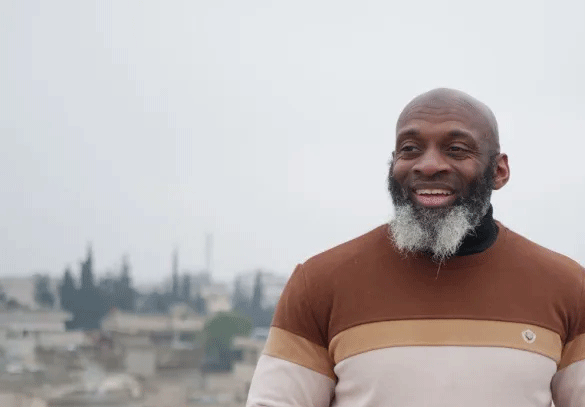
The Syrian revolution was fought to tear down a police state, not to replace it with a replica under a different banner. Today, Assad’s dungeons of Damascus may have been replaced by the security apparatus of Ahmed al-Sharaa (aka Abu Mohammad al-Jolani, the leader of Hay’at Tahrir al-Sham – HTS), but the arrest of New York journalist Bilal Abdul Kareem proves that the transitional administration is replicating the very tyranny from which Syrians died in their thousands to escape.
The social media firestorm that preceded Bilal’s arrest centered on his interview with an Egyptian sheikh regarding the citizenship rights of foreign fighters.
The truth is that Sheikh Abu al-Yaqzan al-Masri, whose real name is Muhammad Naji, is a man of little importance to most Muslims. In the grand scheme of geopolitics, the Egyptian cleric is a minor figure, perhaps even a strategic nuisance, but journalists must be allowed to interview whoever they choose.
The interview was a vital expression of press freedom.
Bilal’s record cannot be rewritten. When foreign operatives and dignitaries negotiated their way out of the catastrophic siege of Aleppo in 2016, he stayed behind. He chose to remain under a storm of barrel bombs to ensure that the world witnessed the agony of the Syrian people. He was prepared to die so that the truth might be made known.
Having been smuggled across the border into HTS-controlled territory myself in January 2019 to report on the ground, I saw a reality that completely contradicted the convenient narratives of both Western intelligence and local security forces.
During my time in Idlib, I deliberately refused to interview Jolani or anyone in his inner circle. Instead, my focus was on a 400-strong community of expatriates, primarily British and European Muslims.
These heroic individuals were not jihadists or militants. They were professionals, teachers, educationalists, clinicians and humanitarian workers driven by a profound belief in the Ummah. They left comfortable lives in the West to rebuild shattered schools, establish medical services, and restore basic dignity to the Syrian population when no one else would.
To now criminalise discussions about the legal status and human rights of these families is a betrayal of those who stood by Syria in its darkest hours.
The post-Assad administration run by Jolani is rapidly losing its moral legitimacy. The revolution was fought for accountability, the rule of law, and the dismantling of the secret police. However, Syria now finds itself under a leadership that fills its dungeons with dissenters and silences critical journalists beyond the reach of transparent justice. Syria under Jolani risks becoming a mirror image of the Assad regime he allegedly sought to replace.
The current leadership’s desperate bid for international and Western acceptance has created dangerous strategic compromises. The supporters of the current administration are either too blind or too compromised to see the long-term geopolitical consequences of Sharaa’s policies, which include:
* The exploitation of Syrian territory by allowing foreign military operations — including Israeli strikes against Lebanon from Syrian soil — which undermine regional solidarity and compromise Syria’s sovereignty.
* Delivering the Zionist dream. By striving to cooperate with global powers, this administration risks delivering the regional ambitions of a “Greater Israel” on a silver platter.
My American friend Bilal Abdul Kareem is currently detained because he dared to ask uncomfortable questions about citizenship, governance and military alignment. His arrest is a litmus test for the future of Syria.
Syria has sacrificed the soul of the revolution by arresting Bilal Abdul Kareem. He must be released without delay.
https://www.middleeastmonitor.com/20260531-syria-has-sacrificed-the-soul-of-the-revolution-by-arresting-bilal-abdul-kareem/
------
New Age Islam, Islam Online, Islamic Website, African Muslim News, Arab World News, South Asia News, Indian Muslim News, World Muslim News, Women in Islam, Islamic Feminism, Arab Women, Women In Arab, Islamophobia in America, Muslim Women in West, Islam Women and Feminism