
ISIS Insurgents Wage War on History: Many Places of Worship Destroyed, Say Iraqi Residents

By Praveen Swami
June 29, 2014
Two other reports by Praveen Swami from the war zone:
Mosul Refugees Live In Fear, Uncertainty
Iraq Launches Ramadan Counter-Offensive
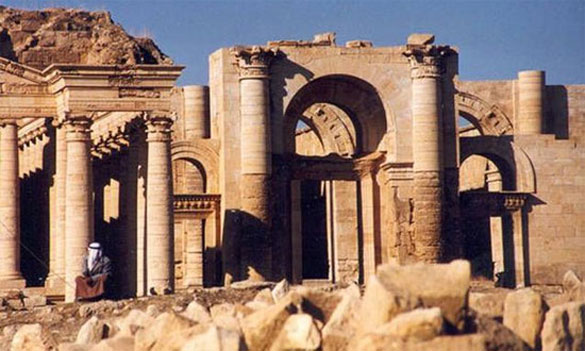 Hatra, an ancient city 110 km southwest of Mosul, is a potential target.
----------
As historic shrines are levelled and manuscripts removed from museums, concerns grow for World Heritage sites
Generations of the young and lovelorn of Mosul have gazed at the Tomb of the Girl in Ras al-Jada, reputed to honour a beautiful girl who died of a broken heart. Historians believe the tomb in fact belonged to the great historian of medieval Islam, Ali ’Izz al-Din Ibn al-Athir al-Jazari, who died in 1260. In his masterwork, the al-Kamil fil’Tarikh, the History of the World, al-Jazari chronicled the epic wars of his times, from the Crusades to the Mongol invasions.
Now, the Tomb of the Girl is a gaping hole, bulldozed by Islamic State of Iraq and al-Shams (ISIS) insurgents who captured Mosul less than a fortnight ago. The statue of the poet Mullah Uthman Ali Mussili, a nineteenth century Mosul poet whose lyrics still run through modern Arab music, has been removed from the al-Mahata area. The statue to iconic poet Abu Tammam in the Bab al-Tourb area, residents say, is gone.
Many Places of Worship Destroyed, Say Iraqi Residents
Even as fighting rages on in Iraq between the ISIS insurgents and Iraqi troops, local residents who fled to Erbil, say several Shi’a places of worship have been destroyed — among them, the mausoleum of the saint Fathi al-Ka’en, and shrines in the villages of Sharikhan and al-Qubbah. The statue of the Virgin in the Church of the Immacuate in the al-Shifa area, Christian refugees told The Hindu, is also gone.
“No one protested,” a Mosul school teacher told The Hindu over the telephone, “even though these things are very dear to all communities in the city. Perhaps it is because everyone here is too busy trying to stay alive”.
The doors of the Mosul museum — looted in 2003, after the United States invasion of Iraq, but still home to one of the world’s great collections of sculpture — have been padlocked, local residents said. The centuries-old manuscripts stored in Mosul’s central library, many of them gold-leaf religious texts, have been removed.
The Iraq-affairs magazine Niqash records the Mosul calligrapher Abdallah Ismail noting that “the worst thing about wars is that they do not distinguish between the present and the past.”
Future Bleak
“I'm sure that if they continue to control this city, the ISIS will destroy all of those things,” Qais Hussein, head of Iraq’s State Board of Antiquities and Heritage, told the news agency AINA. “They've already aggressively attacked our employees working in those sites and in the museums, telling them that this is haram [forbidden] to work in a place with those statues and objects.”
There are some 1,800 sites in Mosul and 250 buildings in the surrounding Nineveh province that the government classifies as historical, he said. Parts of Nineveh province have come under the control of Kurdish forces, but Islamist insurgents still control large swathes.
Hatra and the Ashour Temples — both UNESCO World Heritage Sites — are causes of particular concern to archaeologists. The well-preserved 2CE complex at Hatra — familiar to millions as the set for the opening scenes for the iconic 1973 horror film ‘The Exorcist’ — is thought to be a potential target, because of its statues of pre-Islamic gods. ISIS also controls the temple complex at Nimrud, home to 3,000-year-old statues of Assyrian deities and gods.
Islamist insurgents have frequently destroyed pre-Islamic art: Afghanistan’s Taliban blew up the Buddha statues at Bamiyan in 2001, while Mali’s Ansar Dine destroyed Sufi shrines when it captured Timbuktu in 2012. ISIS itself looted the museum at the Syrian city of Raqqa, after capturing the city, selling the art on the international black market to raise funds.
Source: http://www.thehindu.com/news/international/isis-insurgents-wage-war-on-history/article6158435.ece
-------
Mosul Refugees Live In Fear, Uncertainty
By Praveen Swamy
June 30, 2014
Fuel, Food Run Out In Mosul
Food, fuel and water are running out in Iraq’s second largest city, causing thousands to flee ahead of the air strikes many fear will precede a government counter-offensive to retake cities captured by Islamist insurgents earlier this month. Escaping Mosul residents interviewed by The Hindu on Sunday said power supply was down to two hours a day, while petrol and cooking gas were not available.
At least 39 Indian construction workers are believed to be trapped in the city, being held under guard by Islamist insurgents.
Local residents leaving the city told The Hindu that migrant workers had been forced to build defensive earthworks on Mosul’s outskirts. Fatah Hassan, who fled Mosul three days ago, told The Hindu that he had visited a construction site where Indians worked and found that insurgents had set up a base there.
Husain Atiyah, a truck driver, also recalled seeing Indians at a construction site on Mosul’s suburbs — some easily identifiable as Sikhs by their bright turbans. “I had talked to some of them,” he said. “I have no idea where they are now, though.”
Mr. Atiya also had a message: “please tell Amitabh [Bachchan] we love him.” “I miss his films now more than ever,” he said, “but there is nowhere I can watch one.”
Fear Grips Refugees
Early on Sunday morning, hundreds began lining up near a giant earthwork across the Mosul-Erbil highway — men, children, women, standing in the 40ºC heat without shade or water, in the hope of being allowed across the mud on to the road to freedom.
Hammad Hassan was one of the few people going the other way, dragging two large black suitcases that he said were stuffed with food and medicine. “I don’t know why the hell I’m going back”, he said. “I really don’t.”
Fifty metres away, men dressed in Punjabi-style suits watched quietly: insurgents of the Dawlat al-Islami al-Iraq wa al-Shams, called the Dasht by local residents, and the Islamic State of Iraq and al-Shams/Syria by the rest of the world.
“They asked us to stay,” said Ruqqya Ahmad Hassan, a single mother of one with ageing parents to care for, “saying Mosul would be a citadel against the Râfidah [an abusive word for Shia Muslims], and we would earn god’s blessings.” “The city is dying,” she said, “and I do not want my children to die with it”.
Peshmerga, the army of Iraq’s quasi-independent Kurdistan region, had barred vehicles from moving into their territory after a suicide bomber targeted barracks a few kilometres up the road. The Peshmerga’s post at Bazwa, back down the road, was littered with burnt-out pick-up trucks and jeeps.
“There are at least a thousand people trying to come out every day,” said the Peshmerga’s commander at Gokcheli, the last Kurdish outpost, on Mosul’s industrial suburbs. “Lots of Sunnis, lots of Shia, one Palestinian. No Indians or Pakistanis though, which is odd because there are lots of them working in Erbil.”
For those Mosul refugees without family or friends in Kurdistan, home will be the United Nations High Commission on Refugees-run Hazer camp — a giant patch of desert fast filling up with blue-and-white tents. Many are digging in for the long haul.
Yusuf Abd al-Aziz has opened a small shop selling sweets and snacks to children inside the camp. “This is going to be a long war,” he says, “and I have to build a life, because there will be nothing to go back to.”
Other religious minorities who have fled Mosul are just as scared as the Shia. Ali Haider, a Shabak or ethnic-Kurdish Shia, fled the village of Ali Arash when Peshmerga and ISIS insurgents traded fire earlier this week. The village is now well defended by Peshmerga positions but its population has fled. “I did not want my family to wait there till the next attack came,” he said, “and I have no doubt that it will come.”
ISIS insurgents have not carried out killings of minorities, but some shrines and emblems of Mosul’s secular culture have been targeted, leading to a large-scale exodus of minorities. Though some return occasionally for business, refugees spoke of a city partitioned by communal hate.
Sunnis have their own fears. Ala Bashar Mahmood, who ran a shop in Mosul, left the city on Friday after Iraqi forces bombed insurgent positions on its fringes. “I’m not as afraid of ISIS as I am of the Iraqi army because they will make all Sunnis pay for their defeat by the dasht,” he said.
Source: http://www.thehindu.com/news/international/world/mosul-refugees-live-in-fear-uncertainty/article6160796.ece
-------
Iraq Launches Ramadan Counter-Offensive
By Praveen Swami
June 29, 2014
Even as Iraq’s Muslims prepared to mark the beginning of Ramadan on Saturday, Prime Minister Nouri al-Maliki’s government has launched its largest counter-offensive so far to reclaim territory seized by the Islamic State of Iraq and Syria (ISIS) insurgents. The offensive has sparked off giant refugee flows. Humanitarian workers have reported that tens of thousands have fled towards Kirkuk and Erbil, while some have fallen back to ISIS’ key base at Mosul.
Government sources said brigade-size forces, have cleared the road north to Samarra, and surrounded Tikrit from the south, east and west. Forces have also pushed west towards Fallujah, part of the corridor that has been used by ISIS to threaten Baghdad since last year.
The push came even as intense diplomatic efforts continued to build a new political coalition in Baghdad, with Saudi Arabia seeking to push key Sunni politicians to join Mr. Maliki’s Shia-dominated government.
Iraq’s military hopes to stabilise the frontline through the month of prayer and fasting, securing Baghdad against attack from the north and west — and preventing a jihadist breakthrough towards the cities of Karbala and Najaf, sacred to the Shia faith.
The Ramadan counter-offensive, military sources in Erbil said, involves large elements of the country’s single armoured division, backed by Mi-17 armed helicopters. The Army has also pushed forward several of its eight motorised infantry brigades. Its forces are also using 10 Scan Eagle drones, as well as Hellfire ground-to-air missiles mounted on Cessna turbo-prop aircraft, provided by the United States in December.
Even as the counter-offensive began, though, ISIS continued to target Baghdad’s periphery, firing rockets at Latifiya, on the city’s southern fringes, and at least one more at Sab al-Bour, in its north. Local media said at least 12 people were killed and several dozen injured in the strikes. The group’s ability to reinforce positions from its bases in Syria has also seemed undiminished, with reports suggesting thousands of new fighters have joined the group’s ranks.
Fighting has been ongoing in the Sunni-dominated al-Anbar province — home to cities like Ramadi and Fallujah — since December, 2013, when large-scale protests broke out against the government over human rights abuses.
Prime Minister Maliki responded by withdrawing the military, but police failed to prevent jihadists from using the opportunity to consolidate their positions. Insurgents then steadily took control of parts of Fallujah, Ramadi, Tarmiya and Abu Ghraib, all in striking range of Baghdad.
The Iraqi military, on paper, has overwhelming superiority over ISIS and its major ally, the Jaish al-Naqshbandiyya, linked to former Dictator Saddam Hussein’s Ba’ath party. The International Institute of Strategic Studies’ authoritative Military Balance states, that Iraq had 2, 71,400 active military personnel in the spring of 2013, with 1, 93,400 in the Army, as well as 5, 31,000 personnel in police and ancillary units guarding installations and oil fields. IISS figures also show that the military remains well funded, having received a record $17.1 billion, up from $14.6 bn. in 2013.
Source: http://www.thehindu.com/news/international/world/iraq-launches-ramadan-counteroffensive/article6158414.ece
URL: https://newageislam.com/islam-terrorism-jihad/isis-insurgents-wage-war-history/d/97831