
Dr. Umar Nabi’s Claims, Suicide Bombings, Martyrdom Operation, and the Misuse of Islamic Terminology

By Ghulam Ghaus Siddiqi, New Age Islam
19 November 2025
In recent days, several news channels have been broadcasting a video of a man named Dr. Umar Nabi, who appears in connection with the Red Fort blast. In this video, he asserts calmly, confidently, and disturbingly that what the world commonly understands as a suicide bombing is, in his view, an “act of martyrdom”, or a “martyrdom operation”. He further implies that such operations are religiously valid and rooted in Islamic tradition.
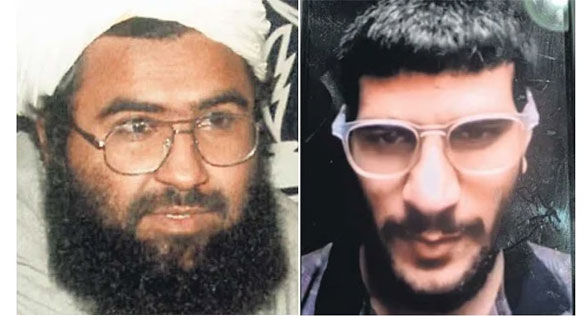
Masood Azhar, Dr Umar Un Nabi
Umar body language shows Jaish training as a suicide bomber (Photo: The New Indian Express)
------
This claim stands in stark and painful contradiction to the collective voice of the Muslim world. Over the past several decades, thousands of scholars, Arab and non-Arab alike, have issued clear, decisive, and unanimous fatwas condemning suicide bombings without the slightest ambiguity. Their verdict has always been the same:
“taking one’s own life is categorically forbidden in Islam, irrespective of the circumstances.”
This humble writer, too, has addressed this topic repeatedly, citing explicit proofs from the Qur’ān and the Aḥādīth, establishing beyond any doubt that suicide operations have no legitimacy in Islamic law. Yet, as the recent reports show, Dr. Umar insists on reframing suicide attacks under the deceptive label of “martyrdom operations.” This is not merely a semantic shift—it is an attempt to sanctify what is inherently un-Islamic and to lure others into the same destructive path.
In that article, I explained that the modern extremist doctrine of “martyrdom operations” is nothing more than an intellectual fabrication designed to conceal what Islamic law unequivocally defines as suicide. For decades, extremist groups have attempted to sanctify self-destruction by replacing the term Amaliyyāt Intihāriyyah (suicide operations) with euphemistic labels such as Amaliyyāt Istishhādiyyah (martyrdom operations), Amaliyyāt Fidā’iyyah (sacrifice operations), or Amaliyyāt Jihādiyyah (jihad operations). Yet none of these linguistic disguises can override the clear Qur’ānic commands and Prophetic teachings that categorically forbid suicide under all circumstances.
In the article, I demonstrated that their argument collapses entirely when confronted with foundational Islamic texts, particularly the verses of Sūrah an-Nisā’ (4:29) and Sūrah al-Baqarah (2:195), which establish an absolute prohibition against self-killing. I also noted that when extremists cite verses such as 9:111 and 2:154 to glorify martyrdom, they deliberately blur the distinction between a believer killed unjustly in the path of Allah and a person who kills himself in the act of murder. The former is honoured; the latter is condemned. No rebranding of terminology can erase this theological fact.
Furthermore, I highlighted that the Qur’ān itself exposes the moral bankruptcy of the extremist narrative. Verse 5:32 affirms that killing an innocent soul is akin to killing the whole of humanity; an affirmation that dismantles any claim that suicide attacks serve the “cause of Allah.” When a seeker of truth sincerely compares the “jihadist” framing with the Qur’ānic ethos of mercy and justice, he immediately realises that these groups are not fighting for God; rather, they are violating His most fundamental commandments. Whether such acts are called “suicide attacks,” “jihad operations,” or “martyrdom missions,” the ruling remains the same: they are forbidden, immoral, and antithetical to Islam’s teachings on the sanctity of life. The crux of my argument was simple yet decisive that a wrongful act does not become lawful merely by changing its name. And just as suicide attacks are impermissible under Islamic law, so too are the so-called “martyrdom operations,” for both rest upon the same prohibited foundation: the unjust taking of life.
Also Read: The Jihadists' Suicide Attacks or Martyrdom Operations Strictly Forbidden in Islam
Long before that, during the rise of ISIS, I had written extensively on the severe impermissibility of suicide attacks and the theological distortions used to justify them. Time and experience have taught me an undeniable truth:
Extremists never tire of inventing new strategies, new terminologies, and new deceptions.
They wrap their impulses in religious vocabulary, targeting emotionally fragile individuals who may lack the scholarly tools to differentiate truth from falsehood.
Before further discussion, it is essential to examine the recent reports from The Times of India and India Today, which reveal the ideological mindset behind Dr. Umar’s dangerous rhetoric. Only then can we understand why suicide operations are forbidden in Islam, and how a trained doctor, bound by ethics to preserve life, could attempt to justify suicide as “martyrdom.”
But first, a fundamental question must be asked:
Even if—hypothetically—someone were to accept this false terminology, how could it ever be applied to the Red Fort blast, where innocent civilians were killed and families destroyed?
No person with even a fragment of sound intellect—Muslim or non-Muslim—could justify such an atrocity in the name of Islam.
It seems to me that either this man has been carried away by fanatic emotion, desperately trying to legitimize the illegitimate, or he is oblivious to the fact that his rhetoric stands in open contradiction to Islamic Shari‘ah. Worse still, such claims only fuel anti-Muslim sentiment and compound the already heavy burdens borne by ordinary Muslims.
A Climate of Fear—and the Dangers of Reckless Rhetoric
In an environment, even the mere use or alleged misuse of a slogan during a protest may result in innocent Muslims being imprisoned, their homes bulldozed, and their fate left hanging until the courts intervene. In such a fragile environment, one shudders to imagine the consequences if emotionally charged youths—misled by the rhetoric of someone like Dr. Umar—were to take even a single reckless step.
How many families would be shattered?
How many lives uprooted?
How many more Muslims thrust into the shadows of suspicion?
Alhamdulillah, I am convinced that the overwhelming majority of Indian Muslims reject such extremist narratives without hesitation. They know that Islam is a religion that upholds the sanctity of life, promotes peace, and condemns injustice in all forms. Despite facing countless socio-political challenges, the Muslim community has consistently demonstrated restraint, patience, and respect for the law of the land.
Therefore, when an individual attempts to distort Islamic teachings in a manner that threatens social harmony, it becomes a moral and religious obligation upon scholars, writers, intellectuals, and community leaders to respond with clarity. In such moments, silence is not neutrality—silence is complicity.
Media Reports and the Anatomy of a Dangerous Narrative
The reports published by The Times of India and India Today present a revealing and deeply troubling portrait of Dr. Umar’s ideological orientation.
The videos recovered by investigative agencies show him calmly expounding the concept of suicide bombing—as though he is teaching a theological virtue rather than a morally despicable crime. He repeatedly asserts that a suicide attack is, in reality, a martyrdom operation, and that the world fails to understand its essence.
Such assertions represent a deliberate manipulation of Islamic vocabulary. The phrase “martyrdom operation” is not an Islamic term. It is a modern invention, crafted by militant groups seeking to sanctify acts that Islam explicitly prohibits.
The Times of India report highlights that Umar defines a suicide bomber as someone certain of death at a specific place and time—yet he ignores the fundamental distinction between:
• dying voluntarily by one’s own hand, and
• being killed unjustly while defending truth or innocent lives.
This conflation is not mere ignorance—it is a dangerous form of intellectual dishonesty.
India Today further reports that Umar used this rhetoric to “brainwash and radicalise others”, and is considered the most ideologically hardened member of his group. That a doctor—trained to save lives—would indulge in such ideological perversion only deepens the gravity of his claims.
How Extremists Weaponise Islamic Vocabulary
Throughout modern history, extremist groups have attempted to weaponise Islamic terms, turning sacred concepts into tools for violence. The term shahādah refers to someone unjustly killed while standing for truth, justice, or protecting the innocent.
The Prophet Muṣṭafā ﷺ unequivocally described the true shahīd as one who is killed:
• defending his life and religion,
• protecting his family,
• guarding his property,
• or standing against oppression.
Nowhere—absolutely nowhere—did the Prophet ﷺ endorse taking one’s own life and calling it martyrdom.
In fact, the Prophet ﷺ warned that a person who commits suicide will be punished with the same act of self-harm in the Hereafter. No exceptions. No conditions. Not even in war.
Thus, when Dr. Umar attempts to equate suicide bombing with martyrdom, he is not representing Islam—he is echoing the vocabulary of radical cells.
The Islamic Verdict: Suicide Is Forbidden in Every Context
Islamic teachings on the sanctity of life are unambiguous:
“Do not kill yourselves; indeed, Allāh is Most Merciful to you.”
(Sūrah an-Nisā’, 4:29)
“Do not throw yourselves into destruction with your own hands.”
(Sūrah al-Baqarah, 2:195)
The classical jurists of all major schools—Hanafi, Shāfi‘ī, Mālikī, Ḥanbalī, Ja‘farī, and Zaydī—are unanimous:
“any act that intentionally results in one’s own death is forbidden.”
Moreover, even in legitimate jihad, the means and methods are bound by divine law. One cannot protect Islam by violating Islam.
Suicide bombing is therefore prohibited because:
1. It combines murder with suicide.
2. It kills innocents indiscriminately.
3. It destabilizes societies.
4. It fuels hostility and hatred.
5. It tarnishes the image of Muslims worldwide.
No juristic school—classical or contemporary—has ever endorsed suicide bombing as a form of martyrdom.
False Heroism: The Moral Catastrophe Behind Dr. Umar’s Rhetoric
What Dr. Umar proposes is not martyrdom—it is moral corruption disguised as heroism. His definition of martyrdom aligns not with the Qur’ān or Sunnah, but with the ideology of extremist organisations.
When individuals propagate such rhetoric publicly, especially in a diverse and sensitive society like India, they endanger not only themselves but the entire community. Their words can mislead:
• gullible youth,
• emotionally unstable individuals,
• and those suffering from social alienation.
The consequences can ripple far beyond one misguided individual—affecting families, neighbourhoods, and the reputation of the entire Muslim community.
Why Such Narratives Must Be Challenged
In today’s India—where even peaceful protests can result in unpredictable consequences—the spread of violent rhetoric is catastrophically dangerous. A single misguided step taken under the illusion of “Islamic martyrdom” can devastate countless lives.
Therefore, scholars, thinkers, and community leaders must challenge such distortions with courage and clarity. Islam cannot be allowed to be hijacked by emotionalism, half-knowledge, or politically charged posturing.
Conclusion
The media reports, combined with the ideological claims made by Dr. Umar, force us to examine this issue with utmost seriousness. Suicide operations are forbidden in Islam—not only because they violate divine commands, but because they shake the ethical foundations of Muslim identity.
As this discussion continues, the distinction between legitimate sacrifice and prohibited self-destruction must remain clear. No emotional fervour, no rhetorical trick, and no invented terminology can transform a forbidden act into a sacred one.
……..
A regular Columnist with New Age Islam, Ghulam Ghaus Siddiqi is an Alim and Fazil (Classical Islamic scholar) with a Sufi background and English-Arabic-Urdu Translator. He completed the Classical Islamic Sciences from a Delhi-based Sufi Islamic seminary Jamia Hazrat Nizamuddin Aulia with specialization in Tafseer, Hadith and Arabic. He completed his Alimiat and Fazilat respectively from Jamia Warsia Arabic College, Lucknow and Jamia Manzar- e- Islam, Bareilly, U.P. He did his graduation in Arabic (Hons) and post-graduation (Arabic) from Jamia Millia Islamia, New Delhi.
New Age Islam, Islam Online, Islamic Website, African Muslim News, Arab World News, South Asia News, Indian Muslim News, World Muslim News, Women in Islam, Islamic Feminism, Arab Women, Women In Arab, Islamophobia in America, Muslim Women in West, Islam Women and Feminism