
ISIS Invades Iraq: This Is a War of Religion

By Damian Thompson
June 15th, 2014
Other related articles:
Turkey: ISIS Magnifies Iraq's Sunni Crisis
The rise of ISIL
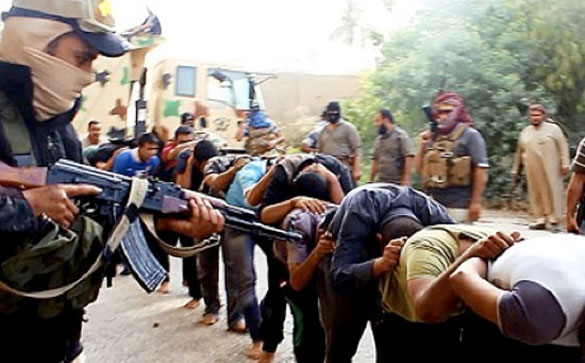 An ISIS photo purporting to show the execution of Iraqi Shias
---------
The relationship between the murderous zealots of ISIS and the rest of the Muslim world is too complicated to sum up concisely. It goes without saying that hatred between Sunnis and Shias lies at its heart. They adhere to profoundly different versions of Islam: where radical Sunnis are disgusted by cultic practices or religious art that distract from the teachings of Mohammed, Shias embrace a messianic cult of martyrdom and ritual self-mortification – and claim a line of descent from the Prophet that Sunnis regard as heresy.
This fault line dates back to the early years of Islam and is familiar to anyone who knows the first thing about the religion. But to make sense of the new Iraqi civil war it's also necessary to untangle the relationship between the fanatics of ISIS and the kingdom of Saudi Arabia, notionally an ally of the West. The pampered aristocracy of the House of Saud may not wish to be publicly associated with terrorists, but it is the Saudis who, since the 18th century, have nurtured the ultra-puritan Wahhabi ideology adopted by those same terrorists. Wahhabis or Salafists (the two terms are almost interchangeable) seek religious purity through iconoclasm. In Mecca this takes the form of the Saudis razing every shrine associated with Mohammed, lest they encourage superstition, while simultaneously building hotels modelled on Las Vegas. In Iraq and Syria, non-Sunni places of worship are also razed, but the iconoclasm is accompanied by the slitting of throats.
Many rich Saudis are secretly thrilled by the advance of ISIS, whose atrocities are an extreme manifestation of their own Wahhabi ideology. And they will gloat mightily if ISIS fulfils its ambition of reducing every Shia shrine in Iraq to blood-spattered rubble. As we speak, funds are being transferred from their bank accounts to the organisers of the insurgency, who despise Saudi prince lings for their "Western" lifestyles but are more than happy to pocket the cash.
The transactions and alliances surrounding this civil war are sordid and cruel on both sides. But this is in the nature of wars of religion, which throughout history have combined barbarism and hypocrisy. The conflict between Catholics and Protestants in early modern Europe produced scenes that were as awful as those we are witnessing today. We did, however, grow out of it. The Muslim world still hasn't and you can't help wondering if it ever will.
Source: http://blogs.telegraph.co.uk/news/damianthompson/100276395/isis-invades-iraq-this-is-a-war-of-religion/
-------
Turkey: ISIS Magnifies Iraq's Sunni Crisis
By Rasim Ozan Kutahyali
June 17, 2014
The Middle East is in chaos again. The whole world is closely following Mosul’s occupation by the savage terrorist organization the Islamic State of Iraq and al-Sham (ISIS). Along with Mosul’s occupation and the ensuing developments in Iraq, we in Turkey are also following the case of the Turkish nationals seized from the Turkish Consulate in Mosul.
A crisis desk was set up as soon as the news of the ISIS raid on the consulate reached Ankara. The Turkish government outlined a road map emphasizing the following three points:
Our staff will be rescued unharmed.
Turkey will act together with the international community.
There will be no daring moves such as a military operation; rather, the international community will be mobilized.
Convening in a special session on Turkey’s appeal, the UN Security Council issued a strong statement in support of Turkey, and NATO followed suit. The leaders of both organizations also made statements that satisfied Turkey. Similarly, international outreach to Prime Minister Recep Tayyip Erdogan and expressions of support also pleased Ankara.
In the meantime, back channel diplomacy leaped into action. According to Abdulkadir Selvi, a Turkish journalist close to government circles, the efforts surrounding Iraq moved on three tracks:
Communication was opened with the Baghdad government.
The Kurdish Regional Government was involved in the matter from the very beginning.
Back channel diplomacy was launched and contacts were established with influential clans in Mosul.
According to Selvi, ISIS requested to meet with the diplomatic mission before it stormed the Turkish consulate, seeking to be acknowledged. This was the reason the Turkish consulate was targeted, and their reply when asked what they demanded: to be acknowledged as an interlocutor by an international mission.
On June 16, while Turkish Foreign Minister Ahmet Davutoglu had a working breakfast with NATO Secretary-General Anders Fogh Rasmussen, I contacted sources close to Davutoglu to discuss the general situation in Iraq and ISIS’s occupation of Mosul.
From the Turkish Foreign Ministry’s perspective, the Iraqi government led by Prime Minister Nouri al-Maliki has for years failed to take the necessary steps for political and economic equality in the country, marginalizing the Sunni communities in particular. Maliki’s operations against Sunni politicians like former Vice President Tariq al-Hashimi and former Finance Minister Rafi al-Issavi have been casting Sunnis out of politics. The attempts to arrest al-Issavi in particular are seen as a gross mistake.
One of my sources, who wished to remain nameless, made the following comments: “The al-Issawi affair triggered long-lasting protests against Maliki. The protests, which started two years ago, continued until recently and Maliki responded with violence. The Sunni hatred of Maliki united many different groups. The latest developments are the deed of a coalition that brings ISIS together with groups such as the Military Council of Tribal Revolutionaries, the Mujahedeen Army and the Naqshbandi Soldiers. It gets backing also from old Baathists. ISIS is a terrible terrorist organization, but one has to see the whole picture in Iraq.”
In response to my questions about ISIS, the sources spoke of its links to the Syrian regime. The general perception in Turkey, a conspiracy theory about cooperation between the two, it quite popular among Sunni conservatives.
Here is what my sources said about ISIS: “ISIS contacts with the Syrian regime date back to Iraq’s occupation. Syrian intelligence played a key role in mustering al-Qaeda-linked fighters in Iraq. By virtue of its structure in Iraq, ISIS is linked both to local tribesmen and old Baathist military officers. For instance, Abu Bakr al-Iraqi, the head of the ISIS military council who was killed in Aleppo a few months ago, was a former Baath general. What the media reports as the capture of cities in Iraq by ISIS is a phenomenon with a political and social background going well beyond ISIS. An armed rebellion against the Maliki government involving various Sunni groups is underway in Iraq.”
On the issue of the occupation of Mosul by ISIS and its advance on Baghdad, they said, “There are two reasons for the capture of Mosul by ISIS and the threat it poses to Baghdad. First, the Sunni groups’ anti-Maliki coalition acquired a critical strength as an armed force and was welcomed by populations in the seized cities. Second, Maliki’s army — willingly or unwillingly — put up no resistance. Its inefficiency was the result mainly of the coalition’s deterrence, the demographic structure of the cities in question and the army’s earlier failures in those cities. For quite some time Maliki had been asking the United States for help against the groups that form the current coalition. He labelled the coalition and the protests as terrorism and sought to win the sympathy and support of the international community. And so far he has waged quite a successful campaign in directing all attention to ISIS and overshadowing the legitimate demands of Sunni communities.”
Sources close to the Turkish Foreign Ministry are also concerned about the Sunni groups’ relationship with ISIS, saying, “The Sunni groups in Iraq should not allow their legitimate demands to be overshadowed because of ISIS. The lack of sharing and compromise — deferred for a long time by Maliki — is the main underlying cause of the current crisis, but anti-Maliki groups should reckon the cost that collaboration with a terrorist group such as ISIS will have both for themselves and Iraq.”
In the Turkish Foreign Ministry’s view, ISIS has already proven to be a Trojan horse in Syria. Iraqis with legitimate demands should accurately analyze the Syrian experience. The sources strongly underline that Sunni groups should not project their hatred of Maliki on Shiites in general. Otherwise, they believe, Maliki might exploit the sectarian card just like Syrian President Bashar al-Assad did.
http://www.al-monitor.com/pulse/originals/2014/06/kutahyali-isis-mosul-iraq-syria-foreign-ministry-hostages.html#ixzz35175Ljvk
-------
The rise of ISIL
By Mustafa Gürbüz
June 15, 2014
How has a blood-thirsty organization become a major player across Turkey's border? Iraq's exclusivist policies, in addition to the rift between Saudi Arabia and Iran, are to blame.
In his comparative study on revolutionary movements, Jeff Goodwin suggests two main reasons to explain the development concerning armed insurgencies: exclusivist repression and weak state infrastructure. Suffering from both, Iraq is now a failed state that is vulnerable to militant groups. Recruiting the old-regime's Baathist elements, the Islamic State in Iraq and the Levant (ISIL) is forcefully sweeping through north-western Iraq and threatens the nation's capital, Baghdad.
Why is ISIL so popular among Sunnis in Iraq? According to the former Iraqi Vice President, Tariq al-Hashimi, there has been a government-led lynching campaign against all Sunnis in the country. The pressure increased following the departure of US forces in December 2011. “Sunni businessmen, students, doctors and civil servants,” says al-Hashimi, “are being closely monitored, their offices are being confiscated and they are unfairly eliminated from positions in the public and private spheres and so on. Being Sunni has become tantamount to being a terrorist suspect in Iraq.” As Prime Minister Nouri al-Maliki's government became the government of Shiites exclusively, alienated Sunni youth were left to the hands of ISIL militants. Goodwin's book title captures this aggressive feeling well: "No Other Way Out."
ISIL fighters ramp up the horrific acts of violence to distinguish themselves as “the” only alternative for Sunnis. The sectarian civil war in Syria has been a great opportunity for such a strategy of mass fear. Many moderate Syrian opposition groups were pushed aside. ISIL leader Abu Bakr al-Baghdadi, a pseudonym, formed Jabhat al-Nusra as al-Qaeda's affiliate in Syria. Al-Baghdadi and ISIL militants killed ruthlessly and further developed their organizational base: As many as 12,000 militants were recruited, 3,000 of whom were from Western countries. In his Washington Post column (June 10), David Ignatius shares his exchange with a senior US intelligence officer on the rise of ISIL:
This group is so toxic that it's disowned by al-Qaeda and is feuding with al-Qaeda leader Ayman al-Zawahiri. Senior US intelligence officials tell me that ISIS is now recruiting fighters from other affiliates, including the Yemen-based al-Qaeda in the Arabian Peninsula and the Somali-based al-Shabab. Zawahiri, cautious and uncharismatic, “is not coping very well,” the intelligence official explains. The true heir to Osama bin Laden may be ... al-Baghdadi, who is “more violent, more virulent, more anti-American” than Zawahiri, the official says.
Now, there is a fear among US counterterrorism officials that the increased tension between ISIL and al-Qaeda may cause attacks on the United States and its allies. The radicals try to convince potential recruits that they are the ones who are genuinely potent. This competitive outbidding might frustrate the Obama administration as the US drone policy in the region is increasingly criticized.
In understanding the rise of ISIL, the Saudi Arabia factor should not be missed. Saudi intelligence supported ISIL militants as a containment strategy against Iran. Other Gulf states, especially Qatar and Kuwait, often turned a blind eye to their citizens who fund ISIL.
The Sunni-Shiite divide in the region caught Turkey unprepared. Turkey's earlier support of Jabhat al-Nusra is not a secret anymore. The challenge of ISIL will shape Turkey's Kurdish politics as well. Taking control of Kirkuk as the Iraqi army flees, the Kurdish Regional Government (KRG) appears as a bulwark against ISIL. At odds with the Kurdistan Workers' Party (PKK), the KRG will declare the first independent Kurdish state soon.
http://www.todayszaman.com/blog/mustafa-gurbuz_350393_the-rise-of-isil.html
URL: https://newageislam.com/islam-terrorism-jihad/isis-invades-iraq-this-war/d/87627