
Taliban Fighters In A Classroom: Taliban Swap Guns For Pens To Learn About Human Rights
New Age Islam News Bureau
04 May 2022
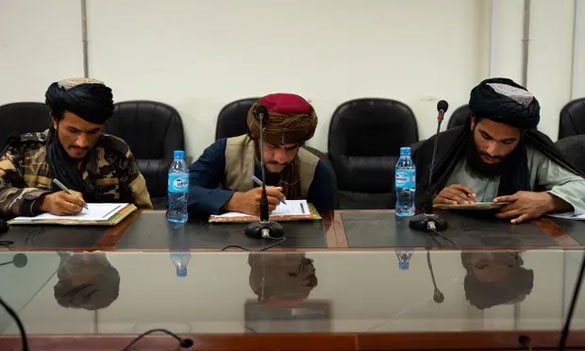 Taliban
fighters turned policemen answer questions at the end of a course on
international humanitarian law aiming to teach them how to protect civilians,
Kandahar, Afghanistan, 30 March. Photograph: Elise Blanchard/The Guardian
Taliban
fighters turned policemen answer questions at the end of a course on
international humanitarian law aiming to teach them how to protect civilians,
Kandahar, Afghanistan, 30 March. Photograph: Elise Blanchard/The Guardian
----------
• Hindus Shower Flowers On Muslims Coming Out Of
Mosque After Namaz at Moradabad in UP After Muslims Did The Same on A
Procession Taken Out A Day After Hanuman Jayanti
• Curbs On Media, Civil Society Undermine Pakistan's
Image, Ability To Progress: Blinken
• Iranian DM, General Ashtiani, Warns of Spread of
Islamophobia, Terrorism in World
• Years After Daesh Defeat, Northern Iraq Struggles To
Rebuild
South Asia
• Taliban Chief Hails ‘Victory’ in Rare Public Speech
in Afghanistan
• Afghanistan’s free fall sparks accelerating humanitarian
crisis
• International recognition for Taliban regime remains
elusive
--------
India
• Hindus, Muslims Celebrate Eid Together In Delhi’s
Violence-Hit Jahangirpuri
• Notice To Event Organisers For Hate Speech Against
MuslimsAt A ‘Sant Samagam’ In Aligarh
• Loudspeaker row: MNS workers play Hanuman Chalisa
near mosque in Mumbai
• Police Book Raj Thackeray, MNS Workers Begin
Offensive Against Mosque Loudspeakers
• PalayamImam Seeks Public Apology FromPC George
• Gurugram witnesses huge Id turnout at mosques due to
reduced open spaces for prayers
• Party Workers Will Protect Mosques: Minister Ramdas
Athawale Amid Loudspeaker Row
• Kerala: Malappuram man who renounced Islam attacked,
police file case
-------
Pakistan
• ‘I lost everything’: Pakistani airstrikes escalate
conflict on Afghan border
• Terror of heavy vehicles unleashed on Karachi city
roads
• Balochistan’s northern districts celebrate Eid with
KP
--------
Mideast
• FM: Iran, US Exchanging Written Messages through EU
• Iranian President Discusses Muslim World Issues with
Turkish, Qatari, Tajik Leaders
• Iranian Envoy: Omission of No Political Party in
Iraq Possible
• Iranian President Extends Eid Al-Fitr
Congratulations to Muslim World Leaders
• Turkey to repatriate 1 million Syrian refugees:
Erdogan
--------
Arab World
• Yazidis, Displaced Again, Fear More Strife In Iraqi
Homeland
• Turkey aims for one million refugees to return to
Syria
• Iraq military extends control over northern Sinjar:
Official
• Biden meets with parents of reporter who went
missing in Syria
• Kuwait seeks to invest $750 million in Pakistan
projects
• Qatar reclaims crown from US as world’s top LNG
exporter
--------
Africa
• Militants Launch Deadly Attack On International
Military Camp In Central Somalia
• UN chief calls for safe return for Nigeria’s
displaced
• Transit and ‘torture’: Rescued migrants recount
Libya horrors
• Food aid for South African families marks end of
Ramadan as prices spiral
• Worst drought in decades devastates Ethiopia's
nomads
--------
Southeast Asia
• Muslims In Singapore To Celebrate Hari Raya
AidilfitriOn May 3: Mufti
• 6 magnificent mosques that have stood the test of
time
--------
North America
• Man Charged After Threats Uttered During Nightly
Prayer Service AtToronto Mosque: Police
• Washington faces a moment of reckoning as Iran
nuclear talks reach an impasse
• CIA chief met with Saudi crown prince in April in
bid to mend ties: WSJ
--------
Europe
• Bradford Attempted Murder Charge After Eid Mosque
Attack
• Israel, Furious Over Lavrov’s Hitler Comment, Cannot
Burn Its Bridges With Russia
• UK Man Accused Of Funding Daesh Through Govt
COVID-19 Loans
• Italian president extends ‘warmest wishes’ for Eid
Al-Fitr
• Swedish-Iranian Jalali to be executed on spying
charges by May 21: Report
• Russia says Israel supports neo-Nazis in row over
Ukraine
Compiled by New Age Islam News Bureau
URL: https://www.newageislam.com/islamic-world-news/taliban-fighters-classroom-human-rights/d/126930
--------
Taliban Fighters In A Classroom: Taliban Swap Guns For
Pens To Learn About Human Rights
3 May 2022
Taliban fighters turned policemen answer questions at
the end of a course on international humanitarian law aiming to teach them how
to protect civilians, Kandahar, Afghanistan, 30 March. Photograph: Elise
Blanchard/The Guardian
---------
Around a conference room table, young Taliban fighters
quietly listen to an instructor teaching them how to behave with civilians.
Awkwardly armed with notebooks and pens, most of the
25 fighters turned policemen have never been in a classroom before. They have
spent most of their young lives as combatants in rural areas, and under their
ample traditional outfits, their wrist-sized ankles betray how undernourished
they are.
“What is the problem with bringing weapons inside a
hospital?” trainer Raouf asks.
“People will be scared,” a young Taliban member
answers.
“It will have a bad effect on sick people,” another
says.
This two-day class on international humanitarian law
(IHL), organised by Geneva Call, a humanitarian organisation, takes place in Kandahar,
southern Afghanistan.
“Did you ever bring your gun inside the hospital?”
Raouf asks. All the fighters laugh. “Yes,” they say, “of course!”
The rules of IHL can seem obvious: you cannot punish
someone you arrest before they go to court; boys under 18 are children and
should not fight; or “if someone is not fighting against you, you should not
fight them”.
But, Raouf says, these students “have no knowledge of
all these things, they were in the mountains with only guns”.
Since October, Raouf has trained 250 men in Kandahar.
“If we continue, I am sure they will change. I have seen a lot of changes
already.”
After class, the fighters say they will modify some
behaviours. “I will not enter hospitals with weapons any more,” says
Barakatullah, 28. “It was also new for me to hear that we have to respect the
human dignity of prisoners.”
During the course, Barakatullah had stood up to speak
about the torture he’d endured at Bagram jail, where he spent eight years.
But the young man, with his long black beard and soft
eyes, seems more weary than angry. After losing all his family except his
mother in a US airstrike, all he wishes for is “a normal life”.
“If I can find another job, I would leave the police.
I can be a shopkeeper or work for an NGO.”
According to Ashley Jackson, co-director of the Centre
for the Study of Armed Groups at the Overseas Development Institute, it is
important to keep engaging with the Taliban.
“Even small changes to their behaviour could save
lives,” she says.
In the classroom, all students wear a turban or a
small traditional hat. Some regularly raise their hands to answer. Others
fidget with their prayer beads at the back, struggling to sit still.
Fighters readily agree with preventing gender
violence, but some topics call for more tact, like the use of improvised
explosive devices (IED), suicide bombers or any act that may hurt civilians.
Taliban soldiers, since their return to power, have
often killed civilians because their vehicles didn’t stop at checkpoints.
“The Taliban have transitioned from a fighting force
to a government almost overnight – with almost no preparation, training or
understanding of things like human rights norms,” says Jackson.
“There are horrific problems with torture and beating
in Taliban detention. And the Taliban isn’t doing much to address that, so it’s
really up to others to try whatever they can to prevent more suffering.”
Kefayatullah, 22, one of those on the course, now
works in a jail.
“I learned yesterday that we should behave humanely
with prisoners,” he says.
“When I went back to the prison where I work, a person
called saying that the mother of a prisoner wanted to talk to her son. Before,
we were not allowing this. But because of the training, I gave my mobile to the
prisoner to speak to his mother.”
About 60% of the students cannot read, some have only
attended religious classes in rural madrasas.
“I’d like to restart my education and learn English.
After class yesterday, I told my friends we should ask for a teacher to come to
the police headquarters,” says Kefayatullah.
During the break, the fighters stay seated, laugh and
take pictures of each other. It is an image far removed from the one they often
project in propaganda videos.
According to FaryanehFadaei, Geneva Call’s director
for Afghanistan, the key to the training’s success is to adapt the material to
cultural sensitivities, with each rule linked to Islamic references
“Because it is contextualised, developed with
community leaders and religious scholars, it is accepted,” says Fadaei.
“Usually after the training, the participants ask for
more training and booklets to give to their friends.”
Geneva Call trains between 200 and 400 people a month
across Afghanistan, half of them members of armed forces.
Maiwandi, 21, is in the Taliban’s elite special
forces. Seated at the back in his military jacket, he struggles to concentrate.
Maiwandi joined the Taliban at 12. At 19, faced with brutal US raids in his
village, he enrolled as a suicide bomber.
Advertisement
“This war took the best years of my life, my childhood
and my education,” he says. “Now when I see people who are educated, who went
to university, I feel bad and wish I was them.”
Like Barakatullah or Kefayatullah, Maiwandi represents
the importance of Geneva Call’s training for young Taliban members who have
only known violence.
After the course, Maiwandi says he would love to study
more in future but adds that, if asked by his leadership, he would do what he’d
signed up for, as a suicide bomber.
Still, perhaps, he hopes “there will be no more war”.
Source:TheGuardian
Please click the following URL to read the text of the
original story:
--------
Hindus Shower Flowers On Muslims Coming Out Of Mosque
After Namaz at Moradabad in UP After Muslims Did The Same on A Procession Taken
Out A Day After Hanuman Jayanti
May 4, 2022
 The arrangements were made by Bareilly’s Vyapar Mandal
-----------
Bareilly: Members of the Hindu community on Tuesday
gathered to shower flowers on Muslims returning home after offering prayers at
a mosque in Thakurdwara, Moradabad. This happened a few days after Muslims did
the same to members of the Bajrang Dal during a procession taken out a day
after Hanuman Jayanti in the town.
Circle officer (CO) of Thakurdwara Anoop Singh and
sub-divisional magistrate Parmanand Singh have been encouraging people of both
the communities to maintain peace. CO Singh said, "Respecting each other’s
religion will change the outlook of people and there won’t be any communal
tensions." Both officials were also looking after security arrangements in
Thakurdwara as two festivals -- Eid and Akshaya Tritiya -- fell on the same
day.
The arrangements were done by members of the 'Vyapar
Mandal' of the town. Gaurav Chauhan, who was leading this initiative, told TOI,
"We all live in harmony and have been celebrating each other's festivals
for years in the town. This year, we just attempted to make our Muslim brothers
feel special and valued."
An elderly man, who was on his way back from the
mosque and did not wish to be named, told TOI, “We had never expected such a
gesture. It came in as a pleasant surprise. Such harmony is the need of the
hour as many parts of the country are witnessing incidents with communal
overtones.”
CO Singh said, “The residents of Thakurdwara have sent
across the message that kindness is above all and that it doesn't take much to
maintain peace. People should follow suit and spread the message of love and
peace.”
Source:TimesOfIndia
Please click the following URL to read the text of the
original story:
--------
Curbs
on media, civil society undermine Pakistan's image, ability to progress:
Blinken
May
4, 2022
 WASHINGTON:
Restrictions on media outlets and civil society undermine Pakistan's image as
well as its ability to progress, US Secretary of State Antony Blinken said.
WASHINGTON:
Restrictions on media outlets and civil society undermine Pakistan's image as
well as its ability to progress, US Secretary of State Antony Blinken said.
"We
are aware of significant restrictions on media outlets and civil society, more
broadly in Pakistan," Blinken told reporters at a news conference
organised here on Tuesday by the Washington Foreign Press Centre.
His
remarks came after a report released by a global media watchdog, Reporters
Without Borders, showed that Pakistan slid from 145th position last year to
157th this year on the World Press Freedom Index.
Responding
to a question, Blinken said, "Here again a vibrant free press, an informed
citizenry are key for any nation and its future, including Pakistan. I think
these practices that we see undermine freedom of expression, they undermine
peaceful assembly. They undermine Pakistan's image as well as its ability to
progress."
The
Secretary of State underlined that the US takes up this issue with Pakistan at
regular intervals.
"It
is something that comes up both in our direct engagements and in the work that
we're doing every day," he said.
About
the global scenario, Reporters Without Borders said the 20th World Press
Freedom Index reveals a two-fold increase in "polarisation" amplified
by information chaos, that is media polarisationfuelling divisions within
countries, as well as polarisation between countries at the international
level.
Source:TimesOfIndia
Please
click the following URL to read the text of the original story:
--------
Iranian
DM, General Ashtiani, Warns of Spread of Islamophobia, Terrorism in World
2022-May-3
 TEHRAN
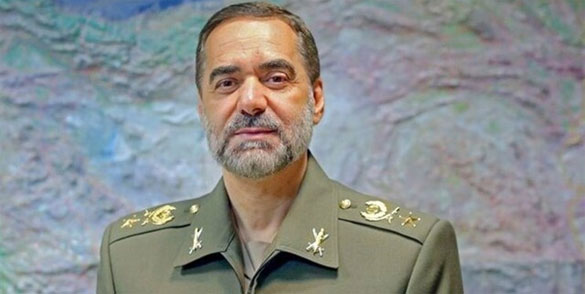
(FNA)- Iranian Defense Minister Brigadier General Mohammad Reza Ashtiani
felicitated Eid Al-Fitr to his counterparts in the Muslim states, and warned of
the spread of Islamophobia and terrorism by the imperialist powers.
TEHRAN
(FNA)- Iranian Defense Minister Brigadier General Mohammad Reza Ashtiani
felicitated Eid Al-Fitr to his counterparts in the Muslim states, and warned of
the spread of Islamophobia and terrorism by the imperialist powers.
----------
General
Ashtiani in separate messages to his counterparts in Muslim states on Monday
called on the Islamic countries to unite with greater amity and solidarity
against plots and conspiracies designed by the western powers.
He
emphasized that it is necessary for the Islamic countries to unite with each
other in the face of the hegemonic powers' plots through collaboration, unity
and closer solidarity.
General
Ashtiani stressed the need for strengthening relations, increasing interaction
and friendship among the Armed Forces of the countries of Islamic world.
He
described Eid al-Fitr as an opportunity for the materialization of solidarity
and strengthening of social and humanitarian bonds among Muslims and for close
integration in order to achieve peace and friendship.
General
Ashtiani warned against Islamophobia and terrorism waged by global imperialism
and called for Muslim unity to thwart those plots.
He
expressed the hope that the auspicious Islamic festivity would result in unity
and amity among Muslim nations and the promotion of their defense cooperation.
The
office of Leader of the Islamic Revolution Ayatollah Seyed Ali Khamenei
announced Tuesday as Eid al-Fitr in Iran.
The
fasting month of Ramadan — the ninth month on the Islamic calendar — ends with
the celebration of Eid al-Fitr, which is one of the main Muslim holidays.
Ramadan’s
end is announced after the sighting of the first crescent of the new moon. On
Eid al-Fitr, Muslims are encouraged to be specially generous and forgiving.
Source:
Fars News Agency
Please
click the following URL to read the text of the original story:
--------
Years
after Daesh defeat, northern Iraq struggles to rebuild
May
03, 2022
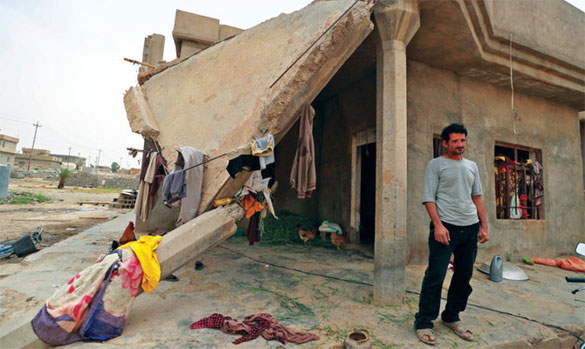 Iraqi
father-of-five Issa Al-Zamzoum stands outside his damaged house in the
war-ravaged village of Habash, some 180 km north of Baghdad. (AFP)
Iraqi
father-of-five Issa Al-Zamzoum stands outside his damaged house in the
war-ravaged village of Habash, some 180 km north of Baghdad. (AFP)
----------
HABASH,
Iraq: In Iraq, “maku” means “nothing,” and father-of-five Issa Al-Zamzoum says
“maku” a lot: no electricity, no home, no rebuilding and no job.
Eight
years after heavy fighting between Daesh terrorists and the army, the
reconstruction of his war-ravaged village in northern Iraq is at a standstill.
“There
is nothing here, no electricity,” 42-year-old Zamzoum sighed. “Even work, there
is none.”
Zamzoum
lives with his wife and family in Habash, some 180 kilometers (110 miles) north
of the capital Baghdad, a village dotted with dozens of bomb-blasted houses
still ruined from intense fighting in 2014.
Part
of their roof, which caved in during the bombardment, still lies in crumbling
and bullet-scarred wreckage.
In
one room, a hen watches over her chicks. In another, filthy mattresses are
piled up against the wall.
The
building does not even belong to Zamzoum: his own home was left uninhabitable.
While
the Baghdad government eventually celebrated military “victory” over Daesh in
December 2017, the scale of destruction was immense.
“Reconstruction?
We do not see it,” Zamzoum said gloomily. “Nothing has happened since the war.”
Habash
paid a heavy price during Daesh’s siege of Amerli, a town less than 10
kilometers away.
In
2014, the jihadists, who controlled the key northern city of Mosul and
surrounding areas, moved south to attack Amerli, using surrounding settlements
such as Habash as bases for their assault.
The
combined forces of the Iraqi army, Shiite militias and Kurdish forces launched
a counterattack to break the siege with gruelling street fighting, and Daesh
forces were pushed out.
But
for residents of the already hard-hit area, it was not the end of their
suffering.
According
to Human Rights Watch, after the siege “pro-government militias and volunteer
fighters as well as Iraqi security forces raided Sunni villages and
neighborhoods” surrounding Amerli, including Habash.
HRW
used satellite imagery to map “heavy smoke plumes of building fires, likely
from arson attacks” in the village.
Today,
nearly 20,000 people displaced by the conflict need aid in the area, according
to the Norwegian Refugee Council, an aid agency.
“Humanitarian
needs are significant,” the NRC said.
As
well as basic needs like clean water and electricity, even obtaining identity
papers is a challenge for many.
“Many
people have been displaced across governorates and face major barriers to
travel to obtain civil documents,” the NRC said.
“Others
face security clearance issues related to perceived affiliation with the
Islamic State” group, it added.
Like
most of the residents of Habash, Zamzoum’s neighbor Abdelkarim Nouri is a Sunni
Muslim.
In
Shiite-majority Iraq, Sunnis have sometimes been viewed with distrust, suspected
of being complicit in past support of the extremists.
Daesh
jihadists follow a radical interpretation of Sunni beliefs.
“Our
life is a shame,” Nouri said. “I don’t have a job. I have five sheep, and they
are the ones who keep me alive.”
He
said he had appealed to his member of parliament for support, but nothing had
changed.
Nouri
does not mention religion or talk of sectarianism — a deeply sensitive topic in
a country where tens of thousands of people died during bloody inter-religious
conflict in 2006-2008.
Now,
over four years since the end of Daesh’s self-proclaimed “caliphate” in Iraq,
many Sunnis say they are victims of harassment and discrimination.
A
US State Department report last year cited concerns among Sunni officials that
“government-affiliated Shia (Shiite) militia continued to forcibly displace
Sunnis.”
The
report quoted officials describing “random arrests of Sunnis in areas north of
Baghdad” and detentions made on suspicion of Daesh links.
In
Salaheddin province, where Habash is located, officials speak of “security
risks” which are delaying reconstruction — without mentioning Daesh jihadists
by name.
While
Habash is under government control, the militants still operate just 15
kilometers further north.
On
the road that leads to the village of Bir Ahmed, forces of the Hashed Al-Shaabi
— a Shiite-led former paramilitary coalition now integrated into Iraq’s state
security apparatus — stand guard.
“The
situation in Bir Ahmed is beyond our control and that of the army,” a senior
officer said. “You can get in, but I can’t guarantee you can get out.”
Source:ArabNews
Please
click the following URL to read the text of the original story:
https://www.arabnews.com/node/2075236/middle-east
--------
South Asia
Taliban
Chief Hails ‘Victory’ in Rare Public Speech in Afghanistan
May
01, 2022
The
reclusive Taliban chief, in a rare public appearance, Sunday hailed what he
said was the return of security and the Islamic system to Afghanistan after his
hardline group seized power last August.
“Congratulations
on this victory, freedom and success,” Hibatullah Akhundzada told several
thousand worshippers at the central mosque in the southern city of Kandahar. He
spoke at the start of three days of Eid al-Fitr festivities to mark the end of
the Muslim fasting month of Ramadan. The second largest Afghan city is known as
the Taliban’s birthplace and de facto power center.
Akhundzada
was making his first public speech since the takeover. He delivered the brief
address without turning to face the worshippers.
Taliban
security confined journalists, including the crew of the official Afghan
television, to a corner of the mosque and did not allow them to approach
Akhundzada.
An
eyewitness told VOA the compound was heavily guarded, with machine-gun
positions on the roof of the mosque around the dome and under construction
towers next to the building. A large number of Taliban soldiers were deployed
in and outside of the house of worship and Russian-made MI-17 helicopters and a
Cessna aircraft hovered over the mosque when Akhundzada was delivering his
speech.
The
tight security measures stemmed from a series of bombings in mosques, schools
and other civilian targets across major Afghan cities, including the capital,
Kabul, over the past two weeks, killing and injuring scores of people. The
victims were mostly members of the minority Shi’ite Muslim community.
Some
of the attacks have been claimed by Islamic State’s Afghan affiliate, Islamic
State Khorasan Province, commonly known by the acronym ISIS-K.
The
deadliest of the attacks took place in the northern province of Kunduz, where a
bomb ripped through a crowded mosque, killing at least 36 worshippers and
wounding scores of others. No group has yet claimed responsibility.
War-related
casualties, however, have almost disappeared in Afghanistan since August 15,
when the insurgent-turned ruling Islamist group seized power from the
then-Western-backed government in Kabul and U.S.-led coalition troops withdrew
from the country days later after 20 years of war with the Taliban.
Akhundzada's
public appearance on Sunday was his second known since he was appointed as the
supreme leader of the Taliban in 2016. He had visited a mosque in Kandahar last
October and briefly spoke to a small gathering of his followers.
Taliban
social media accounts later released an audio recording from the October event
in a bid to dismiss rumors of his death and media speculation about the role
the low-profile Akhundzada is playing in the policy making affairs of the
interim government in Kabul.
The
Taliban rulers are being denounced by the global community for not lifting a
ban on schoolgirls’ education in Afghanistan despite repeated public pledges
they would allow women to work and receive an education.
In
a message on Friday ahead of the Eid festival, the Taliban chief tried to
address those concerns.
“We
respect and are committed to all the Sharia (Islamic law) rights of men and
women in Afghanistan; no one should worry about it and do not use this
humanitarian and emotional issue as a tool for political ends,” Akhundzada
said.
“The
IEA is committed to take further steps in this regard, as education is the key
to rescue our compatriots and pave the way towards our country’s development
and prosperity,” he said, using the official name of the Taliban government,
the Islamic Emirate of Afghanistan.
Source:
VOA News
Please
click the following URL to read the full text of the original story:
https://www.voanews.com/a/6552692.html
--------
Afghanistan’s
free fall sparks accelerating humanitarian crisis
04
May ,2022
The
Taliban takeover of Afghanistan and the resulting cut in international aid has
led to a worsening humanitarian crisis, according to the latest report by a
Pentagon watchdog that has spent more than a decade tracking conditions in the
war-torn nation.
More
than 24 million people are now in need of humanitarian assistance in
Afghanistan, up from about 18.4 million last year, the US Special Inspector
General for Afghanistan Reconstruction, or Sigar, said in a report late Tuesday
night.
For
the latest headlines, follow our Google News channel online or via the app.
“Some
70 percent of households reported being unable to cover basic food and non-food
needs, reflecting the impact of decline in household incomes, according to the
study,” citing State Department figures. It went on to cite reports of people
selling their kidneys as evidence of how dire the situation has become.
But
in an even more ominous note, the report says conditions are likely to worsen.
The
country is suffering its worst drought in three decades. That was underway
before a recent surge in food prices, fueled by the war in Ukraine, itself a
major grain exporter.
The
United Nations has warned more than half of the country’s 40 million people are
facing acute hunger and a million children could die of starvation.
Afghanistan’s
economy has been in free fall partly because international aid, which accounted
for 40 percent of gross domestic product, was abruptly cut back and the US
moved to block the central bank’s access to some $9 billion in overseas
reserves.
Yet
aid that had continued after the Taliban takeover in August 2021 is now at
risk.
In
March the Taliban reversed itself and abandoned a commitment to reopen high
schools to girls. That prompted the World Bank to halt $600 million in
assistance.
The
report also said Taliban authorities have continued their efforts to restrict
the media by detaining journalists.
Source:
Al Arabiya
Please
click the following URL to read the full text of the original story:
--------
International
recognition for Taliban regime remains elusive
3
May, 2022
Kabul
[Afghanistan], May 3 (ANI): Since the Taliban seized power in Afghanistan, its
spokespersons have commuted to several neighbouring nations, but failed to
establish effective diplomatic ties.
“The
Taliban tried hard to engage with the world through diplomacy, but they did not
succeed because Afghanistan is still unrecognized, and the reason for that is
the restrictions imposed on women, youth and media. These restrictions must be
lifted,” said WaliForouzan, international relations expert, TOLOnews reported.
Politicians
and political analysts said that the Islamic Emirate has not engaged in
effective diplomacy over the past eight months toward gaining international
recognition.
Dealing
with the issue of international recognition, Amir Khan Muttaqi, the Taliban’s
acting Minister of Foreign Affairs, has made numerous trips to nations, failing
terribly at establishing ties.
Diplomats
from the Islamic Emirate in Russia, China, Iran, Pakistan and Kazakhstan have
officially begun their work but it is not yet clear which of these countries
will take the lead in recognizing the Islamic Emirate.
After
the Taliban took over in August 2021, living costs and food prices in the
country skyrocketed, and it cited World Bank findings saying that incomes are
likely to have fallen by around a third in the last few months of 2021.
Source:ThePrint
Please
click the following URL to read the full text of the original story:
https://theprint.in/world/international-recognition-for-taliban-regime-remains-elusive/940833/
--------
Hindus,
Muslims celebrate Eid together in Delhi’s violence-hit Jahangirpuri
May
3, 2022
Hindu
and Muslim communities together celebrated Eid on Tuesday at Jahangirpuri’s
Kushal Chowk by exchanging sweets and hugs, giving a message of peace and
harmony in the area that witnessed communal violence last month.
The
locals also treated the security personnel deployed there to sweets.
“Last
month was quite tough for the people of Jahangirpuri. Today, on the occasion of
Eid, we gathered at Kushal Chowk. We exchanged sweets and hugged each other and
sent a message of harmony and peace. This shows people in Jahangirpuri live in
harmony and respect each other’s religions,” a representative from the Muslim
community Tabrez Khan said.
Khan
expressed hope that full normalcy will return in the area soon.
“The
situation is improving. Normalcy has returned to a large extent and we are
expecting complete normalcy in the coming days,” he said.
Police
said they have ensured adequate security arrangements on the occasion of Eid.
Usha
Rangnani, Deputy Commissioner of Police (Northwest) said, “We have adequate
security and law arrangements put in place across the district. Aman Committee
meetings have been conducted as always to maintain peace and tranquillity in
all the areas.”
Meanwhile,
shops in and around Kushal Chowk–except for the main lane in Block C where a
mosque is located— have reopened.
Hawkers
and customers have also returned for business.
Indramani
Tiwari, the president of the Residents’ Welfare Association, who represented
the Hindu community, said Eid is being celebrated in a peaceful manner.
“We
are celebrating Eid together and expecting this harmony to remain among the
people. There is peace in the area and we expect complete normalcy soon,”
Tiwari said.
Clashes
broke out between the two communities during a Hanuman Jayanti procession in
Jahangirpuri, in which eight police personnel and a local resident were injured.
Source:
Indian Express
Please
click the following URL to read the full text of the original story:
--------
Notice
To Event OrganisersFor Hate Speech Against Muslims At A ‘Sant Samagam’ In
Aligarh
May
4, 2022
AGRA:
After some speakers allegedly made derogatory remarks against the minority
community at a ‘Sant Samagam’ (religious event) on Sunday, the Aligarh district
administration issued a show cause notice to the organisers on Monday seeking a
reply within 24 hours. On Tuesday evening, the organisers, in their response,
claimed that no rules were violated at the event.
According
to the notice issued by the additional city magistrate (first) Kunwar Bahadur
Singh, swords were brandished at the event despite a ban on carrying weapons
and there were reports that comments were being made against a religious
minority to incite sentiments. The organisers violated the terms of the
permission granted for food distribution, recitation of ‘Sundar Kand’ and
ceremony for priests only, the notice said.
Ashok
Kumar, who was issued the notice, claimed that no provocative speeches were
delivered during the event and that saints had focused only on publicity and
dissemination of Sanatan dharma. The sword was symbolic and it, along with the
Bhagavad Gita, was presented to saints in presence of the Bharatiya Janata
Party’s Member of the Legislative Assembly, Kumar claimed. He urged the
administration to cancel the notice as, according to him, no rules were
violated at the event.
Source:
Times Of India
Please
click the following URL to read the full text of the original story:
--------
Loudspeaker
row: MNS workers play Hanuman Chalisa near mosque in Mumbai
May
04, 2022
Mumbai:
Maharashtra Navnirman Sena (MNS) workers played Hanuman Chalisa on a
loudspeaker near a mosque in Charkop area of Mumbai on Wednesday morning, a day
after their party chief Raj Thackeray gave a call to recite the religious hymn
to protest against loudspeakers blaring ‘azaan’.
In
a video, an MNS worker, holding the party flag, was seen playing the Hanuman
Chalisa on a loudspeaker from a high-rise here. In the background, the ‘azaan’
could be heard from a loudspeaker of a nearby mosque.
In
neighbouring Thane city, some MNS activists played the Hanuman Chalisa on a
loudspeaker at a spot in Indira Nagar area. No mosque was located in the
vicinity.
Undeterred
by the registration of a case against him, MNS president Raj Thackeray had on
Tuesday urged people to play the Hanuman Chalisa on loudspeakers on Wednesday
wherever they hear loudspeakers “blaring azaan (Islamic prayer call)”.
In
an open letter, Thackeray had asked people to lodge complaints with police by
dialling 100 if they are disturbed by the sound of ‘azaan’.
“I
appeal to all Hindus that tomorrow, the 4th of May, if you hear the loudspeaker
blaring with azaan; in those places, play Hanuman Chalisa on loudspeakers.
That’s when they will realise the hindrance of these loudspeakers,” the MNS
leader had said.
Source:
Firstpost
Please
click the following URL to read the full text of the original story:
--------
Police
Book Raj Thackeray, MNS Workers Begin Offensive Against Mosque Loudspeakers
04.05.22
New
Delhi: Members of Raj Thackeray’s Maharashtra Navnirman Sena played the Hanuman
Chalisa on a loudspeaker near a mosque in the Charkop area of Mumbai on
Wednesday morning, even as Maharashtra police registered an offence against
Thackeray over a “provocative” speech he delivered on the topic on May 1.
Thackeray
has given repeated calls to MNS workers to protest against loudspeakers playing
azaan or the Islamic call to prayer.
A
court in western Maharashtra’s Sangli district has also issued a non-bailable
warrant against Thackeray in connection with a 14-year-old case.
In
addition, Mumbai police has served him a notice under Section 149 of the Code
of Criminal Procedure, related to preventing cognizable offences, as a
precautionary measure.
Police
have issued precautionary notices under various sections of the CrPC to more
than 300 people in the Central Mumbai region, including prominent MNS leaders.
The number of MNS workers who have been served police notices across the state
is over 75,000.
News18
has reported that Thackeray has lined up 2,000 lawyers to fight legal cases if
MNS workers are booked.
As
some MNS leaders threatened to hit the streets if further action is taken
against their leader, the Shiv Sena, part of Maharashtra’s ruling coalition,
said the state does not run on ultimatums and that the rule of law prevails.
Open
letter
The
police in Aurangabad on Tuesday registered a case against Raj Thackeray, two
days after he called for silencing loudspeakers atop mosques from May 4.
The
53-year-old politician was booked under sections 153 (wantonly giving
provocation with intent to cause riot), 116 (abetment of offence punishable
with imprisonment if offence be not committed) and 117 (abetting commission of
offence by the public or by more than 10 persons) of the Indian Penal Code and
provisions of the Maharashtra Police Act.
In
the Aurangabad rally on May 1, the MNS chief had asked people to play the
Hanuman Chalisa outside mosques from May 4 if loudspeakers playing the azaan
were not removed. On Wednesday evening, he repeated the call.
In
an open letter, he asked people to lodge a complaint with the police by dialing
100 if they are distributed by the sound of azaan.
“One
must complain daily,” the MNS leader said. “I appeal to all Hindus that
tomorrow, the 4th of May, if you hear the loudspeaker blaring with azaan; in
those places, play Hanuman Chalisa on loudspeakers. That’s when they will
realise the hindrance of these loudspeakers,” Thackeray said in the letter.
In
a video, an MNS worker, holding the party flag, was seen playing the Hanuman
Chalisa on a loudspeaker from a high-rise in Mumbai. In the background, the
azaan could be heard.
In
neighbouring Thane city, some MNS activists played the Hanuman Chalisa on a
loudspeaker at a spot in Indira Nagar area. No mosque was located in the
vicinity.
On
Tuesday, Maharashtra DGP Rajnish Seth said the Aurangabad police commissioner
will take appropriate legal action against Thackeray over his May 1 speech
against loudspeakers in mosques.
Source:TheWire
Please
click the following URL to read the full text of the original story:
--------
Palayam
imam seeks public apology from PC George
04th
May 2022
THIRUVANANTHAPURAM:
Palayam Imam VP Suhaib Moulavi has called for an apology from former legislator
PC George for his hate speech against Muslims. “If he can tender an apology to
society that would be the best step. I expect that from him. If anyone tries to
create a riot or hatred against communities, we Muslims, Hindus, Christians,
believers and atheists will not accept it,” he said at the Eidgah sermon on
Tuesday.
Without
naming him, the Imam said George made dangerous comments like Muslim traders
mixing drugs in food to sterilise people of other religions. He attempted to
flare up hatred. He said the call to choose shops as per one’s religion was
unheard of. The Imam asked people not to encourage hate speech. “The land has a
tradition of harmony. Eidgah is hosted at Advaithashramam here. Devotees coming
for AttukalPongala take rest in the courtyard of the mosque. Brotherhood is the
beauty of secularism,” he said. He urged society to isolate those who deliver
communal speeches.
Source:New
Indian Express
Please
click the following URL to read the full text of the original story:
--------
Gurugram
witnesses huge Id turnout at mosques due to reduced open spaces for prayers
MAY
03, 2022
Extra
sessions were held to accommodate the devotees at several mosques
The
mosques across the Millennium City witnessed higher turnout this year on the
occasion of Id-ul-Fitr on Tuesday due to reduced number of open spaces for
offering of namaz and extra sessions were held to accommodate the devotees.
The
prayers were conducted for around three hours in the morning amid tight
security at a dozen mosques and half-a-dozen open spaces starting at 6 a.m. and
remained peaceful.
Mufti
Mohammad Saleem Qasmi, president, Jamiat-Ulama-i-Hind, Gurugram, said an
announcement was made for four prayer sessions at Choma Masjid in Palam Vihar
anticipating huge turnout, but the management was forced to conduct the fifth
session as well. Mr. Qasmi said a large number of devotees were turned away
since it was not possible to conduct more sessions. “Even after the fifth
session, the turnout was so huge that two more sessions could be held, but we
asked the devotees to go back and offer prayers at their homes. Around 1,500
devotees offered prayers in each session. Earlier, we conducted prayers only
thrice and the attendance in the third session was usually thin,” said Mr.
Qasmi.
He
said that around 30 open spaces were available for offering of namaz last year
and therefore the turnout at the mosques was usually low. The offering of namaz
at open spaces was reduced from 30-odd places to around half-a-dozen last year
following strong protests by Hindu outfits.
The
devotees could be seen making a beeline outside Choma Masjid even before the
first session of prayer at 6.05 a.m. Though each session lasted for around 15
minutes, the mosque management kept a gap of 15 minutes between two successive
sessions for better crowd management.
Mr.
Qasmi said a written request was made to the Police Commissioner on Monday for
adequate security outside the mosques and at open spaces to avoid any untoward
incident. “The posters of the movie The Kashmir Files, and Bhagva Gurugram
(Saffron Gurugram) have come up in the city over the past few days. We,
therefore, demanded adequate security to prevent miscreants from disturbing
communal harmony. The local Station House Officer along with his team reached
the mosque before the devotees gathered for the prayers,” the cleric said.
Around
25,000 devotees offered prayers at Rajiv Chowk Idgah, which witnesses the
maximum turnout on the occasion of Id every year, in two sessions. Besides the
one-and-a-half acre of Idgah premises, an individual owning half-an-acre of
land adjoining the mosque also offered it for the prayers. Though the community
had requested for installation of loudspeakers at Idgah during the prayers for
better crowd management, the permission did not come through.
Aslam
Khan, chairman, Haryana Anjuman Charitable Trust, said six prayer sessions were
to be held at the Anjuman Mosque in view of the large number of devotees,
though only four were held last year. Situated in Sector 57, this lone mosque
on the government allocated land in New Gurugram caters to almost half of the
city’s municipal area spread across South and East zones and a large section of
the floating population commuting to the Millennium City daily for work at
private firms, shops and malls on Golf Course Road, Rajesh Pilot Road, Cyber
City, Mehrauli-Gurugram Road and the DLF areas. The court has stayed construction
at the mosque in an ongoing case.
Source:TheHindu
Please
click the following URL to read the full text of the original story:
--------
Party
Workers Will Protect Mosques: Minister Ramdas Athawale Amid Loudspeaker Row
May
03, 2022
Mumbai:
Union minister of state for social justice and empowerment Ramdas Athawale on
Tuesday said workers of his Republican Party of India (A) will protect mosques
if anyone tried to remove loudspeakers from there forcibly.
Mr
Athawale said that his party would ensure that the Muslim community does not
face injustice.
"We
are not against playing Hanuman Chalisa outside a mosque. But our opposition is
to Maharashtra Navnirman Sena's (MNS) demand of bringing down loudspeakers from
mosques. The RPI (A) workers will protect mosques if someone tries to forcibly
remove loudspeakers from mosques," he told reporters.
"Instructions
can be given to lower the volume of these loudspeakers. The BJP may have
supported the demand of the MNS, but that does not mean my party is in favour
of such a move. If Raj Thackeray gives an ultimatum to have these loudspeakers
removed, then workers of my party will protect mosques," he added.
There
should be no disputes between Hindus and Muslims, Mr Athawale said.
"Loudspeakers
have been atop mosques for a long time then why raise the issue now? Unlike Raj
Thackeray's claim that the loudspeaker is a social issue, it is, in fact, a
religious issue," he said.
Source:
ND TV
Please
click the following URL to read the full text of the original story:
--------
Kerala:
Malappuram man who renounced Islam attacked, police file case
May
4, 2022
The
Kollam police have registered an attempt to murder case against a group of men
after a 24-year-old man who renounced Islam filed a complaint saying that he
was attacked and was facing threats from within the community for doing so.
The
Kollam police on Sunday registered the case after a complaint from Askar Ali,
who hails from Malappuram. Ali, who has completed a 12-year Hudawi religious
programme from a prominent religious academy in Malappuram, was in Kollam on
Sunday to deliver a talk on his experience as a student of Islamic studies. He
was to speak at an event organised by Essense Global, an organisation promoting
“scientific temper, humanism and the spirit of inquiry and reform in society”.
According
to Ali’s complaint, a group of people from Malappuram tried to abduct him to
ensure that he did not address the event. “They took me to Kollam beach, where
I was manhandled. They destroyed my mobile phone and tore my clothes. They
forcibly took me to a vehicle and tried to lock me inside. When locals raised
an alarm, the police saved me,” he said.
According
to Essense Global, Ali then delivered his address in the presence of police. In
a video, Ali spoke about his experience as a student of Islamic studies,
alleged sexual harassment during his studies and his journey towards “the path
of humanism”.
Source:
Indian Express
Please
click the following URL to read the full text of the original story:
-------
Pakistan
‘I
lost everything’: Pakistani airstrikes escalate conflict on Afghan border
May
3, 2022
MANDATAH
VILLAGE (Afghanistan): It was nearly 3 a.m. in the mountainous borderlands of
eastern Afghanistan when a deafening thud jolted Qudratullah awake. Confused,
he staggered to the doorway of his mud brick home, looked outside and froze.
Thick
plumes of black smoke and dust filled the air. The front of the modest house
where his relatives lived was a pile of rubble. His 3-year-old nephew stood in
the yard, sobbing. Behind him, four more children were sprawled across the pale
earth, their lifeless frames soaked in blood.
Qudratullah
ran toward them, he said. Then another blast struck.
His
village, Mandatah, was one of four in eastern Afghanistan hit this month by
Pakistani airstrikes, Afghan officials said, killing at least 45 people, including
20 children.
Among
them were 27 of Qudratullah’s relatives — an almost incomprehensible loss.
Qudratullah, 18, who like many in Afghanistan goes by only one name, lost his
16-year-old wife, who was crushed beneath a pile of rubble in the second
airstrike. His older brother, who survived, lost all four of his daughters, all
younger than 11.
“I’m
devastated,” Qudratullah said. “I lost my wife, my relatives, our home, our
vehicles, our animals, everything.”
The
predawn airstrikes in Khost and Kunar provinces two weeks ago marked a serious
escalation of the cross-border conflict in this remote, wild and rocky stretch
of Afghanistan and exacerbated tensions between the two countries that have
navigated a delicate relationship since the Taliban seized power last year.
Pakistani
officials have not confirmed or commented on the airstrikes.
The
airstrikes, which Afghan officials said were carried out by Pakistani military
aircraft, came several days after militants said to be operating from the area
killed seven soldiers across the border in Pakistan.
In
eastern Afghanistan, many feared that the carnage of the recent airstrikes was
the beginning of a violent new chapter of the long-running conflict in the
tribal lands that spill across the porous border. Reinforcing those concerns,
Afghanistan’s acting minister of defense, Mullah Muhammad Yaqoob, warned in a
speech Sunday that the Taliban government would not tolerate any more
“invasions” from neighboring countries on Afghan soil.
“Pakistan
sending in manned aircraft and killing so many people in different places, the
Taliban’s defense minister threatening war if there are more attacks — this is
a turning point,” said Asfandyar Mir, a senior expert at the United States
Institute of Peace.
For
more than a decade, Pakistani authorities have sought to stamp out the
militants hostile to the Pakistani state in Afghanistan’s borderlands,
sporadically hitting the area with artillery that has killed a handful of
civilians each year.
After
the Taliban toppled the Western-backed government in Afghanistan, many in
Pakistan hoped that the insurgents turned rulers — who benefited from
Pakistan’s support over the past 20 years of war — would rein in the violence
by the militants, known as Tehrik-e-Taliban Pakistan or the Pakistani Taliban.
But
in recent months, attacks by the group in Pakistan have surged: Since the
Western-backed Afghan government collapsed in August, the Pakistani Taliban
have carried out 82 attacks in Pakistan, more than double the number over the
same period of the previous year, according to the Islamabad-based Pak
Institute of Peace Studies. The attacks killed 133 people.
Those
numbers are still relatively low compared with the height of the Pakistani
Taliban’s insurgency around 2009, but the recent sharp increase in violence has
fueled fears that the group is gaining strength after having declined over the
past decade, and has reinforced concerns that Afghanistan under the new Taliban
government could become a haven for militants.
The
Islamic State group has carried out several attacks across the country, mainly
against Afghanistan’s Shiite minorities, while the Pakistani Taliban have
resurged in the east, analysts say.
Taliban
officials have denied providing safe haven for militants, including the
Pakistani Taliban, but the issue has become a flashpoint between Afghan and
Pakistani authorities, who claim that the militant group — which is responsible
for some of the worst terrorist attacks in Pakistan’s history — has become
emboldened under the new Taliban government and allowed to operate freely on
Afghan soil.
The
Pakistani Taliban, which analysts estimate to have several thousand fighters in
eastern Afghanistan, have maintained ties with the Taliban for more than a
decade and pledged allegiance to the Taliban leader. Hundreds of jailed
Pakistani Taliban militants were released from prison last year as the Afghan
Taliban seized control of major cities and liberated their prisons.
“It
would be fair to describe the TTP as the ideological twin of the Afghan Taliban,”
said Madiha Afzal, a fellow at the Brookings Institution, using the
abbreviation for Tehrik-e-Taliban Pakistan. “When the Taliban took over
Afghanistan last year, the TTP hailed the Taliban’s ‘victory’ and renewed its
oath of allegiance.”
The
villages hit in the recent airstrikes are nestled between mountains blanketed
in pine forests. With soil too stubborn for large-scale farming, most residents
scrape out a living harvesting pine nuts each fall or collecting lumber from
the forest to sell in the local market.
The
glint of a barbed-wire fence dividing Pakistan and Afghanistan is visible just
over the horizon. The border, known as the Durand Line, cuts directly through
traditional Pashtun lands and for decades was little more to families divided
on either side than a line drawn across the maps of British colonial officers.
The
fence itself has been a source of tension between the two countries since
Pakistani authorities began its construction in 2019 along the disputed border.
When
Pakistani military launched a sweeping military offensive against militants in
2014, hundreds of thousands of people fled the fighter-bombers pounding
Pakistan’s tribal areas and crossed into Afghanistan, seeking shelter with
relatives.
Among
them were many militants with the Pakistani Taliban, who found refuge among the
Taliban. For years, they quietly regrouped amid the threat of US airstrikes and
offensives by Western-backed Afghan security forces. But since the Taliban
seized power last year, many militants, now able to move freely, have returned
to their relatives’ homes along the border, residents say.
Signs
of their presence and support abound: Children wear small buttons with pictures
of Hakimullah Mehsud, the second emir of the Pakistani Taliban, who was killed
in a US drone strike in 2013. The militant group’s flag is hoisted above homes
and shops.
And
unlike in many other parts of the country, where the Taliban’s security forces
have conducted house-to-house sweeps to collect weapons from civilians, these
villages are flush with armed men.
But
as the signs of Pakistani Taliban militants have grown in recent months, so too
has the shelling from Pakistan, residents say. Still, the devastation from the
airstrikes April 16 was unlike anything they had ever experienced.
Around
3 that morning in Kanai village, Rangin, 30, felt his wife nudging him to wake
up for suhoor, the predawn meal Muslims eat before the daylong fasts during the
holy month of Ramadan. A migrant from North Waziristan in Pakistan, he fled
during the military offensive and eventually built a small home on the Afghan
hillside where he lived with his wife and four children.
Rangin
had told his wife to let him sleep; then the walls and ceiling crashed down on
top of them in a deafening boom, he said. Trapped beneath the rubble, his right
arm was pressed against his wife’s torso, which swelled and sank as she fought
to breathe. Minutes later, two more blasts destroyed a neighbor’s empty home
and a shop down the road, killing its 16-year-old shopkeeper.
After
a half-hour, Rangin could no longer feel his wife’s chest move. He was
eventually rescued, but she was dead, along with his three daughters, ages 1, 3
and 10.
“Why
are they bombing us?” he asked, standing in the wreckage of his home. “We are
just refugees. This is a cruelty.”
Bits
of torn bank notes from the 150,000 Pakistani rupees, roughly $800, in savings
he kept in his home fluttered on the ground around him. Like others interviewed
here, he said he had no connection to the Pakistani Taliban.
Around
the same time that morning in the nearby village of Mandatah, a blast tore
through the front of Qudratullah’s family home. His relative and neighbor
Sadamullah, 21, ran to the house with his aunt, uncle and cousin, choking on
smoke. He could make out the bodies of children laying on the lawn and red
flames engulfing the family’s tractor and pickup truck.
But
before Sadamullah could make sense of the scene, another blast hit the back of
the house, throwing him on the ground. When he came to, he saw his cousin
laying face down on the earth, legs covered in blood. His aunt and uncle were
buried beneath the rubble.
“For
almost 20 minutes, my hands, feet and brain were not working. I lost control,”
Sadamullah said.
Source:
Times Of India
Please
click the following URL to read the full text of the original story:
--------
Terror
of heavy vehicles unleashed on Karachi city roads
Muhammad
Usman Mallick
May
3, 2022
KARACHI:
The unchecked misuse of heavy vehicles continues to be a death sentence for
Karachi’s residents, where more than half of all traffic accident fatalities
during the first four months of the current year are attributable to buses,
trailers, trucks, dumper trucks, water tankers and oil tankers, it emerged on
Monday.
On
the morning of March 22, a father and his two minor daughters were crushed to
death by a cement mixer on Sharea Faisal as they were on their way to the
children’s school on a motorbike.
In
a similar accident, a man and his two sons were run over by a trailer on ICI
Bridge as they made their way home from work.
A
week ago, two motorcyclists suffered the same fate in Quaidabad, when a water
bowser’s brakes failed and it ran over and killed them near Daud Chowrangi.
Sixty-nine
dead, 40 injured in 62 fatal accidents between January and April this year
Gut-wrenching
stories such as these, of families being torn up by recklessly driven large
vehicles, have become a regular feature of the city’s news cycle. Tragically,
the city’s denizens seem to have little option, but to accept it as an inherent
risk of life in a chaotic and sometimes lawless metropolis.
‘Around
90pc of victims are motorcyclists’
DIG
Traffic Ahmed Nawaz Cheema told Dawn that in accidents that involve heavy
vehicles, 90pc of the victims are either bike riders or pedestrians.
According
to the data compiled by Karachi Traffic Police, there were a total of 79
accidents recorded in the first four months (up to April 28) of this year
alone. Of the total, 62 accidents resulted in casualties, with 69 killed and 40
injured as a result.
Among
the fatal accidents, trucks were responsible for the deaths of 17, trailers for
10, water tankers eight, cars/jeeps seven, buses six, unknown vehicles five,
minibuses, dumper trucks and oil tankers three, and coaches, pickups and
motorcycles two each. A total of 56 motorcyclists lost their lives in 49 fatal
accidents.
When
asked about the reasons for the markedly higher fatality rate among
motorcyclists in accidents, DIG Cheema said: “If we look into the accidents,
about 92pc of the bike riders were not wearing helmets [at the time of
accident] and 100pc of them did not have back view mirrors installed.”
He
cited reckless riding by bikers and traffic rules violations by heavy vehicles
as the major causes behind fatalities.
“Bikers
shift the lanes from extreme left to extreme right, or extreme right to extreme
left. Similarly, heavy vehicles are not allowed to use the extreme right lane
or even left, but centre [but do not observe the rule].”
On
a question regarding the traffic police’s continued failure to address the
issue, DIG Cheema told Dawn that Karachi police chief Ghulam Nabi Memon had in
February restricted the authorisation to issue challans over traffic violations
to Section Officers (SO) only, which has prevented officers of other ranks from
taking immediate action over violations.
“The
city used to have 1,040 officers entitled to issue tickets,” he said, adding
that the department only has 108 SOs, of which 88 are assigned to on-road duty.
To
counter the shortage of challan-issuing officers, a recommendation of 350
“energetic and clean” assistant sub inspectors, sub inspectors and inspectors
has been sent to the AIGP to permit them to issue tickets.
Heavy
vehicles not allowed on Sharea Faisal: DIG
On
the question of measures taken to curb such incidents, he said restrictions
have been imposed on the movement of intercity heavy transport vehicles,
including long haul vehicles and 22-wheelers, and they are only allowed to ply
the roads from 11pm to 7am.
He
noted that these vehicles can only use designated roads and are not allowed to
use Sharea Faisal. As far as intra-city heavy vehicles are concerned, he added,
they are banned from plying the roads during peak hours, which are from 7am to
9am and 5pm to 9pm.
However,
he said, the measure had been resisted by private transport vehicles as well as
government institutions. In particular, the water tankers operated by the
Karachi Water and Sewage Board (KWSB) and garbage trucks operated by the Sindh
Solid Waste Management Board were facing issues due to the restrictions. He
said the traffic department is subsequently reviewing the situation and
planning to allow some relaxations to the rules.
When
asked about how such cases are prosecuted, Advocate AhrarJawaid Bhutto
explained that FIRs are filed by the deceased family under Section 320
(Punishment for qatl-i-khata by rash or negligent driving) of the Pakistan
Penal Code, but case rarely go to the point of conviction and are mostly
settled through out-of-court compromises.
Source:
Dawn
Please
click the following URL to read the full text of the original story:
https://www.dawn.com/news/1687944/terror-of-heavy-vehicles-unleashed-on-karachi-city-roads
--------
Balochistan’s
northern districts celebrate Eid with KP
Saleem
Shahid
May
3, 2022
QUETTA:
Amid tight security, Eid was celebrated in northern districts of Balochistan on
Monday. In the province’s other districts, including provincial capital Quetta,
Eid will be celebrated on Tuesday as announced by the Central Ruet-e-Hilal
Committee.
The
northern districts of Balochistan bordering Afghanistan, where Eid was celebrated
on Monday, included Chaman, Qila Abdullah, Qila Saifullah, Zhob, Musakhail,
Duki, Kohlu, Barkhan, Loralai, Gulistan and Khanozai.
In
Chaman town, Eid prayers were held at over 100 places. In other cities and
towns of northern Balochistan big congregations of Eid prayers were arranged.
Heavy contingent of security forces, including police, Levies and personnel of
Frontier Corps, were deployed at mosques and open places where Eid
congregations were held.
The
districts’ Ruet-i-Hilal Committees in Chaman, Qila Saifullah, Qila Abdullah,
Loralai, Barkhan and Kohlu had announced Eid on Monday on the basis of evidence
they received from the people who had claimed that they had sighted the Shawal
moon.
However,
some Ulema in these cities did not agree with the decision and asked the people
to fast on Monday and celebrate Eid on Tuesday.
The
prayer leader of the Central mosque in Chaman Hafiz Matiullah announced to
celebrate Eid on Tuesday as, according to him, the local committees have not fulfilled
the religious requirement about collecting evidence regarding sighting of the
moon.
Source: Dawn
Please
click the following URL to read the full text of the original story:
https://www.dawn.com/news/1688035/balochistans-northern-districts-celebrate-eid-with-kp
--------
Mideast
FM:
Iran, US Exchanging Written Messages through EU
2022-May-3
“The
Vienna talks have not been paused, but they continue in another process to
remove the unilateral sanctions imposed on us and through the exchange of
written messages with the Americans through the EU representative,” Amir
Abdollahian said in an interview with Yemen’s Arabic-language al-Masirah
television network.
He
underlined that Iran’s objective in the talks is to reach a “strong” and
“permanent” agreement, adding, “We urged the American side to be
realistic."
“Removing
sanctions in all areas and receiving economic guarantees are among the most
important items on our negotiating team’s agenda.”
The
top Iranian diplomat also said he believes the Americans have perfectly
understood Iran’s red lines.
“We
will continue the dialog. As soon as an agreement is about to be reached, our
representative in the negotiations will make the final changes to the
agreement,” Amir Abdollahian said.
The
Islamic Republic has made clear that both the JCPOA and the UN Security Council
Resolution 2231 are the benchmarks for the Vienna talks, rejecting anything
less or more than those two.
Several
rounds of negotiations have been held in the Austrian capital since April 2021
to bring the US back into the Iran deal. The Vienna talks, however, exclude
American diplomats due to their country’s withdrawal from the deal, officially
called the Joint Comprehensive Plan of Action (JCPOA), on May 8, 2018.
Recent
weeks have brought the talks to a new impasse, as the US insists on its refusal
to remove Iran’s Islamic Revolution Guards Corps (IRGC) from its foreign
terrorist organization list.
Source:
Fars News Agency
Please
click the following URL to read the full text of the original story:
https://www.farsnews.ir/en/news/14010213000416/FM-Iran-US-Exchanging-Wrien-Messages-hrgh-EU
--------
Iranian
President Discusses Muslim World Issues with Turkish, Qatari, Tajik Leaders
2022-May-3
During
the phone talks with his Turkish counterpart Recep Tayyip Erdogan on Monday,
Rayeesi denounced the recent "unacceptable" developments in
Palestine, urging all Muslim countries to push for an end to the atrocities
carried out by the Israeli regime against the Palestinian people.
"It
is necessary for us to make every effort to stop the inhumane attacks of the
Zionist regime on the Palestinian people through collective efforts among
Muslim countries and making use of various international capacities," he
said
Rayeesi
also extended his felicitations to the Turkish president and nation on the
occasion of Eid al-Fitr and wished the best for the entire Muslim Ummah.
He
further emphasized that the Islamic Republic's policy is based on the promotion
of inclusive relations with regional states, particularly Turkey.
Erdogan,
for his part, said he is willing to pay a visit to Tehran and hold talks with
Iranian officials on leading regional and international developments as well as
ways to expand mutual relations, particularly in the trade sector.
The
Turkish president also expressed hope that the great Eid al-Fitr would bring
health, prosperity and happiness for all Muslim nations across the world.
Also,
in a Monday phone call with Qatar's Emir Sheikh Tamim bin Hamad Al Thani, Rayeesi
expressed the hope that peace and security would be established across the
Muslim world.
He
congratulated the Qatari Emir and people on the auspicious Eid al-Fitr
occasion.
Meantime,
the presidents of Iran and Tajikistan stressed the need for coordination
between the two countries to ensure regional security.
"The
Islamic Republic of Iran believes that security and prosperity of the people of
Tajikistan is security and prosperity of the Iranian people," Rayeesi told
Tajikistan President Emomali Rahmon during a phone conversation.
The
Iranian president emphasized the need to develop security coordination between
the two countries and added, "Iran is concerned about security situation
in the region, especially in Afghanistan."
He
hailed growing economic relations between the two countries and invited the
Tajik president to visit Iran, which he said would play an effective role in
improving bilateral and regional interactions.
The
office of Leader of the Islamic Revolution Ayatollah Seyed Ali Khamenei announced
Tuesday as Eid al-Fitr in Iran.
The
fasting month of Ramadan — the ninth month on the Islamic calendar — ends with
the celebration of Eid al-Fitr, which is one of the main Muslim holidays.
Source:
Fars News Agency
Please
click the following URL to read the full text of the original story:
--------
Iranian
Envoy: Omission of No Political Party in Iraq Possible
2022-May-3
Dialogue
and consultation among the political parties in Iraq for reaching an agreement
is the only way out of the political impasse in the country, Masjedi said.
He
added that Iraq is an independent country with respected political leaders and
that no one has the right to interfere in its internal affairs.
"Given
the political and social details prevailing in Iraq, the Islamic Republic
believes that dialogue and consultation between the political parties can be
helpful."
Masjedi
referred to the developments in Iraq after the elections, and said, "Given
the failure of the Iraqi political factions to form a government, everyone
needs to reach an agreement. Because it is not possible to remove a political
party from the Iraqi political scene."
Masjedi
began his diplomatic mission as Iran’s ambassador in Iraq in March 2017.
He
will be replaced by Mohammad Kazzem Al-e Sadeq.
Source:
Fars News Agency
Please
click the following URL to read the full text of the original story:
https://www.farsnews.ir/en/news/14010213000402/Iranian-Envy-Omissin-f-N-Pliical-Pary-in-Ira-Pssible
--------
Iranian
President Extends Eid Al-Fitr Congratulations to Muslim World Leaders
2022-May-3
President
Rayeesi in separate messages to his counterparts in Islamic countries on Monday
felicitated Eid al-Fitr as manifestation of faith, knowledge and flourishing
the Divine nature and human excellence.
The
Iranian President considered Eid al-Fitr as a feast of returning to self,
blossoming of human nature and promised reward of pious and virtuous people and
expressed hope that Muslims around the world would receive the Divine rewards
at the end of holy month of Ramadan.
On
this auspicious occasion, President Rayeesi also expressed the hope that bonds
of unity and amity would be further strengthened among people in the Islamic
community in line with realization of sublime ideals of the pure religion of
Islam and people across the world would witness end of conflicts as well as
restoration of peace and security.
The
office of Leader of the Islamic Revolution Ayatollah Seyed Ali Khamenei
announced Tuesday as Eid al-Fitr in Iran.
The
fasting month of Ramadan — the ninth month on the Islamic calendar — ends with
the celebration of Eid al-Fitr, which is one of the main Muslim holidays.
Source:
Fars News Agency
Please
click the following URL to read the full text of the original story:
--------
Turkey
to repatriate 1 million Syrian refugees: Erdogan
03
May 2022
Turkey’s
president says the country is to send back around one million Syrian refugees
to northern Syria, under a plan aimed at enabling their resettlement in houses
partially built by Turkey there.
“We
are backing up our strategy with projects to encourage the returns,” Recep
Tayyip Erdogan said on Tuesday. “We are preparing a project to realize our one
million Syrian brothers' return."
Under
the scheme, the Turkish government would seek to accommodate the Syrians in
100,000 houses in the militant-held northern Syria province of Idlib, the London-based
news and analysis website, the Middle East Eye (MEE) reported.
Critics
remind that since 2011— when Syria found itself in the grip of rampant violence
fueled by several regional countries, including Turkey, and others —Idlib has
been serving as a safe haven for the militants and terrorists who would flee
there from Damascus’ anti-terror operations.
They
warn that the Syrians, whom Ankara seeks to repatriate, might include a
considerable number of former militants, something that threatens to compound
the situation in the province or result in the spillover of violence elsewhere.
“All
infrastructure projects, from housing to hospitals, everything regarding daily
life will be in this project,” Erdogan said.
Turkey
currently hosts 3.7 million Syrian refugees and 1.7 million other foreign
nationals, the MEE reported.
The
Turkish opposition and conservative politicians are, meanwhile, pressing Ankara
to repatriate the refugees.
“The
main opposition Republican People’s Party (CHP) has spearheaded the increasingly
hostile anti-Syrian rhetoric,” the website said.
CHP
chief Kemal Kilicdaroglu has promised to send Syrians back to their country if
elected president in 2023.
Source:
Press TV
Please
click the following URL to read the full text of the original story:
https://www.presstv.ir/Detail/2022/05/03/681447/Turkey-Syria-return-refugees-Erdogan
--------
Arab World
Yazidis,
displaced again, fear more strife in Iraqi homeland
03
May ,2022
Iraqis
in a northern town still traumatized by memories of ISIS feared more violence
Tuesday after hostilities between the military and a local militia erupted,
people internally displaced by the fighting said.
Tensions
reached a fever pitch when Iraq’s military launched an offensive in Sinjar
district Sunday to clear out armed elements of the YBS, a local militia
comprised largely of minority Yazidis.
The
YBS has ties to the insurgent Kurdistan Worker’s Party, or PKK, a separatist
movement banned in Turkey.
The
heavy fighting prompted over 3,000 people, most of them Yazidis, to flee toward
the Kurdish-run north. It wasn’t clear if there were any dead or wounded in the
fighting: Iraqi officials have released no figures and have not commented on
casualties.
Fighting
ceased Tuesday and the Iraqi army said it had re-established control of Sinjar.
But the violence and subsequent displacement dealt a blow to Baghdad’s efforts
to encourage more Yazidis to return to their ancestral homeland after years of
war.
An
agreement was brokered by the United Nations in October 2020 between Baghdad
and the Kurdish-run government to implement order in the area. Under that
agreement, the federal police are the sole state authority.
The
accord has not proven successful. Critics have said this is because it did not
consult powerful local forces in Sinjar or even Yazidi leaders.
Local
residents, who also include Arab Sunnis, are also deeply divided.
Lt.
Gen. Abdul-Amir al-Shammari, deputy commander of Iraq’s Joint Operations
Command, told a news conference in Sinjar that Iraqi forces have imposed
security and law and order and have opened all the roads in the district.
“The
goal of these operations was to impose the (rule of) law and security to secure
a safe environment so that we can rebuild Sinjar and return the displaced.”
But
Yazidis, many displaced now for a second time, are reluctant to return.
Most
of the displaced fled north to the Kurdish-run region where they were
distributed across different camps. Many first fled in 2014 after ISIS’s brutal
onslaught and returned in recent years to rebuild their homes.
The
memories are still fresh in Sewe’s mind. His was among the dozens of families
who made their way to the Chemishko camp in Zakho on Monday. He only gave The
Associated Press his first name.
“It
is the second time that we escaped,” he said. “We don’t know where to go, we
don’t have a place to go, and we don’t know where we are going now.”
The
YBS was created in 2014 with assistance from the PKK. They proved instrumental
in driving out ISIS elements from the area after the collapse of the Iraqi
army. The YBS has since remained a powerful local force in the area, citing
deep mistrust of the federal government forces deployed to protect the area.
The
Iraqi army said the aim of the offensive has been to reassert state authority
in response to the YBS erecting checkpoints and preventing citizens from
returning to their homes.
But
most residents expect more violence.
Source:
Al Arabiya
Please
click the following URL to read the full text of the original story:
--------
Turkey
aims for one million refugees to return to Syria
03
May ,2022
Turkish
President Recep Tayyip Erdogan on Tuesday said Ankara was aiming to encourage
one million Syrian refugees to return to their country by building them housing
and local infrastructure there.
Turkey
is today home to more than 3.6 million Syrian refugees, who fled after a civil
war broke out in 2011 in Turkey’s southern neighbor.
Erdogan
is facing rising public anger over the refugees’ presence and is wary of the
issue dominating next year’s presidential and parliamentary elections.
For
the latest headlines, follow our Google News channel online or via the app.
“We
are preparing a project for the return of one million of our Syrian sisters and
brothers to their home country,” Erdogan said in a video address.
He
said his government would work with international and local civil society
organizations to reach the goal.
The
video was broadcast to hundreds in Idlib, northwestern Syria, during a ceremony
to hand out keys to houses that Turkey has constructed in the war-torn
country’s north for displaced Syrians, an AFP correspondent said.
Erdogan
said around 500,000 Syrians have returned to “safe zones” on the Turkey-Syria
border since 2016.
Turkey
plans to encourage more to return by building more houses for the returnees
inside Syria.
“We
will carry out this project with 13 local assemblies in the region, especially
in Azaz, al-Bab, Tal Abyad and Ras-al Ayn and it’s pretty comprehensive,”
Erdogan said.
Under
the project, Turkey will also help build a school and a hospital to serve those
returning, and help with infrastructure needed by the local economy, “from
agriculture to industry.”
Turkish
Interior Minister Suleyman Soylu on Tuesday visited the Kammouneh camps in
Sarmada region, northwestern Syria, for the ceremony.
Speaking
to a jubilant crowd waving Turkish flags, Soylu said Turkey would continue to
support Syrians and at least 100,000 homes would be ready by the end of 2022 in
the region.
Turkey
has welcomed nearly five million refugees in total including Syrians and
Afghans but their presence has caused tensions with locals, especially as the
country suffered an economic crisis last summer.
Civil
society associations and aid groups fear refugees will be used as a scapegoat
for the country’s problems in the 2023 electoral campaign as Erdogan faces an
angry populace.
Several
opposition parties regularly call for the return of Syrian refugees to their
home country.
Turkish
officials in mid-April banned Syrian refugees from temporarily visiting Syria
to see their families for the Eid al-Fitr holiday in early May, which marked
the end of the holy month of Ramadan.
Source: Al Arabiya
Please
click the following URL to read the full text of the original story:
--------
Iraq
military extends control over northern Sinjar: Official
03
May ,2022
An
Iraqi military official said Tuesday that they had extended their control over
the northern district of Sinjar after fierce clashes between the army and a militia
linked to a Kurdish separatist group forced thousands to flee.
“We
imposed security and law and opened all roads. There was no damage to civilian
facilities, nor to civilians,” said Lt. Gen. Abdul-Amir al-Shamari, the deputy
commander of the Joint Operations Command.
For
the latest headlines, follow our Google News channel online or via the app.
At
least 3,000 people left Sinjar and its surrounding areas, the military and
local Iraqi Kurdish officials said Monday.
They
said they headed farther north toward the semi-autonomous Kurdish region to
seek asylum.
The
residents left when clashes intensified on Monday between the Iraqi army and
the YBS, a militia group with ties to the Turkish insurgent Kurdistan Worker’s
Party, or PKK.
Many
were Yazidis displaced during the 2014 ISIS onslaught and are bracing for
another round of violence after returning to their homes only a few years ago.
Most
of the displaced were distributed across camps in the Kurdish region, said Pir
Dayan, director of the migration and crisis response department in Dohuk
province, in the Kurdish-run region.
The
violence erupted when the Iraqi military launched an operation late Sunday to
clear the area of YBS forces, most of them comprised of members from the Yazidi
religious minority.
By
Monday, the fighting spread to other areas in Sinjar district.
In
a statement, the Iraqi military said Monday the offensive was to dismantle YBS
checkpoints erected in Sinjar that have prevented citizens from returning to
their homes and undermined Iraqi state authorities.
When
Iraqi military units confronted YBS forces, the statement said, they were met
with heavy fire, snipers and explosives-laden devices on the roads.
The
YBS has controlled much of Sinjar since 2014 driving out ISIS from the district
with assistance from the PKK.
Source:
Al Arabiya
Please
click the following URL to read the full text of the original story:
--------
Biden
meets with parents of reporter who went missing in Syria
03
May ,2022
US
President Joe Biden told the parents of a reporter who disappeared in Syria
almost a decade ago that his administration would work “relentlessly” until his
return is secured, White House press secretary Jen Psaki said in a statement on
Monday.
Biden
met on Monday with the parents of Austin Tice, a freelance journalist and
former marine, who disappeared while reporting in 2012.
“During
their meeting, the President reiterated his commitment to continue to work
through all available avenues to secure Austin’s long overdue return to his
family,” Psaki said.
She
said the administration would work “relentlessly until Austin and other
Americans held hostage and wrongfully detained worldwide are safely at home
with their loved ones.”
Source: Al Arabiya
Please
click the following URL to read the full text of the original story:
--------
Kuwait
seeks to invest $750 million in Pakistan projects
03
May ,2022
Kuwait-backed
units are planning several projects in Pakistan valued at $750 million, marking
one of the largest proposed investments in the South Asian country in recent
years.
Kuwait
Investment Authority’s Enertech Holding Co. and Pakistan Kuwait Investment
Company have applied for a digital bank license and proposed a hydrogen plant
and two smart cities, said Mohammad al-Fares, chairman at Pakistan Kuwait Investment
Co. The two are already working on a $200 million water pipeline.
The
proposed investments are a boon for Pakistan, which has seen muted foreign
investment for more than a decade because of energy outages, terrorism and
political instability.
Recent
turmoil has led to a regime change while the nation’s foreign exchange reserves
have dropped to less than two months of imports.
Newly
elected Prime Minister Shehbaz Sharif is currently visiting Saudi Arabia, which
has provided loan support in the past. Pakistan is also negotiating with the
International Monetary Fund to release $3 billion this year.
Although
loans have been the main stop-gap for financial support, the nation has long
sought to increase foreign investment to reduce its reliance on borrowing.
Enertech
and Pakistan Kuwait Investment Company have formed an alliance to explore
opportunities in Pakistan, said al-Fares.
Source:
Al Arabiya
Please
click the following URL to read the full text of the original story:
--------
Qatar
reclaims crown from US as world’s top LNG exporter
03
May ,2022
Qatar
reclaimed the crown as the world’s top liquefied natural gas exporter from the
US just as the end of winter lowered demand for the heating fuel in the
northern hemisphere.
April
exports of the superchilled fuel from Qatar surpassed 7.5 million metric tons,
edging out the US, according to ship tracking data compiled by Bloomberg.
Maintenance at Qatargas reduced the Middle Eastern nation’s exports a month
earlier.
During
the winter months, low temperatures, combined with Europe’s desire to cut
dependence on Russian energy, drove up the demand for natural gas and prices of
the fuel.
Once
winter ended, some US export terminals have used the period of softer demand
and lower prices to undergo maintenance, which has lowered the US production.
A
shale gas revolution, coupled with billions of dollars of investments in
liquefaction facilities, transformed the US from a net LNG importer to a top
exporter in less than a decade.
Looking
ahead, the US and Qatar are expected to engage in a two-horse race for
dominance in the global LNG market. Once the Calcasieu Pass export terminal in
Louisiana is complete later this year, the US is expected to reach a peak LNG
production capacity of 13.9 billion cubic feet of natural gas per day.
Source: Al Arabiya
Please
click the following URL to read the full text of the original story:
--------
Africa
Militants
launch deadly attack on international military camp in central Somalia
03
May 2022
At
least three civilians have been killed and a number of others wounded after a
military camp belonging to African Union mission came under attack by Takfiri
al-Shabab terrorists in central Somalia.
The
attack, targeting the camp with Burundian troops in the Shabelle region
northeast of Mogadishu, was carried out by heavily-armed militants in the early
hours of Tuesday.
Local
residents and elders said at least three individuals lost their lives and five
others were injured in the crossfire.
“We
were awoken by huge blasts early in the morning. The blasts were at the African
Union mission base. Heavy exchange of gunfire followed,” local elder Mohamed
Nur said.
The
al-Shabab terrorist group claimed in a statement that it had overrun the base
following a series of violent clashes.
The
latest attack comes amid a protracted political crisis in Somalia and an
ongoing drought in the Horn of Africa.
The
al-Shabab group has been fighting Somalia’s central government for more than a
decade in an attempt to establish its own rule in the African country.
Source:
Press TV
Please
click the following URL to read the full text of the original story:
--------
UN
chief calls for safe return for Nigeria’s displaced
04
May ,2022
United
Nations Secretary General Antonio Guterres on Tuesday called for the safe and
“dignified” return of people displaced by Nigeria’s extremist conflict, as
local authorities close camps and urge people to go back to their communities.
More
than 40,000 people have been killed and around 2.2 million people displaced by
over a decade of fighting in the country’s northeast between the military and
Boko Haram and its offshoot ISIS West Africa Province (ISWAP).
During
a visit to a camp for displaced people in Maiduguri, Guterres praised the local
governor’s efforts for development in Borno State, the epicentre of the
conflict since 2009.
Nigerian
authorities are planning to close all camps for displaced people in Borno by
2026 -- but aid agencies are concerned about security and conditions on the
ground in some of the communities to which they will return.
“Let’s
do what we have to do about humanitarian support to these camps,” Guterres
said.
“But
let’s try to find a solution for people, and that solution is to create the
conditions, security conditions, development conditions for them to be able to
go back home in safety and dignity.”
Nigerian
officials say they only return people to secure areas, with the goal of
encouraging the resumption of farming and weaning people off humanitarian
assistance.
Guterres
also visited a rehabilitation camp for former extremist fighters and called for
more support for efforts to reintegrate them into society.
Thousands
of Boko Haram fighters and their families have surrendered in recent months.
“I
was amazed to see today in the centre [that] those that have been terrorists,
they want to integrate in the society and contribute to society. And the policy
that is in place here is a policy of reconciliation,” he said.
Source:
Al Arabiya
Please
click the following URL to read the full text of the original story:
--------
Transit
and ‘torture’: Rescued migrants recount Libya horrors
May
03, 2022
TRIPOLI:
On a medical ship off the Italian coast, rescued migrants are coloring in a map
of Africa, where many started their perilous journeys toward Europe.
The
countries are brightly colored in yellow, green, purple and red. Libya however,
a common transit country from sub-Saharan Africa into Italy, is black.
For
many of the migrants, the country evokes painful memories: Abuse, torture and
trafficking.
Libya
has been singled out as a dangerous country for migrants, and a UN report last
year revealed “crimes against humanity” inflicted on the most vulnerable.
For
some aboard the Geo Barents ship run by medical charity Doctors Without
Borders, the dangers are all too familiar.
“I
was tied up, beaten, electrocuted,” said 25-year-old Eritrean refugee John, who
gave only one name.
He
explained how he fled authoritarian Eritrea in 2018, crossing through Ethiopia
and Sudan before arriving in the southeastern Libyan city of Al Kufra four
years ago.
“I
was abducted from Al Kufra and sold to traffickers. And then to others,” he
said.
He
eventually escaped, boarding a dinghy headed for Italy, from which he was
rescued in April by the Geo Barents.
He
like others has received medical care on board the ship, where migrants also spend
time doing activities like the map coloring exercise.
John
colors Libya in black to signify the pain he experienced during his time there.
“There
is no government in this country,” he said. “No laws.”
John
is one of the tens of thousands of migrants who attempt the dangerous and often
deadly crossing from Libya to Italy every year. More than 31,000 made the
journey by sea last year, according to UN figures.
Many
stream to Libya from elsewhere in Africa, boarding precarious vessels to cross
the Mediterranean toward Italy.
AFP
could not independently verify details of John’s account, but MSF doctors on
the Geo Barents say many migrants arrive with chilling reminders of their time
in Libya.
“We
see a lot of them with actual physical evidence of violence, injuries that
cause long-term problems,” said MSF doctor Mohammed Fadlalla.
“We
commonly see bullet wounds, burns, evidence of electrocution, lots of
beatings.”
Many
migrants land in the hands of traffickers in Libya who demand hefty sums in
exchange for their freedom. Attempts to escape can be a death sentence.
The
Geo Barents helps those lucky enough to flee, trawling the waters of the
central Mediterranean near Italy and Libya in search of migrant boats.
It
stops in Italian or international waters — never Libyan waters — and takes in
migrants in need, sometimes for as long as two weeks, before they are sent to
Italy.
Fadlalla
said medics on the ship often use scars or bruises to piece together what
happened to the migrants — a kaleidoscope of trauma used to compile accounts of
human rights violations.
Others
need extensive mental and emotional support.
A
lot of these survivors who have suffered this torture have psychological
difficulties as well,” said Fadlalla.
“Fear,
difficulty sleeping, flashbacks, anxiety, depression.”
Libya
has gained a notorious reputation for migrants on the dangerous route to
Europe.
A
UN fact-finding mission last year found some of the abuses faced by migrants
there could be classified as “crimes against humanity.”
“Violations
against migrants are committed on a large scale by state and non-state actors,
with a high level of organization and with the encouragement of the state,” one
of the UN experts, ChalokaBeyani, wrote.
Lawyer
Jelia Sane, who specializes in refugee law and human rights, condemned European
governments for intercepting migrant boats coming from Libya, urging them to
offer safe and legal routes.
“The
evidence of the plight of refugees and migrants in Libya can no longer be
ignored,” said Sane, from London’s Doughty Street Chambers.
And
for those who have been tortured, access to “full rehabilitation services, as
required by international law,” should be offered, she said.
Senegalese
migrant Eladj Ndiaye still bears the evidence of such abuse.
The
19-year-old has scars on his scalp and under his lip from when he was beaten
with a glass bottle by his captors. They held him for several weeks in Libya,
he said.
“Everywhere
in Libya you are robbed, you are beaten,” he added.
Source:ArabNews
Please
click the following URL to read the full text of the original story:
https://www.arabnews.com/node/2075231/middle-east
--------
Food
aid for South African families marks end of Ramadan as prices spiral
May
03, 2022
CAPE
TOWN: Volunteers in Cape Town on Tuesday followed a tradition that took root in
South Africa nearly 40 years ago at the height of apartheid, providing a plate
of food to less fortunate families to celebrate the end of the Muslim fasting
month of Ramadan.
This
time there is an added urgency to their gesture of humanity, as spiralling
inflation driven by the Ukraine conflict has pushed up staple food prices,
making it tougher for cash-strapped consumers in Africa’s most advanced
economy.
Normally
prepared after late evening prayers on Monday, the steaming pots of aromatic
akhni — a rice, potato and meat dish — will be distributed to feed more than
90,000 people across all faiths in Cape Town, the spiritual home of Islam in
South Africa.
“In
the case of Islam, more specifically Ramadan, there is an increased call for
generosity of spirit,” said Sheikh Sadullah Khan, one of the co-founders of
Nakhlistan, a not-for-profit outfit which started in 1984.
“You
can’t even celebrate your Eid unless you meet the needs of some poor person
somewhere.”
Millions
of Muslims worldwide celebrated the religious holiday, Eid Al-Fitr, which marks
the end of a month-long dawn to sunset fasting period of Ramadan.
On
an empty rugby field stood rows of huge 130-liter pots, stirred for hours with
a wooden oar-like plank to cook tons of food intended for delivery to some of
Cape Town’s poorest communities, and even prisons.
“I
actually feel grateful because you know there’s a lot of people that don’t have
(food) and this side (where we live) poverty is real,” Tamia Galant, one of the
recipients in Bishop Lavis, said.
According
to South Africa’s Household Affordability Index, the cost of the average
household food basket increased by 8.2 percent, or 344 Rand ($21.34)
year-on-year in April, to reach 4,543 Rand compared to last year’s prices.
Source:ArabNews
Please
click the following URL to read the full text of the original story:
https://www.arabnews.com/node/2075101/world
--------
Worst
drought in decades devastates Ethiopia's nomads
04
May 2022
There
has hardly been a drop of rain in Hargududo in 18 months. Dried-up carcasses of
goats, cows and donkeys litter the ground near the modest thatched huts in this
small village in the Somali region of southeastern Ethiopia.
The
worst drought to hit the Horn of Africa in decades is pushing 20 million people
towards starvation, according to the UN, destroying an age-old way of life and
leaving many children suffering from severe malnutrition as it rips families
apart.
April
is meant to be one of the wettest months of the year in this region. But the
air in Hargududo is hot and dry and the earth dusty and barren.
Many
of the animals belonging to the 200 semi-nomadic herder families in the village
have perished.
Those
who had "300 goats before the drought have only 50 to 60 left. For some
people... none have survived," 52-year-old villager Hussein Habil told
AFP.
The
tragic story is playing out across whole swathes of southern Ethiopia and in
neighbouring Kenya and Somalia.
In
Ethiopia, the eyes of the world have largely focused on the humanitarian crisis
in the north caused by the war between government forces and the Tigray
People's Liberation Front (TPLF) that has left nine million people in need of
emergency food aid.
But
the UN Office for the Coordination of Humanitarian Affairs (OCHA) estimates
that up to 6.5 million people in Ethiopia -- more than six percent of the
population -- are also severely food insecure because of drought.
Lack
of rain has killed nearly 1.5 million head of livestock, around two-thirds of
them in the Somali region, said OCHA, showing "how alarming the situation
has become".
Herds
provide the nomadic or semi-nomadic populations of this arid and hostile region
with food and income as well as their savings.
But
the surviving animals have deteriorated so much that their value has plummeted,
reducing the buying power of the increasingly vulnerable households, OCHA
warned.
Society
'disintegrating'
"We
were pure nomads before this drought, depending on the animals for meat,
milk" and money, said 50-year-old Tarik Muhamad, a herder from Hargududo,
50 kilometres (30 miles) from Gode, the main town in the Shabelle
administrative zone.
"But
nowadays most of us are settling down in villages... There is no longer a
future in pastoralism because there are no animals to be herded."
An
entire society is disintegrating as the loss of livestock threatens the
herders' very way of life: villagers forced to leave their homes to find work
in the city, families divided, children neglected as their parents focus on
trying to save their animals, essential for their survival.
"Our
nomadic life is over," Muhamad said bitterly.
The
alternating dry and rainy seasons -- a short one in March-April followed by a
longer period between June and August -- have always set the rhythm of herders'
lives.
"Before
this catastrophic drought, we used to survive difficult times thanks to the
grasses from earlier rains," the herder said.
But
none of the last three rainy seasons have come. And the fourth one, expected
since March, is likely to fail too.
"We
usually have droughts, it's a cyclical thing... previously it used to be every
10 years but now it's coming more frequently than before," said Ali Nur
Mohamed, 38, from British charity Save the Children.
Even
camels lose their humps
In
East Africa, the frequency of drought has doubled from once every six years to
once every three since 2005, according to the latest UN Intergovernmental Panel
on Climate Change (IPCC) report.
"Several
prolonged droughts have occurred predominantly within the arid and semi-arid
parts of the region over the past three decades."
As
early as 2012, a study by US development agency USAID found that southern
regions of Ethiopia were receiving 15 to 20 percent less rainfall than in the
1970s. And those areas that did get the 500 millimetres of annual rainfall
needed for viable agriculture and livestock farming were shrinking.
Drought
will be high on the agenda of the UN Convention to Combat Desertification
(UNCCD), which begins in Abidjan on Monday.
Herders
trying to recover from a drought are being "hit by a second drought",
said Save the Children's Mohamed.
"So
it makes it impossible for them to recover quickly from the previous shocks."
The droughts come "so close that these pastoralists are unable to be
resilient."
The
herders AFP met in the Somali region say they have lost between 80 and 100
percent of their livestock. The few herds of cows or goats we spotted were
emaciated.
Even
many dromedaries have lost their humps, the vital stores of fat that enable
them to survive for long periods without food.
-
'Walked for five days' -
Many
herders have moved to camps that have sprung up to house the vast numbers of
people displaced by what they describe as the worst drought they have ever
seen.
In
the morning light in Adlale, not far from Gode, dozens of women in coloured
veils emerge from clouds of ochre dust to collect emergency food aid
distributed by the UN's World Food Programme (WFP).
"We
walked for five days to come here," said Habiba Hassan Khadid, a
47-year-old mother of 10. "All of our livestock perished because of the
drought."
"I
have never before experienced such a drought," she said. "I came here
with nothing."
About
2,700 families are living in the camp known as Farburo 2, which was set up
three months ago.
Small
huts made of branches and patchworks of fabric provide some shelter from the
searing heat, with temperatures close to 40 degrees Celsius (104 Fahrenheit).
"The
living conditions are alarming," said camp coordinator Ali Mohamed Ali, as
most of the families scrape by on what they get from relatives or from local
residents.
'Way
of life can't continue'
In
his tiny hut, Abdi Kabe Adan, a sturdy and proud 50-year-old, weeps uncontrollably
and prays to Allah for the rains to come.
"Before,
rain fell elsewhere in the region, so we moved with our animals to watered
pastures, even if it took several days.
"But
this time the drought is everywhere... Wells have run out of water, no pastures
for animals to graze. I don't think it's possible for our way of life to
continue," he sobbed.
"I
have seen goats eating their own faeces, camels eating other camels. I have
never seen that in my life."
There
are few men in the camp. Some have stayed with the last of the cattle in the
hunt for elusive grass, but many have left in search of work in town.
Others
have simply fled, unable to face the shame or the questions about the future
from their anxious wives.
The
drought has also damaged the social structure of these communities.
"Before,
the men had honoured chores like milking the animals, buying food and goods for
the family. These roles have disappeared along with our livestock," said
Halima Harbi, a 40-year-old mother of nine.
Solidarity
in the face of diversity has given way to rivalry, she said. "When the
water trucks arrive, the old and vulnerable receive nothing because competition
is fierce."
-
'No time to care for children' -
Children
are paying the highest price as the disaster worsens.
As
well as a malnutrition crisis, "children are forced to drink contaminated
water, putting them at risk of cholera and other killer diseases," said
Russell, who visited the Somali region last week.
Another
heartbreaking consequence of drought, she said, is an increase in child
marriage "as families marry off their daughters in the hope they will be
better fed and protected as well as to earn dowries."
"People
don't even have time to look after their children," said Ali Nur Mohamed
of Save The Children.
"You
can understand the magnitude of the problem... (when) a mother forgets to take
her (sick) child to the nearest hospital ... because she is preoccupied with
her other children or trying to save her livestock."
Save
the Children staff do the rounds in the communities, identifying children at
risk and taking them for treatment to health centres, such as the hospital in
Gode.
In
the stifling air of the hospital's nutrition unit, mothers sit on iron-framed
beds, using their veils to try to keep themselves and their painfully thin
children cool and repel the flies.
Hospital
director Dr MahamedShafi Nur said children in the region are already on the
verge of malnutrition, so if they get sick, they cross the danger line.
Most
are treated on an outpatient basis, given ready-to-eat peanut-based nutritional
pastes. Those who suffer complications -- about 15 percent -- are hospitalised.
Paediatrician
Dr Mahamad Abdi Omar says mothers often find themselves alone with their
offspring as the father hunts for food for their animals. So by the time they
are able to bring a sick child to hospital, there are added complications.
-
Heart-wrenching choices -
Baby
Samiya had been suffering from diarrhoea and vomiting for a week before her
mother Rokiya Adan Mahad, 39, finally brought her into the clinic.
The
38-year-old said she came to the hospital without telling her husband. "He
wouldn't have let me leave, there is so much to do."
Abdullahi
Gorane's son, his hair discoloured by malnutrition, had been suffering from
diarrhoea and vomiting for weeks.
"I
was taking care of the livestock, I didn't have time for my child," said
30-year-old Abdullahi -- the only father present -- who decided to bring in his
son only when the drought took most of his herd.
Ahmed
Nur, a health worker at the Kelafo clinic about 100 kilometres (60 miles) from
Gode, said one of the issues is a lack of "exclusive breastfeeding"
-- mothers give their newborns water or sugar instead so the babies do not get
enough milk.
But
the situation has been aggravated by the drought.
"Every
month, the number of malnourished kids is increasing," he said.
Parents
like Ayan Ibrahim Haroun, 45, are confronted with terrible choices: treating
their child can mean risking the loss of their livestock.
Source:
Press TV
Please
click the following URL to read the full text of the original story:
https://www.presstv.ir/Detail/2022/05/04/681488/Worst-drought-in-decades-devastates-Ethiopia-nomads
--------
Southeast Asia
Muslims
in Singapore to celebrate Hari Raya Aidilfitri on May 3: Mufti
MAY
2, 2022
SINGAPORE
- Muslims in Singapore will celebrate Hari Raya Puasa, also known as Hari Raya
Aidilfitri, on Tuesday (May 3), the Republic's top Islamic leader said on
Sunday.
In
a statement, Mufti NazirudinMohd Nasir said that according to astronomical
calculations, the crescent moon for the Islamic month of Syawal did not appear
in the evening after sunset, as it had set earlier.
"This
signifies that tomorrow (May 2) will be the end of 30 days of Ramadan," he
said. "As such, I am pleased to announce that the first day of Syawal or
Hari Raya Aidilfitri for year 1443H falls on Tuesday, May 3."
Dr
Nazirudin also said in an Instagram post that a team from the Office of the
Mufti had, after sunset on Sunday, conducted a moon sighting, but the crescent
moon - which traditionally marks the start of a new month in the Islamic
calendar - could not be seen.
"May
God bless this effort to help us follow our Prophet's saying, which tells us to
fast for 30 days if the crescent moon is not visible," he added in the
post in Malay.
The
post included a photo of Dr Nazirudin and his colleagues with astronomical
instruments at Raffles Marina in Tuas.
In
his statement, Dr Nazirudin wished all Muslims in Singapore Selamat Hari Raya
Aidilfitri, and sought their forgiveness for any shortcomings. He also urged
everyone to continue taking safety precautions as they celebrate Hari Raya.
Singapore's
announcement comes as Malaysia, Indonesia and Brunei announced on Sunday night
that they would be celebrating Hari Raya a day earlier, on Monday, after their
religious authorities had sighted the moon.
The
Islamic Religious Council of Singapore (Muis) had, in October 2021, revised the
date for Hari Raya Aidilfitri to May 3, 2022. This was based on revised
criteria for astronomical calculations adopted by the Islamic authorities of
Brunei, Indonesia, Malaysia and Singapore to determine Islamic calendar dates
from 2022 onwards.
In
a statement last October, Muis said the agreement was reached among the
countries after years of research, in the hopes that important dates in the
Islamic calendar could be aligned in the region.
Muslim
religious authorities in Bangladesh and India also announced on Sunday that as
the crescent moon was not seen, Hari Raya in their countries would be
celebrated on Tuesday.
Prior
to the 1970s, Singapore’s top Muslim authorities would often trek up Mount
Faber or set out by boat to Sultan Shoal to try and sight the new moon, which
often could not be seen with certainty, before taking guidance from Malaysian
religious leaders on festive dates.
Source:StraitsTimes
Please
click the following URL to read the full text of the original story:
--------
6
magnificent mosques that have stood the test of time
Noel
Wong
May
4, 2022
As
places of worship go, mosques tend to be among the most fascinating
architectural wonders out there. From simple structures to magnificent
monuments, mosques have often wowed visitors with their aesthetic and their
architecture.
Besides
functioning as sacred sites, many mosques around the world have a rich history
as well. Here are some with fascinating stories to tell.
1.
Hagia Sophia (Turkey)
Built
by the Byzantine emperor Justinian I in 537 AD, Hagia Sophia functioned as a
Christian cathedral for over 900 years.
It
is a gorgeous stone and marble building, topped by a golden dome measuring over
30 metres in diameter, an engineering feat during its construction.
During
the Ottoman conquest of Constantinople in 1453, the building impressed the
victorious Mehmed II enough that he ordered its conversion into a mosque.
While
it was turned into a museum by Turkish president Kemal Ataturk in 1934, the
Hagia Sophia reverted to functioning as a mosque in 2018.
So
superior is its architecture and design that the Hagia Sophia continues to be
listed among the most beautiful buildings in the world.
2.
Great Mosque of Djenne (Mali)
Believed
to be the largest mud brick structure in the world, the Great Mosque of Djenne
stands as a reminder of the capabilities of African civilisations.
During
the Middle Ages, this part of Africa enjoyed a great boom in trade, leading to
prosperous and powerful empires emerging in the region.
After
having converted to Islam, Sultan Koi Konburo erected the Great Mosque of
Djenne in the 13th century, intending it to be a centre of learning and
worship.
Over
the centuries, the mosque has been demolished and rebuilt numerous times, with
the latest incarnation built in 1906.
Today,
the mosque remains the pride of the local population, who hold an annual
festival where they repair the building to ensure its longevity.
3.
Great Mosque of Xi’an (China)
With
China historically being a global trade centre, it was only natural that Muslim
traders would head east following the Silk Road.
Many
would come to reside in the ancient capital of Chang’an (Xi’an today), where a
large expatriate community resided.
In
742 AD, Tang emperor Xuanzong ordered the construction of a place of worship
for the Muslim community, hence the birth of the Great Mosque.
However,
the fall of the Tang dynasty also saw the destruction of the mosque, which was
only reconstructed in 1378 under the Ming dynasty.
While
the mosque was turned into a steel factory during the Cultural Revolution, it
has since resumed its original function and is an active place of worship
today.
4.
Ummayad Mosque (Syria)
Regarded
to be among the most sacred sites in Islam, the Umayyad Mosque is also among
the world’s oldest and largest.
Some
Christians and Muslims believe John the Baptist’s head is buried here, and
Muslims also believe Jesus will appear here before the End Times.
The
mosque stands on the remains of an ancient Greco-Roman temple, of which some
parts can still be seen today.
During
the conquest of Damascus by Timur the Lame, the Umayyad Mosque was razed to the
ground and had to be painstakingly rebuilt in the years that followed.
Sadly,
the civil war in Syria also left the ancient mosque in ruins, with much work
needed to restore the historical site to its former glory.
5.
Mosque–Cathedral of Córdoba (Spain)
Having
relocated to Spain after the Umayyad caliphate’s overthrow, Emir Abdul Rahman I
swore he would make Cordoba greater than his former home of Damascus.
Hence,
he constructed a beautiful mosque in 783 AD, which became the world’s third
largest.
To
remind him of his former home, Abdul Rahman imported fruit trees from the
Middle East. Orange trees still grow in the mosque’s courtyard.
The
mosque was the epitome of Islamic architecture, with its beautiful arches and
mosaics still aweing visitors today.
Following
the Christian conquest of Cordoba in 1236, the mosque was converted into a
church, though the new rulers decided to preserve its exquisite architecture.
6.
Imam Mosque (Iran)
Declared
a Unesco World Heritage Site, this mosque which stands in the centre of Esfahan
is particularly celebrated by the Iranian people.
Previously
known as the Shah Mosque, it was renamed to Imam Mosque after the Islamic
Revolution which saw Iran becoming a republic.
The
mosque was built during the Safavid era, with the building being a good example
of Persian architecture.
The
building apparently has impressive acoustic properties; with anyone speaking,
even softly, beneath its massive dome, hearing their voice echo loudly and
clearly.
Source:Free
Malaysia Today
Please
click the following URL to read the full text of the original story:
--------
North America
Man
charged after threats uttered during nightly prayer service at Toronto Mosque:
police
By
Hannah Jackson
May
3, 2022
Police
say a Toronto man has been arrested and charged in connection with a threat
investigation at a Mosque.
In
a press release, Toronto police said the incident took place on April 15 at 11
p.m., in the Kennedy Road and Eglinton Avenue East area.
Officers
said a man entered a Mosque during nightly prayer and made “violent threats”
towards individuals.
Police
said the man fled the Mosque at the end of the service.
On
April 17, 50-year-old IntaqabAlaam, from Toronto was arrested.
He
has been charged with uttering threats.
STORY
CONTINUES BELOW ADVERTISEMENT
Source:GlobalNews
Please
click the following URL to read the full text of the original story:
https://globalnews.ca/news/8806108/toronto-mosque-threats-kennedy-road-eglinton-avenue-east/
--------
Washington
faces a moment of reckoning as Iran nuclear talks reach an impasse
May
03, 2022
WASHINGTON:
White House officials believe Iran is inching closer to becoming a nuclear
threshold power and could be just weeks away from producing both sufficient
fissile material and the necessary technology to weaponize and deliver a
nuclear payload.
Reaching
the milestone of a significantly shorter breakout period to building a nuclear
bomb would give Iran a great deal of leverage and bargaining power in future
negotiations even as it seeks hegemony over the Middle East in accordance with
its grand strategy.
Despite
a concerted effort by the Biden administration to coax Iran to return to the
2015 nuclear deal, indirect negotiations between the two sides have hit a
roadblock owing to Tehran’s insistence that the Islamic Revolutionary Guard
Corps be removed from the US list of designated foreign terrorist
organizations.
Jason
Brodsky, policy director at United Against Nuclear Iran, an advocacy group
based in Washington, believes Iran has been free to push ahead with its nuclear
program because Western powers have lacked the commitment to set firm
conditions.
“On
advanced centrifuge research and production, Iran has made significant progress
over the last year — particularly after it started enriching uranium to 60 percent,
and in its production of uranium metal,” Brodsky told Arab News.
“This
all happened because the Iranians tested the international community’s red
lines and found out that what once were thought to be red lines were not really
red lines.”
If
recent Middle East history is any guide, the Obama-era nuclear deal with Iran,
formally known as the Joint Comprehensive Plan of Action, did not slake the
thirst of the regime in Tehran for nuclear arms or regional dominance.
US
President Joe Biden hopes to reverse his predecessor’s decision in 2018 to
withdraw the US from the 2015 nuclear accord. The Trump administration believed
the deal did little to prevent Tehran from obtaining a nuclear weapon, stem its
ballistic missile program, or halt its malign activities across the Middle
East.
According
to Brodsky, even after the sobering experience of crippling sanctions slapped
on the Iranian economy by the Trump administration following the withdrawal
from the JCPOA, the regime in Tehran still harbors nuclear ambitions.
“Iran
will continue along this path,” he said. “Iran is increasing its capabilities
in the production of centrifuges, with production lines and capacities being
expanded, according to recent remarks from the International Atomic Energy
Agency director-general. This can be seen at Natanz as well as a separate, new
location in Esfahan.”
Negotiations
in Vienna between Iran, the US and the other original JCPOA co-signatories —
China, France, Germany, Russia and the UK, along with the EU — have stalled. In
Brodsky’s view, Tehran is deliberately playing for time in the hope of
strengthening its bargaining position.
“The
Iranians for over a year have been dragging out the negotiations to advance
their nuclear program so that it produces a shorter and weaker deal for the
West while notching a stronger agreement for itself in the form of non-nuclear
sanctions relief,” he said.
While
the international community is preoccupied with the conflict in Ukraine and the
threat of an armed confrontation between Russia and NATO, a moment of reckoning
looms when Washington will have to decide whether the talks with Iran have
reached a dead end.
Andrea
Stricker, a research fellow at the Foundation for Defense of Democracies,
believes Iran is rapidly approaching a nuclear milestone that cannot be dealt
with at a later date through a watered-down deal.
“It
is concerning that Tehran is close to amassing enriched uranium sufficient for
a nuclear weapon but Washington’s intention appears to be to scare recipients
of this message into supporting a revived Iran deal,” she told Arab News.
“Iran
has nearly enough 60-percent-enriched uranium for one atomic bomb, which does
not require further enrichment to weapons-grade. And, overall, it has enough
enriched uranium for at least four weapons.”
She
said the solution to the problem is not an accord “that provides billions of
dollars in sanctions relief for Tehran and allows it to expand its uranium
enrichment program starting in 2024.”
According
to Stricker, the deal offered by Biden could mean no restrictions on Iranian
advanced centrifuge development from 2024 onward, thereby permitting a
significantly shorter breakout time to a bomb than under the original JCPOA.
“Under
the terms of the reported deal, Iran’s breakout time would only extend to around
four months, not at least seven months, as in 2015,” she said.
“Iran
is permitted to add 400 centrifuges per year to its stockpile of advanced
centrifuges starting in 2024. By the end of the accord, Iran would be on the
threshold of nuclear weapons and unstoppable if it chose to break out.”
Wary
of a preemptive assault by its enemies, Iran appears to be placing its most
advanced centrifuges deeper underground, beyond the reach of international
monitors, saboteurs and missile strikes.
This
strategy is reinforcing latent suspicions that Iran’s centrifuge production,
enrichment research and production efforts are serving military ends rather
than strictly civilian purposes, as the regime claims.
“Iran
is restarting advanced centrifuge production at two underground facilities that
Tehran relocated to make the sites impervious to sabotage or military strikes,”
said Stricker.
“Theoretically,
Iran could use around 650 IR-6 centrifuges, for example, and existing stocks of
enriched uranium to make weapons-grade uranium very quickly. These two
centrifuge-manufacturing facilities are not currently under IAEA monitoring, so
the world has no assurance that Iran is not diverting centrifuges for a
clandestine enrichment plant.”
Among
the advocates of a Biden nuclear deal that gives in to Iran’s demand for
rescinding the IRGC’s terrorist designation is Ben Rhodes, who was deputy
national security adviser to former President Barack Obama. Rhodes recently
stated publicly that the terror designation is an overly burdensome roadblock
to a deal that would benefit US national security interests. The facts,
however, tell a different story.
According
to data compiled by the Jewish Institute for National Security of America,
Iranian aggression — specifically missile strikes, naval confrontations,
cyberattacks, kidnappings and weapons tests — has doubled since Biden took
office. There is no proof that the expressed desire of the Biden team to revive
the nuclear deal and offer significant incentives on sanctions and nuclear
inspections has moderated the behavior of the Iranian regime or curbed its
proclivity for violence, it adds.
“There
are alternative policy options available to the Biden administration: A
combination of sanctions, aggressive sanctions enforcement, diplomatic isolation,
covert action, deterrence, and a credible military option is one,” said
Brodsky.
“There
is now greater realignment with the E3 (group of France, Germany and Italy) on
Iran policy, and Washington should use this dynamic to move on from the JCPOA.”
Critics
of the Biden administration’s policy on Iran say that maintaining the foreign
terrorist organization, or FTO, designation of the IRGC benefits US interests
that go beyond the purview of a nuclear deal with Iran.
“There
is significant bipartisan opposition to removing the foreign terrorist
organization designation,” said Brodsky.
“It
would cause a firestorm if the Biden administration, in a midterm-election
year, delisted the IRGC as an FTO. And, in the end, I have questions as to how
much political capital the Biden administration wants to expend on
resuscitating this deal.”
Stricker
believes the Iranian leadership is hedging its bets in the expectation that US
negotiators will eventually blink, in no small part thanks to the fact that
Iran has not faced any real penalties for evading sanctions or for its
clandestine nuclear advances.
“The
IAEA has not been able to complete its investigation into whether Iran’s
program maintains military dimensions, which is why the deal’s proposition of
loosening restrictions on the enrichment side over time makes no sense,” she
said.
In
her view, if the Biden administration wants to halt its tumbling poll ratings,
it needs to set much firmer conditions for Iran to follow in exchange for
sanctions relief and a revived nuclear deal.
“A
policy reset requires scrapping any legalization of Iran’s enrichment program
and requiring full transparency and IAEA access,” Stricker said. “Tehran should
prove to the world that the nuclear program is fully peaceful before it gets
relief from sanctions.”
By
all accounts, the likelihood of Iran opting for the straight and narrow is slim
to none. On Monday, Ali BahadoriJahromi, an Iranian government spokesman, told
state media that Iran intends to continue the negotiations for a nuclear deal
until its “national interests are fully and comprehensively protected.”
Source: Arab News
Please
click the following URL to read the full text of the original story:
https://www.arabnews.com/node/2075151/middle-east
--------
CIA
chief met with Saudi crown prince in April in bid to mend ties: WSJ
04
May 2022
CIA
Director William Burns had an unannounced meeting with Saudi Arabia’s Crown
Prince Mohammed bin Salman last month, according to The Wall Street Journal.
The
visit, which took place in mid-April in the Saudi Arabia port city Jeddah, came
as the administration of President Joe Biden pushes to repair relations with
Riyadh.
Although
details of what the two discussed were not available, recent sources of
US-Saudi tension include oil production, the Ukraine conflict, the Iran nuclear
deal and the Saudi-led war in Yemen.
“It
was a good conversation, better tone than prior US government engagements,” one
American official said of the meeting with Prince Mohammed, who runs Saudi
Arabia’s daily affairs on behalf of his 86-year-old father, King Salman.
Several
US officials have visited the kingdom in the past year in a bid to mend
relations, The Wall Street Journal reported.
Burns
met the Saudi Prince with the Washington-Riyadh relationship at its lowest
point in decades, with then presidential candidate Biden notably saying in 2019
that the kingdom should be treated like a pariah over human-rights issues such
as the killing of dissident journalist Jamal Khashoggi.
“We
were going to, in fact, make them pay the price, and make them, in fact, the
pariah that they are,” Biden said during a Democratic presidential debate.
According
to a secret US intelligence assessment released last year by Biden, Prince
Mohammed approved an operation to capture or kill Khashoggi, which resulted in
his 2018 murder and dismemberment inside the Saudi consulate in Istanbul,
Turkey.
Saudi
Arabia initially issued conflicting stories about Khashoggi’s disappearance,
but eventually claimed that the Washington Post columnist had been killed in a
“rogue” operation.
Prince
Mohammed has denied involvement in the murder and told Biden’s national
security adviser in September that he never wanted to discuss the matter again,
The Wall Street Journal reported.
Source:
Press TV
Please
click the following URL to read the full text of the original story:
https://www.presstv.ir/Detail/2022/05/04/681489/CIA-chief-Saudi-crown-prince-ties
--------
Europe
Bradford
attempted murder charge after Eid mosque attack
04
May 2022
A
man has been charged with attempted murder after another man was stabbed during
a knife attack inside a mosque.
The
victim, aged in his 20s, was seriously injured at the Islamic Centre on Newton
Street, Bradford, during Eid celebrations on Monday.
Fezan
Hussain, 26, of Radfield Road, Wyke, was also charged with possession of an
offensive weapon, West Yorkshire Police said.
Source: BBC
Please
click the following URL to read the full text of the original story:
https://www.bbc.com/news/uk-england-leeds-61314613
--------
Israel,
furious over Lavrov’s Hitler comment, cannot burn its bridges with Russia
MOHAMMED
NAJIB
May
03, 2022
RAMALLAH:
There are signs that a diplomatic crisis between Israel and Russia, caused by a
comment by Russian Foreign Minister Sergey Lavrov, could escalate.
Israeli
leaders were furious when, during an interview with an Italian TV channel on
Sunday, he suggested that Hitler was of Jewish origin.
Asked
how Russia can claim to be fighting to “de-Nazify” Ukraine when President
Volodymyr Zelensky is Jewish, Lavrov said: “I could be wrong but Hitler also
had Jewish blood. (The fact that Zelensky is Jewish) means absolutely nothing.
Wise Jewish people say that the most ardent antisemites are usually Jews.”
Six
million Jews were murdered by Hitler’s Nazi Germany in the Holocaust during the
Second World War. Lavrov’s comment sparked a storm of anger in Israel and the
country’s Foreign Ministry summoned the Russian ambassador on Tuesday,
demanding a clarification and an apology.
Israeli
Foreign Minister Yair Lapid described Lavrov’s words as “unforgivable and
disgraceful,” and “a grave historical mistake.”
Israeli
Prime Minister Naftali Bennett said: “Such lies are meant to blame the Jews
themselves for the most terrible crimes in history and thus free the oppressors
of the Jews from their responsibility … No war we are witnessing in this era is
comparable to the Holocaust and there is no war similar to it.”
Maria
Zakharova, a spokesperson for the Russian Foreign Ministry, hit back, saying:
“We have paid attention to the anti-historical statements of Israeli Foreign
Minister Yair Lapid, which largely explain the current Israeli government’s
approach in support of the neo-Nazi regime in Kyiv.”
Israeli
political analyst Yoni Ben-Menahem told Arabs News that Bennett and Lapid are
trying to put pressure on Russia to strengthen the position of US President Joe
Biden against Iran, and to pave the way for the reopening of the US Consulate
in East Jerusalem. Biden is planning to visit Israel and Palestine in June.
However, he added that Israeli authorities face a balancing act as they do not
want to strain ties with Russia so much that it threatens their operations
against Iranian elements in Syria.
“Bennett
and Lapid are trying to escalate against Russia to win Biden and assure him
that Israel supports the US position regarding Ukraine,” Ben-Menahem said. “But
at the same time, Israel does not want to reach a rupture with Russia so as not
to impede the actions of the Israeli air force against Iranian targets in
Syria.”
Israeli
sources told Arab News that Lapid hates the Russians and is trying to show
himself to be a supporter of democracy and human rights in Russia. In doing so,
they added, he is trying to get closer to Biden and influence his policies.
Although
tensions are rising in Russian-Israeli relations, the dispute has not reached
the point of a diplomatic crisis just yet. However, with Israeli officials
insisting on an official apology for Lavrov’s comment it is hard to predict how
and when the tensions will ease.
Relations
between Russia and Israel are currently largely based on shared interests in
Syria. Moscow supports President Bashar Assad and wants to stabilize his regime
and help to restore the country because this gives it the legitimacy to
maintain Russian military bases there.
Israel
has respected these objectives and has not targeted the Syrian regime. However,
the option to attack Assad’s palace was considered by the head of the Israeli
army more than two years ago because the Syrian president had allowed Iranians
to enter the country and conduct military activities there. As a result the
Iranians were considered legitimate targets for Israeli air attacks, in
coordination with the Russians, who did not object.
Israeli
experts told Arab News that if the relationship between Russia and Israel grows
even more complicated the Israelis might bomb Syrian targets, which could
weaken Assad and leave Moscow in the embarrassing position of being unable to
protect an ally.
Ksenia
Svetlova, a former member of the Knesset and a research fellow at the Institute
for Policy and strategy at Reichman University, told Arab News: “Russia should
mind its business. It has enough on its head and there is no need to open
another front with Israel, which has no intention to anger anybody.
Source: Arab News
Please
click the following URL to read the full text of the original story:
https://www.arabnews.com/node/2075111/middle-east
--------
UK
man accused of funding Daesh through govt COVID-19 loans
May
03, 2022
LONDON:
A former pub landlord in the UK has been accused of using government COVID-19
support loans to donate to Daesh, The Times has reported.
To
fund the terror group, 42-year-old Tarek Namouz allegedly funneled thousands of
pounds in cash from the scheme, which was designed to aid small businesses over
successive lockdowns in the country.
In
total, the government loaned about £47 billion ($59 billion) under the program.
It is now estimated that £17 billion will never be repaid, and that £4.9
billion were claimed fraudulently.
Namouz
appeared in court through a video call on Monday. He also stands accused of
possessing terrorist information.
He
allegedly sent “the proceeds of COVID-19 bounce back funding loans to Daesh,”
prosecutor Jonathan Polnay said.
Source: Arab News
Please
click the following URL to read the full text of the original story:
https://www.arabnews.com/node/2075081/world
--------
Italian
president extends ‘warmest wishes’ for Eid Al-Fitr
May
03, 2022
ROME:
President Sergio Mattarella expressed his “warmest wishes to all the people who
profess the Islamic faith in Italy for a happy and peaceful Eid Al-Fitr.”
He
urged all political and religious institutions in the country, including
schools and families, to “commit to educate people on mutual respect and
against incitement to hatred and violence, as the principles of the Italian
constitution prescribe.”
This,
he said, “is a moral obligation that we all have especially toward the youngest
generations. With them and for them, we must build together a strong and
resilient society that is able to reject and condemn any form of intolerance
and discrimination.”
Mattarella
added that the celebrations marking the end of the holy month of Ramadan
“invite us to reflect on the decisive role that religions can play as vehicles
of peace, of encounter and sharing between individuals and peoples.”
Source:
Arab News
Please
click the following URL to read the full text of the original story:
https://www.arabnews.com/node/2075056/world
--------
Swedish-Iranian
Jalali to be executed on spying charges by May 21: Report
04
May ,2022
Swedish-Iranian
national Ahmad Jalali will be executed by the Iranian regime on May 21 on
convictions of spying, the country’s ISNA news agency reported citing sources.
Source:
Al Arabiya
Please
click the following URL to read the full text of the original story:
--------
Russia
says Israel supports neo-Nazis in row over Ukraine
03
May ,2022
Russia’s
foreign ministry accused Israel on Tuesday of supporting neo-Nazis in Ukraine,
further escalating a row which began when Russian Foreign Minister Sergei
Lavrov claimed Adolf Hitler had Jewish origins.
Israel
lambasted Lavrov on Monday, saying his claim - made when talking about
Ukrainian President Volodymyr Zelenskyy who is Jewish - was an “unforgivable”
falsehood that debased the horrors of the Nazi Holocaust.
Leaders
from several Western nations denounced Lavrov’s comments and Zelenskyy accused
Russia of having forgotten the lessons of World War Two.
The
Russian ministry said in a statement that Israeli Foreign Minister Yair Lapid’s
comments were “anti-historical” and “explaining to a large extent why the
current Israeli government supports the neo-Nazi regime in Kyiv.”
Moscow
reiterated Lavrov’s point that Zelenskyy’s Jewish origins did not preclude
Ukraine from being run by neo-Nazis.
“Antisemitism
in everyday life and in politics is not stopped and is on the contrary nurtured
(in Ukraine),” it said in a statement.
Lavrov
made the Hitler assertion on Italian television on Sunday when he was asked why
Russia said it needed to “de-nazify” Ukraine if the country’s own president,
Volodymyr Zelenskyy, was himself Jewish.
Israel
has expressed support for Ukraine following the Russian invasion in February.
But wary of damaging relations with Russia, a powerbroker in neighboring Syria,
it initially avoided direct criticism of Moscow and has not enforced formal
sanctions on Russian oligarchs.
Source:
Al Arabiya
Please
click the following URL to read the full text of the original story:
--------
URL: https://www.newageislam.com/islamic-world-news/taliban-fighters-classroom-human-rights/d/126930