
Saudi Border Guards Accused of Killing Hundreds of African Migrants in A Recent 15-Month Period: Human Rights Watch
New Age Islam News Bureau
22 August 2023
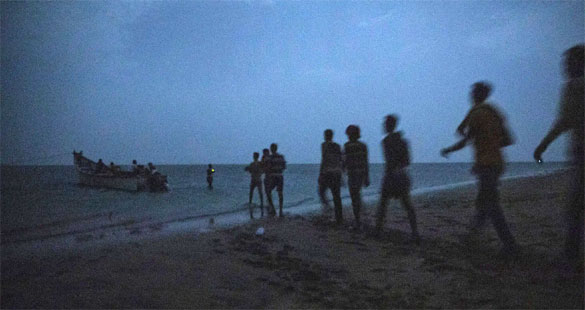
Saudi
Border Guards Accused of Killing Hundreds of African Migrants in A Recent
15-Month Period: Human Rights Watch
-----
Arab World
·
Music Commission launches Oud
House in Riyadh; registration opens
·
Minister receives non-resident
ambassador of Paraguay in Riyadh
·
Authorities warn of famine
among displaced Yemenis as UN limits supplies
·
Saudi citizen injured after
falling from hotel balcony in France
-------
Mideast
·
Netanyahu says recent attacks
on Israelis are backed by Iran
·
10 years after deadly chemical
attack, Syria’s survivors seek justice
·
As Syria burns, and its economy
collapses, firefighters appeal for support
·
Protests rock government-held
areas in southern Syria as economy crumbles
·
This year over 200 Palestinians
and nearly 30 Israelis have been killed, highest since 2005, UN says
·
Iran says prisoner exchange
process with US will take up to two months
·
Authorities warn of famine
among displaced Yemenis as UN limits supplies
·
Two Palestinians arrested; one
teenager shot dead after Israeli settlers killed: army
·
Tense calm in divided Cyprus
after UN says peacekeepers attacked
------
India
·
Prevent split of Muslim vote:
West Bengal CM to clerics
·
West Bengal govt. hikes
honorarium for imams and muezzins in Bengal by Rs 500
·
NIA makes 4th arrest in ISIS
Jabalpur module case
·
Nuh violence accused,
identified as Aamir, held after gunfight with Haryana police
·
US court stays extradition of
Mumbai terror attacks accused Tahawwur Rana pending his appeal
-------
Pakistan
·
Govt Resolves to Deal with
Jaranwala Incident on No Fear No Favor Basis
·
Damage to Jaranwala churches,
homes estimated at Rs67m
·
Special court formed to hear
cipher case in camera
·
Islamabad, Kabul in contact
over militancy issue: official
·
ECP constitutes high-powered
committee for election arrangements
·
Zaheer A Janjua lauds
diaspora’s role in strengthening ties between Pak, Canada
·
Pakistan, Saudi Arabia sign an
Air Services Agreement to facilitate their citizens
·
Special court remands Shah
Mahmood Qureshi in FIA custody for four days
-------
South Asia
·
Iran's ambassador to Kabul
Calls Technical Team's Visit Positive Step for Kabul, Tehran
·
At least 70% of Afghans
struggle in poverty with no jobs: IOM
·
Afghan delegation attends in
7th Afghanistan Future Thought Forum session held in Indonesia
·
Nearly 40 Afghan refugees
released from Pakistani prisons
--------
Europe
·
Sweden Ponders New Police
Powers to Stop Quran Burning
·
Ukrainian UAVs intercepted near
Crimea – Moscow
·
UK officials banned from
calling Russia and China ‘hostile states’ – The Times
·
‘Fallen angels from hell’ –
Scholz slams critics of his Ukraine policies
·
Greece joins Ukraine’s F-16
fighter jet coalition
·
42 countries and EU join
formation of International registry of damages caused by Russian aggression
against Ukraine
-------
Southeast Asia
·
In Singapore, Man Gets 16
Years' Jail, Caning for Sexually Assaulting Step-Nephew Repeatedly Over Five
Years
·
Ex-PM Thaksin returns to
Thailand after 15 years in exile
·
Kian Ming: Pakatan victory in
Sg Pelek impossible without BN’s support
·
Kedah Bersatu chief says ‘all is
well’ with PAS after its three partymen sworn in as excos
·
Fly The Jalur Gemilang, Show
Loyalty, Love for Country, Anwar Urges Malaysians
·
Selangor’s delicate balance of
coalition politics
------
Africa
·
In Niger, A Jihadist Threat
Difficult to Measure
·
Libya repatriates 161 Nigerian
migrants
·
South Africa beefs up security
ahead of BRICS summit
·
Brazil, China presidents arrive
Johannesburg for BRICS summit
·
Over 2 million children in
Niger need humanitarian aid
·
Nelson Chamisa, the 'young'
pastor aiming for Zimbabwe poll upset
------
North America
·
CAIR Welcomes Charges for
Suspect in Mosque Vandalism, Urges Restorative Action and Educational
Opportunities
·
CAIR and Emgage Action Call on
Fox News Anchors to Raise Muslim, Minority Community Engagement in Republican
Presidential Primary Debate
·
US dollar ‘cannot be trusted,’
former IMF executive tells RT
·
Americans urged to
‘immediately’ leave Belarus
·
US ready to train Ukrainian
pilots on F-16s if European partners reach capacity
Compiled by
New Age Islam News Bureau
URL: https://newageislam.com/islamic-world-news/saudi-border-guards-african-migrants-hrw/d/130498
-----
Saudi Border Guards Accused of Killing
Hundreds of African Migrants in A Recent 15-Month Period: Human Rights Watch
Saudi
Border Guards Accused of Killing Hundreds of African Migrants in A Recent
15-Month Period: Human Rights Watch
-----
Aug. 21, 2023
By Ben Hubbard and Shuaib Almosawa
Border guards in Saudi Arabia have
regularly opened fire on African migrants seeking to cross into the kingdom
from Yemen, killing hundreds of men, women and children in a recent 15-month
period, Human Rights Watch said in a report released on Monday.
The guards have beaten the migrants with
rocks and bars, forced male migrants to rape women while guards watched and
shot detained migrants in their limbs, leading to permanent injuries and
amputations, the report said.
The shooting of migrants is “widespread
and systematic,” it said, adding that if killing them were Saudi government policy,
it would constitute a crime against humanity.
A Saudi government statement dismissed
the report as inaccurate.
“The allegations included in the Human
Rights Watch report about Saudi border guards shooting Ethiopians while they
were crossing the Saudi-Yemeni border are unfounded and not based on reliable
sources,” the statement said.
The report provides chilling new details
about the conditions along one of the world’s most dangerous smuggling routes,
a patch of isolated, war-ravaged territory rarely visited by journalists, aid
workers or other international observers.
It focuses on the plight of migrants
from Ethiopia, one of the world’s poorest countries, who seek to enter Saudi
Arabia — the Arab world’s richest nation and one of the globe’s largest oil
exporters — and on the increasingly harsh efforts by the kingdom’s security
forces to keep migrants out.
Faisal Othman, a migrant from Ethiopia,
told The New York Times that he was trying to cross the border with about 200
others last September when a projectile exploded near the group and shrapnel
tore apart the women around him.
“Most of them ended up as remains,” Mr.
Othman, 31, said by phone on Sunday from the Yemeni capital, Sana. “They were
shredded like crushed tomatoes.”
His account was not included in the
Human Rights Watch report, but was similar to many of the cases it documented.
He said destitution pushed people to risk the trip.
For years, streams of migrants have fled
Ethiopia because of poverty, drought and political repression and have headed
for Djibouti, where smugglers transport them across the Gulf of Aden to Yemen,
the Arab world’s poorest country, which has been torn apart by years of war.
In Yemen, the migrants are taken to
territory near the Saudi border that is controlled by the Houthis, an
Iran-backed militant group that seized Sana and much of the country’s northwest
from the internationally recognized Yemeni government in 2014.
The next year, Saudi Arabia and some of
its Arab allies launched a bombing campaign to drive out the Houthis. But it
didn’t work, and the war sank into a stalemate and fueled one of the world’s
worst humanitarian crises.
Human Rights Watch based its report on
dozens of interviews with migrants who have attempted the trip or with their
associates; an analysis of hundreds of photos and videos shot by migrants; and
an examination of satellite images of the border area.
It describes Saudi border guards firing
on groups of migrants with rifles and explosive munitions believed to be
mortars or rockets, often killing large numbers of people.
One 14-year-old girl cited in the report
recalled seeing 30 people killed around her when Saudi guards opened fire on
her group in February. The girl told the researchers that she had hidden under
a rock and had fallen asleep, only to realize that other people she thought
were sleeping around her were dead.
Other migrants cited in the report said
they had been abused by Saudi guards after being stopped near the border. Some
were beaten, and others were shot in the limbs after the guards asked them
where they would prefer to be shot, the report said.
One 17-year-old boy told researchers
that guards had forced him and another migrant to rape two girls in their group
after killing another migrant who had refused to do so.
The report estimates that the number of
migrants killed between March 2022 and June 2023 is at least in the hundreds
but says that the true toll could be in the thousands.
While it focuses on abuses by the Saudi
security forces, the report also accuses the Houthis of the widespread abuse of
migrants by facilitating smuggling, extortion and detention, which together can
constitute human trafficking and torture.
Houthi forces work with smugglers to
gather large numbers of migrants in two makeshift camps near the Saudi border,
the report said. Some migrants pay bribes to be let in and are then abused once
inside. From one of the camps, the migrants walk more than six miles through
mountainous terrain to reach the border, where guards sometimes open fire.
Since the start of Yemen’s war, the
country has seen rampant human rights violations and scant efforts to hold
perpetrators accountable.
In their effort to beat back the
Houthis, Saudi Arabia and its allies have carried out a bombing campaign that
has hit weddings, funerals and a school bus full of children on a field trip,
altogether killing an untold number of civilians. For their part, the Houthis
have fired rockets at civilian targets in Saudi Arabia, deployed child soldiers
and controlled the territory they hold with an iron fist, sometimes
disappearing dissidents.
The pace of the conflict has slowed
since Saudi Arabia and Iran, which supports the Houthis, reestablished
diplomatic relations this year and Saudi Arabia began peace talks with the
Houthis. But talk of accountably for war crimes has been absent from the
discussions.
The last United Nations-backed body
established to monitor human rights violations in Yemen stopped working in
2021, after Saudi Arabia and the United Arab Emirates lobbied members of the United
Nations Human Rights Council to end the body’s mandate.
Although Monday’s report suggested that
the Saudi border forces had become more harsh in targeting migrants, the
violence is not new, and there have not been significant international efforts
to stop it.
Abdulaziz Yasin, a prominent member of
the Ethiopian community in Sana, said the reports of migrants’ being attacked
never stopped.
“Every day, there are three, four or
five migrants being killed,” he told The Times in a phone interview. “Sometimes,
10, 20 or 30 get killed at once. There are a lot of Africans being killed.”
Still, he said, the community believes
that it cannot count on any international agency to help.
“We complain to the organizations to no
avail,” he said. “How can anyone help us?”
Source: nytimes.com
Please click the following URL to read
the full text of the original
https://www.nytimes.com/2023/08/21/world/middleeast/saudi-arabia-migrants-yemen.html
------
Saudi Arabia Rejects ‘Unfounded’ HRW Allegations
Of Killing Ethiopians At Yemen Border
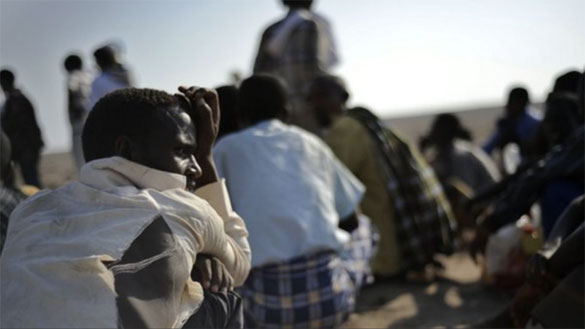
Saudi Arabia
has denied accusations made by Human Rights Watch that Saudi border forces
killed hundreds of Ethiopian migrants on its border with Yemen. (AFP/File
Photo)
------
August 21, 2023
RIYADH: Saudi Arabia has rejected
accusations made by Human Rights Watch that Saudi border forces killed hundreds
of Ethiopian migrants on its border with Yemen.
Speaking to AFP on condition of
anonymity, a Saudi government source said the accusations were baseless.
“The allegations included in the Human
Rights Watch report about Saudi border guards shooting Ethiopians while they
were crossing the Saudi-Yemeni border are unfounded and not based on reliable
sources,” the source said.
Saudi authorities have also strongly
denied allegations made by UN officials in 2022 that border guards
systematically killed migrants last year.
In its report, HRW accused Saudi border
guards of shooting heavily and using explosives to kill migrants, mostly
Ethiopian, who were trying to cross into the Kingdom from Yemen.
Source: arabnews.com
Please click the following URL to read
the full text of the original
https://www.arabnews.com/node/2359166/saudi-arabia
------
‘No Hate Speech Content’ At Hindu Sena Mahapanchayat,
Book Organiser: Legal Experts’ Advise to Delhi Police
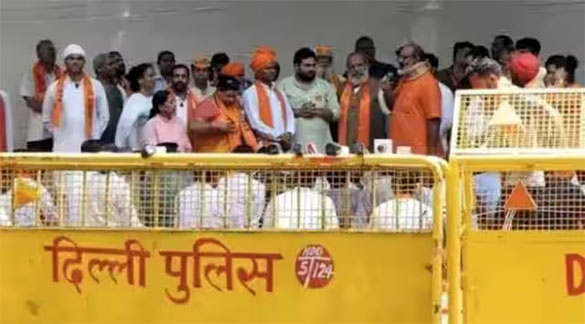
The police
had initially allowed the mahapanchayat and allowed 100 people to sit and
protest. However, they had to intervene after the alleged hate speeches, they
said. (File)
------
By Mahender Singh Manral
New Delhi | August 22, 2023
Two days after the Delhi Police
cancelled a Hindu Sena Mahapanchayat which was underway at Jantar Mantar after
speakers at the gathering allegedly started making hate speeches, legal experts
have advised the investigation officer to file an FIR under Section 188 of the
Indian Penal Code (IPC) against the organiser as they have not found any
content of hate speech, The Indian Express has learnt.
Section 188 of the IPC pertains to
disobedience to an order duly promulgated by a public servant.
The Mahapanchayat was organised by the
All India Sanatan Foundation and the Hindu Sena in the wake of the clashes in
Haryana’s Nuh. Those present at the event, amid heavy police barricading,
included Hindu Sena national president Vishnu Gupta, Raksha Dal’s Pinky
Chaudhary and Dasna Devi temple priest Yati Narsinghanand Saraswati. The event
started at 10 am.
On Sunday, the New Delhi district police
said they stopped the speakers at the event and asked them to leave after they
spoke “against one community”.
An official said the New Delhi district
police discussed the matter with senior officers at the Delhi Police
headquarters and they were asked to take legal opinion. “On Monday evening, the
police received a legal opinion in which they have been told that they have not
found any content of hate speech and they should take legal action against the
organiser for violating the norms of the conditions,” the official said, adding
that the police will send their case file to the legal experts again with more
facts to take another opinion in the coming days.
The police had initially allowed the
mahapanchayat and allowed 100 people to sit and protest. However, they had to
intervene after the alleged hate speeches, they said.
At the event, Narsinghanand came on
stage and spoke about the Nuh clashes. At around 11.50 am, he said, “If the
situation doesn’t change, a non-Hindu person will become the Prime Minister…You
won’t have any land for yourself and will have to drown in the Indian Ocean…
since you won’t fight.”
After one more member gave a speech,
Gupta – the final speaker – came on stage around 12.10 pm and said, “Last
month, there was a peaceful Shobha Yatra in Mewat, but a group of Jihadis
attacked with stones and fired. Several Hindu brothers were killed and others
were left injured… Why hasn’t a CRPF camp been constructed there to punish
these Jihadis?”
He went on, “Why have we been surrounded
by police here? We are the victims and should get an opportunity to speak.
Nobody should have an objection… The country’s Partition was over religion but
I feel it was incomplete. Till the time there are Muslims…”
As he spoke, Additional DCP (New Delhi)
Hemant Tiwari intervened and told the crowd: “The organisers have been told not
to say anything about another community/group. Despite our repeated requests,
you didn’t listen to us. Hence… this mahapanchayat is over. Please leave. We
told you not to take names of another community…” Another police officer also
urged the people to leave, saying the time allotted was over. A video of the
incident was shared on social media.
Source: indianexpress.com
Please click the following URL to read
the full text of the original
https://indianexpress.com/article/cities/delhi/delhi-police-hindu-sena-mahapanchayat-hate-speech-legal-experts-8903389/
-----
Pakistanis Abroad Express Frustration,
Heartbreak Over Jaranwala
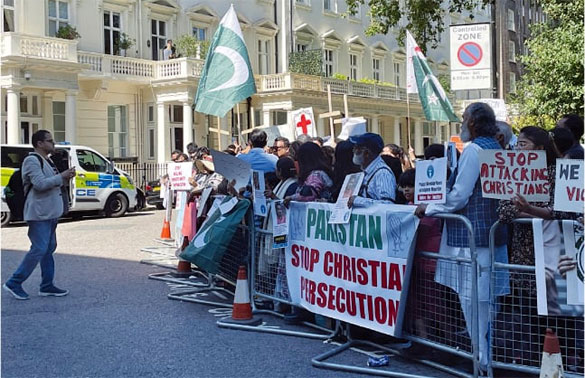
PROTESTERS
carry banners and flags during a demo outside the Pakistan High Commission in
London against Jaranwala attacks, on Monday.—Dawn
------
August 22, 2023
Atika Rehman
LONDON: Hopelessness, fear and
frustration — these were the main sentiments expressed by members of a large
demonstration of Pakistani Christians outside the Pakistan High Commission on
Monday.
More than 100 Pakistani Christians
living across England travelled to London to demand better protection for
Christians back home and condemn the violence that took place in Jaranwala last
week.
Several carried Pakistan flags. There
were banners demanding the abolition of blasphemy laws and also placards saying
“Christian Lives Matter”.
A delegation also met Pakistan’s high
commissioner to share their concerns and demand action.
Rehana Noreen, a nurse trained at Aga
Khan University Hospital in Pakistan, said she moved to the UK in 2006 and has
since worked for the National Health Service. “I appeal to the UK government to
allow British citizens to sponsor relatives so they can immigrate here. I am
concerned for my family members back home.”
She said she felt like “I was about to
have a heart attack” when she heard the news about the Jaranwala violence. “My
mother, brother, sisters and their family are all back home living around
Punjab. I fear for them. We want a Pakistan where Christians can pray without
fear.”
Javed Billa, who emigrated to the UK 25
years ago, also said he felt “heartbroken”.
Asif Mall from the All Pakistan
Christian Organisation said there was mounting frustration that no culprits
were apprehended when it came to crimes against Christians. “This is why there
is such a large crowd here. I have not seen such a large gathering of
Christians at a protest since the violence in Shanti Nagar, Khanewal, in 1997.”
He said he felt “hopeless” as
politicians and lawmakers had “failed Christians over the years”.
White House vigil
In Washington, Pakistani Christians and
their sympathisers held a vigil outside the White House on Sunday evening and
prayed for the safety of those facing attacks over blasphemy allegations in
Pakistan.
“This is not acceptable, no one should
be attacked for their beliefs,” said Peter John, a Pakistani Christian leader
who organised the vigil, while commenting on the Jaranwala incident.
Later, at a news conference in Northern
Virginia, several Christian organisations demanded increased protection for
blasphemy victims in Jaranwala and elsewhere in Pakistan.
“We will raise this issue in the US
Congress, the United Nations and with the US administration,” Victor Gill, who
chairs the US-based Christian Voice of Pakistan (CVOP) group, said at the
briefing.
A representative of the Pakistan Embassy
informed the briefing that “the culprits have been identified and will be
punished in accordance with the law”.
Pastor Azhar Alam of the Trinity Church,
Haddington Valley, Pennsylvania, urged Pakistani Muslims not to react to
allegations. “Don’t just blame and punish. Probe and prove first,” he said. “Do
not victimise the weak and the innocent.”
‘Faith should not attract violence’
Meanwhile, the United Nations secretary
general, Antonio Guterres, has urged all governments to prevent and address
acts of violence based on religion and belief, stressing that freedom of
religion and belief is an inalienable human right.
In a message for the ‘International Day
Commemorating the Victims of Acts of Violence Based on Religion or Belief’,
observed on Aug 22 (today), Mr Guterres said: “Faith and belief should never
attract violence. Yet, around the world, people and communities, particularly
minorities, face intolerance, discrimination and threats — to their places of
worship, their livelihoods and even their lives. Hatred stirred on and offline
is often the cause.
He added, “Together, let’s honour the
victims of violence by striving to build a more inclusive, respectful, and
peaceful world — one where diversity is celebrated.”
Anwar Iqbal in Washington and Amin Ahmed
in Islamabad also contributed to this report
Source: dawn.com
Please click the following URL to read
the full text of the original
https://www.dawn.com/news/1771465/pakistanis-abroad-express-frustration-heartbreak-over-jaranwala
-------
Higher Education Ministry Crafting Plan
to Reopen Girls’ Universities: Afghanistan
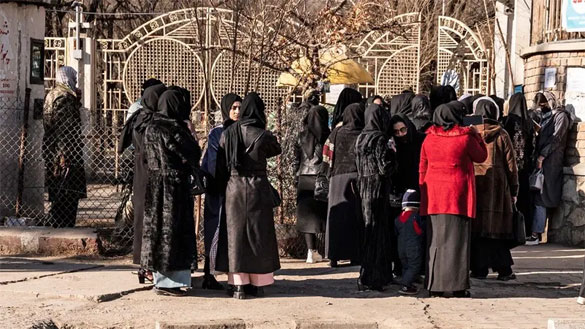
Photo: Khaama.com
----
By Fidel Rahmati
August 21, 2023
A Ministry of Higher Education committee
has said they are developing a plan to reopen universities for female students.
Once this plan is finalized, they intend to make it public and share the
details.
During the annual report, Lutfullah
Khairkhwa, the deputy minister of Higher Education, conveyed that there
currently needs to be a definite timeframe to complete the plan.
The Ministry of Education reported over
1 million new student registrations last year; more than 500,000 are girls,
primarily below grade 7.
This situation remains unchanged, even
though numerous months have transpired since the ban on girls’ education within
universities has been imposed. The decree, which swiftly emerged in December
2022, prohibited girls from attending university within a week, consequently
subjecting thousands of female students to an uncertain future.
As a result, thousands of
university-bound girls faced the distressing prospect of their educational
pursuits being curtailed.
The far-reaching international reactions
to the ban on girls’ education and training have underscored Afghanistan’s
distinct position worldwide. It is now a solitary country where girls are
systematically denied the fundamental rights to pursue employment, education,
and skill development.
This prohibition hampers individual
growth and perpetuates a larger cycle of gender inequality within the country.
Source: khaama.com
Please click the following URL to read
the full text of the original
https://www.khaama.com/higher-education-ministry-crafting-plan-to-reopen-girls-universities/
------
Arab World
Music Commission launches Oud House in
Riyadh; registration opens
August 21, 2023
RIYADH — The Music Commission of Saudi
Arabia and the Arab Oud House, led by the Maestro Naseer Shamma, inaugurated
Monday the Oud House in Riyadh, one of the Arab Oud House's branches in
different parts of the world.
The institution teaches techniques for
playing oud and other musical instruments, such as flute, bezek, cello and
violin, among others. It helps spread Arabic culture and awareness about the
importance of the oud, and builds a global community of professional oud
players.
The Arab Oud House's curriculum entails
studying various musical-playing techniques, equipping students to understand
musical compositions, different music schools and musical symbols.
After a period of training and
rehearsals, students may participate in concerts.
The establishment of Riyadh Oud House is
part of the Music Commission's efforts to attract regional and international
musical cadres and establish curricula of international standards.
The goal is to boost the music industry
in the Kingdom of Saudi Arabia, develop it, and train and empower local talent.
The Music Commission invites all those
interested in learning oud playing techniques to register at
https://engage.moc.gov.sa/reg_form/tracks/2853/new.
Registration is open from Aug. 22 to
Sept. 21. — SPA
Source: saudigazette.com.sa
Please click the following URL to read
the full text of the original
https://saudigazette.com.sa/article/635124/SAUDI-ARABIA/Music-Commission-launches-Oud-House-in-Riyadh-registration-opens
------
Minister receives non-resident
ambassador of Paraguay in Riyadh
August 21, 2023
RIYADH: Sara Al-Sayed, deputy minister
for public diplomacy at the Saudi Ministry of Foreign Affairs, received the
non-resident ambassador of Paraguay to the Kingdom, Jose Avila, on Monday in
Riyadh.
During their meeting the two sides
reviewed bilateral relations and discussed the latest regional and
international developments in various fields. They also discussed a number of
issues of common interest to the two countries.
The ambassador was also received by
Abdulrahman Al-Rassi, Saudi deputy minister for international multilateral
affairs.
In a post shared on X, Avila wrote that
he’s looking forward to his meetings with Saudi authorities in the coming week,
“to continue cultivating relations with Paraguay in various sectors” as there
is “lots of potential in Saudi Arabia.”
Source: arabnews.com
Please click the following URL to read
the full text of the original
https://www.arabnews.com/node/2359071/saudi-arabia
------
Authorities warn of famine among
displaced Yemenis as UN limits supplies
August 21, 2023
AL-MUKALLA: Authorities in the central
Yemeni province of Marib have warned that tens of thousands of internally
displaced people are at risk of hunger in the wake of a UN decision to cut off
humanitarian aid due to insufficient funding.
Abd-Rabbu Meftah, deputy governor of
Marib province, feared that if the UN did not resume its relief work there,
more than 60 percent of Yemen’s IDPs living in Marib could starve.
Several hunger-related cases had
reportedly already been documented at displacement camps.
There are warning signs of malnutrition
among the displaced people in Marib province. The United Nations and
humanitarian organizations must recognize that 62 percent of displaced
individuals in the republic are in need of relief,” Meftah said.
Local officials in Marib noted that more
than 2 million people — more than 60 percent of Yemen’s displaced people — were
currently living in the city after fleeing conflict or Houthi repression in
their home areas and most of them were in dire need of food, shelter, and
medicine.
The authorities’ request for expedited
food assistance came after local media reported that provincial health
officials had documented numerous cases of severe malnutrition among displaced
residents in Marib.
Khaled Al-Shajani, deputy head of the
internationally recognized government’s executive unit for camps for the
internally displaced in Marib, told Arab News on Monday that his office had
registered the arrival of more than 16,000 displaced individuals in Marib since
January.
And he said some UN entities had already
begun reducing the amounts of food baskets, cash, and other aid distributed to
displaced people and health facilities in Marib.
“This (aid reduction) represents a
potential humanitarian catastrophe for the province’s displaced and poor.
Humanitarian needs are significant, while interventions are decreasing,”
Al-Shajani added.
Due to a “critical” lack of funds, the
World Food Programme has announced that food assistance in Yemen will be
reduced further in the coming months, a move anticipated to impact on millions
of needy Yemenis, including displaced people in Marib.
The cuts were not only likely to hit
those who relied on food baskets, but additional 1.4 million people benefitting
from the WFP’s malnutrition prevention activities, and more than 3 million
pupils fed by the WFP School Feeding program.
In a statement, the WFP’s Yemen
representative, Richard Ragan, said: “We are confronted with the incredibly tough reality of making decisions
to take food from the hungry to feed the starving while
millions of Yemenis continue to rely on us for survival.
“We do not take this decision lightly
and are fully cognizant of the suffering these cuts will cause.”
The Saudi aid agency, KSrelief, has
begun distributing thousands of food hampers to Yemenis in Marib and other
provinces in the country to fill the void left by the UN’s aid reductions.
Source: arabnews.com
Please click the following URL to read
the full text of the original
https://www.arabnews.com/node/2359011/middle-east
-----
Saudi citizen injured after falling from
hotel balcony in France
August 21, 2023
PARIS — A Saudi citizen sustained
injuries, including multiple fractures, following his fall from the balcony of
a hotel where he was staying in the southern French city of Cannes.
Responding to the social media reports
about the accident, the Saudi embassy in Paris confirmed that the accident
happened last Wednesday.
The embassy said that the citizen was
transferred to a specialized hospital where he is receiving the necessary medical
care. “The embassy is following up his condition with the French health
authorities and the rest of the concerned authorities,” the embassy said in a
statement, while wishing him speedy recovery.
Source: saudigazette.com.sa
Please click the following URL to read
the full text of the original
https://saudigazette.com.sa/article/635115/SAUDI-ARABIA/Saudi-citizen-injured-after-falling-from-hotel-balcony-in-France-nbsp
------
Mideast
Netanyahu says recent attacks on
Israelis are backed by Iran
REUTERS
August 22, 2023
JERUSALEM: Israeli Prime Minister
Benjamin Netanyahu said on Monday that a series of recent deadly attacks
against Israelis has been funded and encouraged by Iran.
“We are in the midst of a terror attack.
This terror attack is encouraged, guided, funded by Iran and its satellite
states,” Netanyahu said in broadcast remarks.
He spoke in the occupied West Bank at a
site where hours earlier an Israeli woman was shot dead by suspected
Palestinian gunmen.
Israel, he said, would employ measures
to settle the score with the attackers and those who sent them, from near or
far.
Source: arabnews.com
Please click the following URL to read
the full text of the original
https://www.arabnews.com/node/2359191/middle-east
-----
10 years after deadly chemical attack,
Syria’s survivors seek justice
By Joby Warrick
August 21, 2023
On that most terrible of nights, when
death stalked every street and crept into bedrooms where small children slept,
Taher Hijazi was jarred awake by someone shouting his name just outside his
window.
“Bring your camera and come down
immediately!” the voice said.
“What’s happening?” Hijazi called,
peering into the dark.
“Come down, I can’t talk,” the voice
said.
Hijazi, then a 26-year-old amateur
videographer living in the outer suburbs of Damascus, Syria, stumbled outdoors
clutching his camcorder. It was not yet 3 a.m., but it was soon clear that a
calamity had struck. Strange rockets had fallen in the neighborhood overnight,
and an invisible poison was spreading through the warrens of apartment
buildings east of the capital. Hundreds of people were dying.
Hijazi hurried to a nearby hospital as
throngs of the stricken were beginning to arrive. As he approached the
building, he could hear shouts and wails, and see workers moving the bodies of
the dead onto the sidewalk to make room. The sight of the freshly arriving
victims would scar his memory for the rest of his life.
“I saw the most horrifying scene,” he
said. “I saw men, women and children, falling and dying, outside the hospital,
in front of the hospital. It was like Judgment Day.”
Hijazi began taking videos, recording
everything. At one point, he trained his lens on a small girl. She was about 6
years old, wearing a red shirt and a pendant in the shape of a heart. She lay
on the bare floor, quietly gasping for breath.
“She was visibly choking, dying,” he
said. “I wondered, ‘Why don’t I throw the camera away and try to do something
to help this kid who’s dying?’ Yet there was nothing I could do.”
He steadied himself and kept recording.
Justice delayed
The sarin gas attack on civilians in
Ghouta, Syria, on Aug. 21, 2013, may well be the most thoroughly documented
atrocity of its type in history. Yet, a decade later, it is a crime for which
there has been no real punishment — and strikingly little accountability.
Many thousands of photos and videos
captured the immediate aftermath, as a small army of volunteer documentarians
like Hijazi dutifully recorded the events, along with journalists, medical
workers and residents. A U.N.-appointed team traveled to affected
neighborhoodswithin days to interview survivors and to collect biological
samples and fragments of the rockets, some of which still contained liquid
sarin, the deadly nerve agent unleashed on three opposition-held neighborhoods
that night.
A mountain of evidence pointing to the
Syrian regime has continued to grow. Intelligence agencies and weapons
inspectors collected Syrian documents, witness statements, intercepted
communications and other evidence — some of it never published — related to the
Syrian military’s preparations for carrying out the attack as well as panicked
conversations among Syrian officials after the scale of the casualties became
clear.
The gassing of thousands of people with
an outlawed nerve agent shocked the world and struck many experts at the time
as inexplicably reckless, occurring as it did on the outskirts of a major
capital within easy reach of TV camera crews. At the time, just over two years
after massive street protests across Syria erupted into civil war, President
Bashar al-Assad’s government appeared at risk of collapse, and his army, with
crucial backing from Syrian allies Iran and Russia, had turned to ever more
brutal tactics in an effort to crush the rebellion, which Assad denounced in
speech that year as a “terrorist” movement led by a “bunch of criminals.”
The attack, which U.S. officials say
killed more than 1,400 people, was the second-deadliest use of chemical weapons
against civilians of all time, exceeded only by Iraqi leader Saddam Hussein’s
mass poisoning of ethnic Kurds in northern Iraq in 1988.
Yet, to date, none of the images or
forensic data collected in the attack’s aftermath have ever been used in a
trial. Neither the United Nations nor the International Criminal Court has ever
brought formal proceedings against the Syrian government, which is
overwhelmingly implicated in the Ghouta attack, according to multiple
independent groups that reviewed the evidence. The world’s chemical weapons
watchdog, the Organization for the Prohibition of Chemical Weapons (OPCW), has
found Syria’s government culpable for other chemical attacks but has not
launched a fact-finding probe to attribute blame for what was by far the most
serious.
The reasons are complicated. Experts
mainly blame Russia, Syria’s most important ally. Moscow has used its U.N.
Security Council veto and influential position on international agencies to
block official inquiries into the 2013 attack, in much the same way as it has
stymied international investigations into alleged war crimes by Russian
soldiers in Ukraine.
But the United States and other Western
countries also have come under harsh criticism for a fumbled early response to
the attack and for not acting decisively when Syria found a way to continue
using chemical weapons by shifting from banned nerve agents such as sarin to
ordinary — but still deadly — chlorine gas. Meanwhile, much of the world
appears to have simply moved on, with more than 20 Arab countries voting in May
to normalize relations with Syria after a years-long boycott.
Survivors of the attack refuse to give
up. For many victims and their supporters, Aug. 21 has become a powerful symbol
encompassing hundreds of alleged war crimes in a conflict that has killed at
least a half-million people. It also has come to represent the Syrian
opposition’s best hope for eventually bringing Assad and his top generals to
trial for crimes against humanity.
The photos and videos taken by Hijazi
and others have become part of a massive archive that continues to grow, as
Syrian exiles and human rights groups ferret out new evidence, including
forensics studies and government documents smuggled out of the country by
defectors. In the past two years, criminal cases stemming from the Ghouta
attack have been filed in three European countries, and a network of lawyers
and activists is exploring novel legal theories that could allow the first
international criminal prosecution of the Assad government to move forward in
the coming months.
Supporters of the plan acknowledge it is
unlikely that Ghouta survivors will see their former president in the dock in
the near future. But even a trial in absentia will send an important message to
Syrians and to the rest of the world, said Stephen Rapp, the State Department’s
ambassador at large for war-crimes issues at the time of the attack.
“Assad wanted to make Ghouta unlivable
for the civilian population, and used sarin gas to murder at least 1,400
innocent men, women and children,” said Rapp, who now advises survivors on
their legal strategy. “This was the violation of a rule universally recognized
for the last 10 decades — and a crime that can never be justified.”
Death on a historic scale
For Syria, the timing of the attack
could hardly have been worse. Months earlier, the president of the United
States had sternly warned the Assad government that any use of chemical weapons
would transgress an American “red line,” strongly implying that the response
would include a U.S. military strike. On the very day of the attack, a team of
U.N. fact-finders was in the capital to investigate allegations that outlawed
chemical weapons were being used in Syria’s civil war.
Even the U.N. investigators initially
were baffled by the decision to launch a massive chemical attack during their
visit — and one so close to the capital that they could see the streaks of the
outgoing rockets from their hotel windows. Syria and Russia have repeatedly
promoted, without evidence, claims that rebels unleashed poison gases on their
own neighborhoods in a false-flag operation intended to draw U.S. and European
countries into the civil war. The Damascus regime, which would eventually
acknowledge that it manufactured sarin in industrial quantities and kept it in
ready-to-use stockpiles until 2013, has denied ever using chemical weapons,
including on Ghouta.
“We wish here to state categorically
that we have never used chlorine or any other toxic chemicals during any
incidents or any other operations in the Syrian Arab Republic since the
beginning of the crisis and up to this very day,” Faisal Mekdad, a top Syrian
diplomat who is now the country’s foreign minister, said in 2015.
Investigations would prove otherwise.
Crucial evidence was uncovered in the immediate aftermath of the attacks. More
has turned up in the years since.
military officials with access to
intelligence reports on the events.
The first important clues were
discovered by the U.N. team that happened to be on the ground at the time.
Traveling unarmed and unescorted through no man’s land, braving snipers and
ambushes along the way, investigators traveled to the stricken neighborhoods
and found remnants of the specialized artillery rockets that had slammed into
several opposition-held neighborhoods across an area spanning several miles
east and south of Damascus. Some of the rockets, a later forensic examination
concluded, used Soviet-designed engines fitted with large cylindrical canisters
that release highly volatile liquid poisons on impact. The rockets’
trajectories showed that they had been launched from government-controlled
areas to the north and west.
The weapon itself was indisputably
sarin, of the high purity that is typical for state-run military programs. One
of the deadliest known chemical poisons, sarin is difficult and dangerous to
make. Tests showed that the specific sarin used in the attack contained a
unique blend of ingredients that matched precisely the formula the Syrian
military had used in its weapons since the 1980s.
The effect was devastating. Because
sarin is heavier than air, the deadly gas hugged the ground and seeped into
basements and bomb shelters where families with children had taken refuge from
artillery strikes the night before. Of the deaths, about a third were children,
many of whom died in their pajamas.
“It’s pretty sinister,” Ake Sellstrom,
the Swedish medial professor who headed the U.N. fact-finding mission, said in
interview for a 2021 book on the chemical attack and its aftermath. “First you
do a bombardment, which means that you put people in shelters. And when you have
people in shelters on a morning like that, you spread the gas, which you know
will come down into the shelters.”
In the years since, subsequent
investigations have strengthened the evidentiary case pointing to Syria’s
regime. Improved testing methods in 2017 enabled a joint U.N.-OPCW team to more
precisely link the Assad government’s existing sarin stockpile to the nerve
agents used in the attacks against civilians. The samples contained not only
the same ingredients but an identical molecular makeup.
OPCW inspectors would find further
evidence of Syria’s possession of rockets similar to those used in the Ghouta
attack. A team of investigators searching through a government-controlled
warehouse near Damascus in 2015 found one such rocket, capable of carrying
either conventional explosives or chemical weapons, still in a wooden packing
crate bearing stenciled markings showing its delivery to the government-control
Syrian port of Latakia.
A photograph of that rocket with its
distinctive cylinder-shaped warhead was shown to The Washington Post. The
discovery of the rocket was mentioned in a confidential report shared with OPCW
member states, including the United States. The finding is seen as a “direct
connection between the munitions used in the Ghouta attack and the Syrian
chemical weapons program,” said Gregory D. Koblentz, director of the biodefense
graduate program at George Mason University’s Schar School of Policy and
Government.
Some OPCW officials also deduced from
records that there may had been inadvertent casualties from the chemical attack
inside Syria’s military, according to Western officials who reviewed the
evidence. Syrian government officials privately told the inspectors that
several people attached to Syria’s elite chemical weapons unit died just days
before the Aug. 21 attack, in an incident that the Assad government has never
acknowledged or explained. The timing of the mysterious deaths suggests a
possible accident during operations to fill the rockets with sarin, the
official said.
The accident, if it happened, could also
reflect the Assad government’s limited experience with chemical weapons, which
were originally manufactured for use in missiles in a possible future war
against Israel. The sarin — classified as a weapon of mass destruction, or WMD
— was repurposed for use against Syrian rebels in 2013. Still, before Aug. 21
of that year, such weapons had been used only a handful of times in relatively
small amounts, with few casualties. U.S. intelligence officials say they
believe Assad authorized the use of chemical weapons and left it to his
generals to make decisions about using them tactically to drive rebels and
their supporters from their strongholds. A declassified U.S. assessment in 2013
asserted that Assad’s forces began mixing chemicals in preparation for the
attack around Aug. 18.
“We think that there was improvisation
and limited testing, and then someone at the field level made a
miscalculation,” said one Western security official, speaking on the condition
of anonymity to discuss sensitive intelligence. “The Syrians didn’t know what
they were doing, and they underestimated the effect.”
One small comfort, he said, is that the
impact could have been far worse.
“In a more crowded area,” he said, “that
much sarin, in that concentration, might have killed 10 times as many people.
A pass on mass murder
The OPCW’s investigation of Syria’s
chemical weapons program is now in its 10th year, though progress has largely
stalled since 2019, when the Assad government effectively cut off access to key
sites and documents. Ironically, the watchdog group’s probe into the massive
sarin attack in 2013 never even got off the ground — which is why videos and
other evidence collected by survivors remain crucial to any effort to hold
Syrian officials legally accountable.
Inspectors have publicly named culprits
in three other chemical weapons investigations — but not for Ghouta. Their
hands were effectively tied by complex legal agreements hammered out by
diplomats in September 2013, in the frenzied weeks after scenes from the
massacre first flashed on TV news channels around the world.
The Obama administration refrained from
launching a U.S. military strike over Syria’s “red line” breach, pausing a plan
to attack Damascus initially because of the presence of the U.N. inspection
team on the ground. It then collapsed entirely after lawmakers from both
political parties overwhelmingly rejected legislation authorizing a strike.
President Barack Obama instead accepted a Russian deal in which the United
States would defer military action if Syria agreed to join the Chemical Weapons
Convention and unilaterally destroy its entire stockpile, under international
supervision.
Against all odds, the disarmament plan
mostly worked. Over a span of nine months, teams of international experts
supervised the removal or destruction of nearly all of Syria’s chemical
weapons. (U.S. intelligence officials later concluded that a small portion of
the original stockpile was hidden away, and some of it was used in a sarin
attack years later in April 2017.) The experts also oversaw the physical destruction
of labs and production equipment for making more sarin. Then, in an astonishing
technical achievement, the Pentagon converted an old cargo ship into the
world’s first floating chemical weapons destruction plant and neutralized
nearly 1,400 tons of liquid poisons at sea. As a feat of arms control, it was
historic: the first unilateral elimination of an entire WMD program in the
middle of a war.
The price was essentially a pass for
Damascus on the Ghouta attack. Syria lost its most strategically important
weapons stockpile, but under the Russian agreement, Assad was never forced to
acknowledge his role in the massacre. His government could be held responsible
for future chemical attacks but not past ones.
That hasn’t stopped Damascus from using
chemical weapons short of sarin in attacks against rebels and civilians. Human
rights groups say there have been more 300 chemical weapons attacks since 2013,
the vast majority of them involving chlorine, a common chemical used in water
purification and one that Syria possesses legally. While chlorine is far less
deadly, using it as a weapon is banned by international law. Yet Syria has done
so scores of times, with relatively little international outcry, current and
former U.S. officials say.
“The lesson for Assad is he can do
anything necessary to stay in power and there will be no accountability,” said
Robert S. Ford, who served as the U.S. ambassador to Syria in the early years
of the civil war and repeatedly sought to confront Assad over an array of
alleged war crimes, from systematic torture and rape to barrel-bomb attacks
that deliberately targeted hospitals in rebel-held areas.
“Of the kinds of vicious things the
Assad government is doing to maintain itself in power,” Ford said, “gas attacks
are at the top of the list. But it’s a long list.”
New cases, novel theories
Taher Hijazi’s list includes crimes that
devastated his own family. His brother was a newlywed with a young baby when he
was picked up seemingly at random by Syria’s secret police in 2014. Soon afterward,
the family learned that he had died in prison. Four years later, Hijazi’s
father, a government employee who stayed away from protests and studiously kept
his political opinions to himself, was killed in a Russian airstrike on his
hometown of Douma, Syria. The family was never allowed to recover his remains.
Hijazi fled Syria and applied
successfully for asylum in France. Still, when he thinks of all the horrors he
witnessed during the war, his mind inevitably returns to Ghouta and August
2013. He shared his videos and stories with human rights groups, and he was
named as one of about a dozen plaintiffs in a French criminal complaint in 2021
accusing the Syrian government of crimes against humanity.
Similar criminal complaints have been
filed in Germany and Sweden, each claiming that individual countries have a
universal right to bring criminal charges for human rights offenses that
occurred outside their borders. Meanwhile, lawyers representing Syrian
survivors and advocacy groups are exploring new legal avenues that they hope
will lead to an international prosecution, backed by a coalition of countries
in multiple jurisdictions. The International Criminal Court, the usual venue
for such cases, is not an option, in part because Syria is not a member of the
ICC, and the court does not try cases in absentia.
A wide array of governments appear to
back the idea of a multicountry prosecution centered on the chemical attack —
the clearest and perhaps gravest violation of international law in Syria’s
12-year-old war, according to attorneys representing Syrian survivors. A point
of consensus among the participants is that the case “needs to be Syrian-led,”
said Ibrahim Olabi, a British attorney specializing in international law.
The Biden administration did not comment
on specific legal approaches but said the White House intends to move forward
with efforts “promoting accountability for those responsible for these heinous
crimes,” National Security Council spokesperson Adrienne Watson said. “We
cannot let the world become desensitized to the use or proliferation of
chemical weapons,” she said.
Among the available evidence for such a
case are the videos taken by Hijazi. And 10 years later, he still becomes
visibly emotional when he talks about certain victims his camera lens briefly
isolated during the chaos of that evening. Now a father, he thinks often about
the little girl in the red shirt, struggling for what surely were her final
breaths. He remembers a grief-stricken mother he observed hours later, looking
with dread for a familiar face amid the rows of shrouded bodies in a makeshift
morgue.
“She was looking for her own children,”
he said. “The faces and bodies were covered. She actually had to go through
them and remove the cover from each face.” He choked up as recalled the moment.
“They were just children,” he said.
Hijazi today doubts he will live to see
any of the responsible Syrian officials imprisoned for the crimes he witnessed.
But it’s sufficient for now, he said, to know that his videos may have an impact,
ensuring at least that the world knows what the perpetrators did.
“There are certain things that give us
hope, but not many,” he said of the legal process he has witnessed so far.
“Recent experience proves to us that the road to justice is a very long one.”
Source: washingtonpost.com
Please click the following URL to read
the full text of the original
https://www.washingtonpost.com/national-security/2023/08/21/syria-sarin-chemical-weapons-justice/
------
As Syria burns, and its economy
collapses, firefighters appeal for support
By Mohamad El Chamaa
August 19, 2023
BEIRUT — Earlier this month, as fires
raged across Syria’s Mediterranean coast, President Bashar al-Assad visited
firefighters in the northern countryside of Latakia, a government stronghold.
“You have made great efforts in very
difficult circumstances that can be likened to the battles that were taking
place,” Assad told them, referring to the country’s devastating decade-long
civil war. “There’s terrorists and real battles, and there’s the weather and
the wind itself maneuvering forces from side to side.”
The fires sweeping across northwestern
Syria this summer have compounded a dire humanitarian situation. The region,
still reeling from two massive earthquakes in February and a grinding economic
crisis, remains divided among rival factions and isolated from the world.
Firefighters on both sides of the conflict are now trying to confront a common
enemy, but are hobbled by a lack of support from the government and the
international community.
In earthquake-battered Syria, a
desperate wait for help that never came
The fires started in late July, the
latest in a series of blazes across the Mediterranean, from Greece to Algeria.
A transformer explosion ignited the fires, according to a local forestry expert
in Latakia, who spoke to The Washington Post on the condition of anonymity for
fear of government reprisal. Heat waves, low humidity and strong winds allowed
the flames to spread quickly across the pine-covered mountains and sparked
other fires in neighboring Idlib and Hama provinces.
Husam Zelito, 47, has fought fires for
more than 20 years in and around Idlib. A government firefighter before the
war, he is now a member of Syrian Civil Defense, better known as the “White
Helmets,” a group of aid workers and first responders that operates in
rebel-held areas.
“Forest fires are the most challenging,
and where we are struggling a lot,” he told The Post. “The human resources are
there, but we need special vehicles that can cover the steep slopes and roads.
Our trucks cannot reach some areas, and this slows the response time.”
At least 17 people have died in fires
this year, according to the White Helmets, including 13 children. Nearly 80
people have been injured.
Even in government-held Latakia, war and
Western sanctions have depleted local resources, the forestry expert said: In
2011, “we had around 550 firetrucks. Now there are less than 140, and they lack
maintenance.”
The government’s stranglehold on
information has made it difficult to determine the extent of the fire damage.
Early reports said at least 370 acres had been burned; weeks later, no updated
figures have been released. Latakia’s governor, Amer Hilal, has formed a
committee to assess the full impact. No deaths have been reported in government
areas.
“We have to wait a bit before getting a
precise estimate,” the expert in Latakia said, but there’s “massive destruction
— the forests are intertwined with a lot of agricultural lands and farms.
People had to leave their homes.”
The director of Latakia’s agriculture
department, Bassem Doba, told state media that extinguishing the fires has been
especially difficult because the affected area is still littered with land
mines.
But government media has stressed that
the situation is under control, and has published a few photos of the fires.
Pictures from Assad’s visit to Latakia show him surrounded by firefighters.
Charred trees are visible in the background.
On its Facebook page, the Latakia Fire
Brigade thanked Assad for his visit but asked him to raise the profile “of
firefighters’ work in Syria ... which is considered one of the lowest among
government.”
In a rare critique, Thaer al-Hassan,
head of the fire brigade in Hama, east of Latakia, told the government-aligned
Al Watan newspaper that firefighters should receive higher salaries, noting
that sanitation workers are better-paid.
High turnover has reduced the Hama
brigade to 97 firefighters, Hassan said previously, noting that at least 60
more men were needed. In addition to forest fires, he said, the crews routinely
have to put out tanker fires and are often attacked by rebel fighters.
Frustration has been building for years
as fire seasons get longer and more intense. Muhammad Debsawy, another fire
captain in Hama, put it bluntly last year: “It is unreasonable for a
firefighter to be exposed to fire and toxic gases while extinguishing a blaze,
and to only receive a monthly compensation of 290 Syrian pounds, which is not
enough to buy falafel.”
National officials doubled salaries for
government workers this week, but the decision was accompanied by an increase
in fuel prices.
Saudi Arabia mends ties with Syria as
part of regional diplomatic spree
Though Syria was readmitted to the Arab
League in May and has recently normalized relations with a number of its
formerly adversarial neighbors, those moves have done little to slow the
collapse of its economy. At the beginning of the year, one U.S. dollar was
equivalent to 6,650 Syrian pounds; the figure now is 14,300.
Ninety percent of Syrians are living in
poverty. Last year, 14.6 million people needed humanitarian assistance,
according the United Nations, more than at any point during the course of the
war.
In Idlib, home to nearly 2.9 million
people displaced by the conflict, firefighting falls to the White Helmets, who
are also responsible for responding to government airstrikes and other
emergencies. This year alone, they say, they’ve been called to nearly 2,000
fires.
“Sometimes in one day you have five to
seven fires,” Zelito said. “In some other countries, maybe they would have
asked for international support. The vegetation cover is becoming more and more
scarce year after year, and the green areas are decreasing.”
George Mitri, a professor at Lebanon’s
University of Balamand, echoed Zelito, saying conditions are ripe for further
spread. As climate change fuels recurring fires in the region, he said, they
will be increasingly hard to control.
“This is where we start losing the
biodiversity on the site, because it cannot recover easily after two fires
within a relatively short period of time,” he said. “So it burns again and
again.”
Source: washingtonpost.com
Please click the following URL to read
the full text of the original
https://www.washingtonpost.com/world/2023/08/19/syria-fires-latakia-idlib-assad/
-----
Protests rock government-held areas in
southern Syria as economy crumbles
AP
August 22, 2023
BEIRUT: Protests spread Monday in two
government-held provinces in southern Syria amid widespread anger over the
crash of the Syrian pound and the dwindling purchasing power of many people in
the war-torn country, opposition activists said.
The rare protests are still limited to
southern Syria and are far from government strongholds along the Mediterranean
coast, the capital Damascus and the largest cities, including Aleppo and Homs.
The protests came a week after Syrian
President Bashar Assad issued two decrees doubling public sector wages and
pensions, sparking inflation and compounding economic woes for others.
The US dollar has strengthened from 7,000
Syrian pounds at the beginning of 2023 to 15,000 now. At the onset of Syria’s
uprising turned-civil war in 2011, the dollar was trading at 47 pounds.
The protests were concentrated in the
southern city of Sweida, home to the country’s Druze minority, and the nearby
province of Daraa, often considered the birthplace of Syria’s uprising 13 years
ago. Sporadic protests in Sweida against the government and corruption have
intensified and turned violent, while Daraa, back under government control
since 2018, has experienced high crime and clashes between militias.
There was no immediate comment Monday
from the government about the second day of protests in Sweida and Daraa.
On Sunday, the pro-government Sham FM
radio station reported that final exams at branches of Damascus University in
Sweida were postponed until further notice because some students could not
reach campuses because of road closures.
Assad’s decision to hike wages and
pensions comes as the cash-strapped government continues to restructure an
expensive subsidy program for fuel, gasoline and wheat for bread. Soon after
the decision, public transport and fuel fares increased. The economy has
already been struggling after years of conflict, corruption and mismanagement,
and Western-led sanctions on the government over accusations of war crimes and
involvement in the illicit narcotics trade.
“We only kneel to God,” chanted dozens
of protesters in the city of Sweida who were accompanied by Druze clerics,
according to Suwayda 24, a news website run by activists in the region.
It said protesters were coming to the
provincial capital from nearby villages.
The British-based Syrian Observatory for
Human Rights, an opposition war monitor, reported that protesters closed main
roads in Sweida, including the road leading to the local headquarters of
Assad’s ruling Baath party.
In Daraa province, where protests
against the government in March 2011 spread across the country, protesters
marched in villages including Nawa, Jasem Sanamein and Dael calling for the downfall
of Assad’s government and for the expulsion of Iranian influence from the
region, according to opposition activist Ahmad Al-Masalmeh. Iran has been a
main backer of Assad, helping to tip the balance of power in his favor.
The United Nations estimates that 90
percent of Syrians in government-held areas live in poverty and that over half
of the country’s population of 12 million struggles to put food on the table.
Source: arabnews.com
Please click the following URL to read
the full text of the original
https://www.arabnews.com/node/2359181/middle-east
------
This year over 200 Palestinians and
nearly 30 Israelis have been killed, highest since 2005, UN says
AP
August 22, 2023
UNITED NATIONS: The Israeli-Palestinian
conflict has killed over 200 Palestinians and nearly 30 Israelis so far this
year – already surpassing last year’s annual figures and the highest number
since 2005, the UN Mideast envoy said Monday.
Tor Wennesland told the UN Security
Council that the upswing in violence is being fueled by growing despair about
the future, with the Palestinians still seeking an independent state.
“The lack of progress toward a political
horizon that addressed the core issues driving the conflict has left a
dangerous and volatile vacuum, filled by extremists on all sides,” he said.
While Israelis and Palestinians have
taken some actions toward stabilizing the situation, Wennesland said unilateral
steps have continued to fuel hostilities.
He pointed to the unabated expansion of
Israeli settlements – which are illegal under international law “and a
substantial obstacle to peace” – as well as Israel’s demolition of Palestinian
houses, its operations in the West Bank area under Palestinian administrative
and police control, and attacks by Israeli settlers. He also cited “Palestinian
militant activity.”
Wennesland said the current situation is
compounded by “the fragility” of the Palestinian Authority’s financial
situation and severe funding shortages facing UN agencies including the UN
agency for Palestinian refugees, UNRWA.
“While we must urgently focus on
addressing the most critical issues and on de-escalating the situation on the
ground, we cannot ignore the need to restore a political horizon,” he said.
US Ambassador Linda Thomas-Greenfield,
who chaired the meeting, condemned violence by both sides and urged immediate
steps to reduce the escalating violence.
She reiterated US support for a
two-state solution and “good-faith dialogue” between the parties. And she
acknowledged the appointment of Saudi Arabia’s ambassador Jordan as
non-resident consul general in Jerusalem, adding that the US will support “any
and all efforts that will bring us closer to a two-state solution.”
Russia’s deputy UN ambassador Dmitry
Polyansky told the council the long-term stagnation of the peace process “is
compounded by the ongoing illegal unilateral actions of Israel to create
irreversible facts on the ground, which negates the prospects for reviving
direct talks between Palestinians and Israelis.” He called the “unprecedented
pace” of Israel’s settlement expansion the biggest threat.
Polyansky called a visit to the region
by UN Secretary-General Antonio Guterres, expected before the end of the year,
“very timely.” And he reiterated Russia’s call for a meeting of the so-called
Quartet of Mideast mediators – the UN, US, European Union and Russia — “to
revive the peace process and direct Palestinian-Israeli talks on all final
status issues.”
France’s political coordinator Isis
JaraudDarnault also condemned “the Israeli colonization of the Palestinian
territories” that it wants for its future state, and continuing Israeli
demolitions, including a school in the West Bank’s Ramallah region on Aug. 17
which was financed by European donors including France. She also condemned
violence against Israelis.
Darnault told the council the UN and
regional actors have an essential role to play in restoring “a credible
political horizon.”
“The normalization of relations between
Israel and several states in the region contributes to stability and security,
but this dynamic will remain incomplete as long as it is not accompanied by a
resumption of the political process toward a solution that meets the legitimate
aspirations of both Palestinians and Israelis,” she said.
Source: arabnews.com
Please click the following URL to read
the full text of the original
https://www.arabnews.com/node/2359211/middle-east
------
Iran says prisoner exchange process with
US will take up to two months
REUTERS
August 21, 2023
Five US citizens held in Iran would be
freed while $6bn of Iranian assets frozen in South Korea would be released
Iranian assets that had been frozen in
South Korea were transferred to Switzerland’s central bank
DUBAI: The process of releasing US
prisoners held in Iran will take up to two months, Iran’s Foreign Ministry
Spokesperson Nasser Kanaani said on Monday during a press conference.
“A specific time frame has been
announced by relevant authorities, and it will take a maximum of two months for
this process to take place,” Kanaani said.
Earlier this month, Tehran and
Washington reached an agreement whereby five US citizens held in Iran would be
freed while $6bn of Iranian assets frozen in South Korea would be released.
Iranian assets that had been frozen in
South Korea were transferred to Switzerland’s central bank last week for
exchange and transfer to Iran, South Korean media reported on Monday.
Washington would also release some
Iranians from US prisons, Iran said.
Iran allowed four detained US citizens
to move into house arrest from Tehran’s Evin prison, a lawyer for one said. A
fifth was already under home confinement.
Source: arabnews.com
Please click the following URL to read
the full text of the original
https://www.arabnews.com/node/2358701/middle-east
------
Authorities warn of famine among displaced
Yemenis as UN limits supplies
SAEED AL-BATATI
August 21, 2023
AL-MUKALLA: Authorities in the central
Yemeni province of Marib have warned that tens of thousands of internally
displaced people are at risk of hunger in the wake of a UN decision to cut off
humanitarian aid due to insufficient funding.
Abd-Rabbu Meftah, deputy governor of
Marib province, feared that if the UN did not resume its relief work there,
more than 60 percent of Yemen’s IDPs living in Marib could starve.
Several hunger-related cases had
reportedly already been documented at displacement camps.
“There are warning signs of malnutrition
among the displaced people in Marib province. The United Nations and
humanitarian organizations must recognize that 62 percent of displaced
individuals in the republic are in need of relief,” Meftah said.
Local officials in Marib noted that more
than 2 million people — more than 60 percent of Yemen’s displaced people — were
currently living in the city after fleeing conflict or Houthi repression in
their home areas and most of them were in dire need of food, shelter, and
medicine.
The authorities’ request for expedited
food assistance came after local media reported that provincial health
officials had documented numerous cases of severe malnutrition among displaced
residents in Marib.
Khaled Al-Shajani, deputy head of the
internationally recognized government’s executive unit for camps for the
internally displaced in Marib, told Arab News on Monday that his office had
registered the arrival of more than 16,000 displaced individuals in Marib since
January.
And he said some UN entities had already
begun reducing the amounts of food baskets, cash, and other aid distributed to
displaced people and health facilities in Marib.
“This (aid reduction) represents a
potential humanitarian catastrophe for the province’s displaced and poor.
Humanitarian needs are significant, while interventions are decreasing,”
Al-Shajani added.
Due to a “critical” lack of funds, the
World Food Programme has announced that food assistance in Yemen will be
reduced further in the coming months, a move anticipated to impact on millions
of needy Yemenis, including displaced people in Marib.
The cuts were not only likely to hit
those who relied on food baskets, but additional 1.4 million people benefitting
from the WFP’s malnutrition prevention activities, and more than 3 million
pupils fed by the WFP School Feeding program.
In a statement, the WFP’s Yemen
representative, Richard Ragan, said: “We are confronted with the incredibly tough reality of making decisions
to take food from the hungry to feed the starving while millions of Yemenis
continue to rely on us for survival.
“We do not take this decision lightly
and are fully cognizant of the suffering these cuts will cause.”
The Saudi aid agency, KSrelief, has
begun distributing thousands of food hampers to Yemenis in Marib and other
provinces in the country to fill the void left by the UN’s aid reductions.
Source: arabnews.com
Please click the following URL to read
the full text of the original
https://www.arabnews.com/node/2359011/middle-east
------
Two Palestinians arrested, one teenager
shot dead after Israeli settlers killed: army
AFP
August 22, 2023
JERUSALEM: Israeli forces on Tuesday
arrested two Palestinians suspected of shooting dead an Israeli settler near
Hebron in the occupied West Bank, where violence has surged since early last
year. Batsheva Nigri, 40, was killed on Monday in a drive-by shooting while
traveling in a car with her daughter and a man near Hebron, in the second
attack targeting Israelis in the territory within days.
Her daughter was unhurt but the man was
wounded and was in serious condition, the Israeli army and medics said.
Two Palestinian residents of Hebron
suspected of being the perpetrators of the shooting were arrested, the army
said, after roads in the vicinity of the attack were blocked and a large
manhunt was conducted.
On Tuesday also Israeli security forces
stormed into a town the northern West Bank, leading to fighting that killed a
17-year-old Palestinian, according to Palestinian health officials, the latest
violence to grip the occupied territory.
The Israeli military conducted an arrest
raid before dawn in the town of Zababdeh south of Jenin, local medics said. The
Palestinian Health Ministry reported that 17-year-old Othman Abu Kharj was
fatally shot in the head. The raid came as Israeli security forces were still
searching for the Palestinian gunman that carried out a shooting in the
northern Palestinian city of Hawara that killed an Israeli father and son on
Saturday.
The Israeli military did not immediately
respond to a request for comment on the raid in Zababdeh.
Hebron shooting
The two Palestinians arrested on Tuesday
related the the women killing were questioned according to the army this
morning, “During their initial questioning, the two linked themselves to
carrying out the attack,” the army said in a statement, adding they had turned
in the weapon allegedly used in the attack.
Nigri was a teacher and resident of Beit
Hagai, an Israeli settlement south of Hebron.
The Palestinian militant group Hamas,
which controls the Gaza Strip, had called her killing a “heroic act” and a
“normal response” to settlement projects.
The attack came two days after an
Israeli father and son were shot dead at a car wash in the town of Hawara in
the West Bank.
Israel has yet to make any arrests in
that case despite a search operation that has seen troops raid villages and
carry out house-to-house searches.
There has been a surge in violence in
the West Bank since early last year, with a string of attacks by Palestinians
on Israeli targets, repeated deadly Israeli army raids and violence by Jewish
settlers against Palestinian communities.
Israel has occupied the West Bank since
the 1967 Six-Day War, when it also seized the Gaza Strip but withdrew from it
in 2005.
Excluding annexed east Jerusalem, the
West Bank is home to nearly three million Palestinians and around 490,000
Israelis who live in settlements considered illegal under international law.
At least 218 Palestinians have been
killed so far this year in violence linked to the Israeli-Palestinian conflict.
Some 31 Israelis, one Ukrainian and one
Italian have also been killed, according to an AFP tally compiled from official
sources on both sides.
They include, on the Palestinian side,
combatants as well as civilians and, on the Israeli side, three members of the
Arab minority.
Source: arabnews.com
Please click the following URL to read
the full text of the original
https://www.arabnews.com/node/2359296/middle-east
------
Tense calm in divided Cyprus after UN
says peacekeepers attacked
AFP
August 22, 2023
NICOSIA: A tense calm held Monday in
Cyprus after the United Nations accused Turkish Cypriot forces of assaulting
peacekeepers attempting to block road construction in the divided island’s
buffer zone.
It was the most serious incident of its
kind in years on the east Mediterranean island and drew widespread
international condemnation.
The confrontation occurred on Friday in
Pyla, an ethnically mixed village in the UN-patrolled buffer zone between the
internationally recognized Republic of Cyprus in the south and a breakaway
Turkish Cypriot statelet in the north.
The UN said four peacekeepers were
injured and its vehicles were also damaged as they tried to block the
“unauthorized construction work” near Pyla.
“All is calm in Pyla this morning,”
Aleem Siddique, spokesman for the UN Peacekeeping Force in Cyprus (UNFICYP),
told AFP.
“The mission remains on standby to block
any resumption of construction works,” he said, adding that the injured
peacekeepers have been released from hospital.
Turkish President Recep Tayyip Erdogan
on Monday accused the peacekeepers of instigating the violence, calling their
“physical intervention... unacceptable.”
“It is neither legal nor humane to
prevent Turkish Cypriots living in Pyla from accessing their homeland,” Erdogan
said in his first public remarks about the incident.
Cyprus government spokesman Konstantinos
Letymbiotis told reporters that meetings have been held internally and with
permanent members of the UN Security Council since Thursday over the tensions.
“At this time, very delicate and
specific handling is required,” he said on Monday.
The Council, after a closed-door
session, condemned the assaults and said they could constitute crimes under
international law.
It said the road construction work “runs
contrary to Security Council resolutions and constitutes a violation of the
status quo in the UN Buffer Zone.”
Authorities in the self-proclaimed
Turkish Republic of Northern Cyprus (TRNC), who say the road project is aimed
at easing the plight of its people, dismissed the UN mission’s allegations as
“baseless.”
Veysal Guden, the Turkish Cypriot mayor
of Pyla, said construction on the road would continue Monday in Turkish Cypriot
controlled areas, but workers would not enter the UN-controlled zone.
“A chance will be given to diplomacy.
Talks will continue,” Guden told AFP.
The European Union condemned Friday’s
incident, and in a joint statement Britain, France and the United States
expressed “serious concern at the launch of unauthorized construction” of the
road.
UN Secretary-General Antonio Guterres’s
spokesman, Stephane Dujarric, said on Monday that “preventing tensions and
ensuring the maintenance of the status quo across the buffer zone is the
mission’s top priority.”
The peacekeeping mission “is engaging
with the Turkish Cypriot side and all concerned” to agree on a “mutually
acceptable way forward,” Dujarric said.
Local media reported that talks took
place between the TRNC and UN on Monday.
EU member Cyprus has been divided since
1974 when Turkish forces occupied the island’s northern third in response to a
military coup sponsored by the junta then in power in Greece.
Only Ankara recognizes the statehood of
the Turkish Republic of Northern Cyprus, proclaimed by Turkish Cypriot leaders
in 1983.
Efforts to reunify the island have been
at a standstill since the last round of UN-backed talks collapsed in 2017.
Source: arabnews.com
Please click the following URL to read
the full text of the original
https://www.arabnews.com/node/2359196/middle-east
------
India
Prevent split of Muslim vote: West
Bengla CM to clerics
22 August 2023 | Saugar Sengupta |
Kolkata
Apparently sensing alienation in her
minority vote base, Bengal Chief Minister Mamata Banerjee on Monday returned to
her old ways of showering endowments on Muslim clerics before giving out a
clarion call to oust Prime Minister Narendra Modi from power.
Speaking at a meeting of the Muslim
clerics, Mamata said that though her Government was facing financial crisis due
to non-clearance of central dues to the tune of Rs 1.15 lakh crore she had
decided to provide a monthly increment on the stipends paid to the Muezzims and
Imams.
“They (Centre) have stopped all the
grants and have not been paying out legitimate Rs 1.15 lakh crore … still we
have decided to give an increment of Rs 500 to the Muezzims and Imams … and
also along with this a matching increment will be given to the (Hindu)
priests,” Mamata said.
Digging out the old bogey of National
Citizenship Register and Citizenship Amendment Act, Banerjee said “like she had
prevented NRC and CAA she would also prevent Uniform Civil Code at any cost.”
She said, “we have unleashed a whole lot
of projects for the Muslim youth by including them in the OBC category … now we
are increasing the stipends paid to the Imams and Muezzims … besides we are
also declaring a business loan of Rs 5 lakh for the youth of the minority
community.” Saying that Modi’s rule would not last beyond 2024 general
elections, the Chief Minister said “I have only one hunger … and that hunger is
to oust Narendra Modi from power,” giving out a “Modi Hatao Desh Bachao (oust
Modi to save India)” call.
Citing examples of violence in many
parts of the country including Haryana and Manipur Banerjee said “attempts are
being made to impose one religion, one faith, one language and one caste in
India … but till I am there I will not allow this to happen … I will always be
by your side like your sister, your daughter and your mother.”
Asking the Muslim clerics to prevent
splitting of votes at a time when the BJP was engineering riots to polarize the
electorate Banerjee said, “there is a conscious attempt to help the BJP by
splitting the minority votes in order to help Modi … so I ask you not to let
that happen and prevent division of votes.”
Source: dailypioneer.com
Please click the following URL to read
the full text of the original
https://www.dailypioneer.com/2023/india/prevent-split-of-muslim-vote--mamata-to-clerics.html
------
West Bengal govt. hikes honorarium for
imams and muezzins in Bengal by Rs 500
22.08.23
Pranesh Sarkar
Mamata Banerjee on Monday announced an
increase in the honorarium of imams and muezzins in Bengal by Rs 500 a month
before explaining that she couldn't hike the amounts further to match their
expectations because of the Centre's refusal to clear the dues of Rs 1.15 lakh
crore.
Henceforward, the imams and muezzins
will get Rs 3,000 and Rs 1,500 a month, respectively.
“The imams help us in implementing
government schemes. Be it the pulse polio drive or Somobyathi, the imams help
us implement the schemes and programmes.... The honorarium for imams and
muezzins had started in 2012. I announce our decision to increase the
honorarium by Rs 500 a month," said the chief minister during a programme
attended by the imams and the muezzins from across Bengal.
The programme held at the Netaji Indoor
Stadium in Calcutta assumed significance as many in the state administration
felt that the chief minister wanted to keep her minority vote bank intact ahead
of the 2024 Lok Sabha polls amid questions on whether the ruling party was
losing the support of a section of Muslims.
The chief minister also announced that
the honorarium for nearly 4,000 Hindu priests would be increased to Rs 1,500
from Rs 1,000 a month.
The honorarium is distributed to imams
and muezzins by the Waqf Board after the funds are given by the government.
More than 45,000 imams and muezzins get the honorarium these days.
Initially, the government used to give
the honorarium to the imams and muezzins directly from the state exchequer. But
later on, Calcutta High Court had struck down the decision of the government.
The state then decided to give the honorarium through the Waqf board. The funds
are transferred to the board which disburses the amounts to the imams and
muezzins.
The BJP has always criticised the
scheme, saying it is the Trinamul Congress’s tool for minority appeasement.
Trinamul sought to refute the
allegation, saying giving the honorarium to the imams helped the state as they
extended cooperation to implement development projects in the Muslim-dominated
areas.
“In the past, several projects,
including pulse polio immunisation, had hit roadblocks. But during our time,
the programme runs smoothly because of the active participation of the imams,”
said a Bengal minister.
During the programme, Mamata tried to
explain why she could not meet the imams' expectation of an honorarium of at
least Rs 5,000 a month.
“The Centre did not clear dues of Rs
1.15 lakh crore. The BJP-led Centre is trying to strangulate the state
financially. But I would say that in another six months, we will oust the
BJP-led government and then I can look into all these issues,” said the chief
minister.
Mamata also pointed out that her
government was spending heavily on minority development despite the Centre not
releasing funds under several schemes.
“The Centre has almost stopped the
minority and OBC scholarships. But our government is carrying on with these
schemes on its own. We gave scholarships to 3.63 crore minority students in the
past 12 years,” said the chief minister.
Mamata said her government had given the
approval for the recruitment of 6,152 teachers and 433 non-teaching staff to
614 state-aided madrasas. The state also wishes to bring students of more than
700 khariji madrasas under government schemes like Kanyashree, Sabooj Sathi and
free tab distribution programme.
“For this, these madrasas will be given
recognition by the government. The state will not interfere in fixing the
curriculum of the madrasas, but the students will get the benefit of government
schemes,” the chief minister said.
Sources said Mamata had attended the
meeting of the imams and muezzins knowing that the financial condition of the
state would not allow her to increase the honorarium of the imams according to
their wish.
“But she attended the meeting to send a
message to the imams, who are considered to be opinion makers among the
minority voters in rural areas. She made it clear why her government could not
meet their demand at this moment. She wanted to be clear on her part,” said a
source.
The chief minister, however, announced
that if any of the imams or muezzins wanted to start their business, the
government would help them by securing a soft loan of Rs 5 lakh under the
Bhabishyat Credit Card.
Some of the imams present at the meeting
said a hike of Rs 500 in the monthly grant was not going to help them by any
means. “Our demand was to increase the honorarium to Rs 5,000 a month…. Even
that amount would be meagre because of the spiralling prices of essential
commodities,” said one of them.
Source: telegraphindia.com
Please click the following URL to read
the full text of the original
https://www.telegraphindia.com/west-bengal/mamata-banerjee-hikes-honorarium-for-imams-and-muezzins-in-bengal-by-rs-500/cid/1960634
------
NIA makes 4th arrest in ISIS Jabalpur
module case
22 August 2023 | PNS | New Delhi
The National Investigation Agency (NIA)
on Monday said it has”successfully
untangled more threads in the ISIS Jabalpur module case with the arrest of the
fourth accused in the conspiracy to unleash terror in the country.”
The accused, identified as Kasif Khan,
is a resident of Jabalpur, Madhya Pradesh, and had been inspired and motivated
by the ideology of the banned terrorist organisation ISIS to spread mayhem in
the country. Khan had been working closely with his three associates, Syed
Mamoor Ali, Mohammad Adil Khan and Mohammad Shahid, who were arrested by the
NIA earlier in May this year. Khan along with others, was involved in
organising Dawah programs to brainwash and radicalise gullible Muslim youth to
work for the ISIS, a transnational militant Islamist group, which has been
involved in carrying out major terror attacks across the world.
The NIA had registered the ISIS Jabalpur
module case on May 24, 2023 after it learnt that the accused persons were
actively disseminating ISIS propaganda through the social media and on-ground
Dawah activities.“The accused had conspired to carry out violent terror attacks
in India on behalf of ISIS with the ultimate aim of establishing an Islamic
State. NIA investigations had revealed that the module had been conducting
meetings/Dars to plan terror attacks.
They had also been engaged in motivating and
recruiting youth, procuring deadly weapons, collecting funds and disseminating
ISIS propaganda material,” the agency said in a statement.
The NIA alleged the conspiracy was being
planned and ISIS propaganda was being spread by the accused through various
social media platforms.”ISIS has been trying to spread its wings across India
by establishing localised terror modules,” it said.
Source: dailypioneer.com
Please click the following URL to read the
full text of the original
https://www.dailypioneer.com/2023/india/nia-makes-4th-arrest-in-isis-jabalpur-module-case.html
------
Nuh violence accused, identified as
Aamir, held after gunfight with Haryana police
22nd August 2023
By PTI
GURUGRAM: A man allegedly involved in
communal violence in Nuh was arrested after a brief encounter with police in
the Tauru area of the district, officials said on Monday.
He has been identified as Aamir, a
resident of Didhara village, they said.
A search operation was launched
following inputs that the accused, along with his associates, was hiding in the
Aravalli hills near Tauru, police said.
The accused opened fire at the police
and in retaliatory firing, he received a bullet injury in his leg, they said,
adding the accused was nabbed and placed under arrest. He was admitted to
Nalhar Medical College for treatment, they said.
Police said the search is on for other
communal violence accused hiding in the hills.
A country-made pistol and five
cartridges were recovered from Aamir's possession, they said.
Six people, including two home guards
and a cleric, died in the communal clashes that erupted in Nuh when the Vishva
Hindu Parishad's Braj Mandal Yatra was attacked by a mob on July 31.
Source: newindianexpress.com
Please click the following URL to read
the full text of the original
https://www.newindianexpress.com/nation/2023/aug/22/nuh-violence-accused-held-after-gunfight-with-haryana-police-2607700.html
------
US court stays extradition of Mumbai
terror attacks accused Tahawwur Rana pending his appeal
PTI Washington: 22.08.23
Overriding the Biden administration’s
appeal, a US court has ordered a stay on the extradition of Pakistani-origin
Canadian businessman Tahawwur Rana, to India where he is facing a trial for his
involvement in the 2008 Mumbai terror attacks.
Rana, 62, has appealed before the Ninth
Circuit Court against the order by a US District Court in the Central District
of California that denied the writ of habeas corpus.
District Judge Dale S. Fischer of the US
District Court in Central California in his latest order said that Rana’s “ex
parte application” seeking a stay on his extradition is granted.
“The extradition of Rana to India is
stayed pending the conclusion of his appeal before the United States Court of
Appeals for the Ninth Circuit,” Judge Fischer said in the order issued on
August 18.
In doing so the judge overrode the
government’s recommendations that there should be no stay on Rana’s
extradition.
Rana faces charges for his role in the
Mumbai attacks and is known to be associated with Pakistani-American terrorist
David Coleman Headley, one of the main conspirators of the 26/11 Mumbai
attacks.
While the Court does not find that Rana
“has made a strong showing that he is likely to succeed on the merits” –
otherwise the Court would have ruled in his favour in the first instance – he
has certainly raised serious legal questions going to the merits, the judge
wrote.
“The proper meaning of “offence” in
Article 6(1) of the extradition treaty is not clear and different jurists could
come to different conclusions. Rana’s position is certainly colourable and
could very well be found to be correct on appeal,” the judge noted.
“The final two factors “merge when the
Government is the opposing party.” There is value in compliance with India’s
extradition request, but Rana’s extradition proceedings have been going on for
more than three years, which suggests that the process has not been rushed so
far. Otherwise, the public interest, if anything, favours Rana,” the judge
wrote.
“The public has a strong interest in the
proper interpretation of extradition treaties, particularly in the
interpretation of provisions that provide important individual protections like
the one at issue here. Further, there is a strong public interest in
definitive, binding interpretations of treaties. District courts cannot provide
those rulings; courts of appeals can,” the judge wrote, throwing the legal
battle to the Ninth Circuit Court now.
The US Court of Appeals for the Ninth
Circuit has asked Rana to submit his argument before October 10 and the US Government
has been asked to submit its response by November 8.
Judge Fischer wrote that Rana has shown
that he is likely to suffer significant irreparable harm absent a stay.
He will be extradited to India for a
trial on serious crimes with no hope for a review of his arguments or hope for
his return to the United States. The government admits this, but then argues
that because “this claimed irreparable harm applies categorically to any
fugitive who seeks a stay of extradition pending appeal,” it does not count,
the judge said.
Earlier the US attorney John J Lulejian
appealed before the District Court to deny Rana’s ex parte application for a
stay of extradition pending appeal and argued that the stay would cause
“unwarranted delay” in the United States’ fulfilment of its obligations to
India and this will damage its credibility in the international arena and
impair its ability to obtain the cooperation of foreign nations in bringing
United States fugitives to justice.
Rana, he argued, cannot show a likelihood
of success on the merits of his claims or otherwise meet his burden of
justifying a stay. “Accordingly, the United States respectfully requests that
the Court deny his ex parte application,” the US attorney wrote.
Lulejian argued that the District Court
should deny Rana’s request for a stay for the threshold reason that he has
failed to demonstrate that he is likely to obtain a reversal of this Court’s
decision in the Ninth Circuit.
In his ex parte application for a stay,
Rana has made no showing whatsoever, let alone a strong showing, that he is
likely to succeed on the merits of his appeal, he argued. Indeed, he simply
states that he seeks a stay “to permit his non-bis in idem argument to be heard
by the court of appeals.” India's National Investigation Agency (NIA) is
probing Rana's role in the 26/11 attacks carried out by terrorists of the
Pakistan-based Lashkar-e-Taiba group. The NIA has said that it is ready to
initiate proceedings to bring him to India through diplomatic channels.
A total of 166 people, including six
Americans, were killed in the 2008 Mumbai terror attacks in which 10 Pakistani
terrorists laid a more than 60-hour siege, attacking and killing people at
iconic and vital locations of Mumbai.
Source: telegraphindia.com
Please click the following URL to read
the full text of the original
https://www.telegraphindia.com/world/us-court-stays-extradition-on-pakistani-origin-canadian-businessman-tahawwur-rana-pending-his-appeal/cid/1960693
-------
Pakistan
Govt resolves to deal with Jaranwala
incident on no fear no favor basis
August 22, 2023
Caretaker Minister for Religious Affairs
and Interfaith Harmony Aneeq Ahmed has reiterated government's firm resolve to
deal with Jaranwala incident on no fear no favor basis.
In an exclusive talk with Radio
Pakistan's News and Current Affairs Channel, he said there is no room for
Jaranwala-like incidents in Pakistan, as Islamic teachings do not allow anyone
to harm someone's sentiments and properties.
The Minister said he would personally
visit Jaranwala tomorrow to express sympathy with the effected families.
Regarding recently concluded MoU with
Saudi Arabia, he said these agreements would help facilitate Pakistani pilgrims
travelling to the Kingdom for Hajj or Umrah.
Aneeq Ahmed said we also aim to make
best possible arrangements with in affordability of Pakistani pilgrims for next
year's Hajj.
Source: radio.gov.pk
Please click the following URL to read
the full text of the original
https://www.radio.gov.pk/22-08-2023/govt-resolves-to-deal-with-jaranwala-incident-on-no-fear-no-favor-basis
------
Damage to Jaranwala churches, homes
estimated at Rs67m
August 22, 2023
Tariq Saeed
TOBA TEK SINGH: Interim Prime Minister
Anwaarul Haq Kakar on Monday visited Jaranwala, days after violent mobs
destroyed dozens of houses and churches over allegations of blasphemy, to
express solidarity with the Christian community and distribute compensation
cheques among families whose houses were burnt down by the frenzied mob.
According to estimates compiled by
Faisalabad’s district administration, at least 22 churches ransacked by mobs
suffered damages to the tune of Rs29.1 million whereas 91 houses which bore the
brunt of violence suffered losses to the tune of Rs38.5 million. The administration
forwarded this report to the provincial government. The list of items destroyed
by the mob included fans, air-conditioners, water filter plants, generators,
carpets, furniture, and other electrical appliances.
During his speech in Jaranwala on his first
official visit anywhere in the country, the interim premier said it was the
duty of the state to protect the lives and properties of religious minorities.
“It is the responsibility of the government to ensure the safety of every
citizen,” PM Kakar said.
The interim PM stressed the need for
interfaith unity and said anyone found committing injustices with minorities
would have to face the consequences from the state. “Extremism has nothing to
do with any religion, language or region,” the premier remarked.
“The Christian community played an
important role in the creation of Pakistan and it is the responsibility of
every Muslim to protect the minority community.” The premier distributed
cheques for Rs2 million each among the members of the Christian community whose
houses were destroyed during the violence.
Hunt for suspects underway
During the ceremony, Punjab Caretaker
Chief Minister Mohsin Naqvi said police were hunting suspects with the help of
CCTV footage and geo-fencing, adding that culprits would have to face
punishment under the law.
He said whatever damage the churches
suffered, they would be restored to their original condition within days and
handed over to their respective administrations.
He announced that financial assistance
would be provided to each victim.
According to a handout, the CM conveyed
that the dedication towards “aiding the community is unwavering”.
He vowed neither the prime minister nor
the CM would simply “make fleeting appearances” as the government would be
persistent in its engagements.
The chief minister assured that
substantial efforts were being “exerted to ensure a just resolution for the
Christian community, with visible results expected in the near future”.
Source: dawn.com
Please click the following URL to read
the full text of the original
https://www.dawn.com/news/1771458/damage-to-jaranwala-churches-homes-estimated-at-rs67m
-----
Special court formed to hear cipher case
in camera
August 22, 2023
Malik Asad
ISLAMABAD: A special court, established
on Monday to hear the cases filed under the Official Secrets Act, handed over
former foreign minister and vice chairman of Pakistan Tehreek-i-Insaf (PTI)
Shah Mehmood Qureshi to the Federal Investigation Agency (FIA) on a four-day
physical remand in the cipher case.
Mr Qureshi is named in the First
Information Report (FIR) registered against him under the Official Secrets Act.
The federal government has already
notified Judge Abual Hasnat Zulqarnain of the Anti-Terrorism Court as the judge
of the special court to preside over the trial under the Official Secrets Act.
Mr Qureshi was presented before Judge
Zulqarnain under tight security. The court declared the proceedings as
in-camera. Advocate Shoaib Shaheen represented Mr Qureshi.
The prosecutor from the FIA requested
custody of Mr Qureshi for the recovery of the missing cipher and related
documents.
The judge remanded him into custody for
four days and directed the prosecution to produce Mr Qureshi on August 25.
According to the FIR, a case has been
registered against former prime minister Imran Khan and Mr Qureshi under
sections 5 and 9 of the Official Secrets Act, 1923, read with Section 34 of
the Pakistan Penal Code (PPC).
They have been accused of wrongful
communication/use of official secret information and illegal retention of a
cipher telegram (an official secret document) with mala fide intention,
whereas the roles of former SPM Muhammad Azam Khan, former federal minister
Asad Umer, and other involved associates will be ascertained during the course
of the investigations.
It said former PM Khan, former FM
Qureshi and their other associates are involved in communication of
information contained in secret classified document (cipher telegram received
from Parep Washington dated March 7, 2022 to the Secretary, Ministry of Foreign
Affairs) to the unauthorised persons (i.e. public at large) by twisting facts
to achieve their ulterior motives and personal gains in a manner prejudicial
to the interests of state security.
They held a clandestine meeting at Banigala
on March 28, 2022 to conspire to misuse the contents of the cipher in order to
accomplish their nefarious designs.
The accused, Mr Khan, with mala fide
directed the former principal secretary, Azam Khan, to prepare the minutes of
said clandestine meeting by manipulating the contents of the cipher message to
use it for his vested interest at the cost of national safety.
Moreover, the numbered and accountable
copy of the cipher telegram sent to PM Office was deliberately kept by the
former PM, with mala fide intention, and was never returned to the Ministry of
Foreign Affairs.
The said cipher telegram (official
secret document classified as such) is still in the illegal
possession/retention of the accused Mr Khan, the FIR claimed.
Source: dawn.com
Please click the following URL to read
the full text of the original
https://www.dawn.com/news/1771455/special-court-formed-to-hear-cipher-case-in-camera
------
Islamabad, Kabul in contact over
militancy issue: official
August 22, 2023
Umer Farooq
PESHAWAR: With intelligence reports
claiming that militants flee to Afghanistan after carrying out activities in
Pakistan, the Khyber Pakhtunkhwa counter-terrorism department has said
Islamabad and Kabul are in contact with each other to address the issue.
“There is a state-to-state contact
[between Pakistan and Afghanistan] to work out a solution [to escape of
militants to Afghanistan]. Very serious negotiations are underway,” additional
inspector-general and head of the CTD’s KP chapter Shaukat Abbas told reporters
in response to a question during a briefing.
Mr Abbas said the department located
relatives of the suicide bomber, who targeted a vehicle of security forces on
August 9 in Bajaur and was working to identify the bomber, who blew himself up
at a JUI-F workers’ convention in the tribal district on July 30.
“We have arrested some people over the
attack on JUI-F moot but have yet to bust the network. The suicide bomber is
most probably an Afghan national,” he said revealing the identification of a
sleeper cell of militants active in Swabi district for seven to eight years.
Mr Abbas said that a police official and
two constables were travelling in a car in Yar Hussain area of Swabi on April 7
when militants riding a motorbike hurled a hand grenade inside martyring two
and injuring another.
He said assistant sub-inspector Saher
Khan and constable Gul Naseeb were martyred and constable Ijaz was injured and
that CCTV camera footage of the attack was obtained during the probe.
The AIG said that the CTD finally
received intelligence in the presence of a suspected militant and a team raided
the location arresting suspected militant Arshad, a resident of the Swabi
district.
He said that during interrogation,
Arshad identified Ataullah and Sher Ali, both residents of Swabi, in the CCTV
footage.
Mr Abbas said that Arshad told police
that the attack was planned at his hujra and that besides him, Ataullah, Sher
Ali, and Aqib Javed were also involved in the attack.
He said that Sher Ali was arrested and a
hand grenade and a pistol were recovered from him and that both suspected
militants belonged to the banned Tehreek-i-Taliban Pakistan’s Saifullah Group.
The official said efforts were underway
to arrest the remaining two suspected militants, including Ataullah and Aqib.
He said that the mastermind of the
militant activity was identified as Abideen, who was the brother of Ataullah
and was currently present in Afghanistan.
Mr Abbas said that Ataullah was a member
of the Tehreek-i-Taliban Pakistan’s Mohsin Qadir group.
He said that Ataullah was a cleric at a
local seminary and was involved in the brainwashing of seminarians and that he
grew up in Pakistan and went to Afghanistan afterward.
Meanwhile, police sub-inspector Gul
Jalal, who was posted to the Police Assistance Lines in the provincial capital,
succumbed to bullet injuries on Monday.
The police said Jalal had come under gun
attack on Friday when he was on the way to the mosque to offer pre-dawn Fajr
prayer.
They added that the sub-inspector was
shifted to the hospital but died.
Source: dawn.com
Please click the following URL to read
the full text of the original
The martyred police official’s funeral
was held at Peshawar’s police headquarters on Monday.
https://www.dawn.com/news/1771533/islamabad-kabul-in-contact-over-militancy-issue-official
------
ECP constitutes high-powered committee
for election arrangements
August 22, 2023
Election Commission of Pakistan has
constituted a high-powered supervisory committee to make arrangements for
upcoming general elections in the country.
The committee, led by Special Secretary
of Election Commission, will maintain close coordination with relevant
departments to ensure smooth elections.
Chairing a meeting in Islamabad,
Secretary of Election Commission, Omar Hamid Khan directed the heads of all
Election Commission divisions and Provincial Election Commissioners to promptly
finalize election-related arrangements.
Meanwhile, the Election Commission has
again cautioned the federal and provincial governments against getting involved
in any political activities that might undermine the smooth conduct of
elections.
In a notification, the Election
Commission asked the caretaker administrations to confine themselves to the
authority granted to them by the Elections Act, 2017.
The Commission further directed the
interim administrations to refrain from announcing or commencing any fresh
development initiatives on both federal and provincial levels.
Source: radio.gov.pk
Please click the following URL to read
the full text of the original
https://www.radio.gov.pk/22-08-2023/ecp-constitutes-high-powered-committee-for-election-arrangements
------
Zaheer A Janjua lauds diaspora’s role in
strengthening ties between Pak, Canada
August 22, 2023
Pakistan Expo was held in the Canadian
city of Vancouver to showcase the country's products to the local buyers and
customers and help forge business to business collaborations between Pakistan
and Canada.
The event was inaugurated by Pakistan's
High Commissioner to Canada Zaheer A Janjua while Consul General of Pakistan to
Vancouver Janbaz Khan and a large number of Pakistani Canadian entrepreneurs,
vendors, producers, businessmen, tradesmen, ministers and legislators were also
present.
Speaking on the occasion, High
Commissioner Zaheer A Janjua said the participation of a large number of trade
delegates and businessmen from Canada and Pakistan and the attendance of
thousands of local buyers and visitors was an affirmation of the quality and
success of the event.
Zaheer Janjua highlighted the role and
contribution of half a million Pakistani diaspora in Canada in further
strengthening the cordial, friendly and enduring relationship between Pakistan
and Canada.
He hoped the Pakistan Expo Vancouver
2023 would serve as an ideal platform for an increased cooperation between the
private sectors of both countries that would give impetus to the bilateral
commerce and trade.
Source: radio.gov.pk
Please click the following URL to read
the full text of the original
https://www.radio.gov.pk/22-08-2023/zaheer-a-janjua-lauds-diasporas-role-in-strengthening-ties-between-pak-canada
------
Pakistan, Saudi Arabia sign an Air
Services Agreement to facilitate their citizens
August 21, 2023
Pakistan and Saudi Arabia have signed an
Air Services Agreement to enhance cooperation in the aviation sector to
facilitate citizens of the two countries.
The agreement was signed in Islamabad on
Monday in the presence of Minister for Religious Affairs and Interfaith
Harmony, Aneeq Ahmed and Saudi Minister for Hajj and Umrah, Dr. Tawfiq bin
Fawzan Al-Rabiah.
Later, addressing a joint news
conference, Aneeq Ahmad said the agreement would soon yield positive results,
especially for Pakistani pilgrims.
Acknowledging provision of the best
services and facilities to the Hajj and Umra pilgrims by the Saudi Government,
he said Route to Makkah is benefiting the Pakistani intending pilgrims.
Aneeq Ahmed urged that more facilities
should be provided to Pakistani pilgrims at Mina and Arafat.
He also demanded that an alternative
land should be provided for the construction of Pakistan House as the earlier
location has been incorporated in the extension of Haram.
He said Pakistani citizens of over 65
years should be exempted from biometric.
Speaking on the occasion, the Saudi
Minister said the Kingdom is trying its best to bring down the Hajj
expenditure.
He said now the visa for Pakistani Umrah
pilgrims will be valid for 90 days and they can visit historical sites of the
Kingdom as well besides performing Umrah.
He assured that flights between Pakistan and
Saudi Arabia will be enhanced under the agreement.
Source: radio.gov.pk
Please click the following URL to read
the full text of the original
https://www.radio.gov.pk/21-08-2023/pakistan-saudi-arabia-sign-an-air-services-agreement-to-facilitate-their-citizen
------
Special court remands Shah Mahmood
Qureshi in FIA custody for four days
By Khalid Iqba
August 22, 2023
ISLAMABAD: A Special Court set up under
the Official Secrets Act Monday approved a four-day physical remand of PTI Vice
Chairman Shah Mehmood Qureshi in the cipher case.
Judge Abul Hasnat Zulqarnain placed
Qureshi in the custody of Federal Investigation Agency (FIA) under Sections 5
and 9 of the Official Secrets Act, 1923. The prosecutor sought a 13-day
physical remand of the PTI leader which was opposed by his counsel Shoaib
Shaheen.
Qureshi was arrested on Saturday from
his residence in Islamabad and taken to the FIA headquarters. According to a
copy of the FIR, at the conclusion of an enquiry upon a complaint registered by
the Counter Terrorism Wing (CTW) of the FIA, it transpired that Imran Ahmad
Khan Niazi, Shah Mahmood Qureshi and their other associates were involved in
the communication of information contained in a secret classified document to
the unauthorised persons by twisting facts to achieve their “ulterior motives”
and personal gains in a manner prejudicial to the interests of state security.
The FIR says the accused held a
clandestine meeting at Banigala on March 28, 2022 to conspire to misuse the
contents of the cipher in order to accomplish their “nefarious designs”. The
accused, Imran Khan, mala fidely directed the then principal secretary to the
prime minister Muhammad Azam Khan to prepare the minutes (record note) of the
said clandestine meeting by manipulating the contents of the cipher message to
use it for his vested interest at the cost of national safety
It further says the said cipher telegram
is still in the illegal possession/retention of the accused, Imran Khan. The
unauthorised retention and misuse of the cypher telegram by the accused persons
compromised the entire cypher security system of the state and secret
communication method of the Pakistani missions abroad.
On March 27, 2022, Imran Khan, the then-prime
minister, claimed that there was a foreign conspiracy afoot to overthrow his
government. During his D-Chowk address, Imran did not mention the US or the
countries involved. “I seldom write my speeches but I wrote this speech today
so that I don’t get emotional and say anything which can affect our foreign
policy,” he had said. While taking out a piece of paper from the pocket of his
black waistcoat, claiming it evidence, Imran had also said, “We got to know
about it [foreign conspiracy] a few months back…if anyone has any doubt, I can
show the letter to him but it would be off the record,” the PM said.
“We know from where attempts are being
made to pressure us…we’ve been threatened in writing but we will not compromise
on national interest no matter what,” he declared. Meanwhile, the authorities
have opened a criminal investigation against former prime minister Imran Khan
on the charges of leaking state secrets, after naming him and his three aides
in a fresh case. The matter, currently under investigation, pertains to a
classified cable sent to Islamabad by Pakistan’s ambassador in Washington early
last year, which Khan is alleged to have made public. Imran has accused that
the cable was part of a US conspiracy to oust him in a vote of no-confidence in
2022 for visiting Moscow ahead of Russia’s attack on Ukraine.
Khan is currently serving a three-year
sentence in a graft case and has been barred from politics for five years. “Our
investigation is collecting evidence to stand a case in a court to indict Imran
Khan on the charges of leaking official secrets,” reported an international
wire agency on Monday quoting a top security source.
The PTI information secretary Rauf Hasan
offered no comment. His close aide Zulfi Bukhari, however, said such a charge
against Khan would be unconstitutional after the law became controversial with
an assertion by President Arif Alvi that he never signed recent amendments to
the legislation, which was mandatory.
Khan has formally been arrested in
connection with the charges, which the Federal Investigation Agency (FIA) is
probing, the source said. One of the three aides named in the case, former
foreign minister Shah Mehmood Qureshi, was arrested on Saturday and sent to the
FIA’s custody by a court on Monda for four days, his lawyer IntazarPanjutha
said.
A copy of the FIA case said Khan and his
aides disclosed the classified documents to unauthorised persons and were
“twisting the facts to achieve their ulterior motives and personal gains”.
Under Pakistan’s Official Secrets Act, the sentence can range from two to 14
years in prison or even death, lawyers say.
Khan used the secret document for his
“vested interest at the cost of national security,” the case says, adding that
the former premier also retained illegally a copy of the classified cable.
Source: thenews.com.pk
Please click the following URL to read
the full text of the original
https://www.thenews.com.pk/print/1102397-humaira-ahmad-refuses-to-become-alvi-s-principal-secretary-special-court-remands-qureshi-in-fia-custody-for-four-days
------
South Asia
Iran's ambassador to Kabul Calls
Technical Team's Visit Positive Step for Kabul, Tehran
By Mitra Majeedy,
21 August 2023
Iran's ambassador to Kabul, Hassan
Kazemi Qomi, said that the visit of the Iranian delegation to a water measuring
station at Deh Rawud in Uruzgan province, is a positive step for engagement and
trust building between Kabul and Tehran.
Iranian experts have observed and
measured water flow at the measuring station at Deh Rawud, and in the month of
Asad, 1402, the amount of water flow was reported to be less than the monthly
amount of a normal water year.
Iran’s ambassador said online that it is
expected that the amount of water rights of Iran from the Helmand River will be
measured correctly and with justice "according to paragraph b of article 3
of the treaty" between the two countries.
Political analyst Zalmai Afghanyar said
that the water rights mentioned repeatedly by Iran are a political issue.
“They have used Afghanistan’s water in
the past decades. Was water right an issue then? The only problem is that an
Islamic government is ruling in Afghanistan now and this concerns Iran,” he
said.
The Ministry of Energy and Water (MoEW)
said that the Islamic Emirate is committed to honoring the rights of Iran based
on the water treaty signed between Afghanistan and Iran in 1973.
“The Islamic Emirate is committed to the
water treaty of 1973 with Iran. In this treaty, in addition to estimations, all
problems and its solutions are included,” said Matiullah Abid, a spokesman for
the MoEW.
Some Afghan water analysts believe that
there is a need to invest in a joint pipeline to carry water in a bid to solve
the challenges of water affecting both countries.
“To solve the problems permanently,
there should be negotiations on a water pipeline. When a water pipeline
transfers water from Kajaki to Sistan and districts in Helmand and Nimroz, it
benefits both countries,” said Najibullah Sadid, water analyst.
Earlier, Ali Akbar Mehrabian, Iran's
minister of energy, through the Iranian media asked the authorities of the
Islamic Emirate to pay Iran's water rights from the Helmand River based on the
amount of rainfall.
Iran's minister of energy said that
drought in Afghanistan is also serious, but Iran wants its legal right to water
based on the amount of rainfall in Afghanistan.
Source: tolonews.com
Please click the following URL to read
the full text of the original
https://tolonews.com/afghanistan-184746
-----
At least 70% of Afghans struggle in
poverty with no jobs: IOM
By Fidel Rahmati
August 22, 2023
The International Organization for
Migration (IOM) recently released a report saying that 70% of the Afghan
population lives below the poverty line. This revelation sheds light on the
dire economic conditions faced by the people of Afghanistan.
The organization said, “At least 70% of
Afghans live below the poverty line and are jobless.” It continued, saying,
“Amidst a collapsing economy, small and medium-sized businesses continue to lay
off staff.”
The organization also warned on Tuesday
on social media platform X and emphasized that “Time is running out, and
Afghanistan cannot wait.”
Afghanistan’s soaring poverty rate
profoundly impacts society, limiting access to essentials like food, clean
water, healthcare, and education. Insufficient funds curtail individual and
communal efforts to elevate living standards and break free from poverty’s
vicious cycle.
Previously, the United Nations noted the
Taliban administration’s resurgence heightened the demand for Afghan
humanitarian aid.
Meanwhile, reports indicate that the de
facto administration’s establishment led to the loss of approximately 900,000
jobs and a significant surge in the need for aid.
In addition, the United Nations Office
for the Coordination of humanitarian affairs reported a stark rise in
Afghanistan’s needy population, increasing from 6.3 million in 2019 to 28 3 million
in 2023.
According to the 2023 report, the United
Nations presented contrasting data to those released by the International
Organization of Migration (IOM). The report said that following the Taliban’s
rise to power, Afghanistan’s official economy experienced a significant and
devastating decline, with an estimated 95-97 per cent of the population now
living below the poverty line.
Amid the current humanitarian crisis,
the Taliban administration has enforced stringent constraints on women’s
involvement in aid agencies and local organizations. This has further worsened
the already dire humanitarian situation.
Source: khaama.com
Please click the following URL to read
the full text of the original
https://www.khaama.com/at-least-70-of-afghans-struggle-in-poverty-with-no-jobs-iom/
-----
Afghan delegation attends in 7th
Afghanistan Future Thought Forum session held in Indonesia
By Fidel Rahmati
August 22, 2023
The seventh session of the Afghanistan
Future Thought Forum (AFTF) took place on Sunday in Jakarta, the capital of
Indonesia.
During the event, participants discussed
the ongoing challenges in Afghanistan and explored possible measures to build
trust in the region, said Sultan Barakat, Director of Conflict and Humanitarian
Studies at the Doha Institute for Graduate Studies.
“At this meeting, there was a discussion
about trust building and reviewing current challenges in Afghanistan and
potential trust-building measures; the meeting was held in continuation of the
efforts in line with the policy of interaction with the Islamic Emirate,”
Barakat added.
The meeting reportedly took place in a
closed-door setting.
Barakat said the Afghan Friends Task
Force (AFTF) had active involvement from Afghan men and women, totalling 30
participants. Fatima Gilani, who formerly chaired the Afghan Red Crescent
Society, was the task force’s leader.
During this event, diplomats
representing countries such as Japan, Malaysia, Indonesia, Belgium, Sweden,
Canada, Australia, and Norway and representatives from the European Union and
the World Bank engaged in discussions with Afghan delegates.
Although Barakat did not furnish
specific information regarding the attendance of representatives from the
Taliban administration at the AFTF session, there were indications that Farooq
Azam, the Ministry of Water and Energy advisor, took part in the meeting.
Barakat added that AFTF members thanked
the Uelma of Alech for insights on enacting Sharia law within a framework of
administrative autonomy.
Source: khaama.com
Please click the following URL to read
the full text of the original
https://www.khaama.com/afghan-delegation-attends-in-7th-aftf-session-held-in-indonesia/
-----
Nearly 40 Afghan refugees released from
Pakistani prisons
By Fidel Rahmati
August 21, 2023
The Ministry of Refugees and
Repatriation has officially announced the release and repatriation of 37 Afghan
refugees held in Pakistani prisons for varying durations of one to six months.
According to a statement on social media
X, the returnees came via Torkham, crossed the border and are now back in their
home country.
The statement added that several of
these returnees had been referred to the International Organization for
Migration office to receive essential aid.
The statement emphasized that the
detained people had completed sentences ranging from one to six months in
Pakistani prisons. However, the specific reasons behind their apprehension were
not given in the statement.
Afghan refugees faced arrests and
mistreatment in Pakistan and Iran due to lacking legal residential documents.
Recent evidence shows a rise in the
detention of Afghan refugees in Pakistan. In the latest incident, 18 Afghan
migrants were arrested by Pakistani police and released after paying bribes.
Moreover, according to the Taliban
officials of the Prisons affairs administration, nearly 4,000 citizens are
incarcerated in Iranian prisons.
Reports show that since the resurgence
of the Taliban in Afghanistan, around 750,000 Afghan citizens have migrated to
Pakistan.
Source: khaama.com
Please click the following URL to read
the full text of the original
https://www.khaama.com/nearly-40-afghan-refugees-released-from-pakistani-prisons/
------
Europe
Sweden Ponders New Police Powers to Stop
QuranBurning
21-Aug-2023
Sweden's government says it is considering
changing the Public Order Act to make it possible for police to deny permission
for acts such as burning the Quran but only if they threaten national security.
The country has raised its terror alert
to the second highest level, saying it had thwarted attacks after Quran
burnings and other acts against Islam's holiest text outraged Muslims and
triggered threats from jihadists.
Insults towards public figures or
against religions are protected by Sweden's far-reaching freedom of speech laws
and the government rules out changing them.
However, Minister of Justice Gunnar
Strommer said on Friday he would appoint a commission to look into giving
police wider powers to deny acts such as Quran burnings.
"Of course, general international
dissatisfaction or vague threat should not be enough – it must be about serious
and qualified threats," Strommer told a news conference.
He added it could give police the power
to select a different location for a protest or to dissolve it.
Salwan Momika, an Iraqi living in Sweden,
has damaged several copies of the Quran in recent months. Many Muslims view
desecrating the Quran, which they see as the literal word of God, as a grave
offense. A media outlet linked to militant group al-Qaeda has urged violent
retribution against Sweden.
The decision to appoint a commission met
with immediate scepticism from several political parties, including the
government's support party, the anti-immigration Sweden Democrats.
"Even if different values always
need to be weighed against each other, the Sweden Democrats will never accept
that we adapt to threats and pressure from Islamists and dictatorships,"
Sweden Democrats' party leader Jimmie Akesson said in a statement.
On Friday, the government said it had
tightened security at embassies and other missions due to an increase in
threats against Swedish interests abroad.
Source: newseu.cgtn.com
Please click the following URL to read
the full text of the original
https://newseu.cgtn.com/news/2023-08-21/Sweden-ponders-new-police-powers-to-stop-Quran-burning-1mnz9BIkL5e/index.html
-----
Ukrainian UAVs intercepted near Crimea –
Moscow
21 Aug, 2023
Kiev had planned to use the drones for a
“terrorist attack,” the Russian Defense Ministry said
Two Ukrainian drones were disabled and
brought down off the coast of Crimea on Monday evening, the Russian Defense
Ministry said. Kiev has stepped up unmanned aircraft attacks on Russian soil in
recent months.
The UAVs on a mission to “conduct a
terrorist attack” were intercepted around 11pm local time, the ministry said in
a brief statement in the early hours of Tuesday.
“The two Ukrainian drones were spotted
by air defenses and downed by means of electronic warfare,” the MOD said. It
added that the UAVs then veered off course, crashing into the Black Sea 40
kilometers (24.8 miles) northwest of the Crimean Peninsula.
Kiev has increased drone attacks in
Crimea and elsewhere in Russia in recent months. According to Russian officials,
a drone heading for Moscow was downed on Monday morning. Multiple UAVs were
shot down over the weekend in the Belgorod Region, which shares a border with
Ukraine, the local governor said.
Several unmanned aircraft crashed in
Moscow’s financial district earlier this month, without causing any fatalities.
On July 17, a Ukrainian seaborne drone struck the Crimean Bridge, which
connects the peninsula with mainland Russia, killing two people and injuring
their teenage daughter. Moscow responded by striking port infrastructure in the
Ukrainian city of Odessa.
Source: rt.com
Please click the following URL to read
the full text of the original
https://www.rt.com/russia/581617-drone-downed-near-crimea/
------
UK officials banned from calling Russia
and China ‘hostile states’ – The Times
21 Aug, 2023
The reported policy shift has been
condemned as “pathetic” and “Orwellian” by hawks
The UK Foreign Office has banned
government officials from describing Russia, China or other nations as “hostile
states,” The Times reported on Monday, citing multiple sources.
The wording has effectively been
prohibited for use in official documents and even internal correspondence
between civil servants and various government agencies, according to the
newspaper. An unnamed official with another department told The Times that he
had recently had a submission turned down by the Foreign Office over the
language used.
“States aren’t inherently hostile
themselves, they just do hostile things,” the Foreign Office explained, as
cited by the official.
Apart from banning the wording from
current correspondence, previous official documents have also been edited,
including the 2021 integrated review of foreign and defense policy, The Times
reported. The document now uses “hostile actors” instead of “hostile states,”
while terms such as “hostile state activity” have been replaced with “state
threats.”
The policy shift, which is believed to
be primarily aimed at mending ties with China, has reportedly gone down badly
in various government departments. Some officials have described the changes as
“ludicrous” and said they have caused “a lot of bemusement across government.”
UK fears Chinese ‘spy’ cars – The
TelegraphREAD MORE: UK fears Chinese ‘spy’ cars – The Telegraph
The government has acknowledged the
policy shift, explaining that the new wording has been introduced to keep
London’s position in line with that of its allies.
“The integrated review refresh uses a
range of terms to describe the activities of state and non-state actors, including
‘state threats.’ This terminology is agreed across government and is widely
used by our allies,” a spokesperson told the media, insisting that the UK
continues to take “strong action” against “state threats.”
The new policy has been harshly criticized
by hawkish politicians, including the former leader of the Conservatives, Sir
Iain Duncan Smith, who condemned the change as “pathetic.”
“This is Orwellian political speak in
which you invent terms that are themselves meaningless to describe genuine
dangerous and difficult circumstances because you have an ulterior motive such
as not frightening your own people or not to upset those you are dealing with.
The idea that China is not a hostile state is absurd,” the MP told The Times.
Duncan Smith doubled down in a post on X
(formerly Twitter), appearing to compare modern China to Nazi Germany.
“A country guilty of genocide, slave
labour, invasion of the South China Seas and eyeing up plans to invade Taiwan,
apparently isn’t a hostile state. Officials should remember that appeasement
didn’t work in the 1930’s and it won’t work now,” he wrote.
Source: rt.com
Please click the following URL to read
the full text of the original
https://www.rt.com/news/581605-uk-officials-hostile-states/
------
‘Fallen angels from hell’ – Scholz slams
critics of his Ukraine policies
21 Aug, 2023
The German chancellor told an event in
Munich that his detractors were posing as peace doves
German Chancellor Olaf Scholz has
accused critics of his country’s policy of giving military aid to Ukraine of
playing into Russia’s hands. He made the comments in reaction to being booed by
the crowd during a campaign speech in Munich’s iconic Marienplatz square on
Friday evening.
Confronted by calls of “warmonger,”
“loser,” and “liar,” amongst others, Scholz responded that “right-wing
populists” represent a “gloomy future” for Germany.
He went on to argue that those demanding
an end to German weapon deliveries to Ukraine were not peace doves, but rather
“fallen angels, that come from hell, because at the end of the day they make
the case for a warmonger,” – an apparent reference to Russian President
Vladimir Putin.
The official went on to defend his
decision to provide Kiev with weapons to fend off “imperialist aggression,”
assuring the public that such steps were taken only after careful
consideration.
Similar scenes occurred during events
the German Chancellor attended in Frankfurt and Neuruppin last week, where
critics took aim at his climate policies.
Meanwhile, the results of a new opinion
poll released by Bild on Saturday indicated that some 64% of respondents would
want to see the incumbent “traffic light” coalition government made up of
Scholz’s Social Democrats, the Free Democrats, and the Greens replaced. Only
22% expressed content with the way the country is being governed at present,
the media outlet revealed, with 70% of the Germans polled dissatisfied with
Scholz personally.
Back in June, Scholz was booed at a
‘European Festival’ in the town of Falkensee, organized by his own SPD
party.
As captured by a Ruptly video agency
cameramen, some of the attendees denounced the chancellor as a “people’s
traitor” and a “warmonger,” while calling for “peace without weapons.”
According to Bild, some of those people
were members of right-wing groups and were sporting pro-Russia symbols.
Scholz’s government has consistently
supported Ukraine since the start of its conflict with Russia last February,
with the chancellor predicting that Berlin would have to provide weapons to
Kiev for years to come.
However, in addition to those opposing
such deliveries, the official has also caught flak from top Ukrainian officials
and some politicians at home for his apparent hesitancy when it has come to
certain types of hardware, such as Leopard tanks.
Speaking at another event on Friday, the
official insisted that all efforts to shore up Ukraine were being undertaken
only after careful consideration and in close coordination with allies to
minimize the risk of the conflict merging into a “war between Russia and NATO.”
Source: rt.com
Please click the following URL to read
the full text of the original
https://www.rt.com/news/581597-germany-scholz-booed-weapons-ukraine/
------
Greece joins Ukraine’s F-16 fighter jet
coalition
22/08/2023
IRYNA VOICHUK
Following a meeting with Greek Prime
Minister Kyriakos Mitsotakis, Ukrainian President Volodymyr Zelenskyy announced
that Greece would join the training of Ukrainian F-16 pilots.
“Today we have an important result for
the aviation coalition: Greece will take part in the training of our pilots on
F-16s,” Yevpropeiska Pravda reported, citing Zelenskyy’s statement during a
press conference in Athens.
Zelenskyy expressed his gratitude to the
Greek Prime Minister for “willingness to help more in protecting our freedom.”
Other countries, including Germany,
France, Portugal, Netherlands, Belgium, Denmark, the United Kingdom, US, have
also backed the initiative. Their support follows the United States’ crucial
statements that it will allow the reexport of F16s to Ukraine, as it produces
the F-16 aircraft and is joining the fighter jet coalition.
On 18 August, Danish Foreign Minister
Lars Løkke Rasmussen and Dutch Foreign Minister Wopke Hoekstra confirmed that
the US has approved the transfer of F-16 fighter jets to Ukraine following the
completion of pilots’ training.
On 19 August, Minister of Defense
Oleksiy Reznikov said Ukrainian pilots have already started training on Western
F-16 fighter jets.
Source: euromaidanpress.com
Please click the following URL to read
the full text of the original
https://euromaidanpress.com/2023/08/22/greece-joins-ukraines-f-16-fighter-jet-coalition/?swcfpc=1
-----
42 countries and EU join formation of
International registry of damages caused by Russian aggression against Ukraine
ORYSIA HRUDKA
21/08/2023
42 countries and the European Union have
joined forces to establish an international registry cataloging damages
inflicted by Russia’s aggression against Ukraine, as announced by Prime
Minister Denys Shmyhal.
During the international conference
titled “Special Tribunal for the Crime of Aggression Against Ukraine: Justice
Must Prevail” held in Kyiv, Prime Minister Shmyhal emphasized Ukraine’s
commitment to seeking compensation for the losses incurred due to the war with
Russia.
He further highlighted the successful
collaboration, revealing that the formation of the international registry of
damages has garnered support from 42 countries and the European Union.
Shmyhal expressed the urgency in
expediting the implementation of other essential components of the compensation
mechanism and addressed the matter of funding:
“The key question – where to find the
funds for confiscation – has a straightforward answer: from frozen and
confiscated Russian assets.”
The Prime Minister stressed the importance
of partners adapting their legislative frameworks to facilitate the transfer of
these funds, aligning with the pursuit of justice.
He added that in collaboration with
Ukraine’s partners, a precedent could be established, setting the stage for legal
penalties for those responsible and securing the necessary funds for
reconstruction.
Source: euromaidanpress.com
Please click the following URL to read
the full text of the original
https://euromaidanpress.com/2023/08/21/42-countries-and-eu-join-formation-of-international-registry-of-damages-caused-by-russian-aggression-against-ukraine/?swcfpc=1
------
Southeast Asia
In Singapore, man gets 16 years' jail,
caning for sexually assaulting step-nephew repeatedly over five years
22 Aug 2023
SINGAPORE, Aug 22 — When he was just six
years old, his step-uncle sexually assaulted him in their home.
The sexual assault stopped five years
later when the boy ran away from home after learning that his step-uncle’s
actions were wrong during a sex education class in school.
Yesterday (August 21), the High Court
sentenced the step-uncle, now 29, to 16 years’ imprisonment and 24 strokes of
the cane for three counts of aggregated sexual assault with penetration.
Another 19 similar charges were taken into consideration for sentencing.
He cannot be named due to a court order
protecting the victim’s identity.
What happened
The victim had seen his step-uncle as a
fatherly figure — he had never met his biological father, and his stepfather
preferred his biological children to him.
The adults in the family also subjected
the boy to harsh physical punishment, Deputy Public Prosecutor (DPP) Heershan
Kaur said.
“The accused would pick the victim up
from school and helped the victim with his homework. He also gave the victim
extra money to buy food,” DPP Kaur said.
Court documents showed that the man
sexually assaulted his step-nephew 22 times, of which 21 took place in their
home. The other incident was at a fast food outlet’s toilet for the handicap.
The man had done so to relieve himself
from stress and for his own sexual gratification, DPP Kaur said.
The first sexual assault was in 2011,
when the victim was six years old and the step-uncle 16.
Most occurred in the step-uncle’s
bedroom — which he shared with his brother — typically in the afternoon when
there was nobody or fewer people in the house, or at night when everyone else
had slept.
To invite his step-nephew into his
bedroom, the young man would use the excuse of study or play. He would then put
a blanket over both of them so that his brother could not see what was
happening.
There were also times when the man would
lock the bedroom door instead and not use the blanket, DPP Kaur said.
“The victim cried after each occasion,”
she added.
On some occasions, the man asked his
step-nephew to touch him, and on one occasion to engage in a sexual act.
The victim did not tell anyone about the
sexual assaults, because his step-uncle said that he would scold the victim
less and treat him better if he did as he was told. The boy was also fearful,
court documents stated.
It was only in 2015, when the victim was
in Primary 5, did he learn through sex education classes that his step-uncle
was sexually assaulting him. The boy then ran away from home.
Reporting the incident
After running away, the victim was sent
to a foster home. He did not tell anyone what he went through because he was
afraid to do so, and wanted to move on from the incidents, DPP Kaur said.
However, after being pressed by his
psychiatrist to talk about his past, the victim eventually revealed what his
step-uncle had done. Court documents did not state when the victim spoke to his
psychiatrist.
The victim also told a social worker
working on his case later, because “this had been bothering him for a very long
time and he just wanted to tell someone about it”, DPP Kaur said.
A police report was made on Feb 18 in
2020 and the step-uncle was arrested at his workplace a few days later. He was
employed as a deskside engineer.
The victim was found to be “distressed
and uncomfortable” when recounting the sexual abuse he faced during a medical
examination. He also expressed that it was hard to forgive his step-uncle and
he felt anger towards the man.
For each charge of aggravated sexual
assault by penetration, the man could have been jailed between eight and 20
years, and caned no less than 12 times. ― TODAY
Source: malaymail.com
Please click the following URL to read
the full text of the original
https://www.malaymail.com/news/singapore/2023/08/22/in-singapore-man-gets-16-years-jail-caning-for-sexually-assaulting-step-nephew-repeatedly-over-five-years/86478
------
Ex-PM Thaksin returns to Thailand after
15 years in exile
22 Aug 2023
BANGKOK, Aug 22 ― Thailand's divisive
ex-leader Thaksin Shinawatra returned to the kingdom today, after 15 years in
exile and hours before parliament votes for a new prime minister.
The billionaire landed in a private jet
at Bangkok's Don Mueang airport at 9am (0200 GMT), to be greeted by hundreds of
noisy “Red Shirt” supporters waving banners and singing songs.
Thaksin emerged briefly from the
terminal building to bow and offer a floral garland at a portrait of King Maha
Vajiralongkorn as a mark of respect before waving to supporters.
The former Manchester City owner was led
away by officials to face arrest on old criminal cases, in the latest act in
the kingdom's rolling political drama.
Lawmakers will vote in the afternoon to
install business tycoon SretthaThavisin as prime minister at the head of a
coalition led by the Pheu Thai party ― the latest incarnation of Thaksin's
political movement.
Earlier, a Facebook video posted by his
sister Yingluck ― like Thaksin, ousted from power by Thailand's generals ―
showed the 74-year-old shaking hands with the crew as he boarded his jet in
Singapore.
“The day you are waiting for is finally
come,” Yingluck wrote.
Crimson supporters
A day that began with a private jet for
Thaksin will likely end in a prison cell ― yet another dramatic shift in a
switchback career that has included two election victories, defeat in a coup,
criminal charges and long years of self-imposed exile.
Thaksin has said he is prepared to face
justice in order to return to his homeland and see his grandchildren ― though
he has long maintained the criminal charges against him are politically
motivated.
“I would like to request permission to
return to live on Thai soil and share the air with my fellow Thai brothers and
sisters,” he posted on Twitter, which has been rebranded as X, yesterday.
At the airport, hundreds of supporters
from the “Red Shirt” movement loyal to Thaksin gathered singing songs and
waving banners ― most decked out in their usual crimson colours.
“I am a real Red Shirt ― whenever they
want our support, I will always be there for them,” Karuna Wantang, 70, a
retired bureaucrat from Nongkai, in the country's northeast, told AFP.
“I don't only like him but I love him.”
Thaksin has been convicted in four
criminal cases in his absence, although the statute of limitations has expired
in one. The jail sentences against him total 10 years.
From the airport, he will be taken to
the Supreme Court, issued with a jail warrant and put in detention.
Hundreds more Red Shirts lined the route
he is expected to take.
It is unclear how long Thaksin might
serve in jail. His associates hope he may be moved to house arrest after a
brief incarceration, although there are no guarantees.
For all his long absence from the
country, Thaksin remains Thailand's most influential ― and controversial ―
politician of modern times.
Loved by the rural poor for policies
including cheap healthcare and the minimum wage, he is reviled by the
pro-military and royalist elite who saw his rule as corrupt, authoritarian and
a threat to Thai social order.
Parties linked to Thaksin have dominated
elections since 2001 ― until this year, when the progressive Move Forward Party
(MFP) won the most seats.
PM vote
But MFP's leader Pita Limjaroenrat saw
his bid to become PM dashed on the rocks of bitter opposition from conservative
junta-appointed senators spooked by his determination to reform royal insult
laws and tackle business monopolies.
While party patriarch Thaksin is being
processed by the courts, Pheu Thai MPs will be preparing for the vote for a
prime minister, expected around 3 pm.
The party is confident of getting
Srettha approved in a joint vote by both houses, after gaining another 40 seats
for its coalition on Monday with the addition of the army-linked PalangPracharath
Party (PPRP).
It takes their controversial grouping ―
including military-backed United Thai Nation, the former party of 2014
coup-maker Prayut Chan-o-cha ― to 314 lower house seats.
Following MFP's exclusion from the first
coalition, Pheu Thai's deals with army-linked parties have enraged supporters
who voted overwhelmingly against military-backed rule in May. ― AFP
Source: malaymail.com
Please click the following URL to read
the full text of the original
https://www.malaymail.com/news/world/2023/08/22/ex-pm-thaksin-returns-to-thailand-after-15-years-in-exile/86507
-------
Kian Ming: Pakatan victory in Sg Pelek
impossible without BN’s support
By Zarrah Morden
22 Aug 2023
KUALA LUMPUR, Aug 22 — Former Bangi MP
Ong Kian Ming today said that Pakatan Harapan (PH) would not have been able to
win the Sungai Pelek seat in the Selangor state election without Barisan
Nasional’s (BN) support.
A 25 per cent vote transfer from BN
supporters was enough to ensure that the ethnic Chinese PH candidate won the
Malay-majority seat with a 1,458 vote majority in a fight against the Perikatan
Nasional (PN) candidate who was a well-known former local Umno leader, he said
in a statement.
“PH would not have been able to win N56
Sungai Pelek seat without support from Umno especially in the Malay majority
areas of Jenderam Hulu, Salak, and Hulu Cucuh,” he said.
He explained that 5 per cent out of the
25 per cent of Malay support given to BN in the 15th general elections (GE15)
swung to PH in the Selangor state election. Similarly, around 5 per cent of the
Chinese vote and 10 per cent of the Indian vote had also swung to PH from BN,
he said.
“All in all, a vote transfer of
approximately 25 per cent of total BN votes from GE15 went to PH in the 2023
state elections, with the remaining 75 per cent going to PN,” he said, using
the abbreviation for the state elections.
“Given that Perikatan Nasional won a
negligible amount of the non-Malay vote in this 40 per cent non-Malay
constituency in GE15 and in the 2023 state electionsand given the 25 per cent
vote transfer from BN to PH (including 5 per cent out of 25 per cent or 20 per
cent BN’s Malay support in GE15), this was sufficient for PH to win this seat
with almost 52 per cent of the popular vote,” he added.
Besides that, the cooperation between PH
and BN leaders at the grassroots level was strengthened by the presence of
state and national leaders.
“I experienced this when International
Trade and Industry Minister, Datuk Seri Tengku Zafrul Abdul Aziz, came to
Sungai Pelek to campaign with the PH candidate, Lwi Kian Seong, together with
Ng Sze Han, the DAP Selangor state secretary and recently sworn in as Selangor
executive council member.
“Zafrul was able to mobilise the local
Umno leadership and grassroots to throw their support behind the PH candidate,”
he said.
On the other hand, PH’s aid on the
campaign trail and vote transfers from it to BN would have also helped the
former rival win other seats, such as in Dusun Tua, he said.
DAP had originally won Dusun Tua in the
14th general elections and the seat was given to Umno to contest in the recent
state elections, he said.
He went on to explain that DAP leaders
including its Selangor chairman Gobind Singh, Ng Sze Han, Kampung Tunku
assemblyman Lim Yi Wei and Taiping MP Wong Kah Woh had campaigned for the Umno
candidate there, Datuk Johan Abdul Aziz, who won the seat with a 3,014 vote
majority.
PH won 32 out of Selangor’s 56 seats
while BN won two. This gave PH a simple majority with which to form the state
government, but it was denied a two-thirds majority. Meanwhile, PN gained
ground in the country’s richest state with 22 seats.
Source: malaymail.com
Please click the following URL to read
the full text of the original
https://www.malaymail.com/news/malaysia/2023/08/22/kian-ming-pakatan-victory-in-sg-pelek-impossible-without-bns-support/86482
------
Kedah Bersatu chief says ‘all is well’
with PAS after its three partymen sworn in as excos
By Ben Tan
22 Aug 2023
KUALA LUMPUR, Aug 22 — The tense
situation between PAS and Parti Pribumi Bersatu Malaysia (Bersatu) in the Kedah
Perikatan Nasional (PN) regarding the allocation of the state executive
councillor posts have been cleared up.
Kedah Bersatu chief Datuk Mohd Suhaimi
Abdullah said the party has accepted the fewer number of state executive
councillor posts compared to the previous term and that there is no longer a
dispute, news portal Free Malaysia Today reported last night.
“All is well. All (appointed) excos have
been sworn in, so this puts an end to the issue,” he was quoted as saying after
three Bersatu assemblymen took their oath office before Kedah’s Sultan
SallehuddinBadlishah yesterday.
The trio, Bukit Kayu Hitam assemblyman
HalimatonShaadiah Saad, Suka Menanti’sDwozahir Ab Ghani and Kubang Rotan’s
Salleh Saidin, joined the new state government line-up led by Menteri Besar
Datuk Seri Muhammad Sanusi Md Nor from PAS.
Berita Harian previously reported
unnamed sources claiming that Kedah Bersatu leaders were dissatisfied at getting
only three posts for state executive councillors compared to five during
Sanusi’s first term as menteribesar.
In the new Kedah exco, PAS holds the
lion’s share with seven posts, including Sanusi. Gerakan, which won its only
seat in Kulim, got one exco post.
Bersatu Youth chief Wan Ahmad Fayhsal
Wan Ahmad Kamal told the news portal that the appointment of every state
executive councillor for PN-led states is done by consensus of all component
parties.
He denied that Kedah Bersatu leaders
were unhappy with being given only three executive councillor posts.
In the August 12 Kedah election, PN
formed the state government after securing 33 of the 36 state assembly seats.
Islamist party PAS dominated the state
polls with 22 seats, while Bersatu won 10 and Gerakan one.
Source: malaymail.com
Please click the following URL to read
the full text of the original
https://www.malaymail.com/news/malaysia/2023/08/22/kedah-bersatu-chief-says-all-is-well-with-pas-after-its-three-partymen-sworn-in-as-excos/86494
------
Fly the Jalur Gemilang, show loyalty,
love for country, Anwar urges Malaysians
22 Aug 2023
KUALA LUMPUR: Datuk Seri Anwar Ibrahim
calls on all Malaysians to fly the Jalur Gemilang in conjunction with the
National Month to demonstrate their loyalty and love for the country, as well
as to embrace the spirit of independence.
The Prime Minister also urged the public
to celebrate National Month and show that they are a generation that
understands the struggles of previous generations in attaining the nation's
independence.
"I propose that from now until
Independence Day on Aug 31 and subsequently Malaysia Day on Sept 16, we should
proudly hoist the Jalur Gemilang on every vehicle, in every office, at homes,
or wherever, to show that Malaysia now rises as a united nation, with
aspirations, and with ideals to embrace the spirit of independent,” he said.
Anwar was speaking in a special video
message for the National Day 2023 celebration, produced by Radio Televisyen
Malaysia (RTM).
"Malaysia Madani: TekadPerpaduanPenuhi
Harapan (Determination in Unity, Fulfilling Hope)" is the chosen theme for
this year’s National Day and Malaysia Day celebrations.
The National Day celebration will be
held on Aug 31 at Dataran Putrajaya, while the Malaysia Day celebration on Sept
16 is slated to be held in Kuching, Sarawak. – Bernama
Source: thestar.com.my
Please click the following URL to read
the full text of the original
https://www.thestar.com.my/news/nation/2023/08/22/fly-the-jalur-gemilang-show-loyalty-love-for-country-anwar-urges-malaysians
-----
Selangor’s delicate balance of coalition
politics
22 Aug 2023
KUALA LUMPUR – The political landscape
of Selangor, long considered Malaysia’s powerhouse state, is undergoing a
remarkable transformation. Yesterday’s swearing-in ceremony for its new
executive council made up of the Pakatan Harapan-Barisan Nasional (PH-BN)
alliance paints a vivid portrait of this change.
Against the backdrop of Istana Alam
Shah’s regal surroundings, 10 members took their oath of office, a scene laden
with solemnity, and yet, an undercurrent of tension seemed to linger outside
the palace.
Amidst the visual spectacle of this
political inauguration lies an intricate scenario of political decisions and
dynamics, both visible and concealed. The infusion of new faces into Selangor’s
political framework carries with it the promise of new perspectives and renewed
energy.
A closer look at the dynamics of seat
allocation in this coalition reflects this complexity as the distribution of
seats among the coalition partners tells a story of its own. DAP got four
seats, while PKR and Amanah secured three and two seats respectively, and BN
got the other seat.
The re-entry of BN into the state
government after a hiatus of 15 years marks a significant shift in the political
calculus of Selangor, signalling a new chapter in its political narrative.
Yet, within this complex interplay of
coalition politics, there emerges an intriguing subplot that merits attention.
The breakdown of the council’s
composition – seven Malays, two Chinese and one Indian – has raised questions
and concerns, particularly within the ranks of PKR.
DAP in a tight spot?
The exclusion of Gunaraj George, despite
his prominent role within Selangor PKR, from the line-up has cast a spotlight
on the intricate balance between ethnic representation and community support.
His absence has resonated particularly
within the Indian community. With nine out of Selangor’s 22 PKR divisions led
by Indians, his exclusion reverberated more forcefully.
Many have come out to voice their
displeasure and some have accused DAP of playing partisan politics. As Roy
Nyaneswaran, the Kota Raja PKR information chief, had aptly put it, the
situation had presented an occasion for PH to demonstrate its commitment to
inclusivity.
However in the end, DAP still landed the
Indian exco seat while Gunaraj was left out to dry. But looking at the
developments in the DAP, it was also in a tight spot due to recent developments
within the party.
Two prominent Indian party veterans P.
Ramasamy and D. Kamache quit DAP in the run-up to the state polls. This brought
about plenty of allegations against the party, including that it alienated
Indian members and many were being side-lined.
Against this backdrop, DAP was pushed
into a corner over the exco composition. It needed to give a seat to a Malay to
show its inclusivity and that Malays could rise up the ranks in the party.
Hence Bandar Utama second-term
representative Jamaliah Jamaluddin’s selection.
Despite being pressed into giving its Indian
quota to PKR, DAP was simply unable to do so as doing so would lead to further
accusation that it was ignoring its Indian grassroots. However, this decision
came at the expense of PKR and Gunaraj.
Not time for division
As word came out that V. Papparaidu
would be the sole Indian voice in the exco, many PKR members went ballistic
over it. However, being a senior party member with tremendous experience in
treading on such issues, Gunaraj has since sought to quell the growing
disquiet.
He called for calm, emphasising that a
final decision had been made and it must be respected.
“This is not a time for division, but an
opportunity for unity within PH. With or without a position, I will do my
utmost for the people,” he said, while echoing a sentiment that places public
service above personal ambition.
This brief but intense episode serves as
a timely reminder that in the realm of politics, the broader cause should
always eclipse individual aspirations.
The intricate dance of coalition
politics, with its delicate balancing act, is far from straightforward. It
highlights the imperative of embracing diversity while ensuring that
representation remains equitable.
As Selangor embarks on this new
political odyssey, it is crucial to extract lessons from this episode. Ensuring
that all segments of the populace feel adequately represented is of paramount
importance.
The government’s actions should also
resonate with the aspirations of the people, transcending the boundaries of
ethnicity, background and political affiliation. Ultimately, the essence of
politics should be grounded in service to the people, with every decision
serving as a reflection of these fundamental values.
It also serves as a reminder of the
broader challenges inherent in coalition politics. As the state charts its
course into a tough five-year journey with Perikatan Nasional breathing down
its neck, a successful government is one that listens, unites and responds to
the collective voices of all communities, ultimately fostering a sense of
shared ownership and purpose. – The Vibes, August 22, 2023
Source: thevibes.com
Please click the following URL to read
the full text of the original
https://www.thevibes.com/articles/news/98039/selangors-delicate-balance-of-coalition-politics
-------
Africa
In Niger, a jihadist threat difficult to
measure
21 Aug 2023
Several deadly attacks have struck Niger
since the 26 July coup that toppled elected president Mohamed Bazoum, but
analysts warn against hasty interpretation of the scant data available.
As soon as they came to power, the
soldiers who overthrew President Bazoum cited a "deteriorating security
situation" to justify their coup.
This perception is shared by some
Nigeriens but seems to be contradicted by the statistics.
In the first six months of 2023, attacks
on civilians were 49% lower than in the first six months of 2022, and the
number of deaths 16% lower, according to the NGO Acled, which records the
victims of conflicts around the world.
Western observers and partners, notably
France, a privileged ally of the ousted regime which still has 1,500 troops in
Niger, have highlighted these encouraging results.
This improvement is partly attributed to
the strategy implemented by Mr Bazoum, the only one of its kind in the Sahel,
to combat jihadist groups.
While the military regimes in
neighbouring Mali and Burkina Faso are carrying out "anti-terrorist"
operations that are accused of taking a heavy toll on civilian populations,
Niger has opted for a policy of "extending a helping hand".
Peace agreements between communities,
development projects, negotiations with leaders of armed groups... A strategy
considered promising and appreciated by Western partners, but criticised in
Niger, particularly within the army.
- Sense of insecurity -
The perception of security differs
according to the context. According to an Afrobarometer survey conducted in
June 2022, seven out of ten Nigeriens (72%) were satisfied with the security
situation in their country.According to the survey, rural populations directly
affected by the violence were much more satisfied than urban dwellers (78%
versus 47%).
"Urban dwellers are more
politicised, they have better access to information (...) And the higher the
standard of living, the more importance is attached to safety and health
issues", says MahamaneTahirou Ali Backo, associate researcher at the Laboratoired'Etudes
et de recherches sur les dynamiquessociales et le développement local (Lasdel)
in Niamey, who took part in the survey.The researcher also points out that the
survey was not carried out in the so-called "red" zones, where the
population is most directly affected, to guarantee the safety of the
interviewers.
"The most well-documented attacks
are those against the symbols of the State or large-scale attacks, but because
of the circulation of arms and banditry, violence is almost a daily
occurrence", explains this researcher, one of the few who has recently
been able to gain access to these areas where jihadist groups are active, on
the fringes of Niger, Mali and Burkina Faso.
Furthermore, the number of attacks and
victims does not necessarily reflect the feeling of insecurity fostered by the
jihadist groups, who exercise a form of indirect control, sometimes a long way
from their bases.
"If there is less visible violence,
that doesn't necessarily mean that people are living better. Taxes are still
being levied, and even though the number of attacks is falling, the influence
of armed groups is spreading within Niger", says Tatiana Smirnova, a
researcher at the Franco Paix Centre for Conflict Resolution.
- Closed schools -
The jihadists "are not seeking to take
official power, but are exercising a form of indirect government and social
control over vast areas", explains Jean Pierre Olivier de Sardan, Emeritus
Director of Research at the CNRS and researcher at Lasdel.This influence is
reflected in the closure of primary and secondary schools in the
Sahel.According to a report by the United Nations Children's Fund (UNICEF),
around 890 schools were closed in August 2022 because of insecurity in the four
regions of Niger most affected by the attacks, including Tillabéri.In May 2023,
the Niger Ministry of Education reported that more than 900 schools were no
longer in operation in the Tillabéri region alone.
Peace agreements between communities
have led to a significant drop in violence in some areas, according to analysts
and available statistics, but other areas have seen a resurgence of incidents.
The jihadists are grafting themselves
onto local conflicts, the diversity of which makes it difficult to establish an
overall trend.
From one department to another, "the
dynamics, groups and conflicts are not the same", warns Tahirou Ali Bako.
"Seen from the outside, people tend to standardise situations, but they
are not homogeneous", he adds.
Source: africanews.com
Please click the following URL to read
the full text of the original
https://www.africanews.com/2023/08/21/in-niger-a-jihadist-threat-difficult-to-measure/
------
Libya repatriates 161 Nigerian migrants
AFP
August 22, 2023
TRIPOLI: Libyan authorities on Monday
repatriated 161 Nigerians, officials said, part of a UN-backed voluntary return
scheme as some North African countries see a spike in irregular migration.
The group, including 75 women and six
children, received food and drinks from International Organization for
Migration staff at Mitiga airport in Tripoli before boarding the plane, AFP
correspondents said.
Interior Minister Imed Trabelsi, of the
UN-recognized government based in the war-torn country’s west, met the migrants
before their departure.
“We cannot bear the burden of
clandestine migration alone” without international support, he told reporters
at the airport.
He said that out of the group, “102 were
intercepted at the border as they were trying to” cross between Libya and
Tunisia.
The North African neighbors on August 10
agreed to share responsibility for providing shelter for hundreds of migrants
stranded at their border, ending a month-long crisis triggered by mass
expulsions of migrants by Tunis.
Some 2,000 migrants, primarily from
sub-Saharan African countries, had been driven to the remote desert area of Ras
Jedir by Tunisian authorities and left there to fend for themselves, according
to witnesses, rights groups and UN agencies.
Since the start of July, at least 27
have been found dead in the border area and another 73 were missing, a humanitarian
source told AFP earlier this month.
An official with Nigeria’s embassy in
Tripoli said the group of 161 was “not forced back” home.
“We spoke to (them) and explained that
migration is not bad... but you have to follow due process,” said embassy adviser
Samuel Okeri.
“They are going back willingly. And as
you can see, they are not sad but happy to go back to Nigeria. There is no
place like home.”
A group of 165 Nigerians including 90
women and nine children was repatriated on June 20 under the same scheme.
Libya is a major gateway for migrants
and asylum seekers attempting perilous sea voyages in often rickety boats in
the hope of a better life in Europe.
An estimated 600,000 migrants live in
the war-scarred country, which has seen 12 years of stop-start conflict since
the 2011 NATO-backed revolt that toppled strongman Muammar Qaddafi.
Libyan authorities have come under sharp
criticism from the United Nations and rights groups over reported violence
against migrants.
Source: arabnews.com
Please click the following URL to read
the full text of the original
https://www.arabnews.com/node/2359176/middle-east
------
South Africa beefs up security ahead of
BRICS summit
21 Aug 2023
South Africa’s government said all the
preparations were ready including security elements that have been beefed up
ahead of the main event.
South African Police minister Bheki Cele
said the security forces of the country "are ready", and they have
been ready for some time, he assures incoming leaders, delegates and citizens that
they will do whatever it takes to make sure that the summit takes place in a
safe and secure environment and no one should be "scared".
"We've pushed up the capabilities,
but we have been there all the time and we shall be there long after
BRICS" he added.
South Africa's hosting of the summit has
turned a spotlight on its ties with the Kremlin, especially as it has refused
to condemn Russia's invasion of Ukraine.
Some 50 other leaders who are not BRICS
members -- among them Iran's Ebrahim Raisi and Indonesia's President Joko
Widodo -- have confirmed they will attend the talks.
The BRICS nations account for about a
quarter of the global economy and interest in joining the group has surged this
year.
At least 40 countries have shown
interest in becoming members, with 23 having submitted their applications.
South Africa supports calls to open up
membership of BRICS.
Source:
Please click the following URL to read
the full text of the original
Source: africanews.com
Please click the following URL to read
the full text of the original
https://www.africanews.com/2023/08/21/south-africa-beefs-up-security-ahead-of-brics-summit/
------
Brazil, China presidents arrive
Johannesburg for BRICS summit
22 Aug 2023
Brazil’s President Luiz Inacio Lula da
Silva arrived in Johannesburg with his wife Rosangela "Janja" da
Silva on Monday, the eve of the opening of the BRICS summit in South Africa.
Earlier, China's President Xi Jinping
also headed to South Africa on Monday and has now arrived, according to state
media.
In footage seen online, South Africa's
President Cyril Ramaphosa welcomed the Chinese leader at the OR Tambo airport
Johannesburg.
The state visit is Xi's second
international trip of 2023, after making an official trip to Russia in March.
The Chinese leader previously visited South Africa in 2018 as he sought to
enhance his country's diplomatic and economic ties with the continent.
"Chinese President Xi Jinping left
Beijing on Monday for the 15th BRICS Summit to be held in Johannesburg, South
Africa, and a state visit to South Africa," Xinhua news agency reported.
The heads of Brazil, China, India and
South Africa plus Russia's top diplomat will gather between August 22-24 this
week under the theme "BRICS and Africa".
Questions had swirled over whether
Russian President Vladimir Putin -- who is sought by the International Criminal
Court (ICC) for his role in the Ukraine war -- would attend this year's BRICS
conference in South Africa, which is a signatory of the ICC.
On the agenda at this year's summit will
be the possible future expansion of BRICS membership, which the bloc has
previously indicated it is open to.
Several African countries have
previously expressed a desire to join the bloc, including Algeria, Egypt and
Ethiopia.
A total of 69 countries have been
invited to the summit, including all African states.
BRICS, a loosely-defined group that sees
itself as a counterweight to Western economic domination, derives its name from
Brazil, Russia, India, China and South Africa.
The group represents 23 percent of the
world's gross domestic product and 42 percent of the world's population.
Source: africanews.com
Please click the following URL to read
the full text of the original
https://www.africanews.com/2023/08/22/brazil-china-leaders-arrive-johannesburg-for-brics-summit/
------
Over 2 million children in Niger need
humanitarian aid
21 Aug 2023
More than two million children are
"in need of humanitarian aid" in Niger, a country destabilized by a
recent coup and undermined by jihadist violence, the United Nations Children's
Fund (UNICEF) said on Monday. , in a statement sent to AFP.
"More than two million children
have been affected by the crisis and are in desperate need of humanitarian
assistance," the organization said.
"Before the recent civil unrest and
political instability in Niger", UNICEF already estimated in 2023 "at
1.5 million the number of children under 5 suffering from malnutrition,
including at least 430,000 suffering from deadliest form of malnutrition".
According to UNICEF, these figures may
increase "if food prices continue to rise and an economic downturn hits
families, households and incomes".
In addition, "electricity
shortages" - already frequent in Niger and multiplied by the sanctions
imposed on the country by the Economic Community of West African Countries
(ECOWAS), in response to the coup - affect the cold chain and can compromise
the effectiveness of "infant vaccines" stored in health structures.
UNICEF recalls that it "continues
to provide humanitarian assistance to children throughout the country".
However, it warns that its "vital supplies remain blocked at the various
entry points of the country", such as at the border with Benin.
The UN organization “launches an urgent
appeal” to the “actors” of the crisis to guarantee access to Niger for
humanitarian workers and supplies, and asks “donors to protect humanitarian
funds from multilateral or unilateral sanctions”.
Niger, destabilized by a coup on July
26, is one of the poorest countries in the world and depends economically and
energetically on foreign countries. It has also been undermined for several
years by jihadist attacks in the west and south-east.
Source: africanews.com
Please click the following URL to read
the full text of the original
https://www.africanews.com/2023/08/21/over-2-million-children-in-niger-need-humanitarian-aid/
------
Nelson Chamisa, the 'young' pastor
aiming for Zimbabwe poll upset
21 Aug 2023
Zimbabwe opposition leader Nelson
Chamisa organises his last campaign rally before elections in Bulawayo.
"We are one, for this is our country and we will win together as
one," he tells his supporters.
Zimbabwe is battling economic troubles
and many in southern African country are pinning their hopes for a better
future on this presidential vote expected to be divisive.
"The first thing we are going to do
is to go to places like Bhalagwe where there was Gukurahundi, turn them into
memorial museums so that we acknowledge this history to say we have gone this
far and no further," he said.
"We will engage our community
leaders and our churches so that they lead this healing process, so that they
lead people by telling the truth to unite the people because we are one, for
this is our country and we will win together as one."
Chamisa endorsed aspiring councillor for
Bulawayo, David Coltart, to be the next mayor
Coltart who is a lawyer with 40 years of
experience said he will use his expertise to ensure the interests of the people
of Bulawayo.
"We will review all the contracts
in Bulawayo, to see whether they are the interest of the citizens of Bulawayo,
if we find the contracts are not in the interest of Bulawayo. If we find that
they are benefitting the small number of people then we will do all in order to
cancel them. We will also work hard to ensure that the wealth that is generated
in this city is kept in this city," said David.
An experienced politician with decades
of activism under his belt, Zimbabwe's 45-year-old opposition leader Nelson
Chamisa is still known to many as "mukomana" or "the young
man".
The moniker reflects the age gap between
the presidential hopeful and his main challenger in an August 23 vote incumbent
Emmerson Mnangagwa, 80.
It is also used to avoid uttering the
politician's name in public in a country where rights groups say his rival has
unleashed a brutal crackdown on dissent.
A lawyer and church pastor, Chamisa
leads the Citizens Coalition for Change (CCC) -- the only party harbouring any
real hope of unseating the ruling ZANU-PF, which has held an iron grip on power
since independence in 1980.
Still, the odds are stacked against it.
Some CCC rallies have been blocked, some
of its members arrested and thrown in jail and fears of vote rigging are
widespread.
Chamisa has seen it all before.
The lightly built, moustachioed Chamisa
has been arrested several times for his political activities.
In 2007, he was severely beaten with
truncheons and an iron bar and left for dead. He spent five days in hospital
after the attack, which was widely blamed on ruling-party thugs.
In 2021 he was the target of what he
calls an assassination plot when shots were fired at his convoy. A bullet
ripped through the left rear seat of his car where he normally sits.
"I'm lucky to be alive," he
said.
- Ego, hits and religion -
He joined the opposition Movement for
Democratic Change (MDC) as a student when it was founded in 1999 and took it
over after the death of his mentor, party leader Morgan Tsvangirai, in 2018.
Chamisa in the intensive care unit of a
Harare hospital in March 2007 after being attacked.
That same year Chamisa came close to
beating Mnangagwa in a tight election, the first held after the ousting of
longtime ruler Robert Mugabe.
He contested the result but lost in
court.
Last year Chamisa broke away from the
MDC and set up the CCC, determined to have another go at securing the top job.
He has promised to create a new Zimbabwe
"for everyone", tackling corruption, relaunching the economy and
pulling the country out of international isolation.
Many voters disgruntled at widespread
poverty and runaway inflation are rallying behind him, but he has not been
spared criticism even from within his own camp.
"He's extremely self-confident, I
think to a fault," said Nicole Beardsworth, a political analyst
specialising in Zimbabwe at South Africa's University of the Witwatersrand.
Chamisa's centralised leadership style
has stripped his party, commonly referred to as "triple C", of its structures.
This is rooted in fears it could be
infiltrated by the ruling party.
But critics say it has weakened the CCC,
causing confusion and a lack of organisation in the run-up to the vote.
Some complain Chamisa has not been vocal
enough in demanding freedom for popular CCC senior official and lawmaker Job
Sikhala, who has spent more than a year behind bars, and has failed to
articulate an alternative vision for Zimbabwe.
Religion is a recurrent topic in
Chamisa's messaging but analysts say this has alienated some in middle-class
urban areas, where the party is stronger.
The word "God" appears more
than 40 times in the CCC's manifesto, which includes among its top priorities
"making Zimbabwe a God-loving, God-honouring and a God-fearing
nation".
"God is in it" is the campaign
slogan.
- Political upbringing -
Born in Masvingo, south of the capital
Harare, Chamisa studied law and political science at the University of Zimbabwe
and also holds a degree in theology.
He credits his career to his parents'
insistence that he should value education and excel in school.
As head of the Zimbabwe National
Students Union in the late 1990s, Chamisa was among organisers of
demonstrations against Mugabe's government that resulted in colleges and
universities being shut down.
Chamisa
who is married with one child
rose through the MDC party ranks, holding posts including leader of the
youth wing and party spokesman.
Over the years, he has earned a
reputation for delivering passionate speeches spiced with humour a sharp contrast
to the sombre Mnangagwa.
In the troubled power-sharing government
after the 2008 election, he was the youngest member of cabinet, serving as
information and communication technology minister.
"Chamisa is a very charismatic
figure," said Zimbabwean scholar Brian Raftopoulos.
"But his weaknesses are lack of
accountability within his own party (and) a lack of a long-term vision."
Source: africanews.com
Please click the following URL to read
the full text of the original
https://www.africanews.com/2023/08/21/nelson-chamisa-the-young-pastor-aiming-for-zimbabwe-poll-upset/
-------
North America
CAIR Welcomes Charges for Suspect in
Mosque Vandalism, Urges Restorative Action and Educational Opportunities
Ismail Allison
August 21, 2023
(WASHINGTON, D.C., 8/21/2023) – The
Council on American-Islamic Relations (CAIR), the nation’s largest Muslim civil
rights and advocacy organization, today welcomed charges for a suspected
perpetrator of vandalism targeting an Islamic center in Portales, New Mexico.
A 14 year-old suspect in the vandalism
of the Portales Islamic Center has been charged. The suspect is allegedly one
of several who participated in the vandalism, and reportedly only participated
in spray painting the outside of the building.
The mosque was vandalized five times in
June, including one incident in which vandals ripped up copies of the Holy
Quran, Islam’s revealed text, and poured beer on their pages. (The consumption
of alcohol is prohibited in Islam.) Vandals stabbed holes into the walls of the
building and damaged the building’s AC unit.
The suspect said he only participated in
the vandalism from 4 p.m. to 5 p.m. on June 29 after he and two friends found
the building’s back door already busted open and discovered holes in the wall,
with broken glass and other damage, including spray-painted walls.
In a statement, CAIR Deputy Executive
Director Edward Ahmed Mitchell said:
“We welcome the arrest of this suspect.
The congregation of the Portales Islamic Center has seen their house of worship
desecrated and deserve to have justice. Given the young age of the suspect and
the value our faith places on mercy and forgiveness, we urge law enforcement to
pursue restorative action and opportunities for learning about Islam and the
Muslim community.”
He noted that CAIR called on law
enforcement authorities to investigate a possible bias motive in the vandalism
and called for stepped-up police patrols
in the area of the mosque.
CAIR’s mission is to protect civil
rights, enhance understanding of Islam, promote justice, and empower American
Muslims.
La misión de CAIR es proteger las
libertadesciviles, mejorar la comprensión del Islam, promover la justicia, y
empoderar a losmusulmanesenlosEstados Unidos.
Do you like reading CAIR press releases
and taking part in our action alerts? You can help contribute to CAIR’s work of
defending civil rights and empowering American Muslims across the country by
making a one-time contribution or becoming a monthly donor. Supporters like you
make CAIR’s advocacy work possible and defeating Islamophobia an achievable
goal. Click here to donate to CAIR.
Source: cair.com
Please click the following URL to read
the full text of the original
https://www.cair.com/press_releases/cair-welcomes-charges-for-suspect-in-mosque-vandalism-urges-restorative-action-and-educational-opportunities/
------
CAIR and Emgage Action Call on Fox News
Anchors to Raise Muslim, Minority Community Engagement in Republican
Presidential Primary Debate
Ismail Allison
August 21, 2023
(WASHINGTON, D.C., 8/21/23) – The
Council on American-Islamic Relations (CAIR) and Emgage Action today called on
Fox News anchors Bret Baier and Martha MacCallum – who are scheduled to moderate
the first Republican presidential primary debate on Wednesday, August 23 – to
question Republican presidential candidates about their plans to reach out to
and engage with Muslim, Arab, South Asian, Asian, African American, Hispanic,
and other minority communities.
CAIR and Emgage Action are uniting their
voices to emphasize the need for presidential candidates to address how they
plan to engage and listen to the concerns of diverse American communities,
including American Muslims. As Fox News anchors Baier and McCallum prepare to
host the initial Republican primary debate, both organizations assert the
crucial importance of elevating substantive discourse that transcends political
rhetoric.
Earlier today, CAIR and Emgage Action
sent the following request to Fox News anchors Bret Baier and Martha MacCallum:
“Inclusivity is not merely a buzzword;
it stands as an integral element within our nation’s tapestry. This Republican
presidential primary debate presents candidates with a chance to substantiate
their dedication to active involvement across all sectors of our diverse
society. We respectfully urge you to query Republican primary presidential
candidates regarding their strategies for connecting with Muslim, Arab, South
Asian, Asian, African American, Hispanic, and other minority communities.
Furthermore, as immigration is a critical issue area for these communities, we
encourage you to inquire about the candidates’ immigration platforms as well as
ask about their positions on previous policies which applied religious
dimensions to immigration access.”
CAIR and Emgage Action are urging
Republican presidential primary debate moderators and participants to address
how they will engage minority communities. By prioritizing these issues, the
Republican primary presidential debate can serve as a platform for substantive
discussions that reflect the true makeup of the ever-changing nation.
About the Debate
The first Republican presidential
primary debate is slated for Wednesday, August 23rd, at 9:00 PM ET / 8:00 PM CT
/ 7:00 PM MT / 6:00 PM PT in Milwaukee, Wisconsin. The debate will be aired on
Fox News. Notably, Milwaukee has also been chosen as the host city for the 2024
Republican National Convention. The confirmed debate participants are: Gov.
Doug Burgum of North Dakota; former Gov. Chris Christie of New Jersey; Gov. Ron
DeSantis of Florida; former Gov. Nikki Haley of South Carolina; former Vice
President Mike Pence; entrepreneur Vivek Ramaswamy; and Senator Tim Scott of
South Carolina.
Republican presidential candidate and
former President Donald Trump has declined to partake in the debate. Instead,
he has chosen to release a pre-recorded interview with Tucker Carlson via
online channels.
The Republican presidential primary
debate marks a pivotal starting point for the 2024 election season and
candidates have a unique opportunity to outline their strategies for genuine
engagement, dismantling barriers, and amplifying the voices of communities
historically marginalized in political discourse.
About CAIR: The Council on
American-Islamic Relations is the nation’s largest Muslim civil rights and
advocacy organization. CAIR’s mission is to protect civil rights, enhance
understanding of Islam, promote justice, and empower American Muslims.
About Emgage Action: Emgage Action
supports and advocates for just policies that strengthen our pluralistic
democracy and protect human rights at home and abroad.
Source: cair.com
Please click the following URL to read
the full text of the original
https://www.cair.com/press_releases/cair-and-emgage-action-call-on-fox-news-anchors-to-raise-muslim-minority-community-engagement-in-republican-presidential-primary-debate/
-----
US dollar ‘cannot be trusted,’ former
IMF executive tells RT
21 Aug, 2023
BRICS needs alternative to the American
currency, according to Brazilian economist Paulo Batista
The dollar-based international monetary
system is becoming increasingly “dysfunctional,” prompting BRICS countries to
consider creating their own currency, Brazil’s former representative at the
International Monetary Fund (IMF), Paulo Nogueira Batista Jr., has told
RT.
According to Batista, even though the
greenback will remain an important global legal tender, the currency can no
longer be trusted.
Speaking ahead of the 15th BRICS summit
in Johannesburg, the Brazilian economist said that US-led financial
institutions are not addressing the needs of developing countries. He pointed
to “growing dissatisfaction” among emerging market economies with the way that
existing dollar-based institutions such as the IMF and the World Bank
work.
“We remain in the IMF, we remain in the
World Bank, we are participating but we decided to create our own avenue as a
development because the world is becoming increasingly multipolar and the
Washington institutions do not respond to that,” Batista said, referring to the
BRICS bank.
Officially known as the New Development
Bank (NDB), the organization is a multilateral financial development
institution established by the alliance of major emerging economies, comprising
Brazil, Russia, India, China, and South Africa in 2014.
The economist noted that the NDB was
created by and for emerging economies without the participation of advanced
countries, and claimed it is more “Global South-oriented than the World Bank
can ever be.”
Africa can benefit from partnership with
BRICS – RamaphosaREAD MORE: Africa can benefit from partnership with BRICS –
Ramaphosa
“We had deliberate intention to have the
bank acting in a non-intrusive manner – support the plans, infrastructure,
sustainable development in the countries without trying to guide them,
overwhelm them with rules that are not necessarily the ones that they see fit
for their own development needs,” Batista said.
Speaking about the prospects of
de-dollarization, he stated that the greenback will remain “a very important
currency,” but the fact that the US has been using the dollar as a weapon to
target countries seen as hostile to the West has reduced confidence in it.
“When the US does what it does [by]
taking advantage of its role as the issuer of the dominant currency, other
countries are uncertain as to whether they can continue using the dollar as
they have been using,” he warned.
Batista insisted that the multipolar
world would lead to the reduction of the role of Western currencies.
“This has accelerated with the use of
the dollar for political purposes, for geopolitical purposes, notably now
against Russia,” the former IMF executive explained.
According to Batista, BRICS has “a role
to play” in creating its own reserve currency. Russia has already proposed that
the new currency be called ‘R-five’, as the currencies of the BRICS countries
all begin with the letter ‘R’ (real, ruble, rupee, renminbi, and rand).
“I believe that the R-five can be
started as a unitive account and subsequently evolve into other steps,” Batista
concluded.
Source: rt.com
Please click the following URL to read
the full text of the original
https://www.rt.com/business/581569-brics-alternative-currency-dollar/
------
Americans urged to ‘immediately’ leave
Belarus
21 Aug, 2023
Any US citizens in Belarus should leave
right away, the State Department said in a bulletin on Monday, citing new
closures of border crossings by Lithuania and the possibility of more to come.
“The Lithuanian government on August 18
closed two border crossings with Belarus at Tverecius/Vidzy and Sumskas/Losha,”
the department said. “The Polish, Lithuanian, and Latvian governments have stated
that further closures of border crossings with Belarus are possible.”
“US citizens in Belarus should depart
immediately,” the bulletin added.
Americans were urged to travel by land
using the “remaining border crossings with Lithuania and Latvia,” because
Poland has closed the border, or by plane, though not to Russia or Ukraine.
The Ukraine-Belarus border has likewise
been closed. Meanwhile, most Western airlines have halted flights to Minsk and
closed their airspace to Belarusian and Russian flights, so it was unclear how
Americans might fly out without passing through Russia.
Washington has urged its citizens not to
travel to Belarus for years, first citing the Covid-19 pandemic, then the 2020
unrest following the presidential election – which the US claims to have been
rigged or stolen – and since February 2022, Minsk’s support for Moscow’s
military operation against Kiev.
According to the State Department,
Belarus is also dangerous due to “the arbitrary enforcement of local laws, the
potential of civil unrest, the risk of detention,” and the inability of the US
to assist its citizens, since the embassy in Minsk “suspended operations” at
the end of February 2022 .
The Polish government has increased its
military presence along the border with Belarus over the past month, citing
what they called a threat of “hybrid warfare” by Wagner Group fighters who left
Russia at the end of July, following a failed mutiny.
Minsk has repeatedly insisted that there
is no threat and that Warsaw is getting hysterical due to domestic politics
ahead of the general election. Meanwhile, Moscow has warned that any attack on
Belarus would be treated as an attack on Russia itself.
Source: rt.com
Please click the following URL to read
the full text of the original
https://www.rt.com/russia/581609-americans-urged-leave-belarus/
------
US ready to train Ukrainian pilots on
F-16s if European partners reach capacity
22 AUGUST 2023
The US is ready to join in the training
of Ukrainian pilots on F-16 fighter jets if European allies do not have enough
time to train all of the pilots.
Source: Sabrina Singh, Deputy Pentagon
Press Secretary, during a briefing
Quote: "We're open to training
existing pilots if capacity is reached in Europe. That's the condition [we set
– ed.]. So, if Denmark and the Netherlands are taking the lead on training, if
they just do not have the capacity to train as many pilots as Ukraine wants to
send or plans to send, then we will help train stateside."
Details: Singh noted that Ukraine will
decide independently how many pilots will undergo training.
"[Ukraine] is still putting
together how many pilots they have that are going to be able to be
trained," Singh said.
Singh added that Ukrainian pilots will
also need to complete English language training, and this procedure will take
some time.
Background: On a visit to the
Netherlands, President Volodymyr Zelenskyy announced that 42 F-16 fighter jets
"will be in Ukrainian skies".
Source: pravda.com.ua
Please click the following URL to read
the full text of the original
https://www.pravda.com.ua/eng/news/2023/08/22/7416540/
------
URL: https://newageislam.com/islamic-world-news/saudi-border-guards-african-migrants-hrw/d/130498