
Pakistan PM Approves Grant of Rs100 Million for Construction of Hindu Temple in Islamabad
New Age Islam News Bureau
27
Jun 2020
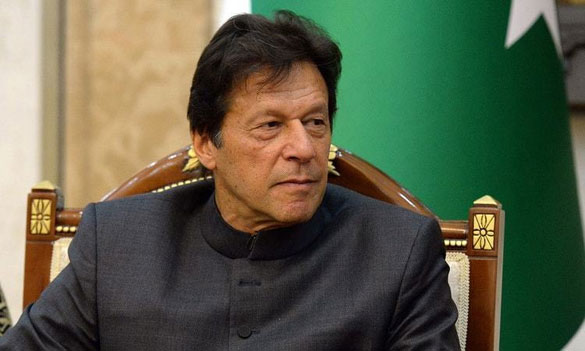
Prime Minister Imran Khan has given a verbal approval. — PM's Facebook page/File
-----------
•
Maharashtra Mosque Sets Up COVID-19 Facility, Provides Free Oxygen
•
India Grants Thousands Citizenship Rights in Kashmir
•
'I Have to Find the Mecca of My Heart': Muslims Grieve as Hajj Is Drastically
Limited
•
UN Human Rights Experts Urge India To Release Anti-CAA Protesters
•
London's Muslim Community Launches Soup Kitchen at Hyatt Street Mosque
•
Taliban Prisoner Issue Almost Resolved, Peace Talks Expected ‘Soon’
•
Shari’a Law and Dispute Resolution in the Post-COVID-19 Legal Order
•
30,000 Muslims Pray in Al-Aqsa Mosque While Sticking to Social Distancing
•
Libya Is Battling Against Terrorism, Mercenaries, Turkish Colonization: LNA
-----
Pakistan
•
Pakistan PM Approves Grantof Rs100 Million for Construction of Hindu Temple in
Islamabad
•
Pakistan’s Case Not Taken Up At FATF Meeting: FO
•
Pakistan's anti-graft body files corruption case against Nawaz Sharif
•
Pak court sentences five al-Qaida terrorists to 16 years in jail
•
Pakistan records lowest single-day spike in coronavirus cases after a month
•
NA passes Rs4.2tr budgetary demands, grants
•
Sexual abuse cases: Judge for use of only sterile objects to collect evidence
•
PTM says ready for talks but calls for confidence-building measures
•
Opposition’s dream of govt dissolution won’t come true: Punjab governor
--------
India
•
Maharashtra Mosque Sets Up COVID-19 Facility, Provides Free Oxygen
•
India Grants Thousands Citizenship Rights in Kashmir
•
Kochi Mosque Asks Devotees To Bring Own Prayer Mats
•
No Hizbul militant in south Kashmir's Tral now, first time since 1989: Police
•
J&K Terror Outfits Recruiting Kids as Young As 14: US
•
J&K: CRPF personnel, 5-year-old killed in militant attack in Anantnag’s
Bijbehara
•
Three militants killed in Jammu and Kashmir’s Pulwama district
•
SC asks foreign TJ members to serve the copy of plea to Centre
•
Teen injured in Pak firing along LoC in Poonch
--------
Arab
world
•
'I Have to Find the Mecca of My Heart': Muslims Grieve as Hajj Is Drastically
Limited
•
Intel: Al-Qaeda Branch Confirms US Drone Killed Zarqawi Relative in Syria
•
Coronavirus: Syria faces unprecedented hunger crisis, UN warns
•
Iraqi security forces raid Iran-backed militia's headquarters south of Baghdad
•
Iraq says 13 pro-Iran fighters arrested for anti-US rocket attacks: AFP
•
Lebanon blames 'foreign interference' for riots, slams blocking of roads
•
Iraqi leaders say raid on Kata'ib Hezbollah HQ 'dictated by US'
•
Mosques in Makkah welcome worshippers for first Friday prayers after curfew
lifted
--------
North
America
•
UN Human Rights Experts Urge India To Release Anti-CAA Protesters
•
US Report Slams Pakistan On Terrorism: Here Is What It Says
•
Russia Secretly Offered Afghan Terrorists Bounties to Kill Troops, US
Intelligence Says
•
US waging all-out sanctions war on Iran
•
Soldiers’ cases highlight reach of white supremacy in U.S. military
--------
Europe
•
London's Muslim Community Launches Soup Kitchen at Hyatt Street Mosque
•
ISIS militant sentenced to nine years in UK for inciting violence in Germany
•
Belgian parliament urges sanctions against Israel
•
25 Europe-bound asylum seekers held in Turkey
•
French jihadist goes on trial over IS group executions in Syria
--------
South
Asia
•
Taliban Prisoner Issue Almost Resolved, Peace Talks Expected ‘Soon’
•
Kuwait sends Bangladesh MP Shahid Islam to jail
•
Gambia's justice minister who led Rohingya case resigns
•
Four Rohingya left dead after gunfight with Bangladeshi police near refugee
camp
•
US watchdog: Afghan gov’t weakened ahead of Taliban talks
--------
Southeast
Asia
•
Shari’a Law and Dispute Resolution in the Post-COVID-19 Legal Order
•
Indonesian Muslim Scholars Worried by Europe Islamophobia
•
More Indonesians Tolerant of Homosexuality, Though Vast Majority Still Say No:
Pew Survey
•
‘Don’t Be Satisfied with Numbers’: Doubts Remain as Jakarta Officials Claim
Epidemic Under Control
•
Singapore mosques resume Friday prayers after 15-week suspension
•
Malaysia can’t take any more Rohingya refugees, PM says
•
Sarawak Says Only Assistant Registrars May Officiate Non-Muslim Marriages
DuringRMCO
•
Four Islamic State militants killed near Philippine capital
•
Perak Shariah Court First to Accept E-Payment Options
--------
Mideast
•
30,000 Muslims Pray in Al-Aqsa Mosque While Sticking to Social Distancing
•
UN Rights Investigator Urges EU to Punish Any Israeli Annexation In West Bank
•
Hamas says armed resistance main tool to thwart Israeli annexation plan
•
Iran Cautions UNSC to Avoid Making More Mistakes to Appease US
•
FM Spokesman: Iran Victim of Terrorists Created, Backed by US
•
Iran-backed Katai'b Hezbollah spokesman threatens Iraqi PM following overnight
raids
•
CBI Chief Dismisses IMF's Forecast of Iran's Economy
•
Turkish opposition hits COVID-19 donation campaign’s lack of transparency
•
Iran Asks for Romania’s Full Report on Fugitive Ex-Judge’s Death
•
Judiciary Official: Sanctions Price Paid by Iran for Prioritizing Human Rights
•
Israel honours cyber-terrorists behind May attack on Iranian port
•
Israeli warplanes conduct fresh airstrikes against positions in besieged Gaza
Strip
•
2.4 million children in Yemen could go malnourished amid pandemic: UNICEF
•
Yemeni forces to strike strategic targets deeper inside Saudi Arabia: Top
Houthi official
•
Netanyahu says Israel, UAE to cooperate on coronavirus as normalization speeds
up
--------
Africa
•
Libya Is Battling Against Terrorism, Mercenaries, Turkish Colonization: LNA
•
Egypt, Ethiopia, Sudan to finalize Nile dam agreement in two to three weeks:
Minister
•
Russian, foreign mercenaries enter Sharara oil field: Libya National Oil
Corporation
•
Libyan marks liberation of Gharyan from Haftar
•
S. Africa’s top judge in hot water over Israel remarks
•
Somali artists use art to spread COVID-19 awareness
•
Commander in Somali al Shabaab militant group killed - state media
•
Armed group abducts 10 aid workers in southwestern Niger
Compiled
by New Age Islam News Bureau
URL: https://www.newageislam.com/islamic-world-news/pakistan-pm-approves-grant-rs100/d/122232
--------
Pakistan
PM Approves Grant of Rs100 Million for Construction of Hindu Temple in
Islamabad
Kalbe
Ali
June
27, 2020
ISLAMABAD:
Prime Minister Imran Khan has approved a grant of Rs100 million for the
construction of the first Hindu temple in the capital.
The
request for the grant of the amount was made to the prime minister by Minister
for Religious Affairs Pir Noorul Haq Qadri during a meeting with the prime
minister.
The
meeting was also attended by a delegation of MNAs belonging to religious
minorities including Lal Chand Malhi, Dr Ramesh Vankwani, Jai Prakash Ukrani,
Shunila Ruth and James Thomas.
The
delegation discussed the issues faced by religious minorities and lauded the
efforts of civil and armed forces in crushing the terrorist networks across the
country who had been targeting people of other faiths as part of their
extremist agenda.
The
delegation sought the support of the government for the construction of first
temple in the capital. The prime minister gave verbal approval.
The
minister for religious affairs told Dawn that the summary in this regard had
already been sent to the PM Secretariat.
“We
will pursue the matter with the PM Secretariat and it is expected that it will
be signed next week,” the minister said.
As
per the official procedure, the copy of approval will be sent to the finance
ministry for allocation of grant while construction work will be executed by
Pak-PWD.
Meanwhile,
Lal Chand Malhi said the Hindu population in Islamabad had reached to around
3,000, which included government employees, private sector employees, members
of the business community and a large number of doctors.
“While
the official formalities are underway, we have decided to continue the initial
ground works including the levelling of the land and erecting the boundary
wall,” Mr Malhi added.
Hindu
Panchayat Islamabad will manage the Shri Krishna Mandir. The Panchayat’s
president, Mahesh Chaudhry, said a large number of people from various parts of
the country, including Balochistan and Sindh, had shifted to Islamabad, mainly
due to insecurity in those areas.
“Now
when we have families here, there is a need for a crematorium, a place for
collective prayers and marriage ceremonies,” Mr Chaudhry said, adding that
“currently, we hold Holi and Diwali functions in government’s community halls
or marquee.”
Though
there will be a place for Hindus to exercise their rituals in the near future,
to solemnise marriage is legally not possible in Islamabad as there are no
officially notified rules and regulations regarding Hindu Marriage Law 2017,
even three years after the law was enacted.
https://www.dawn.com/news/1565405/pm-approves-grant-for-construction-of-hindu-temple-in-islamabad
--------
Maharashtra
mosque sets up COVID-19 facility, provides free oxygen
June
26, 2020
In
a humanitarian gesture, a mosque in Bhiwandi town of adjoining Thane district
has been converted by its administrators into a temporary COVID-19 facility,
where oxygen is provided free of cost to patients.
The
facility at Makkah Masjid in the Shanti Nagar area of the powerloom town has
been set up by the local chapter of Jamaat-e-Islami Hind (JIH), Movement for
Peace and Justice and the Shanti Nagar Trust, which runs the mosque.
Apart
from putting up five beds equipped with oxygen cylinders, the JIH also delivers
them for free to patients homes if required, an office-bearer of the JIH said,
adding the makeshift facility is open to all communities.
So
far, the Bhiwandi-Nizampur municipality has recorded over 1,332 COVID-19 cases
and 88 casualties. It has a mortality rate of 5.26 per cent, a release stated.
“Bhiwandi-Nizampur has been hit hard by the pandemic as it is a congested city.
It
doesn’t even have proper health infrastructure. “The situation has only
worsened during the pandemic as general medical practitioners have shut their
clinics fearing the virus spread,” said Ausaf Ahmed Falahi, president of the
JIH’s Bhiwandi chapter.
As
a majority of people here lack awareness about the viral disease and are unable
to afford treatment, a facility like this one was the need of the hour, he
said. Over 70 persons have benefited from this facility, which has two doctors,
while 15 oxygen cylinders have been delivered to the homes of eight COVID-19
patients, Falahi said.
People
irrespective of their religion have been availing treatment at the mosque, he
added. “Makkah Masjid has been shut for prayers since the lockdown. So, we
decided to use a part of the premises to help those who can’t avail treatment
elsewhere,” said Qaiser Mirza of the Shanti Nagar Trust.
https://www.financialexpress.com/lifestyle/health/maharashtra-mosque-sets-up-covid-19-facility-provides-free-oxygen/2004725/
--------
India
grants thousands citizenship rights in Kashmir
Hilal
Mir
26.06.2020
SRINAGAR,
Jammu and Kashmir
As
many as 25,000 people have been granted domicile certificates in
Muslim-majority Indian administered Jammu and Kashmir since May 18, which local
politicians believe is the beginning of disturbing demographic profile of the
region.
The
certificate, a sort of citizenship right, entitles a person to residency and
government jobs in the region, which till last year was reserved only for the
local population.
Last
year on Aug. 5, when India revoked the semi-autonomous status of the region, it
also scrapped the local special citizenship law, guaranteed under Article 35
(A) of the Indian Constitution.
The
law was barring outsiders including Indian nationals from settling and claiming
government jobs, to maintain the demographic balance.
On
Friday, a picture of the domicile certificate issued to Navin Kumar Choudhary,
a bureaucrat originally from the Indian state of Bihar, went viral on social
media.
In
April this year, amid the ongoing coronavirus lockdown, the government notified
domicile laws making an unspecified number of outsiders eligible for residency
and jobs.
According
to the new law, any person who has lived in the region for 15 years, or has
studied in the region for seven years and passed his class 10 or class 12
examination is eligible for domicile certificate.
Also,
children of Indian government employees who have served in the state for 10
years are eligible to settle and claim local citizenship rights. The law
applies even if the children have never lived in Kashmir.
Out
of 66, top bureaucrats serving in the region, 38 are outsiders belonging to
other Indian states. Many other outsiders serve in various central government
institutions like banks, post offices telecommunication facilities, security
institutions, and universities.
Majority
of new citizens in Jammu region
Kashmiri
politicians across the divide have said the revocation of special citizenship
rights was aimed at reversing the Muslim majority character of the region.
According
to a census conducted by India in 2011, out of 12.5 million total population,
Muslims comprise 68.31% and Hindus 28.43% in Jammu and Kashmir.
Speaking
to Anadolu Agency on the condition of anonymity, a government official said,
since May 18, when the rules were notified, 33,000 persons had applied for the
domicile certificates. Out of them, 25,000 persons have been granted
citizenship rights, he said.
As
many as 32,000 applications were filed in 10 districts of the Hindu majority
Jammu region. The highest number of 8,500 certificates has been issued in the
Doda district, which has a delicate demographic balance, with Muslims
comprising 53.81% and Hindus 45.76%.
As
many as 6,213 domicile certificates have been issued in Rajouri district, which
has 62.71% Muslim population. Authorities have distributed 6,123 citizenship
certificates in Poonch, a border district comprising 90.44% Muslim population.
In
the Kashmir region, which is about 96.4% Muslim population, 435 certificates
have been issued so far, out of the total 720 applications.
As
of now, it is not clear how many outsiders, like Choudhary, have been issued
domicile certificates. The 25,000 new citizens also include Hindu refugees, who
had settled in the region at the time of partition of the sub-continent in
1947. They had migrated from territories, now part of Pakistan. But due to the
state’s residency laws and special status they were not granted local
citizenship rights.
Disputed
territory
Kashmir
is held by India and Pakistan in parts and claimed by both in full. A small
sliver of Kashmir is also held by China.
Since
they were partitioned in 1947, the two countries have fought three wars -- in
1948, 1965, and 1971. Two of them have been over Kashmir.
Some
Kashmiri groups in Jammu and Kashmir have been fighting against the Indian rule
for independence or unification with neighboring Pakistan.
According
to several human rights organizations, thousands of people have reportedly been
killed in the conflict in the region since 1989.
https://www.aa.com.tr/en/asia-pacific/india-grants-thousands-citizenship-rights-in-kashmir-/1891086
--------
'I
have to find the Mecca of my heart': Muslims grieve as hajj is drastically
limited
June
26, 2020
Caitlin
Yoshiko Kandil
(RNS)
— Shaykh Hassan Lachheb remembers first dreaming of hajj as a child, looking at
small Polaroid photographs of his father at an airport in his native Morocco as
he left for the holy pilgrimage to Mecca, in Saudi Arabia, one of the five
obligations required of devout Muslims. Lachheb determined then to make the
journey one day himself.
Lachheb,
now president and co-founder of Tayseer Seminary in Knoxville, Tennessee,
realized his dream many years later. For the past five years he has led groups
of American Muslims on twice-a-year trips to Mecca during hajj, which takes
place in the Islamic month of Dhul-Hijjah, and umrah, a non-obligatory pilgrimage
performed any time of year.
“Hajj
is the fullest manifestation of what Islam is,” he said, “in regard to
spirituality, in regard to rituals, in regard to our connection to history and
how deep our history is.”
But
this year will be different.
Earlier
this week, the Saudi government announced that international visitors would be
barred from hajj this summer out of concern for the coronavirus pandemic. Only
about 1,000 people living in Saudi Arabia will be allowed to participate in the
weeklong ritual, which begins July 28. The gathering typically draws some two
million people from around the globe.
As
early as March, Lachheb said, his group realized that their trip was threatened
by the spread of COVID-19. Officially cancelling the trip, however, brought
sadness. The pilgrimage has been disrupted in the past by wars and pandemics,
but this year marked the first time in history that the two holiest mosques in
Islam, the Grand Mosque in Mecca and the Prophet’s Mosque in Medina, have been
closed to the public simultaneously, he said.
Seeing
images of these deserted holy sites — particularly around the Kaaba, the black
cube that Muslims circumambulate during hajj — was a spiritual shock. “When you
see it completely empty, it’s like our hearts are empty,” he said.
The
uncertainty in recent months about whether hajj would go on has troubled many
of those who planned to go, said Khalid Latif, a chaplain at New York
University who has led hajj and umrah trips for students, faculty and NYU's
neighbors for the past three years. “I think you'd find some Muslims feeling
some relief that they just know what’s happening," he said.
But
many may not be able to simple say, "next year," said Latif. In
addition to the expense — his trips with NYU cost up to $10,000 per person —
not everyone can easily arrange to take time from work, never mind cover care
for children or parents.
Though
hajj is considered an obligatory ritual for all Muslims who are healthy enough
to make the trip and have the means, preservation of life supersedes all else.
For
American Muslim converts, however, the hajj is more than the fulfillment of a
sacred ritual. For all Muslims, hajj represents a fresh start when all past
sins are forgiven, but for many Americans it’s the first chance to experience a
completely Muslim environment.
“We
represent about 1% of the population,” said James Jones, vice chair of the
Islamic Seminary of America in Richardson, Texas, who embraced Islam in 1979
and went on pilgrimage in 1992. “But there, everybody’s Muslim, and especially
for the convert, that’s the first opportunity to be in a place where
everybody’s Muslim.
"I
don’t have to worry about what I’m eating, I don’t have to worry about
offending anybody by saying, ‘assalamu alaikum, peace be upon you,'" Jones
said. "There’s that sense of ease when you’re around Muslims. Everybody’s
praying five times a day and nobody’s complaining about the call to prayer.”
Jones
pointed out that Islam teaches that, since people are judged by their
intentions, those who planned on making hajj this year will reap the same
spiritual rewards as if they had gone.
For
some groups, coronavirus restrictions have even come as a kind of boon. The
Hajjah Project started in Los Angeles in 2016 to support local women who are
making pilgrimage for the first time. In March, the group had to cancel a
conference on how to plan for hajj. Instead, the project's founder, Krishna
Najieb, redirected efforts to developing a “Sisters Sunday Coffee” Zoom series
where women discuss Islamic spirituality.
After
the killing of George Floyd, she created another series called “Eight Days of
Muslimah Prayer and Action.”
And
instead of fundraising to help women offset the cost of pilgrimage, one of the
group’s core activities, Najieb said the Hajjah Project used the funds to buy
headscarves for incarcerated Muslim women.
“We
had always felt like the Hajjah Project could evolve to not just supporting
sisters making a first-time trip to hajj, but sisters trying to do things that
are good for the community using Islamic values,” said Najieb, who performed
hajj in 2015.
For
Lachheb of Tayseer Seminary, he has also turned the absence of hajj this year
into a spiritual opportunity. After the grief he initially felt, he said he has
had time to reflect on the fact that closeness to God shouldn’t be tied to any
physical place, and that, with the right intentions, he can still perform hajj
internally.
“I
have to find the Kaba of my heart, I have to find the Mecca of my heart,” he
said.
https://religionnews.com/2020/06/26/i-have-to-find-the-mecca-of-my-heart-muslims-grieve-as-hajj-is-drastically-limited/
--------
UN
human rights experts urge India to release anti-CAA protesters
Jun
27, 2020
A
group of United Nations human rights experts has asked India to
"immediately" release people who were arrested for protesting against
the country's controversial Citizenship Amendment Act (CAA) passed last year.
"These
defenders, many of them students, appear to have been arrested simply because
they exercised their right to denounce and protest against the CAA," a
press statement released by the Office of the United Nations High Commissioner
for Human Rights said on Friday.
"[Their]
arrest seems clearly designed to send a chilling message to India's vibrant
civil society that criticism of government policies will not be
tolerated," it said.
Prime
Minister Narendra Modi's Hindu nationalist government introduced CAA late last
year, laying out a path to citizenship for people from six religious minorities
from Afghanistan, Bangladesh and Pakistan who arrived in India before 2015. The
law excluded Muslims from the list.
The
determination of rights to Indian citizenship based on religion triggered mass
protests across India - some led by Muslim women - and resulted in a fierce
police crackdown.
Critics
say the law discriminates against Muslims and undermines India's secular
constitution.
'Alarming
cases'
During
the nationwide protests against the CAA, deadly violence had erupted in
February in capital New Delhi in which 53 people, mostly Muslims, were killed.
Several
anti-CAA activists were arrested in connection with the New Delhi violence and
later charged under the Unlawful Activities (Prevention) Act (UAPA), a
stringent anti-terror law.
The
UN human rights experts said the police also failed to act against the ruling
Bharatiya Janata Party (BJP) leaders and supporters accused of "incitement
to hatred and violence".
A
federal minister had raised "shoot the traitors" slogans at a pro-CAA
rally, while a BJP legislator from northeast Delhi - the site of February
violence - had threatened to remove the protesters from the streets.
In
their statement, the UN experts named 11 of those arrested, saying their cases
included "serious allegations of human rights violations" and
"torture and ill-treatment" in custody.
They
said one of the "most alarming cases" of India's action against the
CAA protesters involved pregnant student Safoora Zargar, who was jailed for
more than two months.
Zargar,
27, was allegedly kept in solitary confinement, denied regular contact with
family and not provided adequate medical care or diet, they said.
She
was granted bail earlier this week in her sixth month of pregnancy on
humanitarian grounds.
The
other 10 jailed protesters named by them were Meeran Haider, Gulfisha Fatima,
Asif Iqbal Tanha, Devangana Kalita, Natasha Narwal, Khalid Saifi, Shifa Ur
Rehman, Kafeel Khan, Sharjeel Imam and Akhil Gogoi.
The
UN experts said these arrests appeared to be "discriminatory". Indian
activists have also accused the BJP government of using limited access to legal
resources during the coronavirus lockdown to target political dissenters and
Muslims.
"Authorities
should immediately release all human rights defenders who are currently being
held in pre-trial detention without sufficient evidence, often simply on the
basis of speeches they made criticising the discriminatory nature of the
CAA," the UN experts said.
In
March, the UN Commissioner for Human Rights (UNHRC) Michelle Bachelet informed
India that her office had filed an application urging the country's Supreme
Court to make the UN body a third party in one of the many petitions filed by
Muslim groups, opposition parties and activists challenging the CAA's
constitutional validity.
In
response, India said the CAA was its "internal matter" and that
"no foreign party has any locus standi on issues pertaining to India's
sovereignty". Meanwhile, the top court is still hearing those petitions.
https://www.aljazeera.com/news/2020/06/human-rights-experts-urge-india-release-anti-caa-protesters-200626105916987.html
--------
London's
Muslim community launches soup kitchen at Hyatt Street mosque
Jun
26, 2020
Members
of London's large Muslim community are joining forces to launch the city's
first Muslim Soup Kitchen, a program that aims to help less fortunate
Londoners.
The
project launches July 4 and volunteers will serve meals every Saturday at 12:30
for about an hour, or until the food runs out, said Zeba Hashmi, one of the
volunteers behind the project.
"We
want to serve women and children and men, whoever is hungry, whoever needs the
food," she said.
"There
is a crisis in terms of poverty, in terms of families not having enough food to
eat in this city. As Muslims, it's part of our faith, and it's part of other
faiths as well, to help those in need."
The
Muslim community has worked in the past to get food to the Salvation Army and
St. Vincent de Paul Society, as well as serving food at Mission Services and
the Salvation Army.
The
Muslim Soup Kitchen brings together the London Muslim Mosque, the Islamic
Centre of Southwestern Ontario, the Muslim Association of Canada, the north
London Islamic Centre and the Hyatt Mosque.
Volunteers
with all of those groups will work to serve lunch on Saturdays at the Hyatt
Mosque at 282 Hyatt Street, off of Hamilton Road near Adelaide Street, to serve
lunch.
In
the past, volunteers with the soup kitchen served meals to the women who use My
Sister's Place, but decided they wanted their efforts to include children and
men as well.
Food
will be provided by local restaurants, Hashmi said. Because of COVID-19
restrictions, it will be take-away.
https://www.cbc.ca/news/canada/london/london-ontario-muslim-soup-kitchen-1.5627221
--------
Taliban
Prisoner Issue Almost Resolved, Peace Talks Expected ‘Soon’
June
27, 2020
KABUL:
Peace talks between warring Afghan factions are expected to start as soon as
they iron out their main differences over the release of the “most dangerous”
Taliban prisoners, officials and sources from both sides said.
Despite
a major push by the United States, there has been a delay in the intra-Afghan
talks as the Afghan government and some key NATO members are uncomfortable
about the release of Taliban commanders accused of conducting large-scale
attacks that killed civilians in recent years.
An
Afghan government source said the prisoner issue had largely been resolved and
they would release an alternative set of prisoners with talks expected to start
mid-July.
“The
Taliban agreed because it was delaying the talks,” he said, adding the
government had also demanded a guarantee from the Taliban that it was no longer
holding any Afghan security force prisoners.
A
source close to the Taliban said the group was willing to move forward so long
as most of the 5,000 prisoners demanded were released.
“I
don’t think releasing or not releasing 200 or 300 prisoners will matter in the
process, the Taliban can agree for (those) prisoners to remain in Afghan
government custody,” the source said.
Taliban
political spokesperson Suhail Shaheen could not be reached for comment but has
reiterated in recent weeks that the group expects the full terms of their
February agreement with the United States, including the release of 5,000
prisoners, to be implemented before talks can start.
Pakistan,
seen as a key regional player in getting the Taliban to peace talks, said it
expected negotiations to begin very soon and was optimistic that sticking
points, including the prisoner issue, would be resolved.
“I
think we are almost there,” Foreign Minister Shah Mahmood Qureshi told Reuters
in an interview on Thursday. “The impediments have been addressed one by one
and now there is a general agreement that this is the way forward…I’m expecting
things to be begin quickly.”
https://www.pakistantoday.com.pk/2020/06/26/taliban-prisoner-issue-almost-resolved-peace-talks-expected-soon/
--------
Shari’a
Law and Dispute Resolution in the Post-COVID-19 Legal Order
June
26, 2020
By
Damilola S. Olawuyi
Modern
societies have for many years evolved efficient methods for resolving legal
disputes in a peaceful manner. Litigation in courts, as well as out-of-court
alternative dispute resolution (ADR) methods – such as negotiation, mediation,
conciliation and arbitration – are popular avenues through which a wide range
of commercial and non-commercial disputes are resolved in Qatar and beyond.
However,
the ongoing COVID-19 pandemic poses complex and multifaceted challenges to
justice delivery systems across the world. History teaches us that in times of
global disasters and economic disruptions, such as those triggered by COVID-19,
legal disputes significantly increase. These include employment disputes,
breach of contract, bankruptcy, insurance claims, family disputes, supply chain
disruptions, and more. In light of the impending tsunami of complex legal disputes
that could arise post-COVID-19, lawyers and judicial institutions will require
support so that they can effectively handle such disputes and not be
overwhelmed. In addition to technological, digitalization, financial and
infrastructure needs, innovative dispute management mechanisms will be required
to avoid institutional gridlock.
The
COVID-19 pandemic provides an opportunity to explore how Shari’a law – the
principal source of law in Muslim countries – can provide additional and
innovative avenues for dispute resolution. For many years, the value of Islamic
ADR has been explored in the literature but has not been exhaustively tested.
Islamic ADR promotes the resolution of disputes outside of courts, in
accordance with the tenets and procedures of Shari’a law. Shari’a-compliant
modes of resolving disputes include Muhtasib (use of an ombudsman); Sulh
(negotiation, mediation/conciliation); and Tahkim (arbitration). One
distinguishing feature of Islamic ADR, as compared to traditional ADR methods,
is that parties agree to abide by Qur’anic injunctions and prophetic practice
in determining their claims. For example, the Qur’an and Hadith prohibit the
levying of interest (riba). In selecting Islamic ADR, parties therefore choose
to exclude riba.
In
addition to its inestimable moral, cultural and spiritual value, Islamic ADR
can provide an alternative legal framework for resolving non-commercial
disputes such as family disputes, property and inheritance. The same is also
true of small and medium scale entrepreneurial disputes where religious tenets
and principles can play a key role in timely, less acrimonious, and
cost-effective resolution. In a post-COVID-19 world, Islamic ADR Tribunals can
reduce the impending pressure and demand on courts and ADR institutions and
allow parties to achieve final and binding resolution in a timely, accessible
and cost-efficient manner.
Islamic
ADR can be implemented within the framework of existing judicial institutions
across the Islamic world. Among the lessons that can be gleaned from countries
such as the United Kingdom, Malaysia and Indonesia, where Islamic ADR is
already being implemented with varying levels of success, is that the most
important first step is to develop clear and comprehensive rules and procedures
that provide legal backing and support for Islamic ADR.
For
example, the Asian International Arbitration Centre in Malaysia has developed
Islamic Arbitration Rules (i-Arbitration Rules), which provide a comprehensive
framework of Shari’a-compliant rules and procedures for resolving disputes. An
equally important step for fast-tracking the adoption of Islamic ADR is to
leverage the existing expertise of arbitrators, practitioners and scholars who
are already well versed in the intricacies of ADR, as well as the fundamental
principles of law. Such experts can guide the speedy development of tailored
Islamic ADR principles and procedures that reflect the rich and diverse legal
cultures and traditions across and within Muslim countries.
Higher
education institutions also have crucial roles to play in developing innovative
programs to train and prepare societies for the emerging legal order post-COVID
19. The College of Law at Hamad Bin Khalifa University (HBKU) is already
spearheading innovation in this area. Through its Juris Doctor (J.D.) program,
LL.M. in International Economic and Business Law, LL.M. in International Law
and Foreign Affairs, as well as the Certificate Program “Law in Practice in
Qatar”, students have exceptional opportunities to acquire comparative legal
skills and knowledge on the rudiments of ADR and its practical application in
their home countries.
https://moderndiplomacy.eu/2020/06/26/sharia-law-and-dispute-resolution-in-the-post-covid-19-legal-order/
--------
30,000
Muslims pray in Al-Aqsa Mosque while sticking to social distancing
June
26, 2020
AMMAN,
Jordan: More than 30,000 Muslims attended Friday prayers at Al-Aqsa Mosque
while respecting stricter health conditions imposed by the Jerusalem Waqf
Department.
Sheikh
Azzam Khatib, director general of the Jordanian Waqf Department in Jerusalem,
said that the stricter conditions were brought in because of the uptick in the
number of confirmed coronavirus cases in Jerusalem and in other Palestinian
towns.
“We
issued numerous statements, videos and other announcements telling worshippers
that they must bring their own prayer mat and mask and that we will implement a
strict physical separation,” he told Arab News.
Khatib
said that the Health Ministry’s announcement of 72 coronavirus cases in the
Jerusalem area was very disturbing. “We were worried seeing the numbers of
those contracting the virus while many events, including weddings and other
public gatherings, were being held without any adherence to basic anti-COVID-19
health requirements.”
He
added that the Jerusalem Waqf did not want to be held responsible for the
spread of the deadly disease.
“We
take our responsibilities seriously and we don’t want to be blamed for
facilitating the spread of the virus. We also don’t want to give an excuse to
the Israelis to prevent worshippers from accessing the mosque again.”
Khalil
Assali, a member of the Jerusalem Waqf Council, said that the waqf director and
staff had no choice but to strictly follow the Health Ministry’s requirements.
“We
noticed an increase in visits to pray in Al-Aqsa from Palestinian citizens of
Israel and we have been worried about the potential of the spread of the virus,
especially during the entry and exit of worshippers when they crowd around the
gates and alleys,” he told Arab News.
Waqf
staff as well as volunteers were deployed all over the Haram Al-Sharif, which
is a UNESCO World Heritage Site, to ensure strict adherence to the waqf
department’s orders.
Wedding
parties have been banned in all governorates across the West Bank, the Palestinian
government said last Tuesday, because the number of infections were rising.
“Due
to the increase in the number of coronavirus infections during the past 24
hours and in order to avoid the spread of the epidemic ... With regret, the
government has decided to ban wedding celebrations in all governorates in order
to keep you and your community safe from any harm,” it said.
The
Palestinian government ended a two-month lockdown on May 25, allowing all
sectors to reopen.
https://www.arabnews.com/node/1695911/middle-east
--------
Libya
is battling against terrorism, mercenaries, Turkish colonization: LNA
26
June 2020
The
Libyan National Army (LNA) is fighting an ongoing battle against terrorism and
“Turkish Colonization” in Libya, said LNA spokesman Ahmed al-Mismari said on
Thursday.
The
LNA official said that the Libyan people comprehend and reject “Turkey’s
expansionist ambitions to extend its influence over our country and the entire
Arab region, with aggressive colonial motives, and to control and plunder our
wealth to address its struggling economic crisis.”
For
all the latest headlines follow our Google News channel online or via the app.
Al-Mismari
said that Turkey was able to do this after “agents and traitors opened the way
for them to capture our land and desecrate it, through direct military
intervention, and by sending mercenaries and terrorist fighters from various
global terrorist organizations, via the deal of shame and disgrace.”
Tensions
have been escalating in Libya and between the countries which back the two
warring parties in it, the LNA, commanded by Khalifa Haftar, and the Government
of National Accord (GNA), led by Fayez al-Serraj.
Turkey,
which backs the GNA, has also been ramping up its military intervention in
Libya recently. Ankara has been providing air support, weapons and allied
fighters from Syria to the GNA.
In
November, Turkey signed a military cooperation pact with the GNA. The two
parties also signed a maritime demarcation deal, which gives Ankara exploration
rights in the eastern Mediterranean.
The
maritime deal was rejected as “illegal” by many Mediterranean countries such
Greece and Cyprus.
In
early in June, Turkish President Recep Tayyip Erdogan said that his country’s
support for the GNA “will increasingly continue.”
On
Thursday, Turkey said that the GNA demanded Haftar’s forces to withdraw from
Sirte and Jufra region as a pre-requisite for ceasefire talks.
Egypt’s
‘national security’
Turkey’s
intervention in Libya would give it a foothold in the natural-resources-rich
Middle East, where its international ties to many countries are strained.
This
is especially significant for Egypt, since it shares a long border with Libya,
backs Haftar’s LNA and its relationship with Turkey has been tense for years.
On
Saturday, Egyptian President Abdel Fattah al-Sisi said that his country has a
legitimate right to intervene in Libya and ordered the army to be prepared to
carry out missions if necessary.
He
said: “Any direct intervention from the Egyptian state has now acquired
international legitimacy,” adding that Egypt had received “direct threats” from
“terrorist militias and mercenaries” supported by foreign countries.
Earlier
in June, Egypt had called for a ceasefire in Libya, however, in his recent
speech Sisi said that Egypt has always been reluctant to intervene in Libya but
“the situation now is different.”
“If
some people think that they can cross the Sirte-Jufra frontline, this is a red
line for us,” he said.
The
LNA spokesman thanked Egypt and Sisi for standing in solidarity with the people
of Libya, and saluted all the Arab countries which supported Egypt’s stance,
which he said “reflected the strength of Arab solidarity in the face of terrorism,
and colonization.”
https://english.alarabiya.net/en/News/north-africa/2020/06/26/Libya-is-battling-against-terrorism-mercenaries-Turkish-colonization-LNA.html
--------
Pakistan
Pakistan’s
case not taken up at FATF meeting: FO
June
27, 2020
ISLAMABAD:
The Foreign Office on Friday said that Pakistan’s case was not taken up at the
Financial Action Task Force (FATF) meeting held earlier this week and it would
continue to be on its ‘grey list’ till October.
“The
agenda of FATF’s virtual plenary meeting, held on 24 June 2020, did not include
Pakistan. In this virtual plenary meeting, no new decision regarding Pakistan
was made,” the FO said in a statement.
Therefore,
the decisions taken at the FATF’s plenary held in February would remain in
effect, it said.
Pakistan
was at the last plenary given a six-month extension (till June 2020) on the
grey list for meeting the remaining requirements of its action plan with a
warning that action would be taken against it if it did not show “significant
and sustainable progress especially in prosecuting and penalising terrorism
financing cases”.
Pakistan
has been on the grey list since June 2018. The grey list comprises countries
being monitored by the illicit financing watchdog for weaknesses in their
anti-money laundering and counter-terrorism financing regimes.
Pakistan’s
case was not discussed at the Paris meeting because of a decision taken by FATF
on April 28 to suspend the ICRG (International Cooperation Review Group)
review process for the countries on the grey list.
Evaluation
of Pakistan’s progress on the FATF Action Plan would now be made in the next
plenary cycle beginning in October. The next cycle would have a new president.
China led FATF from Oct 2019 to June 2020.
“Pakistan
remains committed to completing its FATF Action Plan and continues to make
progress,” the FO said.
This
situation was, however, misreported by the Indian media, which claimed that the
June 24 plenary kept Pakistan on the grey list for failing to check flow of
money to terror groups. Indian Ministry of External Affairs (MEA) too jumped in
to exploit the misrepresentation of the situation by claiming that it
vindicated Delhi’s stance about Pakistan not taking action against terrorist
networks.
The
FO said it rejects the remarks by MEA spokesperson and outrightly dismisses the
“fabricated news reports” in Indian media.
Indian
media reports in this regard, it said, were “patently misleading and part of
the incessant smear campaign by India against Pakistan”.
The
FO recalled that it had repeatedly warned about India’s “sinister attempts” to
use FATF process for its “narrow” political gains.
“Pakistan
has also been raising the issue of India’s dubious credentials as an impartial
and objective assessor of Pakistan’s progress on the FATF Action Plan. India’s
efforts to misuse the technical forum of FATF for discrediting Pakistan have
been noticed by FATF members and are not appreciated by the international
community,” it emphasised.
It
called on FATF members to take note of India’s malicious campaign against
Pakistan and reject its attempts to politicise the FATF process.
https://www.dawn.com/news/1565473/pakistans-case-not-taken-up-at-fatf-meeting-fo
--------
Pakistan's
anti-graft body files corruption case against Nawaz Sharif
Jun
27, 2020
LAHORE:
Pakistan's anti-graft body has filed a corruption case against deposed prime
minister Nawaz Sharif and three others for their alleged involvement in the
illegal allotment of land in Punjab province about 34 years ago.
An
arrest warrant has been issued against the 70-year-old three-time premier who
is in London for medical treatment.
The
National Accountability Bureau (NAB) has approached an anti-corruption court to
declare Sharif a proclaimed offender since he did not respond to any of its
summons.
The
three other accused named in the case filed by the NAB are Jang/Geo media group
owner Mir Shakilur Rahman, former Lahore Development Authority (LDA) director
Humayun Faiz Rasool and former director (land) Mian Bashir.
In
1986, when he was the Punjab chief minister, Sharif had allegedly allotted
54-'kanal' (canal) land in Lahore to Mir Shakilur Rehman in violation of rules.
Rahman,
who was arrested on March 12, is on judicial remand.
In
the reference, Sharif and the two officers were accused of the misuse of
authority in allotting the precious land along the canal to Rahman in violation
of the rules.
Sharif
had left for London in November after the Lahore High Court granted him a
four-week permission to go abroad for treatment.
He
had submitted an undertaking to the court to return to Pakistan, citing his
record of facing the law and justice, within four weeks or as soon as he is
declared healthy and fit to travel by doctors.
Last
month, a fresh picture of 'ailing' Sharif having tea at a London cafe along with
his family went viral on social media, sparking a debate on his health with the
ruling Pakistan Tehreek-i-Insaf members demanding his return to face corruption
cases.
In
the picture, he was seen sitting at a roadside cafe with his granddaughters. He
sported a blue shalwar kameez and a cap and apparently looked in better health.
Sharif
was given bail in the Al-Azizia Mills corruption case, in which he was serving
a seven-year prison sentence in Kot Lakhpat Jail.
He
was also given bail in a money-laundering case to facilitate his travel abroad.
Sharif
was diagnosed with "complicated coronary artery/ischemic heart disease
with significant disease burden".
Full
report at:
https://timesofindia.indiatimes.com/world/pakistan/pakistans-anti-graft-body-files-corruption-case-against-nawaz-sharif/articleshow/76656070.cms
--------
Pak
court sentences five al-Qaida terrorists to 16 years in jail
Jun
26, 2020
ISLAMABAD:
An anti-terrorism court in Pakistan’s Punjab province convicted five al-Qaida
militants over terrorism-related charges and sentenced then to 16 years in
prison each.
The
verdict was announced by the ATC in Gujranwala city on Thursday.
The
court found Abdullah Umair, Ahmadur Rehman, Asim Akbar Saeed, Muhammad Yaqoob
and Muhammad Yusuf guilty of terror offences and each convict was handed five
years in prison for terrorism financing, seven years for keeping explosives,
three years for supporting al-Qaida and one year for keeping al-Qaida
literature.
The
court also ordered the confiscation of the personal properties of the convicts
and fined them Rs 1,80,000 (Pakistani currency) each.
The
convicts, according to the spokesperson of Punjab’s counter-terrorism
department (CTD), were running a media cell for al-Qaida in the Indian
Subcontinent (AQIS) in Gujranwala.
They
were arrested in a joint operation by the CTD Punjab and spy agency
Inter-Services Intelligence (ISI) in December 2019.
"The
AQIS had been running its propaganda campaign online and physically from a
secret location in Karachi," the spokesperson said, adding that they had
shifted their set-up to Gujranwala to escape surveillance.
During
investigations, CTD Punjab found that Asim Akbar Saeed, a resident of Lahore,
had been associated with al-Qaida since 2005 and was in charge of the group’s
media cell.
In
addition to online material, he ran a printing press where AQIS literature was
published. The printed material was disseminated to various parts of Pakistan and
Afghanistan through couriers.
Another
convict, Abdullah Umair, aka Hanzala, a resident of Karachi, had joined the
organisation in 2010. He was coordinating AQIS activities in Pakistan and
Afghanistan. Similarly, Ahmadur Rehman of Karachi had joined AQIS in 2015 and
was trained for urban ambush operations. Convict Yousaf, of Karachi, was the
brother of AQIS commander Muhammad Yaqoob. He had also been trained in urban
terrorist warfare.
Full
report at:
https://timesofindia.indiatimes.com/world/pakistan/pak-court-sentences-five-al-qaida-terrorists-to-16-years-in-jail/articleshow/76652197.cms
--------
Pakistan
records lowest single-day spike in coronavirus cases after a month
Jun
26, 2020
ISLAMABAD:
Pakistan's Covid-19 patients will be around 225,000 by the end of June as
compared to the estimated 300,000, a senior minister said on Friday, as the
country recorded 2,775 infections, the lowest single-day spike in coronavirus
cases in about a month.
Planning
minister Asad Umar said the government succeeded in keeping the expected number
under control after people showed responsibility.
"As
a result, we are now looking at 225,000 cases by June end instead of 300,000,
which we initially feared," he told the media after chairing the meeting
of the National Command and Control Centre (NCOC) that reviewed the Covid-19
situation.
He
said the reduction showed that success against the virus was possible through
joint efforts and following the guidelines including wearing masks at public
places were paying dividends.
Umar
said that hotspots were identified and provinces tasked to take action and
clusters were sealed in 20 cities.
"It
is a reminder that if we take the right measures, God will protect us and if we
don't, the situation can worsen," he said.
He
said despite the pressure on hospitals, the health system was not going to
collapse.
Pakistan
on Friday recorded its lowest single-day spike in coronavirus cases in about a
month after 2,775 people tested positive for the infection, taking the national
tally to 195,745.
The
highest single-day spike was recorded on June 13 with 6,825 new cases. On May
29, Pakistan recorded 2,429 cases, the lowest.
According
to the data released by the ministry of national health services, 59 people
died due to Covid-19 in the last 24 hours, taking the total number of
fatalities to 3,962.
So
far, 84,168 patients have recovered from the disease.
Sindh
has recorded maximum 75,168 patients followed by Punjab with 71,987,
Khyber-Pakhtunkhwa 24,303, Islamabad 11,981, Balochistan 9,946, Gilgit-Baltistan
1,398 and Pakistan-occupied Kashmir 962 patients.
The
authorities conducted 1,193,017 tests including 21,041 tests during the last 24
hours.
Meanwhile,
Pakistan sought the World Health Organisation's (WHO) support to develop
guidelines for the upcoming Eid ul Azha when cattle markets are held across the
country to sell animals for sacrifice.
Special
Assistant to Prime Minister on National Health Services Zafar Mirza during a
meeting held on Thursday through video link with WHO Regional Director Dr Ahmed
Al-Mandhari and his team asked for help to prepare guidelines.
Mirza
said Pakistan was fighting Covid-19 through a robust and coordinated national
response.
The
purpose of the meeting was to discuss Pakistan's response to the contagion and
to explore areas where the WHO could provide technical guidance and support to
help the country fight the virus.
Prime
Minister Imran Khan on Thursday defended his government's handling of the
coronavirus crisis, saying there has been no confusion or contradiction in the
official policies since the start of the disease.
"They
say again and again that there was confusion ... if there was one country whose
government did not have confusion, it was ours," Khan said while
addressing Parliament.
Full
report at:
https://timesofindia.indiatimes.com/world/pakistan/pakistan-records-lowest-single-day-spike-in-coronavirus-cases-after-a-month/articleshow/76647579.cms
--------
NA
passes Rs4.2tr budgetary demands, grants
Syed
Irfan Raza
June
27, 2020
ISLAMABAD:
Amid severe criticism by the opposition, the National Assembly on Friday passed
budgetary demands and grants of over Rs4.2 trillion of the budget for financial
year 2020-21 recently laid in the house for debate.
The
opposition did not present cut motions on 96 demands, paving the way to their
passage in the first phase of the session before interval, while on 94 other
demands its cut motions were rejected.
The
opposition members termed the budget “unrealistic” and said the government had
tried to fool the people through the budget. They lamented the government’s
fiscal and social policies vis-à-vis taxes, performance of institutions, health
and education sectors, minorities, foreign loans and their utilisation, salary
and pension of government employees, exports, oil pricing, sugar crisis and
food security.
They
said the targets set in the budget 2020-21 would never be met because ground
realities were ignored by the government during its preparation.
The
opposition leaders also sought details of assets of Prime Minister Imran Khan’s
advisers and special assistants, besides demanding resignation of Aviation
Minister Ghulam Sarwar Khan for what they called his “irresponsible” statement
relating to the recent crash of PIA’s aircraft in Karachi and the educational
degrees of pilots of the national flag carrier.
Dr
Nafeesa Shah of the Pakistan Peoples Party (PPP) demanded the aviation
minister’s resignation for maligning the country, PIA and its pilots and
sending a wrong message to the international community.
Mohsin
Ranjha of the Pakistan Muslim League-Nawaz (PML-N) sought details of assets of
PM’s advisers and special assistants and asked if parliamentarians could submit
their assets’ details to the Election Commission of Pakistan, then why PM’s
aides could not provide such details before parliament.
In
his concluding speech, Minister for Industries Hammad Azhar responded to all
the allegations of the opposition and described the current account deficit
inherited from the last PML-N government as “mother of all economic ills”. “The
current account deficit affects GDP and caused inflation in the country,” he
added.
Talking
about the opposition’s criticism that the government had enhanced the revenue
target by Rs1tr without imposing any new tax and keeping in view the economic
condition of the country due to the coronavirus pandemic, the minister said the
government was going well in terms of revenue collection and could have
generated Rs4,800 billion, but the target was hampered by the impact of
Covid-19.
Responding
to another objection raised by the opposition regarding renaming of the Benazir
Income Support Programme, Mr Azhar said the data of BISP was used only for one
category of the Ehsaas cash distribution programme [for coronavirus-hit poor
people], while fresh data was prepared for other categories.
On
the National Finance Commission Award, he assured the opposition that all
grievances of the provinces would be addressed. He said the country’s exports
and imports had declined due to the global economic crisis after the pandemic.
Talking
about the “hot money” received from international donors, he said $4-5bn had
been utilised for retiring interest on foreign loans and $4-5bn was still in
the national foreign reserves.
Responding
to an objection that the government had not reduced the prices of petroleum
products as much as they should be, the minister said the government had passed
on the maximum benefit of crash of international oil prices to the people of
Pakistan than any other country in the world.
Earlier,
PPP’s Naveed Qamar asked why the rampant inflation had not come down in the
country despite the fact that oil prices had declined sharply. “More than one
million people of the country had already fallen below poverty line due to
government’s faulty economic policies even before the Covid-19 crisis,” he
said.
He
said the rulers had been criticising the last PML-N regime for ample circular
debts, but the present government had also increased it. “The government had
given good news to the nation that it will clear all circular debts in one
year, but they are fast increasing,” he regretted.
Mr
Qamar said the government always talked about minorities, but it had not
allocated any funds for them in the budget. He said the government had agreed
to increase salary of government employees but did not mention from where these
funds would be generated. The PPP leader accused the government of placing
bogus and unrealistic estimates and expenditures before the National Assembly
by harming the sanctity of parliament.
PML-N
leader Khurram Dastagir said the government had obtained Rs7,941bn foreign
loans, but nobody knew where that amount was. He also demanded details of the
funds the government had received from international donors as assistance for
combating the coronavirus crisis and their usage.
MNA
Ayesha Ghuas Buksh said the government had prepared the budget in line with the
instructions and desires of the International Monetary Fund. “It is better to
rent out the country to IMF.” She said the budget was unrealistic and the
government could never meet its budgetary targets. “The government is
destroying the sanctity of the document,” she added.
PPP
leader Shahida Rehmani broke into tears while speaking on the floor of the
house because of critical condition of her father and mother suffering from
Covid-19. “If anything goes wrong with my parents, I will not forgive Prime
Minister Imran Khan,” she said while criticising the government’s policy on the
coronavirus pandemic.
Full
report at:
https://www.dawn.com/news/1565470/na-passes-rs42tr-budgetary-demands-grants
--------
Sexual
abuse cases: Judge for use of only sterile objects to collect evidence
June
27, 2020
LAHORE:
The Lahore High Court has taken strong notice of use of non-sterile objects to
collect evidence in sexual assault cases and issued a set of guidelines for the
health authorities.
The
health department shall ensure provision of sufficient quantities of Sexual
Assault Evidence Collection Kits to all hospitals in Punjab, including those at
the district and tehsil headquarters, said Justice Tariq Saleem Sheikh in an
order about dismissal of bail petition of a suspect facing charge of sodomy.
During
the course of hearing, an official of the Punjab Forensic Science Agency (PFSA)
told the judge that doctors usually prepared swabs with non-sterile objects
such as matchsticks, ice cream scoops, broomsticks and twigs and then used them
to collect evidence from the victim. In some cases, he added, large cotton
plugs were used as swabs.
These
objects sometimes caused injury or infection to the victim and often
jeopardised the process of DNA analysis owing to incorporation of contaminants
and potential inhibitors.
Justice
Sheikh observed that in a sexual assault case, the victim was the crime scene
and the prime responsibility for collection of evidence from him/her rested on
the medical officer.
The
guidelines issued by the judge required the medical officers to use, without
fail, the kits for collection of forensic evidence in all sexual assault cases.
The
judge observed that only sterile standard cotton tip swabs, provided at the
PFSA, or otherwise commercially available, could be used for collection of
evidence from the body of a victim. “Homemade swabs and cotton balls etc should
never be used for evidence collection,” said the judge.
Justice
Sheikh further said the medical officers shall also adhere to guidelines issued
by PFSA for collection, preservation and transportation of samples. He said
they shall particularly ensure they take detailed and accurate history of the
incident from the victim, including (but not limited to) the assault activity,
time elapsed since the assault, and post-assault activities of the victim. The
DNA samples should be dispatched to the forensic laboratory without delay.
Full
report at:
https://www.dawn.com/news/1565391/sexual-abuse-cases-judge-for-use-of-only-sterile-objects-to-collect-evidence
--------
PTM
says ready for talks but calls for confidence-building measures
Iftikhar
A. Khan
June
27, 2020
ISLAMABAD:
The Pashtun Tahaffuz Movement (PTM) announced on Friday that the group accepted
the government’s offer for talks but stressed that the authorities should first
take confidence-building measures (CBMs) to demonstrate their sincerity.
Speaking
at a press conference here, PTM chief Manzoor Pashteen said the government must
take steps to bridge the trust deficit, adding that it was customary for
parties to take CBMs before entering into talks.
At
the press conference, he was flanked by PTM-backed members of the National
Assembly Mohsin Dawar and Ali Wazir.
Mr
Pashteen mentioned in particular the FIRs that had been registered against PTM
activists, many of whom, he claimed, had been put behind bars.
He
said the PTM was ready to describe in detail to the authorities in “black and
white” all the problems being faced by the Pashtun from Chaman to Swat.
He
said that freedom of speech and freedom of expression were constitutional
rights which could not be taken away. “If there are excesses, there will be a
protest,” he remarked.
In
response to a question, he said Defence Minister Pervez Khattak and National
Assembly Speaker Asad Qaiser had approached the PTM to formally offer a
dialogue.
Speaking
on the occasion, MNA Dawar claimed that the state had failed “to protect the
people and provide them with fundamental human rights”.
He
said there were “curbs even on freedom of association and assembly”. “FIRs with
terrorism charges are registered when we hold a public meeting.”
Mr
Dawar criticised Prime Minister Imran Khan for calling the slain Al Qaeda
leader Osama bin Laden a “martyr” and asked the government to explain its
priorities.
He
said a shift in the state’s policy was a sine qua non (prerequisite) for peace
and development. The country’s economy was “collapsing”, he claimed and said
peace was essential for putting the economy back on track.
The
parliamentarian asked the government to take all the stakeholders on board.
Mr
Wazir was of the view that the Baloch and Pushtun had always been deceived in
the name of talks.
Defence
Minister Pervez Khattak had recently extended an invitation to leaders of the
PTM to come to the negotiating table and discuss all the contentious issues
with the government.
“We
Pakhtun belong to the same province; therefore, we should collectively work for
the development of Khyber Pakhtunkhwa,” the minister said in a statement.
Mr
Khattak said the erstwhile Federally Administered Tribal Areas (Fata) had been
merged with Khyber Pakhtunkhwa in order to bring the tribal people into the
national mainstream.
Full
report at:
https://www.dawn.com/news/1565424/ptm-says-ready-for-talks-but-calls-for-confidence-building-measures
--------
Opposition’s
dream of govt dissolution won’t come true: Punjab governor
June
27, 2020
LAHORE:
Pakistan Muslim League-Q MNA Chaudhry Moonis Elahi on Friday called on Punjab
Governor Chaudhry Muhammad Sarwar. In the meeting held at Governor House,
bilateral relations of PTI and PML-Q were discussed.
During
the meeting, governor said that opposition’s daydreaming of dissolution of PTI
government won't come true because people and allies were standing firm with
the government. He said that general elections would be held in 2023. He
suggested for opposition that instead of making a noise in parliament they must
wait for elections.
He
hoped that Punjab and federal budget would be easily passed with the help of
allies. All allies are standing by PTI and no one is talking about parting ways
from coalition government, Sarwar added.
He
said that people had given us mandate for five years and we would complete our
term. He commented on Covid-19 situation and said it was increasing day by day
because society was still not taking it serious. He requested the people to
observe SOPs so that health system could be saved from total collapse. He vowed
that smart lockdown would be extended to areas where people were not taking
corona serious.
He
made it clear to the opposition that the government would not come under
pressure by threats of agitation. Under the leadership of Prime Minister Imran
Khan, we will get Pakistan rid of corruption, inflation and unemployment,
Sarwar vowed.
Full
report at:
https://www.thenews.com.pk/print/678510-opposition-s-dream-of-govt-dissolution-won-t-come-true-punjab-governor
--------
India
Kochi
Mosque asks devotees to bring own prayer mats
JUNE
26, 2020
Kochi:
A mosque in Kochi has urged the devotees to bring their own mats ahead of
reopening for prayers on Friday.
Most
of the mosques in Kochi decided to remain shut in the first week of this June
despite the Centre’s relaxation for reopening religious places and places of
worship from June 8.
Hayatul
Islam Masjid, which was shut due to the lockdown imposed due to COVID, has now
decided to open from June 26 with the Friday Namaz.
The
mosque authority has ensured sanitizing facilities and social distancing norms
by markings in the prayer hall. They have also issued a notice saying, “Masjid
will not give prayer mats to the devotees. Everyone has to bring their own mats
from home.”
TK
Yakoob Naeemi, Imam of Hayatul Islam Masjid, said “We are going to open the mosque
for namaz by following all the instructions of government and health
department. We will not allow any person above 65 years and below 10 years to
the masjid. We will also not allow any person who has a fever, cold and cough.”
Following
the protocol, we have marked the places for namaz, said Moosa MK, President of
Masjid committee adding, “We have also prepared register book to register the
names of the persons who come to the masjid. We have given instruction to all
devotees to come with the Aadhar card.”
https://www.siasat.com/kochi-mosque-asks-devotees-bring-own-prayer-mats-1914654/
--------
No
Hizbul militant in south Kashmir's Tral now, first time since 1989: Police
Jun
26, 2020
SRINAGAR:
The Jammu and Kashmir Police on Friday claimed that there was no presence of
Hizbul Mujahideen militants in the Tral area of Pulwama district now-the first
time since the outbreak of militancy in the Valley in 1989.
The
police's claim came after three militants were on Friday killed in an overnight
encounter with security forces in the Chewa Ular area of Tral in south
Kashmir's Pulwama district.
“After
today's #successful ops (operations), no presence of HM #terrorist in #Tral
area. It has happened for first time since 1989,” Inspector General of Police
(IGP) Kashmir Vijay Kumar said in a tweet on the Kashmir zone police's official
Twitter handle.
The
Hizbul Mujahideen was a dominant force in Kashmir after the militancy broke out
in the valley as the outfit had several thousand cadres at the peak of
insurgency. Several top commanders of the outfit, including Burhan Wani and
Zakir Musa, were from the Tral area.
https://timesofindia.indiatimes.com/india/no-hizbul-militant-in-south-kashmirs-tral-now-first-time-since-1989-police/articleshow/76649954.cms
--------
J&K
terror outfits recruiting kids as young as 14: US
Jun
27, 2020
NEW
DELHI: A US state department report on human trafficking in India has said that
non-state armed groups continue to recruit and use children as young as 14 in
direct hostilities against the government in J&K.
The
Congressional-mandated 2020 Trafficking in Persons report of the state
department, released by secretary of state Mike Pompeo on Thursday, noted that
Maoist groups, particularly in Chhattisgarh and Jharkhand, forcibly recruited
children as young as 12 to handle weapons and IEDs, and in some cases be human
shields.
https://timesofindia.indiatimes.com/india/jk-terror-outfits-recruiting-kids-as-young-as-14-us/articleshow/76654612.cms
--------
J&K:
CRPF personnel, 5-year-old killed in militant attack in Anantnag’s Bijbehara
June
26, 2020
A
CRPF man and a five-year-old boy were killed after militants attacked a CRPF
party in South Kashmir’s Bijbehara on Friday. Police sources said that the
attack took place near Padshahi Bagh area of Bijbehara in Anantnag district.
A
senior police officer confirmed to The Indian Express that one CRPF man and a
boy sustained critical injuries in the attack and they succumbed. The militant
been identified as Zahid Daas and belongs to the Jammu Kashmir Islamic State
(JKIS) outfit, police said.
The
area has been cordoned off by the security forces and a manhunt has been
launched to nab the attackers.
A
Kashmir based CRPF Spokesperson Junaid Khan told The Indian Express that one
CRPF man died in the attack. “There was a deployment of CRPF in the area,” he
said.
https://indianexpress.com/article/india/jk-crpf-personnel-5-year-old-killed-by-militants-in-anantnags-bijbehara-6477271/
--------
Three
militants killed in Jammu and Kashmir’s Pulwama district
Jun
26, 2020
Security
forces on Friday gunned down three militants during a gun battle in Jammu and
Kashmir’s Pulwama district, officials said.
Troops
had launched an operation at Chewa Ullar in Tral of Pulwama District on
Thursday evening after receiving information about the presence of militants in
the area.
Officials
said the first militant was killed early on Friday morning and two more were
killed later as the operation progressed. The militants, believed to be locals,
were hiding in a house which was damaged during the gun battle.
Two
AK-47 assault rifles were recovered from the site, a spokesperson of the Indian
Army said.
A
police spokesman said that, during a search operation, the militants were given
an opportunity to surrender. However, they fired indiscriminately on the joint
search party, which retaliated and this led to the gun battle.
“Arms
and ammunition, including two AK rifles, six AK magazines, five AK rounds, a
pistol, a pistol magazine, four pistol rounds and other incriminating materials
were recovered from the site. All the recovered materials have been taken into
case records for further investigation and to probe their role and complicity
in other terror crimes,” the spokesman said.
The
spokesman further said that the bodies of the three militants have been sent to
Handwara for conducting the last rites after completing medico-legal
formalities, including collection of DNA.
“In
case any family claims the killed terrorists as their kin, they can come
forward for their identification and participation in the last rites at
Handwara,” he said.
Full
report at:
https://www.hindustantimes.com/india-news/three-militants-killed-in-j-k-s-pulwama/story-N9PovVV3ucLuxfmQu8EnkN.html
--------
SC
asks foreign TJ members to serve the copy of plea to Centre
JUNE
26, 2020
New
Delhi: The Supreme Court on Friday asked the foreign nationals who challenged
the Ministry of Home Affairs’s order blacklisting them for alleged
participation in Tablighi Jamaat activities to serve the copy of their petition
to the Central Government.
A
bench comprising Justices A M Khanwilkar, Dinesh Maheshwari and Sanjiv Khanna
said that their pleas will be heard on Monday.
Senior
Advocate Salman Khurshid, appearing for the petitioners, submitted that
individual orders of visa cancellation have not been served on the petitioenrs.
The
foreign nationals, aggrieved by the decision of the Ministry of Home Affairs
(MHA) to blacklist foreigners from different countries for their alleged
involvement in ‘Tablighi Jamaat Activities’, have approached Supreme Court
challenging the constitutionality of the move.
On
April 2, the Press Information Bureau (PIB) communicated the government’s
decision to blacklist as many as 960 foreigners from 35 countries who were
present in India. At the same time, orders were issued to Director Generals of
Police (DGPs) of all States and Union Territories as well as the Commissioner
of Delhi Police (CP) to register FIRs against such foreign nationals. The
petitioners also inform that subsequent to this decision, on April 4, the
Government further blacklisted around 2500 foreigners, present in India, from
travelling to India for a period of 10 years, but there has been no press
release regarding the same.
Contending
that the decision has been taken unilaterally and arbitrarily, the Petitioners
urge the Top Court to declare the decision as unconstitutional and thus, void.
It
is emphasised that a decision of en masse blacklisting without issuing notice
or giving a chance to be heard is a blatant violation of not only principles of
natural justice, but also the Right to Life under Article 21.
“The
impugned decision, by its very unilateral nature, infringes the principle of
natural justice, particularly, audi alteram partem by blacklisting the
aforementioned foreigners present in India without first granting an
opportunity of being heard or notice of any form, and resultantly depriving the
aggrieved foreign nationals of their right of locomotion and travelling back to
the country of their citizenship.”
The
petitioners, all of whom have been blacklisted, submit that not only has the
sudden decision led to FIRs being registered against them but has also resulted
in them having to forfeit their passports to the State Administration. This,
they contend, is a complete deprivation of personal liberty, without following
procedure established under law.
One
of the petitioners, it is informed, is in the seventh month of her pregnancy.
She was quarantined in March and, after being released in May, continues to be
in a facility with restricted movement, which denies her the opportunity to go
home and give birth in comfortable surroundings with dignity and security.
The
entire contention of the petitioners is that the Government “baselessly and
arbitrarily passed a blanket ban on the aggrieved foreign nationals under the
garb of alleged visa violations pursuant to alleged Tabligh activities, forcing
such persons to remain in India under restricted movements…
…on
a mere blanket presumption without any substantiation that they violated the conditions
of their validly granted visas, under relevant sections of the Foreigners Act,
1946 and Disaster Management Act, 2005.”
In
furtherance of this contention, it is pointed out that the decision is based on
the presumption of involvement in ‘tablighi activities’, but nowhere is it
defined how these activities were prohibited or what led to the violation of
conditions of validly granted visas.
Referring
to the “General Policy Guidelines relating to Indian Visa”, as made available
by MHA, it is pointed out that there is no restriction on foreigners visiting
religious places or attending normal religious activities. The restrictions
however are regarding engaging in tabligh work or preaching religious
ideologies, making religious speeches or proselytizing.
Further
referring to MHA’s Press Release from March 31, it is pointed out that the
Government stated the following:-
“Devout
Muslims from across the country and also from foreign countries visit the
Markaz for religious purpose.
…This
is a continuous process throughout the year.
…Since
March 23, lockdown has been strictly imposed by State authorities/Police across
Delhi including in and around Nizamuddin and Tabligh work came to a halt.”
This,
assert the petitioners, shows that Muslims from all over visit the Tablighi
Jamaat Headquarters, and since March, all Tabligh work had come to a halt on
account of the nationwide lockdown. Thus, it is submitted that:-
“…even
as per the understanding of the MHA with regard to ‘Tabligh Activities’, what
has been prohibited are only acts falling under the category of preaching
religious ideologies, making speeches in religious places, proselytization,
distribution of audio or visual display/ pamphlets pertaining to religious
ideologies, however, there is neither any prohibition in visiting a religious
place and attending normal religious activities nor can such an act be said to
have constituted a violation of the visa conditions, thereby attracting the
arbitrary and unilateral decision of en masse blacklisting of visas validly
granted, depriving the fundamental right of personal liberty of all such
foreigners.”
The
petitioners also state that the Government issued a Standard Operating
Procedure (SOP) on April 2 regarding the transit of foreign nationals stranded
in India amid the COVID-19 outbreak. However, as a result of a short press
release on the same day, the present petitioners could not benefit from the
same.
The
letters subsequently sent to the DGPs and CP of Delhi “has conclusively decided
that such foreigners had violated the conditions of their tourist visas by
indulging in Tabligh Activities, without ascertaining whether such persons had
merely attended a religious discourse or had been found to be indulging in the
prohibited activities of preaching and proselytization”, submit the
petitioners.
Pointing
out that constitutional rights against preventive detention extend to foreign
nationals as well, it is urged that Article 21 of the Constitution uses the
word ‘person’ and not ‘citizen’ to protect a foreigner’s personal liberty,
which includes free movement across the country.
With
regard to the importance of the Right to life and liberty, it is asserted
that:-
“…all
human beings are born with some unalienable rights like life, liberty and
pursuit of happiness. The importance of these natural rights can be found in
the fact that these are fundamental for their proper existence and no other
right can be enjoyed without the presence of right to life and liberty. Life
bereft of liberty would be without honour and dignity and it would lose all
significance and meaning and the life itself would not be worth living. Hence,
that is why “liberty” encapsulates the quintessence of a civilized existence.
The object of Article 21 is to prevent encroachment upon personal liberty in
any manner.”
Full
report at:
https://www.siasat.com/sc-asks-foreign-tj-members-serve-copy-plea-centre-1914603/
--------
Teen
injured in Pak firing along LoC in Poonch
Jun
26, 2020
JAMMU:
A 17-year-old girl was injured in Pakistani firing along the Line of Control
(LoC) in Jammu and Kashmir’s Poonch district on Friday evening. She was grazing
her cattle along the border when the ceasefire violation took place.
“Around
6 pm, Nazia Kouser (17) of Mandhaar-Mohallah-Challerri in Bandichechian sector
of Poonch district was grazing her cattle ahead of a fence near the LoC, when
suddenly Pakistan army fired from a forward post by a small weapon, resulting
in a bullet injury to the girl,” SSP Poonch Romesh Angral said.
Full
report at:
https://timesofindia.indiatimes.com/india/teen-injured-in-pak-firing-along-loc-in-poonch/articleshow/76652222.cms
--------
Arab
world
Intel:
Al-Qaeda branch confirms US drone killed Zarqawi relative in Syria
Jun
25, 2020
An
al-Qaeda branch in northwest Syria has confirmed that a US drone strike earlier
this month killed one of the group’s most senior leaders, a veteran Jordanian
jihadi who had been the brother-in-law of Abu Musab al-Zarqawi.
Huras
al-Din, an al-Qaeda branch in northwest Syria, released a statement Wednesday
saying that Khaled al-Aruri, also known as Abul Qassam al-Urduni, was killed as
a result of a US strike on a vehicle he was in earlier this month in Idlib
province.
Aruri
was headed to a meeting of local militant leaders in order to form a military
cooperation body, the statement read.
Video
of the vehicle appeared to show it had been struck with a non-explosive missile
bearing long metal blades, possibly the RX9 Hellfire missile, which the US
military and CIA have used in prior strikes to limit collateral damage. The
United States took credit for the strike last week.
Why
it matters: The strike is one of Washington’s latest assassinations of senior
jihadi leaders hiding out in an area of Syria controlled by Islamist rebels,
some of whom are backed by Turkey.
Huras
al-Din’s statement said Aruri was the group’s deputy emir for martyrdom, though
others have suggested he may have been the group’s de facto leader. The veteran
jihadi fought in Afghanistan both before and after the Sept. 11, 2001, attacks,
and fought against the US occupation of Iraq “from its first days” alongside
Zarqawi, the statement read. Zarqawi was killed in a 2006 US airstrike near
Baquba, Iraq.
Last
week, local reports said a senior Islamic State (IS) official who had been
close to that group’s deceased leader, Abu Bakr al-Baghdadi, was also killed in
a drone strike northwest of the Syrian city of al-Bab. A representative for US
Central Command declined to comment on that strike. Baghdadi died during a US
Delta Force raid on a house in northwest Syria in October.
What’s
next: Fighting broke out between Hayat Tahrir al-Sham and Huras al-Din earlier
this week as rumors circulate in Idlib that Hayat Tahrir al-Sham may be leaking
intelligence on the location of Huras al-Din leaders. Another Huras al-Din
figure is believed to have been killed in a drone strike in Idlib on Wednesday.
US
strikes on al-Qaeda and IS figures in northwest Syria are unlikely to let up.
The State Department on Wednesday doubled its reward to $10 million for
information leading to the killing or capture of Amir Muhammad Sa’id
Abdal-Rahman al-Mawla, whom the US government believes is IS’ current leader,
publicly known by the name Abu Ibrahim al-Hashimi al-Qurayshi.
Know
more: Fehim Tastekin looks at Turkey’s perilous choices in Idlib province,
including its commitment to Russia to get rid of hard-line groups.
https://www.al-monitor.com/pulse/originals/2020/06/al-qaeda-syria-branch-drone-strike-kill-zarqawi-relative.html?utm_source=iterable&utm_medium=email&utm_campaign=1317422_
--------
Coronavirus:
Syria faces unprecedented hunger crisis, UN warns
26
June 2020
Syria
faces an unprecedented hunger crisis with over 9.3 million people lacking
adequate food while the country’s coronavirus outbreak, though apparently
controlled for now, could still accelerate, UN aid agencies said on Friday.
The
World Food Program (WFP) told a briefing in Geneva that the number of people
short of essential foodstuffs had risen by 1.4 million in the past six months.
Read
the latest updates in our dedicated coronavirus section.
Food
prices had also soared by more than 200 percent in less than a year due to the
freefall in neighboring Lebanon’s economy and COVID-19 lockdown measures in
Syria, WFP spokeswoman Elisabeth Byrs said.
After
nine years of armed conflict, more than 90 percent of Syria’s population lives
under the $2 per day poverty line and humanitarian needs are growing, Akjemal
Magtymova, the World Health Organization (WHO)Representative in Syria, told a
separate briefing.
Fewer
than half of Syria’s public hospitals are functional, while half of the medical
workforce has fled since the conflict began, she said, with those remaining
facing a “pervasive threat of kidnapping and targeted killings.”
Authorities
have reported 248 coronavirus infections, including nine deaths in
government-held areas, while a further 5 cases and one death have been recorded
by the Kurdish-led administration in the northeast, WHO figures show.
“The
official numbers represent a likely underestimate of the true numbers, and
that’s not unique to Syria at all,” said Richard Brennan, WHO’s regional
emergency director.
Children
are neglected victims of Syria’s war
After
a slow start, COVID-19 outbreaks in Iraq, Egypt and Turkey accelerated and the
same is expected in Syria, he said.
“What
we do know in Syria is you don’t have an explosive outbreak, you can’t cover
up, you can’t miss an explosive outbreak.
The
health facilities are not overwhelmed, so this is why we still have an
opportunity to scale up our preparedness to blunt and mitigate the worst of the
outbreak,” Brennan said.
Full
report at:
https://english.alarabiya.net/en/News/middle-east/2020/06/27/Coronavirus-Syria-faces-unprecedented-hunger-crisis-UN-warns.html
--------
Iraqi
security forces raid Iran-backed militia's headquarters south of Baghdad
25
June 2020
Iraqi
security forces raided a headquarters belonging to an Iran-backed militia south
of Baghdad late on Thursday, seized rockets and detained three leaders of the
group at the site, two Iraqi government officials said.
The
officials said the militia group targeted was Kata'ib Hezbollah, an Iran-backed
group that U.S. officials have accused of firing rockets at bases hosting US
troops and other facilities in Iraq.
For
all the latest headlines follow our Google News channel online or via the app.
One
government official told Reuters that one of the three leaders detained in the
raid was an Iranian. Iraqi special forces from the Counter Terrorism Service
carried out the raid, he said.
The
official added that the three detained leaders were handed over to the US
military. A spokesman for the US-led coalition in Iraq did not immediately
respond to a request for comment.
Iraq's
new prime minister, Mustafa al-Kadhimi, has indicated he will be tough on
militia groups which target US installations. The raid, which took place after
midnight, is the first sign Kadhimi will follow through on his tough talk.
It
took place after a number of rocket attacks near the US Embassy in Baghdad and
other US military sites in the country in recent weeks.
Full
report at:
https://english.alarabiya.net/en/News/middle-east/2020/06/26/Iraqi-security-forces-raid-Iran-backed-militia-s-headquarters-south-of-Baghdad.html
--------
Iraq
says 13 pro-Iran fighters arrested for anti-US rocket attacks: AFP
25
June 2020
Iraqi
security forces arrested more than a dozen pro-Iran fighters overnight, in
their first raid against those accused of anti-US rocket attacks, Iraqi
officials told AFP early Friday.
Elite
fighters from the Counter-Terrorism Service raided a headquarters in southern
Baghdad used by Kata'ib Hezbollah, arresting 13 of them and confiscating the
rocket launchers, three officials said.
For
all the latest headlines follow our Google News channel online or via the app.
"Based
on intelligence information, a CTS unit raided a base used by Brigade 45,
seizing three rocket launchers and arresting 13 fighters," one of the
officials said.
Since
October, nearly three dozen attacks have targeted American interests in Iraq,
including a range of military bases, the US Embassy in Baghdad and US oil
companies.
They
have killed Iraqi, US and UK military personnel. and military actors in
Baghdad.
https://english.alarabiya.net/en/News/middle-east/2020/06/26/Iraq-says-13-pro-Iran-fighters-arrested-for-anti-US-rocket-attacks-AFP.html
--------
Lebanon
blames 'foreign interference' for riots, slams blocking of roads
27
June 2020
The
Lebanese interior and municipalities minister has blamed recent violent street
protests on foreign meddling and funding, vowing to sue those blocking roads
during the riots.
Speaking
to al-Manar TV channel on Friday, Mohammed Fahmi said Lebanese authorities are
in possession of “certain and confirmed information that foreign interference
and financial support are behind the acts of vandalization.”
Earlier
this month, a new wave of protests broke out in several Lebanese cities, with
the participants calling for the government's resignation while cutting
roadways with burning tires and rubbish bins.
They
were angry about a rapid fall in the national currency against the US dollar
and mounting economic hardship.
Protesters
in Tripoli, Lebanon’s second-biggest city, lit a branch of Lebanon’s Central
Bank on fire and clashed with security forces who tried to disperse them with
tear gas.
Prime
Minister Hassan Diab said at the time that the unrest was an attempt to mount a
“coup” against his government and manipulate the value of the Lebanese pound.
The
Lebanese currency, which had been pegged to the dollar at the rate of 1,500 for
nearly 30 years, has lost 75 percent of its value since October 2019,
obliterating the purchasing power of many people in the debt-ridden country.
Elsewhere
in his remarks, Fahmi said that the “corruption” of those carrying out the
riots had “spared us a major disaster.”
“They
did not spend all the sums of money that they received from the plotters to
spark security incidents,” he added.
The
interior minister also warned that “the economic and social situation is a
ticking bomb,” noting, however, that security is under control.
“Attacks
on citizens and public and private property are prohibited,” Fahmi said. “We
will file lawsuits against those who do it. Yes to freedom of expression and
assembly but no to the blocking of roads.
Security
forces would prevent the blocking of roads as it amounts to “a form of
aggression against citizens’ dignity," he pointed out.
On
Friday, Diab said during a cabinet meeting that Central Bank Governor Riadh
Salameh was accountable for the currency collapse.
Information
Minister Manal Abdel-Samad said after the meeting that Diab had confirmed that
Lebanon is going through "a major crisis" and that "the Central
Bank is responsible for the exchange rate of the dollar."
Diab's
government, sworn in at the start of 2020, has put together an economic reform
plan and begun bailout talks with the International Monetary Fund (IMF) amid a
deepening financial crisis.
Full
report at:
https://www.presstv.com/Detail/2020/06/27/628345/Lebanon-riots-Mohammed-Fahmi-foreign-interference
--------
Iraqi
leaders say raid on Kata'ib Hezbollah HQ 'dictated by US'
27
June 2020
Senior
Iraqi leaders say the US was behind the Thursday raid on the headquarters of
Kata'ib Hezbollah, which raised serious questions about Iraq's direction under
the new government.
Kata'ib
Hezbollah is an anti-US unit operating under Hashd al-Sha'abi - an Iraqi
umbrella group also known as Popular Mobilization Forces (PMU) which includes
more than 40 militia groups fighting Takfiri terrorism.
“The
late Thursday night's operation against Hashd al-Sha’abi had been dictated by
the United States. There are foreign interventions and bids to harm the PMU,”
Qais al-Khazali, leader of Asa'ib Ahl al-Haq which is part of the PMU, said in
a statement released on Friday.
He
advised Iraqi officials not to engage in a confrontation with Hashd al-Sha’abi
as the anti-terror group represents people from all strata of the Iraqi
society.
“No
one can prevent the resistance fighters from battling US forces in order drive
them out of Iraq if they do not withdraw through peaceful means,” Khazali
pointed out.
He
also highlighted that no resistance faction has ever targeted Iraqi government
institutions inside Baghdad’s heavily fortified Green Zone.
Don’t
play into US hands: Nujaba official
A
senior official with Harakat Hezbollah al-Nujaba also called upon Iraqi
authorities not to play into the hands of US military forces, warning against
further raids on PMU headquarters.
Nasr
al-Shammari, the deputy secretary-general and official spokesman of the
movement, touched on numerous sacrifices made by Kata'ib Hezbollah in the
campaign against Daesh terrorists, saying members of the group must not be
targeted.
Shammari
cited efforts by certain parties in Iraq to stoke sedition in Iraq, saying the
Thursday raid was "a desperate attempt" that would have
"unpredictable consequences for its planners”.
Iraq's
Counter Terrorism Service must fight Daesh'
Meanwhile,
Friday prayers leader of Najaf Sayyid Sadr al-Din al-Qabanchi denounced the
raid on Kata'ib Hezbollah and detention of more than a dozen members of the
anti-terror group.
Iraq's
elite Counter Terrorism Service, he said, must fight Daesh and other terrorist
sleeper cells instead of targeting Hashd al-Sha’abi fighters.
Qabanchi
also advised the Iraqi government to address the country's problems, such as
the ongoing Turkish military offensive, economic woes and the coronavirus
pandemic.
Hashd
al-Sha’abi is a thorn in the side of the United States which is widely believed
to be managing an array of militant groups, including Daesh, to advance its
Israel-centric agenda in the region.
In
November 2016, the Iraqi parliament voted to integrate the PMU, which was
formed shortly after the emergence of Daesh in Iraq in 2014, into the military.
On
March 27, the New York Times newspaper reported that the Pentagon had ordered a
secret directive, which called on US military commanders to prepare a campaign
against Kata'ib Hezbollah.
In
April, a member of the Iraqi parliament's security and defense committee had
warned about ulterior motives behind the redeployment of US troops to various
military sites across the Arab country, saying Washington was drawing up plans
to target PMU and its affiliates.
Hashd
al-Sha’abi fighters have played a major role in the liberation of areas held by
the Daesh terrorists ever since the Takfiri group launched an offensive in the
country, overrunning vast swathes in lightning attacks.
In
2009, the US State Department blacklisted Kata'ib Hezbollah and imposed
sanctions on the group which has been the frequent target of American
airstrikes in Iraq.
Iraqi
lawmakers unanimously approved a bill on January 5, demanding the withdrawal of
all foreign troops following the US assassination of Lieutenant General Qassem
Soleimani, the commander of the Quds Force of Iran's Islamic Revolution Guards
Corps, along with Abu Mahdi al-Muhandis, the deputy head of Iraq's PMU, and
their companions.
Later
on January 9, former Iraqi prime minister, Adel Abdul-Mahdi, called on the
United States to dispatch a delegation to Baghdad tasked with formulating a
mechanism for the move.
Full
report at:
https://www.presstv.com/Detail/2020/06/27/628342/Raid-on-Kataib-Hezbollah-HQ-in-southern-Baghdad-dictated-by-US-PMU-leader
--------
Mosques
in Makkah welcome worshippers for first Friday prayers after curfew lifted
June
26, 2020
MAKKAH:
Worshippers performed Friday prayers in mosques in Makkah for the first time on
Friday since a coronavirus curfew was completely lifted in Saudi Arabia earlier
this week.
Mosques
in the holy city opened 20 minutes before the call to prayer and closed 20
minutes after the prayer had ended to prevent the spread of COVID-19.
Worshippers
were required to keep a distance of 2 meters from each other whilst praying,
bring their own prayer mats and wear masks.
Ablution
areas and toilets in mosques remain closed and children are not allowed to
attend as part of preventive measures.
Medical
teams have also been stationed at the main entrances to the mosques in
cooperation with the Ministry of Health.
A
media awareness campaign has been launched to highlight safety procedures at the
holy site.
Elsewhere
in the Kingdom, worshippers also flocked to perform Friday prayers at mosques
amid strict health measures.
Saudi
authorities reopened all mosques for prayers as part of the Kingdom’s plan for
a gradual return to normal life.
Full
report at:
https://www.arabnews.com/node/1695826/saudi-arabia
--------
North
America
US
report slams Pakistan on terrorism: Here is what it says
Jun
26, 2020
NEW
DELHI: Washington's annual terrorism report, 'Country Report on Terrorism
2019', said Pakistan was doing too little to counter terrorist groups,
particularly those taking aim at rival India and the dreaded Haqqani network
operating in Afghanistan.
Here
is a look at the key observations mentioned in the report on terrorism in
Pakistan —
Pakistan
continued to serve as a safe haven for certain regionally-focused terrorist
groups. It allowed groups targeting Afghanistan, including the Afghan Taliban
and affiliated HQN, as well as groups targeting India, including LeT and its
affiliated front organizations, and JeM, to operate from its territory.
Islamabad
has yet to take decisive actions against Indian- and Afghanistan-focused
militants who would undermine their operational capability.
Thought
Pakistan undertook counter-terrorism operations against groups such as
Tehrik-e-Taliban Pakistan, Jaish-e-Mohammed, Lashkar e-Tayyiba, ISIS-K, and the
Balochistan Liberation Army, the country remained a safe harbour for other
regionally focused terrorist groups.
Pakistan
allowed groups targeting Afghanistan, including the Afghan Taliban and
affiliated HQN, as well as groups targeting India, including LeT and its
affiliated front organizations, and Jaish-e-Mohammed (JeM), to operate from its
territory.
While
Pakistani authorities indicted LeT co-founder Hafiz Saeed and 12 of his
associates on December 11, they have made no effort to use domestic authorities
to prosecute other terrorist leaders such as JeM founder Masood Azhar and Sajid
Mir, the mastermind of LeT’s 2008 Mumbai attacks, both of whom are widely
believed to reside in Pakistan under the protection of the state, despite
government denials.
In
2019, Pakistan made some progress toward meeting the action plan requirements
for the FATF, allowing it to avoid being blacklisted, but did not complete all
action plan items.
https://timesofindia.indiatimes.com/world/pakistan/us-report-slams-pakistan-on-terrorism-here-is-what-it-says/articleshow/76645391.cms
--------
Russia
secretly offered Afghan terrorists bounties to kill troops, US Intelligence
says
Jun
27, 2020
WASHINGTON:
American intelligence officials have concluded that a Russian military
intelligence unit secretly offered bounties to Taliban-linked terrorists for
killing coalition forces in Afghanistan — including targeting American troops —
amid the peace talks to end the long-running war there, according to officials
briefed on the matter.
The
United States concluded months ago that the Russian unit, which has been linked
to assassination attempts and other covert operations in Europe intended to
destabilize the West or take revenge on turncoats, had covertly offered rewards
for successful attacks last year.
Islamic
terrorists, or armed criminal elements closely associated with them, are
believed to have collected some bounty money, the officials said. Twenty
Americans were killed in combat in Afghanistan in 2019, but it was not clear
which killings were under suspicion.
The
intelligence finding was briefed to President Donald Trump, and the White
House’s National Security Council discussed the problem at an interagency
meeting in late March, the officials said. Officials developed a menu of
potential options — starting with making a diplomatic complaint to Moscow and a
demand that it stop, along with an escalating series of sanctions and other
possible responses, but the White House has yet to authorize any step, the
officials said.
An
operation to incentivize the killing of American and other NATO troops would be
a significant and provocative escalation of what American and Afghan officials
have said is Russian support for the Taliban, and it would be the first time
the Russian spy unit was known to have orchestrated attacks on Western troops.
Any
involvement with the Taliban that resulted in the deaths of American troops
would also be a huge escalation of Russia’s so-called hybrid war against the
United States, a strategy of destabilizing adversaries through a combination of
such tactics as cyberattacks, the spread of fake news, and covert and deniable
military operations.
The
Kremlin had not been made aware of the accusations, said Dmitry Peskov, press
secretary for President Vladimir Putin of Russia. “If someone makes them, we’ll
respond,” Peskov said. A Taliban spokesman did not respond to messages seeking
comment.
Spokespeople
at the National Security Council, the Pentagon, the State Department and the
CIA declined to comment.
The
officials familiar with the intelligence did not explain the White House delay
in deciding how to respond to the intelligence about Russia.
While
some of his closest advisers, like Secretary of State Mike Pompeo, have
counseled more hawkish policies toward Russia, Trump has adopted an
accommodating stance toward Moscow.
At
a summit in Helsinki in 2018, Trump strongly suggested that he believed Putin’s
denial that the Kremlin interfered in the 2016 presidential election, despite
broad agreement within the U.S. intelligence establishment that it did. Trump
criticized a bill imposing sanctions on Russia when he signed it into law after
Congress passed it by veto-proof majorities. And he has repeatedly made
statements that undermined the NATO alliance as a bulwark against Russian
aggression in Europe.
The
officials spoke on the condition of anonymity to describe the delicate
intelligence and internal deliberations. They said the intelligence has been
treated as a closely held secret, but the administration expanded briefings
about it this week — including sharing information about it with the British
government, whose forces are among those said to have been targeted.
The
intelligence assessment is said to be based at least in part on interrogations
of captured Afghan militants and criminals. The officials did not describe the
mechanics of the Russian operation, such as how targets were picked or how
money changed hands. It is also not clear whether Russian operatives had
deployed inside Afghanistan or met with their Taliban counterparts elsewhere.
The
revelations came into focus inside the Trump administration at a delicate and
distracted time. Although officials collected the intelligence earlier in the
year, the interagency meeting at the White House took place as the coronavirus
pandemic was becoming a crisis and parts of the country were shutting down.
Moreover,
as Trump seeks reelection in November, he wants to strike a peace deal with the
Taliban to end the Afghanistan War.
Both
American and Afghan officials have previously accused Russia of providing small
arms and other support to the Taliban that amounts to destabilizing activity,
although Russian government officials have dismissed such claims as “idle
gossip” and baseless.
“We
share some interests with Russia in Afghanistan, and clearly they’re acting to
undermine our interests as well,” Gen. John W. Nicholson Jr., commander of
American forces in Afghanistan at the time, said in a 2018 interview with the
BBC.
Though
coalition troops suffered a spate of combat casualties last summer and early
fall, only a few have since been killed. Four Americans were killed in combat
in early 2020, but the Taliban have not attacked U.S. positions since a
February agreement.
American
troops have also sharply reduced their movement outside of military bases
because of the coronavirus, reducing their exposure to attack.
While
officials were said to be confident about the intelligence that Russian operatives
offered and paid bounties to Afghan militants for killing Americans, they have
greater uncertainty about how high in the Russian government the covert
operation was authorized and what its aim may be.
Some
officials have theorized that the Russians may be seeking revenge on NATO
forces for a 2018 battle in Syria in which the US military killed several
hundred pro-Syrian forces, including numerous Russian mercenaries, as they
advanced on an American outpost. Officials have also suggested that the Russians
may have been trying to derail peace talks to keep the United States bogged
down in Afghanistan. But the motivation remains murky.
The
officials briefed on the matter said the government had assessed the operation
to be the handiwork of Unit 29155, an arm of Russia’s military intelligence
agency, known widely as the GRU. The unit is linked to the March 2018 nerve
agent poisoning in Salisbury, England, of Sergei Skripal, a former GRU officer
who had worked for British intelligence and then defected, and his daughter.
Western
intelligence officials say the unit, which has operated for more than a decade,
has been charged by the Kremlin with carrying out a campaign to destabilize the
West through subversion, sabotage and assassination. In addition to the 2018
poisoning, the unit was behind an attempted coup in Montenegro in 2016 and the
poisoning of an arms manufacturer in Bulgaria a year earlier.
American
intelligence officials say the GRU was at the center of Moscow’s covert efforts
to interfere in the 2016 presidential election. In the months before that
election, American officials say, two GRU cyberunits, known as 26165 and 74455,
hacked into Democratic Party servers, and then used WikiLeaks to publish
embarrassing internal communications.
In
part because those efforts were aimed at helping tilt the election in Trump’s
favor, Trump’s handling of issues related to Russia and Putin has come under
particular scrutiny. The special counsel investigation found that the Trump
campaign welcomed Russia’s intervention and expected to benefit from it, but
found insufficient evidence to establish that his associates had engaged in any
criminal conspiracy with Moscow.
Operations
involving Unit 29155 tend to be much more violent than those involving the
cyberunits. Its officers are often decorated military veterans with years of
service, in some cases dating to the Soviet Union’s failed war in Afghanistan
in the 1980s. Never before has the unit been accused of orchestrating attacks
on Western soldiers, but officials briefed on its operations say it has been
active in Afghanistan for many years.
Though
Russia declared the Taliban a terrorist organization in 2003, relations between
them have been warming in recent years. Taliban officials have traveled to
Moscow for peace talks with other prominent Afghans, including the former
president, Hamid Karzai. The talks have excluded representatives from the
current Afghan government as well as anyone from the United States and at times
have seemed to work at crosscurrents with U.S. efforts to bring an end to the
conflict.
The
disclosure comes at a time when Trump has said he would invite Putin to an
expanded meeting of the Group of Seven nations, but tensions between U.S. and
Russian militaries are running high.
Full
report at:
https://timesofindia.indiatimes.com/world/us/russia-secretly-offered-afghan-militants-bounties-to-kill-troops-us-intelligence-says/articleshow/76656616.cms
--------
US
waging all-out sanctions war on Iran
26
June 2020
By
Stephen Lendman
I
always agree with Foreign Minister [Mohammad Javad] Zarif. There is no question
about what the US policy is, it's toward the same policy more or less, the same
policy with variations on the theme against all sovereign nations who don't
subordinate their sovereign rights to US interests.
Well,
no nation should subordinate its sovereign rights to the interests of any other
country. The US wants all of the nations operating its vassal states. Only US
interest matters, not theirs.
So
the nations that stand up for the rights as they should -- international law on
their side -- are targeted by the US -- the phrase I like to use is, “US wages
war on these countries by hot or other means.” And by “the other means”
includes sanctions war, state terrorism, other hostile actions and they aim,
above all, at the ordinary people of these countries.
The
whole idea is to make ordinary people in Iran, in China, in Russia, Venezuela,
Nicaragua, you name it, Yemen, the same thing, make them suffer.
And
the idea never works. The idea is if you make the ordinary people of countries
that you want to target to control them, to make them suffer then they'll go
against the ruling authorities and come over to support the US -- something
like that. Well, it never works.
Every
time the US tries this it backfires. The populations of targeted countries end
up supporting the ruling authorities more than before. Why? Because they're the
only ones they can turn to for help. They certainly can't get any help from a
foreign government, certainly not the US.
So,
the antagonism toward the US is really very widespread worldwide because of US
policies. And US policies are what the scourge of imperialism is all about.
Just hostile policies inflicting enormous on people worldwide, including on US
people - ordinary people in America to the harm greatly by US policies.
And
when elections happen, and there will be another one in the US on November 3. I
won't be voting. I haven't voted for decades because I have nothing to vote
for. US elections always turn out the same way. It doesn't matter which wing of
the one-party state wins. The policies are the same, including ordinary
Americans, including countries all around the world, US allies, and
adversaries.
But
the US is waging all-out sanctions war on Iran, all-out hostile policies
against Iranian people, to punish them, to try to bring Iran back to the US
vassal state.
Well,
it hasn't worked since 1979. There isn’t any indication that it will work. It's
even worse. The US does the same thing to Cuba. It hasn't worked against Cuba
since 1960 -- for 60 years it hasn't worked. You would think that there are
people in Washington who are smart enough to think: “Well, you know if what
we've done doesn't work, maybe we ought to try something different.”
But
they don't try anything different. They keep doing the same thing over again
and keep getting the same results. Well, Einstein called it the definition of
insanity. People who do the same thing repeatedly and expect a different
result. They never get a different result.
Iranian
people are resolute. The same thing for Cubans, Russians, Chinese, they were no
part of going along with the US. They are nationals of their own country. They
don't want to be dominated by any other country.
So
as long as the US keeps doing this it furthers its own decline. It's a very
slow process, but the US has been in decline for decades, especially in the
post 9/11-period. The US is declining, and US imperialism and the US Empire
will end up the same as all other empires in history, in the dustbin of history
where it belongs.
Full
report at:
https://www.presstv.com/Detail/2020/06/26/628334/US-waging-all-out-sanctions-war-on-Iran
--------
Soldiers’
cases highlight reach of white supremacy in U.S. military
By
Dan Lamothe and Souad Mekhennet
June
25, 2020
As
Ohio National Guard soldiers were dispatched to help quell unrest in
Washington, D.C., one was keeping a secret from his commanders: He had
frequently espoused neo-Nazi views among like-minded friends.
Pfc.
Shandon Simpson had participated in a white supremacist channel on the Telegram
messaging app called RapeWaffen Division, according to the SITE Intelligence
Group. The channel’s members have touted the rape of female police officers,
posted images with Confederate battle flags and swastikas and called white
women who have children with men of other races “traitors.”
On
Twitter, Simpson tried to recruit fascists to join him in a new group, used an
image of Nazi Party leader Richard Walther Darré as his profile picture and
marked the 75th anniversary of Adolf Hitler’s death on April 30.
“I
pay respects to him as a martyr who died in Berlin completely unwilling to
capitulate,” Simpson tweeted, according to the Middle East Media Research
Institute, which monitors extremism online. “In loving memory of a great leader
of the German people. Rest in peace, führer.”
Simpson
is one of several service members whose actions have come under scrutiny in
recent months as the U.S. military grapples with white extremism in its ranks.
The military has wrestled with the problem for decades, but the issue is
receiving new attention amid a broader conversation about race and
discrimination prompted in part by the death of George Floyd, a black civilian
who was killed in police custody last month.
Ohio
Gov. Mike DeWine announced June 5 that a guard member had been suspended for
expressing white supremacist views but did not identify him. Simpson is now
being processed for a separation from the military, said Stephanie Beougher, an
Ohio National Guard spokeswoman. It is not clear how his actions first came to
the attention of authorities, or if he will face any charges.
“Racism
and prejudice has no place in our organization,” Beougher said in a statement.
“Every member of the Ohio National Guard is held to a high standard of professionalism.
Ohio knows and trusts its National Guard. Any threat to that public trust will
not be tolerated.”
Simpson’s
case has come into focus as another soldier faces serious charges. On Monday,
the Justice Department charged Pvt. Ethan P. Melzer in a plot in which
authorities said he worked with the extremist group Order of Nine Angles in an
attempt to kill fellow American soldiers abroad.
Members
of the “racially motivated violent extremist group” have espoused neo-Nazi and
satanic beliefs and admiration for both Hitler and Osama bin Laden, the
indictment said.
“The
Order of Nine Angles’ spiritual leader . . . is a notorious British neo-Nazi
leader with a violent criminal history,” said Joanna Mendelson, an associate
director of the Anti-Defamation League. “He exemplifies a thought leader who
bridges and borrows elements of white supremacy and Islamist extremist ideology
into his beliefs.”
Melzer,
22, of Louisville, consumed extremist propaganda online and sent messages to
members of the Order of Nine Angles, or O9A, and participants of the RapeWaffen
Division, the indictment said. His lawyer, Jennifer Willis, did not respond to
a request for comment.
U.S.
law enforcement intervened last month, charging him in an indictment that was
unsealed on Monday. He told officials he intended the attack “to result in the
deaths of as many of his fellow service members as possible,” according to
court documents.
It
is not a surprise that Melzer ascribed to O9A’s ideology and was a member of
RapeWaffen, said Rita Katz, SITE’s executive director. RapeWaffen upholds O9A
“as its central philosophy” and has described itself as having links in the
United States, Canada, Russia, Australia and other countries, she said.
Simpson,
who did not respond to requests for comment, posted content from RapeWaffen on
his Facebook page. He also promoted a complementary group, RapeKrieg, that
adheres to an even more extreme version of O9A ideology, Katz said.
Simpson,
who was first identified by the nonprofit website Unicorn Riot, also raised the
prospect of committing violence, stating under the pseudonym “Zoltanous HN” on
June 2 that “they have activated my unit and we’re getting real ammunition to
shoot and kill,” according to a copy of that message recovered by SITE. He
added “Rahowa,” a term that is short for “racial holy war” in white supremacist
channels, Katz said.
It
is unclear if other members of RapeWaffen are U.S. service members, but more
than one of them have claimed to be, Katz said. A general recommendation for
O9A adherents is to join the armed forces to gain combat experience in
anticipation of war, she added.
O9A
was established in the 1970s as a Nazi-Satanist group in Britain with plans and
has promoted extreme violence for decades, influencing neo-Nazi groups on both
sides of the Atlantic, a European security official said, speaking on the
condition of anonymity because of the sensitivity of the issue.
Membership
estimates for O9A range from a few dozen to about 2,000, the official said. The
group targets young people and sends supporters into other organizations to
influence and recruit, the official said.
Another
soldier, Pfc. Corwyn Storm Carver, was scrutinized last year by the Army after
investigative reports raised concerns about his alleged membership in the
Atomwaffen Division, an American neo-Nazi group, the official said. Social
media posts discovered in the investigation showed that Carver used hashtags
for O9A and posted a picture of “the Sinister Tradition,” a book detailing O9A
views.
An
Army spokesman, Lt. Col. Emanuel L. Ortiz, said the service’s investigation did
not result “in charges related to terrorism or acts of violence.” But Carver
was administratively separated last August after serving just 28 months, an
unusually short enlistment. The Army declined to explain the circumstances of
his departure, citing personnel policies.
RapeWaffen’s
alleged founder has posted information under the username “Sinisterius” and
“Sinistrovs” and repeatedly claimed that the group is a splinter of the
Atomwaffen Division, an American neo-Nazi organization, said a second European
security official who tracks extremist groups. The official also spoke on the
condition of anonymity because of the sensitivity of the issue.
RapeWaffen
highlights how O9A’s ideas and imagery have become appealing in the extreme,
far-right online communities that proliferate on Telegram and other parts of
the Internet, the official said.
Full
report at:
https://www.washingtonpost.com/national-security/soldiers-cases-highlight-reach-of-white-extremism-into-us-military/2020/06/25/0203532e-b582-11ea-9b0f-c797548c1154_story.html?utm_source=iterable&utm_medium=email&utm_campaign=1317422_
--------
Europe
ISIS
militant sentenced to nine years in UK for inciting violence in Germany
26
June 2020
An
ISIS militant who encouraged mass murder in Germany has been sentenced to at
least nine years in prison in Britain.
Fatah
Abdullah, 35, had been charged under Britain’s terrorism laws with encouraging
another person to plow a car into crowds, attack people with a meat cleaver and
detonate bombs, “with the aim of killing and/or causing serious injury.”
The
incitement took place between April 9 and Dec. 11, 2018.
Abdullah,
who was born in Iran but was living in the northern English city of Newcastle
after receiving asylum, was arrested after a joint inestigation by British and
German police.
He
pleaded guilty in March to inciting terrorism overseas and engaging in conduct
in preparation to assist others to commit terrorist acts.
https://english.alarabiya.net/en/News/world/2020/06/26/ISIS-militant-sentenced-to-nine-years-in-UK-for-inciting-violence-in-Germany.html
--------
Belgian
parliament urges sanctions against Israel
Agnes
Szucs
26.06.2020
BRUSSELS
The
Belgian federal parliament adopted a resolution on Friday urging the government
to prepare a list of countermeasures against Israel in case it annexes the
occupied Palestinian territories.
The
resolution was proposed by the Green party, and passed with 101 votes in favor
and 39 abstentions.
The
text calls the government to “play a leading role at European and multilateral
level in order to set up a list of effective countermeasures to respond
proportionately to any Israeli annexation of the occupied Palestinian
territory.”
The
resolution acknowledges the fact that some states might veto EU sanctions. So
it suggests the Belgian government to create a European coalition with
like-minded countries.
The
resolution is legally non-binding, but it carries a significant message from
lawmakers that the government can hardly ignore.
The
lawmakers were scheduled to adopt another verdict on asking for the recognition
of the Palestinian state, but the vote was delayed for a week because of a
last-minute amendment.
Earlier
this week, more than 1,000 lawmakers from across Europe condemned the West Bank
annexation plan in a joint letter.
They
urged European leaders to prevent the annexation and save the prospects of a
two-state solution, and expressed support for the EU foreign policy chief Josep
Borrell’s previous statement warning that “annexation could not pass
unchallenged”.
Encouraged
by US President Donald Trump’s so-called “Deal of the Century,” Israeli
Minister Benjamin Netanyahu last month announced his government would formally
annex the Jordan Valley and all settlement blocs in the West Bank.
The
West Bank, including East Jerusalem, is seen as occupied territory under
international law, thus making all Jewish settlements there – as well as the
planned annexation – illegal.
Palestinian
officials have threatened to abolish bilateral agreements with Israel if it
goes ahead with the annexation, which would further undermine the two-state
solution.
Full
report at:
https://www.aa.com.tr/en/europe/belgian-parliament-urges-sanctions-against-israel/1890912
--------
25
Europe-bound asylum seekers held in Turkey
Ilkan
Toprak
26.06.2020
At
least 25 asylum seekers were held in northwestern Turkey after attempting to
reach Europe illegally, a security source said late Thursday.
Acting
on a tipoff, provincial gendarmerie command teams in Ayvalik district of
Balikesir province detained 25 Syrian nationals who were preparing to travel to
the Greek island of Lesbos, said the source on condition of anonymity.
A
man suspected of organizing the illegal journey was also arrested, the source added.
The
asylum seekers were referred to the provincial migration office, while legal
proceedings have been initiated against the suspected organizer.
Due
to its geographical location and conflicts in neighboring regions, Turkey has
been one of the main routes for asylum seekers seeking to start a new life in
Europe.
Full
report at:
https://www.aa.com.tr/en/europe/25-europe-bound-asylum-seekers-held-in-turkey/1890384
--------
French
jihadist goes on trial over IS group executions in Syria
25/06/2020
A
French jihadist went on trial Thursday on terror charges amid accusations that
he oversaw executions in Syria as a senior figure in the Islamic State (IS)
extremist group.
Tyler
Vilus, 30, is facing charges of belonging to a terrorist group, heading a unit
of IS group fighters and "aggravated murder" between 2013 and 2015.
He faces a life sentence if convicted.
Investigators
suspect him of being part of the "Al-Muhajireen" (the immigrants)
brigade, a squadron that tortured and carried out summary executions, which he
denies.
Vilus
is also accused of supervising executions as a member of the religious police
in the north-eastern Syrian town of Ash Shaddadi, close to the Iraqi border.
In
a 2015 video published by the IS group's media department, a man alleged to be
Vilus is two metres away as two kneeling and blindfolded prisoners – one
belonging to the Free Syrian Army rebel fighters and the other a member of
Bashar al-Assad's army – are executed with a bullet to the head.
In
an interview with FRANCE 24, sociologist Farhad Khosrokhavar, an expert in
radicalisation, described Vilus as a "charismatic personality" who
became an "emir", or general, of the IS group and was heavily
involved in propaganda efforts to attract people to Syria.
Vilus
was arrested at an Istanbul airport with a Swiss passport in July 2015 and was
subsequently deported to France.
His
arrest and trial are being seen as a major coup for the French security
services, as Vilus is believed to have known many French jihadists in Syria.
Vilus
has admitted to being in contact with the man French secret services believe
was the mastermind of the November 2015 terror attacks in Paris, Abdelhamid
Abaaoud.
Vilus's
mother, dubbed "Mama Jihad" in the French press, travelled three
times to Syria in support of her son and was sentenced to 10 years in prison in
June 2017 for her "unfailing commitment" to jihad.
Full
report at:
https://www.france24.com/en/20200625-french-jihadist-goes-on-trial-over-is-group-executions-in-syria?utm_source=iterable&utm_medium=email&utm_campaign=1317422_
--------
South
Asia
Kuwait
sends Bangladesh MP Shahid Islam to jail
June
26, 2020
Samir
Salama
Abu
Dhabi: Kuwait’s Public Prosecution has ordered Bangladeshi member of
parliament, Mohammad Shahid Islam and another accused, taken into custody on
charges of human trafficking and money laundering, to be jailed for 21 days in
the central prison, Kuwait media reported.
Prosecutors
also ordered the custody of a director at the manpower authority and an
official at the Ministry of Interior be extended pending trial.
A
businesswoman was released on KD2,000 ($6,500) bail, Al Rai newspaper reported.
Investigations
revealed that the Bangladeshi lawmaker has an annual net profit of about two
million dinars ($6.5 million), after all his bribes and gifts he spends in
exchange for facilitating his work to bring in workers from Bangladesh.
Kuwait’s
Public Prosecution is continuing its marathon investigation into the case of
the MP.
A
source familiar with prosecutors’ investigations told Al Qabas that two of the
accused had been issued with a warrant of arrest, but they have so far been
hidden from view.
The
source said that one of them, a Kuwaiti official, had obtained a cheque worth
one million dinars ($3.25 million), through his dealings with the Bangladeshi
lawmaker, to employ Bangladeshi workers in government agencies. “Therefore, it
is paramount for prosecutors to know the details of these transactions,” the
source said.
The
source pointed out that the Public Prosecution seized documents and contracts
from within the Bangladeshi MP’s company, under pre-judgement attachment since
June 6. A document showed 600,000 Kuwaiti dinars ($1.95 million) said to have
been obtained by an agent of a businessman without knowing the reason and
without an agreement between him and the Bangladeshi member of parliament.
The
accused runs the Marafie Kuwaitia Group as managing director and CEO.
Mohammad
Shahid Islam had 5 million Kuwaiti dinars ($16.25 million or Dh69.76 million)
in assets in Kuwait.
Sources
close to the investigation told Al Qabas that Kuwaiti authorities have imposed
a freeze on the bank accounts of the Bangladeshi lawmaker and his company.
They
said freezing of assets is part of a legal measure to prevent the Bangladeshi
lawmaker from moving his assets beyond the jurisdiction of a court in Kuwait.
More
arrest warrants likely
Sources
said the number of Kuwaiti officials under investigation has risen to seven.
Earlier,
witnesses said the Bangladeshi MP would act like a mafia boss, demanding
‘taxes’ from the poor and low-income workers, Al Rai reported.
Kuwait:
Prime suspect in graft case barred from travel
“The
accused’s men imposed a ‘royalty’ on workers, at a value of 8 dinars per day,”
a witness said.
Witnesses
give rare glimpse of Bangladeshi MP’s grip on compatriot workers in Kuwait
During
interrogation, Islam reportedly confessed to have provided 1.1 million dinars
by cheque to an official at the Ministry of Interior, one million dinars in
cash to another official, in addition to “bags” of millions of dinars in cash
to a third official, Kuwaiti media reported.
Maryam
Al Aqeel, the Minister for Social Affairs and Minister of State for Economic
Affairs, has ordered the suspension of a senior official in the Public Manpower
Authority for three months, at the request of the Public Prosecution, regarding
an investigation conducted against him for his alleged involvement in
human-trafficking.
Trading
in work permits
Prosecutors
heard testimonies from scores of Bangladeshi workers who had been brought into Kuwait
by the accused, from Bangladesh, for money. The Bangladeshi MP has also been
accused of trading in work visas and siphoning off money to the United States
for laundering.
According
to Al Qabas, the suspect is part of a three-member racket whose other members
include another Bangladeshi MP, whose wife is also an MP from a seat reserved
for women.
The
Al Qabas report added that the trio occupied sensitive positions in three major
companies that brought over 20,000 Bangladeshi workers to Kuwait in exchange
for more than 50 million dinars ($163 million).
https://gulfnews.com/world/gulf/kuwait/kuwait-sends-bangladesh-mp-shahid-islam-to-jail-1.72272863
--------
Gambia's
justice minister who led Rohingya case resigns
Mustapha
K Darboe
26.06.2020
The
Gambian justice minister who led efforts to protect human rights in his own
country, as well as an international case in defense of the persecuted Rohingya
minority in Myanmar, has stepped down from his government post.
Abubakarr
Tambadou, who will leave office on June 30, will be replaced by lawyer Dawda
Jallow, President Adama Barrow announced Thursday.
At
a press conference in Gambia's capital Banjul on Friday, Tambadou said: "I
led efforts to rebuild a hitherto weakened judiciary and I'm glad that we now
have a respectable, robust and independent organ of state."
Tambadou
is hailed inside and outside Gambia for advocating rule of law and human
rights, as well as for establishing the transitional justice process to deal
with human rights violations of former president Yahya Jammeh who ruled the
West African country for 22 years.
Tambadou
also established an inquiry to recover Jammeh's allegedly ill-gotten assets and
a draft constitution more protective of human rights.
During
his tenure, Tambadou pushed for Jammeh to be held accountable for past crimes.
He helped the US arrest one of Jammeh's alleged henchmen, Michael Sang Correa,
and made clear that if Jammeh tried to return to Gambia, he would be arrested
on charges of committing atrocities.
Tambadou
told journalists that his resignation was for personal reasons, but would not
comment on reports that he would be appointed as UN registrar of the
International Residual Mechanism for Criminal Tribunals.
The
international court was established by the UN Security Council in 2010 to
perform the remaining functions of the International Criminal Tribunal for the
former Yugoslavia and International Criminal Tribunal for Rwanda.
"What
happened in this country on 1 December 2016 was a revolution by any standards,
a political revolution to match any other in world history. We removed a
dictator by democratic means, through the ballot box, and peacefully,"
said Tambadou, referring to the country's landmark elections that voted Jammeh
out of office.
"Since
then, a lot has happened over the past three and a half years. On my part, I
have initiated and delivered on the key pillars of our transitional justice
process which has now achieved global recognition by experts as being among the
best models in the world, particularly for its inclusiveness and
originality."
At
ICJ for Rohingya
In
January this year, Tambadou led a historic court case of genocide against
Myanmar at the International Court of Justice on the country's Muslim Rohingya.
The case was filed by Gambia with the backing of the Organization of Islamic
Cooperation.
"We
didn't always agree with Tambadou, but he always listened to human rights
advocates and especially to Yahya Jammeh's victims," said international
rights activist and lawyer Reed Brody.
"What
was particularly exceptional, though, was that Tambadou stood up for abuse
victims not only in his own country but thousands of miles away in Myanmar.
Gambia's bold decision to take up the cause of the downtrodden Rohingya
minority by suing Myanmar for genocide at the International Court of Justice
demonstrated the kind of international solidarity we don’t see very often these
days," he said.
The
Rohingya, described by the UN as the world's most persecuted people, have faced
heightened fears of attack since dozens were killed in communal violence in
2012.
Full
report at:
https://www.aa.com.tr/en/africa/gambias-justice-minister-who-led-rohingya-case-resigns/1891379
--------
Four
Rohingya left dead after gunfight with Bangladeshi police near refugee camp
27
June 2020
Four
suspected members of a Rohingya group allegedly involved in kidnapping for
ransom were killed in a gunfight with Bangladeshi police near the sprawling
refugee camps where refugees from Myanmar live, officials said.
The
gunfight took place Friday when a team of security officials was searching for
the gang leader in a forest near the Rohingya camps at Cox’s Bazar, said police
Inspector Pradeep Kumar Das.
Another
inspector, Morzina Akhter, said the suspects opened fire at police, sparking
the gunfight that led to their deaths. Police also recovered about 40,000 drug
pills and locally made guns, he said.
According
to authorities and local media reports, the gang led by Abdul Hakim has
kidnapped many locals for ransom and killed those whose families failed to pay.
It had allegedly abducted at least seven Bangladeshis over the last two months
and killed three hostages. Hakim remains at large.
While
human rights groups acknowledge there are criminal elements among some of the
Rohingya refugees, they have urged authorities to thoroughly investigate such
cases.
In
March, police fatally shot seven suspected members of a Rohingya gang allegedly
involved in drug dealing and human trafficking.
Full
report at:
https://english.alarabiya.net/en/News/world/2020/06/27/Four-Rohingya-left-dead-after-gunfight-with-Bangladeshi-police-near-refugee-camp.html
--------
US
watchdog: Afghan gov’t weakened ahead of Taliban talks
By
KATHY GANNON
June
25, 2020
ISLAMABAD
(AP) — A U.S. watchdog warned that “systemic” corruption within the Afghan
government is weakening its bargaining position in upcoming peace negotiations
with the Taliban, even as the insurgents said Thursday they were ready and had
compiled their agenda for the long-awaited talks.
John
Sopko, Special Inspector General for Afghan Reconstruction, said the Taliban
and other militants underscored the government’s corruption, using it to
“undermine public support for the government, garner recruits to their cause,
and weaken the government’s bargaining position during future peace
negotiations.”
“It
is the most insidious threat the Afghan government faces because it saps the
support of citizens who are trying to go about their daily work, feed their
families, and live free of fear and intimidation,” Sopko told a monitoring
group known as Integrity Watch Afghanistan on Wednesday.
Meanwhile,
about 50 civil society activists in Kabul rallied on Thursday against
corruption, urging the International Monetary Fund to rescind a $220 million
loan given last month to the Afghan government to help mitigate the impact of
the coronavirus pandemic. Afghanistan has reported over 30,000 cases, including
675 deaths, but testing is severely limited, and experts say the number of
infected is likely much higher.
The
protesters said the government has already wasted billions of international
money. Najibullah Azad, who leads the group of lawyers, doctors and economists
in the protest, said government corruption is devouring international money and
thatt he feared the IMF’s $220 million would disappear.
Sopko
criticized Afghan President Ashraf Ghani’s government, saying it only paid lip
service to fighting corruption, “ticking off the boxes” rather than
implementing changes and arresting some of the worst offenders.
“The
private sector and particularly international investors – who care far more
about their own bottom line – will not overlook Afghanistan’s failure to tackle
the corruption challenge,” he said. “Afghanistan’s leaders must come to realize
that in the end, private sector investment will matter far more to their
country’s future than international donors, because after 19 years of war,
foreign governments, including the United States, are growing weary of paying
Afghanistan’s bills.”
International
donors cover 75% of Afghanistan’s operating budget and the U.S. alone pays $4
billion annually to finance Afghanistan’s military and security forces.
Ghani’s
spokesman, Sediq Sediqqi, objected to Sopko’s criticism, insisting that “the
government has done a lot to tackle corruption and that has to be seen.”
No
date has yet been set for negotiations but Deborah Lyons, the U.N. special
representative to Afghanistan told the U.N. Security Council on Thursday that
she was “cautiously optimistic” the talks could start in July in Doha, Qatar,
where the Taliban maintain a political office.
One
of the obstacles to the start of the negotiations has been the exchange of
prisoners, envisaged under a deal the Taliban signed with the United States at
the end of February. That accord — and the Afghan-Taliban talks that were meant
to follow — are seen as Afghanistan’s best chance for peace and an opportunity
for U.S. and NATO troops to leave the war-torn country after nearly two decades
of fighting.
Full
report at:
https://apnews.com/25fcdfc7680670c38a389f31095b060d?utm_source=iterable&utm_medium=email&utm_campaign=1317422_
--------
Southeast
Asia
Indonesian
Muslim scholars worried by Europe Islamophobia
June
23, 2020
Indonesian
Muslim intellectuals have voiced their concerns following a recent report on
mounting Islamophobia in western countries.
A
report published Sunday by the Foundation for Political, Economic and Social
Research (SETA), a think tank based int eh Turkish capital Ankara, outlined the
discrimination and xenophobia that many Muslims face in European countries.
The
European Islamophobia Report 2019 recounted many Islamophobic developments that
occurred last year in both Europe and across the world.
"The
elections to the European parliament and to several national parliaments saw a
further rise in popularity of ultra-nationalist parties in some
countries," it said, quoting the annual report of European Commission
against Racism and Intolerance.
Ahmad
Suaedy, a lecturer at the University of Nahdlatul Ulama Indonesia, agreed that
Islamophobia was a rising tide in western countries.
"Recently,
Islamophobia has not only been present in a form of employment discrimination,
but also manifested in violence, physical assault, and terrorism," Suaedy
told Anadolu Agency on Monday.
According
to the SETA's report, the European Commission recognized that people from
ethnic or racial minorities in the EU experienced higher risks of economic
hardship, poorer-quality housing, residential segregation, unemployment and
assault.
Suaedy
said Islamophobia was also present in the Brexit victory and Donald Trump's
election win across the Atlantic.
Citing
the Islamophobic terrorist attack in Christchurch, New Zealand, that left 51
people dead in two mosques, he said that research had revealed that acts of
"violence and terrorism" were employed more by "far-right"
groups rather than Muslims and migrants.
Suaedy
asserted that the rise of Islamophobia was a symptom of oligarchic populism.
"Such
a phenomenon can be seen as a response to the rise of grassroots movement, like
what happened when Barrack Obama won the US presidential election, that
emboldened pro-Trump sentiment among white supremacists," he said.
Suaedy
underlined that Islamophobia was also present in India with its controversial
Citizenship Act that he said brought discrimination against Muslims by Hindus,
and in Myanmar, where Buddhists have long discriminated against the Muslim
Rohingya.
"This
is a global [phenomenon], but each region has a specific issue," he added.
-
Western media bias
SETA
said in its report that the media, alongside politics, were the most
influential spaces where Islamophobia could either be challenged or
consolidated.
Hamid
Fahmy Zarkasyi, a vice-chancellor of the Darussalam University, told Anadolu
Agency on Monday that Islamophobia in Europe was triggered by images often
raised by the media, particularly in the West.
"The
face of Islam that is often displayed is one that is full of violence and acts
of terror," he said.
Zarkasyi
said though the elites in the current global society had a better understanding
of Islam, their views were sometimes eclipsed due to bias in Western media.
He
said there had been a mutual understanding between religious communities on
each other's worship needs.
"Theologically,
there isn't really a problem. It becomes a problem among non-religious
communities as they don't really understand Islam," said Zarkasyi.
He
said the West currently needed a greater understanding of pluralism, more than
Indonesia -- a diverse country with the world's largest Muslim population.
"Indonesia
has long had a good mutual understanding among religious communities," he
added.
-
Dialogue is solution
Ali
Munhanif, the dean of the Faculty of Social and Political Sciences of Syarif
Hidayatullah State Islamic University in Jakarta, said Islamophobia was a
manifestation of globalization in the short term.
He
said its rise suggested that the Western world -- especially the US and the EU
-- were not ready for the migration of professionals and laborers that come
with globalization.
"Globalization
requires a willingness to have new experiences. Ironically, the West was
unprepared," added Munhanif.
He
also identified crises in identity as one of the causes of Islamophobia,
triggered by the conflict between socialism and capitalism.
"Due
to the lack of dialogue, this identity issue gave birth to violence against
community, ethnicity and religion. Then, it later emerged as
Islamophobia," he said.
Munhanif
said he believed the West had actually known other cultures, including Islam,
through colonialism.
However,
the newer generation does not know other cultures besides their own, so they
grow up with prejudices, he added.
"Islam
and its culture are seen as a threat to the modernity they live in."
Munhanif
added that dialogue between religious groups must continue if this problem is
to be overcome.
"Religious
dialogue is a long-term solution and it must continue in our country, as well
as Western countries, to eliminate Islamophobia," he said.
Full
report at:
https://www.yenisafak.com/en/news/indonesian-muslim-scholars-worried-by-europe-islamophobia-3532780
--------
More
Indonesians tolerant of homosexuality, though vast majority still say no: Pew
survey
Apriza
Pinandita
June
26, 2020
Public
acceptance of homosexuality in Indonesia has improved slightly in the past few
years, a recently published study by Pew Research Center suggests, though the
level remains low compared with those of other countries.
The
report -- which polled 38,426 respondents across 34 countries from May to
October last year -- found that only 9 percent of Indonesians agreed that
homosexuality should be accepted by society, an increase from only 3 percent in
2013.
Most
respondents in the world's largest Muslim-majority country disagreed, with 80
percent of them saying homosexuality should be discouraged.
The
US-based think tank said it found that public opinion on the acceptance of
homosexuality in each society remained sharply divided by country, region and
economic development, despite major changes in laws and norms in many countries
regarding same-sex marriage and the rights of lesbian, gay, bisexual and
transgender (LGBT) people.
The
report also suggested that attitudes on the acceptance of homosexuality were
shaped by the country where the polled respondents lived, as it found that
people in wealthier and more developed economies are "generally more
accepting of homosexuality" than those in poorer and less-developed
economies.
"Religion
and its importance in people’s lives also shape opinions in many countries. For
example, in some countries, those who are affiliated with a religious group
tend to be less accepting of homosexuality than those who are
unaffiliated," Pew Research Center said in its 2019 report,"
Political ideology also plays a role in the acceptance of homosexuality."
In
its 2015 report, Pew Research Center ranked Indonesia in third place among
countries that highly regard religion, with 97 percent of people in the country
saying religion was very important to them.
Although
the 2019 study showed a slight improvement for Indonesia, its people's level of
acceptance of homosexuality is the second-lowest among other countries
surveyed.
The
nation of 268 million people shared the same spot with Tunisia, where 9 percent
also said homosexuality should be accepted. Nigeria is the country with the
lowest level of acceptance of homosexuality at 7 percent.
Homosexuality
is not illegal in Indonesia -- except in conservative Aceh with its strict
Islamic laws -- however, sentiment against the LGBT community has persisted in
the country over the years.
The
anti-LGBT rhetoric hit a new high in 2016, with an unprecedented flood of
inflammatory statements and crackdowns against the minority group. Intimidation
and persecution against them still persist to this day.
Meanwhile,
in the neighboring country Philippines, 73 percent of respondents agreed that
homosexuality should be accepted by society, according to the study.
Countries
such as the United States, Canada, the United Kingdom, Spain, France and
Germany were also placed in the higher ranks with more than 70 percent
acceptance for homosexuality.
Although
majorities in 16 of the 34 surveyed countries in 2019 said homosexuality should
be accepted, the think tank's report showed that the global divide remains.
While
94 percent of respondents in Sweden -- the country with the highest level of
acceptance on the list -- agreed on acceptance of homosexuality, only 7 percent
in Nigeria shared the same sentiment.
"But
even with these sharp divides, views are changing in many of the countries that
have been surveyed since 2002, when the Center first began asking the question
of whether homosexuality should be accepted by society or not on its
international surveys," the report said.
In
many of the countries surveyed, there have been double-digit increases in
acceptance of homosexuality between the 2002 and 2019 studies, including a
21-point increase in South Africa and a 19-point increase in South Korea.
Full
report at:
https://www.thejakartapost.com/news/2020/06/26/more-indonesians-tolerant-of-homosexuality-though-vast-majority-still-say-no-pew-survey.html
--------
‘Don’t
be satisfied with numbers’: Doubts remain as Jakarta officials claim epidemic
under control
Sausan
Atika
June
27, 2020
Jakarta,
the first epicenter of the COVID-19 epidemic in Indonesia, has reportedly
brought the outbreak “under control”, officials have said, in a statement that
has raised eyebrows as new cases still appear in the city.
The
capital of Indonesia continues to have more cases than anywhere else in the
country with a total of 10,796 confirmed cases as of Friday, while the number
of daily new cases always ranks among the top three provinces.
Home
to about 10 million people, the city has logged 1,128, 874 and 949 new cases
per week for the past three consecutive weeks until June 26, according to data
from the national COVID-19 task force.
Jakarta
Governor Anies Baswedan said new cases remained low thanks to the double
testing that officials had been exercising since early June to shore up
negative results. He also claimed Jakarta’s epidemiological statistics,
comprising the reproductive rate and positivity rate, were on the decline.
The
three are among the city administration’s main considerations for easing
restrictions under the so-called “transitional phase” of large-scale social
restrictions (PSBB), the governor said.
As
of June 21, the COVID-19 reproductive rate in the city was 0.98, according to
the city health agency.
The
World Health Organization (WHO) requires a region to have, among other things,
a testing capacity of below 0.1 percent of the population per week and a
positivity rate of below 5 percent, before it can begin to reopen the economy.
Jakarta
has tested 0.22, 0.18 and 0.13 percent for each week during the three weeks of
the transitional PSBB, according to data compiled from the city's official
coronavirus website, corona.jakarta.go.id. The time taken to receive test
results had also reduced from more than one week in March to two days as of
mid-May, Anies said.
Jakarta
has had a positivity rate ranging between 3.3 and 6.2 percent for the past two
weeks, according to data gleaned from the city administration's website.
“Yes,
we still have cases. [The pandemic] has yet to end. However, we have those
numbers relatively under control when compared to the situation in April,”
Anies told the Post in a recent exclusive interview.
In
addition to the metrics, the governor said the capital’s healthcare facilities
for treating COVID-19 patients had much improved. The city health agency
recorded 4,556 beds and 659 intensive care units last week, an increase from
904 beds and 80 ICUs in March.
Only
around 30 to 35 percent of all the facilities were occupied, Anies said late
Thursday at a zikr (Muslim prayer chant) event live-streamed on Youtube.
“The
evaluation of [the transitional PSBB] is that our epidemiological numbers show
we are under control, health facilities are not overwhelmed and we did not see
a jump in the number of patients and [visitors] in public places,” Anies said
last weekend, citing occupancy rates of just 17 percent in shopping malls after
reopening.
University
of Indonesia (UI) epidemiologist Tri Yunis Miko Wahyono said when it came to
public health, the decision to ease restrictions must account for more than
just numbers, especially when the daily number of new cases was still high.
"I
agree that [the reproductive rate and positivity rate] is about to decline, but
it is not safe and under control yet, because it may rise again," Miko
said. "Let's redefine what 'under control' means. For instance, new cases
must not be above 100 per week – not per day."
He
acknowledged that Jakarta had been facing a severe economic contraction, which
forced the administration to reopen the economy even though, as a former
epicenter, it should have been the last to reopen.
As
of Friday, East Java leapfrogged Jakarta to become the new national epicenter
of the disease in Indonesia, according to the official daily tally.
With
the inevitability of economic repercussions, Miko called on the city to impose
health protocols that were stricter than existing efforts and warned against
resuming activities that made no direct contribution to the economy.
He
noted the resumption of Car Free Day (CFD) on Jl. Sudirman and Jl. M.H. Thamrin
on Sunday with a ban for street vendors. More than 40,000 visitors descended on
the street that day.
The
city administration responded midweek by shifting CFD this weekend to 32 spots
for sporting activities across Jakarta in an attempt to reduce crowd numbers.
Jakarta
Public Order Agency head Arifin admitted that the public was still lacking in
compliance with the order to not gather in large crowds, among other basic
health protocols.
Arifin
said the agency had been patrolling residential neighborhoods every day over
two shifts – morning and afternoon – to remind people to observe health
protocols.
The
agency has collected Rp 200.92 million (US$14,139) in fines from 1,150
individual violators for not wearing masks during the transition period.
Public
health specialist Baequni of the Syarif Hidayatullah State Islamic University
(UIN), the head of the Indonesian Public Health Expert Association’s (IAKMI)
Jakarta branch, demanded the city administration involve public health
professionals to oversee the implementation of health protocols at the grassroots
level.
He
argued that inconsistent compliance with health protocols was largely due to a
lack of knowledge and public awareness, which is why he believes it is
important to supervise the efforts rather than merely reminding people.
“Do
not be satisfied with the numbers […] The only way to adapt [to COVID-19] is by
instilling a culture of public health [awareness],” he said.
Full
report at:
https://www.thejakartapost.com/news/2020/06/26/dont-be-satisfied-with-numbers-doubts-remain-as-jakarta-officials-claim-epidemic-under-control.html
--------
Singapore
mosques resume Friday prayers after 15-week suspension
By
Massita Ahmad
June
27, 2020
SINGAPORE,
June 26 – As the republic entered its second week of Phase Two of reopening
today, Singapore mosques have been allowed to resume Friday prayers and daily
congregational prayers, after they were suspended on March 13 to curb the
COVID-19 outbreak.
A
Bernama survey around the Sultan Mosque in Kampung Glam today found that a few
of the staff were seen ready to receive congregants at Gate 3 of the mosque
before the Zuhur prayer call (Azan Zuhur).
At
the entrance was a notice that read: “Bersama Menangani COVID-19. Selamat
Datang ke Masjid Sultan. Pembukaan Selamat.”
The
Friday congregational prayers were conducted with a maximum of 50 congregants
per session at each mosque.
In
today’s nationwide live sermon (khutbah) titled “Gratitude and Patience” (by
Ustaz Ammar Yasir Mohamed Fatris), the congregants were told: “All of us
attending today’s prayers would have to adhere to several safety measures.
“These
are part of the new norms which we must quickly learn to adapt to, for our own
safety. We understand that the majority of our community members are still
unable to perform their Friday prayers, hence let us continue to stay resilient
and patient in facing these tests.
“Continue
your good efforts and cooperate with one another, as it is a form of your
contribution to safeguard the wellbeing of others.”
In
announcing the resumption on June 21, Majlis Ugama Islam Singapura (MUIS) said
to enable more congregants to perform the Friday prayers, two half-hour prayer
sessions will be held every Friday, with an interval of about 30 minutes
between the two sessions, to ensure safe crowd management.
Sermons
and prayers will be shortened to a maximum of 20 minutes, it said.
MUIS
has also developed an online prayer booking system to manage the demand and
ensure the orderly conduct of the congregational prayers.
The
system allows for the reservation of available prayer spaces for Friday prayers
as well as 50 slots for each of the five daily congregational prayers
immediately after the Azan (prayer call).
To
enable more worshippers to perform their Friday prayers, the system will limit
the number of bookings an individual can make for Friday prayers to only one
reservation within a three-week window.
Private
worship beyond congregational prayer sessions will continue to be available and
subject to the same limit of 50 persons at any one time.
Full
report at:
https://www.bernama.com/en/general/news.php?id=1854735
--------
Malaysia
can’t take any more Rohingya refugees, PM says
June
26, 2020
KUALA
LUMPUR: Malaysia can no longer take in Rohingya Muslim refugees from Myanmar,
Prime Minister Muhyiddin Yassin said on Friday, citing a struggling economy and
dwindling resources as a result of the novel coronavirus pandemic.
Muslim-majority
Malaysia has long been a favored destination for Rohingya seeking a better life
after fleeing a 2017 military-led crackdown in Myanmar and refugee camps in
Bangladesh.
But
Malaysia, which does not recognize refugee status, has recently turned away
boats and detained hundreds of Rohingya, amid rising anger toward foreigners
who have been accused of spreading the coronavirus and taking up scarce state
funds.
“We
can no longer take more as our resources and capacity are already stretched,
compounded by the COVID-19 pandemic,” Muhyiddin said in teleconference with
other leaders of the 10-member Association of South East Asian Nations (ASEAN),
which includes Myanmar.
“Yet,
Malaysia is unfairly expected to do more to accommodate incoming refugees.”
The
treatment of Rohingya has been divisive for ASEAN, with its two Muslim-majority
members — Malaysia and Indonesia — criticizing Buddhist-majority Myanmar and
expressing growing frustration with Rohingya arriving on boats operated by
people smugglers.
Myanmar
denies abuses against members of the minority in Rakhine State, in western
Myanmar, but says the Rohingya are not citizens but illegal immigrants from
South Asia.
Rohingya
have for years boarded boats between November and April, when the seas are
calm, to get to Southeast Asian countries including Malaysia, Thailand and
Indonesia.
Muhyiddin
urged the UN refugee agency to speed up the resettlement of Rohingya in Malaysia
to third countries. The agency says there are more than 100,000 Rohingya in
Malaysia though rights groups say the number is higher.
He
also called for more efforts to combat the trafficking of Rohingya, who he said
were increasingly at risk for exploitation, slavery and recruitment by
militants.
“ASEAN
must do more to help Myanmar, and Myanmar must also do more to help itself for
this crisis to be put behind us,” he said.
Dozens
of Rohingya died and their bodies were thrown overboard from a boat that later
landed on a Malaysian island this month with 269 people on board, authorities
said.
Full
report at:
https://www.arabnews.com/node/1695721/world
--------
Sarawak
says only assistant registrars may officiate non-Muslim marriages during RMCO
27
Jun 2020
BY
SULOK TAWIE
KUCHING,
June 27 ― Sarawak’s Unit For Other Religion (Unifor) today reiterated that only
non-Islamic houses of worship and religion associations with assistant
registrars of marriages are allowed to perform marriage ceremonies among
non-Muslim couples during recovery movement control order (RMCO).
Unifor
said the assistant registrars must be appointed under Section 28 of the Law
Reform (Marriage and Divorce) Act, 1976 as a condition to perform the marriages
among the non-Muslim couples.
“The
number of people who attend the ceremony is limited to 20, after taking into
consideration of the social distancing requirement of one metre,” it said in a
statement on the issuance of the standard operating procedures (SOPs) for
non-Islamic houses of worships and religious associations to perform marriage or
funeral ceremonies during RMCO.
It
said the SOPs have been approved by the Sarawak Disaster Management Committee
(SDMC), and to be effective from July 1 until further notice.
Unifor
said children under-12 are not allowed to attend marriage ceremonies.
It
also reminded the attendees to register names on the registration book or swipe
QR Code through MySejahtera or COVIDTrace on the phone of their presence at the
venues.
Unifor
also reiterated that the number of people attending funeral ceremonies is limited
to 50 consisting of people providing funeral services and close relatives of
the deceased person.
“The
visit to the cemeteries is limited to not more than 20 persons consisting of
only family members,” it said, pointing out that children under-12 are barred
from coming.
Unifor
said that individuals who are sick, having a cough or flu and with a body
temperature of 37.5 degrees Celcius is not allowed to attend the marriage
ceremonies or funeral services and visit the cemeteries.
It
also reminded the attendees of these ceremonies that they are not allowed to
eat and drink activities are not allowed.
“They
must also pay serious attention to aspects of security and cleanliness at the
marriage ceremonies at the houses of worships and religious association or at
the funeral ceremonies and visits to the cemeteries,” Unifor said.
It
said family members must put on their face masks and always wash or sanitise
their hands while at the cemeteries.
“They
are also not allowed to shake hands with each other,” Unifor said.
Full
report at:
https://www.malaymail.com/news/malaysia/2020/06/27/sarawak-says-only-assistant-registrars-may-officiate-non-muslim-marriages-d/1879353
--------
Four
Islamic State militants killed near Philippine capital
26
Jun 2020
MANILA
(The Straits Times/ANN): Philippine security officials killed four suspected
Islamic State-linked militants on Friday (June 26) in a city just south of
Manila.
They
were killed during a raid at around midnight on a house where they were staying
inside a gated community in Don Bosco district in Paranaque city, just an
hour's drive from the capital.
One
of the men fired at the policemen and tried to lob a grenade that went off
prematurely.
An
officer was injured when his legs were hit by shrapnel.
Police
reports identified those killed as Bensaudi Sali, 37, Ramin Hussin, Jamal
Kalimming, and a woman in her 40s, Merhama Abdul Sawari.
"The
unwanted presence of (terrorists) in Metro Manila... proves that terrorist
groups know no pandemic," said General Felimon Santos Jr, the military
chief.
"Not
even Covid-19 could deter or prevent (them) and their cohorts from planning and
looking for the opportune time to strike and kill."
Intelligence
sources cited by the online news site Rappler said all four were likely a
sleeper cell sent to Metro Manila by Abu Sayyaf chieftain Hatib Sawadjaan,
described in previous reports as the 'acting emir' in the Philippines of the
Islamic State in Iraq and Syria (Isis).
Rappler
said Sawari was a "group finance and logistics facilitator".
She
received remittances from Indonesian terrorist Yoga Fabrianto, who was arrested
in Sabah, Malaysia, last year, it said.
Rappler
said the money was meant to finance the deadly attack in January last year on a
Roman Catholic cathedral on Jolo island in the Muslim province of Jolo
Sawari's
husband, Sali, had purportedly been working as a security guard at a
condominium, also in Paranaque. The two other suspects were security guards as
well.
Sawadjaan,
60, and his small, but brutal, faction in the Abu Sayyaf group reportedly
plotted the attack on the Jolo cathedral.
At
least 23 people were killed and over 100 injured in the attack.
Military
reports said an Indonesian couple blew themselves up minutes apart, one inside
and the other outside, the cathedral.
Pro-Isis
militants are said to be fanning out well beyond their enclaves in southern
Philippines to tap into dense urban areas and far-flung towns and villages
where they can move around unencumbered by a military drive bent on eradicating
them.
Sawadjaan
is the father-in-law of Malaysian militant Amin Baco.
Full
report at:
https://www.thestar.com.my/aseanplus/aseanplus-news/2020/06/26/four-islamic-state-militants-killed-near-philippine-capital
--------
Perak
Shariah Court first to accept e-payment options
26
Jun 2020
THE
Perak Shariah Court has become the first shariah court in the country to
introduce e-payment services, making it easier for the public to make payments
while reducing cash transactions.
Perak
Shariah Chief Judge Asa’ari Mohd Yazid said the service, which is a
collaborative effort with Bank Islam Malaysia Bhd will begin on July 1 for
payment of fines and case registration.
https://www.themalaysianinsight.com/s/256721
--------
Mideast
UN
rights investigator urges EU to punish any Israeli annexation in West Bank
Friday,
26 June 2020
A
UN rights investigator has urged the European Union to adopt measures in a bid
to prevent or punish any Israeli annexation of the occupied West Bank, less
than a week before the Tel Aviv regime intends to implement its much-condemned
plan to annex further parts of the Palestinian territory.
In
a statement on Friday, Michael Lynk, the UN special rapporteur on the situation
of human rights in the Palestinian territory said the European bloc should back
up its warnings against Israeli plans with “a decisive menu of
counter-measures.”
He
was apparently pointing to possible economic, trade or other sanctions against
Tel Aviv. The EU has already said that the annexation must not go unchallenged.
Israeli
prime minister Benjamin Netanyahu has time and again announced that he would
begin cabinet-level discussions for annexing more areas in the occupied West
Bank on July 1, in accordance with US President Donald Trump's the so-called
deal of the century.
Trump’s
scheme, unveiled in January, largely gives in to Israel’s demands while
creating a Palestinian state with limited control over its own security and
borders, enshrining the occupied Jerusalem al-Quds as Israel’s “capital” and
allowing the regime to annex settlements in the West Bank and the Jordan
Valley.
Lynk’s
statement came just three days after some 1,080 lawmakers from 25 European
countries warned that the annexation plans “will be fatal to the prospects of
Israeli-Palestinian peace and will challenge the most basic norms guiding
international relations.”
They
also said called for “commensurate consequences”, if Israel, which has more
than 400,000 settlers in the occupied West Bank, went ahead with annexation.
On
June 18, High Representative of the EU for Foreign Affairs and Security Policy
Josep Borrell also warned that the annexation would have "significant
consequences" for bilateral ties between the bloc and Tel Aviv.
On
Wednesday, UN Secretary General Antonio Guterres, for his part, repeated his
call on Israel to “abandon its annexation plans.”
Elsewhere
in his remarks on Friday, Lynk said that “We have reached a point where
resolutions without resolve can no longer contribute to reaching the just and
durable peace and human security that Palestinians and Israelis deserve.”
However,
it seems that the EU has not yet decided on a clear strategy on how to stop
Israel’s plan or how to respond in a meaningful way if annexation goes ahead.
Trump’s
scheme further maintains that the future Palestinian state will consist of scattered
lands linked together via bridges and tunnels. It will also be demilitarized,
meaning it will be subject to Israeli control for security.
Full
report at:
https://www.presstv.com/Detail/2020/06/26/628329/Palestine-Israel-annexation-EU-UN-Lynk-West-Bank-Trump
--------
Hamas
says armed resistance main tool to thwart Israeli annexation plan
26
June 2020
A
senior official from the Palestinian resistance movement of Hamas says armed
resistance is a main tool to thwart the Israeli plan of annexing parts of the
occupied West Bank and the Jordan Valley.
“The
Israeli annexation plans are a new crime added to the crimes of stealing
Palestinian land and resources,” Mousa Abu Marzouk said.
Abu
Marzouk stressed that Hamas would use all means available to thwart those plan,
including armed resistance as a main tool.
Hamas’
military wing, the Ezzedine al-Qassam Brigades, on Thursday described the
Israeli decision as a “declaration of war” on the Palestinian nation.
The
Palestinian Authority has already terminated all agreements with Israel over
the annexation plan, a brainchild of Israeli Prime Minister Benjamin Netanyahu,
who has set July 1 as the date for the start of cabinet discussions on the
annexation plan.
Netanyahu
has been driven ahead by US President Donald Trump, who unveiled a “peace” plan
for the Middle East in January that effectively sidelines the Palestinians
altogether.
The
plan, which Trump himself has described as the “deal of the century,” envisions
Jerusalem al-Quds as “Israel’s undivided capital” and allows the Tel Aviv
regime to annex settlements in the occupied West Bank and the Jordan Valley.
The plan also denies Palestinian refugees the right of return to their
homeland, among other controversial terms.
The
Palestinians want the West Bank as part of a future independent Palestinian
state with East Jerusalem al-Quds as its capital.
Palestinians
protest against Israeli plan
Tens
of thousands of Palestinians took part in a protest called by Hamas in the city
of Khan Yunis in the besieged Gaza Strip in condemnation of the Israeli
annexation plan.
Speaking
at the rally, a member of Hamas’ political bureau, Salah al-Bardawil, said the
Israeli would be expelled from Palestinian lands.
He
also denounced the normalization of ties between some Arab regimes and Tel
Aviv.
Jordan
and Egypt are the only two Arab states that have open diplomatic ties with
Israel. However, some of the others, including Saudi Arabia, the United Arab
Emirates, and Bahrain, have been tilting toward the Tel Aviv regime
increasingly openly in the recent past.
Israeli
forces attack anti-settlement protesters
Meanwhile,
Israeli forces attacked Palestinians taking part in weekly protests against
Israeli settlement construction, in Kafr Qddum, in the occupied West Bank, on
Friday, leaving many protesters injured.
Full
report at:
https://www.presstv.com/Detail/2020/06/26/628321/Hamas-armed-resistance-Israeli-annexation-plan
--------
Iran
Cautions UNSC to Avoid Making More Mistakes to Appease US
Jun
26, 2020
"The
US resolution proposing to extend Iran's arms embargo is in violation of the
UNSC Resolution 2231, and it would be a devastating mistake for the Security
Council," Takht Ravanchi said on Thursday.
Takht
Ravanchi made the remarks at a news conference focusing on the Americans' claim
to their participation in Resolution 2231 and the possibility of using the
snapback mechanism to restore the relevant sanctions.
"The
provisions of the draft resolution of the United States to extend the arms
embargo are in conflict with the UN Security Council Resolution 2231, and
should be rejected," he added.
Takht
Ravanchi recalled that Russia and China, as two members with veto power of the
UNSC, have expressed their full support for the JCPOA, the full implementation
of this agreement and Resolution 2231, and said, "In fact, the US act will
have implications for international law, as well as future cooperation with the
UNSC."
"The
UNSC must be aware that it is violating the resolution it has adopted and it
would be a devastating mistake for the council to violate its resolution,"
he added.
In
relevant remarks on Thursday, Takht Ravanchi tweeted that the UNSC
members-states unanimously called for full implementation of the Joint
Comprehensive PlAN OF Action (JCPOA).
"Yesterday,
US briefed #UNSC on the extension of arms embargo on Iran and called for
Council's unity," the Iranian envoy wrote on his Twitter account.
He
pointed out that "@StateDept note on the briefing mentioned NOTHING about
the reaction of UNSC members. Perhaps reason was their UNANIMOUS call for full
implementation of #JCPOA & UNSCR 2231."
On
May 11, Iran’s top diplomat Mohammad Javad Zarif said Washington’s attempts to
approve a resolution to extend arms embargos against Tehran in violation of the
nuclear deal will fail.
Full
report at:
https://en.farsnews.ir/newstext.aspx?nn=13990406000097
--------
FM
Spokesman: Iran Victim of Terrorists Created, Backed by US
Jun
26, 2020
"Islamic
Republic of Iran strongly condemns the US annual report on terrorism due to its
obvious blame game, sheer dishonesty, and double standards in the fight against
terrorism," Mousavi said.
He
further said that the United States as the main sponsor of state terrorism,
symbolized by the Israeli occupying regime, cannot claim that it is fighting
terrorism.
The
spokesman added that Israel is not in a position to pass judgement in this
respect, either.
A
cursory look at the last few decades makes it clear that the US has created
terrorist groups and even supported them, as some US officials have confessed,
Mousavi stressed, adding that during the election campaign, the US President
Donald Trump also openly admitted that former US administrations had created
Daesh (ISIL) and other terrorist outfits.
The
US’ dastardly move in martyring the counter-terrorism hero Lieutenant General
Qassem Soleimani is an obvious example of the terrorist crimes of the US
regime, he said.
Mousavi
reiterated that Iran has been the biggest victim of terrorist acts carried out
with the direct and indirect support of the US, and emphasized that with more
than 17,000 martyrs the country has always been at the forefront of the fight
against terrorism regionally and globally.
In
relevant remarks on June 24, Iran's Deputy Judiciary Chief for International
and Human Rights Affairs Ali Baqeri said the US terror attack on the world's
No. 1 counter-terrorism commander, martyr Lieutenant General Qassem Soleimani,
came in reprisal for the defeat of US proxy terrorists in the region.
"History
will testify that the Islamic Resistance Front, commanded by Iranian General
Soleimani, stood against Takfiri terrorism and its supporters bravely and
mightily and defended the rights of the regional people, including the Muslims,
Christians, Shiites, Sunnis, Arabs, Kurds and Turkmen, but the US regime took
revenge of the defeated terrorists from the resistance front by assassinating
the brave Iranian General to prove once again that it always stands by
terrorists against nations," Baqeri said on Wednesday.
Elsewhere,
he referred to the "illegal and illegitimate" sanctions imposed by
the US against Iran, stressing that they are "a clear instance of the
violation of the Iranian nation's fundamental rights".
Baqeri
said despite the US claims about supporting human rights in Iran, it has
prevented imports of foodstuff, drugs and medical equipment by means of
embargoes.
Lieutenant
General Soleimani and Deputy Commander of Iraq's Popular Mobilization Forces
(PMF) Abu Mahdi al-Muhandis were assassinated in a US drone strike on Baghdad
International Airport in Iraq on January 3.
On
January 8, the IRGC Aerospace Force started heavy ballistic missile attacks on
US Ein Al-Assad airbase in Southwestern Iraq near the border with Syria and a
US operated airbase in Erbil in retaliation for the US assassination of General
Soleimani.
Ein
Al-Assad is an airbase with a 4km runway at 188m altitude from sea levels,
which is the main and the largest US airbase in Iraq. Early reports said the
radar systems and missile defense shields in Ein Al-Assad failed to operate and
intercept the Iranian missiles. Unofficial reports said the US army's central
radar systems at Ein Al-Assad had been jammed by electronic warfare.
The
second IRGC reprisal attack targeted a US military base near Erbil airport in
Iraqi Kurdistan Region in the second leg of "Martyr Soleimani"
reprisal operation.
Iraq
said the attacks had not taken any toll from its army men stationed at these
two bases. The US army had blocked entrance into Ein Al-Assad to everyone,
including the Iraqi army.
It
was the first direct attack on the US army ever since world war two.
The
IRGC officials said none of the missiles had been intercepted.
Full
report at:
https://en.farsnews.ir/newstext.aspx?nn=13990406000125
--------
Iran-backed
Katai'b Hezbollah spokesman threatens Iraqi PM following overnight raids
26
June 2020
A
security spokesman for an Iran-backed militia issued a statement on Friday
threatening Iraqi Prime Minister Mustafa al-Kadhimi, describing him as an
“American agent,” following an overnight raid on the group by security forces.
The
Iran-backed Kata’ib Hezbollah security spokesperson threatened al-Kadhimi with
punishment, or “torture” after the raid that led to the arrest of over a dozen
fighters, which sent a strong message to militias, warning against attacking
Iraqi facilities.
For
all the latest headlines follow our Google News channel online or via the app.
“Let
this mutant know that the sword of the resistance is the sword of Ali ‘peace be
upon him’ and [the men of the resistance] will only submit to God,” Abu Ali
al-Askari said in a Telegram statement. “We are waiting for you to suffer from
God’s torture, or by our hands.”
Al-Askari
also accused al-Kadhimi of attempting to distance himself from the killing of
the “two martyrs,” in reference to the January drone strike which killed Islamic
Revolutionary Guards Corps (IRGC) commander Qassem Soleimani and deputy
commander of the Popular Mobilization Forces (PMF) Abu Mahdi al-Mohandes.
Initial
reports circulated that Baghdad’s Green Zone was put under lockdown following
the raids by Iraq’s Counter-Terrorism Service (CTS) on a militia headquarters
in southern Baghdad. According to Al Arabiya sources and videos, several
militiamen carrying weapons took to the streets following the arrests, causing
tension and fear.
Three
leaders from Kata’ib Hezbollah were arrested and handed over to the US
military, an Iraqi security official told Reuters. One of the leaders was
Iranian, the news agency said.
But
this was denied by the US Department of Defense.
“Detainees
were not handed to US forces,” a spokesperson for Operation Inherent Resolve
(CJTF-OIR) told Al Arabiya English.
The
spokesperson added that there were “no US/Coalition forces involved in these
raids. We refer you to the Iraqi Security Media Cell on Twitter for any updates
on the operation.”
The
Iraqi Security Media Cell had not posted anything on Twitter regarding the
raid.
It
is unclear how many fighters were exactly arrested with the PMF saying 19,
while a government official told Reuters it was 23.
Thursday’s
raid was the first such incident since al-Kadhimi took office and pledged to
crack down on militias.
During
the raid, rocket launchers were confiscated as the fighters were targeted for
their participation in attacks on bases hosting US troops and other facilities
in Iraq.
Sajad
Jiyad, a political analyst based in Baghdad, said that those detained had been
or would be released, as there were no judicial warrants for their arrest, and
there was no evidence they committed a crime.
Asked
why the raid took place, Jiyad told Al Arabiya English, “The fact the CTS was
used in the raid shows the aim was to send a message that attacks targeting
Iraqi facilities such as Baghdad airport and the Green Zone will not be
tolerated.”
This
seemed to be validated with Reuters citing that one senior PMF official said
that after some negotiation, the detainees were handed over to paramilitary
security forces.
Full
report at:
https://english.alarabiya.net/en/News/middle-east/2020/06/26/Iran-backed-Katai-b-Hezbollah-spokesman-threatens-Iraqi-PM-following-overnight-raids.html
--------
CBI
Chief Dismisses IMF's Forecast of Iran's Economy
Jun
26, 2020
"Even
CBI's most negative scenarios cannot confirm the forecast of minus six percent
economic growth for Iran," Hemmati said in reaction to IMF's forecast.
In
its very recent forecast on world economy, IMF has said that Iran's Gross
Domestic Product, GDP, will decline by about six percent in 2020.
"IMF
has made a mistake as it did so last year," the CBI governor added.
On
Wednesday, the IMF slashed its forecast for annual global economic growth as
the coronavirus cases spike in the US and developing countries.
The
IMF is now projecting global economic gross domestic product (GDP) to fall 4.9
percent in 2020, 1.9 percentage points higher than the 3-percent decline the
international lender projected in April, The Hill reported.
While
the IMF expects global GDP growth to rebound to 5.4 percent next year, that
rate is still 6.5 percentage points below the growth level projected by the IMF
in January.
The
emergence of the pandemic and the shutdowns imposed to fight it will cost the
global economy more than $12 trillion over the next two years, said IMF chief
economist Gita Gopinath in a Wednesday article.
“The
COVID-19 pandemic pushed economies into a Great Lockdown, which helped contain
the virus and save lives, but also triggered the worst recession since the
Great Depression,” Gopinath wrote.
“Over
75 percent of countries are now reopening at the same time as the pandemic is
intensifying in many emerging market and developing economies. Several
countries have started to recover. However, in the absence of a medical
solution, the strength of the recovery is highly uncertain and the impact on
sectors and countries uneven,” she added.
The
IMF’s dire projections come amid increasing concern about the economic blow of
rising coronavirus cases across much of the US and countries with far less
developed medical infrastructures.
The
daily number of new COVID-19 cases in the US is the highest it has been since
April as several states around the country experience spikes in cases,
according to data released by Johns Hopkins University on Wednesday.
Dr.
Anthony Fauci, the US government’s top infectious disease expert, called the
increases “disturbing” during testimony before a House committee Tuesday,
urging swift action to help slow the spread and track outbreaks in US hot
spots.
“Right
now, the next couple of weeks are going to be critical in our ability to
address those surgings that we’re seeing in Florida, in Texas, in Arizona and
in other states,” Fauci told the House Energy and Commerce Committee.
Full
report at:
The
deepening anxiety about the path of pandemic also shook Wall Street on
Wednesday.
https://en.farsnews.ir/newstext.aspx?nn=13990406000173
--------
Turkish
opposition hits COVID-19 donation campaign’s lack of transparency
June
26, 2020
JEDDAH:
The recent National Solidarity Donation Campaign launched by Turkish President
Recep Tayyip Erdogan came under fire by Turkish opposition parties over an
alleged lack of transparency.
Alpay
Antmen, a lawmaker from Mersin province representing the main opposition party,
the CHP, submitted a question to the vice-president, asking how the money
collected by the campaign — which totals 2.1 billion Turkish liras ($306
million) so far — was reimbursed to needy people.
However,
he was advised to direct his request to the family, labor and social services
minister, whose only response was advice to “check out the ministry’s website,”
which did not provide any details about the campaign or its recipients.
Erdogan
donated seven months of his salary to help fight COVID-19 on March 31, the day
he launched the campaign. Cabinet members in the government and some
parliamentarians also donated 5.2 million Turkish liras ($791,000) to the campaign.
The
initiative was designed to provide support to low-income people facing economic
hardship following lockdown measures.
“We
will follow hard after this issue. They are obliged to reveal where this money
was spent. It is the parliament’s responsibility to be held accountable for
money-related issues,” Antmen told Arab News.
“The
state should be managed in a serious way. When a parliamentarian asks where
this money was spent, a strong presidency should be accountable for the
spending. If they have concerns about disclosing this basic information, then
we can assume that they have something to hide,” he added.
During
the COVID-19 outbreak, municipalities headed by mayors from opposition parties
were prevented from organizing online donation campaigns, where funds they had
collected were blocked by the Interior Ministry, over concerns that it “may
create a state within state.”
Fundraising
campaigns launched by mayors from cities such as Istanbul and Ankara just
before the presidential campaign were quickly declared illegal on April 1. It
was not an April Fools’ joke.
“They
excluded municipalities from fundraising efforts, although they were totally
accountable until the single penny of their citizens. But now they don’t give
us any single answer about the details of their own nationwide campaign” Antmen
said.
The
presidential fundraising campaign was also criticized by former prime minister
Ahmet Davutoglu, who formed the Future Party last year. He said it was a waste
of time and resources.
“There
can be nothing more absurd than state bodies being involved in such an aid
campaign. You are just taking money out of one pocket and putting it in the
other,” he said.
The
CHP is set to launch a parliamentary probe if information about money spent
under the fundraising campaign proves unsatisfactory.
Following
constitutional changes made last year, opposition members of parliament lost
their right to submit censure motions in these cases.
An
April report by the CHP estimated pandemic-related job losses in the Turkish
labor force to be around five million.
Full
report at:
https://www.arabnews.com/node/1695926/middle-east
--------
Iran
Asks for Romania’s Full Report on Fugitive Ex-Judge’s Death
Jun
26, 2020
Tehran
has urged Bucharest to prepare a full report on the death of its fugitive
ex-judge Gholamreza Mansouri in Romania, Esmayeeli said.
He
added that Iran is pursuing the case via its foreign ministry and Interpol and
has also sent several letters to Romanian Judiciary chief.
Iran
will not leave the case as it had announced Mansouri as 'wanted' and he was
under the surveillance of the (Romanian) police, the spokesman noted.
Unfortunately,
Western countries and the US, which boisterously claim to fight money-
laundering and financial corruption, provide shelter for Iranian financial
criminals, he underlined.
In
relevant remarks, Iran's Deputy Judiciary Chief Gholam Hossein Mohseni Ejei
said Romania should account for the death of ex-judge, Gholamreza Mansouri, in
the European country.
"The
Romanian government should certainly be accountable. He [Mansouri] had stated
his intention to return to Iran and he was under police control and the
Romanian government should account for his death," Mohseni Ejei said on
Wednesday.
"There
are ambiguities and effort should be made to clarify them," he added.
Also
on Monday, Iranian Prosecutor General Mohammad Jafar Montazeri in a letter to
his Romanian counterpart Augustin Lazar called for rapid and serious
investigations into Mansouri's death.
"I
demand you to order serious and comprehensive investigations into the cause of
Mansouri's death given the importance of this issue and finding the reality and
the responsibility that relevant judiciary officials and Interpol of Romania
have had to protect and monitor the suspect," Montazeri said in his
letter.
He
also called for identification and prosecution of individuals possibly involved
in Mansouri's death.
Full
report at:
https://en.farsnews.ir/newstext.aspx?nn=13990406000149
--------
Judiciary
Official: Sanctions Price Paid by Iran for Prioritizing Human Rights
Jun
26, 2020
"The
sanctions imposed by the US and enacted by its Western allies on the Iranian
nation are the price the country is paying for prioritizing human rights,"
Baqeri said.
He
noted that the coercive measures flagrantly violate basic rights of the
ordinary Iranians.
Baqeri
reiterated that the US has mounted pressure on Iran due to the latter’s commitment to defending nations’ rights.
In
a relevant development on Tuesday, the Iranian Judiciary's High Council on
Human Rights in a statement condemned the abuse of international law by the
western governments against the Islamic Republic.
"The
anti-human rights record of the western governments supporting the extension of
Iran's Special Rapporteur on Human Rights was so thick and black that it could
not be denied or forgotten," the Iranian High Council on Human Rights'
statement said.
It
pointed out that the reality of the political decision" of the Western
governments in extending the mission of the Iranian Special Rapporteur on Human
Rights would never tarnish the "clear and proud truth" of the Islamic
Republic of Iran's human rights.
"The
implementation of religious rulings, the rules of the constitution, and the
laws and regulations in question will not be in doubt," the statement
added.
Condemning
any instrumental use of international capacity by Western governments, it
condemned the use of special Rapporteur as a major threat to human rights.
Full
report at:
https://en.farsnews.ir/newstext.aspx?nn=13990406000076
--------
Israel
honours cyber-terrorists behind May attack on Iranian port
26
June 2020
The
Israeli military has honored units, which had been involved in a May
cyberattack against Iran’s Shahid Rajaee port on the coast of the Persian Gulf
near the Strait of Hormuz.
The
units that took part in the terrorist operation against the Iranian port have
received “certificates of appreciation” from the head of Tel Aviv’s military
intelligence apparatus Tamir Hayman.
The
elements honored by the Israeli military include troops in the regime’s Unit
8200, which is Israel’s cyber spy agency.
A
statement by the Israeli military claims that the cyberattack, carried out on
May 9, has yielded “a unique and impressive operational achievement.”
However,
Iranian officials said at the time that the attack briefly knocked computers at
Shahid Rajaee port terminal offline.
Mohammad
Rastad, managing director of the Ports and Maritime Organization of Iran, said
the terrorist attack “failed to penetrate the PMO’s systems and was only able
to infiltrate and damage a number of private operating systems at the ports”.
According
to intelligence and cybersecurity officials, cited by the Washington Post, the
attack was carried out by Israeli operatives. It came after the occupying
regime said it had been the target of an attempt to penetrate the computers
that operate water distribution systems in Israel.
The
sprawling Shahid Rajaee port facility is the newest of two major shipping
terminals in the Iranian coastal city of Bandar Abbas, on the Strait of Hormuz.
Iran
has been the target of US and Israeli cyber terrorism for a decade, including
attempts to remotely sabotage the Islamic Republic’s nuclear program.
In
2010, US and Israeli intelligence agencies unleashed a computer worm called
Stuxnet on Iranian uranium-enrichment plants in an attempt to disrupt Iran’s
nuclear program. The Washington Post reported two years later that the US
National Security Agency (NSA), its spy service CIA, and Israel’s military had
worked together to launch Stuxnet against Iran’s nuclear facilities.
The
attack was followed by Mossad’s assassination of several Iranian nuclear
scientists.
Full
report at:
https://www.presstv.com/Detail/2020/06/26/628297/Israel-cyber-terrorism-Iran-Shahid-Rajaee-port--
--------
Israeli
warplanes conduct fresh airstrikes against positions in besieged Gaza Strip
27
June 2020
Israeli
warplanes have carried out fresh airstrikes against the besieged Gaza Strip,
targeting a number of areas in the south and center of the Palestinian enclave.
The
Israeli military said in a statement that the Friday night strikes were carried
out against targets belonging to the Hamas resistance movement, a few hours
after Tel Aviv claimed that two rockets were launched from the coastal sliver
at southern Israel.
According
to the statement, the rockets fell in open areas, with no casualties or damage
caused.
It
said that Israeli fighter jets, among other targets, hit “a workshop” that
produces “rockets as well as infrastructure used to manufacture weapons for
Hamas.”
The
rocket launch triggered alert sirens in several Israeli communities along the
border.
Palestinian
media reported that Israeli airstrikes hit targets in the southern and central
areas of the Gaza Strip.
There
were no immediate reports of casualties from Gazan authorities.
The
Israeli regime every so often launches strikes against positions in the
blockaded enclave, accusing the resistance groups there of launching rockets.
The
Israeli strikes came just a day after Hamas repeated its condemnation of the
Israeli regime’s planned annexation of parts of the occupied West Bank and the
Jordan Valley, saying the contentious decision amounts to “declaration of war”
on the Palestinian nation.
Israeli
prime minister Benjamin Netanyahu has time and again announced that he would
begin cabinet-level discussions for annexing more areas in the occupied West
Bank on July 1, in accordance with US President Donald Trump's the so-called
deal of the century.
Gaza
has been under Israeli siege since June 2007.
Since
2008, Israel has waged three wars against Gaza, where two million Palestinians
live under a 12-year Israeli blockade. Thousands of Gazans have been killed in
each of these deadly wars.
Full
report at:
https://www.presstv.com/Detail/2020/06/26/628335/Palestine-Israel-airstrikes-Gaza-Strip-rocket-Hamas-Trump-annexation
--------
2.4
million children in Yemen could go malnourished amid pandemic: UNICEF
26
June 2020
The
United Nations children’s agency, UNICEF, has warned that the shortage of
humanitarian assistance amid the coronavirus pandemic threatens to push more
children in Yemen to the brink of starvation.
The
UNICEF reported on Friday that the number of malnourished children in Yemen
could increase to 2.4 million by the end of the year, which would be equivalent
to nearly half of all Yemeni children under the age of five.
The
UNICEF report “Yemen five years on: Children, conflict and COVID-19” added that
as the country’s “devastated health system and infrastructure overall struggles
to cope with the coronavirus pandemic, the already dire situation for children
is likely to deteriorate considerably.”
“If
we do not receive urgent funding, children will be pushed to the brink of
starvation and many will die,” UNICEF Yemen representative Sara Beysolow Nyanti
said. “We cannot overstate the scale of this emergency.”
Yemen
was turned into the scene of the world’s worst humanitarian crisis after Saudi
Arabia and a number of its allies launched a war against the country about five
years ago.
The
ongoing war was meant to subdue a popular uprising that had toppled a
Riyadh-friendly regime. While the Saudi-led coalition has failed to achieve
that objective, it has been continuing often blind operations that kill and
maim civilians, including children.
The
US-based Armed Conflict Location and Event Data Project (ACLED), a nonprofit
conflict-research organization, estimates that the war has claimed more than
100,000 lives over the past five years.
More
than half of Yemen’s hospitals and clinics have been destroyed or closed as a
result of the war by the Saudi-led coalition, which is supported militarily by
the UK, the US, and other Western countries.
The
UNICEF report also said that nearly 7.8 million children were without access to
education, adding that could put them “at risk of child labor, recruitment into
armed groups and child marriage.”
“UNICEF
has previously said, and again repeats, that Yemen is the worst place in the
world to be a child and it is not getting any better,” Nyanti said.
UNICEF
has received only 39% of its 461-million-dollar appeal for its humanitarian
response to Yemen, and only 10% of its 53-million-dollar appeal for its
COVID-19 response in the country has been funded.
Full
report at:
https://www.presstv.com/Detail/2020/06/26/628309/Yemen-coronavirus-children-malnourished-starvation-UNICEF
--------
Yemeni
forces to strike strategic targets deeper inside Saudi Arabia: Top Houthi
official
26
June 2020
Yemen’s
popular Houthi Ansarullah movement has praised the latest retaliatory missile
and drone strikes on strategic sites deep inside Saudi Arabia, saying Yemen's
army forces and allies are planning to hit more targets in reprisal for the
kingdom's war on the impoverished nation.
“A
number of Yemen's strategic goals were achieved during the operation [dubbed
the Fourth Deterrent Balance Operation]. Several others will soon be attained,”
Mohammed al-Bukhaiti, a member of Ansarullah's political bureau, said in an
exclusive interview with Arabic-language al-Alam television news network on
Thursday night.
He
added, “What distinguishes the recent Yemeni military offensive from the
previous ones is the high number of missiles used in the operation, as well as
the sensitive targets struck.”
“Secondly,
it was carried out after the peace offer [recently made by member of Yemen’s
Supreme Political Council Mohammed Ali al-Houthi] to dispel Saudis’ delusion
that Yemen has put forward the proposal out of despair. After strikes against
the sensitive sites, however, Saudi Arabian authorities and their advocates,
especially the United States and Britain, realized it was not the case,”
Bukhaiti pointed out.
He
noted that world countries now well know that Yemeni forces are capable enough
to target the depths of the Saudi territory.
“Spokesman
of the [Saudi-led] coalition of aggression [Colonel Turki al-Maliki] used to
boast about how fast the Royal Saudi Air Forces could control Yemen's airspace
in just 15 minutes. But he is now constantly talking about Yemeni missiles and
strikes against Riyadh and other regions of Saudi Arabia, collecting the
remains of the projectiles and putting them on public display,” the senior
Ansarullah official stated.
On
Tuesday, Bukhaiti told Lebanon’s al-Mayadeen television news network that the
headquarters of the Saudi Defense Ministry, general intelligence agency as well
as King Salman Air Base were among military targets hit in the recent Yemeni
precision strikes on Riyadh and the southern Saudi border regions of Najran and Jizan.
The
Riyadh regime, he said, was trying to cover up the losses it has suffered in
the raids, adding that the military operation made Saudi Arabia and the United
Arab Emirates — a key party to the coalition —
change their strategies.
“The
Yemeni weapons are continuously making progress, and the next strikes will be
more painful and against more sensitive targets,” the Ansarullah official
noted.
UAE-backed
STC separatists expel Hadi loyalists from Socotra
Forces
affiliated with Yemen's so-called Southern Transitional Council (STC), who are
backed by the United Arab Emirates, have begun expelling rival Saudi-backed
militiamen linked to former Yemeni president, Abd Rabbuh Mansur Hadi from
Socotra island.
The
separatists fully captured the strategic Arabian Sea island on Friday following
fierce clashes with Hadi loyalists, and the latter abandoned the territory,
according to online news outlet Middle East Eye.
Fresh
Saudi airstrikes leave five civilians dead in central Yemen
At
least five civilians have been killed when Saudi military aircraft carried out
airstrikes against areas in Yemen’s central province of al-Bayda.
Saudi
warplanes conducted aerial assaults against a pickup truck, an oil tanker and a
number of cars as they were traveling along a road linking Radman and Qaniya
areas late on Thursday, leaving five people dead and several others injured,
unnamed local sources told Yemen’s Arabic-language al-Masirah television
network.
Saudi
Arabia and a number of its regional allies launched a devastating war on Yemen
in March 2015 in order to bring Hadi back to power and crush the Ansarullah
movement.
The
US-based Armed Conflict Location and Event Data Project (ACLED), a nonprofit
conflict-research organization, estimates that the war has claimed more than
100,000 lives over the past five years.
Full
report at:
https://www.presstv.com/Detail/2020/06/26/628299/Yemeni-forces-to-strike-more-strategic-targets-deep-inside-Saudi-Arabia
--------
Netanyahu
says Israel, UAE to cooperate on coronavirus as normalization speeds up
26
June 2020
Prime
minister Benjamin Netanyahu says Israel and the United Arab Emirates (UAE) are
set to publicly announce cooperation over what he described as the fight
against the novel coronavirus, amid attempts by a number of Arab countries to
normalize diplomatic relations with the Tel Aviv regime.
Speaking
at an air force graduation ceremony on Thursday, Netanyahu said the impending
measure stemmed from “prolonged and intense contacts.”
“This
collaboration will be in the areas of research and development and technology,
in areas that will improve health security throughout the region,” he said.
Channel
12 news reported that Mossad chief Yossi Cohen had helped broker the new
agreement.
The
report said the deal may include the opening of mutual missions both in the
Occupied Territories and the UAE.
Several
hours later, a spokesman for the UAE’s Foreign Ministry tweeted, “In light of
strengthening international cooperation in the fields of research, development
& technology in service of humanity, two private companies in the UAE
sign(ed) an agreement with two companies in Israel to develop research
technology to fight COVID-19.”
The
Emirati state-run news agency WAM also confirmed the move, saying, “As a result
of the pandemic’s spread worldwide, it is imperative to place the protection of
humanity at the forefront of global action to overcome this unprecedented
crisis.”
The
names of the companies were not immediately revealed.
Earlier
this month, a cargo plane operated by Etihad Airways, a flag carrier airline of
the UAE alongside Emirates, landed at Ben Gurion airport near Lod, located 20
kilometers (12 miles) southeast of Tel Aviv, purportedly carrying
coronavirus-related medical supplies for the Palestinians.
But
the Palestinian Authority officials rejected the shipment, and said it wasn't
coordinated with them.
The
new partnership between Abu Dhabi and Tel Aviv came just days before the
Israeli regime intends to annex large parts of the occupied West Bank and the
Jordan Valley, irrespective of growing chorus of international condemnation.
In
response to Israel’s decision, Palestinian President Mahmoud Abbas declared the
end of all agreements signed with Israel and the United States on May 19.
On
June 15, the Palestinian Islamic resistance movement, Hamas, severely censured
attempts by the UAE to normalize relations with the Israeli regime, warning
that such efforts amount to a “poisonous stab” in the back of the Palestinian
nation.
Hamas
spokesman Abdel-Latif al-Qanoo called for a unified Arab position in order to
stop all forms of normalization and to end what he described as “cacophonous
voices” out of the UAE, especially after it was revealed that a number of
Emirati officials had participated in several meetings on normalization with
the Tel Aviv regime.
Full
report at:
https://www.presstv.com/Detail/2020/06/26/628288/Netanyahu-says-Israel-UAE-to-cooperate-on-coronavirus-as-normalization-speeds-up
--------
Africa
Egypt,
Ethiopia, Sudan to finalize Nile dam agreement in two to three weeks: Minister
27
June 2020
Egypt,
Ethiopia and Sudan will agree a deal to fill the giant Nile dam in two to three
weeks, Ethiopia's water minister said on Saturday, a day after leaders from the
three countries and South African President Cyril Ramaphosa, who chairs the African
Union held an online summit.
“Consensus
reached to finalize the #GERD agreement within 2 to 3 weeks,” Seleshi Bekele,
Ethiopia's Minister of Water, Irrigation and Energy said in a tweet.
https://english.alarabiya.net/en/News/north-africa/2020/06/27/Egypt-Ethiopia-Sudan-to-finalize-Nile-dam-agreement-in-two-to-three-weeks-Minister.html
--------
Russian,
foreign mercenaries enter Sharara oil field: Libya National Oil Corporation
26
June 2020
Libya's
National Oil Corporation (NOC) said on Friday Russian and other foreign
mercenaries had entered the Sharara oilfield on Thursday to block the
resumption of energy exports after a months-long blockade by eastern-based
forces.
Most
of Libya's main oilfields are under the control of the eastern-based Libyan National
Army (LNA), which has fought alongside Russian mercenaries according to the
United Nations.
The
NOC, which attempted to restart production at Sharara this month after battle
lines shifted, is based in Tripoli, seat of the internationally recognised Government
of National Accord (GNA), which financially relies on oil exports.
https://english.alarabiya.net/en/News/north-africa/2020/06/26/Russian-foreign-mercenaries-enter-Sharara-oil-field-Libya-National-Oil-Corporation.html
--------
Libyan
marks liberation of Gharyan from Haftar
Walid
Abdullah
27.06.2020
TRIPOLI,
Libya
The
Libyan Defense Ministry said Friday that it considered the liberation of
Gharyan last June "the real start for the military collapse of putschist
[Khalifa] Haftar's militia."
Deputy
Defense Minister Salah al-Namroush said "liberating Gharyan was a
strategic shift in the battle to defend Tripoli and western Libyan
cities."
"The
Libyan people won't accept the return of an individual authoritarian rule even
if supported by UAE [United Arab Emirates] drones and Russian Pantsir defence
systems." he said on the first anniversary of the liberation of the city.
Al-Namroush
hailed Gharyan residents who revolted against Haftar and refused that their
city be used as "an incubator to Haftar's gangs" in southern Tripoli.
Forces
of the Internationally-recognized government managed June 26, 2019 to free
Gharyan, which was used as a command operations center for Haftar's aggression
against Tripoli.
The
government launched Operation Peace Storm in March to counter attacks on the
capital and recently retook strategic locations, including the Al-Watiya
airbase and Tarhuna, the final stronghold of Haftar's in western Libya.
Full
report at:
https://www.aa.com.tr/en/africa/libyan-marks-liberation-of-gharyan-from-haftar/1891585
--------
S.
Africa’s top judge in hot water over Israel remarks
Hassan
Isilow
26.06.2020
JOHANNESBURG
South
Africa’s ruling party on Friday expressed concern at remarks made by the
country’s chief Justice Mogoeng Mogoeng viewed as supporting Israel contrary to
the country’s position.
“We
are deeply concerned with the remarks by chief Justice Mogoeng Mogoeng during
an interview” with Jerusalem Post, the African National Congress (ANC) said in
a statement.
In
the interview, Mogoeng commented on South Africa’s position on a question
pertaining to Israel-Palestine conflict, and suggested the country should take
a more balanced approach in the matter.
"As
a citizen of our great country, we are denying ourselves a wonderful opportunity
of being a game-changer in the Israeli-Palestinian situation. We know what it
means to be at loggerheads, a nation at war with itself," Mogoeng was
quoted as saying.
The
ruling party said: “The esteemed Chief Justice entered the arena of political
commentary which may make him vulnerable should he have to adjudicate a human
rights matter in future.”
The
ANC further said it was unfortunate for the chief justice to say that “South
African government policy was binding upon himself and that he was not seeking
to reject it” but then clearly and openly opposed it as “a citizen.”
The
ruling ANC said the chief Justice had openly supported Israel’s “actions
condemned by the United Nations Security Council (UNSC) on numerous occasions
and contemptuous behavior towards the human rights of the people of Palestine.”
The
party, once led by the late global iconic Nelson Mandela, said it has
consistently through its resolutions supported Palestine and views the
contemporary state of Israel as an Apartheid state.
“We
support human rights and stand with oppressed Palestinians who include
Christians of the holy land, the residents of Jerusalem and Bethlehem who are
living under Israel Apartheid,” the statement said.
It
added that Israel’s imminent annexation of Palestinian territories is nothing
more than a land grab and theft.
It
said the chief Justice sought to turn the matter of the rights of the people of
Palestine into a religious argument which it is not.
Full
report at:
https://www.aa.com.tr/en/africa/s-africa-s-top-judge-in-hot-water-over-israel-remarks/1891183
--------
Somali
artists use art to spread COVID-19 awareness
Magdalene
Mukami
26.06.2020
MOGADISHU,
Somalia
On
her balcony in a small apartment in Somalia’s capital Mogadishu, Nujuum Hashi
Ahmed is concentrating on a new painting that springs from the depths of her
imagination.
Armed
with sheer originality, she moves a paintbrush across a piece of canvas, her
hands slightly stained with paint, her focus always is to bring real-life
looking characters to life using her pieces of art … Today she has completed a
painting of herself with boxing gloves punching the coronavirus.
The
young and famous Somali painter contracted coronavirus in Mogadishu. She does
not know how she caught the disease but she attributes it to her community not
being serious about measures that the government has imposed to curb the spread
of the infectious virus.
“I
don’t know how I got infected, I had to lock myself in my small apartment for a
very long time which was a challenging time. During that time I made two pieces
of art, the first one was of me taking care of myself with home remedies, the
other drawing I did was me fighting and punching the coronavirus … literally
boxing it,” she told Anadolu Agency.
Nujuum
is saddened by how the Somali people are dealing with COVID-19 and believes
they could do more to tackle the pandemic. She has observed that people are not
taking the measures put in place seriously and lack information on the disease.
“If
somebody wears a face mask, everyone is looking at them saying they have the
coronavirus, it is like stigmatizing them, telling them “you are wrong,” yet
these are people who are doing the right thing, this is something that really
sickens me a lot.”
“It
is really depressing to see the people behaving the way they are behaving here
in Mogadishu, people are really careless about this pandemic, you see the
restaurants and places where people meet are still open, friends are hugging,
shaking hands and walking around … You see markets are full of people buying
and selling stuff … you see young people having coffee and sitting very close
to each other, they are not even thinking about the problem that the disease is
causing … it really disturbs me.”
Since
the start of the outbreak, Somalia has confirmed 2,878 coronavirus cases with
90 recorded deaths. A total of 868 people have recovered from the disease in
the Horn of Africa country, according the official figures.
A
COVID-19 survivor, Nujuum is using her art to spread awareness about how deadly
the disease is and how to avoid it across Somalia.
The
European Union has stepped in to help Somalis in different genres of art to
raise awareness about the disease throughout the country. The painter believes
that with so many illiterate Somalis, this is the best way for artists to
tackle COVID-19.
“Art
reaches many more people. In the Somali community, a majority of people do not
know how to read or write, so they need art to understand how dangerous this
problem is. We are sending the message to all Somalis both educated and not
educated, including the ones who cannot hear but see. We will work hard to
spread this message to our people.”
In
a statement the EU Delegation in Somalia said that it joined hands with young
Somali artists to create awareness about the outbreak in the country.
Affirming
their support in a statement, the EU in Somalia said that “Somali youth and
artists have a crucial role to play in the Covid response, underlines the EU
Ambassador Nicolas Berlanga-Martinez.”
“The
fight is not only a fight against Covid-19, it is also a fight against
misinformation, rumors, and stigma around the disease. With their voice and
talent, youth and artists can share crucial information, within their community
but also among their fans, to engage with a large audience in response to the
crisis. The EU recognizes this potential and seeks to amplify their voices by
displaying and supporting their work.”
Somali
musicians have released numerous songs promoting social distancing, wearing of
face masks among many other measures. Other artists across Mogadishu who spoke
to Anadolu Agency lauded the move and promised to spread the message to every
corner of the country.
Somalia
has been described as a powder keg waiting to explode with one of the worst
COVID-19 measures put in place in the African continent.
Full
report at:
https://www.aa.com.tr/en/africa/somali-artists-use-art-to-spread-covid-19-awareness/1890554
--------
Commander
in Somali al Shabaab militant group killed - state media
JUNE
26, 2020
MOGADISHIU
(Reuters) - Somali security forces have killed a commander of the al Shabaab
militant group in a military operation, state radio reported on Thursday.
Ahsraf
Azmi Abu Hamdan, who was from Nepal, was a senior trainer in the Islamist
group.
He
was killed in an operation in the Middle Juba region in southern Somalia, state
radio said. Three other fighers were also killed.
Al
Shabaab has been fighting to topple Somalia’s central government since 2008 to
establish its own rule based on a strict interpretation of Islam’s sharia law.
https://af.reuters.com/article/topNews/idAFKBN23X112-OZATP?utm_source=iterable&utm_medium=email&utm_campaign=1317422_
--------
Armed
group abducts 10 aid workers in southwestern Niger
25
Jun 2020
Unidentified
gunmen have abducted 10 humanitarian aid workers as they were distributing food
in a village in southwestern Niger, their NGO said in a statement.
Kadidiatou
Harouna, of the Action and Impact Progress (APIS), said on Thursday the
assailants drove into the village in the Tillaberi region on Wednesday
afternoon on a motorbike and told the victims to follow them.
She
told the AFP news agency APIS, a partner of the UN World Food Programme, had
worked in the volatile region near the borders with Burkina Faso and Mali
"without problems" in the past year.
A
German aid worker and an Italian priest were abducted in the region in 2018.
Gunmen
in the area have previously stolen several vehicles of the International
Committee of the Red Cross (ICRC) and Doctors Without Borders (Medecins Sans
Frontieres, or MSF) in the region.
One
of the MSF vehicles was used in May 2019 in a failed attack on a high-security
prison near the Niger capital, Niamey, where fighters were being held,
according to the authorities.
Fighters
with links to al-Qaeda and the ISIL (ISIS) group have increasingly mounted
attacks across the Sahel in recent years despite the presence of thousands of
regional and foreign troops in the region.
The
violence has hit Mali and Burkina Faso the hardest, rendering large swaths of
those countries ungovernable, but it has also spilled into Niger, which shares
long and porous borders with its two neighbours.
Full
report at:
https://www.aljazeera.com/news/2020/06/armed-group-abducts-10-aid-workers-southwestern-niger-200625152015498.html?utm_source=iterable&utm_medium=email&utm_campaign=1317422_
--------
URL: https://www.newageislam.com/islamic-world-news/pakistan-pm-approves-grant-rs100/d/122232
New Age Islam, Islam Online, Islamic Website, African Muslim News, Arab World News, South Asia News, Indian Muslim News, World Muslim News, Women in Islam, Islamic Feminism, Arab Women, Women In Arab, Islamophobia in America, Muslim Women in West, Islam Women and Feminism