
Kashmir Under Curbs, Internet Throttled After Protests Over Killing Of Iran's Supreme Leader Ali Khamenei
New Age Islam News Bureau
02 March 2026
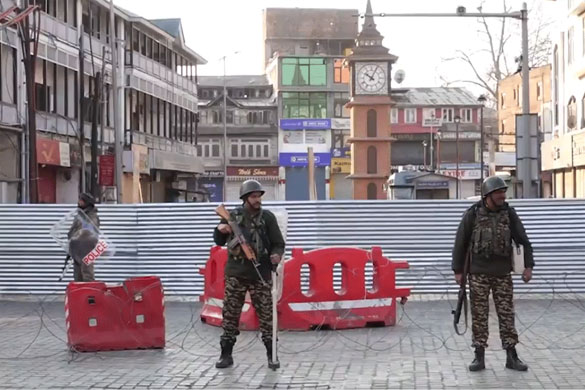
Videograb
---------
· Kashmir under curbs, internet throttled after protests over killing of Iran’s supreme leader Ali Khamenei
· Iran’s security chief Larijani says ‘will not negotiate’ with US
How Saudi Arabia’s night-time economy takes over during holy month
· Putin Expresses Condolences to Iran's President Over Khamenei 'Cynical Assassination'
· Unauthorized war or justified action? US Congress split on Iran strikes
· Outrage As Nigerian Shiites Protest Killing Of Iran’s Supreme Leader
· Pahang Sultan calls for special prayers state-wide for safety of Middle East nations
· Jamaat activist killed in clash with BNP men in Chuadanga
------
India
· ‘War is unwelcome, but change was long overdue’: Pune’s Iranian community reacts to US-Israeli strikes on Iran
· Protests across India against killing of Iranian Supreme Leader Ali Khamenei in US-Israel attack
· PM Modi should play important role in stopping war in Iran, says Owaisi
· First signal from Delhi: PM Modi tells MBZ ‘strongly condemn’ attack on UAE
· Peaceful protests in Kashmir, Shias and Sunnis organise largest demonstration in Valley
· LoC drone intrusions force closure of Kashmir schools till March 3
------
Mideast
· Trump tells Iranian forces to surrender or face ‘certain death’
· Iraqi militia claims drone attack targeting US troops in Baghdad
· Israeli general says to intensify strikes on Lebanon
· Israel says carrying out ‘large-scale strikes’ on Tehran
· Turkish central bank takes measures to limit market impact of regional conflict
· Israeli military launches strikes against Lebanon after Hezbollah rocket attack
· Gaza’s ceasefire had some momentum. Now, some fear a new war will distract the world
· UAE closes embassy in Tehran, withdraws diplomatic staff from Iran
------
Arab World
· KSrelief distributes cartons of dates in Jundiai, Brazil
· Traditional market lights up as part of Al-Ahsa festival
· Riyadh emerges as Gulf evacuation hub for wealthy amid regional escalation
· Islamic University of Madinah launches competition to promote sustainability
· A month of festivities from Diriyah to Jazan
· Governor of Saudi Arabia’s Eastern Province opens World Civil Defense Day 2026 exhibition
· Saudi Red Crescent Authority in Al-Baha raises readiness to address weather issues
------
Europe
· ‘Political assassination’: Moscow slams US-Israeli strike on Iranian leader
· UK will allow US to use bases to strike Iranian missile sites, PM says
· UK mounts operation to support thousands of Britons in Middle East
· RAF base in Cyprus targeted in suspected drone strike, MoD says
· Winston Churchill statue vandalised in London: Man arrested for writing ‘Free Palestine’
· Russia has enough oil to last 60 years – deputy PM
------
North America
· Trump says Iran wants to talk but who will lead after Khamenei?
· Did Trump need Congress' approval to attack Iran? Here's what to know
· Suspect in Texas shooting wore 'Property of Allah' clothing and Iranian flag emblem, AP source says
· CAIR-Texas and Austin Muslim Community Extend Prayers, Condolences to Families Impacted by Deadly Shooting
· San Jose Islamic centre a hub for free medical and dental care
· ‘We’re devastated’: Canada-born permanent US resident held in ICE custody; family demands safe return
------
Africa
· Court Grants Malami, Son ₦200 Million Bail Over Alleged Terrorism Charges
· Kano police suspend Ramadan performance over security concerns
· Kebbi gov probes Islamic school fire incident
· PDP Governor, Bala Mohammed Speaks On Defection After Closed-Door Meeting With Tinubu
· US Providing Military Support To Nigeria At No Cost — DHQ
· DSS Arrests Alleged Mastermind Of Kogi Church Kidnap
· Kenyan lawmaker among 6 dead in helicopter crash
------
Southeast Asia
· Anwar condemns US and Israel strikes on Iran in Dewan Rakyat, calls for ceasefire
· Anwar says govt working to bring home Malaysians stranded in Middle East after Iran strikes
· Govt to keep religious reality shows on air, tighten compliance rules, says deputy minister
· Sabah approves 2-acre land for Chinese-Muslim cultural complex with public mosque near Luyang to boost interfaith harmony and tourism
· Cheng Hoo Mosque Distributes Rp 500,000 Zakat to 32,000 Recipients
· Penang deputy chief minister quizzed by MACC over alleged misuse of zakat funds
· MCMC moves to curb recirculation of old Quran‑insult video linked to Singaporean national
------
South Asia
· PM Tarique Rahman prioritises migrant safety, energy security
· DNCC forms cell to step up mosquito-control
· Protecting Our Environment Is Protecting Our Future
· Cracking Down on Narcotics: Safeguarding Afghanistan’s Society and Youth
· The Reward for Giving Charity in Ramadan
· Continuation of Afghan-Pak Tensions Destabilizes Region
· Region at Crossroads: Dialogue or Destruction
Compiled by New Age Islam News Bureau
------
Kashmir under curbs, internet throttled after protests over killing of Iran’s supreme leader Ali Khamenei
02.03.26
Videograb
-------
Authorities imposed sweeping restrictions and throttled mobile internet services across Kashmir on Monday following massive protests over the killing of Iran’s supreme leader Ayatollah Ali Khamenei in a joint US-Israel strike.
The iconic Ghanta Ghar at Lal Chowk in Srinagar was sealed, with barricades erected around the clock tower as security forces fanned out across the city. Officials said a large number of police and paramilitary CRPF personnel were deployed to prevent gatherings of protestors.
Khamenei was killed in an airstrike in Tehran on Saturday during a joint Israel-US attack on Iran. Iranian state media confirmed the same on Sunday, triggering a wave of protests and mourning across the world, including India.
Kashmir — which has about 15 lakh Shias — witnessed major protests at Lal Chowk, Saida Kadal, Budgam, Bandipora, Anantnag and Pulwama, an official said. The protesters were seen beating their chests as they shouted anti-US and anti-Israel slogans.
Officials said the restrictions were imposed as a precautionary measure to maintain law and order. Concertina wires and barricades were placed at key intersections leading into the city, while similar curbs were enforced in Shia-dominated areas in other districts of the valley.
Mobile internet services were also curtailed, with high-speed data throttled across all networks in the Kashmir valley. Officials said the step was taken as a precautionary measure to maintain law and order in the area.
The clampdown came in the backdrop of a one-day strike call given by Mutahida Majlis-e-Ulama (MMU) chairman Mirwaiz Umar Farooq.
"We urge the people to observe it with unity, dignity, and complete peacefulness," the Mirwaiz said.
The strike call was supported by several political parties, including opposition PDP president Mehbooba Mufti.
"Extending our full support and solidarity with the shutdown call of Mirwaiz Umar Farooq on the martyrdom of Iran's Supreme Leader. This is a day of mourning to remind the world that injustice anywhere wounds the entire Muslim Ummah and all who stand for truth," Mufti said.
Authorities also ordered the closure of all educational institutions, including private schools, for two days as a precautionary measure for the safety of students and to maintain law and order.
Meanwhile, the police issued an advisory urging media organisations and news platforms to exercise responsibility in their coverage.
"Please refrain from publishing unverified information, speculation, or rumours; ensure that all reports are confirmed through credible and authoritative sources before dissemination; and avoid sensational headlines that may create unnecessary panic," the advisory read.
The police said responsible and accurate reporting is essential to maintain public trust and prevent misinformation.
Source: telegraphindia.com
Please click the following URL to read the text of the original Story
https://www.telegraphindia.com/india/kashmir-under-curbs-internet-throttled-after-protests-over-killing-of-irans-supreme-leader-ali-khamenei/cid/2149523
------
Iran’s security chief Larijani says ‘will not negotiate’ with US
March 02, 2026
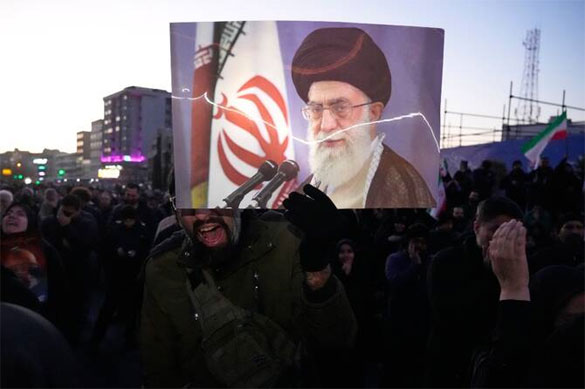
Government supporters mourn in a gathering after state TV officially announced the death of Iranian Supreme Leader Ayatollah Ali Khamenei in Tehran, Iran. (AP)
---------------
TEHRAN: Iran “will not negotiate with the United States,” Ali Larijani, the powerful head of Tehran’s Supreme National Security Council said on Monday.
In a post on X, Larijani denied media reports that Iranian officials had sought to initiate talks with the Trump administration following a wave of US-Israeli strikes on Iran over the weekend, which came after Tehran and Washington held nuclear negotiations.
Larijani also said the US leader Donald Trump's "delusional fantasies" have plunged the Middle East into chaos.
"Trump plunged the region into chaos with his 'delusional fantasies' and now fears more American troop casualties," he wrote on X, following a wave of US-Israeli strikes on Iran.
Source: arabnews.com
Please click the following URL to read the text of the original Story
https://www.arabnews.com/node/2634963/middle-east
------
How Saudi Arabia’s night-time economy takes over during holy month
WAAD HUSSAIN
March 01, 2026
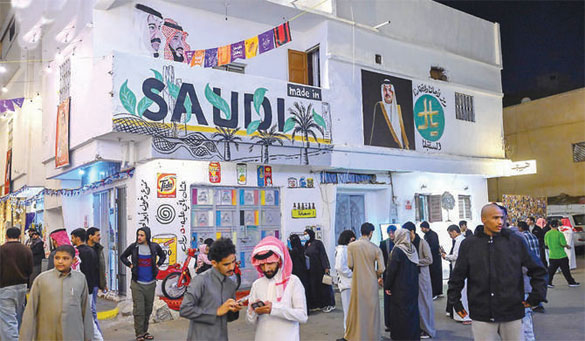
In Ramadan, commerce follows culture. (SPA)
-----------
ALKHOBAR: The economy does not slow down in Saudi Arabia during Ramadan; it shifts almost entirely to the night.
Between Taraweeh prayers and sahoor, commercial activity surges across major cities. Retail peaks at night; restaurants operate until dawn. Food delivery, dessert trucks and cafes report their highest footfall after midnight. For nearly 30 days the Kingdom runs on a reversed clock.
This is not anecdotal. A previous Arab News report on Ramadan consumer behavior showed a consistent rise in spending during the holy month, particularly across food, retail and hospitality sectors.
Another Arab News analysis of e-commerce trends described Ramadan as a “peak season” for digital platforms, with higher transaction volumes and increased late-night activity.
Across Riyadh, Jeddah and Dammam, streets that appear subdued before maghrib fill rapidly after evening prayers. Shopping malls extend hours; waterfront areas remain active well past midnight; Ramadan markets combine commerce and community.
The sectors that benefit most are food and beverage operators, seasonal vendors and small entrepreneurs.
“After Taraweeh is when our real day begins,” said Fahad Al-Qahtani, who owns a specialty coffee shop in Alkhobar. “From 10 p.m. to 2 a.m. we see more traffic than during an entire weekday outside Ramadan. Customers stay longer and treat it as social time.”
The shift is rooted in energy patterns. Fasting slows movement during the afternoon. After iftar, energy returns — and with it, consumption.
“I don’t plan shopping during the day in Ramadan,” said Noura Al-Salem, a social media manager. “After iftar and prayers, I feel productive. That’s when I shop for Eid, meet friends or run errands.”
Retailers structure operations around this behavioral reset. Night shifts expand; promotions are timed after prayer hours. Seasonal inventory — lanterns, sweets, decor and gift sets — dominates window displays.
Ramadan is also the peak discount season across sectors. Banks introduce financing campaigns; clothing retailers launch seasonal collections alongside limited-time discounts; supermarkets compete aggressively on staple pricing, often releasing weekly Ramadan bundles.
For many retailers, Ramadan is not a spiritual slowdown: It is the most important commercial month of the year. Nowhere is the shift clearer than among small businesses and seasonal vendors. In the Kingdom’s cities, food trucks stationed near mosques and corniche areas report peak demand close to midnight.
“Families and friends come after prayers and stay,” said Rashed Al-Harbi, who operates a food truck along the waterfront. “Midnight feels like peak hour.”
Hessah Al-Dossari, who runs a home-style street food truck, said demand increasingly reflects demographic shifts. “Many people live alone,” she said. “During Ramadan they look for food that reminds them of home. That’s why we sell out faster.”
Digital behavior reinforces the pattern. A previous Arab News report on Ramadan spending highlighted steady growth in digital payments and mobile transactions during the holy month. Food delivery apps and online retail platforms see stronger late-night activity as daily routines reorganize around fasting.
In many countries night-time economies are driven by entertainment districts or tourism. In Saudi Arabia during Ramadan, they are driven by ritual. Prayer schedules define movement; family gatherings define spending. Cultural rhythm dictates commercial timing.
The question is whether this seasonal transformation signals something broader. As Saudi cities expand mixed-use districts and extended-hour retail under Vision 2030, Ramadan offers a live demonstration of how flexible urban economies can operate beyond traditional 9-to-5 models. Businesses that adapt quickly can benefit; those that do not can struggle.
Ramadan after dark is not simply atmosphere: It is a concentrated case study in behavioral economics. Energy shifts. Time shifts. Spending shifts.
The Kingdom is demonstrating how deeply commerce follows culture.
Source: arabnews.com
Please click the following URL to read the text of the original Story
https://www.arabnews.com/node/2634925/saudi-arabia
------
Putin Expresses Condolences to Iran's President Over Khamenei 'Cynical Assassination'
March 01, 2026
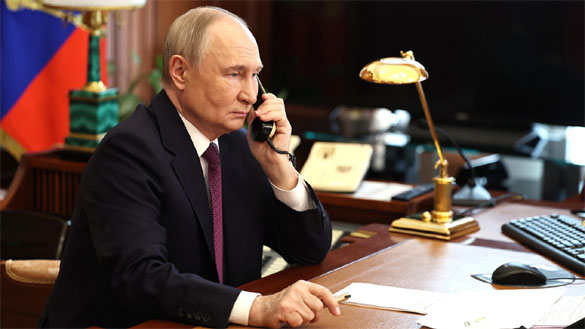
Russian President Vladimir Putin on Sunday expressed condolences over what he called the “assassination” of Iran’s supreme leader Ayatollah Ali Khamenei in U.S.-Israeli strikes on Iran.
“Please accept my deepest condolences in connection with the assassination of the supreme leader of the Islamic Republic of Iran ... committed in cynical violation of all norms of human morality and international law,” Putin said in a message to Iranian President Masoud Pezeshkian published by the Kremlin.
“In our country, Ayatollah Khamenei will be remembered as an outstanding statesman who made a tremendous personal contribution to the development of friendly Russian-Iranian relations,” he added.
Iranian state television confirmed the death of its supreme leader Ayatollah Ali Khamenei and launched a fresh wave of attacks on Sunday as Israel hit back at the capital Tehran.
Russia's Foreign Ministry on Sunday said Khamenei's death as well as other top Iranian officials was “met with outrage and deep regret in Moscow.”
Russia “resolutely and consistently condemns the practice of political assassinations and the 'hunting' of leaders of sovereign states,” the ministry added.
It called for “an immediate de-escalation, a cessation of hostilities, and a return to the political and diplomatic process.”
Senior Russian diplomats have warned that the U.S.-Israeli strikes on Iran would bring the region to the brink of a nuclear mishap and escalate tensions beyond the region.
Russia’s Permanent Representative to the UN Vasily Nebenzya decried the strikes as a “genuine betrayal of diplomacy” and dismissed Western arguments that Iran was seeking to acquire nuclear weapons as “completely unfounded.”
“Despite its willingness to engage in the diplomatic process, Tehran is once again being stabbed in the back,” Nebenzya said at an emergency UN Security Council session Saturday.
Referring to Iran’s retaliatory strikes on U.S. military assets in Iraq and the Gulf states, Nebenzya said the U.S.-Israeli attacks “spurred the escalation in the region and is liable to spill over far beyond the region.”
Russia’s Foreign Ministry on Saturday condemned the U.S.-Israeli strikes on Iran as a “deliberate, premeditated and unprovoked act of armed aggression... under the cover of the renewed negotiation process.”
The ministry also warned the attacks brought the region to the “brink of a humanitarian, economic and potentially even radiological disaster.”
“[The U.S. and Israel] cannot but recognize that they are effectively prompting countries cross the globe, and the Middle East in particular, to pursue ever more grave means of countering emerging threats by plunging the Middle East into the abyss of uncontrolled escalation,” it said.
The statements reiterated key issues raised by Foreign Minister Sergei Lavrov during a call with Iranian Foreign Minister Abbas Aragchi on Saturday.
Lavrov and the ministry suggested that Moscow was misled by Israel’s “assurances conveyed to Russia indicating that Israel had no interest in entering into military confrontation with Iran.”
Russia's air transport authority Rosaviatsia said all commercial flights to Israel and Iran were cancelled “until further notice.”
Tehran has stood by as one of Moscow's closest allies throughout Russia's Ukraine offensive, and the Kremlin had earlier called for restraint in the run-up to the U.S.-Israeli strikes on Iran. In 2025, Russia and Iran signed a strategic partnership treaty aimed at strengthening ties — including in military matters.
Source: themoscowtimes.com
Please click the following URL to read the text of the original Story
https://www.themoscowtimes.com/2026/03/01/putin-expresses-condolences-to-irans-president-over-khamenei-cynical-assassination-a92081
------
Unauthorized war or justified action? US Congress split on Iran strikes
1 Mar, 2026
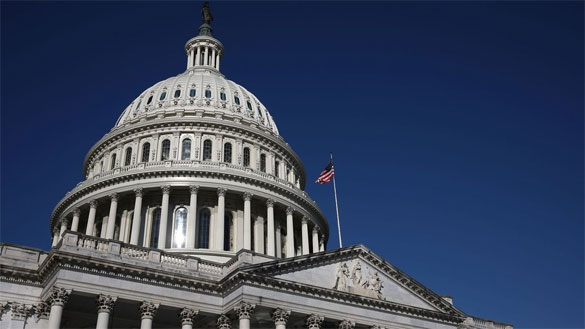
FILE PHOTO. © Getty Images / Win McNamee
-------------
US President Donald Trump’s unilateral decision to launch strikes against Iran has met a mixed response in Congress, as lawmakers are split over the issue, mostly along party lines. Democrats are now seeking to stop the campaign under the 1973 War Powers Act.
The US and Israel launched the attack on Saturday, with Trump openly stating that the operation was aimed at bringing about regime change in Iran to eliminate “imminent threats” to the American people. The attacks have killed over 200 people, according to the Iranian Red Crescent Society. Tehran responded by launching retaliatory strikes against targets in Israel as well as US bases across the Middle East.
Iran called the attack a blatant violation of its sovereignty. Russia and China condemned it as an “unprovoked act of aggression.” The UK, France, and Germany criticized Iran’s retaliatory strikes on neighboring countries, stopping just short of endorsing the US and Israeli actions.
‘Decisive action’
High-ranking Republicans in Congress have lined up behind Trump, commending his decision as a necessary step. Senate Majority Leader John Thune accused Iran of refusing to engage in diplomacy and stated that the president was thwarting “threats” allegedly coming from Tehran.
Chairman of the Senate Armed Services Committee Roger Wicker hailed what he called a “decisive action” and one of the “hardest decisions” taken by Trump, referring to the strikes as “a pivotal and necessary operation to protect Americans and American interests.”
House Speaker Mike Johnson said the Trump administration had briefed the ‘Gang of Eight’ – a group of eight congressional leaders who are legally required to be informed about classified intelligence issues – on the strikes earlier this week, while talks with Tehran were still ongoing. He nevertheless claimed that Washington “made every effort” to pursue a peaceful solution, stating that Tehran was facing “severe consequences for its evil actions.”
‘Another endless and costly war’
Democratic leaders in the House and the Senate criticized Trump for not being transparent enough about the operation’s goals and strategy, arguing that it could turn into a new endless war. They also called for invoking the 1973 legislation limiting the use of the armed forces without congressional approval.
“The American people do not want another endless and costly war in the Middle East,” Senate Minority Leader Chuck Schumer said in a statement, arguing that the Trump administration “has not provided Congress and the American people with critical details about the scope and immediacy of the threat.”
House Minority Leader Hakeem Jeffries maintained that, even though Iran “must be aggressively confronted,” the White House “must seek authorization” from Congress for the operation, which “constitutes an act of war.”
Senator Jack Reed, a ranking member of the Armed Services Committee, accused Trump of thrusting the US “into a major war with Iran,” with “no endgame” and “against the clear wishes of the American people.” He also vowed “rigorous oversight” of the operation.
This is not ‘America First’
Democrats are now seeking a vote on a resolution aimed at removing US military forces “from unauthorized hostilities in the Islamic Republic of Iran.” It was originally introduced by Representative Thomas Massie – one of the few dissenters in the Republican camp – last summer, when Washington joined West Jerusalem in another bombing campaign against the Islamic Republic.
The resolution is based on the 1973 War Powers Act, which limits any military action lacking congressional authorization to 60 days. It also introduced a mechanism for Congress to force presidents to immediately terminate any unauthorized deployments. The lawmakers would still need two-thirds majorities in the House and the Senate to override a presidential veto.
Democratic Representative Ro Khanna urged the House to convene on Monday to vote on the resolution. Jeffries said in his statement that House Democrats were “committed to compelling a vote” on the issue. Massie took to X on Saturday to express his opposition to the strikes and vowed to work with Khanna to “force” a vote on the resolution. “This is not ‘America First’,” he wrote.
Article 1 of the US Constitution gives Congress, not the president, the power to declare war. Trump defended his decision by claiming that the goal of the operation was to protect the American people by eliminating “imminent threats from the Iranian regime.”
Tehran has consistently denied seeking nuclear weapons, insisting its program is for peaceful purposes, even as it boosted its uranium enrichment to 60% purity after Trump unilaterally abandoned the 2015 nuclear deal. The UN nuclear watchdog, the International Atomic Energy Agency, as well as US intelligence chief Tulsi Gabbard, also stated last year that there was no evidence Tehran was working on a nuclear weapon.
Source: rt.com
Please click the following URL to read the text of the original Story
https://www.rt.com/news/633270-us-congress-split-strikes-iran/
------
Outrage As Nigerian Shiites Protest Killing Of Iran’s Supreme Leader
March 1, 2026
Members of the Islamic Movement in Nigeria (IMN), led by Ibrahim El-Zakzaky and popularly known as Shiites, on Sunday staged a protest in parts of Niger State over reports of the assassination of Iran’s Supreme Leader, Ayatollah Ali Khamenei.
The alleged killing, said to have occurred during coordinated United States–Israel strikes on Iran, has not been independently verified by international authorities as of the time of filing this report.
According to Sahara Reporters, dozens of IMN members mobilised shortly after news of Khamenei’s reported death began circulating on social media.
The protesters marched through parts of the state, chanting solidarity slogans while waving Iranian flags and placards bearing inscriptions such as “We Stand With Iran” and “Free Iran,” alongside other anti-US and anti-Israel messages.
The group described the reported assassination as an act of “global injustice and imperial aggression.”
In a statement circulated among supporters, the movement expressed deep sorrow over what it termed the martyrdom of the Iranian leader and pledged continued solidarity with the Iranian people.
“We strongly condemn the United States–Israel aggression against Iran. The blood of martyrs will not be shed in vain,” part of the statement read.
Chants of “Death to America” and “Death to Israel” echoed during the procession as demonstrators vowed resistance against what they described as Western interference in Middle Eastern affairs.
The protest underscores the longstanding ideological alignment between IMN members and the Iranian government, a relationship that has often drawn scrutiny from Nigerian authorities.
The Islamic Movement in Nigeria has, over the years, organised rallies in solidarity with Iranian causes and frequently criticised US and Israeli foreign policies.
Source: naijanews.com
Please click the following URL to read the text of the original Story
https://www.naijanews.com/2026/03/01/outrage-as-nigerian-shiites-protest-killing-of-irans-supreme-leader/
-----
Pahang Sultan calls for special prayers state-wide for safety of Middle East nations
01 Mar 2026
KUANTAN, March 1 — The Sultan of Pahang, Al-Sultan Abdullah Ri’ayatuddin Al-Mustafa Billah Shah, wants all mosques and suraus in the state to hold “solat hajat” (special prayers) for the safety of Islamic countries, particularly those in the Middle East.
Pahang Mufti Prof Datuk Dr Asmadi Mohamed Naim said the Sultan also ordered the prayers to be held to seek Allah SWT’s protection for Malaysians currently in the affected regions from any form of disaster, calamity or threat.
“The special prayers are to be performed today, March 1, 2026, after the Isyak prayer and before the Tarawih prayer,” he said in a statement.
Yesterday, the media reported that Malaysia strongly condemned the attack on Iran and the subsequent counterattacks involving several Middle East countries, namely Saudi Arabia, Bahrain, the United Arab Emirates (UAE), Kuwait and Qatar, on February 28.
In a statement issued on Saturday, the Foreign Ministry said the attacks violated the principles of sovereignty and territorial integrity, as well as the prohibition against the use of force under the United Nations Charter and international law. — Bernama
Source: malaymail.com
Please click the following URL to read the text of the original Story
https://www.malaymail.com/news/malaysia/2026/03/01/pahang-sultan-calls-for-special-prayers-statewide-for-safety-of-middle-east-nations/210889
------
Jamaat activist killed in clash with BNP men in Chuadanga
02 Mar 2026
A Jamaat-e-Islami activist was killed, reportedly in a clash with BNP leaders and activists, at Hasadah Bazar in Jibannagar upazila of Chuadanga on Saturday evening.
The deceased was identified as Hafizur Rahman, younger brother of Mofizur Rahman, ameer of Banka union unit of Jamaat, said Jibannagar Police Station Officer-in-Charge Solaiman Sheikh.
“The confrontation unfolded in phases outside the gate of a Kamil madrasa from 7:30pm to 9:00pm... At least six people from both sides sustained injuries during the incident,” he added.
“One of the people critically injured in the clashes later died while being taken to Dhaka. Following a post-mortem at Chuadanga 250-bed General Hospital, the body was handed over to the family,” Chuadanga Superintendent of Police Mohammad Monirul Islam told The Daily Star.
Jibannagar Upazila Nirbahi Officer Md Ashraful Alam Rasel said tension remained high in the area.
“Police, army, and other law enforcement personnel visited the scene at night. An application has been submitted to the deputy commissioner requesting additional forces,” he added.
According to police and locals, the clash erupted from an earlier attack on Mehdi Hasan, convener of Hasadah union Swechchhasebak Dal, at Sutia village on February 13. Police rescued Hasan and admitted him to the upazila health complex.
On Saturday evening, Mofizur and Hafizur were travelling with a few activists to the party office at Hasadah Bazar on motorcycles when they were obstructed in front of the Kamil madrasa by Mehdi, who allegedly assaulted them. In the ensuing retaliation, at least six people were injured, they added.
Jibannagar upazila BNP President Anwar Hossain Khan held Jamaat responsible for the incident, claiming that the party had been repeatedly attacking BNP leaders and activists since the election.
He alleged that Jamaat men had brutally assaulted the Swechchhasebak Dal leader before handing him over to police in an injured condition, which led to the clash.
Upazila Jamaat Ameer Maulana Sazedur Rahman countered that Jamaat leaders and activists were innocent and had been attacked with locally made weapons.
Chuadanga-2 lawmaker and Ameer of district Jamaat, Md Ruhul Amin, told The Daily Star that it was not a clash but an attack.
He said a young man from Sutia village had gone to Hasadah Bazar on Saturday to buy iftar items. There, BNP activists assaulted him. Later, our men went to the spot and asked the person who had beaten him to come forward for a mutual settlement. They were standing beside the market at the time. Then 20 to 25 men arrived on motorcycles and launched a sudden attack. He said one activist was killed and three others were in critical condition. They have been admitted to Chuadanga Sadar Hospital. “A total of five of our men were injured in the attack. We demand a fair investigation and justice over the incident.”
Source: thedailystar.net
Please click the following URL to read the text of the original Story
https://www.thedailystar.net/news/bangladesh/crime-justice/news/jamaat-activist-killed-clash-bnp-men-chuadanga-4118421
-----
India
‘War is unwelcome, but change was long overdue’: Pune’s Iranian community reacts to US-Israeli strikes on Iran
Shubham Kurale
Mar 2, 2026
The news of US-Israeli strikes on Iran sent waves of shock and reflection through Pune’s Iranian community. Members of the community gathered at the Haji Mohammed Jawad Isphani Imambara in Pune Camp to mourn Supreme Leader Ayatollah Ali Khamenei on Sunday evening. Yet beyond the mourning, conversations indicated a community divided in its emotions, condemning the violence while acknowledging that many Iranians had long yearned for change.
Mourning at the Imambara
Aliasgar Ramzan Dekhani, managing trustee at the Imambara, along with several others, paid tribute to the late Supreme Leader. “He dedicated his life to Qur’anic learning, faced imprisonment, torture, and exile for standing with Imam Khomeini, and in 1989 was entrusted with the responsibility of Supreme Leadership,” Dekhani said.
“For more than three decades, he guided the nation through wars, sanctions, and global pressure, consistently highlighting spirituality, justice, and governance. He has left behind a legacy of courage, scholarship, and unwavering faith,” he added.
‘Don’t want Iran to become another Iraq or Libya’
Not everyone in the community shared the same sense of loss. Mariam, a third-generation Indo-Iranian living in Pune, was candid about her mixed emotions. “I woke up in disbelief at the news surrounding the death of the Ayatollah. I cannot ignore what millions of Iranians have endured for decades. No government that harms its own civilians can expect unquestioned legitimacy,” she said.
She acknowledged the difficult road ahead: “There is a war going on, and recovery will not be easy. But when religion and politics are combined in governance, it ends up isolating people, because not everyone believes in the same ideology. The Zoroastrians and others have been sidelined.”
Mariam said the change could not have come without pressure from outside, including the Iranian diaspora, and the youth who had taken to the streets at great personal cost. “Many young people lost their lives demanding their rights. Iran has a highly educated population, yet there are no jobs and no opportunities. The regime itself is responsible for the youth turning against it. If they had been good to the secular Iranians, everyone would have lived in peace.”
She added, “We do not want the US and Israel in Iran for the long term. We do not want a repeat of the 1953 coup; Iranians deserve better. I would not say what they did was right, but change was difficult without them. What I want is a democratic government that is representative of the people, that grows the economy, creates jobs, listens to people’s demands, and works in a secular manner.”
‘Civilians carry the greatest burden’
Hasti Rajabi, an Iranian artist based in Pune, spoke with measured concern. “The escalating tensions between Iran and the United States have created a fragile and unpredictable environment. In situations like this, it is always civilians, young people, and the vulnerable who carry the greatest burden.”
Rajabi stated that many Iranians were already under severe economic and social pressure. “Rising instability only increases uncertainty for ordinary citizens who are simply seeking security and opportunity. There is also a strong and growing aspiration among many Iranians, particularly the younger generation, for greater transparency, accountability, freedom of expression, and meaningful civic participation.”
She added that Iran’s geopolitical significance meant the consequences would extend far beyond its borders. “Developments there inevitably affect regional security and international energy markets. I hope all stakeholders prioritise de-escalation, dialogue, and peaceful solutions.”
‘We want dignity and normalcy’
Dr Maral Yazarloo, a fashion designer from Iran based in Pune, spoke with both grief and hope. “As a human being, I am deeply saddened by the loss of life. Escalation never affects just one country, it impacts the region and eventually the entire world.”
She reflected on the internal struggles that had pushed Iran to this point. “Many Iranians, especially young people, have lost their lives while simply seeking freedom and basic rights. Seeing parents mourn their young children who were killed during protests has broken the hearts of Iranians everywhere.”
Yazarloo recalled a different Iran. “Fifty years ago, Iran was one of the most talked-about countries in the Middle East: culturally rich, socially vibrant, and connected internationally. We want that back. We want dignity, normalcy, and the ability to live freely without fear.”
She was firm, however, that change must come from within. “Real change must ultimately come from the Iranian people themselves. Freedom cannot feel imposed from outside, it has to be owned from within. Iranians are educated, intelligent, and capable. A new chapter, if it comes, should restore our pride and allow the world to see who we truly are.”
Source: indianexpress.com
Please click the following URL to read the text of the original Story
https://indianexpress.com/article/cities/pune/war-is-unwelcome-but-change-was-long-overdue-punes-iranian-community-reacts-to-us-israeli-strikes-on-iran-10560674/
------
Protests across India against killing of Iranian Supreme Leader Ali Khamenei in US-Israel attack
Mar 2, 2026
Protests erupted in several Indian states against the killing of Iranian Supreme Leader Ayatollah Ali Khamenei on Sunday in a joint military operation conducted by the United States and Israel.
Amid the demonstrations, authorities in Jammu and Kashmir curtailed mobile internet speed, reported PTI.
Khamenei, 86, had served as Iran’s supreme leader since 1989. He controlled all branches of the government and the armed forces.
He was considered to be a significant figure among Muslims from the Shia community.
His death came as Israel and the US on Saturday launched a joint operation in Iran to degrade the capabilities of the Iranian government. Iran retaliated to the attacks and said that the US-Israeli operation had begun while the nuclear negotiations were on.
After Khamenei’s death on Sunday, Tehran vowed revenge and fired missiles at Israel and other countries across the Gulf in a counteroffensive.
In India, protests were seen in Jammu and Kashmir, Maharashtra, Uttar Pradesh, Delhi, Rajasthan and Karnataka against the supreme leader’s killing.
Jammu and Kashmir
In Jammu and Kashmir, the police sealed Lal Chowk in Srinagar and restricted civilian movement on Monday after protests were held a day earlier in the Union Territory against Khamenei’s killing, The Indian Express reported.
Lal Chowk had been occupied by protesters the entire day on Sunday.
The newspaper quoted unidentified officials as saying that the action was taken after a meeting of security officials on Sunday evening to discuss the protests in Srinagar and other parts of the Valley.
The officials added that there were concerns that the protests could potentially lead to law and order issues in the Union Territory.
As part of the restrictions, inter-district movement will not be allowed on Monday, The Indian Express reported. Checkpoints will also be set up at entry and exit points to prevent persons from assembling.
While the assembly of multiple persons would not be allowed, residents would be allowed to mourn the death of Khamenei in Imam Baras, the newspaper quoted.
Imam Baras are specialised religious assembly halls used primarily by Muslims from the Shia community to conduct mourning rituals.
Additionally, the authorities throttled high-speed mobile internet, reported PTI. Network speeds have been curtailed across all mobile networks in the Kashmir valley.
Srinagar MP Aga Ruhullah Mehdi on Sunday described the closing of Lal Chowk as a “disgrace” and “a shameful act”.
“It [Lal Chowk] is available for dance and music parties, which is the symbolic identity you want to attach to it,” the National Conference leader said. “But when people came out to mourn, to stand in solidarity with the innocent lives being torn apart, it threatens you despite the fact that the demonstrations were entirely peaceful.”
He added: “Do not insult us by treating our grief as a law and order problem. Do not interfere in what are deeply emotional moments for the people of Kashmir”.
Ruhullah also asked the administration not to “side with tyrants”.
Rajasthan
In Rajasthan’s Ajmer, the Shia community on Sunday announced a three-day mourning for Khamenei, PTI reported.
The announcement was made by Syed Asif Ali, a leader from the community, who urged members to refrain from celebrations during the period.
Condolence meetings were also organised at religious places, according to the news agency.
Karnataka
In Alipur village of Karnataka’s Chickballapur district, members of the Shia community called for a protest march and announced three days of mourning, The Hindu reported.
Residents told the newspaper that Khamenei visited the village and inaugurated a community hospital in 1981 as a 41-year-old cleric in the early years of the Islamic Republic.
“Khamenei inaugurated Imam Khomeini Hospital in Alipur, which is still run by the Anjuman-e-Jafaria Committee in the village,” the newspaper quoted Shafeeq Abidi, an Urdu poet and former journalist from Alipur, as saying. “Today we are all in grief and mourning following the death of Khamenei.”
In Bengaluru, hundreds of Shia Muslims gathered in Richmond Town on Sunday for a condolence meet and a solidarity march, The Times of India reported.
Delhi
Hundreds gathered at Delhi’s Jantar Mantar to mourn the killing of Khamenei, The Indian Express reported. The gathering was organised by the All India Shia Council.
The crowds shouted “America Murdabad” and “Netanyahu Murdabad” during the gathering.
Mohseen Taqvi, the imam of the Jama Masjid, said that US President Donald Trump was not just against Iran, but against humanity.
“No one wanted this. Not even Americans,” the newspaper quoted him as saying. “It’s just Trump. Look what he is doing to our own country. We are being told what to buy, where to buy.”
Maharashtra
In Mumbai too, Shia Muslims took to the streets to protest against the killing of the supreme leader, ANI reported.
Uttar Pradesh
Protests were held in Uttar Pradesh’s capital Lucknow by members of the Shia community.
On Sunday, several gathered near the Bara Imam Bara mosque and shouted slogans during a protest, The New Indian Express reported.
Maulana Yasoob Abbas, general secretary of the All India Shia Personal Law Board, announced that effigies of Trump and Israeli Prime Minister Benjamin Netanyahu will be burnt during another protest on Monday.
The Shia community also declared a three-day mourning, according to the newspaper.
Jharkhand
In Jharkhand’s Ranchi, representatives of the Jharkhand Janadhikar Mahasabha, the Communist Party of India (Marxist-Leninist) Liberation, the Communist Party of India (Marxist) and the Communist Party of India held a protest condemning the US-Israeli attacks on Iran.
The groups described the attack as “criminal and violent”, saying that it was “in flagrant violation of Iran’s national sovereignty, the UN [United Nations] Charter and all international treaties”.
They said that the attack on Iran, which began immediately after Prime Minister Narendra Modi's visit to Israel, “demonstrated how wrong and damaging this visit was to Indian interests”.
The groups added: “On the one hand, the Modi government compromised 50,000 Indian workers. On the other, abandoning decades of its foreign policy, it is now following these fascists.”
A procession was also taken out by the Jharkhand unit of the All India Shia Personal Law Board, where the participants displayed photos of Khamenei, reported PTI.
Madhya Pradesh
In Madhya Pradesh’s Bhopal, a condolence meeting and protest were held by Shia Muslims in the Karond area to mourn and condemn Khamenei’s death, The New Indian Express reported.
Prominent religious leaders said that the supreme leader’s “martyrdom” in the holy month of Ramadan and his contributions to Islam would be remembered.
More than 100 members of the community also took out a protest march, shouting slogans against the US and Israel, after the meeting, the newspaper reported.
The attacks
The attacks in Iran came amid tensions over Tehran’s nuclear programme.
Washington acts as a guarantor of Israel’s security. Israel has been claiming that Iran is “closer than ever” to obtaining a nuclear weapon, which could alter the regional security balance.
Iran has long maintained that its nuclear programme is for civilian purposes.
However, amid fears of a potential attack, with a heavy US military deployment off its coast in recent months, Tehran had been forced to reopen negotiations with Washington about its nuclear programme.
On Sunday, Khamenei’s daughter, grandchild, daughter-in-law and son-in-law were also killed in the joint US-Israeli military operation,
Subsequently, senior Iranian cleric Alireza Arafi was appointed to serve as part of the country’s interim leadership. Arafi has been named the jurist member of the temporary leadership council responsible for carrying out the supreme leader’s duties during the transition period until a successor is selected under Iran’s constitutional process.
India on Saturday said that it was “deeply concerned” about the recent developments in Iran and the Gulf. The Ministry of External Affairs urged all sides to exercise restraint, avoid escalation and prioritise the safety of civilians. “Dialogue and diplomacy should be pursued to de-escalate tensions,” it stated.
Source: scroll.in
Please click the following URL to read the text of the original Story
https://scroll.in/latest/1091094/protests-across-india-against-killing-of-iranian-supreme-leader-ali-khamenei-in-us-israel-attack
-----
PM Modi should play important role in stopping war in Iran, says Owaisi
01 Mar 2026
HYDERABAD: Condemning the joint US-Israel military strikes on Iran, AIMIM president Asaduddin Owaisi on Sunday expressed hope that the central government would play a role in halting the war.
The Hyderabad MP termed the "assassination" of Iran's Supreme Leader Ayotallah Ali Khamenei as an "immoral and unlawful act."
Khamenei was killed in a major attack by Israel and the United States. He said the attacks on Iran must stop immediately to prevent regional instability, noting that 10 million Indians work in the region.
Addressing reporters here, Owaisi said, "We hope that the Government of India and Prime Minister Narendra Modi will play a role in stopping this war. The war should end.
He has a huge responsibility to take it forward because if this spreads, there will be huge turmoil, uncertainty, and instability."
The AIMIM leader said US President Donald Trump and Benjamin Netanyahu have jointly attacked Iran in the holy month of Ramzan.
"We condemn the attack on Iran".
Warning that targeting a revered figure like Khamenei would not go unanswered, the AIMIM chief said, "He (Khamenei ) is a respected leader of the Shia community and if you target him, the Iranians will not remain silent."
Referring to the Iran-US talks in Geneva, he said the attack occurred despite the "breakthrough" in talks.
"So, when there is a breakthrough in talks, the US and Israel attacked Iran and killed an 86-year-old man (Khamenei)."
He described it as a "cowardly attack, inhuman and immoral attack on the people of Iran.
"School children have died. Where is the so-called Western humanity?" he asked.
Owaisi warned that a spike in oil prices, even by USD 1, will have a huge impact on the Indian economy.
He pointed out that hundreds of Indians, including those who travelled to perform Umrah, are stuck in Makkah and Madina because of the cancellation of flights.
There are hundreds of people stranded at the Dubai airport and various other airports, be it Saudi Arabia or Oman.
Citing the 2003 US invasion of Iraq based on "so-called weapons of mass destruction" and the civil wars in Libya and Syria, he said, "the world is seeing what is going on in Sudan now."
Noting that Iran is a huge country, he said these measures would fail to bring about a regime change in that country.
"The people of Iran have been living under sanctions for the last 35 years. I don't think that will happen," he said.
Owaisi said if there are attempts by Israeli Prime Minister Benjamin Netanyahu to change the regime in Iran, then it is not going to happen.
The AIMIM leader drew a parallel between Israel's attack on Iran and Pakistan's actions in Afghanistan and labelled both nations as forces of "aggression and mischief" in their respective neighbourhoods.
The United States and Israel launched a major attack on Iran on Saturday, with US President Donald Trump calling on the Iranian public to seize control of their destiny and rise up against the Islamic leadership that has ruled their country since 1979.
Source: newindianexpress.com
Please click the following URL to read the text of the original Story
https://www.newindianexpress.com/nation/2026/Mar/01/pm-modi-should-play-important-role-in-stopping-war-in-iran-says-owaisi-2
-----
First signal from Delhi: PM Modi tells MBZ ‘strongly condemn’ attack on UAE
Shubhajit Roy
Mar 2, 2026
PRIME MINISTER Narendra Modi chaired a meeting of the Cabinet Committee on Security Sunday night and in what could be taken as New Delhi’s first comments following the US-Israel massive air strikes on Iran, he said, India strongly condemned the attack on UAE and supported “de-escalation, regional peace, security and stability”.
The New York Times reported that at least four people were killed and more than 100 others were injured across the UAE, Kuwait, Qatar, Bahrain and Oman, in the missile and drone attacks by Iran in response to the American and Israeli assault.
While New Delhi did not release any statement after the CCS or the killing of Iran’s Supreme Leader Ayatollah Ali Khamenei, Modi condoled the deaths in the UAE during a conversation with President Sheikh Mohamed bin Zayed Al Nahyan on Sunday.
“Spoke with President of the UAE, my brother Sheikh Mohamed bin Zayed Al Nahyan. Strongly condemned the attacks on the UAE and condoled the loss of lives in these attacks. India stands in solidarity with the UAE in these difficult times. Thanked him for taking care of the Indian community living in the UAE. We support de-escalation, regional peace, security and stability,” Modi said on X.
Indian expats account for 35 per cent of UAE’s population, and form its largest ethnic community.
Beyond the nine million Indians living in the extended West Asian neighbourhood, what frames India’s diplomatic challenge at this juncture are its own beliefs on sovereignty and territorial integrity, a complicated relationship with Khamenei over the last few decades, sensitivities of the domestic minority community, and evolving partnership with the US.
The CCS meeting was attended by Home Minister Amit Shah, Defence Minister Rajnath Singh, Finance Minister Nirmala Sitharaman and External Affairs Minister S Jaishankar, besides NSA Ajit Doval, Secretaries in the PMO, P K Mishra and Shaktikanta Das, Cabinet Secretary T V Somanathan, CDS General Anil Chauhan and Foreign Secretary Vikram Misri. So far, there has been no official statement expressing condolences for the Iranian leader.
The Iranian embassy in Delhi on Sunday urged governments around the world to strongly condemn the US-Israel attack on Iran and the killing of its Supreme leader. It said the US and Israel will have to endure the “grave consequences of this unforgivable crime”.
India’s attempts to navigate the West Asian crisis
Over the last few days, and weeks, India is stretching its diplomatic muscle to navigate the current crisis — from a quiet trip to Iran by India’s Deputy NSA in January to Prime Minister Modi’s recent trip to Israel, and phone calls by to foreign ministers of countries in the Middle East — External Affairs Minister Jaishankar called up Oman’s Foreign Minister. Oman has been playing a key role in mediating between the US and Iran.
The last statement from New Delhi before Khamenei’s killing expressed deep concern at the “recent developments” in Iran and the region. This was seen as neutral and well-hedged. It did not mention the attacks by US and Israel, and the counter-attacks by Iran, and appeared diplomatically distant and neutral. But some in the Gulf have perceived this as a non-acknowledgement of the serious nature of the violations of international law.
So, the first big challenge will be to frame its response post the killing of the Iranian Supreme leader, his family members, and key officials including defence minister.
The earlier statement did call for “respect” for sovereignty and territorial integrity— a thinly veiled reference to violation of Iran’s sovereignty — and asked for “dialogue and diplomacy”.
This framing was seen as being supportive of Iran’s position, which — in its official statement —strongly condemned the attacks carried out by Israel and the US against the “sovereignty and territorial integrity” of Iran.
Khamenei and India — not an easy relationship
Secondly, India did not have an easy relationship with Iran under Khamenei. He was routinely critical of India’s treatment of minorities and his statements after the Babri masjid demolition in 1992 and Delhi riots in 2020 have not gone down well with New Delhi.
But, many diplomats recall how Tehran came to India’s rescue at the UN Human Rights Commission in March 1994, where a consensus on Kashmir – which was on the boil – was blocked by it. That was the early days of Khamenei’s leadership as the spiritual leader. While the then Prime Minister PV Narasimha Rao diplomatically dealt with him, Delhi was extremely obliged to him.
That be so, Khamenei never held back his punches on India’s treatment of minorities.
On December 7, 1992, a day after the Babri Masjid was demolished on December 6, then Indian ambassador to Iran Hamid Ansari — who later became India’s Vice President — was summoned by the Iranian government. The Foreign ministry issued a demarche, made a public statement, and conveyed the Supreme Leader Khamenei’s concerns to the Indian envoy “behind closed doors”.
Tehran radio said that Khamenei asked Iranian Foreign Minister Ali Akbar Velayati to convey to Delhi through diplomatic channels that Muslims in Iran and elsewhere in the world could not tolerate the destruction of the Babri mosque in Ayodhya by a Hindu mob. A radio dispatch quoted Khamenei as saying the destruction of the mosque was ‘not just a local issue’
In 2019, Khamenei raised the issue of Kashmir after the government revoked Kashmir’s special status under Article 370 in August.
Shia community, and domestic sensitivities
Delhi, however, understands that the Supreme leader is revered by the Shia community in the country, and has a huge following in Kashmir, Lucknow, Hyderabad — pockets of Shia population.
His killing, along with his family members including his daughter, son-in-law and grandson, makes him a “martyr”, and that is how it has been projected by the Iranian establishment. Diplomats, who have dealt with Iran, say martyrdom in the Shiaite faith is an honourable act, and the community and the nation tend to unite and mourn their elder — despite their own misgivings about his violent repressive track record.
So, it is mindful of the sensitivities about any Indian government response or non-response, and wants to assess the repercussions of the protests that have gathered momentum on Sunday.
This puts the Indian security and diplomatic establishment in tenterhooks. They are continuously assessing if there is any material threat to Iranian, American or Israeli diplomatic establishments in India. There have been attacks in Pakistan on the US consulate in Karachi.
India and Iran, going forward
India’s own engagement with Iran’s regime in the coming months is another aspect that New Delhi is very mindful of. The regime in Iran has held out on Sunday, and has signalled continuity as the Iranian state news agency IRNA said on Sunday morning that Iran’s president, the head of the judiciary and a jurist of the Guardian Council would be in charge during the transition period.
Delhi has maintained quiet channels of communication with the members of regime, and a quiet visit by Deputy National Security advisor Pavan Kapoor in January where he met Iran’s NSA Ali Larijani and other senior members of the regime is reflective of the diplomatic outreach from Delhi to Tehran.
Diplomats said that the Iranian regime has a continuity plan of upto 40 leaders in the hierarchical ladder, in case of decapitation of the top 39 leaders in the regime. That makes the regime quite deep and strong.
And, Delhi is preparing to deal with the new leadership, as its envoy in Tehran and his team has been meeting the key players over the past two years — despite the usual security and diplomatic challenges
But, the Iranian regime has vowed full-scale revenge against the American and Israeli attacks, and the South Block will watch out for how long that lasts.
Maintaining ties with other West Asian countries
India’s engagement with the strategic partners in the region, from PM’s visit to Israel to External Affairs minister S Jaishankar’s calls to the regional partners including Iran, Israel, Saudi Arabia, UAE, Qatar, Kuwait and Bahrain. This outreach is an effort to reach out to all the partners across the aisle, and warring against each other, so that Delhi’s deep strategic and economic stakes and diaspora interests are protected.
How far will Trump push against Iran
How far will US President Donald Trump go in pushing ahead with the kinetic actions and how resilient is the Iranian regime are issues that are still unravelling.
The US administration has mobilised the largest buildup of US military in two decades to the Middle East, since the war in Iraq in 2003, and is poised to be offensive against Iran and defend its own assets and personnel.
“This is an uncharted territory, and we don’t have the past frameworks to lean on. So we will try to be agile and nimble to deal with the situation, which is unfolding in real time,” a government source told The Indian Express.
Source: indianexpress.com
Please click the following URL to read the text of the original Story
https://indianexpress.com/article/india/first-signal-from-delhi-pm-modi-tells-mbz-strongly-condemn-attack-on-uae-10560114/
------
Peaceful protests in Kashmir, Shias and Sunnis organise largest demonstration in Valley
Muzaffar Raina
02.03.26
Kashmir on Sunday witnessed its largest protests in years following the assassination of Iran leader Ali Khamenei in a joint US-Israeli strike.
Thousands poured onto the streets and Srinagar’s long-subdued city centre sprang back to life as a hub of demonstrations after nearly a decade.
Police, who report to the lieutenant governor’s administration, escorted the protesters — mostly Shias but including many Sunnis — and placed no restrictions on their movement.
The protesters were allowed to march the streets, venting their anger by chanting anti-US and anti-Israel slogans, following an assessment that they were unlikely to turn violent.
Intense protests were seen at Srinagar’s Lal Chowk — once the epicentre of pro-independence demonstrations — the Shia-dominated towns of Budgam and Magam, and many other places. Swathes of Kashmir observed a shutdown. But the day passed peacefully.
Politicians from across the Sunni-Shia divide, whether pro-India or pro-azadi, expressed outrage at Khamenei’s killing.
Chief minister Omar Abdullah asked the police and the administration “to exercise utmost restraint and refrain from using force or restrictive measures” on the mourners.
The Mutahida Majlis-e-Ulama, a body of Kashmiri religious scholars from both the Shia and Sunni schools, led by Hurriyat chief Mirwaiz Umar Farooq, issued a rare call for a “peaceful voluntary strike” on Monday.
It termed the assassination a “blatant act of aggression by the US and Israel that has shaken the conscience of the Muslim world”.
Officials said the administration, wary of the protests snowballing after witnessing Sunday’s momentum, was weighing the option of imposing restrictions on Monday.
Khamenei, a central religious authority in the Shia world, was revered by Kashmir’s Shias — and many Sunnis, too — for his firm stand against the US and Israel.
Tens of thousands – men and women, young and old -- began surging onto the streets after reports of the assassination emerged early in the day.
Many wore black clothes and waved Khamenei’s pictures along with Palestinian, Hezbollah and Iranian flags. They chanted slogans all day, reciting elegies in rhythmic unison. Many beat their chests and wept.
Fiery speeches were delivered, with many condemning the Arab states for failing to stand up to the US and Israel. Iran has been a formidable supporter of the predominantly Sunni Palestinians.
Imtiyaz Hussain, a protester, said Khamenei had stood like a rock against the US and Israel while many other Muslim leaders were cosying up to them.
People’s Democratic Party (PDP) leader Iltija Mufti — daughter of former chief minister Mehbooba Mufti — shared a video of the Iranian leader telling an audience that women were the managers of the home and not servants to men.
“Yet imperialist paedophiles who drugged & assaulted minors will pontificate about how the Islamic world & it’s leaders disrespect & disempower women,” Iltija wrote.
In a post on X, the Mirwaiz said the people of Jammu and Kashmir collectively condemned the brutal assassination and the “ongoing aggression against Iran, as well as the massacre of innocent girl students in Minab”.
Mehbooba said in a post that her party would extend “full support” to the shutdown call for Monday “on the martyrdom of Iran’s Supreme Leader”.
“United in grief and united in resistance, we stand firm with the people of Iran,” she said.
Lal Chowk, home to the political landmark of Ghanta Ghar, last witnessed a big protest in 2016 after the encounter death of Hizbul Mujahideen poster boy Burhan Wani.
Source: telegraphindia.com
Please click the following URL to read the text of the original Story
https://www.telegraphindia.com/india/peaceful-protests-in-kashmir-shias-and-sunnis-organise-largest-demonstration-in-valley-in-years-against-assassination-of-khamenei-prnt/cid/2149462
-----
LoC drone intrusions force closure of Kashmir schools till March 3
Mar 1, 2026
NEW DELHI: Schools across Jammu and Kashmir will remain closed on March 2 and 3 due to multiple Pakistani drone intrusion attempts along the Line of Control (LoC) and escalating tensions in West Asia, the directorate of school education, Kashmir, announced today.
Authorities postponed the scheduled reopening of schools up to Class 8th—originally set for tomorrow after winter vacations—to prioritise student safety amid a rapidly evolving security situation. The order covers all government and private recognised schools in the region.
In the latest incident, Indian Army troops thwarted 2-3 small quadcopters trying to breach Indian airspace in the Poonch sector along the LoC between 5:45 AM and 6:00 AM today. Vigilant personnel deployed swift counter-drone measures, forcing the drones to retreat without causing harm.
This marks the latest in a series of drone sightings along the LoC and International Border over recent days, prompting the Army to ramp up surveillance and readiness against further violations.
Source: indiatimes.com
Please click the following URL to read the text of the original Story
https://timesofindia.indiatimes.com/india/loc-drone-intrusions-force-closure-of-kashmir-schools-till-march-3/articleshowprint/128924037.cms
------
Mideast
Trump tells Iranian forces to surrender or face ‘certain death’
March 01, 2026
PALM BEACH, US: US President Donald Trump on Sunday warned Iran’s security forces to surrender or be killed, after the US military said it destroyed the headquarters of the elite Revolutionary Guards.
“I once again urge the Revolutionary Guard, the Iranian military and police to lay down your arms and receive full immunity or face certain death. It will be certain death. It won’t be pretty,” Trump said in a video address.
A day after the killing of Supreme Leader Ali Khamenei pitched the Middle East and the global economy into deepening uncertainty, the US and Israel pressed ahead with a military campaign that has sent shockwaves through sectors from shipping to air travel to oil.
Trump said he expects the campaign against Iran to last for a month. “It’s always been a four-week process. We figured it will be four weeks or so. It’s always been about a four-week process so — as strong as it is, it’s a big country, it’ll take four weeks — or less,” he was quoted as saying in an interview with the Daily Mail.
As the conflict entered its second day, Trump said 48 Iranian leaders had been killed and that the US military had started sinking Iran’s Navy, destroying nine Iranian warships so far and “going after the rest.”
US aircraft and warships have struck more than 1,000 Iranian targets since Trump ordered the start to major combat operations on Saturday, the US military said. The strikes include B-2 stealth bombers dropping 2,000-lb bombs on hardened, underground Iranian missile facilities.
Iran’s retaliatory attacks also started taking their toll. Although the US military reported no casualties on Saturday, on Sunday it said three US troops were killed and another five were seriously wounded in US operations against Iran.
US Central Command said several other US troops suffered minor shrapnel injuries and concussions as well. It did not disclose where or how those casualties took place.
Two US officials, speaking on condition of anonymity, told Reuters the US service members were killed on a base in Kuwait.
Trump sought to brace the US public for more casualties as he acknowledged the deaths, the first in major operations since he returned to office last year. The US bombing of Iran’s nuclear sites last June and the US military’s seizure of Venezuela’s president in January did not lead to US fatalities.
“We have three, but we expect casualties, but in the end it’s going to be a great deal for the world,” Trump told NBC News.
Michael Waltz, the US envoy to the United Nations, said in a post on X: “Freedom is never free.”
Undaunted
Iran’s foreign minister said in a post on X that its military had studied “defeats of the US military to our immediate east and west,” referring to Afghanistan and Iraq.
“We’ve incorporated lessons accordingly,” he said. “Bombings in our capital have no impact on our ability to conduct war.”
Iranian President Masoud Pezeshkian said a leadership council composed of himself, the head of the judiciary and a member of the powerful Guardians Council had temporarily assumed the duties of supreme leader following the killing of Khamenei, who had led Iran since 1989.
Trump has called on Iranians to topple their government, but on Sunday told a magazine that Iran’s new leadership wanted to talk to him and that he has agreed.
“They want to talk, and I have agreed to talk, so I will be talking to them. They should have done it sooner ... They waited too long,” Trump was quoted saying in an interview with the Atlantic magazine.
Democratic US Senator Chris Coons said he did not see how regime change in Iran could happen with the current operation. “There’s no example I know of in modern history where regime change has happened solely through air strikes,” Coons said on CNN’s “State of the Union” program.
Jonathan Panikoff, a former US deputy national intelligence officer for the Near East, said Washington and Israel appear to be pursuing a strategy aimed not only at degrading Iran’s military response capabilities, but at destabilizing the regime itself by removing its senior leadership and testing the loyalty of the rank and file.
The success of that approach, he said, would ultimately depend on whether security forces stand aside or defect if public unrest resurfaces.
“There’s no simple answer for what’s going to come next,” Republican Senator Tom Cotton, who chairs the Senate Intelligence Committee, said on CBS News’ “Face the Nation” program.
Republican Senator Lindsey Graham, a staunch Trump ally and defense hawk, echoed Trump’s call for the Iranian people to decide who should lead their government.
“You know, this idea, ‘You break it, you own it,’ I don’t buy that one bit,” Graham said on NBC’s “Meet the Press” program.
“This is not Iraq. This is not Germany. This is not Japan. We’re going to free the people up from a terrorist regime.”
Source: arabnews.com
Please click the following URL to read the text of the original Story
https://www.arabnews.com/node/2634944/middle-east
------
Iraqi militia claims drone attack targeting US troops in Baghdad
March 02, 2026
DUBAI: An Iraqi Shiite militia claimed a drone attack Monday targeting US troops at the airport in Iraq’s capital, Baghdad, further widening the retaliation over the killing of Iran’s Supreme Leader Ayatollah Ali Khamenei.
The group, Saraya Awliya Al-Dam, is one of a group of Shiite militias operating in Iraq following the 2003 US-led invasion of the country that toppled Saddam Hussein.
The US and Iraq did not immediately comment on the claim.
The attack comes as Iranian-supported militias including the Lebanese group Hezbollah have entered the war started by the US and Israel launching an airstrike campaign targeting Iran’s theocracy.
Source: arabnews.com
Please click the following URL to read the text of the original Story
https://www.arabnews.com/node/2634956/middle-east
------
Israeli general says to intensify strikes on Lebanon
March 02, 2026
JERUSALEM: A senior Israeli general said on Monday the military would intensify its attacks on Lebanon, after launching strikes in response to rocket fire claimed by Iran-backed militant group Hezbollah.
“Hezbollah chose the Iranian regime over the State of Lebanon and initiated an attack on our civilians... they will pay a heavy price,” said Rafi Milo, head of the Israeli military’s Northern Command.
“The strikes continue, their intensity will increase,” he was quoted as saying in a military statement.
Source: arabnews.com
Please click the following URL to read the text of the original Story
https://www.arabnews.com/node/2634966/middle-east
------
Israel says carrying out ‘large-scale strikes’ on Tehran
March 02, 2026
JERUSALEM: The Israeli military said it launched “large-scale strikes” on Tehran on Monday, two days since the start of a US-Israeli campaign against Iran.
“The Israeli Air Force... has begun an additional wave of strikes against the Iranian terror regime at the heart of Tehran,” the military said in a statement.
Israei's new “large-scale” strikes followed mile fire from Iran that injured three people in Jerusalem late on Sunday.
“A direct impact of a munition was identified on one of the main roads in Jerusalem,” police said in a statement, sharing footage showing officers at a highway section littered with rubble.
Israel’s emergency medical service Magen David Adom said three people were injured, including a 46-year-old man with moderate shrapnel wounds.
The medical organization earlier said several others were treated for light injuries at the site.
AFP journalists heard a series of loud blasts above the city, after the Israeli military said it had detected missiles launched from Iran.
Israel’s Kan public television and Channel 12 broadcast footage showing police officers and rescuers deployed in areas where visible damage could be seen, one “in the center of the country” and the other in the Jerusalem area.
In the Jerusalem area, the footage showed a road strewn with debris and rocks.
In the center of the country, damaged cars could be seen.
Military censorship prohibits the media from disclosing the exact locations of the impact sites.
In other developments:
• The European Union has warned of the cost to the Middle East of a long war, and said it was reinforcing its naval mission in the Red Sea with additional vessels as Iran’s retaliation to US-Israeli strikes threatens maritime traffic, a European diplomat said.
Two new French ships will join the EU’s Aspides mission, bringing to five the number of warships taking part, the diplomat told AFP.
• Gulf states vowed to defend themselves against Iranian attacks, including by “responding to the aggression” if need be, after the Gulf Cooperation Council convened via video-link to formulate a unified response.
• Top US officials including Secretary of State Marco Rubio will make the case Tuesday to Congress for the attack on Iran. Rubio, Defense Secretary Pete Hegseth, CIA Director John Ratcliffe and military chief General Dan Caine “will brief the full membership of both chambers of Congress,” White House spokesman Dylan Johnson said.
• Container shipping company Maersk said it was halting passage through the Suez Canal and the Strait of Hormuz for “safety” reasons.
The Danish group was the latest of several shipping groups to make similar announcements after Iran’s Revolutionary Guards declared the strait closed on Saturday.
• Seven people were injured in the Jerusalem area following the latest salvo of missiles fired from Iran, Israeli firefighters said.
• British Prime Minister Keir Starmer said he had agreed to let the United States use UK bases to fire “defensive” strikes aimed at destroying Iranian missiles and their launchers. But in a video address posted to social media, he added: “We were not involved in the initial strikes on Iran and we will not join offensive action now.
• Iranian media reported that a police station in a city on the outskirts of Tehran had been hit, killing an unspecified number of people, with others reportedly trapped under debris. “According to initial reports, a number of citizens were martyred and some were trapped under the rubble,” the Tasnim news agency reported.
• Iranian news agency ISNA reported that Gandhi hospital in northern Tehran had been targeted by strikes. The Fars and Mizan agencies published a video, presented as being from inside the facility, showing debris on the floor among wheelchairs.
Source: arabnews.com
Please click the following URL to read the text of the original Story
https://www.arabnews.com/node/2634952/middle-east
------
Turkish central bank takes measures to limit market impact of regional conflict
March 02, 2026
ISTANBUL: The Turkish central bank said on Sunday it decided to suspend one-week repo auctions and start lira-settled foreign exchange forward selling transactions amid the regional conflict’s impact on markets.
In a statement, the central bank said measures were taken following recent developments and to ensure the sound functioning of the foreign exchange market while preventing possible volatilities in exchange rates and stabilize foreign exchange liquidity.
Source: arabnews.com
Please click the following URL to read the text of the original Story
https://www.arabnews.com/node/2634951/middle-east
------
Israeli military launches strikes against Lebanon after Hezbollah rocket attack
March 01, 2026
JERUSALEM/BEIRUT: The Israeli military launched a wave of airstrikes against Hezbollah positions across Lebanon on Monday, marking a sharp escalation following the group’s first rocket barrage since the onset of joint US-Israeli operations against Iran.
Explosions rocked the southern suburbs of Beirut, a known Hezbollah stronghold, shortly after the Israeli military (IDF) reported multiple projectiles crossing from Lebanese territory.
While Israeli air defenses intercepted at least one launch and others fell in open areas, the exchange shattered the relative quiet maintained since a 2024 US-brokered ceasefire.
Lebanese Prime Minister Nawaf Salam condemned the rocket fire launched at Israel, as the Israeli military launched a series of strikes across Lebanon in response.
“Regardless of who is behind it, the rocket fire from southern Lebanon is an irresponsible and suspicious act that endangers Lebanon’s security and safety and gives Israel pretexts to continue its attacks on it,” Salam said on X.
Hezbollah claimed responsibility for the rocket strikes, signaling a shift in its stance after previously expressing only “solidarity” with Tehran on Saturday.
In a statement, the group said it launched “a barrage of missiles and a swarm of drones” at Israel “in retaliation for the pure blood of... Ayatollah Imam Sayyid Ali Al-Husseini Khamenei... and in defense of Lebanon and its people, and in response to the repeated Israeli attacks.”
“The resistance leadership has always emphasized that the continuation of Israeli attacks and the assassination of our leaders, youth, and people gives us the right to defend ourselves and respond at the appropriate time and place,” Hezbollah said.
The IDF confirmed no injuries or significant damage from the incoming fire but emphasized that the retaliatory strikes aim to neutralize further threats from the Iran-backed group, which remains significantly weakened from the 2024 conflict.
“The IDF (Israel Defense Forces) will operate against Hezbollah’s decision to join the campaign, and will not enable the organization to constitute a threat to the State of Israel,” the military said.
Ahead of the strikes, the Israeli military issued an alert urging Lebanese people to stay one kilometer away from more than 50 villages in southern Lebanon.
Posting on X, Israeli Lt. Col. Ella Waweya said: "For your safety, you must immediately evacuate your homes and move away from the villages by at least 1,000 meters to open areas."
Some schools in Beirut opened their doors for those who fled the south and Dahiyeh, south of Beirut's municipal city limits.
Israel and Lebanon agreed to a US-brokered ceasefire in 2024, ending more than a year of fighting between Israel and Lebanese militant group Hezbollah that had culminated in Israeli strikes that severely weakened the Iran-backed group. Since then, the sides have traded accusations over violations.
Lebanon’s presidency said on Saturday it had been told by the US ambassador that Israel would not escalate against Lebanon as long as there are no hostile acts from the Lebanese side.
Source: arabnews.com
Please click the following URL to read the text of the original Story
https://www.arabnews.com/node/2634949/middle-east
------
Gaza’s ceasefire had some momentum. Now, some fear a new war will distract the world
March 02, 2026
DEIR AL-BALAH, Gaza Strip: Some Palestinians say they fear the widening war sparked by US and Israeli attacks against Iran could overshadow the fragile situation in Gaza, just over a week after US President Donald Trump rallied billions of dollars in pledges for the territory’s reconstruction and tried to nudge a ceasefire forward.
Residents say they are scared of neglect and deprivation, with Israel in the wake of the weekend strikes closing all crossings into their shattered territory of over 2 million people.
Palestinians told The Associated Press they were rushing to markets, haunted by memories of painful food scarcity last year under months of Israel’s blockade. Part of Gaza, around Gaza City, was found to be in famine.
“When the crossings shut down, everything was suspended from the market,” said Osamda Hanoda from Khan Younis. “The prices go up, and people live in misery.”
Reports show prices of goods rising sharply
The shaky Israel-Hamas ceasefire had led to more humanitarian aid and other supplies entering Gaza, even as the United Nations and aid partners say more of everything from basic medical supplies to fuel is needed.
Now, Palestinians are hoarding again, with reports of prices rising sharply for basic goods such as bags of flour.
“We are afraid of not finding milk” and diapers for the kids, or food and water, said Hassan Zanoun, who was displaced from Rafah.
COGAT, the Israeli military body overseeing civilian affairs in Gaza, did not respond to a request for comment Sunday. In its announcement of the closings, it asserted that the food supply inside the territory “is expected to suffice for an extended period.” It added that the rotation of humanitarian workers in and out of Gaza is postponed.
It was not clear when any crossing might reopen. Israeli authorities focused on Iran, and citizens dashed repeatedly for shelter as sirens wailed.
Ramadan is disrupted
The war in Gaza began with the Hamas-led attack on Israel on Oct. 7, 2023, and it’s been marked from the start by restrictions on people and supplies being allowed into the territory — and terrified people, including medical evacuees in need of treatment, getting out.
A month ago, Gaza’s main Rafah border crossing with the outside world — its only crossing not with Israel — reopened, allowing a small and tightly controlled flow of Palestinian traffic in both directions. No cargo was allowed through.
Now all crossings are closed again in the middle of the holy Muslim fasting month of Ramadan, a time of chosen deprivation, evening feasts and prayer. Images have shown Palestinians lined up at long tables in the middle of bombed-out debris.
The strikes on Iran shook that routine.
“All the people rushed to markets, and they all wanted to shop and hide,” said Abeer Awwad, who was displaced from Gaza City, as word of the explosions in Tehran began to spread.
Under the Oct. 10 US-brokered ceasefire, the heaviest fighting has subsided, though regular Israeli fire continues in Gaza. The UN World Food Program has noted progress in the enclave but said in its latest food security analysis last week that hunger remains.
“Households reported an average of two meals per day in February 2026, compared to one meal in July,” it said. “Still, one in five households consumed only one meal daily.”
A challenge for aid groups and others
Refocusing the world’s attention on Gaza is a challenge for aid groups and others as Iran scrambles for new leadership and explosions continue in Tehran, Israel and around the Middle East.
Trump has said bombing in Iran could continue through the week or longer, and warned Tehran of “A FORCE THAT HAS NEVER BEEN SEEN BEFORE!” if it escalates attacks.
It’s a dramatic turn from Trump’s launch less than two weeks ago of his new Board of Peace, a gathering of world leaders that is aimed at ending the war in Gaza but has ambitions of resolving conflicts elsewhere.
Even with that bump in momentum on Gaza, major challenges remain for the ceasefire. They include disarming Hamas, assembling and deploying an international stabilization force, and getting a newly appointed Palestinian committee meant to govern Gaza into the territory.
As the Middle East turns to another war, some Palestinians see a benefit: Israel’s military is distracted.
“The good thing is that the sound of booms and demolitions is rare now near the yellow line,” said Ahmed Abu Jahl, of Gaza City, speaking about the line dividing Gaza and marking out roughly half the territory controlled by Israeli forces.
“Even the drones, they are still flying overhead, but their number has gone down.”
Source: arabnews.com
Please click the following URL to read the text of the original Story
https://www.arabnews.com/node/2634946/middle-east
------
UAE closes embassy in Tehran, withdraws diplomatic staff from Iran
March 02, 2026
DUBAI: The United Arab Emirates closed its embassy in Tehran on Sunday and has withdrawn its ambassador and all diplomatic staff from Iran following Iranian missile strikes targeting the Gulf country.
In a statement, the UAE Ministry of Foreign Affairs said the decision came in response to what it described as “blatant Iranian missile attacks” on Emirati territory.
The ministry said the strikes targeted civilian sites, including residential areas, airports, ports and service facilities, and represented a serious and irresponsible escalation.
“These hostile attacks constitute a flagrant violation of national sovereignty and a clear breach of international law and the Charter of the United Nations,” the statement said.
The ministry added that the move reflects the UAE’s “firm and unwavering stance against any aggression” that threatens its security and sovereignty. It accused Iran of continued hostile and provocative conduct that undermines de-escalation efforts and pushes the region toward a dangerous trajectory, threatening regional and international peace, energy security and global economic stability.
Dubai and Abu Dhabi have faced hundreds of missile and drone attacks since Saturday, as Tehran retaliates against US-Israeli airstrikes.
While the majority of the projectiles have reportedly been intercepted, there have been reports of casualties and damage in several areas of both cities.
Source: arabnews.com
Please click the following URL to read the text of the original Story
https://www.arabnews.com/node/2634930/middle-east
------
Arab World
KSrelief distributes cartons of dates in Jundiai, Brazil
March 01, 2026
JUNDIAI: The King Salman Humanitarian Aid and Relief Center has distributed 1,600 cartons of dates in Jundiai, Sao Paulo, Brazil, benefiting 200 families, including host community members, refugees, and immigrants. This initiative is part of a project to distribute 200 tonnes of dates in Brazil in 2026.
The center also distributed 1,504 cartons of dates to the most vulnerable families in Brazil’s Mogi das Cruzes, benefiting 188 families from the host community, refugees, and migrants, as part of a project to distribute 200 tonnes of dates in the Latin American country.
This initiative is part of the many relief and humanitarian projects provided by the Kingdom through its humanitarian arm, KSrelief, to support those affected by disasters worldwide.
Elsewhere, the center distributed 1,480 food baskets to the displaced and other vulnerable groups, including persons with disabilities, women, and the elderly, in Kassala State in Sudan, benefiting 10,360 individuals, representing 1,480 families.
Source: arabnews.com
Please click the following URL to read the text of the original Story
https://www.arabnews.com/node/2634929/saudi-arabia
-----
Traditional market lights up as part of Al-Ahsa festival
March 01, 2026
AL-AHSA: The “Al-Qaisariya Nights 2026” festival, held during Ramadan, is drawing large crowds with a wide range of attractions celebrating Al-Ahsa’s cultural heritage.
The squares and alleyways of the traditional Al-Qaisaryah Market are bustling with activity, adorned with beautiful yellow lights and a heritage gate welcoming visitors. Children are particularly engaged in traditional games.
The festival is a cultural and heritage event celebrating Al-Ahsa’s rich legacy. Activities include folk performances, traditional arts, community gatherings, traditional games, as well as interactive experiences and recreational activities for families and youth.
These activities embody Al-Ahsa’s cultural heritage. The comprehensive program also features guided tours within the market, theatrical performances depicting traditional commercial life, and arts and crafts workshops for children and young people.
Visiting Al-Qaysariyah Market during the days and nights of Ramadan is no longer limited to Saudis. Gulf citizens and foreigners also visit to shop, buy goods, and enjoy its atmosphere, as well as its artistic and architectural style. It is an exceptional case among the popular markets in the eastern part of the Kingdom.
Source: arabnews.com
Please click the following URL to read the text of the original Story
https://www.arabnews.com/node/2634928/saudi-arabia
------
Riyadh emerges as Gulf evacuation hub for wealthy amid regional escalation
March 01, 2026
RIYADH: Riyadh has become a principal evacuation hub for wealthy residents and senior executives seeking to leave the Gulf amid escalating regional tensions, according to a report by Semafor.
The Saudi capital’s King Khalid International Airport is among the few major airports in the region still operating normally after Iranian missile and drone strikes targeted cities including Dubai and Abu Dhabi over the weekend, as well as locations in Qatar and Bahrain.
With airspace closures elsewhere, stranded executives and high-net-worth individuals have been travelling overland to Riyadh, in some cases undertaking a roughly 10-hour journey from Dubai, in order to board private or commercial flights out of the region.
Citing people familiar with the arrangements, Semafor reported that private security firms have been hiring fleets of SUVs to transport clients to the Saudi capital before arranging chartered aircraft departures.
Those being evacuated include senior figures at global financial institutions as well as affluent individuals who had been in the Gulf for business or leisure.
The surge in demand has sharply increased costs.
Ameerh Naran, chief executive of private jet brokerage Vimana Private, told Semafor that Riyadh is currently “the only real option” for those seeking to exit the region, with private jet charters from the Saudi capital to Europe reaching as much as $350,000.
Alternative routes have narrowed. Security providers initially explored using Oman as an exit corridor, but that option became unviable after reported Iranian strikes on the country’s port infrastructure and a tanker, leaving Riyadh as the most accessible transit point, the report said.
Riyadh’s role marks a notable shift in regional risk perception. In previous years, security concerns — including cross-border Houthi attacks during the Yemen conflict and earlier periods of regional instability — had led many expatriates and business leaders to favour other Gulf cities as transit hubs.
However, Saudi Arabia’s more flexible visa regime, which now allows many nationalities to obtain visas on arrival, combined with the kingdom’s ability so far to keep its airspace open, has reinforced its position as a temporary gateway out of the region.
While some schools have moved to remote learning and certain companies have advised staff to work from home, Semafor reported that daily life in Riyadh has largely continued uninterrupted compared with other Gulf cities that have faced direct attacks.
Source: arabnews.com
Please click the following URL to read the text of the original Story
https://www.arabnews.com/node/2634911/saudi-arabia
-----
Islamic University of Madinah launches competition to promote sustainability
March 01, 2026
MADINAH: The Islamic University of Madinah has announced the launch of the “Innovate” competition for a sustainable university city.
The competition aims to empower students to present innovative solutions that contribute to developing the campus environment and enhancing sustainability and quality of life within the university.
The competition focuses on motivating participants to design practical, implementable initiatives across multiple tracks, including renewable energy and efficiency, resource and water management, zero-waste initiatives, sustainable and smart transportation, sustainable healthcare, quality of the educational environment and buildings, the circular economy and campus life, digital transformation, and responsible consumption.
The competition stages include the submission phase, followed by prototype implementation, and final judging before a closing ceremony honoring the winners and distinguished participants.
The deadline for submissions was on Sunday, with the remaining stages continuing according to the approved timeline.
The university stated that applicants must be enrolled as undergraduate or graduate students, with participation allowed individually or in teams of two to five members, provided the idea is original, innovative, and not copied from existing projects.
Judging criteria include the level of innovation, feasibility, environmental impact, economic viability, and quality of the prototype. Prizes and financial support of up to SR60,000 ($16,000) have been allocated to encourage participants to present impactful solutions that advance sustainability goals within the university.
Source: arabnews.com
Please click the following URL to read the text of the original Story
https://www.arabnews.com/node/2634910/saudi-arabia
-------
A month of festivities from Diriyah to Jazan
LAMA ALHAMAWI
BASMAH ALBASRAWI
March 01, 2026
RIYADH: As daylight hours quieten during Ramadan, cities across Saudi Arabia are coming alive after sunset with a surge of markets and bazaars that blend commerce, culture and community.
From Diriyah to Jazan, seasonal events and historic souqs are drawing crowds with traditional foods, local crafts and late-night programming that reflects the Kingdom’s enduring trading heritage.
In the Kingdom’s capital, Ramadan markets offer so much to see and do that residents and visitors must be strategic when scheduling visits across the city.
At the historic site of Diriyah, the Diriyah Biennale Foundation welcomes the return of its annual JAX Ramadan Market, which runs until Saturday, March 7. The market offers something for every visitor, blending local cuisine with immersive cultural programming and creative activities.
Visitors can sample Ramadan favorites such as jareesh, saleeg, luqaimat, mutabbaq, and sambusa while enjoying storytelling sessions, traditional games, and intricate henna artistry.
Nouf Al-Sayeed, who grew up in Unaizah before moving to Riyadh, highlighted her experience visiting the Ramadan markets in the capital.
“Diriyah’s (JAX) Ramadan market is one that I look forward to every year, after Taraweeh I go with my friends and we jump from food stall to food stall sampling all the Ramadan foods like gemmat, Vimto drinks, and fun modern twists on traditional favorites … we once had a fried risotto jareesh ball which was a new twist to a beloved classic,” Al-Sayeed told Arab News.
In Riyadh’s business hub, the King Abdullah Financial District has unveiled “KAFD Ramadan Nights.” The event features live entertainment, local boutiques showcasing homegrown products, and storefronts serving traditional teas, all centered around a Ramadan tent offering authentic local dishes.
Looking to the east, the eastern province’s Ithra by Aramco’s “Lights of Ramadan” is an artistic and interactive experience featuring lantern-making workshops taking place until March 17.
Meanwhile, in Al-Ahsa, the historic Al-Qaisaryah Market streets are decorated with lights and lanterns, showcasing a heritage-inspired atmosphere for Ramadan. The market covers an area of 7,000 sq. meters with 14 entry gates and more than 422 parallel commercial stores. Its open corridors welcome a flood of visitors each night to shop for local products and Ramadan favorites after prayer.
Similarly, Qassim’s Al-Musawkaf Market, located nearby Al-Bassam Heritage House in Unaizah, is a permanent fixture that offer a distinct experience during Ramadan. The area features decorated streets, seasonal pop-up storefronts, and late-night bites for quick shopping. Visitors go to experience traditional crafts, local dishes, and traditional Najdi architectural styles.
Al-Sayeed said the market is “a home of culture, family, simplicity, and traditional Saudi trade and business,” and added: “It’s one of the oldest markets, and a nice escape from the busyness of Riyadh.”
The Basta Khair event in Jazan, hosted by Jazan Region Municipality at the Sunset Waterfront, brings together local artisans, chefs, and performers to underline the artworks and handicrafts that embody the Kingdom’s cultural heritage.
Speaking to the Saudi Press Agency, Mayor of Jazan Region Yahya Al-Ghazwani said that the initiative, now in its second season and running until the end of Ramadan, supports and empowers families and street vendors by providing an organized and safe environment to display their products.
“This enhances the stability of their businesses and improves the quality of services provided,” he said, adding that it supports the local economy, creates job opportunities for citizens, and enables creators and small business owners to showcase their products.
Ramadan spirit is also high in the holy cities with festivities for visitors and locals alike. According to SPA, festivities are credited with driving much of the increase in economic activity for Makkah and Madinah during the holy month.
Madinah is welcoming Ramadan with a variety of festivities that embrace the city’s holy history, Islamic education, and art. Many of these can be found through WeBook.
On Feb. 23, the “Evening of the Three Literati” brought together the writers Abdullah Al-Anzi, Faisal Al-Shahrani, and Hosni Malek to celebrate the holy city’s culture. The event was part of the larger Al-Madinah Winter Evenings program.
Islamic activities include experiences of Islamic history such as the Creation Story Museum and the International Fair and Museum of the Prophet’s Biography which provide immersive journeys. Both feature interactive exhibits and storytelling. Entry tickets range from SR30-40 ($8-10.60).
Celebrating the history of Islam comes paired with appreciation for the arts in Madinah where initiatives like the Prince Mohammed bin Salman Global Center for Arabic Calligraphy, which offers an experience that gives insight on tracking history of Arabic Calligraphy within the Islamic world, including its importance in the Qur’an.
For those looking to explore historic Islamic destinations, the Bustan Al-Mustadal and The Journey to Quba and Al-Bustan are both affordable experiences (SR15-25) that provide historical aspects to fundamental Islamic stories.
For those visiting Madinah during Ramadan and looking for something more local, Al-Hayy District brings together modern and century-old aesthetics. The district is just a 20-minute walk from Masjid Al-Nabawi and brings locals and visitors together to celebrate Ramadan with decorations, lights, and nasheed gatherings.
In Makkah, there are many traditions that welcome visitors. Speaking to Arab News about places to visit in Ramadan, Abdullah Oraif, a regular Makkah visitor, said: “One of my favorite parts is to wrap up prayers and taraweeh with enjoying some of Makkah’s traditional treats, such as laddu delights, labania, and hareesah, which are nostalgic flavors for natives in Makkah and worth a try for visitors and pilgrims.”
He added that there are also traditional drinks in Makkah that are festive for Ramadan season such as sobia and zamzami.
Source: arabnews.com
Please click the following URL to read the text of the original Story
https://www.arabnews.com/node/2634909/saudi-arabia
------
Governor of Saudi Arabia’s Eastern Province opens World Civil Defense Day 2026 exhibition
March 01, 2026
DHAHRAN: Prince Saud bin Bandar bin Abdulaziz, deputy governor of the Eastern Province, inaugurated the World Civil Defense Day 2026 exhibition at the Dhahran International Exhibitions Center on Sunday, with the participation of several government and private entities.
Held under the theme “A Safe Environment … for a Sustainable Future,” the event showcased modern technologies and safety initiatives, according to the Saudi Press Agency.
During the visit, he received a briefing from Maj. Gen. Majid bin Mohammed Al-Mawzan, director of Civil Defense in the Eastern Province, on key services, awareness campaigns and field programs.
The presentation also highlighted technologies used for monitoring, early warning and incident management, including artificial intelligence applications that support operations.
Prince Saud said the continued development of the Civil Defense sector’s operational and technical systems reflects the support it receives from the Kingdom’s leadership.
He added that investing in national talent and adopting advanced technologies enhances field efficiency, strengthens coordination among entities and supports the protection of lives and property.
Source: arabnews.com
Please click the following URL to read the text of the original Story
https://www.arabnews.com/node/2634924/saudi-arabia
------
Saudi Red Crescent Authority in Al-Baha raises readiness to address weather issues
March 01, 2026
AL-BAHA: The Al-Baha branch of the Saudi Red Crescent Authority has raised its level of readiness to help address issues caused by the weather in the region.
The initiative is being implemented in accordance with the authority’s plan and with the aim of ensuring the provision of all necessary capabilities.
The authority has affirmed the readiness of its emergency centers and field teams. Some 19 ambulance teams and five rapid response teams have been allocated, in addition to the required equipment, ensuring prompt intervention and provision of highly efficient emergency services.
The authority has called on all residents in the region to adhere to the instructions of the competent authorities and follow the safety procedures during fog and low-visibility conditions. They should also comply with traffic safety regulations and directives issued by Civil Defense.
The emergency number 997 and the Asefni, Tawakkalna, and Absher applications are available around the clock in emergency situations, and members of the public are urged to make immediate contact when necessary.
Source: arabnews.com
Please click the following URL to read the text of the original Story
https://www.arabnews.com/node/2634903/saudi-arabia
------
Europe
‘Political assassination’: Moscow slams US-Israeli strike on Iranian leader
2 March 2026
The US-Israeli political assassinations against Iran have no place in a civilized world, the Russian Foreign Ministry has said, commenting on the death of the Islamic Republic’s supreme leader, Ayatollah Ali Khamenei, in US-Israeli airstrikes.
Tehran confirmed early Sunday that the 86-year-old leader was killed in one of the attacks. His daughter, son-in-law, and granddaughter also reportedly lost their lives in the strike. Israeli Prime Minister Benjamin Netanyahu said Khamenei’s compound was struck in a “powerful surprise attack,” vowing that “thousands of targets” in the Iranian leadership will be killed in the coming days.
Moscow met the news of Khamenei’s death with “outrage and deep sorrow,” the ministry said in a statement on Sunday.
“The Russian Federation resolutely and consistently condemns the practice of political assassinations and the ‘hunting’ of leaders of sovereign states, which contradicts the fundamental principles of civilized interstate relations and blatantly violates international law,” it said.
Moscow also warned that continued hostilities are leading to growing civilian casualties and inflicting serious damage on civilian infrastructure.
The conflict also threatens maritime traffic in the Strait of Hormuz, the statement said, adding that disruptions in the key waterway could lead to major imbalances in global energy markets.
“We call for urgent de-escalation, a cessation of hostilities, and a return to the political and diplomatic process in order to resolve existing issues on the basis of the UN Charter and the Treaty on the Non-Proliferation of Nuclear Weapons,” the ministry added.
Iranian President Masoud Pezeshkian’s office said Khamenei’s killing will not go unanswered, vowing to retaliate against “the perpetrators and commanders of this great crime” with “full strength.”
The bombing campaign launched earlier this week was described by Washington and West Jerusalem as a preemptive operation. US President Donald Trump has said regime change is one of the goals.
Moscow has said Iran was attacked because it “refused to yield to the dictates of force and hegemonic pressure.”
Source: rt.com
Please click the following URL to read the text of the original Story
https://www.rt.com/russia/633401-hunt-leaders-no-place-civilized/
-----
UK will allow US to use bases to strike Iranian missile sites, PM says
2 March 2026
Ben Hatton
The UK has agreed to a US request to use British military bases for "defensive" strikes on Iranian missile sites, Sir Keir Starmer has said.
But the prime minister said the UK had learned lessons from the "mistakes of Iraq", and was not involved in the initial strikes on Iran and "will not join offensive action now".
Sir Keir said the basis of the decision to accept the US request was the "collective self-defence" of allies and protecting British lives, accusing Iran of pursuing a "scorched-earth strategy".
The BBC understands the US is likely to use RAF Fairford in Gloucestershire and Diego Garcia in the Indian Ocean for strikes on Iranian missile sites.
In his video statement on Sunday, Sir Keir said the US would use UK bases for the "specific and limited defensive purpose" of destroying Iran's missiles "at source".
He added that the move was in accordance with international law, and the UK government had published what it said was a summary of its legal advice.
It was reported last month that the British government had not given permission for the US to use UK military bases to support any potential US strikes on Iran.
US President Donald Trump said it "may be necessary" for the US to use RAF Fairford and Diego Garcia for operations should Iran "decide not to make a deal".
Both bases have been used by the US in the past to conduct long-range heavy bombing missions.
The US and Israel began attacking Iran early on Saturday, with Trump encouraging the Iranian people to remove the country's government.
The Iranian regime has responded with attacks on US assets and countries in the region with a US military presence, including Bahrain, Qatar, the United Arab Emirates, Kuwait and Iraq.
Sir Keir had said UK aircraft were "in the sky" in the Middle East as part of a defensive operation to protect its allies and citizens in the region, but said the UK "played no role" in the strikes.
On Sunday, he said British aircraft had successfully intercepted Iranian strikes, but added: "Our partners in the Gulf have asked us to do more to defend them and it's my duty to protect British lives."
He began the statement by saying it "remains the case" that the UK is "not involved in the strikes on Iran".
At least 200,000 British citizens are in the region - including residents, those on holidays and passengers in transit, Sir Keir said - and the government "will continue to do all we can to support" them.
British people, including members of the armed forces, as well as allies, were being put at "huge risk" from Iranian strikes, he said, accusing the regime of "becoming even more reckless".
Iranian strikes have "hit airports and hotels where British citizens are staying", and on Saturday "hit a military base in Bahrain, narrowly missing British personnel", Sir Keir said.
He added: "The only way to stop the threat is to destroy the missiles at source, in their storage depots, or the launchers which are used to fire the missiles.
"The United States has requested permission to use British bases for that specific and limited defensive purpose.
"We have taken the decision to accept this request to prevent Iran firing missiles across the region, killing innocent civilians, putting British lives at risk, and hitting countries that have not been involved."
Sir Keir said the move was the "best way to eliminate the urgent threat and prevent the situation spiralling further".
The UK government has not explicitly said whether it backs the US-Israeli strikes on Iran or if it thinks they are legal.
Defence Secretary John Healey was repeatedly pressed on the issue by the BBC on Sunday morning.
He said it was the for US to set out the legal basis for its actions, and that while the UK had not taken part in the strikes, "we share, however, the primary aim of all allies in the region and the US that Iran should never have a nuclear weapon".
In what it described as a summary of its own legal position for allowing the US to use its bases, the UK government said in a statement released late on Sunday: "The UK and its allies are permitted under international law to use or support force in such circumstances where acting in self-defence is the only feasible means to deal with an ongoing armed attack and where the force used is necessary and proportionate."
The UK, France and Germany, in a joint statement on Sunday evening, accused Iran of carrying out "indiscriminate and disproportionate" strikes.
The BBC understands UK government officials are also formulating plans to potentially evacuate British nationals from the Middle East, should airspace in the region remain closed.
Source: bbc.com
Please click the following URL to read the text of the original Story
https://www.bbc.com/news/articles/cqj9g11p1ezo
------
UK mounts operation to support thousands of Britons in Middle East
2 March 2026
The UK is mounting an operation to support at least 200,000 British nationals in the Gulf, as Iran continues to launch strikes in the region in response to an ongoing attack by Israel and the US.
More than 94,000 Britons have registered their location and contact details to receive direct Foreign Office updates, with the majority being holidaymakers in the United Arab Emirates or people in transit at major hub airports.
Government officials are understood to be formulating potential plans to evacuate UK nationals, should airspace in the region remain closed.
Flights have been diverted or cancelled, with journeys to and from Tel Aviv, Dubai, Doha and other international hubs affected.
The government has asked British nationals in Bahrain, Israel, Kuwait, the Palestinian territories, Qatar and UAE to register their presence to receive updates.
British nationals are currently advised to stay where they are and follow the instructions of local authorities, as well as monitor the Foreign Office's travel advice, which officials expect to change rapidly.
Speaking on Sunday evening, Prime Minister Sir Keir Starmer said at least 200,000 British citizens were in the region, including residents, families on holiday and those in transit.
He said Iran had launched sustained attacks across the region and had "hit airports and hotels where British citizens are staying".
"I ask all our people in the region to please register your presence and follow Foreign Office travel advice," he added.
"I know this is a deeply worrying time. And we will continue to do all we can to support you."
British nationals transiting through Dubai and Doha are being advised to remain indoors in a secure location and avoid travelling outside if possible.
This is the first time the government's crisis response programme has covered more than one country, and it has never previously handled so many people.
Government officials have told the BBC this number is expected to continue to rise in the coming hours.
The Israeli military said it had continued to hit sites in central Tehran following the death of Supreme Leader Ayatollah Ali Khamenei in an airstrike on Saturday morning.
Iran has vowed to retaliate with "devastating blows" and has fired missiles at many of its neighbouring countries as well as US military targets.
In Dubai, residents have mainly stayed indoors as their city has been hit by missiles and drones, with luxury hotels and its main airport - the world's busiest by passenger traffic - damaged.
Elsewhere, UK nationals in Saudi Arabia have been told to "remain indoors in a secure location", while those in Jordan, Syria, Lebanon, Iraq, Yemen, and Turkey have been instructed to "remain vigilant" and take shelter if advised to do so.
It is understood no British nationals have been killed or injured so far in the conflict.
But Defence Secretary John Healey said some 300 UK troops had been within "a few hundred yards" of an Iranian strike on a base in Bahrain.
Meanwhile, Sir Keir spoke to regional leaders to express his "solidarity" in the face of "dangerous Iranian escalation".
The UK played no role in the strikes on Saturday, but British planes are patrolling in the Middle East as part of a defensive operation, and on Sunday an RAF Typhoon jet operating out of Qatar shot down an Iranian drone, the Ministry of Defence said.
Source: bbc.com
Please click the following URL to read the text of the original Story
https://www.bbc.com/news/articles/cdjm8pn0ld8o
------
RAF base in Cyprus targeted in suspected drone strike, MoD says
2 March 2026
Chris Graham
A British RAF base in Cyprus was targeted by a "suspected drone strike" on Sunday night, the Ministry of Defence has said.
The MoD said the armed forces were responding to the attack at RAF Akrotiri in Cyprus at around midnight local time (22:00 GMT). The BBC understands there were no casualties in the suspected strike.
"Our force protection in the region is at the highest level and the base has responded to defend our people," the MoD said.
It comes after Prime Minister Sir Keir Starmer said the UK had agreed to a US request to use British military bases for "defensive" strikes on Iranian missile sites.
A Cyprus government spokesperson said that the incident "involved an unmanned drone, which caused limited damage", according to the Reuters news agency.
In the early hours of Monday morning, the Sovereign Bases Administration confirmed that it was planning the "temporary dispersal of non-essential personnel" from RAF Akrotiri Station.
The temporary dispersal notice would only apply to the military base, it said, adding that there was no need for residents to leave the nearby Akrotiri village.
"All other locations, workplaces, businesses and facilities will remain open as normal and there are no restrictions in place," the statement read.
The latest conflict began on Saturday morning when Israel and the US launched a "massive" and ongoing attack against Iran's leadership and military, with Supreme Leader Ayatollah Ali Khamenei among those killed.
Iran has responded by firing ballistic missiles and drones at US assets and allies across the region, targeting Israel, Bahrain, Kuwait, Qatar, the United Arab Emirates and Jordan.
Defence Secretary John Healey said earlier on Sunday that British troops and civilians in the Middle East were being put at risk from "indiscriminate attacks" by Iran.
In a separate earlier incident, Healey said two ballistic missiles were fired towards Cyprus although he was "pretty sure" it was not being targeted.
A Cypriot government spokesman later said Sir Keir had "clearly confirmed that Cyprus was not a target" during a telephone call with the country's president Nikos Christodoulides.
On Sunday, an RAF Typhoon jet operating out of Qatar shot down an Iranian drone in a "defensive air patrol", the Ministry of Defence said.
It was the first time a UK fighter had brought down an Iranian drone since the US and Iran strikes began.
Earlier, a UK counter-drone unit in Iraq took down an Iranian drone that was heading towards a coalition base housing UK service personnel.
However, Sir Keir said the UK had learned lessons from the "mistakes of Iraq", and was not involved in the initial strikes on Iran and would "not join offensive action now".
Sir Keir said the basis of the decision to accept the US request to use British military bases was the "collective self-defence" of allies and protecting British lives, accusing Iran of pursuing a "scorched-earth strategy".
The BBC understands the US is likely to use RAF Fairford in Gloucestershire and Diego Garcia in the Indian Ocean for strikes on Iranian missile sites.
Source: bbc.com
Please click the following URL to read the text of the original Story
https://www.bbc.com/news/articles/cm2r0q310e3o
----
Winston Churchill statue vandalised in London: Man arrested for writing ‘Free Palestine’
Feb 28, 2026
A 38-year-old man has been arrested on suspicion of defacing the statue of Sir Winston Churchill in Parliament Square, Westminster.
Police said that he is also being investigated for alleged links to the activist group Palestine Action, marking the first such arrest since the high court ruled the government’s ban on the group unlawful.
The bronze statue of the former prime minister was spray-painted with red graffiti calling Churchill a “Zionist war criminal,” alongside phrases including “Stop the Genocide” and “Free Palestine.” In the early hours of Friday, additional slogans reading “Never again is Now” and “Globalise the Intifada” appeared.A Metropolitan Police spokesperson said that officers arrived on the scene within two minutes of the incident. Cleaners were seen removing the graffiti on Friday morning. The suspect was initially detained on suspicion of racially aggravated criminal damage, according to BBC.
A representative of 10 Downing Street described the attack as “completely abhorrent,” adding: “Churchill was a great Briton. This government will always stand up for our values and the perpetrator must be held to account.”
A Home Office spokesperson echoed the sentiment, calling the vandals “a disgrace.”
“Sir Winston Churchill is a figure of great national pride. The vile vandals defacing this statue are a disgrace,” the spokesperson added.
Dutch group Free the Filton 24 claimed responsibility, posting a video on Instagram appearing to show a man defacing the statue. The group describes itself as associates of Palestine Action activists previously charged over a 2024 break-in at a UK site of Israeli defence firm Elbit, accoridng to BBC.
The Churchill statue, created by Ivor Roberts-Jones and unveiled in 1973 by Lady Churchill, has been vandalised several times in the past, including during Black Lives Matter protests in 2020 and an Extinction Rebellion climate demonstration later that year.
It stands among 12 statues in Parliament Square, commemorating figures such as Abraham Lincoln and Nelson Mandela.
Source: indiatimes.com
Please click the following URL to read the text of the original Story
https://timesofindia.indiatimes.com/world/uk/winston-churchill-statue-vandalised-in-london-man-arrested-for-writing-free-palestine/articleshowprint/128881678.cms
-------
Russia has enough oil to last 60 years – deputy PM
1 Mar, 2026
Russia holds an estimated 31 billion tons of recoverable oil reserves – including proven deposits and volumes not yet ready for production – enough to last over 60 years at the current output rate, Deputy Prime Minister Aleksandr Novak has announced.
Novak made the estimate on Friday, during a working visit to the Sirius Federal Territory where he spoke to students on the oil industry, global trends, and Russia’s role in the sector.
“Today, our country ranks fourth in terms of recoverable oil reserves after Saudi Arabia, Iran, and Iraq. In terms of recoverable, profitable oil reserves, we have enough for 62 years at the current production rate,” he stated. He stressed, however, that this does not mean Russia will run out of oil in six decades, noting that additional volumes are added annually through exploration and drilling.
According to Russian estimates, only Iraq (19.6 billion tons), Iran (21.7 billion), and Saudi Arabia (40.9 billion) have larger reserves. Globally, commercial oil reserves total approximately 176.7 billion tons.
“The main goal is to ensure that our country has sufficient oil reserves for 30 to 50 years. Maintaining this balance is crucial. Therefore [we] are constantly drilling and searching for more oil,” Novak concluded.
Novak noted that oil accounts for 30% of the global energy balance and predicted that demand will remain strong in the near future, driven largely by transportation and petrochemicals. He earlier stated that Russia’s oil sector remains stable despite Western sanctions on the industry and accounts for about 10% of global crude output.
Russia currently operates around 3,500 fields, including on Sakhalin, the Arctic shelf, and in Eastern Siberia. Last month, Russian energy major Gazprom Neft announced the discovery of a new oil field on the Yamal Peninsula – the Kontorovich deposit – with estimated geological reserves at 55 million tons, the largest found in the region in three decades.
In Russia, fields with recoverable reserves of 30-300 million tons are classified as “large.” For most European states, however, a field the size of Kontorovich would be enormous. Many have far smaller total reserves than this single deposit. Poland’s recently discovered Wolin East field – considered the largest in Polish history and Europe’s biggest discovery of the past decade – holds only 22 million tons of recoverable reserves – less than half of Kontorovich.
Source: rt.com
Please click the following URL to read the text of the original Story
https://www.rt.com/russia/633301-russia-oil-reserves-sixty-years/
------
North America
Trump says Iran wants to talk but who will lead after Khamenei?
March 1, 2026
Benjamin Weinthal
As the White House confirmed on Sunday, the Islamic Republic of Iran's leadership has contacted the U.S. asking for talks. The list of potential successors to replace Ayatollah Ali Khamenei, who was killed on Saturday by an Israeli airstrike, includes his son and former advisers.
Since the establishment in 1979 of the Islamic Republic, led by the fiery anti-American Ayatollah Ruhollah Khomeini, this will be only the second time that a new supreme leader has been selected.
The potential successors to Khamenei include a list of hard-line anti-Western extremists who, like Khamenei, are set on the destruction of Israel and the continued export of the Islamic revolution.
Ali Larijani
One possible successor is regime loyalist Ali Larijani, the secretary of the Supreme National Security Council, who reportedly implemented Khamenei’s plan to massacre over 30,000 Iranians who protested against his regime in January.
On Saturday, he threatened a response in a statement on X on Saturday, writing, "We will make the Zionist criminals and the vile Americans regret it," adding, "The brave soldiers and the great nation of Iran will deliver an unforgettable lesson to the hell-bound oppressors of the international order."
In January, the U.S. Department of the Treasury’s Office of Foreign Assets Control (OFAC) sanctioned Larijani as one of "the architects of the Iranian regime’s brutal crackdown on peaceful demonstrators." The statement added, "Larijani was one of the first Iranian leaders to call for violence in response to the legitimate demands of the Iranian people."
Larijani was the president of the Islamic Republic’s parliament and, like Khamenei, has engaged in Holocaust denial. Larijani was also a commander for the Islamic Revolutionary Guard Corps (IRGC), a U.S. and EU-designated terrorist organization.
Beni Sabti, an Iran expert at the Institute of National Security Studies in Israel, questioned reports claiming that Larijani is favorite to be the next supreme leader. He told Fox News Digital, "Larijani is not a cleric, but he can help some of the candidates who are clerics behind the curtains, such as his brother, Mohammad-Javad Larijani, who was head of the judiciary."
Mohammad-Javad Larijani
Mohammad-Javad Larijani has called for the destruction of Israel and denied the Holocaust. He was previously secretary general of Iran's high council for human rights.
As a close adviser to the late supreme leader, he has defended stoning for adultery, declaring it protects "family values" as part of Islamic law.
Mojataba Khamenei
Another replacement for Khamenei might be his second son, Mojtaba, who works closely with IRGC. The first Trump administration sanctioned him in 2019.
According to the Treasury Department sanction designation, "The Supreme Leader has delegated a part of his leadership responsibilities to Mojataba Khamenei, who worked closely with the commander of the Islamic Revolutionary Guard Corps-Qods Force (IRGC-QF) and also the Basij Resistance Force (Basij) to advance his father’s destabilizing regional ambitions and oppressive domestic objectives."
Iran International reported that the IRGC seeks a rapid-fire replacement for Khamenei. The Islamic system in Iran prescribes an elected body of 88 senior clerics—the Assembly of Experts—to select the next leader.
Alireza Arafi
The cleric and jurist Alireza Arafi, 67, who is part of a three-person temporary leadership council to run Iran might also be the successor to Khamenei.
According to the U.S.group United Against a Nuclear Iran, Arafi promised "death" to protesters who knock over the turbans of Iranian Islamic clerics. "Those who attack the turbans of the clergy should know that the turban will become their shroud," Arafi said.
Ayatollah Mohammad-Mehdi Mirbagheri
The extremist Ayatollah Mohammad-Mehdi Mirbagheri is also a contender to replace Khamenei. Mirbagheri argues for fighting and overcoming "infidels."
Mirbagheri has quoted Iran's first Supreme Leader, Ruhollah Khomeini, declaring that a "new culture based on Islam in the world" would mean "hardship, martyrdom and hunger" and that Iranian people had "voluntarily chosen" to embrace this activity, according to Iran International. Mirbagheri’s theological credentials position him as a natural replacement for Khamenei.
Other names
Another clerical successor to Khamenei being discussed is Hassan Khomeini, the grandson of Ayatollah Ruhollah Khomeini. He is the custodian of the Khomeini mausoleum and, at 53 is young by the Islamic Republic’s standards for leadership.
United Against a Nuclear Iran ranked Ayatollah Seyyed Hashem Hosseini Bushehri, who was born in 1956 in Bardkhun, Bushehr, a second tier candidate to replace Khamenei.
"Bushehr, is a powerful figure in Iran's religious and academic spheres. He embarked on his theological education in Bushehr before moving to Qom to further his studies.
According to UANI, In 2024, Bushehri urged Iranian women to "address issues such as the status of women's rights in Western societies and the flaws that exist in this area in the West," which would prevent the "enemy [the West]" to "not even have a chance to challenges us [Iran]."
Iran analyst, Sabti, who was born in Tehran, said, "I don’t think that Israel and the U.S. should allow them to choose the next leader." He compared the successor system to Hamas when Israel eliminates a Hamas terrorist leader, and he is swiftly replaced with a new leader.
"There is a need to "prevent the next leader from being chosen," he said. "Maybe we can eliminate the next one even before he is chosen."
He said it is important to "break the system" to prevent the continuation of terrorism. "It is bad for Arab countries and Israel if the regime remains the same" in Iran.
Sabti said the regime can continue to build its illicit nuclear weapons program, ballistic missiles and sponsor terrorism, adding it is better to dissolve the regime and "bring in a new system.
He concluded that regime change requires "talking to the people," and, "maybe it is time for them to come out and make the good revolution."
Source: foxnews.com
Please click the following URL to read the text of the original Story
https://www.foxnews.com/world/trump-says-iran-wants-talk-who-lead-after-khamenei
-----
Did Trump need Congress' approval to attack Iran? Here's what to know
Mar 2, 2026
Urging Iranians to overthrow their clerical rulers, the US launched "major combat operations" along with Israel against Iran early on Saturday.
The US is calling the operation "Epic Fury", while the Israelis call it "Lion's Roar".
Iran's Supreme Leader Ali Khamenei and other senior officials have been killed.
The aerial assault came two days after US-Iranian talks on Tehran's nuclear programme ended without a deal.
Iran launched counter-attacks throughout the Middle East in retaliation to what its foreign minister called an "unprovoked, illegal" attack by the US and Israel.
Here's what we know so far:
How many have died?
Three US service members have been killed in action and five seriously injured, US Central Command said on Sunday, without identifying the deceased.
The personnel were based in Kuwait, reports the BBC's US partner CBS.
"Several others sustained minor shrapnel injuries and concussions - and are in the process of being returned to duty," Central Command posted on X.
More than 200 people have been killed across Iran and more than 700 injured, according to the Red Crescent on Saturday.
At least 165 people including children have died in an explosion at a school in southern Iran, according to Irna, the state news agency.
At least nine people died when an Iranian missile hit a synagogue bomb shelter in the central Israeli town of Beit Shemesh, the BBC's Hugo Bachega reports from the scene.
One person died and at least 20 were wounded when an Iranian missile hit several buildings in central Tel Aviv, according to Israeli newspaper Haaretz.
In counterattacks, Iran also fired drones and missiles at Bahrain, Kuwait and Qatar the UAE, all of which have a US military presence.
One person was killed and 11 injured at airports in Abu Dhabi and Dubai, authorities and airport officials said.
Did Trump need Congress' approval to attack Iran?
In his video announcement, Trump described the US-Israel attacks on Iran as "major combat operations".
Congress reserves the power to officially declare war, as written in Article I of the US Constitution, but it has not done so.
The Constitution does, however, give the president broad authority to engage in military action.
This grey area has been the source of much debate recently in Washington.
Reactions on Capitol Hill to the US-Israel attack on Iran have fallen largely along partisan lines. Republicans, who currently control both chambers of Congress, were mostly in support.
House Speaker Mike Johnson, a Republican, said the Trump administration had notified the "Gang of 8" - a bipartisan group of congressional leaders - ahead of the strikes.
Democrats mostly denounced the attacks, accusing Trump of launching a war without congressional approval.
Democrats renewed calls for Congress to take up a war powers resolution, like the bill that failed last year for lack of Republican support.
If another war powers resolution were introduced and passed, it could block the president's unilateral use of force without congressional approval.
But the odds of such a bill passing appear unlikely for now.
Few Republicans have indicated they would back such a measure, except for congressman Thomas Massie and Senator Rand Paul.
Why did the US attack Iran?
Shortly after explosions were reported in the Iranian capital on Saturday, Trump took to social media to accuse Tehran of waging an "unending campaign of bloodshed and mass murder targeting the United States".
He argued Iran had rejected every opportunity to renounce its nuclear programme and claimed it was developing long-range missiles that could threaten Europe, US troops overseas, and even "soon reach the American homeland".
He further cited the violent takeover of the US embassy in Tehran in 1979, resulting in dozens of Americans being held hostage for 444 days, as well as Iran's proxies bombing a US Marine barracks in Beirut in 1983 that killed 241.
The US president had also pledged in January to intervene when Iranian security forces crushed protests amid an economic crisis.
In June last year, the US bombed three nuclear facilities in Iran. Trump said the US Operation Midnight Hammer had "obliterated" Iran's nuclear programme.
Last summer's US attacks paved the way for a ceasefire in a 12-day conflict between Iran and Israel.
Israel had launched air strikes on Iranian nuclear, military and infrastructure sites. Tehran had retaliated by firing hundreds of rockets and drones at Israel.
How many of Iran's leaders have been killed?
Trump announced on social media that Supreme Leader Ayatollah Ali Khamenei had died, describing him as "one of the most evil people in History".
Iranian state TV later confirmed the death of Khamenei, 86, who had ruled since 1989, and declared 40 days of mourning.
Trump told Fox News that 48 Iranian leaders had been killed in the operation.
BBC Verify obtained satellite imagery taken over Tehran that showed significant damage to part of Khamenei's office in the Iranian capital.
Will there be US boots on the ground?
There's no indication US combat troops will be deployed on the ground in Iran, not least because of the low appetite among the American public for a ground invasion.
"The president has no plan for any kind of large-scale ground force inside of Iran," Republican Senator Tom Cotton told the BBC's US partner CBS on Sunday.
The US operation will include "an extended air and naval campaign", Cotton said, and search-and-rescue efforts could "go in and extract any downed pilot".
The US has about 13 military bases across the Middle East, with 30,000 to 40,000 troops normally deployed between them.
The US military has been building its presence in the Middle East for weeks and has two aircraft carriers, USS Gerald R Ford and USS Abraham Lincoln, in the region.
Does Iran have the capability to attack the US?
The Iranian regime has always denied it wants a nuclear weapon, but it has enriched uranium to a level that has no civilian use in a nuclear power programme, says the BBC's international editor Jeremy Bowen.
So far Israel and the US have published no evidence that it was about to build the bomb, he adds.
There have been no public reports of a pending Iranian attack on the US mainland, but local authorities from New York City to Los Angeles said they were on high alert.
Source: bbc.com
Please click the following URL to read the text of the original Story
https://www.bbc.com/news/articles/c626ljyvmg3o
-----
Suspect in Texas shooting wore 'Property of Allah' clothing and Iranian flag emblem, AP source says
March 1, 2026
AUSTIN, Texas (AP) — A gunman wearing clothes with an Iranian flag design and declaring “Property of Allah” killed two people and wounded 14 early Sunday at a Texas bar, a law enforcement official told The Associated Press. The FBI is investigating the shooting, which erupted a day after the U.S. and Israel launched an attack on Iran, as a potential act of terrorism.
Police in Austin shot and killed the gunman, who used both a pistol and a rifle to carry out the attack, police said.
The suspect drove past the bar several times before stopping and shooting from the window of his SUV at people on a patio and in front of the bar, according to Austin Police Chief Lisa Davis.
He then parked, got out with a rifle and began shooting at people walking along the street before officers rushed to the intersection and shot him, Davis said. Three of the injured were in critical condition Sunday morning, she said.
The gunman was identified as 53-year-old Ndiaga Diagne, the Department of Homeland Security said in a statement.
He first entered the U.S in 2000 on a B-2 tourist visa and became a lawful permanent resident six years later after marrying a U.S. citizen, according to DHS. He became a naturalized U.S. citizen in 2013, the department said. Diagne was originally from Senegal, according to multiple people briefed on the investigation who spoke on the condition of anonymity because they were not authorized to publicly discuss the investigation.
Authorities found “indicators” on the gunman and in his vehicle leading the FBI to look into the possibility of terrorism, said Alex Doran, the acting agent in charge of the FBI’s San Antonio office.
“It’s still too early to make a determination on that,” Doran said Sunday morning.
The White House said President Donald Trump had been briefed on the shooting.
Texas Gov. Greg Abbott warned that the state would respond aggressively to anyone trying to “use the current conflict in the Middle East to threaten Texas.”
“We will not be intimidated, and we will not be terrorized,” he said in a statement.
The shooting happened outside Buford’s Backyard Beer Garden just before 2 a.m. along Sixth Street, a nightlife destination filled with bars and music clubs and only a few miles (kilometers) from the University of Texas.
The school’s president said on social media that some of those impacted included “members of our Longhorn family.”
“Our prayers are with the victims and all those impacted,” said university President Jim Davis.
The entertainment district has a heavy police presence on weekends, and officers were able to confront the gunman within a minute of the first call for help, Davis said.
Austin Mayor Kirk Watson praised the fast response by police and rescuers.
“They definitely saved lives,” he said.
One of the victims was found in the street between two parked cars. Inside the multistory bar, there were overturned tables and drinks left behind by fleeing customers.
There have been at least two other high-profile shootings in Austin’s Sixth Street entertainment district within the past five years, including one in the summer of 2021 that left 14 people wounded. Although this weekend’s shooting doesn’t meet the definition of a mass killing, there have been five of those so far this year.By JACK MYER, ALANNA DURKIN RICHER, ERIC TUCKER and JOHN SEEWER Associated Press
Source: courthousenews.com
Please click the following URL to read the text of the original Story
https://www.courthousenews.com/suspect-in-texas-shooting-wore-property-of-allah-clothing-and-iranian-flag-emblem-ap-source-says/
-----
CAIR-Texas and Austin Muslim Community Extend Prayers, Condolences to Families Impacted by Deadly Shooting
March 1, 2026
The Texas chapter of the Council on American-Islamic Relations (CAIR-Texas), a chapter of the nation’s largest Muslim civil rights and advocacy organization, today offered condolences to the loved ones of the victims of a deadly shooting at an Austin bar early this morning.
In a statement, CAIR-Texas said:
“CAIR-Texas and the Austin Muslim community extend our condolences to the families of the victims killed in this horrific mass shooting in our city and pray that God grants a full recovery to those injured.
“CAIR-Texas unequivocally condemns this act of violence and all acts of unjust violence anywhere in our country and around the world, regardless of the perpetrator or the motivation. We also reject any efforts to ascribe collective blame or punishment to entire communities or faiths based on the actions of individual criminals. While a single person carried out this heinous attack last night, hundreds of thousands of Texas Muslims finished their night prayers and headed to their homes while calling on God for global peace and justice.
“We encourage elected officials, law enforcement, faith leaders, and community members to come together to support the families of the victims and reaffirm our shared commitment to public safety.
“In this time of mourning, our communities must unite in compassion and resilience, standing together for justice, understanding, and peace.”
CAIR’s mission is to protect civil rights, enhance understanding of Islam, promote justice, and empower American Muslims.
La misión de CAIR es proteger las libertades civiles, mejorar la comprensión del Islam, promover la justicia, y empoderar a los musulmanes en los Estados Unidos.
Source: cair.com
Please click the following URL to read the text of the original Story
https://www.cair.com/press_releases/cair-texas-and-austin-muslim-community-extend-prayers-condolences-to-families-impacted-by-deadly-shooting/
------
San Jose Islamic center a hub for free medical and dental care
MARCH 1, 2026
During Ramadan and daily prayer, the Evergreen Islamic Center in San Jose offers a place for spiritual reflection. It also provides a community hub, voting center and supportive services from food to health care.
The center is unique in that it not only provides a food pantry and food distribution, it also offers free medical and dental services for uninsured people. Several grants have enabled the center to accomplish this health care feat. It received $150,000 from nonprofit Islamic Relief, $90,000 from the California Association of Free Clinics and $50,000 from CVS, Chief Medical Officer Aifra Ahmed told San José Spotlight. The center’s annual operating budget for health and dental services is $50,000.
“A big part of our faith is charity,” Faisal Yazadi, former board president for the Evergreen Islamic Center, told San José Spotlight, adding the center donates annually to numerous causes such as natural disaster aid, libraries, teacher organizations and Second Harvest of Silicon Valley food bank.
During the CalFresh benefit delays last year, the center saw a significant increase of people needing help — and it hasn’t let up. Board President Saqib Hassan told San José Spotlight the center has seen an almost 50% increase in food assistance as inflation continues to rise.
A steady stream of cars encircles the center every first Saturday of the month to pick up packages of rice, flour, sugar and oil. The food pantry also includes pasta, legumes, fruit, vegetables and hygiene supplies.
What started with serving about 50 families has grown to approximately 135. The center distributed 30,453 pounds of food at a cost of $46,632 last year, according to Jawed Iqbal, operations team member. The center spends about $175 every month on the food pantry, with community members contributing most of the items.
“Food is getting expensive, especially for people who … don’t have much to spare,” Iqbal told San José Spotlight. “It gives them some help … something they can rely on.”
Health services are offered on Sundays by a large rotating staff of volunteers, including medical and dental professionals. The health care component provides primary care consultations, physical therapy, OBGYN care, psychiatry, basic lab work and medication. The Evergreen Islamic Center contracts with APPNA Community Health Center for its medical volunteers.
More than 650 patients have received services at the free clinic between 2020, when the health clinic first opened, through 2025. Yazadi said that equates to $1 million. The center also refers patients to specialists and surgeons.
Dr. Mubasher Rana said patients receive care they otherwise might go without.
“We try to do everything that we possibly can to help them,” he told San José Spotlight. “They’re very appreciative because it’s very hard, especially for people who don’t have insurance to navigate the system.”
Resident Hamza Khan, who previously brought his mother to the center for medical care, came by himself on Feb. 22 to see the dentist. He said being able to access medical and dental care without a fee is incredibly helpful for his family.
“It means that we won’t have to go through the hospital,” he told San José Spotlight. “And for folks that do not have health insurance, the community trying to help us this way means a lot. We have family that volunteer here as doctors as well, so we are part of both sides of the cycle.”
Khan said his mother received good service despite the clinic being crowded with patients waiting to be seen.
“They were really helpful, really organized and they got us in on time,” he said. “And they followed up as well.”
Dr. Nazish Mir said the center started offering dental services last year, including exams, X-rays, cleanings, preventative screenings and referrals.
“Dental services are pretty expensive,” she told San José Spotlight. “We do have other bigger community health clinics around. The problem is, they are completely overbooked. And for somebody in pain or needing some antibiotics for an infection, the ER is the only choice and we all know ERs are overburdened. Helping them with basic stuff helps them down the line to avoid bigger problems.”
The center’s resident scholar, Imam Sami Rehman, said it is a place where residents come for healing, as well as spiritual well-being.
“I had somebody come to me after the morning prayer,” he told San José Spotlight. “He was having a very difficult time in his marriage. He just needed someone to talk to. I’ve firsthand seen the direct impact of services that are provided here … directly affecting the lives of both the Muslim and non-Muslim community here every day.”
The center’s annual Grand Iftar, a large community gathering held during Ramadan to break the fast, will be held from 7-8:15 p.m. on March 8 at 2486 Ruby Ave. in San Jose.
Source: sanjosespotlight.com
Please click the following URL to read the text of the original Story
https://sanjosespotlight.com/san-jose-islamic-center-a-hub-for-free-medical-and-dental-care/
------
‘We’re devastated’: Canada-born permanent US resident held in ICE custody; family demands safe return
Mar 1, 2026
A 39-year-old Canadian-born father of three has spent nearly four months in US Immigration and Customs Enforcement (ICE) custody after being detained at a Houston airport over a misdemeanor charge from when he was a teenager, a move his family says has left them “baffled” and devastated.
Curtis James Wright, a legal US permanent resident who has lived in the United States since childhood, was taken into custody on November 6 at George Bush Intercontinental Airport while returning from a business trip to Mexico.
According to local reports and a family fundraiser, authorities pulled him aside for secondary screening before informing his fiancée that he would be transferred to an ICE detention facility.
Wright is currently being held at the South Texas ICE Processing Center, about an hour southwest of San Antonio.
Decades-old charge resurfaces
Family members say immigration officials cited a misdemeanor drug possession charge dating back 22 years to when Wright was 17.
His father, Jim Wright, told local media that the case was adjudicated at the time and that Curtis has since renewed his green card twice without issue.
“They’ve renewed his permanent residency multiple times over the last two decades,” Jim told CTV news, questioning why authorities are now challenging his status.
The family entered the US on visas in 1998 and became lawful permanent residents in 2001.
Since then, Curtis has built a life in Texas, earning a business degree and working in the oil and gas sector.
Jim also acknowledged his son’s past legal troubles, which included the teenage drug possession case involving a Xanax tablet, a misdemeanor firearms-related charge after a handgun registered to his wife was found in a vehicle he was driving, and an impaired driving arrest eight years ago.
According to his family, Wright has since given up alcohol and focused on his career and children.
“The Separation Has Been Miserable”
Speaking from detention, Wright described the toll of prolonged separation from his family. As reported by CTV News, he said, “None of it has been enjoyable. The separation from my family has been miserable.”
His fiancee, Kayla Thomsen, said their 18-month-old daughter asks for her father daily. “She wakes up every morning saying ‘da-da,’ because it would be him going to get her,” she told local media. “We’re all devastated.”
Wright is also father to two young sons from a previous marriage. His family fears deportation to Canada could jeopardize custody arrangements and force costly relocation.
Legal fight underway
Last month, Wright’s attorneys filed a writ of habeas corpus challenging his continued detention, arguing it violates his constitutional rights and that he is not a flight risk. The family has launched a GoFundMe campaign to cover mounting legal expenses.
In the fundraiser, relatives describe him as a devoted father who, even in detention, has tried to help fellow detainees by sharing supplies and teaching English — earning the nickname “professor.”
“Curtis tells us he is surrounded by fathers and workers, not ‘the worst of the worst,’” the fundraiser states.
An ICE spokesperson did not immediately respond to media requests for comment.
For now, Wright remains behind bars, awaiting his immigration hearing, as his family continues to fight for what they call his safe return home.
Source: indiatimes.com
Please click the following URL to read the text of the original Story
https://timesofindia.indiatimes.com/world/us/were-devastated-canada-born-permanent-us-resident-held-in-ice-custody-family-demands-safe-return/articleshowprint/128897155.cms
------
Africa
Court Grants Malami, Son ₦200 Million Bail Over Alleged Terrorism Charges
February 27, 2026
By Enioluwa Adeniyi
A Federal High Court in Abuja on Friday granted bail to former Attorney-General of the Federation, Abubakar Malami, and his son, Abdulaziz, in the sum of ₦200 million each over alleged terrorism-related offences.
The presiding judge, Joyce Abdulmalik, ordered the defendants to produce two sureties each in like sum.
The court held that one of the sureties must provide the title deed of a developed property located in either Asokoro or Maitama, Abuja.
The defendants were also directed to deposit their international passports with the court as part of the bail conditions.
Malami and his son were arraigned on February 3 on a five-count charge bordering on alleged terrorism financing and illegal possession of firearms.
The Department of State Services accused Malami of refusing to prosecute terrorism financiers whose case files were reportedly forwarded to the Office of the Attorney-General for prosecution.
According to the charge sheet, the former AGF allegedly “knowingly abetted terrorism financing” by declining to initiate prosecution against the suspects, contrary to Section 26(2) of the Terrorism (Prevention and Prohibition) Act, 2022.
The DSS also alleged that Malami and his son were in possession of a Sturm Magnum 17-0101 firearm, 16 live rounds of Redstar AAA 5’20 cartridges and 27 expended cartridges at their residence in Birnin Kebbi, Kebbi State, without a licence.
The prosecution argued that possession of the firearm and ammunition amounted to preparing to commit an act of terrorism, contrary to Section 29 of the Terrorism (Prevention and Prohibition) Act, 2022.
The defendants, however, pleaded not guilty to all the counts.
A.U. Igwe, counsel to the prosecution, informed the court that the case file had been transferred to the Department of Public Prosecution for further handling.
Justice Abdulmalik subsequently adjourned the matter to March 4 for hearing.
Source: naijanews.com
Please click the following URL to read the text of the original Story
https://www.naijanews.com/2026/02/27/breaking-court-grants-malami-son-%e2%82%a6200-million-bail-over-alleged-terrorism-charges/
------
Kano police suspend Ramadan performance over security concerns
March 2, 2026
Hussaini Ibrahim
The Kano State Police Command has suspended the annual Tashe performance usually held during Ramadan, citing security concerns.
In a statement issued on Saturday by the Police Public Relations Officer, CSP Abdullahi Haruna Kiyawa, the command reiterated its commitment to maintaining public safety and order throughout the holy month.
The command said the decision was taken in liaison with the Kano State Government to prevent criminals from exploiting the event to perpetrate crimes, including thuggery, handset snatching and drug abuse.
“The suspension became necessary to deny hoodlums the opportunity to use the occasion as a cover to commit crimes,” the statement read.
The Commissioner of Police, Ibrahim Bakori, urged parents and guardians to caution their children and wards against acts capable of breaching law and order.
According to him, “Anyone found violating the law will face the full consequences, as the command has put in place adequate security measures to ensure a peaceful Ramadan period.”
He added, “We appeal to the good people of Kano State to cooperate with the police and other security agencies to sustain the relative peace being enjoyed across the state.”
The police assured residents that proactive steps had been taken to curb criminal activities during Ramadan and wished the people of Kano State a peaceful and successful fasting period.
Source: punchng.com
Please click the following URL to read the text of the original Story
https://punchng.com/kano-police-suspend-ramadan-performance-over-security-concerns/
------
Kebbi gov probes Islamic school fire incident
March 2, 2026
Animashaun Salman
Governor of Kebbi State, Nasir Idris, has ordered the immediate constitution of a high-powered investigative committee following a fire outbreak at Nurul Haqq Quranic and Arabic School in Birnin Kebbi.
The incident, which occurred on Saturday evening, gutted several hostels and classrooms within the school premises, triggering panic among students and nearby residents.
“We are constituting a committee to thoroughly investigate the circumstances surrounding this incident and to advise the government on measures to prevent a recurrence in any school across Kebbi State,” he said.
Idris, who was reportedly on his way to break his Ramadan fast on Saturday, noticed thick smoke along the roadside and immediately ordered his convoy to stop and investigate.
On discovering that the smoke was coming from the school, he directed the immediate evacuation of students and contacted the Kebbi State Fire Service and other emergency responders.
His swift intervention ensured that rescue operations began without delay.
Despite observing his fast, the governor reportedly remained at the scene for hours, personally supervising the evacuation of over 140 students and ensuring they were safely accounted for.
Firefighters battled the flames for about three to four hours before bringing the situation under control.
Describing the incident as “most unfortunate,” the governor expressed gratitude that no lives were lost.
“We thank Almighty Allah that no life was lost in this incident. The safety of our children remains paramount to this administration. We will not treat this matter lightly,” he said.
He noted that the presence of gas cylinders in some of the students’ rooms contributed to the intensity of the blaze.
The governor commended the Kebbi State Fire Service for what he described as a “prompt and professional response,” adding that their dedication prevented what could have been a major tragedy.
“Our fire service personnel demonstrated courage and professionalism. Their timely intervention made a significant difference,” he stated.
Idris reassured parents and guardians that all affected students were safe and had been temporarily relocated to the school’s main branch pending further assessments of the damaged structures.
Boarding schools, particularly Quranic and Arabic institutions across parts of northern Nigeria, often face safety challenges linked to overcrowding, electrical faults, and improper handling of cooking appliances within hostels.
Safety experts have repeatedly called for stricter enforcement of fire safety regulations, including restrictions on the use of gas cylinders and other combustible materials in student accommodations.
Source: punchng.com
Please click the following URL to read the text of the original Story
https://punchng.com/kebbi-gov-probes-islamic-school-fire-incident/
------
PDP Governor, Bala Mohammed Speaks On Defection After Closed-Door Meeting With Tinubu
February 27, 2026
Bauchi State Governor, Bala Mohammed, has maintained his stance of remaining in the opposition Peoples Democratic Party (PDP) amid the wave of defection to the All Progressives Congress (APC).
Naija News reports that Mohammed made this known on Friday after holding a closed-door meeting with President Bola Tinubu at the presidential villa.
Governor Mohammed was in Aso Rock to brief the president on the security situation in Bauchi State.
Mohammed particularly updated President Tinubu on the bandits’ disturbing activities in the Alkaleri Local Government Area of the state, which require timely attention.
Addressing state House correspondents after the meeting, Mohammed spoke on the wave of defection from the PDP to the ruling party, saying the defectors have the freedom to move to any party of their choice.
However, the governor maintained his decision to remain in PDP.
In other news, the Economic and Financial Crimes Commission (EFCC) recently defended its independence after allegations by BMohammed that the anti-graft agency was harassing him for political reasons.
Governor Mohammed had suggested that he was being targeted for refusing to join the ruling All Progressives Congress (APC) and also questioned the arrest of his Finance Commissioner, whom he claimed had no case to answer.
Responding to the allegation, the EFCC said politics has no place in its operations and described the governor’s claims as unfounded.
Speaking during an interview on Arise News on Monday, the EFCC Director of Public Affairs, Wilson Uwujaren, said the commission had consistently demonstrated neutrality since its establishment.
Source: naijanews.com
Please click the following URL to read the text of the original Story
https://www.naijanews.com/2026/02/27/breaking-pdp-gov-bala-mohammed-speaks-on-defection-after-closed-door-meeting-with-tinubu/
------
US Providing Military Support To Nigeria At No Cost — DHQ
February 27, 2026
The Defence Headquarters (DHQ) has stated that the United States is providing military support to Nigeria at no cost as part of efforts to combat terrorism.
The military disclosed that the US is offering training, intelligence and other operational assistance to strengthen Nigeria’s counter-terrorism operations.
The Director of Defence Media Operations at the Defence Headquarters, Major General Michael Onoja, made this known on Friday while briefing journalists on security operations conducted in February 2026.
Onoja explained that the support is being channelled through the United States Africa Command under a partnership arrangement.
“The presence of US troops in Nigeria is about partnership. They are here to assist the Nigerian military with training, intelligence, and other needed support,” he said.
He added that the assistance comes without financial obligation to Nigeria.
“It is the policy of the United States to fight terrorism globally. So their presence in Nigeria is at no cost. The training assistance is at no cost. The US government is only interested in combating terrorism,” Onoja stated.
The Defence spokesman also responded to the recent surge in attacks and kidnappings in Adamawa State and parts of the North-West.
Onoja dismissed suggestions that new terrorist groups had emerged in the affected areas, assuring Nigerians that troops were intensifying operations against armed groups.
“I assure you that attacks on the terrorists are being carried out by troops, and the decimation of their activities is ongoing. At the end of the day, these terrorists will get tired, and we will smoke them out wherever they are,” he said.
Onoja added that while the military sympathises with families who have lost loved ones, security forces are closing in on those responsible.
On reports that some state governments were negotiating with armed groups, he emphasised that while Nigeria operates a federal system, such engagements must involve the appropriate federal authorities.
“Nigeria is a federation, and state governments, as federating units, have the right to enter into any agreement they wish. But they cannot do that without the knowledge of the National Security Adviser,” he said.
The Defence Headquarters also acknowledged public concerns regarding some former militants who underwent the Operation Safe Corridor deradicalisation programme.
According to Onoja, authorities are collaborating with relevant stakeholders to review the programme and address Nigerians’ concerns.
He assured that necessary steps were being taken to ensure that the programme achieves its intended objectives without compromising national security.
Source: naijanews.com
Please click the following URL to read the text of the original Story
https://www.naijanews.com/2026/02/27/us-providing-military-support-to-nigeria-at-no-cost-dhq/
-------
DSS Arrests Alleged Mastermind Of Kogi Church Kidnap
February 27, 2026
Operatives of the Department of State Services (DSS) have arrested Shafiu Usman, the alleged mastermind behind the deadly attack on ECWA Church in Ayetoro, Kogi State, where over 20 worshippers were kidnapped on December 14, 2025.
Security sources who spoke with Daily Trust disclosed that Usman was apprehended at a hideout in Gombe State, where he had reportedly been lying low after the attack.
According to sources, Usman confessed during interrogation to orchestrating the Ayetoro church attack and other kidnapping operations across Niger, Kwara and Kogi States.
He was also said to have admitted involvement in banditry and cattle rustling.
“Shafiu admitted to involvement in kidnapping, banditry, and cattle rustling. He said Ibrahim Battijo supplied him with arms and ammunition,” a security source said.
The suspect reportedly revealed that he collaborated with Ibrahim Dange Battijo, described as a bandit operating across Niger, Kwara, Kogi and Zamfara States.
Sources further disclosed that following the Kogi attack, Usman fled to Gombe State in an attempt to evade arrest.
“After the Kogi attack, Usman fled to Gombe, but DSS operatives trailed and arrested him,” the source added.
The arrest, according to security officials, underscores the agency’s continued operations against banditry and terrorism.
“This arrest underscores the DSS’s ongoing achievements in tackling banditry and terrorism, including recent operations in Gombe State that neutralized arms trafficking networks, rescued kidnap victims, and dismantled cross-state syndicates,” the source said.
As of the time of filing this report, the DSS had yet to issue an official statement on the arrest.
Source: naijanews.com
Please click the following URL to read the text of the original Story
https://www.naijanews.com/2026/02/27/just-in-dss-arrests-alleged-mastermind-of-kogi-church-kidnap/
-----
Kenyan lawmaker among 6 dead in helicopter crash
March 2, 2026
A member of parliament was among six people who died after a helicopter crashed in Kenya on Saturday in what police described as bad weather.
The helicopter went down minutes after takeoff and burst into flames in a hilly area of Nandi County in the west of the country, police chief Samuel Mukuusi said, adding all six people on board had died. Among the dead was lawmaker Johana Ng’eno.
Mukuusi said an investigations into the cause of the crash had begun.
Kenya's civil aviation authority is yet to comment on the incident.
Parliament Speaker Moses Wetang’ula eulogized Ng’eno as a “devoted legislator and a committed servant of the people.”
The 54-year-old legislator was serving his third term and was re-elected in 2022 on a ruling party ticket.
Source: africanews.com
Please click the following URL to read the text of the original Story
https://www.africanews.com/2026/03/01/kenyan-lawmaker-among-6-dead-in-helicopter-crash/
------
Southeast Asia
Anwar condemns US and Israel strikes on Iran in Dewan Rakyat, calls for ceasefire
02 Mar 2026
By Syed Jaymal Zahiid
KUALA LUMPUR, March 2 — Prime Minister Datuk Seri Anwar Ibrahim in Parliament this morning condemned the US and Israel’s attack on Iran, blasting it as a flagrant violation of international law as he repeated calls for a ceasefire.
“Malaysia strongly condemns the assault on Iran by the US and Zionist regime,” he said during a special communication session.
“Iran is a free and sovereign state and no matter what your differences are, what they are doing goes against global order,” the Tambun MP added.
Iran’s Red Crescent society said that joint strikes by the US and Israel, which began on Saturday, killed at least 201 people and wounded more than 700.
From the 201 killed, most were children.
The bombardment happened despite reports suggesting ongoing positive talks between Tehran and Washington regarding the latter’s nuclear programme.
Anwar said that as a small and middle power nation, Malaysia can only call for an immediate and unconditional ceasefire even as he called the attacks on Iran barbaric and illegal.
The Tambun MP then slammed Israel as the only country allowed to act with impunity, citing Tel Aviv’s assault on several countries in the last four years alone.
“Should there be any grounds for dispute, they must return to the negotiating table in a constructive manner,” the Pakatan Harapan chairman told Parliament.
“The global order, including the United Nations —with the recent statement by Secretary-General Guterres—clearly binds member states to abide by international law,” he said.
“Yet, Israel is the only country that continuously violates international resolutions. Today it is Iran, yesterday Lebanon, and before that Iraq and Syria, while the slaughter of the people of Palestine and Gaza continues to this day,” Anwar added.
Anwar’s condemnation of the attacks received bipartisan support.
Opposition Leader Datuk Seri Hamzah Zainudin said the prime minister should be commended for unequivocally slamming Washington and Israel for what he described as an inhuman attack on Iran.
“I would like to praise and congratulate the government, especially Tambun, for a stern and firm statement opposing Zionist cruelty,” Hamzah said.
Another opposition lawmaker suggested Malaysia could also be the victim of forced regime change, which Anwar concurred with.
“We are aware that when we dare to speak up for what is right, we may also invite problems, including economic challenges arising from geopolitical developments,” he said.
“We may differ in opinion here, we battle during elections and in this house, but we must not allow foreign countries or foreign companies to be used to carry out sabotage,” the Tambun MP added.
Source: malaymail.com
Please click the following URL to read the text of the original Story
https://www.malaymail.com/news/malaysia/2026/03/02/anwar-condemns-us-and-israel-strikes-on-iran-in-dewan-rakyat-calls-for-ceasefire/210962
------
Anwar says govt working to bring home Malaysians stranded in Middle East after Iran strikes
Syed Jaymal Zahiid
02 Mar 2026
KUALA LUMPUR, March 2 — Prime Minister Datuk Seri Anwar Ibrahim told Parliament today that the Foreign Ministry is reaching out to several countries in a bid repatriate Malaysians stranded by US-Israel bombings of Iran.
The strikes on Iran have forced airspace closures and flight disruptions.
Anwar said a large number of Malaysians, exceeding 29,112 registered and unregistered people, work in the region, the highest numbers being in Qatar, the UAE (United Arab Emirates), Saudi Arabia, and Jordan.
“As a government, we are naturally responsible for preserving and ensuring the safety of Malaysians to guarantee their security while they are there,” he said during an urgent communication session in the Dewan Rakyat.
“We, particularly Wisma Putra (the Ministry of Foreign Affairs), are monitoring the situation closely.
“The Embassy is assisting some, and we are reaching out to coordinate repatriation if necessary, although flight restrictions currently hamper this. Flights are permitted from Saudi Arabia, but certainty regarding other countries remains,” he added.
Iran’s Red Crescent society said that joint strikes by the US and Israel, which began on Saturday, killed at least 201 people and wounded more than 700.
From the 201 killed, most were children.
The bombardment happened despite reports suggesting ongoing positive talks between Tehran and Washington regarding the latter’s nuclear programme.
Source: malaymail.com
Please click the following URL to read the text of the original Story
https://www.malaymail.com/news/malaysia/2026/03/02/anwar-says-govt-working-to-bring-home-malaysians-stranded-in-middle-east-after-iran-strikes/210997
------
Govt to keep religious reality shows on air, tighten compliance rules, says deputy minister
02 Mar 2026
KUALA LUMPUR, March 2 — The government has no plans to halt the broadcast of religious-themed reality TV shows, despite concerns over the involvement of some former participants in activities that could harm Islam’s image.
Deputy Minister in the Prime Minister’s Department (Religious Affairs), Marhamah Rosli, said the government is tightening compliance with the Entertainment Guidelines in Islam (Second Edition 2014), approved by the National Fatwa Committee, to ensure religious reality TV programmes’ original objectives are not undermined by individual misconduct.
“Any legal breaches by former participants are their personal responsibility and subject to existing laws, but the Department of Islamic Development Malaysia (Jakim) will continue to monitor programme content to ensure it complies with aqidah, syariah, and moral principles.”
“The government will tighten guideline compliance, enhance content monitoring, and involve syariah panels and expert advisers in every production to ensure programmes are disciplined, responsible, and remain relevant in today’s digital media landscape,” she said during an oral question and answer session in the Dewan Negara today.
She was responding to a question from Senator Dr Jufitri Joha, who asked whether the government would suspend religious reality shows or tighten their guidelines after some former participants were involved in activities that tarnish Islam’s image.
Marhamah said Clause 10(1)(a) of the guidelines requires participants to uphold good conduct even off-air.
Addressing a supplementary question from Jufitri on South-east Asian Islamic scholar Prof Ken Miichi’s view that religious reality shows are part of “Islamic pop culture” that may skew between values and popularity, Marhamah said the government sees the programmes as an important informal educational tool for youth.
“We want to provide viewers with meaningful alternatives. We aim to nurture a generation that is talented and popular, yet principled, with good morals, and firmly rooted in their faith,” she said.
She added that TV AlHijrah, an agency under the religious affairs department, enforces strict content screening and appoints Jakim officers as syariah advisers for all its productions, including Akademi Qurra’ and Pentas Marhaban.
Meanwhile, responding to Senator Wan Martina Wan Yusoff about coordination with state religious authorities, Marhamah said Jakim engages regularly to ensure religious content across all platforms is authentic, credible, and authoritative, while respecting each state’s jurisdiction. — Bernama
Source: malaymail.com
Please click the following URL to read the text of the original Story
https://www.malaymail.com/news/malaysia/2026/03/02/govt-to-keep-religious-reality-shows-on-air-tighten-compliance-rules-says-deputy-minister/210979
-----
Sabah approves 2-acre land for Chinese-Muslim cultural complex with public mosque near Luyang to boost interfaith harmony and tourism
01 Mar 2026
KOTA KINABALU, March 1 — The Sabah government has approved a two-acre land grant to the Malaysian Chinese Muslim Association (Macma) Sabah for the development of a Chinese-Muslim cultural complex, marking a significant step towards strengthening interfaith harmony and cultural tourism in the state.
Sabah Finance Minister Datuk Seri Panglima Masidi Manjun said the project would go beyond being a cultural centre, as it would also include the construction of a mosque open to the public, making it a shared religious and community facility for people of all backgrounds.
He said the initiative reflected Sabah’s long-standing tradition of harmony among different ethnic and religious communities.
“The state government has approved two acres of land for Macma Sabah to develop a Chinese-Muslim cultural complex. This will not only be a cultural centre, but also include a mosque that can be used by the general public,” he said after officiating the Iftar and Chinese New Year celebration organised by Macma Sabah on Saturday.
He added that the complex is envisioned as a new tourism product for Sabah, where visitors would be able to witness the state’s unique model of inter-ethnic and interfaith harmony through religious and cultural facilities developed in one integrated space.
According to Masidi, the project would also provide opportunities to showcase Chinese cultural traditions that are compatible with Islamic teachings, creating a platform for cultural education and dialogue.
The approved land is located near Luyang, along Jalan Kebudayaan, which he described as a strategic and suitable location for such a development.
“When fully developed, it is expected to become one of the places of interest for tourists, but also to see the beauty of our ethnic and religious diversity,” he said.
Masidi noted that Sabah has long been regarded as a model for managing inter-ethnic and interfaith relations, where diversity is not seen as a dividing line but as a shared social strength.
He said it was common in Sabah for families to have members of different religious backgrounds who continue to live closely together, maintaining kinship ties and mutual respect.
“This event reflects that reality that harmony in Sabah is not just spoken about, but can be seen in real initiatives that bring communities together,” he added.
Present at the event were Macma president Prof Datuk ChM Ts Dr Taufiq Yap; Macma Sabah chairman Dr Ritchie Jay Cheng, Sabah Housing and Urban Development Board chairman Datuk Awang Ahmad Sah and Director of the Community Development Leaders Unit (UPPM) Sabah Datuk Awang Kadin Tang. — The Borneo Post
Source: malaymail.com
Please click the following URL to read the text of the original Story
https://www.malaymail.com/news/malaysia/2026/03/01/sabah-approves-2-acre-land-for-chinese-muslim-cultural-complex-with-public-mosque-near-luyang-to-boost-interfaith-harmony-and-tourism/210879
-----
Cheng Hoo Mosque Distributes Rp 500,000 Zakat to 32,000 Recipients
Achmad Ali
March 2, 2026
Surabaya. Cheng Hoo Mosque, a mosque established by Chinese-Indonesian Muslims in Surabaya, is distributing Rp 500,000 ($9,522,720 total) in zakat to each of 32,000 registered recipients during Ramadan.
The large-scale charity program has drawn thousands of applicants. Organizers recorded around 32,000 beneficiaries this year, bringing the total disbursement to Rp 16 billion. To prevent overcrowding, the distribution has been staggered over 12 days, with approximately 3,000 recipients scheduled each day.
The mosque, known for its ancient Chinese architectural design and dominant maroon color scheme, has seen long queues forming daily in its courtyard.
“The zakat distribution program during Ramadan runs 12 times, and today marks the third day,” said Abdullah Nirawi, chairman of the mosque’s foundation, on Sunday.
He added that the number of recipients has doubled compared to last year, reflecting rising demand for assistance. Of the total beneficiaries, 30,000 are Surabaya residents, while 2,000 others are registered at Cheng Hoo mosques in Banyuwangi, Pandaan, Jember, and Malang.
The zakat program is being conducted in coordination with local authorities, particularly in verifying recipient data and ensuring orderly distribution.
Many beneficiaries expressed relief, citing rising prices of staple goods during Ramadan.
“This is my first time receiving zakat from Cheng Hoo Mosque. I will use the money to buy food for breaking the fast,” said Ningsih, an elderly resident living near the mosque.
Source: jakartaglobe.id
Please click the following URL to read the text of the original Story
https://jakartaglobe.id/lifestyle/cheng-hoo-mosque-distributes-rp-500000-zakat-to-32000-recipients
-----
Penang deputy chief minister quizzed by MACC over alleged misuse of zakat funds
02 Mar 2026
KUALA LUMPUR, March 2 — Penang Deputy Chief Minister I, Datuk Mohamad Abdul Hamid, was at the Malaysian Anti‑Corruption Commission (MACC) office in Penang this morning to provide a statement over allegations of abuse of power in a land purchase involving zakat funds.
Mohamad, who also serves as the President of the Penang State Islamic Religious Council (MAINPP), arrived at the MACC building around 9.48am in a white Proton X70 SUV, Kosmo! Online reported today.
A special officer accompanying him was also seen entering the premises.
The Batu Maung assemblyman was dressed in a white long-sleeved shirt paired with dark trousers.
In February, Mohamad said that any decision regarding land purchases using zakat funds in Penang was not made individually but through discussions and collective agreement within the MAINPP committee.
He added that the ongoing investigation was not solely directed at him, but also involved the MAINPP institution.
Earlier reports linked him to controversy over alleged abuse of power in the same land purchase case.
Following the allegations, Penang PAS called for his immediate resignation.
Source: malaymail.com
Please click the following URL to read the text of the original Story
https://www.malaymail.com/news/malaysia/2026/03/02/penang-deputy-chief-minister-quizzed-by-macc-over-alleged-misuse-of-zakat-funds/210969
------
MCMC moves to curb recirculation of old Quran‑insult video linked to Singaporean national
02 Mar 2026
KUALA LUMPUR, March 2 — The Malaysian Communications and Multimedia Commission (MCMC) is taking action over the renewed circulation of a video from 2024 showing a Singaporean national allegedly insulting Islam by stepping on the Quran.
The video resurfaced online, prompting complaints from the public and sparking concern and tension within the local community, MCMC said in a statement.
Preliminary investigations indicate that the individual involved is a Singaporean and that the incident occurred in Singapore.
MCMC is working closely with social media platforms, including Threads, Facebook and TikTok, to ensure appropriate measures are taken, including blocking access to the content in Malaysia.
The commission emphasised that sharing material that touches on religious sensitivities and could threaten social harmony is irresponsible and may result in legal action under current laws.
Members of the public are urged not to upload, share or redistribute the content.
Any information can be reported to MCMC via https://aduan.mcmc.gov.my or to the Royal Malaysia Police for further action.
Source: malaymail.com
Please click the following URL to read the text of the original Story
https://www.malaymail.com/news/malaysia/2026/03/02/mcmc-moves-to-curb-recirculation-of-old-quraninsult-video-linked-to-singaporean-national/210967
-----
South Asia
PM Tarique Rahman prioritises migrant safety, energy security
02 Mar 2026
Prime Minister Tarique Rahman has instructed officials of ministries and departments concerned to remain alert and closely monitor developments in the Middle East.
He said that protecting migrant workers, ensuring energy security, and maintaining economic stability will be the government’s immediate priorities as the situation unfolds.
The PM also directed the foreign ministry to stay in regular contact with Bangladesh missions in the Gulf countries to ensure the safety and security of Bangladeshis living there.
The decisions came when Tarique held a meeting with Foreign Minister Khalilur Rahman and PM’s Foreign Affairs Adviser Humaiun Kobir, along with senior officials, to assess the situation and review diplomatic and economic preparedness.
Meeting sources said Tarique wants to keep a balanced relationship with Iran and the US.
Bangladeshi Muslims have sympathy for Iran and the BNP-led government has to keep a healthy relationship with America, said sources.
“The prime minister instructed the authorities to ensure the safety and security of expatriates and also to extend visa validity periods, as many of them are unable to return to their host countries due to flight cancellations and regional instability,” said an official, seeking anonymity.
Tarique has taken updates on the condition of Bangladeshi expatriates in Iran and other Middle Eastern countries amid the ongoing war in the region.
The officials said the country had faced similar crises before and although there might be some fluctuations in energy-related matters, overall preparations are adequate and there is no need for undue concern.
They added that if the war continues, global oil prices are likely to rise, which would directly affect Bangladesh’s economy as the country imports most of its fuel from the Middle Eastern countries.
If the conflict spreads and disrupts oil supply routes such as the Strait of Hormuz, it could lead to higher fuel prices, reduced remittance flow, and slower economic growth.
For now-, the government says it is monitoring developments closely and preparing precautionary measures to safeguard the economy and citizens abroad.
Also, higher oil prices would increase the government’s import bill, put pressure on foreign exchange reserves, raise electricity generation and transport costs, and ultimately push up inflation, the officials said.
Bangladesh has around 75 lakh migrant workers in Saudi Arabia, the United Arab Emirates, Qatar, Kuwait, and Oman. Remittances sent by them are one of the country’s main sources of foreign currency.
Expatriates currently working in Middle Eastern countries, as well as those planning to travel there for employment, may face problems.
Officials said prolonged instability could slow down construction projects and other economic activities in the Gulf nations, potentially resulting in reduced job opportunities, delayed recruitment, or even job losses.
During yesterday’s meeting, the PM instructed the expatriates’ welfare and overseas employment ministry to prepare support measures in case any Bangladeshi workers face difficulties due to instability in the region.
The government has also asked the energy ministry to closely monitor global oil and gas prices.
Sources said Bangladesh imports most of its fuel from the Middle East. If the conflict disrupts oil supply routes or increases global prices, the country’s import costs could rise sharply.
Officials said the government is also reviewing fuel stock levels to ensure that sufficient reserves are maintained to prevent supply disruptions at home.
“At the moment, there is little chance of an increase in oil prices,” said a ministry official.
The civil aviation authority has also been asked to monitor flight routes to and from the Middle Eastern countries.
The Gulf region serves as a major transit hub for Bangladeshi passengers and cargo, and any airspace restrictions could affect travel and trade.
At the meeting, Tarique emphasised that Bangladesh will maintain a balanced diplomatic stance and support peaceful resolution of disputes through dialogue.
According to officials, the PM has instructed the foreign ministry to closely follow international discussions and remain engaged with global partners to protect Bangladesh’s interests.
He also asked the ministry to stay alert to prevent any internal instability or misinformation that could arise due to international tensions.
Government officials said coordination meetings may be held regularly to review the situation and update response plans as needed.
The premier also asked relevant agencies to prepare clear public communication so that citizens remain informed and do not panic.
“We are not directly involved in the conflict, but we must protect our economic and national interests,” said an official familiar with the discussions.
At the same time, officials stressed that Bangladesh’s foreign policy remains guided by principles of non-alignment, peace, and regional stability.
After the meeting, PM’s Additional Press Secretary Atikur Rahman Ruman told reporters that the prime minister is closely monitoring the situation at Hazrat Shahjalal International Airport, particularly regarding passengers stranded due to flight disruptions.
Source: thedailystar.net
Please click the following URL to read the text of the original Story
https://www.thedailystar.net/news/bangladesh/news/pm-tarique-rahman-prioritises-migrant-safety-energy-security-4118371
------
DNCC forms cell to step up mosquito-control
2 MARCH 2026
Dhaka North City Corporation (DNCC) Administrator Md Safiqul Islam Khan yesterday said a monitoring cell has been formed to oversee mosquito control measures, with drives being conducted as planned.
Speaking while visiting Korail slum in the capital, Safiqul said residents would begin to see the benefits of the initiatives within a short time.
“We are continuously working from our place of responsibility and accountability so that the people can live with some relief,” he said.
State Minister for Local Government, Rural Development and Cooperatives Mir Shahe Alam, who was present during the visit, said information collection activities were under way in Korail for the distribution of Family Cards.
“We have inspected the information collection process. Eligible individuals will receive Family Cards free of cost, and money will be sent directly to their accounts. We request everyone not to pay any kind of bribe to anyone in this regard,” he said.
Source: thedailystar.net
Please click the following URL to read the text of the original Story
https://www.thedailystar.net/news/bangladesh/news/dncc-forms-cell-step-mosquito-control-4118116
------
Protecting Our Environment Is Protecting Our Future
March 2, 2026
The environment is the very foundation upon which life depends. Every breath we take, every drop of water we drink, and every crop that sustains us is intimately connected to the health of our natural surroundings. Afghanistan, with its diverse landscapes ranging from fertile valleys to arid deserts, mountains, and rivers, faces unique environmental challenges that have intensified over decades of conflict, population growth, and climate change. Protecting our environment is not merely an act of conservation; it is a profound responsibility that ensures the survival, well-being, and prosperity of present and future generations. The connection between environmental protection and societal stability cannot be overstated. Without clean air, safe water, fertile soil, and sustainable natural resources, economic development falters, public health suffers, and social tensions increase. Therefore, the protection of our environment is inseparably linked to protecting our future.
One of the most pressing environmental challenges in Afghanistan is the degradation of natural resources. Decades of conflict and mismanagement have taken a toll on forests, rivers, and arable land. Deforestation, often caused by the need for firewood or commercial exploitation, has contributed to soil erosion, decreased rainfall retention, and loss of biodiversity. The reduction of forested areas not only diminishes the natural beauty and ecological balance but also increases the risk of natural disasters such as landslides and floods. By preserving and restoring forests, Afghanistan can strengthen the resilience of its environment, improve agricultural productivity, and reduce the risks associated with climate extremes. Tree planting initiatives, sustainable forestry practices, and community-based conservation efforts are essential to reverse the damage and secure a healthy environment for generations to come.
Water scarcity is another critical issue that demands urgent attention. Afghanistan relies heavily on rivers, streams, and underground aquifers to meet the water needs of its population, agriculture, and livestock. Overuse, pollution, and inefficient irrigation systems have placed immense pressure on these resources. Contaminated water sources contribute to the spread of waterborne diseases and threaten food security. Protecting water resources requires investment in modern irrigation techniques, careful monitoring of water usage, and enforcement of laws against pollution. Community awareness campaigns are equally important to encourage responsible water consumption, the preservation of wetlands, and the prevention of contamination. Ensuring access to clean and sufficient water is a fundamental part of safeguarding both human health and environmental sustainability.
Agriculture, the backbone of Afghanistan’s economy, is also deeply intertwined with environmental stewardship. Unsustainable farming practices, overgrazing, and the overuse of chemical fertilizers have led to soil degradation and declining crop yields. Protecting the environment through sustainable agriculture not only preserves soil fertility but also boosts food security, supports rural livelihoods, and strengthens national stability. Crop rotation, organic fertilizers, and soil conservation techniques are practical measures that farmers can adopt with appropriate support and training. Government policies, local governance, and international partnerships should aim to empower farmers with the knowledge, tools, and resources to cultivate their land responsibly while maintaining ecological balance.
Climate change presents an additional layer of challenge, and its effects are already visible across Afghanistan. Increasing temperatures, erratic rainfall patterns, and recurring droughts have disrupted agricultural cycles, reduced water availability, and caused hardship for vulnerable communities. Glacial melt in mountainous regions, accelerated by rising temperatures, threatens downstream water supplies and intensifies the risk of flash floods. Protecting the environment, therefore, requires urgent action to address the causes and consequences of climate change. Investment in renewable energy sources, efficient energy use, and sustainable land management can reduce the ecological footprint while promoting economic growth. Communities must also be engaged in climate adaptation strategies, including the construction of water reservoirs, the planting of drought-resistant crops, and the development of early warning systems for natural disasters.
Environmental protection is not limited to natural resources; it encompasses the prevention of pollution and the management of waste. Urban centers in Afghanistan, including Kabul, face challenges from improper waste disposal, air pollution, and industrial contamination. Trash accumulation, open burning, and untreated wastewater compromise public health and degrade the environment. Municipal authorities must implement effective waste management systems, including collection, recycling, and safe disposal methods. Public education campaigns can reinforce the importance of maintaining clean neighborhoods, rivers, and public spaces. Citizens, local businesses, and government agencies share a collective responsibility to ensure that urban development does not come at the expense of environmental integrity.
The protection of biodiversity is another vital aspect of environmental stewardship. Afghanistan is home to unique plant and animal species, some of which are endangered. Loss of habitat, hunting, and illegal trade threaten this biodiversity, weakening ecosystems that sustain human life. Conservation initiatives, protected areas, and community engagement are crucial to preserving this natural heritage. Protecting biodiversity is not just an ecological necessity; it also has economic and cultural implications. Ecotourism, sustainable harvesting of forest products, and the preservation of culturally significant species can contribute to local economies while fostering respect for nature.
Public awareness and community involvement are essential to all environmental efforts. Policies and regulations alone cannot guarantee success. Citizens must understand the consequences of environmental neglect and actively participate in solutions. Schools, universities, and media outlets can play a pivotal role in educating communities about sustainable practices, conservation, and climate resilience. Local leaders and religious authorities can advocate for environmental responsibility, highlighting the ethical duty to safeguard nature for future generations. Grassroots movements, community cleanups, tree planting campaigns, and youth-led initiatives all reinforce the message that protecting the environment is a shared endeavor.
Economic development and environmental protection are often perceived as conflicting objectives, yet they are fundamentally interdependent. A degraded environment undermines productivity, increases healthcare costs, and restricts economic opportunities. Conversely, sustainable practices create jobs, stimulate innovation, and ensure long-term economic resilience. Afghanistan’s future growth depends on recognizing this connection. Investments in renewable energy, sustainable agriculture, eco-friendly infrastructure, and environmental technology not only protect natural resources but also create employment, encourage entrepreneurship, and improve living standards. A forward-looking economy integrates environmental priorities into planning, recognizing that short-term gains achieved at the cost of nature are unsustainable.
Governance and enforcement play a crucial role in environmental protection. Laws without enforcement are ineffective, and policies without implementation are meaningless. Afghanistan must strengthen institutions tasked with environmental oversight, ensure accountability, and provide adequate resources for monitoring and compliance. Partnerships with international organizations, non-governmental organizations, and neighboring countries can enhance capacity, share best practices, and support cross-border environmental initiatives. At the same time, policies must be inclusive, transparent, and adaptable, reflecting the needs and concerns of local communities while safeguarding national interests.
Ultimately, protecting the environment is a moral imperative as much as a practical necessity. It is a responsibility that transcends politics, ethnicity, and ideology, uniting all citizens in a common purpose. The natural world sustains life, and its degradation threatens the very foundation of society. Every action taken to preserve forests, rivers, soil, wildlife, and clean air contributes to a legacy of health, prosperity, and stability. Conversely, neglecting these responsibilities risks catastrophic consequences, from food insecurity and water scarcity to increased vulnerability to disasters and loss of biodiversity. Afghanistan’s path to a secure and prosperous future is inseparable from environmental stewardship.
The future cannot be safeguarded without proactive environmental measures today. Protecting our environment is an investment in the longevity of our society, the resilience of our economy, and the well-being of our citizens. It requires a holistic approach that integrates sustainable resource management, climate adaptation, pollution control, and community engagement. It demands that leaders, institutions, and citizens recognize the profound interconnections between ecological health and human prosperity. Only through sustained effort, collective responsibility, and a long-term vision can Afghanistan ensure that its natural wealth supports generations to come. By embracing environmental protection as a core national priority, the country can secure its future, create economic opportunities, enhance social cohesion, and foster a culture of respect for the natural world.
In conclusion, protecting our environment is not an optional endeavor but a fundamental necessity. It safeguards the resources upon which life depends, strengthens economic resilience, supports social stability, and preserves cultural and natural heritage. Afghanistan’s environment is fragile yet full of potential, and the actions taken today will determine the quality of life for generations yet unborn. Dialogue, planning, and collaboration between government, communities, and international partners are essential to address pressing challenges such as deforestation, water scarcity, climate change, pollution, and biodiversity loss. Every tree planted, every river protected, every policy enforced, and every citizen engaged brings the nation closer to a sustainable, secure, and prosperous future. Protecting our environment is, in essence, protecting our future, and it is a responsibility that cannot be delayed or neglected. Afghanistan has the knowledge, resilience, and willpower to rise to this challenge, ensuring that its natural heritage endures and that its citizens can thrive in harmony with the world around them. The time to act is now, for the sake of our people, our economy, our society, and the generations that will inherit the land we care for today.
Source: thekabultimes.com
Please click the following URL to read the text of the original Story
https://thekabultimes.com/protecting-our-environment-is-protecting-our-future/
-----
Cracking Down on Narcotics: Safeguarding Afghanistan’s Society and Youth
March 2, 2026
Afghanistan, a nation rich in history, culture, and resilience, has long faced a challenge that threatens its social stability and the future of its youth: narcotics. The cultivation, trafficking, and consumption of drugs have persisted as one of the gravest threats to public health, economic development, and national security. Yet, in recent years, the Islamic Emirate of Afghanistan (IEA) has taken meaningful steps to address this crisis, signaling a serious commitment to protecting society and empowering its younger generation.
The roots of Afghanistan’s narcotics problem are deeply entrenched. For decades, the country has been the world’s largest producer of opium, supplying raw materials for heroin and fueling illicit global markets. In rural areas, widespread poverty and limited economic alternatives have driven many farmers to cultivate poppy, providing short-term income but exposing families and communities to long-term harm. Urban centers, meanwhile, have seen a rise in drug abuse among youth, endangering their health, education, and future prospects. The consequences are profound: addiction fuels crime, strains families, and undermines social cohesion.
Recognizing the severity of the problem, the IEA has intensified its efforts to combat narcotics across Afghanistan. Law enforcement campaigns, including targeted eradication of poppy cultivation, disruption of trafficking networks, and seizure of illegal substances, have produced tangible results in multiple provinces. These measures demonstrate that the government is taking decisive action to dismantle the economic and logistical infrastructure that sustains the drug trade. By targeting production and distribution channels, the IEA is sending a clear message: narcotics will not be tolerated, and the safety of Afghan citizens remains a top priority.
Equally important is the focus on protecting Afghanistan’s youth. Adolescents and young adults are especially vulnerable to addiction due to social pressures, unemployment, and limited educational opportunities. The IEA has recognized this challenge by promoting initiatives that discourage drug use and encourage productive engagement in society. Public awareness campaigns, community outreach programs, and partnerships with local leaders aim to educate youth about the dangers of narcotics and to offer guidance and mentorship. These efforts not only reduce vulnerability to addiction but also empower young Afghans to become agents of positive change in their communities.
Education and economic alternatives are crucial components of a successful anti-narcotics strategy. The IEA has emphasized vocational training, literacy programs, and job creation initiatives in areas affected by drug cultivation and trafficking. By providing farmers and young people with legitimate sources of income, these programs reduce dependence on narcotics-related livelihoods and create sustainable pathways for economic growth. Communities equipped with education, skills, and opportunity are far more resilient to the temptations of drug production and use.
International cooperation and technical support also play a role in strengthening Afghanistan’s anti-narcotics measures. While challenges such as cross-border trafficking persist, the IEA has engaged with neighboring countries and international partners to enhance border controls, share intelligence, and coordinate efforts to intercept illicit drug flows. By combining domestic enforcement with regional collaboration, Afghanistan is taking a proactive approach to a problem that transcends national borders.
In addition to law enforcement and prevention, the IEA has prioritized rehabilitation for those affected by addiction. Recognizing that drug dependency is a health issue, the government has expanded access to treatment centers, counseling services, and reintegration programs. These initiatives enable individuals to recover and regain their ability to contribute meaningfully to society. Rehabilitation not only improves the lives of addicts and their families but also serves as a deterrent, demonstrating to youth that recovery and positive futures are attainable even after struggles with substance abuse.
Community engagement has also been central to the IEA’s strategy. Religious leaders, tribal elders, and local authorities are mobilized to raise awareness, offer guidance, and encourage adherence to social norms that reject drug use. Afghanistan’s rich cultural and religious traditions provide a strong framework for promoting healthy lifestyles and reinforcing collective responsibility. By combining government policy with community leadership, the fight against narcotics becomes a societal effort rather than a purely administrative one.
The results of these measures are increasingly visible. Reports indicate declines in illegal cultivation in certain regions, disruption of trafficking operations, and greater public awareness of narcotics dangers. While the challenges remain formidable, particularly in areas with entrenched poverty or historical drug production, the steps taken by the IEA provide hope and demonstrate a clear commitment to change. Each successful eradication campaign, awareness program, and rehabilitated individual reflects progress toward a safer, healthier Afghanistan.
Nevertheless, the battle against narcotics requires sustained effort. Poverty, limited infrastructure, and entrenched criminal networks continue to pose obstacles. Yet the progress made so far underscores an important reality: Afghanistan is capable of confronting this crisis with determination and resilience. By strengthening law enforcement, expanding education and economic alternatives, enhancing rehabilitation services, and engaging communities, the nation can gradually reduce the grip of narcotics on its society.
In conclusion, narcotics present a profound threat to Afghanistan’s social fabric, economic stability, and the well-being of its youth. The Islamic Emirate of Afghanistan’s multifaceted efforts—from rigorous law enforcement to education, rehabilitation, and community mobilization—illustrate a serious commitment to safeguarding society. Protecting the younger generation, providing alternatives to illicit livelihoods, and fostering public awareness are not only practical measures but moral imperatives. Through sustained commitment, cooperation, and vigilance, Afghanistan can mitigate the impact of narcotics, preserve the promise of its youth, and build a future characterized by stability, health, and opportunity. The fight against drugs is not merely a policy goal—it is a pledge to the nation’s people and a promise to the generations who will inherit the country’s legacy.
Source: thekabultimes.com
Please click the following URL to read the text of the original Story
https://thekabultimes.com/cracking-down-on-narcotics-safeguarding-afghanistans-society-and-youth/
-----
The Reward for Giving Charity in Ramadan
March 2, 2026
As human beings, we have an inbuilt desire to help others if we can. This attribute is greatly endorsed in Islam, which gives immense importance to charity and helping others. Muslims are advised and encouraged to share what they have been blessed with and distribute it to those who are not so fortunate. Charity is not only beneficial for those who receive it, but it also lays a great reward for the ones who give. It is essentially food for the soul and serves as a means of salvation as well. It’s our duty as Muslims to help those who need it most.
It is designated by Allah (SWT) himself, as it is said: “Ramadan is the month of giving and mercy, and in it, Allah blesses the believers with forgiveness and being saved from Hellfire. Therefore, whoever is merciful and giving in Ramadan, Allah will be even more Merciful and Giving and will bestow upon him countless bounties and blessings.”
An act of goodwill that is prescribed by Allah (SWT) himself should be carried out throughout the year with the sole intention of pleasing Him. However, when the Holy Month of Ramadan arrives, every type of worship and the act of pleasing our Lord should be increased, including the noble act of charity.
The Holy Prophet (PBUH) is reported to have said: “Ramadan is an honourable and blessed month, and the rewards for generosity are multiplied in it.”
Ramadan brings many blessings, which is why plenty of Muslims choose to pay their Zakat during this month. Generally speaking, Ramadan is spent in a state of meditation and prayer; however, time is also invested in aiding others. From the support of children to the aid of developing countries, Zakat provides Muslims with a feeling of salvation. One of the many great things about Ramadan is Eid al-Fitr, when the entire Muslim Ummah reunites and celebrates the occasion together, enjoying all the festivities that follow afterwards.
In Ramadan, when we experience the effects of hunger during our fast, we establish a closer association with those people who usually go through the condition due to a lack of food. So, fasting serves two purposes. It tests your obedience and devotion to Allah (SWT) and how well you can restrain yourself from the pleasures of life, and it also reminds you of the people who are starving and living in famine. This feeling inspires and enables us to help others. Charity to these families this month will not only help them financially but will also help them out spiritually.
While it’s important to perform charitable acts throughout Ramadan, as well as the rest of the year, the Night of Power (Laylat al-Qadr) offers many rewards for generosity. The exact date of the Night of Power is unknown; however, we know that it falls within the final 10 days of Ramadan. The odd-numbered nights during the final 10 are of particular importance, especially the 27th night of Ramadan. The Night of Power is the time in which Allah (SWT) first revealed the Qur’an to the Prophet Muhammad (PBUH) via Angel Jibril (AS). As a result, any rewards for good deeds are greatly multiplied. We urge everyone to put in the extra effort this Ramadan and graciously donate to those in need. Charity is the truest salvation for a person, and such a noble deed never goes unrewarded in the eyes of Allah (SWT).
Source: thekabultimes.com
Please click the following URL to read the text of the original Story
https://thekabultimes.com/the-reward-for-giving-charity-in-ramadan/
-----
Continuation of Afghan-Pak Tensions Destabilizes Region
March 1, 2026
Renewed tensions between Afghanistan and Pakistan have once again raised serious concerns across the region. At a time when regional stability, economic cooperation, and connectivity are crucial for shared prosperity, continued escalation between two neighboring Muslim countries serves no constructive purpose. Instead, it risks undermining fragile progress and deepening mistrust. For this reason, countries in the region, especially Islamic nations, should actively support efforts to reduce tensions and promote dialogue.
Afghanistan and Pakistan are bound by geography, faith, culture, and long-standing social ties. Instability between them affects not only their governments but also millions of ordinary people whose livelihoods depend on cross-border trade and interaction. Prolonged confrontation weakens economic prospects, disrupts transport corridors, and creates uncertainty that can spread beyond their borders.
The Islamic Emirate of Afghanistan has consistently stated that it does not seek war. Since 2021, the authorities in Kabul have emphasized sovereignty, security, and regional cooperation as central pillars of their policy. They maintain that Afghanistan’s security is closely connected to the stability of neighboring countries. In this perspective, peaceful coexistence and economic integration are preferable to confrontation.
However, continued cross-border strikes and military actions risk escalating the situation. Any attack on Afghan territory, regardless of justification, can fuel tensions and undermine trust-building efforts. Escalation not only complicates bilateral relations but also increases the possibility of miscalculation. In such a sensitive environment, restraint and communication are essential.
At the same time, every sovereign state has the legitimate right to defend its territory and protect its citizens. Afghanistan considers the defense of its security and sovereignty a fundamental right under international norms. While it expresses preference for diplomatic solutions, it has also made clear that if attacks continue, it reserves the right to use available options to ensure its national security. This position reflects a balance between seeking peace and maintaining deterrence.
Given these realities, regional mediation becomes increasingly important. Islamic countries, in particular, have both moral responsibility and strategic interest in preventing further deterioration. Institutions such as the Organization of Islamic Cooperation provide a platform for dialogue among Muslim-majority states and can facilitate constructive engagement. Encouraging communication, confidence-building measures, and security coordination can help reduce misunderstandings.
Similarly, broader regional frameworks like the Shanghai Cooperation Organisation offer mechanisms for addressing shared security concerns through cooperation rather than unilateral action. Multilateral dialogue creates transparency and reduces the likelihood of escalation.
Economic cooperation also offers a path away from conflict. Trade, transit agreements, and regional infrastructure projects can transform tensions into partnerships. Afghanistan’s geographic position gives it potential to serve as a bridge between Central and South Asia, but this opportunity depends on stable relations with its neighbors.
Ultimately, the path forward lies in restraint, dialogue, and mutual respect for sovereignty. The Islamic Emirate of Afghanistan does not seek confrontation and views regional stability as essential to its own security. Yet it also affirms its right to self-defense if necessary. Preventing further escalation requires active engagement from regional and Islamic countries to ensure that diplomacy prevails over conflict. Peace between Afghanistan and Pakistan is not only a bilateral necessity but a regional imperative.
Source: thekabultimes.com
Please click the following URL to read the text of the original Story
https://thekabultimes.com/continuation-of-afghan-pak-tensions-destabilizes-region/
-----
Region at Crossroads: Dialogue or Destruction
March 2, 2026
At a time when regional and global tensions appear to be intensifying, the call for restraint has never been more urgent. Conflicts, whether between Afghanistan and Pakistan, or broader confrontations involving the United States, Israel, and the Islamic Republic of Iran, carry consequences that extend far beyond borders. War rarely remains confined to one battlefield; its political, economic, and humanitarian costs ripple across entire regions. For countries already burdened by decades of instability, another cycle of confrontation would be both devastating and unnecessary.
Afghanistan, in particular, stands as a stark reminder of the heavy price of prolonged conflict. After more than four decades of war, beginning with the Soviet invasion, followed by civil strife, international intervention, and insurgency, the Afghan people have endured displacement, economic hardship, and deep social wounds. The collective memory of loss and destruction remains fresh. It is therefore understandable that the people of Afghanistan do not wish to see their country drawn into new and exhausting conflicts with neighboring states.
Tensions between Afghanistan and Pakistan have periodically flared, often fueled by border disputes, security concerns, and mutual accusations. These disputes require careful diplomacy rather than military escalation. Both nations share deep historical, cultural, and economic ties. Instability along their border harms ordinary citizens first, traders, farmers, students, and families whose lives depend on cross-border movement and cooperation. Escalation risks undermining regional connectivity, trade initiatives, and fragile economic recovery efforts on both sides.
At the same time, broader geopolitical rivalries involving the United States, Israel, and the Islamic Republic of Iran heighten the risk of miscalculation. Any open confrontation among these actors would likely destabilize the wider Middle East and South Asia. Energy markets could be disrupted, refugee flows could increase, and smaller states could find themselves pressured to take sides in conflicts not of their making. In such a volatile environment, prudence and dialogue are not signs of weakness but expressions of responsible statecraft.
The Islamic Emirate of Afghanistan has consistently stated that it does not seek war, while affirming that defending sovereignty and territorial integrity remains a legitimate right. This position reflects a principle recognized in international relations: no state desires aggression, but every state asserts its right to self-defense. The challenge lies in ensuring that defensive postures do not spiral into broader hostilities through miscommunication or reactive measures.
Ultimately, continued warfare, whether in Afghanistan, Pakistan, or Iran, serves no sustainable national interest. Military confrontation diverts scarce resources away from development, education, healthcare, and infrastructure. It erodes public trust and deepens poverty. Most importantly, it perpetuates a cycle of grievance that makes long-term peace more elusive.
The path forward demands diplomatic engagement, confidence-building measures, and a commitment to mutual respect. Regional actors, particularly neighboring and Muslim-majority countries, can play a constructive role by encouraging dialogue and de-escalation. International stakeholders, too, should prioritize mediation over militarization.
History has repeatedly shown that wars are far easier to start than to end. The wiser course, especially for nations that have already endured profound suffering, is to invest in stability rather than strife. Restraint today may prevent regret tomorrow.
Source: thekabultimes.com
Please click the following URL to read the text of the original Story
https://thekabultimes.com/region-at-crossroads-dialogue-or-destruction/
------