
Islamic NATO? Saudi Arabia-Pakistan Defence Pact - What It Means For India
New Age Islam News Bureau
19 September 2025
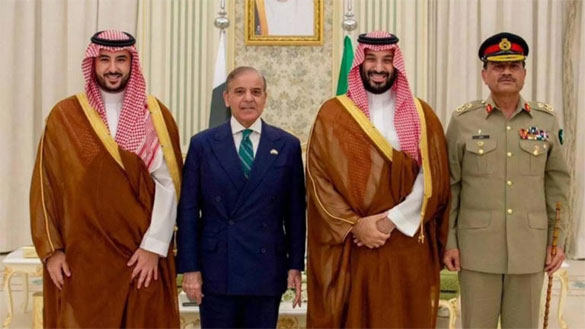
· Islamic NATO? Saudi Arabia-Pakistan Defence Pact - What It Means For India
· Analysts Hail Saudi-Pakistan Strategic Mutual Defence Pact in Riyadh As Step Toward Regional Stability
· Ex-Reform UK Councillor “Discriminating Unlawfully” Against Muslims In Social Media Posts, Investigation Finds
· Jamaat-e-Islami Warns Of ‘Another Hasina’ If Polls Held Under Current System
· Police Arrest Islamic Cleric, Alfa Basiru, With Suspected Human Flesh In Oyo
-----
India
· 'Assam Without BJP' Will Be Beef, Borders & Bigotry
· I Respect All Religions: CJI Addresses Backlash Over Temple Idol Remark
· 'Though I Am Muslim, I Love This Bhagwa IPhone 17': Delhi Man Rejoices After Purchase; Cosmic Orange Shade In Spotlight
· How The Supreme Court Ruling On Waqf Act Puts Properties In Administrative Limbo
· CPM leader Prakash Karat flags RSS-BJP threat to secularism, calls for unity against Hindutva
· CDS Gen Anil Chauhan: Operation Sindoor heralded ‘new kind of warfare’; attack was sophisticated
· Government will review Waqf Act provisions put on hold, says former JPC chief
-----
Arab World
· Ministry of Interior receives Pakistan’s Frontier Works Organization chief
· Saudi Virtual Centre launches water sustainability drive
· Advanced Digital Environment Aims At Helping Worshippers At Holy Mosques
· Landmark trade show in Riyadh attracts thousands
· Islamic Affairs minister inaugurates development projects for mosques in Madinah
· Global Infrastructure Expo in call to address groundwater issues, mitigate impact
-----
Europe
· Ground broken on new Brick Veil Mosque project in Preston
· Why France is at risk of becoming the new sick man of Europe
· Second migrant removed to France after court bid fails
· Moscow rules out visa restrictions for EU citizens
----
South Asia
· BNP Punished Over 7,000 Members For Misconduct
· ‘Disaster if polls not held in line with July Charter’
· From Saudi To Indonesia, Music Stays In Muslim Countries’ Classrooms
· Trump Says U.S. Seeking to Regain Control of Afghanistan’s Bagram Air Base
-------
Africa
· Chinese Firms Pay Price Of Jihadist Strikes Against Mali Junta
· Ex-Imo Lawmaker Regains Freedom After Abduction
· What Tonye Cole Told Me About Amaechi After My Clash With Fubara – Wike
-----
North America
· Plano Man Indicted For Terrorist-Related Hate Crime Anti-Muslim Messages, Threats Against Zohran Mamdani, DA Says
· CAIR Condemns Distribution of White Supremacist Propaganda in Wisconsin
· N.L. Islamic School goes full-time with home-schooling program, while eyeing permanent location
· From Student Visas To Terror Networks: Why America Needs A Muslim Brotherhood Investigation
· Key takeaways from Trump-Starmer news conference
-----
Mideast
· Inaction On Gaza Is Complicity In Israel’s Genocide: UN Commission Of Inquiry
· Syria’s New Envoy Vows To ‘Turn Hope Into Action’ In First UN Security Council Address
· Turkish And Palestinian Presidents Discuss International Recognition Of Palestinian Statehood At UN
· Syrian authorities capture 2020 car bomber near Aleppo
· Israel resumes attacks on Hezbollah’s strongholds south, north of Litani River
· Israel army says four soldiers killed in south Gaza
· Egypt and Turkiye hold ‘Friendship Sea’ navy drills as tensions rise in Middle East
· Turkiye warns Cyprus’ Israeli air defence system could destabilize island
· Lebanon health ministry says two killed in Israeli strike in Baalbek
-----
Southeast Asia
· Malaysia PM calls for holistic view of halal at MIHAS 2025
· Prabowo orders acceleration of Indonesian Hajj Village in Mecca
· Malaysia to exempt some Palestinian farm and food products from customs duties, Tengku Zafrul say
· Anwar invites new Thai PM Anutin to Malaysia to boost bilateral ties
· Immigration detains 52 foreign workers in Johor Bahru raid on massage centres
Compiled by New Age Islam News Bureau
URL: https://newageislam.com/islamic-world-news/islamic-nato-saudi-arabia-pakistan-india/d/136901
-----
Islamic NATO? Saudi Arabia-Pakistan Defence Pact - What It Means For India
Sep 18, 2025
TL; DR: Driving the news Saudi Arabia and Pakistan have signed a sweeping strategic mutual defence agreement, declaring that an attack on either will be treated as an attack on both.
The deal comes just days after Israel’s airstrike on Doha, which killed some senior Hamas leaders amid ceasefire talks - triggering outrage across Arab capitals.
Pakistan, a nuclear weapons state, is now officially linked to Saudi defence, reshaping strategic equations in the Gulf and South Asia.
Saudi Crown Prince Mohammed bin Salman and Pakistan Prime Minister Shehbaz Sharif signed the pact in Riyadh. Pakistan’s army chief, Field Marshal Asim Munir, attended - signaling the military’s endorsement of the pact’s implications.
Why it matters
This pact upends the old US-centric security architecture in the Middle East and creates new risks and alliances across three regions.
For Israel: The inclusion of Pakistan’s nuclear umbrella introduces a new deterrent against its regional military actions.
For India: The pact emboldens Pakistan, adds uncertainty in future conflicts, and risks tilting Arab support away from India.
For China: This is a quiet strategic windfall - an opportunity to deepen influence with two key allies while side-lining the US.
For the US: Washington’s credibility as a security guarantor in the Gulf is now under serious question.
"This agreement... strengthens joint deterrence against any aggression," said a joint statement from Saudi and Pakistani officials - seen as a direct response to Israel’s Qatar raid.
Between the lines
Saudi officials insist the pact is “not aimed at any specific country.” But regional analysts agree the timing isn’t accidental.
The Doha strike was a turning point. It exposed Qatar - home to a major US military base - as vulnerable. Gulf states saw Washington’s silence as complicity.
Saudi Arabia, already exploring alternatives to US guarantees, acted swiftly to make permanent its defence relationship with Pakistan - long speculated, now official.
Crucially, the pact is deliberately ambiguous about whether Pakistan’s nuclear arsenal is included - a gray area that adds deterrent weight without triggering international red lines.
“This is a comprehensive defensive agreement that encompasses all military means,” a senior Saudi official told Reuters.
Is this the start of an Islamic or Arab Nato?
The Saudi-Pakistan defence pact has reignited talk of a long-dreamed but elusive idea: a collective Muslim military alliance often called an Islamic or Arab Nato. For decades, this concept has surfaced in moments of crisis - and usually faded. This time, the conditions feel sharper.
The symbolism is striking. Saudi Arabia - custodian of Islam’s holiest sites - has formally bound its security to Pakistan, the only Muslim-majority nuclear state. Qatar, directly attacked, may seek similar guarantees.
Turkey, already in Nato, has long envisioned an Islamic bloc.
The Gulf mood has shifted: reliance on US protection feels increasingly hollow after Washington failed to prevent missiles from striking Doha. As the SCMP noted, Arab states now see little choice but to take “real and tangible measures” themselves.
Yet obstacles are formidable. Rivalries among Muslim states - Saudi Arabia versus Iran, Qatar versus the UAE, Turkey versus Egypt - make collective action fragile. The Economist observed that calls for an “Islamic Nato” often ring hollow given how many Arab regimes distrust Iran, one of the loudest voices pushing for such a bloc.
Still, momentum is undeniable. The idea of Gulf and wider Muslim states pooling military resources against a common external threat has more traction now than at any point since the Arab Spring.
Zoom in: Israel’s new deterrence dilemma
While Saudi Arabia has in recent years pursued a cautious rapprochement with Israel, including back-channel talks and limited normalization, the latest developments may put such overtures on hold.
The pact with Pakistan, a country with no diplomatic relations with Israel and a history of supporting Palestinian causes, sends a message that Riyadh is willing to hedge its bets and strengthen deterrence against perceived threats, even if it means aligning with states outside the Abraham Accords framework.
For the first time, Israel must plan for a world in which its military actions could invoke a nuclear response-not from Iran, its long-time antagonist, but from an ally of US.
Israel’s military freedom of action - especially cross-border strikes - just encountered a nuclear tripwire.
Israel’s strike on Doha aimed to decapitate Hamas leadership but instead:
Killed normalization prospects with Riyadh.
Galvanized Islamic unity.
Activated a defence pact with nuclear implications.
Now, any future Israeli strike in the Gulf risks:
Provoking Pakistani retaliation, potentially conventional or cyber.
Drawing condemnation from a unified bloc of Arab states.
*Empowering Hamas and Hezbollah, who can claim new backing from a major Muslim coalition.
Expect Tel Aviv to:
Accelerate defence upgrades (e.g., Iron Dome, Arrow-3, David’s Sling).
Double down on ties with India and the US for strategic depth.
Exercise greater caution before any unilateral action in third-party Gulf states.
Israeli analysts called the pact a “game-changer” and warned of an “expanded threat matrix.”
Zoom in: India’s uneasy balancing act
We have seen reports of the signing of a strategic mutual Defence pact between Saudi Arabia and Pakistan. The Government was aware that this development, which formalises a long-standing arrangement between the two countries, had been under consideration. We will study the implications of this development for our national security as well as for regional and global stability. The Government remains committed to protecting India's national interests and ensuring comprehensive national security in all domains.
MEA on Saudi Arabia-Pakistan defence pact
India faces a sharp strategic squeeze. It has deep ties to both Saudi Arabia and Israel, and a long-standing conflict with Pakistan.
The concern is less about direct Saudi involvement in a South Asian conflict and more about symbolism and support. Pakistan, emboldened by Riyadh’s backing, may adopt a harder stance in future crises-whether over Kashmir, terrorism, or water rights. If Saudi financial support flows into Pakistan’s defence modernization, India may find itself facing a better-equipped adversary.
This places India in an uncomfortable diplomatic position. It relies on Saudi Arabia as its third-largest oil supplier and a key investment partner. It also enjoys a deepening military relationship with Israel. The challenge now is to maintain both ties without appearing compromised or exposed.
India’s likely response? Quiet hedging. Expect tighter defence cooperation with Israel, new military procurements, and back-channel diplomacy with Gulf states to ensure the pact doesn’t tilt against Indian interests.
Diplomatic fallout: The MEA said it will “study the implications” of the pact for national security.
Military calculus changes: With Pakistan now seen as having Arab backing, India fears a harder Pakistani posture in any future Kashmir crisis.
Material concern: Saudi money could now strengthen Pakistan’s military, indirectly or directly - via oil subsidies, weapons upgrades, or tech transfers.
New Delhi’s likely response:
Deepen defence ties with Israel (already India’s #2 arms supplier).
Accelerate military modernization - especially missile systems and border defences.
Step up diplomatic outreach in the Gulf to keep Riyadh neutral in South Asian crises.
Our relationship with India is more robust than it has ever been. We will continue to grow this relationship and seek to contribute to regional peace whichever way we can.
A Saudi official to AlJazeera
The US on the sidelines-or in the crossfire?The United States, once the unchallenged security guarantor of the Gulf, is watching from the margins. Its muted response to the Qatar strike and lack of visible deterrence has eroded confidence among allies.
As Foreign Affairs noted earlier this year, “the US has become both too present and too absent-willing to support military campaigns, but unwilling to restrain them.”
The result? Gulf states are hedging. A mutual defence pact with a nuclear partner like Pakistan isn’t just about deterrence; it’s a declaration of independence from a security order many now see as broken.
Washington now faces the unenviable task of holding together relationships with Israel, Saudi Arabia, India, and Pakistan-each of which sees the others with growing suspicion.
China’s opportunity (and risk)
China may be the quietest but biggest strategic winner here. It is already Pakistan’s closest partner (via CPEC) and has deepened ties with Riyadh through Belt and Road, energy deals, and arms sales.
Beijing’s gains
A stronger Gulf partner distancing from US influence.
A rising role as regional arms supplier and mediator.
Validation of China’s multipolar world strategy, with Washington increasingly sidelined.
China’s playbook:
Publicly back the pact as defensive unity.
Privately urge restraint - Beijing fears oil disruptions, instability, and escalation.
As SCMP noted, “Beijing benefits from a realignment that validates its approach - diplomacy, deterrence, and development.”
What’s next
Several scenarios loom:
US recalibration – Washington will likely attempt to rebuild trust with Saudi Arabia, possibly revisiting defence guarantees. At the same time, it may push Israel to avoid further unilateral escalations.
Saudi balancing act – Riyadh will try to prove the pact doesn’t undermine ties with India, while strengthening its leadership role in the Muslim world.
Pakistan’s rising profile – Expect more joint exercises, visible deployments, and louder rhetoric positioning Islamabad as protector of Muslim states.
Potential domino effect – Qatar, Turkey, or even smaller Gulf states could seek similar arrangements, edging closer to a real “Arab Nato.”
The longer the Israel-Palestine conflict drags on, the more likely this pact will solidify into the nucleus of a larger coalition.
Source: indiatimes.com
Please click the following URL to read the text of the original Story
https://timesofindia.indiatimes.com/india/saudi-pakistan-defense-pact-saudi-pakistan-defense-pact-and-india-islamic-nato-pakistan-nuclear-weapons/articleshow/123978246.cms
-------
Analysts Hail Saudi-Pakistan Strategic Mutual Defence Pact in Riyadh As Step Toward Regional Stability
Naimat Khan
September 18, 2025
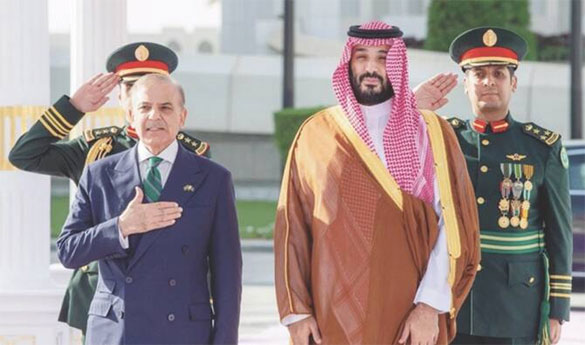
Pakistan’s Premier Shehbaz Sharif, along with Saudi Crown Prince Mohammad bin Salman, receives a guard of honor upon his arrival in Riyadh. (SPA
-------------
KARACHI: Saudi Arabia and Pakistan signed a Strategic Mutual Defence Agreement on Wednesday, pledging that aggression against one country would be treated as an attack on both, in what experts described as a landmark move that reflects shifting global alignments and decades of close cooperation between the two allies.
The accord was concluded in Riyadh during Prime Minister Shehbaz Sharif’s meeting with Saudi Crown Prince Mohammed bin Salman.
Sharing a copy of the joint statement on X early on Thursday, Saudi Defense Minister Khalid bin Salman described the two nations as “One front against any aggressor ... Always
and forever.”
Pakistani analysts meanwhile said the agreement underscored both countries’ intent to formalize longstanding security ties while also reflecting broader shifts in the regional and global order.
“The defence pact between Pakistan and KSA (Kingdom of Saudi Arabia) … will have a long-term impact on the power matrix of both South Asia and the Middle East,” Huma Baqai, an academic and foreign affairs expert, told Arab News.
“This development is definitely indicative of a changing global order and new alliances in the making. It may also result in a domino effect of more Gulf and Arab states seeking such alliances with Pakistan.”
She said Saudi Arabia’s decision was a recognition of Pakistan’s military capabilities, demonstrated during its May 2025 conflict with India.
The two South Asian neighbors fought a four-day war earlier this year after an attack in Indian-administered Kashmir that New Delhi blamed on Islamabad. Pakistan denied involvement, but the hostilities — the deadliest since 2019 — left more than 70 people dead before a US-brokered ceasefire took effect.
In Islamabad’s telling, it shot down at least six Indian aircraft during the fighting and forced New Delhi to agree to a ceasefire.
Security analyst Syed Muhammad Ali described the accord as “international recognition that Pakistan is not just a South Asian power but a power which can contribute toward preserving peace and security in the Middle East as well.”
He said “Saudi confidence in Pakistan’s military is evidence that the international community views Pakistan as a capable and responsible power after Islamabad gave a befitting response to New Delhi in the May 2025 conflict.”
Defense analyst Muhammad Samrez Salik, a retired major general, said the agreement would build on more than eight decades of close security ties between the two countries:
“The latest defense pact will augur well for the defense and security of both nations and for regional stability. KSA has recognized that and decided to benefit from Pakistan’s military capabilities. I expect and hope that KSA will also help Pakistan achieve economic stability.”
Baqai added that the pact could also be seen “as a positive development which would definitely have a ripple effect on the Pakistani economy.”
Jeddah-based Chaudhry Shahbaz Hussain, a former Pakistani federal minister, said the pact “symbolizes the trust, fraternity, and unshakable bond that has always existed between our two nations — rooted in faith, mutual respect and common destiny.”
He added that this remarkable milestone embodies the shared vision of the crown prince “for a secure, prosperous, and united Muslim Ummah.”
Earlier on Thursday, Sharif wrote on X that talks with the Saudi crown prince covered a wide range of issues, including regional challenges and steps to enhance bilateral cooperation.
“On the bilateral front, I greatly value HRH’s consistent support and his keen interest in expanding Saudi investments, trade and business ties between our two countries,”
he posted.
“It is my fervent prayer that Pakistan-Saudi Arabia’s friendship continues to flourish and attain new heights of glory.”
Source: arabnews.com
Please click the following URL to read the text of the original Story
https://www.arabnews.com/node/2615858/saudi-arabia
-------
Ex-Reform UK councillor “discriminating unlawfully” against Muslims in social media posts, investigation finds
18th Sep 2025

A Doncaster councillor expelled by Reform UK over “unacceptable” posts on Facebook has allegedly discriminated “unlawfully” against people of Muslim faith, a City of Doncaster Council (CDC) investigation has found.
Councillor Mark Broadhurst, who now sits as an independent on Doncaster Council, was the subject of an investigation by Neil Concannon, head of litigation & regulatory and deputy monitoring officer.
In a damning report, Mr Concannon concluded Cllr Broadhurst breached the Members’ Code of Conduct in four areas – three of which are directly related to his social media activity.
The investigation centred around complaints regarding two posts on Broadhurst’s Facebook account – one dated March 19, 2024, and the other March 30, 2024.
Mr Concannon’s report concludes Broadhurst failed to “treat members of the public with respect”, specifically Muslim members of the public.
Broadhurst was also found to have breached the Code of Conduct by “failing to promote equality and discriminating unlawfully against people of the Muslim faith”.
In a scathing explanation of how he reached this conclusion, Mr Concannon wrote: “Looking objectively at the content of the two offending posts in this case, they do not promote equalities; they do the exact opposite of this.
“Further, it seems very clear to me that they are comments, racial or ethnic slurs and jokes [albeit in very bad taste] that are derogatory and offensive to an individual’s or group’s characteristics which promote negative stereotypes relating to those characteristics.
“On that basis, on the balance of probabilities, I conclude that the content of the posts amount to discriminatory behaviour against people of the Muslim faith by Councillor Broadhurst and as such, I have no hesitation in concluding that he breached… the Code.
“I note one of the complainants says as follows: ‘This is an outright display of Islamaphobia, promoting dangerous stereotypes and hatred to an entire community. Such rhetoric from an elected official is alarming and goes against the principles of equality, inclusivity, and respect. It emboldens discrimination, fuels intolerance and diminishes public trust in governance’.
“I believe this succinctly describes the situation and I could not have summarised the position more clearly myself.”
Mr Concannon’s report will be presented to the audit hearings sub-committee at a hearing on Wednesday, September 24, 2025.
Broadhurst did not respond to the Local Democracy Reporting Service when asked to comment on the investigation and the findings.
The investigation also concluded a fourth breach of the Members’ Code of Conduct which requires councillors to “cooperate” with investigations into breaches.
Mr Concannon’s report states: “I am informed by the monitoring officer that despite numerous attempts by him to contact Councillor Broadhurst about these complaints, he has failed on each occasion to respond to the monitoring officer.
“The monitoring officer has sent numerous emails to Councillor Broadhurst through both his CDC and personal email addresses, numerous voicemails have gone unanswered, hard copies have also been posted to Councillor Broadhurst’s home address and provided to Councillor Broadhurst in person but no response has been provided I will turn to this issue in more detail later in my report, but at this point I note that as a result of this, I do not have the benefit of any comments whatsoever from Councillor Broadhurst on either of the complaints.”
Source: doncasterfreepress.co.uk
Please click the following URL to read the text of the original Story
https://www.doncasterfreepress.co.uk/news/politics/mark-broadhurst-doncaster-discriminated-unlawfully-in-facebook-posts-5324440
-------
Jamaat-e-Islami Warns Of ‘Another Hasina’ If Polls Held Under Current System
Sep 18, 2025
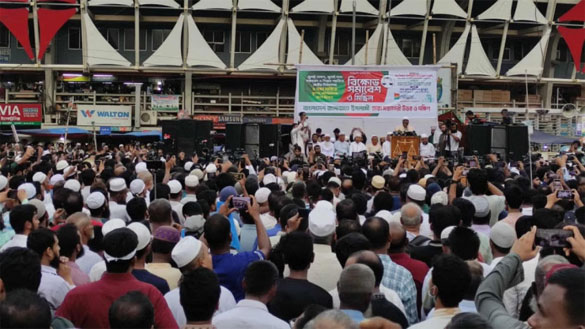
Photo: Rashed Shumon/Star
------------
Jamaat-e-Islami Secretary General Mia Golam Porwar today warned that holding another national election under the current system could create another form of fascism and another leader like Hasina.
"If elections are held again under the existing state structure, it will give birth to another form of fascism -- another Hasina," said Golam Parwar while addressing a rally in front of the south gate of Baitul Mukarram National Mosque as the chief guest.
Jamaat arranged the rally to press home their five-point demand, including the implementation of the July Charter.
Addressing the interim government, the Jamaat leader said, "You are failing to maintain a level playing field. We are going to the discussion table, but those talks are yielding no results. It seems the government, under some pressure, is heading towards a futile exercise."
From this noon to evening, Jamaat-e-Islami, Islami Andolon Bangladesh, Bangladesh Khelafat Majlis, Khelafat Majlis, Nezam-e-Islami Party, Bangladesh Khelafat Andolon and Jatiya Ganatantrik Party (JAGPA) staged brief rallies and demonstrations in and around Baitul Mukarram and the National Press Club. The demands of all seven parties were almost the same.
Golam Porwar also said, "Jamaat-e-Islami wants Bangladesh to move towards an acceptable election. But unfortunately, we see that the government is bowing to the political influence of a certain quarter or, some power or external influence."
He further said, "We have demanded that the upcoming election must be held on the legal basis of the July Charter. Now, a party is creating obstacles, saying there is no need for such constitutional reforms. They are saying the next elected government will reform the constitution and add these provisions to its schedule. This is against the people's aspirations."
Golam Porwar said the issues of reform must be incorporated into the July Charter, given legal basis through a constitutional order, and endorsed by a referendum before the election. Otherwise, the country may plunge into a major disaster."
Source: thedailystar.net
Please click the following URL to read the text of the original Story
https://www.thedailystar.net/news/bangladesh/politics/news/jamaat-warns-another-hasina-if-polls-held-under-current-system-3989271
--------
Police Arrest Islamic Cleric, Alfa Basiru, With Suspected Human Flesh In Oyo
by Segun Showunmi, Ibadan
September 18, 2025

The Oyo Police Command has confirmed the arrest of an Islamic Cleric, simply identified as Alfa Basiru with items suspected to be human flesh at Ibadan Toll gate end of Lagos expressway.
The team of the Command also recovered a Toyota Camry car abandoned by the owner who allegedly took to his heels during the search on the expressway.
The spokesman of the Command, Adewale Osifeso confirmed the arrest of the cleric and the recovery of the car on the verified X handle of the Command on Thursday.
He said he was arrested during a stop and search operation the Federal Highway Patrol Team on Ibadan bound Lagos bus with registration number XA 561 IRG bus at Ibadan Toll gate end.
Osifeso said the case has been transfered to the homicide section of the Criminal Investigation Department, Iyaganku for further investigation.
He added that forensic analysis would be carried out on the seized item to determine the content.
In another development, Osifeso confirmed recovery of a Toyota Camry abandoned by the owner during a search.
He stated that police operatives flagged down the said car during a search while the driver in the process took to his heels to escape arrest.
“The car has been taken into custody by the Command while members of the public with legitimate claims to the vehicle are urged to come forward with verifiable documents or contact the Police Command.”
Osifeso said the operations were not exaggerated security theatrics, but real and deliberate measures to maintain law and order and as well as ensuring the safety of residents and travellers within Oyo State.
Source: thenationonlineng.net
Please click the following URL to read the text of the original Story
https://thenationonlineng.net/police-arrest-islamic-cleric-with-suspected-human-flesh-in-oyo/
------
India
'Assam Without BJP' Will Be Beef, Borders & Bigotry
Neelan Pandey
18 September, 2025
New Delhi: An elderly Muslim man cutting meat in the open while men in skull caps and women in hijabs crowd the airport, Ranghar, and cricket stadium, take over government land, and infiltrate the borders—these Artificial Intelligence (AI)-generated visuals are part of the Assam BJP’s election ad campaign.
The latest video comes on the heels of a series of controversial videos released by the BJP, as it makes illegal immigration and Hindu-Muslim divisions its poll planks for the upcoming state elections. Assam, Kerala, Puducherry, Tamil Nadu, and West Bengal are the states going to the polls in 2026.
The advertisement shows “Assam without BJP”, in which Muslims have become the majority. Assam Chief Minister Himanta Biswa Sarma has repeatedly predicted this prospect, in a bid to justify his strong-handed tactics against alleged encroachments.
A look at the BJP Assam’s X page reveals that it has, of late, been posting along similar lines, calling Congress MP Gaurav Gogoi ‘Paaijaan’ for “close links with Pakistan”, while highlighting that his British wife worked there. Such posts or videos demonstrate the focus of the BJP and Himanta on illegal immigration, besides Hindu-Muslim divisions, before the Assam assembly elections, which, they fear, will be a close contest, political experts say.
“You see, Assam has a history of political mobilisation around the issue of illegal migration from Bangladesh. The current dispensation—the [Himanta Biswa Sarma-led] BJP—has added a religious dimension to this dynamic,” said Rahul Verma, a fellow at the Centre for Policy Research (CPR). “While they claim to be addressing the problem of illegal migrants, both directly and indirectly, the focus is often on Muslim migration.”
“With assembly elections due next year in both West Bengal and Assam, one of the [BJP’s] strategies appears to be linking the Opposition in these states to the cause of illegal migrants and Muslims and portraying them as guardian angels for these groups that people see as a key part of those parties’ voter base,” Verma added, speaking to ThePrint.
The latest video posted by the BJP on X depicts Assam with a Muslim-majority population, suggesting the state faces a “Muslim takeover” and would legalise beef without the BJP in power. The public is urged to “choose your vote carefully”. Moreover, Rahul Gandhi and Gaurav Gogoi appear in the video in the backdrop of a Pakistan flag, along with the caption ‘Pakistan Link Party’.
BJP’s politics of targeting Miyas
In Assam, Muslims, including indigenous Assamese Muslims, Hindi-speaking Muslims, and those of Bengali origin—the largest sub-group—account for more than 34 percent of the population, according to the 2011 Census.
The latest series of Assam BJP posts ties up with previous statements of Himanta, who, in the past, has said that his party does not need the votes of ‘Miyas’ of ‘char’ areas (riverine sandbar) for the next 10 years till they reform themselves and stop indulging in practices, such as child marriage. ‘Miya’ is often used as a derogatory term for Bengali-speaking Muslims.
The latest video is not the only X post by the BJP around the ‘infiltrator’ topic.
In another post, the BJP targets Gaurav Gogoi, saying ‘Miyah ka masiha aa gaya’.
“Looks like Paaijaan’s soldiers couldn’t hold their excitement—dancing like it’s their first and last chance to see him. Forget elections, it feels more like a baraat out there!” said another BJP Assam post.
In a third X post, BJP Assam said, “Elections are on in Bodoland, but just look at Paaijaan’s rally stage! Not a single son of the soil made it there. This is their “strategy”. and when BJP sweeps the polls, they’ll do what they do best—cry louder than a nursery kid denied candy.”
When the Indian cricket team of late defeated Pakistan in one of the Asia Cup matches, BJP Assam’s X handle posted a picture of Gaurav Gogoi looking upset when asked who won.
Old politics, new wrapping
The video drew sharp criticism from several politicians, with Gaurav Gogoi and Lok Sabha MP from Hyderabad Asaduddin Owaisi accusing the BJP of seeking to create a ‘Muslim-mukt‘ Bharat.
“BJP Assam has posted a disgusting AI video that shows a Muslim-majority Assam if there was no BJP. They are not fear-mongering just for votes, this is the repulsive Hindutva ideology,” wrote Owaisi in his post.
As the BJP sought to defend the posts, Congress leader Gaurav Gogoi said, “…the words, actions and images produced by the BJP IT cell do not even have the strength to scratch the surface of Assamese society.” He further said that the “great state of Assam deserves politicians who help the people of Assam reach new heights”.
The state Congress unit has also decided to file a police complaint in the matter.
Nilanjan Mukhopadhyay, a writer and journalist based in Delhi, pointed out that whenever the BJP has faced an electoral challenge, it has turned to strident Hindu-Muslim polarisation—something it is doing in Assam now, considering the state elections are due next year.
Explaining the phenomenon, Mukhopadhyay said the pattern became quite clear in 2014, and it has since then regularly repeated itself. The approach of the BJP, he said, was out in the open on 15 August 2014, when, in his Independence Day speech at the Red Fort, Prime Minister Modi announced a demographic mission. “It was a clear indication that the BJP plans to raise this issue in a big way. Subsequently, in West Bengal, both Amit Shah and Modi talked about ‘infiltrators’,” Mukhopadhyay pointed out.
It is clear that collective issues, such as unemployment, food scarcity, and growing frustration among the youth—similar to what prevails in Sri Lanka, Bangladesh, and Nepal—are the actual concerns in the country, Nilanjan Mukhopadhyay added. “Despite the publicity campaigns, there are serious issues confronting the public, related to things like bread-and-butter and other basics,” he said, adding, “I see this effort [by the BJP] as part of the process to revive its traditional platform.”
In Assam, this politics harks back to the old Sangh Parivar platform under the leadership of Balasaheb Deoras in 1978-79, when the Assam agitation began, according to Nilanjan Mukhopadhyay. Since the 1970s, the Northeast track record of the Sangh has improved, Mukhopadhyay further said, mentioning the Sangh’s shift in focus to social expansion and establishing a presence. “So now, there is significant organisational involvement across states, such as Manipur, Nagaland, and Assam,” he added.
Deora, during his time only, established a distinction between two groups migrating from Bangladesh—the “infiltrators”, mainly Muslims, and the “refugees,” primarily Hindus fleeing persecution—Nilanjan Mukhopadhyay said. “This narrative maintains that Muslims are often seen as trying to alter India’s demographic balance, while Hindus are considered genuine refugees. What I am really getting at is that whether they are Hindus or Muslims, people leave Bangladesh for very different reasons,” he added.
Nilanjan Mukhopadhyay stressed that historical, demographic, and socio-economic factors drive migration. “This has always been the case, even before Independence. Politically, it looks like the BJP is worried, which is why they are trying to highlight these issues.”
Source: theprint.in
Please click the following URL to read the text of the original Story
https://theprint.in/politics/beef-borders-bigotry-bjp-assams-infiltrator-politics-is-back-now-in-ai-wrapping/2745994/
--------
I Respect All Religions: CJI Addresses Backlash Over Temple Idol Remark
19.09.25
Chief Justice of India B.R. Gavai on Thursday said he had “respect for all religions”, as he sought to address mounting criticism of his September 16 remark that a petitioner pray to Lord Vishnu himself for the restoration of the God’s beheaded idol at the Javari temple in Khajuraho.
“You say you are a staunch devotee of Lord Vishnu, then go and pray to the deity,” CJI Gavai had orally remarked to the counsel appearing for Rakesh Dalal, who had sought the restoration of Lord Vishnu’s idol that was allegedly destroyed and beheaded by Mughal invaders. The CJI dismissed the petition.
Justice Gavai faced a backlash on social media. Two Supreme Court advocates, Vineet Jindal and Satyam Singh Rajput, on Wednesday wrote to CJI Gavai, urging him to withdraw his remarks as they had hurt the sentiments of millions of Hindus across the country.
During the hearing of a matter on Thursday relating to illegal mining in Karnataka, Justice Gavai told lawyers that these days everything gets distorted on social media.
“Nowadays it can be anything on social media. Someone told me that I had dismissed a petition.... I believe in all religions, I respect all...,” Justice Gavai said while referring to his comments and explaining that he did not mean to hurt anyone’s sentiments.
Solicitor-general Tushar Mehta said he knew CJI Gavai for over a decade. “Your Lordship visits temples, Gurdwaras and places of religion with reverence,” Mehta said.
He added: “This is a serious issue (social media trolls)…. We all know about Newton’s law that every action has an equal and opposite reaction. Now every action has a disproportionate social media reaction!”
Justice K. Vinod Chandran, the other judge on the bench, said even he had received enquiries after he withdrew from hearing a case relating to the Vedanta group. Justice Chandran said that prior to becoming a judge he had appeared for another company, but people started asking him whether he had any holdings in the Vedanta group.
Source: telegraphindia.com
Please click the following URL to read the text of the original Story
https://www.telegraphindia.com/india/i-respect-all-religions-chief-justice-of-india-b-r-gavai-addresses-backlash-over-temple-idol-remark-prnt/cid/2123812
-------
'Though I Am Muslim, I Love This Bhagwa IPhone 17': Delhi Man Rejoices After Purchase; Cosmic Orange Shade In Spotlight
Sep 19, 2025
NEW DELHI: Excitement gripped Apple flagship stores across India on Friday morning as the iPhone 17 series officially hit shelves, drawing massive crowds in Delhi, Mumbai, and Bengaluru.
Among the highlights was the striking new “Cosmic Orange” edition — a shade likened to saffron — which quickly stole the spotlight and sparked conversations far beyond the tech world.
One enthusiastic buyer in Delhi, moments after purchasing the orange iPhone 17, said: “I was in the queue since morning, and I am excited to buy the iPhone of this colour. In India, this saffron-coloured phone will become very popular. I am a Muslim, but I love this colour”
Apple began nationwide sales of the iPhone 17 line-up on Thursday, a day after unveiling it globally on September 9, 2025. The launch includes the iPhone 17, iPhone 17 Pro Max, AirPods 3, Watch Series 11, Watch SE3, and Watch Ultra 3.
At the Bandra-Kurla Complex (BKC) store in Mumbai, queues stretched long into the morning as buyers waited to get their hands on the new devices. Similar scenes played out in Bengaluru at the new Apple Hebbal store in the Mall of Asia.
Buyers showed special interest in the Cosmic Orange edition, with many likening it to “Bhagwa” or saffron — a colour often associated with Indian tradition and symbolism.
Another customer, Aman Chouhan, told news agency ANI in Mumbai: “I have purchased the iPhone 17 Pro Max, one in 256GB and the other in 1TB. I was waiting in line since midnight, and now I have got it. It has new features. The orange colour is new, and it’s in demand.”
The orange iPhone's debut has also created significant buzz on social media.
The iPhone 17 Pro and Pro Max models feature major upgrades, including a redesigned rear camera module that now stretches across the width of the phone. Each of the three lenses now uses a 48MP sensor, a first for the Pro lineup.
The telephoto lens has received a significant resolution and sensor-size boost, with Apple claiming up to 8x optical-quality zoom, as reported by The Verge.
The devices are available in three colours: silver, blue, and the much-talked-about orange — a far more vivid shade than previous models, now fast becoming a cultural symbol in its own right.
Source: indiatimes.com
Please click the following URL to read the text of the original Story
https://timesofindia.indiatimes.com/city/delhi/though-i-am-muslim-i-love-this-bhagwa-iphone-17-delhi-man-rejoices-after-purchase-cosmic-orange-shade-in-spotlight/articleshow/123992798.cms
-------
How the Supreme Court ruling on Waqf act puts properties in administrative limbo
Faizan Ahmad
Sep 19, 2025
The Supreme Court’s interim ruling on Monday on a batch of petitions challenging the Waqf (Amendment) Act, 2025, stayed some of the law’s most draconian provisions But, by neglecting the cumulative effect of the amendments as a whole, it has left the foundational pillars of waqf administration vulnerable to a deeply flawed piece of legislation.
The judgment, while attempting a balancing act, ultimately creates a state of administrative limbo for waqf properties – endowments under Islamic law dedicated to a religious, educational or charitable cause.
The constitutional questions at the heart of this challenge are yet to be answered. Until they are, the verdict will serve as a judicial stamp for the “land jihad” conspiracy theory peddled by Hindutva forces, claiming that Muslims use the instrument of waqf to usurp land belonging to the public and to Hindus.
A legislative overhaul
To understand the verdict’s implications, one must first grasp the seismic shifts introduced by the 2025 Amendment Act. As the petitioners argued, the law radically unsettles the existing system by introducing several alarming changes.
It grants sweeping new powers to the Collector, an executive officer of the state, to effectively determine the ownership of properties, creating a glaring conflict of interest in cases where the government itself is a claimant.
The act introduced an expansive and vague definition of “government property”, which, when read with new provisions, creates a presumption that any “disputed” property belongs to the government retrospectively.
It also abolished the category of “waqf by user” – a centuries-old, judicially recognised Islamic principle whereby properties used for religious purposes over a long period are deemed waqf, even without a formal deed.
Furthermore, it altered the composition of the Central Waqf Council and State Waqf Boards to allow for a potential non-Muslim majority, a stark contrast to the governance structures of religious endowments of other communities. It was this comprehensive legislative assault that prompted petitioners to seek a stay on the act’s implementation as a whole.
A judgment of half-measures
The Supreme Court, acknowledging the gravity of some of these provisions, did offer crucial interim relief.
First, the court has stayed the provision requiring a person to prove they have been practising Islam for at least five years to create a waqf.
Secondly, it put a hold on the immediate consequences of an inquiry under the new Section 3C: it stayed the provisions that would have allowed a government-designated officer to unilaterally alter revenue records based on his own report, declaring a waqf property as government land. It directed that no waqf can be dispossessed, nor its records changed, until the matter is fully adjudicated by the Waqf Tribunal.
Thirdly, the court capped the number of non-Muslim members on the central council at four and on state boards at three.
These stays prevent an immediate, executive-led expropriation of properties. However, they fail to address the fundamental flaws that remain embedded in the act.
Problems that remain
First, while the consequences of a Collector’s inquiry into ownership of a property are stayed, the process is not. A designated officer can still initiate an inquiry into any waqf property, casting a cloud of uncertainty over its status.
The judgment then creates a paradoxical situation: it protects the waqf from dispossession but simultaneously freezes its assets by barring the creation of any third-party rights (such as leases or development agreements) until the dispute is finally resolved.
This could lead to administrative paralysis, preventing a waqf from generating income for its charitable objectives while it is forced into a protracted legal battle initiated by the government itself.
Second, the court upheld the prospective deletion of “waqf by user”. Even though the court has clarified that the order will not come in the way of the final challenge to the constitutionality of the provisions of the act, it has made several concerning observations on the deletion of the “waqf by user” category.
The court has reasoned that if mutawallis – managers and caretakes of waqfs – failed to register for over a century, they cannot complain about the deletion of the provision now.
This argument is misplaced because a waqf is held to be a divine endowment dedicated to charity, and its legal and religious character is not dependent on the actions of its temporary manager. To the contrary, identifying and surveying waqf by user properties was a statutory obligation on the states.
But according to the statistics of the Joint Parliamentary Committee on The Waqf (Amendment) Bill that were shown to the court, surveys had been conducted in only five out of 28 states and four out of eight Union territories. The biggest states by area – Gujarat, Jharkhand, Rajasthan, Uttar Pradesh (Sunni) and Uttarakhand – had not reported any surveys.
Deleting the provision altogether effectively punishes the entire community of beneficiaries and nullifies a pious endowment due to administrative neglect of the state governments, which is a fundamentally unjust and disproportionate outcome.
The very essence of “waqf by user” is that its status is established through long, uninterrupted dedication to religious use, often without a formal deed or a single date of creation. These properties, such as ancient masjids, dargahs and cemeteries, have existed for centuries as community property. The court’s decision to emphasise the failure to register overlooks this historical reality.
While the court correctly notes that the previous law allowed registration even without a deed, this only strengthens the argument that the solution should have been to enforce or streamline that existing process – not to use non-compliance as a pretext to abolish the entire legal category.
The court seems to conflate registration requirements with registration being a precondition to create the waqf itself, contrary to the settled legal position that a lack of registration does not invalidate the status of the property as a waqf.
Failing to draw a link
Even more surprising is the fact that the court does not analyse how the stated object of the act – to prevent mismanagement of endowments – has any reasonable link to the religious composition of the board. During the hearings, the government had justified the measure by stating that the waqf properties owned by Muslims are routinely in conflict with “other communities”.
It is wrong to portray waqf disputes, which are among individual parties, mostly with mutawallis, as disputes between communities. Second, merely having a property contested by parties belonging to different religious communities is still no reason to establish a right of non-Muslims to have a seat on the state-level administrative board.
Any maladministration can be properly dealt with by the state government. In fact, section 99 of the Waqf Act allows the board to be fully taken over by the state government after due inquiries.
The premise for introducing non-Muslim members is rather the repeated insinuation that Muslims cannot be trusted with waqf administration. The court has vindicated this trope by mediating a compromise to accept four members in the council and three members in the board though the petitioners had at length argued that even one is too many. This, they said, constituted an intrusion into the right of minorities to administer their own institutions.
Today, at a time when the Muslim community is facing repeated threats on its dignity, institutions and property, the most affected will be the most marginalised who depend on madarsas, community parks, hospitals and graveyards – all of which are waqf.
The interim reliefs are welcome bandages, but the deep wounds inflicted by the Amendment Act remain.
Source: scroll.in
Please click the following URL to read the text of the original Story
https://scroll.in/article/1086740/how-the-supreme-court-ruling-on-waqf-act-puts-properties-in-administrative-limbo
-------
CPM leader Prakash Karat flags RSS-BJP threat to secularism, calls for unity against Hindutva
Subhashish Mohanty
19.09.25
Senior CPM leader Prakash Karat on Thursday cautioned people against the growing threat of “fascist forces” and the “so-called Hindutva”, alleging attempts to undermine the secular spirit of the country and the Constitution itself.
Delivering the Sitaram Yechury Memorial Lecture, Karat said: “The essence of the last 11 years of BJP rule is the drive to create a Hindu Rashtra. Both the BJP and RSS are working towards that goal. Even Mohan Bhagwat has said the RSS’s work can change with time, but the ideology of a Hindu Rashtra will remain eternal.”
Karat noted that for the first time in 100 years of the RSS’s existence, a former Pracharak had become Prime Minister, while several others, including the Union home and defence ministers, held key posts.
“The RSS will not let this opportunity go waste. A systematic effort is being made to turn India into a Hindu Rashtra to suit their political agenda. We have to defeat that force to safeguard the country’s diversity,” he said.
He accused the government of pushing Hindu “vicharadhara (ideology)” into institutions such as the executive, judiciary, armed forces, and even the courts.
“Some high court judgements have also reflected this Hindu vicharadhara. A systematic approach is under way to make it the state’s ideology,” he added.
Karat also flagged the “emergence of the Hindu-Corporate alliance”, alleging that monopolistic capitalism was aligned with Hindutva. Referring to a Delhi court order noting that there should be “no criticism against Adani”, he said: “There is a threat to press freedom. There is a threat to people’s India. Is this the India we should build?”
He said 40 per cent of the nation’s wealth was concentrated in the hands of just 1 per cent of the population, while nationalised banks were being compelled to extend ₹10,000-crore loans to corporate defaulters.
On minorities, Karat cited laws in BJP-ruled states such as Maharashtra, Gujarat and Rajasthan, including anti-conversion legislation, cow protection measures, and “love jihad” provisions. In Haryana, he said, cow vigilantes were given “high status” with no action taken against them, while in Assam, laws were being framed requiring permission to purchase land between Hindus and Muslims.
Criticising the government’s economic claims, he said: “A campaign is on that Modi has made India the world’s 5th largest economy. The stark reality is that people’s incomes have fallen and jobs are not available.”
Calling for broader unity, Karat urged engagement with “religious and hard believers” to convince them that Hindutva was being communalised for political gain. “They are not working for tribals or Dalits, but for the capitalists. We need to expose them in every field — socio-cultural, intellectual and academic,” he said.
Other senior leaders, including Janardan Pati, also spoke on the occasion.
Source: telegraphindia.com
Please click the following URL to read the text of the original Story
https://www.telegraphindia.com/india/cpm-leader-prakash-karat-flags-rss-bjp-threat-to-secularism-calls-for-unity-against-hindutva-prnt/cid/2123861
-------
CDS Gen Anil Chauhan: Operation Sindoor heralded ‘new kind of warfare’; attack was sophisticated
19.09.25
Chief of Defence Staff, General Anil Chauhan, said Operation Sindoor heralded a "new kind of warfare", and ensured that India beat Pakistan decisively in every escalation during the strike.
Unlike traditional warfare, this was fought on land, in air and sea, electromagnetic space and cyber domains, where the adversary was seen only through the help of satellite and electronic images or signal intelligence, he said.
The top military officer also said the first strikes during the operation were conducted at 1 am to avoid civilian casualties across the border.
"It was a new kind of warfare... Till now, we have assumed victory in terms of capture of territory, the number of equipment destroyed, or the number of prisoners of war you have captured or soldiers you have killed...These were associated with traditional ways of fighting warfare.
"One of the matrices of victory over here is the sophistication of our attack, which was demonstrated there... Precision strikes for long-distance targets during the night required special efforts... We beat Pakistan decisively in every escalation during Operation Sindoor," Gen Chauhan asserted.
The first strikes took place between 1-1.30 am on May 7 on nine identified terrorist targets to prevent civilian casualties, he said during an interaction with school children on Operation Sindoor at the Raj Bhavan here on Thursday.
Operation Sindoor was launched in the aftermath of the Pahalgam terror attack, which claimed the lives of 26 people, mostly tourists.
"Earlier, we did the Balakot operation, but we didn't have satellite images or photos... But what we did at 1 am now (Operation Sindoor), despite difficulty in collecting evidence in the darkness of night, was due to twin reasons -- first, we had confidence in our capabilities that we could take imagery, and the second, we wanted to avoid civilian casualties.
"The best (option) would have been the time of 5.30 am or 6 am... But that time of the first Azan or Namaz... many civilian lives would have been lost. We wanted to avoid that completely," Gen Chauhan said.
He said that India was monitoring the neighbouring nation's flying activities for some time and chose the strike on the night of May 7, as the weather was clear with no rain prediction.
Contrary to the general notion that the army was engaged at seven targets and the air force at two, the "navy was also involved in the strikes with S400 and S120, and deployment of navy commandos in Jammu and Kashmir and Punjab in addition to the Arabian Sea", he said.
"During Uri and Balakot, we chose land and air medium, but in this operation, a surprise element was there as we adopted a new strategy, which was needed for success, and used drones, the capability of which we acquired," Gen Chauhan said.
He said the evolving character of warfare is now driven more by technology than the sheer number or territorial occupation.
"Modern warfare demands that we fight today's conflicts with tomorrow's technology. The battlespace is no longer limited to traditional domains of land, air, and sea and has expanded to include space, cyber, the electromagnetic spectrum, and even the cognitive domain. In recent operations, this shift was evident.
"India was able to strike deep into enemy territory with long-range precision weapons, guided by satellite imagery, electronic surveillance, and signal intelligence, often without direct visual contact with the adversary. These were non-contact, multi-domain operations where success was not measured by the ground captured, but by the level of dominance and sophistication displayed across all levels of escalation," he emphasised.
Giving an example of the strike on Sarjal village in Pakistan's Punjab, he said that though it appeared to be an unremarkable location comprising merely an old primary health centre, technical intelligence confirmed it had been a base for repeated terrorist infiltrations.
The precision strike neutralised a key node in the adversary's network, reflecting the effectiveness of a technology-led approach, the chief of defence staff said.
This paradigm shift in warfare requires rethinking traditional metrics of victory. Success is no longer solely defined by body counts or territorial gains, he said.
Instead, it is measured through strategic deterrence, operational sophistication and information dominance.
The army, navy, and air force have learnt many lessons from Operation Sindoor to ensure higher levels of preparedness and integration, Gen Chauhan said.
"As warfare continues to evolve, our armed forces are not just adapting; they are actively shaping the future battlespace. Victory today lies not only in decisive action, but in the ability to maintain superiority across all domains," he said.
He also noted that 'fauj' (military) is the only place where there is no nepotism.
"Merit is rewarded, and there is recognition of work. You (children) should aspire to join the armed forces if you want to serve the nation, and explore the country and the world," Gen Chauhan said.
He added that the armed forces made maximum efforts this year to rescue citizens amid a high number of natural calamities.
Source: telegraphindia.com
Please click the following URL to read the text of the original Story
https://www.telegraphindia.com/india/cds-gen-anil-chauhan-says-operation-sindoor-heralded-new-kind-of-warfare-claims-attack-was-sophisticated/cid/2123838
-------
Government will review Waqf Act provisions put on hold, says former JPC chief
Preetha Nair
19 Sep 2025
NEW DELHI: Days after the Supreme Court stayed certain provisions of the Waqf Amendment Act 2025, Jagdambika Pal, the former chairman of the JPC on the Waqf Amendment Act, stated that the government will review the provisions that were put on hold, maintaining that the SC has recognised the law with its interim order.
He told this paperthe government would consider the interim suspension of some of the key provisions, such as empowering the district collector to unilaterally decide whether a property is a Waqf or government property.
The SC order clearly endorses the law. A stay has been imposed on certain provisions. The government will definitely look into it, and it will take action on that in light of the court’s decision,” he said.
In its interim order, the SC stayed three contentious provisions of the Waqf (Amendment) Act, including the clause requiring a person to be a practising Muslim for five years before dedicating property as Waqf. The SC ruled that this clause will remain suspended until state governments frame rules to determine such conditions.
“The Supreme Court has not stayed the five-year practice clause. It had only stayed for the time being while saying that the state governments will make the rules,” said Pal.
Practising Muslim for five years
The SC stayed 3 provisions of the Waqf Act, including the clause requiring a person to be a practising Muslim for five years before dedicating property as Waqf.
Source: newindianexpress.com
Please click the following URL to read the text of the original Story
https://www.newindianexpress.com/nation/2025/Sep/19/government-will-review-waqf-act-provisions-put-on-hold-says-former-jpc-chief
------
Arab World
Ministry of Interior receives Pakistan’s Frontier Works Organization chief
September 18, 2025
RIYADH: Acting Saudi Deputy Minister of Interior Prince Abdulaziz bin Mohammed bin Ayyaf received Maj. Gen. Abdul Sami, the director general of the Frontier Works Organization in Pakistan, at his office in Riyadh on Thursday.
During the meeting, several topics of mutual interest were discussed.
Saudi Arabia and Pakistan have recently signed a joint strategic defense agreement in Riyadh. The agreement comes within the framework of the two countries’ efforts to enhance their security and achieve security and peace in the region and the world.
It aims to develop aspects of defense cooperation between the two countries and enhance joint deterrence against any aggression. This agreement stipulates that any aggression against either country is an aggression against both, SPA said.
Source: arabnews.com
Please click the following URL to read the text of the original Story
https://www.arabnews.com/node/2615851/saudi-arabia
------
Saudi Virtual Center launches water sustainability drive
September 18, 2025
RIYADH: The Saudi Water Authority, in collaboration with the King Abdulaziz City for Science and Technology and King Abdulaziz University, has launched a joint virtual center for innovation in desalination technologies.
The aim is to drive sustainability, make use of advanced materials and renewable energy, and foster research collaboration to enhance national capabilities in water technology.
The center’s establishment is the result of a tripartite memorandum of understanding between the partners, which sets the foundation for cooperation in key areas, the Saudi Press Agency reported. This includes the development of local membranes to improve primary water treatment efficiency, software development, and the creation of joint research laboratories for graduate students.
This partnership underscores the authority’s commitment to strengthening academic and institutional collaborations, unifying efforts to develop innovative, sustainable solutions to water challenges, and ensuring the security of the Kingdom’s water resources.
Source: arabnews.com
Please click the following URL to read the text of the original Story
https://www.arabnews.com/node/2615853/saudi-arabia
-------
Advanced digital environment aims at helping worshippers at holy mosques
September 18, 2025
MAKKAH: The General Authority for the Affairs of the Two Holy Mosques has worked on building an integrated digital environment to help performance efficiency and raise the quality of services provided to worshippers.
It has increasingly employed modern technology and digital tools to serve Umrah performers, worshippers and visitors through an integrated strategy, in line with the digital age and supported by the skills, capacities, and distinguished performance of the authority’s employees and affiliates.
The aim is to enable worshippers to easily and smoothly access all services and comply with organizational regulations.
The authority has launched eight digital services to benefit visitors, cover bookings, enrich experience, and enhance beneficiary feedback.
Among the services are the unified transportation service at the two holy mosques and the central reporting system.
Source: arabnews.com
Please click the following URL to read the text of the original Story
https://www.arabnews.com/node/2615852/saudi-arabia
--------
Landmark trade show in Riyadh attracts thousands
RASHID HASSAN
September 18, 2025
RIYADH: Thousands of local, regional, and international professionals descended as more than 250 exhibitors showcased workspaces and stationery, paper, gifts, homeware, and children’s toys at the Riyadh Front Exhibition and Conference Center.
The event revealed a powerful convergence of global manufactures and traders as both Saudi Arabia’s Vision 2030 giga-projects and rapid market diversification have created unprecedented demand for innovation across workplaces, education, and lifestyle sectors.
Running until Thursday, the event was officially opened on Tuesday by Ajlan Saad Al-Ajlan, vice chairman of the board of directors at the Riyadh Chamber, the strategic partner of the event.
Al-Ajlan said: “We are proud to officially open and be strategic partners for the event here. By bringing such events to the Kingdom — events that are already proven and established in other global markets — we are connecting international and regional industry expertise.
“It is with this sharing of knowledge and innovation that we will keep delivering towards our Vision 2030 goals.”
On the opening day, panelists discussed how Saudi-driven innovation is shaping the future of the office, from culturally attuned design and agile project delivery to sustainability and supply chain resilience.
Mohammed Al Zamil, managing director at I-AM, highlighted how local insight is redefining excellence in workplace design.
Muhannad A Alhammadeh, marketing director of HAY Developments, said: “By 2035 the workplace will be shaped by multiple generations, hybrid work, automation, and climate urgency.”
Elaine O’Connell, senior vice president at event organizer dmg events, said: “As expected, the inaugural show is spotlighting how the Kingdom continues to establish itself as a vibrant hub for creativity, design, and innovation. What we have seen is that it is also doing its part in shaping the future of workplaces.”
Ahmed Al-Humaidi, sales director at Almutlaq Furniture, told Arab News: “Almutlaq is one of the pioneering companies in the Saudi market in the field of furniture. Today, the company is focusing on projects in line with the state’s current direction. Participating in the exhibition, we expect to attract a larger number of visitors, bigger projects, and greater opportunities.
“There have been many accomplishments; for example, Almutlaq is supplying Roshn with doors for the Sidra Project, one of the Kingdom’s major projects.
“The focus of our participation is not limited to Almutlaq, but also to showcasing international brands.”
Tarek Amin, dealer development manager at Haworth Middle East and Africa, praised the inaugural event for the networking opportunities, and added: “We are delighted to join with our partner Almutlaq Furniture. The Kingdom is a key market for us, and the opportunities here are tremendous as it continues its transformation under Saudi Vision 2030.”
Another exhibitor, Jose Garcia, Qyos product manager at Actiu, said: “Saudi Arabia is a key market with huge potential, and this show allows us to establish our presence and connect with architects, designers, and corporate end users.”
Taking place alongside the show was The Creative Circle, a two-day forum with 25 speakers, as well as a three-day workshop by Artsy.
One of the highlights on the opening day was a fireside chat with Dr. Mohammad Tantawy, co-founder, board member and CMO at Green Point Group.
Tantawy said: “There is a lot of greenwashing here, so companies must look at the full manufacturing process, including working with a reliable partner.”
Hobbies Castle, one of the Kingdom’s largest pop culture and trading card distributors, hailed the organizers for launching a much-needed industry platform in the form of the Kids and Toys section.
Mostafa Hamdy, country manager KSA at Hobbies Castle, said: “We have already created some incredible connections with other distributors, widening our potential network and customer base, which was a key focus of our participation.”
Source: arabnews.com
Please click the following URL to read the text of the original Story
https://www.arabnews.com/node/2615844/saudi-arabia
-------
Islamic Affairs minister inaugurates development projects for mosques in Madinah
September 18, 2025
MADINAH: Several development projects for mosques and grand mosques in Madinah were inaugurated on Wednesday by the Saudi Minister of Islamic Affairs, Dawah and Guidance Dr. Abdullatif bin Abdulaziz Al-Sheikh, with a total value exceeding SR395 million ($105.3 million).
The Saudi Press Agency reported that this was part of Al-Sheikh’s inspection visit to the ministry’s branch in Madinah, to assess its needs and review the ministry’s projects in the region.
The projects inaugurated by Al-Sheikh included the operation and maintenance of mosques and grand mosques at a cost of more than SR95 million, covering about 90 percent of the mosques in the region, along with the inauguration of the construction of 87 new mosques and grand mosques at a cost exceeding SR282 million.
The minister also inaugurated the Mosque Development Project, which includes building new mosques according to smart and sustainable models, and rehabilitating existing mosques by updating the designs, as well as adding new modern requirements, preparing external areas, carrying out landscaping, and implementing smart regulations.
Al-Sheikh affirmed that these projects are the results of the leadership’s support and dedication to the construction and upkeep of mosques and improvement of services to meet the needs of worshippers and reinforce the noble mission of serving Islam and Muslims.
Al-Sheikh reviewed the progress of work, and the development plans and programs of the ministry’s branches in the region, ensuring they improved efficiency and enhanced the quality of the services provided to citizens, residents and visitors to Madinah.
Source: arabnews.com
Please click the following URL to read the text of the original Story
https://www.arabnews.com/node/2615816/saudi-arabia
-------
Global Infrastructure Expo in call to address groundwater issues, mitigate impact
HAIFA ALSHAMMARI
September 18, 2025
RIYADH: The Global Infrastructure Expo shed light on various major projects in the Kingdom this week in Riyadh, highlighting examples of smart cities while emphasizing the importance of building solid infrastructure for them.
Among the subjects local experts discussed were the urgency of addressing contaminated groundwater, and eliminating its root causes and mitigating its negative effects in Riyadh.
Faris Saad Almukati, water planning director at Riyadh Infrastructure Projects Center, discussed groundwater management, and said: “(Some) 39 percent of the sources of groundwater issues in Riyadh come from wastewater, 38 percent from water network leaks, 14 percent from over irrigation, and 9 percent from stormwater.”
Al-Narjis, Al-Arid, and Twaeeq neighborhoods are among the most-affected areas in Riyadh.
Almukati told Arab News: “Groundwater poses a challenge to cities because it is composed of several sources that are somewhat polluted. The main sources are leaks in sewage networks, leaks in drinking water networks, and rainwater.”
He explained how a leakage threatens the development of a city because it has the potential to impact the electricity supply.
“The presence of groundwater, especially when it is close to the surface, sometimes affects electrical cables, which are a major part of the electricity supply to cities,” he added.
The polluted water from leakages or the gathering of stormwater not only impacts the connectivity of electricity, but also disadvantages construction work and the sector implementing residential work.
Almukati said: “On the roads we sometimes encounter groundwater seeps that are somewhat contaminated and not natural water, and this is where the big challenge lies.”
The Riyadh Infrastructure Projects Center has strategies to reduce the problem and improve the overall experience for people in the Kingdom.
Almukati said: “The center works on infrastructure projects, developing a comprehensive action plan and studying the current situation in cooperation with relevant authorities. It develops strategies, including the importance of sewage networks, rainwater drainage networks, and groundwater reduction networks.
“The importance of these projects lies in reducing the impact of groundwater. Therefore, we work closely with the relevant authorities on a plan to ensure the implementation of these projects as soon as possible and their integration to minimize the impact on the city.”
Although the contamination of surface groundwater has been a major issue for many nations around the globe, advances are being developed continuously to mitigate effects, said Almukati.
Societies are using more traditional solutions, the director said, when the utilization of technology, such as AI or other technologies, could be used to predict the issues prior to them happening.
Source: arabnews.com
Please click the following URL to read the text of the original Story
https://www.arabnews.com/node/2615806/saudi-arabia
------
Europe
Ground broken on new Brick Veil Mosque project in Preston
18TH SEPTEMBER
By Paul Faulkner
Work has officially, if only symbolically, begun on a long-planned "bold and distinctive" new mosque on the outskirts of Preston which will provide space for hundreds of worshippers.
A groundbreaking ceremony took place at the site of the ‘Brick Veil Mosque’ on Sunday.
The gathering at the plot, alongside the Broughton roundabout, where the A6 and M55 meet, included special guest Mufti Iqbal Bhoja, principal of Darul Uloom Matliwala, based in the city of Baruch in India.
The moment marked a major milestone for the ambitious project, which was granted planning permission back in February 2022.
However, it remains too early to say how long the landmark building will take to construct and when it might be ready to welcome its congregation. More details on that front are expected in the new year.
The 12-metre-tall structure, complete with a 30-metre minaret and space for 248 prayer mats and associated worshippers, became the subject of a public inquiry after initially being given the green light by Preston City Council’s planning committee.
That decision was ‘called in’ for reconsideration by the government, but the scheme was approved in January 2023 by the then Conservative communities secretary, Michael Gove.
A spokesperson for the project said after the groundbreaking ceremony: “The mosque’s design was selected through an international RIBA [Royal Institute of British Architects] competition, which attracted entries from around the world.
"The winning design was chosen for its bold and distinctive response to the site’s prominent location, creating a landmark that will combine traditional values with contemporary architecture.
“The project places strong emphasis on working with local and regional contractors, ensuring that businesses across Preston and the wider North West are at the heart of its delivery.
"This commitment not only supports the local economy, but also reflects the wealth of skill and expertise within the region’s construction industry.
“Once complete, the Brick Veil Mosque will serve as a place of worship, education, and community activity, while also standing as a lasting asset for future generations.
"It marks an important milestone for the city and will be a source of pride for the local community and beyond.”
Back in June, the planning committee approved a ‘reserved matters’ application, which set out how the raised site surrounding the mosque, which was used as a compound during the building of the Broughton bypass in the mid-2010s, will look once it is developed.
Since the bypass was completed the site has been an overgrown scrubland covered in weeds.
A plaza area outside the place of worship will be created, featuring silver grey paving flags and a “monolithic reconstituted stone bench”.
Source: lancashiretelegraph.co.uk
Please click the following URL to read the text of the original Story
https://www.lancashiretelegraph.co.uk/news/25476543.ground-broken-new-brick-veil-mosque-project-preston/?callback=in&code=NGFMNZYWODETNWVJYY0ZMMQ0LTGZMJCTOTAXMZZHMGQ5NGZH&state=f5fc7f4198c44372bf20d8c25f242618
-------
Why France is at risk of becoming the new sick man of Europe
19 September 2025
Some people in France were upset to learn this week that their political chaos was being laughed at… by the Italians.
In less than two years France has gone through five prime ministers, a political feat unsurpassed even in Rome's times of post-war political turbulence.
And now, the French parliament – reconfigured after the president's decision to hold a snap election in July 2024 – is struggling to produce a majority capable of passing a budget.
Add to this a general strike on Thursday called by unions opposed to previous budget proposals.
Newspapers in Rome and Turin exhibited a distinct gioia maligna (malicious joy) in recounting recent events.
There was the humiliation of the recently departed Prime Minister François Bayrou, the warnings of spiralling debt and the prospect of the French economy needing to be bailed out by the IMF.
But most of all, there was the fading glory of the president, Emmanuel Macron.
"So where is the grandeur now?" asked Il Messaggero.
The cost of servicing national debt this year is estimated to be €67 billion - it now consumes more money than all government departments except education and defence.
Forecasts suggest that by the end of the decade it will outstrip even them, reaching €100 billion a year.
Last Friday, the ratings agency Fitch downgraded French debt, potentially making it more expensive for the French government to borrow, reflecting growing doubts about the country's stability and ability to service that debt.
The possibility of having to turn, cap in hand, to the International Monetary Fund for a loan or to require intervention from the European Central Bank, is no longer fanciful.
And all this against a background of international turmoil: war in Europe, disengagement by the Americans, the inexorable rise of populism.
Last Wednesday there was a national day of protest organised by a group called Bloquons Tout (Let's Block Everything). Hijacked by the far-left, it made little impact bar some high-visibility street clashes.
But a much bigger test came yesterday, with unions and left-wing parties organising mass demonstrations against the government's plans.
In the words of veteran political commentator Nicolas Baverez: "At this critical moment, when the very sovereignty and freedom of France and Europe are at stake, France finds itself paralysed by chaos, impotence and debt."
President Macron insists he can extricate the country from the mess but he has just 18 months remaining of his second term.
One possibility is that the country's inherent strengths – its wealth, infrastructure, institutional resilience – will see it through what many feel is a historic turning-point.
But there is another scenario: that it emerges permanently weakened, prey to extremists of left and right, a new sick man of Europe.
Tensions with prime ministers
All of this dates back to Macron's disastrous dissolution of the National Assembly in the early summer of 2024. Far from producing a stronger basis for governing, the new parliament was now split three ways: centre, left and far-right.
No single group could hope to form a functioning government because the other two would always unite against it.
Michel Barnier and then François Bayrou each staggered through a few months as prime minister, but both fell on the central question that faces all governments: how the state should raise and spend its money.
Bayrou, a 74-year-old centrist, made a totem out of the question of French debt – which now stands at more than €3 trillion, or around 114% of Gross Domestic Product (GDP).
He wanted to stabilise repayments by cutting €44 billion from the 2026 budget.
Bayrou was brought down when the left and far-right MPs united in a vote of confidence last week, but polls showed that many voters were also hostile to the prime minister's ideas, such as abolishing two national holidays to pay for more defence.
Emmanuel Macron's immediate recourse has been to entrust a member of his inner circle to pioneer a new approach.
Sébastien Lecornu, the 39-year-old named as prime minister last week, is a quietly-spoken Norman who became a presidential confidant over late-night sessions of whisky-and-chat at the Elysée.
Following the appointment, Macron said he was convinced "an agreement between the political forces is possible while respecting the convictions of each".
Macron is said to appreciate Lecornu's loyalty, and a sense that his prime minister is not obsessed with his own political future.
After tensions with his two predecessors – the veterans Michel Barnier and François Bayrou – today the president and prime minister see eye-to-eye.
"With Lecornu, it basically means that Macron is prime minister," argues Philippe Aghion, an economist who has advised the president and knows him well.
"Macron and Lecornu are essentially one."
Lecornu's Herculean task
Macron wants Lecornu to carry out a shift. From leaning mainly towards the political right, Macron now wants a deal with the left – specifically the Socialist Party (PS).
By law, Lecornu needs to have tabled a budget by mid-October. This must then be passed by year-end.
Arithmetically the only way he can do that is if his centrist bloc is joined by "moderates" to its right and left – in other words the conservative Republicans (LR) and the Socialists (PS).
But the problem is this: every concession to one side makes it only more likely that the other side will walk out.
For example, the Socialists – who feel the wind in their sails – are demanding a much lower target for debt reduction. They want a tax on ultra-rich entrepreneurs; and an abrogation of Macron's pension reform of 2023 (which raised the retirement age to 64).
But these ideas are anathema to pro-business Republicans, who have threatened to vote against any budget that includes them.
The main employers' union MEDEF (Mouvement des Entreprises de France) has even said it will stage its own "mass demonstrations" if Lecornu's answer to the budget impasse is to raise more taxes.
Making the situation even more intractable is the timing: the pending departure of Macron makes it all the more unlikely that either side will make concessions. There are important municipal elections in March, and then the presidential elections in May 2027.
At either end of the political checkerboard are powerful parties – the National Rally (RN) on the right, France Unbowed (LFI) on the left – who will be shouting "treason" at the slightest sign of compromise with the centre.
And for any politician of note, there may well be an instinct to limit to the absolute minimum any contact with the fast-eroding asset that is Emmanuel Macron.
So Lecornu's task is Herculean. At best, he might just cobble together a deal and ward off immediate defeat in the Assembly. But such a budget would necessarily be truncated. The signal to the markets would be more French fudge. The cost of servicing debt would rise further.
The alternative is failure, and the resignation of yet another PM.
That way is Macron's doomsday scenario: another dissolution leading to more elections which Marine Le Pen's National Rally might win this time.
Or even – as some are demanding – the resignation of Macron himself for his role in presiding over the impasse.
The conjuncture of several crises
Studying France, it is always possible to strike a less "catastrophist" note. After all, the country has been through crises in the past and always muddled through and some see things to admire in Macron's France.
For the former LR president Jean-Francois Copé, "the fundamentals of the French economy, including its balance of imports and exports, remain solid.
"Our level of unemployment is traditionally higher than the UK's but nothing disastrous. We have a high level of business creation, and better growth than in Germany."
Aghion, the former Macron adviser, is also relatively sanguine. "We are not about to go under, Greece-style," he says. "And what Bayrou said about debt was an effective wake-up call."
But to others the shifting state of world affairs makes such remarks feel overly optimistic, if not complacent.
According to economist Philippe Dessertine, director of the Institute of High Finance in Paris, "we can't just wave away the hypothesis of IMF intervention, the way the politicians do.
"It is like we are on a dyke. It seems solid enough. Everyone is standing on it, and they keep telling us it's solid. But underneath the sea is eating away, until one day it all suddenly collapses.
"Sadly, that is what will happen if we continue to do nothing."
According to Françoise Fressoz of Le Monde newspaper, "We have all become totally addicted to public spending. It's been the method used by every government for half a century – of left and right – to put out the fires of discontent and buy social peace.
"Everyone can sense now that this system has run its course. We're at the end of the old welfare state. But no one wants to pay the price or face up to the reforms which need to be made."
What is happening in France now is the conjuncture of several crises at once: political, economic, and social – and that is what makes the moment feel so significant.
In the words of pollster Jerome Fourquet last week, "It is like an incomprehensible play being acted out in front of an empty theatre."
Voters are told that debt is a matter of national life or death, but many either don't believe it, or can't see why they should be the ones to pay.
Presiding over it all is a man who came to power in 2017 vested with hope, and promising to bridge the gap between left and right, business and labour, growth and social justice, Euro-sceptics and Euro-enthusiasts.
Following this latest debacle, forthright French commentator Nicolas Baverez drew a devastating conclusion in Le Figaro: "Emmanuel Macron is the real target of the people's defiance, and he bears entire responsibility for this shipwreck.
"Like all demagogues, he has transformed our country into a field of ruins."
Source: bbc.com
Please click the following URL to read the text of the original Story
https://www.bbc.com/news/articles/cvg9n6vr2eyo
------
Second migrant removed to France after court bid fails
Dominic Casciani
19 September 2025
An Eritrean man has been flown out of the UK under the government's "one in, one out" deal with France, after a last-minute court bid to delay the departure failed.
The second cross-Channel migrant to be removed from the UK under the policy was accompanied by Home Office officials on the Air France flight from Heathrow Airport to Paris.
It comes a little over a month since the UK and France agreed the year-long pilot scheme of exchanges of migrants in the hope of deterring small boat crossings.
The first flight under the agreement returned one person, an Indian national, to France on Thursday.
The man who was removed on Friday wore a white hoodie as he sat with three officials wearing Home Office passes at the back of the plane.
The Home Office confirmed he was on board the flight, which arrived at Charles de Gaulle airport at about 7:30 BST.
Speaking on BBC Radio 5 Live Breakfast, Business and Trade Secretary Peter Kyle said: "These are the first steps and we will be ramping up from here."
It comes after a mixed week for the government as it tries to show voters it has a grip on immigration.
Another Eritrean man was granted a last-minute legal claim to temporarily block his removal by the same judge who rejected the appeal in Friday's case. However, the Indian national was sent to France on Thursday without a legal challenge.
The man who was removed on Friday arrived in England on a small boat in August.
His lawyers had argued that he may have been the victim of human trafficking.
In a ruling after a three-hour emergency hearing on Thursday, the presiding judge said there was no legal justification to delay the transport of the unnamed man.
Mr Justice Sheldon said there was "significant public interest" in removing him, noting that the home secretary was pursuing a policy to combat dangerous people smuggling.
He would instead have an opportunity to make his case in France.
"There is no serious issue to be tried in this case that the claimant has been denied procedural fairness," said the judge.
The "one in, one out" deal is intended to deter people from turning to smugglers to cross the Channel because of the risk they could be sent back.
It proposes that, for each migrant the UK returns to France, another migrant with a strong case for asylum in the UK will be allowed to come in return.
Neither government has suggested that the plan will smash the crossings on its own.
At least three boats carrying migrants left beaches in France on Friday morning following an improvement in the weather after a week of windy conditions.
The Eritrean man sent back on Friday said he fled his home country in 2019 because of forced conscription - and he spent time in Ethiopia, South Sudan and Libya before coming to Europe.
He said he had lived in France, sleeping rough, and eventually made his way to Dunkirk to try to cross to England.
But in his ruling, Mr Justice Sheldon noted the man had given differing accounts of his allegations of trafficking, and so it was open to the home office to conclude that "his account of trafficking could not reasonably be believed".
The judgement came just hours after the Home Office changed its policy on how to handle modern day slavery claims from English Channel migrants, to make it harder for them to resist being sent to France.
The new policy means that a migrant who is refused protection in the UK because they have suffered slavery or trafficking may only challenge that decision after they have been flown out of the country.
The rule change also came after a different Eritrean man facing a return to France won a temporary delay on modern slavery grounds. The government said it would appeal against that decision.
On Thursday, US President Donald Trump weighed in on illegal immigration to the UK at the end of his state visit.
During a press conference with Prime Minister Sir Keir Starmer, he suggested using the military to combat small boat crossings.
Sir Keir countered by affirming that the UK had "a number of cooperation deals with other countries" in place and that the government is taking the issue "incredibly seriously".
Home Secretary Shabana Mahmood said the first return under the UK-France scheme demonstrated to people attempting small boat crossings "if you enter the UK illegally, we will seek to remove you".
The Home Office says that more flights are planned in the coming days, but it is not clear how many passengers will be booked on to each one because of ongoing legal challenges - or threats of them.
Around 100 men are currently in immigration removal centres near Heathrow under the scheme. Each one was detained after arriving in the UK on a small boat and told they were potentially eligible to be returned to France.
Around 5,590 migrants have reached the UK since the scheme came into effect at the start of August.
Source: bbc.com
Please click the following URL to read the text of the original Story
https://www.bbc.com/news/articles/cx273vnkjpmo
------
Moscow rules out visa restrictions for EU citizens
19 Sep, 2025
Moscow has no plans to restrict visas for EU citizens, Russian Foreign Ministry spokeswoman Maria Zakharova has said.
She made the comments after reports that the EU is considering limiting visas for Russian tourists as part of its 19th sanctions package against Moscow.
“We have no plans to close the border to European citizens or to restrict their visits in any way. We believe that human contacts, tourism, business, and humanitarian ties must be maintained. Our country seeks to build bridges between people despite efforts within the EU to tear them down,” Zakharova said at her regular Thursday briefing.
“Such discriminatory measures are yet another element of the hybrid warfare waged by Brussels and of the cancel culture aimed at everything Russian,” she added.
In 2022, the EU suspended a deal that had simplified visa procedures for Russians and had cut application fees, citing the Ukraine conflict. Moscow suspended the same arrangement the following year.
Several EU members, including Estonia and Finland, have called for a full ban on Russian tourists, describing them as potential security threats. One of the proponents of the ban is former Estonian Prime Minister Kaja Kallas, who now serves as the EU’s top diplomat.
Source: rt.com
Please click the following URL to read the text of the original Story
https://www.rt.com/russia/624896-russia-no-eu-visas-restriction/
-------
South Asia
BNP punished over 7,000 members for misconduct
Sep 19, 2025
BNP Acting Chairman Tarique Rahman yesterday said over 7,000 party members have faced demotion or expulsion over corruption, extortion, and misconduct, acknowledging the decision was difficult but essential.
"This has not been an easy decision, but it is a necessary one. Discipline is not a weakness -- it is our strength. By holding our own members accountable, we show the nation that we are serious about integrity and will hold ourselves to the same standards we demand from those in power," he said in a Facebook post.
Tarique stressed that rebuilding trust with the people, particularly the youth, required internal reform. He urged party members to remain united, disciplined, and committed to service.
"Just as you place your trust in me, I place my trust in each of you for this task. Together, we will prove that Bangladesh can have accountable governance, stable institutions, and a hopeful future," he said.
Looking ahead to the February 2026 election, he said BNP is reorganising from the grassroots, embedding transparency and accountability, so the party reflects the aspirations of a new generation.
"We know the youth want opportunity, not empty rhetoric; citizens want stability, not chaos; and the world wants to see Bangladesh as a democracy that is credible and respected. We are determined to meet these expectations," Tarique said.
"We are working to ensure our image reflects service, fairness, and competence, not division or entitlement," he said.
Source: thedailystar.net
Please click the following URL to read the text of the original Story
https://www.thedailystar.net/news/bangladesh/politics/news/bnp-punished-over-7000-members-misconduct-3988906
-------
‘Disaster if polls not held in line with July Charter’
Sep 19, 2025
Leaders of several Islamist parties yesterday claimed the country may face a "national disaster" if the upcoming general election is not held on the basis of the July Charter.
They also demanded a legal basis for the charter and alleged that the government has failed to ensure a level playing field ahead of the election and accused it of bowing to political and external pressure.
Islamist party leaders made the allegations during demonstrations staged in various parts of the capital yesterday.
As a part of its announced programme, Jamaat-e-Islami organised a rally at the south gate of Baitul Mukarram National Mosque around 5:00pm.
Addressing the gathering, Jamaat Secretary General Mia Golam Parwar said, "We've demanded that the next election be held only after giving legal basis to the July Charter. Now a party is opposing it, saying there is no need for such constitutional reform. This is against public aspirations.
"The July Charter must be given a legal basis through a constitutional order and a referendum before the election. Otherwise, the country may fall into a great disaster. If another election is held under the existing state structure, it will give birth to fascism again."
Parwar also said Jamaat wants Bangladesh to move towards an acceptable election. "But unfortunately, we are seeing a quarter exerting political influence or bowing to certain powers. As a result, the government and decision-making authorities are failing to ensure a level playing field."
He alleged that discussions with the government have so far failed to bring any result.
Around the same time, Bangladesh Khelafat Majlish held a rally at the mosque's north gate, where its Secretary General Jalaluddin Ahmad said, "If the July Charter is not implemented, a national disaster is inevitable. Without it, no electoral process will bring welfare to the nation."
He claimed there is a conspiracy to foil the aspirations of the July uprising. "Those who want to delay the implementation of the July Charter for the next parliament are actually seeking political advantage."
At another rally after Zohr prayers at the same venue, Islami Andolon Bangladesh Senior Nayeb-e-Ameer Syed Muhammad Faizul Karim said, "I believe India does not want the July Charter to get a legal basis.
"Are you reflecting India's hopes and aspirations?" he asked, addressing the interim government.
"The interim government was not formed only for elections. It was formed for reforms, justice and then elections. How can you hold an election without reforms and visible justice?" he also asked.
Demonstrations by other Islamist groups near the Jatiya Press Club caused severe traffic congestion in the area, stretching to GPO on the busy afternoon.
Between 3:00pm and 4:00pm, Khelafat Majlish, Bangladesh Khelafat Andolon and Nezame Islam Party held a joint rally in front of the press club, while Jatiya Ganatantrik Party (Jagpa) staged another programme at Bijoynagar water tank area around 4:30pm.
Source: thedailystar.net
Please click the following URL to read the text of the original Story
https://www.thedailystar.net/news/bangladesh/news/disaster-if-polls-not-held-line-july-charter-3989471
-------
From Saudi To Indonesia, Music Stays In Muslim Countries’ Classrooms
Sep 18, 2025
The National Ulama Mashayekh Aimma Parishad has announced a protest march to be held after Juma prayers tomorrow, demanding that religion teachers be employed in all primary schools in place of music and dance teachers.
The announcement came during a seminar held on Tuesday at the auditorium of Institution of Diploma Engineers, where leaders of Jamaat-e-Islami, Islami Andolon Bangladesh, Khelafat Majlish, Bangladesh Khelafat Majlis, and Bangladesh Khelafat Andolon were present.
Speakers at the event said the interim government's decision -- to appoint music and dance teachers in primary schools -- is indirectly linked to "atheist ideology", calling it a "conspiracy to erode the faith of future generations".
They stressed that there is no alternative to religious and moral education, accusing the interim government of trying to drag the nation backwards. They vowed not to allow this to happen, promising that the "corrupting influence" of music and dance would be uprooted. If necessary, they said, a united movement would be waged to press for the appointment of religion teachers.
When The Daily Star sought comments from the Islamic Foundation in this regard, Dr Waliur Rahman Khan, a Muhaddith there, said, "Teaching dance and music in primary schools, or recruiting teachers for those subjects, is an unnecessary, wasteful and illogical step."
According to him, Bangladeshi students are already "weak in essential subjects such as Bangla, English, mathematics and science". Their ignorance about religion, manners, morality and ethics prevents them from being freed from lies, corruption and wrongdoing. He argued that introducing dance and music means cutting time from essential subjects and burdening children with non-essentials.
He added, "The developed world has progressed by practising honesty, discipline, and the pursuit of knowledge, science and technology. The Arab world has advanced by ensuring religious observance, justice, and equitable distribution of resources. They have not broadly taught dance and music."
Given Bangladesh's current socio-economic realities, he said, no conscious or patriotic person can support the idea of teaching music and dance in all schools.
Meanwhile, reports from Mena Magazine, Muslim Mirror and several other Saudi outlets revealed that under its "Vision 2030", Saudi Arabia in 2023 trained 7,000 female kindergarten teachers in music. Last year, the kingdom also appointed over 9,000 music teachers in government schools. Noor Al-Dabbagh, director of planning at the Saudi Ministry of Culture, said the aim was to reform education by integrating arts and culture into the curriculum.
Other Muslim-majority countries, including Malaysia, Indonesia, Turkey and Egypt have also retained music in their national curricula.
A 2023 study by Kira Weiss, a PhD candidate in ethnomusicology, found that since 1931, both Arab and Western music instruction have been part of Egypt's government school curriculum. Cairo even established separate institutions for Arab music training.
A 2009 research report by Professor Dr Ilhan Özgül of Kastamonu University in Turkey, said that music became compulsory in Turkish primary schools in 1968. The curriculum was formally approved by the Ministry of Education in 1994, and revised by a special commission in 2006.
In Malaysia, a 2007 study by Muhammad Hasan Abdullah, lecturer in Music and Performance Arts at Sultan Idris Education University, found that music was first introduced in primary schools in 1982. In 1996, it was also included in selected secondary schools.
In Indonesia, a 2023 joint report by Professor Sularso and colleagues at Ahmad Dahlan University said music has been compulsory in primary schools since the 1970s. Following the 2021 "Nusantara Traditional Music Pre-Congress", efforts were also made to include traditional music in curricula as a strategic move.
A 2009 European Commission report mentions that music is compulsory in primary schools across Europe. In the UK, it is mandatory for children aged 5 to 14.
In China's nine-year compulsory education system, music is a prescribed subject, while Sweden also treats it as an essential part of schooling. Music and dance are compulsory in Germany, Japan, Australia and South Africa.
Former caretaker government adviser and Executive Director of the National Literacy Movement, Rasheda K Chowdhury, said that opposition to music and dance in Bangladesh reflects "hardliner thinking".
"Why should the government step back because of what hardliners say? The government must act considering students' future, their creativity and innovative skills -- so that a creative nation is built," she told The Daily Star.
In her view, culture and arts are vital for fostering intellectual growth.
"On one side we need creativity and innovative skills; on the other, we need respect for others and for other faiths," she said.
"We cannot discard the heritage of Lalon Shah, Hason Raja, Shah Abdul Karim and Kazi Nazrul Islam," she said.
Professor Kamrul Hasan Mamun of Dhaka University's Physics Department said he sees no contradiction between religious education and music.
"In this region, names like Ustad Alauddin Khan, Bade Ghulam Ali Khan and Ustad Bismillah Khan stand out. All were devout Muslims and yet practised music. There is also a link between music and subjects like mathematics and physics. Many scientists practised music," he said.
"People of Bengal have poetry in their blood, songs in their hearts. Even those without formal education write beautiful lyrics, compose melodies, and sing. Where else in the world is there such a rich culture?
"Are we now going to forget this culture?" he asked, warning that if the government caves in out of fear, "this Bangladesh will no longer exist. Society will deteriorate, division and hatred will grow."
In a tone of frustration, he added, "Why this hostility towards music? Where will this thinking take us? Back to the primitive age?"
Writer-lyricist Latiful Islam Shibli, executive director of the Kabi Nazrul Institute, said he is unconcerned about what religious parties say on the streets or in public meetings.
"What is said in protests or gatherings is not the issue. The government will frame education policy considering the emotions, history and politics of this country, and will proceed accordingly," he told The Daily Star.
Meanwhile, Ain O Salish Kendra (ASK) described the demand for cancelling the recruitment of music teachers in public primary schools as a "premeditated" act.
In a statement, ASK said the demand not only violates constitutional rights but also represents an attempt to weaken the country's national culture.
Source: thedailystar.net
Please click the following URL to read the text of the original Story
https://www.thedailystar.net/news/bangladesh/news/saudi-indonesia-music-stays-muslim-countries-classrooms-3989281
------
Trump Says U.S. Seeking to Regain Control of Afghanistan’s Bagram Air Base
By Fidel Rahmati
September 19, 2025
U.S. President Donald Trump announced that Washington seeks to regain control of Afghanistan’s Bagram Air Base, stressing its strategic importance near China’s nuclear facilities.
U.S. President Donald Trump declared in a joint press conference with British Prime Minister Keir Starmer that Washington is determined to retake Afghanistan’s Bagram Air Base, calling it a critical strategic asset.
Trump, a sharp critic of the 2021 U.S. withdrawal, said the chaotic exit under former President Joe Biden allowed weapons, equipment, and the base itself to fall into Taliban hands. He argued the loss was a grave mistake, citing Bagram’s proximity to China’s nuclear facilities.
He further alleged that China now influences the base, though Taliban officials strongly deny this. Trump maintained that Bagram’s strategic position makes it vital for U.S. global security interests.
Expressing frustration, he said, “We lost it for free. Now we are trying to take it back,” emphasizing its location just “one hour” from Chinese missile sites.
Taliban spokesman Zabihullah Mujahid dismissed Trump’s statement as “wishful thinking,” reiterating that Bagram is fully under Taliban control and Afghanistan will not allow any foreign military presence on its soil.
The dispute underscores Afghanistan’s enduring role in U.S. strategic calculations, particularly in the context of Washington’s rivalry with Beijing.
Source: khaama.com
Please click the following URL to read the text of the original Story
https://www.khaama.com/trump-says-u-s-seeking-to-regain-control-of-afghanistans-bagram-air-base/
-------
Africa
Chinese firms pay price of jihadist strikes against Mali junta
19 Sep 2025
Jihadists allied to Al-Qaeda have launched a blitz of raids on Malian industrial sites run by foreign firms, especially Chinese, as a tactic to undermine the ruling junta.
While present across wider west Africa, the powerful Group for the Support of Islam and Muslims, known by its Arabic acronym JNIM, represents the greatest threat to the arid Sahel region today, the United Nations says.
In June, the JNIM warned that its well-armed fighters would target all foreign companies at work in Mali, run by the army since back-to-back coups in 2020 and 2021, as well as any business doing public works for the state without “its authorisation”.
A recent UN report found the group’s “core ambition remains the creation of an emirate that could challenge the legitimacy of military regimes, force them to cede authority and implement sharia” law, or the Islamic legal code.
To that end, the JNIM’s raids in the west could allow it “to establish a racketeering network that extorts foreign companies and undermines the legitimacy of the Malian government”, while kidnapping foreigners “to ransom them back to their governments”, the American Enterprise Institute (AEI) said.
From the end of July, the JNIM has made good on its threats, attacking seven foreign-run industrial sites in one of Africa’s top producers of gold and lithium, according to the AEI.
Six of those were run by Chinese firms, most of them in the gold-rich Kayes region to the west, with the jihadists abducting at least 11 Chinese citizens in the raids, AEI analyst Liam Karr told AFP.
“From what we can tell, China is bearing the brunt,” Karr said.
In the wake of the attacks, China’s foreign affairs ministry said it had urged the junta “to spare no effort in searching for and rescuing the kidnapped individuals”.
It said it had “further taken practical and effective measures to ensure the safety of local Chinese citizen institutions and projects”.
Besides Chinese, the JNIM also kidnapped three Indians at a cement works in the west in early July.
“The group has no grievances against the Chinese, but it stems from the group’s desire to deal a blow to the Malian economy instead,” said Bakary Sambe, director of the Dakar-based Timbuktu Institute think tank.
“Kayes holds strategic value for JNIM as a key economic hub. The region accounts for roughly 80 percent of Mali’s gold production and serves as a trade corridor to Senegal”, the country’s top supplier, according to the Soufan Center consultancy.
As a result, the JNIM’s western campaign “threatens to undermine business ties” with China, “one of Mali’s largest economic partners”, warned the AEI.
Chinese private investment in Mali came to $1.6 billion between 2009 and 2024, while the Chinese government has poured in $1.8 billion across 137 projects since 2000, AEI figures show.
– Raids spread –
Mali’s reliance on Beijing has only grown since the coups that brought the military to power.
After turning its back on former colonial ruler France and the West more broadly, the junta has sought closer ties with China, as well as Russia and Turkey.
Russian mercenaries from the Wagner paramilitary group and its successor, Africa Corps, Chinese armoured cars and Turkish drones have helped the Malian army in its more than a decade-long fight against the jihadist insurgency.
For Karr, Russian willingness “to be a disruptor to strengthen its influence” stands “at odds with China, because China wants stability for its business interests”.
Despite the outside help, the Malian junta has struggled to contain the JNIM and its rival, the Islamic State-Sahel Province group.
Deadly attacks across the Kayes region piled up in August, while the JNIM hit businesses in the Malian centre “for the first time”, Karr said, with Chinese sugar refineries near the town of Segou among the targets.
Several days later, an assault on a British-run lithium mine in Bougouni in the south left a security guard dead.
The rash of jihadist raids comes as the junta, which trumpets a nationalist policy of greater domestic sovereignty over Mali’s riches, is bidding to tighten its grip on the country’s mining resources.
The military government has seized control of Mali’s largest goldmine, the Loulo-Gounkoto site in the Kayes region, from Canadian giant Barrick Mining, demanding hundreds of millions of dollars in back taxes.
Source: guardian.ng
Please click the following URL to read the text of the original Story
https://guardian.ng/news/nigeria/metro/chinese-firms-pay-price-of-jihadist-strikes-against-mali-junta/
-------
Ex-Imo Lawmaker Regains Freedom After Abduction
September 19, 2025
By Enioluwa Adeniyi
A former member of the Imo State House of Assembly, Ngozi Ogbu, has been freed after spending several days in the custody of gunmen who abducted him last week.
The Imo State Police Command, on Thursday, confirmed that Ogbu, who once represented Okigwe State Constituency, was rescued on Wednesday night.
The Command’s spokesman, Henry Okoye, who disclosed this in a statement, assured that efforts were ongoing to track down those behind the abduction.
He said, “The Imo State Police Command has confirmed the release of Hon. Ngozi Ogbu, the former legislator who represented Okigwe State Constituency. He was released yesterday night. The Command is working in synergy with other security agencies to make sure his abductors are apprehended and brought to book.
“We are ever committed to enhancing the peace and security of everyone in Imo State.”
Reports indicated that the kidnappers had demanded the redeployment of security operatives from the Okigwe area as a condition for releasing the lawmaker.
It, however, remained unclear if any ransom was paid, as neither Ogbu nor members of his family had publicly commented on the incident at the time of filing this report.
Meanwhile, the Police Command reiterated its determination to rid the state of criminal elements and restore confidence among residents.
Source: naijanews.com
Please click the following URL to read the text of the original Story
https://www.naijanews.com/2025/09/19/ex-imo-lawmaker-regains-freedom-after-abduction/
-------
What Tonye Cole Told Me About Amaechi After My Clash With Fubara – Wike
September 19, 2025
By Rachel Okporu Fadoju
The Minister of the Federal Capital Territory (FCT), Nyesom Wike, has spoken about a past discussion with the 2023 governorship candidate of the All Progressives Congress (APC) in Rivers State, Tonye Cole.
Naija News reports that Wike, while appearing on Channels Television’s ‘Politics Today’, stated that Cole approached him immediately after discovering his clash with the Rivers State Governor, Sim Fubara.
According to Wike, Cole had indicated interest in working with him, and when he questioned him about his loyalty to the former Governor of the State, Rotimi Amaechi, the APC chieftain said, “He doesn’t care about Amaechi and Amaechi cannot tell him what to do.”
Wike added, “I saw the clips one Pastor Tonye Cole said I’m confusing, he should continue to be confused. At my level of politics, we are not on the same level.
“Immediately, Tonye Cole saw that me and Fubara had issues, he came to my house, we sat at my swimming pool side.
“He said he has come so that we can work together, I asked him what about his loyalty to Amaechi, he said he doesn’t care about Amaechi and Amaechi cannot tell him what to do. Imagine such a character.”
In related news, Tonye Cole has opined that Rivers State and Lagos used to be at par, but they are now distinct.
Cole made the statement while speaking on Channels Television’s breakfast programme, ‘Morning Brief’.
According to Tonye Cole, Rivers is no longer at par with Lagos due to poor governance and regressive politics in the state.
Source: naijanews.com
Please click the following URL to read the text of the original Story
https://www.naijanews.com/2025/09/19/what-tonye-cole-told-me-about-amaechi-after-my-clash-with-fubara-wike/
------
North America
Plano Man Indicted For Terrorist-Related Hate Crime Anti-Muslim Messages, Threats Against Zohran Mamdani, DA Says
September 18, 2025
A Plano man was indicted on 22 counts of terrorist-related hate crime charges against New York Assemblyman and Democratic candidate for mayor Zohran Mamdani, according to the district attorney in Queens, New York.
Jeremy Fistel, 44, faces four counts of making a terroristic threat as a hate crime, four counts of making a terroristic threat, seven counts of aggravated harassment in the second degree as a hate crime and seven counts of aggravated harassment in the second degree.
He was indicted on those charges Sept. 4, arrested Sept. 11 in Texas and extradited to Queens on Wednesday, according to a press release from Queens DA Melinda Katz.
"Let me be very clear," Katz said, "we take threats of violence against any office holder extremely seriously – and there is no room for hate or bigotry in our political discourse."
According to Katz, Fistel left anti-Muslim messages and threats on Mamdani's voicemail as well as written messages spanning from June through July.
Fistel could face up to 15 years in prison if convicted. Court records show he pleaded not guilty to all 22 charges.
According to Katz, Fistel’s messages and voicemails all included explicit language and anti-Muslim remarks against Mamdani.
He allegedly left Mamdani a voicemail message June 11, telling him to “go back to Uganda” and threatening his family. A few days later, Fistel allegedly left another voicemail telling Mamdani he was not welcome in New York or America and to “go on and start your car. See what happens…yeah, keep an eye on your house and your family.”
On July 8, Fistel allegedly submitted a message through the assemblyman's website.
“I hope you get terminal cancer and die a painful death very soon,” Fistel’s message reportedly read. “I’d love to see an IDF bullet go through your skull.” The message also allegedly included violent comments about Mamdani's wife. Katz said another voicemail left a few days later had more explicit threats to Mamdani and his family, saying they “deserved to die.”
Mamdani’s staff first reported the messages to the police on June 18, Katz said, and Fistel allegedly blocked his caller ID during the calls before investigators later determined that the messages came from his mobile phone. The message submitted through the website is connected to Fistel’s email account, Katz said. His next court date is Nov. 19.
A 33-year-old democratic socialist and member of the state assembly since 2021, Mamdani won the Democratic bid for New York City mayor in July in an upset over former New York Gov. Andrew Cuomo. He'll face current Mayor Eric Adams and Cuomo, both running as independents, in the general election. Mamdani, who is Muslim, faced Islamophobia in the wake of his victory. He's also been a vocal opponent of Israel's war in Gaza, with some equating that opposition to antisemitism.
He’s also faced backlash from Republicans including President Donald Trump, who in a past social media post called Mamdani a communist and implied federal funding could be withheld from the city if he is elected.
“This is a rather shocking development, and a very bad one for New York City,” Trump wrote on Truth Social following Gov. Kathy Hochul's endorsement of Mamdani. “How can such a thing happen? Washington will be watching this situation very closely. No reason to be sending good money after bad!”
Trump, without evidence, also questioned whether the candidate was in the U.S. without legal status during a press conference. Mamdani was born in Uganda, has lived in the U.S. since he was 7 years old and became a naturalized citizen in 2018.
If elected, Mamdani would be the city’s first Muslim mayor and its first of Indian American decent.
Source: keranews.org
Please click the following URL to read the text of the original Story
https://www.keranews.org/news/2025-09-18/north-texas-man-indicted-for-anti-muslim-messages-threats-against-zohran-mamdani-da-says
------
CAIR Condemns Distribution of White Supremacist Propaganda in Wisconsin
September 18, 2025
The Council on American-Islamic Relations (CAIR), the nation’s largest Muslim civil rights and advocacy organization, today condemned the distribution of white supremacist propaganda in Wisconsin.
Police in Baraboo, Wisconsin, are investigating sandwich bags containing white supremacist messages found by residents on Monday morning.
Earlier this week, CAIR similarly condemned the distribution of White supremacist propaganda in Evergreen, Montana.
“These cowardly attempts to spread white supremacist ideology have no place in any community,” said CAIR National Communications Director Ibrahim Hooper. “We call on local, state, and federal leaders to repudiate those responsible for spreading hate and division.”
He said Washington, D.C., based CAIR and the American Muslim community stand in solidarity with all those challenging antisemitism, systemic anti-Black racism, xenophobia, Islamophobia, white supremacy, and all other forms of bigotry.
CAIR’s mission is to protect civil rights, enhance understanding of Islam, promote justice, and empower American Muslims.
La misión de CAIR es proteger las libertades civiles, mejorar la comprensión del Islam, promover la justicia, y empoderar a los musulmanes en los Estados Unidos.
Do you like reading CAIR press releases and taking part in our action alerts? You can help contribute to CAIR’s work of defending civil rights and empowering American Muslims across the country by making a one-time contribution or becoming a monthly donor. Supporters like you make CAIR’s advocacy work possible and defeating Islamophobia an achievable goal. Click here to donate to CAIR.
You are receiving this email due to your interest selection from commercial media databases. If you would like to join CAIR’s media list, please sign up here:
Source: cair.com
Please click the following URL to read the text of the original Story
https://www.cair.com/press_releases/cair-condemns-distribution-of-white-supremacist-propaganda-in-wisconsin-2/
--------
N.L. Islamic School goes full-time with homeschooling program, while eyeing permanent location
Sep 18, 2025
The leader behind a new Islamic home-schooling program in Newfoundland and Labrador says the group plans to become a full-time private school as early as next year.
Mohamed AbdAllah, board chair for N.L. Islamic School, says it will go a long way to keeping families of the Islamic faith in the province — and it will help young newcomers avoid a culture shock.
"It's important if we want to keep people here, to build something for them," AbdAllah told the St. John's Morning Show on Thursday. "It's not just to throw them into the ocean and tell them how to swim."
At present, about 20 children between Grades 1 and 5 are enrolled in a full-time home-schooling program run from a temporary location near downtown St. John's.
They follow the standard curriculum set out by the Newfoundland and Labrador English School District, with additions specific to the Islamic faith.
"They learn the tradition of their faith," AbdAllah said. "How to behave, how to eat, how to drink, how to pray. The basics of what their parents usually teach them at home. So they come and apply it also in school. Our school is a continuum of who they are and what they believe in and how their parents want to raise them."
The program started on a part-time basis last year, but since then demand has swelled.
AbdAllah said the board circulated a survey, which heard from more than 150 people interested in enrolling their kids in an Islamic education program.
Families have left to seek private education
AbdAllah — who has been in Newfoundland and Labrador for nearly 20 years — said there's been interest in a private education program the entire time he's been here, but there haven't been enough students until recent years.
He said public education is a "great system," but people want the choice of a faith-based education. The province does have multiple private Christian schools, including St. Bon's and Anchor Academy in St. John's.
It's so important to some families that they've chosen to leave the province.
"We've seen a lot of professionals leave the community because their kids don't have a school that they have an option to send them to," AbdAllah said.
He said it's easier for adults to assimilate to their communities, but children sometimes struggle with the shift. AbdAllah said he's heard stories of Muslim children dealing with racism and bias in the province's public system. He's hoping N.L. Islamic School can help ease those transitions and teach students about acceptance and diversity.
"Being accepted and being present makes people feel like, 'OK, we can actually exhibit what we believe in. There's no problem with that. We can be different.' We don't have to agree with each other, but we have to live with each other. And that wouldn't happen without knowledge, and conveying that knowledge to each other. And that's what we're trying to do."
He said the group has its sights set on a building to be a full-time home for an accredited school as early as next year. They are seeking private funding of about $500,000 to make it happen.
Source: cbc.ca
Please click the following URL to read the text of the original Story
https://www.cbc.ca/news/canada/newfoundland-labrador/nl-islamic-school-going-full-time-1.7636972
------
From Student Visas To Terror Networks: Why America Needs A Muslim Brotherhood Investigation
September 18, 2025
Hamas leader Mousa Abu Marzouk's recent legal challenge to have his organization removed from the UK's terror list should serve as a wake-up call for American policymakers. This brazen attempt to legitimize Hamas comes from a member of the Muslim Brotherhood who arrived in the U.S. on a student visa in 1982 and spent 14 years helping plant the seeds for terror networks on American soil – networks that played a crucial role in the post-October 7 pro-Hamas demonstrations across our nation. There is a need to investigate this, and legislation recently introduced provides an opportunity to do so.
Abu Marzouk's case exemplifies how terrorist organizations exploit America's open society to establish deep roots here. During his U.S. stay, this multibillionaire now living in luxury in Qatar headed Hamas's political wing while earning advanced degrees from Colorado State University and Louisiana's Columbia State University. For over a decade, he operated freely, even seeking recognition from the Bush and Clinton administrations. The fact that he obtained a green card and raised millions of dollars for terrorism while living openly in America demonstrates how these organizations view our educational institutions not as pathways to integration, but as opportunities to embed operatives and build support networks.
The connection between Abu Marzouk and the infamous Holy Land Foundation (HLF) case exposes the true scope of one such network. The HLF – which had been under FBI surveillance since 1994 and, in December 2001, months after 9/11, was listed as a Specially Designated Terrorist and a Specially Designated Global Terrorist for funding Hamas and was shut down – was just the tip of the iceberg. Abu Marzouk was connected to a web of American Muslim organizations and figures that laundered millions of dollars for Hamas operations and global jihad with repercussions that are still felt today.
Many individuals involved in these early networks have children and associates who now lead today's pro-Hamas activism in the U.S. This appears to be the result of a calculated, long-term strategy rather than coincidence. Abu Marzouk's own daughter and son still live in the Washington, D.C. suburbs.
Then consider also Dr. Tareq Al-Suwaidan, another influential figure from this network and a Muslim Brotherhood leader who established Islamic centers and mosques throughout the country in the late 1980s that remain active today. An open supporter of violent jihad and an unindicted HLF co-conspirator, he explained in a recent podcast that while studying in Oklahoma, he had established not only a mosque but "the Arab Muslim Association in all of America." In another podcast, he discussed his participation in Islamist organizing in the U.S., in Florida where he was sent and later while attending Pennsylvania State University, where he established a mosque.
Al-Suwaidan is banned from entering the U.S. due to his terror ties and antisemitic statements – yet his daughter is a doctoral candidate and Prize Fellow in Philosophy of Religion at Harvard University and deeply involved in anti-Israel campus activities, and is known to have associated with anti-Israel members of Congress from "the Squad," Reps. Rashida Tlaib and Alexandria Ocasio-Cortez.
The pattern continues with Sami Al-Arian, the former South Florida University professor who openly supports jihad and incites terrorism and who established Islamic fundraising organizations, including the Islamic Committee for Palestine and the World and Islam Studies Enterprise, Inc., while utilizing his university position as cover. Originally entering the U.S. on a student visa, living, inter alia, in Virginia, he was later convicted on terrorism charges and deported to Turkey. In a podcast last year Al-Arian said that the Muslim Brotherhood's foundational work in the U.S. began in the early 1960s when Brotherhood members "came to the U.S. to study" and "settled in America."
He should know. His children now hold influential positions in American academic and media circles – his daughter is a well-known U.S.-based journalist for Al-Jazeera English. Furthermore, his son-in-law was recently removed as department chair at Georgetown University after he publicly expressed hope that Iran would launch a "symbolic strike" on a U.S. base.
There is also Hatem Bazian, UC Berkeley professor, who is founder and chair of American Muslims for Palestine (AMP) – a successor organization of the Holy Land Foundation-linked Islamic Association for Palestine (IAP) and the American Muslim Society (AMS). He was a featured speaker at a 2004 fundraiser for KindHearts, an organization described by the U.S. Department of the Treasury as "the progeny of Holy Land Foundation," alongside another featured speaker, Mohammed Al-Mezain, one of the Holy Land Five who served 15 years in prison for his role in the HLF case and was released in 2022 and deported to Turkey. Bazian is the leader of the BDS movement and anti-Israel activism on campuses and encampments across the U.S. and Canada since October 7.
Sabri Samirah, a Jordanian Muslim Brotherhood leader living illegally in Chicago, served as chairman and board of directors member of the Islamic Association of Palestine (IAP) which is an unindicted co-conspirator in the Holy Land Foundation trial; during the trial, the federal government had successfully argued that IAP's purpose was to support Hamas with "propaganda and information." Samirah was barred from returning to the U.S. after a visit to Jordan in 2003 for national security reasons but eventually won a lawsuit to be allowed to return under President Obama in 2010. His son, a former delegate in the Virginia legislature and a former campaign official for Rep. Rashida Tlaib, is connected to antisemitic and anti-Israel organizations. He was an active member of the AMP-linked Students for Justice in Palestine.
Another example of a Muslim Brotherhood leader coming to the U.S. and establishing Islamist institutions is the Egypt-born Prof. Salah Soltan. He lived and worked in the U.S. for over a decade, residing in Dearborn, Michigan and establishing the Islamic American University in Southfield, Michigan, which he headed from 1999 to 2004 and was actively at least up to 2024. Before coming to the U.S., he had been a professor of Islamic Law at Cairo University. He was arrested in Egypt in September 2013 for opposing the removal of that country's Muslim Brotherhood president Mohamed Morsi, and in 2015 was convicted for his leadership role in the Muslim Brotherhood and sentenced to death. In 2021, Sen. Ted Cruz (R-TX) used MEMRI research on Soltan on the Senate floor, commenting that the Biden-Harris administration was "once again boosting the Muslim Brotherhood."
The Muslim Brotherhood's own strategic document, entered as evidence in federal court during the HLF trial, outlined its "grand jihad" in America for "eliminating and destroying the Western civilization from within." This was not hyperbole – it was the organization's explicit blueprint, requiring activists to implement its agenda.
Five HLF leaders are still imprisoned in the U.S.; another, the brother of Hamas leader abroad Khaled Mashal, was released late last year from federal prison in Texas. Islamist groups and designated terrorist organizations with a U.S. presence including those under investigation continue to call for their release including Council on American-Islamic Relations (CAIR), Students for Justice in Palestine (SJP), Within Our Lifetime, and Samidoun. The most extensive archives on the HLF case can be found on the website of Steven Emerson's Investigative Project on Terrorism; his groundbreaking research was the first to expose the threat of jihad in America.
Today's Islamist organizations that are under investigation – including the Council for American-Islamic Relations (CAIR) about which Sen. Tom Cotton recently wrote a Congressional letter requesting an investigation for its terrorist ties, including to the Muslim Brotherhood and Hamas; American Muslims for Palestine (AMP); and the Islamic Society Of North America (ISNA) – have documented roots in or were themselves unindicted co-conspirators in the HLF case.
In a sign of things to come, in an August 13 interview about a U.S. designation of the Muslim Brotherhood and the Council on American-Islamic Relations (CAIR) as terrorist, Secretary of State Marco Rubio said that this was "in process." He added: "We are constantly reviewing for groups to designate for what they are: supporters of terrorists, maybe terrorists themselves... You've mentioned a couple of names, particularly the Muslim Brotherhood, that are of grave concern."
These organizations' transformation from underground networks into mainstream advocacy groups reflects the Muslim Brotherhood's long-term strategy. The coordinated nature of the post-October 7 protests across the West provides additional cause for concern – their identical messaging and tactics suggest pre-planning rather than spontaneous reactions to events in Gaza.
There is growing bipartisan support for action. Democrats like Rep. Jared Moskowitz and Republicans like Reps. Nancy Mace and Rany Fine have written Congressional letters and introduced legislation to designate the Muslim Brotherhood as a terrorist organization. Sen. Ted Cruz and half a dozen cosponsors recently introduced similar legislation. He stated that the Muslim Brotherhood "provides support" to its other branches "that are terrorist organizations," including Hamas, that it is "committed to the overthrow and destruction of America" and that it poses "an acute threat to American national security interests." The U.S., he said, should "expeditiously" designate it terrorist, as U.S. allies in Europe and the Middle East.
But designation alone is not sufficient. Congress must examine the full scope of Muslim Brotherhood operations in the U.S. over the past two decades. We need comprehensive answers: What other networks exist? What are their current activities and their goals for the future? How did organizations with documented ties to terrorism financing continue to operate and influence American policy and send students here? We must investigate the extent to which foreign terrorist organizations have infiltrated our institutions, especially on university campuses, in the media, and on Capitol Hill.
Abu Marzouk's legal maneuver to remove Hamas's terror designation and the long-term plans of his allies reminds us that terrorist organizations never abandon their ultimate goals – they simply adopt new tactics and bide their time.
*Steven Stalinsky is Executive Director of The Middle East Media Research Institute (MEMRI). Rachel Legow is a National Security & Terrorism Project Research Fellow at MEMRI
Source: memri.org
Please click the following URL to read the text of the original Story
https://www.memri.org/reports/student-visas-terror-networks-why-america-needs-muslim-brotherhood-investigation
-------
Key takeaways from Trump-Starmer news conference
September 19, 2025
Sir Keir Starmer and Donald Trump have delivered a joint press conference at the end of the US president's second state visit to the UK.
The press conference at the PM's country residence Chequers, lasting just under an hour, saw the leaders field questions on topics ranging from world affairs to domestic politics.
Trump spoke warmly about his relationship with the UK, and largely avoided talking about contentious issues that came up in the questioning.
Here are the main points.
1. Trump skirted round Palestine 'disagreement'
The UK's imminent recognition of Palestinian statehood was a potential flashpoint, with Trump having previously said that the move could reward Hamas.
But asked directly about the UK's plans, Trump merely noted that he had a "disagreement" with Starmer on the issue, adding for good measure that it was one of only a "few disagreements" between the pair.
Starmer emphasised that the timing of the UK's decision, which is set to take place in the coming days, had "nothing to do" with Trump's visit, and should be seen in the context of an overall plan for a "plan for peace" in the Middle East.
And he added that Hamas, a designated terror group in the UK, could play "no part" in any future Palestinian state.
Those comments were warmly welcomed by Trump, with the US president reaching across his podium to give Starmer a pat on the back.
2. Using troops to stop illegal migration
Trump was also given a chance to comment on another tricky political issue for Starmer - his efforts to stop illegal arrivals into Britain amid record numbers of small boat crossings in the English Channel this year.
This time however the US president did not mince his words, suggesting Starmer should potentially involve the military, and warning that illegal migration "destroys countries from within".
Trump referred to his approach to securing the US border and said the pair had discussed the issue during their private meeting earlier.
He added: "I think your situation is very similar. You have people coming in, and I told the prime minister I would stop it, and it doesn't matter if you call out the military, it doesn't matter what means you use."
Starmer said the first flight under the migrant returns deal with France taking off earlier, calling it an "important step forward" on the small boats issue.
3. Tough talk on Ukraine
An area where the pair were seemingly united was in condemning Russia over its full-scale invasion of Ukraine, after Trump said earlier this week said he could impose tougher sanctions on the country if Nato allies meet certain conditions.
Starmer condemned recent Russian missile attacks that saw damage to the British Council building in Kyiv, and said the recent actions of Russian President Vladimir Putin were not those of someone who wants peace.
The US president said Putin had "really let me down", admitting he thought solving the Russia-Ukraine war would be one of the easier conflicts to deal with.
He added, however, that he did not regret holding the peace summit in Alaska with Putin a few months ago, and he felt an "obligation" to help find an end to the war due to the enormous loss of life in the conflict.
4. Free speech flashpoint avoided
Another potential point of tension was the subject of free speech, after Trump's vice-president JD Vance's scalding attack on European democracies, including the UK, over the issue earlier this year.
But asked whether he agreed with Vance and whether the issue remained an important area of disagreement with Starmer, Trump chose not to comment, instead moving to the next question.
Starmer promised the UK would protect free speech "jealously and fiercely," calling it one of the country's "founding values".
But he said free speech had to be balanced against the need for protections, such as protecting children from paedophiles and "those that peddle suicide" online.
5. Peter Mandelson - the elephant in the room?
The state visit has taken place one week after Sir Keir sacked former Labour minister Lord Mandelson as his ambassador to the US over his past friendship with the convicted sex offender Jeffrey Epstein.
That had the potential to be awkward for both the prime minister and the US president, who also had a friendship with the now-deceased Epstein before falling out with him in the early 2000s, prior to the late financier's conviction for soliciting prostitution from a minor.
Referring to Mandelson as the "elephant in the room", Sky News reporter Beth Rigby asked Trump if he had sympathy with the sacked Labour peer.
Despite having shaken hands with Lord Mandelson in the Oval Office earlier this year, Trump replied: "I don't know him, actually," before suggesting Sir Keir would be better placed to speak on the subject.
The prime minister repeated his previous assertion that he had sacked Lord Mandelson after new information came to light about his association with Epstein.
Source: bbc.com
Please click the following URL to read the text of the original Story
https://www.bbc.com/news/articles/cre5nylyzd4o
------
Mideast
Inaction On Gaza Is Complicity In Israel’s Genocide: UN Commission Of Inquiry
EPHREM KOSSAIFY
September 18, 2025
NEW YORK CITY: Two years into the war in Gaza, a landmark report from the UN Commission of Inquiry has shaken the international community. For the first time, a UN body has formally concluded that Israel is committing genocide against the Palestinian people.
As diplomatic activity intensifies ahead of the 80th session of the UN General Assembly, the report is dominating closed-door briefings, drawing attention from ambassadors, journalists and diplomats alike. Many are calling it a watershed moment in the decades-old conflict.
Speaking to Arab News from Geneva, the commission’s chair, Navi Pillay — a former UN high commissioner for human rights and former president of the International Criminal Tribunal for Rwanda — offered not only legal clarity but moral urgency.
Commenting just two days after the report’s release, she reflected on its reception, the obligations of states and why the world can no longer afford to remain silent.
“There has been a huge response to this report,” Pillay said. “We expected that, because this is the first UN voice identifying what’s happening — what happened and what’s happening — as genocide.
“I’m here in Geneva, and all the waiters seem to have seen the media. It just warms my heart that ordinary people were waiting for some clarity … they were waiting for the voice of the UN on this.”
The report is the product of two years of painstaking investigation. “We worked so hard to get this done — but we had to be thorough on this,” said Pillay.
But for many, the report’s conclusions come as little surprise, merely confirming what they already knew. “Many people said to me, ‘If we can see it for ourselves on television — why are you only calling it genocide now?’ People are owed explanations for this,” she added.
The report lands amid a shift in global consciousness. From street protests to parliaments, calls for an end to the war are growing louder. In Washington, 21 members of Congress have now publicly stated that Israel is committing genocide against Palestinians.
Asked whether this signals a turning point in global perceptions, Pillay did not mince her words. “States will be shaken,” she said. “Because this is the Genocide Convention. Every member state — they don’t even have a choice — is obligated to prevent and to punish genocide.
“Now of course, the ideal is to wait for the International Court of Justice decision, but that’s not clear yet. In the meantime, how will they prevent genocide if you’re going to not recognize it?”
Pillay’s warning to governments is stark: Silence is not neutrality — it is complicity. “If states remain silent and take no action, then that is not being neutral,” she said. “That is being involved in and being complicit in the commission of genocide. So that’s a very serious impact on states.”
So what must UN member states do now, particularly those supplying weapons and diplomatic cover to Israel?
“States know what tools they have to take action,” said Pillay. “They’ve done it in other situations — and very fast, too, because it suits them. International law says you can’t have double standards. You have to have the same standard.
“The Genocide Convention is very clear — you must take action. You can’t just recall ambassadors and think you’ve fulfilled your obligation. You must act to prevent genocide — through prosecution, sanctions or other tangible means.”
She added: “You yourself have to take steps to stop it. I’m hoping that they will get together, discuss this, and come up with strategies.”
The UN Commission of Inquiry refrained from making too many specific recommendations, Pillay said, because “those are political decisions that must be made by states.”
“But, and this is what I am emphasizing, once it’s under the Genocide Convention, you can’t just do little things like withdrawing your ambassador. You have to actively, for instance, prosecute or actually see how you can help prevent genocide continuing in Gaza.”
Under a 1948 international treaty known as the Genocide Convention, genocide is defined not only by the acts committed, such as mass killings, but by the specific intent — dolus specialis — to destroy, in whole or in part, a national, ethnic, racial or religious group.
This definition means genocide is one of the hardest crimes to prosecute. Prosecutors must establish not just that atrocities occurred, but that they were carried out with the deliberate goal of eradicating a particular group.
The difficulty lies in the fact that intent is rarely stated outright. Political and military leaders seldom make explicit declarations of genocidal purpose.
Instead, prosecutors must infer intent from indirect sources — patterns of conduct, official policies, systematic targeting of civilians and the broader context in which the violence occurs.
However, Pillay believes the case with Israel is different. The Commission found that proving intent has been unusually straightforward.
According to Pillay, unlike in most genocide cases, intent here was openly declared by political and military leaders, often in public statements.
These were backed by actions that systematically targeted civilians and destroyed the conditions necessary for Palestinian life in Gaza.
In this instance, the evidence of intent was not hidden — it was overt, repeated and matched by consistent patterns of conduct on the ground.
“Let me first point out that I have experience of judging genocide,” Pillay said. “I was the judge and president of the UN International Criminal Tribunal of Rwanda.
“That was the very first judgment in the world of genocide. And I assure you, it was much harder. We didn’t have the kind of help that we have now.”
Pillay gave multiple examples of statements by Israeli leaders that she says reflected genocidal intent.
“As early as Oct. 7, 2023, Prime Minister (Benjamin) Netanyahu vowed to inflict ‘a mighty vengeance’ on all of the places which Hamas is deployed, hiding and operating in. ‘We will turn them into rubble,’ he said. He told residents of Gaza, ‘leave now because we will operate forcefully everywhere.’
“The use of the phrase ‘wicked city’ in the same statement implied that he saw the whole city of Gaza as responsible and a target for vengeance. He made no distinction between combatants and civilians — which the law requires them to do — knowing Palestinians have nowhere to go.
“To us, that’s the cruelest part. I have studied very many conflicts, and the victims or even the perpetrators knew they could go to neighboring countries. Here, Palestinians are locked in. Where are they expected to go?”
She cited further statements from former Defense Minister Yoav Gallant. On Oct. 9, 2023, Gallant announced a complete siege on Gaza claiming Israel was fighting “human animals” and must act accordingly.
In a speech to security forces the next day, he said: “Gaza won’t return to what it was before. There will be no Hamas. We will eliminate everything. If it doesn’t take one day, it will take weeks or even months. We will reach all places.”
President Isaac Herzog, meanwhile, said “it’s an entire nation out there” that is responsible.
“These have become much more blatant in announcing their policy. They didn’t hide it,” Pillay said. “And furthermore, their own soldiers were posting these videos of their acts, as well as the statements of their leaders and the instructions from the military heads.”
Beyond statements of intent, the report also referenced several acts that constitute genocide.
“Where is the military objective in killing children?” Pillay asked. “Where is the military objective in killing people who reach the aid site of that Gaza Humanitarian Foundation, which took over from UNRWA, and then the people were starving — starvation being a weapon of genocide?”
The Commission posed these questions directly to Israel, which, like all states, has a legal obligation to prevent and punish genocide. It requested details of any investigations Israel may have conducted into the alleged acts.
But, Pillay said, Israel has not cooperated with the Commission, despite being bound to do so by the International Court of Justice.
“They never let us in, which they had been ordered to do by the ruling of the International Court of Justice. We could have talked with many more victims firsthand … But they didn’t do that.”
The Commission found evidence to prove Israel had committed four of the five genocidal acts defined by the Genocide Convention.
The four acts are killing, causing serious bodily or mental harm, deliberately inflicting conditions of life calculated to bring about the destruction of a group in whole or in part, and imposing measures intended to prevent births.
“We looked at the direct attack on the only one fertility clinic in Gaza, where apparently they had 4,000 embryos saved, and the Israeli forces directly shot at the nitrogen tanks that kept the embryos alive. And now they’re all destroyed,” said Pillay.
“So that would be an example of measures (not only) to prevent births, (but) also in fact, positively destroying, to ensure the end of the Palestinian population and their right to live.”
Governments and UN agencies are under mounting pressure to say Israel’s conduct in Gaza amounts to genocide.
On Tuesday, UN Secretary-General Antonio Guterres condemned the “systematic destruction” of Gaza City, but when asked whether he concurs with the Commission’s conclusion that genocide was occurring, he insisted it was for the international courts to decide.
“As I’ve said, time and time again, in these and different, similar circumstances, it is not in the attributions that the secretary-general to do the legal determination of genocide,” he told a press briefing at UN headquarters. That belongs to the adequate judicial entities, namely the International Court of Justice.”
Asked about the secretary-general’s reluctance to use the word “genocide,” Pillay responded with nuance and urgency.
“I used to say the same, too,” she said. “I used to say to media, don’t call it genocide, wait for the court to determine. But what’s different now is that this genocide is occurring right now. It’s been going on for two years. It’s occurring in front of our eyes.
“For me, as a judge who used to have the attitude of ‘wait’ — I am asking: How can states act to prevent genocide? How can they punish people who are committing genocide if they have to wait for a genocide determination from the court?”
She also pointed to the ICJ’s order that there are “plausible indications” genocide is taking place, adding: “That is also new. We’ve never had that kind of clear directive from the court before. So these would all influence me.
“And obviously the massive evidence that’s been gathered, which is now available to the UN, should help them to reexamine the positions they adopted, as I did.”
The evidence, she said, should push the UN to act.
“It’s not a matter of choice. They’re obliged — each country — to take steps to prevent and punish. The UN has a bigger role here to ensure that access to justice is a priority for victims all over.”
Israel’s foreign ministry said it “categorically” rejected the report, describing it as “distorted and false,” and accusing its authors of parroting Hamas propaganda. Pillay’s response is sharp and unequivocal.
“I wish I could say to them — and I wish they would point out to me — where in our extensive 80-page report we are relying on Hamas for the information,” she said.
“We were the first UN body, on Oct. 10, 2023, to condemn the Hamas attacks. We said that they constitute war crimes and crimes against humanity. So it’s just absurd to call us Hamas.”
Asked whether she believes Israel will ever face accountability for its actions in Gaza, Pillay said it was vital to document crimes, even if justice took years to achieve.
“I never thought apartheid in South Africa would end in my lifetime, but it has — mainly through the collective pressure of civil society, not so much governments,” she said. “As we saw in Cambodia, 20 years after the conflict, the UN set up a tribunal.”
She recognizes the public frustration. “I can understand the public out there. They tell me that too: ‘Are you wasting your time with this?’”
But, she insists, the report matters: “For the Palestinians who have been victims of this, it’s very important to stress to states. And civil society is in a good position to pressure their own governments — not only the entire world, but in particular the region where Palestine is being denied.”
Source: arabnews.com
Please click the following URL to read the text of the original Story
https://www.arabnews.com/node/2615839/middle-east
-----
Syria’s new envoy vows to ‘turn hope into action’ in first UN Security Council address
EPHREM KOSSAIFY
September 19, 2025
NEW YORK: The Syrian Arab Republic’s new Permanent Representative to the UN Ibrahim Olabi pledged to “turn hope into action” in a landmark address to the Security Council on Thursday, signaling what he described as a historic shift in the country’s approach to diplomacy, accountability, and national reconciliation.
Delivering his first remarks since assuming the post on Sept. 11, the 34-year-old British-German lawyer and human rights advocate, acknowledged international calls for justice and reform.
He vowed that Syria would “add to hope, action,” and work to restore unity and stability in a country ravaged by over a decade of war amidst the fall of the previous regime.
“Less than a year ago, a young Syrian woman sat at this very table speaking out against tyranny. Today, I stand before you as a representative of a new Syria — a Syria committed to freedom, dignity, and justice,” Olabi said.
Much of Olabi’s statement focused on recent unrest in Suwayda, a southern governorate that has seen mass protests and violent crackdowns in recent months.
He told council members that the Syrian government had adopted a comprehensive roadmap for resolving the crisis, developed during a tripartite meeting in Damascus with the US and Jordan.
The plan includes an official request for an investigation by the UN’s Independent International Commission of Inquiry on Syria and a commitment to hold accountable all perpetrators of violence, regardless of affiliation.
Olabi noted that suspects from the Ministry of Defense and Interior had already been arrested and that the government had taken “unprecedented steps” to cooperate with international investigators.
“The families of the victims should feel that justice was truly served,” he said, promising that the process would be inclusive and transparent.
The roadmap, according to Olabi, also envisions the creation of a local police force representative of Suwayda’s diverse population, reconstruction of destroyed areas, delivery of humanitarian assistance, and a campaign to promote national unity and counter extremism.
Olabi outlined what he called a “new political reality” in Syria, following the “liberation of the country from oppression” and the preservation of state institutions. He announced that Syria would soon hold the first elections “in decades” based on a genuine separation of powers.
“These elections will be a genuine opportunity for all Syrian men and women to participate in drafting the future of the country,” he said, promising a minimum of 20 percent representation for women on candidate lists and allowing international observers to monitor the vote.
Olabi said the electoral process would be carried out under judicial and media supervision, with oversight agreements already signed between the High Electoral Commission and civil society organizations.
In addition to political reforms, Olabi emphasized Syria’s efforts to revive its economy through agreements with foreign governments and international companies. He pointed to global partnerships and community-led initiatives from the Syrian diaspora aimed at supporting the country’s recovery.
However, he lamented what he called the international community’s “insufficient” support at both the humanitarian and developmental levels.
He urged member states to fulfill their pledges to the UN’s humanitarian response plan and warned that Syria is facing its worst drought in three decades, threatening food and water security.
“We need a quantum leap in international engagement to meet the scale of our challenges,” he said.
Olabi also condemned recent Israeli airstrikes in Syria and called on the UN Security Council to take urgent action. He accused Israel of expanding its operations in Syrian territory, particularly in the occupied Golan Heights, and cited relevant UN resolutions demanding Israeli withdrawal.
Olabi concluded his remarks with a sweeping vision for Syria’s future, one centered on inclusivity, sovereignty, and civil peace.
“Damascus, the heart of Syria, will continue to bring together all Syrian men and women,” he said. “They stand today united, looking towards the future, rejecting terrorism, hate speech, and extremism — turning the page on suffering and pain.”
Source: arabnews.com
Please click the following URL to read the text of the original Story
https://www.arabnews.com/node/2615865/middle-east
------
Turkish and Palestinian presidents discuss international recognition of Palestinian statehood at UN
September 18, 2025
LONDON: Turkish President Recep Tayyip Erdogan on Thursday discussed with his Palestinian counterpart, Mahmoud Abbas, preparations for the UN General Assembly in New York next week, during which several countries have pledged to officially recognize the State of Palestine.
Their meeting, at the presidential palace in Ankara, focused on efforts to end Israel’s ongoing war on Gaza that began almost two years ago, the latest developments in the occupied West Bank and East Jerusalem, and the pursuit of a two-state solution to resolve the wider conflict between Israelis and Palestinians.
Under the joint sponsorship of Saudi Arabia and France, several major countries and international powers have stated their intention to officially recognize Palestinian statehood during the UN General Assembly, including France, the UK, Canada, Australia and Belgium.
Abbas said that regional security and stability depend on ending the war in Gaza, halting the forced displacement of Palestinians and land grabs by Israel, and ending the Israeli occupation of Palestinian territories through the establishment of a Palestinian state based on pre-1967 borders with East Jerusalem as its capital, the Palestinian Wafa news agency reported.
Abbas and Erdogan also discussed Palestine’s strong historical ties with Turkiye, which ruled the Mediterranean region for nearly four centuries through its Ottoman Empire until the British and French mandates for the region during the First World War.
Abbas arrived in Turkiye on Wednesday for a three-day official visit.
Source: arabnews.com
Please click the following URL to read the text of the original Story
https://www.arabnews.com/node/2615848/middle-east
------
Syrian authorities capture 2020 car bomber near Aleppo
September 18, 2025
LONDON: Syrian authorities have arrested a suspect linked to a 2020 car bomb attack in the town of Saajo, near Azaz in northern Syria, which killed five and injured dozens of people.
The Internal Security Command in Aleppo announced the capture of Hussein Hajj Mowas, from the village of Marran in Aleppo countryside. Officials said he was disguised in female attire in an attempt to escape when he was detained on Thursday.
According to the Ministry of Interior, Mowas carried out the bombing in exchange for money and used his job as a delivery truck driver to smuggle weapons and banned materials.
The July 2020 explosion in Saajo killed at least five people and wounded 85 others.
Since the fall of the Bashar Assad regime last December, the new government in Damascus has arrested several suspects and criminals, including army officers, over crimes committed during the country’s civil conflict.
Source: arabnews.com
Please click the following URL to read the text of the original Story
https://www.arabnews.com/node/2615861/middle-east
-------
Israel resumes attacks on Hezbollah’s strongholds south, north of Litani River
NAJIA HOUSSARI
September 18, 2025
BEIRUT: The Israeli military launched a series of airstrikes on Thursday evening targeting areas south and north of the Litani River, after issuing urgent warnings for residents to stay away from six designated locations.
This tactic mirrors the approach followed during the Israeli war on Hezbollah that began in October 2023 and which ended with a ceasefire agreement that took effect on Nov. 27, 2024.
The airstrikes hit sites around the town of Dibbin and three locations in Mays Al-Jabal, with initial reports indicating that a Syrian national was injured in the raids. A house in Kfar Tibnit was also targeted.
A second wave of raids struck areas in the Tyre district, specifically Burj Qalaya and Al-Shahabiya.
“The timing of the attacks is striking, as it coincides with Hezbollah’s preparations to commemorate the first anniversary of the assassinations of its two Secretary-Generals Hassan Nasrallah and Hashem Safieddine,” a Lebanese security source told Arab News. “This is an attempt to remind the party that Israel continues to pursue it.”
The source expected Israeli attacks to escalate until the first anniversary of Nasrallah’s death on Sept. 27.
Prime Minister Nawaf Salam was informed of the Israeli threats and subsequently of the attacks during a Cabinet session, and said: “The Lebanese government’s position is commitment to the cessation of hostilities and the government’s engagement in the mechanism’s meetings.”
Salam said during the session: “The legitimate question today is: Where is Israel’s commitment to these mechanisms?
“How can it be possible to continue to practice intimidation and attacks while these meetings are supposed to ensure the full implementation of Resolution 1701 and the cessation of hostilities?”
The Cabinet called on the international community — especially the signatories of the Cessation of Hostilities Agreement — to apply maximum pressure on Israel to immediately halt its attacks and return to diplomatic negotiations. Under the terms of the mechanism and the Cessation of Hostilities Agreement, Israel committed to several obligations, including withdrawing from the Lebanese territories it still occupies, ceasing all attacks, and releasing prisoners.
The Israeli military confirmed the attacks on Lebanon in a statement, claiming that it struck “military targets belonging to Hezbollah.”
Israeli military spokesman Avichay Adraee claimed in a video posted on social media that the attacks were “in response to Hezbollah’s prohibited attempts to rebuild its activities in the area.”
Adraee addressed the residents of the targeted areas before the strikes, saying: “You are located in buildings used by the terrorist Hezbollah. For your own safety, you are obliged to evacuate these buildings and adjacent buildings immediately and move at least 500 meters away from them. Remaining in these buildings exposes you to danger.”
The Kfar Tibnit-Nabatieh Al-Fawqa road experienced heavy traffic toward the city of Nabatieh and neighboring towns due to the displacement of threatened residents. The road leading to Kfar Tibnit was closed for public safety.
The Israeli military also targeted the Baalbek area on Wednesday night with airstrikes that killed Hussein Saifo Sharif and wounded several other people. The Israeli army claimed that Sharif was “a major arms dealer and supplier operating from Lebanon to direct cells inside Syria planning to carry out plots against Israel.” It added: “His activities constitute a violation of the understandings between Israel and Lebanon.”
The Lebanese Army Command said it had recorded “more than 4,500 violations of Lebanese sovereignty by land, air, and sea since the Cessation of Hostilities Agreement came into effect … including the launching of Molotov cocktails and the bombing of homes.”
It explained that Thursday’s attacks “on southern villages and civilians in populated areas resulted in deaths and injuries,” and warned that “these attacks and violations hinder the army’s deployment in the south, and their continuation will hinder the implementation of its plan, starting from the area south of the Litani River.”
It added: “The Army Command is monitoring these violations in coordination with the Cessation of Hostilities Monitoring Committee and UNIFIL forces.”
The body revealed that, as part of “monitoring engineering survey operations in the southern regions, a specialized military unit found and dismantled a camouflaged spy device that the Israeli enemy had placed in the Labbouneh-Tyre area.”
Source: arabnews.com
Please click the following URL to read the text of the original Story
https://www.arabnews.com/node/2615810/middle-east
-------
Israel army says four soldiers killed in south Gaza
AGENCIES
September 18, 2025
JERUSALEM: The Israeli military said that four soldiers were killed and one was severely wounded in the southern Gaza Strip on Thursday, without providing further details.
Israeli media reported that the four were killed in the early hours of the morning in the southern Gaza city of Rafah.
It is the first such deaths to be reported since Israel launched a major offensive in Gaza City in the north in August. The offensive has sparked international outrage and mass protests inside Israel.
The deaths of soldiers announced Thursday could further erode support for the war among Israelis who fear that the fighting puts soldiers and hostages at risk.
According to an AFP toll based on data from the Israeli military, 472 soldiers have been killed since the start of the military’s ground offensive in Gaza in late 2023.
Source: arabnews.com
Please click the following URL to read the text of the original Story
https://www.arabnews.com/node/2615827/middle-east
-------
Egypt and Turkiye hold ‘Friendship Sea’ navy drills as tensions rise in Middle East
September 18, 2025
LONDON: Egypt and Turkiye will conduct joint naval drills in the eastern Mediterranean next week. This is the first time in 13 years the Friendship Sea exercises have been staged.
The Turkish Defense Ministry announced that joint maritime exercises with Egypt will be held from Sept. 22 to 26, to develop ties and collaboration between the two regional powers.
Turkiye is participating with frigates, fast attack boats, a submarine and two F-16 fighter jets, alongside Egyptian naval units. The top commanders of the Egyptian and Turkish navies are expected to attend a high-level observer day on Sept. 25. Egypt’s Tahya Misr and Fouad Zekry frigates will visit the Turkish Aksaz Naval Base on the south-east coast of the Aegean Sea as part of the maritime maneuvers.
Friendship Sea began in 2009 and continued annually until 2013, when diplomatic relations strained over policies concerning Libya and the ousting of Mohammed Morsi as president, the Muslim Brotherhood affiliate supported by Turkiye.
In 2023, the two countries began repairing links and reappointed ambassadors. This was followed by state visits in 2024 by the two countries’ presidents.
The navy drills are taking place during heightened military tensions in the Middle East. Both countries have condemned the Israeli airstrikes on the Qatari capital this month and are firm in their support for Palestinian statehood, opposing Israel’s military actions in Gaza.
Source: arabnews.com
Please click the following URL to read the text of the original Story
https://www.arabnews.com/node/2615820/middle-east
------
Turkiye warns Cyprus’ Israeli air defense system could destabilize island
September 18, 2025
ANKARA: Turkiye is closely monitoring Cyprus’ reported procurement of an Israeli air defense system, Turkish officials said Thursday, warning that the move could destabilize a “fragile balance” on the divided island.
Turkish defense ministry officials expressed concerns over reports suggesting that an Israeli-made Barak MX integrated air defense system had been delivered to Cyprus.
The officials, who spoke on condition of anonymity in line with government regulations, said Cyprus’ ongoing armament efforts would threaten peace and stability on the island and may lead to “dangerous consequences.”
The Mediterranean Island has been split along ethnic lines since 1974 when Turkiye invaded in the wake of a coup that aimed to unify the island with Greece. Only Turkiye recognizes a 1983 Turkish Cypriot declaration of independence in the island’s northern third where Turkiye continues to maintain more than 35,000 troops.
The Israeli ground-based system is capable of simultaneously intercepting missiles, drones and aircraft from as far as 93 miles (150 kilometers) away. Its deployment would mark a significant upgrade to Cyprus’ defense shield, which had until recently only consisted of Soviet-era weapons, such as the BUK M1-2 missile system.
Cyprus’ defense minister, Vasilis Palmas, said in an interview with The Associated Press last year that bolstering the country’s defense capacity is critical for the island nation, which is located close to the war-torn Middle East.
Turkiye regards the deployment of the Israeli system as a security threat.
In 1997, Cyprus’ plans to deploy Russian-made S-300 air defense missiles triggered a standoff with Turkiye, which threatened military action. The tensions de-escalated after Cyprus agreed to transfer the missiles to Greece.
The defense officials said that Turkiye remains committed to safeguarding the security of the Turkish Cypriots, adding, without elaborating, that all kinds of measures were being taken to ensure their safety.
Source: arabnews.com
Please click the following URL to read the text of the original Story
https://www.arabnews.com/node/2615795/middle-east
------
Lebanon health ministry says two killed in Israeli strike in Baalbek
September 18, 2025
BEIRUT: An Israeli strike on the eastern city of Baalbek killed at least two people late on Wednesday night, Lebanon’s health ministry said.
Lebanon’s official National News Agency reported that the strike was carried out by “an Israeli drone.” Israel frequently launches strikes in Lebanon, saying it is targeting Hezbollah, despite a ceasefire that brought its most recent war with the group to a halt in November.
Baalbek, a millennia-old city and home to a set of UNESCO World Heritage-listed Roman temples, sits in the Bekaa Valley, which is close to the Syrian border and has been a stronghold for Hezbollah.
Under pressure from the United States and fearing an escalation of Israeli strikes, the Lebanese government is now moving to disarm Hezbollah.
The group, which previously dominated Lebanese politics and was thought to be better armed than the military, was severely weakened by the war with Israel.
According to Beirut, the Lebanese army must complete its disarmament of Hezbollah in areas near the Israeli border within three months.
Source: arabnews.com
Please click the following URL to read the text of the original Story
https://www.arabnews.com/node/2615790/middle-east
-------
Southeast Asia
Malaysia PM calls for holistic view of halal at MIHAS 2025
Sept. 19, 2025
KUALA LUMPUR, Malaysia — Sustainability, integrity and resilience came to the fore in Malaysian Prime Minister Anwar Ibrahim’s vision for a more comprehensive understanding of what halal means in today’s world.
Speaking at the opening ceremony of the Global Halal Summit in Kuala Lumpur, Malaysia, Friday — which runs alongside the Malaysia International Halal Showcase 2025 — Anwar highlighted Malaysia’s commitment to advancing halal standards and innovation in a world where halal is scaling fast and wide.
"As we navigate the complexities of the modern era, it is essential that we return to the very foundation of halal, which represents a holistic view and way of life, grounded in cleanliness, integrity and accountability," Anwar said.
He noted that halal is no longer a strictly religious concept, but a global value system gaining traction even in non-Muslim-majority countries, extending far outside food into health care, cosmetics, tourism and Islamic finance.
“It is a system of values, one that champions ethical consumption, social justice, human dignity and environmental sustainability,” he explained. "Because of its universal appeal to all segments of society, halal products and services are now an increasingly popular choice among consumers, including those in predominantly non-Muslim countries."
According to the prime minister, Malaysia’s halal certification authority, the Department of Islamic Development Malaysia, sits at the center of this global ecosystem, with nearly 10,000 companies certified under the country’s comprehensive halal standards.
The Malaysian government is moving forward with efforts to position the halal industry as a major pillar of the national economy.
"In every investment mission and bilateral engagement, I must say this without exception, Malaysia positions halal as a universal economic model," he said, adding that the halal sector is projected to contribute 10.8 percent to Malaysia’s gross domestic product by 2030.
"The global halal market is valued at over 16.02 trillion Malaysian ringgit ($3.8 trillion) and is expected to reach 22.88 trillion ringgit by 2030," he said.
In tandem with the sector’s growth, he also highlighted MIHAS’s digital evolution, stating, “MIHAS 2025 will fully leverage the Madani Digital Trade Platform, an artificial intelligence-driven tool designed to optimize cross-border business matching.”
Source: koreaherald.com
Please click the following URL to read the text of the original Story
https://www.koreaherald.com/article/10579429
-------
Prabowo orders acceleration of Indonesian Hajj Village in Mecca
September 19, 2025
Jakarta (ANTARA) - Indonesian President Prabowo Subianto has instructed six ministries and related agencies to accelerate the development of the Indonesian Hajj Village in Mecca, Saudi Arabia.
The directive is outlined in Presidential Instruction (Inpres) Number 15 of 2025, signed by Prabowo on August 6, 2025, in Jakarta.
A copy of the instruction released by the Ministry of State Secretariat on Thursday stated that the policy aims to improve services for Indonesian Hajj and Umrah pilgrims by providing adequate and appropriate accommodation facilities in the Holy Land.
The order assigns the Minister of Finance, Minister of Foreign Affairs, Minister of Investment and Downstreaming, Head of the Danantara sovereign wealth fund, Head of the Hajj Financial Management Agency, and Head of the Hajj Organizing Agency to take strategic and coordinated steps in planning, implementing, and managing the program.
The instruction includes directives on fiscal support and financing schemes, such as funding mix, guarantees, and taxation in line with existing legislation.
Prabowo also called for stronger diplomacy with the Government of Saudi Arabia to address aspects of international law and development cooperation.
The directive further instructs relevant parties to secure investment partners, establish joint ventures, and explore other cooperation mechanisms to support funding and operations.
According to the instruction, financing for the Hajj Village can come from the Danantara sovereign wealth fund, the Hajj Financial Management Agency, partnerships with domestic or foreign parties, the State Budget (APBN), or other legitimate and non-binding sources in line with the law.
Prabowo asked all ministries and agencies involved to implement the instruction with full responsibility, work in synergy, and regularly report progress to the President.
The Indonesian Hajj Village is expected to serve as an integrated accommodation center that enhances the quality of services for Indonesian Hajj and Umrah pilgrims, while strengthening Indonesia’s position as the largest sender of Hajj pilgrims in the world.
Source: antaranews.com
Please click the following URL to read the text of the original Story
https://en.antaranews.com/news/380845/prabowo-orders-acceleration-of-indonesian-hajj-village-in-mecca
--------
Malaysia to exempt some Palestinian farm and food products from customs duties, Tengku Zafrul say
19 Sep 2025
KUALA LUMPUR, Sept 19 -- Malaysia has agreed in principle to exempt some Palestinian agricultural and food products from customs duties, the Investment, Trade and Industry Minister Tengku Datuk Seri Zafrul Abdul Aziz.
“Malaysia stands firmly behind Palestine to help rebuild its economy and establish the foundations for socio-economic recovery.
“We look forward to working closely with our Palestinian partners to deliver tangible mutual benefits for our people,” he said during a memorandum of understanding (MoU) exchange between Malaysia and Palestine on trade and economic cooperation here today.
The MoU was exchanged between MITI secretary-general Datuk Hairil Yahri Yaacob and Palestinian ambassador to Malaysia Walid Abu Ali, and witnessed by Prime Minister Datuk Seri Anwar Ibrahim. — Bernama
Source: malaymail.com
Please click the following URL to read the text of the original Story
https://www.malaymail.com/news/malaysia/2025/09/19/malaysia-to-exempt-some-palestinian-farm-and-food-products-from-customs-duties-tengku-zafrul-say/191610
-------
Anwar invites new Thai PM Anutin to Malaysia to boost bilateral ties
19 Sep 2025
KUALA LUMPUR, Sept 19 — Prime Minister Datuk Seri Anwar Ibrahim has invited Thailand’s new Prime Minister Anutin Charnvirakul to visit Malaysia after he officially assumes his duties.
Anwar, in a Facebook post, said the invitation was extended to Anutin during a phone conversation between them yesterday.
“The visit (by Anutin) is among the efforts to strengthen the close ties between the two neighbouring countries.
“We also discussed the latest developments at the Thailand-Cambodia border. I emphasised the importance for all parties to maintain peace and avoid allowing any differences to spark unnecessary tensions,” he said.
Anwar also called for any arising issues to be resolved at the negotiation table through the Joint Border Committee (JBC) meetings.
“Malaysia believes that the spirit of dialogue, diplomacy and mutual understanding is the best way to ensure regional peace and stability,” he added.
Anutin, 58, leader of the Bhumjaithai Party, officially took office as Thailand’s 32nd Prime Minister on Sept 7 after receiving royal assent, marking a new chapter in the country’s political leadership. — Bernama
Source: malaymail.com
Please click the following URL to read the text of the original Story
https://www.malaymail.com/news/malaysia/2025/09/19/anwar-invites-new-thai-pm-anutin-to-malaysia-to-boost-bilateral-ties/191579
--------
Immigration detains 52 foreign workers in Johor Bahru raid on massage centres
18 Sep 2025
PUTRAJAYA, Sept 18 — The Immigration Department (JIM) detained 52 foreign workers after inspecting 115 individuals in a special operation at three massage and reflexology centres around Johor Bahru yesterday.
Its director-general, Datuk Zakaria Shaaban, said those detained comprised nine foreign men - one from Indonesia, Myanmar (five), Bangladesh (two) and China (one) - and 43 foreign women - Thailand (32), China (eight) and one each from Myanmar, Vietnam and Laos.
He added that those detained, aged between 19 and 59, are believed to have worked as masseurs without any valid documents.
“During the raid, we also detained three Malaysian men believed to be the caretakers of the premises,” he said in a statement today.
Zakaria said the operation, which began at 6 pm, involved 47 enforcement personnel from Putrajaya and Johor and was led by Immigration Enforcement Division director Basri Othman.
He added that the integrated operation was carried out following tip-offs and intelligence gathered.
“Upon further inspection, one of the premises was found to have not only offered massage and reflexology services, but also provided sauna rooms for its clients,” he said.
Zakaria said the charges are between RM92 and RM180, depending on the package, while the sauna room package is priced at up to RM300.
He added that all the individuals were detained on suspicion of committing offences under the Immigration Act 1959/63 and the Immigration Regulations 1963.
They have all been placed at the Setia Tropika Immigration Depot, while 15 Immigration Form 29 (Witness Summons) were also issued during the operation, he said. — Bernama
Source: malaymail.com
Please click the following URL to read the text of the original Story
https://www.malaymail.com/news/malaysia/2025/09/18/immigration-detains-52-foreign-workers-in-johor-bahru-raid-on-massage-centres/191562
-------
URL: https://newageislam.com/islamic-world-news/islamic-nato-saudi-arabia-pakistan-india/d/136901