
How can one not feel angry?': Omar Abdullah condemns killing of Khamenei, appeals to J-K protesters to 'keep law in mind'
New Age Islam News Bureau
04 March 2026
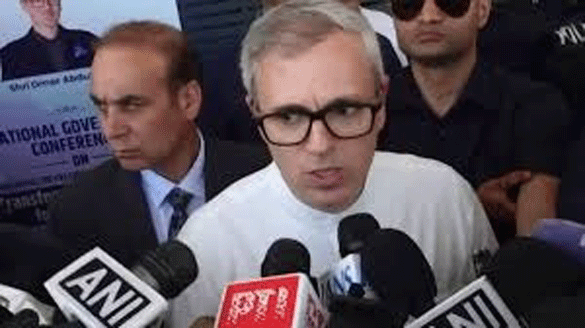
· ‘How can one not feel angry?’: Omar Abdullah condemns killing of Khamenei, appeals to J-K protesters to ‘keep law in mind’
· Trump says ‘someone from within’ Iranian regime might be best choice to lead once war ends
· Saudi Cabinet condemns ‘blatant’ Iranian aggression; affirms Kingdom’s right to respond to threats
· Germany warned of Iranian sleeper cells after Tehran's fatwa on West
· CAIR Condemns Pentagon’s Use of Dangerous Anti-Muslim ‘Holy War’ Rhetoric to Justify Iran Bombing
· West African states to create new force to fight jihadists in region
· Putrajaya says no tolerance for insults to Islam, warns public against spreading false claims
· Afghanistan’s Soil Will Never Be Used Against Any Country, Spokesman
-----
India
· ‘Does PM Modi support assassination of a head of state…’: Rahul Gandhi questions govt’s silence on West Asia conflict
· Mehbooba Mufti mauls Islamic countries for ‘silence’ over ‘martyrdom’ of Iran’s Ali Khamenei
· US, Israel attacks Iran: AIMPLB urges UN to take steps for ceasefire
· PM Modi calls Oman, Kuwait leaders, discusses Indian diaspora safety amid West Asia conflict
· Owaisi slams Union Govt’s advisory to identify pro-Iran radical preachers, calls it double standards
· Middle East conflict: UP village with roots of Khomeini bloodline in grief
· Karnataka’s ‘Mini Iran’ is Shia in faith, but rooted in local culture
· Sidi Saiyyed Mosque to be refurbished; open space area set for upgrade
· FIR against media outlets for ‘distorted narratives’ over Srinagar protests
· Army foils infiltration bid in Bhimber Gali sector in J&K’s Poonch
· NIA says GoPro connected to Pahalgam attack was ‘activated’ in China, court seeks assistance from Chinese authorities
· Army foils terrorists' infiltration bid along LoC in Jammu and Kashmir's Rajouri
---
Mideast
· Israel says it has launched ‘broad wave’ of strikes on Iran, as Tehran widens its response across the region
· Khamenei to be buried in holy city of Mashhad: Iranian media
· Hezbollah defies Beirut’s military ban with fresh strikes on Israel
· Of strikes and succession: How Iran’s ‘mosaic regime’ endures after Khamenei’s killing
· Israeli airspace to ‘gradually’ reopen overnight Wednesday-Thursday: minister
· Prosecutors request swift trial for pair accused of glorifying Iranian attacks against Bahrain
· Syria sends thousands of troops to Lebanon border, sources say
---
Arab World
· Winter ushers in cool comforts, eases fasting in Saudi Arabia
· Saudi development program signs deal to improve livelihoods of smallholder farmers in Yemen
· Riyadh university takes part in academic conference
· Briton found guilty of murdering Saudi Arabia student, 20
· Give back this Ramadan: ‘Share the Joy, Give a Toy’ returns in UAE
---
Europe
· Donald Trump attacks Sadiq Khan and makes wild claim about British 'Sharia courts'
· How Lent and Ramadan unite fasting Londoners
· Man arrested over incident at mosque
· Two more teens arrested over mosque stabbing death
· Sheffield's Muslim community showers city centre in gifts to celebrate Ramadan
· Calls for heightened security at Kirklees mosques after Manchester incident
· 'I take training seriously but Ramadan is more important'
---
North America
· Is Russia the key to ending the Iran war?
· Islamic school exclusion from Texas voucher program is 'religious gerrymandering,' lawsuit alleges
· Michigan Mosque Honors Iran's Khamenei as Martyr
· CAIR-NJ Continues Demand for Accountability, Investigation into Killing of US Teen, Nasrallah Abu Siyam
· CAIR, CAIR Action, and CAIR Texas Urge Texas Muslim Voters to Turn Out for Primary Election
· CAIR-NY Calls on WABC to Drop Sid Rosenberg After Latest Racist ‘Islam Cockroach’ Attack on Mayor Mamdani
· CAIR-Pittsburgh Condemns Nazi Threat Targeting City Mayor
---
Africa
· ‘Nigeria Is Not Safe With What Is Happening In Iran’ – Hakeem Baba-Ahmed
· APC Is The Direct Sponsor Of Terrorism In Nigeria – Former Presidential Candidate
· ‘It Will Never Happen Again’ – CAC Registrar Apologises To Senate Over Snub
· Museveni launches Tamini, Uganda’s first Islamic insurance firm
· Sudan government says drone attacks came 'from Ethiopian territory'
· Army Deploys GOC To Tackle Bauchi Banditry After Deadly Attacks
· RSF drone strike causes blackout in Sudan’s El-Obeid
---
Southeast Asia
· Three men jailed for stealing mosque donation box in Shah Alam
· Malaysians strongly advised to defer non-essential travel to seven Middle East countries
· Rare ‘red moon’ lunar eclipse illuminates Ramadan sky
· PM Anwar demands price stability, supply assurance for Ramadan
· Samsuri’s appointment as Perikatan chairman does not automatically make him PM candidate, says Muhyiddin
· Anwar drops appeal to refer PM immunity questions to Federal Court in Yusoff Rawther civil suit
· Singapore bets on six months of free AI subscriptions to get citizens up to speed
---
South Asia
· The Recent Political Climate Between Afghanistan & Pakistan
· Strait of Hormuz Crisis and Fear of Wider Economic Fallout
· PM lauds Ansar-VDP’s role, assures continued development support
· US Assistant Secretary Paul Kapur arrives in Dhaka
· Integrity in Leadership Is the Foundation of Progress
· Saplings Are Lifelines: Protecting Water and Combating Climate Change
· War Not First Option, But Defence a Duty: Afghanistan Spokesperson
Compiled by New Age Islam News Bureau
URL:
---
‘How can one not feel angry?’: Omar Abdullah condemns killing of Khamenei, appeals to J-K protesters to ‘keep law in mind’
Arun Sharma
Mar 3, 2026
Jammu and Kashmir Chief Minister Omar Abdullah on Tuesday condemned the killing of Iran’s Supreme Leader Ayatollah Ali Khamenei in strikes by the US and Israel. Protests against Khamenei’s killing continued in J&K for a third consecutive day, and the Chief Minister appealed for restraint.
“I condemn the killing of Khamenei and his family,” Abdullah said while talking to journalists after an event in Jammu. “The people of Iran must be the ones to decide their own leadership without any external interference. What law gave America and Israel the right to do this?” he asked.
Calling for the maintenance of peace amid protests in J&K, he said the anger among people regarding the killing of Khamenei was understandable. “I can understand. How can one not feel angry? But in such circumstances, it is most important to control emotions,” he said, appealing to religious leaders to guide people towards maintaining peace.
“You have every right to express your anger, resentment and your faith, but you must keep the law in mind,” he said.
He further said, “I do not want any misuse of force by the police or the central paramilitary forces here, resulting in people getting injured or, God forbid, anyone losing their life. That would be deeply unfortunate.” He appealed to the public not to allow the situation to deteriorate, adding that some people were trying to “spoil the atmosphere”.
He emphasised that protests should be conducted sensitively to ensure the safety of other citizens. “We have to ensure that the lives of other citizens are safeguarded, [so] some permissions were granted and some were later not approved,” he added.
Pointing out that reports of stone-pelting had emerged from certain places since Monday, he said that in one instance, there was an attempt to assault a Deputy Superintendent of Police (DSP), compelling the government to take stricter measures.
“Our effort will be to ensure that people are given the freedom to carry out their activities properly and peacefully as soon as possible,” Abdullah said.
About Indians staying in Iran, Abdullah said that the Jammu and Kashmir government was in close coordination with the Ministry of External Affairs.
“Most of our students and other people who are in Iran have been moved to safe areas,” he said, adding, “Some of our final-year students who are in hospitals are not agreeing to leave.”
He urged them to follow official advisories issued by the embassy, and “if the embassy says we should move to a safe area, then we should go to a safe area”, he said.
Meanwhile, people in most parts of Rajouri and Poonch districts observed a bandh in protest against the killing of Khamenei. At some places, people also held demonstrations against the US and Israel. The bandh was reported to be peaceful in both districts.
Source: indianexpress.com
Please click the following URL to read the text of the original Story
https://indianexpress.com/article/india/omar-abdullah-khamenei-death-jk-protesters-keep-law-in-mind-10563490/
---
Trump says ‘someone from within’ Iranian regime might be best choice to lead once war ends
March 03, 2026
WASHINGTON: President Donald Trump on Tuesday said that “someone from within” the Iranian regime might be the best choice to take power once the US-Israel military campaign is completed — but said “most of the people we had in mind are dead.”
The president, who four days ago had emphatically called on Iranians to “take over your government” once the US-Israel bombardment ends, appeared to drift further away from the idea that the war presents an opportunity to end the theocratic rule that has been in place since the country’s 1979 Islamic revolution.
Trump said that many Iranian officials his administration had viewed as potential new leaders for the country had been killed in the US-Israeli campaign that killed Iranian Supreme Leader Ali Khamenei and many other top officials.
Trump has not publicly identified anyone whom he views as a credible future leader for Iran. And it’s unclear what, if any, outreach the White House had with Iranian officials since the war started.
“Most of the people we had in mind are dead,” he said in an exchange with reporters in the Oval Office. “Now we have another group, they may be dead also, based on reports. So you have a third wave coming. Pretty soon we’re not going to know anybody.”
Trump said Reza Pahlavi, the exiled crown prince of Iran’s last shah who is trying to position himself for a return should Iran’s Shiite theocracy fall, is not someone that his administration has considered in depth to take over leadership in Iran.
“It would seem to me that somebody from within maybe would be more appropriate,” Trump said, adding that it may make sense for “somebody that’s there, that’s currently popular, if there is such a person” to emerge from the power vacuum.
Trump’s comments came as he hosted German Chancellor Friedrich Merz for his first in-person engagement with a foreign leader since the US and Israel launched the war against Iran.
Trump said he wanted to avoid a “worst case” scenario where “somebody takes over who’s as bad as the previous person.”
“That could happen. We don’t want that to happen,” Trump added. “You go through this, and then in five years you realize you put somebody in who was no better.”
The White House is trying to counter criticism
The White House has stepped up its push to counter criticism that it moved unnecessarily quickly to launch a war of choice against Iran.
Trump’s decision to strike last week followed lengthy negotiations by the president’s envoy Steve Witkoff and son-in-law Jared Kushner with the Iranians — talks the US increasingly viewed as an effort to stall any progress.
After the most recent round of discussions in Geneva, Switzerland, last week, Witkoff and Kushner told Trump that reaching a nuclear agreement similar to one that former President Barack Obama struck in 2015 was possible, according to a senior administration official.
The official, who briefed journalists on condition of anonymity, described it as a potential “Obama-plus deal” and Witkoff and Kushner believed such an agreement would take months, but was possible.
Still, even as they expressed their willingness to pursue diplomacy and “fight for every point that we can” if that’s what Trump wanted, the negotiators stressed to the president that the Iranians were not willing to make a deal that would be satisfactory to the US
Trump snaps at the UK, Spain over lack of support
Meanwhile, Trump sharply criticized Britain and Spain for their reluctance to aid the US-Israeli strikes on Iran.
“This is not Winston Churchill that we’re dealing with,” Trump fumed about British Prime Minister Keir Starmer.
Starmer had initially blocked American planes from using British bases for the attacks on Iran that started on Saturday. He later agreed to let the United States use bases in England and on Diego Garcia in the Indian Ocean to strike Iran’s ballistic missiles and their storage sites, but not to hit other targets.
Trump also said he was going to “cut off all trade with Spain,” the day after Foreign Minister José Manuel Albares said his country would not allow the US to use jointly operated bases in southern Spain in any strikes not covered by the United Nations’ charter.
Trump disputes that Israel forced his hand
The president also sought to push back on criticism from some of his staunchest allies over the decision to go to war — questions that grew louder after Secretary of State Marco Rubio said on Monday that the US had decided to strike because “we knew that there was going to be an Israeli action.”
“And we knew that if we didn’t preemptively go after them before they launched those attacks, we would suffer higher casualties,” Rubio said.
But Trump rejected the notion that the White House had been dragged into the conflict by Israel. “We were having negotiations with these lunatics, and it was my opinion that they were going to attack,” Trump said. “If anything, I might have forced Israel’s hand.”
Rubio on Tuesday echoed Trump’s insistence that the decision to attack Iran was made independent of Israel.
Merz said during his visit with Trump at the Oval Office that Germany is “looking forward to the day after” the Iran war is over.
He said Berlin wants to work with the US on a strategy for when the current Iranian government no longer exists.
“We are having a high interest in common approach and common work and what we can do,” Merz said. “And this is this is important not just for the Americans,” he said. “This is extremely important for Europe and extremely important for Israel and their security.”
Merz also noted surging oil prices were damaging the world economy, laying down an argument for finding a quick endgame to the conflict.
The president acknowledged that oil and gas prices were going to rise as the US remains engaged in the strikes — yet argued it would be fleeting.
“We have a little high oil prices for a little while, but as soon as this ends, those prices are going to drop, I believe, lower than even before,” Trump said.
The average price for a gallon of gasoline in the US jumped 11 cents overnight Tuesday to about $3.11 in the United States, according to the AAA.
Source: arabnews.com
Please click the following URL to read the text of the original Story
https://www.arabnews.com/node/2635179/middle-east
---
Saudi Cabinet condemns ‘blatant’ Iranian aggression; affirms Kingdom’s right to respond to threats
March 04, 2026
RIYADH: Saudi Arabia has warned it reserves the “full right” to respond to Iranian aggression following a series of “blatant and cowardly” strikes targeting the capital and the Eastern Province.
The warning came during a late-night Cabinet session on Tuesday, chaired by Crown Prince and Prime Minister Mohammed bin Salman via videoconference, according to the Saudi Press Agency (SPA).
During the session, the Cabinet “reaffirmed Saudi Arabia’s full solidarity with the brotherly countries whose territories were subjected to blatant Iranian aggression”, signaling a united front against regional threats.
The session followed a dramatic escalation of hostilities, including a direct drone attack on the US Embassy in Riyadh.
Major General Turki al-Malki, spokesperson for the Ministry of Defense, confirmed that while air defenses intercepted multiple threats, the embassy compound sustained a “limited fire and minor material damage.”
General Al-Malki further announced that Saudi forces successfully intercepted and destroyed eight additional drones targeting the cities of Riyadh and Al-Kharj early Tuesday morning.
In a sharp rebuke of the embassy strike, the Saudi Ministry of Foreign Affairs (MOFA) cited a flagrant violation of the 1949 Geneva Convention and the 1961 Vienna Convention on Diplomatic Relations.
“The repetition of this flagrant Iranian behavior... will push the region toward further escalation,” the Ministry stated, underscoring that these provocations occurred despite Riyadh’s explicit policy of not allowing its airspace or territory to be used as a launchpad for strikes against Iran.
Global condemnation and solidarity
The Cabinet expressed deep appreciation for the wave of international support as world leaders condemned Tehran’s “indiscriminate” behavior.
In a joint show of force, the US and GCC member states (Bahrain, Kuwait, Qatar, Saudi Arabia and the UAE) along with Jordan stood united, labeling the strikes a “dangerous escalation” and reaffirming a collective right to self-defense.
Leaders from the United Kingdom, France, and India. — including Prime Minister Narendra Modi — voiced strong solidarity with the Kingdom. The UK government confirmed its forces are engaged in “defensive actions” to maintain regional stability.
Amid the heightened military tension, the Cabinet reviewed the Kingdom’s hospitality efforts for GCC citizens currently stranded at Saudi airports due to regional airspace closures. The crown prince reaffirmed that the state would mobilize all capabilities to support brotherly nations in any measures they take to restore regional peace and stability.
Source: arabnews.com
Please click the following URL to read the text of the original Story
https://www.arabnews.com/node/2635182/saudi-arabia
---
Germany warned of Iranian sleeper cells after Tehran's fatwa on West
03/03/2026
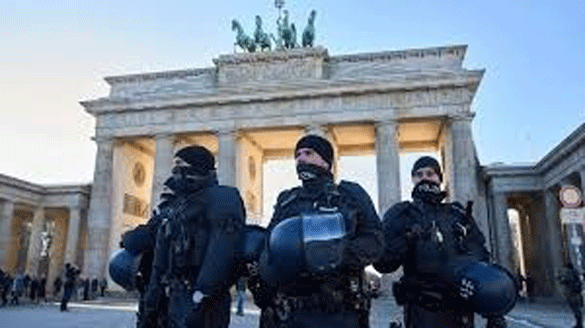
Experts in Germany have warned that Iran-linked sleeper cells could strike in Europe after a fatwa was issued by Tehran over the death of Ayatollah Ali Khamenei, as Berlin boosts vigilance and US probes possible terror attacks.
Germany faces heightened security concerns following a fatwa issued after the killing of Iranian Ayatollah Ali Khamenei, with security experts warning of potential attacks by Iranian sleeper cells across Europe.
Grand Ayatollah Nasser Makarem Shirazi issued a fatwa on 1 March calling for holy war against the US and Israel following Khamenei's death in joint US-Israeli strikes Saturday.
The fatwa declared that all Muslims were obligated to avenge the "blood of the martyr" and identified the US and Israel as "the main perpetrators of this crime", according to Iran's state-run Tasnim News Agency.
A fatwa is a ruling made by an Islamic religious authority or high-ranking scholar, binding on those who recognise their authority.
The Tehran regime has used it repeatedly as a tool of intimidation or terror, with Ayatollah Ruhollah Khomeini issuing a fatwa in 1988 against "unrepentant" opponents to the regime, which led to mass executions.
Another 1989 fatwa by Khomeini against writer Salman Rushdie led to global protests, violent attacks on his translators and publishers — including the shooting of Norwegian publishing company CEO William Nygaard — and a 2022 knife attack on Rushdie, who suffered serious health consequences and lost an eye as a result.
'An accelerant for possible attacks on Europe'
Extremism expert Heiko Heinisch told Euronews he estimates "the risk of spontaneous single offence attacks and the activation of sleeper cells to be relatively high".
Terrorism researcher Nicolas Stockhammer warned the fatwa acts as "an accelerant for possible attacks in Europe", affecting "existing networks, sympathisers and hybrid actors" aimed at a "diffuse, transnational support base".
Heiko Teggatz, head of the German Federal Police Union, said it "cannot be ruled out that Iran will send people all over the world to carry out terrorist attacks on Israeli and American facilities".
US authorities are warning of increased threats from "lone wolf" attacks and sleeper cell activation. Two attacks occurred in North America on Sunday, though exact motives remain under investigation.
A gunman killed two people and wounded 14 at a bar in the Texas city of Austin on Sunday morning. The FBI identified the suspect as Ndiaga Diagne, 53, a naturalised US citizen originally from Senegal.
Diagne wore a sweatshirt reading "Property of Allah" and a shirt featuring the Iranian flag during the attack, according to law enforcement officials who spoke to CBS News and AP. A Quran was found in his vehicle, according to authorities.
The FBI is investigating the shooting as potential terrorism, though officials cautioned Diagne had prior mental health issues. Investigators are examining whether he self-radicalised.
Hours earlier, a boxing gym in Richmond Hill, Ontario owned by Iranian-Canadian dissident Salar Gholami was targeted by a gun attack in the early morning on Sunday. No one was injured.
Gholami, a prominent organiser of anti-regime protests in Toronto, told Iran International he believes the attack was "intimidation directed at critics of the Islamic Republic".
York Regional Police said they are investigating but have not established a motive or made arrests.
Threat change possible 'at any time,' officials say
Germany hosts significant Iranian networks linked to the Islamic Revolutionary Guard Corps. In 2022, Babak J threw a Molotov cocktail at a synagogue in Bochum on behalf of the IRGC. The same year, shots were fired at a rabbi's house in Essen with IRGC involvement.
North Rhine-Westphalia's Interior Ministry told Euronews there are currently "no findings or indications" of specific threats, but acknowledged "a change in the threat situation" is possible "at any time" due to the dynamic situation.
Interior Minister Herbert Reul said, "If there are new findings, we will react immediately and increase the measures."
"We currently have no concrete evidence of a threat" but "our security authorities are monitoring developments closely," Bavaria's Interior Minister Joachim Herrmann told Euronews.
Germany's Federal Ministry of the Interior said all security authorities are "continuously assessing the threat situation" and are "on high alert".
Heinisch noted that since 1979, there have been "over 100 executed and foiled attacks in Europe that can be attributed to Iran". A UK MI5 report from late 2024 mentioned 20 attempted Iranian attacks in Britain since January 2022.
Teggatz urged the German government to "immediately suspend all admission programmes in which NGOs are involved in the selection of people," specifically mentioning Afghanistan, South Sudan and Gaza.
Heinisch criticised political failures: "Politicians should have reacted to the Iranian threat much earlier, put the Revolutionary Guards on the terror list and closed all mosques linked to the Mullah regime, the IRGC or Hezbollah."
Even after the closure of the Islamic Centre in Hamburg, several mosques in Europe remain under direct control of the Iranian regime, according to security experts.
Source: euronews.com
Please click the following URL to read the text of the original Story
https://www.euronews.com/2026/03/03/germany-warned-of-iranian-sleeper-cells-after-tehrans-fatwa-on-west
---
CAIR Condemns Pentagon’s Use of Dangerous Anti-Muslim ‘Holy War’ Rhetoric to Justify Iran Bombing
March 3, 2026
The Council on American-Islamic Relations (CAIR), the nation’s largest Muslim civil rights and advocacy organization, today condemned the Pentagon’s use of dangerous anti-Muslim “holy war rhetoric” to justify bombing Iran.
One commander reportedly told non-commissioned officers at a briefing that the Iran war is part of God’s plan and that President Trump was “anointed by Jesus to light the signal fire in Iran to cause Armageddon and mark his return to Earth.”
CAIR also noted that Defense Secretary Pete Hegseth recently referred to “crazy regimes like Iran, hell-bent on prophetic Islamic delusions.”
In a statement, Washington, D.C., based CAIR said:
“Every American should be deeply disturbed by the ‘holy war’ rhetoric that Secretary Hegseth, Benjamin Netanyahu and even some U.S. military commanders are reportedly using to justify the war on Iran.
“We are not surprised to see Benjamin Netanyahu once again using the biblical story of Amalek – which claims that God commanded the Israelites to murder every man, woman, child and animal in a pagan nation that attacked them – to justify Israel’s mass murder of civilians in Iran, just as it did in Gaza. It is even more unacceptable for U.S. officials and military commanders to embrace similarly dangerous rhetoric, which risks turning this illegal and deadly war into a religious war.
“Mr. Hegseth’s derisive comments about ‘Islamist prophetic delusions,’ an apparent reference to Shia beliefs about religious figures arising near the end times, was unacceptable. So is U.S. military commanders telling troops that war with Iran is a biblical step towards Armageddon.
“This illegal war must end, and so must the dangerous religious rhetoric that everyone from Pete Hegseth to Benjamin Netanyahu is using to justify it.”
Yesterday, CAIR and CAIR Action, one of the nation’s leading Muslim political organizations, released a pre-election primary survey of 1,086 registered Muslim voters from four states – Georgia, Illinois, North Carolina, and Texas – showing high expected turnout among Muslim voters, overwhelming opposition to a new U.S. war in the Middle East, strong disapproval of President Donald Trump, and broad unwillingness to vote for candidates who deny that genocide has occurred in Gaza.
CAIR is encouraging all Americans to contact the White House and their members of Congress to demand an end to the Trump administration’s “unnecessary, unjustified, and unconstitutional” regime-change war launched against Iran for Israel’s benefit.
TAKE ACTION NOW: TELL CONGRESS: NO U.S. WAR WITH IRAN
Last week, CAIR urged all Americans to contact their members of Congress and demand support for the bipartisan Khanna–Massie War Powers Resolution to block President Trump from launching an unauthorized war against Iran.
Last year, CAIR also condemned Israel’s unilateral offensive strikes on Iran and called on the Trump administration to immediately halt all U.S. weapons transfers and military aid to the Netanyahu government.
CAIR previously issued a statement warning President Trump that the Netanyahu government’s insistence that the U.S. adopt a “zero-enrichment” demand in negotiations was meant to scuttle the talks and lead to war, which is exactly what happened.
Source: cair.com
Please click the following URL to read the text of the original Story
https://www.cair.com/press_releases/cair-condemns-pentagons-use-of-dangerous-anti-muslim-holy-war-rhetoric-to-justify-iran-bombing/
---
West African states to create new force to fight jihadists in region
04 March 2026
The 12 countries of the Economic Community of West African States (ECOWAS) have reportedly decided to create a new force to fight jihadists operating in the region.
Sources told the AFP news agency that military chiefs made the decision during a meeting in Freetown over the weekend.
Discussions focused on the rising terrorist threat, the expansion of transnational organised crime, and the persistent challenges related to maritime insecurity.
The initial goal is to have around 2,000 troops ready to fight "terrorism and insecurity" across West Africa.
Sources said they will remain stationed in their own countries, with Sierra Leone serving as a logistical base for the group.
Officials are reportedly still thrashing out the details of how to finance the force and ECOWAS has not yet issued an official statement.
The Sahel, which cuts across Africa between the Sahara and sub-Saharan Africa, has long been plagued by jihadist insurgencies led by groups linked to Al-Qaeda and the Islamic State.
They have been particularly active in three former French colonies -- Burkina Faso, Mali and Niger -- that quit the ECOWAS in recent years following military coups.
The three countries have formed their own alliance, but a West African chief of staff says they will be encouraged to cooperate with the new force.
The three countries "are in a part of the Sahel that is the epicentre of the fight against the jihadists. They must be included," he said.
Source: africanews.com
Please click the following URL to read the text of the original Story
https://www.africanews.com/2026/03/04/west-african-states-to-create-new-force-to-fight-jihadists-in-region/
---
Putrajaya says no tolerance for insults to Islam, warns public against spreading false claims
By Muhammad Yusry
03 Mar 2026
KUALA LUMPUR, March 3 — The Prime Minister’s Office today said the government views seriously the malicious spread of slander, defamatory allegations and false references linked to a recent controversy involving the alleged desecration of the al-Quran.
Senior press secretary to the prime minister, Tunku Nashrul Abaidah, said such actions were clearly intended to discredit the government’s efforts and to create public unrest by conflating separate and unrelated issues.
“With regard to the alleged desecration of the al-Quran involving a university student, the Madani government wishes to reiterate that the individual concerned has been arrested by the police.
“One day after the incident became public knowledge, the police detained him, on February 25. Immediate action was taken and the individual was charged in court today,” he said during an evening briefing that was broadcast live on social media.
Tunku Nashrul stressed that the government would not tolerate any form of insult towards Islam, particularly against the holy Quran.
“As stressed by the prime minister, this country is governed by the rule of law. True justice demands a transparent judicial process, not punishment without due inquiry,” he said.
He urged the public to refer to accurate and credible sources before sharing information, and not to use social media as a platform to spread unsubstantiated allegations.
He also called on Malaysians to allow the legal process to proceed fairly and transparently, and not to exploit the sanctity of religion for partisan political interests.
Source: malaymail.com
Please click the following URL to read the text of the original Story
https://www.malaymail.com/news/malaysia/2026/03/03/putrajaya-says-no-tolerance-for-insults-to-islam-warns-public-against-spreading-false-claims/211191
---
Afghanistan’s Soil Will Never Be Used Against Any Country, Spokesman
March 4, 2026
KABUL: Enayatullah Khwarazmi, spokesman for the Ministry of National Defense, reiterated during a press conference in Kabul that the Islamic Emirate of Afghanistan (IEA) remains firmly committed to ensuring that Afghan territory is not used as a platform for attacks against any foreign nation.
He stressed that this policy has been repeatedly affirmed and remains unchanged.
Khwarazmi stated that war has never been the first option for the Islamic Emirate, and any military responses have been forced upon Afghanistan due to “repeated aggressions by malicious circles.”
According to him, the actions taken by Afghan forces are strictly defensive and are aimed at protecting the country’s sovereignty.
Addressing the ongoing Operation Rad-ul-Zulm, Khwarazmi said it was launched due to persistent violations by Pakistan’s military regime, including airstrikes and operations that targeted civilian homes near the Durand Line.
He described Afghanistan’s military response as a case of “legitimate defense.”
Providing an operational update, he said 150 Pakistani militia members have been killed, more than 200 injured, and nearly 40 enemy posts captured since the start of the operation.
He emphasized that Afghan forces have shown resilience in defending the country’s borders.
Khwarazmi also warned that any attack on Afghanistan would be met with a decisive response. “Whoever has looked at the soil of Afghanistan with an evil eye has had their face rubbed in dust,” he said.
He called on all sides to recognize that the Afghan people do not leave aggression unanswered.
Source: thekabultimes.com
Please click the following URL to read the text of the original Story
https://thekabultimes.com/afghanistans-soil-will-never-be-used-against-any-country-spokesman/
---
India
‘Does PM Modi support assassination of a head of state…’: Rahul Gandhi questions govt’s silence on West Asia conflict
Asad Rehman
Mar 4, 2026
In his first remarks since the situation in West Asia escalated on Sunday and the assassination of Iran’s Supreme Leader, Ayatollah Ali Khamenei, Lok Sabha Leader of Opposition Rahul Gandhi on Tuesday asked if Prime Minister Narendra Modi “supports the assassination of a head of state as a way to define the world order” and said that “silence now diminishes India’s standing in the world”.
Gandhi, who has consistently raised questions over PM Modi’s foreign policy, said: “Escalating hostilities between the United States, Israel and Iran are pushing a fragile region toward wider conflict. Crores of people, including nearly a crore Indians, face uncertainty.”
He said that while security concerns are real, attacks that violate sovereignty will only worsen the crisis. “The unilateral attacks on Iran, as well as Iran’s attacks on other Middle Eastern nations, must be condemned. Violence begets violence – dialogue and restraint remain the only path to peace,” he said in a post on X.
Escalating hostilities between the United States, Israel and Iran are pushing a fragile region toward wider conflict. Crores of people, including nearly a crore Indians, face uncertainty.
While security concerns are real, attacks that violate sovereignty will only worsen the…
Gandhi said that “India must be morally clear” and “should have the courage to speak plainly in defence of international law and human lives”.
“Our foreign policy is rooted in sovereignty and the peaceful resolution of disputes – and it must remain consistent,” said the Congress MP.
“PM Modi must speak up. Does he support the assassination of a head of state as a way to define the world order? Silence now diminishes India’s standing in the world,” wrote Gandhi.
His remarks come on a day when Congress Parliamentary Party chairperson Sonia Gandhi wrote a piece in The Indian Express titled: “Government’s silence on killing of Iran leader is not neutral, it is abdication.”
The veteran Congress leader and Rajya Sabha member wrote: “India has long invoked the ideal of vasudhaiva kutumbakam — the world is one family. That civilisational ethos is not a slogan for ceremonial diplomacy; it implies a commitment to justice, restraint and dialogue, even when doing so is inconvenient. At moments when the rules-based order is under visible strain, silence is abdication. India has long aspired to be more than a regional power; it has sought to serve as the conscience-keeper of the world. That stature was built on a willingness to speak for sovereignty, peace, non-violence and justice even when doing so was inconvenient. At this moment, there is an urgent need for us to rediscover that moral strength and articulate it with clarity and commitment.”
Source: indianexpress.com
Please click the following URL to read the text of the original Story
https://indianexpress.com/article/india/does-pm-modi-support-assassination-of-a-head-of-state-rahul-gandhi-questions-govts-silence-on-west-asia-conflict-10562775/
---
Mehbooba Mufti mauls Islamic countries for ‘silence’ over ‘martyrdom’ of Iran’s Ali Khamenei
March 3, 2026
Peoples Democratic Party (PDP) chief Mehbooba Mufti on Tuesday took strong exception to the Organisation of Islamic Cooperation’s (OIC) response to the recent US-Israel strikes on Iran, calling out the body for what she termed an unsettling silence. She alleged that by not explicitly condemning the attacks and appearing to deflect responsibility toward Tehran, the grouping had failed to stand by the broader Muslim community.
“It is deeply disturbing that the OIC stands as a mute spectator while America and Israel commit blatant aggression against the sovereignty of Iran. Its silence on the martyrdom of Iran’s Supreme Leader, and its attempt to shift blame onto Iran, is not only alarming but disgraceful. Instead of condemning this brazen attack on Iran , it has chosen silence, covertly endorsing the actions of the Epstein gang. This represents a grave betrayal of the collective conscience and interests of the Muslim Ummah.”
She said in her post on X,
Meanwhile, restrictions remained in force across the Kashmir Valley for a second consecutive day on Tuesday, with authorities citing the need to maintain law and order following recent developments in Iran.
Internet speeds were also reduced to curb the circulation of provocative content online.
Senior Shia leaders urged the community to maintain peace while expressing grief over the killing of Iran’s Supreme Leader, Ayatollah Ali Khamenei.
Source: thestatesman.com
Please click the following URL to read the text of the original Story
https://www.thestatesman.com/india/mehbooba-mufti-mauls-islamic-countries-for-silence-over-martyrdom-of-irans-ali-khamenei-1503565561.html
---
US, Israel attacks Iran: AIMPLB urges UN to take steps for ceasefire
Mar 4, 2026
NEW DELHI: The All India Muslim Personal Law Board on Tuesday "strongly and unequivocally condemned" the open aggression by US-Israel against Iran. The board urged the UN and the international community to take immediate, effective, and concrete steps to ensure a ceasefire and prevent the region from descending into a devastating war.
In a press statement, the board's spokesperson, SQR Ilyas, said significant progress had been made in negotiations between Iran and the US regarding Iran's nuclear programme.
He also expressed deep sorrow and grief over the martyrdom of Iran's supreme leader, Ayatollah Khamenei. He said targeting the central leadership of a sovereign country during wartime and openly speaking of regime change constitutes a blatant violation of international law.
AIMPLB urged the Indian govt, UN and international community to take immediate measures to stop the war. "Otherwise, this fire will not remain confined to one region."
Source: indiatimes.com
Please click the following URL to read the text of the original Story
https://timesofindia.indiatimes.com/india/us-israel-attacks-iran-aimplb-urges-un-to-take-steps-for-ceasefire/articleshow/128999709.cms
---
PM Modi calls Oman, Kuwait leaders, discusses Indian diaspora safety amid West Asia conflict
03.03.26
Prime Minister Narendra Modi on Tuesday reached out to Sultan Haitham bin Tarik of Oman and Crown Prince of Kuwait Sheikh Sabah Al-Khaled Al-Hamad Al-Mubarak Al-Sabah, expressing concern over attacks on their countries during the ongoing conflict in West Asia and discussing the welfare and security of the Indian community residing there.
“The prime minister spoke to two important leaders from the Gulf region on Tuesday afternoon. He had a phone call with the Sultan of Oman, Sultan Haitham bin Tarik, and also had a conversation with the Crown Prince of Kuwait, Sheikh Sabah Al-Khaled Al-Hamad Al-Mubarak Al-Sabah,” an official said.
The phone calls took place in the wake of a coordinated offensive launched against Iran by the United States and Israel, in which the Islamic country's supreme leader, Ayatollah Ali Khamenei, was killed. In retaliation, Iran has fired drones and missiles at Israel and US military installations around the Gulf, as well as at the global business and aviation hubs of Dubai and Doha.
The prime minister has also spoken to the heads of Jordan, Bahrain, the United Arab Emirates (UAE) and Israel. He condemned the attacks on Gulf nations, citing violations of their sovereignty and territorial integrity, but did not comment on the US-Israel strikes on Iran, which Tehran has likewise described as breaches of its sovereignty.
New Delhi has not expressed the same degree of solidarity with Iran that the Prime Minister conveyed to the rulers of the UAE, Saudi Arabia and Bahrain.
Congress leader Rahul Gandhi on Tuesday said Prime Minister Narendra Modi must clarify whether he supports the assassination of a head of state as a means of defining the global order. He added that both the unilateral attacks on Iran and Iran’s retaliatory strikes on other Middle Eastern nations must be condemned.
Source: telegraphindia.com
Please click the following URL to read the text of the original Story
https://www.telegraphindia.com/world/pm-modi-calls-oman-kuwait-leaders-discusses-indian-diaspora-safety-amid-west-asia-conflict/cid/2149710
---
Owaisi slams Union Govt’s advisory to identify pro-Iran radical preachers, calls it double standards
March 03, 2026
All India Majlis-e-Ittehadul Muslimeen (AIMIM) president, Asaduddin Owaisi, on Tuesday (March 3, 2026) criticised the Union government’ advisory in which it reportedly directed authorities to identify pro-Iran radical preachers, even as he pointed out that the move “exposes Modi government’s double standards”.
Taking to X, and quoting a media report, he stated, “There is a baba who has violated his bail conditions repeatedly & incited genocide against Muslims. The Central govt itself funded a conference that called for the overthrow of India’s constitution.”
Mr. Owaisi, who represents Hyderabad in the Lok Sabha, claimed that the number of anti-Indian Muslim hate speeches — which reference Gaza genocide by the hands of Israel — had shot up since 2023. “No advisory has ever been issued to counter anti-Muslim hate speech. In those cases, the Centre says that ‘law and order is a state subject’,” the AIMIM president posted.
This 'advisory' exposes Modi government's double standards. There is a baba who has violated his bail conditions repeatedly & incited genocide against Muslims. The Central govt itself funded a conference that called for the overthrow of India's constitution. The number of… pic.twitter.com/7CZ2QV8sWW
Source: thehindu.com
Please click the following URL to read the text of the original Story
https://www.thehindu.com/news/national/telangana/owaisi-slams-union-govts-advisory-to-identify-pro-iran-radical-preachers-calls-it-double-standards/article70698998.ece
---
Middle East conflict: UP village with roots of Khomeini bloodline in grief
Mar 4, 2026
KINTOOR (BARABANKI): In 1834, a Shia cleric named Sayed Ahmad Musavi Hindi left the village of Kintoor in what is now UP on a pilgrimage to Iran. He settled and raised a family there, creating a lineage that would shape Iran's sociopolitical destiny - first through the 1979 Islamic Revolution led by his great-grandson Ruhollah Khomeini, and then the latter's successor Khomeini, Ali Khamenei.
Almost two centuries since Musavi turned his back on Kintoor, this village around 4,000km from Tehran mourns Khamenei's killing last weekend like a death in the family.
Within hours of news arriving about the air strike in which Iran's supreme leader died, Muslim residents of Kintoor - both Shia and Sunni - were out on the streets, holding portraits of Khamenei and shouting slogans against Israel and the US. Shops shut, majlis (assemblies) were organised and processions by mourners dressed in black stretched into the night.
Two days on, the frisson of anger and grief hasn't subsided. "Khamenei opted for bravery instead of surrender," a protester said. "His death is worthy of remembrance."
The story goes that Ahmad Musavi travelled to Iran with the then nawab of Awadh and would have returned to Kintoor, one of the flashpoints of the 1857 Sepoy Mutiny, if British allowed him to. "Musavi saheb fuelled anti-British sentiment in India through his writings, which is why the colonial regime blocked his return," said 33-year-old Adil Kazmi, a descendant of the Ayatollah patriarch's cousin, Mufti Mohammad Quli Musavi.
Ahmad Musavi was born in Kintoor but received an Islamic education at Najaf in Iraq, the cradle of Shia scholarship, to become a respected Twelver Shia cleric. His progeny adopted the name "Khomeini" from the Iranian city of Khomeyn that would later become his adopted home.
Adil's cousin Rehan said Ahmad Musavi retained the suffix "Hindi" after his family surname as a marker of his Indian roots even as he embraced Iran, marrying his mentor's daughter and becoming father to three daughters and a son named Syed Mostafa. The latter was Khomeini's father.
Ahmad Musavi died in 1869 and was buried in Karbala.
Adil's father, 67-year-old Syed Nihal Kazmi, recalls a team from Iran visiting Barabanki 25 years ago to research Khomeini's ancestry and check on the community his ancestors were part of.
Historian Ravi Bhatt traces the migration further back. "It is believed that Khomeini's ancestors had come to India from Nishapur in northeast Iran and later called their relatives to settle in Barabanki, which had become a major Islamic centre," Bhatt told TOI.
Inside homes in Kintoor, portraits of Khomeini still hang on the walls. The family's connection with the village may have been severed two centuries ago, but a part of this Barabanki pocket won't let go.
Source: indiatimes.com
Please click the following URL to read the text of the original Story
https://timesofindia.indiatimes.com/city/lucknow/a-up-village-with-khomeini-roots-mourns-khamenei/articleshowprint/129002925.cms
---
Karnataka’s ‘Mini Iran’ is Shia in faith, but rooted in local culture
Mar 4, 2026
Alipur: Just past Doddaballapur's industrial edge, the road narrows and signboards begin to change with names like Allama Street, Hussain Circle, and Hamza Street. On Sunday, Alipur — about 70km northwest of Bengaluru — fell into a quiet three-day mourning period. Black banners came up on shopfronts, conversations became hushed, and the mood was subdued. For this village, often dubbed ‘Mini Iran', the death of Ayatollah Ali Khamenei was not distant international news. It was personal. He had walked these streets in March 1981.
With a population of around 25,000, roughly 23,009 of them Shia Muslims, Alipur is "administered locally" through Anjuman-e-Jafaria, a community body that residents describe as an advisory and welfare institution. Despite the demographic tilt, several residents stressed that daily life runs on Kannada rhythms.
"Almost 100% of our daily life follows Indian and Kannada culture, with only some Islamic practices," said Alhaj Er Mir Ali Abbas, president of the Anjuman. He explained that the body comprises Islamic scholars and selected members who serve two-year terms, overseeing welfare and mediation. "If people want to go to the police or courts, they can freely do so. Our association handles development, infrastructure, and community needs."
The economic backbone of Alipur lies in gemstones. Chief patron Allama Hujjatul maintained that Alipur's identity is not built on foreign patronage. "Most of our business and lifestyle, like gem trading, comes from our forefathers and Indian tradition, not Iranian culture. We follow Islamic law here most of the time, but people are free to follow their own system as well. We have received no funding from Iran," he said. Many families, he added, send at least one child to study in Iran for religious education, but they "eventually come back".
Though Arab traders are believed to have settled here nearly 300 years ago — and later links with Iran influenced religious practices — the cultural base remains distinctly local. Food habits underline their rootedness. Lunch tables here are more likely to feature ragi mudde, idli, vade, and dose, than any distinctly Iranian fare. Education too follows the state, CBSE, or ICSE syllabi in six schools, including two run by the govt. Land has been donated for a proposed govt first-grade college for girls, reflecting a long-standing emphasis on women's education.
Visit woven into history
That emphasis, according to residents, was sharpened by Khamenei's visit. On that summer day almost 45 years ago, he arrived around 11am, accompanied by associates, during a broader India tour. A Shia delegation had invited him, and security was tight.
Mir Fazil Raza, now secretary of the Anjuman, was 14 then. "We were arranged in rows inside the mosque to welcome him," he recalled. Twelve boys were selected through a lucky draw to formally greet Khamenei. "At the time, they were looking for class 7 and 8 boys who were presentable. I was very happy when I was selected," said Raza. They wore yellow shirts bearing the words ‘Republic of Iran — Welcome' in Farsi or Urdu.
Ahmed Abbas Alipur, 64, a social worker with a doctorate in non-Muslim Urdu poets, was part of the organising team. "We prepared carefully — volunteers were chosen to manage security and for welcome duties," he said. He recalled Khamenei's "energetic address" that lasted about 45 minutes and highlighted the need to respect one's motherland. "He emphasised education, welfare, and local development, and his presence inspired initiatives such as establishing a mini-hospital," Ahmed added.
The hospital became one of that visit's tangible legacies. There were smaller, intimate moments too. Khamenei was taken to a mosque where an elderly man had passed away. At the family's request, he offered prayers for the deceased. Later, he stopped by the fields where a farmer was at work. According to residents, when the farmer attempted to touch his feet, he stopped him, brushed the mud off his hands, and embraced him.
Mir Murtuza Ali, now 96 and a former gram panchayat chairman, hosted Khamenei for lunch. "My nephew was the one who brought him here from Bengaluru. I requested him to have lunch at our place. From my own farm, I provided goats to prepare mutton biryani for everyone," he said, smiling at the memory. "I remember him saying, ‘I don't usually eat this much spice, but since you made it with love, I ate it — it's so good.'" The spot where Khamenei sat has since been turned into a small prayer space.
Principles of coexistence
However, Alipur's social fabric extends beyond its Shia identity. Basavaraj, 68, a farmer born and brought up in the village, spoke of coexistence. "The population of Muslims here is larger, but there haven't been many fights; we've always lived in harmony," he said.
He recalled one tense episode about 30 years ago when Muharram and the Ganesha festival coincided. "A small clash occurred, which police resolved. Since then, whenever there is a festival, the cops usually come. Otherwise, everything is fine — we discuss issues among ourselves, and if there are any problems, we approach the panchayat officials."
Such accounts show the layered reality of ‘Mini Iran'. Residents acknowledge that the 1979 Iranian Revolution influenced certain religious practices here. Hijab use, Quran recitation, and daily prayers follow Shia norms. There are no pubs, theatres, or stadiums, and entertainment is limited. Charity sustains welfare initiatives.
Soon, the shops will reopen, farmers will return to the fields, and classrooms will buzz again. But memories of Ali Khamenei's visit still shape how Alipur sees itself — Indian in daily life, Shia in faith.
Source: indiatimes.com
Please click the following URL to read the text of the original Story
https://timesofindia.indiatimes.com/city/bengaluru/karnatakas-mini-iran-is-shia-in-faith-but-rooted-in-local-culture/articleshowprint/128987328.cms
---
Sidi Saiyyed Mosque to be refurbished; open space area set for upgrade
Mar 3, 2026
THE OPEN space next to the 16th-century Sidi Saiyyed Mosque is being redeveloped into a landscaped public garden featuring a recessed seating plaza inspired by the monument’s iconic latticework, along with new lighting and upgraded amenities.
“We hope to pay tribute to Sidi Saiyyed Jali through the garden,” said landscape architect Aniket Bhagwat from M/s Prabhakar B Bhagwat, who is leading the project.
“That seating space is inspired by one of the motifs in the Jali and it is slightly sunken so that it can deal with the noise of the traffic around,” said Bhagwat.
Work began around two months ago and is being executed under a Corporate Social Responsibility initiative of the UN Mehta Foundation, the philanthropic arm of the Torrent Group, through a memorandum of understanding with the Ahmedabad Municipal Corporation (AMC).
“The Sidi Saiyyed Mosque is a centrally protected monument. The corporation cannot do anything inside it,” said AMC Deputy Commissioner Ramya Bhatt. “The garden that is next to it is being developed.” He added that since the site falls within the regulated zone of a protected monument, approval from the National Monuments Authority was obtained before work began.
While Bhagwat described the central feature as incorporating a fountain within the recessed seating space, the focus would remain on the seating, says Bhatt.
Beyond the garden redevelopment, Bhagwat said the foundation is also assisting the mosque management. “What UNM is doing is helping the mosque with the lighting of the mosque and a little bit of refurbishment of the compound walls and whatever help they require,” he said. He added that efforts are underway to improve water storage arrangements used for ablution and sanitation, noting that permanent construction within an archaeologically protected monument is restricted.
“Efforts are on to ensure that the Sidi Saiyyed Jali is lit well, lighting trials are yet to be conducted” Bhagwat said.
Built in 1572–73 during the final years of the Gujarat Sultanate, the mosque was commissioned by Sidi Saiyyed, an Abyssinian who began life as a slave before rising to prominence. Though modest in scale and lacking the large domes or towering minarets seen in other Indo-Islamic structures, it is known for its ten intricately carved stone jalis, especially the famed “Tree of Life” panel carved from single slabs of yellow sandstone. The motif has since become emblematic of Ahmedabad.
The mosque stands almost at the centre of Ahmedabad’s historic walled city. It has hosted high-profile visitors including Prime Minister Narendra Modi who was accompanied by former Japanese Prime Minister Shinzo Abe during the latter’s 2017 visit.
Ahmedabad has roughly 1.39 sq km of park area across its 464 sq km municipal limits, translating to about 0.25 sq m of green space per person, well below the World Health Organisation’s suggested 9 sq m benchmark. The redevelopment forms part of a broader CSR-led effort to upgrade public gardens across the city.
There is no formal completion deadline. “We’re hoping it’s not more than another four or five months, six months at the most,” Bhagwat said, adding that labour availability during the festival season could affect timelines.
Source: indianexpress.com
Please click the following URL to read the text of the original Story
https://indianexpress.com/article/cities/ahmedabad/sidi-saiyyed-mosque-to-be-refurbished-open-space-area-set-for-upgrade-10563418/
---
FIR against media outlets for ‘distorted narratives’ over Srinagar protests
Mar 03, 2026
he Jammu and Kashmir Police have registered an FIR against several media channels and social media users for allegedly spreading “distorted narratives and unverified content” following Monday’s protests in Srinagar.
Officials on Tuesday said the move targets the “deliberate circulation of false, fabricated, and misleading information” across electronic and social media platforms. While the police did not name specific outlets or indviduals, they confirmed that several profiles have been identified and summoned.
“These elements are systematically attempting to spread distorted narratives with the clear intent to incite unrest, disturb public order, and create disharmony,” a police spokesperson said. “Such malicious misinformation campaigns pose a grave threat to peace, security, and the integrity of the nation.”
On Monday, police used tear gas and “mild force” to disperse Shia Muslim protesters, including women, who had defied restrictions in parts of Srinagar. The demonstrations were held to protest the killing of Iranian leader Ayatollah Ali Khamenei in recent military actions.
The police action drew sharp criticism from political leaders. Srinagar MP Aga Syed Ruhullah Mehdi and PDP leader Iltija Mufti alleged that police physically assaulted women protesters, sharing viral videos on X to back their claims.
The police spokesperson confirmed that FIR No. 01/2026 has been registered at the Cyber Police Station.
“Several profiles have been identified, and concerned individuals have been summoned to the cyber cell. Investigation is underway, and strict legal action will follow against anyone found involved,” the spokesperson added.
Srinagar police further warned that spreading inflammatory or unverified information would invite stringent consequences, advising citizens and media houses to verify facts from official sources before sharing content that could disturb communal harmony.
Source: hindustantimes.com
Please click the following URL to read the text of the original Story
https://www.hindustantimes.com/cities/chandigarh-news/fir-against-media-outlets-for-distorted-narratives-over-srinagar-protests-101772522112330.html
---
Army foils infiltration bid in Bhimber Gali sector in J&K’s Poonch
04 Mar 2026
SRINAGAR: The Army on Wednesday said troops foiled an infiltration attempt by militants along the Bhimber Gali area in the border district of Poonch in Jammu and Kashmir.
In a post on X, Jammu-based White Knight Corps of the Indian Army said, "acting on credible intelligence inputs and sustained surveillance, movement of militants was detected in the general area of Bhimber Gali, early hours, today."
The post also read that the Corps responded with decisive force and showcased superior tactical execution.
The army men swiftly targeted the infiltrators, successfully foiling the infiltration attempt and preventing any breach of the LoC.
“The enemy’s designs were effectively thwarted through coordinated ground action,” the Army said.
It stated that troops have been reoriented to maintain strict domination of the area, supported by integrated ground and aerial surveillance.
“A robust operational posture and heightened alert continue to remain in force across the sector,” it added.
“The wall stands vigilant; every infiltration bid will fail,” the Army asserted.
"The Army and BSF men deployed along the LoC and International Border (IB) in Jammu and Kashmir have been placed on maximum alert in view of apprehension of infiltration attempts by militants from across the border," sources said.
They said the counter-infiltration grid has been further strengthened to foil every infiltration bid at the LoC and IB.
Source: newindianexpress.com
Please click the following URL to read the text of the original Story
https://www.newindianexpress.com/nation/2026/Mar/04/army-foils-infiltration-bid-in-bhimber-gali-sector-in-jks-poonch
---
NIA says GoPro connected to Pahalgam attack was ‘activated’ in China, court seeks assistance from Chinese authorities
Arun Sharma
Mar 4, 2026
An NIA court in Jammu has issued a Letter Rogatory (letter of request) to the competent judicial authority in China for assistance in finding the supply chain and end-user details of an electronic device linked to the probe into last year’s terror attack in Pahalgam.
The move came in response to an application filed by NIA Deputy Inspector General Sandeep Choudhary under BNSS section 112, which empowers Indian courts to issue a ‘Letter of Request’ to authorities in foreign countries regarding evidence that may be outside India.
Terrorists had on April 22 last year killed 25 tourists and a local guide in South Kashmir’s Pahalgam.
Referring to the seizure of various material and electronic devices connected with the conspiracy and execution of the terrorist attack, the NIA application said that one such crucial electronic device was a GoPro camera, which it said was relevant for establishing pre-attack reconnaissance, movement and operational preparation of the terrorist module involved in the Pahalgam attack.
“A lawful notice under the Bharatiya Nagarik Suraksha Sanhita was issued to the manufacturer GoPro B V, seeking details regarding the supply chain and activation of the said device,” the NIA said, adding that the manufacturer in its official response informed that the “said camera was supplied to AE Group International Limited, a distributor based in the People’s Republic of China; and the camera was activated on 30.01.2024 at Dongguan, People’s Republic of China”.
Pointing out that the activation, initial use and commercial trail of the said device lie within the territorial jurisdiction of the People’s Republic of China, the NIA filed the application before the court as the “information necessary to trace the purchaser, end-user, and associated technical records can only be obtained through judicial assistance of the Chinese authorities”.
Exclusive: Pahalgam attackers fired in air in ‘celebration’ after gunning down 26 civilians, star witness tells investigators
“Since India and China are not signatories to any mutual treaty…on the subject, in such an eventuality, assistance as requested can be sought under the United Nations Convention against Transnational Organized Crime (UNTOC) as both the nations have ratified the UNTOC,” observed NIA judge Prem Sagar, adding that the Ministry of Home Affairs has given its concurrence for the issuance of the Letter Rogatory to China to seek legal assistance in the investigation of the case.
Pointing out that a draft Mutual Legal Assistance request is also annexed with the application, the judge held that the information sought is “very important for establishing the chain of custody, user, attribution and evidentiary linkage of the seized device, which was supplied to AE Group International Limited, a distributor based in the People’s Republic of China”.
Source: indianexpress.com
Please click the following URL to read the text of the original Story
https://indianexpress.com/article/india/nia-says-gopro-connected-to-pahalgam-attack-was-activated-in-china-court-seeks-assistance-from-chinese-authorities-10563786/
---
Army foils terrorists' infiltration bid along LoC in Jammu and Kashmir's Rajouri
04.03.26
Army troops on Wednesday scuttled an infiltration attempt by a group of terrorists along the Line of Control (LoC) in Rajouri district, officials said.
The suspected persons were observed trying to sneak into this side from the Turkandi forward area around 4.15 am, prompting the army to open fire, the officials said.
The army's Jammu-based White Knight Corps confirmed that an infiltration attempt by the terrorists from across the border had been foiled.
"Acting on credible intelligence inputs and persistent surveillance, movement of terrorists was detected in the general area of Bhimber Gali, along the LoC during early hours of March 4.
"Responding with decisive force and showcasing superior tactical execution, alert troops of White Knight Corps engaged swiftly, foiling the infiltration attempt and denying any breach of the LoC. The enemy's designs were effectively thwarted through coordinated ground action," it said in a post on X.
Officials said it was not immediately clear whether any terrorist was hit in the firing.
A massive search operation has been launched, with reinforcements inducted to clear the area of any terrorist presence.
"Own troops have been reoriented to ensure relentless domination of the area, supported by integrated ground and aerial surveillance. A robust operational posture and heightened alert remain in force across the sector," the army said, adding, "the wall stands vigilant – every infiltration bid will fail." On February 19-20, army troops foiled an infiltration bid by terrorists in Sunderbani sector of Rajouri, leading to the seizure of some arms and ammunition.
Source: telegraphindia.com
Please click the following URL to read the text of the original Story
https://www.telegraphindia.com/india/army-opens-fire-at-suspected-terrorists-at-line-of-control/cid/2149765
---
Mideast
Israel says it has launched ‘broad wave’ of strikes on Iran, as Tehran widens its response across the region
March 04, 2026
JERUSALEM/DUBAI/TEHRAN: Israel early Wednesday launched new attacks on Iran as the US military said it has hit nearly 2,000 targets inside the Islamic republic, which tried to impose a cost by expanding a missile and drone barrage across the region.
With global energy prices on the rise, President Donald Trump said the US Navy was ready to escort oil tankers through the Strait of Hormuz, the vital chokepoint into the Gulf that Iran has threatened to seal off.
Israel’s military said it launched a “broad wave of strikes” after midnight across Iran, which in the hours before had launched three separate missile barrages at Israel, causing mild injuries to a woman in Tel Aviv.
The US military has destroyed 17 Iranian ships, including a submarine, and struck nearly 2,000 targets in Iran, the commander of the US Central Command said on Tuesday.
“Today, there is not a single Iranian ship underway in the Arabian Gulf, Strait of Hormuz, or Gulf of Oman,” US Central Command’s Brad Cooper said in a video posted to X.
Cooper said the US military has “severely degraded Iran’s air defenses” and taken out hundreds of ballistic missiles, launchers and drones.
The video showed missiles and jets launching from US ships, and targets exploding on the ground.
Cooper noted that Iran has launched over 500 ballistic missiles and more than 2,000 drones in retaliation.
But he said the US is “hunting” Iran’s last remaining mobile ballistic missile launchers to eliminate their “lingering launch capability.”
Cooper said the operation has involved more than 50,000 troops, 200 fighter jets, two aircraft carriers and bombers, and “more capability is on the way.”
“We’ve just begun,” Cooper said, adding that the US military is targeting “all the things that can shoot at us.”
“These forces bring a massive amount of firepower, representing the largest buildup by the US in the Middle East in a generation,” he said in the video message, describing the first day’s barrage as bigger than the so-called “shock and awe” against Saddam Hussein’s Iraq in 2003.
Iran‘s response
The US and Israeli attacks have killed 787 people in Iran, according to the Iranian Red Crescent, a toll that could not be independently confirmed.
Iran vowed to inflict a heavy price in retaliation. Drones struck adjacent the US consulate in Dubai, starting a fire but inflicting no casualties, and against the US military base at Al-Udeid in Qatar.
The attacks came a day after strikes on the US embassies in Riyadh and Kuwait City and on a US air base in Bahrain.
“We are saying to the enemy that if it decides to hit our main centers, we will hit all economic centers in the region,” Islamic Revolutionary Guard General Ebrahim Jabbari said.
Iranian attacks have killed at least nine people and wounded dozens in the Gulf region, according to various reports quoting local authorities.
Among the latest death was an 11-year-old girl who was killed after shrapnel fell in a residential area in Kuwait City, health authorities said Wednesday.
The Kuwait army said in a statement the shrapnel fell over a house and left casualties while forces were intercepting “several hostile aerial targets” over the country.
The Health Ministry said in a separate statement that the child died of her wounds at the hospital.
The child’s mother and three other relatives were injured and being treated at the hospital, it said.
Vessel hit in Gulf of Oman
A vessel was hit by a projectile early Wednesday in the Gulf of Oman off the United Arab Emirates, an agency of the UK military said.
There were no reported casualties.
The United Kingdom Maritime Trade Operations Center said the vessel was struck 8 miles east of Fujairah, one of the UAE’s seven emirates.
The attack damaged the vessel’s steel plating.
No fire or water intake was reported, it said.
Iran hits US embassies
The US State Department said Tuesday it’s preparing military and charter flights for Americans who want to leave the Middle East. Several other countries also arranged evacuation flights for their citizens.
An attack from two drones on the US Embassy in Riyadh caused a “limited fire,” according to the Saudi Arabian Defense Ministry, and the embassy urged Americans to avoid the compound.
An Iranian drone struck a parking lot outside the US consulate in Dubai, sparking a small fire, Secretary of State Marco Rubio said in Washington. He said all personnel were accounted for.
The United Arab Emirates said it has intercepted the vast majority of more than 1,000 Iranian missile and drone attacks against it.
US embassies in Saudi Arabia, Kuwait and Lebanon said they were closed to the public.
The US State Department ordered the evacuation of non-emergency personnel and family in Kuwait, Bahrain, Iraq, Qatar, Jordan and the United Arab Emirates. And US citizens were urged to leave more than a dozen Middle Eastern countries, though many were stranded because of airspace closures.
The US military has confirmed six deaths of American service members.
Four of the American soldiers killed were identified as Capt. Cody A. Khork, 35, of Winter Haven, Florida; Sgt. 1st Class Noah L. Tietjens, 42, of Bellevue, Nebraska; Sgt. 1st Class Nicole M. Amor, 39, of White Bear Lake, Minnesota; and Sgt, Declan J. Coady, 20, of West Des Moines, lowa, who received a posthumous promotion in rank. They were assigned to the Iowa-based 103rd Sustainment Command.
Ghost town
In Tehran, residents who have not fled remained shut away in their homes for fear of the US-Israeli bombardment.
The Iranian capital is normally home to around 10 million people, but in recent days “there are so few people that you’d think no one ever lived here,” said Samireh, a 33-year-old nurse.
Authorities had previously urged people to leave the city, and police officers, armed security forces and armored vehicles have been stationed at main junctions, carrying out random checks on vehicles.
In the more upmarket north of Tehran, the meowing of cats and chirping of birds replaced the usual din of traffic jams.
Iranian authorities said a strike on a school in the city of Minab on the first day of the war killed more than 150 people.
Drone downed near Baghdad airport
In Baghdad, a drone was shot down on Wednesday near Baghdad’s international airport, a day after a similar attack on the facility, two security sources told AFP.
“A drone was downed near Baghdad airport, with no casualties or material damage reported,” an Iraqi security source said. Another security source in Baghdad confirmed the incident.
The airport includes a military base that hosts a US diplomatic facility and previously housed US-led coalition troops.
Source: arabnews.com
Please click the following URL to read the text of the original Story
https://www.arabnews.com/node/2635183/middle-east
---
Khamenei to be buried in holy city of Mashhad: Iranian media
March 03, 2026
TEHRAN: Iran’s slain supreme leader Ayatollah Ali Khamenei will be buried in the holy city of Mashhad, the Fars news agency said Tuesday.
Khamenei, who led the country for 36 years, was killed at 86 during a wave of US-Israeli attacks on Saturday.
He was originally from Mashhad, Iran’s second-largest city, where his father is buried at the Imam Reza shrine.
Before the burial, a “large farewell ceremony” will be held in Tehran, the Revolutionary Guards said on their Telegram account.
No date for the burial was disclosed.
After Khamenei’s death, power was entrusted to a three-man interim council until the Assembly of Experts elects his successor.
It includes the president, the head of the judiciary and a jurist from the Guardian Council, the body that oversees legislation and vets electoral candidates.
Fars, citing an official familiar with the process, reported that “for security reasons,” the assembly’s final meeting could be postponed until after Khamenei’s burial.
Iranian media said the building housing the 88-member body in the holy city of Qom, south of Tehran, was hit Tuesday by US-Israeli strikes.
Its main headquarters in the Iranian capital was also struck the day before.
Source: arabnews.com
Please click the following URL to read the text of the original Story
https://www.arabnews.com/node/2635159/middle-east
---
Hezbollah defies Beirut’s military ban with fresh strikes on Israel
March 03, 2026
BEIRUT: Lebanese militant group Hezbollah said Tuesday it targeted several Israeli military bases and tanks in response to Israeli strikes on the group’s strongholds in Lebanon, including the south Beirut suburbs.
Israel continues to carry out successive air raids, particularly on Beirut’s southern suburbs and the south of the country, after issuing evacuation warnings to residents, while Lebanese authorities on Monday recorded the displacement of more than 58,000 people from areas hit by the strikes.
Israel announced Tuesday morning it had begun a new round of “simultaneous strikes in Tehran and Beirut.”
It announced later that day that it hit “approximately 60” targets “belonging to the Hezbollah and Hamas terrorist organizations.”
The Israeli military also said it had deployed troops to several locations in southern Lebanon in what it described as a “forward defense” measure along the border.
Defense Minister Israel Katz said he “authorized the Israel Defense Forces (IDF) to advance and take control of additional strategic positions in Lebanon in order to prevent attacks on Israeli border communities.”
Lebanon was drawn into the regional war on Monday after an initial attack on Israel by Hezbollah, which said it wanted to “avenge” the killing of Iranian supreme leader Ayatollah Ali Khamenei during the US-Israeli strikes.
Israel promptly launched large-scale strikes on Lebanon, where the government on Monday declared an immediate ban on Hezbollah’s military activities.
In separate statements, Hezbollah on Tuesday claimed responsibility for 11 attacks on Israel, saying it targeted at least five Israeli tanks, three of them in Lebanese territory using guided missiles and “appropriate weapons.”
The group also said it used attack drones and rocket salvos to target several bases in northern Israel and the Golan Heights, occupied by Israel since 1967.
Additionally, it claimed to have downed an Israeli drone over the southern city of Nabatiyeh.
These attacks came “in response to the criminal Israeli aggression on dozens of Lebanese cities and towns,” Hezbollah said.
Since the early morning hours, Beirut’s southern suburbs have been subjected to a series of air strikes targeting several buildings after evacuation warnings.
AFP photographers saw huge plumes of smoke rising into the air and obscuring the sky.
Hezbollah’s Al-Manar TV broadcaster said its Beirut headquarters had been targeted overnight and announced Tuesday morning that Israel targeted the offices of Hezbollah’s Al-Nour radio broadcaster as well.
In a statement, Hezbollah condemned the strikes on “two civilian media outlets” saying they were aimed at “silencing the voice and image of the resistance.”
The southern city of Sidon, largely spared during the last Hezbollah-Israel war, was struck twice on Tuesday.
One strike hit a headquarters belonging to Jamaa Islamiya, an Islamist group allied with Hamas and Hezbollah, and the other came after an evacuation warning elsewhere in the city.
The surroundings of Tyre, further south, were also struck after evacuation warnings.
Source: arabnews.com
Please click the following URL to read the text of the original Story
https://www.arabnews.com/node/2635176/middle-east
---
Of strikes and succession: How Iran’s ‘mosaic regime’ endures after Khamenei’s killing
Jonathan Gornall
March 03, 2026
LONDON: Iran’s supreme leader, Ali Khamenei, was killed on Saturday along with much of the Iranian regime’s senior civilian and military leadership. But, thanks to Iran’s “mosaic” leadership structure, the regime itself is far from dead.
When Iran’s first supreme leader, Ayatollah Ruhollah Khomeini, died of natural causes in 1989, his successor, Khamenei, took office the very next day.
Now Khamenei is dead, killed along with dozens of members of his family and other senior Iranian leaders in a series of US and Israeli attacks on targets across Tehran. Days later, the succession question remains unanswered.
But this, experts suggest, does not mean that Iran is drifting rudderless in a power vacuum — or that cutting off the head will kill the snake.
“The Iranian regime is a system that was built to last,” said Dr Burcu Ozcelik, a senior research fellow at the London-based Royal United Services Institute.
“It has constitutional provisions in place and deep contingency planning, with four or five names for each key role, and so there was a high level of preparedness for a leadership decapitation campaign.”
Contingencies for just such an eventuality, which were first put in place at the end of the Iran-Iraq war in 1988, “were stepped up after Oct. 7, 2023, when the Iranians assessed that there would be a long-lasting confrontation with Israel.
“And although the attacks that followed didn’t lead to a regional confrontation of the sort we are seeing now, the Iranians have been long preparing for this.”
This is what Robert Pape, a professor of political science at the University of Chicago, specializing in international security affairs, characterized this week as “the mosaic regime.”
“Iran anticipated decapitation long before (the US operation) Epic Fury began,” he wrote on Substack.
“Under its ‘mosaic’ leadership defense doctrine, authority is dispersed into semi-autonomous cells across military, security, and political domains. Redundancy substitutes for hierarchy.”
Pape added: “Airpower kills leaders; it does not easily kill distributed function.”
This was reflected in comments from Mohammad Bagher Ghalibaf, the speaker of Iran’s parliament, who said the regime had “prepared for these moments” and had “planned for all scenarios.”
Indeed, despite multiple attacks by Israel and the US on senior civilian and military leadership, the drones and missiles keep coming across the Arabian Gulf.
The Iranian state “can be best described as polymorphous,” said Dr. Arshin Adib-Moghaddam, professor of global thought and comparative philosophies at the Department of Politics and International Studies at the School of Oriental and African Studies in London.
Western media, he added, “has a skewed understanding of the political dynamics in Iran and there is also a political agenda behind the misrepresentations.
“The tragedy is that this false reality informs decisions. This is why we are facing this horrific war. Bad, ideological knowledge created bad, impulsive decisions.”
Within Iran, he said, “there are several institutions that compete with each other and are anchored quite firmly in networks permeating society.”
At the heart of the system is the supreme leader, who supervises the other branches of government, including elected bodies such as the presidency, the Assembly of Experts and the parliament.
“And then there are the security layers, the military (Artesh), the Islamic Revolutionary Guard Corps and their underbellies — for instance the Basij units with their representation in every university, municipal council, large organizations and even the smallest villages of the country.”
In addition, “there are theological power centers in the Shiite-Islamic seminaries surrounding the holy sites in Mashhad and Qom.
“It is this polymorphic structure that explains why the Israel-US assassination campaign hasn’t disrupted the ability of Iran to govern the country, certainly for now.”
Sooner or later a new supreme leader will have to be appointed. The constitution of the Islamic Republic of Iran lays down a precise process.
In theory, a serving leader designates his preferred successor, whose appointment after his death is subject to approval by the Assembly of Experts — a panel of 88 Islamic jurists.
The Assembly of Experts building in Qom was itself struck on Tuesday as regime clerics were gathering to elect a new supreme leader, according to local media. At the time of writing, it was not immediately clear who was inside. If confirmed, the attack is likely to delay the process further.
“I don’t know that a date has been set,” said RUSI’s Ozcelik. “I think the language being used is that it would be ‘in the near future.’
“But there will be security concerns around a physical meeting of key clerical figures that would certainly be on the radar of American and Israeli intelligence and, given the circumstances, I think the regime can continue to justify not a delay but a considered longer timeline.”
It remains unknown who, if anyone, Khamenei had designated as his successor. If he had not, it might fall to the Assembly of Experts to pick someone.
The field of candidates is larger than it once was. Under the original terms of the constitution, framed after the 1979 revolution, a supreme leader had to be chosen from among the pool of Grand Ayatollahs.
That changed when Ayatollah Khomeini’s original choice to succeed him, Grand Ayatollah Hussein Ali Montazeri, fell out of favor and was dropped from the succession after he began to publicly criticize some of the violent excesses of the regime.
The constitution was then amended, opening up the field of succession beyond the limited cohort of Grand Ayatollahs, which allowed Khomeini to designate Khamenei as his successor. The Assembly of Experts endorsed his choice on June 3, 1989.
In the meantime, Iran is being run, as dictated by the constitution, by a three-man council. The council, which was formed on Sunday, consists of President Masoud Pezeshkian, judiciary chief Gholamhossein Mohseni Ejei, and senior cleric Alireza Arafi.
In theory, these are the men that US President Donald Trump would be talking to should the US decide to reopen negotiations. However, Tuesday’s attack on the Presidential Office suggests no one in the regime is safe.
“I don’t know if these three are actually targets,” said Ozcelik. “Although I think that would be consistent with what we’ve seen from the Israelis’ point of view.
“But I’m not sure how helpful it would be to take out a figure such as President Pezeshkian, who in Iranian terms is a moderate, and a potential point of contact with whom Trump and his administration could have talks going forward.
“And whenever this concludes, there will need to be someone in Tehran who is able to pick up the phone when Trump calls.”
Who that might be right now is as much a question of who remains alive as anything else, said Mona Yacoubian, director and senior adviser of the Middle East Program at the Center for Strategic and International Studies in Washington.
“I’m going to guess that the US would engage with those with whom they’ve engaged in the past, whether it’s Foreign Minister Abbas Araghchi, or possibly Ali Larijani, secretary of the Supreme National Security Council,” she said.
“Those are, I think, the two key people I would highlight, which doesn’t necessarily overlap with that Transitional Council.”
That said, as the death toll among Iranian leaders continues to mount, it could be that no one is now safe.
“And the message that sends is one of regime change,” said Yacoubian. “That’s what the US and Israel in particular have been focused on.
“We have heard President Trump, in one of his many different interactions with various members of the media, note that the US had identified successors, and that those successors had been killed.
“I think that about sums it up, and that’s why I think that any public naming of a supreme leader may not come for some time.”
She added: “In some ways, it’s not clear how important that is at this point. I think the focus in Iran right now is very much on maintaining regime cohesion, such as it exists.
“The military and security circles have long been engaged on these questions and have been thinking through this type of scenario planning.
“So I don’t know how significant it is that we have yet to hear of a new supreme leader being named because these other centers of power, which have long existed in Iran, were likely already planning for a post-Khamenei transition well before this current conflict started, and they are clearly still acting and working, perhaps in a decentralized way.
“So yes, there have been decapitation strikes. But what that actually means in terms of how the system in Iran is operating is unclear.”
Source: arabnews.com
Please click the following URL to read the text of the original Story
https://www.arabnews.com/node/2635168/middle-east
---
Israeli airspace to ‘gradually’ reopen overnight Wednesday-Thursday: minister
March 03, 2026
JERUSALEM: Israel’s transport minister said the country will gradually reopen its airspace overnight between Wednesday and Thursday, after it was closed to civilian flights as the US and Israel launched strikes on Iran.
The initial approved flights will be to repatriate Israelis, a transport ministry spokesperson told AFP, adding that there will be no departures for now.
“The airspace will reopen gradually starting already on the night between Wednesday and Thursday, and of course subject to security developments,” Miri Regev said during a press conference at Tel Aviv’s Ben Gurion Airport.
The reopening had initially been scheduled for next week but was moved up “following security assessments with professional and security experts,” Regev said.
Sharon Kedmi, director general of the Israel Airports Authority, told reporters the re-opening will begin “very cautiously, with one aircraft per hour during the first 24 hours — a narrow-body aircraft.”
“After 24 hours, if everything works as planned, we will increase to two narrow-body aircraft per hour or one wide-body aircraft,” he added.
Israel closed its airspace to civilian flights Saturday after announcing the launch of a campaign of “preventive strikes” against Iran together with the US.
Source: arabnews.com
Please click the following URL to read the text of the original Story
https://www.arabnews.com/node/2635160/middle-east
---
Prosecutors request swift trial for pair accused of glorifying Iranian attacks against Bahrain
March 04, 2026
BEIRUT: Prosecutors in Bahrain have requested a swift trial for two suspects accused of posting messages on social media glorifying and promoting recent Iranian attacks against Manama.
In a message posted on social media platform X, Bahrain’s Public Prosecution said the unnamed individuals shared videos of Iranian attacks against military sites and other locations in the Kingdom. The suspects expressed joy about these terrorist acts, encouraged them and called for them to continue, prosecutors added.
They said they had received criminal reports from cybercrime officials about a number of social media accounts posting footage of Iranian attacks targeting military installations, where filming is prohibited, as well as strikes on public and private properties.
An investigation by law enforcement officers revealed the identities of the suspects, prosecutors said, and they were detained. No date was specified for an expedited trial.
Source: arabnews.com
Please click the following URL to read the text of the original Story
https://www.arabnews.com/node/2635178/middle-east
---
Syria sends thousands of troops to Lebanon border, sources say
March 03, 2026
DAMASCUS/BEIRUT: Syria has reinforced its border with Lebanon with rocket units and thousands of troops, eight Syrian and Lebanese sources said on Tuesday, as conflict spread in the region including between Israel and Hezbollah in Lebanon.
The sources included five Syrian military officers, a Syrian security official and two Lebanese security officials who spoke on condition of anonymity.
The Syrian officers said the Syrian reinforcement operation began in February but sped up in recent days. The Syrian and Lebanese armed forces did not immediately respond to requests for comment.
The Syrian officers, including a senior member of the military, said the move was aimed at preventing arms and drugs smuggling as well blocking Iran-backed Lebanese Hezbollah or other militants from infiltrating Syria.
A Syrian officer told Reuters that military formations from several Syrian army divisions, including the 52nd and 84th Divisions, have expanded their presence along the border in western Homs countryside and south of Tartus.
The reinforcements include infantry units, armored vehicles and short-range Grad and Katyusha rocket launchers, the official said.
The Syrian security official said Damascus had no plans for military action against any neighboring country. “But Syria is prepared to deal with any security threat to itself or its partners,” he said.
Still, the move has fueled concern among some European and Lebanese officials over a possible incursion.
The Syrian military officers vehemently denied any such plans, saying Syria wants balanced relations with its neighbor after decades of strained ties linked to Syria’s outsized influence in Lebanon and Hezbollah’s support for the former government of Syrian President Bashar Assad during a 14-year civil war.
Syria had troops stationed in Lebanon from 1976 until 2005 including during Lebanon’s civil war that ended in 1990.
Hezbollah resumed firing at Israel on Monday more than a year after reaching a ceasefire to a months-long war in 2024. Since that ceasefire, Israel continued near-daily strikes.
Israel this week ordered much of Lebanon’s south evacuated, with tens of thousands of people displaced. Israeli airstrikes across Lebanon’s South and southern Beirut have killed dozens and prompted thousands of people to flee toward Syria.
A senior Lebanese security official said Syrian authorities told Beirut that Syria’s deployment of rocket launchers along the mountains that form Lebanon’s eastern border with Syria was a “defensive measure against any action or attack that Hezbollah might launch against Syria.”
Source: arabnews.com
Please click the following URL to read the text of the original Story
https://www.arabnews.com/node/2635153/middle-east
---
Arab World
Winter ushers in cool comforts, eases fasting in Saudi Arabia
Rashid Hassan
March 03, 2026
RIYADH: This year, Ramadan is being observed in winter in Saudi Arabia and much of the region, bringing cooler temperatures and shorter fasting hours.
In Riyadh, temperatures have ranged from 8-20 C, while parts of the Northern Borders region have recorded lows of 3 C. The milder weather coincides with the holy month, which this year falls from mid-February to mid-March.
Because the Islamic Hijri calendar is around 11 days shorter than the Gregorian year, Ramadan shifts each year, becoming gradually earlier. Cloudy skies and intermittent rain have also kept temperatures low in parts of the Kingdom and forecasts indicate continued cool conditions.
According to the National Center for Meteorology: “Starting Tuesday until the end of the current week, the cold weather will continue in the northern regions, while temperatures will drop from Wednesday in the regions of Riyadh, Qassim, and the Eastern Province.”
The forecast added that thunderstorms accompanied by hail may occur in parts of Eastern Region, Riyadh, Najran, Jazan, Aseer and Baha. Fog may also form. Rain showers are expected in parts of Northern Borders, Al-Jouf, Hail, Qassim and Madinah.
For many residents, the cooler weather has made fasting from dawn to sunset more manageable compared with previous years when Ramadan fell during the peak summer heat.
“Ramadan in winter offers a more comfortable fasting experience, characterized by shorter daylight hours and cooler temperatures, which significantly reduce hunger, dehydration and fatigue,” Nafisa Usman, an Indian homemaker who has lived in Riyadh for more than two decades, told Arab News.
Although last year had pleasant weather for much of the holy month, prior to that Muslims had endured the challenge of fasting during long, hot summer days.
Thamr Al-Otaibi, a property dealer in the capital, said shorter days allowed people to break their fast earlier and avoid prolonged exposure to high temperatures.
“This pleasant weather is a welcome change, as it lightens the physical burden of fasting,” he added. “The cool weather also enables engaging in outdoor activities during the day as well as after the iftar. It was a tough task during the summer.”
Mohammed Asghar, a Pakistani taxi driver in Riyadh, said: “Fasting in winter is (easier), particularly for those of us who cannot always stop for iftar due to the nature of our work. This pleasant weather, warm days, cool nights, not only makes fasting less daunting but also improves our overall well-being, making the spiritual journey more engaging.”
Shahid Anwar, a safety manager, echoed that view, saying fasting at outdoor work sites was much easier in the current conditions.
“The confluence of spiritual reflection and favorable weather makes Ramadan a uniquely enjoyable experience,” he added. “The nights are particularly lively, with traditional decorations and treats drawing more people outdoors than in the hotter days during the summer.”
With milder temperatures, some community groups have opted to hold outdoor iftars, such as the annual gathering of AMUOBA Riyadh, an alumni association of India’s Aligarh Muslim University.
Source: arabnews.com
Please click the following URL to read the text of the original Story
https://www.arabnews.com/node/2635167/saudi-arabia
---
Saudi development program signs deal to improve livelihoods of smallholder farmers in Yemen
March 03, 2026
RIYADH: Representatives from the Saudi Program for Development and Reconstruction of Yemen and the Response Foundation for Humanitarian and Relief Work signed an agreement on Tuesday to implement the “Strengthening the Agricultural Value Chain for Smallholders” project.
The scheme targets about 2,300 Yemeni families — more than 16,000 beneficiaries — across three governorates of agricultural and economic importance: Abyan, Marib and Hadramout, the SDRPY said in a post on X.
The project supports key sectors that affect livelihoods, particularly agriculture, which remains a central pillar of economic stability in Yemen.
Source: arabnews.com
Please click the following URL to read the text of the original Story
https://www.arabnews.com/node/2635162/saudi-arabia
---
Riyadh university takes part in academic conference
March 04, 2026
RIYADH: The Deanship of the Common First Year at King Saud University took part in the 45th Annual Conference on the First-Year Experience, held in Seattle, US.
This year’s edition focused on students’ academic and social transitions, guided advising, retention strategies and enhancing student engagement, in addition to showcasing successful institutional models for building sustainable transitional pathways.
The university’s participation aligns with a strategic direction that positions the first-year experience as a cornerstone of the quality of university outcomes.
During the scientific sessions and workshops, the dean delivered remarks highlighting the importance of intentionally designing the first-year student experience, emphasizing that academic support and advising programs should not be viewed as parallel services, but rather as an integral part of the educational experience’s structure.
He also reviewed models of the deanship’s initiatives to support new students, including early follow-up mechanisms and academic and skills development programs aimed at fostering university readiness from the first weeks of study.
The deanship said that its participation in the international conference aligns with a strategic direction to strengthen King Saud University’s institutional presence on specialized academic platforms and to leverage global expertise to develop policies and practices that support new students.
Source: arabnews.com
Please click the following URL to read the text of the original Story
https://www.arabnews.com/node/2635169/saudi-arabia
---
Briton found guilty of murdering Saudi Arabia student, 20
March 03, 2026
RIYADH: A British construction worker has been found guilty of murdering 20-year-old Saudi Arabia citizen Mohammed Al-Qasim who was studying English in Cambridge, the BBC has reported.
Chas Corrigan, 22, of Holbrook Road, had been drinking and using cocaine before he stabbed Al-Qasim in the neck on Aug. 1, 2025, prosecutors said on Monday.
Corrigan denied murder but admitted possession of a knife and told the court that he had waved it, intending to scare and not injure.
He told the court he did not realize that Al-Qasim was injured at all, and that he could not remember the exact details of their conversation. He will be sentenced at a later date.
Family members and friends of Al-Qasim told Arab News previously that the young man’s killing was a “devastating shock.”
“Mohammed was deeply loved and left a lasting impression on all who knew him, especially as the only son to his parents, born after four daughters,” said uncle Abdulrahman Al-Qasim.
The senseless murder was caught on video, which was shown to jurors, depicting Corrigan speaking to Al-Qasim and his friends.
He walked away before returning and becoming involved in an altercation.
Corrigan told jurors he had been drinking in a nearby pub and had consumed around six pints of Guinness, one or two gin and tonics and several drinks containing vodka, and had also used cocaine twice.
Despite this, he told jurors that he was “not drunk,” and claimed that he was carrying a kitchen knife for self-defense after having been attacked in the past.
Although he could not remember the details of the conversation, Corrigan said that Al-Qasim “startled” him, adding “I thought he was going to hurt me.”
Prosecutors said a silver kitchen knife with a 13-centimeter blade was later found among plants in a nearby street.
Corrigan’s father Peter, who is in his early 50s and lives in Vinter Terrace, has admitted assisting an offender. He is also waiting to be sentenced.
EF International Language Campuses Cambridge, where Al-Qasim was studying, previously said in a statement to Arab News: “Mohammed was a bright and kind young man who quickly became a valued part of our community.
“He was known for his positivity, curiosity, and warmth toward everyone around him.”
Source: arabnews.com
Please click the following URL to read the text of the original Story
https://www.arabnews.com/node/2635117/saudi-arabia
---
Give back this Ramadan: ‘Share the Joy, Give a Toy’ returns in UAE
March 03, 2026
Dubai: As the spirit of Ramadan gathers communities together across the UAE, Landmark Leisure has announced the revival of its much-loved campaign to spread happiness among children in need.
In partnership with the Emirates Red Crescent and the Islamic Affairs & Charitable Activities Department (IACAD), the entertainment division of the Landmark Group has brought back the ‘Share the Joy, Give a Toy’ initiative through its flagship brand, Fun City Arabia.
The drive aims to collect preloved toys in good condition and distribute them to underprivileged children across the country.
A platform for kindness
In a statement, Silvio Liedtke, CEO of Landmark Leisure, GCC and India, has noted that Ramadan is a time when communities unite through “acts of kindness and generosity.”
“‘Share the Joy, Give a Toy’ is a platform that encourages families to be a part of this act of kindness by donating toys that can bring joy to children in need,” said Liedtke.
“This Ramadan, we are delighted to continue this initiative with our partners and the community, and we look forward to seeing families come together to share the joy of giving.”
Multiple drop-off points
Families have been invited to donate gently used toys at participating Fun City locations across the UAE. These will be carefully collected and distributed through Emirates Red Crescent and IACAD to ensure that it will reach the children who need them most.
To make participation more accessible, drop-off boxes will be available at Fun City outlets located in key malls across the country. Participating locations include Arabian Centre, Mercato Mall, Century Mall (Mamzar), Ibn Battuta Mall, Oasis Centre, Nad Al Sheba Mall, Abu Dhabi Mall, Dalma Mall, Al Falah Central Mall, Al Seef Village Mall, Marina Mall, Kalba Mall, Oasis Sharjah, Bawadi Mall, and Al Hamra Mall.
Additional drop-off points are available at Fun Block in Zero6 Mall, Fujairah Mall, Souq Al Jami, Barari Outlet Mall, Fun Works, and Tridom outlets in the UAE.
The initiative also extends to Qatar through Fun Ville locations at Al Khor Mall, Ezdan Mall (Al Gharafa), Al Asmakh Mall, Barwa Village, Ezdan Mall (Wakrah), Barwa City, and Abu Sidra Mall.
“These stores were chosen for easy access, enabling families and visitors to participate and bring joy to children who need them. With multiple drop-off points across the city, Landmark Leisure aims to make the act of giving more accessible and impactful,” said the group.
Beyond bringing smiles to young faces, the project has shared a common goal to promote “compassion, responsible giving, and sustainability.” By giving toys a second life, families can contribute to the cause of sustainable consumption and responsible reuse.
For more details about the donation drive, interested guests may visit the official website of Fun City Arabia. With small acts of generosity, families across the UAE can help make this Ramadan brighter for children in need.
Source: gulfnews.com
Please click the following URL to read the text of the original Story
https://gulfnews.com/uae/give-back-this-ramadan-share-the-joy-give-a-toy-returns-in-uae-1.500462115
---
Europe
Donald Trump attacks Sadiq Khan and makes wild claim about British 'Sharia courts'
Mikey Smith
03 Mar 2026
Donald Trump attacked Sadiq Khan and claimed "Sharia courts" operate in the UK as he lashed out over Britain being "uncooperative" over Iran. He tore into Keir Starmer - accusing him of being "no Winston Churchill" over his reluctance to let the US launch attacks on Iran from British soil.
Trump said the UK had been "very, very uncooperative", and complained that it had taken three or four days to come to an agreement about US use of bases in England and Diego Garcia. And he admitted the "worst case scenario" of the conflict would be someone rising up to replace the regime who is just as bad.
"The worst case would be we do this and then somebody takes over who's as bad as the previous person," Trump said during an Oval Office event alongside German Chancellor Friedrich Merz. That could happen. We don't want that to happen. It would probably be the worst - you go through this and then in five years, you realise you put somebody in who was no better."
He threatened to cut off all trade with Spain over their refusal to let the US launch attacks from joint airbases in southern Spain. And turning to Starmer's reluctance to support the US in the conflict, Trump said: "This is not Winston Churchill we're dealing with."
"I will say the UK has been very, very uncooperative with that stupid island that they have," he said, referencing the UK's deal to return the Chagos Islands to Mauritius, in return for a 100 year lease on them and the UK-US airbase on Diego Garcia. That they gave away and took a 100 year lease, having perhaps to do with indigenous people claiming the island that never even saw the island before. What's that all about? They ruin relationships, it's a shame, it's a shame."
Trump then launched into a lengthy rant claiming wind farms and immigration have ruined the UK.
"The UK, I love that country, my mother was born there...I love it," he said. "There are places that you automatically feel warmly about. But the UK, what they're doing with energy and what they're doing with immigration is horrible."
The UK's use of windmills to generate electricity has been a constant bugbear for Trump, ever since a wind farm was built off the coast of one of his Scottish golf courses, which he considered an eyesore. He also returned to a frequent target for his attacks, London's Labour Mayor, Sadiq Khan.
"You have a terrible mayor of London," he said. "A terrible mayor. An incompetent guy. And you have Sharia Courts".
The UK does not have 'Sharia courts'. Some Muslim groups hold sharia councils, but similarly to Ecclesiastical Courts in the Church of England and Canon Law Tribunals in the Catholic Church, both of which also operate in the UK, they have no authority in law. Judaism, Hinduism and Sikhism also have voluntary arbitration tribunals similar to Sharia councils.
Responding to an earlier jibe from the President, a spokesperson for Sadiq Khan said: "The Mayor is clearly still living rent free in Donald’s Trump’s head. He’s obsessed with him. Sadiq could probably claim squatters rights.”
Source: mirror.co.uk
Please click the following URL to read the text of the original Story
https://www.mirror.co.uk/news/politics/donald-trump-attacks-sadiq-khan-36811669
---
How Lent and Ramadan unite fasting Londoners
Nora Fakim
March 04, 2026
For the first time since 1993, Ramadan and Lent have started more or less at the same time, but how different are these seasonal traditions?
As the sun starts to set in Marylebone, central London, the doors of Libyan restaurant Acacus open. Chickpea soup with lamb and varieties of tagine are being brought to the tables for those observing Ramadan.
The restaurant's owner Khaled Giami says it is a good time to bring people together for reflection and forgiveness.
"Ramadan is basically you fast from sunrise to set," he says. "You don't eat anything or drink anything within that period of time.
"A Libyan iftar, we break the fast with dates, then the soup comes in, then a small dish then a main dish. It's nice not to eat the whole thing at once, break it down in stages.
"The idea is not to eat too much as well," he adds, chuckling.
A few miles away in south-east London, Christians are also in a season of fasting and prayer for Lent. St Edmund's Church in Beckenham is filled with worshippers coming together.
Fr Stephen Wymer says with fasting in the Christian faith, just giving something up isn't the main point.
"It's really to make us holier, better people, not just among our own Christian circle but with everyone we meet no matter what their religion or culture is," he says.
"It's not about losing weight."
Wymer also feels it's a great time to be fasting with other religions. "There definitely needs to be more prayer and fasting with what's going on in the world right now."
This year, Ramadan and Lent started at more or less at the same time. The last time this happened was in the 1990s.
Fasting is a shared practice across many faiths. Timothy Winter, an associate professor of Islamic studies at the University of Cambridge, says there are more commonalities than differences when it comes to fasting.
"Jewish fasting, Christian fasting, Muslim fasting, Buddhist fasting and others really has the same purpose and the forms are quite similar," says Winter, who's originally from north London.
"One of the forms that Christians used to observe in this country, and universally in early Christianity, was something called the black fast.
"The black fast basically means nothing to eat or drink in the daylight hours, which is more or less something Muslims do and there are still many Christians who observe the black fast.
"On a recent pleasant trip to Malta I discovered the Maltese word for Lent is Ramadan because it used to be a Muslim island and then it became Catholic and they kept the word because I think they felt it's more or less the same thing."
Across the capital, faith leaders have been marking that common ground. Last week, the Archbishop of Canterbury Dame Sarah Mullally attended an interfaith iftar event in London - and at a time of ongoing conflict in the Middle East, many in the city are celebrating their similarities rather than their differences.
Back at Acacus, 19-year-old Abdelgadir, who has come to break his fast with friends, reflects on the moment.
"I love the fact that we are all trying something together. We are all going through a religious phase. We're doing Ramadan, they're doing Lent.
"It's nice to see people around doing something similar, but at the same time it's a completely different religion. It's a nice mix of cultures."
Khaled agrees. "It just shows you how great London is. To give everybody their space and their liberty to practise their religion with respect to others.
"It's a beautiful city for different religions and different societies. That's why London is one of the best cities in the world for this."
Source: bbc.com
Please click the following URL to read the text of the original Story
https://www.bbc.com/news/articles/cn8z2ng73pxo
---
Man arrested over incident at mosque
March 04, 2026
Andy Giddings
A 31-year-old has been arrested following reports of a man becoming verbally aggressive at a mosque.
West Mercia Police said it was called to Shrewsbury Muslim Centre on Preston Street at about 16:55 GMT on Monday and arrested the man on suspicion of racially aggravated common assault.
He remains in police custody and the force said it was "keeping an open mind as to the motivation behind this incident".
It also said there would be extra patrols in the area and it was working with the local Muslim community to offer reassurance.
It said the reports it received on Monday afternoon were that "a man had entered the premises, where he became verbally aggressive towards members of the centre, and had pushed a man".
Sgt Phil Parke said at this stage it was believed to have been an isolated incident and there was no wider risk to the public.
Source: bbc.com
Please click the following URL to read the text of the original Story
https://www.bbc.com/news/articles/cwy6r09dy1wo
---
Two more teens arrested over mosque stabbing death
Aida Fofana
March 04, 2026
Two more teenagers have been arrested in connection with a fatal stabbing outside a mosque.
Zeeshan Afzal, 18, was discovered with serious injuries on Oldbury Road in Smethwick following disorder on 20 February and died shortly afterwards.
Two 17-year-olds, who cannot be legally named, were taken into custody for questioning on Tuesday morning.
Three other teenagers have been charged with murder over the 18-year-old's death and police have appealed for anybody with information to come forward.
Det Insp Ade George said inquires were continuing and police believed there were a number of people who had information but had not spoken so far.
"Your information, alongside what we've received so far, could be vital in helping us get justice for Zeeshan and his family. It's tragic someone so young has had their life taken away from them," George added.
Source: bbc.com
Please click the following URL to read the text of the original Story
https://www.bbc.com/news/articles/cg7ey37gpp2o
---
Sheffield's Muslim community showers city centre in gifts to celebrate Ramadan
4 MAR 2026
A group of Muslims have showered a city centre with gifts to celebrate Ramadan.
Muslim community group An Naisha gathered outside Sheffield Town Hall on Saturday afternoon, giving out gifts of dates and chocolate to celebrate the holy month.
Robert Dyson, former deputy chief constable of South Yorkshire Police, and Rotherham Mayor Rukhsana Ismail attended the gift-giving show, as well as inspirational fundraiser Aroob Haroon. Haroon Rashid, who attended, said: "The atmosphere was extremely positive, with volunteers interacting with people from all backgrounds and sharing the significance of Ramadan in an accessible and welcoming way."
"This is a strong example of grassroots community cohesion in Sheffield," he added.
You can see some pictures from the event in our photo gallery below.
Get all the latest and breaking Sheffield news straight to your inbox by signing up to our newsletter here.
Source: examinerlive.co.uk
Please click the following URL to read the text of the original Story
https://www.examinerlive.co.uk/news/local-news/gallery/sheffields-muslim-community-showers-city-33524365
---
Calls for heightened security at Kirklees mosques after Manchester incident
Abigail Marlow
04 Mar 2026
A Kirklees councillor is calling for action and heightened security at local mosques in light of a recent incident.
Last week, police rushed to Manchester Central Mosque following reports that two individuals 'armed with an axe and a knife' had entered the premises during Ramadan prayers. Two men were arrested.
Darren Connor, aged 55, has since been charged with possession of an offensive weapon without lawful authority or reasonable excuse. He pleaded not guilty to this allegation at Manchester Magistrates’ Court on Friday (February 27), according to the BBC and other news outlets.
At the same time, Connor was also charged with possession of cannabis which he admitted. The case has been referred to the Crown Court. The second man arrested will face no further action.
The situation has caused great concern closer to home, with Cllr Imran Safdar (Independent, Crosland Moor and Netherton) contacting West Yorkshire Police and Safer Kirklees to organise a meeting regarding precautions, safety and guidance. The councillor has urged mosques to be “vigilant” and review their existing security measures.
Councillor Safdar said: "Sadly, not every place of worship in Kirklees has the budget to have security guards present. Of course we call out and condemn attacks on any places of worship but I’m especially concerned about places of worship from the Muslim faith here in Kirklees. Please stay safe, stay vigilant, and report any incidents to your local police…”
He added: “Discrimination, bullying and crimes linked to anti-Muslim hatred are unacceptable and must be tackled with the same vigour as the equally worrying problem of antisemitism.”
DCI Oliver Coates of Kirklees Police, said on Friday (February 27): “We are aware that Wednesday’s incident in Manchester will have deeply affected our local Muslim faith communities, particularly during Ramadan.
“Neighbourhood Policing Officers have been engaging with mosques and speaking with Elders to discuss any local concerns.
“Our mosques continue to receive specific patrols as places of worship and reassurance work with our communities will continue over the coming days.”
A spokesperson for Kirklees Council said: “We fully understand the concerns of the local community and we are working with the police to ensure local mosques are receiving the appropriate guidance and additional support.
“We encourage all local faith establishments to consider security needs and to seek advice where it is needed. Any faith-based organisations who are concerned about safety will receive a prompt response. They can contact their local neighbourhood policing team Kirklees | West Yorkshire Police or, for less urgent matters, email Safer@kirklees.gov.uk.”
Source: examinerlive.co.uk
Please click the following URL to read the text of the original Story
https://www.examinerlive.co.uk/news/west-yorkshire-news/calls-heightened-security-kirklees-mosques-33524635
---
'I take training seriously but Ramadan is more important'
Harry Poole
3 March 2026
A marathon training block is tough enough. Fasting while preparing to take on the world's best over 26.2 miles is harder still.
Mahamed Mahamed is among a talented generation of British male distance runners closing in on Mohamed Farah's national record over the marathon distance.
But, as he builds towards this year's London Marathon, the 28-year-old is currently finishing his sessions as late as 1am as he attempts to balance the demands of training at altitude with observing Ramadan.
Mahamed, fourth on the UK all-time list, has ignored advice to postpone his fasting while training to improve his personal best of two hours seven minutes and five seconds.
"Some people think I shouldn't [fast while training]," Mahamed told the Press Association.
"Especially now, because I've got a competition coming up, they think I should focus on training for now and then maybe fast.
"But I'm used to it. It became my routine. I am grateful for that advice but I just get on with everything."
Mahamed has based himself in the town of Ifrane in Morocco's Atlas Mountains as he builds towards April's race.
The location allows him to train safely under the floodlights of the track at night, alongside other Muslims currently observing the Islamic holy month of Ramadan by not eating or drinking during daylight hours.
At their longest, Mahamed's days extend into the early hours of the morning. He will head out for his first session at around 4pm, then break his fast and attend mosque before completing a second session.
Once he is adequately refuelled, Mahamed will sleep for an hour or two and then wake for more food at about 4am, before returning to bed to top up on sleep.
"It's a little bit hard," Mahamed admitted.
"I take my job seriously, but Ramadan is the most important for me. It makes me focus as well. It makes me understand who I am and what I could do."
Mahamed is among four active British marathon runners to have clocked under 2:08, alongside triathlete Alex Yee, Emile Cairess and Philip Sesemann, in what he describes as a "new era" cohort.
Fourth at the 2024 London Marathon, he will target a personal best in London before chasing a European Championship medal in Birmingham this summer.
Source: bbc.com
Please click the following URL to read the text of the original Story
https://www.bbc.com/sport/athletics/articles/c1e9vqn4xd6o
---
North America
Is Russia the key to ending the Iran war?
3 Mar, 2026
By Murad Sadygzade,
The Middle East has seen many crises that began as ‘limited’ operations and turned into open-ended wars.
The familiar pattern is not caused by miscalculation alone, but by geography and structure; once the first missiles fly, the region’s tightly interlinked security and economic systems pull neighboring states into the blast radius. What is happening around Iran today fits this logic with disturbing clarity. The US-Israeli strike campaign may have been conceived as a short, high-intensity effort, but the trajectory now points toward something far larger, because the conflict has already expanded beyond the original triangle and is steadily drawing in the Arab monarchies of the Persian Gulf.
In strategic terms, this expansion is not incidental. It follows a logic Tehran considers both necessary and, in its own framing, legitimate. Iran argues that once the US becomes a direct party to the operation – through strikes, intelligence support, basing, or force posture – it acquires the status of an active belligerent, and that US military infrastructure across the region therefore becomes a lawful target.
From that standpoint, the “battlefield” is not confined to Iranian airspace or Israeli territory; it extends to the regional lattice that enables American power projection, including bases, logistics nodes, command-and-control facilities, airfields, and the wider support ecosystem that keeps them functioning. In practice, the line between purely military and militarily-enabling assets can blur in moments of escalation, which is precisely why pressure radiates outward – toward transport corridors, port facilities, radar sites, and other strategic points that Tehran associates with US operations. The effect is to broaden the map of retaliation and to raise the costs not only for Washington and its partners, but also for the surrounding states whose territory hosts, supports, or is perceived to support America’s regional footprint.
This is where the crisis becomes qualitatively more dangerous. A conflict that threatens the Gulf is no longer only a regional confrontation but becomes a global economic stress test. The Gulf monarchies are the connective tissue of international energy markets and trade flows. When oil infrastructure and the maritime corridors around the Strait of Hormuz feel vulnerable, the consequences travel instantly – through shipping insurance, futures markets, investor confidence, and the risk calculations of governments far beyond the region. Oil prices have risen amid fears linked to strikes on regional oil infrastructure and tankers.
At the same time, the crisis is smashing one of the most durable assumptions of recent decades, namely the belief that the US, as the principal external power in the Gulf, can reliably guarantee the security of its traditional Arab partners under conditions of rapid escalation. The US retains enormous military capacity, but modern retaliation strategies are designed to evade a simple “shield.” When threats are dispersed and when the aim is to inject uncertainty into daily economic life rather than seize territory, even the most advanced defense posture can appear reactive. The political meaning of these matters. If Gulf capitals conclude that Washington’s umbrella is no longer sufficient – or no longer automatic – the entire regional security architecture starts to fracture.
That fracture does not imply an immediate break with Washington. Gulf leaders are too pragmatic, their defense structures too intertwined with US systems, and their relationships too deeply institutionalized for sudden rupture. But what it does imply is a structural shift. In a high-risk environment, states diversify. They widen their diplomatic portfolios, deepen ties with multiple global centers, invest in redundant channels, and try to create options before the next crisis arrives. The more the Gulf feels exposed, the more this diversification becomes not an ambition but a necessity.
Yet it is crucial to understand the Gulf’s immediate instinct today. Despite anger over attacks and the growing temptation – voiced in some commentary – to “act,” the prevailing interest of the Arab monarchies is de-escalation, not participation in a regional war. War would bring them no strategic prize commensurate with the costs. It would likely harden domestic security pressures, threaten long-term investment narratives, disrupt aviation and trade, and entrench them as permanent targets in a cycle of retaliation. Even for wealthy and well-armed states, the benefits of escalation are thin; the risks are thick.
This is why the diplomatic battlefield matters as much as the military one. The question is no longer only who can strike harder, but who can build the most credible off-ramp – an off-ramp that preserves dignity for all sides while reducing the immediate danger to Gulf states and preventing a broader conflagration. It is precisely in this space that Russia’s role has become central and, for many in the region, increasingly hopeful.
The cluster of telephone calls made on Monday by Russian President Vladimir Putin to Gulf leaders was not routine protocol. It was a concentrated intervention aimed at creating a diplomatic corridor at the exact moment when corridors are scarce. The Kremlin reported that Russia’s president spoke with leaders of the UAE, Qatar, Bahrain, and Saudi Arabia amid the escalation, and that Moscow signaled readiness to use its ties with Iran to help restore calm.
The significance is not merely that calls happened; it is the function those calls are designed to serve. Russia occupies a rare position in the region’s political geometry. Moscow has a strategic partnership with Iran and maintains working, often constructive and warm relations with the Gulf monarchies. Reuters has described the Kremlin’s intention to leverage Russia’s strategic partnership with Iran to ease tensions, including by conveying Gulf concerns regarding attacks on oil infrastructure.
In the language of crisis management, this is the essence of mediation. It is a concrete promise to transmit concerns, clarify red lines, and press for restraint where restraint is urgently needed.
Consider the UAE case, which illustrates how mediation can be both immediate and practical. Putin would relay to Tehran the complaints of UAE President Mohamed bin Zayed Al Nahyan about Iranian strikes, in a context where Abu Dhabi insists it is not being used as a platform for attacks on Iran.
This is not a minor detail. In escalatory wars, misperceptions about basing, facilitation, or complicity can turn neutral states into “legitimate” targets in an adversary’s narrative. A mediator’s value lies in lowering the temperature by correcting assumptions, separating rumor from reality, and carving out space for non-belligerents to stay non-belligerents.
The de-escalation emphasis is also echoed by regional reporting. The call between Putin and Mohamed bin Zayed focused on an immediate halt to escalation and a prioritization of dialogue and diplomacy to avoid widening the conflict.
When Gulf leaders seek protection today, they are not only seeking interceptors and radar coverage. They are seeking political mechanisms that reduce the frequency and intensity of strikes in the first place. In this sense, Russia’s mediation offer aligns directly with Gulf priorities; protect infrastructure, prevent widening, and keep the region from tipping into full-scale war.
Russia’s role looks even more substantial when one examines the Saudi dimension. In a call with Saudi Crown Prince Mohammed bin Salman, Putin discussed escalation risks, voiced concern about the spread of conflict to other Arab countries, warned of catastrophic consequences, and emphasized the need to defuse the crisis through political and diplomatic solutions.
Here the “catastrophic consequences” phrase is an accurate description of what happens when Gulf security collapses and when energy arteries become battlefields. It is also an argument designed to persuade all parties that restraint is not weakness but survival.
What makes Russia particularly suitable for this mediator role is the breadth and practicality of its regional relationships. Many countries can speak to one side. Few can speak credibly to all relevant sides, especially when emotions are high and trust is thin. Russia’s advantage is not that it replaces any existing alliance system but that it can supplement and stabilize the region precisely because it is accepted as a working interlocutor across multiple capitals. In a crisis, that acceptance becomes strategic capital.
Mediation is often misunderstood as a grand conference or a dramatic peace plan. In real conflicts, successful mediation frequently begins with smaller, verifiable steps. The most realistic, high-impact objective Russia can pursue right now is a set of informal guardrails – reducing strikes against Gulf civilian and energy infrastructure, discouraging the targeting of ports and airports, and lowering the incentive to treat third-country territory as a pressure point. Reuters specifically reported that the Kremlin intended for Putin to convey Arab leaders’ concerns to Iran regarding attacks on oil infrastructure.
This points to a clear diplomatic agenda; protect the Gulf’s critical arteries, because their vulnerability is the fastest route from regional escalation to global shock.
There is also a broader dimension to Russia’s mediation potential, which is preventing the region from sliding into a chain reaction of strategic panic. When states feel unprotected, they hedge. When they hedge under fire, they may pursue dangerous capabilities, adopt riskier doctrines, or form destabilizing new blocs. Russian Foreign Minister Sergey Lavrov has already warned the war could backfire by spurring Iran and Arab nations to seek nuclear weapons.
Whether one agrees with that framing or not, the underlying logic is sound; prolonged insecurity accelerates radical decisions. A mediator who can produce even a modest reduction in temperature can slow that acceleration and, by doing so, reduce the risk of a far larger catastrophe.
Seen through this lens, Russia’s diplomatic activity is not merely a regional maneuver; it is an act of global responsibility. When a conflict touches the Gulf, the entire international system has an interest in preventing escalation. Yet not every global actor has the access, trust, or political flexibility to play a broker’s role at speed. Russia does, and that is why Moscow’s phone diplomacy has been watched so closely.
Russia is not trying to ‘win’ the conflict for one side. Russia is trying to stop the conflict from becoming uncontainable. That is what mediation is supposed to do at moments like this. The fact that Gulf leaders took the call, and that Moscow is explicitly offering to convey its concerns to Tehran, suggests that the region sees Russia as a serious diplomatic actor capable of delivering messages that matter, quickly and at the highest level.
If Russia succeeds in helping to reduce Iranian strikes on Gulf territory and infrastructure – if it can help draw a line that keeps the Arab monarchies from becoming routine targets – it will have achieved something of enormous consequence. It would not only prevent a short campaign from turning into a full-scale regional war; it would protect the global economy from an energy and maritime shock. It would preserve the very possibility of rebuilding a regional security architecture after the current one has been shaken.
The Middle East is not short of weapons. What it lacks, in moments like this, are functioning bridges. Russia, by virtue of its relationships and its active diplomacy, is positioned to be that bridge – between Tehran and the Gulf, between escalation and restraint, between a widening battlefield and a narrow window for de-escalation. In a crisis where time matters and where miscalculation can become irreversible, that bridge may be the difference between a regional tragedy and something far worse.
Source: rt.com
Please click the following URL to read the text of the original Story
https://www.rt.com/news/633658-russia-key-iran-war/
---
Islamic school exclusion from Texas voucher program is 'religious gerrymandering,' lawsuit alleges
Steven Ardary
March 3, 2026
HOUSTON - A Muslim parent is suing a number of Texas officials, alleging they have categorically excluded Islamic private schools from the state's school voucher program.
The lawsuit names acting Comptroller Kelly Hancock, Attorney General Ken Paxton and state education commissioner Mike Morath.
Harris County parent Mehdi Cherkaoui claims the school where his two children attend, Houston Qur'an Academy Spring, is being blocked from the state program because of its "Islamic religious identity" and Hancock's "impermissible religious gerrymanders." The filing goes on to say the school meets the neutral requirements for inclusion in the voucher program.
The lawsuit claims the comptroller is using Gov. Greg Abbott's designation of the Council on American-Islamic Relations as a terrorist organization and a school having "Islamic ties" to deny the entry of any Islamic school to the Texas Education Freedom Accounts program.
What they're saying:
"HQA Spring has hosted or permitted use of its facilities for community events, including educational ‘Know Your Rights’ presentations open to parents and students regarding civil rights and legal protections available under U.S. law—the type of civic engagement and community service routinely hosted by religious institutions of all denominations," the lawsuit states.
Court documents state that no Islamic school had been approved as a school for the voucher program when the application process opened for parents on Feb. 4.
"The exclusion is not based on individualized findings of unlawful conduct by any specific school, but rather on categorical presumptions that Islamic schools are suspect and potentially linked to terrorism by virtue of their religious identity and community associations," court documents state.
The lawsuit names Hancock in his official role as comptroller since he administers the TEFA program. Paxton is named as a defendant because of a legal opinion in response to Hancock asking about exclusion authority. The lawsuit names Morath in his role as education commissioner because the office sets state standards for private schools.
Cherkaoui said he pays $17,910 per year for his children to attend the school and that his children's tuition would be covered if the school was accepted into the program, and he were eligible for the voucher program.
He's asking the court to order that the school's application to TEFA be processed "under the same neutral, non-discriminatory standards applied to non-Islamic private schools." The deadline for parents to enroll their children in the voucher program is March 17.
Texas lawmakers accuse comptroller of excluding Islamic schools
The lawsuit comes after Texas Democrats sent a letter to Hancock accusing the acting comptroller of using blanket exclusion to block Islamic schools from joining the program.
Hancock had previously asked Attorney General Ken Paxton for a legal opinion on the agency's authority to determine the eligibility of certain private schools in the program.
"The people of Texas deserve the highest assurance that no taxpayer dollars will be used, directly or indirectly, to support institutions with ties to a foreign terrorist organization, a transnational criminal network, or any adversarial foreign government," the request said.
In January, Paxton issued an opinion stating the Comptroller's Office has the full authority to prohibit schools under the "other relevant law[s]" provision of Senate Bill 2.
"Let me be crystal clear: Texans’ tax dollars should never fund Islamic terrorists or America’s enemies," Paxton said of the opinion. "The Comptroller’s Office has always possessed exclusive authority under the TEFA framework to stop any school illegally tied to terrorists or foreign adversaries from accessing taxpayer dollars, and this opinion affirms that authority. There is no question that the Comptroller’s Office is statutorily charged with ensuring that our school choice program is protected from abuse by terrorists or the Chinese Communist Party."
While the attorney general's opinions are not legally binding, they are used as guidance by state agencies.
Paxton's opinion came in response to Hancock's question over whether schools that had hosted events for the Council on American-Islamic Relations or had alleged ties to the Chinese government could be banned from the program.
Governor Greg Abbott designated CAIR as a terrorist organization in November. The group has since filed a lawsuit claiming the proclamation is based on "defamatory" and "provably false statements."
Lawmakers said multiple Islamic schools have been denied or removed from TEFA eligibility "despite having no affiliation with CAIR or any designated organization cited in generalized alligations."
School choice in Texas
The Texas Legislature passed Senate Bill 2 in April, carving out $1 billion for the program in its first year.
Most parents who qualify can receive up to nearly $10,500 each year in public money for their child to go to private school.
The program will be capped at 90,000 students statewide. The education savings accounts will be given on a priority scale, so lower-income households and students with special needs will get priority first for the funds.
Applications for students opened on Feb. 4. According to the Comptroller's Office, more than 100,000 students applied in the first two weeks.
Source: fox26houston.com
Please click the following URL to read the text of the original Story
https://www.fox26houston.com/news/texas-school-voucher-program-lawsuit-islamic-schools
---
Michigan Mosque Honors Iran's Khamenei as Martyr
03 March 2026
A mosque in Dearborn, Michigan, recently held a service that lauded Ali Khamenei, Iran's late supreme leader, as a "martyr" and "the great leader of our time."
President Donald Trump confirmed Khamenei's death in a Truth Social post Saturday afternoon, hours after announcing Operation Epic Fury.
Video excerpts of the Dearborn service were posted online Tuesday by the Middle East Media Research Institute, though it is unclear when the event actually took place.
In the clips, preacher Hassan Salamey cast Khamenei as a noble figure and called for Allah to "have mercy on his soul."
After a cutaway, Salamey launched into a lengthy diatribe blaming "Zionist Jews" for the joint U.S.-Israel operation and invoking Satan.
"We might think this was an attack led by Zionist Jews, but the commander of their mission is the very one who was trying to prove that Adam was not worth prostrating to," Salamey said.
"Iblis [Satan] is the one behind the scenes leading their camp in the shadows lurking, lurking in their symbology, their ideologies, their psychology, their economy, claiming they follow the laws of Moses in Deuteronomy and Iblis [Satan] is the hidden commander of today's society."
Iran responded to Operation Epic Fury by firing hundreds of ballistic missiles and drones indiscriminately at targets in Israel, Qatar, Bahrain, the United Arab Emirates, Kuwait and Saudi Arabia.
Salamey also accused what he called the "devil-worshipping Freemasons" and "Zionist-minded Christopher Columbus" of genocide and land theft.
"Regardless of the stooge we put at the desk of the Oval Office, Republican or Democrats, but even if 1,000 elections come to pass, it is clear that this country was built for and built by the Epstein class and that just like Palestine, we live on stolen land," Salamey said, referencing the convicted sex offender Jeffrey Epstein.
"When the devil worshiping Freemasons reached these shores and the Zionist-minded Christopher Columbus who came to explore and they genocided the natives and put the one eye of the devil on their currency to put their plans in full sight while the Statue of Liberty is actually Lucifer, the demonic bearer holding a torch of light," Salamey continued.
Another preacher, Usama Abdulghani, praised mothers who brought young children to the service and urged attendees to embrace what he described as a "culture" of honoring martyrs.
"We ask Allah to accept this sacrifice, and I offer my condolences to each and every one of you, and I also offer my congratulations on this ultimate honor that he received after 86 years of jihad in the way of Allah, subhanahu wata [glory be to God] Allah," Abdulghani said, according to the video.
"It was very important that we have this gathering today and that we remember our shahid [martyr] and that we not be intimidated by the Epstein class," he continued.
"Even more than that, I appreciate the brothers and I appreciate our sisters, especially those sisters who brought small children so that our children will grow up with this culture where we remember our martyrs and we're not ashamed of them."
Source: newsmax.com
Please click the following URL to read the text of the original Story
https://www.newsmax.com/politics/dearborn-michigan-iran/2026/03/03/id/1248183/
---
CAIR-NJ Continues Demand for Accountability, Investigation into Killing of US Teen, Nasrallah Abu Siyam
March 3, 2026
The New Jersey Chapter of the Council on American-Islamic Relations (CAIR-NJ), the nation’s largest Muslim civil rights and advocacy organization, is demanding a federal investigation into the killing of American citizen, Nasrallah Abu Siyam in the occupied West Bank on February 18th, 2026.
Nasrallah Abu Siyam, a Palestinian American from Philadelphia with strong familial ties to New Jersey, was fatally shot on February 18th in the occupied West Bank, the first day of Ramadan. According to reports, Abu Siyam was confronting Israeli settlers who were attempting to steal sheep and goats from his family’s village of Mukhmas. The settlers began firing at Abu Siyam and others in the group, where five were injured. Over 300 of the village’s sheep and goats were stolen.
In a statement, CAIR-NJ Executive Director Selaedin Maksut said:
“Our elected leaders must speak out and demand accountability for the killing of Abu Siyam. He is now the second teenager from the tri-state area killed by Israeli settlers in the occupied West Bank in less than a year. Silence in the face of such violence is unacceptable.
We call for an immediate criminal investigation and justice for Abu Siyam and his family.
We are urging New Jersey’s congressional delegation to use every diplomatic and legislative tool available to demand accountability for the killing of Abu Siyam.”
Background:
Abu Siyam is now the second teen in the last year killed amid surging violence in the West Bank, following the recent death of 14-year-old Amer Rabea of Saddle Brook, New Jersey. These deaths occur as Israeli settlement expansion reaches unprecedented levels that often result in displacement of Palestinian families.
CAIR National office sent a letter to Secretary of State Marco Rubio and Attorney General Pam Bondi calling on the Trump administration to launch an independent U.S. investigation into the killing of a 19-year-old American citizen from Philadelphia by Israeli settlers in the West Bank and hold those responsible accountable.
LETTER: https://www.cair.com/wp-content/uploads/2026/02/letterrenasrallahabusiyammurder.pdf
Other Americans killed by Israel include:
Sayfollah Musallet, an American beaten to death by Israeli settlers in Sinjil in 2025;
Khamis al-Ayyad, American killed by smoke inhalation after a settler attack that set homes and vehicles ablaze in 2025;
Omar Mohammad Rabea, a 14-year-old American shot by an Israeli soldier who died after being denied timely medical treatment in 2025;
Ayşenur Ezgi Eygi, an American activist shot by an Israeli sniper during a peaceful West Bank protest in 2024;
Tawfiq Ajaq, a 17-year-old American fatally shot by an off-duty Israeli police officer in 2024;
Mohammad Khdour, a 17-year-old American shot and killed by Israeli soldiers in 2024;
Jacob Flickinger, an American aid worker with World Central Kitchen killed in a 2024 airstrike in Gaza.
Shireen Abu Akleh, an American journalist shot by an Israeli sniper in 2022 while clearly identified as press;
Omar Assad, an 80-year-old American who died after being bound and abandoned by Israeli soldiers in 2022;
Rachel Corrie, a 23-year-old American human rights defender killed by an Israeli military bulldozer in 2003;
In its letter to the State Department and Justice Department, CAIR said in part:
“The United States must use its full authority and its close relationship with Israel to conduct an independent U.S. investigation into this killing, particularly given the Israeli government’s well-documented pattern of distorting facts, fabricating narratives, and ultimately exonerating itself, its soldiers, and illegal settlers, even in cases involving the killing of American Palestinian Muslim and Christian citizens.
In a similar case last September, CAIR and CAIR-Chicago called on your offices to investigate and hold accountable the illegal Israeli settlers responsible for murdering U.S. citizen Khamis Ayyad, a Cicero, Illinois resident and father of five.
This killing was not only a brutal murder but, in the legal sense, an act of terrorism carried out by illegal settlers who have for years terrorized Palestinian communities, including American citizens, with impunity. These violent, politically motivated attacks, often enabled by the Israeli government and military, are part of a broader effort to forcibly seize Palestinian land. The United States has both the legal authority and treaty mechanisms to investigate this crime.”
CAIR’s mission is to protect civil rights, enhance understanding of Islam, promote justice, and empower American Muslims.
Source: cair.com
Please click the following URL to read the text of the original Story
https://www.cair.com/press_releases/cair-nj-continues-demand-for-accountability-investigation-into-killing-of-us-teen-nasrallah-abu-siyam/
---
CAIR, CAIR Action, and CAIR Texas Urge Texas Muslim Voters to Turn Out for Primary Election
March 3, 2026
The Council on American-Islamic Relations (CAIR), CAIR Action, and CAIR Texas today urged Muslim voters across the state to turn out and vote in the Texas primary election on Election Day.
The organizations previously sent voter information and reminders to more than 50,000 Muslim primary voters statewide as part of a nonpartisan civic engagement effort to increase participation within the community. In addition, CAIR and CAIR Action yesterday released a pre-election survey of 1,086 registered Muslim voters in Georgia, Illinois, North Carolina, and Texas showing high expected turnout, strong opposition to a new U.S. war in the Middle East, significant disapproval of President Donald Trump, and broad resistance to candidates who deny that genocide has occurred in Gaza.
Polls will be open from 7:00 a.m. to 7:00 p.m. Voters who are in line by 7:00 p.m. have the right to remain in line and cast their ballot.
“In many Texas districts, the primary election effectively determines who will hold office. At a time when our communities are calling for meaningful solutions on education, healthcare, public safety, and an end to rising division and harmful rhetoric, civic participation is essential. We encourage every eligible voter to make a plan and vote.”
Voters can confirm their polling location and access additional voter information at:
Language assistance is available at polling locations. Voters may bring an interpreter of their choice (excluding an employer or union representative), or ask poll workers about available assistance.
CAIR is a 501(c)(3) nonprofit and America’s largest Muslim civil rights organization. Its mission is to enhance understanding of Islam, protect civil rights, promote justice, and empower American Muslims. As a 501(c)3 nonprofit, CAIR does not endorse or oppose candidates for office and makes no claims as to the favorability of one candidate being elected over another.
CAIR Action is a 501(c)(4) advocacy organization dedicated to engaging, educating, and mobilizing Muslim voters, training emerging leaders, and advancing policy priorities that improve community well-being and representation.
Source: cair.com
Please click the following URL to read the text of the original Story
https://www.cair.com/press_releases/cair-cair-action-and-cair-texas-urge-texas-muslim-voters-to-turn-out-for-primary-election/
---
CAIR-NY Calls on WABC to Drop Sid Rosenberg After Latest Racist ‘Islam Cockroach’ Attack on Mayor Mamdani
March 3, 2026
The New York chapter of the Council on American-Islamic Relations (CAIR-NY) today called on WABC to drop the openly racist radio host Sid Rosenberg following his latest anti-Muslim attacks on Mayor Zohran Mamdani.
In an X post, Sid Rosenberg called Mayor Mamdani a “Radical Islam cockroach” and a “Jihadist America hating mayor,” while urging Trump to intervene.
In a statement, CAIR-NY Executive Director Afaf Nasher said:
“Mr. Rosenberg’s latest vile, racist attacks on Mayor Mamdani are completely unacceptable and completely unsurprising. Mr. Rosenberg has a long history of such comments, from comparing Black women to apes to now comparing New York’s first Muslim mayor to a cockroach. WABC should not host the program of such a hateful, slanderous bigot.”
CAIR previously called for Mr. Roseberg to be dismissed for hateful remarks on the 9/11 terror attacks and said that Rosenberg never should have been hired due to his past racist remarks about Black women.
Source: cair.com
Please click the following URL to read the text of the original Story
https://www.cair.com/press_releases/cair-ny-calls-on-wabc-to-drop-sid-rosenberg-after-latest-racist-islam-cockroach-attack-on-mayor-mamdani/
---
CAIR-Pittsburgh Condemns Nazi Threat Targeting City Mayor
March 3, 2026
The Pittsburgh chapter of the Council on American-Islamic Relations (CAIR-Pittsburgh), the nation’s largest Muslim civil rights and advocacy organization, today condemned the reported broadcast of Nazi propaganda and an alleged threat targeting Pittsburgh Mayor Corey O’Connor over local police communication channels.
Authorities reported that an unidentified individual gained unauthorized access to an analog public safety radio channel on Monday and broadcast extremist content, including Nazi propaganda and a threat referencing the Pittsburgh mayor. County officials clarified that the system itself was not breached but was improperly accessed, and they are working with law enforcement and federal regulators as the investigation continues.
In a statement, CAIR-Pittsburgh Executive Director Christine Mohamed said:
“The use of Nazi propaganda and threats of violence against a public official is disturbing and unacceptable. No one, regardless of political affiliation, should face intimidation or violent rhetoric. Extremist symbolism and hate have no place in our city. We urge a full investigation to ensure accountability and to protect the integrity of our public safety systems.”
Mohamed encouraged anyone who encounters hate speech, extremist threats, or bias incidents to report them to the local authorities.
She said CAIR and the American Muslim community stand in solidarity with all those challenging antisemitism, systemic anti-Black racism, xenophobia, Islamophobia, white supremacy, and all other forms of bigotry
CAIR’s mission is to protect civil rights, enhance understanding of Islam, promote justice, and empower American Muslims.
La misión de CAIR es proteger las libertades civiles, mejorar la comprensión del Islam, promover la justicia, y empoderar a los musulmanes en los Estados Unidos.
Source: cair.com
Please click the following URL to read the text of the original Story
https://www.cair.com/press_releases/cair-pittsburgh-condemns-nazi-threat-targeting-city-mayor/
---
Africa
‘Nigeria Is Not Safe With What Is Happening In Iran’ – Hakeem Baba-Ahmed
March 4, 2026
Former Adviser to President Bola Tinubu on Political Matters, Hakeem Baba-Ahmed, has said that Nigeria is not safe amid the ongoing tension in Iran.
Naija News recalls that the US and Israel launched air strikes on Iran on Saturday, resulting in the death of its Supreme Leader and other top political office holders.
Speaking about the attack on Iran, Baba-Ahmed, during an interview on Trust TV, said Nigeria is in trouble.
Baba-Ahmed faulted the decision of the United States President, Donald Trump, on the attack against Iran, stressing that it has resulted in chaos.
He said, “Nigeria too is in trouble. We are not safe with what is going on in Iran.
“The world is by now aware of the fact that two days ago, the United States of America and Israel attacked the State of Iran, killed its leader and a number of very senior political and military officers, as well as a number of other citizens.
“Clearly, the United States had decided to effect regime change, meaning the removal of the entire leadership of Iran and maybe installing a different one, or giving a chance to the citizens of Iran to choose who will next govern them.
“Unfortunately, it doesn’t work as neatly as leaders like President Donald Trump think. What we are likely to have is what we are beginning to see now, a lot of chaos, prolonged crisis, both within Iran and around it, and a lot of uproar around the world.”
Source: naijanews.com
Please click the following URL to read the text of the original Story
https://www.naijanews.com/2026/03/04/nigeria-is-not-safe-with-what-is-happening-in-iran-hakeem-baba-ahmed/
---
APC Is The Direct Sponsor Of Terrorism In Nigeria – Former Presidential Candidate
March 4, 2026
Former presidential candidate of the National Conscience Party (NCP), Martin Onovo, has accused the ruling All Progressives Congress (APC) of directly sponsoring insecurity and terrorism in Nigeria.
Speaking via a statement, Onovo contrasted the federal government’s rapid response to a coup plot in the Benin Republic with what he described as its failure to confront Nigerian terrorists for over 50 months.
He argued that it is naive to expect the ruling party to combat networks allegedly linked to its own members and cited multiple instances he claimed demonstrate the party’s involvement in violent activities across the country.
Onovo highlighted a statement from prominent figures, including former President Muhammadu Buhari, who reportedly said, “Attack against Boko Haram is an attack against the North.”
He also claimed that former Borno State governor and current Vice President Kashim Shettima had demanded that amnesty be granted to Boko Haram.
Further evidence cited included testimonies from military and intelligence officials, such as Gen. Theophilus Danjuma (Rtd.), who stated, “The Armed Forces are not neutral, they are colluding with the armed bandits killing citizens,” and Kunle Olawunmi, a retired Navy Commodore; one time Military Attaché to France, and ex-Commandant of the Defence Intelligence College, who stated that the government “already knows these people.”
He also cited recent court cases, including a Dubai court conviction linking Nigerian terrorist sponsors to senior ruling party officials, as well as the confession of Kawu Baraje, a founding leader of the APC, who allegedly admitted that “we imported the Fulani terrorists for the 2015 elections.”
Onovo concluded that the evidence leaves “no reasonable doubt” that the APC is the “direct sponsor of insecurity and terrorism in Nigeria.”
Source: naijanews.com
Please click the following URL to read the text of the original Story
https://www.naijanews.com/2026/03/04/apc-is-the-direct-sponsor-of-terrorism-in-nigeria-former-presidential-candidate/
---
‘It Will Never Happen Again’ – CAC Registrar Apologises To Senate Over Snub
March 4, 2026
By Richard Ogunsile
The Registrar-General of the Corporate Affairs Commission (CAC), Hussaini Magaji, on Monday apologised to the Senate Committee on Finance over his failure to honour previous invitations by the panel.
Naija News reports that Magaji’s appearance before the committee followed a resolution by lawmakers asking President Bola Ahmed Tinubu to remove him from office for what they described as his “repeated refusal” to honour legislative summons.
The committee had adopted the resolution during a budget defence session after a motion was moved by the senator representing Abia North, Orji Uzor Kalu, recommending that Magaji be reported to the President for immediate removal.
Chairman of the committee and senator representing Niger East, Sani Musa, had accused the CAC boss of consistently ignoring invitations from the National Assembly.
The development heightened tensions between the commission and lawmakers, raising concerns about executive-legislative relations.
Appearing before the panel on Monday, Magaji tendered an unreserved apology, attributing his absence to a communication gap within the commission.
“I sincerely tender my apology. Sir, it is not our conduct; and it’s not my conduct. I hold this committee in high esteem,” he said.
“What happened that day, sir, is actually a miscommunication between our staff and the committee.
“I was coming from Lagos, and I asked them to call, to let the committee know that I am coming, because we received the letter a few minutes before that day.
“So I had to leave some of the activities that took me to Lagos and rushed back. Unfortunately, I came late.”
Magaji admitted that there were internal lapses in communication between the CAC and the National Assembly but assured the committee that corrective steps had been taken.
“I observed that I have issues internally in my commission concerning communication between the national assembly and my commission,” he said.
“And as a result of that, sir, we created an office now dedicated purposely as a liaison with the national assembly; so that something like that cannot happen again.
“This is my undertaking, sir, it will never happen again. I hold this committee with high esteem, and I took responsibility for what happened by tendering my apology, sir.”
Naija News reports that following his apology, several senators acknowledged his remorse and appealed to the committee to reconsider its earlier position.
The senator representing Plateau Central, Diket Plang, urged the panel to give Magaji another opportunity to correct the lapses.
Similarly, former Senate Leader and senator representing Kebbi North, Yahaya Abdullahi, warned that while the apology was commendable, legislative summons must never be ignored.
Subsequently, the senator representing Kogi East, Isah Jibrin, moved a motion to rescind the committee’s earlier recommendation for Magaji’s removal.
The motion was seconded by the senator representing Katsina North, Nasir Zangon, and was unanimously adopted by the committee.
‘NASS Is Above Everyone’
In his remarks, Musa reiterated the constitutional authority of the National Assembly to summon and hold public officials accountable.
“The National Assembly is above everyone else,” he declared.
“The Constitution empowers this institution to hold the President and other officeholders accountable, including impeachment if necessary. No one should take this committee for granted.”
Source: naijanews.com
Please click the following URL to read the text of the original Story
https://www.naijanews.com/2026/03/02/it-will-never-happen-again-cac-registrar-apologises-to-senate-over-snub/
---
Museveni launches Tamini, Uganda’s first Islamic insurance firm
04 March 2026
President Yoweri Museveni has launched Tamini General Insurance, Uganda’s first Islamic insurance company.
Tamini is a sister company of Salaam Bank Limited, the country’s first Islamic bank.
The bank was launched by President Museveni in 2024 in the presence of Mahmoud Ali Youssouf, chairperson of the African Union Commission.
The Salaam Group already operates Takaful Africa in Kenya and Tamini in Djibouti, with the Ugandan venture powered by the same platform.
Speaking during the launch on Tuesday, President Museveni urged the Muslim community to invest in commercially viable ventures rather than consumptive spending.
“Insurance is about preparing so that in case anything goes wrong, you have a backup. When you borrow, you invest, but what if things do not go as planned? I thank Tamini Insurance for completing the cycle,” he said.
The launch took place at Millennium Park in Lugogo, Kampala, during an Iftar dinner organised by the Senior Presidential Advisor on Political Affairs and Head of the NRM National Chairman’s Office, Hajjat Hadijah Namyalo.
“Salaam Bank and Tamini, you are welcome to Uganda. Uganda is a growing market with over 45 million people. The population will reach 100 million by 2050. You are in Uganda at the right time,” the President said.
Museveni also praised the Salaam Group for extending inclusive financial services to both low- and middle-income earners, describing its operations as a comprehensive financial ecosystem offering both financing and insurance solutions.
Mr Ibrahim M. Abdirahman, chairman of Salaam Bank Limited (Uganda), said the bank had made notable gains within just two years of operation.
“We have welcomed thousands of customers who previously felt excluded from the formal banking system. We have deployed billions of shillings in halal financing towards agro-processing, agriculture, trade, real estate and manufacturing. We have also maintained a robust balance sheet, proving that Islamic banking is not only ethical but also sustainable and resilient,” he said.
Mr Mohamed Bahdon, Group CEO of Tamini Insurance, outlined three operational pillars guiding the firm’s entry into the Ugandan market: ethical investment, transparent oversight and collective participation, all aimed at advancing financial inclusion.
He noted that Islamic insurance would offer affordable cover and help reshape the country’s insurance landscape while creating a new ecosystem aligned with Uganda’s Vision 2040.
“A farmer who accesses halal financing from Salaam Bank to grow crops can now insure that crop through Tamini,” Bahdon said. “This will help transform Uganda’s economy from a consuming nation into a producing nation.”
President Museveni also said the government is committed to implementing interest-free wealth creation initiatives such as the Parish Development Model (PDM). He explained that the six per cent annual charge on the programme is meant to control inflation and maintain stability of the fund. He urged the Muslim community to take advantage of such government initiatives.
“We should work to eliminate poverty by getting everyone out of poverty. PDM will help ensure the remaining 30 per cent of Ugandans also move out of poverty,” he said. The President also directed PDM management committees to adopt a matrilineal approach when selecting beneficiaries of the funds.
Meanwhile, the CEO of the Insurance Regulatory Authority of Uganda, Alhaji Ibrahim Kaddunabbi Lubega, said Uganda’s insurance sector has grown to more than Sh2 trillion, with further expansion expected following the introduction of sharia-compliant insurance by Tamini General Insurance.
Source: the-star.co.ke
Please click the following URL to read the text of the original Story
https://www.the-star.co.ke/news/africa/2026-03-04-museveni-launches-tamini-ugandas-first-islamic-insurance-firm
---
Sudan government says drone attacks came 'from Ethiopian territory'
04 March 2026
Sudan’s army-aligned government has accused Ethiopia of involvement in recent drone strikes, saying attacks launched “from inside Ethiopian territory” targeted sites in Sudan in February and March.
In a statement on Monday, Sudan’s foreign ministry warned Ethiopian authorities of what it called the consequences of these “hostile acts,” describing the incidents as “clear aggression.” The statement did not specify who carried out the attacks, how many occurred, or which locations were hit. It marks the first time Khartoum has officially accused Ethiopia of interference in Sudan’s nearly three-year-long war between the regular army and the paramilitary Rapid Support Forces.
The conflict has increasingly drawn in regional and international actors. At a recent UN Security Council meeting, British Foreign Secretary Yvette Cooper said the absence of a ceasefire was due to military leaders believing victory was still possible as they continue to acquire more lethal weapons, citing external support from multiple states.
Sudanese officials have also accused the United Arab Emirates of increasing arms shipments via Ethiopia to the RSF since late 2025, allegations Abu Dhabi denies. Meanwhile, army chief Abdel Fattah al-Burhan is backed by Egypt, Saudi Arabia and Turkey.
UN High Commissioner for Human Rights Volker Turk has warned that civilian killings have more than doubled this year, describing the war as “bloody and senseless” and fuelled by foreign sponsors. Amid fears of regional spillover, Chad has closed its border with Sudan.
Source: africanews.com
Please click the following URL to read the text of the original Story
https://www.africanews.com/2026/03/03/sudan-government-says-drone-attacks-came-from-ethiopian-territory/
---
Army Deploys GOC To Tackle Bauchi Banditry After Deadly Attacks
04 March 2026
The Nigerian Army has deployed the General Officer Commanding (GOC) 3rd Division, Major General Eyitayo Foluso Oyinlola, to oversee intensified military operations against bandits in Alkaleri Local Government Area of Bauchi State.
The move followed directives from the Chief of Defence Staff, General Olufemi Olatubosun Oluyede, in the wake of deadly attacks that displaced residents of Mansur, Futuk, Digare and Gwana communities.
The deployment, according to a military report, was part of renewed efforts to halt the spate of violence in the troubled communities and restore confidence among residents.
Naija News reports that Major General Oyinlola subsequently paid a courtesy visit to Governor Bala Mohammed at the Government House, where he briefed the governor on ongoing operations and the military’s next line of action.
Addressing journalists after the meeting, Oyinlola assured that the military was implementing both kinetic and non-kinetic strategies to restore normalcy in the affected areas.
He disclosed that troops had intensified clearance operations, enhanced surveillance across identified flashpoints, and strengthened collaboration with other security agencies operating in the state.
According to him, intelligence-driven efforts were ongoing to dismantle criminal hideouts and disrupt armed groups responsible for the attacks.
He added that additional manpower and logistics had been mobilised to sustain a robust security presence in Alkaleri and adjoining communities.
Governor Mohammed, in his remarks, pledged the state government’s continued support to security agencies in their efforts to combat insecurity.
He said beyond military action, the government would deepen community engagement and roll out broader socio-economic interventions aimed at addressing the root causes of insecurity in the state.
The latest deployment comes amid heightened concerns over banditry in parts of Bauchi, with residents calling for sustained military presence to prevent further displacement and loss of lives.
Source: naijanews.com
Please click the following URL to read the text of the original Story
https://www.naijanews.com/2026/03/04/army-deploys-goc-to-tackle-bauchi-banditry-after-deadly-attacks/
---
RSF drone strike causes blackout in Sudan’s El-Obeid
Asharq Al-Awsat
March 03, 2026
KHARTOUM: A paramilitary drone strike on a power plant Tuesday caused a blackout in Sudan’s key Kordofan city of El-Obeid, a local official and an eyewitness told AFP.
“A drone belonging to the Rapid Support Forces bombed the city’s power station early this morning, causing a fire,” an official with the state electricity company said, requesting anonymity because they were not authorized to brief the media. El-Obeid is the largest city in Sudan’s Kordofan region, currently the fiercest battlefield in the war raging between the RSF and the regular army since April 2023.
“I heard an explosion at 2:00 a.m. (0000 GMT) then saw flames coming from the direction of the station,” city resident Awad Ali told AFP. “It’s now past 9:00 a.m. and power isn’t back.”
North Kordofan state capital El-Obeid lies on a key crossroads that connects RSF-controlled Darfur in the west with the army-controlled east, including the capital Khartoum.
For a year, since the army broke a long-running RSF siege, the paramilitary has been trying to encircle the city, including by launching drone strikes and attacking nearby towns.
Recent weeks have seen the army mount a counteroffensive, managing to break the siege on Kordofan’s two other major cities: Dilling and Kadugli, where hundreds of thousands faced mass starvation. Since it began, the war has killed tens of thousands and left around 11 million people displaced, creating the world’s largest hunger and displacement crises.
It has also effectively split the country in two, with the army holding the north, center and east while the RSF and its allies control the west and parts of the south.
Source: arabnews.com
Please click the following URL to read the text of the original Story
https://www.arabnews.com/node/2635161/middle-east
---
Southeast Asia
Three men jailed for stealing mosque donation box in Shah Alam
03 Mar 2026
Three men were sentenced to six months in jail and fined for stealing a mosque donation box, while a teenager’s sentencing was deferred for a social report.
SHAH ALAM: Three men were sentenced to six months in jail by the Magistrate’s Court here today after pleading guilty to stealing a mosque donation box.
The accused, K Tineshuaran, 26, R Nishanraj, 22, and S R Danesh, 27, entered their pleas after the charge was read out in Tamil before Magistrate Muhammad Syafiq Sulaiman.
The court ordered the prison sentences to begin immediately and also imposed a fine of RM4,000 on each man, with an additional three months’ jail in default of payment.
They were jointly charged with stealing a stainless steel donation box, valued at RM2,000, from Masjid Seksyen 7 Shah Alam without permission at 4am on Feb 22.
The offence, under Section 380 of the Penal Code, carries a maximum penalty of 10 years’ imprisonment and a fine for a first conviction.
In a separate closed-door proceeding at the same court, a 17-year-old boy also pleaded guilty to the same offence.
Magistrate Muhammad Syafiq ordered the teenager to be released on RM1,500 bail with one surety, setting April 28 for the submission of a character report from the Social Welfare Department.
All the accused were represented by lawyer Swinder Singh, assisted by Ashrul Haikal, while deputy public prosecutor Muaz Khawarizmi Azfar prosecuted.
The magistrate rejected an application by the defence counsel to postpone sentencing for the three men, who were described as sole breadwinners and first-time offenders, citing no special grounds for justification.
Source: thesun.my
Please click the following URL to read the text of the original Story
https://thesun.my/news/malaysia-news/courts/three-men-jailed-for-stealing-mosque-donation-box-in-shah-alam/
---
Malaysians strongly advised to defer non-essential travel to seven Middle East countries
04 Mar 2026
KUALA LUMPUR, March 4 — Malaysians are strongly advised to defer all non-essential travel to Iran, Iraq, Jordan, Kuwait, Qatar, Bahrain, and the United Arab Emirates (UAE) as the official travel advisory issued by the Foreign Ministry is still in force.
The ministry, widely known as Wisma Putra, said it is monitoring the fluid security and travel situation across the Middle East in close coordination with Malaysian diplomatic missions in the region.
In a media advisory today, Wisma Putra said it noted the announcement by UAE authorities on the opening of designated safe air corridors and Malaysia Aviation Group (MAG)’s temporary resumption of return services to and from Jeddah and Madinah on March 4 to 8.
“Following the announcement on safe air corridors, our missions are liaising with relevant authorities and operational stakeholders to clarify implementation details and facilitate orderly onward travel as conditions permit,” it said.
In the UAE, the embassy in Abu Dhabi and the consulate general in Dubai are engaging with those awaiting onward travel arrangements while in Saudi Arabia, the Consulate General of Malaysia in Jeddah are monitoring the situation involving affected Malaysian umrah pilgrims.
Officers conduct welfare and needs-based assessments, with priority given to those facing extended transit delays and time-bound accommodation arrangements, while keeping an eye on announcements regarding the gradual resumption of commercial flight operations serving Jeddah and Madinah, it said.
In Oman, Qatar, and Bahrain, help is being rendered to Malaysians currently in transit or awaiting revised travel arrangements in the countries.
Across Iran, Iraq, Lebanon, Jordan, and Syria, diplomatic missions report that Malaysian citizens in their registries, including students, are safe.
Wisma Putra said it continues to update its records of Malaysians in the affected region through the e-Konsular system, and is coordinating with the Higher Education Ministry to monitor the welfare of Malaysian students.
Malaysians who have yet to register their presence are encouraged to do so at https://ekonsular.kln.gov.my, while those seeking consular assistance may contact the nearest Malaysian diplomatic missions.
The ministry’s Operations Room in Putrajaya is operational on a 24-hour basis and may be contacted at +603-8887 4570 or via email at dutyofficer@kln.gov.my.
Wisma Putra’s travel advisory regarding the seven Middle Eastern countries remain in force until further notice. — Bernama
Source: malaymail.com
Please click the following URL to read the text of the original Story
https://www.malaymail.com/news/malaysia/2026/03/04/malaysians-strongly-advised-to-defer-non-essential-travel-to-seven-middle-east-countries/211276
---
Rare ‘red moon’ lunar eclipse illuminates Ramadan sky
4 Mar 2026
A rare total lunar eclipse, creating a ‘red moon’, coincided with Ramadan for the first time in years, drawing crowds to observatories despite cloudy conditions
KUALA LUMPUR: A striking ‘red moon’ graced the sky during Ramadan in a rare total lunar eclipse. National Planetarium principal assistant director Nur Fazilah Mohamad Hanafiah described it as a unique astronomical event.
“This is the first time a full lunar eclipse has occurred during Ramadan in my tenure,” she told Bernama. She noted there had been solar eclipses before, but this total lunar eclipse was a first.
The phenomenon was not fully visible in the capital due to unfavourable weather. Visitors still witnessed the partial eclipse phase when the cloud cover thinned.
The eclipse began at 4.44 pm with the penumbral phase. The partial phase started at 5.50 pm before reaching totality at 7.33 pm.
For Peninsular Malaysia, the phenomenon was visible from 7.26 pm. Sabah witnessed it earlier around 6.30 pm, followed by Sarawak at about 7 pm.
Despite cloudy skies, many members of the public remained at the observatory grounds. They followed the event through telescopes and live broadcasts on large screens.
The Malaysian Space Agency announced the next total lunar eclipse visible in Malaysia is expected on Dec 31, 2028. A Bernama survey found visitors came prepared with food to break their fast while waiting.
“So far, the response has been very encouraging,” said Nur Fazilah. Many visitors came with families to observe the moon’s movement using telescope facilities.
Visitor Wan Nurhanim Wan Mansor brought her family from Seri Kembangan for the event. Although the ‘red moon’ was not fully visible, she said the experience offered valuable exposure for her children.
“I wanted to expose them to real-life learning,” she said. Her children previously only watched such events on screens but experienced the observatory atmosphere tonight.
Meanwhile, the Federal Territory Islamic Religious Department encouraged several mosques to hold special eclipse prayers. This was in conjunction with the rare phenomenon.
Source: thesun.my
Please click the following URL to read the text of the original Story
https://thesun.my/news/malaysia-news/rare-red-moon-lunar-eclipse-illuminates-ramadan-sky/
---
PM Anwar demands price stability, supply assurance for Ramadan
3 Mar 2026
Prime Minister Anwar Ibrahim insists on stable prices and guaranteed supply of essentials nationwide during Ramadan and ahead of Syawal celebrations.
KUALA LUMPUR: Prime Minister Anwar Ibrahim has declared that the availability of essential goods and price stability must be guaranteed nationwide during Ramadan and leading up to Syawal without compromise.
He stressed this directive to protect the public from excessive living costs during a period when demand for daily necessities rises significantly, according to his Senior Press Secretary Tunku Nashrul Abaidah.
The Prime Minister has instructed the Ministry of Domestic Trade and Cost of Living to intensify continuous monitoring under Ops Pantau 2026.
Anwar also wants food prices at Ramadan bazaars across the country to be closely supervised to ensure they remain reasonable and affordable for all.
He further emphasised that business premises must meet proper hygiene standards, supported by adequate facilities provided by local authorities.
Tunku Nashrul added that the MADANI Rahmah Sales Programme will continue throughout Ramadan to provide Malaysians access to essential goods at lower prices.
The MADANI government is committed to ensuring meaningful Ramadan and Syawal celebrations for all without the burden of excessive living costs.
Source: thesun.my
Please click the following URL to read the text of the original Story
https://thesun.my/news/malaysia-news/people-issues/pm-anwar-demands-price-stability-supply-assurance-for-ramadan/
---
Samsuri’s appointment as Perikatan chairman does not automatically make him PM candidate, says Muhyiddin
04 Mar 2026
KUALA LUMPUR, March 4 — Tan Sri Muhyiddin Yassin has said the appointment of PAS vice-president Datuk Seri Dr Ahmad Samsuri Mokhtar as Perikatan Nasional (PN) chairman does not mean the Terengganu Menteri Besar will automatically be the coalition’s prime ministerial candidate.
According to Berita Harian, the Bersatu president said the question of who PN would nominate as prime minister if it wins the 16th General Election (GE16) is a separate matter and has not yet been discussed with PAS.
“That has not been discussed yet… when the matter arose previously and I was nominated (as prime minister), PAS leaders said no, they did not want to discuss it further… so I think that position still stands,” he was quoted as saying at the Bersatu headquarters on Monday.
An extraordinary PN Supreme Council meeting on February 22 appointed Ahmad Samsuri as the coalition’s new chairman after Muhyiddin stepped down from the post on December 30, 2025.
Muhyiddin said Bersatu had previously preferred for the coalition to be led by a party president, but respected PAS’ position in supporting Ahmad Samsuri for the role.
He added that the PN constitution does not require the chairman to be a party president, but states that the role should be filled by a more senior leader.
Source: malaymail.com
Please click the following URL to read the text of the original Story
https://www.malaymail.com/news/malaysia/2026/03/04/samsuris-appointment-as-perikatan-chairman-does-not-automatically-make-him-pm-candidate-says-muhyiddin/211256
---
Anwar drops appeal to refer PM immunity questions to Federal Court in Yusoff Rawther civil suit
04 Mar 2026
PUTRAJAYA, March 4 — Datuk Seri Anwar Ibrahim today reportedly withdrew his appeal to refer eight constitutional questions to the Federal Court, including whether a sitting prime minister enjoys immunity from civil suits.
Anwar had sought a ruling from the Federal Court on whether, under Articles 39, 40 and 43 of the Federal Constitution, a serving prime minister enjoys limited immunity from civil actions involving alleged personal conduct before assuming office.
During proceedings at the Court of Appeal today, Anwar’s counsel Sanjay Mohan informed the court that the appellant was withdrawing the appeal and had notified the respondent, according to a report in Berita Harian.
The questions arose from a civil suit filed by his former research assistant Muhammed Yusoff Rawther over an alleged incident that occurred about eight years ago, before Anwar became prime minister.
A three-member panel led by Datuk Wong Kian Kheong, sitting with Datuk Azmi Ariffin and High Court judge Datuk Seri Latifah Mohd Tahar, reportedly struck out the appeal today.
The court also reportedly ordered Anwar to pay RM50,000 in costs to Muhammed Yusoff, to be settled before 5pm on April 6.
Wong reportedly said the appeal involved eight constitutional questions touching on matters of public interest, including the issue of alleged prime ministerial immunity, and noted that the respondent had already filed full written submissions.
He added that the appeal also involved interlocutory applications, including one to stay the High Court trial pending the appeal and another seeking leave to file an additional record of appeal.
On June 4 last year, the High Court dismissed Anwar’s application to refer the constitutional questions to the Federal Court.
Judicial Commissioner Roz Mawar Rozain ruled that the questions were speculative and unnecessary for the disposal of the civil suit, adding that civil proceedings do not amount to a deprivation of liberty under Article 5 of the Federal Constitution.
Source: malaymail.com
Please click the following URL to read the text of the original Story
https://www.malaymail.com/news/malaysia/2026/03/04/anwar-drops-appeal-to-refer-pm-immunity-questions-to-federal-court-in-yusoff-rawther-civil-suit/211251
---
Singapore bets on six months of free AI subscriptions to get citizens up to speed
03 Mar 2026
SINGAPORE, March 3 — Singapore is gearing up for an AI future — and it wants its people to get comfortable with the technology fast.
From the second half of 2026, Singaporeans who enrol in selected SkillsFuture artificial intelligence courses will receive six months of free access to premium AI tools, in a move the government hopes will build confidence and boost adoption.
The announcement was made by Manpower Minister Dr Tan See Leng during the Ministry of Manpower’s budget debate on March 3, The Straits Times reported.
“Like learning a language, developing true fluency in AI comes from consistent use and building confidence through experimentation,” Dr Tan told Parliament, adding that subsidised access would make it easier for Singaporeans to gain hands-on practice.
The subscription scheme is slated to roll out later this year, with details of qualifying courses and the specific AI platforms still to come.
Discussions are ongoing with major providers including Google, Microsoft, OpenAI and the general-purpose AI agent Manus, Dr Tan said.
He warned that Singapore cannot allow its skills gap to widen, pointing to a recent report by McKinsey, the Economic Development Board and Tech in Asia, which found that three in five South-east Asian firms have yet to see meaningful financial gains from AI due to low adoption and expertise.
“We cannot afford to let this gap persist,” he said, as reported by the Singapore daily.
“Singapore will take decisive steps.”
Nominated MP Terence Ho urged the ministry to ensure that AI access remains inclusive, particularly for mature and lower-income workers.
In response, Dr Tan said the scheme will initially cover all Singaporeans aged 25 and above, with “practical and accessible training for AI at all levels”.
“Beyond this, we will continue to explore ways to include more mature and lower-income workers in our national AI journey,” he said.
According to MOM, eligible participants will receive access to premium subscriptions regardless of prior skill level, though the specific tool will depend on the course they sign up for — ensuring, the ministry said, that the subscription “best fits the content and skills taught”.
Current commercial AI plans range widely in price. Google’s basic Gemini-powered plan costs S$10.98 (RM34) a month, rising to S$359.58 for its developer tier. Manus AI charges between S$20 and S$200 a month depending on credit allocation, while Microsoft’s Copilot-enabled 365 plans run from S$15.49 to S$28.99. OpenAI’s ChatGPT subscriptions range from S$11 to S$300, with the highest tier offering unlimited messages and early access to experimental tools.
Source: malaymail.com
Please click the following URL to read the text of the original Story
https://www.malaymail.com/news/singapore/2026/03/03/singapore-bets-on-six-months-of-free-ai-subscriptions-to-get-citizens-up-to-speed/211182
---
South Asia
The Recent Political Climate Between Afghanistan & Pakistan
March 4, 2026
Historically, relations between Afghanistan and Pakistan have always been marked by ups and downs. Although both countries share a Durand Line, common cultural values, and deep social ties, political differences and security concerns have heavily impacted their relationship.
The core issues dictating these relations largely revolve around the Durand Line skirmishes, the refugee crisis, and mutual security accusations. The past half-century of conflict, particularly the continuous instability in Afghanistan, has further deepened the atmosphere of distrust between the two nations.
Despite efforts for dialogue and cooperation between both sides at various stages, political shifts and regional developments have continuously subjected these relations to new challenges. The political ties between the two countries have periodically improved, only to face new setbacks later.
The primary cause of the recent clashes between Afghanistan and Pakistan stems from disagreements over the Tehrik-i-Taliban Pakistan (TTP).
Pakistan claims that the Islamic Emirate of Afghanistan supports the TTP and provides them with safe havens within Afghanistan. Conversely, the Islamic Emirate of Afghanistan claims that Pakistan conducts strikes on Afghan soil and creates security disruptions along the unrecognized (fictitious) Durand Line.
The spokesman for the Islamic Emirate, Mawlavi Zabihullah Mujahid, has repeatedly denied any Afghan government support for the TTP. He has added that the presence of the TTP in Pakistan is an internal Pakistani matter and that Afghanistan is not responsible for securing Pakistan.
In recent months, Pakistan has carried out airstrikes in various Afghan provinces, claiming to target terrorists, whereas on every occasion, the victims have been civilians.
In response to Pakistan’s strikes on Afghan soil, Afghanistan’s Ministry of National Defense launched a series of retaliatory attacks against Pakistan on the evening of Thursday, February 26. A spokesperson for the Ministry of National Defense stated that these retaliatory operations against Pakistani forces are ongoing in various Durand Line areas of Paktia, Khost, Kunar, and Nangarhar provinces.
The Afghan government’s retaliation and resistance against this aggression have been met with strong support from a large number of Afghans both inside the country and abroad. The general public has expressed that Afghanistan has every right to defend itself and its people.
Residents from various provinces say they are fully prepared to fight shoulder-to-shoulder with their security forces to defend the country.
Haji Syed Nabi, a 56-year-old resident of the southern province of Uruzgan, says that in his entire lifetime, he does not remember Pakistan ever being a true friend to Afghanistan. He states that he, along with the rest of Afghanistan, is ready to cooperate with Afghan forces in a conflict against Pakistan.
He adds: “We welcome this fight and are fully prepared for it. Whenever we are called upon, we will step up to serve this country and support our security forces with all our might. Thank God, successful strikes were carried out against them last night; we stand firmly behind our security forces.”
Mohammad Anwar Halimi, a resident of Kandahar and a political observer, notes that Pakistan’s airstrikes and the Afghan government’s retaliatory actions have severely damaged political ties. He argues that Pakistan exploits these deteriorated relations to accuse the Islamic Emirate of supporting terrorism on international platforms, claiming Afghan soil is being used against Pakistan and potentially against other nations.
He further alleges that, looking at the events of the past three years, Pakistan has taken on the project of harboring and training ISIS militants, providing them with training in various Pakistani cities.
“The recent attack in Russia, the attacks in Iran, other regional attacks, and the ones carried out inside Afghanistan—all of these were orchestrated from ISIS centers located in Pakistan,” Halimi claims.
Halimi also points out that the deteriorating political relationship has negatively impacted the economic ties between the two countries. According to him, Pakistan’s restrictions on Afghan merchants at the Karachi port and the closure of Durand Line crossings have led to a decline in trade volume. Furthermore, bans on Afghan goods, the seizure of merchants’ containers, and increased tariffs have severely damaged the economies of both nations.
However, several other residents of the southern region believe that war cannot improve the current atmosphere of insecurity between Afghanistan and Pakistan.
Hazrat Mohammad, a political analyst and resident of Helmand, suggests that both sides should choose the path of peace over war and resolve the current issues through direct dialogue.
He added that Pakistan must respect Afghanistan’s political sovereignty and treat it as an independent state. Once the Islamic Emirate is assured that Pakistan views them as a sovereign and independent entity, the Islamic Emirate will in turn respect Pakistan’s political sovereignty and address their demands and concerns.
He emphasizes that war is not in the interest of either country, and both Afghanistan and Pakistan must strive to resolve the issue through mutual understanding and put an end to the hostilities.
According to this Helmand resident, Pakistan views the close ties between Afghanistan and India as a threat to its national interests, growing anxious over any strategic agreements or developmental cooperation—an apprehension that he deems unfounded.
The relations between Afghanistan and Pakistan have been full of ups and downs throughout history. During its first era, the Islamic Emirate maintained close ties with Pakistan, and its government was officially recognized by Islamabad. Following the Islamic Emirate’s return to power, it was widely expected that relations would remain close and positive. However, disputes over the TTP, refugees, and the unrecognized Durand Line caused relations to sour.
The primary catalyst for the recent conflict between Afghanistan and Pakistan is Pakistan’s airstrikes and aggression on Afghan territory.
Pakistan accuses Afghanistan of sheltering and supporting the TTP. Although the Islamic Emirate has denied these allegations, Pakistan used this as a pretext to launch strikes on Khost, Paktika, Nangarhar, Kunar, and Kabul. The recent strike on Kabul prompted the Islamic Emirate to launch retaliatory operations against Pakistani military outposts stationed along the unrecognized Durand Line, which has deteriorated the relations between the two countries even further.
Source: thekabultimes.com
Please click the following URL to read the text of the original Story
https://thekabultimes.com/the-recent-political-climate-between-afghanistan-pakistan/
-------
Strait of Hormuz Crisis and Fear of Wider Economic Fallout
March 4, 2026
The recent escalation of hostilities involving the United States, Israel, and Iran has triggered immediate and far-reaching consequences for global energy markets. At the center of this crisis lies the Strait of Hormuz, one of the most strategically important maritime chokepoints in the world. Roughly one-fifth of globally traded oil and significant volumes of natural gas pass through this narrow waterway each day. Any disruption in this corridor sends shockwaves through international markets, and that is precisely what is unfolding now.
Following Iranian attacks and warnings from Iran’s Revolutionary Guard that vessels transiting the strait could be targeted, commercial shipping traffic has slowed dramatically, with some reports suggesting it has nearly halted. At least five oil tankers have reportedly been damaged, while around 150 vessels remain stranded between Iranian and Omani waters. The immediate result has been a sharp rise in global oil prices, climbing from $73 per barrel prior to the outbreak of coordinated US and Israeli attacks on Iran to $79.40 per barrel within days.
Energy markets react not only to actual supply disruptions but also to perceived risks. The Strait of Hormuz serves as the primary export route for oil producers such as Saudi Arabia, Iran, Iraq, and United Arab Emirates. These nations collectively account for a significant share of global petroleum exports. Even a temporary obstruction can create uncertainty in supply chains, driving speculative trading and pushing prices upward.
The implications extend far beyond oil-importing countries in Europe or Asia. For instance, Japan, heavily reliant on imported liquefied natural gas (LNG), has already expressed concern. Nearly 30 percent of Japan’s electricity generation depends on LNG, much of which passes through the Strait of Hormuz. Japanese officials have stated they are closely monitoring both supply flows and price fluctuations. A sustained disruption could force energy-importing nations to dip into reserves, seek alternative suppliers, or pay significantly higher prices.
Similarly, China has urged restraint, emphasizing that the strait and its surrounding waters are essential arteries for global trade and energy transportation. Beijing’s call for an immediate halt to military operations reflects broader international anxiety: prolonged conflict in such a sensitive maritime zone threatens not only regional stability but also the fragile recovery of the global economy.
If the war continues, the consequences may become far more severe. Energy prices are foundational to virtually every sector, transportation, manufacturing, agriculture, and electricity production. Rising oil prices increase shipping and logistics costs, which in turn drive up the price of goods worldwide. Inflationary pressure would intensify, especially in countries already struggling with economic fragility.
For wealthy nations, higher energy costs translate into slower growth and political pressure. For poorer and developing countries, however, the impact could be devastating. Many low-income nations depend heavily on imported fuel for electricity generation and transportation. A dramatic and sustained surge in oil prices could trigger fuel shortages, rolling blackouts, increased food prices, and currency instability. Governments with limited fiscal space may struggle to subsidize fuel or cushion vulnerable populations.
History demonstrates that energy shocks often precede or worsen global recessions. The oil crises of the 1970s, for example, reshaped international economic policy and caused long-term structural disruptions. While today’s global energy markets are more diversified, the Strait of Hormuz remains irreplaceable in the short term. Alternative routes and pipelines cannot immediately compensate for a major blockage.
Beyond economics, prolonged instability in the strait could escalate militarily. Increased naval deployments by regional and global powers raise the risk of miscalculation. Insurance premiums for shipping companies are already rising, and some firms may avoid the route entirely. This would further reduce available supply and amplify price volatility.
Moreover, financial markets are highly sensitive to geopolitical risk. A deepening conflict could trigger declines in global stock markets, weaken investor confidence, and slow foreign investment flows, particularly into emerging economies. In interconnected global markets, instability in one strategic chokepoint can ripple across continents within hours.
The stakes are therefore exceptionally high. Diplomatic engagement and de-escalation are urgently needed to prevent the crisis from spiraling further. If hostilities persist, oil prices could rise to alarming levels, potentially surpassing previous peaks, with consequences that would reverberate worldwide. The burden would fall disproportionately on the world’s poorest nations, where rising fuel and food prices can quickly translate into humanitarian crises.
The Strait of Hormuz is more than a narrow waterway between the Gulf and the Indian Ocean; it is a lifeline of the global economy. Continued conflict risks not only destabilizing the Middle East but also inflicting lasting damage on global economic stability. In an already uncertain world, sustained warfare in such a critical corridor could prove to be a tipping point with consequences that are both severe and enduring. Sayed Sharif
Source: thekabultimes.com
Please click the following URL to read the text of the original Story
https://thekabultimes.com/strait-of-hormuz-crisis-and-fear-of-wider-economic-fallout/
---
PM lauds Ansar-VDP’s role, assures continued development support
04 Mar 2026
Prime Minister Tarique Rahman today praised the patriotism and professionalism of the members of Bangladesh Ansar and Village Defence Party (Ansar-VDP) and assured continued development of the force.
The prime minister made the remarks during a courtesy call by the Director General of Ansar and VDP, Major General Abdul Motaleb Sazzad Mahmud, at the Prime Minister’s Office at the Secretariat, said the PM’s Additional Press Secretary Atikur Rahman Rumon.
During the meeting, they exchanged greetings and discussed the force’s ongoing activities and future plans.
The prime minister commended Ansar and VDP personnel for their tireless efforts in maintaining peace and security and serving the public interest.
He directed the force to continue its public service activities in the interest of national peace, security and stability.
The director general briefed the prime minister on various development initiatives undertaken by the force.
The prime minister said the ongoing development of Ansar and VDP would continue in the coming days.
He also called upon members of the force to remain fully prepared to safeguard the country’s sovereignty.
Source: thedailystar.net
Please click the following URL to read the text of the original Story
https://www.thedailystar.net/news/governance/news/pm-lauds-ansar-vdps-role-assures-continued-development-support-4120421
---
US Assistant Secretary Paul Kapur arrives in Dhaka
04 Mar 2026
US Assistant Secretary for South and Central Asian Affairs S Paul Kapur arrived in Dhaka tonight on a two-day visit to discuss expanding bilateral trade and investment, enhancing security cooperation and advancing shared interests in the Indo-Pacific region.
“We warmly welcome Assistant Secretary S Paul Kapur to Bangladesh. Kapur will engage with government officials and business leaders to strengthen US-Bangladesh strategic ties,” said the US Embassy in Dhaka.
This is Paul Kapur’s second leg of the visit after India, where he visited from March 1-3.
In a statement today, the US State Department said Paul Kapur will be in Dhaka on a two-day visit to strengthen US-Bangladesh strategic ties.
Tomorrow, Paul Kapur is scheduled to meet the US Embassy officials and then meet Foreign Minister Khalilur Rahman, Home Minister Salahuddin Ahmed, Minister of Power, Energy and Mineral Resources Iqbal Hasan Mahmud Tuku and Commerce Minister Khandakar Abdul Muktadir.
In the evening, he is expected to meet with a business delegation. On Thursday, he will meet the political leaders.
Source: thedailystar.net
Please click the following URL to read the text of the original Story
https://www.thedailystar.net/news/bangladesh/diplomacy/news/us-assistant-secretary-paul-kapur-arrives-dhaka-4119891
---
Integrity in Leadership Is the Foundation of Progress
March 4, 2026
Nations rise or fall on the character of those who lead them. Policies matter, strategies matter, and institutions matter—but without integrity at the core of leadership, none of these can sustain progress. Integrity is the invisible architecture that holds a nation together; it is the moral compass that keeps power aligned with purpose. When leaders act with honesty, accountability, and fairness, societies grow stronger, more unified, and more resilient. When leaders abandon integrity, decay begins at the top and spreads downward, eroding public trust, weakening institutions, and obstructing development.
At this moment in history, when nations across the world confront rapid change—politically, socially, technologically—the demand for integrity in leadership has never been greater. Progress is not simply about adopting new systems or implementing new policies; it is about ensuring that leadership remains anchored to truth, justice, and service to the people. No country can hope to achieve long-term development if its leaders fail to uphold these values.
Integrity is not a slogan; it is a discipline. It requires leaders to make hard choices, to place the public interest above personal gain, and to act transparently even when no one is watching. Leaders with integrity do not fear scrutiny—they welcome it. They do not hide behind bureaucracy—they confront challenges openly. They do not silence criticism—they engage with it thoughtfully. In doing so, they build a political culture rooted in trust, and trust is the currency of national unity.
When leadership is grounded in integrity, governance becomes more than a mechanism of control; it becomes a partnership between the state and the people. Citizens feel seen, heard, and protected. They believe in their country’s direction. They invest emotionally and economically in the nation’s future. They defend the system because they know the system defends them. Such unity cannot be manufactured through force or propaganda—it is earned through consistent ethical conduct.
The absence of integrity in leadership, however, creates fertile ground for corruption, inequality, and injustice. A leader without integrity may still command authority, but the authority lacks moral legitimacy. Under such conditions, public trust collapses. Citizens begin to question not only the intentions of their leaders but the entire purpose of governance. A government that loses the trust of its people loses its strongest tool for maintaining stability: the willing cooperation of society.
History offers countless examples of nations that progressed rapidly under leaders who combined vision with moral clarity. These leaders set the tone for their administrations, showing that honesty is not a weakness but a strength. They understood that transparency builds confidence, that accountability strengthens institutions, and that fairness draws citizens together in shared purpose. They also knew that without integrity, even the most ambitious plans crumble.
But integrity in leadership is not only about ethical behavior—it is also about consistency. A leader must be the same person in public and in private, making decisions guided by principles rather than impulses. Consistency creates predictability, and predictability creates stability. Citizens, investors, and international partners all rely on a nation’s leadership to act in ways that are rational, truthful, and fair. When leaders speak honestly, keep their commitments, and act with discipline, they send a powerful message: this is a country that can be trusted.
Integrity also means accepting responsibility, a quality too often lacking in leadership around the world. True leadership is not about avoiding mistakes but about acknowledging them, learning from them, and correcting them. Leaders who refuse accountability weaken their own authority and push their nations into cycles of denial and dysfunction. On the other hand, leaders who accept responsibility set an example that strengthens the entire governance culture.
One of the most important expressions of integrity in leadership is respect for the people. Progress is impossible when leaders forget that their authority comes from the needs and aspirations of citizens. A leader with integrity listens before acting, consults before deciding, and prioritizes the well-being of the most vulnerable. Such a leader recognizes that power is a trust, not a privilege; a duty, not a reward. When leaders honor this trust, they elevate the entire political system.
Furthermore, integrity in leadership has a direct impact on national development. Economic growth depends not only on resources and infrastructure but on the stability and transparency of governance. Investors seek predictable environments. Citizens need confidence to work, innovate, and contribute. Institutions require clear rules and impartial enforcement. All of this becomes possible only when leadership is rooted in honesty and accountability. In short, integrity is not only a moral virtue—it is an economic asset.
International relations, too, are shaped by the integrity of leadership. Nations with honest, consistent leaders find it easier to build partnerships, resolve disputes, and gain respect on the global stage. Diplomatic credibility is impossible without ethical leadership. A country whose leaders uphold truth and justice earns trust, while one whose leadership lacks integrity becomes isolated and vulnerable to external pressure.
Most importantly, integrity gives leadership a higher purpose. It prevents power from transforming into arrogance. It reminds leaders that a nation’s progress is measured not by the comfort of the ruling class but by the well-being of its people. Leaders who act with integrity elevate public service into an honorable mission—one rooted in compassion, humility, and responsibility.
As Afghanistan continues navigating its own path of transformation, the importance of integrity in leadership becomes especially clear. The challenges are great, the expectations high, and the responsibilities immense. To secure lasting stability and progress, leadership must continue demonstrating honesty, discipline, and moral clarity. Only through integrity can governance become both strong and just. Only through integrity can institutions gain legitimacy. Only through integrity can a nation earn the confidence of its own people and the respect of the world.
In the end, every great society is built on trust, and trust begins at the top. Progress cannot be commanded—it must be cultivated through the sincerity and responsibility of those who lead. Integrity is the foundation upon which all lasting achievements are built. For any nation seeking stability, unity, and prosperity, there is no alternative path. Leadership must hold fast to truth, uphold justice, honor commitments, and serve with a clean heart. Only then can progress truly take root, and only then can a nation rise to meet its fullest potential.
Source: thekabultimes.com
Please click the following URL to read the text of the original Story
https://thekabultimes.com/integrity-in-leadership-is-the-foundation-of-progress/
---
Saplings Are Lifelines: Protecting Water and Combating Climate Change
March 4, 2026
As Afghanistan faces the dual crises of water scarcity and climate change, one of the most effective, yet often overlooked, solutions lies in the humble sapling. Planting trees is not just an environmental gesture—it is a strategic necessity. Every sapling planted today contributes to a healthier environment, ensures sustainable water resources, and strengthens communities against the worsening impacts of climate change in this country. Yet, despite their proven benefits, tree planting and forest conservation remain underprioritized in many regions, leaving Afghanistan vulnerable to drought, floods, soil erosion, and rising temperatures. Understanding the critical role of saplings is essential if Afghanistan hopes to secure its future.
Water and forests in Afghanistan are inextricably linked. From the snow-capped mountains of the Hindu Kush to the arid plains of Helmand and Kandahar, trees and plants act as natural regulators of the water cycle. They absorb rainfall, store it in the soil, reduce surface runoff, and release moisture back into the atmosphere through the process of transpiration. This cycle ensures the availability of water for human and agricultural needs, prevents soil erosion, and maintains groundwater reserves. In areas where deforestation has occurred—whether due to overgrazing, illegal logging, or fuelwood collection—the effects are immediately visible: rivers dry up, wells run dry, and fertile land turns to dust. In contrast, regions with sustained tree cover, such as parts of Bamyan and Nuristan, often experience more stable water availability, even during periods of low rainfall. Each sapling planted is not merely a tree—it is a guardian of Afghanistan’s fragile water resources.
Climate change has further amplified the importance of trees in Afghanistan. Rising temperatures, unpredictable rainfall, and increased frequency of droughts threaten agriculture, livelihoods, and national food security. Saplings, as the foundation of future forests, play a vital role in mitigating these effects. Through photosynthesis, trees absorb carbon dioxide—a primary greenhouse gas—from the atmosphere and store it in their biomass. This natural carbon capture is essential for slowing global warming and maintaining ecological balance. Additionally, forests help moderate local climates by providing shade, reducing heat in towns and cities, and stabilizing soil. In Afghanistan, where many communities rely directly on rain-fed agriculture and local water sources, each tree can make the difference between a harvest and a famine.
The benefits of saplings in Afghanistan extend beyond water and climate. Forested landscapes provide habitats for wildlife, maintain biodiversity, and prevent desertification, particularly in provinces like Badghis, Farah, and Ghazni, where land degradation is severe. Healthy forests protect communities from landslides and floods, which are becoming increasingly common due to changing rainfall patterns. Moreover, trees can offer socio-economic advantages: fruits, nuts, timber, and medicinal plants can empower rural communities, create jobs, and improve livelihoods. By planting and nurturing saplings, Afghan citizens invest not only in environmental stability but also in economic resilience.
Despite these advantages, Afghanistan continues to experience alarming rates of deforestation and environmental degradation. Decades of conflict, population pressures, and illegal logging have stripped many areas of their natural vegetation. This loss exacerbates water scarcity, accelerates climate change impacts, and threatens food and livelihood security. The urgency is clear: reforestation and afforestation must become national priorities. Planting saplings should not be seen as symbolic—it is a critical strategy to safeguard the environment, water, and the future of the nation.
Successful sapling programs in Afghanistan require planning and commitment. Species selection must consider local climates, soil types, and water availability, ensuring that saplings can survive and thrive. Maintenance—including watering, protection from grazing animals, and pruning—is essential during the early stages. Community involvement is crucial: when local populations participate in planting and protecting trees, they develop a sense of ownership, increasing the likelihood of long-term success. Education campaigns that highlight the link between saplings, water, and climate can motivate action and foster sustainable practices, particularly in rural areas where dependence on natural resources is highest.
The Afghan government, along with local authorities and civil society organizations, has an essential role to play. Incentives for tree planting, regulations against illegal logging, and the integration of forest restoration into national climate strategies are all effective measures. Investment in research and innovation—such as drought-resistant tree species and watershed management—can amplify the benefits of saplings. Furthermore, international partnerships and funding can help scale reforestation projects and secure the water resources essential for Afghanistan’s survival.
Urban areas in Afghanistan also benefit from saplings. Cities like Kabul, Herat, and Mazar-i-Sharif face environmental stress due to rapid urbanization, air pollution, and heat accumulation. Strategic planting of trees along streets, in parks, and near schools can reduce temperatures, improve air quality, and create green spaces for citizens. Urban forests also symbolize a commitment to sustainability and inspire communities to engage in environmental stewardship.
The human cost of inaction is clear. Water scarcity affects millions, particularly women and children who bear the burden of fetching water. Crop failures threaten food security, leading to malnutrition and economic instability. Extreme heat, floods, and storms endanger lives, especially in vulnerable provinces. By investing in saplings, Afghan communities take a proactive step toward reducing these risks. Planting trees is a solution that addresses multiple crises simultaneously: water scarcity, climate change, biodiversity loss, and socio-economic instability.
In conclusion, saplings in Afghanistan are far more than plants—they are lifelines. They protect water, combat climate change, preserve biodiversity, and support human livelihoods. The act of planting a sapling is a tangible investment in a sustainable future, ensuring stability and security for generations to come. Afghan citizens, communities, and authorities alike must recognize that every tree planted today represents hope for tomorrow. Protecting water, fighting climate change, and securing Afghanistan’s future are urgent imperatives, achievable in part through the simple, yet profound, act of nurturing saplings. The survival and prosperity of Afghanistan depend on the trees we plant today.
Source: thekabultimes.com
Please click the following URL to read the text of the original Story
https://thekabultimes.com/saplings-are-lifelines-protecting-water-and-combating-climate-change/
---
War Not First Option, But Defense a Duty: Afghanistan Spokesperson
March 4, 2026
The latest remarks by the spokesperson of the Islamic Emirate, Hamdullah Fitrat, present a clear message to both the Afghan people and the international community.
“Afghanistan does not seek war, yet it will not stand defenseless in the face of aggression.”
According to Fitrat, armed conflict with Pakistan’s military regime has never been Kabul’s preferred path. This assertion reflects a broader position that stability and peaceful coexistence with neighboring countries remain central to Afghanistan’s foreign policy. However, peace cannot be sustained if airstrikes and military incursions continue to target civilians and infrastructure inside Afghan territory.
The reported civilian toll is deeply alarming. Over one hundred civilians have reportedly lost their lives, and many more have been wounded, most of them women and children. Hundreds of homes have been partially or completely destroyed across several provinces, forcing thousands of families to flee. Such figures, represent not only a humanitarian crisis but also a serious violation of international norms designed to protect non-combatants during armed conflict.
The Islamic Emirate’s spokesperson’s statement that closing Pakistan’s embassy in Kabul remains an option underscores the seriousness of the situation. While no final decision has been made, even considering such a diplomatic measure signals that tensions have reached a critical level, while diplomatic relations are often the last bridge between the two disputing neighbors.
Several international actors, including Russia, the United Kingdom, and the European Union, have offered to mediate. This presents a valuable opportunity as mediation, if conducted sincerely and impartially, could prevent further escalation and create space for dialogue. The region cannot afford prolonged instability between two neighboring Muslim countries whose security and economic futures are closely intertwined.
The Islamic Emirate’s leadership has framed its military response as defensive and retaliatory, not offensive expansionist. Afghanistan seeks peace but reserves the right to defend its sovereignty.
Ultimately, the path forward must prioritize de-escalation as continued violence will only deepen humanitarian suffering, fuel displacement, and destabilize the wider region. If mediation efforts are pursued in good faith, there is still a chance to replace the language of missiles with the language of negotiation.
For Afghanistan and Pakistan alike, the choice is stark which is prolonged confrontation or a renewed commitment to dialogue as history shows that while wars may begin quickly, their consequences endure for generations.
Source: thekabultimes.com
Please click the following URL to read the text of the original Story
https://thekabultimes.com/war-not-first-option-but-defense-a-duty/
New Age Islam, Islam Online, Islamic Website, African Muslim News, Arab World News, South Asia News, Indian Muslim News, World Muslim News, Women in Islam, Islamic Feminism, Arab Women, Women In Arab, Islamophobia in America, Muslim Women in West, Islam Women and Feminism