
Delhi Court Orders Seizure Of ‘Offensive’ MF Husain Paintings Which Depict Hindu Deities Hanuman And Ganesh
New Age Islam News Bureau
23 January 2025
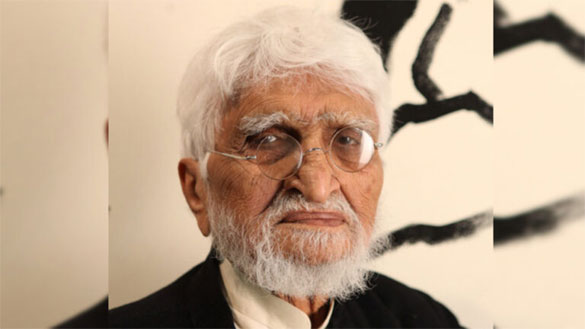
Artist Maqbool Fida Husain
----------
· Delhi Court Orders Seizure Of ‘Offensive’ MF Husain Paintings Which Depict Hindu Deities Hanuman And Ganesh
· 78% Of Waqf Properties In UP On Government Land; Govt Claims Several Historic Buildings
· Faith-Based Violence, Insecurity Lead To Hindu Migration In Sindh: Human Rights Commission of Pakistan
· Trump Designates Yemen’s Houthis As A ‘Foreign Terrorist Organization’
· Saudi Arabia Announces New National Policy To Eliminate Forced Labour
-----
India
· ‘Is This Justice?’ How Delay In Registration Cost A Bengali Muslim Woman In Assam Her Citizenship
· 'I Respect Both Faiths': For 18 Years, A Muslim Is Overseeing A Hindu Temple In UP’s Bahraich
· Eight Urdu Medium Schools Converted To Hindi Medium In Ajmer, Rajasthan
· Sambhal admin starts excavating centuries-old well found near Mughal-era Shahi Jama Masjid
· Kerala Muslim Groups Are Auditing Others On Islamophobia
· BJP’s Waqf Gamble: Calculated Counter to the Caste Census
· Supreme Court extends stay on court-monitored survey of Shahi Idgah mosque in Mathura
· One Year After Modi's Ram Temple Consecration, 'Dispute' Has Become a Continual Process
· Six Muslim youths arrested in Assam for posting 'offensive' cow slaughter video on Instagram
------
Pakistan
· Aerial Firing, One-Wheeling, Kite Flying Declared Un-Islamic by Darul Iftah Jamia Naeemia
· PTI Founder Expresses Gratitude To MBS For Releasing Pakistani Inmates
· Changes to cybercrime law unveiled amid protest
· Call for full court to settle SC jurisdiction row
· Ex-SC judge made chairman of panel on missing persons, SC told
· Relief convoy reaches Kurram amid heavy security
· Qureshi to Zardari: ‘Ditch PML-N, engage with PTI on South Punjab province’
------
North America
· Trump puts all US government diversity staff on paid leave 'immediately'
· Registration Opens for 2025 Maryland Muslim Lobby Day
-----
Arab World
· Saudi libraries to get upgrade including public theatres
· Saudi Arabia condemns Israeli attack on West Bank’s Jenin
· Top Saudi university wins Japan Prize for contributions to marine ecosystem research
· Crown prince to Trump: Saudi Arabia seeks to push US investments to $600bn during second term
· Saudi ambassador receives UN Special Envoy to Syria in Riyadh
· Saudi Arabia expected to be among top tourism destinations by 2030, minister says
------
South Asia
· Islamic Emirate Forces Should Be Strengthened In Number And Quality
· 2018 National polls: ACC to probe roles of Hasina, ROs, chiefs of police, Rab
· Khaleda Zia acquitted in Cumilla sabotage case
· 70 Years of China-Afghanistan Diplomatic Ties
· Over 700,000 people have left Afghanistan in the past three months
· Amir Khan Muttaqi meets UN special envoy in Afghanistan
· Ambassador of Islamic Emirate Addresses Shanghai Cooperation Organization Meeting
-------
Mideast
· Leaders Of Anti-Aggression Parties Visit Office Of Islamic Jihad Movement In Sana'a
· Southern Forces Loom Large As Syria’s New Rulers Try To Form A National Army
· Israeli army builds wall on Blue Line, reinstalls border cameras
· Syrian detained over Bayraktar mosque attacks
· Jihad condemns killing, displacement operations practiced by enemy in Jenin
· Hamas, Jihad Movements praise stabbing operation in Tel Aviv
· To secure Gaza ceasefire, dealmakers overcame enemies’ deep distrust
· ‘We need Syria to be a place of peace and development,’ Foreign Minister Al-Shaibaani tells WEF
------
Europe
· Italy Releases Libyan Wanted For Alleged War Crimes
· Blackburn Hotel To Homes Plan Gets Nod Despite Islamic Chanting
· Trump tells Putin to end 'ridiculous war' in Ukraine or face new sanctions
· UK warns Putin after Russian spy ship seen near British waters
· EU commissioner hopes Ukraine conflict continues
------
Africa
· Lagos Muslim Leaders Pledge Partnership With Government
· Ondo Muslim cleric curses cultists for killing wife, son
· Yobe’s commitment to agric. development very Impressive – Islamic Development Bank
· INEC Announces Date For FCT Local Government Elections, Gives Update On Anambra 2025 Governorship Election
· Civilians flee as fighting between M23 and DRC army approaches Goma
-----
Southeast Asia
· ‘Another Time’: Zahid Dodges Question On AGC’s Gag Order Move Over Najib’s House Arrest Addendum
· Resigning is ‘running away from the problem’, Najib tells court on 1MDB chairman Bakke quitting
· Najib: Like ‘hara-kiri’ for me to receive money in my personal account if I doubted it was Saudi donation
· Ex-Malaysian Bar presidents call for legal fraternity to heed CJ’s words in upholding rule of law and judiciary independence
· Malaysia On Track To Capture Major Share Of Islamic Tourism By 2028
Compiled by New Age Islam News Bureau
URL: https://newageislam.com/islamic-world-news/delhi-court-mf-husain-painting-hindu-hanuman/d/134412
------
Delhi Court Orders Seizure Of ‘Offensive’ MF Husain PaintingsWhich Depict Hindu Deities Hanuman And Ganesh
January 23, 2025
Artist Maqbool Fida Husain
---------
A Delhi court has ordered the seizure of two paintings by renowned artist MF Hussain, which depict Hindu deities Hanuman and Ganesh. The paintings were on display at the Delhi Art Gallery (DAG) in Connaught Place.
The order, issued by Judicial Magistrate First Class Sahil Monga of the Patiala House Courts, came after a complaint was filed by Advocate Amita Sachdev. She alleged that the paintings were offensive and hurt religious sentiments.
Sachdev visited the gallery on December 4, took photographs of the paintings, and later lodged an FIR on December 9. During a follow-up visit on December 10, the paintings were no longer on display.
The court’s ruling referenced a police inquiry report, which confirmed that the gallery had cooperated by providing security camera footage and a video recorder for investigation. The inquiry identified the paintings in question by their serial numbers in the gallery’s records.
The magistrate observed that the paintings were part of a private exhibition and intended to showcase Hussain’s original work. The DAG, in a statement, clarified that it was not a party to the legal proceedings but was reviewing the situation and consulting with experts.
The gallery also mentioned that it had been assisting the police with their inquiries and highlighted that the exhibition had been well-received by the public, attracting around 5,000 visitors.
According to the gallery, the complainant was the only individual who raised objections about the artworks. The gallery also criticized the complainant for publicizing the images on social media and news outlets, claiming that she did so with the intent to generate a wider audience and stir controversy by alleging that the artworks were offensive to her religious sentiments.
MF Hussain, considered one of India’s greatest modern artists, passed away in 2011. Despite his international acclaim, his work has often sparked controversy, particularly his depictions of religious figures.
This latest incident adds to the ongoing debate in India about the boundaries of artistic expression, freedom of speech, and religious sensitivity. Legal experts, artists, and the public are closely following the case as it progresses, as it touches on deeper questions about the intersection of art, religion, and the law. — With Agencies Inputs
Source:muslimmirror.com
Please click the following URL to read the text of the original Story
https://muslimmirror.com/delhi-court-orders-seizure-of-offensive-mf-husain-paintings/
---------
78% of waqf properties in UP on government land; govt claims several historic buildings
January 22, 2025
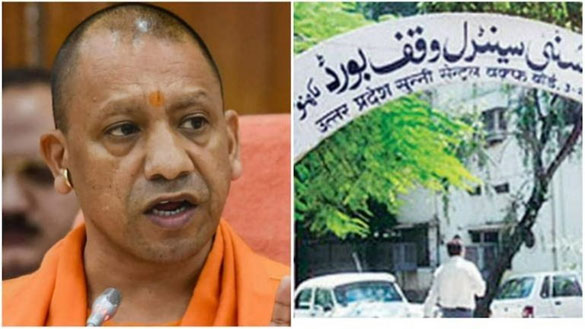 After madrasas, UP govt to start survey of Waqf properties
-----------
Around 1,14,624 Sunni and Shia endowments (endowment properties) in Uttar Pradesh are under threat. In fact, the current form of the central government’s Waqf Amendment Bill 2024 includes a provision to end the waqf status of waqf-by-user properties. About 4624 properties in the Shia Waqf Board and about 1,10,000 properties in the Sunni Waqf Board categories in the state. are registered in Waqf Board under Waqf By User.
With the enactment of the Waqf Amendment Bill in its current form, the Waqf status of these properties will end. At present, around 1,25,000 waqf properties across the state are registered with the Sunni Central Waqf Board. About 1,10,000 of these properties are dedicated by users. Also, 7,785 properties across the state are registered with the Shia Central Waqf Board. Of these, 4,624 properties belong to the endowment-wise user category.
Meanwhile, in the meeting of the Joint Parliamentary Committee (JPC) formed to take the views and suggestions of Muslims on the Waqf Amendment Act, 2024, held in Lucknow on Tuesday, the state government submitted the survey report of the Waqf properties. That 14,000 hectares of land in UP is claimed as waqf, while 11,700 hectares of land is government land. Which is more than 70 percent.
In the report, the government has not considered many famous buildings of the state including Lucknow’s Chota Imambara, Biga Imambara and Begum Hazrat Mahal Park as waqf properties. Earlier, the Sachar Committee report also declared 60 waqf properties as government property. Speaking to the media after the meeting on Tuesday, JPC President Jagdambika Pal also mentioned the Sachar Committee report. Told that the state government has said that they have conducted a comprehensive survey of waqf properties.
Earlier there was no record of these properties. The government said that the 60 waqf properties declared as government property by the Sachar Committee are also being surveyed. Jagdambika Pal said that earlier the JPC had met with the minority government minister and the people of the government. The meeting is held. Then all Islamic scholars and Bar Council people were also heard. Said, this is the last visit of JPC. JPC has held meetings in all states.
This is the last meeting. We will give our report on this in the meeting starting from January 31. He said, “A good report will come, which will lead to a good law.” After leaving the meeting, Shia Waqf Board Chairman Ali Zaidi told the media that the JPC had questioned officials of the minority department and religious leaders on the amendment bill. The JPC raised questions on several points regarding the data presented by the Minority Welfare Department.
Asked where the data for these properties came from? How long will the pending work of waqf survey take? The officers of the department responded to this. On the question of Chota Imambara and Biga Imambara not being waqf property, Ali Zaidi said that this figure of the government is wrong.
Source:muslimmirror.com
Please click the following URL to read the text of the original Story
https://muslimmirror.com/78-of-waqf-properties-in-up-on-government-land-govt-claims-several-historic-buildings/
---------
Faith-Based Violence, Insecurity Lead To Hindu Migration In Sindh: Human Rights Commission of Pakistan
Shazia Hasan
January 23, 2025
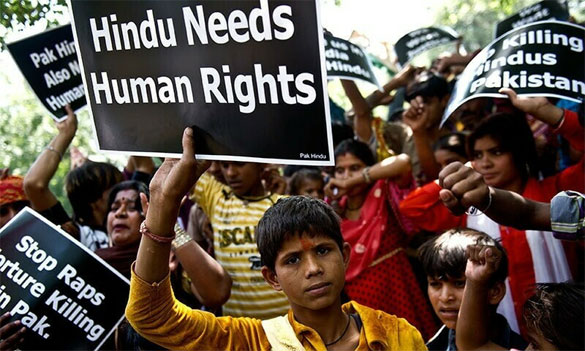 • Study says economic struggle, climate change also compelling families to leave the country
• CM’s Special Assistant on Human Rights voices concern over incidents of forced conversion of young girls
• Rights body chairman claims well-to-do Hindus enjoy facilities in India, but the poor live in refugee camps
KARACHI: The Human Rights Commission of Pakistan (HRCP) on Wednesday launched a fact-finding study that found that deteriorating law and order, insecurity as a religious minority, faith-based violence, economic struggles and worsening climate conditions have compelled many Hindu families in Sindh to migrate abroad.
Authored by senior journalist Zia-ur-Rehman, the study, ‘Exodus: Is the Hindu Community Leaving Sindh?’ was launched at the HRCP office.
Speaking at the launch, HRCP chairperson Asad Iqbal Butt said that they had been hearing that many Hindu families were leaving Sindh, which has the biggest population of Hindus in the country. “But the case needed to be proved through fact-finding,” he said, adding that if you look at the migration of the Hindu community, it started way back in 1947.
“Now migration also takes place internally within the province, from city to city, for earning prospects,” he said. “Then some also go abroad for higher education,” he added.
“We heard last year that as many as 300 people left Kashmore to go to India. But this was under-reported. There were more people than the number quoted. And this number increases whenever there is tension between Pakistan and India. Many left here at the time of the demolition of Babri Mosque in Ayodhya. The same happened during the construction and inauguration of the Ram temple in its place,” Mr Butt pointed out.
“Those among the Hindu community who migrated to India already have some family there. The well-to-do Hindus enjoy facilities in India. But the poor live in refugee camps,” he added.
Minority rights activist Pushpa Kumari said that migration of Hindus needs to be looked at seriously. “There are so many causes behind it, including forced conversion, kidnapping for ransom, backlash related to India, intolerance, fear and vulnerability, etc,” she said.
Senior journalist Sohail Sangi said that many people migrate but they do it out of choice. “Hindus, on the other hand, are forced to leave,” he said.
He also said that migration also is the result of wrong decisions made by the federal government. “We have turned into an intolerable society, which makes the minorities in our country feel unsafe and vulnerable,” he said.
“The law and order situation is also not helping. The people have no confidence in law enforcement agencies. This can change through interaction with communities to give them confidence, by creating a safe environment for them. The government organisations also need to be sensitised and made aware about the needs of the minority communities,” he said.
Special Assistant to Chief Minister (SACM) on Human Rights Rajvir Singh Sodha reminded that all the big educational institutions and health facilities in the province, especially upper Sindh were built by non-Muslims, mostly Christians and Parsis.
He also said that the Hindu families who left this side around Partition, now have their third generation who have been told about Sindh by their elders. “They say that their grandparents cry when they speak about the cities they had to leave. And the third generation speaks Sindhi at home even though they have not lived in Sindh. It is the language which was passed down to them by their elders,” he said.
Mr Sodha also lamented the luring of young, innocent, and impressionable girls by Muslim men who say that “they are doing a service to Islam”. “If you are truly serving Islam then why don’t you convert older Hindus, why innocent girls?” He asked.
He also said that children of non-Muslim minorities should be given religious education in schools. “If not in schools, then we should arrange for religious instruction classes in our temples. They also need to be educated about their religion just like all the schools here teach Islamiat,” he said.
Source:dawn.com
Please click the following URL to read the text of the original Story
https://www.dawn.com/news/1887065/faith-based-violence-insecurity-lead-to-hindu-migration-in-sindh-hrcp
---------
Trump designates Yemen’s Houthis as a ‘foreign terrorist organization’
January 23, 2025
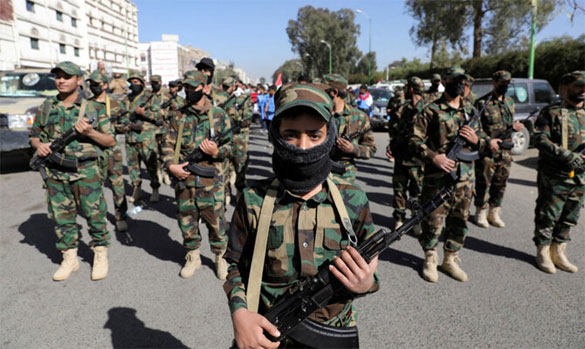 Houthi fighters take part in a parade for people who attended Houthi military training as part of a mobilization campaign, in Sanaa, Yemen December 18, 2024. (Reuters)
-----------
WASHINGTON: US President Donald Trump on Wednesday re-designated Yemen’s Houthi movement, known formally as Ansar Allah, as a “foreign terrorist organization,” the White House said.
The move will impose harsher economic penalties than the Biden administration had applied to the Iran-aligned group in response to its attacks on commercial shipping in the Red Sea and against US warships defending the critical maritime chokepoint.
Proponents of the move say it is overdue, though some experts say it could have implications for anyone seen as aiding the Houthis, including some aid organizations.
“The Houthis’ activities threaten the security of American civilians and personnel in the Middle East, the safety of our closest regional partners, and the stability of global maritime trade,” the White House said in a statement.
The Houthis, who control most of Yemen, have carried out more than 100 attacks on ships plying the Red Sea since November 2023, saying they were acting in solidarity with Palestinians over Israel’s war against Hamas in Gaza. They have sunk two vessels, seized another and killed at least four seafarers.
The attacks have disrupted global shipping, forcing firms to re-route to longer and more expensive journeys around southern Africa for more than a year.
The group has targeted the southern Red Sea and the Gulf of Aden, which are joined by the narrow Bab Al-Mandab strait, a chokepoint between the Horn of Africa and the Middle East.
Under the Biden administration, the US military sought to intercept Houthi attacks to safeguard commercial traffic and waged periodic strikes to degrade Houthi military capabilities. But it did not target the group’s leadership.
At the start of his presidential term in 2021, Joe Biden had dropped Trump’s terrorist designations to address humanitarian concerns inside Yemen. Confronted with the Red Sea attacks, Biden last year designated the group as a “Specially Designated Global Terrorist” organization. But his administration held off on applying the harsher FTO designation.
British charity Oxfam said the move would worsen the suffering of Yemeni civilians, disrupting vital imports of food, medicine, and fuel.
“The Trump administration is aware of these consequences but chose to move forward anyway, and will bear responsibility for the hunger and disease that will follow,” Oxfam America’s director of peace and security, Scott Paul, said in a statement.
David Schenker, who was assistant secretary of state for Near Eastern affairs in the first Trump administration, said Trump’s move on Wednesday was an obvious, early step to respond to what he described as one of Iran’s leading proxy forces in the Middle East.
“While the redesignation likely won’t have a positive impact on the group’s behavior, the measure suggests the new administration is not looking to induce (or cajole) the Iranians to negotiations through blandishment,” Schenker told Reuters.
The Trump administration said the US will work with regional partners to eliminate Houthi capabilities, deprive it of resources “and thereby end its attacks on US personnel and civilians, US partners, and maritime shipping in the Red Sea.”
The designation will also trigger a broad review of UN partners, non-governmental organizations and contractors operating in Yemen, the White House said.
“The President will direct USAID to end its relationship with entities that have made payments to the Houthis, or which have opposed international efforts to counter the Houthis while turning a blind eye toward the Houthis’ terrorism and abuses,” the White House said.
The Houthis in recent days have signaled they were scaling back attacks in the Red Sea following a multi-phase cease fire deal between Israel and Hamas. Earlier on Wednesday, the group released the crew of the Galaxy Leader commercial ship more than a year after they seized their Bahamas-flagged vessel off the Yemeni coast.
Source:arabnews.com
Please click the following URL to read the text of the original Story
https://www.arabnews.com/node/2587458/middle-east
---------
Saudi Arabia Announces New National Policy To Eliminate Forced Labour
LAMA ALHAMAWI
January 22, 2025
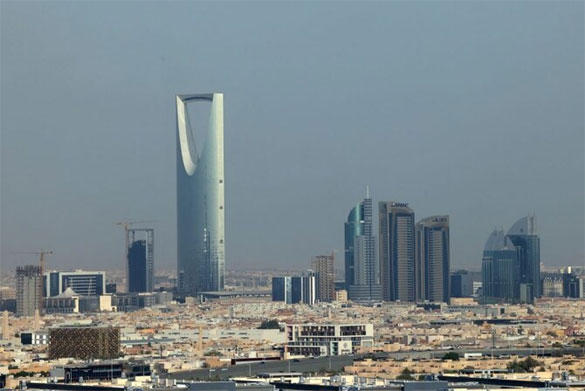 The Kingdom Centre skyscraper in Riyadh, Saudi Arabia, Aug. 1, 2023. (AFP)
----------
RIYADH: Saudi Arabia has introduced its National Policy for the Elimination of Forced Labor, the Ministry of Human Resources and Social Development announced.
“This policy adopted by the Kingdom will ensure the protection of persons living or working in the Kingdom and create a safe working environment,” Osama Ghanem Alobaidy, adviser and professor of law at the Institute of Public Administration in Riyadh, told Arab News.
In 2021, Saudi Arabia, became the first GCC country to ratify the International Labour Organization’s Protocol of 2014 to the Forced Labour Convention, bringing it in line with international standards to eliminate forced labor.
“This shows the Kingdom’s commitment to improve and protect the rights of individuals living or working in the Kingdom,” Alobaidy said.
The newly introduced policy aims to eliminate forced labor through prevention and protection measures.
According to the Ministry of Human Resources and Social Development, it will also strengthen national, regional and international coordination to integrate better efforts to combat forced labor.
Deputy Minister for Control and Development of the Work Environment Sattam Alharbi said: “The introduction of the National Policy for the Elimination of Forced Labor is an important milestone for the Kingdom of Saudi Arabia.
“It demonstrates our collective commitment to creating a safe environment for everyone living and working in our country, ensuring their rights are protected,” Alharbi said.
“The introduction of the national policy also builds on our ongoing work to safeguard employees’ rights, in collaboration with global and local partners.”
The national policy also includes victim-focused initiatives that will enhance care, support and access to justice.
It will support the implementation of measures to provide legal, social and economic support for forced labor victims, aiding their recovery and protecting against the risk of re-victimization.
This new policy is not the first of its kind for the Kingdom. Saudi Arabia has been implementing multiple measures to protect the rights of its workforce.
“The Kingdom already has a set of laws, rules and regulations addressing this matter even before the adoption of this policy,” Alobaidy said.
In October of 2024, Saudi Arabia’s Ministry of Human Resources and Social Development and the Insurance Authority launched an insurance service that would cover unpaid wages for up to six months and provide travel assistance for expatriates in the Kingdom in the case of private-sector defaults.
Alobaidy highlighted the multiple laws that the Kingdom has put in place to protect the workforce: “The law on trafficking of persons and the labor laws for example and regulations prohibit any forms of forced labor.”
Elaborating on Saudi Arabia’s decision to ratify the International Labour Organization’s Protocol of 2014 to the Forced Labour Convention, the professor said: “It is also commendable that the Kingdom took the lead among GCC countries in ratifying the protocol to the forced labor convention to eliminate forced labor.”
“The Kingdom’s adoption of this policy is welcome news to persons working or living in the Kingdom since it will ensure greater protection of their rights,” he said.
“This will enhance the work environment in the Kingdom in line with the Kingdom’s Vision 2030 objectives,” Alobaidy said.
Source:arabnews.com
Please click the following URL to read the text of the original Story
https://www.arabnews.com/node/2587391/saudi-arabia
---------
India
‘Is this justice?’ How delay in registration cost a Bengali Muslim woman in Assam her citizenship
23-01-2025
On the morning of January 11, I arrived at Begum Zan’s home in Assam’s Barpeta district.
I came bearing bad news.
The 54-year-old woman was busy with her household chores in Chengulia, a village on the banks of the Beki river. Her husband, Mansur Ali, had gone fishing.
Two days ago, unknown to Zan, the Gauhati High Court had dismissed her appeal and struck down her citizenship. The reason: she had failed to enroll herself at the foreigners’ regional registration office in time.
“It was during the [first Covid-19] lockdown,” said Zan, as she broke down. “We should have gone for the hearing. But I didn’t know the urgency and our lawyer told us of the deadline three months later.”
Though previous Gauhati High Court orders had been more lenient in similar cases, the two-judge bench hearing her case took a different view.
In doing so, they cited the landmark Supreme Court order that upheld Section 6A of the Citizenship Act, 1955, which devised a framework for awarding citizenship to migrants to Assam. The five-judge bench upheld the section 4:1 in October last year.
Curiously, the Gauhati High Court cited the lone dissenting opinion of Justice JB Pardiwala to declare Zan a foreigner.
“Is it even justice that for a delay in registration, she will lose her citizenship and become illegal?” asked her husband Mansur Ali, the caretaker of a village mosque. The couple survive on the money sent by their three children, who work as migrant labourers outside the state.
The tribunal order – all was not lost
In 2017, Begum Zan was asked to appear before a foreigners’ tribunal – quasi judicial bodies unique to the state that rule on citizenship issues.
As is common in several such cases, the border police had raised a red flag over Zan’s citizenship and accused her of entering Indian territory illegally, leading to a notice from the tribunal.
Zan contested this allegation, arguing that she was a citizen of India by birth, that she was born in Chengulia and had lived in the village all her life – first at her paternal home and then with Ali.
On June 29, 2020, the foreigners’ tribunal in Barpeta district ruled that she was not a citizen by birth.
Nor had Zan been able to prove that she and her father entered Assam before January 1, 1966. But all was not lost. The tribunal was satisfied that the family had entered the state before March 24, 1971.
Both those dates are crucial to determining citizenship status in Assam, as laid out in Section 6A of the Citizenship Act, 1955.
The section was enacted in 1985 to implement the Assam Accord, signed between Assamese leaders and the Indian government, which put an end to a popular movement against “illegal immigrants” from Bangladesh. The law created two categories: those who entered Assam before January 1, 1966, and those who arrived between January 1966 and March 24, 1971.
Both were granted citizenship, but the latter group was denied voting rights for 10 years after being identified as “foreigners”.
Zan, according to the foreigners’ tribunal order, fell in the second category.
The tribunal said that she could still be granted citizenship, provided she registered herself with the FRRO in Barpeta within 30 days of the order – a condition laid down by Section 6A of the Citizenship Act, 1955.
Zan’s husband Ali told Scroll she failed to keep to the deadline as their advocate failed to inform them that they had to register with the FRRO within 30 days. “He took us there three months later, and by then the deadline had passed,” he said.
Ali added: “If we were educated, we would have registered ourselves.” He alleged that their advocate took at least Rs 3 lakh from them as fees.
Within three months of the tribunal order, she filed a formal request with the superintendent of border police in Barpeta for an extension. “We visited the SP’s office for three days. But our lawyer did not take us inside.”
Her request was turned down. In 2024, after doing the rounds of several lawyers’ offices, she finally moved the high court.
The high court order
Zan’s counsel AS Tapadar argued before the high court that she could not register with the concerned FRRO, Barpeta within the prescribed time limit due to a communication gap with the advocate, the Covid-19 lockdown and other compelling reasons. “The delay was neither deliberate nor intentional and was occasioned only due to financial hardship and poor legal advice from the local lawyer, for which considerable time was lost,” Tapadar argued.
But the bench of Justice Kalyan Rai Surana and Justice Susmita Phukan Khaund rejected Begum Zan’s prayer that her citizenship not be struck down because of a delay in registration.
In doing so, the bench was going against earlier orders of the Gauhati High Court that had allowed late registration of several migrants.
The court argued that Justice Pardiwala’s dissenting opinion had forced their hand.
Justice JB Pardiwala had said that those who migrated to Assam between January 1, 1966 and March 24, 1971 but had failed to register themselves with the concerned authority in the prescribed time limit will no longer be eligible for citizenship.
“This Court, being bound by the decision of the Supreme Court of India would not have power to extend time for the petitioner to register herself before the concerned and/or jurisdictional registering authority,” the Gauhati High Court order said.
However, Tapadar, Zan’s advocate, had pointed out that the observation of Justice Pardiwala “is the minority view of the single judge, whereas the majority verdict does not subscribe to the minority view”.
The Gauhati High Court argued that the petitioner has not been able to demonstrate from the Section 6A judgement of the constitution bench that “there was a conflict between the majority opinion and the minority opinion given [in the paragraph concerning registration].”
Tapadar also referred to six earlier cases to show that the Gauhati High Court “has been consistently passing orders to extend the time” for a person who had been adjudged a foreigner to register himself/ herself “on good cause being shown”.
The court rejected this argument stating the previous decisions are “no longer a binding precedent” in light of the “decision of the recent Supreme Court of India.”
“This judgement means that late registration will not be permitted any longer,” Tapadar told Scroll. “Because of this judgement, lots of people will suffer.”
He said that approximately 5,000 people in this category may find it difficult to retain their citizenship and might be sent to detention camps. “We will take this to the apex court.”
Is a minority opinion binding?
Legal experts also contested the high court’s order. “I don't think the minority judgement would have any binding force on any point of law or fact,” Guwahati-based advocate Sauradeep Dey, who has represented many people caught in citizenship disputes.
Dey added: “The high court ought to deal with the issue of delay in registration [at the FRRO] on a case-to-case basis. The delay, if justified, should be condoned. If a person is unable to register for reasons beyond her control, would it imply losing citizenship outright without any option of taking corrective steps? I don't think that would be judicious. This decision has to be appealed in the Supreme Court.”
He said the only point of law to be decided here is whether the minority view, even if it is not in loggerheads with the majority view, would have any binding force.
Back in Chengalia village, the distraught couple was fearful of the road ahead. “We are poor people,” Zan said. “Our children survive by working outside, away from home, and we are staying on railway land. What can we do?”
Her husband Mansur Ali asked me: “Do you think she will be picked up by the police and sent to a detention centre? Is it safe for her to live here now or should we send her away somewhere?”
Source:scroll.in
Please click the following URL to read the text of the original Story
https://scroll.in/article/1078065/is-this-justice-how-delay-in-registration-cost-a-bengali-muslim-woman-in-assam-her-citizenship
----------
'I Respect Both Faiths': For 18 Years, A Muslim Is Overseeing A Hindu Temple In UP’s Bahraich
23.01.25
A heartening story of communal harmony has emerged from the Uttar Pradesh district of Bahraich, which has been in the headlines recently for communal tensions and wolf attacks.
Mohammad Ali, a devout Muslim, has become an enduring symbol of unity through his 18-year-long service as the caretaker and president of a trust managing a Hindu temple.
In Jaitapur Bazar, 27 kilometers from the Bahraich district headquarters, Ali oversees the Vriddh Mateshwari Mata Ghurdevi Temple, a site that is now revered by Muslims too.
Observing Islamic traditions like roza and namaz, 58-year-old Ali also devotes himself to the worship of Goddess Ghurdevi and Lord Hanuman, balancing his dual roles with remarkable dedication.
Ali recalls a turning point from his childhood, "When I was seven, I suffered from leukoderma, leaving my eyes white. Treatments failed until my mother took me to the Ghurdevi temple."
He further said he believed that "applying water from the sacred pindi" helped cure the condition, inspiring his lifelong connection to the temple. He said he began actively serving there in 2007 after he had a rather dramatic dream in which the Goddess asked him to care for the temple.
Under Ali's leadership, the temple has flourished. Initiatives like fundraising through grain collections during harvest seasons have generated significant resources. "This year alone, Rs 2.7 lakh was raised for temple development," Ali told PTI.
Public contributions and government support have also helped in its renovations, with over Rs 30.40 lakh utilised for construction and maintenance.
Recently, a 5.5-foot Hanuman idol, sourced from Jaipur for Rs 2.5 lakh, was consecrated during a five-day ceremony attended by thousands. The invitation card for the event prominently featured Ali's name as the temple committee president alongside local BJP MLA Sureshwar Singh as the chief guest.
District Tourism Officer Manish Srivastava confirmed the temple's inclusion in a religious tourism initiative two years ago, further enhancing its status.
The temple's impact transcends religious lines, attracting Muslim women who join Hindu devotees in prayers.
"I respect both Hindu and Muslim faiths. Serving the temple fulfils my devotion and my commitment to communal unity," Ali said.
Source:telegraphindia.com
Please click the following URL to read the text of the original Story
https://www.telegraphindia.com/india/i-respect-both-faiths-for-nearly-two-decades-a-muslim-overseeing-hindu-temple-in-up/cid/2079171
---------
Eight Urdu Medium Schools Converted To Hindi Medium In Ajmer, Rajasthan
January 22, 2025
The recent conversion of eight Urdu medium schools in Ajmer into Hindi medium institutions has triggered widespread anger among the local Muslim community. This decision has been perceived as an act of cultural and religious discrimination, as many of these schools have been serving the Muslim population for decades, symbolizing their linguistic and cultural heritage.
In December 2024, the Bharatiya Janata Party (BJP)-led Rajasthan government directed the state police to replace Urdu and Persian terms in policing terminology with Hindi. This directive was followed by a setback on January 17, when the Director of the Secondary Education Department in Bikaner issued an order to convert several Urdu medium schools in Ajmer into Hindi medium institutions. Among the affected schools are the Government Primary Urdu School Badbaav and the Government Girls High Primary Urdu School, both operational since 1941.
This move has left the Muslim community distraught, particularly as Urdu medium schools in Rajasthan were already grappling with a shortage of textbooks in Urdu and qualified Urdu teachers. For many, the decision represents a systematic erosion of their educational rights and cultural identity.
Local parents and residents have voiced strong opposition, describing the decision as an attack on their cultural and linguistic heritage. “Urdu is an integral part of our identity,” said a concerned parent at a sit-in protest. “This move threatens to erase our language and history.”
The affected schools are situated in predominantly Muslim neighborhoods, and the community sees the conversion to Hindi medium as a deliberate attempt to marginalize Urdu in education. Parents argue that the switch will disproportionately affect Muslim students, many of whom are more comfortable learning in Urdu.
Community leaders and activists have submitted a memorandum to the District Collector and Rajasthan Chief Minister Bhajanlal Sharma, demanding an immediate reversal of the decision. Md Razi , a local leader, stated, “This is not just about language; it’s about our children’s right to education in their mother tongue. We will oppose this decision with all our might.”
Mrs Yasmeen Jahan accused the state’s Education Minister, Madan Dilawar, of spearheading this move. She claimed it was part of a broader agenda to undermine the cultural diversity of Rajasthan. “Our children are being stripped of their identity,” she said.
The Urdu medium schools in question are deeply rooted in Ajmer’s history and culture. For instance, the Government Primary Urdu School Badbaav has been educating Muslim children since the early 1940s. These institutions are more than just schools; they represent a connection to the linguistic and cultural heritage of the community.
Local residents argue that instead of eliminating Urdu education, the government should have allowed it to coexist with Hindi as an optional subject. “Why not provide both options?” questioned Aslam Khan, a school teacher. “This decision is not about improving education; it’s about sidelining a minority language.”
In response to the decision, parents and activists are planning larger protests, including mass rallies, to draw attention to their cause. Protest leader Najma Khan stated, “If the government doesn’t address our concerns, we will escalate our efforts. This is about our children’s future.”
The District Collector acknowledged the community’s concerns but defended the decision as part of broader educational reforms. “Our goal is to provide quality education for all, regardless of language,” the official stated. However, this explanation has done little to alleviate the community’s fears.
The controversy highlights the broader struggle to protect the linguistic and cultural rights of minority communities in India. For the Muslim community in Ajmer, the fight for Urdu education has become a rallying point for preserving their heritage.
“This is not just about eight schools,” said a local teacher. “It’s about the survival of our language and identity. Urdu is as essential as any other subject, and we demand the right to choose.”
The fate of these eight Urdu medium schools remains uncertain, but the resolve of Ajmer’s Muslim community is clear. They are determined to continue their fight, hoping to secure a reversal of the decision and preserve the right of their children to learn in their mother tongue.
As protests gain momentum, the state government faces mounting pressure to address the community’s concerns. Whether this decision will mark a turning point in Rajasthan’s educational policies or deepen the divide over language and identity remains to be seen. For now, the local Muslim community in Ajmer remains united in its pursuit of justice, vowing to protect its cultural and linguistic legacy.
Source:muslimmirror.com
Please click the following URL to read the text of the original Story
https://muslimmirror.com/rajasthan-eight-urdu-medium-schools-converted-to-hindi-medium-in-ajmer/
----------
Sambhal admin starts excavating centuries-old well found near Mughal-era Shahi Jama Masjid
Jan 23, 2025,
MEERUT: Sambhal district administration on Wednesday began excavating a centuries-old well located 50m from the Mughal-era Shahi Jama Masjid in Chandausi town. The digging is part of a broader initiative to revive historical wells and pilgrimage sites across the city.
Sambhal DM Rajender Pensiya told TOI, “A total of 19 wells are mentioned in the history of Sambhal district, and we have so far managed to identify 17. Over decades, these wells were sealed off and encroached upon. The well adjacent to Jama Masjid was also encroached and a cemented platform was built over it. Nine more wells were found separately during the search, making a total of 28 wells found so far, including 19 Mahakoops and 87 pilgrimage sites. The sites have been freed from encroachment. This action is being taken after receiving a complaint letter from local residents.”
Sambhal SP Krishan Kumar Bishnoi said, “Adequate security measures have been taken and an additional superintendent of police, along with a police force and personnel from provincial armed constabulary, was present during excavation. Law and order situation is stable.”
The excavation effort comes after residents highlighted the condition of wells, many of which were encroached upon or neglected over the years. Authorities are focused on restoring thehistorical structures and ensuring their preservation.
ASP Shreesh Chandra said, “Legal action will follow after further investigation. According to local accounts and elderly residents, this well has existed for centuries. Further verification will be done as the excavation progresses.”
Sanjay Kumar, a resident, said, “This well is situated near the Harihar temple. It used to be a place of worship where people came during auspicious occasions like childbirth or weddings. Over time, it was covered and its original form altered. The excavation will restore its historic appearance.”
Shahi Jama Masjid has been at the centre of recent tensions in Sambhal. On Nov 19, a court-ordered survey began to investigate claims the mosque was built over a demolished Hindu temple. The second inspection on Nov 24 led to clashes, resulting in five deaths. Following this, SC directed that no action be taken regarding a private well located near the mosque’s entrance without its permission.
Source:indiatimes.com
Please click the following URL to read the text of the original Story
https://timesofindia.indiatimes.com/india/sambhal-admin-starts-excavating-centuries-old-well-found-near-mughal-era-shahi-jama-masjid/articleshow/117470492.cms
---------
Kerala Muslim Groups Are Auditing Others On Islamophobia
ANAND KOCHUKUDY
23 January, 2025
Some time ago, a delegation from the Students Islamic Organisation of India visited me and handed over a booklet titled ‘What is Islamophobia’. The SIO and its parent body, Jamaat-e-Islami, are at the forefront of efforts to combat Islamophobia in Kerala. However, the same Jamaat-e-Islami has also been aggressively championing political Islam—albeit couched as identity politics.
Such contradictions aside, Muslim outfits in Kerala often hold the Bharatiya Janata Party (BJP)—and, in some cases, the Left—responsible for the spread of Islamophobia in the state. The term ‘Chri-Sanghi’, coined by James Panavelil, a priest of the Syro-Malabar Church, has also brought Christians under that ambit.
Yet, these Muslim organisations are seldom willing to apportion any blame to their own fraternity for fanning Islamophobia. In fact, any question about the outlawed Popular Front of India (PFI) or Abdul Nazar Madani is often countered with whataboutery: “But what about the Sangh Parivar?”
This reveals not only their defensive mindset toward Muslim fundamentalism but also a rigid refusal to acknowledge the existence of Islamists within the community. Just as these Muslim outfits audit others for stoking Islamophobia, isn’t it time they were also held accountable for their omissions and commissions?
Islamophobia’s internal enablers
There are instances galore of Muslim organisations stoking Islamophobia in Kerala.
A case in point is the recent campaign against MEC 7, a fitness programme started in Malappuram over a decade ago by ex-CISF soldier Salahudheen P.
The movement against it is fuelled by the Samastha Kerala Jem-iyyathul Ulama’s AP faction, so named for its leader Kanthapuram AP Aboobacker Musliyar, also known as Sheikh Abubakr Ahmad.
Just this week, Kanthapuram Musliyar himself came out in the open against MEC 7, referring to the mixing of men and women in the programme as “haram” and then blaming critics for “abusing Musliyars”.
The Jamaat-e-Islami’s shrill campaign to make Hamas synonymous with Palestine has also played a part in stoking Islamophobia in recent times. Then there’s the Munambam issue, a land dispute between the Kerala Waqf Board and a community of Christian fisherfolk. Various Muslim organisations claimed the land as Waqf property without studying the legal position, and without thinking through the social consequences of taking a hardline position.
In another controversy, Abdul Hameed Faizy Ambalakkadavu of the Samastha’s EK faction has more than once criticised IUML president Sayyid Sadiq Ali Thangal for participating in Christmas celebrations. In 2023, Ambalakkadavu objected after Thangal was photographed eating cake alongside BJP state president K. Surendran. Then in 2024, Ambalakkadavu reignited the debate after Thangal visited the Bishop’s house for Christmas and was again photographed eating cake, though Surendran or other BJP politicians were not present.
Of course, this issue has a clear element of factional and sectarian politics. Ambalakkadavu is part of the Shajra faction of the EK Samastha, a ginger group that has adopted a pro-Left position within the organisation.
But Amabalakkadavu is a repeat offender, having raked up this issue even a year back, leading to contentious debates in Kerala.
Faith revivalism
These developments also need to be viewed in conjunction with other social shifts, including the rise of Halal-certified restaurants and Kerala’s changing food habits.
Take a road trip across Kerala on the National Highway and you’ll see an influx of Arabic restaurants. The number of Keralites working in the Persian Gulf and the resultant exchange of culinary tastes is a reason for this, but it has also fuelled Halal debates.
In my childhood, it was common for us friends to visit each other’s homes and break bread with families. There has been a change on this count lately as people have now begun to enquire whether the meat served at weddings—and even households—is Halal-certified. Strangely, prosperity has been accompanied by faith revivalism.
This is also witnessed in changing sartorial styles, with more women taking to hijabs and purdahs—attire that wasn’t originally part of Kerala’s public life before the Gulf oil boom. The Malayalam film industry which churned out a number of Muslim socials from the ‘50s would testify to this change. Back then, Muslim female characters had their own unique attire, which has now been replaced by these adopted practices.
Religion vs rules in schools and colleges
A few months ago, a huge controversy erupted over some girl students demanding that they be allowed to perform namaz at Nirmala College, run by the Syro-Malabar Church in central Kerala. It was the timely intervention of Vicar General Monsignor Pius Malekandathil, who previously taught history at Delhi’s Jawaharlal Nehru University, that ensured that the matter didn’t go out of hand.
This was followed by an even more bizarre demand at St Joseph’s Higher Secondary School in Paingottoor, located fairly close to Nirmala College, that two Class 12 girls be allowed to offer namaz. I undertook a personal fact-finding mission in its wake to determine if there was a pattern behind these incidents. It so happens that my family runs another school, barely a couple of miles from St Joseph’s.
It turned out that only one girl continued to insist on the demand even after being dissuaded by the school authorities. This same girl had previously insisted on wearing full-sleeve clothing that reached her palms beneath her uniform—a request the school had accommodated. In a conversation with me, her father, an adherent of the ultra-orthodox Tablighi Jamaat and a wealthy businessman and cleric, sounded extremely resentful about his daughter being denied the opportunity to perform namaz in school.
According to the Kerala Education Rules, relaxations are given to Muslim students only on Fridays to attend prayers if mosques are available nearby—which St Joseph’s had been duly following.
Separately, the Left government had formed a committee under MA Khader to propose reforms in Kerala’s school education. The committee recommended the adoption of gender-neutral uniforms and change in school timings, along with the conversion of all public schools into co-educational institutions. The state cabinet gave an in-principle nod to all of it—before Muslim bodies flexed their muscles to overturn it.
These organisations opposed the change in public school timings, arguing it would leave no time in the morning for students from the community to attend madrasa or religious studies. Their resistance to gender-neutral uniforms and co-education was attributed to “religious reasons”.
Left appeasement of Islamists
Although it is generally the Congress and its ally, the IUML, that take disproportionate blame for pandering to conservative elements of all communities, the Communist Party of India-Marxist (CPI-M) has cynically used such reactionaries for its own ends during successive terms in power.
Following the demolition of the Babri Masjid in 1992, when the IUML refused to heed the call of Muslim bodies to quit the Congress-led state government in protest, the CPI-M in Kerala built a rainbow coalition of fundamentalist and orthodox Muslim political parties to capture power.
This coalition included the Indian National League (INL), an IUML splinter led by Ebrahim Sulaiman Sait; the Abdul Nazar Madani-led Islamic Seva Sangh (ISS), which later became the People’s Democratic Party (PDP); the National Development Front (NDF), which metamorphosed into the Popular Front of India (PFI); the Samastha AP faction; and the Jamaat-e-Islami.
Today, the INL, the PDP, and the Samastha AP faction continue to back the Left, even as the Jamaat-e-Islami aligns with the Congress and IUML. Along with its opposition to MEC 7, the AP Samastha has now initiated a campaign against the Jamaat-e-Islami as a counter to the latter’s political campaign against the CPI-M, which it has accused of promoting ‘Hindutva Marxism.’
Just as the Sangh Parivar and the CPI-M have their share of intellectuals and propagandists, the Jamaat-e-Islami, too, has cultivated non-Muslim faces, such as Ezhava intellectual Baburaj Bhagawathi, Dalit activist Sunny M Kapikkad, and far-left fringe frigures such as PA Prem Babu, to propagate its agendas.
The IUML’s culpability
For all its positive contributions to Kerala, the IUML must also take its share of the blame for past misjudgments that have contributed to the stoking of Islamophobia.
Most notably, the Oommen Chandy cabinet’s induction of a fifth minister from the IUML in 2011-12 had a ripple effect on subsequent political events, including the consolidation of Hindu groups as a counter to it. The unwieldy controversy in 2015 over the lighting of traditional Kerala lamps during public functions comes to mind in the wake of the cake controversy.
An article written by IUML state president Sayyid Sadiq Ali Thangal in 2020, hailing Turkey’s reconversion of the Hagia Sophia into a mosque, proved to be another blunder, further feeding Islamophobia. Today, the IUML’s welcoming of the Jamaat-e-Islami’s support could turn out to be a double-edged sword. In any case, the Jamaat-e-Islami holds more utility for the IUML as it attempts to gain wider acceptance.
For all its secular pretensions, the Jamaat cannot change its spots. This is most evident in its prejudicial position on the Munambam issue. While IUML secretary Mohammed Shah concurred with this assessment in a conversation, KP Noushad Ali of the Congress begged to differ: “The fact that the Jamaat-e-Islami is not using the Munambam issue for propaganda purposes is a huge relief for us under the current circumstances.”
The PFI and Salafi fringe
Alongside mainstream Muslim outfits and political parties, the PFI and fringe Salafi groups have played a massive role in stoking Islamophobia in Kerala. The hand-chopping of college professor TJ Joseph by PFI cadres— reportedly triggered by a reference to Prophet Mohammad in a BCom question paper—was an inflection point.
Notably, it was Madhyamam, a daily run by the Jamaat-e-Islami, that first highlighted the question paper controversy on its local pages, which eventually spiralled out of control.
The dozen-odd people who left Kerala to join the Islamic State in 2015-16 were mostly adherents of Salafism who had been influenced by online preachers. This led to yet another wave of Islamophobia. The Hadiya conversion case followed, with the PFI once again playing a role behind the scenes. Today, self-styled Salafi preachers are mushrooming on YouTube and other platforms in northern Kerala, drawing even the attention of state intelligence officials.
Suffice it to say, the Jamaat-e-Islami and political outfits that campaign against the stoking of Islamophobia in Kerala must first look within before conveniently laying the blame on others.
Anand Kochukudy is a Kerala-based journalist and columnist. He tweets @AnandKochukudy. Views are personal.
Source:theprint.in
Please click the following URL to read the text of the original Story
https://theprint.in/opinion/kerala-muslim-groups-are-auditing-others-on-islamophobia-it-isnt-helping/2457732/
---------
BJP’s Waqf Gamble: Calculated Counter to the Caste Census
January 23, 2025
NEW DELHI – The Bharatiya Janata Party (BJP) is steering the contentious Waqf Amendment Bill into the heart of its political strategy, a move that some believe is aimed at countering the rising demand for a caste census. The Joint Parliamentary Committee (JPC) tasked with examining the bill has already missed its initial deadline during the winter session of Parliament and is unlikely to meet the extended timeline of the upcoming Budget session, which begins on January 30.
According to those aware of the developments, the BJP-led government may now push the report until the monsoon session because the committee won’t be able to finish its job by the extended deadline. A committee member told Clarion India that the panel could not meet the deadline because it would take a long time to document the concerns of thousands of stakeholders.
This delay has fuelled speculation that the BJP is intentionally prolonging the Waqf issue, using it as a tool to stir emotive sentiments, much like its approach to Article 370 and the Ram temple in the past.
The JPC, led by BJP MP Jagadambika Pal, has faced severe criticism from opposition members, who accuse the chairman of partisan conduct and procedural violations. They argue that the proceedings have lacked transparency, with the committee’s functioning marked by undue haste and selective engagement with stakeholders. An opposition member of the JPC told Clarion India that the chairman is pressured to pay attention to stakeholders with valid concerns. The committee has not followed the proper process till today.
A recent example is the invitation extended to Anwar Manipaddy, a former Karnataka Minorities Commission chief and former Karnataka BJP vice president, to present allegations against Congress president Malikarjun Kharge and the Karnataka Waqf Board. Opposition MPs claim that Manipaddy’s testimony was biased and his remarks defamatory, violating parliamentary norms that restrict discussions on sub-judice matters. Despite their protests, the chairman permitted Manipaddy to continue, prompting opposition members to send a strongly worded letter to Lok Sabha Speaker Om Birla.
The letter criticised the committee’s proceedings as undemocratic and warned of a potential boycott by opposition members.
Adding to the government’s challenges is the resistance from key NDA allies like the Telugu Desam Party (TDP) and the Janata Dal (United). Both parties, which have significant minority support in their respective states, have opposed provisions in the bill, such as the inclusion of non-Muslims in Waqf Boards. JD(U), in particular, is treading cautiously ahead of the Bihar assembly elections, wary of alienating its core voter base. Sources indicate that the BJP has not offered any assurances to these allies about amending the bill, leaving them dissatisfied and increasing the likelihood of further delays.
The BJP’s focus on the Waqf issue comes at a time when the demand for a caste census has gained significant traction, particularly after Bihar’s recent release of its caste survey data. A caste census threatens to disrupt the BJP’s carefully constructed social engineering efforts, which rely on unifying Hindus across caste lines.
By shifting attention to the Waqf issue, the BJP appears to be employing a familiar strategy of leveraging emotive issues to consolidate its voter base. Observers are drawing parallels between this tactic and the party’s approach during the 1990s, when it used the Ram Mandir movement to counter the implementation of the Mandal Commission report. With the Ram Mandir issue now over and done with, the BJP and its ideological mentor, the RSS, seem to be searching for a new rallying issue. The Waqf controversy, with its potential to polarise and energise voters, fits the bill. Waqf properties are spread all over the country and with a sizeable number of them under adverse possession can be used for stoking communal tension.
In a written reply to the Parliament during the winter session, Union Minister for Minority Affairs Kiren Rijiju said that a total of 994 Waqf properties have been reported as alienated — or illegally encroached upon. Alienated properties refer to Waqf land or assets that have been transferred or encroached upon through unlawful means.
Statements from senior BJP leaders have reinforced the perception that the party is using the Waqf issue as a political tool. Uttar Pradesh Chief Minister Yogi Adityanath recently described Waqf boards as “land mafias” and accused them of mismanaging resources.
Speaking at the ‘Maha Kumbh Mahasammelan’, organised by a private news channel in Lucknow, Yogi said, “It is hard to tell whether it is a Waqf Board or a board of land mafias.” He said his government has amended the Waqf Act and is actively investigating all “occupied” land.
Although Yogi is known for making provocative and communally tinged remarks, this was not the occasion to raise the Waqf issue. His statement suggests that the party wants to use this issue for political purposes in the coming days. At an event in Lucknow, the chief minister claimed that his government had amended the Waqf Act to investigate all “occupied” land, a statement widely interpreted as an attempt to provoke communal sentiments.
Meanwhile, RSS leader Indresh Kumar, who heads the Muslim Rashtriya Manch, alleged that Waqf Boards have failed to serve the Muslim community despite their extensive resources. Minister Rijiju, who introduced the Waqf Amendment Bill in August 2024, admitted that the Waqf issue is inherently political, further underscoring the party’s intentions.
Broader Strategy
The JPC’s delay in submitting its report appears to be part of a broader strategy to keep the Waqf issue alive in public discourse. This delay allows the BJP to use the controversy as a counterweight to the caste census demand, which poses significant challenges to its electoral strategy. By framing the Waqf debate as a corrective measure against alleged corruption and inefficiency, the BJP hopes to divert attention from the implications of a caste census while appealing to its core voter base.
However, this approach is not without risks. The BJP’s reliance on emotive issues to galvanise support has its limits, particularly in a society as diverse and caste-conscious as India’s. Moreover, the resistance from NDA allies and opposition parties highlights the fragility of the BJP’s coalition and the challenges of governing in a deeply polarised environment. The Waqf issue, like the Ram Mandir, may serve as a useful tool for mobilisation, but its long-term efficacy in addressing the BJP’s political challenges remains uncertain. Of the proposed 40 amendments in the bill, particularly, bringing in non-Muslims on the waqf boards may be used as a communal card.
As the Budget session approaches, the BJP’s handling of the Waqf Amendment Bill will be closely watched. Whether it succeeds in using the issue to counter the caste census demand or risks alienating key allies and voters will have significant implications for its political trajectory.
Minister Rijiju also admitted that the Waqf issue was a political one. When Clarion India confronted him about it at a recent Haj conference in Delhi, he said it needed to be discussed separately. The Waqf debate, at its core, reflects the BJP’s broader strategy of navigating complex social dynamics through a mix of polarising rhetoric and calculated delays.
Source:clarionindia.net
Please click the following URL to read the text of the original Story
https://clarionindia.net/bjps-waqf-gamble-calculated-counter-to-the-caste-census/
---------
Supreme Court extends stay on court-monitored survey of Shahi Idgah mosque in Mathura
23.01.25
The Supreme Court on Wednesday extended its stay on the Allahabad High Court order that permitted a court-monitored survey of the Shahi Idgah mosque in Mathura.
A bench of Chief Justice Sanjiv Khanna, Justice Sanjay Kumar and Justice K.V. Viswanathan passed the order extending the interim stay and posted the matter for further hearing to April 1.
“List the matter in the week commencing April 1, 2025... interim orders to continue,” the bench said.
The mosque complex, which is at the centre of a title dispute, is located adjacent to the Krishna Janmabhoomi temple. The Hindu side claims the mosque premises bear signs suggesting that a temple once existed at the site.
Besides challenging the high court order on December 14, 2023, on the appointment of a court commissioner for the survey of the Shahi Idgah, the mosque committee had questioned the maintainability of the suits filed by the Hindu claimants on the ground that the 1991 Places of Worship Act mandated the preservation of the religious character of a place of worship as it existed on August 15, 1947.
While staying the high court order regarding the appointment of a court commissioner, the apex court had on January 16 last year said the high court was free to continue hearing other related issues in the batch of suits filed by various Hindu groups relating to title dispute.
Justice Khanna, while staying the order, had said the apex court had “reservations” about the application filed by one of the Hindu claimants based on which the high court had passed the impugned order. "Issue notice returnable on January 23, 2024. Some legal issues arise for consideration… proceedings before the high court can continue but the commission will not be executed in the meantime,” the bench had said.
On September 22, 2023, the apex court had refused to direct a scientific audit of the disputed Shri Krishna Janmabhoomi-Shahi Idgah Masjid land to determine the ownership claims of the two communities, saying it was for the high court to determine the matter.
The top court had passed the earlier directions while refusing to entertain the special leave petition filed by the Krishna Janmabhoomi Mukti Nirman Trust against a July 2023 order passed by the high court refusing to entertain its plea for directing a scientific audit of the premises spanning nearly 14 acres to decide the ownership claim.
Source:telegraphindia.com
Please click the following URL to read the text of the original Story
https://www.telegraphindia.com/india/supreme-court-extends-stay-on-court-monitored-survey-of-shahi-idgah-mosque-in-mathura/cid/2079076
----------
One Year After Modi's Ram Temple Consecration, 'Dispute' Has Become a Continual Process
Nilanjan Mukhopadhyay
January 22, 2025
One year after the Ram temple in Ayodhya was consecrated by prime minister Narendra Modi in his embodiment of the chief priest of a Hindu State, there is no sense of ‘closure’ to the political narrative – running unceasingly since the mid-1980s – which tore India asunder besides propelling the Bharatiya Janata Party to its domineering position.
The absence of a ‘full stop’ to the mosque-temple dispute is in sharp contrast to the words of reassurance that Modi uttered last year after performing the religious rituals, that the inauguration of the (partially constructed) Ram temple was “not only an opportunity of victory but also of humility.”
Not only was the humbleness, that the prime minister so categorically pledged, absent in even several of his election speeches over the past year, but it is also conspicuously missing in innumerable assertions of many of his party colleagues, most notably chief minister of Uttar Pradesh, Adityanath.
Quite clearly, the ‘resolution’ of the Babri Masjid-Ram Janmabhoomi imbroglio with the Ram temple’s portals being thrown open to devotees did not mark “a moment of realisation of the maturity of Indian society.”
Instead, the ‘movement’ continues sans humility and with the same ferocity that was its hallmark ever since the issue was patronised by the Sangh parivar from the mid-1980s.
In November 2019, those dismayed at the Supreme Court’s Ayodhya judgement took solace at the underlying message of the verdict: that the grant of the disputed site to the Hindu party to construct a temple safeguarded other places of worship from demands to alter their character.
This underlying message was based on the permanence of the Places of Worship (Special Provisions) Act 1991. The five judges who appended their signatures to probably the most awaited judgement of this era, also affirmed that the law, passed when the P.V. Narasimha Rao government was in office, “protects and secures the fundamental values of the Constitution.”
The verdict also categorically spelt out that the Act “speaks to the future by mandating that the character of a place of public worship shall not be altered” and that it “seeks to impose a positive obligation to maintain the religious character of every place of worship as it existed on 15 August 1947 when India achieved independence from colonial rule.”
One year after the consecration, Indians await the trial challenging the constitutionality of the same Act in which the apex court had raised the promise of a harmonious future when the character of no other place of worship shall be altered.
One year after the Ram temple’s inauguration, Adityanath is walking the same path, but not in Ayodhya. Instead, he is doing so in Sambhal and has made it clear that the same norm would be followed in every place of worship which he would like to be “reclaimed” by the Hindus.
The UP chief minister, in fact, has asserted, “Reclaiming heritage is not a bad thing…Disputed structures should not be called mosques. India will not be run on the Muslim League mentality.”
Modi, who in his post-consecration speech, so vehemently declared: “Ram is not fire, Ram is energy. Ram is not a dispute, Ram is a solution”, now chooses silence at the Yogi’s declarations because he is worried over the latter’s strategy of upping the ante higher than anyone within the party.
One year after the consecration it is now painfully evident that the event was not a mere momentary symbol of triumph and revenge. Instead, the continuing onslaught, be it over the Gyanvapi Masjid in Varanasi, the Shahi Idgah in Mathura, the Jama Masjid in Sambhal or the shrines being claimed in Ajmer, Bhojshala and innumerable other Islamic places of worship, makes it evident that victory and vengeance shall be a continual process.
The process of constructing the Ram temple in Ayodhya was accompanied by the launch of massive developmental projects in the small-town turned religious megapolis, or a veritable Hindu Vatican.
This underscored that the Ram Janmabhoomi movement had morphed into one that was not intent on just a temple. Instead the andolan – movement – was now on way to raising a new central ‘sacred site’.
One year later, with the pursuit of innumerable Ayodhya-type agitations, it is now evident that there shall be new and ‘sacred’ sites in every nook and corner. And, since as per Adityanath, no disputed site can be referred as a mosque, there shall be none in this land if it is claimed by the Hindus.
The apex court in its aforementioned verdict of November 9, 2019, also directed the award of “a suitable plot of land measuring 5 acres” to the Sunni Central Waqf Board which would thereafter, be at liberty to “take all necessary steps for the construction of a mosque on the land so allotted together with other associated facilities”.
The land may have been allotted as directed, but the mosque remains a distant dream. In fact, it would another wonder of the world, this one located in the peripheries of Ayodhya, if it ever becomes a reality.
One year after the consecration, it is evident that instead of the grand temple marking the ‘resolution’ of the issue, this then would be the forbidding future lying in store for every ‘disputed’ Muslim place of worship.
Modi planned the inauguration of the partially-built temple last year to launch his electoral campaign. But now it is evident that the other ‘open’ disputes are aimed at launching a new phase of perpetual campaigns.
Those who have gained by polarisation on the basis of religious identity and by whipping up prejudice against the religious minorities, especially Muslims and Christians, probably do not think that peak levels have been reached yet.
Just as few heard of a ‘raging dispute’ right through the turbulent 1980s and 1990s over the medieval era mosque in Sambhal, there are many more similar disputes which will be raked up as and when the politics of Hindutva requires an impetus.
One year after Modi consecrated the Ram temple in Ayodhya it is evident that he merely raised a smokescreen by stating that “construction of this temple of Ram Lalla is also a symbol of peace, patience, mutual harmony and coordination of Indian society. We are seeing that this construction is not giving birth to any fire…”
Source:thewire.in
Please click the following URL to read the text of the original Story
https://thewire.in/communalism/modi-ram-temple-consecration-vengeance-violence-dispute-structure
--------
Six Muslim youths arrested in Assam for posting 'offensive' cow slaughter video on Instagram
22 January 2025
Guwahati: Police in BJP-ruled Assam on Wednesday arrested six Muslim youths on charges of posting an "offensive" video of cow slaughter on Instagram recently.The six were arrested during a joint drive carried out by Guwahati city police and their counterparts in Kamrup district, acting on a complaint lodged at the city's Hatigaon police station. The six, aged between 19 and 30 years, hail from Asalpara village in Kamrup district, police said.
Police said the six were arrested for posting an "offensive" video clip depicting cow slaughter on Instagram. They have been identified as Sahil Khan, Hafizur Islam, Rokibul Husain, Sahidul Islam, Izaz Khan and Jahidul Islam.A case was registered under section 13 (1) of Assam Cattle Preservation Act 2021 (prohibiting public sale and consumption of beef) and Section 299 (insult or attempt to insult the religious beliefs of any class of citizens) and Section 196 (speech or actions that promote enmity or hatred between groups) of Bhartiya Nyaya Sanhita (BNS).The arrest comes weeks after the BJP-led government in Assam decided to prohibit cow slaughtering and consumption of beef and beef products in all public places, including hotels and restaurants. The government in 2021 had amended the Assam Cattle Preservation Act, prohibiting sale and consumption of beef within five kilometers radius of temples and Vaishnavite monasteries. The state cabinet in December, however, extended the ambit of the act and prohibited the same in all public places.
Source:deccanherald.com
Please click the following URL to read the text of the original Story
https://www.deccanherald.com/india/assam/six-muslim-youths-arrested-in-assam-for-posting-offensive-cow-slaughter-video-on-instagram-3367929
----------
Pakistan
Aerial Firing, One-Wheeling, Kite Flying Declared Un-Islamic by Darul Iftah Jamia Naeemia
January 22, 2025
LAHORE: Darul Iftah Jamia Naeemia, one of Pakistan’s leading seminaries, has issued a Fatwa, declaring one-wheeling, aerial firing and kite flying against Sharia (Islamic laws) and, a sin.
The Fatwa was issued at the request of Lahore police, who sought guidance about the matter related to wheelie, aerial firing and kite flying from the religious scholars in light of Sharia as dozens of people lost their lives due to metal strings, stray bullets and one-wheeling.
Referring to the teachings of the religion, the Fatwa reads: “Preservation of human life is utmost priority in Islam.”
The Fatwa urged the people to comply with the state's laws aimed at protecting lives, properties and honour of the citizens.
“Aerial firing is not only extravagance but also creates panic among the people. It can also become a cause of death of anybody,” reads the Fatwa, adding that the acts were against the law, and Sharia.
Quoting several Quranic verses and Hadiths, the religious scholars declared these acts “haram” [forbidden].
At least 26 people sustained bullet injuries on the New Year in Karachi alone this month.
The development came a day after the Punjab Assembly imposed a complete ban on kite flying across the province. The bill also suggested severe penalties for violation by enacting the Punjab Prohibition of Kite Flying (Amendment) Act, 2024.
Individuals caught flying kites will face a three to five year imprisonment or a fine of Rs2 million, or both, according to the amendments. Failure to pay the fine could result in an additional year of imprisonment, it added.
Source:thenews.com.pk
Please click the following URL to read the text of the original Story
https://www.thenews.com.pk/latest/1274926-aerial-firing-one-wheeling-kite-flying-declared-un-islamic
---------
PTI founder expresses gratitude to MBS for releasing Pakistani inmates
January 22, 2025
RAWALPINDI: Incarcerated former prime minister Imran Khan on Wednesday thanked Saudi Crown Prince Mohammed bin Salman for releasing thousands of Pakistani prisoners, his counsel quoted him as saying.
His remarks came a day after, Foreign Minister Ishaq Dar informed the Senate that the kingdom freed a total of 7,208 Pakistani prisoners between 2019 and 2024.
During the Saudi Crown Prince Mohammad bin Salman’s visit to Pakistan in February 2019, then prime minister Khan requested for the release of Pakistani prisoners. Days after the historic visit, the crown prince ordered the release of a large number of Pakistani prisoners.
A day earlier, Dar, who also holds the portfolio of deputy prime minister, apprised the upper house of the parliament that the Ministry of Foreign Affairs was developing a comprehensive consular policy through stakeholder consultations for Pakistanis imprisoned in foreign jails.
In a written response, he added that while the policy is being formulated, Pakistan continued to protect its citizens abroad through established international frameworks.
“Our consular officers visit Pakistani nationals, who are in prison or in detention and arrange legal representation for them," said the foreign minister.
Giving a breakdown of the prisoners released from the Saudi jails, Dar said that 545 inmates were released in 2019, 892 in 2020, 916 in 2021, 1,331 in 2022, 1,394 in 2023, and 2,130 in 2024. Dar further informed the house that it was difficult to ascertain the actual number of prisoners released from foreign jails due to continuous influx of inmates.
Currently, over 23,456 Pakistani nationals were serving jail terms in different countries across the globe, he added.
He further said that there were 12,156 Pakistani nationals in Saudi jails, 5,292 in the United Arab Emirates (UAE), 811 in Greece and 338 in Qatar. It is pertinent to mention that most prisoners had settled illegally in foreign countries, while other Pakistani nationals imprisoned abroad were held for minor crimes.
Speaking about other matters today, Lawyer Faisal Chaudhary said the PTI founder said that he would continue raising concerns over the 26th Amendment.
Talking to journalists outside Adiala jail in Rawalpindi, the lawyer raised questions over the charges framed against the PTI founder in the GHQ attack case, saying that all the witnesses recorded the same testimonies before the court in the high-profile case.
Last month, the jailed PTI founder was indicted in the GHQ attack case.
Khan’s lawyer was of the view that PTI’s petitions regarding human rights were pending before the Supreme Court, adding that they wanted the constitutional bench to hear their petitions at the earliest.
Source:thenews.com.pk
Please click the following URL to read the text of the original Story
https://www.thenews.com.pk/latest/1274943-pti-founder-expresses-gratitude-to-mbs-for-releasing-pakistani-inmates
-------
Changes to cybercrime law unveiled amid protest
Iftikhar A. Khan
January 23, 2025
• Standing Committee on Interior to take up Peca (Amendment) bill today
• Changes proposed include creation of new authority with powers to block both content and social media platforms
• NCCIA to replace FIA Cybercrime Wing; 3-year terms suggested for disinformation
• Package to overhaul criminal justice system also laid before parliament
ISLAMABAD: A bill seeking amendments to the country’s cybercrime laws was introduced in the National Assembly on Wednesday, proposing three-year prison terms for spreading disinformation, dissolving the FIA’s Cybercrime Wing and setting up of a new investigation agency, and establishing a new authority with vast powers, which include partial or full blocking of social media platforms.
“Whoever intentionally disseminates, publicly exhibits or transmits any information through any information system, that he knows or has reason to believe to be false or fake and likely to cause or create a sense of fear, panic or disorder or unrest in general public or society shall be punished with imprisonment which may extend up to three years or with fine which may extend to Rs2m or with both,” reads the latest draft, titled the Prevention of Electronic Crimes (Amendment) Bill, 2025.
The proposed amendment to Peca was presented as a supplementary agenda item by Law Minister Azam Nazeer Tarar on behalf of the interior minister.
The introduction coincided with a noisy protest by PTI-led opposition lawmakers, who criticised the speaker for refusing to grant the floor to Leader of the Opposition Omar Ayub Khan before the question hour.
The National Assembly’s Standing Committee on Interior is set to convene today (Thursday) to discuss the Peca (Amendment) Bill.
According to the bill, the Social Media Protection and Regulatory Authority will be based in Islamabad, with the provision to establish offices in other provinces as needed.
The authority will oversee the enlisting of social media platforms and set operational standards and ensure the protection of users’ rights while facilitating social media platforms.
The authority will be authorised to take disciplinary action against social media platforms violating the Peca Act. It can also direct relevant institutions to remove unlawful content from social media. Individuals affected by illegal online activities must report to the authority within 24 hours.
The authority will comprise nine members, including the interior secretary, the PTA chairman and the Pemra chairman serving as ex-officio members. The chairman and five other members will be appointed for a five-year term. The chairman must hold at least a bachelor’s degree or have 15 years of relevant experience.
The chairman will have the power to order the immediate blocking of any unlawful content on social media.
Under the new amendments, all social media platforms must register with the authority. Platforms failing to comply with the law may face temporary or permanent bans.
The authority will have the power to block content that contradicts the ideology of Pakistan or incites citizens to break the law.
It will also be authorised to block unlawful content targeting members of the judiciary, armed forces, parliament or provincial assemblies. Content deleted during parliamentary proceedings cannot be reuploaded on social media.
According to the amendment bill, statements from banned organisations or individuals cannot be uploaded on social media.
NCCIA, council and tribunal
The amendment also proposes the establishment of a Social Media Complaint Council. In cases where social media platforms fail to comply with directives, the authority will have the power to approach the tribunal for enforcement.
To investigate illegal activities on social media, the federal government will establish the National Cyber Crime Investigation Agency (NCCIA), as per the amendment bill. The agency will be headed by a director general, appointed for a three-year term.
Officers and personnel of the authority will have powers equivalent to police officers of corresponding ranks. Upon the establishment of the new investigative agency, the FIA’s Cybercrime Wing will be dissolved.
The federal government will also establish a Social Media Protection Tribunal to enforce the provisions of the amended act. The tribunal will be chaired by a former high court judge and will include a journalist and a software engineer as members.
According to the proposed amendment, decisions made by the tribunal can be challenged in the Supreme Court within 60 days.
CrPC amendments
Earlier, the law minister also introduced a bill proposing 108 amendments to the Criminal Procedure Code (CrPC). The amendments aim to simplify the filing of FIRs, prevent false complaints and curb police excesses during arrests and detentions.
Mr Tarar highlighted provisions requiring lower courts to grant bail when police investigations favour acquittal. He also proposed a one-year timeline for completing trials in criminal cases, with high courts mandated to act if deadlines are exceeded. Pending appeals in high courts would also need to be resolved within a specified timeframe, with consequences for non-compliance.
The bill also includes provisions for using modern devices as evidence and invited input from lawmakers during committee reviews.
The National Assembly also passed the Biological and Toxin Weapons Convention (Implementation) Bill, introduced by Dr Shezra Mansab Ali Khan Kharal.
Meanwhile, Parliamentary Secretary for Energy Aamir Talal Khan responded to a calling-attention notice, stating that 70 per cent of K-Electric’s 2,100 feeders are now loadshedding free. He added that 282 out of 295 feeders serving mixed-use consumers face no loadshedding, while only 30pc of feeders in high-loss areas experience power outages.
At the start of the session, Leader of the Opposition Omar Ayub Khan attempted to raise a point of order but was denied by Speaker Sardar Ayaz Sadiq, who remarked, “No point of order will be allowed before the question hour is over. I do not make U-turns.”
This sparked a protest by PTI lawmakers, who chanted slogans in support of their imprisoned founder Imran Khan. They also tore copies of the agenda, which were seen flying all around.
Source:dawn.com
Please click the following URL to read the text of the original Story
https://www.dawn.com/news/1887118/changes-to-cybercrime-law-unveiled-amid-protest
--------
Call for full court to settle SC jurisdiction row
Nasir Iqbal
January 23, 2025
• SC bench enlists Khawaja Haris Ahmed and Ahsan Bhoon as amici
• Judicial order cannot be trumped by administrative order, court told
ISLAMABAD: The Supreme Court on Wednesday continued to delve into the raging controversy whether a constitutional committee — set up under Article 191A of the Constitution — could undo the effect of a judicial order by withdrawing the jurisdiction of a regular bench that had already taken cognisance of the case.
The two-judge bench, comprising Justice Syed Mansoor Ali Shah and Justice Aqeel Ahmed Abbasi, resumed the case concerning non-fixation of the matter before the regular bench and contempt of court against Additional Registrar (Judicial) Nazar Abbas, who was removed by the court office on Tuesday.
The two-judge bench appointed senior counsel Khawaja Haris Ahmed and Ahsan Bhoon as amici curiae in addition to Muneer A. Malik and Hamid Khan, who were previously appointed.
The new amici were appointed when Attorney General for Pakistan (AGP) Mansoor Usman Awan pointed out that Munir Malik and Hamid Khan were already counsel in cases challenging the 26th amendment.
When Hamid Khan referred to Article 176 to say that SC will include a chief justice and other judges as determined by parliament, Justice Shah while pointing towards the AGP observed in a lighter note: “Are we ‘other’ judges for being members of the regular bench?”
Justice Abbasi also observed: “Now we have been rendered ‘others’!”
On Tuesday, Registrar Muhammad Saleem Khan had explained that the case was not fixed on Jan 20 because of the two decisions — by the regular committee constituted under Section 2 of the SC (Practice and Procedure) Act and the constitutional committee set up under Article 191(A)(4) of the Constitution.
The court had on Tuesday framed two questions by describing them as of great public importance namely: whether the two committees have the authority to withdraw a case from a regular bench hearing serious questions of constitutional law relating to the jurisdiction of the regular bench and whether these committees can, by an administrative order, undo the effect of a judicial order, whereby next date of hearing a specific case has been fixed before a regular bench.
On Wednesday, Munir Malik, argued through a video link from Karachi that two fundamental questions arose, namely: all the cases pending in the SC were to be first examined by the regular committee.
And only if a question arises that the matter ought to be sent to the constitutional committee, the case could be sent to the constitutional committee.
He stated that a judicial order cannot be trumped by an administrative order because that directly affects the judiciary’s independence, adding that a case being heard by a bench cannot be withdrawn through an administrative order.
He said these questions were of fundamental importance and went to the root of the independence of judiciary also submitting that it ought to be heard by the full court so that the matter was settled once and for all.
When asked whether such an order can be passed in contempt proceedings, he said, it could be as in the present case the very defence presented by the accused was that the case was not fixed before the court because of the decisions of the two committees that held its meeting on Jan 17.
Meanwhile, Hamid Khan referred to the court’s Jan 21 order and rephrased the questions earlier framed by the court by stating whether a judicial order and its implementation could be undone or varied by a committee exercising administrative and procedural powers and whether a constitutional question coming up before a bench could be decided by it or referred to the full court for its determination.
He then referred to Articles 175 and 176 to submit that the SC has been constituted under Article 175 and its constitution has been described under Article 176. Both these provisions, if read together, do not envisage any divisibility within the SC regarding the exercise of judicial power.
Advocate Shahid Jamil Khan, representing respondents in the main case, referred to Articles 204(c) and 175(2) to submit that the jurisdiction under Article 187 that authorises the apex court to do complete justice was also available to the bench and hence the committee’s decisions could be examined by the bench.
He submitted that the administrative order cannot override a judicial order and to the extent of inconsistency the administrative order was void.
He submitted that the question as to how the benches were to be regulated ought to be heard by the full court.
Meanwhile, Nazar Abbas sought time to file his written statement, which the court allowed.
Source:dawn.com
Please click the following URL to read the text of the original Story
https://www.dawn.com/news/1887112/call-for-full-court-to-settle-sc-jurisdiction-row
---------
Ex-SC judge made chairman of panel on missing persons, SC told
January 23, 2025
ISLAMABAD: The constitutional bench of the Supreme Court was told on Wednesday that the federal government has appointed former Supreme Court judge Faqir Muhammad Khokhar as the new chairman of the Commission of Inquiry on Enforced Disappearance (CIED) in place of Javed Iqbal.
The information was shared before the six-judge constitutional bench by Additional Attorney General (AAG) Malik Javed Iqbal Wainse.
Headed by Justice Amin-ud-Din Khan, the constitutional bench had taken up the long emotive issue of missing persons.
Justice Iqbal, who also headed the commission set up on the US operation in Abbottabad in 2011 in which Al Qaeda founder Osama bin Laden was killed, was appointed the chairman of the commission in September 2011.
During the hearing, Justice Jamal Khan Mandokhail while expressing frustration observed that the government could have resolved the chronic issue of the missing persons had it a will to do so.
During the last hearing of the case of missing persons, Justice Mandokhail had observed that only parliament has the solution to settle the unlawful practice of enforced disappearances of citizens.
The AAG outlined the government’s intention of establishing a missing persons’ tribunal through a new legislation in case CIED failed to function in a satisfactory manner.
At this Justice Muhammad Ali wondered how long will this legislative process take. The AAG explained that the cabinet committee was already working on the law.
Justice Mandokhail regretted that the law on the missing persons already exists, adding that the enforced disappearance was a crime. If someone is guilty, let them be tried. If not, then release them.
The AAG said the federal government wanted to resolve this issue comprehensively, once and for all.
Justice Syed Hasan Azhar Rizvi inquired as to how many missing persons have been recovered by the commission so far and will these individuals ever testify where they were kept.
The registrar of CIED however informed the court that the recovered individuals always kept mum and they do not share the whereabouts where they were detained.
Justice Musarrat Hilali however stressed the need for early legislation to end the chronic issue of missing persons.
Justice Mandokhail said “we can only hope that the government will take decisive action but we cannot compel parliament to legislate”.
Earlier on Jan 3, 2024, a three-judge bench of the Supreme Court headed by then Chief Justice of Pakistan (CJP) Qazi Faez Isa had ordered the federal government to furnish an undertaking in writing, signed by senior-most officers of the ministries concerned, that no citizen will be picked up other than in accordance with the law.
Source:dawn.com
Please click the following URL to read the text of the original Story
https://www.dawn.com/news/1887111/ex-sc-judge-made-chairman-of-panel-on-missing-persons-sc-told
---------
Relief convoy reaches Kurram amid heavy security
Umer Farooq | Javid Hussain
January 23, 2025
• KP govt to convene jirga to highlight responsibilities of peace accord signatories
• Military operation in parts of Kurram concludes after four days
PESHAWAR / KURRAM: A convoy of 61 vehicles carrying relief supplies reached Kurram on Wednesday under tight security, officials confirmed.
The convoy, loaded with flour, medicines and vegetables, was escorted by police, district administration and security forces. It arrived in the Alizai area of the restive Kurram district via Bagan, the site of a deadly attack on a similar convoy on Jan 16, which claimed the lives of two security personnel and eight truck drivers.
“The convoy left for Parachinar at 1pm. Anyone responsible for any untoward incident will be dealt with,” a source said.
Meanwhile, the Khyber Pakhtunkhwa government announced plans to convene a jirga comprising signatories of the Dec 31, 2024, peace accord between warring factions in Kurram. The purpose is to remind them of their obligations to maintain law and order in the district.
A meeting chaired by KP Chief Minister Ali Amin Khan Gandapur was attended by the provincial police chief, additional chief secretary (home) and other officials. According to an official statement, it was decided that the demolition of bunkers in the district would resume immediately, with regular monitoring of the process. Arrangements for temporarily displaced persons would also be prioritised.
It was stressed during the meeting that the political leadership and public representatives must take visible steps to restore peace. It also underscored a commitment to act against militants and extremists on both sides without discrimination.
The meeting resolved that both factions must submit a procedure for de-weaponising the district to the government as soon as possible. The district administration and police will lead efforts to arrest suspects named in FIRs, with support from other law enforcement agencies.
The government also decided to arrest elements disrupting peace and their facilitators, ensuring legal action against them. Special contingents may be deployed to secure the Kurram Road, and the police will finalise plans for temporary and permanent recruitment to maintain security.
“Steps will be taken immediately for the restoration and beautification of Bagan Bazaar,” the statement noted, adding that a uniform narrative on the Kurram situation would be presented to the media and negative propaganda would be countered effectively.
Military operation ends
A military-led operation against miscreants in the Ochat, Charkhel, Dadkamar and Zarana areas of Kurram concluded on Wednesday after four days.
The district administration claimed to have confiscated a huge cache of arms and destroyed eight bunkers. Officials warned of strict action in case of any violations of the peace agreement.
The Thall-Parachinar Road has remained closed since Nov 21 following a deadly reprisal attack on a convoy of 200 passenger vehicles travelling from Parachinar to Peshawar. The attack in Bagan claimed over 130 lives and sparked armed clashes between two groups.
Within 36 hours, Bagan Bazaar came under attack, resulting in over 500 shops and 600 houses being burned. The road’s closure has caused severe shortages of food and medicine in Kurram.
A truce brokered by a KP government committee on Nov 23 was extended for seven days. A grand jirga later negotiated a fragile peace deal on Dec 31.
However, the agreement suffered a major blow when a relief convoy was attacked on Jan 16, killing truck drivers and security personnel. This led to a military operation in Bagan on Jan 19.
Source:dawn.com
Please click the following URL to read the text of the original Story
https://www.dawn.com/news/1887114/relief-convoy-reaches-kurram-amid-heavy-security
--------
Qureshi to Zardari: ‘Ditch PML-N, engage with PTI on South Punjab province’
Mansoor Malik
January 23, 2025
LAHORE: The Pakistan Tehreek-i-Insaf (PTI) has called upon President Asif Ali Zardari to reiterate his pronouncement about the creation of south Punjab province – only if the PPP is serious on the subject and not doing a political gimmick.
“If President Zardari had spoken about the creation of south Punjab province seriously instead of a political gimmick, the PPP should engage the PTI and part ways with the PML-N,” says PTI Vice Chairman Shah Mahmood Qureshi, who is currently incarcerated in the Kot Lakhpat Jail.
In a hand-written letter sent to this reporter on Wednesday, Mr Qureshi stated the creation of south Punjab province was part of the PTI manifesto announced in 2018. He said no other political party had so far made a manifesto commitment to the people. The PPP had spoken about it but not included it in its manifesto, he added.
Explaining the administrative and economic rationale behind the creation of a separate province, Mr Qureshi stated that south Punjab comprising three divisions – Multan, Bahawalpur and Dera Ghazi Khan -- had a larger population than Khyber Pakhtunkhwa.
Similarly, he said the Punjab province was bigger than most European countries and added that the Indian Punjab was divided into three states – Punjab, Haryana and Himachal Pradesh.
Economically, he said, a separate province would be viable and geographically contiguous.
Beginning the process in line with its manifesto, he said the PTI government had created a south Punjab secretariat in Multan and Bahawalpur and was due to meet its commitment in 2023.
He said the PTI government had announced a separate ADP for south Punjab, having funds according to its population, and ring-fenced it so that money could not be diverted out of the south Punjab projects. The incumbent PML-N government has withheld money allocated for south Punjab, Mr Qureshi claimed.
He regretted that even resources allocated in the budget were re-appropriated over the first year from slow-moving to fast-moving projects and added that even the budgeted fund was not spent and diverted to projects out of south Punjab.
The PTI leader said the rules of business were amended to devolve power and special secretaries as well as additional secretaries for all departments were placed in Multan and Bahawalpur. He said a post of Additional Chief Secretary South Punjab was created and the incumbent Punjab chief secretary served as the first ACS south Punjab.
Asserting that the creation of the new province will strengthen the federation, Mr Qureshi said Punjab otherwise on its own could out vote the other three federating units.
The incarcerated PTI leader also stated that the NFC share was not being fairly distributed as Southern districts were deprived of a fair share and it largely remained under-developed, facing higher levels of poverty and showing poor social indicators compared to northern Punjab.
The former foreign minister said south Punjab had also remained under-represented in the civil service and acknowledged that Sindh had created a rural quota for representation of backward areas of Sindh.
YASMIN: In a separate hand-written statement sent on Wednesday, incarcerated PTI Punjab President Dr Yasmin Rashid stated the Form-47 government had a golden opportunity to rectify it’s wrongs done by forming the Judicial Commission and let the truth come out.
Reacting to the government’s inability to form a Judicial Commission, she asked, “Are the incumbent rulers scared that once the truth comes out their narrative will be finished?,”
She said the people of Pakistan already knew everything and the incumbent rulers could not trick a vibrant and intelligent nation as they proved by voting for PTI on Feb 8, 2024.
“We know we all are innocent and that is why we are ready to face the Judicial Commission,” she said.
The PTI leader said the people of Pakistan wanted to know the exact truth about what happened on May 9, 2023, and who orchestrated the whole debacle?
“History will never forgive, if you will not let the truth come out,” she warned the rulers.
Referring to the non-compliance of the Production Orders of Senator Ejaz Chaudhry, she said it explained that this weak puppet government could not move without the consent of the Deep State.
Dr Rashid stated that the will of the people had been sacrificed at the altar of power as the incumbent rulers decided just to hold onto the chairs, which had been offered to them.
Source:dawn.com
Please click the following URL to read the text of the original Story
https://www.dawn.com/news/1887147/qureshi-to-zardari-ditch-pml-n-engage-with-pti-on-south-punjab-province
---------
North America
Trump puts all US government diversity staff on paid leave 'immediately'
January 23, 2025
President Donald Trump has ordered that all US government staff working on diversity, equity and inclusion (DEI) schemes be put on immediate paid administrative leave.
The White House confirmed that all federal DEI workers had to be put on leave by 17:00 EST (22:00 GMT) on Wednesday, before the offices and programmes in question were shut down.
In an executive order issued on Tuesday, Trump also called for an end to the "dangerous, demeaning and immoral" programmes.
It is unclear how many people are affected by the order, the American Federation of Government Employees (AFGE), which represents 800,000 federal workers, said.
Since his inauguration, the president has acted swiftly on a number of key pledges through a raft of unilateral actions.
He repeatedly attacked DEI practices on the campaign trail, arguing that they were discriminatory.
In his inaugural address, Trump pledged to "forge a society that is colour-blind and merit-based".
DEI programmes aim to promote participation in workplaces by people from a range of backgrounds.
Their backers say they address historical underrepresentation and discrimination against certain groups including racial minorities, but critics say such programmes can themselves be discriminatory.
On Tuesday, a memo was sent from the US Office of Personnel Management to the heads of government agencies, instructing them to place DEI employees on leave.
The memo had a number of requests, including the removal of public websites for DEI offices.
By Thursday, federal agencies must compile a list of DEI offices and workers. By 31 January, agencies must submit "a written plan" for executing lay-offs in DEI offices.
Trump's executive order, meanwhile, took aim at what it called the "illegal" policies of DEI and DEIA (diversity, equity, inclusion, and accessibility), framing them as being in opposition to US law.
It said these policies had the capability to "violate" important underlying civil rights laws that protect Americans from discrimination.
White House Press Secretary Karoline Leavitt said the move "is another win for Americans of all races, religions, and creeds", and fulfils a campaign promise made by Trump.
The executive order requires federal hiring, promotions and performance reviews "reward individual initiative" rather than "DEI-related factors".
It also requires the US attorney general to submit, within 120 days, recommendations "to encourage the private sector" to end similar diversity efforts.
And the order revokes a civil rights era executive order, signed by former President Lyndon B Johnson, that makes it illegal for federal contractors to discriminate on the basis of "race, colour, religion, sex, sexual orientation, gender identity or national origin" when hiring.
It also required them to take affirmative action to ensure equal opportunity during employment.
Revoking that order will have ripple effects in the federal and private sector, said Alvin Tillery, a political scientist and co-founder of the 2040 Strategy Group, which does DEI training in the private sector.
He said that theoretically, a company with only white employees that now refuses to hire black people, or Latinos, or women, for example, "can go for a federal contract without showing that your processes are compliant" with federal diversity standards.
It could also eliminate training programmes aimed at curbing discrimination or reinforcing positive behaviour, critics say.
"People are going to be ill-informed about what discrimination is and what it looks like," said Les Alderman, a DC-based civil rights lawyer who represents federal and congressional workers.
"Good-hearted people are going to be wrong about some things that we do and it is going to have consequences."
Unions representing federal employees have condemned Trump's executive orders.
The AFGE argues that diversity programmes have reduced gender and racial pay disparities in the federal workforce.
AFGE national president Everett Kelley said in a statement that removing the programmes serves to undermine "the merit-based civil service and turn federal hiring and firing decisions into loyalty tests".
The order was "designed to intimidate and attack non-partisan civil servants", said National Federation of Federal Workers national president Randy Erwin.
Tuesday's executive order comes on the heels of a related one signed by Trump on Monday.
That one declares that all DEI offices, positions and programmes be terminated within 60 days, "to the maximum extent allowed by law".
Among the roles targeted for elimination are "chief diversity officer" and "environmental justice" positions.
Several large US companies have ended or scaled back their DEI programmes in recent weeks, including McDonald's, Walmart and Facebook parent company Meta.
Others, like Apple and retailers Target and Costco, have publicly defended their DEI programmes.
Mr Tillery said that, while he believes the former Biden administration's effort to add DEI positions across government was well intentioned, it did not meet its goals.
"The DEI jobs were underfunded, understaffed, the people doing the work were heroes with very few resources," he said. "But now we're going to go to zero."
Source:bbc.com
Please click the following URL to read the text of the original Story
https://www.bbc.com/news/articles/cgj288ywj23o
----------
Registration Opens for 2025 Maryland Muslim Lobby Day
January 22, 2025
The Maryland office of the Council on American-Islamic Relations (CAIR) and community partners announced today that registration has opened for the 2025 annual statewide Muslim Lobby Day in Annapolis.
Co-hosted by CAIR, Prince George’s County Muslim Council, United Maryland Muslim Council, and the IMAN Network including over 30 mosques and organizations representing approximately 350,000 Maryland residents, this year’s lobby day will be held on Monday, February 17 at 5:30pm.
WHAT: 2025 Maryland Muslim Lobby Day
WHEN: Monday, February 17, 5:30pm
WHERE: Maryland House of Delegates, 6 Bladen Street, Annapolis, MD
REGISTRATION LINK: https://bit.ly/feb17registration
Once participants register and are approved, they will receive an email with a link to schedule lobby day meetings in advance.
CONTACT: mdoutreach@cair.com
The Muslim Lobby Day will prioritize nearly a dozen issues including the following:
1) repealing Maryland’s unconstitutional anti-BDS executive order
2) ending public funding for the Maryland Israel Development Center (MIDC) that brings Israeli weapons manufacturers into the state
3) designating January as ‘Muslim American Heritage Month’ in Maryland to combat Islamophobia and promote inclusivity
4) enhancing penalties for doxxing attacks against students
5) Second Look Act to address extreme sentencing and mass incarceration
6) Not on Our Dime Act that would prohibit nonprofit organizations from supporting illegal Israeli settlements
7) protecting vulnerable tenants including refugees and immigrants against arbitrary evictions
8) ending 287(g) contracts that deputize local law enforcement officials to perform the roles of ICE agents
9) Maryland Voting Rights Act to boost election transparency and prohibit voter suppression
10) protecting safe locations for immigrant communities such as hospitals and schools
CAIR is America’s largest Muslim civil liberties and advocacy organization. Its mission is to enhance understanding of Islam, protect civil rights, promote justice, and empower American Muslims.
La misión de CAIR es proteger las libertades civiles, mejorar la comprensión del Islam, promover la justicia, y empoderar a los musulmanes en los Estados Unidos.
Source:cair.com
Please click the following URL to read the text of the original Story
https://www.cair.com/press_releases/registration-opens-for-2025-maryland-muslim-lobby-day/
---------
Arab World
Saudi libraries to get upgrade including public theatres
January 22, 2025
RIYADH: Saudi Arabia’s libraries are getting a major overhaul that will include the building of public theatres and other cultural amenities.
The Libraries Commission is transforming the Kingdom’s libraries after the launch of a national growth strategy in 2021, the Saudi Press Agency reported.
One aspect of the strategy includes a sorting and inventory project for information resources. Other amenities will include training rooms and event halls.
Carried out under the leadership of Prince Badr bin Abdullah bin Farhan, the minister of culture, the libraries development initiative is part of a five-year plan for 153 libraries throughout the Kingdom.
The inventory project involves migrating information resources to digital systems to better facilitate their preservation, retrieval, and use.
Speaking at a press conference at the King Fahd National Library in 2021, Dr. Abdulrahman Al-Asem, chief executive officer of the Libraries Commission, said that initiatives will include hosting events and activities to enrich knowledge, improve reading habits, and raise literacy levels.
These activities will include information literacy workshops, games for children and young adults, national youth competitions, and launching a national libraries day.
“The strategy includes multiple initiatives serving the sector, partners, and the general community, believing in the pivotal role of libraries in achieving the Ministry of Culture’s goals based on the objectives of the Kingdom’s Vision 2030 as cultural, participatory, and development platforms that strive to develop capacities and businesses, as well as ensure continuous education, innovation, and workforce development, ensuring international cooperation and exchange of knowledge,” he said at the time.
In addition to working with experts and specialists, the commission conducted research on 27 countries’ library systems for guidance on what strategic pillars, objectives, initiatives, and key performance indicators to look out for.
Al-Asem added that the public libraries development strategy aimed to improve regulations and standards through financing and investment, as well as employee skill training.
It also hopes to improve community participation and will launch awareness campaigns on information literacy and public library services.
Source:arabnews.com
Please click the following URL to read the text of the original Story
https://www.arabnews.com/node/2587412/saudi-arabia
---------
Saudi Arabia condemns Israeli attack on West Bank’s Jenin
January 23, 2025
RIYADH: Saudi Arabia has condemned Israeli forces’ attack in the occupied West Bank’s Jenin area, the Saudi Press Agency said early Thursday.
Gunfire and explosions rocked Jenin on Wednesday, an AFP journalist reported, as the Israeli military kept up a large-scale raid for a second day.
The operation, launched just days after a ceasefire paused more than a year of fighting in Gaza, has left at least 10 Palestinians dead, according to Palestinian health authorities.
Israeli officials have said the raid is part of a broader campaign against militants in the West Bank, citing thousands of attack attempts since the Gaza war erupted in October 2023.
“The Kingdom renews its demand for the international community to assume its responsibilities towards halting Israeli violations of relevant international laws and treaties,” a Saudi foreign ministry statement read.
Saudi Arabia warned that the continuation of these violations might cause the fighting and chaos to return to occupied Palestinian territories, thus risking the security and safety of civilians and undermining chances of peace in the region.
Source:arabnews.com
Please click the following URL to read the text of the original Story
https://www.arabnews.com/node/2587455/saudi-arabia
---------
Top Saudi university wins Japan Prize for contributions to marine ecosystem research
January 23, 2025
JEDDAH: The King Abdullah University of Science and Technology (KAUST) was awarded the prestigious Japan Prize for its contributions to advancing the understanding of changing marine ecosystems and pioneering research in blue carbon.
The university's achievement solidifies Saudi Arabia's global standing in developing marine solutions to combat the impacts of climate change.
KAUST biological oceanography and marine ecology Professor Carlos Duarte is among the elite recipients of the Japan Prize. His groundbreaking work in marine ecology has earned him international recognition.
KAUST board of trustees' secretary-general Dr. Fahad bin Abdullah Toonsi expressed pride in the university's achievement, emphasizing its role in enhancing global understanding of marine ecosystems.
He highlighted Saudi Arabia's efforts in sustainable innovation and impactful contributions to climate-change solutions and marine conservation, a milestone reflecting KAUST's commitment to excellence as part of Saudi Vision 2030.
Established in 1985 and often referred to as the “Nobel Prize of Japan,” the Japan Prize is awarded annually to scientists who make exceptional innovations in science and technology that promote peace and prosperity for humanity.
Professor Duarte will travel to Tokyo in April to receive the award from Japanese Emperor Naruhito.
Source:arabnews.com
Please click the following URL to read the text of the original Story
https://www.arabnews.com/node/2587473/saudi-arabia
---------
Crown prince to Trump: Saudi Arabia seeks to push US investments to $600bn during second term
January 23, 2025
RIYADH: Saudi Arabia intends to broaden its trade and investment in the United States to at least $600 billion over the next four years, the Saudi Press Agency reported early on Thursday.
Saudi Arabia’s Crown Prince Mohammed bin Salman told US President Donald Trump about the Kingdom's plan during a phone conversation late Wednesday, the report said.
With Trump's vow to carry out wide-ranging reforms in the world's largest economy, the Kingdom seeks to participate in opportunities for partnership and investment, SPA quoted the crown prince as saying.
The report did not indicate any details of the planned investments.
The two leaders also discussed ways for cooperation between their countries to promote peace, security and stability in the Middle East, in addition to enhancing bilateral cooperation to combat terrorism.
Trump assumed office on Monday and said he would restore American prestige and rebuild its economic power.
Trump made the Kingdom his first foreign visit during his first term and the countries signed a number of investment agreements worth about $400 billion.
The crown prince said in 2018 that part of the “armaments will be manufactured in Saudi Arabia, so it will create jobs in America and Saudi Arabia, good trade, good benefits for both countries and also good economic growth. Plus, it will help our security”.
Trump campaigned on his America First policy which seeks to prioritize the US economy and American citizens.
He signed an executive order on Monday to establish “a robust and reinvigorated trade policy that promotes investment and productivity, enhances our Nation’s industrial and technological advantages, defends our economic and national security”.
Prince Mohammed conveyed his and King Salman’s congratulations to Trump upon his return to the Oval Office and the Saudi leaders wished the American people further progress and prosperity.
Trump expressed his thanks to the king and crown prince for their congratulations, stressing his keenness to work with them on everything that would serve the common interests of both nations.
Trump was well received in the Kingdom in 2017 and attended a number of events in Riyadh with the king and crown prince. King Salman presented the US president with the Collar of Abdulaziz Al Saud, the Kingdom’s top civilian honor.
The king hosted a state dinner for Trump, where both took part in a traditional war dance ahead of the banquet.
The pair also opened the Global Center for Combating Extremist Ideology, part of a broad initiative to tackle the root causes of extremism and stop terror financing.
Source:arabnews.com
Please click the following URL to read the text of the original Story
https://www.arabnews.com/node/2587456/saudi-arabia
---------
Saudi ambassador receives UN Special Envoy to Syria in Riyadh
January 22, 2025
Saudi Ambassador to Syria Faisal Al-Mujfel received UN Special Envoy to Syria Geir Pedersen in Riyadh on Wednesday.
During the meeting, they discussed topics of mutual interest, the Saudi Press Agency reported.
Meanwhile, Saudi aid agency KSrelief’s Assistant Supervisor-General for Planning and Development Aqeel Al-Ghamdi recently met Ambassador of Gabon to Saudi Arabia Ibrahim Membourou in Riyadh.
The two sides discussed relief and humanitarian issues, as well as prospects for humanitarian work in Gabon.
Source:arabnews.com
Please click the following URL to read the text of the original Story
https://www.arabnews.com/node/2587436/saudi-arabia
---------
Saudi Arabia expected to be among top tourism destinations by 2030, minister says
DALAL AWIENAT
January 22, 2025
DAVOS: Saudi Arabia’s Minister of Tourism Ahmed Al-Khateeb said tourism accommodation in the Kingdom was expected to double over the next 10 years.
Al-Khateeb said Saudi Arabia, which has about 400,000 guest rooms at the moment, was projected to double that number to 800,000 by 2030.
The minister reiterated Saudi Arabia’s goal to be part of the world’s top seven tourism destinations by 2030.
“Saudi looks at why people travel and what they are looking for and understand what people want and focus on convenience,” he said.
The Kingdom’s tourism industry is growing at a rapid rate with the creation of mega-projects such as NEOM, a futuristic city on the Red Sea, and The Red Sea Project, which focuses on luxury and eco-tourism, expected to redefine global tourism standards.
Additionally, cultural landmarks such as AlUla, with its ancient Nabatean heritage, and Diriyah, the birthplace of the Saudi state, are undergoing significant restoration to offer visitors unique historical and cultural experiences.
When asked about how the Kingdom manages this growth, the minister said that governance in the Kingdom ensured coordination and that growth was not too rapid.
“There is no such thing as ‘over-tourism,’ but there is mismanagement of resources,” he said.
“Governments are taking tourism for granted. In Saudi we have a minister for tourism and a minister for culture. Having separate ones allows full focus and dedication on goal achieving,” Al-Khateeb added.
European Commissioner for Sustainable Transport and Tourism Apostolos Tzitzikostas said Saudi Arabia was setting an example for the EU in managing tourism and developing a strong travel industry.
With technology advancing rapidly, Al-Khateeb said it was important to use new innovations smartly in the tourism sector.
“This is a people-to-people business. Yes, we should use technology for ease and convenience, but people interaction is an essential part of the experience,” he said.
Source:arabnews.com
Please click the following URL to read the text of the original Story
https://www.arabnews.com/node/2587379/saudi-arabia
---------
South Asia
Islamic Emirate forces should be strengthened in number and quality
January 23, 2025
Under the Islamic Emirate, the country’s army was officially reestablished on 8 November 2021 after the fall of the Western-backed republic government on 15 August 2021 after unsuccessfully ruling Afghanistan for twenty years. As the Islamic Emirate’s authorities assert, the number of the country’s security forces members, including the army, police, and intelligence agency, exceeds 450,000. After reaching power, the country’s army relies heavily on the captured military hardware from the defeated former army, with approximately 2,000 vehicles falling into Mujahidin’s hands after the fall of Kabul. According to reports, from 1 September 2021 to 10 January 2022, 15,102 newly trained Afghan fighters were inducted into the Islamic Emirate Army with the average number of new soldiers estimated at 120 soldiers per week, while the number increased in the ensuing years. The Islamic Emirate of Afghanistan needs more professionally trained and equipped forces within the country’s national defense and interior ministry and intelligence agency besides strengthening the country’s air force. A powerful army that is counted as the backbone of any system to defend the country’s territorial integrity, is a must apart from what any nation considers noninterference in the internal affairs of each other as their firm national and cross-border policy. Afghanistan, under the Islamic Emirate leadership, never wants to interfere in other countries’ affairs but has to waste no time and use any means to have powerful security forces, particularly the Islamic National Army. As the authorities of the Islamic Emirate have frequently emphasized, Afghanistan, with a new Islamic feature and programs wants to go forward based on the Islamic Sharia laws, bilateral interests with the world and regional countries, and most importantly considering the international standards of relations with the worlds and its neighbors. Afghanistan has opened a new chapter with its nation and the world. It wants peace and security and never wants to enter another war and bloodshed again. The country wants to have powerful skilled, trained, and experienced security and defense forces and has the right to secure all needed military hardware from any country as part of its plan to defend its national interests without intending to turn into a threat to other nations. The Islamic Emirate’s leaders have repeatedly assured that the country’s defense and security forces have eliminated militant groups, including the so-called Islamic State’s Khurasan branch in the country and no reason for concern has remained for other countries in this respect. As respect and good relations come from both sides, other countries should honestly deal with the Islamic Emirate based on mutual respect, and any interference from the other side would have a similar and reciprocal reaction. The Islamic Emirate extends the hands of cooperation to all friendly countries and expects the same from others. The Afghan people want to live in peace and stability under the shadow and support of their brave Islamic and devoted forces and oppose any malicious plots endangering this right and the right of co-existence with their neighbors and regional partners.
Source:thekabultimes.com
Please click the following URL to read the text of the original Story
https://thekabultimes.com/islamic-emirate-forces-should-be-strengthened-in-number-and-quality/
---------
2018 National polls: ACC to probe roles of Hasina, ROs, chiefs of police, Rab
Jan 23, 2025
The Anti-Corruption Commission has decided to probe the roles of former prime minister Sheikh Hasina, chiefs of police and Rab, returning officers, and others in the December 30, 2018, national polls.
During a press briefing yesterday, ACC Director General (prevention) Akhtar Hossain said allegations of various irregularities, such as ballot-box stuffing the night before the election, voter fraud, falsely reporting voter turnout above 90 percent at certain centres, illegal financial transactions, and abuse of power to ensure the victory of certain candidates, have been reported by various media and filed with the ACC.
A five-member team has been formed to probe these allegations, said Akhtar, adding that the team would analyse videos, reports from local and international media, election result sheets, and other necessary materials to prepare and submit their findings.
Asked whether the allegation of involvement of then election commissioners would be investigated, he said, "The team can probe anyone if they feel it is necessary."
The KM Nurul Huda-led commission became controversial after the 2018 election as opposition parties alleged ballot-box stuffing the night before election day. In January 2019, the Jatiya Oikyafront, the opposition alliance, alleged that between 30 and 60 percent of the votes were cast the night before.
The Awami League got two-thirds majority in that election.
The same month, Transparency International, Bangladesh, in a study found that stamping of ballots took place the night before election day in more than one centre of the 33 out of 50 surveyed constituencies.
According to a Shushashoner Jonno Nagorik (Shujon) book, the turnout was 100 percent in 213 polling stations, it was between 90 to 99 percent in 7,689 centres.
On December 24, a section of police officials admitted that they were under pressure from then higher authorities during the last three national polls, which were marred by controversies.
During a meeting with the Electoral Reform Commission, they alleged that there were "financial transactions" during the 2014, 2018, and 2024 parliamentary polls.
A complaint filed with the ACC says under the leadership of the then prime minister and AL President Hasina, and with overall management by AL General Secretary Obaidul Quader, party leaders and activists orchestrated the election irregularities.
It also accuses officials from various levels of the government, including then inspector general of police Javed Patwary, DMP commissioner Asaduzzaman Mia, Rab chief Benazir Ahmed, former IGP Shahidul Haque, defence affairs adviser Tarique Ahmed Siddique, then public administration adviser HT Imam, deputy commissioners, returning officers, divisional commissioners, range DIGs, police superintendents, officers-in-charge of police stations, district and upazila election officers, presiding officers, and other officials associated with the election process, of being involved in the irregularities.
Asked whether the ACC would probe allegations regarding the 2014 and 2024 polls, Akhtar said the ACC received allegations regarding 2018 polls only.
"We will consider probes if we get any complaint regarding 2014 and 2024 polls," he said.
Source:thedailystar.net
Please click the following URL to read the text of the original Story
https://www.thedailystar.net/news/bangladesh/politics/news/2018-national-polls-acc-probe-roles-hasina-ros-chiefs-police-rab-3805706
---------
Khaleda Zia acquitted in Cumilla sabotage case
Jan 22, 2025
A Cumilla court has acquitted BNP Chairperson Khaleda Zia and 35 others in a sabotage case filed with Chauddagram Police Station in 2015.
Judge of Cumilla Additional Sessions Judge Court-1 Afroza Jesmin passed the order on Monday, said Public Prosecutor Advocate Kaimul Haque Rinku today.
According to the case statement, a covered van was vandalised and torched amid a countrywide strike on the Dhaka-Chattogram highway in Haiderpul area of Chauddagram upazila on January 25, 2015.
Later, police filed the case under the Special Powers Act against 42 people including Khaleda Zia.
Advocate Rinku said police submitted a charge sheet against 42 people in the case but they could not place any evidence and witness against the BNP chairperson.
After hearing the arguments, he court acquitted all 36 accused. The decision against rest six persons remained pending as they brought Status quo order from High Court in the case.
Source:thedailystar.net
Please click the following URL to read the text of the original Story
https://www.thedailystar.net/news/bangladesh/crime-justice/news/khaleda-zia-acquitted-cumilla-sabotage-case-3805876
---------
70 Years of China-Afghanistan Diplomatic Ties
2025-01-23
KABUL(BNA): As China and Afghanistan commemorate the 70th anniversary of their diplomatic ties, the two countries reflect on a relationship built on mutual respect, sustained partnership, and shared aspirations for development.
Chinese support for Afghanistan’s independence, sovereignty, and territorial integrity remains unwavering. In a statement, Mawlawi Abdul Salam Hanafi, the deputy prime minister of the Islamic Emirate, highlighted the historical foundation of the relationship, emphasizing trade, economic collaboration, and political connections.
In recent years, China has facilitated Afghan exports by offering tariff exemptions. This was evident during the lead-up to the 136th China Import and Export Fair in Guangzhou last year, where Afghan businessmen flocked to the Chinese Embassy in Kabul seeking business visas to tap into the growing trade opportunities.
Afghan products such as saffron, hand-woven carpets, pine nuts, and precious stones have gained visibility in exhibitions across multiple Chinese cities, further strengthening bilateral trade relations.
Chinese investments have also significantly contributed to Afghanistan’s infrastructure and social projects. Notable initiatives include the construction of the Kabul-Jalalabad highway, improvements at Jamhoriat Hospital in Kabul, and educational facilities at Kabul University. Zabihullah Mujahid, spokesman for the IslamicEmirate, emphasized the importance of these economic ties, stating, “We should use all the facilities that we have in common economically.”
China’s humanitarian aid has been critical for Afghanistan, mainly in times of crisis. Arafat Jamal, UNHCR representative in Afghanistan, expressed gratitude for China’s support, which has enabled the UN agency to assist displaced families. citing Xinhua.
In response to natural disasters, China has promptly provided essential relief items, including cash donations to the Afghan Red Crescent Society and aid packages comprising food, clothing, and medicines.
According to Xinhua report, Cultural exchanges have flourished as well, with the Confucius Institute at Kabul University training approximately 5,600 Afghan learners since its establishment in 2008. Students, like Ali, have found joy in learning Chinese and aspire to continue their studies in China.
Cooperation in preserving cultural heritage has also seen fruitful outcomes, particularly at the UNESCO World Heritage Site of the Bamiyan Buddhas, where Chinese and Afghan scholars have collaborated on conservation projects.
Gul Ahmad Wahaj, the Bakhtar News Agency correspondent, remarked on the strength of the cultural ties between the two nations, describing them as “among the strongest and most harmonious.”
Looking to the future, Zhao Xing, the Chinese ambassador to Afghanistan, expressed a commitment to working together for development, regional peace, and mutual cultural exchange, stating, “China is willing to join hands with Afghanistan to pursue development and prosperity.”
Source:bakhtarnews.af
Please click the following URL to read the text of the original Story
https://www.bakhtarnews.af/en/70-years-of-china-afghanistan-diplomatic-ties/
---------
Over 700,000 people have left Afghanistan in the past three months
By Fidel Rahmati-
January 23, 2025035
The International Organization for Migration (IOM) has announced in a report that 740,356 people have left Afghanistan in the past three months.
In a report published on Wednesday, January 22, the organization stated that during this period, more than 983,000 people returned to Afghanistan from Iran and Pakistan, either voluntarily or forcibly.
The report mentions that these individuals left or returned to the country through major crossings like Islam Qala, Milak, Spin Boldak, and Torkham, as well as minor crossings such as Abonasar Farahi, Barmcha, Angor Ada, Ghulam Khan, and Patan.
According to the IOM’s report, there are currently 3.75 million Afghan migrants in Iran and an additional 2.05 million in Pakistan.
This comes amid growing concerns over the increasing pressure and forced deportations of Afghan migrants from Iran and Pakistan in recent months.
The ongoing migration crisis highlights the difficult conditions many Afghans face, as they are forced to seek refuge or return to their home country due to political, economic, and social challenges.
The situation raises critical questions about the future of Afghan migrants and the international community’s role in providing support to those affected by displacement. Further collaboration between countries and organizations will be essential to address the humanitarian needs of these individuals and ensure their safety and well-being.
Previously, the IOM had reported that between July and September of 2024, around 786,769 Afghan citizens left the country, while 973,696 others returned to Afghanistan.
Reports indicate that approximately 8 million Afghan citizens are living abroad, particularly in Iran and Pakistan.
Source:khaama.com
Please click the following URL to read the text of the original Story
https://www.khaama.com/over-700000-people-have-left-afghanistan-in-the-past-three-months/
---------
Amir Khan Muttaqi meets UN special envoy in Afghanistan
ByKhaama Press
January 22, 2025
The Taliban’s Ministry of Foreign Affairs announced that Amir Khan Muttaqi, the group’s Foreign Minister, met with Roza Otunbayeva, the UN Secretary-General’s Special Representative for Afghanistan.
Roza Otunbayeva met with Taliban Foreign Minister Amir Khan Muttaqi, noting that development aid to Afghanistan has increased compared to humanitarian assistance.
According to a statement from the Taliban’s Ministry of Foreign Affairs on Wednesday, January 22, the two discussed humanitarian aid and the country’s economic growth during their meeting.
During the meeting, Muttaqi also emphasized the importance of strengthening economic stability in various sectors and assured that Afghanistan will experience rapid economic growth in the near future.
Meanwhile, U.S. President Donald Trump, on his first day in office, halted U.S. financial aid to Afghanistan for 90 days, causing concerns among international organizations.
With millions in Afghanistan relying on humanitarian aid, some international bodies have described Trump’s decision as alarming, underscoring the fragile state of the country’s population.
Afghanistan faces a dire humanitarian crisis, with over 23 million people urgently needing assistance, according to aid organizations. The worsening economic and social conditions have left many families struggling to survive.
Neighboring countries have exacerbated the crisis by forcibly deporting Afghan refugees, leaving thousands displaced and without support. This has led to a significant exodus of Afghan youth, who are fleeing the country in search of safety and stability.
Immediate international action is critical to addressing the humanitarian crisis and preventing further displacement. Aid organizations call for sustained funding and cooperation to meet the urgent needs of millions.
Source:khaama.com
Please click the following URL to read the text of the original Story
https://www.khaama.com/amir-khan-muttaqi-meets-un-special-envoy-in-afghanistan/
---------
Ambassador of Islamic Emirate Addresses Shanghai Cooperation Organization Meeting
2025-01-22
KABUL(BNA): Mawlavi Bilal Karimi, the Ambassador of the Islamic Emirate of Afghanistan to China, delivered a significant speech at the opening session of the Shanghai Cooperation Organization (SCO) meeting, emphasizing the importance of enhancing economic, trade, and cultural ties between Afghanistan and China.
In his address, Ambassador Karimi highlighted the potential for exporting Afghan products to China, outlining the various opportunities available for collaboration. He called for increased support and facilities for Afghan traders to facilitate smoother trade relations and bolster economic growth.
Following his speech, Ambassador Karimi engaged in bilateral discussions with key leaders, including the Deputy Secretary General of the SCO.
The SCO meeting marks a pivotal moment for Afghanistan as it seeks to integrate more closely with regional economies and enhance its international partnerships.
The discussions are expected to pave the way for future collaborations that could benefit both Afghanistan and China.
Source:bakhtarnews.af
Please click the following URL to read the text of the original Story
https://www.bakhtarnews.af/en/ambassador-of-islamic-emirate-addresses-shanghai-cooperation-organization-meeting/
---------
Mideast
Leaders of anti-aggression parties visit office of Islamic Jihad Movement in Sana'a
22 Jan 2025
Leaders of anti-aggression political parties visited the office of the Islamic Jihad Movement in Sana'a to congratulate the resistance and the Palestinian people on their historic victory over the Zionist enemy.
During the visit, a number of secretaries-general and party representatives congratulated the representatives of the Islamic Jihad and the Palestinian Popular Liberation Movements, praising the cohesion of the Palestinian people and their support for the resistance in confronting the enemy that failed to achieve its goals during the "Al-Aqsa Flood" battle.
The visitors stressed the solidarity of the Yemeni people, led by Sayyed Abdul-Malik Badr al-Din al-Houthi, with the Palestinian resistance, noting that Yemen's support comes from a faith-based, moral and humanitarian standpoint to support the Palestinian people, especially in confronting the war of extermination in Gaza that targets the entire region. They also praised the role of the Yemeni armed forces in coordinating operations with the Palestinian resistance, targeting the depth of the Zionist enemy and preventing its ships from reaching the occupied Palestinian ports.
For their part, representatives of the Islamic Jihad and Popular Liberation Movements expressed their appreciation for the positions of the leader of the revolution and the Yemeni people with all its components in supporting the Palestinian resistance, leading to achieving a ceasefire on the conditions of the resistance.
Source:.saba.ye
Please click the following URL to read the text of the original Story
https://www.saba.ye/en/news3427393.htm
---------
Southern forces loom large as Syria’s new rulers try to form a national army
January 23, 2025
NAWA, Syria: As opposition forces raced across Syria in a surprise offensive launched in the country’s northwest late last year, officials from several countries backing either the rebels or Syria’s government met in Qatar on what to do.
According to people briefed on the Dec. 7 meeting, officials from Turkiye, Russia, Iran and a handful of Arab countries agreed that the fighters would stop their advance in Homs, the last major city north of Damascus, and that internationally mediated talks would take place with Syrian leader Bashar Assad on a political transition.
But opposition factions from Syria’s south had other plans. They pushed toward the capital, arriving in Damascus’ largest square before dawn. Those from the north, led by the Islamist group Hayyat Tahrir Al-Sham, arrived hours later. Assad, meanwhile, had fled.
HTS, the most organized of the groups, has since established itself as Syria’s de facto rulers after coordinating with the southern fighters during the lighting-fast offensive.
Wariness among the southern factions since then, however, has highlighted questions over how the interim administration can bring together a patchwork of former rebel groups, each with their own leaders and ideology.
HTS leader Ahmad Al-Sharaa has called for a unified national army and security forces. The interim defense minister, Murhaf Abu Qasra, has begun meeting with armed groups. But some prominent leaders like southern rebel commander Ahmad Al-Awda have refused to attend.
Officials with the interim government did not respond to questions.
Cradle of the revolution
The southern province of Daraa is widely seen as the cradle of the Syrian uprising in 2011. When anti-government protests were met with repression by Assad’s security forces, “we were forced to carry weapons,” said Mahmoud Al-Bardan, a rebel leader there.
The opposition groups that formed in the south had different dynamics from those in the north, less Islamist and more localized, said Aron Lund, a fellow with the Century International think tank. They also had different backers.
“In the north, Turkiye and Qatar favored Islamist factions very heavily,” he said. “In the south, Jordanian and American involvement nudged the insurgency in a different direction.”
In 2018, factions in Daraa reached a Russian-mediated “reconciliation agreement” with Assad’s government. Some former fighters left for Idlib, the destination for many from areas recaptured by government forces, while others remained.
The deal left many southern factions alive and armed, Lund said.
“We only turned over the heavy weapons … the light weapons remained with us,” Al-Bardan said.
When the HTS-led opposition groups based in the north launched their surprise offensive last year in Aleppo, those weapons were put to use again. Factions in the southern provinces of Daraa, Sweida and Quneitra reactivated, forming a joint operations room to coordinate with northern ones.
Defying international wishes
On Dec. 7, “we had heard from a number of parties that there might be an agreement that … no one would enter Damascus so there could be an agreement on the exit of Bashar Assad or a transitional phase,” said Nassim Abu Ara, an official with one of the largest rebel factions in the south, the 8th Brigade of Al-Awda.
However, “we entered Damascus and turned the tables on these agreements,” he said.
Al-Bardan confirmed that account, asserting that the agreement “was binding on the northern factions” but not the southern ones.
“Even if they had ordered us to stop, we would not have,” he said, reflecting the eagerness among many fighters to remove Assad as soon as possible.
Ammar Kahf, executive director of the Istanbul-based Omran Center for Strategic Studies, who was in Doha on Dec. 7 and was briefed on the meetings, said there was an agreement among countries’ officials that the rebels would stop their offensive in Homs and go to Geneva for negotiations on “transitional arrangements.”
But Kahf said it was not clear that any Syrian faction, including HTS, agreed to the plan. Representatives of countries at the meeting did not respond to questions.
A statement released by the foreign ministers of Turkiye, Russia, Iran, Qatari, Saudi Arabia, Jordan and Iraq after the Dec. 7 meeting said they “stressed the need to stop military operations in preparation for launching a comprehensive political process” but did not give specifics.
The initial hours after armed groups’ arrival in Damascus were chaotic. Observers said the HTS-led forces tried to re-impose order when they arrived. An Associated Press journalist saw an argument break out when HTS fighters tried to stop members of another faction from taking abandoned army munitions.
Abu Ara acknowledged that “there was some chaos” but added, “we have to understand that these people were pent-up and suddenly they achieved the joy of victory in this manner.”Waiting for a state
During a visit by AP journalists to the western countryside of Daraa province this month, there was no visible presence of HTS forces.
At one former Syrian army site, a fighter with the Free Syrian Army, the main faction in the area, stood guard in jeans and a camouflage shirt. Other local fighters showed off a site where they were storing tanks abandoned by the former army.
“Currently these are the property of the new state and army,” whenever it is formed, said one fighter, Issa Sabaq.
The process of forming those has been bumpy.
On New Year’s Eve, factions in the Druze-majority city of Sweida in southern Syria blocked the entry of a convoy of HTS security forces who had arrived without giving prior notice.
Ahmed Aba Zeid, a Syrian researcher who has studied the southern insurgent groups, said some of the factions have taken a wait-and-see approach before they agree to dissolve and hand over their weapons to the state.
Local armed factions are still the de facto security forces in many areas.
Earlier this month, the new police chief in Daraa city appointed by the HTS-led government, Badr Abdel Hamid, joined local officials in the town of Nawa to discuss plans for a police force there.
Hamid said there had been “constructive and positive cooperation” with factions in the region, adding the process of extending the “state’s influence” takes time.
Abu Ara said factions are waiting to understand their role. “Will it be a strong army, or a border guard army, or is it for counterterrorism?” he asked.
Still, he was optimistic that an understanding will be reached.
“A lot of people are afraid that there will be a confrontation, that there won’t be integration or won’t be an agreement,” he said. “But we want to avoid this at all costs, because our country is very tired of war.”
Source:arabnews.com
Please click the following URL to read the text of the original Story
https://www.arabnews.com/node/2587466/middle-east
----------
Israeli army builds wall on Blue Line, reinstalls border cameras
NAJIA HOUSSARI
January 22, 2025
BEIRUT: An Israeli force on Wednesday advanced into the Lebanese town of Taybeh, conducted extensive searches in the area up to Adchit Al-Qusayr and set fire to several homes.
Separately, an Israeli drone struck an area between Wadi Khansa and Al-Majidiya in the Hasbaya district.
The Israeli army is using the remaining time in the ceasefire deal with Hezbollah to establish control over the Lebanese border area.
A security source reported that the Israeli army reinstalled surveillance cameras and listening devices along the border.
The official National News Agency reported that the Israeli army “completed the construction of the concrete separation wall along the Blue Line from Yarin to Dahira.”
As the Lebanese army continues to establish positions in areas vacated by the Israeli army and prepares to enter the town of Hanine in the Bint Jbeil district, a number of residents from the towns of Al-Bayyadah, Shamaa, Alma Al-Shaab and Naqoura in the western sector were permitted to visit their hometowns.
Activists on social media circulated statements urging local populations to “prepare for Sunday, the date by which, according to the ceasefire agreement, the Israeli withdrawal from the border area should have occurred, allowing people to return to their towns.”
However, the Israeli army has continued to prohibit locals from entering the towns, using gunfire as a warning.
A statement issued to residents of Khiam urged caution and advised against hasty returns, “pending an official announcement from the relevant authorities to assess the security situation, as well as from the Lebanese Army, which is expected to clarify the situation on Saturday evening and determine whether a safe return is feasible.”
The statement said: “We are dealing with a treacherous enemy. Do not grant them the opportunity for betrayal, aggression, murder, bombardment and destruction once again.”
In support of the Lebanese Army, the European Council approved on Wednesday a third aid measure under the European Peace Facility, amounting to €60 million ($62 million) for the army.
The measure, according to a statement, “contributes to enhancing the capabilities of the Lebanese army to enable it — in line with Resolution 1701 — to redeploy and secure and maintain stability in the South Litani sector.
“This contributes to protecting the civilian population in the area, and works to enhance the operational capabilities and effectiveness of the Lebanese army, to contribute to national and regional security, thus allowing displaced civilians on both sides to return to their homes.”
Kaja Kallas, EU high representative for foreign affairs and security policy, said: “This new assistance represents a significant increase in the EU’s support to the Lebanese Armed Forces within the framework of the European Peace Facility, at a crucial stage in the implementation of the ceasefire agreement between Lebanon and Israel.
“The Lebanese Armed Forces are essential for regional and local stability, and deserve our full support in carrying out their sensitive mission. The EU and its member states remain strongly committed to supporting Lebanese state institutions and renewing the EU-Lebanon partnership.”
The resolution affirmed “the EU’s commitment to supporting the Lebanese Armed Forces’ capacity to redeploy in the South Litani sector, particularly following the 60-day ceasefire agreement.
“The Lebanese Armed Forces’ plan to redeploy in the South Litani sector is essential to accompany international efforts to achieve a permanent ceasefire and implement resolution 1701,” it said.
“The Lebanese Armed Forces is the main guarantor, alongside UNIFIL, to create the necessary security conditions to restore stability and security for the population on both sides of the border.”
Meanwhile, Sheikh Mohammed Khalil Hamadeh, a Hezbollah official in Western Bekaa, was shot in front of his home by unknown assailants on Tuesday evening. He was hit by six bullets and died in hospital.
It was the first assassination in Lebanese territory since a ceasefire agreement between Hezbollah and Israel went into effect 57 days ago.
An investigation has been launched to identify the perpetrators and the motives of the assassination, especially as Sheikh Hamadeh was a well-known figure in the region.
In a statement, Hezbollah mourned Hamadeh, describing him as “a leader and a warrior, who was martyred.”
Security information said that the gunmen who assassinated him were “driving a civilian car with tinted windows.”
Bekaa MP Ghassan Skaf did not rule out the potential involvement of Israeli spy agency Mossad, “which operates without being bound by any truce.”
He said: “The last war proved that the number of agents inside Lebanon, especially within the supportive environment of Hezbollah, was greater than even the party itself expected. Therefore, even if Israel were to withdraw completely from Lebanon, it would not halt its policy of assassinations.”
In another development, Layal Alekhtiar, Al Arabiya channel’s anchor, landed in Beirut on Wednesday and was accompanied by security forces from the airport to the Justice Palace in Beirut.
A search and arrest warrant was issued against her in November 2023 by the Lebanese Military Public Prosecution.
The warrant followed an inquiry initiated at the behest of individuals close to Hezbollah, following Alekhtiar’s live interview with Israeli army spokesman Avichay Adraee on Al Arabiya.
Lebanese law forbids interactions with Israelis.
A Lebanese security source said: “Alekhtiar was immediately referred to the first investigative judge in Beirut Fadi Sawan at the Justice Palace. Following the interrogation, Alekhtiar was released on bail for 50 million Lebanese pounds ($558).”
Two months after Hezbollah opened a front to support Hamas, Alekhtiar sparked outrage among Hezbollah supporters when she interviewed Adraee on Al Arabiya and addressed him as “ustaz” (mister) and thanked him as “the Israeli army spokesman.”
Alekhtiar had described the complaint against her on social media as “a blatant political persecution in the form of judicial repression,” adding that “this has nothing to do with truth and justice.”
She addressed those who filed the complaint, saying: “They are the ones who plundered the state, bankrupted the people, and gave up the nation’s sovereignty and wealth. They are now covering up their crimes with fabrications to suppress freedoms.”
She added: “You will never affect my freedom, my dignity and my convictions no matter what you do.”
Source:arabnews.com
Please click the following URL to read the text of the original Story
https://www.arabnews.com/node/2587404/middle-east
----------
Syrian detained over Bayraktar mosque attacks
22 January
A 21-year-old Syrian arrested in connection with a series of attacks on Nicosia’s Bayraktar mosque has been remanded in custody for eight days.
Media in the north reported that Turkish Cypriot religious endowment foundation Evkaf filed a complaint following the attacks.
The police on Tuesday clarified the circumstances surrounding attacks on Nicosia’s Bayraktar mosque following media reports.
Turkey’s Anadolu Agency had reported earlier in the day that two attackers armed with knives had entered the mosque on January 12, injuring one person and causing damage to the mosque, before returning a week later to do more damage to the building.
However, the police said the facts were not exactly as reported.
Instead, a spokesperson told the Cyprus Mail, the police had received a call on January 12 regarding an individual who was “threatening to harm himself” at the mosque, but found that the individual had left when they arrived.
Four days later, the spokesperson said, worshippers at the mosque called the police saying a man had entered the building and broken the door and the window of its toilet, and that he had also attacked a person inside.
When the police arrived on that occasion, they arrested a 21-year-old who is Syrian, and found that he had a knife in his possession.
He appeared in court the following day and was fined for carrying a knife and causing damage before being released.
Later that same day, worshippers once again called the police saying that the man was damaging the building. The police once again attended the scene, but found that he had fled.
They issued an arrest warrant for him, before being called for a third time on January 19, with worshippers on that occasion saying the man was harassing them. They then arrived on the scene and arrested him again.
The man was taken before Nicosia district court on Monday and was detained for eight days.
The investigation into the matter is ongoing.
Source:cyprus-mail.com
Please click the following URL to read the text of the original Story
https://cyprus-mail.com/2025/01/22/syrian-detained-over-bayraktar-mosque-attacks
---------
Jihad condemns killing, displacement operations practiced by enemy in Jenin
22 Jan 2025
The Islamic Jihad Movement in Palestine condemned, on Wednesday, in the strongest terms, the systematic displacement, destruction and killing operations practiced by the enemy army against Jenin camp and its people, within the framework of the war of extermination it is waging against the Palestinian people in their land.
In a press statement, the movement held the authority in Ramallah and its security services responsible for participating and colluding in this aggression, after it provided the occupation with services in imposing a siege on Jenin camp for more than 40 days, in clear and public collusion with the occupation, and paving the way for it to storm the camp, pursue the mujahideen and arrest the wounded from inside the hospitals, which proves once again that the security coordination that the authority adheres to only serves the occupation and the class of beneficiaries in it at the expense of the blood of our people, their rights and their future
Source:saba.ye
Please click the following URL to read the text of the original Story
https://www.saba.ye/en/news3427549.htm
---------
Hamas, Jihad Movements praise stabbing operation in Tel Aviv
22 Jan 2025
Hamas and the Islamic Jihad Movements on Wednesday praised the heroic stabbing operation that took place late on Tuesday, in Tel Aviv, in the middle of the enemy entity, which led to the injury of four Zionists, including two who were seriously injured, and the martyrdom of the attacker.
Tasnim International News Agency said Hamas Movement in a statement blessed the heroic stabbing operation in Tel Aviv, which proves once again that the tide of resistance is continuing and increasing, as long as the occupation and its crimes and aggression continue, and the movement mourned the heroic Moroccan martyr "Abdul Qadi Aziz" who carried out the operation.
Hamas Movement said the operation comes as a natural response, hours after the rise of dozens of martyrs and wounded during the occupation's aggression on Jenin, in an eloquent message that blood for blood, and that the hand of resistance will strike with all its strength in the depths of this usurping entity.
The Movement added that all the occupier's attempts to make a field achievement in the occupied West Bank are desperate attempts that will not erase the shame from its forehead, nor will they bring security to it or its settlers, but will be a nightmare that haunts it and shakes its foundations.
Hamas called on the Palestinian people in the West Bank to mobilize and intensify resist the occupation forces and settler militias, and to support Jenin and all the governorates that are exposed to the occupation's aggression with all possible means of resistance.
The Islamic Jihad Movement in Palestine praised the heroic operation carried out by a Moroccan youth in the heart of Tel Aviv, causing a number of injuries among the usurping settlers.
The Islamic Jihad Movement hailed this heroic operation as affirmation of the solidarity of the Arab and Muslim peoples around their central cause in Palestine, and that the free people of our nation will not let the crimes of the occupation pass without punishment, and will pursue it from where it does not expect.
"While we ask Allah to have mercy on the heroic perpetrator, we confirm that his pure blood will turn into a curse that haunts the occupation and haunts the criminals throughout our occupied land," the Jihad Movement said.
Hebrew media reported that the number of those injured in the stabbing operation in Tel Aviv has risen to four, including two people who were seriously injured, according to what the Israeli Broadcasting Authority announced.
Hebrew media reported that the attacker of the stabbing operation in Tel Aviv is Qadi Abdel Aziz, an American tourist of Moroccan origin, who arrived in the entity a few days ago, noting that he is "suspected of having an additional person who helped the perpetrator of the stabbing operation in Tel Aviv."
The media pointed out that an "Israeli citizen" killed the perpetrator of the stabbing operation with her personal pistol.
On January 18, an Israeli settler was seriously injured after being stabbed in Tel Aviv, according to medical sources, while the perpetrator was shot and later announced dead. The attack took place on the eve of the ceasefire in Gaza, which went into effect last Sunday.\Source:saba.ye
Please click the following URL to read the text of the original Story
https://www.saba.ye/en/news3427446.htm
---------
To secure Gaza ceasefire, dealmakers overcame enemies’ deep distrust
January 22, 2025
Inside a lavish clubhouse on Doha’s waterfront, tensions strained by months of fruitless back-and-forth weighed on negotiators as the hour neared 3 a.m.
On the first floor, a Hamas delegation whose leader had once evaded an Israeli airstrike that killed seven family members combed through the details of yet another proposal to halt the war in Gaza. On the second floor, advisers to Israel’s intelligence chief, who had vowed to hunt down those responsible for the Oct. 7, 2023, attack that ignited the war, did the same.
With Qatari, US and Egyptian mediators pushing for resolution, did the sides — such bitter enemies that they refused to speak directly to one another — at last have a deal to pause the fighting and bring dozens of Israeli hostages home?
“They were extremely suspicious toward each other. No trust at all,” said an Egyptian official involved in the negotiations, who spoke on condition of anonymity. The talks that night a week ago dragged on over disagreements about maps showing where Israel would begin withdrawing troops and its demand that Hamas provide a list of hostages who remained alive, he said.
“Both parties were looking at each word in the deal as a trap.”
By the time Qatar’s prime minister, Sheikh Mohammed bin Abdulrahman Al Thani, announced a ceasefire deal last Wednesday evening, mediators had scrambled again to defuse objections by both sides. Even then, disagreements and delays continued over the two days that followed.
But as the fighting in Gaza paused this week, three young Israeli women were released from captivity and dozens of Palestinian prisoners were freed by Israel, the agreement, however tenuous, has held.
After months of deadlock, a singular moment for dealmaking
The story of how Israel and Hamas found their way to a deal stretches back over more than a year. But the timing and unlikely partners who coalesced to push negotiations across the line help explain why it finally happened now.
“Over the course of the last week all of the stars aligned finally in a way that, after 15 months of carnage and bloodshed, negotiations came to fruition,” said Mehran Kamrava, a professor of government at Georgetown University in Qatar.
The agreement was the product of a singular political moment, with one US president preparing to hand power to another.
Both were pushing for a deal to free some 100 Israeli hostages and bring an end to a conflict that began with the killing of about 1,200 in Israel and that Palestinian health officials say has killed more than 47,000 in Gaza.
The health officials do not distinguish between civilians and militants, but say more than half of those killed were women and children.
In tiny but wealthy Qatar, the talks had a steward that positions itself as a go-between in a region on edge, one that hosts the largest US military base in the Middle East even as it provides offices for leaders of Hamas and the Taliban. Egypt, eager to ease instability that has driven an influx of Palestinians across its border and sparked attacks on sea lanes by Houthi rebels, worked to keep the talks on track.
The circumstances partnered Sheikh Mohammed with improbable allies. Then-President Joe Biden sent Brett McGurk, a veteran Middle East hand in both Republican and Democratic administrations. Donald Trump dispatched Steve Witkoff, a Bronx-born real estate billionaire with little if any diplomatic experience, but a longtime friendship with the then-president-elect.
The deal they brought together calls for continued negotiations that could be even more fraught, but with the potential to release the remaining hostages and end a war that has destroyed much of Gaza and roiled the entire region.
Pressure mounted on Israel and Hamas
In the end, negotiators got it done in a matter of days. But it followed months of deadlock over the number of Israeli hostages that would be freed, the number of Palestinian prisoners to be released and the parameters of a pullback by Israeli troops in the embattled enclave.
In late May, Biden laid out a proposed deal, which he said had come from Israel. It drew heavily on language and concepts hammered out with Qatari and Egyptian mediators, calling for a phased agreement with continued negotiation toward a “sustainable calm” – verbiage designed to satisfy both sides.
But talks had stalled even before the detonation of a bomb, attributed to Israel, in late July killed Ismail Haniyeh, the head of Hamas’ political bureau. And efforts by mediators to restart them were derailed when Israeli forces found the bodies of six hostages in a Gaza tunnel in August.
“Whoever murders hostages does not want a deal,” Israeli Prime Minister Netanyahu said.
Pressure on Hamas increased after Israeli forces killed leader Yahya Sinwar — an architect of the Oct. 7 attack — and launched a devastating offensive against Lebanon’s Hezbollah, the group’s longtime ally.
But Qatari officials, frustrated by the lack of progress, announced they were suspending mediation until both sides demonstrated willingness to negotiate.
Weeks later, Trump dispatched Witkoff, a golfing buddy whose most notable prior link to the Middle East was his $623 million sale of New York’s Park Lane Hotel to Qatar’s sovereign wealth fund in 2023.
Flying to Doha in late November, Witkoff asked mediators to lay out the problems undermining the talks, then continued on to meet officials in Israel. The talks restarted soon after, gaining ground through December.
“Witkoff and McGurk were pushing the Israelis. Qatar was pushing Hamas,” said an official briefed on the talks who spoke on condition of anonymity.
Cooperation between Biden and Trump advisers was key
Assigning credit for the progress depends on viewpoint.
The Egyptian official recounted the frustration of successfully pushing Hamas to agree to changes last summer, only to find Netanyahu imposing new conditions.
An Israeli official who spoke on condition of anonymity last week because the negotiations were ongoing said Sinwar’s death and Iran’s weakening influence in the region forced Hamas’ hand, leading to real give-and-take rather than “playing a game of negotiation.”
He and others close to the process said Trump’s rhetoric and dispatch of an envoy had injected new momentum. The Egyptian official pointed to a statement by Trump on social media that there would be “hell to pay” if the hostages were not released, saying it had pressured both Hamas and Israeli officials to get a deal done.
And mediators said the willingness of Witkoff and McGurk — representing leaders loathe to give one another credit for the deal – to partner up was critical.
“How they have handled this as a team since the election, without yet being in office, has really helped close the gaps that allowed us to reach a deal,” Majed Al Ansari, the adviser to Qatar’s prime minister and spokesperson for the Ministry of Foreign Affairs, said in a statement.
In early January, there was a breakthrough in the talks when Hamas agreed to provide a list of hostages it would release in the first phase of a deal, an official briefed on the talks said.
McGurk flew from Washington to Doha hours later. Witkoff followed at week’s end.
The following day – Saturday, January 11 – Witkoff flew to Israel, securing a meeting with Netanyahu even though it was the Jewish sabbath. McGurk called in. Netanyahu agreed to send the heads of Israeli intelligence and internal security back to Doha for negotiations.
That led to extended negotiations, most convening in the Qatari prime minister’s private office, that lasted late into the night.
At points, mediators shuttled back and forth between adversaries on different floors. At others, the chief negotiators for the two sides cycled separately into the prime minister’s office to hash out details.
“But the Hamas and Israeli delegations never crossed paths,” said the official briefed on the talks.
Ceasefire conditions debated up until the last moment
After the lead negotiators for each side left Sheikh Mohammed’s office late Tuesday, the work shifted to the waterfront club owned by the foreign affairs ministry, where “technical teams” from both sides pored over the specific language, a floor apart.
“Until late the first hours of Wednesday we were working tirelessly to resolve last-minute disputes,” said the Egyptian official involved in the negotiations.
After extended discussions focused on the buffer zone Israel is to maintain in Gaza and the names of prisoners to be released, the long night ended with an agreement seemingly at hand, said the official briefed on the talks.
But with reporters gathering Wednesday evening for an announcement, “a last-minute hiccup, last-minute requests from both sides” forced a delay, the official said.
Israel accused Hamas of trying to make changes to already agreed upon arrangements along Gaza’s border with Egypt. Hamas called the claims “nonsense.”
A senior US official involved in the talks said Hamas negotiators made several last-minute demands, but “we held very firm.”
After calling the Hamas negotiators into his office, with the media and the world still anxiously waiting, the Qatari prime minister met separately with the Israelis and US envoys. Finally, three hours behind schedule, Sheikh Mohammed stepped to a lectern to announce the parties had reached an agreement.
Even then, negotiations resumed the following day to wrangle with questions about final implementation of the deal and mechanisms for doing so. By the time the talks ended, it was 4 a.m.
Hours later, Israeli President Isaac Herzog voiced his hope that the deal would bring a national moment of goodwill, healing and rebuilding.
But no one can say how long it will last.
The deal calls for Israel and Hamas to resume talks just over a week from now, to work out the second phase. That is supposed to include the release of all remaining hostages, living and dead, and a permanent ceasefire. But getting there, observers say, will likely be even tougher.
Source:arabnews.com
Please click the following URL to read the text of the original Story
https://www.arabnews.com/node/2587432/middle-east
----------
‘We need Syria to be a place of peace and development,’ Foreign Minister Al-Shaibaani tells WEF
DANIEL FOUNTAIN & ZAYNAB KHOJJI
January 22, 2025
DAVOS: Saudi Vision 2030 is an inspiration for Syria, which needs to become a place of peace and development, Syria’s Foreign Minister Asaad Hassan Al-Shaibaani told the World Economic Forum on Wednesday.
“Where do we see inspiration for the new Syria? We have the Vision 2030 of Saudi Arabia,” Al-Shaibaani said during a conversation with former UK prime minister Tony Blair at the annual meeting of the World Economic Forum in Davos.
“We need Syria to be a place of peace, to be a place of development, a place free of war.”
Having become foreign minister following the overthrow of the Bashar Assad regime on Dec. 8 last year, Al-Shaibaani said the lifting of economic sanctions imposed on the former regime would be “key” to establishing stability in his country.
“Removing economic sanctions is the key for the stability of Syria,” he said, adding that they were imposed for the benefit of Syrians, but are now “against the Syrian people.”
“The reason for these sanctions is now in Moscow,” he said, referring to Assad, who fled to the Russian capital. A new government led by the victorious Hayat Tahrir Al-Sham has since taken Assad’s place, but still does not have full control over the nation’s territory.
“The Syrian people shouldn’t be punished” now that the deposed ruler was no longer in power, said Al-Shaibaani. “We inherited a collapsed state from the Assad regime, there is no economic system,” he added, saying he hoped “the economy in the future will be open.”
Al-Shaibaani said a committee had been formed to study economic conditions and infrastructure in Syria and would focus on privatization efforts, including of oil, cotton, and factories, while exploring “public-private partnerships to encourage investment into airports, railways and roads.”
Al-Shaibaani also confirmed that the country will open its economy to foreign investments, adding that Damascus was working on partnerships with Gulf states in the energy sector.
The new Syrian government has been especially keen to reach out to the Gulf states to reestablish ties, which have long suffered as a result of the Assad regime’s support for the narcotics trade.
“We chose to visit the Gulf countries, because we wanted to fix the relations with these countries, where Assad had made a lot of problems for them,” Al-Shaibaani said.
“(The Assad regime) used harsh language against them, exported Captagon there, these are important countries to the region. But Syria should also take its role in the region, and they can help us with that.”
Al-Shaibaani was not the only Middle Eastern voice at Davos on Wednesday. Iran’s vice-president for strategic affairs, Javad Zarif, also shared his reflections on the regional situation in the wake of Israel’s ceasefires with Hamas and Hezbollah.
Speaking to CNN’s Fareed Zakaria, Zarif said: “The resistance will stay as long as the occupation stays, as long as repression stays. Resistance to Israel, to Israeli occupation, to apartheid, to genocide, existed before the Iranian revolution.”
Zarif said Hamas still exists in Gaza and that Israeli Prime Minister Benjamin Netanyahu did not achieve his goal of destroying the Palestinian militant group during the 15-month war in the enclave.
“Hamas is still there. Israel had to come to a temporary ceasefire. I hope it will be permanent, for the sake of 50,000 people who were massacred by Israel, so that there won’t be another 50,000, but resistance is not dead,” said Zarif.
“I can tell you that the wish for the resistance to go away has been based on a misrepresentation, a framing by Israel, that this is not an Israeli-Palestinian issue, but an Israeli-Iranian issue.”
Zarif said the decades-old conflict can only be ended by resolving the Palestinian question.
“If you want to resolve the problem of Palestine, you should not look at Iran,” he said. “You should look at the Palestinian issue.
“As long as the Palestinian issue is there, the struggle will be there, the resistance will be there, and there will be support from the international community, including from Arab allies of the US.”
Speaking about US President Donald Trump, Zarif said he hoped “a ‘Trump 2’ will be more serious, more focused, more realistic” when dealing with Iran.
In 2018, during his first term, Trump withdrew from the 2015 nuclear deal negotiated by his predecessor Barack Obama, and re-imposed sanctions on Tehran as part of his “maximum pressure” policy against the regime.
Tehran responded by breaching the deal in several ways, including by accelerating its uranium enrichment program.
Trump has vowed to return to the policy he pursued in his previous term that sought to use economic pressure to force Iran to negotiate a deal on its nuclear program, ballistic missiles, and regional activities, including its support for proxy militias.
Zarif added that Iran has good relations with Saudi Arabia and the UAE and that he has proposed a new arrangement in the region that is based on amity.
“I have proposed in an article I recently wrote in The Economist, after my Foreign Affairs article, that we should have a new arrangement in this region,” he said.
“I call it MWADA: Muslim, West Asia Dialog Association. In Arabic, ‘mwada’ means ‘amity,’ and the title in The Economist was ‘Amity instead of enmity.’ Let’s do that.”
In his own address earlier in the day, UN Secretary-General Antonio Guterres lamented the recent rash of conflicts in the Middle East.
“We see a multiplication of conflicts, some of which are leading to a reshaping of different regions of the world — not least the Middle East,” he told the annual meeting.
He did, however, highlight recent progress, including the ceasefire deal between Israel and Hamas, which has already resulted in the exchange of several prisoners and hostages.
“There is, finally, a measure of hope when the ceasefire and hostage release deal in Gaza takes place — and we are working to surge up desperately needed humanitarian aid,” Guterres said.
He also lauded the recent ceasefire between Israel and the Iran-backed Hezbollah militia in Lebanon and the election of a new Lebanese president and prime minister, potentially ending years of political deadlock.
“I was also just in Lebanon where a cessation of hostilities is holding, and a new government is taking shape after two years of stalemate,” he said.
In relation to Syria, Guterres said there was still a danger of further disorder unless the victorious HTS formed an inclusive administration that could work with the international community.
“We still have a strong risk of fragmentation and of extremism in at least parts of the Syrian territory,” he said.
“It is in the interest of us all to engage to make things move in the direction of an inclusive form of governance and I think some gesture must be made in relation to the sanctions.”
Source:arabnews.com
Please click the following URL to read the text of the original Story
https://www.arabnews.com/node/2587426/middle-east
---------
Europe
Italy releases Libyan wanted for alleged war crimes
23nd January
Opposition parties and NGOs are demanding explanations from the Italian government after Rome released the head of Libya's judicial police, who had been arrested on an International Criminal Court (ICC) warrant over allegations of war crimes and crimes against humanity.
Osama Najim - also known as Almasri - is also the director of an infamous detention centre in Mitiga, near Tripoli, which Amnesty International says is the scene of "horrific violations committed with total impunity".
Mr Najim was freed due to a legal technicality, Italian media said, quoting interior ministry sources.
On Wednesday evening, the ICC said Mr Najim had been released by Italy "without prior notice or consultation with the Court" and issued another arrest warrant for him.
He had been arrested on Saturday in Turin, where he had attended a Juventus-Milan football match.
Mr Najim was flown back to Libya on Tuesday night on an Italian government flight. Images shared by local media showed a jubilant crowd welcoming him back with cheers and fireworks.
Shortly after Mr Najim was arrested internal ICC sources were already concerned Italy may release him, said Avvenire, the daily newspaper that first broke the story.
Italian opposition parties have expressed outrage at the release, which Rome has not yet commented on.
Matteo Renzi, former prime minister and leader of a centrist opposition party, asked justice minister Carlo Nordio "to account for his decision before MPs", while Arturo Scotto of the Democratic Party (PD) said Mr Najim was a "Libyan mafia boss" and that Italy - an ICC signatory - had to adhere to international treaties.
Libyan writer and journalist Khalil Elhassi said Italy should explain to the Libyan people why it had released "an extremely dangerous criminal" who he said was "known for taking part in torture of Libyans and migrants".
Two NGOs who work with migrants - Mediterranea Saving Humans and Refugees in Libya - said they had been left "stunned" by news of Mr Najim's release.
"Some of us have suffered torture in the Mitiga camp," the NGOs said in a statement, adding that "any crime committed on [detainees] will fall on the conscience of those who protected and freed a criminal like [Mr Najim]."
According to Amnesty International, Mr Najim headed the Judicial Police wing of the Mitiga prison since 2016 and, from 2021, oversaw various other prisons as director of the Reform and Rehabilitation Institution of the Libyan Judicial Police.
Libya has been splintered since the overthrow of Muammar Gaddafi in 2011, is currently divided between two rival governments, as well as by militias.
Right-wing Prime Minister Giorgia Meloni has made frequent trips to Libya and signed agreements with Tripoli.
In October, she said the two countries were bound "deep cooperation" and were working together to fight illegal immigration.
But Italian governments of all stripes have worked with Libyan authorities and militias for years, providing them with financial and technical support under controversial agreements to tackle illegal immigration, including training and funding for the Libyan coast guard which intercepts migrant boats.
As part of this agreement, Libya is expected to help reduce the number of migrants who pass through the country and arrive in Italy.
The people who are intercepted by the coastguard and brought back to shore are often imprisoned in detention camps, where they are subject to inhuman treatment and dire conditions.
Earlier this month, Italy released an Iranian engineer, Mohammad Abedini, who had been detained on suspicion of supplying drone technology that led to the deaths of US soldiers.
It is thought Abedini's release was linked to the case of Italian journalist Cecilia Sala, who had been freed from a Teheran jail days before.
Source:bbc.com
Please click the following URL to read the text of the original Story
https://www.bbc.com/news/articles/cvged9n0m19o
---------
Blackburn hotel to homes plan gets nod despite Islamic chanting
Jan 23, 2025
By Bill Jacobs
A former hotel in Blackburn can be turned back into two large homes after the owner said he could live with occasional stamping and chanting from the next door Shia Islamic Centre.
Suhel Miah has been granted planning permission to convert the Chimneys Guest House in Preston New Road, Wensley Fold, into two four-bedroomed houses.
Blackburn with Darwen Council has approved the change of use with three conditions.
A report by planning officer Tom Wiggans said: "The application property was last used as a hotel but was originally two dwellings.
"The site comprises a large semi-detached property, in spacious grounds.
"It is seen as two storey from the front, but has habitable rooms in the roof space, and an additional basement level which is only seen from the rear.
"It fronts a busy classified road, with an existing driveway and a large hard surfaced parking area to the rear.
"This application seeks to convert a former hotel in to two separate (four bedroom) dwellings.
"During assessment, the applicant confirmed in writing they will be living in the property directly adjoining the Shia centre next door, and that they are fully aware of the noise from the Shia centre, and that the noise is manageable.
"The applicant clarified they have been living in the property over the last eight years and will continue to do so going forward.
"The Shia Centre has been known to hold some rather noisy gatherings, involving stamping and chanting from the worshippers, and they have had complaints about this in the past when the property was a guest house and an abatement notice was at one point served on the centre due to the noise.
"The centre is quiet most of the time, yet rather loud for one weekday evening for an hour or so.
"In other words, noise from the centre is sporadic but can be loud when it occurs.
"The public protection team concluded that further mitigation is required to secure the residential amenity of the proposed residential dwellings in the form of standard double-glazing units with trickle ventilation.
"This is to protect future occupiers from the identified external noise.
"The proposed change of use would not involve any engineering operations or external alterations, and would have a neutral impact on the property and the wider street scene. It is therefore considered acceptable in visual design terms.
"As originally submitted, a new access would have been created onto Preston New Road.
"This was not considered likely to be acceptable on highway safety / parking grounds.
"The applicant therefore amended the plans to remove the proposed new access."
Source:lancashiretelegraph.co.uk
Please click the following URL to read the text of the original Story
https://www.lancashiretelegraph.co.uk/news/24876549.blackburn-hotel-homes-plan-gets-nod-despite-islamic-chanting/
---------
Trump tells Putin to end 'ridiculous war' in Ukraine or face new sanctions
23nd January
Donald Trump has warned he will impose high tariffs and further sanctions on Russia if Vladimir Putin fails to end the war in Ukraine.
Writing on his social media platform Truth Social, he said that by pushing to settle the war he was doing Russia and its president a "very big favour".
Trump had previously said he would negotiate a settlement to Russia's full-scale invasion launched in February 2022, in a single day.
Russia has not yet responded to the remarks, but senior officials have said in recent days that there is a small window of opportunity for Moscow to deal with the new US administration.
Putin has said repeatedly that he is prepared to negotiate an end to the war, which first began in 2014, but that Ukraine would have to accept the reality of Russian territorial gains, which are currently about 20% of its land. He also refuses to allow Ukraine to join Nato.
Kyiv does not want to give up its territory, although President Volodymyr Zelensky has conceded he may have to cede some currently occupied land temporarily.
On Tuesday Trump told a news conference he would be talking to Putin "very soon" and it "sounds likely" that he would apply more sanctions if the Russian leader did not come to the table.
But in his Truth Social post on Wednesday, he went further: "I'm going to do Russia, whose Economy is failing, and President Putin, a very big FAVOR," he wrote.
"Settle now, and STOP this ridiculous War! IT'S ONLY GOING TO GET WORSE. If we don't make a 'deal', and soon, I have no other choice but to put high levels of Taxes, Tariffs, and Sanctions on anything being sold by Russia to the United States, and various other participating countries."
Continuing, he said: "Let's get this war, which never would have started if I were President, over with! We can do it the easy way, or the hard way - and the easy way is always better. It's time to "MAKE A DEAL"."
Russia's deputy UN ambassador Dmitry Polyanskiy earlier told Reuters news agency that the Kremlin would need to know what Trump wants in a deal to stop the war before the country moves forward.
Meanwhile Ukrainian President Volodymyr Zelensky told the World Economic Forum on Tuesday that at least 200,000 peacekeepers would be needed under any agreement.
And he told Bloomberg that any peacekeeping force for his country would have to include US troops to pose a realistic deterrent to Russia.
"It can't be without the United States... Even if some European friends think it can be, no it will not be," he said, adding that no-one else would risk such a move without the US.
While Ukraine's leaders might appreciate this tougher-talking Trump - they have always said Putin only understands strength - the initial reaction in Kyiv to the US president's comments suggest that it is actions people are waiting for, not words.
Trump has not specified where more economic penalties might be aimed, or when. Russian imports to the US have plummeted since 2022 and there are all sorts of heavy restrictions already in place.
Currently, the main Russian exports to the US are phosphate-based fertilisers and platinum.
On social media, there was a generally scathing response from Ukrainians. Many suggested that more sanctions were a weak reply to Russian aggression. But the biggest question for most is what Putin is actually open to discussing with Ukraine at any peace talks.
In Moscow meanwhile, some people are seeing signs that the Kremlin may be readying Russians to accept less than the "victory" once envisaged, which included tanks rolling all the way west to the southern Ukrainian port city of Odesa.
TV editor Margarita Simonyan, who is stridently pro-Putin, has begun talking of "realistic" conditions for ending the war, which she suggests could include halting the fighting along the current frontline.
That would mean the four Ukrainian regions that Putin illegally pronounced as Russian territory more than two years ago, like Zaporizhzhia, still being partially controlled by Kyiv.
Russian hardliners, the so-called "Z" bloggers, are furious at such "defeatism".
In his social media post, Trump also couched his threat of tariffs and tighter sanctions in words of "love" for the Russian people and highlighted his respect for Soviet losses in World War Two – a near-sacred topic for Putin - though Trump massively overestimated the numbers and appeared to think the USSR was Russia alone. In reality, millions of Ukrainians and other Soviet citizens also lost their lives.
That said, the man who previously said he could "understand" Russia's concerns about Ukraine joining Nato - which for Kyiv is tantamount to saying Putin was provoked - does seem to be shifting his tone.
Trump's position matters. But after 11 years of war with Russia and a history of poor peace deals, Ukrainians are not inclined to be too hopeful.
Source:bbc.com
Please click the following URL to read the text of the original Story
https://www.bbc.com/news/articles/cjw4q7v7ez1o
---------
UK warns Putin after Russian spy ship seen near British waters
23nd January
The Royal Navy has been monitoring a Russian spy ship after it was spotted around UK waters earlier this week, the defence secretary has told MPs.
John Healey said the vessel, Yantar, was used for gathering intelligence and mapping the UK's critical underwater infrastructure.
He said the incident was "another example of growing Russian aggression".
Healey added: "I also wanted President [Vladimir] Putin to hear this message: we see you, we know what you're doing and we will not shy away from robust action to protect this country."
Russia describes Yantar as an oceanic research vessel and it is operated by the country's Ministry of Defence.
Western nations have often tracked the ship operating in European waters and they suspect part of its mission has been to map undersea cables.
They also believe Russia has been stepping up this activity since it launched its full-scale invasion of Ukraine.
As well as surveillance equipment the ship can operate submersible drones capable of reaching the ocean floor.
Undersea infrastructure is crucial for energy supply through power cables and pipelines, while more than 95% of internet traffic is also secured via undersea cables.
Healey said Yantar was currently in the North Sea, after passing near UK waters and being detected 45 miles off the British coast in the English Channel on Monday.
"For the last two days the Royal Navy has deployed HMS Somerset and HMS Tyne to monitor the vessel every minute through our waters," he said.
"I changed the Royal Navy's rules of engagement so that our warships can get closer and better track the Yantar. So far, the ship has complied with international rules of navigation."
The defence secretary said it was the second time the vessel had entered British waters in recent months, with Yantar also detected "loitering over UK critical undersea infrastructure" in November.
He said a Royal Navy submarine had been authorised to surface close to Yantar - a highly unusual move.
Healey described this "strictly as a deterrent measure" and "to make clear that we have been covertly monitoring its every move".
Defence sources told the BBC the ship was also given a verbal warning.
"The ship then left UK waters without further loitering and sailed down to the Mediterranean," Healey added.
Healey said the government was strengthening its response to Russian naval activity with its Nato allies.
He said the Royal Air Force would provide surveillance aircraft to join a Nato deployment to protect critical infrastructure in the Baltic Sea.
It comes after an undersea cable between Estonia and Finland was damaged in December, with Finnish police investigating whether a Russian ship was involved.
Shadow defence secretary James Cartlidge said the Conservative Party stood "shoulder to shoulder" with the government's approach and its "transparency" over the Russian naval threat.
He also welcomed the change to the Royal Navy's rules of engagement, adding: "This sends a powerful signal to Putin that we will not be intimidated and that if his aim is to keep pushing the boundaries of malign activity in our waters, and those proximate to us, we will respond."
Cartlidge said the issue showed why defence spending needed to be increased as soon as possible.
But Grant Shapps, the former Conservative defence secretary called on the government to impound ships it suspects of spying around UK waters.
Shapps told BBC Radio 4's World Tonight programme the UK should take a "more upfront approach".
"If a ship is suspected of [spying] you're perfectly at liberty to go and investigate that and sometimes that means you may have to detain a ship for a period of time in order to get to the truth," he said.
"We all know what they're up to and you do therefore have to have a more proactive, forward-leaning stance towards it."
His fellow former defence secretary Sir Gavin Williamson, also a Conservative, said the threat from Russian naval activity had "grown exponentially".
"If the Royal Navy and the RAF are to have any chance to keep that critical national infrastructure safe they are going to need a flood of resources," he told the BBC.
"We need to be massively scaling up and doing it very quickly."
Source:bbc.com
Please click the following URL to read the text of the original Story
https://www.bbc.com/news/articles/cqjv7qgpw28o
----------
EU commissioner hopes Ukraine conflict continues
22 Jan, 2025
As the fighting continues in Ukraine, NATO states may be gaining additional time to prepare for a potential military confrontation with Russia, Andrius Kubilius, EU commissioner for defense and space, has said.
Kubilius, a noted hawk on Russia and two-time prime minister of Lithuania, was approved by the European Parliament in November as the EU’s first-ever defense commissioner. He made the remarks on Wednesday during an address to the annual conference of the European Defense Agency.
“Every missile, every drone shot down by Ukraine – is one that will not threaten Europe, one that will not threaten NATO,” he claimed, adding that “Every day Ukraine fights on is a day the European Union and NATO can grow stronger.”
The EU commissioner called on governments to boost military support for Kiev, suggesting this would supplement the time needed to present a deterrent to potential “Russian aggression.”
Citing NATO Secretary-General Mark Rutte’s claims about a threat of a potential attack by Russia, Kubilius also urged conference attendees to “turbo charge” defense spending at national and EU levels.
“Russian factories are working day and night, pouring out weapons and ammunition,” he claimed, stressing that it is crucial to “outspend, outproduce – and outgun Russia.”
The EU is investing €300 million (over $312 million) into five cross-border projects to produce ammunition, air and missile defenses, as well as modern armed vehicles, Kubilius said, praising it as a true “big bang” in defense production.
Similar statements were made on Wednesday by the EU’s foreign policy chief Kaja Kallas, who claimed that, by fighting Russia, “he Ukrainians are buying us all time.”
The EU officials’ remarks come amidst growing concerns over a potential sharp reduction in US foreign assistance under President Donald Trump, who took office on Monday.
NATO chief Rutte has repeatedly called on members of the US-led military bloc to adopt a “wartime mindset” and to significantly increase defense spending, citing supposed threats from Russia and other nations. Last week he said that, in five years, member states would not be safe and, unless they act decisively, they’ll have to get “Russian language courses or go to New Zealand.”
Moscow has denied assertions that it represents a threat to any NATO member state and has accused the West of waging a proxy war “to the last Ukrainian.” The US-led bloc’s expansion in Europe and its increased cooperation with Ukraine after the 2014-armed coup in Kiev, caused the ongoing hostilities, Moscow claims.
Source:rt.com
Please click the following URL to read the text of the original Story
https://www.rt.com/news/611476-ukraine-arming-nato-confrontation-russia/
---------
Africa
Lagos Muslim Leaders Pledge Partnership With Government
January 23, 2025
by Ibrahim Adam
Lagos Muslim community leaders have pledged to collaborate with the state government to promote peaceful coexistence and socioeconomic development.
The Muslim leaders made this commitment yesterday during a courtesy visit by the newly elected executives of the Muslim Community of Lagos State (MCLS) to Governor Babajide Sanwo-Olu at Lagos House, Ikeja.
Sanwo-Olu congratulated new executives, led by Muhammed Danmole, on their election and acknowledged the importance of the Muslim community as a critical stakeholder in governance.
“The government sees the Muslim community as an important stakeholder in governance and a critical arm of government,”
He urged the Muslim community to deepen its cooperation with the state and go beyond spiritual activities by engaging in administrative and community development initiatives.
He also assured the leaders of his administration’s commitment to working closely with them.
“We are committed to supporting, engaging, and listening to the Muslim community. Our government values the role of religious bodies in fostering harmony and socioeconomic growth,” he said.
Sanwo-Olu highlighted various government intervention programmes and empowerment initiatives, emphasising their inclusivity of religious organisations.
In response, Danmole expressed the Muslim community’s readiness to partner with the government to ensure peace and development in the state.
Source:thenationonlineng.net
Please click the following URL to read the text of the original Story
https://thenationonlineng.net/muslim-leaders-pledge-partnership-with-government/
---------
Ondo Muslim cleric curses cultists for killing wife, son
January 22, 2025
by Osagie Otabor, Akure
`A Muslim cleric, Alhaji Abdulkareem Adedokun, has placed a curse on cultists who killed his wife, Temitope, and son, Abdul Malik, in Owo, Owo local government area.
A cult war on January 6, 2025, in Owo led to the killing of a chieftain of the All Progressives Congress (APC) Fisayo Oladipo and two others.
Imam Adedokun, who broke his silence since the incidence occurred, said his wife was attacked at her shop.
He said what was most painful was the manner politicians played politics with the killing.
The cleric invoked the authority of his grandfather, Almustaph Adedeji Jika Anabi, who is credited with introducing Islam to Owo and much of Ondo State, to curse the killers.
According to him: “The most painful part of it is how politicians started playing politics with the death of my wife and son when they all know that no members of the Adedokun family has ever participated in cultist activities before.
“I stand on this authority to curse the person who killed Temitope Adedokun and Abdul Malik Adedokun, all members of their cult gangs, their supporters—including politicians and traditional leaders—and those protecting them from security agents.
“From today, every child born into their families will die a mysterious death upon reaching the age of my little Abdul Malik, who was killed. This curse will remain until they can bring my little Abdul Malik back to life. I have concluded this curse in Owo.”
Source:thenationonlineng.net
Please click the following URL to read the text of the original Story
https://thenationonlineng.net/ondo-muslim-cleric-curses-cultists-for-killing-wife-son/
----------
Yobe’s commitment to agric. development very Impressive – Islamic Development Bank
January 22, 2025
The Islamic Development Bank has expressed satisfaction with the Yobe state government’s preparedness to partner with it on an agricultural project. Mr Javed Khan, the bank’s Senior Agriculture Specialist, stated this at a courtesy call on Governor Mai Mala Buni CON at the Government House, Damaturu, on Tuesday.
Khan said the commitment of the Yobe state government to meeting its obligations is quite impressive and encouraging.
Khan who led a team from the bank on an assessment tour of the state to see for itself the documents developed and the preparations on the ground for the project, said the team was convinced with the government’s commitment to the project.
“We were initially discouraged not to come to Yobe state citing insecurity but insisted on coming and are impressed with the peace and security, and the government’s commitment to the project.
“We are working towards a target in the next three months for the state to obtain approval from the bank for the project. “The working synergy between our team and your team suggests that we will achieve our target within the stipulated time frame,” Khan said.
Responding, Governor Buni commended the Bank for not listening to the enemies of progress of the state. “I am glad you did not listen to them. Some of them have never been anywhere close to Yobe State but are telling stories about what they don’t know.
“You are now here and you have seen things for yourselves and can tell the story better. We are ready for this partnership using agriculture to drive the economy of our state and the people. “All the 17 local government areas in the state are now accessible and the people can access their farms and make this proposed project successful,” Buni said.
The Governor explained the importance of agriculture to the people, adding “this project would guarantee food security and economic prosperity in our post-insurgency recovery programme.
“The resilience exhibited by our people in embracing agriculture being their major preoccupation to rebuild their lives after the protracted insecurity is very encouraging and need to be supported” he said.
The Governor re-emphasized the readiness of his administration to partner with the bank to make agricultural development in the state a huge success story.
Source:businessday.ng
Please click the following URL to read the text of the original Story
https://businessday.ng/news/article/yobes-commitment-to-agric-development-very-impressive-islamic-development-bank/
---------
INEC Announces Date For FCT Local Government Elections, Gives Update On Anambra 2025 Governorship Election
22 January 2025
By Oladipo Abiola
The Federal Capital Territory area council elections will be held on February 21, 2026.
The date was announced on Wednesday, January 22, 2025, by the chairman of the Independent National Electoral Commission (INEC), Mahmood Yakubu, during a consultative meeting with political parties in Abuja.
He added that voting will take place in all the designated Polling Units across the 68 constituencies to elect the six Area Council Chairmen and 62 Councilors as the tenure of the current chairmen and councillors will end next year.
Naija News understands the last area council election in the FCT was held on February 12, 2022.
“Consequently, the commission has approved that the 2026 area council election in FCT will be held on Saturday 21st February 2026.
“Voting will take place in all the designated Polling Units across the 68 constituencies to elect the six Area Council Chairmen and 62 Councilors.
“In compliance with the mandatory legal requirements, the notice for the election will be published next month i.e. 26th February 2025. Party primaries will be held from 9th – 30th June 2025. The candidate nomination portal will open from 9.00am on 21st July 2025 to 6.00pm on 11th August 2025,” the INEC chairman said.
Yakubu added that the final list of candidates will be published on September 22, 2025, and campaigns will commence on September 24 and end at midnight on February 19, 2026.
“The detailed timetable and schedule of activities for the election as well as the list of constituencies and type of elections in the FCT will be uploaded to our website before the end of this meeting.
“Hard copies of the two documents have been included in your folders for this meeting. For your guidance, we are also including the hard copies of the regulation and guidelines for political parties 2022 in your folders while the softcopy is already available from our website www.inecnigeria.org.
“In due course, the commission will come up with plans for other routine activities such as the resumption of nationwide Continuous Voter registration and the conduct of outstanding bye-elections,” he added.
2025 Anambra Election
On the November 8, 2025 governorship elections in Anambra State, Yakubu said the next activity is the conduct of primaries by political parties.
The INEC chairman noted that party primaries would hold between 20th March and 10th April 2025.
“May I remind leaders of political parties that primaries for the nomination of candidates for the Anambra State Governorship election begin in the next two months, that is, 20th March to 10th April 2025.
“You may similarly recall that at our last regular meeting, we agreed that you would forward your schedule of activities for the election to the commission to enable us to work together and plan better for the deployment of personnel and resources for the monitoring of your party primaries and campaign activities, to avoid the last-minute rush with the attendant inability to meet deadlines and unnecessarily dissipate our energy and lean resources.
“So far, only a few parties are in compliance. I urge those that have not done so to submit the details by the end of this week,” he said.
Source:naijanews.com
Please click the following URL to read the text of the original Story
https://www.naijanews.com/2025/01/22/inec-announces-date-for-fct-local-government-elections-gives-update-on-anambra-2025-governorship-election/
---------
Civilians flee as fighting between M23 and DRC army approaches Goma
22 January 2025
Civilians have been fleeing the Nzulo camp for displaced people outside Goma in the eastern Democratic Republic of Congo as fighting between M23 rebels and the Congolese army approaches the provincial capital.
The camp is filled with internally displaced people who have already fled at least once in the decades-long conflict that has created one of the world’s largest humanitarian crises.
But amid an uptick in fighting between the Congolese army and Rwandan-backed M23 rebels, they believe it is no longer safe to stay.
David Kasereka fled on a motorbike on Wednesday with a young child, barely stopping to explain that he was leaving because they noticed the rebels had taken the nearby Ngwiro hill.
“We are fleeing, but we don’t know where we are going because everywhere, the bombs are following us. They are already close to here, and we expect to receive a lot of bullets. That is why we decided to leave the camp,” he said.
Nadège Bauma, like many others in Nzulo, was first displaced due to intense fighting in Sake.
On Wednesday, this mother of six gathered what she could of her belongings and piled them into a minibus so that she and her family could flee again.
“We just learned that the M23 have arrived in Ngwiro, and we decided to leave the area because bullets and bombs are falling. We are afraid,” she said.
Congolese authorities said Tuesday that M23 has seized the town of Minova, a key supply route for Goma just 40 kilometres away.
They have also reportedly captured several mining towns in the region.
The United Nations on Monday said more than 237,000 people have been forced from their homes in the mineral-rich region since the start of the year.
Rights group Amnesty International earlier this week called on the warring parties to stop using explosive weapons in densely populated areas.
The M23, or the March 23 Movement, is a militant group composed of ethnic Tutsis who broke away from the Congolese army just over a decade ago.
Rwanda denies accusation by the DRC and the United Nations that it supports the group with troops and weapons.
M23 is one of about 100 armed groups that have been vying for a foothold in mineral-rich eastern Congo since 1998 when the conflict began.
More than 7 million people have been displaced.
Numerous diplomatic initiatives by neighbouring countries and others to resolve the conflicts have failed.
Source:africanews.com
Please click the following URL to read the text of the original Story
https://www.africanews.com/2025/01/22/civilians-flee-as-fighting-between-m23-and-drc-army-approaches-goma/
---------
Southeast Asia
‘Another time’: Zahid dodges question on AGC’s gag order move over Najib’s house arrest addendum
By Malay Mail
23 Jan 2025
KUALA LUMPUR, Jan 23 — Umno president Datuk Seri Ahmad Zahid Hamidi has declined to comment on the Attorney General’s Chambers (AGC) decision to seek a gag order in the case involving former prime minister Datuk Seri Najib Razak’s judicial review.
“I will address this another time,” Zahid, is also the deputy prime minister, told Berita Harian after officiating the Risda Field Officers’ Convention 2025 in Bangi today.
He was responding to questions about whether Umno had discussed or planned to discuss the AGC’s application for the gag order.
On Monday, the AGC filed a motion seeking a court order to prevent any parties from discussing the issue surrounding Najib’s judicial review.
The case centres on Najib’s claims regarding a so-called ‘royal addendum’ that allegedly permits him to serve the remainder of his six-year prison sentence under house arrest.
Shamsul Bolhassan, Deputy Chief of the AGC Civil Division, said the motion for the gag order was filed due to the sensitive nature of the case.
“The motion was filed as the case touches on sensitive issues,” he was quoted as saying by national news agency Bernama.
On January 6, the Court of Appeal ruled in a majority 2-1 decision to remit the case to the High Court for a hearing on its merits.
The ruling followed Najib’s successful appeal against the High Court’s dismissal of his application for leave to initiate judicial review.
The 71-year-old is seeking a mandamus order to compel the respondents to confirm the existence of an additional document, allegedly dated January 29, 2024.
The former Pekan MP is also requesting that, should the document be proven to exist, the respondents be ordered to transfer him from Kajang Prison to his residence in Kuala Lumpur to serve the remainder of his sentence under house arrest.
The case involves several respondents, including the home minister, the commissioner general of prisons, the attorney general, and the Pardons Board for Kuala Lumpur, Labuan, and Putrajaya, among others.
Source:malaymail.com
Please click the following URL to read the text of the original Story
https://www.malaymail.com/news/malaysia/2025/01/23/another-time-zahid-dodges-question-on-agcs-gag-order-move-over-najibs-house-arrestaddendum/164362
---------
Resigning is ‘running away from the problem’, Najib tells court on 1MDB chairman Bakke quitting
By Ida Lim
23 Jan 2025
PUTRAJAYA, Jan 23 — Defendant Datuk Seri Najib Razak today denied that he already knew there was trouble brewing at 1Malaysia Development Berhad (1MDB) when the Finance Ministry-owned company’s chairman Tan Sri Mohd Bakke Salleh resigned in October 2009.
Instead, Najib described Bakke’s resignation as “running away from the problem”, claiming the latter did not tell him about the problems in 1MDB.
Testifying in his trial where 1MDB’s RM2 billion allegedly entered his personal bank accounts, the former prime minister said he disagreed knowing that there was trouble in 1MDB and adding that Bakke did not provide the reasons for his October 19, 2009 resignation.
Najib said Bakke also did not personally tell him later about his reasons for resigning, despite having a lot of opportunities to do so as they met regularly.
At that time, Bakke was Felda chairman and Najib was the minister in charge of the government agriculture agency.
“And as you know, this is the second time he resigned, because he resigned when he was in Terengganu Investment Authority (TIA) and he was reappointed, it’s also worth noting when he resigned, the other board members did not resign, it was Tan Sri Bakke alone,” Najib said.
He added that it was not an exodus of directors and only Bakke resigned from 1MDB’s board.
Lead defence lawyer Tan Sri Muhammad Shafee Abdullah then asked Najib what Bakke’s obligation would have been to the Finance Ministry (MOF) if he knew then that there was some trouble brewing in 1MDB.
Replying, Najib said Bakke could have brought up the problem to the 1MDB board before he resigned, among a number of things.
“If the problem lies with the management, then the board can even make the decision to terminate the services of the management, including the CEO itself. That’s number one.
“Number two, he could have reported it to MOF. But you know, as a board, I think his first instinct would be to confront the issue, and if you are not happy with the management, then you take a stand. You must take a stand, because that’s your job, fiduciary duty as a member of the board is not to run away, resign,” he said.
Najib added that the right action to take is to insist on proper investigation on the management or the CEO if they are the source of the problem, and to then report the investigation findings to the board for a decision to be made, and to also present the report to the Finance Ministry.
“The decision must be taken first line by the board, because the board is the main organ of the company.
“If you run a company and you know the management has been doing something criminal or have been up to shenanigans, basically something illegal or criminal, then it is incumbent upon you to confront the management and insist on investigation and take action.
“I mean, resignation is running away from the problem. You have to take action. And I believe in other corporations or companies, this was the case,” he said.
Najib said he was not aware whether Bakke had lodged a report or not regarding 1MDB.
Naijb said the 1MDB board of directors did not refer allegations of misconduct in the company to the board of advisers. As the prime minister, Najib was chairman of 1MDB’s board of advisers.
Asked what if Bakke’s resignation letter had listed the problems in 1MDB, Najib said he would certainly have ensured that action was taken, and that he would refer it immediately to the board for a meeting to be held to discuss the issues.
“And if it borders on criminality, then the board must report it because there’s a crime, but nothing of that sort happened,” he said.
Previously, Bakke told the High Court that he had tried to alert Najib about mismanagement and financial misconduct in 1MDB by sending a text message (SMS) to Najib.
Bakke told the court he resigned from 1MDB as Najib did not reply to the SMS, and that this caused him to feel that the latter was involved in the 1MDB misconduct.
Bakke also claimed he felt something wrong was happening without his knowledge.
But Najib last week said he did not remember getting the SMS and had expected Bakke to see him even after he was asked by the prosecution.
Yesterday, Najib told the court that Bakke should not have sent an SMS on such a serious matter regarding alleged wrongdoings in 1MDB.
“Because I didn’t receive the SMS, but such a matter cannot be treated on an SMS basis. You don’t send a SMS to a sitting prime minister on such a serious matter,” he said yesterday.
Najib’s 1MDB trial before judge Datuk Collin Lawrence Sequerah resumes this afternoon.
Source:malaymail.com
Please click the following URL to read the text of the original Story
https://www.malaymail.com/news/malaysia/2025/01/23/resigning-is-running-away-from-the-problem-najib-tells-court-on-1mdb-chairman-bakke-quitting/164348
----------
Najib: Like ‘hara-kiri’ for me to receive money in my personal account if I doubted it was Saudi donation
By Ida Lim
23 Jan 2025
PUTRAJAYA, Jan 23 — Datuk Seri Najib Razak today suggested it would be like committing “hara-kiri” or suicide if he suspected that the huge sums of money that entered his private AmIslamic bank accounts were not donations from Saudi Arabia.
Najib was testifying in his defence in the trial where 1Malaysia Development Berhad’s (1MDB) RM2 billion allegedly entered his personal accounts, and has been insisting that those money was gifts and political donations promised by the late Saudi ruler King Abdullah.
Najib said he did not confirm or ask about the sources of the purported donations sent to his bank accounts, as he thought it would be sufficient to rely on AmBank and Bank Negara Malaysia to alert him of any suspicious transactions.
Najib’s lead defence lawyer Tan Sri Muhammad Shafee Abdullah then asked: “Did you for a moment, at all material times, did you entertain any notion that these monies could have come from elsewhere other than the Saudi Arabian sources?”
Najib replied: “No, I didn’t. And if I had any shadow of doubt, then I wouldn’t receive the money. Because knowing that it comes to my personal account and that it is being supervised by the central bank, then I would be causing a lot of problems for myself, if I knew and I didn’t do anything about it.
“That would in fact be in a sense committing suicide,” he said.
When Shafee suggested it would be like “hara-kiri”, Najib agreed: “Hara-kiri or whatever you like to call it.”
Earlier, Najib was asked to respond to the prosecution’s suggestion that he still had the responsibility to check for any issues in his personal bank accounts, even though he had issued two mandate letters to authorise Nik Faisal Ariff Kamil to handle his personal bank accounts.
Najib however responded by saying that he would only have checked the transactions in his personal bank accounts if he was alerted of the need to check them.
“Yang Arif, if I need to check, it must be something that would be a signal to me that I needed to check.
“The reason why I signed this mandate letter, is because being the prime minister then, I’m so busy with so many things, so it would be too taxing and too time-consuming for me to check every single transaction.
“So whenever there is something, you know, a signal from the bank or the compliance manager, something like that, then it would necessitate me to check,” he said.
Asked by his defence lawyer Wan Azwan Aiman Wan Fakhruddin what he meant by “signal”, Najib said that the bank should refer to him if they had some doubts about a transaction and that he would then check the transaction.
Earlier, Najib listed down the reasons why he believed the money in his personal accounts was not illegal money, including his belief that the funds were based on King Abdullah’s support of him through “political funding” and as it came from reputable sources such as the Saudi royal family.
He said some of the purported donations also came from companies that were named in purported letters which promised him Saudi donations, and said AmIslamic Bank or AmBank and Bank Negara Malaysia did not raise any red flags over the money that came into his accounts.
“As I was fully aware, being a politically exposed person, therefore the level of regulatory oversight would be exceedingly high than normal persons, but despite that, there were no red flags, you know, by these two bodies, so there was nothing to indicate that there were sources that were rather dubious,” he said.
Najib’s 1MDB trial before judge Datuk Collin Lawrence Sequerah resumes this afternoon.
Source:malaymail.com
Please click the following URL to read the text of the original Story
https://www.malaymail.com/news/malaysia/2025/01/23/najib-like-hara-kiri-for-me-to-receive-money-in-my-personal-account-if-i-doubted-it-was-saudi-donation/164342
----------
Ex-Malaysian Bar presidents call for legal fraternity to heed CJ’s words in upholding rule of law and judiciary independence
By Kenneth Tee
23 Jan 2025
KUALA LUMPUR, Jan 23 — The Malaysian Bar must heed the words of outgoing Chief Justice Tun Tengku Maimun Tuan Mat in upholding the rule of law and judiciary independence, nine former presidents of the Malaysian Bar said today.
In a statement issued by the former leaders of the professional body for lawyers, the nine noted the independence of the judiciary is often the first casualty in countries where authoritarianism thrived.
As the institution that stands between the people and any abuse of power by the state, the nine said the judicial branch would be a target of attack by any government with such leanings.
“We have done so in the past, and we must continue to do so.
“The Chief Justice has sounded the clarion call and we must respond accordingly,” they said.
Making reference to Tengku Maimun’s speech at the Opening of the Legal Year 2025, the nine said the former made it clear that constitutional supremacy is “here to stay” as stipulated under Article 4 of the Federal Constitution.
“Even Parliament, therefore, must act within its confines.
“The stark reminder by the Chief Justice was that our founding document, the Federal Constitution, cannot be amended at will, but must in all instances conform to the basic structure of the Federal Constitution,” they said, noting that recent citizenship law amendments are therefore open to challenge should they contravene the Constitution’s basic structure.
The nine former Malaysian Bar presidents also said the Malaysian judiciary has reached a point where it was internationally recognised for its independence thanks to years of painstaking rebuilding of its weakened structure.
They noted the pressures put on the judiciary in the last several years by external forces were “clear”, adding it was widely perceived that the previous three governments valued and respected judicial independence more than the current federal government.
“It is evident from the Chief Justice’s speech that we must be ever vigilant to preserve the independence of the judiciary.
“Any backsliding into the unfortunate past must be stopped immediately lest the country and its people pay the price once again,” they said.
They said it was of utmost concern and no coincidence that the Chief Justice had referenced the offence of interference in the judicial appointments process in her speech, further emphasising the importance of the onerous responsibilities of choosing the best candidates to serve as judges.
The statement was signed off by the eight, namely Zainur Zakaria, Datuk Mah Weng Kwai, Datuk Kuthubul Zaman Bukhari, Datuk Yeo Yang Poh, Datuk Ambiga Sreenevasan, Ragunath Kesavan, Datuk Lim Chee Wee, Steven Thiru, and Christopher Leong. The nine of them also commended the “courageous words” of the Chief Justice and her unwavering commitment to her Oath of Office, to the Federal Constitution and to the Independence of the Judiciary.
Source:malaymail.com
Please click the following URL to read the text of the original Story
https://www.malaymail.com/news/malaysia/2025/01/23/ex-malaysian-bar-presidents-call-for-legal-fraternity-to-cjs-heed-words-in-upholding-rule-of-law-and-judiciary-independence/164325
----------
Malaysia On Track To Capture Major Share Of Islamic Tourism By 2028
23/01/2025
KUALA LUMPUR, Jan 22 (Bernama) -- Malaysia recorded 4.82 million Muslim tourists with an estimated expenditure exceeding RM15 billion as of November last year, compared to 4.5 million tourists with RM14.7 billion in spending in 2023. Deputy Prime Minister Datuk Seri Dr Ahmad Zahid Hamidi said Indonesia, Brunei, Pakistan, Saudi Arabia and Kazakhstan are among the top five countries contributing to the increase in Muslim tourist arrivals to Malaysia. “Based on market projections, Islamic tourism, which is expected to grow by around 1.2 per cent annually, places Malaysia in a strong position to capture a significant share of this market by 2028, with close collaboration from all involved parties,” he said at the official launch of ‘IslamiCruise Malaysia-Saudia’ here today. Tourism, Arts and Culture Minister Datuk Seri Tiong King Sing and the Founder of IslamiCruise International Suhaimi Abd Ghafer were also present. Ahmad Zahid said Malaysia's recognition as a leading Muslim-friendly tourist destination by the Global Muslim Travel Index (GMTI) further demonstrates the country's excellence in this sector. Ahmad Zahid, who is also Halal Industry Development Council (MPIH) chairman, said besides Malaysia’s Islamic heritage through mosques, historical sitThese include well-developed Islamic tourism infrastructure and Muslim-friendly hospitality and a variety of halal-certified hotels, restaurants, products and services. “Confidence in Malaysia's halal industry is also a key driver for Islamic tourism, through the diversity of food and beverages that are guaranteed halal, as well as food festivals and unique culinary experiences offered. “This growth is also supported by government initiatives actively promoting Islamic tourism through agencies such as Tourism Malaysia, the Islamic Tourism Centre (ITC), and the Department of Culture and Arts Malaysia (JKKN)," he added. Meanwhile, Ahmad Zahid, as the chairman of the Visit Malaysia 2026 (VM 2026) Committee, said the country aims to attract more than 35.6 million tourists, with an expected revenue of approximately RM147.1 billion. “I hope that IslamiCruise Malaysia-Saudia, which is expected to attract more than 70 per cent of foreign passengers, particularly from the Middle East, Europe and Southeast Asia, will contribute significantly to achieving this target,” he said. Ahmad Zahid said the launch of IslamiCruise Malaysia-Saudia is not only a historic moment for the country’s tourism industry but also opens vast opportunities for industry players to continue growing and strengthen diplomatic and economic relations between Malaysia and Saudi Arabia. “Congratulations to IslamiCruise International Sdn Bhd for being a pioneer in the Islamic tourism industry on cruise ships since 2014. This decade-long success is certainly an inspiration for us to continue innovating and offering unique, exciting, and high-value travel experiences,” he said. The IslamiCruise Malaysia-Saudia, scheduled to begin in January 2026, will offer significant opportunities to promote Malaysia's Islamic touri sm globally, in line with the MADANI government’s goal of making Malaysia the destination of choice for VM 2026. -- BERNAMA
Source:bernama.com
Please click the following URL to read the text of the original Story
https://www.bernama.com/en/general/news.php?id=2385653
----------
URL: https://newageislam.com/islamic-world-news/delhi-court-mf-husain-painting-hindu-hanuman/d/134412