
Ahead Of Eid, NC Seeks Release Of Kashmiris Booked Under UAPA For Protesting Khamenei Killing
New Age Islam News Bureau
16 March 2026
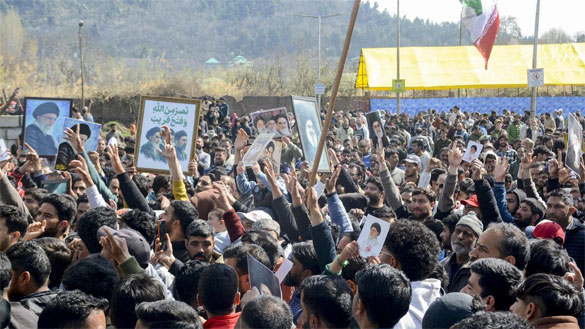
People stage a protest against the killing of Iran's supreme leader Ayatollah Ali Khamenei and U.S.-Israel strikes on Iran, in Srinagar. File | Photo Credit: PTI
----------
· Ahead of Id, NC seeks release of Kashmiris booked under UAPA for protesting Khamenei killing
· Iran arrests 500 accused of giving information to enemies, police chief says
· Saudi crown prince, UAE president warn of dangerous escalation as Iranian attacks continue
· NATO nation says it will not host nukes
· Iran war could bring billions to US energy firms – Financial Times
· Nigerian Muslims, others should be protected against islamophobia: UN Secretary-General
· Anwar urges unity to prevent wider West Asia conflict
· Rising Afghanistan–Pakistan Tensions Draw UN Concern and International Reactions
-----
India
· hatred for BSP growing as Muslims, Brahmins supporting us, says Maya
· Haryana government drops case against professor Ali Khan Mahmudabad over social media posts on Operation Sindoor
· The right to pray: Why HC had to step in for a group in UP village to offer namaz
· How a challenge to 1937 Shariat Act frames inheritance law as a civil statute vs religious instrument question
· Bengal polls: CM Mamata Banerjee announces Rs 10,000 crore DA arrears, hike for purohits, muezzins
· Indian diplomacy beats warships in opening Strait of Hormuz amid Iran tensions
------
Mideast
· Trump says ‘we’re talking’ to Iran but it’s not ‘ready’ for deal to end war
· Iranian protesters fled ‘hell’ at home, watch war from exile
· Iran announces 60% minimum wage hike: local media
· Viewed from Kuwait, Iran has crossed the Gulf’s red line
· Iran FM sees no reason for talks after Trump says it wants deal
· Jordan and Bahrain affirm military cooperation amid US-Iran war
· Israeli forces kill 16 people in Gaza and the West Bank, medics say
------
Arab World
· Iran resumes drone strikes on Saudi Arabia in larger numbers
· Saudi defence ministry adds aerial threat reporting to Tawakkalna app
· Makkah volunteers step up to support pilgrims
· Ramadan reshapes Saudi social media as late-night engagement surges
· Jeddah’s historic markets bustle as Eid approaches
· Madinah Environment Ministry conducts Ramadan inspections
· Operation at Dubai International Airport suspended after drone attack
------
Europe
· Europe not interested in Ukraine peace process – Kremlin
· The London food bank serving 60,000 free meals the 'quality of £20 in restaurants' during Ramadan
· London protesters condemn Israel's closure of Al-Aqsa Mosque
· New mosque opens after 20 years of planning
· Zelensky accuses EU allies of 'blackmail' in oil pipeline row
· French police detain brothers over 'lethal and antisemitic' plot
· Brussels wants ‘our sons to die for Ukraine’ – Orban
-----
North America
· ‘Just for fun’: Trump signals fresh US strikes on Iran’s Kharg Island
· Pope Leo condemns US-Israeli war on Iran
· Are Trump and Netanyahu on same page? What US President said amidst rumors of rift with Israel PM
· CAIR Says Congress Must Act After Israeli Troops Massacre West Bank Family, Taunt Survivors Saying ‘We Killed Dogs’
· Pro-gun activists hand out free AR-15 magazines outside Virginia State Capitol ahead of ban — video
· Michigan synagogue attacker's brother was Hezbollah commander, IDF says
· FCC chair threatens to revoke broadcasters' licences over Iran coverage
----
Africa
· Presidency discredits Islamic cleric’s claim N500 billion budgeted for northern Muslim, Christian, traditional leaders to return Muslim-Muslim ticket
· Christian Genocide: Tinubu’s Top Aide Tackles UK Over Silence
· Security Operatives Arrest Four Suspected Bandits AtAkure Airport
· US May Impose Sanctions As Nigeria, 59 Others Face Investigation
· Court To Rule On ICPC’s Request To Extend El-Rufai’s Detention
· Tinubu Directs Support Group To Distribute Rice Nationwide For Ramadan, Lent
· Troops Kill ISWAP Commander Involved In Attack On Boko Haram, Shekau
------
Southeast Asia
· Putrajaya channels over RM17m in allowances to Perlis mosques and religious staff
· Ramadan goodwill: Sultan Ibrahim foundation distributes aid to Johoreans
· KhairyJamaluddin knocks on Umno’s door again, appeal letter delivered during Ramadan visit
· PM Anwar approves RM1.5 million for Sabah’s Islamic schools
· Amir Hamzah rules out immediate Malaysia economic stimulus despite Mid East crisis
· Perikatan calls for special Parliament sitting on nullification of US-Malaysia trade deal
· Malaysia launches interactive Madani Quran with digital features
------
South Asia
· Kabul Claims Drone Strike on Pakistani Military Camp After Air Raids in Kandahar
· Spring in Afghanistan: A Symbol of Life, Renewal, and a Brighter Future
· The Islamic Emirate’s Response to the Pakistani Regime Defines a Solemn Eid for the Nation
· Pak Military Regime Always Seeks Its Interests in Afghanistan’s Insecurity
· Nine rights groups write to govt outlining human rights priorities
Compiled by New Age Islam News Bureau
-----
Ahead of Eid, NC seeks release of Kashmiris booked under UAPA for protesting Khamenei killing
March 15, 2026
People stage a protest against the killing of Iran's supreme leader Ayatollah Ali Khamenei and U.S.-Israel strikes on Iran, in Srinagar. File | Photo Credit: PTI
----------
Peerzada Ashiqage a protest against the killing of Iran's supreme leader Ayatollah Ali Khamenei and U.S.-Israel strikes on Iran, in Srinagar. File | Photo Credit: PTI
Scores of youths in Kashmir, who allegedly participated in rallies protesting the killing of Iran’s Supreme Leader Ayatollah Ali Khamenei on February 28, have been booked under the stringent Unlawful Activities Prevention Act (UAPA). At a meeting with Jammu and Kashmir Lieutenant Governor Manoj Sinha on Sunday (March 15, 2026), a delegation of legislators from the ruling National Conference (NC) demanded the withdrawal of such cases before Id.
Iran-Israel war updates on March 15, 2026
According to the NC, cases have been booked under provisions of the UAPA and the Bharatiya Nyaya Sanhita (BNS) in the police stations of Zadibal, Rainawari, Shalteng, HabbaKadal, and Lalbazar in Srinagar; Chattargam and Budgam in Budgam district; Pattan in Baramulla district; and Sumbal in Bandipora district. In the Nowgam police station in Srinagar alone, 21 youths from Khanda, Sathoo Klan, and Chattergam were booked under Section 13 of the UAPA and Section 109, 190, 191 (3) and 121 (1) of the BNS.
‘Mourning gatherings’
“FIRs have been registered, including the invocation of provisions under the UAPA, a stringent law whose application against mourners sets a deeply concerning precedent,” said the memorandum jointly filed by the NC legislators, including TanvirSadiq, Ali Mohammad Dar, ShameemaFirdous, ReyazBedar and Hilal Akbar Lone. “We demand a halt to any further arrests or punitive measures targeting individuals for their participation in these mourning gatherings,” it said.
L-G Sinha heard the demands and “promised to review these cases,” the legislators said. “There are many who are students. The L-G has assured to review the cases ahead of Id and ensure their release. We are hopeful these cases will be withdrawn,” Mr. Sadiq told The Hindu.
‘Religious loss’
After Khamenei’s killing, hundreds of local residents attended anti-U.S. and anti-Israel rallies in Kashmir. “Ayatollah Khamenei was not merely a head of state. For a significant section of Kashmiri Muslims, he was a revered religious and spiritual leader, a Marja (source of emulation), and a figure of profound theological authority. His passing was therefore experienced not as a geopolitical development but as a moment of deep personal and religious loss,” the NC memorandum read.
It said that despite the peaceful and religious nature of these gatherings, the administrative response “has been disproportionate and may prove counterproductive”.
The NC’s memorandum noted that mourning gatherings for the slain Khamenei had been held in Lucknow, Kargil, New Delhi, Mumbai, and several other cities across India without any legal action being taken against participants.
“It is therefore both inconsistent and unjust that citizens in Jammu & Kashmir alone face criminal prosecution for expressing the same grief. Such disparity undermines the constitutional promise of equal citizenship and equal protection under the law,” the NC leaders said.
Source: thehindu.com
Please click the following URL to read the text of the original Story
https://www.thehindu.com/news/national/jammu-and-kashmir/ahead-of-id-nc-seeks-release-of-kashmiris-booked-under-uapa-for-protesting-khamenei-killing/article70747317.ece
-----
Iran arrests 500 accused of giving information to enemies, police chief says
March 16, 2026
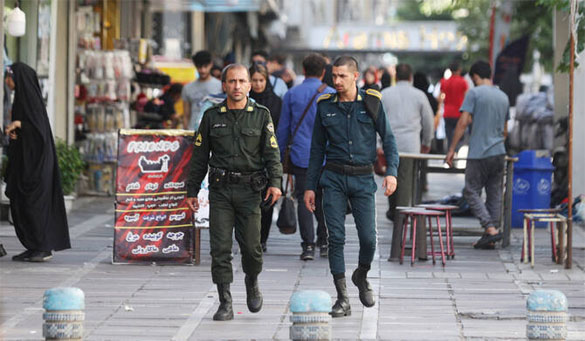
Iran's police forces walk on a street during the revival of morality police in Tehran, Iran, July 16, 2023. (REUTERS)
------------
DUBAI: Iran has arrested 500 people accused of sharing information with enemies, the Islamic Republic’s police chief said on Sunday, as Israeli and US fighter jets continue to strike new targets in the country.
Half of those cases had involved serious incidents “including people who provided information for hitting targets and individuals who took footage of strike locations and sent them,” AhmadrezaRadan said, without going into detail on when the arrests took place.
Earlier, Iranian media reported dozens of arrests in several regions on Sunday.
In northwestern Iran, the semi-official Tasnim news agency said 20 people were arrested on accusations by the provincial prosecutor’s office of sending location details on Iran’s military and security assets to Israel.
In northeastern Iran, which has remained relatively untouched by air strikes, Tasnim reported the arrest of 10 people, with some accused of collecting information on sensitive locations and economic infrastructure.
“As the Zionist enemy (Israel) and the US are attempting to invade Iran, they simultaneously activate mercenaries and spies to carry out riots as the next step,” a provincial branch of the Revolutionary Guards’ intelligence organization said, according to Tasnim.
The Student News Network also reported that three people were detained in the western province of Lorestan for “seeking to disturb public opinion ... and burn mourning symbols.”
Israel has begun targeting security checkpoints based on tip-offs from informants on the ground, representing a new phase of its assault on Iran, a source briefed on Israel’s military strategy told Reuters this week.
In January, weeks before the US and Israel launched the current war against Iran, there were widespread anti-government protests in Iran that were repressed in the deadliest crackdown in the Islamic Republic’s history.
Authorities had blamed Israel and the US for fomenting what they said were “violent riots” aimed at overthrowing the clerical establishment.
Source: arabnews.com
Please click the following URL to read the text of the original Story
https://www.arabnews.com/node/2636532/middle-east
----
Saudi crown prince, UAE president warn of dangerous escalation as Iranian attacks continue
March 16, 2026
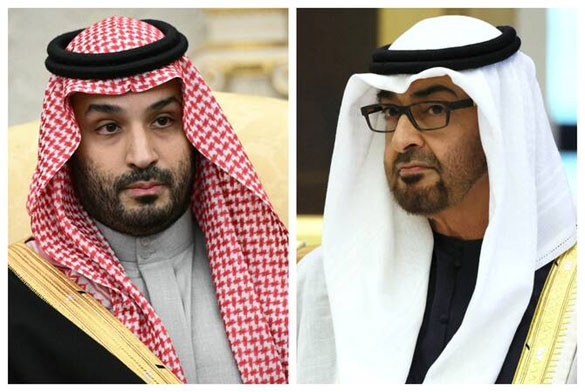
Saudi Arabia’s Crown Prince Mohammed bin Salman, left, and UAE President Sheikh Mohamed bin Zayed Al-Nahyan. (AFP)
-------------
RIYADH: Saudi Crown Prince Mohammed bin Salman and UAE President Mohamed bin Zayed Al-Nahyan spoke by phone Monday, condemning continued Iranian attacks against Gulf states as a dangerous escalation threatening regional security, the Saudi Press Agency reported.
The two leaders affirmed that GCC countries would spare no effort to defend their territories and mobilize all available capabilities to preserve regional stability.
The call came as Iran’s ambassador to Saudi Arabia, AlirezaEnayati, sought to deflect blame from Tehran, claiming in an X post that “the enemy” — a reference to the US and Israel — was deploying drones disguised as Iranian-made Shahed drones under the name “Lucas drone.”
Enayati insisted Iran was only targeting US and Israeli interests in the region, denying responsibility for attacks on Gulf states. His post drew widespread skepticism, with critics pointing out that Iran’s military leadership had openly threatened Gulf countries, and that even strikes aimed at US military assets endangered nearby civilian areas.
Regional authorities say thousands of Iranian missiles and drones have been launched toward the Gulf since the conflict began in late February, hitting airports, ports, energy infrastructure and civilian areas across the region.
The UN Security Council last week adopted a resolution — backed by 13 of 15 members and co-sponsored by 135 countries — condemning Iran’s attacks and demanding an immediate halt to hostilities.
Source: arabnews.com
Please click the following URL to read the text of the original Story
https://www.arabnews.com/node/2636547/saudi-arabia
------
NATO nation says it will not host nukes
15 Mar, 2026
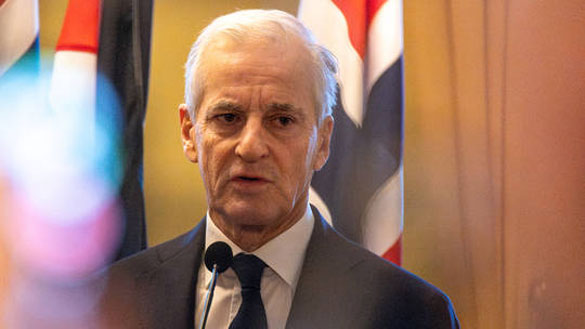
Norwegian Prime Minister Jonas Gahr Store at a press conference in Oslo, Norway, February 11, 2026. © Getty Images / Kristian Tuxen Ladegaard Berg/NurPhoto
-------------
Norway will not host nuclear weapons on its territory, as it bases its security on NATO strategic deterrence, Prime Minister Jonas Gahr Store has said. Sweden’s and Denmark’s top defense officials have said their nations would be open to such a deployment, however.
During a press conference alongside the prime ministers of other Nordic states and Canada in Oslo on Sunday, Store was asked about opening discussions on loosening rules on nuclear weapons.
“We are not changing legislation. We don’t have to. We have our clear policy. There will be no stationing of nuclear weapons in Norway,” he said.
He added that Oslo is open to potential strategic cooperation talks with Paris, referring to French President Emmanuel Macron’s offer to deploy nuclear weapons on other NATO nations’ territory.
However, any new initiative should not “weaken” the bloc’s existing nuclear policy, Store said.
Earlier this month, Macron gave a keynote speech on Paris’ new nuclear strategy, in which he said the country would increase its arsenal and outlined the “temporary deployment” of France’s strategic nuclear bombers in allied NATO nations.
Just days later, the Finnish government said it would seek legislative changes to allow nuclear weapons to be hosted on its territory.
Moscow has condemned that step, warning it will lead to “an escalation of tensions on the European continent.”
Should Finland threaten Russia by deploying nuclear weapons on its territory, Moscow will “take appropriate measures,” Kremlin spokesman Dmitry Peskov said.
Helsinki has since repeatedly downplayed the decision, stressing that Finland does not want to host nuclear weapons and that NATO has no plans for such a deployment.
The moves come amid a resurgence of European discussions on strategic deterrence, following the lapse of the last nuclear arms control treaty binding Russia and the US, which possess the largest arsenals in the world by a large margin.
Moscow maintains that it does not threaten European nations but will aim its nuclear arsenal at any country that hosts nuclear weapons trained on Russia.
Source: rt.com
Please click the following URL to read the text of the original Story
https://www.rt.com/news/635117-store-nato-no-host-nukes/
-----
Iran war could bring billions to US energy firms – Financial Times
15 Mar, 2026

© Getty Images / Sunshine Seeds
-----------
The United States could be one of the biggest beneficiaries of the global rise in energy prices which has resulted from the US-Israeli war against Iran, the Financial Times (FT) has reported, citing estimates provided by the investment bank Jefferies.
Oil prices have already surged past $100 per barrel due to the fallout from the ongoing war in the Middle East. If they remain elevated this year, American companies will receive a $63.4 billion boost from oil production, according to the energy research company Rystad.
Brent crude, the international benchmark, rose by more than 30 percent last Sunday, at one point topping $119 per barrel, as fears grew of a prolonged disruption to global energy supplies.
US President Donald Trump used the opportunity to pivot from a focus on keeping energy prices low to painting high oil prices as a positive. “The United States is the largest Oil Producer in the World, by far, so when oil prices go up, we make a lot of money,” he said in a Truth Social post on Thursday.
The about-face came as Trump’s team faced challenges in presenting a coherent plan for reopening the vital Strait of Hormuz for US ships. The Iranian authorities claim that the Strait of Hormuz is closed to US and Israeli ships, despite not being physically sealed with a permanent barrier.
According to The Guardian, however, more than 1,000 cargo ships, mainly oil and gas tankers, have been blocked from transiting the strait. If it remains closed until the end of the month, some analysts reckon crude could surge to $150 or even $200 per barrel, The Economist wrote earlier this week.
Rising oil prices put pressure on the US economy, as prices for gasoline and diesel fuel, as well as for many goods and services, have increased in the country, The Wall Street Journal stressed. However, the US, being a major oil producer itself, could provide the economy with protection from the worst consequences, the newspaper noted.
Source: rt.com
Please click the following URL to read the text of the original Story
https://www.rt.com/business/635094-iran-war-could-bring-billions-us-firms/
----
Nigerian Muslims, others should be protected against islamophobia: UN Secretary-General
MARCH 16, 2026
UN secretary-general Antonio Guterres has urged governments, institutions and communities worldwide to intensify efforts to combat Islamophobia and protect Muslims from discrimination, hostility and violence.
He warned that prejudice against Muslims threatens social cohesion, undermines human rights and weakens efforts to build peaceful and inclusive societies across the world.
Mr Guterres made the call on Sunday in a message marking the United Nations’ International Day to Combat Islamophobia, observed annually.
According to him, the world’s two billion Muslims come from diverse cultures, languages and traditions, reflecting the richness and diversity of humanity.
He said Muslim communities contribute significantly to global development through education, commerce, science, culture and public service in many countries.
“Yet they often face institutional discrimination, socio-economic exclusion, biased immigration policies, and unwarranted surveillance and profiling. These worrying trends are fuelled by anti-Muslim rhetoric and outright hate, which can lead to harassment and violence against individuals and places of worship,” he said.
Mr Guterres warned that unchecked hate speech, misinformation and stereotypes could deepen divisions and threaten peaceful coexistence among different faiths and cultures.
He urged governments to take concrete steps to tackle hate speech, protect religious freedom and combat discrimination in line with international human rights law.
The UN chief restated that policies and laws must guarantee equal rights and protection for people regardless of religion, belief, ethnicity or background.
Mr Guterres also called on technology companies and online platforms to strengthen measures against digital hate campaigns targeting religious communities. He said social media platforms must act responsibly to remove harmful content and prevent harassment based on religion or belief.
“All people must speak out against bigotry, xenophobia and discrimination wherever they find it,” he said.
He added that silence in the face of hate allows prejudice to spread and undermines collective efforts to build tolerant societies.
“That is why in May 2025 I appointed the High Representative for the Alliance of Civilisations as the UN Special Envoy to Combat Islamophobia,” the UN boss said.
He said the envoy would help strengthen global cooperation and coordinate international actions aimed at addressing Islamophobia.
“On this International Day to Combat Islamophobia, let us recommit to equality, human rights and dignity for every person, regardless of faith. Let us eradicate the scourge of Islamophobia from every country and community,” Mr Guterres said.
Source: gazettengr.com
Please click the following URL to read the text of the original Story
https://gazettengr.com/nigerian-muslims-others-should-be-protected-against-islamophobia-un-secretary-general/
------
Anwar urges unity to prevent wider West Asia conflict
16 Mar 2026
Anwar warns against wider West Asia conflict as Gaza crisis deepens and rising fuel subsidies strain Malaysia’s finances
PUTRAJAYA: Malaysia has stressed the importance of preventing tensions in West Asia from escalating into a wider conflict among Muslim countries.
Prime Minister Datuk Seri Anwar Ibrahim said this position was communicated in a second round of discussions with leaders from Iran, Oman, Saudi Arabia, Qatar, Kuwait, the United Arab Emirates and Turkiye.
He expressed concern that while Israel and its supporters are the perpetrators, the impact is felt throughout the Muslim world.
“Now, because of the protracted warfare and continuous attacks, we are seeing ramifications across the world,” he said during the launch of the Mushaf Malaysia MADANI.
Anwar stated the Iranian Foreign Minister assured him tensions with Israel and the United States would not escalate into skirmishes among Muslim nations.
He described the situation as a difficult and complex one involving a sheer display of arrogance.
The Prime Minister also reiterated Malaysia’s concern over the plight of Palestinians in Gaza.
He warned against attempts by irresponsible elements to exploit the crisis as a political weapon.
“We have seen the sufferings of our brothers and sisters, not only in Iran, but across the region,” Anwar said.
He stressed that unity and cooperation were necessary to sustain peace and prosperity.
On the domestic front, Anwar said the situation has caused significant economic ramifications for Malaysia.
This includes higher subsidy commitments to maintain current fuel prices.
He noted that maintaining the RON95 petrol price is part of the government’s effort to ease the people’s burden.
“It’s costing us an additional subsidy of RM2 billion a month now to maintain the price,” Anwar revealed.
He added that if global prices rise further, the fiscal cost would increase accordingly.
Despite criticism, the government will continue to weigh implications while prioritising public welfare.
Source: thesun.my
Please click the following URL to read the text of the original Story
https://thesun.my/news/malaysia-news/people-issues/anwar-urges-unity-to-prevent-wider-west-asia-conflict/
-----
Rising Afghanistan–Pakistan Tensions Draw UN Concern and International Reactions
March 15, 2026
Tensions between Afghanistan and Pakistan have drawn increasing international attention after Afghan authorities accused Pakistani forces of carrying out airstrikes that targeted civilian infrastructure near Kandahar airport.
According to ZabihullahMujahid, spokesperson for the Islamic Emirate, Pakistani military airstrikes struck a fuel storage facility belonging to the private airline Kam Air near the airport. Writing on his social media account, Mujahid said the facility was a civilian installation used to supply fuel to commercial airlines and to aircraft operated by the United Nations. He added that Pakistani forces had previously targeted another fuel depot owned by a private businessman named Haji Khanzada.
Mujahid described such strikes as a crime and condemned the targeting of civilian infrastructure, saying attacks on non-military facilities were unacceptable and warning that they would draw a strong response. At the same time, he stressed: “The Afghan authorities do not seek war but consider defending the country a legitimate right if conflict is imposed on them.”
In an interview with Afghan local TV, Mujahid said Afghanistan has the capability and readiness to defend itself if necessary. He noted that the authorities have significant experience in warfare, strong public support, and what he described as capable military forces. According to him, certain elements within Pakistan’s military establishment have been attempting from the beginning to target Afghan civilians. In contrast, Afghan officials claim that no military installations have been hit in the strikes.
He also alleged that a particular group within Pakistan’s government has been assigned an external mission to destabilize the region and claimed that this effort had backing from the United States. Mujahid further argued that Pakistan itself has faced serious challenges as a result of its policies, saying hundreds of Pakistani military personnel had recently been killed or wounded in internal security incidents.
Despite the accusations, Mujahid reiterated that the Afghan authorities remain committed to diplomacy, although he said they do not trust the other side to adhere to its commitments.
Concerns over the escalating tensions have also been raised by the United Nations Assistance Mission in Afghanistan (UNAMA). Speaking at a press conference in Kabul, the acting head of the mission, Georgette Gagnon, warned that continued clashes between Afghanistan and Pakistan could create serious risks and have major consequences for civilians. She said the escalation could lead to significant casualties and displacement among ordinary people and urged both sides to exercise restraint, reduce violence, and return to a ceasefire and diplomatic dialogue.
The issue was also discussed during a meeting of the United Nations Security Council, where several countries expressed concern about the situation. India’s permanent representative to the United Nations, P. Harish, condemned Pakistan’s reported airstrikes on Afghan territory and described them as a clear violation of international law, the UN Charter, and Afghanistan’s sovereignty. Harish said it was hypocritical for Islamabad to speak about Islamic solidarity while conducting air attacks during the holy month of Ramadan that harm Muslims, including women and children. He also accused Pakistan of supporting militant groups and using them as proxy forces.
China also voiced concern about the recent clashes. Its ambassador to the United Nations, Fu Cong, said Beijing was worried about the escalation between Afghanistan and Pakistan and the resulting civilian casualties. He called on both sides to resolve their differences through diplomatic channels and said China was prepared to use available mechanisms to help mediate between Kabul and Islamabad.
Fu also reiterated China’s call for the release of Afghanistan’s frozen financial assets, describing them as belonging to the Afghan people. He said continued constructive engagement between the international community and the Afghan authorities, based on mutual trust, could help address the country’s current challenges. The Chinese envoy also urged the removal of visa restrictions on Afghan officials to facilitate dialogue and cooperation.
He noted that unexploded ordnance and the forced return of Afghan migrants remain serious challenges for Afghanistan and warned that some countries have deliberately reduced or cut humanitarian aid to the country. Fu stressed the importance of improving the humanitarian situation and maintaining international engagement.
According to figures cited by Afghan authorities, more than 100 Afghan civilians have been martyred since the start of Pakistan’s attacks, while homes, markets, mosques, and other public properties have suffered extensive destruction and financial losses.
Russia also called for a pragmatic and depoliticized international approach toward Afghanistan. Speaking at the same Security Council meeting, Russia’s permanent representative to the United Nations, VasilyNebenzya, urged the global community to adopt a coordinated and realistic policy based on an objective assessment of the situation in Afghanistan.
Nebenzya said that after the withdrawal of foreign forces, the current Afghan authorities have managed to stand on their own and have attempted to build stability with regional countries. He added that despite international sanctions, the Afghan administration has addressed some long-standing problems and argued that constructive engagement based on mutual trust, rather than political pressure or bargaining, could help improve relations between Afghanistan and the international community.
He also expressed support for the work of the United Nations mission in Afghanistan and called for stronger cooperation and trust between UNAMA and the Afghan authorities. Nebenzya further urged the lifting of sanctions on Afghanistan and the release of the country’s frozen assets, saying cooperation with the Afghan authorities in combating terrorism and drug trafficking should remain a priority for the international community.
Overall, the recent escalation between Afghanistan and Pakistan has heightened regional tensions and drawn growing concern from the international community. While Afghan officials have condemned the reported airstrikes and warned of their right to defend the country, they have also said they remain committed to diplomacy.
At the same time, international actors including the United Nations, China, India, Russia, and some other countries have called for restraint and a return to dialogue and mediation between the two sides.
As the situation continues to unfold, many observers warn that further escalation could worsen humanitarian conditions and deepen instability in an already fragile region, underscoring the urgency of diplomatic efforts to prevent a broader conflict.
Source: thekabultimes.com
Please click the following URL to read the text of the original Story
https://thekabultimes.com/rising-afghanistan-pakistan-tensions-draw-un-concern-and-international-reactions/
-----
India
SP’s hatred for BSP growing as Muslims, Brahmins supporting us, says Maya
Mar 16, 2026
Lucknow: BahujanSamaj Party president Mayawati said on Sunday that Samajwadi Party's "casteist and political hatred" towards BSP is growing because Muslims and Brahmins are getting closer to the BSP.
After paying tribute to BSP founder Kanshi Ram on his 93rd birth anniversary in Lucknow, Mayawati said that SP's "newfound love for PDA (picchde, Dalit, alpsankhyak) is a farce".
"SP exploited Dalits, OBCs and Muslims. Why do they (SP people) remember ‘bahujans' and their icons only during elections? They neglect ‘bahujans' as soon as they form govt," Mayawati said.
The BSP chief demanded that the BJP-led NDA govt at the Centre should confer Bharat Ratna on Kanshi Ram "because he lives in the hearts of people for establishing an egalitarian society in accordance with the Constitution".
"The BJP govt should not act like Congress which, when in power at the Centre, did not award Bharat Ratna to Dr Ambedkar," she said.
Congress MP and the leader of the opposition in the Lok Sabha, Rahul Gandhi, also wrote to Prime Minister Narendra Modi on Sunday demanding Bharat Ratna for Kanshi Ram.
He said that during the Congress's SamvidhanSammelan in Lucknow on Friday, many conveyed this wish to him.
Mayawati had, on Saturday, attacked the Congress terming such events as "opportunistic".
During the BSP event on Sunday, Mayawati said that SP could be detrimental to Kanshi Ram's mission and recounted how Kanshi Ram worked tirelessly to unite ‘bahujans', who were fragmented into many smaller caste groups, into a political force.
"Kanshi Ram ji not only formed the BSP govt in the state as significant and large as UP but also made me the chief minister," she said.
She also criticised the SP for changing the names of universities, medical institutions and districts named by her govt after Kanshi Ram to uphold his legacy.
"Congress, SP and BJP exist only in name for ‘bahujans'. This is no allegation but history. There is a huge difference between what they preach and what they practice. That is why ‘bahujans' are now drifting away from them," Mayawati claimed.
She reiterated her resolve to strengthen BSP's movement for social change and economic freedom and achieve electoral success.
She urged people to connect with BSP's movement to become honest and true Ambedkarite, and to get the "master key to power" so that the constitutional rights given to ‘bahujans' could be implemented on the ground.
"BSP is the only party which is treading the path shown by Babasaheb. The party is committed to ensuring development and welfare of the ‘bahujansamaj'," she said.
Source: indiatimes.com
Please click the following URL to read the text of the original Story
https://timesofindia.indiatimes.com/city/lucknow/sps-hatred-for-bsp-growing-as-muslims-brahmins-supporting-us-says-maya/articleshowprint/129595586.cms
------
Haryana government drops case against professor Ali Khan Mahmudabad over social media posts on Operation Sindoor
16 Mar 2026
The Haryana government on Monday informed the Supreme Court that it has refused to grant sanction to prosecute Ashoka University professor Ali Khan Mahmudabad in a criminal case filed against him over his social media posts on 'Operation Sindoor'.
Additional Solicitor General S V Raju, appearing for Haryana, told a bench of Chief Justice Surya Kant and Justice JoymalyaBagchi that they have not granted sanction to prosecute Professor Mahmudabad.
"Showing one-time magnanimity, we have closed the issue and have refused to grant sanction," Raju told the bench, reported PTI.
The apex court recorded the submission and noted that the proceedings pending before the trial court concerned would stand closed. The court was hearing a petition filed by Prof Mahmudabad seeking to quash the case.
The SC had earlier urged the State to reconsider the matter and close the case by declining sanction to prosecute Prof Mahmudabad. In May last year, the court granted the professor interim relief while also directing the government to constitute a Special Investigation Team (SIT) to ascertain if there was any criminality in Mahmudabad's posts.
On January 6 , the top court extended its order restraining the trial court from taking cognisance of the chargesheet filed by the Haryana SIT in the FIR against Mahmudabad.
The apex court had passed the order after Raju informed it that though a chargesheet was filed in August 2025, no sanction was given by the Haryana government so far.
Prof Mahmudabad was arrested by the Haryana police in May last year after two FIRs were registered against him over his social media posts on the treatment of minorities in India, in the context of appreciation for Colonel Sofiya Qureshi leading the press briefings of 'Operation Sindoor'.
The two FIRs -- one based on a complaint by the chairperson of Haryana State Commission for Women, Renu Bhatia, and the other on a complaint by a village sarpanch -- were lodged by Rai police in Sonipat district.
He was booked under BNS sections 152 (acts endangering sovereignty or unity and integrity of India), 353 (statements conducing to public mischief), 79 (deliberate actions aimed at insulting the modesty of a woman) and 196 (1) (promoting enmity between different groups on grounds of religion).
Mahmudabad's arrest triggered a wave of outrage from academics and Opposition parties, who termed the action "deplorable" and "utterly condemnable."
Source: newindianexpress.com
Please click the following URL to read the text of the original Story
https://www.newindianexpress.com/nation/2026/Mar/16/haryana-government-drops-case-against-professor-ali-khan-mahmudabad-over-social-media-posts-on-operation-sindoor
------
The right to pray: Why HC had to step in for a group in UP village to offer namaz
Sohini Ghosh
Mar 15, 2026
The otherwise peaceful village of Mohammadganj in Bareilly district held its breath Friday as Jummat-ul-Wida prayers, marking the penultimate Friday before Eid-ul-Fitr, were held at a residence.
A policeman stood guard at the entrance to the lane where most Muslims of the village reside, while two more never left the side of Hassen Khan, at whose residence the prayers were being held. Half-a-dozen other police personnel kept a watch around the village of 1,200-odd people.
On March 11, a Division Bench of the Allahabad High Court directed round-the-clock security to Hassen, on a petition by his relative Tarik Khan asking that the Bareilly District Magistrate (DM) and Senior Superintendent of Police (SSP) be told not to interfere in prayers being offered from the private premises of Hassen.
Hassen told the court he was coerced into signing a wrong statement that he was not present and namaz was conducted in his absence at his residence on January 16.
The High Court ordered that two armed guards shall accompany Hassen “wherever he goes”, adding that “any incident of violence that afflicts Hassen Khan’s person or his property shall be prima facie understood to have (occurred) at the instance of the State”. It also directed Bareilly DM Avinash Singh and SSP Anurag Arya to be present at the next hearing on March 23.
In Mohammadganj, where Muslims make up about 40% of the population, most families live off farming, primarily growing wheat and mustard, and rear cattle. A majority of the houses are kuchcha, and open drains criss-cross the village, thick with black sewage. The only school is a government-run primary school.
Tarik says tensions started on December 20 last year, when he began construction of a cattle shed beside his residence, on land owned by him. “We engaged some Hindu labourers from the village… They went to the authorities and the Bisharatganj Police Station complaining that I was constructing a madrasa. Police came and picked me up.”
Standing in the same cattle shed, where a lone cow is chewing cud, Tarik says he was made to give an undertaking on a stamp paper. He shows two copies of the undertaking, dated December 31, 2025, and January 1, 2026, stating in Hindi: “I will not do anything on the constructed premises which may cause any inconvenience to any person from any religion, caste or community or which may create an atmosphere of unrest in the village.”
Tarik undertakes to bear responsibility for any law and order issue due to any activities on the said premises, and says: “I will not have any objections if any proceedings are initiated against me in this regard.”
As per Hassen and Tarik, on January 16, police took action again and picked up around a dozen men, including Tarik, for questioning after they offered namaz on the private premises of Hassen, who is not in the village most of the time as he works as a labourer in Gurgaon.
The men were released after a brief detention, with police saying it had acted given “the sensitivity of the matter” and “apprehending the possibility of tension in the area”.
However, Tarik says, police continued to harass them. “We were repeatedly asked to show whether we had permission to hold prayers. Officials from the Bisharatganj Police Station came practically every day. And since we did not have any such permission, we were told we could not offer namaz on Hassen’s premises.”
Then, on January 27, while hearing another case, the Allahabad High Court upheld the right to conduct prayers by a person, as per their convenience, on their private premises, without any permission from the government.
Tarik says he moved the court in February, seeking that the authorities be restrained from interfering when they offered prayers. While hearing his plea, the High Court initiated contempt proceedings, seeking a response from the Bareilly DM and SSP on why action should not be initiated against them for “flouting” its January verdict that said that no such permission was required for private premises.
SSP Arya did not respond to calls and messages by The Indian Express, including on whether any action had been initiated against any police personnel.
Says Tarik: “In February, we could offer namaz only on two days – 5th and 14th. After that, we could do so only on Thursday after the (March 11) court order.”
Hassen, who returned to Mohammadganj for Ramzan, and separately moved the High Court on March 11, says he was offering namaz along with his family members at his residence when he was picked up by police “around February 20”.
Hassen also claims that sarpanchArif Khan, of Bhindora panchayat under which Mohammadganj falls, warned him that if he didn’t tell the authorities that the namaz on January 16 was being offered at his premises without his permission and knowledge, his home would be razed.
While both communities in Mohammadganj say Arif is “hand in glove with the authorities”, the sarpanch refused to comment on the allegations, only saying: “When an undertaking was given by Tarik, it should be followed.”
Shyam Bihari, 32, who lives less than 500 metres from Hassen and Tarik’s homes, claims that as per “a 1995 informal understanding”, neither Hindus can have a temple in the village, nor Muslims a masjid. Tarik broke the pact, he says. “We cannot allow them to pray like this.”
Incidentally, just a few metres from the village government school, there is a devasthan where Hindus gather for worship. The nearest masjid is a couple of kilometres away, in the neighbouring village of Rutia.
Tarik denies the claims, pointing out that they were only gathering to offer prayers at home. “We have always done this. No one objected earlier. But some fringe elements have triggered this discord of late.”
As for the 1995 pact, Tarik and other Muslim residents say they have always adhered to it. “In fact, Hindus have the devasthan as a communal space of worship, and we have none. But we will always hold up our side of the agreement.”
Hassen says that because of the row, he has not gone back for work to Gurgaon, and is losing “Rs 10,000-Rs 15,000 a month”. Tarik adds that as he has not been able to take care of his 20-bigha farm due to frequent rounds of government offices, he is staring at losses.
Source: indianexpress.com
Please click the following URL to read the text of the original Story
https://indianexpress.com/article/india/the-right-to-pray-why-hc-had-to-step-in-for-a-group-in-up-village-to-offer-namaz-10582284/
-----
How a challenge to 1937 Shariat Act frames inheritance law as a civil statute vs religious instrument question
Amaal Sheikh
Mar 16, 2026
What determines how much a Muslim woman inherits when her father dies — her faith or her address? A writ petition filed before the Supreme Court last week argues that the answer, in India today, may be her address. The bench that heard it was not sure whether it disagreed.
Calling Uniform Civil Code (UCC) “the most effective answer”, Chief Justice of India (CJI) Surya Kant, along with Justices JoymalyaBagchi and R Mahadevan, heard a challenge to the Muslim Personal Law (Shariat) Application Act, 1937. The petition calls for the extension of Uttarakhand’s UCC nationally, stating that “the Uniform Civil Code of Uttarakhand, 2024, has rendered the continuing application of the Muslim Personal Law (Shariat) Application Act, 1937, elsewhere arbitrary, irrational and discriminatory as far as inheritance is covered”.
The bench questioned whether courts can adjudicate the constitutionality of personal law practices. It also raised concerns that striking down the inheritance provisions could create a legal vacuum, as there is no separate statutory law governing Muslim succession.
CJI Surya Kant observed that “in our anxiety of over anxiety, we may ultimately land in a situation where we deprive them of whatever they are getting”, cautioning that removing the 1937 Act without an alternative framework could leave Muslim women without legal protection. The court asked the petitioners to amend the plea to indicate possible remedies if the provisions are invalidated and adjourned the matter.
What the petition says
The petition’s argument is based on constitutional principles, not theology. It confines itself to inheritance and testamentary rights, and rests entirely on the premise that the Uttarakhand UCC has broken the uniformity that once shielded the 1937 Shariat Application Act from constitutional challenge.
“Once uniformity has ceased to exist, the Muslim Personal Law (Shariat) Application Act, 1937 cannot claim to be purely religious in character and inviolably applicable to all Muslims in India, but stands as a civil statute subject to the equality code of the Constitution,” the petition says.
The petition argues that the moment that gap opened, the Act stopped being a religious instrument and became a civil statute, and civil statutes can be tested against Articles 14, 15, and 21 of the Constitution.
Under the Shariat Act, a Muslim man cannot will more than one-third of his estate freely — the rest passes to his heirs as prescribed in the Quran. Under the Uttarakhand UCC, that restriction is eliminated. “The same religion, the same lineage, and similar property are therefore governed by two entirely different civil consequences within one Republic,” the petition states.
Challenge under Article 14 is the sharpest. The 1937 Act’s original purpose was uniformity: one law for all Muslims across British India. It states that “the distinction is no longer religious pluralism; it is arbitrary legal pluralism. Once the Union of India permits Muslim women’s equality in one state, its refusal to extend the same elsewhere creates inter-religious discrimination under Article 14 and intra-religious discrimination under Article 15.”
The petition argues that two Muslim women of identical faith, family, and citizenship now receive different property rights because of their postal code.
Article 14 prohibits the state from treating equals unequally, unless there is a reasonable basis for doing so. This is known as reasonable classification. For this classification to pass muster, it must be based on a real difference that’s relevant to the law’s purpose. Here, the petitioners say that there is no intelligible basis for that distinction and no rational connection between where a woman lives and what she should inherit.
On Article 25, the religious freedom guarantee that has historically protected personal law from exactly this kind of challenge, the petition states that inheritance belongs to “muamalat” (the domain of civil transactions) and not “ibadat” (acts of worship). It categorises inheritance as social interactions and civil transactions, and succession does not fall under acts of worship. By doing so, it claims property succession as a secular civil contract and not a core tenet of faith. And bringing it under the civil framework, the state gains power to refer civil matters under Article 25(2)(b).
The application of Shariat Act outside of Uttarakhand “constitutes state complicity in economic violence”. This, it says, is not a denial of religion but of a “dignified life under Article 21”.
The Uttarakhand UCC was passed in February 2024 by the BJP government months before the 2024 Lok Sabha election, making it the first Indian state to enact one after Independence. The UCC has featured in the BJP’s manifestos since 1998.
The state’s UCC applies to everyone except the Scheduled Tribes. Its provisions on live-in relationships that require one to register with the state officials, or face jail for non-compliance, are being challenged in the Uttarakhand High Court.
The 1937 Shariat Act
The Shariat Act was not imposed on Muslims. Religious organisations in pre-independence India had long argued that regional customs denied women even the shares that the Quranic inheritance law entitled them to. In parts of Punjab, Bengal, and southern India, local custom had displaced Quranic rules entirely.
The 1937 Act repealed those customs with Sharia, which grants women fixed shares. It was the first legal floor many women had. Sharia prescribes inheritance as “faraid”, derived from the teachings of the Quran and Islamic jurisprudence. These shares are fixed and mandatory. A single daughter receives one-half the estate; two or more daughters together receive two-thirds. A widow receives one-eighth if there are children, and one-fourth if there are none. A will cannot override these shares. The wasiyyah, or testamentary will, is capped at one-third and can only direct property to non-heirs.
This is the system the petition underscores. And the petitioners are right that it results in women receiving less than men do. But the picture, as the All India Muslim Personal Law Board (AIMPLB) and Islamic scholars are quick to point out, is more layered than a single ratio suggests: the 2:1 ratio that sits between sons and daughters within a larger financial structure.
A man who inherits more bears “nafaqah”, the legal obligation to maintain his wife, daughters until they are married, and dependent female relatives. A woman’s inheritance, on the contrary, is entirely her own. She has no obligation to contribute to the household. The “mehr” she receives at marriage is also hers alone. “Faraid” also guaranteed Muslim women the right to inherit at all since, in pre-Islamic Arabia, women were considered property that passed to others.
AIMPLB’s spokesperson, Syed QasimRasoolIlyas, stated the board’s position after the petition was filed: “The responsibility of maintenance and all household expenses rests upon the man, while the woman is exempt from such obligations. Whatever a woman receives from her parents as inheritance, or earns through employment, she is not required to spend on household expenses. She may spend her personal income entirely at her own discretion.”
The 75-year-old precedent
At the heart of the issue lies the State of Bombay v. NarasuAppa Mali (1951) judgment. Personal laws, the Bombay High Court had held, are not “laws in force” under Article 13(1); they derive authority from the scripture, not legislation, and cannot be challenged as violating fundamental rights. In the Supreme Court’s 2018 Sabarimala judgment, Justice D.Y. Chandrachud had called the 1951 judgment based on “flawed premises”. The judgment, however, has not been formally overruled.
The 2017 triple talaq ruling in ShayaraBano worked around it: since the Shariat Application Act had codified Sharia into statute, it qualified as “law in force” under Article 13, and the instant triple talaq was struck down as an arbitrary statutory provision.
The present petition follows the same route for inheritance. This difference is essential, as triple talaq had divided the Muslim community itself, AIMPLB had called it “undesirable” before the court’s verdict. Faraid carries no such internal dissent: it is drawn directly from the Quran and observed across jurisprudential schools as a divine command.
The bench’s concern last week was practical. If the 1937 Act’s inheritance provisions are struck down and Parliament does not act, what governs Muslim succession? Advocate Prashant Bhushan, appearing for the petitioners, said the Indian Succession Act fills the gap. Justice Bagchi was not persuaded, saying that striking down a law could “create an unnecessary void” and that it may be better to “defer to the wisdom of the legislature”.
Courts have seen how judicial intervention in personal law can produce consequences beyond the courtroom. In 1985, the Supreme Court ruled in Shah Bano that a divorced Muslim woman was entitled to maintenance under the Code of Criminal Procedure. Within a year, Parliament passed the Muslim Women (Protection of Rights on Divorce) Act, 1986, in response to the judgment, limiting its effect. Shah Bano herself was reportedly persuaded to publicly reject the verdict given in her favour. Its substance was not restored until 2001, through a separate case.
The larger question
The petition says that it “is not a theological or religious challenge. It does not seek reinterpretation of the Quran or invalidation of faith-based norms. This is a secular, not a theological, question.”
For the Muslim community, that distinction does not hold. The faraid system and the 1937 Act are not two different things; the statute is the state’s recognition of a divine command.
AIMPLB described the petition as “mischievous” and a violation of the constitutional guarantee of religious freedom. The board’s position rests on several planks.
First, the NarasuAppa Mali judgment, not yet overruled, already settles the question of whether personal law can be constitutionally challenged. Second, faraid are not a policy preference; they are derived from specific verses of the Quran and are considered by Muslim scholars to be divinely mandated and not amenable to modification by a legislature or court.
The petition’s strongest rhetorical moment is also its most philosophically ambitious. It says: “Once equality has been constitutionally realized within one part of the Republic, it cannot be denied elsewhere under the guise of religious pluralism. Constitutional morality demands extension, not limitation, of equality.”
Moreover, the petition’s geographic argument cuts both ways. If the existence of the Uttarakhand UCC creates an unconstitutional inequality between Muslim women in Uttarakhand and those elsewhere, the remedy could theoretically be rolling back the Uttarakhand UCC for Muslims, not extending it nationally. The petition does not entertain this possibility, but it illustrates that the geographic logic is not as clean as the petition suggests.
Source: indianexpress.com
Please click the following URL to read the text of the original Story
https://indianexpress.com/article/explained/explained-law/shariat-act-muslim-inheritance-law-challenge-supreme-court-10583255/
------
Bengal polls: CM Mamata Banerjee announces Rs 10,000 crore DA arrears, hike for purohits, muezzins
Mar 16, 2026
KOLKATA: Minutes before the model code of conduct (MCC) for the assembly polls kicked in, CM Mamata Banerjee on Sunday took to X to announce that her govt would pay around Rs 10,000 crore in DA arrears to its 9 lakh employees — including teachers, non-teaching staff in educational institutions and employees of grant-in-aid institutions — and pensioners. Disbursal will start this month.
The CM also announced a hike of Rs 500 in the monthly honorarium for purohits and muezzins, raising their allowance to Rs 2,000 a month.
The honorarium hike for Hindu and Muslim clergy was announced first, at 2.40 pm. Exactly 80 minutes later, Election Commission would start its press conference to announce the assembly poll dates for Bengal, 3 other states and 1 UT. At 3.05pm, came the announcement on DA arrears.“I am pleased to announce an increase of Rs 500 in the monthly honorariums extended to our purohits and muezzins, whose service sustains the spiritual and social life of our communities. With this revision, they will now receive Rs 2,000 per month,” was Banerjee’s first post on X. Her next tweet read, “They will start receiving their ROPA (Revision of Pay and Allowances) 2009 DA arrears from March 2026 onwards, as per the modalities detailed in the notifications issued by our finance department.”
Supreme Court had in Feb 2026 directed the Bengal govt to pay 25% of the DA arrears, which works out to Rs 10,000 crore, by March 31. The rest has to be paid according to a modality framed by a committee led by Justice (retired) Indu Malhotra.
When asked by reporters, EC said the announcements did not violate the MCC. Chief election commissioner Gyanesh Kumar said, “With regard to the decisions of certain govts just before the model code of conduct came into force, I have already explained earlier that in a democratic set-up, state and central govts can take any policy decision they feel is appropriate. However, once the model code of conduct comes into operation, any decision which affects the outcome of the elections or acts as an inducement is not allowed. The model code of conduct has come into force just now.”
Trinamool Congress spokesperson Kunal Ghosh said, “The timing has nothing to do with polls or election dates. The CM had planned this scheme well in advance and made the formal announcement when she deemed it appropriate. It is a well-thought-out decision.”
Bhaskar Ghosh of SangramiJoutha Mancha called the announcement a “result of sustained pressure created by the agitating state employees from a non-partisan platform”. Bengal leader of opposition SuvenduAdhikari dismissed the DA announcement as a “joke” and a “classic TMC election drama”. Addressing the CM, he wrote on X, “Is this your desperate last-minute poll gimmick?”
The other announcement, too, has multiple implications. Currently, muezzins — who call the faithful to namaz — and priests in Bengal receive Rs 1,500 a month. Following the hike, they will get Rs 2,000 a month. Imams get a monthly allowance of Rs 2,500 from the govt.
Bengal is home to around 2.5 lakh priests, of whom close to 1.7 lakh are registered with PaschimbangaRajyaSanatan Brahman Trust. Rajib Banerjee, president of the trust, welcomed the move. “Many priests are economically vulnerable, and this increase will benefit them significantly,” he said.
All India Imam Association president MoulanaBakibillahMolla, too, praised the move. “Roughly 60,000 imams and muezzins who are registered for the state honorarium will find this increase meaningful,” he said.
Source: indiatimes.com
Please click the following URL to read the text of the original Story
https://timesofindia.indiatimes.com/city/kolkata/bengal-polls-cm-mamata-banerjee-announces-rs-10000-crore-da-arrears-hike-for-purohits-muezzins/articleshowprint/129598311.cms
------
Indian diplomacy beats warships in opening Strait of Hormuz amid Iran tensions
ParanBalakrishnan
16.03.26
External Affairs Minister S Jaishankar says diplomacy, not warships, may be the most effective way to reopen the Strait of Hormuz after direct talks with Iran allowed two Indian gas tankers to pass safely through the crucial waterway.
“I am at the moment engaged in talking to them and my talking has yielded some results,” Jaishankar told the Financial Times in an interview. “This is ongoing. If it is yielding results for me, I would naturally continue to look at it.”
His remarks come as tensions rise over the Strait of Hormuz, the narrow channel between Iran and several Gulf countries through which roughly a fifth of the world’s oil and gas normally flows. Iran has largely closed the waterway amid the widening Middle East conflict, choking off tanker traffic and sending global energy prices sharply higher.
India’s diplomatic approach contrasts with calls by US President Donald Trump for countries including China, France and the UK to send “warships” in a “team effort” to the region to help the United States force open the strait.
Oil prices climbed above $100 a barrel last week for the first time since 2022, with analysts warning they could hit $150 or more if shipping remains blocked.
Iran’s foreign minister Abbas Araghchi said the waterway “is open” but closed to ships belonging to Iran’s “enemies”, referring specifically to the United States and Israel.
In practice, analysts say this means countries not directly aligned with the US-led military pressure may still be able to send ships through. However, passage will require coordination with Iran’s navy, according to Iranian officials.
For India, which imports around 85 per cent of its oil and gas, reopening the strait is critical for the economy.
Jaishankar suggested that quiet diplomacy may be more effective than military pressure.
“Certainly, from India’s perspective, it is better that we reason and we co-ordinate and we get a solution than we don’t,” he told the Financial Times. “So if that sort of allows other people to engage, I think the world is better off for it.”
The two Indian-flagged gas carriers that transited the strait on Saturday did so after discussions between New Delhi and Tehran, a development that India says shows negotiation can work.
Jaishankar said India has struck no sweeping deal allowing Indian ships free passage.
“There is no blanket arrangement,” he said. “Every ship movement is an individual happening.”
Nor, he said, had India offered concessions in exchange.
“It’s not an exchange issue,” he said. “India and Iran have a relationship. And this is a conflict that we regard as something very unfortunate.”
Governments around the world are now weighing their options as the energy shock ripples through global markets. Some are considering joining military operations to reopen the route, while others are exploring diplomatic channels with Tehran.
European countries are among those testing the negotiation path. France and Italy have begun discussions with Iran about restoring tanker traffic.
Jaishankar was speaking ahead of a meeting of European Union foreign ministers in Brussels on Monday where the Hormuz shutdown is expected to dominate discussions.
Asked whether European countries might replicate India’s approach, Jaishankar said relationships with Iran differ from country to country.
“Each relationship frankly, in a way stands on its own merits,” he said. “So now it’s very hard for me to compare this with some other relationship which may or may not have these.”
Still, he said India was open to sharing its experience.
“I’d be happy to share with EU capitals what we are doing. I know many of them have had conversations with Tehran as well.”
For now, the safe passage of two ships is only an early sign that diplomacy might ease the crisis.
“These are still early days,” Jaishankar said. “We have many more ships there. So while this is a welcome development, there is continuing conversation because there is continued work on that.”
An Indian-flagged oil tanker escaped unscathed after a drone attack struck Fujairah port in the United Arab Emirates and has since set sail for India with a cargo of 80,800 tonnes of crude, the government said on Sunday.
Fujairah sits on the east coast facing the Gulf of Oman, while the other emirates lie on the Persian Gulf. This means oil tankers can load and store crude there without having to pass through the Strait of Hormuz. As a result, Fujairah has grown into an important backup export route for Gulf energy whenever tensions threaten shipping through Hormuz.
The developments came as the war between the United States, Israel and Iran escalated over the weekend with new missile strikes and mounting casualties. Iran launched fresh barrages of missiles at Israel and said it had targeted US bases in Iraq and Kuwait, while Israel said it had struck sites in Iran’s central Isfahan province.
Araghchi said Tehran was prepared for a long conflict and denied it had sought a ceasefire with Washington.
US President Donald Trump said Iranian officials had reached out about a possible deal, but that the terms “aren’t good enough yet”.
Separately, Union Minister PiyushGoyal said over the weekend that “on crude oil, on fuel, we are pretty well placed. We have good stocks in hand. There has been absolutely no disturbance of any sort on the crude or the fuel front, petrol, diesel, aviation fuel.”
India has resumed buying Russian oil after the US gave the go-ahead, easing pressure on its crude supplies.
Source: telegraphindia.com/
Please click the following URL to read the text of the original Story
https://www.telegraphindia.com/india/indian-diplomacy-beats-warships-in-opening-strait-of-hormuz-amid-iran-tensions/cid/2151548
------
Mideast
Trump says ‘we’re talking’ to Iran but it’s not ‘ready’ for deal to end war
March 16, 2026
WASHINGTON: US President Donald Trump said Sunday that the United States was in discussions with Iran as the war enters its third week but that Tehran was not ready for a deal to end it.
“Yes, we’re talking to them,” Trump told reporters aboard Air Force One, without detailing the nature of such talks, when asked if there was any diplomacy under way to end a conflict that has spread across the Middle East and roiled global markets.
“But I don’t think they’re ready. But they are getting pretty close,” Trump said.
Iran’s foreign minister had denied earlier that any talks with the United States were taking place.
Trump said he was not sure he wanted to make a deal to end the war “because first of all nobody even knows who you’re dealing with, because most of their leadership has been killed.”
Iran’s supreme leader Ali Khameini and dozens of other Iranian officials died on the first day of the US-Israeli attacks on February 28.
Trump insisted however that “they want to make a deal badly.”
Foreign Minister Abbas Araghchi said Iran was not interested in talks with the United States, pushing back on Trump’s stance.
“We are stable and strong enough. We are only defending our people,” Araghchi told CBS’s “Face The Nation,” in an interview aired Sunday.
“We don’t see any reason why we should talk with Americans, because we were talking with them when they decided to attack us,” he said. “There is no good experience talking with Americans.”
Source: arabnews.com
Please click the following URL to read the text of the original Story
https://www.arabnews.com/node/2636544/middle-east
----
protesters fled ‘hell’ at home, watch war from exile
March 16, 2026
SULAIMANIYAH: Iranian activist FarhadSheikhi fights back tears as he recalls the crack of gunfire and his fellow protesters falling under a hail of bullets. Now, having fled to Iraq, he watches from afar as American and Israeli strikes pound his country.
“I literally saw hell,” said the 34-year-old Iranian Kurd in Sulaimaniyah, Iraqi Kurdistan’s second city, as he showed AFP photos he took during recent anti-government protests of bodies lying on the bloodied ground.
But his biggest worry today is for the safety of his family back home.
With the Internet under a blackout in Iran, Sheikhi said he relies on a friend who only occasionally manages to get online.
“He calls my father and tells me how they are. That is the only way I get news of them,” he said.
Returning to Iran is no longer an option, according to Sheikhi, whose only remaining dream is to travel to Germany to finish his studies in law.
As the war enters its third week, Sheikhi said people are now more cautious and struggling with worsening living conditions.
“They are also still mourning the heavy price they have already paid” during the recent protests, he said, referring to the government crackdown that rights groups say killed thousands.
He said he can’t lose hope that “one day a social revolution will allow me to go back, but for now the risk is too great.”
After the crackdown in January, Sheikhi fled to the autonomous Kurdistan region in Iraq, fearing arrest and torture back home, where the moustached, bespectacled man had been no stranger to anti-government protests.
In 2022, he joined the vast crowds that poured onto the streets to denounce the death in detention of young MahsaAmini after she was arrested for wearing her hijab improperly.
Back then, he was jailed three times and subjected to torture that left him with hearing loss. Even so, he once again joined the anti-government protests in December and January.
“The crackdown on the people, the slaughter, it was massive. I saw it myself,” he said.
- ‘If I die’-
ArestoPasbar was also taking part in the 2022 protests when shotgun pellets peppered his body, leaving him blind in his left eye.
“I have undergone five surgeries,” Pasbar, 38, told AFP in Sulaimaniyah.
Fearing for his life, he fled Iran for Turkiye. There, he was caught at sea while attempting to reach Europe illegally by boat, and a Munich-based human rights organization helped him obtain asylum in Germany in 2023.
But Pasbar has followed events in Iran closely, his heart aching as he watched the recent crackdown on protests until he couldn’t bear it any longer.
When the war broke out, he left Germany to join the ranks of Iranian Kurdish rebels in Iraqi Kurdistan who have increasingly been the target of cross-border strikes from Iran since the start of the conflict.
“In my heart, I couldn’t remain in that comfort and simply watch my people be oppressed,” he said in a steady, determined voice.
Now, he wears the coarse grey traditional Kurdish fatigues, fully aware, he said, that he may never see his wife and two daughters again.
Before he left, he recounted telling his family: “Even if I die, please stand for your rights. Stand for who you are.”
- ‘Revenge’-
In 2005, when Amina Kadri’s husband, Ikbal, fled Iran to escape political persecution, his family hoped Iraqi Kurdistan would be a safe haven.
But 15 years later, Ikbal — then 57 and a member of an exiled Iranian Kurdish armed group — was killed near the Iraqi-Iranian border.
The assailants shot him, dumped his body in a river and escaped toward Iran on a motorcycle, Kadri quoted witnesses to the killing as saying. She accused Iran of being behind it.
Kadri’s ordeal did not stop there — 53 days later, her eldest son, who had remained in Iran, was executed at age 30 for murder. Kadri claims it was a set-up.
“I no longer care about what happens to me,” Kadri said over the phone from a border town that Kurdistan’s security forces barred AFP from entering, citing security reasons.
“My life is no more valuable than my son’s or my husband’s,” she added.
Today, the 61-year-old homemaker only wishes to see the Islamic republic fall, so she can have “revenge for the blood of all those who have been executed.”
Source: arabnews.com
Please click the following URL to read the text of the original Story
https://www.arabnews.com/node/2636548/middle-east
------
Iran announces 60% minimum wage hike: local media
March 16, 2026
TEHRAN: Iran’s labor minister has announced a more than 60 percent hike in the minimum wage, local media reported Sunday, months after anti-government protests that began as an expression of discontent over dire economic conditions.
The country adjusts its minimum wage yearly to account for inflation, which had skyrocketed under international sanctions in the months leading up to the ongoing war between Iran and its foes Israel and the United States.
A report from the Tasnim news agency citing the minister of labor said that “with the government’s approval,” the monthly minimum wage would increase from 103 million rials to 166 million in the coming year of the Persian calendar, which will begin in a few days’ time.
It also announced a similar hike in child support benefits.
The Iranian currency trades at about 1.47 million rial to the dollar, according to the monitoring website Bonbast.
Economic demonstrations broke out in December of last year, sparked by the high cost of living and the depreciation of the national currency.
They soon evolved into a nationwide movement calling for an end to the country’s clerical leadership that has been in place since the 1979 Islamic revolution.
Authorities launched a crackdown on the protests that rights groups said killed thousands of people, prompting US President Donald Trump to threaten to intervene militarily.
Trump’s stated aims for launching the campaign against the Islamic republic have since shifted, though he has repeatedly called on Iranians to take the opportunity to rise up and take control of their country.
Source: arabnews.com
Please click the following URL to read the text of the original Story
https://www.arabnews.com/node/2636529/middle-east
-----
Viewed from Kuwait, Iran has crossed the Gulf’s red line
DR. BASHAYER AL-MAJED
March 15, 2026
When I first heard the warning sirens in Kuwait, I froze. For a moment, I did not know what to do. Should I run for cover or look up at the sky, wondering what might be coming and when the next siren might sound? All of a sudden, life seemed to be defined by the alarms: times of tense waiting, then short breaks of relief before the alarm sounded again.
War did not seem like something far away or abstract. It felt like it was happening right here. It felt like it was close. It sounded like it was happening outside my window.
As a Kuwaiti citizen, that moment made me think about something that bothered me: How did the Gulf, one of the most important economic areas in the world, become the front line in a war it did not start?
The answer is becoming clearer as Iran’s missile and drone attacks spread across the region. Iranian strikes have hit several Gulf states, including Saudi Arabia, the UAE, Bahrain, Qatar, Oman and Kuwait. Air defense systems in the region have shot down hundreds of missiles and drones, putting civilians and important infrastructure in danger.
Iran says that its attacks are only on military targets. But people who live under the paths of these missiles and drones do not believe that claim. In some parts of the region, strikes have hit or threatened civilian areas, like homes, apartment buildings and civilian airports that are important for daily life. Families have seen debris fall into their neighborhoods, flights have been delayed and people have died or been hurt. No matter what the stated goal is, the truth is clear: these attacks are not just happening at military bases. They are getting to the places where everyday life happens.
This situation also raises serious questions about international law. International humanitarian law states that the parties involved in an armed conflict must follow the rules of distinction and proportionality. These rules are meant to protect civilians and their property. Military operations must clearly distinguish between military and civilian targets. Attacks that cause harm to civilians are not allowed. When residential areas, airports and civilian infrastructure are hit or threatened, it becomes harder to say that operations are only aimed at military targets.
More generally, such actions go against the very foundations of international law. Article 2(4) of the UN Charter forbids threatening or using force against the political independence or territorial integrity of any state. Attacking a sovereign country’s territory with missiles is not only a sign of military escalation, but it also breaks one of the most important rules of modern international law.
In the important Nicaragua v. United States case of 1986, the International Court of Justice reaffirmed this principle. It stressed that the principle of nonintervention and the ban on the use of force are basic rules that govern how states interact with each other. Firing missiles across borders and threatening civilian infrastructure are breaches of the laws that are supposed to protect smaller states.
Iran’s repeated threats to disrupt navigation in the Strait of Hormuz further heighten the gravity of the current situation. This strait links the Gulf to the wider global economy and is one of the most strategic maritime chokepoints in the world, carrying roughly a fifth of global seaborne oil and liquefied natural gas exports. Any attempt to obstruct or militarize this passage therefore has consequences far beyond the region.
Under international maritime law, particularly the regime governing international straits in the UN Convention on the Law of the Sea, vessels of all states enjoy the right of transit, which cannot be suspended or impeded by coastal states. The Strait of Hormuz must remain open to global shipping, even during periods of heightened political tension.
Threats to close the strait or attack commercial vessels raise serious legal concerns, as they challenge the principle of freedom of navigation and the stability of international maritime order. At a time when global energy markets and international trade depend heavily on this narrow waterway, such threats risk transforming a regional conflict into a global economic and security crisis.
The effects of this war go far beyond the Gulf itself. The Gulf is at the heart of the world’s energy system and problems there quickly spread to other markets around the world. Daniel Yergin, a well-known energy expert, has long said that oil markets react not only to real supply problems but also to the idea of geopolitical risk. Prices go up quickly when instability threatens a region that is responsible for a large part of the world’s energy exports.
The Gulf’s role as a center for global trade and transport is another economic effect. It is now one of the most important places in the world for shipping, aviation, logistics and international finance. Escalation threatens commercial aviation corridors, raises the cost of maritime insurance, messes up supply chains and adds uncertainty to global markets. Things that happen in the Gulf do not stay there; they affect the entire global economy.
History confirms that wars in the Middle East do not stay in one place for long. Lawrence Freedman, a strategic scholar, has noted that conflicts in the region frequently develop in a way that even dominant states find challenging to regulate. External actors often find themselves responding to regional dynamics instead of shaping them.
That warning seems especially important right now.
Iran’s attacks on Gulf states, even after those states have made it clear that they are not involved in the conflict, could turn a small fight into a larger crisis.
For Kuwait, these changes are not just theoretical. Iranian missile and drone attacks have hit throughout the country, forcing its air defense systems to stop incoming threats and making life difficult for everyone. Such attacks are a direct violation of the sovereignty and territorial integrity of the state of Kuwait and could be a violation of the UN Charter.
Kuwait’s response has, however, been based on restraint and the rule of law. The state has made it clear that its sovereignty is a red line and that it has the right to defend itself under Article 51 of the UN Charter, as long as it follows the principles of necessity and proportionality that are recognized in international law. Kuwait has also asked the rest of the world to follow the laws that protect sovereign equality and maintain peace and safety.
While I write this, life in Kuwait goes on in the quiet times between sirens. And, like a lot of people in the Gulf, I am listening to that silence and hoping it lasts.
Source: arabnews.com
Please click the following URL to read the text of the original Story
https://www.arabnews.com/node/2636523/middle-east
-------
Iran FM sees no reason for talks after Trump says it wants deal
March 15, 2026
WASHINGTON: Foreign Minister Abbas Araghchi said Iran was not interested in talks with the United States, pushing back on President Donald Trump’s stance that Tehran wants a deal to end the war.
“We are stable and strong enough. We are only defending our people,” Araghchi told CBS’s “Face The Nation,” in an interview aired Sunday.
“We don’t see any reason why we should talk with Americans, because we were talking with them when they decided to attack us.
“There is no good experience talking with Americans.”
Trump on Saturday said Iran wanted a deal, but that he was not prepared to make one on current terms, without giving further details.
“We never asked for a ceasefire, and we have never asked even for negotiation,” Araghchi said.
He added that Iran was ready to talk to countries who want to negotiate for selected oil tankers to pass through the key Strait of Hormuz export route.
“I cannot mention any country in particular, but we have been approached by a number of countries who want to have a safe passage for their vessels,” he said.
Source: arabnews.com
Please click the following URL to read the text of the original Story
https://www.arabnews.com/node/2636495/middle-east
-----
Jordan and Bahrain affirm military cooperation amid US-Iran war
March 15, 2026
LONDON: Jordan and Bahrain reaffirmed their military partnerships during a meeting between Maj. Gen. Yousef Huneiti, chairman of the joint chiefs of staff, and Maj. Gen. Ali Al-Khalifa, Bahrain’s assistant chief of staff for human resources.
The meeting on Sunday in Amman came during the ongoing US-Israeli conflict with Iran, as the two countries reported Iranian drone and missile attacks since Feb. 28.
Huneiti reaffirmed the Jordanian forces’ commitment to enhancing collaboration with their Bahraini counterparts, emphasizing the need for greater military cooperation to strengthen regional security and stability, according to Petra news agency.
The two sides seek to enhance ties and share expertise in military training to develop defense capabilities and serve mutual interests, Petra added.
The meeting was attended by several senior officers of the Jordan Armed Forces and the Bahraini military attache in Amman.
Source: arabnews.com
Please click the following URL to read the text of the original Story
https://www.arabnews.com/node/2636494/middle-east
------
Israeli forces kill 16 people in Gaza and the West Bank, medics say
March 15, 2026
CAIRO/RAMALLAH: Israeli forces killed 16 Palestinians in the Gaza Strip and the West Bank, health officials said, in one of the heaviest death tolls in a single day in weeks, as Israel continued to launch attacks on Lebanon and Iran.
Medics and the interior ministry of the Hamas-run Gaza said an Israeli airstrike killed a senior police official and eight other officers when it hit their vehicle near the entrance to Zawayda town in the central Gaza Strip. At least 14 other people, mostly bystanders, were wounded, the Gaza health ministry said.
Earlier on Sunday, health officials said an Israeli airstrike had killed three people — a man, his pregnant wife, and their son — in the western area of Nuseirat in the central Gaza Strip.
There was no immediate Israeli comment on the incidents in Gaza.
In the Israeli-occupied West Bank, a Palestinian father, mother, and two of their children were killed as they drove in the occupied West Bank, Palestinian health authorities said, and the Israeli military said the incident was under review.
In Gaza there have been regular outbreaks of violence since a ceasefire went into effect in October following two years of devastating war triggered by Hamas-led attacks in Israel on October 7, 2023.
While Israeli attacks in Gaza declined in the days after the US and Israel launched attacks on Iran on February 28, according to residents, medics and analysts, they have since begun to rise again. Israeli fire has killed at least 36 Palestinians since the outbreak of the Iran war, Gaza health officials say.
The territory’s health ministry says that at least 670 people have been killed by Israeli fire since the October ceasefire. Israel said four soldiers were killed by militants in Gaza over the same period.
“We came under direct fire”
In the West Bank village of Tammun, Palestinian health authorities said Ali Khaled BaniOdeh, 37, his 35-year-old wife Waad, and two of their sons aged five and seven died after being shot in the head, while two of their other children sustained injuries.
The Israeli military said in a statement that forces had operated in the village of Tammun to arrest Palestinians wanted for involvement in “terrorist” activity against security forces.
“During the operation, a vehicle accelerated toward the forces, who perceived an immediate threat to their safety and responded with gunfire. As a result, four Palestinians who were in the vehicle were killed,” the military said.
The circumstances of the incident were under review, it said.
Speaking to Reuters at the hospital, Khaled, 12, one of the two surviving boys, said he heard his mother crying and his father praying before shots sprayed the car.
“We came under direct fire, we didn’t know the source. Everyone in the car was martyred, except my brother Mustafa and me,” the boy said.
He said soldiers had pulled him out of the vehicle before beating him and cried: “We killed dogs.”
The Palestinian Health Ministry said one Palestinian was also killed in an attack by Israeli settlers overnight.
Israeli settlers in the West Bank are taking advantage of curbs on movement imposed during the US-Israeli war on Iran to attack Palestinians, with military roadblocks preventing ambulances from reaching victims quickly, rights groups and medics say.
Settlers have killed at least five Palestinians in the West Bank since the Iran war began on February 28, according to the Palestinian health ministry.
Source: arabnews.com
Please click the following URL to read the text of the original Story
https://www.arabnews.com/node/2636493/middle-east
------
Arab World
Iran resumes drone strikes on Saudi Arabia in larger numbers
March 16, 2026
RIYADH: Iran resumed its nightly drone campaign against Saudi Arabia on Monday, launching waves of strikes totaling about 60 hostile drones so far, the Defense Ministry said.
Ministry spokesperson Major General Turki Al-Maliki announced the attacks in a series of posts on X beginning at 2:22 a.m. local time, saying all 48 drones — targeting the Eastern Province — were intercepted and destroyed.
The strikes came hours after Iran’s ambassador to Saudi Arabia, AlirezaEnayati, sought to deflect blame from Tehran, sharing a notice attributed to Iran’s military command claiming that “the enemy” was deploying drones disguised as Iranian-made Shahed drones under the name “Lucas drone.”
The new barrage has raised the number of drones intercepted in the Kingdom at over 230. A tally from the Defense Ministry’s posts have also shown more than 30 missiles had been shot down.
Neighboring Gulf states have reported higher tolls — Bahrain alone said it intercepted 125 missiles and 203 drones, with the attacks killing two people there and 24 others across the region.
The UAE reported engaging 294 ballistic missiles, 15 cruise missiles and 1,600 drones, recording six fatalities.
The Dubai Media Office said on Monday that civil defense teams have successfully contained a fire resulting from a drone impact to one of the fuel tanks in the vicinity of Dubai International Airport.
Iranian strikes have followed a pattern of nightly attacks interspersed with daytime lulls.
Source: arabnews.com
Please click the following URL to read the text of the original Story
https://www.arabnews.com/node/2636542/saudi-arabia
-----
Saudi defense ministry adds aerial threat reporting to Tawakkalna app
March 16, 2026
RIYADH: Saudi Arabia’s Ministry of Defense has launched a service enabling citizens and residents to report suspicious aerial sightings, including drones and missiles, through the Tawakkalna app, amid an ongoing Iranian campaign of strikes against Gulf states.
Ministry spokesperson Major General Turki Al-Maliki described the initiative as a “qualitative leap” in engaging the public in national security, adding that Saudi Arabia’s armed forces possess the capabilities needed to counter any aerial attack on the Kingdom.
The service comes days after Iran began striking military, industrial and other targets across the Gulf in retaliation for US-Israeli attacks inside Iran. The US and Israel launched the strikes on February 28 following the collapse of negotiations over Iran’s nuclear program initiated by US President Donald Trump.
Saudi air defenses have since intercepted an estimated 200 drones and more than 30 missiles. Neighboring Gulf states have reported higher tolls — Bahrain alone said it intercepted 125 missiles and 203 drones, with the attacks killing two people there and 24 others across the region. The UAE reported engaging 294 ballistic missiles, 15 cruise missiles and 1,600 drones, recording six fatalities.
Iranian strikes have followed a pattern of nightly attacks interspersed with daytime lulls.
Earlier Saturday, Iran’s ambassador to Saudi Arabia, AlirezaEnayati, sought to deflect blame from Tehran, sharing a notice attributed to Iran’s military command claiming that “the enemy” was deploying drones disguised as Iranian-made Shahed drones under the name “Lucas drone.”
The claim was met with widespread skepticism, given that Iran’s military had openly threatened Gulf states with strikes on non-US assets.
Source: arabnews.com
Please click the following URL to read the text of the original Story
https://www.arabnews.com/node/2636535/saudi-arabia
-----
Makkah volunteers step up to support pilgrims
TAREQ AL-THAQAFI
March 15, 2026
MAKKAH: Volunteers from across Makkah are providing a range of services to pilgrims, offering guidance, medical assistance and logistical support during the busy Ramadan season.
Doctors, engineers, teachers and professionals from different fields take part in the efforts, helping pilgrims navigate the mosque, assisting elderly visitors and people with disabilities, and supporting families and non-Arabic speakers.
The Saudi volunteers affirm that working at the Grand Mosque represents a great honor and a profound responsibility, given the deep spiritual and humanitarian meanings it carries. It is also a way to seek reward and divine recompense while serving the Grand Mosque.
Dr. Khaled Al-Far, a physician at King Abdullah Medical City, said he volunteers whenever possible to help pilgrims who may experience minor health issues during their visit.
Some pilgrims need quick medical advice or assistance with minor conditions, he said and noted that volunteer doctors can provide immediate guidance and help elderly visitors perform the rituals safely.
Nasser Bukhari, a deputy principal at a school in Makkah, said many pilgrims — particularly elderly visitors and first-time visitors — benefit from simple guidance inside the mosque complex.
He said that many pilgrims need someone to guide them with kindness and calm, noting that a smile and a kind word can often be more important than any other service.
Bukhari affirmed that what volunteers offer is work devoted purely to the sake of God without expecting anything in return.
Engineer Anas Al-Harithi explained that volunteering at the Grand Mosque reflects the spirit of solidarity that characterizes Makkah’s community.
He added that volunteers work with a unified team spirit, with each person contributing what they can according to their specialization or experience.
The General Authority for the Affairs of the Two Holy Mosques told Arab News that volunteer work in Makkah and Madinah is now organized through a structured system that supports services provided to pilgrims during Ramadan and Umrah seasons.
They rely on digital platforms and coordination with the relevant authorities to enhance the quality of services and raise the level of safety and organization inside the Grand Mosque.
Volunteers register through the Haramain Volunteer Platform, a digital system that allows applicants from different professions to submit their information and obtain official volunteer permits.
The authority said volunteers are selected based on field needs, professional qualifications and completion of orientation and training programs.
Medical volunteers participate in coordination with the Saudi Red Crescent Authority and must hold valid professional licenses and cardiopulmonary resuscitation certification. They support medical teams in providing first aid and emergency care, particularly during peak periods.
According to the Authority, engineers assist with organizational and technical tasks such as crowd management and facility safety, while teachers and educators help guide visitors in multiple languages and provide awareness and orientation support.
It also pointed out that teachers and educators play an important role in volunteer work by raising awareness among visitors and pilgrims in several languages, providing directional and organizational guidance, and promoting positive behaviors within the Two Holy Mosques.
The Authority affirmed that integration between the various volunteer specializations comes within an advanced institutional system that operates according to the highest organizational standards, reflecting the honorable image of the Kingdom’s efforts in serving pilgrims.
Source: arabnews.com
Please click the following URL to read the text of the original Story
https://www.arabnews.com/node/2636508/saudi-arabia
------
Ramadan reshapes Saudi social media as late-night engagement surges
WAAD HUSSAIN
March 15, 2026
ALKHOBAR: As fasting hours compress daytime activity, engagement across social media platforms shifts sharply into the night. Posting schedules change and tone softens while interaction peaks after Taraweeh prayers and again before sahoor.
A previous Arab News report on Ramadan consumer trends highlighted a rise in digital transactions and e-commerce during the holy month, particularly in evening hours. The same behavioral logic applies to content consumption. When spending shifts to night, scrolling follows. Platforms such as TikTok, Instagram and Snapchat see stronger late-night engagement, while afternoon activity slows noticeably.
For creators, Ramadan requires strategic recalibration.
“I don’t use my normal schedule,” said Sara Al-Harbi, 26, a Riyadh-based lifestyle content creator. “If I post before iftar, engagement drops. After Taraweeh, people are active. That’s when interaction increases.”
Timing, however, is only part of the adjustment.
Content tone changes noticeably during Ramadan. Food remains dominant, but presentation shifts from aspirational dining to practical sahoor meals, hydration reminders and realistic kitchen routines.
Short clips showing quick meal preparation before fajr frequently outperform highly produced content.
Religious participation also takes on structured digital forms. Short-form Qur’an challenges, in which users share daily reading goals, have become recurring Ramadan trends. They function as informal accountability systems, blending private worship with public encouragement.
“I joined a Qur’an reading challenge because I kept seeing it on my feed,” said Hassan Al-Mutairi, 22, a university student in Dammam. “Posting daily progress helped me stay consistent.”
Arab News has previously reported that Ramadan represents the peak season for digital platforms in the Kingdom, with increased reliance on mobile apps and online transactions.
While those reports focused primarily on commerce, the behavioral shift extends into content creation. Higher nighttime app usage translates into higher engagement for creators and brands.
Businesses adjust accordingly. Restaurants promote sahoor offers close to midnight. Fitness instructors publish fasting-friendly workout plans. Wellness accounts share advice on energy management and sleep cycles.
Campaign timing increasingly aligns with prayer schedules rather than conventional office hours. Audience expectations also evolve during Ramadan.
Creators report that casual late-night recordings frequently generate stronger responses than carefully planned campaigns. Videos filmed in quiet kitchens or dim living rooms resonate because they mirror lived reality during fasting.
“Ramadan engagement is different,” said Reem Al-Otaibi, 31, a Jeddah-based social media strategist. “Users are more reflective. Highly polished content does not always perform well; simple, relatable videos often connect more.”
The shift is not purely commercial; it is communal.
Comment sections during Ramadan often become spaces for shared reminders and encouragement. Users exchange duas, reading updates and motivational messages. Compared with other months, the tone is noticeably calmer.
For Saudis living independently or studying abroad, social media reduces distance.
“Seeing everyone post about iftar makes you feel included,” Al-Mutairi said. “Even if you’re not with family, you feel part of it.”
Unlike global digital trends driven primarily by algorithm changes, Ramadan’s social media surge is structured around ritual. The fasting schedule dictates waking hours. Waking hours dictate posting patterns. Cultural timing overrides algorithmic timing.
For brands, the lesson is timing; for creators, it is authenticity. And for audiences, it is participation.
Ramadan’s social media surge in Saudi Arabia is not random or purely algorithmic. It is seasonal, measurable and culturally anchored.
Source: arabnews.com
Please click the following URL to read the text of the original Story
https://www.arabnews.com/node/2636507/saudi-arabia
-----
Jeddah’s historic markets bustle as Eid approaches
March 15, 2026
JEDDAH: Jeddah’s historic markets are seeing a surge of shoppers flocking to the ancient alleyways of the city’s district of Al-Balad to buy necessities for Eid Al-Fitr.
As Eid approaches, traditional markets are bustling with visitors and overflowing with holiday goods, including clothing, perfumes, sweets, nuts, souvenirs and handicrafts that reflect the distinctive Hijazi heritage.
With their rich architectural, cultural, and commercial heritage, Jeddah’s historic markets remain vibrant hubs during this period, serving as lively stages for both economic and social activity.
Source: arabnews.com
Please click the following URL to read the text of the original Story
https://www.arabnews.com/node/2636511/saudi-arabia
-----
Madinah Environment Ministry conducts Ramadan inspections
March 15, 2026
RIYADH: The Saudi Ministry of Environment in the Madinah region continues its seasonal campaigns in public markets and slaughterhouses during Ramadan.
The aim is to enhance field monitoring, ensure the quality of agricultural products on display, and raise the level of compliance with health and regulatory requirements, contributing to the enhancement of food safety and the protection of public health, the Saudi Press Agency reported.
The ministry branch explained that since the start of the plan, monitoring teams have made 3,554 inspection and guidance tours of public markets and slaughterhouses.
These tours resulted in the seizure and destruction of 11,854 kg of vegetables, fruit, meat, poultry, and fish unfit for consumption, which were disposed of in accordance with regulatory and environmental procedures.
Additionally, 2,490 kg of sound confiscated items were delivered to charitable associations, as part of a community partnership aimed at reducing food waste.
Source: arabnews.com
Please click the following URL to read the text of the original Story
https://www.arabnews.com/node/2636506/saudi-arabia
-------
Operation at Dubai International Airport suspended after drone attack
March 16, 2026
DUBAI: The Dubai Media Office said on Monday that flights at Dubai International Airport have been temporarily suspended following a drone attack.
“Dubai Civil Aviation Authority announces the temporary suspension of flights at Dubai International Airport as a precautionary measure to ensure the safety of all passengers and staff,” the office said on X.
Some flights have been diverted to Al-Maktoum International Airport, and travelers were advised to contact their respective airlines for the latest updates regarding their flights.
A fire, resulting from the drone impact to one of the fuel tanks in the vicinity of Dubai International Airport, has been successfully contained, the office said. No injuries have been reported.
Videos circulating on social media showed a column of smoke billowing from the airport vicinity.
“Authorities are currently responding to a fire resulting from a drone-related incident in the vicinity of Dubai International Airport,” the office earlier posted on X.
“All necessary measures are being taken to ensure everyone’s safety,” it added.
The attack followed warnings by Iran for the evacuation of three major UAE ports, threatening for the first time a neighboring country’s non-US assets.
Tehran accused the US of using “ports, docks and hideouts” in the UAE to launch strikes on Kharg Island, home to the main terminal handling Iran’s oil exports, without providing evidence, as the war showed no signs of ending.
The UAE has repelled 298 ballistic missiles, 15 cruise missiles and 1,606 drones since the Iranian attacks started. A defense ministry statement on Monday said they were engaging against missile and drone threats against Iran.
Air defenses shot down four ballistic missiles and six drones on Sunday alone, the defense ministry said on X.
Kuwait’s National Guard reported early Monday the interception of two drones during the past 24 hours while Bahrain said it has destroyed 125 missiles and 212 since the Iranian attacks started.
Qatar’s defense ministry said late Sunday a number of Iranian drones targeting the countries have been intercepted and destroyed. The ministry did not provide specific details.
Gulf Arab states have faced more than 2,000 missile and drone attacks since the outbreak of the US-Israeli war on Iran on February 28, with targets including US diplomatic missions and military bases but also critical Gulf oil infrastructure, ports, airports, hotels and residential and office buildings.
Source: arabnews.com
Please click the following URL to read the text of the original Story
https://www.arabnews.com/node/2636543/middle-east
------
Europe
Europe not interested in Ukraine peace process – Kremlin
15 Mar, 2026
European leaders are not interested in a diplomatic settlement to the Ukraine conflict, Kremlin spokesman Dmitry Peskov has said. He stressed that the only recent diplomatic outreach by EU states – a visit by a French presidential envoy last month – did not bring “any positive signals.”
The EU and UK have been sidelined in US-backed Ukraine peace negotiations in recent months. Despite lobbying to join the talks, Kiev’s European backers have systematically worked to sabotage the process, Moscow has said.
“The Europeans don’t want to help the peace process,” Peskov said in an interview with the Financial Times published on Sunday. “When the representative of France came, he didn’t bring any positive signals. And so there was indeed nothing positive for him to hear.”
Just days earlier, French President Emmanuel Macron stressed that the Iran conflict would not offer Russia any “respite,” and vowed to continue military support for Kiev. “Nothing will deter us from Ukraine,” he said in a press conference in Paris on Friday.
The US-Israeli attack on Tehran has disrupted plans for the next round of the trilateral peace talks between Moscow, Washington, and Kiev. A new round is now expected sometime this week, White House special envoy Steve Witkoff told CNBC on Tuesday.
According to Trump, the diplomatic process has been slowed by Ukrainian leader Vladimir Zelensky’s refusal to compromise.
“Zelensky is far more difficult to make a deal with” than Russian President Vladimir Putin, he told NBC News on Saturday. “Tell Zelensky to make a deal because Putin’s willing to make a deal.”
Moscow has argued that EU and UK military support for Kiev has emboldened Ukraine to continue the conflict – which Russia sees as a proxy war.
After a deadly Ukrainian strike on Russia’s Bryansk using French-UK-made cruise missiles last week, Moscow summoned the envoys of Paris and London.
“The missile attack on Bryansk would not have been possible without the involvement of British and French specialists,” the Foreign Ministry said in a statement, calling the attack “a deliberate provocation aimed at undermining” peace efforts.
Source: rt.com
Please click the following URL to read the text of the original Story
https://www.rt.com/russia/635096-europe-ukraine-peace-process-kremlin/
-----
The London food bank serving 60,000 free meals the 'quality of £20 in restaurants' during Ramadan
15 Mar 2026
AakifahGani
Ramadan is a testing time for Muslims abstaining from food and drink from dawn to sunset during the holy month and provides an added stress for families struggling financially. A food bank in North West London is stepping in to help those in need during Ramadan by converting its nightly community kitchen serving three-course meals for free into an Iftar service for people of all faiths invited.
Sufra Food Bank, on Pitfield Way in Brent, is aiming to serve 60,000 meals before Eid ul-Fitr. FahimDahya, the manager at Sufra, told MyLondon: "Brent is one of the most multicultural diverse communities in the country, but you still do have segregation, cultural stereotypes, and racism.
"We bring communities together, our neighbours are from different backgrounds. You have language barriers, you have people not able to communicate with neighbours, we are in a society where we don’t check in on our neighbours."
Sufra offers a community kitchen, open to all, where every evening they serve freshly cooked three-course meals to homeless people, anyone who would like company and struggling families. They are converting this to an Iftar service where people of all faiths are welcome.
Fahim added: "We make sure this is done with dignity, high-quality chefs, meals from all cultures. Our three-course meals, including a home-cooked dessert, is of the quality you will get in a restaurant for £20, it’s really dignified and a beautiful service to help those bonds."
Sufra has more than 200 active volunteers who treat anyone who attends the community kitchen like a guest to offer that quality service. Colin, one such guest, told MyLondon: "From day one, coming here, the community has been so welcoming." He added: "It's nourished me, and the environment is friendly and caring."
Michael who has visited Sufra for many years shared how happy he is to have found a "support network". He told MyLondon: "It’s helped my mental health, it took a lot of time for me to recover from Covid, anxiety and being isolated. Coming here meeting people who care, has helped a lot.”
Mara kept it short and sweet about what she loves about the community kitchen and said: "The food, the people and the atmosphere."
Mohammed, who has been volunteering at Sufra for six months and calls it the 'highlight' of his , said: "It's not a typical soup kitchen, you treat people with dignity, you serve them, it gives people that sense of normality." He added: "People build a lot of connections here. Food is a great way to bring people together."
Shalini, another volunteer who has been there for 5 and a half years explained that this is a great space for vulnerable people, those living alone and those who are feeling isolated.
Fahim has set up a specific Ramadan appeal at Sufra for 2026 which is the Ramadan Giving Calendar. The calendar’s aim is to get a box to fill up with specific items. Each day, the calendar will list an item for people to put in the box, such baked beans, cereal, or nappies. At the end of Ramadan, the box will be full and it will be distributed to families in need.
Source: mylondon.news
Please click the following URL to read the text of the original Story
https://www.mylondon.news/whats-on/food-drink-news/london-food-bank-serving-60000-33534814
-----
London protesters condemn Israel's closure of Al-Aqsa Mosque
15/03/2026
Demonstrators took to the streets of central London on Saturday to voice their opposition to Israel's decision to keep the Al-Aqsa Mosque in occupied East Jerusalem closed to Muslim worshippers. The protest, held in front of the Palace of Westminster, drew crowds carrying Palestinian flags and wearing traditional keffiyehs as they condemned the ongoing restrictions on Islam's third holiest site.
The gathering followed a march organized specifically to highlight what protesters described as growing threats to the holy site. After marching through the area, participants performed the noon prayer together in a collective act of worship and solidarity. The demonstration comes as Israel has maintained the closure of Al-Aqsa since February 28, when joint US-Israeli attacks on Iran began, while permitting only about 50 worshippers to pray at the Ibrahimi Mosque in the occupied West Bank.
Palestinian Officials Condemn Worship Restrictions
Palestinian authorities have strongly criticized the Israeli measures, stating that restrictions on prayer at both Al-Aqsa Mosque in Jerusalem and the Ibrahimi Mosque in Hebron constitute a violation of freedom of worship. Officials say the limitations are part of a broader effort to assert control over the two sacred sites, which hold deep religious significance for Muslims worldwide.
The Ibrahimi Mosque has faced particular restrictions since 1994, when Israel divided the site following a settler massacre that killed 29 Muslim worshippers on February 25 of that year. Currently, approximately 63 percent of the site is allocated to Jewish worshippers, with Muslims receiving access to the remaining 37 percent. The mosque is typically opened fully to Muslims only 10 days each year, including Fridays during Ramadan and other significant Islamic occasions.
Uncertainty During Holy Days
Türkiye continues to monitor the situation closely, as the restrictions affect Muslim worshippers during the holy month of Ramadan. The Ibrahimi Mosque, located in Hebron's Old City—an area under full Israeli control—would normally see large crowds during the final days of Ramadan, particularly on the 27th night and during Eid al-Fitr. It remains unclear whether Israeli authorities will permit full access this year, adding to tensions surrounding access to the holy sites.
Source: yenisafak.com
Please click the following URL to read the text of the original Story
https://en.yenisafak.com/world/iran-warns-attack-on-kharg-island-oil-hub-would-reshape-global-energy-markets-3715885
------
New mosque opens after 20 years of planning
16 Mar 2026
A mosque which has taken nearly 20 years to plan and build is finally in use.
The new building in Fenham, Newcastle, has been funded by members of Newcastle Central Mosque and was constructed in phases, with planning for it starting in 2003.
As well as a place of worship, it is also a community centre, with kitchens and classrooms.
Imam Abdul Basith Mohammed said its completion was a "a dream come true", adding: "We hope it will be used by everyone, not just Muslims."
"It is particularly important for young people, because it feels like somewhere they belong, we have so many children who come here," he added.
The new mosque replaces a Victorian building, once owned by the NHS, which was demolished in 2013.
While it was being built, the community used a small hall adjacent, but it was not big enough to hold all those who wished to pray there, particularly during the month of Ramadan.
The new building has more than 20 classrooms and a large space for women to pray.
SuguftaNaz is "quite new to the community" so only experienced the old building for "a couple of years".
"The change in terms of comfort and space is just amazing," she said.
Much of the building will be available for organisations like the NHS to use if required.
Up to 4,000 people are expected to attend the new mosque for Eid-al-Fitr, a special occasion for Muslims which marks the end of the month of Ramadan, with many travelling from Cumbria, County Durham and Northumberland.
It is expected to fall on either 19 or 20 March, depending on the sighting of the moon.
Source: bbc.com
Please click the following URL to read the text of the original Story
https://www.bbc.com/news/articles/cm21mngnd5mo
------
Zelensky accuses EU allies of 'blackmail' in oil pipeline row
16 Mar 2026
James Landale
Ukrainian President VolodymyrZelensky has accused European allies of seeking to "blackmail" Kyiv into reopening a pipeline transporting Russian oil to Hungary and Slovakia.
He said restoring the flow of Russian crude oil through Ukraine into the European Union (EU) would be like lifting economic sanctions on Moscow.
Ukraine says the Soviet-era Druzhba oil pipeline was damaged by Russian air strikes in January and has yet to be repaired.
Hungary depends on Russian energy and is blocking both fresh EU sanctions on Moscow and a vital €90bn ($103bn; £78bn) loan for Kyiv until the pipeline is reopened.
Hungarian Prime Minister Viktor Orban has made hostility towards Ukraine a key issue ahead of April elections. His party is entering the race trailing behind in opinion polls.
The EU has urged Zelensky to repair the pipeline quickly and is asking him to allow inspectors in to visit the damage. Some EU officials fear Zelensky's resistance may help Orban win re-election.
But talking to reporters in Kyiv, including the BBC, Zelensky said he was simply opposed in principle to allowing Russian oil to transit through Ukraine while the EU sanctioned its sale elsewhere.
He said: "We either sell Russian oil or we don't. Because [the EU] are forcing me to restore Druzhba.
"How is this different from lifting sanctions on the Russians? Why can we in one case tell the United States that we oppose lifting sanctions, while on the other hand forcing Ukraine to resume oil transit through Druzhba – and at a political price that effectively pays for anti-European policies?"
Zelensky's comments come after the US loosened sanctions preventing other countries buying Russian oil in order to ease the energy supply crunch sparked by the US-Israel war with Iran. The move has drawn criticism from a number of European leaders.
"If we have decided to restore Russian oil supplies, then I want them to know that I am against it. And there is no need to accuse me of blocking anything. I am not blocking it," Zelensky said.
"I am saying openly: I am against it. But if I am given conditions that Ukraine will not receive weapons, then, excuse me, I am powerless on this issue. I told our friends in Europe that this is called blackmail."
He added that the EU decision to loan Ukraine €90bn had been adopted by all 27 countries and must be implemented.
Talking about the widening conflict in the Middle East, Zelensky described his country's interceptor drones as "Ukrainian oil" and said he was ready to agree a $50bn joint production deal with the US.
He said the US had "reached out to us several times" and claimed Washington was "very interested" in a deal.
Since that war broke out, many countries - especially in the Gulf - have asked Ukraine for help defending against cheap Iranian-designed drones.
Ukraine is a world leader in both producing cheap interceptor drones but also in learning how best to use them against almost nightly Russian attacks.
"For us, this is like oil," Zelensky told reporters. "The production of modern drones and Ukraine's relevant expertise is our today's Ukrainian oil."
He emphasised that Ukraine would want both money and technology in return for any agreements.
He added that Ukraine had proposed a joint production drone deal with the US last year but it had not been agreed.
"We were ready then, and are still fully ready now. We would welcome such a shared use of experience. That is why we made this proposal," he said.
The Ukrainian leader said that since the US-Israel attack on Iran, the US had reached out to Ukraine several times: "There were several requests - either for assistance to a particular country or for support for Americans. Our military is in contact at various levels. We received letters, calls, and requests across all military institutions."
Zelensky also warned about the risks posed to Ukraine by the war in the Middle East.
"We do not want to lose the Americans; we speak about this openly," the Ukrainian leader said.
"The United States is, without question, currently more focused on the Middle East… There may be delays in delivering certain weapons or reductions in the volume of critical defensive supplies for us."
And he opposed the US 30-day waiver on sanctions against Russian oil already at sea: "We do not support such a policy. I believe that lifting sanctions on Russia will not help the world; it will only help Russia."
Zelensky added: "We certainly do not support relaxing the sanctions policy. And overall, this war in the Middle East does not help us, here and now, although we have no illusions about the Iranian regime and we absolutely do not support it - and that is putting it mildly."
The US's temporary sanctions waiver was expected to last until 11 April, according to US Treasury Secretary Scott Bessent.
Vladimir Putin's economic envoy, Kirill Dmitriev, has said that the lifting of sanctions shows Russia is integral to the stability of the global energy market and that further loosening them was "inevitable".
Source: bbc.com
Please click the following URL to read the text of the original Story
https://www.bbc.com/news/articles/c3v7q6d0nq0o
-----
French police detain brothers over 'lethal and antisemitic' plot
16 Mar 2026
Henri Astier
French anti-terror prosecutors have opened an investigation into two brothers suspected of plotting a "lethal and antisemitic" attack.
They say the men – described as Moroccan-Italian nationals aged 20 and 22 – were picked up last week in a car in northern France.
Officers found a loaded semi-automatic weapon, a bottle of hydrochloric acid and a flag of the Islamic State group in the vehicle, the prosecutors say.
As the current war in the Middle East enters its third week, many countries are on heightened alert for possible terror attacks motivated by the conflict. Jewish sites have been targeted with attacks in the US, the Netherlands and Belgium this week.
The pair are said to have arrived in France with their parents in 2017, after the family spent several years in Italy.
Anti-terrorist prosecutors said in a statement that, after concluding they could not wage jihad in Syria or the Palestinian territories, the brothers had in recent weeks developed a "terrorist plan in France, for which they aspired to martyrdom".
Analysis of seized digital devices, together with statements from relatives, revealed a "radicalisation of the two brothers over the past two years, as well as a marked intensification of their jihadist commitment in the days preceding their arrest", officials said.
The two brothers had taken steps in planning a "lethal and antisemitic" attack, the statement added, without giving specifics on the nature of the alleged plot.
There have been concerns that the threat of violence to Jewish communities around the world could be exacerbated due to the US-Israeli strikes on Iran.
An explosion at a Jewish school in Amsterdam on Saturday came a day after a suspected arson attack on a synagogue in Rotterdam the day prior.
A synagogue in the Belgian city of Liège was damaged in an explosion
In the US state of Michigan, a Lebanon-born gunman rammed a pickup truck laden with fireworks and petrol into a synagogue on Thursday. The suspect killed himself, police said.
Source: bbc.com
Please click the following URL to read the text of the original Story
https://www.bbc.com/news/articles/ckgl5d3d3kjo
------
Brussels wants ‘our sons to die for Ukraine’ – Orban
16 Mar, 2026
Hungarian Prime Minister Viktor Orban has accused Brussels of dragging the EU into a direct war with Russia through potential troop deployments to Ukraine.
Speaking at the ‘Peace March’ in Budapest on Sunday, which drew tens of thousands of supporters, Orban said Brussels had taken “the war upon itself” and was pursuing a wartime economic policy.
“They do not want to keep trouble at a distance – they want to march into it: more money, more weapons, more soldiers. We do not know the day or the hour when the first soldier from Brussels will step onto Ukrainian soil, but it will happen. They can hardly wait for soldiers bearing EU insignia to be sent,” he said.
He stressed the importance of renewing “the anti-war alliance” forged by his government, pledging to “preserve Hungary as an island of security and calm.”
“Our sons will not die for Ukraine; they will live for Hungary,” Orban said. “We will protect support for mothers, we will protect our children, and we will not allow our national colors to be replaced with Ukrainian or rainbow flags.”
Orban also claimed that “enormous forces” are trying to pressure Hungary politically and economically to “push the country off its own path” by blocking funding and affordable energy supplies. He accused Brussels of trying to turn Hungarians into “debt servants” to fund the war effort, “using Ukraine as a pretext,” and seeking a change of government in Budapest because his administration refuses to hand over “the keys to the treasury.”
The Orban government has long opposed the EU’s policy of arming and funding Ukraine against Russia, as well as Kyiv’s bid to join the bloc. Tensions between Budapest and Kyiv have escalated in recent months after Ukraine suspended Russian oil supplies to Hungary and Slovakia via a Soviet-built pipeline, while Ukrainian leader Vladimir Zelensky has also issued personal threats against Orban.
Source: rt.com
Please click the following URL to read the text of the original Story
https://www.rt.com/news/635145-brussels-wants-hungarians-die-ukraine/
------
North America
‘Just for fun’: Trump signals fresh US strikes on Iran’s Kharg Island
Mar 15, 2026
US President Donald Trump on Saturday said the United States may carry out additional strikes on Iran’s Kharg Island oil export hub.
Speaking in an interview with NBC News, Trump said previous US strikes had “totally demolished” most of the island’s oil infrastructure. He added that the US “may hit it a few more times just for fun”.
During the current conflict, US forces carried out airstrikes on military installations on Kharg Island, hitting dozens of targets including missile storage areas and other defence sites. Reports said the strikes focused on military facilities, while the oil export infrastructure itself was largely left intact.
However, on Saturday, Trump announced that the United States had carried out strikes on the island, describing it as a key hub for Iran’s oil trade. He said US forces had “obliterated” military facilities on Kharg Island, which lies in the Persian Gulf and handles most of Iran’s crude shipments to the global market.
While the strikes did not directly target the oil terminals, Trump warned that the energy infrastructure could be attacked if Iran interferes with shipping through the Strait of Hormuz, one of the world’s most important oil transit routes.
Kharg Island is widely seen as Iran’s economic lifeline. The small island lies about 30 kilometres off the Iranian mainland near the port city of Bushehr. Despite being only around eight kilometres long, it plays a central role in the country’s oil exports.
The island handles about 90 per cent of the country’s crude exports. Oil from offshore fields such as Aboozar, Forouzan and Dorood is transported through subsea pipelines to the island, where it is stored and loaded onto large tankers.
Call for global naval support
Trump has urged countries dependent on oil shipments through the Strait of Hormuz to send warships to help keep the crucial shipping route open, as tensions with Iran continue to disrupt maritime traffic.
In a post on Truth Social, Trump said, "The countries of the world that receive Oil through the Hormuz Strait must take care of that passage, and we will help — a lot!"
"The US will also coordinate with those countries so that everything goes quickly, smoothly, and well," he added.
About a fifth of global oil and liquefied natural gas normally passes through the strait, a narrow passage of water between Iran and Oman. Tehran’s ability to stop shipping through the channel gives it significant leverage over the United States and its allies.
In an earlier post on Saturday, Trump said that "Many countries, especially those who are affected by Iran’s attempted closure of the Hormuz Strait, will be sending war ships, in conjunction with the United States of America, to keep the strait open and safe."
He added that he hoped countries including China, France, Japan, South Korea and Britain would send ships to the region.
Meanwhile, Western nations have increased their military presence in the eastern Mediterranean during the conflict.
Source: indiatimes.com
Please click the following URL to read the text of the original Story
https://timesofindia.indiatimes.com/world/us/just-for-fun-trump-signals-fresh-us-strikes-on-irans-kharg-island/articleshowprint/129583888.cms
------
Pope Leo condemns US-Israeli war on Iran
15 Mar, 2026
Pope Leo XIV has spoken against the ongoing US-Israeli war on Iran and called for an immediate ceasefire. Stability can never be achieved through violence, the Chicago-born pontiff has warned.
The Pope delivered his speech as part of a weekly Angelus prayer in St. Peter’s Square in the Vatican on Sunday, where he decried two weeks of “horrific violence” suffered by the people of the Middle East.
“I renew my prayerful closeness to all who have lost loved ones in the attacks, which have struck schools, hospitals and residential areas,” Leo said.
On the first day of the military campaign, a suspected US Tomahawk cruise missile razed the ShajarahTayyebeh girls’ school, killing at least 175 people, most of them children, in one of the most tragic incidents of the conflict.
The pontiff called on all sides of the conflict to stop the hostilities and reopen “paths of dialogue.” He also called the developments in Lebanon “a cause of great concern.”
Israel has launched airstrikes against Lebanon over the past weeks in retaliation for Hezbollah’s rocket strikes on the Jewish state. The militant movement, in turn, was responding to the assassination of Iranian Supreme Leader Ayatollah Ali Khamenei in US-Israeli strikes.
“Violence can never lead to justice, stability and peace for which the peoples are waiting,” Leo warned. During a visit to a Rome parish later on Sunday, the pontiff also denounced the idea that disputes could be resolved through war as “absurd.”
US President Donald Trump reportedly rejected efforts by Washington’s Middle Eastern allies to start negotiations with Tehran. “There will be no deal with Iran except UNCONDITIONAL SURRENDER,” he wrote on Truth Social in early March.
Tehran has, in turn, maintained that there could be no peace until the US withdraws its forces from the Middle East. Mohsen Rezaee, a member of the advisory board of Iran’s supreme leader, called the American presence in the region “the main cause of insecurity over the past 50 years.”
Source: rt.com
Please click the following URL to read the text of the original Story
https://www.rt.com/news/635122-pope-us-israel-war-iran/
------
Are Trump and Netanyahu on same page? What US President said amidst rumors of rift with Israel PM
Mar 16, 2026
US President Donald Trump on Sunday denied reports of a rift with Israeli Prime Minister Benjamin Netanyahu, calling them 'fake news'.
Speaking to reporters aboard Air Force One, Trump said, "That was other fake news — I had an argument with Bibi. No. We really get along well. And he would tell you we're leading the whole thing. They can say it or not say it. It doesn't matter to me. My relationship with Bibi Netanyahu is extraordinary."
He added, "We really get along well. He would tell you we're leading the whole thing. He can say it not, the main thing is to get it done. My relationship with Bibi Netanyahu is, I would say extraordinary actually."
The remarks come as the United States and Israel continue their military operations against Iran, a conflict that has destabilized the Middle East and disrupted global markets.
According to officials, the bombardments have displaced over three million people and caused significant damage to infrastructure, while fuel prices worldwide continue to surge.
Earlier, the New York Times in a report stated that Trump and Netanyahu share short-term military goals which include the destruction of Iran’s missile systems, nuclear facilities, naval forces, and weapons production.
However, their long-term objectives appear to diverge. Trump has emphasized weakening Iran and pushing the country toward negotiations, while Netanyahu reportedly seeks regime change and the elimination of Iran’s regional influence.
At the same time, Trump faces domestic pressure. With midterm elections approaching, public support for the conflict remains low, with many Americans wary of a prolonged war.
Experts suggested that Trump may seek a quicker resolution once Iran’s military capabilities are sufficiently reduced, rather than pursuing full-scale regime change.
Source: indiatimes.com
Please click the following URL to read the text of the original Story
https://timesofindia.indiatimes.com/world/us/are-trump-and-netanyahu-on-same-page-what-us-president-said-amidst-rumors-of-rift-with-israel-pm/articleshowprint/129601584.cms
-----
CAIR Says Congress Must Act After Israeli Troops Massacre West Bank Family, Taunt Survivors Saying ‘We Killed Dogs’
March 15, 2026
Muslim civil rights group also condemns Israeli slaughter of healthcare workers in Lebanon
(WASHINGTON, D.C., 3/15/2026) — The Council on American-Islamic Relations (CAIR), the nation’s largest Muslim civil rights and advocacy organization, today said Congress must act to halt U.S. taxpayer support for Israeli war crimes following reports that Israeli forces killed an entire Palestinian family in the occupied West Bank and mocked surviving children after the attack saying, “We killed dogs.”
According to media reports, Israeli forces opened fire on a family car in the West Bank town of Tammun, killing a Palestinian father, mother, and two of their children as they returned home from shopping during the holy month of Ramadan. Two other children survived the shooting with injuries.
Witnesses and survivors reported that Israeli troops beat one of the injured children and taunted survivors, allegedly saying, “We killed dogs,” after the attack.
CAIR also condemned Israel’s slaughter of 12 healthcare workers in Lebanon.
According to media reports, at least 12 healthcare workers, including doctors, nurses, and paramedics, were murdered when an Israeli strike hit a medical center in southern Lebanon.
In a statement, Washington, D.C., based CAIR said:
“The reported execution-style killing of a Palestinian family, including young children, followed by the reported abuse and dehumanizing taunts directed at surviving children, represents a horrifying war crime carried out by forces supported by our tax dollars. No government that receives billions of dollars in U.S. taxpayer support should be able to commit such atrocities with impunity.
“Congress must immediately act to halt U.S. military assistance to the Israeli government. Our nation must not be complicit in the killing of children or the targeting of healthcare workers.”
CAIR said the killing of healthcare workers in Lebanon constitutes another grave violation of international humanitarian law.
“Doctors, nurses, and paramedics must never be targets. Attacking healthcare workers and medical facilities is a clear violation of the laws of war,” CAIR said.
Last week, CAIR welcomed the Netherlands and Iceland joining the case launched by South Africa at the International Court of Justice (ICJ) arguing that Israel is committing genocide in Gaza.
CAIR’s mission is to protect civil rights, enhance understanding of Islam, promote justice, and empower American Muslims.
La misión de CAIR esproteger las libertadesciviles, mejorar la comprensión del Islam, promover la justicia, y empoderar a losmusulmanesenlosEstadosUnidos.
Do you like reading CAIR press releases and taking part in our action alerts? You can help contribute to CAIR’s work of defending civil rights and empowering American Muslims across the country by making a one-time contribution or becoming a monthly donor. Supporters like you make CAIR’s advocacy work possible and defeating Islamophobia an achievable goal. Click here to donate to CAIR.
You are receiving this email due to your interest selection from commercial media databases. If you would like to join CAIR’s media list, please sign up here:
Source: cair.com
Please click the following URL to read the text of the original Story
https://www.cair.com/press_releases/cair-says-congress-must-act-after-israeli-troops-massacre-west-bank-family-taunt-survivors-saying-we-killed-dogs/
------
Pro-gun activists hand out free AR-15 magazines outside Virginia State Capitol ahead of ban — video
Mar 15, 2026
A video is going viral on social media showing pro-gun activists handing out free 30-round AR-15 magazines outside the Virginia State Capitol, in a direct challenge to pending legislation set to ban the sale of such magazines in the state.
The distribution occurred ahead of the expected signature of a bill that would prohibit the sale of high-capacity magazines in Virginia, marking a significant policy shift for the state. The activist giveaway represented an apparent attempt to circumvent the incoming ban by placing magazines in circulation before the law took effect in July, Raw Story reported.
The footage, shared on social media by Documentarian Ford Fischer, showed activists freely distributing the magazines to supporters gathered at the Capitol. The incident underscored the ongoing tension between gun rights advocates and legislators pushing for stricter regulations on firearm accessories.
Social media responses to Fischer's video were mixed, with some users praising the activists' defiance of the proposed ban, while others raised concerns about the distribution of weapons accessories to what appeared to include minors in the crowd.
The MAGA fan are defending the act and called it "patriotism." One of the users commented: "Hundreds of ARMED PATRIOTS completely flooded the Capitol grounds TODAY — peacefully, powerfully, and unapologetically. They're literally HANDING OUT FREE 30-ROUND AR-15 MAGS to everyone who shows up… right before Spanberger& the Dems try to BAN THEM FOREVER!! This is what resistance looks like. This is what the Second Amendment looks like. This is AMERICA refusing to be disarmed. Who’s with them?"
While the left slamming the giving away weapons and raised concerns as it is being distributed to children as well.
Source: indiatimes.com
Please click the following URL to read the text of the original Story
https://timesofindia.indiatimes.com/world/us/pro-gun-activists-hand-out-free-ar-15-magazines-outside-virginia-state-capitol-ahead-of-ban-video/articleshowprint/129590384.cms
------
Michigan synagogue attacker's brother was Hezbollah commander, IDF says
Mar 16, 2026
Grace Eliza Goodwin
A brother of the man accused of attacking a Michigan synagogue on Thursday had been a Hezbollah commander who was killed in an air strike last week, the Israel Defense Forces (IDF) says.
Police say Ayman Muhammad Ghazali died after driving a car full of explosives into the Temple Israel synagogue. Members of his family, including two brothers, had reportedly been killed in an Israeli strike on Lebanon in March.
The IDF said his brother Ibrahim Muhammad Ghazali had managed weapons operations for the Badr Unit in Hezbollah, a political and military group in Lebanon.
The BBC has not independently confirmed the brother's identity and has contacted the US Department of Homeland Security and FBI.
Israel's military said in its post on X on Sunday that Ibrahim Muhammad Ghazali was a "Hezbollah terrorist" who commanded a unit responsible for "launching hundreds of rockets toward Israeli civilians throughout the war".
He was "eliminated" in an Israeli Air Force strike on a Hezbollah military structure last week, the IDF said.
CBS News, the BBC's US partner, said that a freelance journalist working for it in Lebanon was told by sources that both brothers killed in the strike were members of a Hezbollah rocket unit in southern Lebanon.
Hezbollah has strong backing from Iran, and is considered a terrorist organisation by Israel and many other nations, including the UK and US.
Police have not yet identified a motive for the attack on Temple Israel by Ayman Mohamad Ghazali, a 41-year-old naturalised US citizen who came from Lebanon in 2011 and resided in Dearborn Heights.
He had recently suffered "devastating and personal losses overseas", said Dearborn Heights Mayor Mo Baydoun, who added that it was "not an excuse" for the attack.
On Friday, the FBI said Ghazali died of a self-inflicted gunshot wound during a gunfight with police.
They also said he had large quantities of commercial-grade fireworks and several jugs of flammable liquid in the bed of his truck, which ignited during the attack.
No staff or children at the synagogue and its school were hurt in the incident. A security guard was injured but is expected to recover, and around 30 law enforcement officers were treated for smoke inhalation, the local sheriff said.
The FBI has said it is investigating the incident as a "targeted act of violence against the Jewish community".
Michigan Governor Gretchen Whitmer said at a press briefing following the attack that antisemitism is at a "historic high".
"It's why I am calling on anyone with a platform to be very responsible with their rhetoric, not to identify or target the Jewish community. That is antisemitism writ large," she said.
"That's why I'm asking people to turn down the rhetoric," she added.
Source: bbc.com
Please click the following URL to read the text of the original Story
https://www.bbc.com/news/articles/c4gj1135x7ro
------
FCC chair threatens to revoke broadcasters' licences over Iran coverage
Mar 16, 2026
Grace Eliza Goodwin
The chair of the US Federal Communications Commission (FCC) has threatened to revoke broadcasters' licences after US President Donald Trump criticised their coverage of the US-Israel war with Iran.
Brendan Carr told the BBC's US partner CBS News that broadcasters' licences were not a "property right" and warned they can be revoked if stations did not serve the public interest.
Carr's threat came after he accused broadcasters of "running hoaxes and news distortions", saying they can still "correct course" before their licence renewals.
Some Democratic lawmakers called Carr's comments unconstitutional. The FCC issues licences to indivdual broadcast stations, but does not licence TV networks.
"People have gotten used to the idea that, you know, licences are some sort of property right, and there's nothing you can do that can result in losing their licence," Carr told CBS News.
"I try to sort of help reorient people that, no, there is a public interest, and broadcast is different."
The FCC - the country's broadcast media watchdog - regulates radio, TV and satellite airwaves, giving it power over a range of matters, including mergers and decency complaints.
On Saturday, Carr responded to a social media post from Trump in which the US president said "Lowlife 'Papers' and Media actually want us to lose the War".
Carr wrote: "The law is clear. Broadcasters must operate in the public interest, and they will lose their licences if they do not."
Democratic lawmakers criticised Carr's threats as unconstitutional.
Massachusetts Senator Elizabeth Warren wrote that it was illegal "for the government to censor free speech it just doesn't like about Trump's Iran war".
California Governor Gavin Newsom called Carr's threat "flagrantly unconstitutional", while Senator Mark Kelly wrote: "This is overreach by the FCC because this administration doesn't like the microscope and doesn't want to be held accountable."
Carr has been at the centre of the Trump administration's fight against TV broadcasters that Trump has disagreed with.
The FCC chair called for TV presenter Jimmy Kimmel's suspension after the ABC late-night host criticised Trump and Republicans for their reaction to the assassination of Charlie Kirk. Kimmel's show was taken off the air but returned six days later.
Trump has also frequently targeted news outlets over treatment he believes is biased against him, including lawsuits against the Wall Street Journal, New York Times and others.
The FCC, an independent agency, issues eight-year licences to broadcast stations, many of which are owned and operated by television networks. It does not licence TV networks such as CBS, NBC, ABC or Fox.
The FCC says on its website that the "First Amendment and the Communications Act expressly prohibit the Commission from censoring broadcast matter".
It also states that the commission's role in overseeing content on the air waves was "very limited".
The FCC's authority over content standards is limited to broadcasts on television and radio, and does not include cable networks or streaming platforms.
Source: bbc.com
Please click the following URL to read the text of the original Story
https://www.bbc.com/news/articles/c626ye5gq16o
------
Africa
Presidency discredits Islamic cleric’s claim N500 billion budgeted for northern Muslim, Christian, traditional leaders to return Muslim-Muslim ticket
MARCH 15, 2026
An Islamic cleric, Sanusi Khalil, has alleged that N500 billion was budgeted for the purpose of getting the support of Muslim, Christian, and traditional leaders in northern Nigeria for the reelection of a Muslim-Muslim ticket.
Though the cleric did not mention the names of the donors or their representatives, he was probably referring to the reelection campaign of President Bola Tinubu and Vice President KashimShettima, who both won their first term election on the Muslim-Muslim ticket.
In a viral video circulating across social media, the cleric delivered his message to a gathering, stating that he would not allow his religious position to be used for political influence.
Speaking in Hausa, Mr Khalil claimed that he was approached by some unnamed individuals to join a move to mobilise Muslim leaders and traditional rulers across northern Nigeria to support a Muslim-Muslim ticket.
He claimed, “They have budgeted N500 billion to mobilise mallams and traditional rulers so that they can campaign for them. They invited me to join the project but I rejected the offer with a warning to them to never bring something like that to me again.”
The cleric also claimed that a separate budget was made for Christian leaders for the same purpose. “The N500 billion is for Muslim leaders, there’s a separate budget for christian leaders,” he alleged.
When one of the listeners told him that the project was being headed by a pastor, he stated, “Count me out; I will not betray my brothers. I am not like the other greedy Muslim leaders who received money in the name of Muslim-Muslim ticket. Count me out.”
Contacted for his comment on Mr Khalil’s claim, presidential spokesperson, BayoOnanuga, said that the cleric’s claim was fictitious.
“Whoever believes that, can believe anything; including tales by moonlight,” Mr Onanuga said on Sunday in a text message to Peoples Gazette.
Messrs Tinubu and Shettima came under criticisms during the 2023 electioneering over their joint Muslim-Muslim ticket.
Supporters of the Labour Party presidential candidate at the time, Peter Obi, who is a christian from the South-East, criticised Mr Tinubu, a Muslim from the South-West, over his choice of another Muslim from the North-East as a running mate.
Source: gazettengr.com
Please click the following URL to read the text of the original Story
https://gazettengr.com/presidency-discredits-islamic-clerics-claim-n500-billion-budgeted-for-northern-muslim-christian-traditional-leaders-to-return-muslim-muslim-ticket/
-----
Christian Genocide: Tinubu’s Top Aide Tackles UK Over Silence
March 16, 2026
A senior aide to Bola Ahmed Tinubu has criticised the United Kingdom for what he described as its silence during recent global debates about alleged religious persecution in Nigeria.
The criticism came from Sunday Dare, who made the remarks in an opinion article published ahead of Tinubu’s forthcoming state visit to the UK – the first by a Nigerian president in 37 years.
In the article, Dare suggested that Britain had at times appeared distant when contentious narratives about Nigeria surfaced in international discussions.
“For too long, London has sometimes appeared a detached observer when contentious narratives about Nigeria surface in global discourse – despite possessing perhaps the deepest institutional understanding of the country among Western partners,” Dare wrote.
He argued that Britain could have played a moderating role during recent international debates surrounding allegations of religious persecution in Nigeria.
He said: “Moments such as the recent international debate around allegations of religious persecution in Nigeria illustrate how a measured and informed voice from the United Kingdom could have helped calm tensions at the time, rather than allow speculation to shape perception.”
President Tinubu is expected to arrive in London this week for the state visit.
During the trip, Tinubu and his wife, OluremiTinubu, will attend a state banquet hosted by King Charles III and Queen Camilla at Windsor Castle.
The president is also scheduled to hold bilateral talks with British Prime Minister Keir Starmer at 10 Downing Street.
Ahead of the visit, some British lawmakers reportedly urged Prime Minister Starmer to confront Tinubu over concerns about attacks on Christians in Nigeria.
Members of the All-Party Parliamentary Group for Freedom of Religion or Belief called on the UK government to press Nigeria on religious freedom and human rights issues.
The group’s chairman, Jim Shannon, said Nigeria must take concrete steps to stop the killing of Christians and ensure perpetrators are brought to justice.
The lawmakers also referenced the case of Leah Sharibu, who was kidnapped by Boko Haram in 2018 and is believed to still be in captivity after reportedly refusing to renounce her Christian faith.
Dare Calls For Diplomatic Reset
Despite the criticism, Dare called for a renewed diplomatic relationship between Nigeria and the UK.
“A renewed partnership should therefore mean something more than trade statistics and diplomatic visits,” he wrote.
He described the visit as one of the most significant diplomatic engagements of Tinubu’s presidency.
“This is the first time a Nigerian leader will be berthing on the banks of the Thames on a state visit in nearly four decades.”
According to him, discussions during the trip are expected to focus on investment, security cooperation, technology partnerships and diaspora engagement.
Dare also noted that bilateral trade between Nigeria and the United Kingdom currently stands at approximately £8 billion.
Source: naijanews.com
Please click the following URL to read the text of the original Story
https://www.naijanews.com/2026/03/16/christian-genocide-tinubus-aide-tackles-uk-silence/
------
Security Operatives Arrest Four Suspected Bandits AtAkure Airport
March 16, 2026
Security operatives have arrested four suspected bandits around the Akure Airport in Ondo State, following a coordinated security operation involving aviation and local security agencies.
Naija News reports that the development was disclosed in a statement issued late Sunday by the Federal Airports Authority of Nigeria.
According to FAAN, the suspects were first sighted behind the airport perimeter fence towards the Eleyewo community, prompting security operatives to launch an immediate search operation.
The agency said aviation and local security personnel quickly mobilised to secure the area.
“In response, security personnel comprising FAAN’s Aviation Security (AVSEC), the Nigerian Air Force, the Nigerian Army, the Nigeria Police Force and other local security outfits immediately launched a joint search operation,” the statement said.
During the operation, some of the suspected bandits reportedly attempted to escape from the area.
However, four of them were successfully apprehended by the joint security team.
FAAN said the suspects have since been handed over to the police for further investigation.
“During the operation, some individuals were seen attempting to flee the area. Four suspects were eventually apprehended by the joint security team and have been handed over to the Nigeria Police Force Area Command for further interrogation,” the statement added.
The airport authority commended the swift collaboration among various security agencies involved in the operation.
These included personnel from the Nigerian Air Force, the Nigerian Army, the Nigeria Police Force, and the Amotekun Corps, alongside community vigilante groups.
FAAN noted that the coordinated effort among aviation security personnel, the military and local security outfits led to the successful arrest of the suspects.
Source: naijanews.com
Please click the following URL to read the text of the original Story
https://www.naijanews.com/2026/03/16/security-operatives-arrest-four-suspected-bandits-akure-airport/
------
US May Impose Sanctions As Nigeria, 59 Others Face Investigation
March 16, 2026
The United States (US) government has launched a trade investigation into Nigeria and 59 other economies over their alleged failure to prevent the importation of goods produced with forced labour.
The probe was announced in a notice issued by the Office of the United States Trade Representative, which said it had initiated a formal investigation under Section 301 of the Trade Act of 1974.
According to the agency, the investigation will determine whether the trade practices of the affected economies are “unreasonable or discriminatory” and whether they place a burden on American commerce.
The notice, signed by the USTR General Counsel Jennifer Thornton, stated that the investigation began on March 12, 2026.
It explained that the review will assess whether Nigeria and other economies have failed to enact or enforce bans on the importation of goods produced through forced labour.
“The Trade Representative is initiating investigations with respect to acts, policies, and practices of the economies listed in Annex A of this notice related to the failure to impose and effectively enforce a prohibition on the importation of goods produced with forced labour,” the notice stated.
Nigeria is among 60 economies listed in the probe alongside China, India, Brazil, South Africa, the United Kingdom, Canada, and the European Union.
According to the USTR, forced labour allows companies to produce goods at artificially low costs, giving them an unfair advantage in global markets.
The agency said such practices distort competition and undermine businesses operating under fair labour standards.
“For almost 100 years, US law has prohibited the importation of goods mined, produced, or manufactured in whole or in part with forced labour,” the notice said.
The policy, the USTR added, reflects humanitarian, foreign policy and national security concerns.
Global estimates cited in the notice show that forced labour remains widespread.
According to the International Labour Organization, about 28 million people were trapped in forced labour worldwide as of 2021, representing roughly 3.5 out of every 1,000 people globally.
The USTR said the number of people subjected to forced labour increased by 2.7 million between 2016 and 2021, largely due to exploitation in the private sector.
The ILO also estimated that profits generated from forced labour in the global private economy reached $63.9bn annually in 2024.
The US government said forced labour contaminates global supply chains and affects a wide range of products.
Commodities commonly linked to forced labour include agricultural products, textiles, minerals, fish products and palm oil derivatives used in food and biofuel production.
According to the USTR, goods produced under such conditions can still find their way into global markets even after being denied entry into the United States.
“In markets without forced labour import prohibitions, US exports are required to compete with products produced wholly or in part with forced labour,” the notice added.
As part of the investigation, the USTR will consult with the governments of the affected economies and collect evidence from businesses, labour organisations and other stakeholders.
Public hearings on the matter are scheduled to begin on April 28, 2026, at the US International Trade Commission in Washington, and may continue until May 1.
Stakeholders wishing to participate must submit written comments through the USTR’s electronic portal by April 15, 2026.
If the investigation confirms unfair trade practices, the United States may impose additional duties or import restrictions on goods from the affected economies.
Meanwhile, recent data from the National Bureau of Statistics shows that Nigeria’s merchandise trade surplus declined sharply in the fourth quarter of 2025.
According to the NBS report titled Foreign Trade in Goods Statistics, the country recorded a trade surplus of ₦1.71tn, down from ₦3.42tn in the corresponding period of 2024.
The agency attributed the decline largely to falling crude oil exports.
Total trade during the quarter stood at ₦36.21tn, slightly below the ₦36.60tn recorded a year earlier.
Exports dropped to ₦18.96tn, representing a 5.25 per cent decline year-on-year and a 16.88 per cent fall compared with the previous quarter.
Crude oil remained Nigeria’s dominant export, contributing ₦9.70tn, representing 51.17 per cent of total exports.
While exports weakened, imports increased during the period.
The NBS said total imports rose to ₦17.25tn, representing a 3.98 per cent increase from ₦16.59tn recorded in the same period of 2024.
Nigeria’s largest import category was machinery and transport equipment valued at ₦5.13tn, accounting for 29.75 per cent of total imports.
This was followed by mineral fuels valued at ₦4.52tn and chemicals and related products worth ₦2.70tn.
China remained Nigeria’s largest import partner, accounting for ₦5.39tn, or 31.22 per cent of total imports, followed by the United States, the Netherlands, India and Brazil.
Source: naijanews.com
Please click the following URL to read the text of the original Story
https://www.naijanews.com/2026/03/16/us-impose-sanctions-nigeria-59-face-investigation/
-----
Court To Rule On ICPC’s Request To Extend El-Rufai’s Detention
March 16, 2026
A Magistrate Court sitting in Abuja has fixed Tuesday, March 17, to rule on a fresh application by the Independent Corrupt Practices and Other Related Offences Commission (ICPC) seeking an additional 14 days to detain former Kaduna State governor, Nasir El-Rufai.
The presiding magistrate, OkechukwuAkweke, adjourned the matter last week to enable the court to determine whether to grant or dismiss the anti-graft agency’s request.
El-Rufai has been in the custody of the ICPC since February 18, 2026, following allegations bordering on money laundering and the illegal interception of communications belonging to the National Security Adviser, NuhuRibadu.
The anti-corruption commission had earlier secured a 14-day remand order from a Magistrate Court in Bwari, Abuja, on February 19, 2026.
Naija News understands that the remand order, which allowed the commission to detain the former governor while investigations continued, expired on March 5, 2026.
Following the expiration of the initial remand order, lawyers, family members, and supporters of the former governor criticised his continued detention, describing it as unlawful.
They argued that with the expiration of the legal order authorising his detention, the commission should either release him immediately or formally charge him before a court of competent jurisdiction.
According to them, holding the former governor without a valid court order violates his constitutional rights.
In response, El-Rufai instituted a fundamental rights enforcement suit before the Federal Capital Territory High Court, challenging what he described as his prolonged and unlawful detention.
Joined in the suit are the Economic and Financial Crimes Commission, the Department of State Services DSS), the ICPC and the Office of the Attorney-General of the Federation.
The former governor is asking the court to declare his continued detention illegal and order his immediate release.
However, the ICPC has denied violating El-Rufai’s fundamental rights.
The commission maintained that it obtained a valid 14-day remand order from the court and argued that such orders are renewable pending the conclusion of investigations.
The anti-graft agency is therefore seeking a fresh order from the court to continue holding the former governor while it completes its probe.
The court is expected to rule on Tuesday on whether the request for an extension will be granted or dismissed.
Source: naijanews.com
Please click the following URL to read the text of the original Story
https://www.naijanews.com/2026/03/16/court-to-rule-on-icpcs-request-to-extend-el-rufais-detention/
------
Tinubu Directs Support Group To Distribute Rice Nationwide For Ramadan, Lent
March 16, 2026
Renewed Hope Ambassadors, a political support group of President Bola Tinubu, has been directed to distribute rice across the country to support Nigerians observing the Ramadan and Lenten fasts.
This was disclosed in a statement on Saturday by the Director-General of the group and Governor of Imo State, Hope Uzodinma.
According to the statement, the intervention is aimed at promoting national unity and providing support to citizens during a period of deep spiritual reflection for both Muslims and Christians.
Uzodinma said the initiative reflects the President’s commitment to compassion and solidarity during religious observances.
“Ramadan and Lent are seasons that remind us of sacrifice, charity, and care for one another,” he said.
The governor explained that the rice distribution would be carried out through the support group’s nationwide grassroots network to ensure that families across the country benefit.
Uzodinma further stated, “Through this distribution, the Renewed Hope Ambassadors will ensure that families across Nigeria feel the spirit of togetherness during this sacred period.
“Under the directive, the Renewed Hope Ambassadors will coordinate the distribution through their nationwide grassroots network to ensure that families across Nigeria benefit from the intervention during this holy season when both Muslims and Christians are fasting.”
The statement noted that the initiative follows a similar programme implemented during the Christmas period, when rice was distributed to support Nigerians during the festive season.
According to Uzodinma, the programme demonstrates the administration’s continued commitment to supporting citizens during key religious and cultural celebrations.
He added that the distribution would cover both Muslim and Christian communities, reflecting the President’s emphasis on inclusivity and national unity.
Source: naijanews.com
Please click the following URL to read the text of the original Story
https://www.naijanews.com/2026/03/16/tinubu-directs-rice-distribution/
------
Troops Kill ISWAP Commander Involved In Attack On Boko Haram, Shekau
March 15, 2026
Troops of Operation Hadin Kai have reportedly killed BakoGorgore, a senior commander of the Islamic State West Africa Province (ISWAP), during a military operation in Borno State.
The development was disclosed by ZagazolaMakama, a counter-insurgency expert focused on security issues in the Lake Chad region.
According to Zagazola, Gorgore, also known as Abou Mustapha, was killed during an encounter with troops in Kukawa Local Government Area of Borno State.
His death was reportedly confirmed through multiple intelligence sources after security operatives intercepted internal communications among ISWAP fighters acknowledging the incident.
Gorgore, believed to be about 60 years old, was regarded as one of the longest-serving figures within the insurgent group.
Over the years, he reportedly held several strategic positions, including membership of ISWAP’s Shura council, the group’s highest decision-making body.
He had previously been reported killed in 2022 alongside another senior ISWAP commander, Aba Ibrahim.
In May 2021, Gorgore and Ibrahim were said to have led a major offensive against a rival Boko Haram faction known as Jama’atuAhlis Sunna Lidda’awatiwal-Jihad.
The operation resulted in the death of the faction’s leader, AbubakarShekau.
Following the incident, about 17 of Shekau’s commanders reportedly surrendered and pledged allegiance to ISWAP.
Zagazola said the killing of Gorgore could affect the leadership structure of the insurgent group.
“The confirmed killing of Gorgore could have important implications for the leadership cohesion of ISWAP. As a senior Shura member with deep operational experience dating back to the early Boko Haram years, his removal potentially disrupts command continuity within the group,” he said.
He added that the insurgency in the Lake Chad region has historically relied on experienced commanders capable of navigating difficult terrain and maintaining loyalty among fighters.
“The death of a veteran figure like Gorgore weakens institutional memory within the insurgent network and may also trigger internal power struggles as younger commanders compete to fill the vacuum,” he said.
Source: naijanews.com
Please click the following URL to read the text of the original Story
https://www.naijanews.com/2026/03/15/troops-kill-iswap-commander/
------
Southeast Asia
Putrajaya channels over RM17m in allowances to Perlis mosques and religious staff
15 Mar 2026
KANGAR, March 15 — The federal government has allocated more than RM17.19 million this year for the allowances of imams, bilals, siaks, takmir teachers and Al‑Quran and Fardu Ain (Kafa) teachers in Perlis.
The allocation was symbolically handed over by Department of Islamic Development Malaysia (Jakim) director-general Datuk Dr SirajuddinSuhaimee to Perlis Federal Development Office director Maznah Musa.
The handover of the allocation’s mock cheque, held during the Perlis State-level Iftar Ramadan Madani (Irama) 2026 here yesterday, was witnessed by the Raja Muda of Perlis, Tuanku Syed Faizuddin Putra Jamalullail, and the Raja PuanMuda of Perlis, Tuanku Dr HajahLailatulShahreenAkashah Khalil.
Earlier, Tuanku Syed Faizuddin, in his speech, welcomed the centrally implemented ‘Rakan Masjid’ initiative, aimed at fostering closer ties between youths and mosque institutions.
He said that mosques served not only as places of worship, but also as centres for character building, leadership development and the nurturing of noble values in society.
According to him, these efforts were crucial in guiding youths to view mosques as centres of learning, as well as spaces for fostering brotherhood among Muslims.
“The ‘Rakan Masjid’ initiative, if extended to Perlis, could nurture a young generation that loves mosques, is knowledgeable, morally upright and becomes a driving force for unity and the welfare of the ummah,” said Tuanku Syed Faizuddin. — Bernama
Source: malaymail.com
Please click the following URL to read the text of the original Story
https://www.malaymail.com/news/malaysia/2026/03/15/putrajaya-channels-over-rm17m-in-allowances-to-perlis-mosques-and-religious-staff/212744
-----
Ramadan goodwill: Sultan Ibrahim foundation distributes aid to Johoreans
15 Mar 2026
JOHOR BAHRU, March 15 — Yayasan Sultan Ibrahim Johor (YSIJ) distributed food baskets and sweet treats to 300 families in Skudai in conjunction with Ramadan and the upcoming Hari Raya Aidilfitri celebration, yesterday.
The contributions were handed over by YSIJ senior manager Shah Reza MdKanafe to Skudai assemblyman Marina Ibrahim at Dewan Raya TunAminah here.
According to a post on the Facebook page of Sultan Ibrahim Sultan Iskandar, joy was clearly visible on the faces of recipients from various communities who received the aid sets. — Bernama
Source: malaymail.com
Please click the following URL to read the text of the original Story
https://www.malaymail.com/news/malaysia/2026/03/15/ramadan-goodwill-sultan-ibrahim-foundation-distributes-aid-to-johoreans/212747
-----
KhairyJamaluddin knocks on Umno’s door again, appeal letter delivered during Ramadan visit
16 Mar 2026
PETALING JAYA, March 16 — Umno president Datuk Seri Ahmad ZahidHamidi today said the party’s former Youth chief KhairyJamaluddin has formally appealed to return to the party.
ZahidHamidi said Khairy delivered a letter seeking readmission during their meeting yesterday.
“On the blessed 26th night of Ramadan, I received a visit from KhairyJamaluddin, who came to hand me a letter appealing to return to Umno,” he said in a post on Facebook.
“This is the true meaning of RumahBangsa — an effort to reunite those who have parted ways, to bring closer those who have drifted apart, and to gather us once again as one family in the struggle,” he added.
Zahid said he had personally accepted the request and would forward it to the RumahBangsa Unity Committee, chaired by Datuk Seri Mohamed Khaled Nordin, for further consideration.
He also reiterated the importance of unity within the party.
“In this journey of struggle, as I often say — ‘biduklalu, kiambangbertaut’,” he said, using a Malay proverb that conveys the idea of reconciliation and unity after division.
Zahid expressed hope that RumahBangsa would strengthen Umno’s position.
“May RumahBangsa serve as the foundation for bringing together hearts that were once divided, strengthening the ranks of our struggle, and restoring Umno’s strength as the central political body for Malays and Muslims in this country,” he said.
Khairy was expelled from Umno in January 2023 following internal disciplinary action.
Source: malaymail.com
Please click the following URL to read the text of the original Story
https://www.malaymail.com/news/malaysia/2026/03/16/khairy-jamaluddin-knocks-on-umnos-door-again-appeal-letter-delivered-during-ramadan-visit/212805
------
PM Anwar approves RM1.5 million for Sabah’s Islamic schools
15 Mar 2026
Prime Minister Anwar Ibrahim allocates RM1.525 million to five Sabah pondok and tahfiz institutions for infrastructure and digital education upgrades.
KOTA KINABALU: Prime Minister Datuk Seri Anwar Ibrahim today announced an allocation of RM1.525 million for five pondok schools and tahfiz centres in Sabah to upgrade infrastructure and introduce digital education, including artificial intelligence.
He said the initiative reflects the MADANI government’s commitment to strengthening traditional Islamic education institutions while ensuring they keep pace with technological developments.
The five institutions receiving the allocation are PondokPesantrenNurulIhsan and PondokMiftahussalam in Sandakan, PusatPengajianTahfiz Al-Quran Babussalam and Pondok Al-Hasyimi in Kudat, as well as PondokFiiDzilalil Quran in Kota Belud.
“Pondok and tahfiz institutions must adapt to global changes, including technological progress and artificial intelligence,” he said at the MADANI breaking-of-fast event at Universiti Malaysia Sabah.
Anwar clarified that the government will not interfere with the traditional curriculum taught at pondok and tahfiz institutions, but suggested that all educational institutions ensure students master Bahasa Melayu and understand the country’s history.
He said the government only intends to complement the existing curriculum by introducing elements such as language proficiency, history, digital education and artificial intelligence.
Anwar noted that the government had previously stopped financial assistance to sekolah agama rakyat in 2003 despite the institutions serving hundreds of thousands of students nationwide.
He said the current administration decided to review the policy after recognising the important role these institutions play in community education.
“I discussed the matter with my colleagues and felt the decision was not wise, and if there are weaknesses, we should try to improve them while listening to their concerns,” he said.
Meanwhile, Anwar stressed the importance of ensuring national development benefits people at the grassroots level, urging attention for basic facilities like small restaurants and food kiosks used by the majority.
The event was also attended by Sabah Chief Minister Datuk Seri Hajiji Noor, Higher Education Minister Datuk Seri ZambryAbdKadir, Domestic Trade and Cost of Living Minister Datuk ArmizanMohd Ali and Minister in the Prime Minister’s Department (Sabah and Sarawak) Datuk Mustapha Sakmud.
Source: thesun.my
Please click the following URL to read the text of the original Story
https://thesun.my/news/malaysia-news/pm-anwar-approves-rm1-5-million-for-sabahs-islamic-schools/
------
Amir Hamzah rules out immediate Malaysia economic stimulus despite Mid East crisis
16 Mar 2026
KUALA LUMPUR, March 16 — No economic stimulus package will be introduced for the time being in response to the West Asia conflict, said Finance Minister II Datuk Seri Amir HamzahAzizan.
He said the government’s current approach is to focus on short-term measures to ensure economic stability while monitoring developments that could affect the country.
“I think the key point is that we do not yet know whether the crisis in the Middle East will persist. If it does not, I don’t think there is any need to implement an economic stimulus package.
“At present, our approach is to ensure stability over the short term,” he told reporters after the Malaysia Co-Investment Fund (MyCIF) Engagement Day today.
Earlier, Prime Minister Datuk Seri Anwar Ibrahim said Malaysia’s oil supply remained secure, and checks with Petronas confirmed that the country’s petroleum products would last at least until May.
Amir Hamzah added that the government is also mindful of the rakyat’s needs during the festive season, when demand for fuel usually increases due to higher travel and consumption.
He said oil companies are experienced in managing these seasonal surges, taking proactive measures such as boosting supply and placing additional storage tanks in high-demand areas to prevent disruptions.
“The government’s approach is to safeguard the medium and long term. We are working with agencies to ensure supplies remain stable.
“Petronas and other oil and energy companies will continue to increase stockpiles to replenish what is consumed domestically,” he said.
Previously, Amir Hamzah said the government bore RM3.2 billion a month in fuel subsidies for public welfare, with petrol subsidies rising to RM2 billion and diesel to RM1.2 billion monthly, up from RM700 million.
“At present, the government’s approach is to support the public amid visible pressures, but we also urge citizens and domestic companies to exercise caution.
“If there are ways to reduce energy usage or consumption of other affected items, it will help. The impact is not only on Malaysia but globally,” he said.
The West Asia conflict began on February 28 when the United States and Israel launched attacks on Iran, which Tehran responded to with missile and drone strikes targeting US and allied interests in the region.
The tensions have also affected global energy markets, as the strategic Strait of Hormuz-handling around 20 per cent of the world’s oil supply-was disrupted by Iranian threats and actions restricting shipping.
The situation has caused global oil prices to fluctuate amid concerns over potential disruptions to energy supply. — Bernama
Source: malaymail.com
Please click the following URL to read the text of the original Story
https://www.malaymail.com/news/malaysia/2026/03/16/amir-hamzah-rules-out-immediate-malaysia-economic-stimulus-despite-mid-east-crisis/212794
-----
Perikatan calls for special Parliament sitting on nullification of US-Malaysia trade deal
16 Mar 2026
KUALA LUMPUR, March 16 — PerikatanNasional (PN) today called for a special parliamentary sitting to discuss the implications of the nullification of the Agreement on Reciprocal Trade (ART) between Malaysia and the United States.
In a statement today, PN secretary-general Datuk Seri Takiyuddin Hassan said the development could have implications for Malaysia’s export industries, manufacturing sector, supply chains and broader investment policy certainty.
“This development raises serious questions about the status of negotiations and any commitments that may have been made by the government under the agreement,” he said.
He added that at a time of growing global trade uncertainty, clarity in policy direction and investor confidence in Malaysia were increasingly important.
“The nullification of ART following legal developments in the United States highlights the importance of a cautious approach and thorough evaluation before Malaysia enters into international trade commitments,” Takiyuddin said.
The opposition coalition urged the government to provide a comprehensive explanation on the status of the agreement, its economic and diplomatic implications for Malaysia, and measures taken to safeguard national interests.
It added that Parliament should also be briefed on any commitments or concessions made during earlier negotiations affecting Malaysia–United States trade relations.
Investment, Trade and Industry Minister Datuk Seri Johari Abdul Ghani yesterday said that the ART between Malaysia and US is no longer valid following a February ruling by the US Supreme Court that struck down broad tariff measures introduced under president Donald Trump.
Source: malaymail.com
Please click the following URL to read the text of the original Story
https://www.malaymail.com/news/malaysia/2026/03/16/perikatan-calls-for-special-parliament-sitting-on-nullification-of-us-malaysia-trade-deal/212790
------
Malaysia launches interactive Madani Quran with digital features
16 Mar 2026
Prime Minister Anwar Ibrahim launches the Mushaf Malaysia MADANI, a hybrid Quran blending traditional art with QR codes for digital access to translations and STEM insights
PUTRAJAYA: Prime Minister Datuk Seri Anwar Ibrahim today launched the Mushaf Malaysia MADANI at the Integrated Quran Printing Complex.
The hybrid Quran is among the earliest in the country to combine traditional Islamic calligraphy with digital innovation.
Each copy is integrated with a Quick Response (QR) code for accessing digital support materials.
These include translations in various languages, tajwid guides, and explanations of science, technology, engineering, and mathematics (STEM) elements linked to Quranic verses.
It also features audio recitations by international qiraat expert from Egypt, Syaikh Ahmad Isa al-Ma’sarawi.
The transcription of the Mushaf Malaysia MADANI took nearly five years to complete.
It was handled by calligrapher YayasanRestu’sUstaz Abdul Baki Abu Bakar, who has over 30 years of experience in the field.
At the same event, the Prime Minister also launched a waqf Quran container under the One Million Quran Waqf Project.
The container holds copies of the Quran with translations in several languages for Muslim communities abroad.
Available translations include Spanish, as well as English and French editions for communities in Canada and the United States.
The programme reflects Malaysia’s commitment to expanding the global dissemination of the Quran.
It also aims to promote understanding of Islamic values to the international community.
The launch was attended by Deputy Prime Minister Datuk Seri FadillahYusof.
Also present were YayasanRestu Chairman and Nasyrul Quran Chief Executive Officer Datuk Dr Abdul LatiffMirasa.
The event was joined by a line of Cabinet Ministers, senior government officials, state government representatives, and foreign delegates.
Source: thesun.my
Please click the following URL to read the text of the original Story
https://thesun.my/news/malaysia-news/malaysia-launches-interactive-madani-quran-with-digital-features/
------
South Asia
Kabul Claims Drone Strike on Pakistani Military Camp After Air Raids in Kandahar
By Fidel Rahmati
March 16, 2026
Authorities in Kabul say a drone strike targeted a Pakistani military camp in the Wana area of South Waziristan, describing the attack as retaliation for Pakistani air raids in Afghanistan.
The Ministry of Defense under the Taliban said in a statement on Sunday that the strike was carried out in response to overnight airstrikes by Pakistan in Kandahar province.
According to the ministry, the drone attack struck facilities used by the commandos of the Special Service Group as well as other military installations.
The statement claimed the strike caused heavy casualties and significant damage to Pakistani forces, though no independent confirmation has been released.
Officials in Pakistan have not yet commented publicly on the reported drone attack. Pakistani forces carried out fresh airstrikes in parts of Kandahar Province overnight as part of what Islamabad says are operations targeting militant positions near the border.
Authorities in Kabul said the strikes hit a drug rehabilitation hospital and an empty container, adding that the attacks did not cause casualties.
The border between Afghanistan and Pakistan has witnessed repeated tensions in recent months, including airstrikes, artillery exchanges, and accusations of militant activity.
The latest claims highlight growing instability along the frontier, raising concerns that continued retaliatory strikes could further escalate tensions between the two neighboring countries.
Source: khaama.com
Please click the following URL to read the text of the original Story
https://www.khaama.com/kabul-claims-drone-strike-on-pakistani-military-camp-after-air-raids-in-kandahar/
-----
Spring in Afghanistan: A Symbol of Life, Renewal, and a Brighter Future
March 16, 2026
By: S. NaserWatandost
Spring in human life is not merely a simple change in the cycle of seasons; it represents renewal, hope, and the beginning of a new stage in both human life and the natural world. When winter, with all its coldness and silence, finally comes to an end and the first signs of spring appear in nature, it feels as though the world itself is coming back to life. Trees that once stood bare and lifeless begin to turn green again. The earth, which seemed dry and silent during the harsh winter months, transforms into a field of growth and vitality. Gentle spring breezes breathe fresh energy into nature, and the landscape gradually becomes vibrant with color and life.
This transformation is not merely a natural phenomenon but also a reflection of the power and wisdom of Almighty Allah in the order of creation. The same Creator who brings life back to the seemingly dead earth causes flowers and plants to emerge from dry soil. For this reason, spring for human beings is not only about the beauty of nature; it is also a reminder of divine power, the mercy of the Creator, and the hope for new beginnings in life.
From an existential perspective, spring is one of the clearest signs of life within the universe. With the arrival of this season, the earth awakens from its long sleep, and movement and vitality once again flow through every part of nature. This transformation demonstrates that the universe operates according to order, wisdom, and divine will. Within this system, life and death, stillness and movement, dryness and greenery are interconnected. Each represents a stage in the broader cycle of existence.
Beyond this philosophical understanding, spring also carries an epistemological message for humanity. Nature during this season appears like a living book from which human beings can read the signs of the Creator’s wisdom and power. When people observe the blossoming of trees, the growth of fresh grass, and the revival of the earth, they gain a deeper understanding of the harmony and design present in creation. Spring therefore invites human beings to reflect, to contemplate, and to develop a greater awareness of both the world and the Creator who brought it into existence.
For centuries, scholars and thinkers have regarded nature as one of the ways humanity can gain knowledge and awareness of the Creator. In spring, this reality becomes more visible than at any other time of the year. The season displays a clear manifestation of life and divine mercy. By observing these signs, human beings realize that behind the order and beauty of the natural world lies a higher and wiser power guiding the universe.
In our beloved homeland of Afghanistan, spring possesses a special charm and beauty. With its towering mountains, wide valleys, and fertile plains, the country takes on a fresh and vibrant appearance during this season. Blossoms appear on orchard trees, green fields stretch across the countryside, and water begins to flow through rivers and streams fed by melting snow. The natural beauty of Afghanistan during spring becomes a symbol of freshness, vitality, and renewal.
For the people of Afghanistan, spring has always represented hope, effort, and the aspiration for a better future. After long and difficult winters, the arrival of this season brings not only warmth to the land but also renewed optimism to the hearts of its people. It reminds them that life continues, that hardship can be followed by ease, and that new opportunities can emerge even after long periods of difficulty.
In recent years, Afghanistan has also been entering what many describe as a new phase of stability and order. With the current administration of the Islamic Emirate of Afghanistan and the restoration of security across the country, there is hope among some communities that conditions may gradually improve. Although the path toward national development and reconstruction requires time, planning, and sustained effort, there are signs that attention is increasingly being directed toward the country’s internal capacities and resources.
Afghanistan possesses significant potential for economic growth due to its natural resources, agricultural land, and strategic geographic location. Strengthening the agricultural sector, responsibly developing mineral resources, and expanding regional trade can gradually contribute to building a stronger national economy. These efforts require long-term planning and cooperation, but many observers believe that with effective management and dedication, Afghanistan can move step by step toward greater economic self-reliance.
Equally important to economic development is the aspiration of the Afghan people for lasting peace and stability. Decades of conflict and insecurity have imposed enormous hardships on the population, affecting nearly every generation. The desire for peace is therefore deeply rooted in the collective consciousness of the Afghan people. Now that the country is experiencing a period that many view as comparatively more stable than the past decades, citizens hope to focus their energy on rebuilding their communities, strengthening social unity, and improving their livelihoods.
For many Afghans, this moment resembles the arrival of spring after a long and difficult winter. Just as nature gradually revives after months of cold and stillness, the nation also hopes to rebuild and move forward after years of struggle. This renewed sense of hope has begun to take root in the hearts of many young Afghans who dream of contributing to the future of their country. Like the blossoming of spring flowers, these hopes represent the possibility of a brighter tomorrow.
Spring therefore symbolizes more than a seasonal transformation; it reflects a universal message about renewal. It teaches that after periods of hardship and dormancy, life can flourish again. The same natural cycle that transforms barren land into green fields can inspire human societies to seek renewal, cooperation, and progress.
In conclusion, we can say spring has always been a messenger of life, hope, and new beginnings. During this season, nature awakens from the sleep of winter through the will and power of Almighty Allah, presenting a fresh display of vitality and beauty. This transformation reminds humanity that the world moves according to divine order and wisdom, and that after every period of stillness, a new stage of life can begin.
From a perspective of knowledge and reflection, spring offers a valuable opportunity for human beings to contemplate the wonders of creation. By observing the signs of life in nature, people gain a clearer understanding of divine power and mercy, and this awareness can strengthen faith and optimism in their hearts.
Just as nature experiences renewal in spring, Afghanistan also has the potential to move toward a period of growth and flourishing. By preserving stability, strengthening unity among its people, and wisely utilizing the country’s natural and economic resources, there is hope that Afghanistan can progress toward a more peaceful and prosperous future.
Ultimately, spring reminds us of a profound truth: after every winter, a new season inevitably arrives. That season can be filled with hope, tranquility, and progress. For Afghanistan and its people, the arrival of spring symbolizes not only the renewal of nature but also the promise of a brighter tomorrow, God willing.
Source: thekabultimes.com
Please click the following URL to read the text of the original Story
https://thekabultimes.com/spring-in-afghanistan-a-symbol-of-life-renewal-and-a-brighter-future/
------
The Islamic Emirate’s Response to the Pakistani Regime Defines a Solemn Eid for the Nation
March 16, 2026
On February 26 of this year, direct armed conflict erupted between Afghanistan and Pakistani Regime. For several months prior, tensions had been steadily escalating along the Durand regions. During this period, the Pakistani regime frequently violated Afghan sovereignty and carried out attacks that reportedly targeted civilian areas, further intensifying the already fragile situation between the two neighboring countries.
Following these attacks, the Afghan government launched retaliatory operations against Pakistani military positions. According to Afghan authorities, these operations resulted in casualties among Pakistani military personnel and the destruction of several military outposts and pieces of equipment.
Pakistan has repeatedly claimed that its internal security problems originate from Afghan territory. However, Afghan officials have consistently rejected this accusation. They have stated that Afghanistan does not allow threats against other countries to originate from its soil and have emphasized that it is Pakistan’s responsibility to manage and secure its own internal affairs. Despite these assurances, Afghan officials argue that Pakistan has continued to use this justification to conduct airstrikes within Afghan territory.
In response to what it described as violations of its sovereignty, the Afghan government carried out a series of retaliatory actions against Pakistani military forces. Later, the Ministry of Defense announced that Afghan forces had responded to attacks against Afghan territory. As tensions continued to rise incidents persisted, Afghan authorities launched a military operation titled “Radd al-Zulm” (Repelling Injustice) against Pakistani military positions.
The Acting Minister of National Defense, Mawlavi Mohammad YaqoobMujahid, recently addressed the situation in an interview with a private media outlet. He stated that defending the country is the right and responsibility of the current Islamic system. He also warned that if attacks were directed toward Kabul, Afghanistan would respond by targeting Islamabad.
He further stated that Pakistan must take responsibility for maintaining security within its own borders. According to Mujahid, Afghanistan has repeatedly informed Pakistan that threats will not be allowed to emerge from Afghan territory. At the same time, he emphasized that Afghans have long experience in warfare and are prepared to defend their country even if the conflict continues for many years.
“We have clearly told Pakistan that disrespecting Afghan soil is unacceptable to Afghans,” he said. “Initially, our response was limited, but if they prolong the war, we are ready to continue it as well. If Kabul becomes insecure, Islamabad should not expect to remain secure.”
According to the Afghan defense minister, Pakistan’s attacks on Afghan territory may be driven by several objectives. He outlined four possible motives behind these actions.
First, Pakistan may be attempting to create instability inside Afghanistan. Second, it may seek to weaken the Afghan government. Third, Afghan officials believe Pakistan may be attempting to destroy military equipment left behind by the United States after its withdrawal. Finally, Pakistan may be trying to push Afghanistan to formally recognize the Durand Line as an official international border.
Mujahid suggested that Pakistan might have received a “project” from the United States to destroy the remaining military equipment in Afghanistan, although no official confirmation from the United States has been provided. He also stated that Pakistan historically prefers a weak Afghanistan that would consult Islamabad on foreign policy decisions, an idea he described as unrealistic and unacceptable to Afghans.
He assured the Afghan public that the government remains committed to protecting the country’s sovereignty and that any attack on Afghan territory would receive an appropriate response.
Public reactions across Afghanistan have also been strong. Many citizens have long viewed Pakistan with suspicion and resentment, and the recent escalation has intensified those feelings. Demonstrations criticizing Pakistan and expressing support for the Afghan government have reportedly taken place in several provinces.
Some citizens argue that Pakistan, whose political system and policies they believe align closely with those of the United States, seeks to create instability in Afghanistan under various pretexts.
ShaWali, a resident of Kandahar, expressed strong condemnation of the Pakistani airstrikes. He noted that some of the attacks occurred during the holy month of Ramadan, which he said made the situation particularly painful for Afghan civilians.
“We strongly oppose these Pakistani attacks,” ShaWali said. “It is deeply painful that airstrikes are carried out against Afghan civilians during the holy month of Ramadan. Such actions are consistent neither with humanity nor with Islamic principles.”
The ongoing tensions between Afghanistan and Pakistan continue to cast uncertainty over the region. As both governments exchange accusations and military responses, many observers fear that without diplomatic engagement, the conflict could further escalate and deepen instability along Durand line.
Source: thekabultimes.com
Please click the following URL to read the text of the original Story
https://thekabultimes.com/the-islamic-emirates-response-to-the-pakistani-regime-defines-a-solemn-eid-for-the-nation/
------
Pak Military Regime Always Seeks Its Interests in Afghanistan’s Insecurity
March 16, 2026
Throughout history, the Pakistani military regime has played the role of a hired killer and mercenary army against Afghanistan.
Since the foreign invaders launched attacks on Afghanistan and pushed our country into insecurity, Pakistan’s regime also benefited and exploited our hardships and troubles. This regime has always used Afghans as a pretext and, in their name, received billions of dollars from the international community.
At first, it obtained vast aid under the title of Afghan refugees. Later, it received major financial privileges from the United States in exchange for allowing the use of its airports and air corridors, which were then used to launch attacks on Afghanistan. Afterwards, under the pretext of ISIS threat, it deceived the world again and secured further financial assistance, while most of that group’s centers and hideouts were located, and still are, inside Pakistan.
In addition, the Pakistani regime handed over Mujahideen of the Islamic Emirate and some of its own Islamists to the Americans in exchange for dollars. Clear examples include Afghanistan’s former ambassador Mullah Abdul Salam Zaeef and the Pakistani scholar Dr.Aafia Siddiqui. This act is considered another major betrayal in Pakistan’s dark history.
From this historical background, it is evident that Pakistan has always tried to tie its survival to the projects of other countries, especially the United States. But when America and its allies faced defeat in Afghanistan and the Islamic Emirate came to power, Pakistan’s economic sources, derived from Afghanistan’s insecurity, dried up.
This situation forced the Pakistani regime to seek new excuses and projects to regain the satisfaction of its former master. In this process, it raised the issue of the TTP (Tehrik-i-Taliban Pakistan). Pakistan claims that after the victory of the Islamic Emirate, TTP attacks have increased and that the group has bases in Afghanistan. In this way, it wants to portray Afghanistan to the world as a new hub of international terrorism.
However, despite these propaganda efforts, it seems the world no longer trusts Pakistan’s words. Therefore, Pakistan is attempting to draw global attention once again through pressure and war against Afghanistan. Although war always brings insecurity, the situation suggests that Pakistan will not achieve its goals in this game and will not regain its former benefits.
The recent contradictory actions of the Pakistani regime, sometimes proposing talks, sometimes bombing civilians, sometimes announcing ceasefires and then breaking them, are clear signs of its panic and instability.
We assure the people of Afghanistan that, with the help of Allah Almighty and the firm determination of the nation, we will succeed in this trial. Just as Afghans defeated great powers (Britain, the Soviet Union, and America) through faith, patience, and sacrifice, they will also prevail against any regional conspiracies. Of course, for this victory, the nation’s endurance, unity, and steadfast support of its system are essential.
We send this message to Pakistan’s scholars, political parties, and ordinary people that the current ruling regime in Pakistan is not in their interest. Rather, it has become like a cancerous tumor harmful to all the peoples of the region. Remaining silent against it is an escape from responsibility. If you do not raise your voice against oppression and corruption, you will be held accountable for this silence before Allah.
Therefore, it is necessary to make a joint effort for truth, justice, and peace in the region, so that this old, failed, and dysfunctional system comes to an end and the peoples are freed from current hardships and disasters.
Source: thekabultimes.com
Please click the following URL to read the text of the original Story
https://thekabultimes.com/pak-military-regime-always-seeks-its-interests-in-afghanistans-insecurity/
------
Nine rights groups write to govt outlining human rights priorities
March 16, 2026
Nine rights organisations have urged the newly elected government led by Tarique Rahman to prioritise human rights protections and strengthen accountability in Bangladesh.
In a letter published today, the groups said Prime Minister Tarique Rahman and his party, Bangladesh Nationalist Party (BNP), face “urgent challenges” but also have an opportunity to introduce lasting safeguards for rights.
The letter said Tarique Rahman “came to office following a landslide election victory in February 2026. The election was conducted by an interim government that had replaced the increasingly abusive 15-year rule of the former prime minister, Sheikh Hasina, who was toppled by mass protests in 2024.”
The groups said abuses such as “enforced disappearances and extrajudicial killings” that they said had marked Hasina’s rule had ended, but claimed that the interim government continued “arbitrary detentions of political opponents” and failed to stop “mob attacks on journalists, religious minorities and cultural centres”.
“Tarique Rahman has been given a wide mandate to bring change, including by many Bangladeshis who risked their lives to overthrow an autocratic government,” MeenakshiGanguly, deputy Asia director at Human Rights Watch, was quoted as saying in the letter.
“Success will require meaningful reform to ensure that independent institutions are capable of delivering accountability and upholding the rule of law, and real commitment to upholding rights such as freedom of religion and expression,” she added.
In the letter, the groups called for “ending arbitrary detention”, holding those responsible for past abuses accountable, “abolishing the Rapid Action Battalion”, and protecting ethnic and religious minorities.
They also urged the government to safeguard the rights of more than a million Rohingya refugees in Bangladesh and to establish a “strong and independent National Human Rights Commission”.
The letter further noted that during the election campaign, BNP had pledged to safeguard economic rights by increasing resources for healthcare, education, environmental protection and social security.
Source: thedailystar.net
Please click the following URL to read the text of the original Story
https://www.thedailystar.net/news/bangladesh/news/nine-rights-groups-write-govt-outlining-human-rights-priorities-4129926